50 COMPANIES · FORBES AI 50 · [1,500] BUYER PROMPTS · [3] ANSWER ENGINES · [4,500] AI ANSWERS · PUBLISHED 2026 · INDEPENDENT ANALYSIS ·
50 COMPANIES · FORBES AI 50 · [1,500] BUYER PROMPTS · [3] ANSWER ENGINES · [4,500] AI ANSWERS · PUBLISHED Q1 2026 · INDEPENDENT ANALYSIS ·

The Short Version

When buyers ask AI which tools to use, even the most celebrated AI companies rarely come up. Across the 50 leading AI companies, the typical one appears in only about 1 in 10 of the answers where it belongs, and the median AI visibility score is just 4.5 out of 100. Strong websites and well-known brands barely move that number. Being famous, it turns out, is not the same as being recommended.
01 / Aggregate findings

What the data says, at a glance

The headline numbers across all 50 companies and three answer engines. Each figure links to the detail in the methodology and per-company reports below.

4.5

‍
Median AEO visibility score across the AI 50

41

Companies with zero citations from their own website

87

%
Of all citations point to third-party sources, not the brand's own site

81

%
Of relevant AI answers where the average AI 50 company is missing

The pattern is not what brand size predicts. The companies AI recommends most are consumer and creator tools: Speak, Suno, Synthesia, HeyGen, ElevenLabs, the products people actively use, review, and discuss.

‍

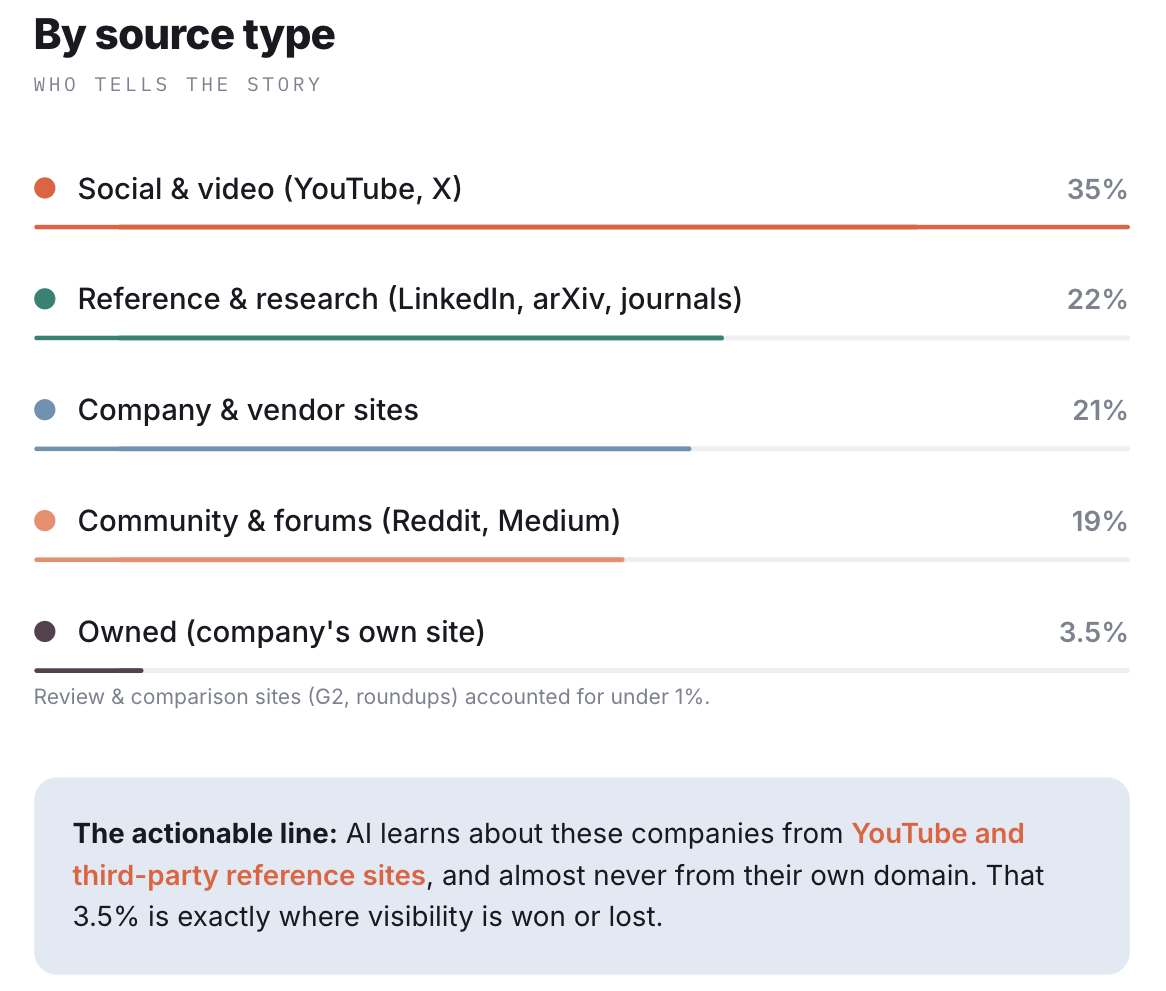
The best-known labs sit near the bottom. OpenAI ranks 18th, Anthropic 26th, Mistral 34th. Answer engines build their picture from third-party corroboration, YouTube, Reddit, and LinkedIn account for 58% of all citations, not from a company's own domain, where 41 of 50 have no presence at all.

‍

AI visibility tracks conversation and documentation, not funding or fame. It is measurable, it is winnable, and it is wide open.

‍

The takeaway for marketing leaders is that AI visibility is now its own discipline. It is measurable, it is winnable, and as the spread across these 50 companies shows, it is very far from solved.

02A / Methodology

How we measured AI visibility

Every company was measured the same way, so the scores are directly comparable. We asked each answer engine the questions real buyers ask, recorded whether the company appeared and how prominently, and turned that into a single score. The details are below.
The universe
The 2025 Forbes AI 50
We analyzed the 50 companies named to the 2025 Forbes AI 50 list. No additions, no substitutions — the full cohort, so the sample is independently defined rather than chosen by us.
The engines
Three answer engines
Each company was evaluated across the surfaces buyers actually use to ask questions today.
The prompts
Category & buyer-intent prompts
30 buyer-intent prompts per company (1,500 in total), spanning category and comparison questions.
The score
The AEO Visibility Score (0–100)

Mention rate divided by average rank when the brand appears, on a 0 to 100 scale. Named often and named first scores high; named rarely and buried scores low.

‍

02B / THE SHIFT

Famous does not mean found

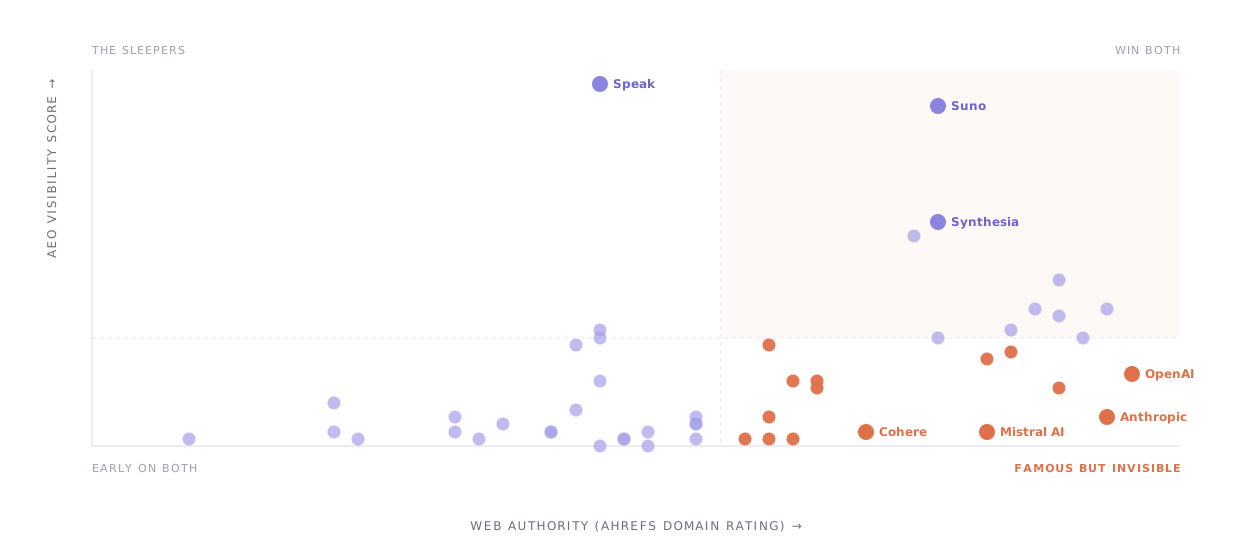
Every company plotted by web authority (Domain Rating) against AI visibility. If the two moved together, the dots would form a line. They don't.

The finding: across the 50, web authority barely predicts AI visibility (r = 0.39, so it explains only about 15% of the difference). Every company here has strong web authority, Domain Rating runs from 54 to 93, yet the median AI visibility score is just 4.5 out of 100. The best-known names sit in the bottom-right: near-total web authority, near-zero presence in AI answers.

Famous But Invisible

High web authority, low AI visibility. The headline quadrant, and it holds OpenAI, Anthropic, Mistral, and Cohere.

WIN BOTH

Strong on the old game and the new one. The generative-media names, Suno, Synthesia, HeyGen, that bridged.

THE SLEEPERS

Lower authority, high AI visibility. Speak leads the whole study on a smaller domain. Proof it is earnable, not just a function of size.

EARLY ON BOTH

Bottom-left. Everything still to play for.

03 / Distribution

How the AI 50 splits across visibility tiers

Every company falls into one of three tiers based on its AEO Visibility Score.

3

/50
Leader
Reliably named when buyers ask, and often the first recommendation. The only companies AI surfaces consistently.
Score 30+

15

/50
Contender
Show up in a meaningful share of answers, but inconsistently and rarely as the top pick. Present, not dominant.
Score 10–29

32

/50
Invisible
Rarely surface, even for questions squarely in their category. When named at all, buried low in the answer.
Score under 10
04 / The ranking

AEO visibility, company by company

Every company on the Forbes AI 50, its category, and its AI visibility score. Open any row for the full per-company report — what each AI engine says about them, and why.
All categories
Thank you! Your submission has been received!
Oops! Something went wrong while submitting the form.
# ↑
Company
Category
AEO visibility
Tier
Report
1
Speak
Vertical AI
50
Leader
Unlock report ↗
2
Suno
Generative Media
47
Leader
Unlock report ↗
3
Synthesia
Generative Media
31
Leader
Unlock report ↗
4
HeyGen
Generative Media
29
Contender
Unlock report ↗
5
ElevenLabs
Generative Media
23
Contender
Unlock report ↗
6
Notion
Data & Productivity
19
Contender
Unlock report ↗
7
Midjourney
Generative Media
19
Contender
Unlock report ↗
8
Cursor
Coding & Dev
18
Contender
Unlock report ↗
9
Databricks
AI Infrastructure
16
Contender
Unlock report ↗
10
EliseAI
Vertical AI
16
Contender
Unlock report ↗
05 / OBSERVATIONS

Where AI learns about the AI 50

Across roughly 10,000 citations, YouTube, Reddit, and LinkedIn account for 58% of everything answer engines cite about these companies. 87% of citations are third-party, and 41 of 50 companies have zero citations from their own site.
06 / Questions

AI SEO, answered

How is the AEO Visibility Score calculated?

Each score runs from 0 to 100 and combines two things: how often a company gets named across the answers we tested, and how high it lands when it appears. Named often and named first scores high; named rarely and buried scores low. We ran 30 buyer-intent prompts per company across ChatGPT, Google AI Overviews, and Perplexity, 4,500 answers in total.

What's the difference between a mention and a citation?

A mention is when the answer names the company in its text. A citation is a source link the model drew from to build that answer. They're different things at very different scales: a company can be mentioned constantly without any of its own pages being cited, which is exactly what we found. Across the 50, 87% of citations pointed to third-party sources, and 41 companies had none from their own site.

Does a low score mean a company's product is worse?

No. The score measures visibility inside AI answers, which is a distribution channel, not a measure of product quality. Plenty of excellent, well-funded companies score low simply because they haven't built presence in the places these models read from. It's a discoverability gap, not a verdict on the product, and one of the more fixable gaps in marketing right now.

What actually moves a company's AI visibility, and how fast?

Answer engines build their picture from third-party corroboration. In this study, YouTube, Reddit, and LinkedIn alone accounted for 58% of every citation. Presence in those sources, plus clear, extractable content and comparison pages, is what moves the number. It tends to respond faster than traditional SEO, because it depends on being referenced and well-structured rather than on years of accumulated domain authority.

Is this study independent, and will it be updated?

Yes. It's independent and unsponsored, with no paid placement, and the company set is defined by the 2025 Forbes AI 50, not by us. The methodology is published so the numbers are reproducible. This is the first edition, and we plan to re-run it so the ranking tracks how AI visibility shifts over time.

About this report
Slate Research
Independent analysis · Published 2026
The State of AI SEO 2026 is an independent study 
of answer-engine visibility across the 2025 Forbes AI 50. It is not sponsored by, and does not include paid placement for, any company in the dataset. Findings are reproducible from the published methodology.
Sample:
50 companies (Forbes AI 50, 2025)
Engines:
ChatGPT, Perplexity, Google AI Overviews
Published:
11 August 2026
Last updated:
11 August 2026