Slate Research. Data collected 30 September to 1 October 2026. Google AI Overviews, United States.
Google now shows an AI Overview on almost every brand search. We ran 144 searches for 100 brand names and captured every answer and every cited source. 93 brands showed an AI Overview for their own name, and 71% of the 652 sources Google cited were pages the brand does not own.
Key findings
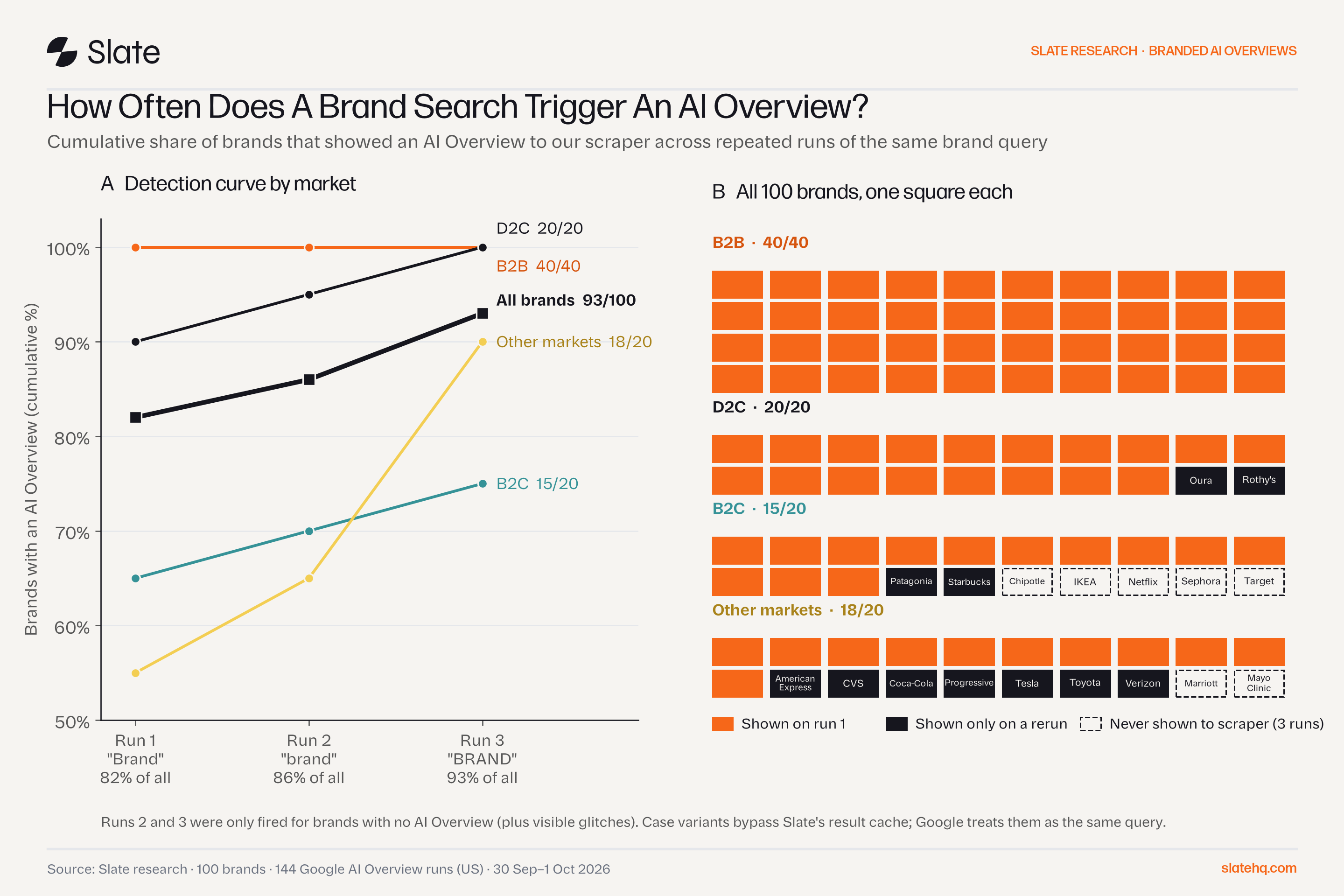
- AI Overviews are close to universal on brand searches. 82 of 100 brands showed one on the first run and 93 after up to three runs. Every B2B and D2C brand in the sample got one.
- Brands supply less than a third of their own answer. 29% of citations point to the brand's website. Only 18 of 93 brands supplied a majority of their own sources, and 13 supplied none.
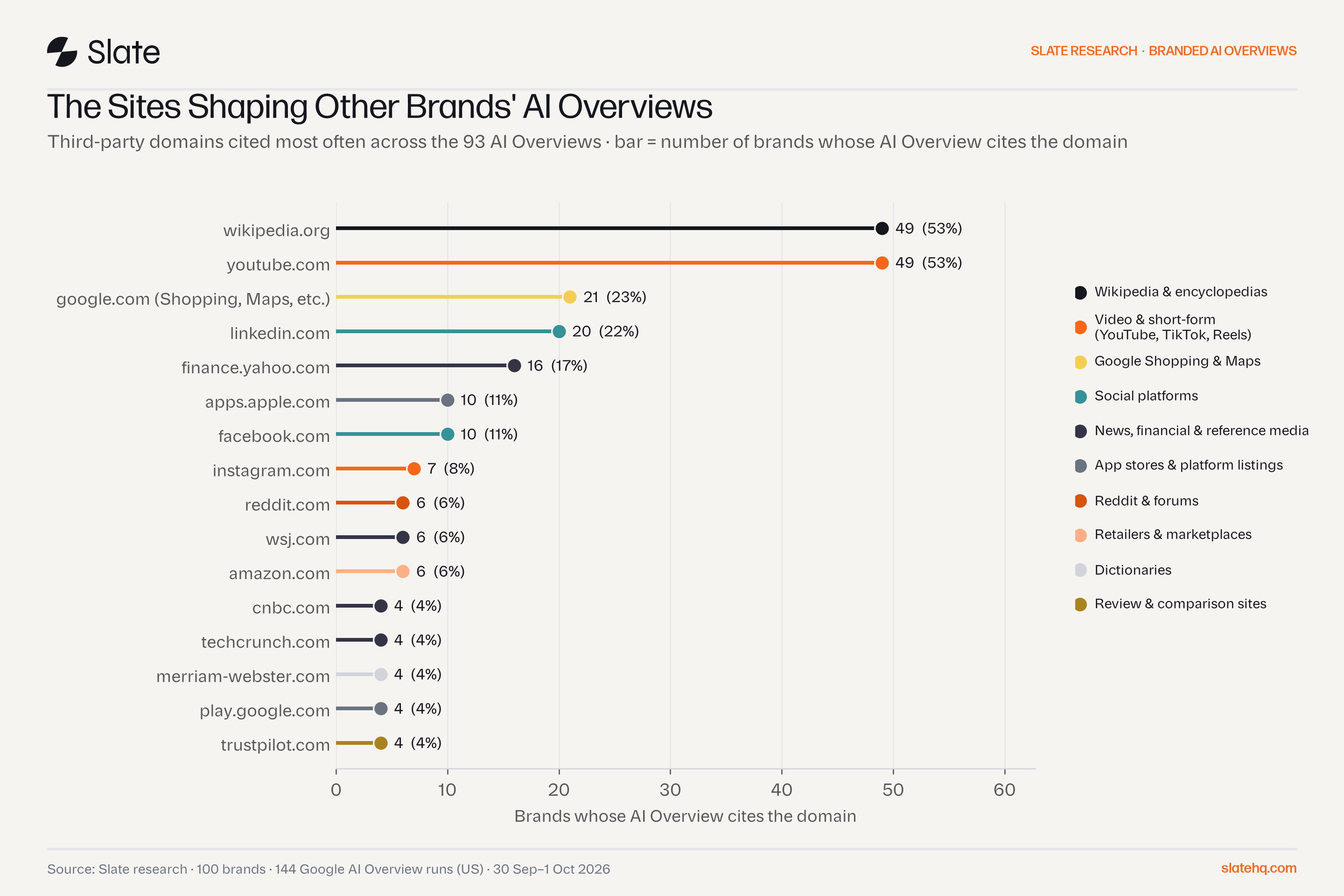
- YouTube and Wikipedia are the most common outside sources. Each appears in 53% of AI Overviews. News and financial media make up 15% of all citations.
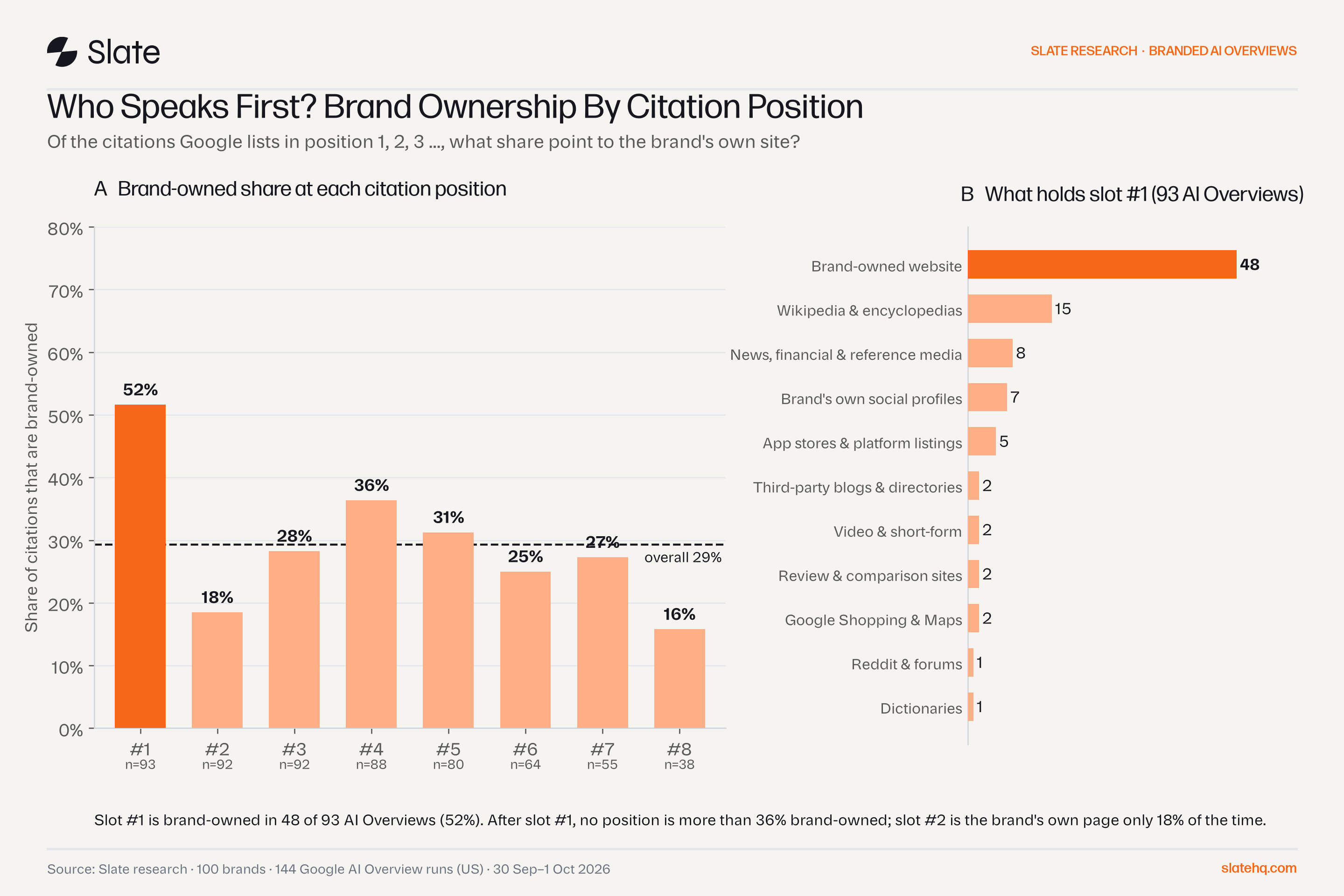
- The brand usually gets the first citation and little after it. The first citation is the brand's site in 52% of answers. The second is the brand's site 18% of the time.
- Many answers give people what they need without a click. At least 40 answers end with chatbot-style follow-up questions and at least 22 quote prices directly.
- Results change between identical searches. 16 of 44 repeat queries (36%) flipped between showing and not showing an AI Overview.
- Other content gets in too: recalls and lawsuits, competitor blog posts, Reddit threads, dictionary definitions, and in one case a support phone number taken from forum posts rather than the brand's site.
Why we ran this study, and how it builds on our July study
In July we published a study of 1,000 B2B SaaS searches. It looked at category searches, such as "best CRM for startups", and found an AI Overview on 979 of them. Of the 21 searches that showed no AI Overview, 18 were decision-stage brand searches such as "[brand] pricing". At that point, Google was mostly leaving brand searches alone.
Less than three months later, 93 of the 100 brand-name searches in this study showed an AI Overview. The two studies used different queries (brand pricing searches in July, the plain brand name here), so the numbers are not a direct comparison. They do point the same way: AI Overviews have moved onto the searches brands used to count as their own.
The July study asked what happens when you rank for a topic: does Google cite you? This study asks a different question. When someone searches your company's name, what does the AI Overview say about you, and which websites did Google use to write it?
To answer it, we ran 100 brands across B2B, D2C, B2C and regulated consumer markets, and recorded every answer and every source.
How AI Overviews went from experiment to default
AI Overviews arrived in stages. They moved through five phases over about three and a half years, and each phase widened the set of searches Google answers directly.
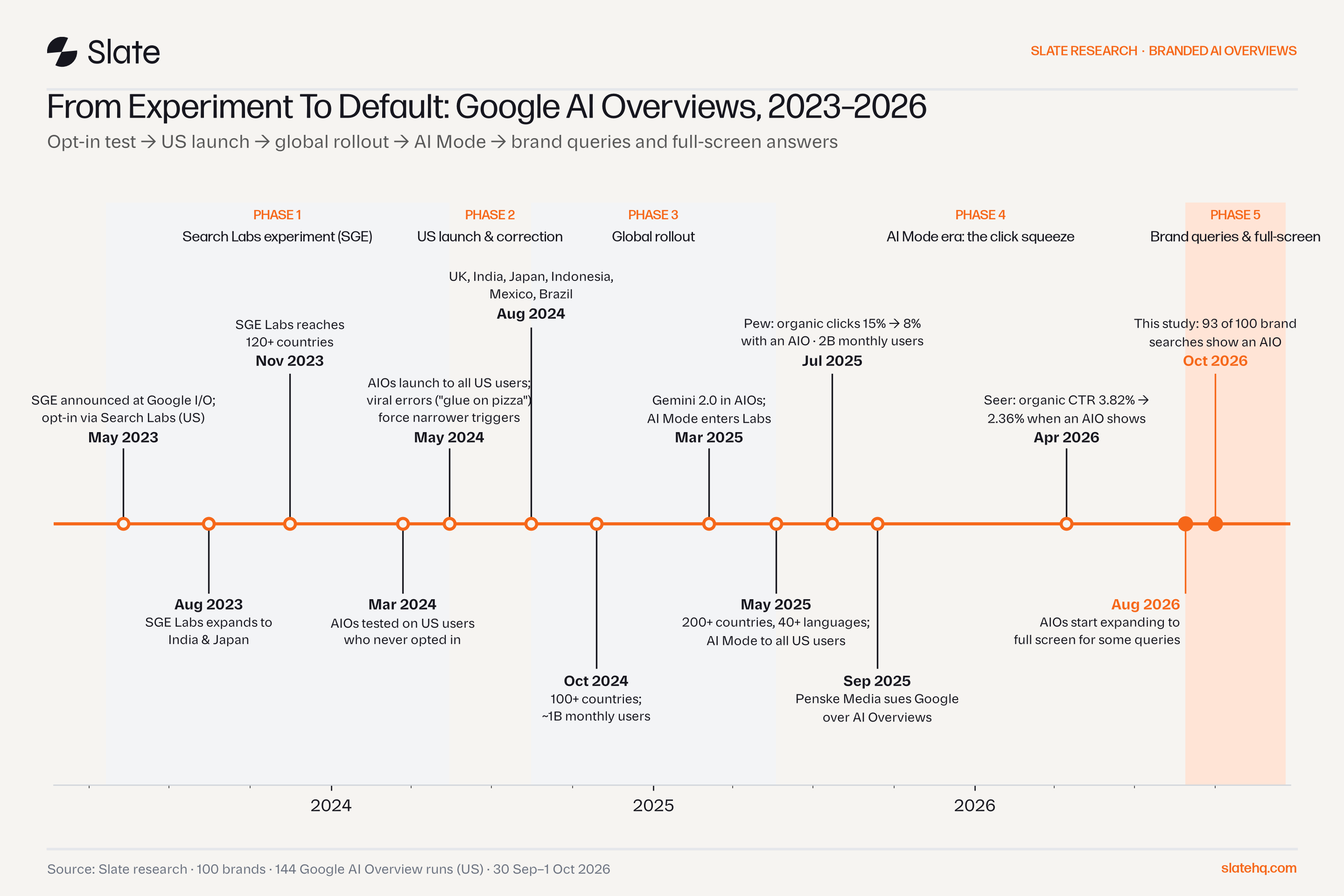
Phase 1: the experiment (May 2023 to May 2024)
Google announced the Search Generative Experience at I/O in May 2023 as an opt-in test inside Search Labs, first in the US, then India and Japan, and by November 2023 in more than 120 countries. In March 2024 Google began showing AI answers to some US users who had never opted in.
Phase 2: launch and correction (May to August 2024)
AI Overviews launched to all US users on 14 May 2024. Within two weeks, screenshots of the feature recommending glue on pizza went viral, and Google narrowed the searches that trigger an overview. This is when most marketers started paying attention.
Phase 3: global rollout (August 2024 to May 2025)
In August 2024 AI Overviews reached the UK, India, Japan, Indonesia, Mexico and Brazil. In October 2024 they expanded to more than 100 countries and about a billion monthly users. By I/O 2025 they were in more than 200 countries and 40 languages.
Phase 4: fewer clicks (May 2025 to August 2026)
Google launched AI Mode to all US users in May 2025, and by July said AI Overviews had 2 billion monthly users. The effect on traffic became measurable. Pew Research found that searchers clicked an organic result on about 8% of visits with an AI Overview, against 15% without one, and clicked a link inside the overview only 1% of the time. In September 2025 Penske Media, owner of Rolling Stone and Variety, sued Google, noting that about 20% of its brand searches already showed an overview. Seer Interactive's 2026 data puts organic CTR at 2.36% when an AI Overview is present and 3.82% when it is not.
Phase 5: brand searches and full-screen answers (August 2026 onward)
In late August 2026 Google began letting some AI Overviews expand to fill the screen. By late September, AI Overviews were appearing on the searches brands have always counted as their own: people typing the company's name. This study measures how often that happens and what the answers say.
For most of the last three years, branded search was the safe part of an SEO report. The searcher already knew who they wanted, and the brand's homepage ranked first. That assumption is what this study tests.
How Google builds an AI Overview for a brand search
Google does not publish its triggering or citation logic, but it does describe the broad mechanics, and our data shows each stage at work. The model below simplifies Google's Search Central guidance on AI features, the "query fan-out" technique Google described when it launched AI Mode, and what we observed.
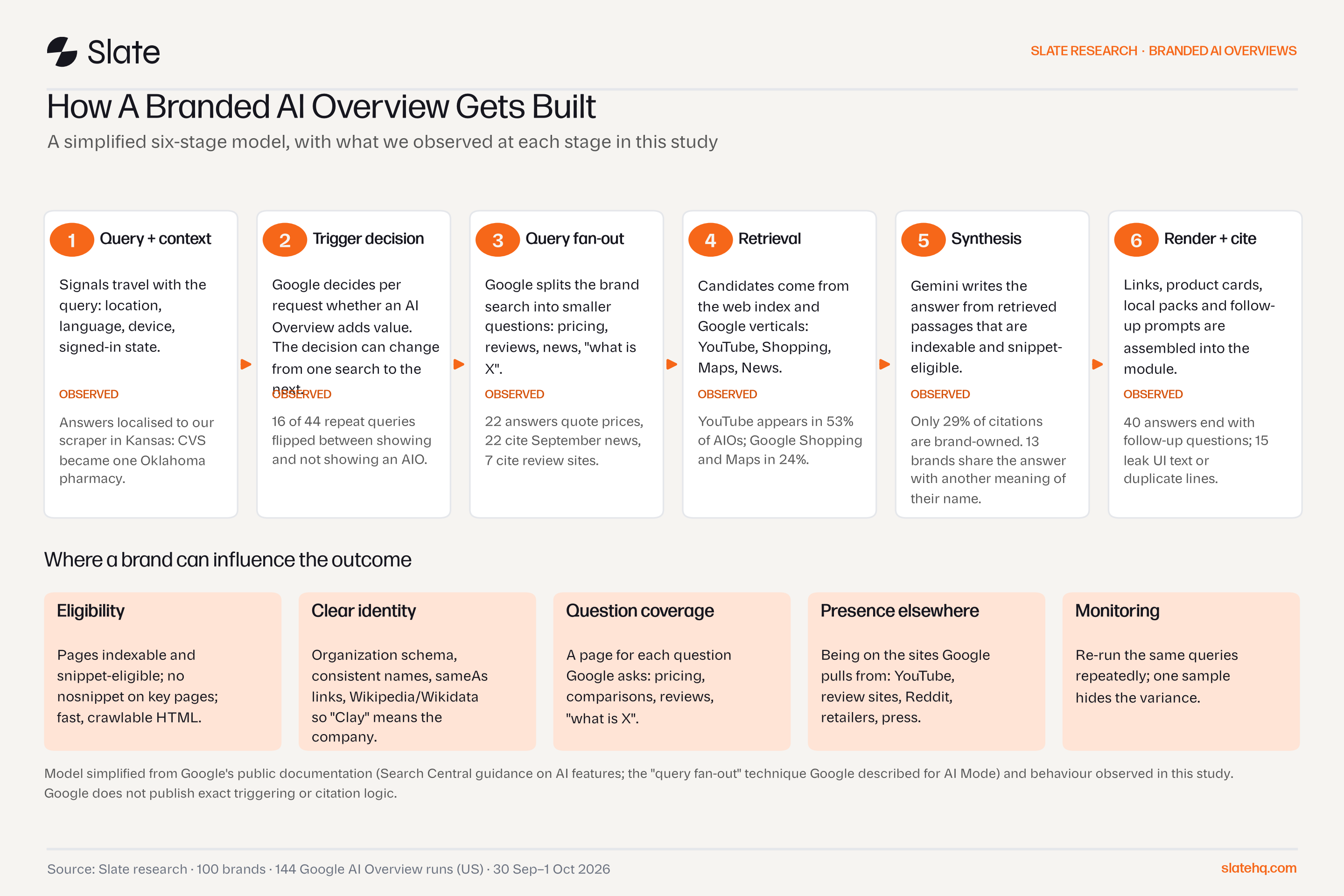
- Query and context. The search arrives with signals: location, language, device and signed-in state. Our scraper sat in Kansas, and it showed. CVS returned a single Oklahoma pharmacy with opening hours, and Toyota's answer ended with a local dealership.
- Trigger decision. Google decides per request whether an overview is useful. The same search can get a different decision each time: identical searches flipped between showing and not showing an AI Overview.
- Query fan-out. A brand name alone doesn't say what the searcher wants, so Google appears to split it into smaller questions (Google calls this query fan-out): what is it, what does it cost, is it any good, what happened recently. That is why so many answers bundle a definition, a price list, reviews and a news section.
- Retrieval. Google gathers possible sources from the web index and Google's own sources: YouTube, Shopping, Maps and News. A brand's own site competes with all of them for every sub-question.
- Synthesis. A Gemini model writes the answer from the retrieved passages. Google says pages need to be indexed and eligible to show a snippet; there is no special markup for AI Overviews.
- Render and cite. Links, product cards, local results and follow-up prompts are assembled into the module. This is also where the visible glitches came from.
To be cited, a page has to be the best match for one of those smaller questions. Owning the homepage is no longer enough, because the homepage answers only one of them.
Methodology
We ran the whole study inside Slate, using the same workflow and sheet tooling our customers use for AI search tracking.
Sample
100 brands in four groups: 40 B2B (software, payroll and HR, fintech, industrial supply and professional services), 20 D2C, 20 B2C consumer platforms and retailers, and 20 from regulated or high-consideration markets we grouped as "other markets" (banking, insurance, travel, automotive, healthcare, consumer goods, telecom and education). We deliberately included brands whose names are also common words, such as Clay, Gong, Loom, Ramp, Casper, Tide and Delta, because brand control is weakest there. The full list is at the end of this article.
Collection
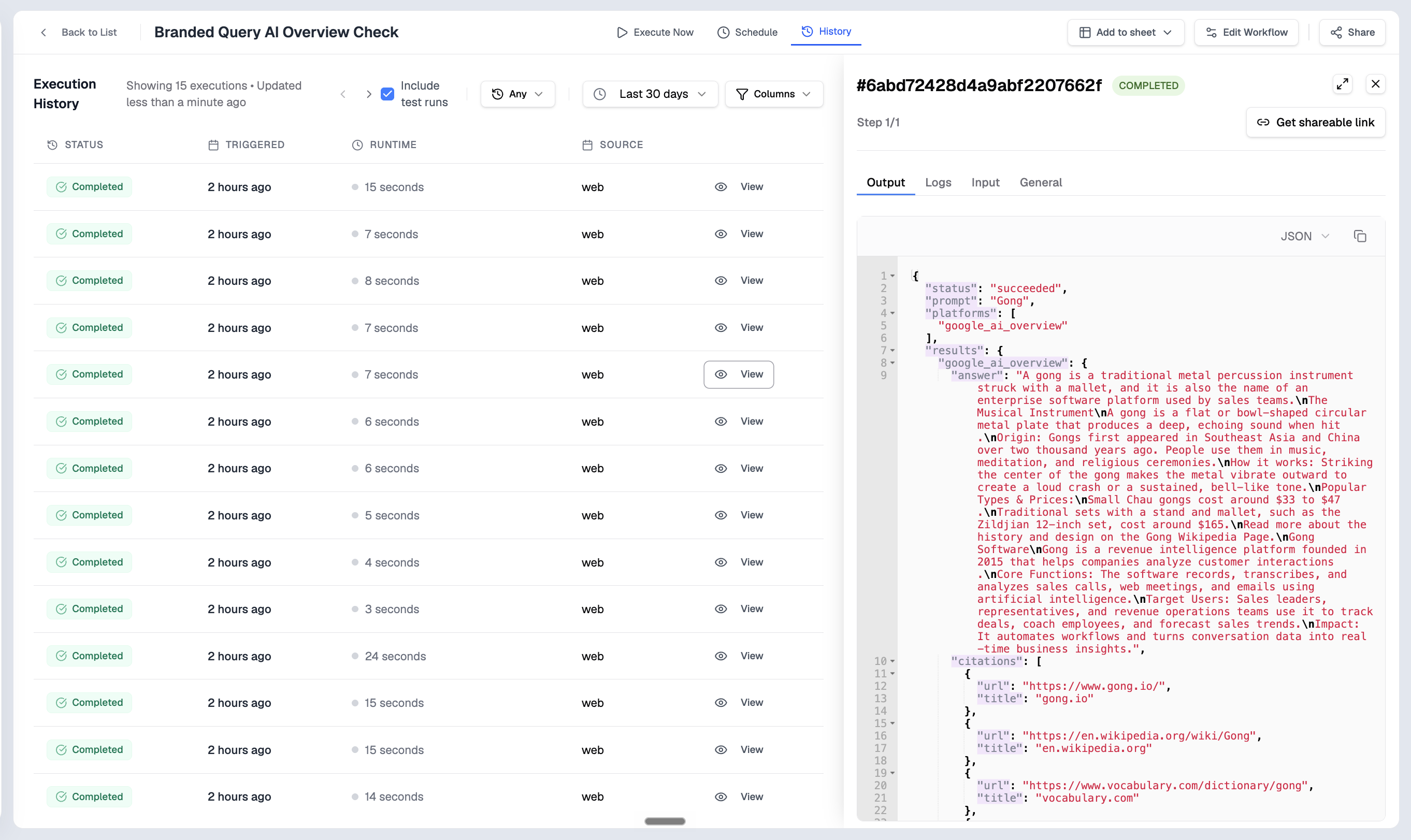
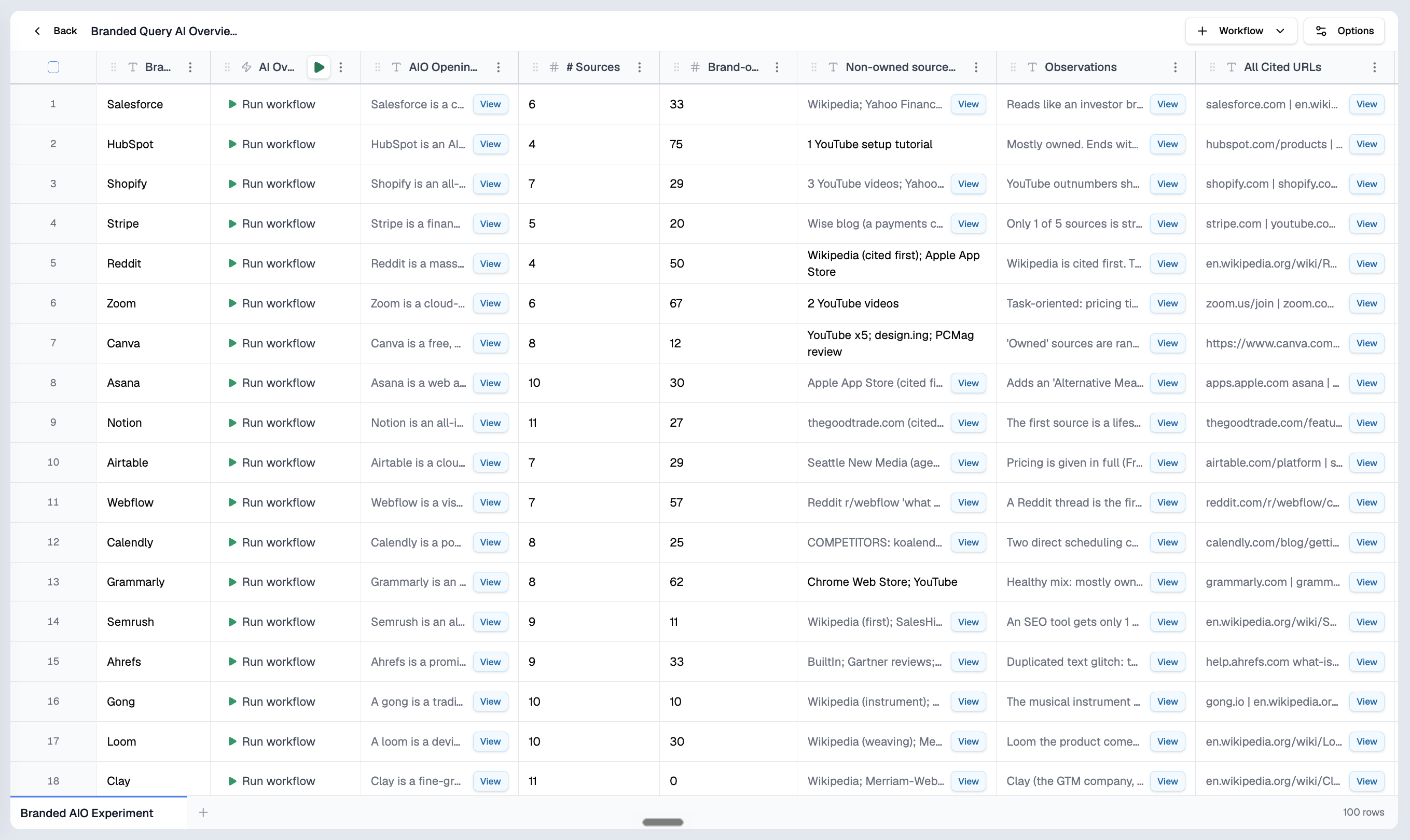
A Slate workflow takes a brand name and sends it as the only query to Google through Slate's LLM Search block, with the platform set to Google AI Overview and the country set to the United States. It returns three fields: whether an overview was triggered, every cited URL in order, and the full answer text. We ran it in five batches of 20 and wrote each result into a Slate sheet, one row per brand.
Reruns
Any brand without an AI Overview, and any answer with a visible glitch, was run again. Slate caches identical queries, so reruns used case variants ("netflix", then "NETFLIX"); Google treats these as the same search. Brands that still showed nothing got a third run, for 144 runs in total.
Classification
For each brand we listed the domains it owns, including subdomains and sister domains (for example help.ahrefs.com, investors.coca-colacompany.com, letsdeel.com and forhers.com). We removed duplicate YouTube links that differed only by timestamp, leaving 652 unique citations across 93 AI Overviews. Each citation was assigned to one of 13 source types. We then read every answer and recorded what it contained: prices, follow-up questions, news, other meanings of the brand name and rendering errors.
Limits
This is one logged-out scraper in one US location over two days, so your own results will differ. A member of our team saw an AI Overview for Netflix in a personal search, while our scraper never did. We chose the brands; they are not a random sample. Some answers were cut off in the scraper preview, so counts of answer features are minimums. We did not fact-check every claim in every answer.
Finding 1: An AI Overview on almost every brand search, but not every time
82 brands showed an AI Overview on the first run. After reruns, 93 did. B2B and D2C reached 100%. B2C and the other-markets group were lower, and the brands that never showed one to our scraper were mostly household names people search to reach an app or a store: Netflix, Target, Chipotle, Sephora, IKEA, Marriott and Mayo Clinic.
The reruns exposed something a single check hides. Of 44 repeat queries, 16 changed result. Tesla, Toyota, Verizon, Starbucks, Coca-Cola and Progressive showed nothing twice and then a full AI Overview on the third try. Grainger, Gymshark and Harry's lost theirs on the second run.
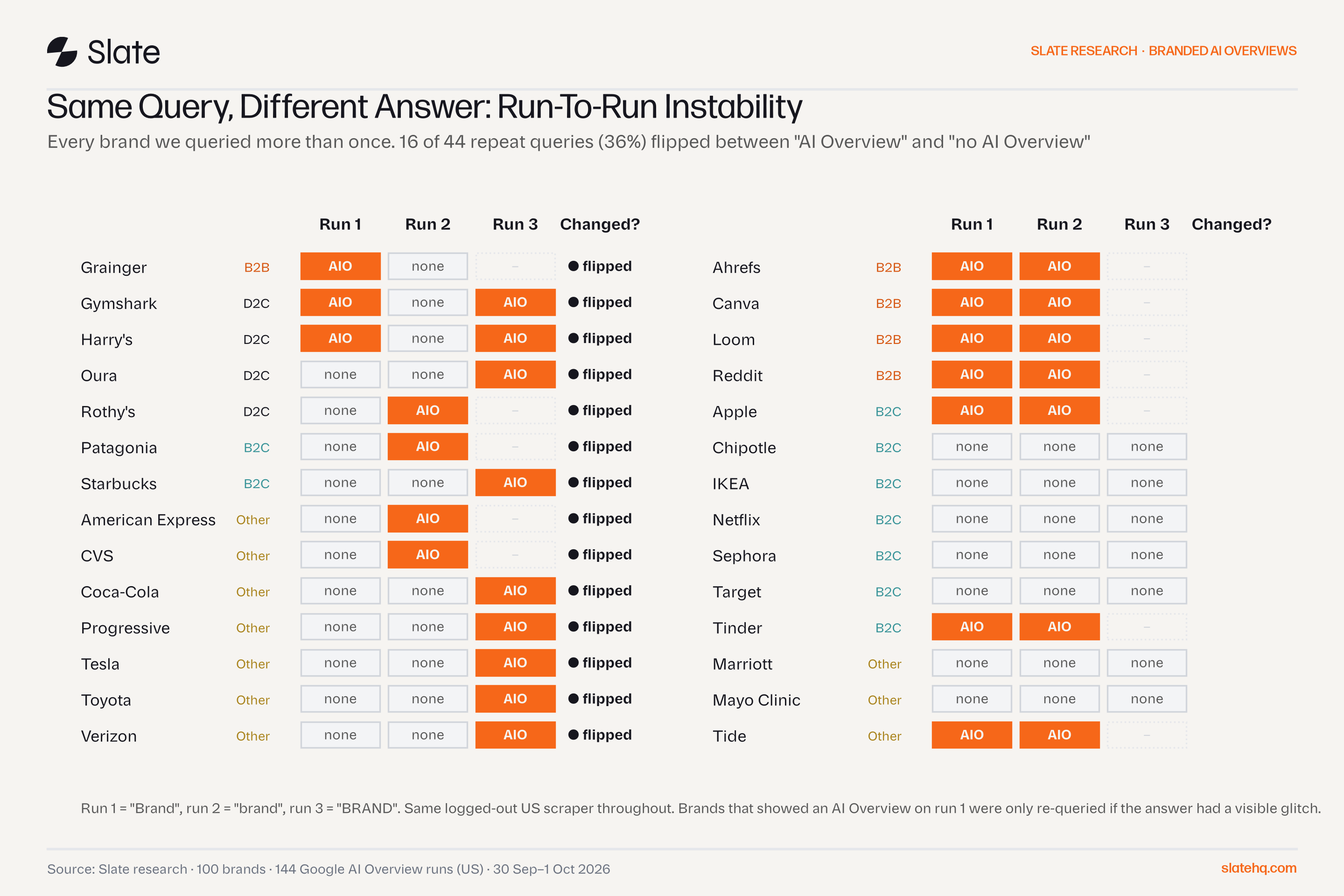
For anyone reporting AI Overview presence to leadership, a one-off check will overstate or understate it. Tracking has to run the same query repeatedly and report a rate.
Finding 2: Brands own less than a third of their own answer
Across all 93 AI Overviews, 29% of citations point to a domain the brand owns. The average brand gets 30% of its sources from itself, with a 95% confidence interval of 25% to 34%. Only 18 brands cross the 50% line.
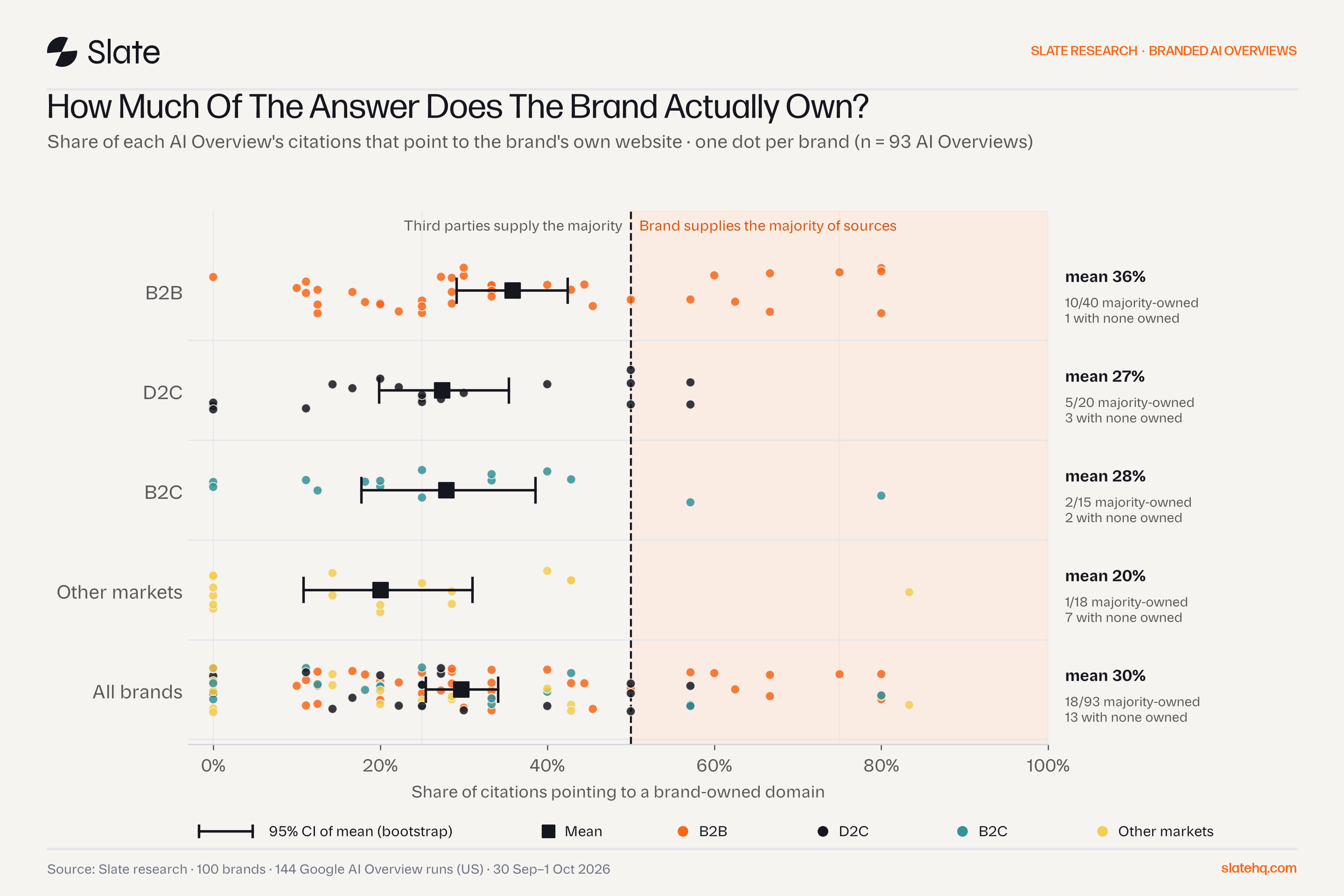
The 13 brands with no owned citations include some of the best-known names in the sample: Pfizer, Toyota, Delta, DoorDash, Starbucks, Verizon, Progressive, CVS, Allbirds, Casper, Clay, Rothy's and Tide. Pfizer's answer was built from a press wire, stock-analysis sites, BioSpace and the Wall Street Journal. All five of DoorDash's sources were news articles, and the answer read like a September news digest.
Finding 3: Where the rest of the answer comes from
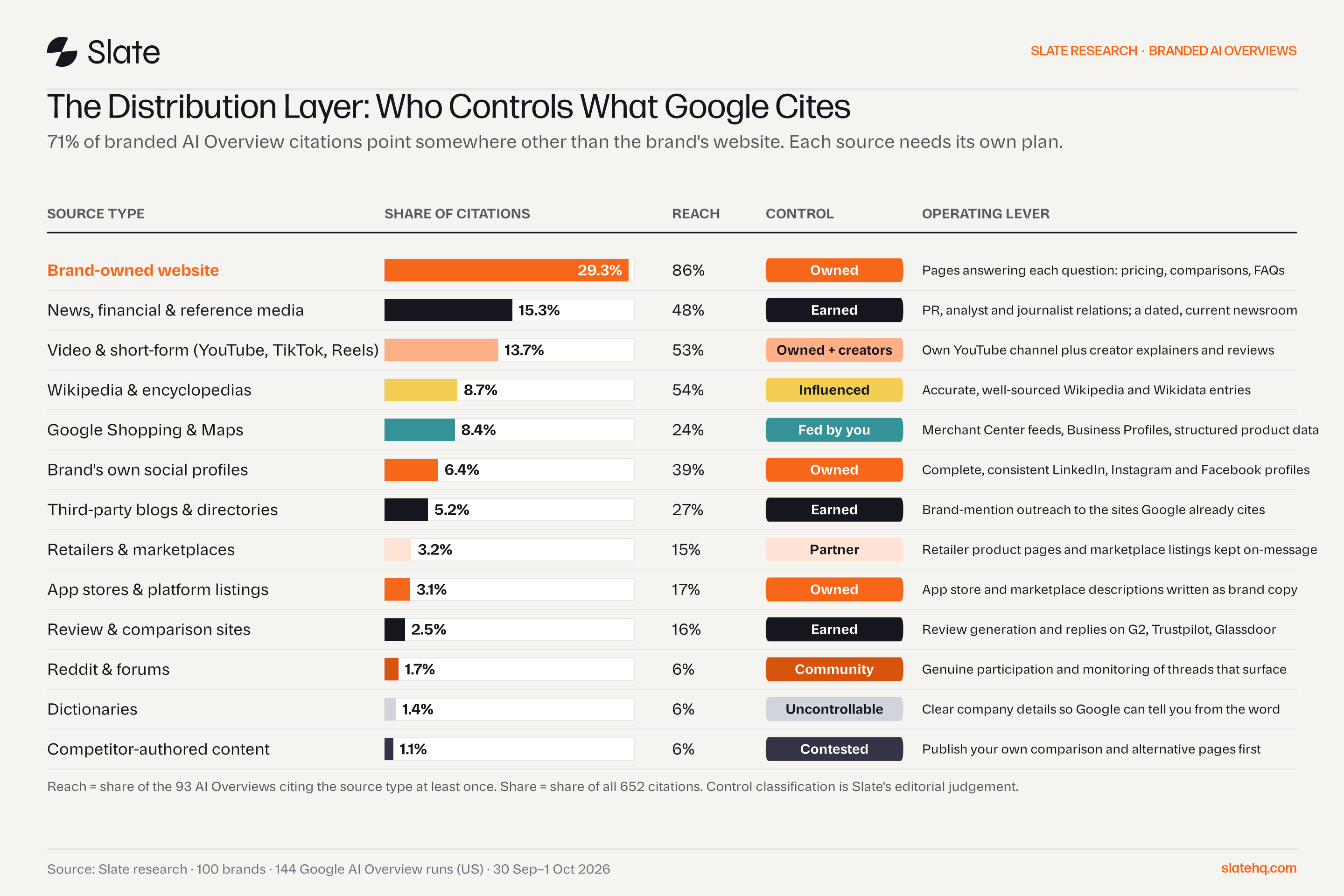
If 71% of citations are not the brand's website, what are they? The mix is consistent enough to plan around.
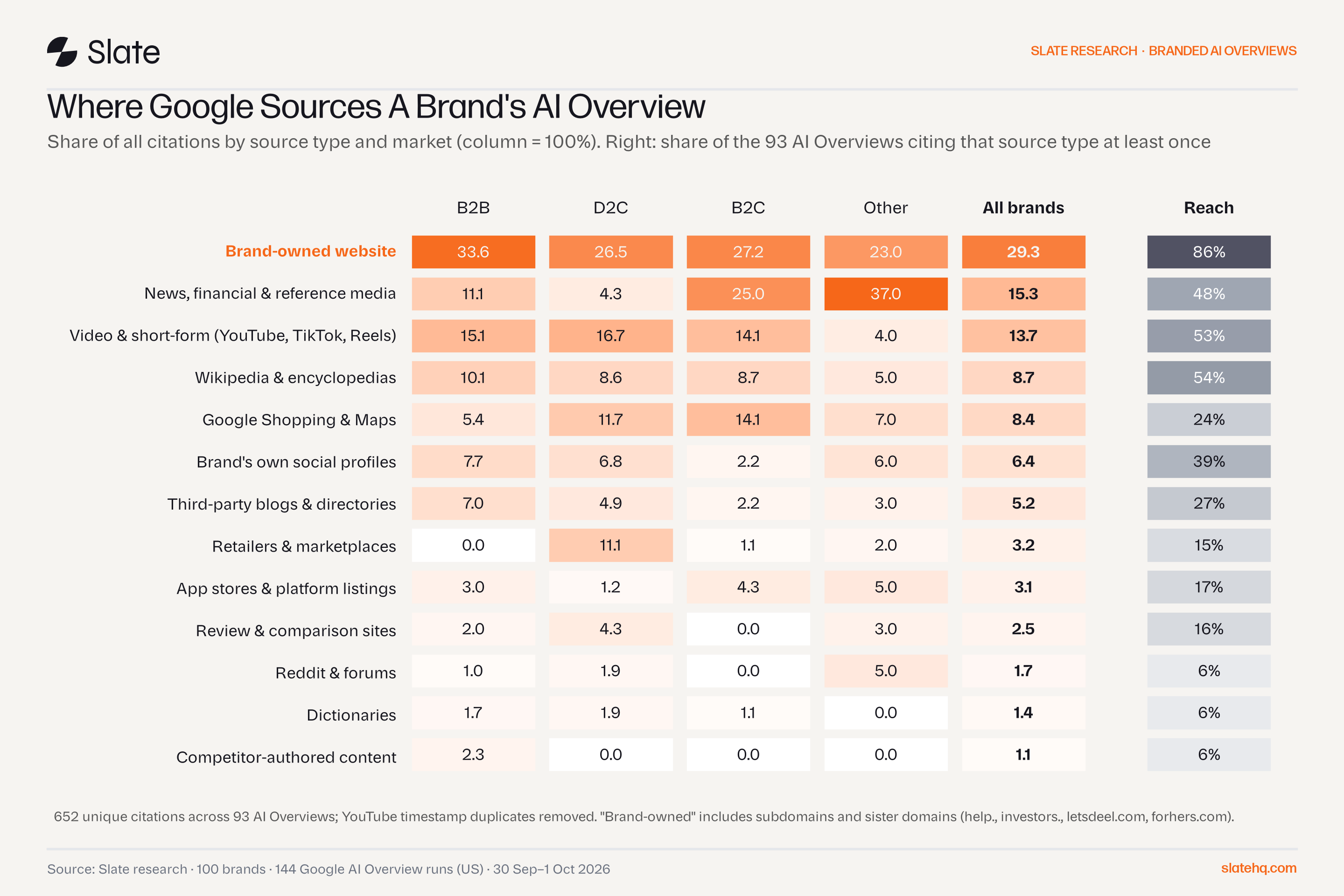
- News and financial media (15% of citations, in 48% of answers). Especially heavy in B2C (25%) and the other-markets group (37%). Stock pages, earnings coverage and same-week news are pulled into a brand answer as context.
- Video (14%, in 53% of answers). YouTube tutorials, Shorts and reviews, many of them made by creators.
- Wikipedia (9%, in 54% of answers). Often the first citation when the brand name is ambiguous or the company is public.
- Google's own Shopping and Maps results (8%, in 24% of answers). Shopping product cards and Maps listings, concentrated in D2C and B2C.
- Retailers (11% of D2C citations). Amazon, Walmart, Nordstrom, Sephora and Ulta speak for D2C brands that built their business on selling direct.
- Reviews, Reddit and competitors (5% combined). Small by volume, but they tend to supply the sentences that judge whether the brand is any good.
Finding 4: The brand gets the first citation and little after it
Position matters because searchers read from the top and many links sit behind a "show more" control. The brand's own site holds the first citation in 48 of 93 answers (52%). From the second position the share drops: 18% at #2, and no later position above 36%.
Finding 5: What else ends up in a brand's AI Overview
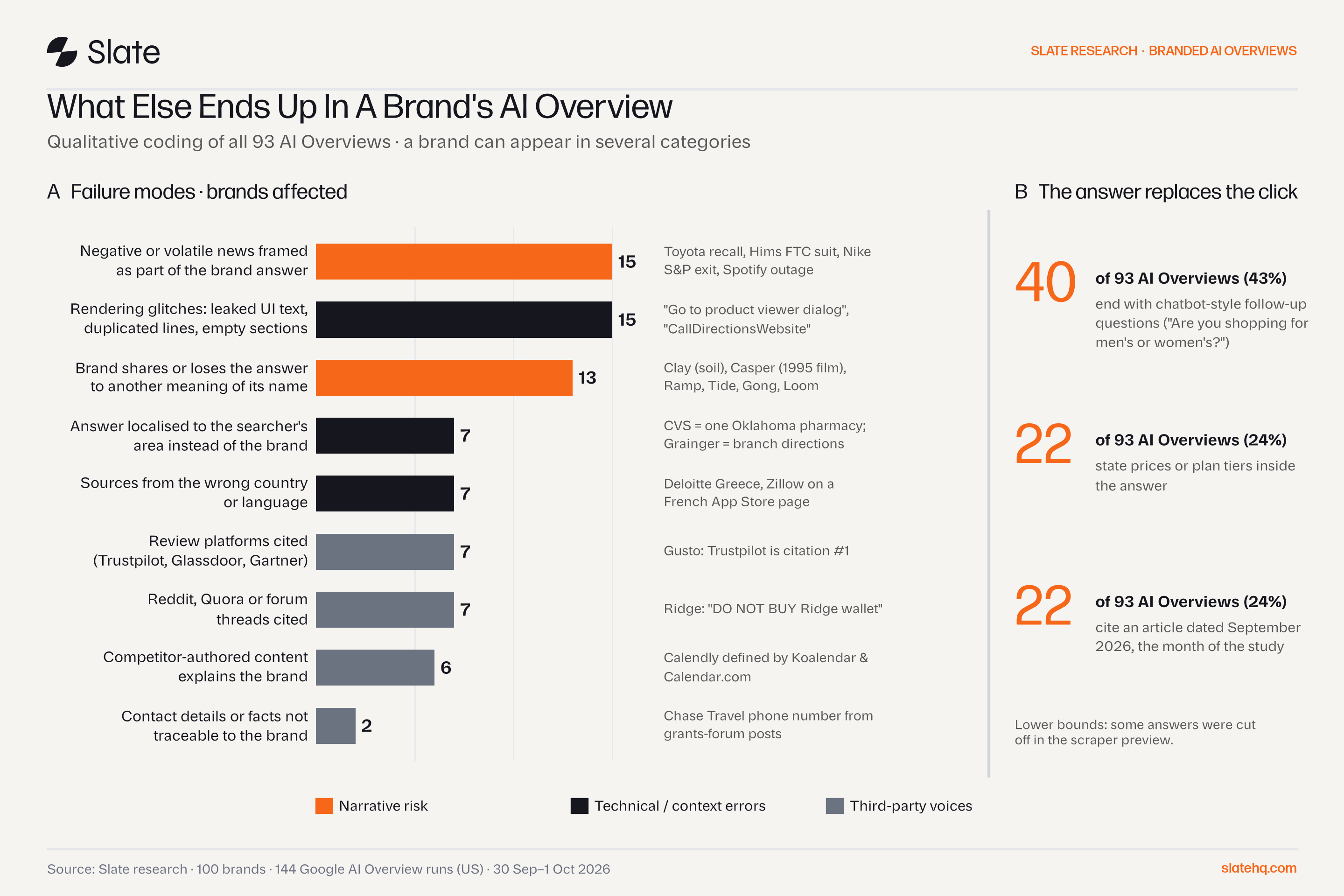
We read all 93 answers. Beyond the source mix, a set of recurring patterns decides whether the answer helps or hurts the brand.
A support number the brand didn't publish
Chase's AI Overview listed a Chase Travel support phone number. Four of its seven sources were user posts on forum.simpler.grants.gov, a US government grants community forum, with titles like "Complete list of Chase Travel customer support." The number came from those posts. We could not match it to the one chase.com page cited, and we have not verified whether it belongs to Chase. Forum posts that plant support numbers for big brands are a known fraud pattern, and when an AI Overview repeats one under a bank's name, the risk falls on the brand's customers.
The name belongs to someone else
For 13 brands, Google split or gave up the answer to another meaning of the name. The AI Overview for "Clay" is entirely about soil and pottery; Clay the GTM platform is not mentioned. "Casper" is the 1995 film, with a link to watch it on Disney+. "Ramp" is a sloped surface, then a wild leek, then the fintech company. "Tide" starts with the Moon. Lemonade the insurer shares its answer with a recipe and a Beyoncé album.
Bad news becomes the introduction
In 15 answers, negative or volatile news was part of the brand answer. Toyota's overview opened with a recall of 508,000 Camry Hybrids, sourced from a class-action news site. Hims led its recent-news section with an FTC lawsuit. Nike's answer opened with its removal from the S&P 100, and Spotify's with a login outage. Ridge's cited a Reddit thread titled "DO NOT BUY Ridge wallet."
Competitors define the brand
Six brands had competitor-written content among their sources. Calendly's AI Overview cited two direct scheduling competitors, Koalendar and Calendar.com, each with a "what is Calendly" article. Gusto's first citation was Trustpilot, followed by a Gusto-vs-ADP comparison written by a rival. If a competitor's comparison page ranks, Google can use it in your answer.
The answer replaces the visit
At least 40 answers ended with chatbot-style follow-ups ("Are you shopping for men's or women's clothing?", "What is your budget range?"). At least 22 quoted prices or plan tiers. Zoom's included step-by-step instructions for joining a meeting. Each of these is a reason the searcher no longer needs to click.
Glitches that survive a rerun
Fifteen answers showed rendering problems: interface text leaking into the answer ("Go to product viewer dialog for this item", "CallDirectionsWebsite"), duplicated lines, empty sections and blank citation brackets. We reran them. Canva and Tinder came back clean. Ahrefs, Apple, Loom and Tide reproduced exactly, so these are problems in Google's answers themselves.
Why a blog-only organic strategy stops working here
Put the two trends together. Clicks are falling when an AI Overview is present: Pew measured organic clicks roughly halving, and Seer measures a 38% lower organic CTR. At the same time, the answer that replaces the click is mostly assembled from pages the brand does not control. Seer also found that being cited inside the overview earns about 120% more organic clicks per impression than being left out, so the clicks that remain go mostly to the sources Google chose.
Most organic teams are still built around one channel: the company website, fed by a blog calendar. That channel supplied 29% of the citations in our study. The other 71% came from video, news, Wikipedia, Google's own product and local data, social profiles, retailers, review sites, forums and competitors. A team that only publishes blog posts is competing for less than a third of the answer.
The blog still matters. The brand's own site is the largest single source and wins the first citation about half the time. But it is one part of a larger system, and each other part needs its own owner and plan.
A plan for each source Google cites
Your website, with a page for every question (29% of citations, owned)
Publish pages that answer each question Google asks about you: pricing, alternatives and comparisons, integrations, "what is [brand]" and FAQs. Make them easy to extract, with clear headings and direct first sentences. Keep them indexable and eligible for snippets.
News and financial coverage (15%, earned)
Google pulls same-month news into brand answers. Keep a current, dated newsroom, and brief journalists and analysts so recent coverage includes your side of the story as well as any recall or lawsuit.
YouTube and short-form video (14%, owned and creators)
Video appears in 53% of answers. Run your own channel with explainer and tutorial content, and work with creators who already review your category.
Wikipedia and entity data (9%, influenced)
Wikipedia is the most common non-brand first citation. Keep Wikipedia and Wikidata accurate within their community rules, and add Organization schema with sameAs links so Google can tell your company from the dictionary word.
Google Shopping and Maps (8%, supplied by you)
Merchant Center feeds and Business Profiles decide what shows in Shopping cards and local results. For retail and local brands, this is brand content.
Third-party blogs and directories (5%, earned)
The many smaller explainer articles and list posts Google already cites. Find them, correct what is wrong, and pursue brand mentions on the ones that rank.
Retailers and marketplaces (3%, partner)
For D2C brands, 11% of citations were retailer pages. Retailer product pages need the same care as your own.
Reviews, Reddit and forums (4%, earned and community)
Small by volume, but they supply the sentences that judge whether the brand is any good. Monitor the threads and review profiles that appear, and respond where it is appropriate.
Two practices apply to every source. Publish your own comparison pages before a competitor's become the reference. And measure repeatedly: with a 36% flip rate, one check tells you almost nothing, so run the same brand searches on a schedule across Google AI Overviews and the other answer engines, and track the rate over time.
How Slate helps you work beyond a single channel
We built Slate for organic growth that now runs across many channels, most of which a blog calendar never reaches. We ran this study end to end in Slate, and the same features cover each source in the plan above.
- AI visibility tracking. Track brand mentions, citations, sentiment and prompt answers across six AI platforms, including ChatGPT, Perplexity, Gemini, Google AI Overviews and AI Mode, with repeated runs so you report rates rather than one-off checks.
- Workflows and Power Sheets. The workflow and sheet we used for this study, available to you. Run the same research across thousands of prompts or URLs.
- YouTube, Reddit and review integrations. Pull YouTube transcripts, Reddit threads and G2 reviews into your workflows, so the sources AI Overviews cite are part of your research and content process.
- Competitive intelligence. See which competitor pages and comparison articles are cited for your brand and category, with Ahrefs and Semrush data built in.
- Outreach. Find the third-party sites already cited for your brand, enrich contacts and run brand-mention and link outreach from inside Slate.
- Opportunities and Pages. Find citation, content, ranking and social gaps, and track clicks, CTR and citations together with Search Console and GA4 data.
- Coworker and custom agents. Hand work to Slate's Coworker in plain language, or turn a repeatable task, such as this brand audit, into an agent that runs on demand.
- Publishing. Create and update the pages your site is missing and publish directly to Webflow or WordPress.
If your brand's AI Overview is being written by Wikipedia, YouTube creators, a stock-news site and a competitor's blog, we can show you which ones and help you work on all of them. Book a demo.
Frequently asked questions
How is this different from Slate's earlier AI Overview study?
Our July 2026 study analyzed 1,000 B2B SaaS category searches, such as "best CRM for startups", and measured how often pages that rank in the top 10 get cited. This study looks only at searches for a brand's own name, across 100 brands in four markets, and measures how much of the answer comes from the brand's own website.
Do AI Overviews show up for brand name searches?
Yes, in most cases. In our study of 100 brands in October 2026, 93 showed a Google AI Overview for their own name in at least one of three searches, and 82 showed one on the first search. Every B2B and D2C brand in the sample got one.
Where do AI Overviews get their information about a brand?
Mostly from sites the brand doesn't own. Only 29% of the 652 citations we collected pointed to the brand's website. The rest came from news and financial media (15%), YouTube and other video (14%), Wikipedia (9%), Google's own Shopping and Maps data (8%), social profiles, blogs, retailers, review sites, forums and competitors.
How do I get my website cited in a branded AI Overview?
Make sure your pages are indexed and eligible to show a snippet, then publish pages that answer the questions Google expands a brand search into: pricing, comparisons, reviews, integrations and "what is [brand]". Use clear headings and direct first sentences, and add Organization schema with sameAs links so Google can identify your company.
Do AI Overviews reduce clicks on branded searches?
Independent studies show lower click-through rates when an AI Overview appears. Pew Research found organic clicks fell from about 15% to 8% of visits, and Seer Interactive measured organic CTR of 2.36% with an AI Overview against 3.82% without. Seer also found that being cited inside the overview earns about 120% more clicks per impression than not being cited.
Why does the AI Overview for my brand change between searches?
Google decides for each request whether to show an AI Overview and which sources to use, and it takes location, language and device into account. In our study, 16 of 44 repeated searches changed between showing and not showing an AI Overview. Track how often an AI Overview appears across many searches, and don't rely on a single check.
Appendix: the 100 brands
- B2B (40): Salesforce, HubSpot, Shopify, Stripe, Reddit, Zoom, Canva, Asana, Notion, Airtable, Webflow, Calendly, Grammarly, Semrush, Ahrefs, Gong, Loom, Clay, Monday.com, Jasper AI, Snowflake, Atlassian, Zendesk, Datadog, Twilio, DocuSign, Workday, Figma, Gusto, Rippling, Ramp, Deel, Caterpillar, Accenture, Cisco, Oracle, Grainger, Uline, ADP, Deloitte
- D2C (20): Warby Parker, Allbirds, Glossier, Casper, Away, Bombas, Brooklinen, Everlane, Liquid Death, Gymshark, Harry's, Dollar Shave Club, Parachute Home, Olaplex, Ridge Wallet, Skims, AG1, Hims, Rothy's, Oura
- B2C (20): Netflix, Spotify, Airbnb, Uber, DoorDash, Duolingo, Nike, Starbucks, Target, Apple, Amazon, Instagram, TikTok, Peloton, Tinder, Chipotle, Sephora, IKEA, Patagonia, Etsy
- Other markets (20): Chase, American Express, Robinhood, Geico, Lemonade, Progressive, Marriott, Delta, Expedia, Tesla, Toyota, Mayo Clinic, CVS, Pfizer, Coca-Cola, Tide, Zillow, Coursera, Verizon, Kaiser Permanente