The content marketing industry spent two years arguing about whether AI content was "good enough."
While we argued, AI content became the default. And honestly? It's fine. The sky didn't fall.
Here's why that matters and what you should actually be worried about instead.
The numbers are already settled
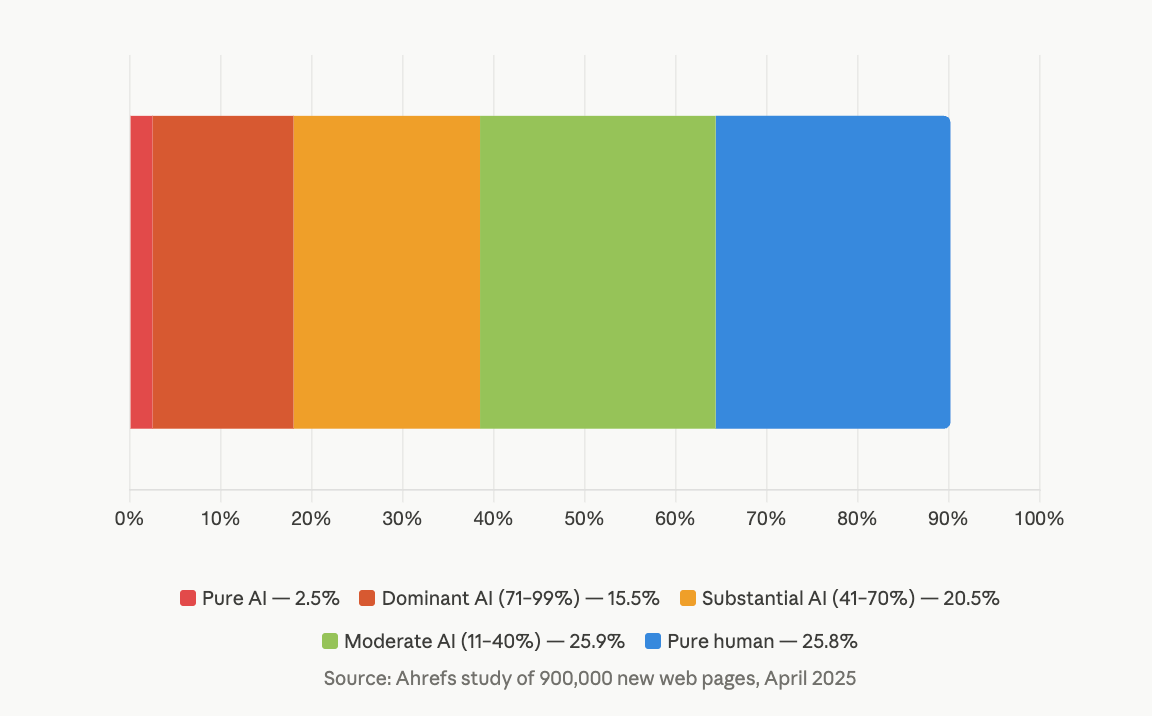
Ahrefs analyzed 900,000 new web pages in April 2025. They found that 74% contained AI-generated content. Only about 26% were categorized as purely human-written.
Let that sink in. Nearly three out of four new pages on the web include AI content.
Of the pages that weren't purely human or purely AI, the breakdown was telling. About 26% showed moderate AI use (11–40% of the content flagged as AI). Another 20% showed substantial AI use (41–70%). And 16% were dominated by AI (71–99% AI-generated).
Only 2.5% were categorized as "pure AI." The other 71.7% were a mix. That's the part most people miss. This isn't a world of robots replacing writers. It's a world where AI is woven into almost everything.
And it makes sense when you look at how people actually work now. AI writing tools are baked into Google Docs, Gmail, Notion, and LinkedIn. You don't even have to go looking for them. The "generate" button shows up automatically. You almost have to opt out at this point.
HubSpot's 2026 State of Marketing Report confirms this from the marketer side: 94% of marketers now plan to use AI in their content creation processes. Not "experimenting with." Not "considering." Planning to use.
Ahrefs also ran a separate survey of 879 content marketers. 87% reported using AI to create or help create content. Just 13% said they don't use AI at all. Blog posts were the most common content type created with AI assistance.
And there's a compounding effect that makes this number only grow. As more AI-generated content gets published, the new content that references it, the roundups, the comparisons, the "based on our research" pieces, picks up traces of AI-generated material too. The presence of AI content spreads, touching everything to a greater or lesser degree.
According to the Content Marketing Institute's 2026 B2B report, 45% of B2B marketers plan to increase investment in AI-powered marketing tools this year. That's the number one investment priority — ahead of events, owned media, and paid channels.
The question "should we use AI for content?" is already answered. Most of us already do.
The quality objection is outdated
The standard pushback goes something like this: sure, AI is fast, but it produces generic, bland, hallucination-riddled content that no serious marketer would publish.
That was a fair criticism in 2023. It's not fair in 2026.
Two things changed. First, the models got better. A lot better. But that's actually the smaller shift.
The bigger shift happened around the models — in the infrastructure that supports them.
Here's what's different now:
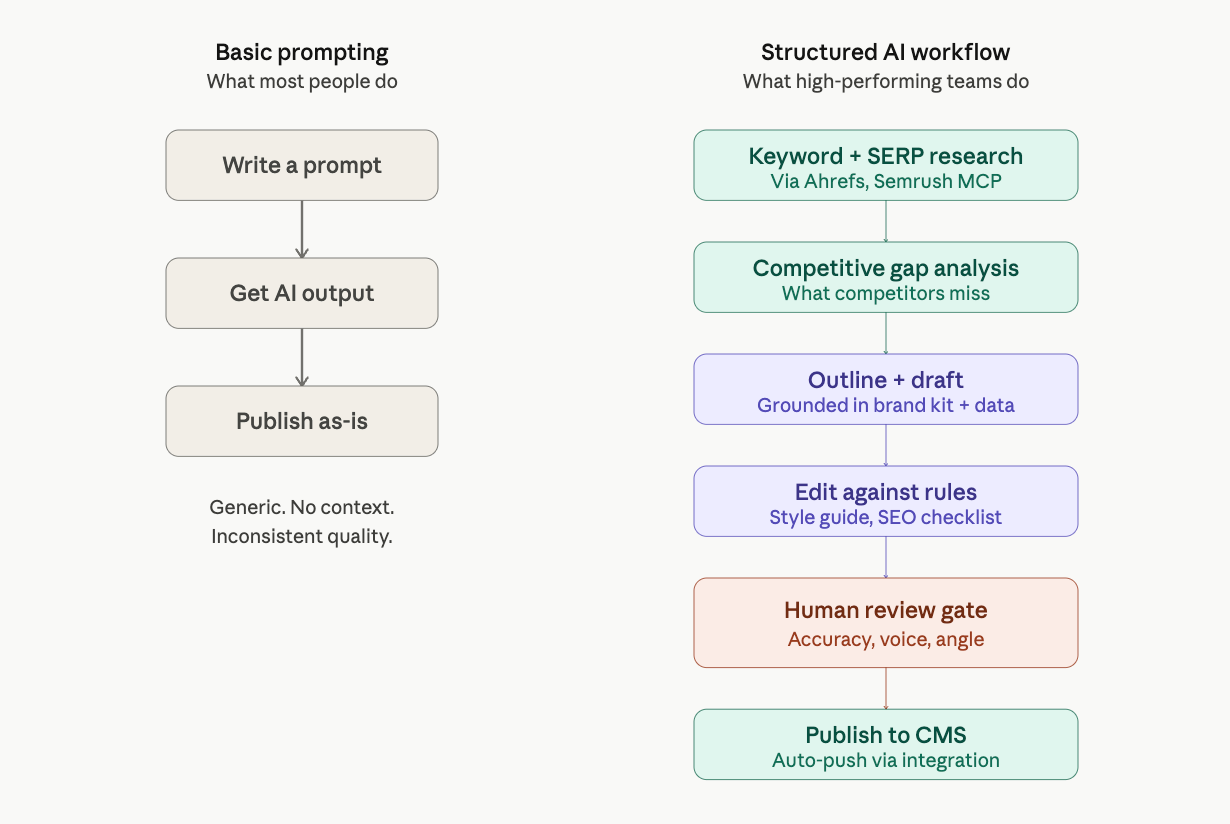
Agentic workflows let you chain multiple AI steps together into one continuous pipeline. You're not just asking an LLM to "write a blog post." You're running a sequence: research the topic, analyze the top-ranking pages, identify content gaps, generate an outline, draft each section grounded in specific source material, then edit against a style guide. Each step feeds into the next.
MCP integrations let AI plug into your existing tools. Your SEO platform, your CMS, your analytics — they become data sources the AI can draw from directly, not things you have to copy-paste between.
RAG and memory systems ground AI outputs in your actual data. Your brand guidelines, your tone of voice, your existing content library. The AI isn't just generating from its training data anymore. It's writing with your context.
SKILL files and guardrails reduce the randomness. You can codify editorial rules — your editing checklist, your structural preferences, your intro style — into reusable instructions the AI follows every time.
Ryan Law, Director of Content Marketing at Ahrefs, made a strong case for this in a recent piece. He now uses Claude Code and a series of roughly 15 custom workflows to update old articles and create new ones. His verdict? The AI-produced articles sound the same and perform the same as his manually written work.
No trade-off.
That's not a random AI enthusiast saying that. It's a career writer with 13 years of experience, running content for one of the biggest SEO brands in the world.
And here's the uncomfortable part of his argument: great content marketing writing is more mechanical than most writers want to admit.
Match the search intent. Fill topic gaps. Structure the article cleanly. Hook the reader in the intro. Use keywords naturally. Make the structure mutually exclusive and collectively exhaustive.
These are simple, repeatable rules. Executed consistently, they produce effective content. And consistent execution of simple rules is exactly what LLMs are built to do. Humans get tired. They get bored. They apply editing checklists unevenly from article to article. An LLM configured with the same rules will follow them the same way every single time, across hundreds or thousands of outputs.
Semrush ran a study and found that AI-generated content and human-generated content had essentially the same chance of ranking in Google's top 10 — 57% versus 58%. When they surveyed marketers, 39% said AI content actually improved their rankings. Only 27% said it made rankings worse.
The performance gap has closed. Whether we like it or not.
Google doesn't care how you made it
This is still the biggest source of anxiety for content marketers. "What if Google penalizes AI content?"
Let's look at what Google actually says.
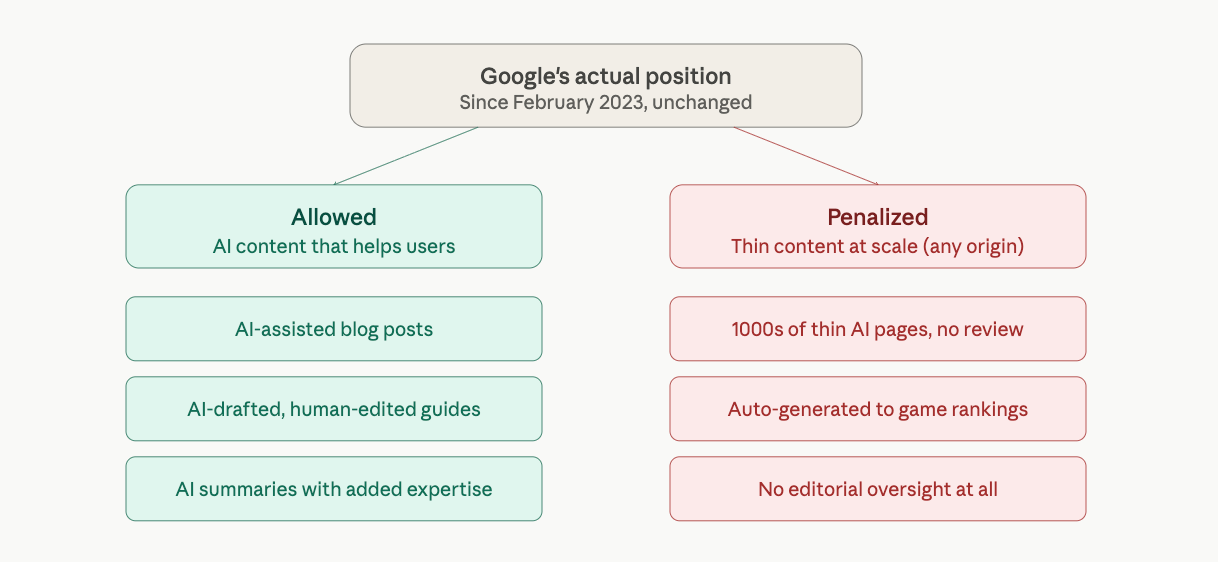
Their official guidance on AI content has been consistent since February 2023. The key line: appropriate use of AI or automation is not against their guidelines.
What is against their guidelines is using automation — whether AI or not — to generate content with the primary purpose of manipulating search rankings. That's their spam policy. It applies equally to low-quality human content and low-quality AI content.
Google has been explicit about this. They've said AI can "power new levels of expression and creativity" and serve as a "critical tool to help people create great content for the web."
Now, that doesn't mean anything goes.
Google's March 2026 core update hit some sites extremely hard. We're talking 50–80% traffic drops. But the target was specific: scaled content abuse. Sites that were pumping out hundreds or thousands of thin AI pages with zero editorial oversight. The update went after scale-without-quality, not AI itself.
The distinction matters a lot. Google's problem is spam. Not origin.
And consider the math. If 74% of new indexed pages contain AI content, Google simply cannot penalize AI broadly without destroying their own search results. Their index would collapse.
So the real rule is straightforward: if your content is helpful, accurate, and better than the alternatives for a given query, Google doesn't care if AI helped you write it. If it's thin, unhelpful, and exists only to capture traffic — they'll demote it regardless of whether a human or a machine created it.
So what's the actual problem?
If AI content quality is fine, and Google isn't going to penalize it, then what's the issue?
The problem isn't that AI content is bad. The problem is that AI content is good enough and now everyone has access to it.
Think about what made a well-researched, 2,000-word how-to article valuable three years ago. It took time. It required skill. It cost money. Most companies couldn't be bothered.
That effort barrier was your moat. And AI just drained it.
Now, anyone with a $20/month subscription can produce that same article in minutes. The content that used to take a skilled writer two days now takes a configured workflow two hours or less.
When the baseline rises, everything that sits at the baseline stops being a differentiator.
Here's an analogy. Before desktop publishing, companies that produced professional-looking documents had an advantage. The typesetting and layout signaled credibility. Then Microsoft Word and InDesign gave everyone access to clean typography and formatting. Professional-looking documents became the default. Nobody was impressed by a nicely formatted report anymore.
The same thing is happening with content marketing. AI didn't lower the bar. It just made the existing bar accessible to everyone.
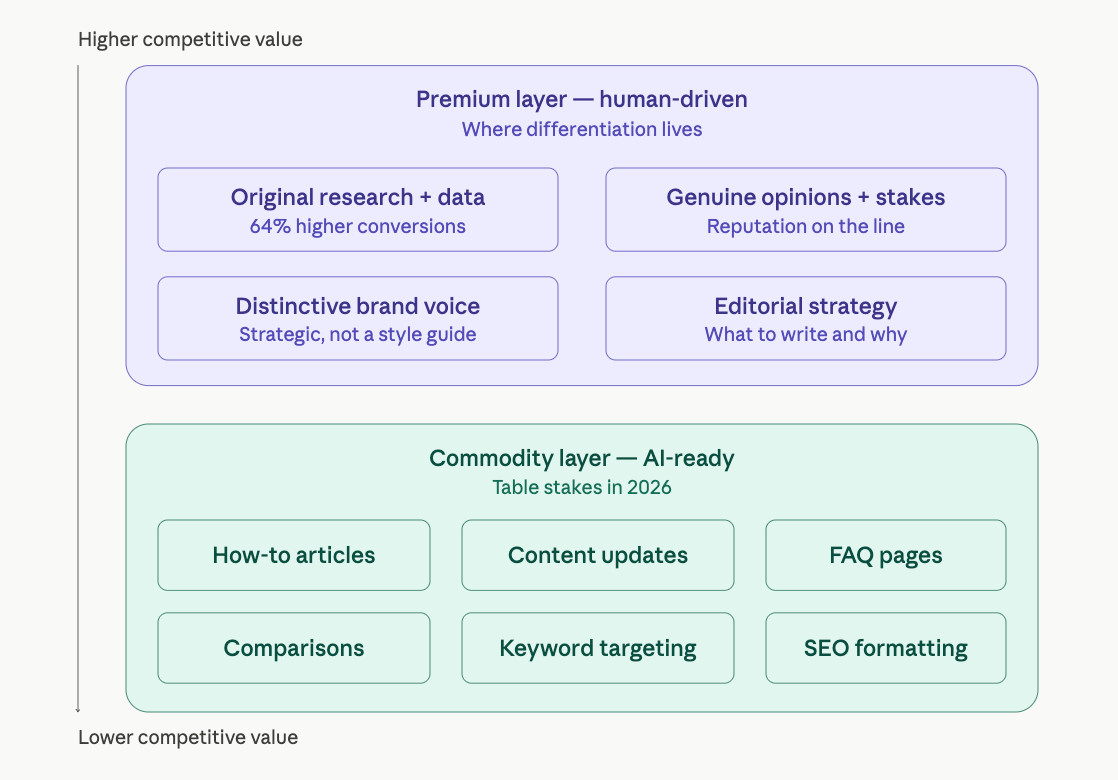
That means the commodity layer of content: informational, keyword-targeted, how-to-style articles, is no longer where you build competitive advantage. It's table stakes.
This is also where a lot of the emotional resistance comes from. Content marketers built careers around the craft of writing. We built identities around it. Admitting that AI can handle 80% of what we do every day feels personal. It's not just a workflow change. It feels like a threat.
But that feeling is the exact thing holding teams back from adapting.
Where humans still have the edge
If AI handles the baseline, your job is to focus on what AI can't easily replicate. That list is shorter than it used to be — but the items on it are more valuable than ever.
Original research and data
AI can summarize existing information beautifully. It can repackage, rephrase, and restructure anything that already exists on the web.
What it cannot do is create new information that doesn't exist yet.
Original research — running surveys, analyzing proprietary data, publishing first-party studies — is the single strongest differentiator in content marketing right now. And the data backs this up.
According to an analysis by Averi AI, marketers who publish original data report 64% higher conversion rates and 61% stronger organic traffic compared to those who don't. And 86% of marketers plan to increase research budgets in 2026.
Look at Ahrefs. Their most-linked content isn't their how-to guides. It's their data studies. The 74% stat from their AI content study earned 488 linking domains. That's not something you can generate with a prompt.
Real experience and genuine opinions
AI can argue any side of any debate convincingly. Give it a thesis, and it'll build a compelling case. Give it the opposite thesis, and it'll do the same thing just as well.
That's exactly why AI opinions don't carry weight. There's no risk behind them. No reputation at stake.
When Ryan Law writes that he wouldn't hire a "content engineer," that opinion matters because he's been a content marketer for 13 years and has something to lose by saying it. He could be wrong. He's putting his professional credibility on the line. That creates trust.
AI has no skin in the game. And readers can feel the difference, even if they can't articulate it.
Distinctive brand voice
Not "friendly and professional." Every brand says that. It means nothing.
Real brand voice comes from consistent, opinionated choices. What you talk about. How you talk about it. What you refuse to talk about. The references you make. The jokes you allow. The stances you take.
That's a strategic decision, not a style guide checkbox. And it's something AI can execute once you've defined it — but it can't create it from scratch. The creative direction has to come from humans who understand the brand's position in the market and the audience's expectations.
This is where platforms like Slate are finding the right balance. Rather than treating AI as a replacement for editorial judgment, Slate's Brand Kit lets you codify your brand's identity: voice, guidelines, author persona — and feed it into every AI workflow as a non-negotiable input. The AI handles the production. Your brand identity stays consistent.
It's the difference between "write me a blog post" and "write me a blog post that sounds like us, using our data, following our editorial rules, optimized for both search and AI citations." That second version requires human strategy upfront, but once it's set, AI can run it at scale.
Strategy and editorial judgment
Knowing what to write about matters more than knowing how to write it. That's always been true. But it matters exponentially more when the "how" is nearly free.
Which topics serve your business goals? Which ones build topical authority? Which searches are worth competing on and which ones aren't? Where's the gap between what your competitors cover and what your audience actually needs?
This is the layer where senior content marketers earn their keep. The strategic layer. And it's the layer AI is furthest from replacing.
Tools can help here: Slate's analytics track brand visibility across ChatGPT, Perplexity, Gemini, and Google AI Overviews, so you can see where you're being cited and where you're invisible. But interpreting that data and turning it into a content roadmap is still a human job.
Building the right system
Accepting that AI content is good enough isn't the same as slapping ChatGPT on autopilot. The teams seeing real results are building systems — not just running prompts.
Here's what that looks like in practice.
Use AI for the commodity work
Informational articles. Content updates. Keyword-targeted how-to pieces. Product comparisons. FAQ pages.
These are the formats that follow predictable patterns. They're the ones where AI's consistency and speed create the most value. Let AI handle the first draft, the research synthesis, or the full production — then edit for accuracy and brand fit.
This isn't cutting corners. It's redirecting human effort to where it matters more.
Build workflows, not one-off prompts
The difference between mediocre AI content and excellent AI content isn't the model. It's the system around it.
A single prompt produces a single output. A workflow produces consistent quality at scale. That means chaining steps: research → outline → draft → optimize → review → publish. Each step with its own instructions, data sources, and quality checks.
This is exactly what Slate's Workflow Builder is designed around — visual pipelines where each step can pull from your SEO tools (Ahrefs, Semrush), reference your brand kit, run the content through human review gates, and push directly to your CMS. You build the workflow once. Then you run it across 50 or 500 topics.
Razorpay, for example, has roughly 10,000 pieces of content and uses Slate to refresh 25 to 30 articles per week. Manually, that's impossible. With a structured workflow that includes human review at key checkpoints, it's routine.
Keep humans in the loop where it matters
The winning model isn't "AI does everything" or "humans do everything." It's hybrid.
Let AI do the parts it's good at: research synthesis, first drafts, structural optimization, internal linking, SEO formatting. Then insert human review at the points where judgment matters most: is this accurate? Does this match our voice? Is this the right angle for this audience?
This is what Gartner's 2026 Marketing Technology Survey found. Content teams using structured AI workflows with human checkpoints produce 3x more content while maintaining 92% brand consistency. Teams without that structure don't come close.
Track whether it's actually working
HubSpot found that 67% of content marketers use AI tools daily. But only 19% track AI-specific KPIs.
That's a problem. If you can't measure whether AI is improving outcomes — not just increasing output — you're just producing more content without knowing if it's doing anything.
Track performance by content type. Compare AI-assisted articles against your legacy content on traffic, engagement, conversions, and keyword rankings. If the numbers are flat or better, you have your answer. If they're worse, you know where to intervene.
What this all means for your content strategy
Let's bring this together.
The data is clear. Most web content already includes AI. The quality has reached a point where it performs on par with human-written content in search. Google doesn't penalize AI content, only bad content. And the infrastructure around AI models has matured enough to produce consistent, on-brand, editorially sound work at scale.
None of this means content marketing is dead. It means the game has changed.
The commodity layer including informational how-to content, keyword-targeted guides, and comparison lists are no longer a differentiator. Everyone can produce it now. Cheaply and quickly at high quality.
The premium layer which involves original research, genuine expertise, distinctive brand voice, and strategic editorial judgment is where the value is shifting. These things still require humans. And they're worth more than ever precisely because the commodity layer is now automated.
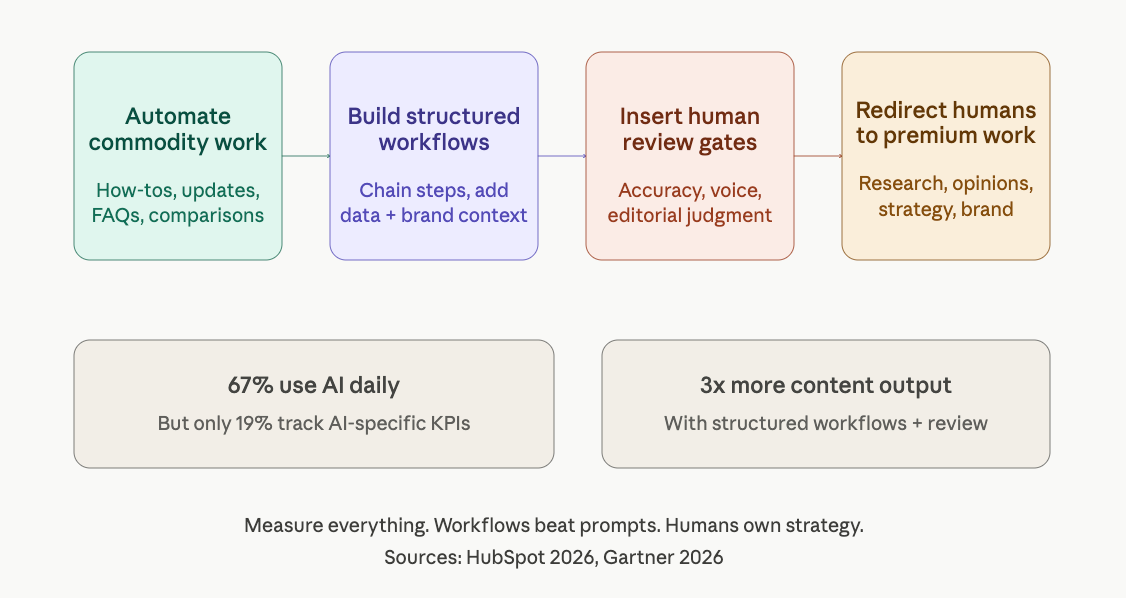
The smartest teams in 2026 aren't debating whether to use AI. They're using it systematically for commodity work and redirecting their human talent toward the work that actually builds audience trust, brand equity, and competitive advantage.
If you're still arguing about whether AI content is "real" content, you're having the wrong conversation. The market has moved on. The only question left is whether you're going to build a system that puts AI where it belongs, or keep doing things the old way while your competitors don't.
Most content is AI now. And that's fine. The question is what you're going to do with the time you get back.