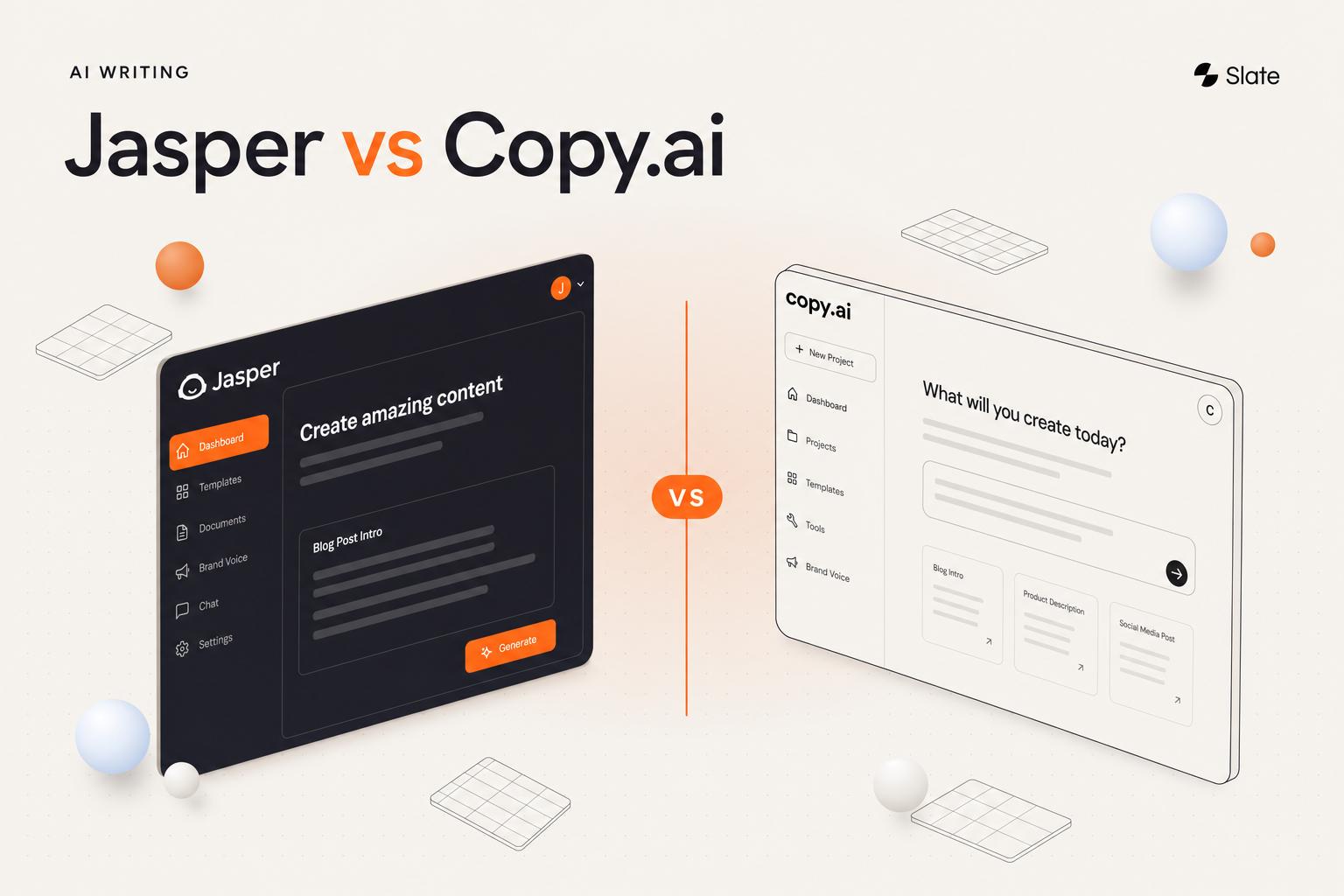
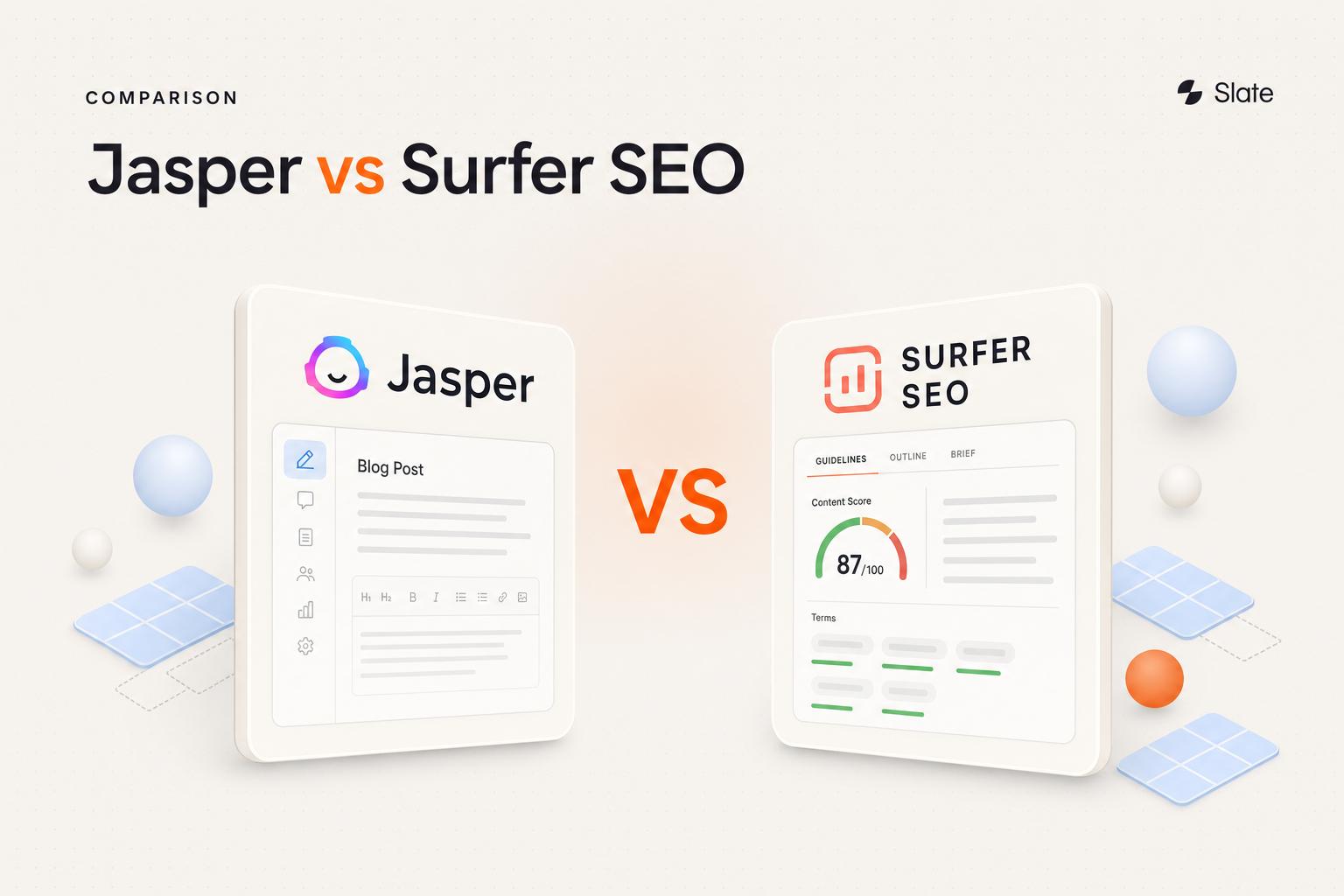
Jasper and Surfer SEO get compared constantly, but the comparison usually misses what actually matters: these tools solve different jobs inside the same workflow. Jasper is built to draft on-brand content fast. Surfer SEO is built to improve that content's visibility in search and AI results, including in environments shaped by Google's AI Overviews rollout.
Jasper is an AI writing platform for marketing teams that need on-brand content at scale, while Surfer SEO is an on-page optimization platform built around SERP analysis and AI search visibility. They overlap in content workflows but solve different primary jobs: creation versus optimization. The right pick depends on where your bottleneck actually sits, especially amid the broader shift toward AI-powered discovery. For a wider view of the tooling landscape, the best AI SEO tools roundup maps how creation and optimization platforms compare.
Key Takeaways
- Jasper is primarily an AI writing and brand-voice platform; Surfer SEO is primarily an on-page optimization and AI search visibility platform. Different primary jobs, frequently stacked together.
- The better choice depends on the bottleneck: drafting speed and brand consistency point to Jasper; topical coverage, optimization, and AI search visibility point to Surfer.
- Jasper's Pro plan starts at $59/month per seat billed annually, while Surfer SEO's Discovery plan starts at $49/month billed yearly. Pricing models differ structurally: seats versus content quotas.
- Most teams use both tools together by drafting in Jasper and optimizing in Surfer's Content Editor, with content moved manually between the two.
- Neither tool is a complete content system. Both leave gaps in turning AI visibility insights into action, as well as in refresh workflows, governance, and outcome measurement.
- For scaling content as a repeatable system, B2B SaaS teams need a content engineering layer like Slate that connects insight to action.
Jasper vs Surfer SEO at a Glance
The fastest way to frame this comparison is by primary job. Jasper helps marketing teams produce on-brand content faster across blog, ads, email, and social. Surfer SEO helps SEO and content teams optimize specific pages to rank in Google and improve visibility in AI search.
Choose Jasper if your bottleneck is drafting volume and brand-consistent writing across channels. Choose Surfer if your bottleneck is on-page optimization, SERP-driven coverage, and AI search visibility. Choose neither alone if your bottleneck is scaling content as a measurable system with refresh workflows and governance.
Side-by-Side Comparison Table
Here's how the three tools map across the criteria that matter most for content teams operating in AI-driven discovery.
What Jasper Is and What It's Best For
Jasper is an AI platform for marketing teams that uses specialized agents and content pipelines to create on-brand content and campaigns at scale.
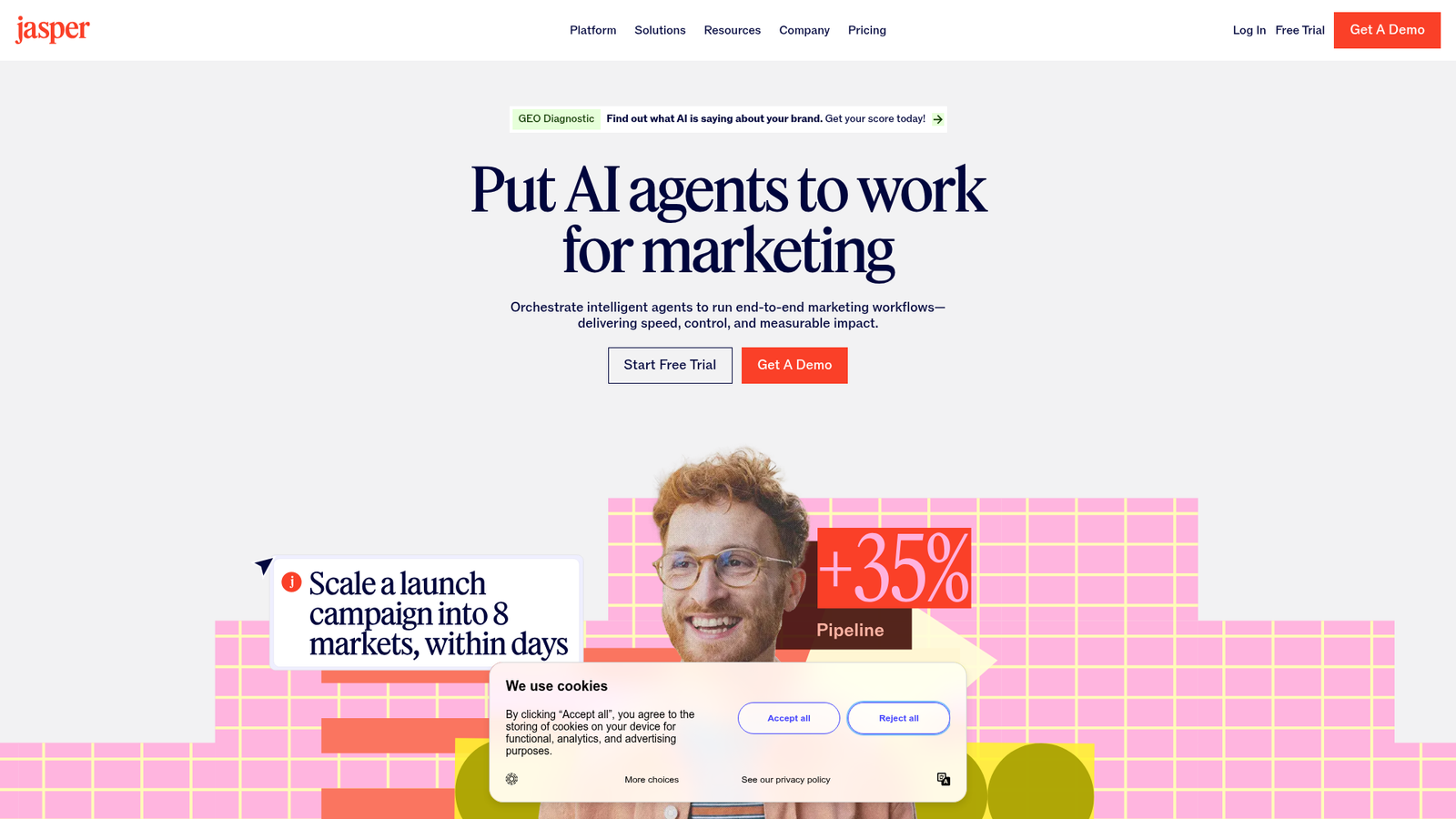
Best for: Modern marketing teams that need brand-controlled AI content and campaign execution at scale.
Key features: Purpose-built AI agents for marketing tasks, content pipelines for end-to-end campaign workflows, and Jasper IQ for brand voice, audience, and company knowledge control.
Pricing: Pro $69/mo per seat billed monthly or $59/mo per seat billed annually with core marketing agents and limited brand customization; Business is custom pricing with advanced agents, custom app builder, Jasper Grid, unlimited IQ customization, API access, and governance controls. Pro includes a 7-day free trial.
G2 rating: 4.7/5
What Jasper Is Best For
Jasper's strength is producing volume without losing brand voice. Teams running blog programs alongside ads, email, and social benefit from one drafting surface that respects their style guide and knowledge base. For teams evaluating drafting platforms more broadly, the best AI content marketing tools comparison is a useful companion read.
- Brand-sensitive marketing teams that need consistent voice across channels
- High-volume drafting across blog, social, ads, and email
- Content, performance, product, and field marketing roles working in parallel
- Teams that want approval-friendly outputs with fewer rounds of editing
Where Jasper Falls Short
Jasper is not built as a full SEO optimization system. SERP analysis, content scoring, and ranking-factor coverage are not its core, and most serious SEO workflows still depend on a dedicated optimization tool layered on top.
- SERP-driven on-page optimization is not its core function
- Native AI search visibility tracking is limited compared to dedicated tools, particularly for understanding how ChatGPT handles web search and citations
- Refresh workflows for aging content are largely manual
- Outputs still require human editing and fact-checking before publish, a finding consistent with research on AI-generated content quality and editorial oversight
If Jasper is close but not quite right, the broader landscape of Jasper alternatives covers options with different trade-offs around SEO depth and workflow automation.
What Surfer SEO Is and What It's Best For
Surfer SEO is an AI SEO and content optimization platform for creating, optimizing, and tracking content visibility across Google and AI search.
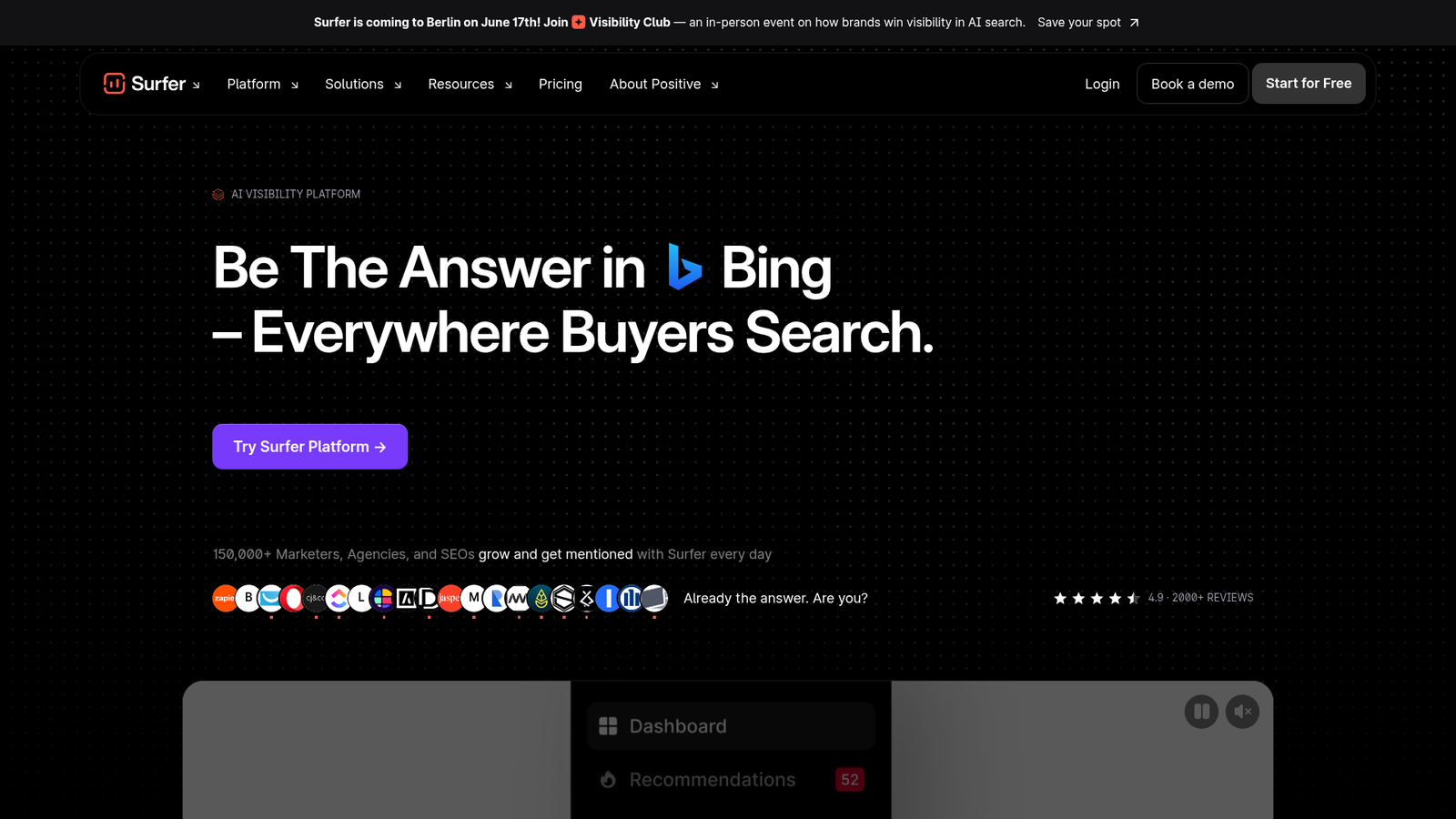
Best for: Agencies, in-house teams, and SEO/content marketers who want to grow visibility in both traditional and AI-driven search.
Key features: Create and optimize content with real-time SEO guidance in the Content Editor, track AI search visibility across tools like ChatGPT and Google AI results with AI Tracker, and audit existing pages with content gap and ranking insights.
Pricing: Discovery $49/mo, Standard $99/mo, Pro $182/mo, Peace of Mind $299/mo (billed yearly), plus Enterprise from $999/mo with tailored packages. A free starter access tier is available.
G2 rating: 4.8/5
What Surfer Is Best For
Surfer's value shows up when ranking discipline matters. The Content Editor turns abstract "write better content" advice into a concrete score tied to top-ranking pages, which makes it easier to brief writers, audit drafts, and refresh underperforming URLs. Teams that lean heavily on audit work often pair it with dedicated content gap analysis tools to prioritize the queue.
- SEO leads optimizing pages around SERP-driven recommendations
- Teams tracking visibility in Google and AI search with AI Tracker
- Agencies managing optimization workflows across client sites
- Content teams refreshing existing URLs for ranking gains
Where Surfer Falls Short
Surfer was built for optimization, not brand-controlled drafting. Teams that need consistent voice across channels or that publish more than blog content quickly hit its limits.
- Brand voice control is lighter than Jasper's Jasper IQ
- Drafting quality depends heavily on input quality and editor skill
- Editorial governance for multi-stakeholder teams is limited
- Heavy reliance on SERP recommendations can produce derivative content
For teams weighing the broader market, the field of Surfer SEO alternatives includes options that pair optimization with refresh workflows and AI visibility ops.
Feature-by-Feature Comparison
This is where the differences sharpen. Both tools touch the content workflow, but the depth of each capability varies significantly by tool.
Content Creation and Drafting Quality
Jasper is built around drafting. Its agents, pipelines, and IQ system are optimized to produce on-brand content quickly across multiple channels, with brand voice and knowledge base controls baked into the writing surface. Surfer offers AI-assisted article generation for SEO-focused content, but the drafting layer is downstream of its SEO scoring engine. The output quality is usable, though brand voice depth is shallower than Jasper's.
Winner: Jasper for brand-led drafting; Surfer is sufficient when optimization is the primary goal.
SEO Optimization and Content Scoring
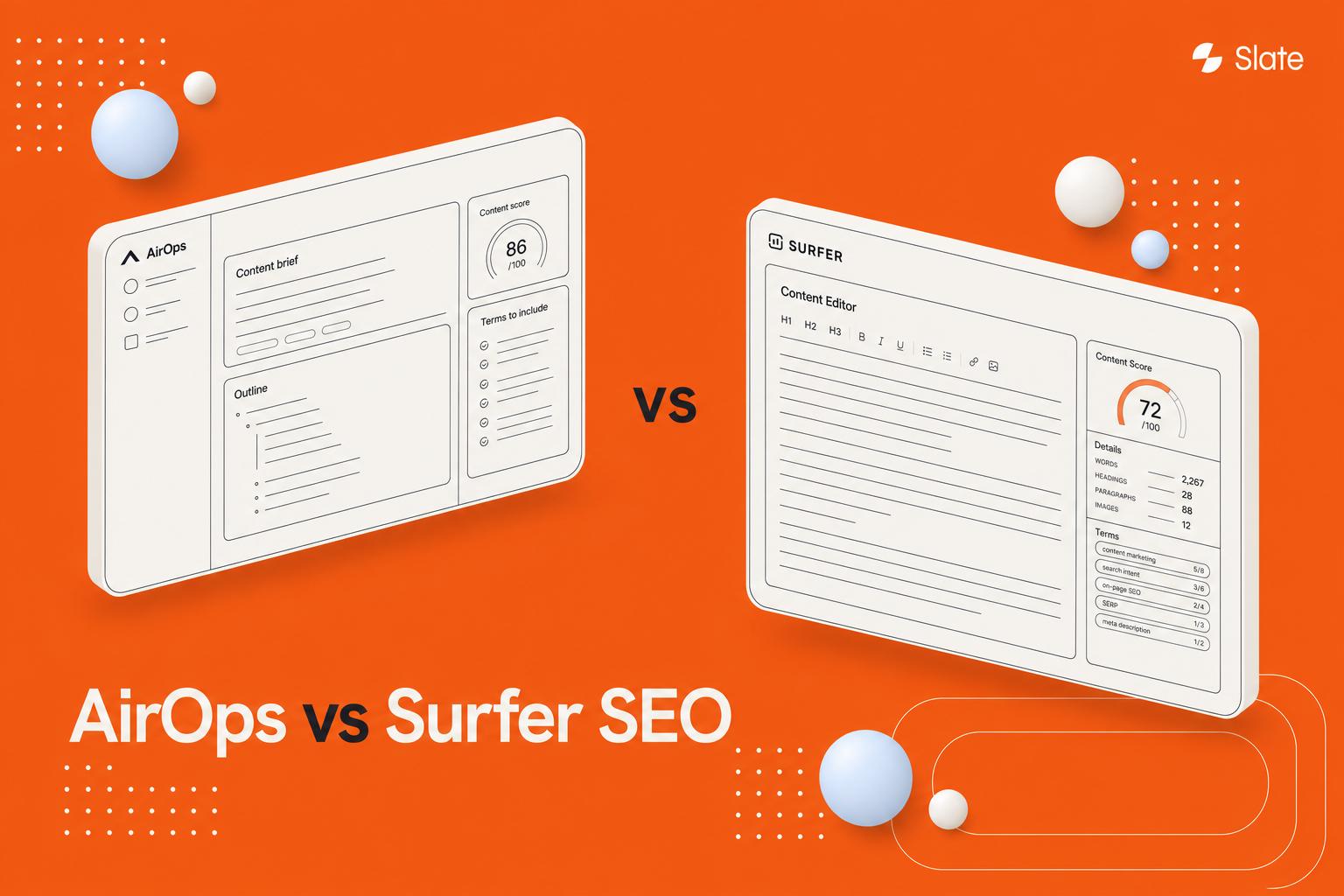
Surfer's Content Editor compares your draft to top-ranking pages and gives a content score based on term coverage, structure, and on-page factors. This is its core product. Jasper doesn't have a comparable native scoring engine - teams that want serious SEO discipline inside Jasper historically paired it with Surfer or a similar tool.
Winner: Surfer SEO. Optimization scoring and SERP analysis are core to its design, not a side feature.
Content Briefs and Topic Coverage
Surfer generates briefs from live SERP data, including suggested headings, term coverage, and competitor patterns. This grounds the brief in what's actually ranking. Jasper can produce briefs through its agents and templates, but the quality depends on prompt engineering and the inputs you feed it.
Winner: Surfer for SERP-derived briefs. Jasper depends on prompt and input quality.
AI Search Visibility
Surfer's AI Tracker monitors how content surfaces across AI search experiences, which is a meaningful step toward AI search visibility. Jasper does not have a comparable tracking layer. Neither tool, however, closes the loop between visibility insight and content action - knowing you've lost visibility in an AI result doesn't automatically tell you what to refresh, in what order, or with what content structure - grounded in how Perplexity's citation model actually surfaces sources. Dedicated AI search visibility tools are emerging to close this loop.
Winner: Surfer between the two via AI Tracker. But neither is purpose-built for turning visibility insights into prioritized content operations - this is the gap Slate was built to fill.
Brand Voice, Governance, and Review Controls
Jasper IQ controls brand voice, audience, and company knowledge across the platform. Business tier adds governance controls suited to multi-stakeholder teams. Surfer's governance and brand-voice capabilities are lighter - it's designed for SEO discipline, not editorial oversight.
Winner: Jasper via Jasper IQ and Business-tier governance.
Workflow Automation and Integrations
Jasper integrates with common marketing stack tools and offers API access on Business plans for deeper workflow connections. Surfer integrates with writing environments like Google Docs and has historically connected with Jasper directly. Neither tool offers end-to-end workflow automation from AI visibility insight to brief to draft to optimization to published page - that requires a content engineering layer. The best SEO automation tools comparison breaks down where each automation layer fits.
Winner: Tie. Both offer integrations; neither covers the full insight-to-publish loop natively.
Jasper vs Surfer SEO Pricing and Total Cost of Ownership
Sticker price is the easy comparison. The operational cost of running both tools is where most teams underestimate the real spend.
Jasper Pricing in 2026
Pricing: Pro $69/mo per seat billed monthly, or $59/mo per seat billed annually, with core marketing agents and limited brand/knowledge customization. Business is custom pricing and adds advanced agents, custom app builder, Jasper Grid, unlimited IQ customization, API access, governance controls, and priority support. A 7-day free trial is available on Pro.
G2 rating: 4.7/5
Jasper's seat-based model means cost scales with team size. A 10-person marketing team on annual Pro is roughly $590/month before any Business-tier upgrade for governance or API access.
Surfer SEO Pricing in 2026
Pricing: Discovery $49/mo, Standard $99/mo, Pro $182/mo, Peace of Mind $299/mo (all billed yearly), plus Enterprise from $999/mo. A free starter access option is available.
G2 rating: 4.8/5
Surfer's pricing scales with content volume - Content Editor articles, audits, and workspaces. Teams optimizing more pages each month typically need Standard or higher, and agencies managing multiple clients often land on Pro or Peace of Mind.
The Real Cost of Running Both
The combined subscription is the visible cost. The hidden cost is operational: editing across two tools, paste-and-reformat handoffs, training time, review overhead, and tool sprawl. A team running Jasper Pro across five seats plus Surfer Standard is paying roughly $394/month in subscriptions - but the workflow tax of switching between tools, reconciling outputs, and managing two billing relationships often costs more in editor hours than the software itself. Smarter content budget allocation typically moves spend from tool stacks toward the workflows that produce measurable outcomes.
Software cost is one input. The real cost is the workflow you build around the tools, and the headcount hours that workflow consumes.
Can You Use Jasper and Surfer SEO Together in 2026?
Yes. Most teams use both tools by drafting in Jasper and pasting content into Surfer's Content Editor for optimization, then publishing manually to their CMS. Historical integrations made the workflow tighter, but most stacked workflows today are still run manually.
What the Workflow Looks Like in Practice
The practical flow most teams run today:
- Research keyword and intent in Surfer
- Generate brief in Surfer's Content Editor
- Draft in Jasper using brand voice and IQ controls
- Paste draft into Surfer's Content Editor and optimize to target score
- Final editorial review for brand voice drift
- Publish manually to CMS
- Track performance and AI visibility after publish
Each handoff is a chance for quality loss, voice drift, or workflow stall. For a structured approach to this kind of multi-stage content work, the AI SEO checklist maps the steps that actually move the needle.
When Stacking Both Makes Sense
Stacking makes sense when you genuinely need both brand-controlled drafting and SERP-driven optimization, and have the editorial capacity to manage the manual handoff. It stops making sense when you're a lean team, your bottleneck is one specific stage, or you need outcome measurement and refresh workflows that neither tool provides.
Which Tool Is Better for Your Team?
The right answer depends on what you're actually trying to fix.
Best for Founders and Lean Marketing Teams
Lean teams with a marketing bottleneck - speed, brand consistency, multi-channel volume - usually get more from Jasper first. SEO discipline matters, but it's often not the gating factor for smaller sites. Add Surfer when SEO becomes a primary growth channel and you have enough indexed pages to optimize systematically.
Best for SEO-Led Content Teams
For SEO-led teams, Surfer SEO is the stronger choice. The Content Editor enforces optimization discipline, AI Tracker covers AI search visibility, and the content audit feature supports refresh work. Add Jasper only if drafting quality or brand voice is the bottleneck - for most SEO teams, it's not.
Best for B2B SaaS Content Teams
B2B SaaS content teams need more than either tool alone provides - a reality reflected in recent B2B SaaS content marketing benchmarks. The job extends beyond drafting and optimization to AI search visibility tracking, citation-ready content, structured refresh workflows, governance across stakeholders, and measurable organic growth tied to pipeline.
This is the category Slate operates in. Slate connects AI search visibility tracking across ChatGPT, Google AI Mode, AI Overviews, and Perplexity to content opportunity discovery, agent-based workflows, brand-safe AI generation through Brand Kit and Knowledge Base, and direct CMS publishing to Webflow and WordPress. For a feature-level breakdown, see Slate vs Jasper.
Best for Agencies Managing Multiple Clients
Agencies typically lean on Surfer for repeatable optimization deliverables across client sites, and Jasper for managing brand voice across multiple accounts. The deciding factor is operational overhead - stacking both means managing two billing relationships and two workflows per client, which scales painfully. Resources for marketing agencies cover how agencies are restructuring stacks to reduce this overhead.
Best for Content Teams Focused on Refreshing Existing Pages
Surfer is the stronger choice for URL-level optimization on existing pages. Neither tool, however, offers a true refresh queue or prioritization engine that tells you which pages to refresh next based on AI visibility loss, traffic decay, and competitive movement. That's a system-level gap that purpose-built content refresh tools are designed to close.
Pros and Cons Summary
A quick scan view of what each tool does well and where it consistently frustrates teams.
Jasper Pros and Cons
Pros:
- Strong brand voice and knowledge controls via Jasper IQ
- Purpose-built marketing agents for ads, email, social, and long-form
- High drafting velocity for multi-channel campaigns
- Mature governance and API access on Business tier
Cons:
- Not a dedicated SEO optimization platform
- AI search visibility tracking is limited
- Outputs require editing and fact-checking
- Seat-based pricing scales quickly with team size
Surfer SEO Pros and Cons
Pros:
- Strong on-page SEO scoring via Content Editor
- AI Tracker covers visibility across Google and AI search
- SERP-driven briefs ground content in what actually ranks
- Content audit feature supports refresh workflows
Cons:
- Brand voice control is shallow compared to Jasper
- Over-reliance on SERP recommendations can produce derivative content
- Editorial governance for multi-stakeholder teams is limited
- Drafting quality depends heavily on input and editor skill
What Jasper and Surfer SEO Don't Solve in 2026
Both tools are excellent at their primary jobs. Neither was designed to be a complete content system, and the gaps matter for teams trying to operate organic growth as infrastructure.
AI Search Visibility as an Operating Model, Not a Feature
Tracking AI visibility is the start. Knowing which pages to create, refresh, or restructure based on those signals - and routing that work through a system that actually executes - is the missing layer. Surfer's AI Tracker shows you where you stand. It doesn't connect that insight to action.
Citation Readiness and Extractability
Optimization scores are built around what ranks on the SERP. Content that gets cited in AI answer engines often follows a different structural standard - explicit definitions, clean attribution, extractable answer blocks, consistent terminology, and structured data and schema markup for extractability. Neither tool enforces that standard natively. Closing this gap is part of what content engineering is built for.
Scalable Refresh Workflows
Both tools help create or optimize a page. Neither runs hundreds of structured refreshes through a queue with prioritization, brand-voice enforcement, and CMS publishing baked in. Refresh at scale is a workflow problem, not a writing problem - and studies on content refresh impact on organic traffic consistently show outsized returns versus net-new content.
Brand Governance at Scale
Jasper has brand voice. Surfer has optimization rigor. Neither has full editorial governance - style enforcement, internal knowledge use, review steps, and approval gates - running through a multi-stakeholder workflow. For teams with legal, product marketing, and brand stakeholders in the chain, this gap creates real friction.
Outcome Measurement Beyond Rankings
Content scores and rankings are inputs. The job to be done is measurable organic growth with clear attribution to pipeline. Neither Jasper nor Surfer answers the "did this content actually drive results" question - that requires connecting content operations to traffic, citations, and revenue outcomes in one system.
How Modern Content Teams Evaluate Tools for Search and AI Visibility
Tool selection has shifted. The question isn't "which tool ranks highest in reviews" - it's "which system delivers measurable organic outcomes." Resources for SEO and content teams explore this evaluation framework in depth, and the broader landscape of best AI SEO tools covers where each category fits.
A 6-Criteria Decision Rubric
Use this rubric to evaluate any tool, including Jasper and Surfer:
- Insight: Does the tool show where you stand in AI search and traditional search?
- Action: Does it connect insight to content decisions, or stop at dashboards?
- Workflow: Is content production repeatable through structured workflows, not ad hoc writing?
- Governance: Are brand voice, accuracy, and review enforced consistently?
- Scale: Can it run hundreds of updates without breaking quality control?
- Outcomes: Is organic growth measurable and attributable, or just inferred?
Jasper scores high on governance and workflow for drafting. Surfer scores high on insight and action for optimization. Neither scores high across all six.
Where Slate Fits in This Decision
Slate is built for teams that need the full system. It connects AI search visibility tracking across ChatGPT, Google AI Mode, AI Overviews, and Perplexity to content opportunity discovery, runs creation and refresh through agent-based workflows in Workflows and Power Sheets, enforces brand quality through Brand Kit and Knowledge Base, and publishes directly to Webflow and WordPress.
The positioning is deliberate. Slate is not a one-to-one replacement for Jasper or Surfer - it's the system layer that sits above both, purpose-built for B2B SaaS teams that want outcomes rather than experiments.
Book a demo: https://slatehq.com/book-a-demo
Final Verdict: Jasper vs Surfer SEO in 2026
Jasper wins for brand-led drafting and marketing-team workflows. The combination of Jasper IQ, purpose-built agents, and content pipelines makes it the strongest choice when the bottleneck is producing on-brand content across channels at speed.
Surfer SEO wins for SEO optimization and AI search visibility tracking. The Content Editor's SERP-driven scoring and AI Tracker's visibility coverage make it the strongest choice when the bottleneck is ranking pages and tracking AI search visibility, traditionally aligned with Google's helpful content guidelines.
Neither wins for teams building a content system that scales across creation, optimization, refresh, governance, and outcome measurement. That's the category Slate operates in, and it's where most B2B SaaS teams find themselves once content moves from project to infrastructure.
The one-line summary: pick Jasper for drafting, Surfer for optimization, and a content engineering platform for the system around both.
Frequently Asked Questions
What Is the Difference Between Jasper and Surfer SEO?
Jasper is an AI writing platform built to help marketing teams draft on-brand content faster across blog, ads, email, and social. Surfer SEO is an optimization platform built around SERP-driven content scoring and AI search visibility tracking. They overlap in content workflows but solve different primary jobs: creation versus optimization.
Which Is Better for SEO Content, Jasper or Surfer SEO?
Surfer SEO is better for dedicated SEO content because optimization scoring, SERP analysis, and AI search visibility are its core product. Jasper produces strong drafts but lacks native SERP-driven optimization. If SEO is your primary growth channel, Surfer is the stronger pick; if drafting quality and brand voice are the bottleneck, Jasper plus light SEO discipline may be enough.
Can Jasper and Surfer SEO Be Used Together in 2026?
Yes. Most teams draft in Jasper and then paste content into Surfer's Content Editor to optimize against the target score before publishing. The workflow is largely manual today - teams move content between the two tools manually, which adds editorial overhead but preserves the strengths of each platform.
Is Surfer SEO Worth It Compared with Jasper?
Surfer SEO is worth it when ranking and AI search visibility are the bottleneck. Its Content Editor scoring and AI Tracker deliver value Jasper doesn't replicate. If your team already drafts well and the gating factor is optimization rigor, Surfer pays back faster than another writing tool. If drafting is the constraint, Jasper delivers more.
Can Jasper Replace Surfer SEO?
Not for dedicated SEO workflows. Jasper produces drafts and supports brand voice, but it doesn't natively score content against top-ranking pages or track AI search visibility the way Surfer does. Teams that try to replace Surfer with Jasper alone usually end up adding a separate SEO tool back into the stack within a few months.
Is Jasper Enough for SEO Content Without Surfer?
Jasper alone can be enough for lighter SEO workflows - small content programs, brand-first sites, or teams where SEO is not the primary growth channel. For structured SEO operations focused on ranking specific pages, refreshing existing URLs, and tracking AI search visibility, especially given the decline in organic click-through rates from AI answers, Jasper alone leaves gaps that Surfer or a content engineering platform covers.
What's the Best Alternative If I Need Both Creation and Optimization in One System?
Slate is purpose-built for teams that need creation, optimization, AI visibility tracking, governance, and CMS publishing in one platform — leveraging Webflow's CMS publishing capabilities and supporting the broader WordPress market share among content sites. It's designed as a content engineering system for B2B SaaS rather than a drafting tool or an optimization tool. Book a demo at slatehq.com/book-a-demo to see how the full workflow runs.