We are all asking ChatGPT, Perplexity, Gemini, and Google AI Mode questions we used to type into Google. The brands that get named, cited, and recommended inside those answers get the early advantage.
So, being two of the leading AI SEO tools, Profound vs. AirOps is a useful comparison, but only if you start with the right diagnosis.
Short answer: Profound is stronger for AI search visibility, prompt tracking, citation analysis, sentiment, and competitive presence. AirOps is stronger for governed content production at volume, with AI search insights feeding the workflow.
Slate is the end-to-end option if you want discovery, content work, publishing, outreach, and measurement in one system.
Key Takeaways
- Profound is built for AI visibility measurement across answer engines.
- AirOps is built for content production workflows, with AI search intelligence added to planning.
- Profound is a better fit when you can’t answer where your brand appears in AI answers.
- AirOps is a better fit when you know what to create and need more governed output.
- Both vendors use usage-based pricing, so model your monthly prompts, tasks, assets, and users before comparing tiers.
- Slate starts at $499/month.
- Slate is the better fit when the handoffs between insight, production, publishing, outreach, and reporting are slowing the team down.
Quick Verdict: Profound vs. AirOps
Profound gives you the map. AirOps gives you the factory.
Slate connects the map, the factory, and the scorecard.
Profound vs. AirOps At A Glance
A demo chart can look great. The better test is uglier.
Take one missing citation from your own data. Ask each vendor to walk it through detection, prioritization, brief, draft, approval, publish, outreach, and re-measurement. Count the systems and people involved.
That count tells you more than the pricing page.
What Is Profound?
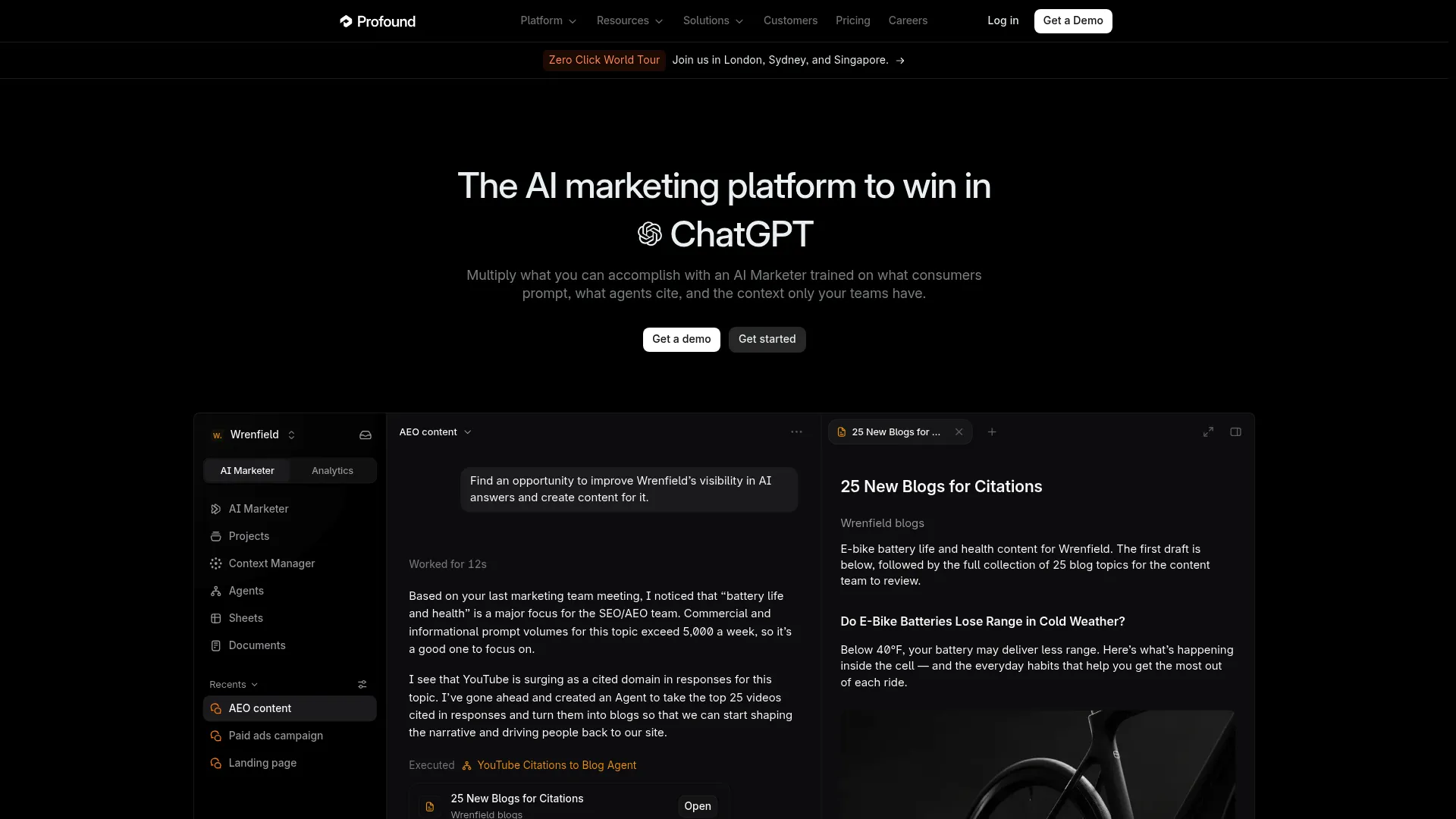
Profound is an AI marketing platform for tracking how a brand appears in AI answers.
It runs structured prompts across answer engines and reports on citations, sentiment, rankings, and competitor presence.
Profound is built for:
- Tracking brand appearance across answer engines.
- Monitoring citations, sentiment, and competitive presence.
- Using prompt-volume and consumer-intent data to guide planning.
- Supporting enterprise needs, including SSO/SAML and SOC 2 on custom plans.
Profound tends to fit:
- Brand teams that need AI visibility reporting.
- Enterprise teams with security and multi-market requirements.
- Agencies that need client-level visibility reporting.
Profound’s boundary is execution. It can show that a competitor appears more often in a high-intent prompt cluster, and it can show the citation pattern behind that lead.
The content brief, CMS publish path, and third-party corroboration work usually live somewhere else.
Pricing: Free seven-day trial with limited AI Marketer credits and 50 prompts per day. Custom packages include tailored prompt tracking, up to nine answer engines, dedicated support, and SSO/SAML.
G2 rating: 4.5/5
What Is AirOps?
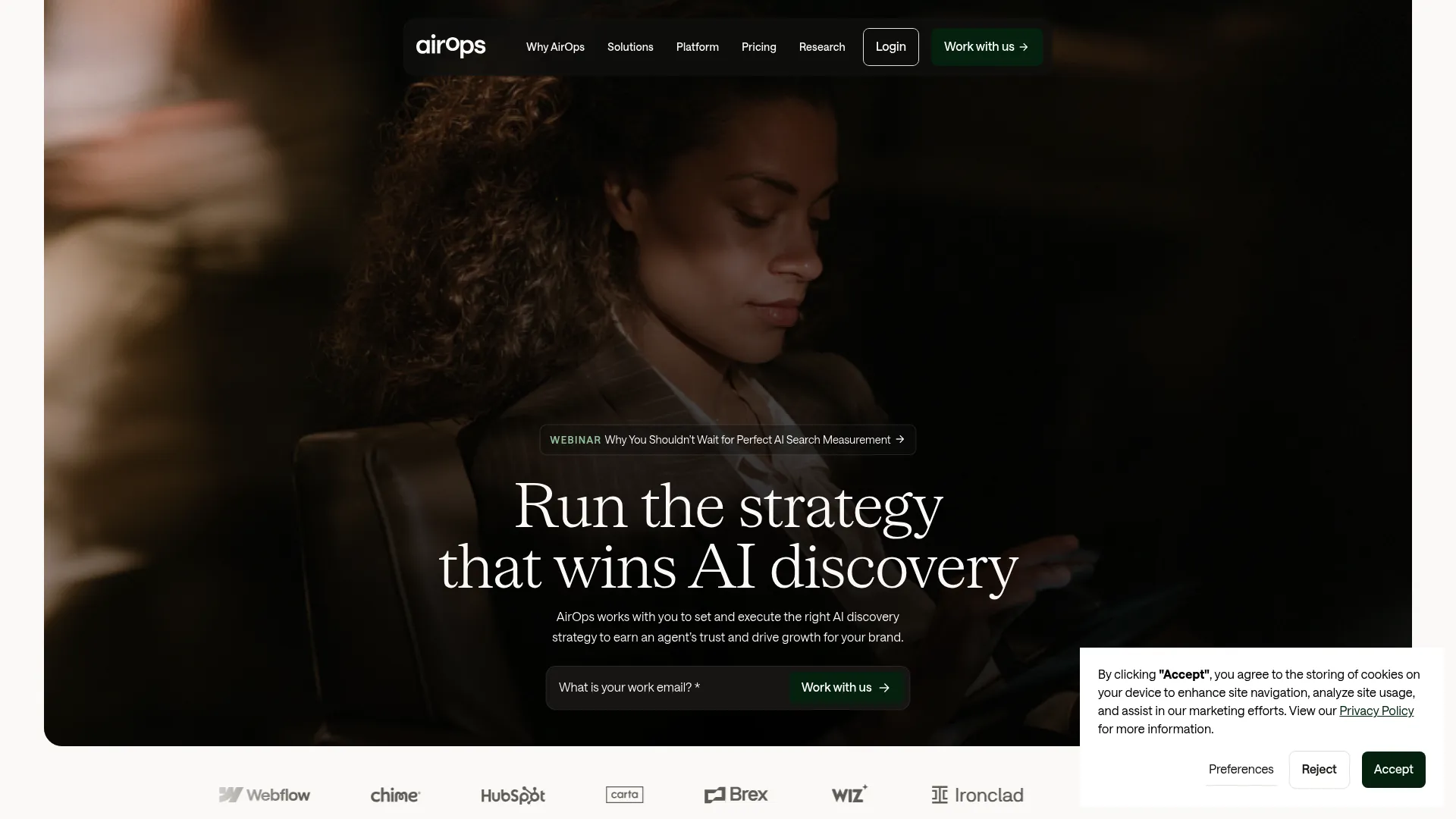
AirOps is an AI search growth platform built around content workflows.
Its unit of work is the task. Those tasks cover content generation, data extraction, workflow steps, and other production work.
AirOps is built for:
- Running repeatable content workflows.
- Using brand kits and knowledge bases to govern output.
- Personalizing work by persona, region, and language.
- Connecting to CMS, SEO, AEO, social, and project tools.
AirOps tends to fit:
- Content teams that need more governed production.
- Localization teams creating many page variants.
- Enterprise teams that want custom agent builds and onboarding.
AirOps’ boundary is measurement depth. It has AI search and competitor intelligence, but teams still need to connect production volume to answer inclusion, citations, organic traffic, and revenue.
Someone has to own that join.
Pricing: Solo is free for one user. Pro is built for small teams with unlimited seats. Enterprise is custom. Solo includes 35,000 monthly content production tasks, and overages are listed at $0.025 per extra task.
G2 rating: 4.7/5
Profound vs. AirOps: The Main Difference
Profound starts with the AI answer. AirOps starts with the content workflow.
That single difference shapes the first 90 days.
With Profound, you’ll probably build a clearer picture of where your brand appears, where competitors show up, and which sources answer engines cite.
With AirOps, you’ll probably build repeatable workflows for briefs, drafts, refreshes, localization, and governed production.
The painful middle is where many teams get stuck. A monitoring tool creates a backlog. A production tool creates output. Leadership still asks whether the work changed AI visibility.
So evaluate the loop:
- Detect the gap.
- Prioritize the work.
- Create or refresh the asset.
- Review and approve it.
- Publish it.
- Build outside corroboration if needed.
- Measure the result.
- Feed that result into the next cycle.
The vendor that covers more of that loop will usually cost less to operate, even if the monthly subscription looks higher.
How To Evaluate AI Search Visibility Platforms In 2026
Use four questions:
- Which answer engines are covered?
- How are prompts selected, grouped, and rerun?
- What citation context do you get?
- Can the finding become assigned work without a CSV detour?
AI answers vary by model, prompt wording, location, session, and time. One snapshot is weak evidence.
A fixed prompt set, stable cadence, and trend view give you better signal.
Prompt Tracking And Prioritization
Profound’s prompt tracking is one of its core strengths. It uses structured prompts, prompt-volume signals, and consumer-intent data to show what buyers ask and where your brand appears.
AirOps also has AI search insights, with personalization by persona, region, and language. Those insights are mainly used to guide content workflows.
A useful prompt set usually has four buckets:
- Brand prompts.
- Category prompts.
- Comparison prompts.
- High-intent problem prompts.
Ask vendors these questions during the demo:
- Can we import keyword and query data?
- How do you rank prompts by intent or demand?
- Can high-value prompts rerun more often?
- What happens when a result changes?
Slate supports prompt and search-term tracking, with scheduled prompt monitoring for consistent trend lines.
Query Fan-Out
Query fan-out is how an AI system breaks one user question into related sub-questions, retrieves sources, and synthesizes an answer.
That means your brand can lose visibility because of a question you never tracked.
Pricing, onboarding time, integrations, compliance, support, and comparison language can all affect whether a tool appears in an AI answer.
And sometimes the source that helps a competitor win is a third-party review page, category page, or comparison article. Your own site can’t always carry the whole job.
Brand Mentions, Citations, And Source Patterns
Profound has citation analytics as a core capability. It also reports sentiment and competitor presence.
AirOps includes AI search and competitor intelligence inside its insight layer.
The useful question is resolution. A citation count tells you who appeared. Citation context tells you where to investigate.
Slate’s citation analysis connects citation tracking to broader opportunity discovery.
Share Of Voice And Competitive Benchmarking
AI share of voice measures how often your brand appears across a fixed prompt set compared with named competitors.
Profound reports competitive presence and ranking inside answer-engine responses. AirOps includes competitor intelligence in its insights.
Don’t compare share-of-voice percentages across vendors. Different prompt sets, engine mixes, and sampling methods can produce different numbers for the same brand on the same day.
Pick one method. Hold it steady. Track the trend.
A move from 14% to 22% inside one stable setup is useful. A number pulled from another vendor’s report is a different measurement.
For more context, see Slate’s guide to AI share-of-voice tracking.
Engine Coverage, Regions, And Freshness
Coverage is easy to compare. Freshness is harder.
Ask how often prompts rerun, how many samples make up one data point, and how the platform separates movement from normal answer variation.
Content Creation And Workflow Automation
AirOps is the stronger production platform between Profound and AirOps.
It has task-metered workflows, brand governance, knowledge bases, brand kits, and CMS integrations. Profound has AI marketing agents for content and campaign work, but its documented strength is visibility intelligence.
Slate covers both sides with Workflows, Power Sheets, SuperBlocks, Brand Kit, Knowledge Base, Coworker, and custom agents.
Research, Topics, And Briefs
Good content planning now pulls from several sources:
- Keyword and query data.
- Prompt gaps in AI answers.
- Entity and topic coverage.
- Competitor citation sources.
Profound is strongest on prompt gaps and buyer-intent signals.
AirOps can turn insight into workflow inputs, especially across persona, region, and language variants.
A useful brief should name the questions the page must answer, the sources it needs to compete with, the structure required for extraction, and the owner who will approve it.
Creation, Refresh, Consolidation, And Retirement
Content work has several possible outcomes:
- Create: No page exists for the prompt cluster.
- Improve: The page exists, but answer engines aren’t extracting it.
- Refresh: The page has aged or lost visibility.
- Consolidate: Several thin pages are splitting authority.
- Retire: The page no longer serves a buyer question.
Refresh work deserves more budget than it gets. Existing pages often have links, history, and prior citations. Updating structure, claims, headings, and supporting data can recover value faster than creating a new asset.
AirOps can help produce and govern that work. Slate adds bulk execution through Power Sheets for thousands of URLs.
Workflow Builders And Agent Delegation
Hand-built workflows can become fragile. Change a CMS field, add a required taxonomy value, or update a template, and a workflow can break.
Slate splits the work between Coworker for one-off tasks and custom agents for repeatable SEO and content jobs.
For more detail, see AI workflows vs. AI agents and AI agents for marketing.
Quality Control And Review
AirOps documents brand governance, brand kits, and knowledge bases. Slate uses Brand Kit and Knowledge Base for voice, tone, and approved source material.
A practical review system should cover:
- Brand voice.
- Source grounding.
- SME review.
- Claims approval.
- Audit history.
- Pre-publish QA.
Human review still belongs on pricing, compliance, competitive claims, regulated topics, and executive-facing pages.
Bulk Work Across Hundreds Of URLs
A common audit looks like this: 1,400 pages lack FAQ schema, 300 pages have outdated metadata, and 90 pages that used to appear in AI citations are slipping.
That’s a bulk operations problem.
Slate handles this through Power Sheets, a spreadsheet-style interface for content refreshes, programmatic page creation, metadata rewrites, internal-link updates, and audits across large URL sets.
AirOps can also support volume work, but task consumption depends on step type and data processed. Model that usage before you pick a tier.
Integrations And Publishing
Publishing is where many content workflows slow down.
Slate publishes directly to Webflow and WordPress.
AirOps lists CMS integrations on Pro and Enterprise tiers.
Profound has no documented CMS publishing path, which fits its measurement-first positioning.
SEO Data Sources
SEO data can double the budget if you need a separate tool.
Slate includes native Ahrefs and Semrush access.
AirOps lists SEO and AEO integrations, with the underlying data depending on what you connect.
Profound focuses on answer-engine measurement, so many teams keep separate SEO subscriptions.
Add those subscriptions to your cost model before comparing vendors.
Analytics Unification
AI visibility, rankings, traffic, and conversions often live in separate dashboards. Then someone has to join the numbers by hand.
Slate’s Pages unifies Google Search Console and GA4 data with clicks, traffic, CTR, citations, and performance monitoring.
AirOps documents revenue-linked measurement and reporting.
Profound’s reporting is strongest around AI answers, citations, sentiment, rankings, and competitors.
A unified view helps you see whether a refreshed page gained citations, gained clicks, lost clicks to answer satisfaction, or needs another round of work.
API Access And Data Portability
Ask these before signing:
- Can we export raw prompt and citation data?
- Is there API access?
- Can data move into our warehouse or BI tool?
- Who owns the prompt data?
- What happens to historical data if we leave?
Trend history is expensive to rebuild. Protect it.
Pricing And Total Operating Cost
Compare operating cost, not list price.
Profound uses credits. AirOps uses tasks. Slate uses credits and tracked prompt/page allowances.
Those units don’t map cleanly.
Confirm pricing with each vendor before buying.
Your full cost model should include:
- Platform subscription.
- SEO and keyword data.
- CMS setup.
- Workflow build and maintenance.
- Editing and fact-checking.
- Review time.
- Outreach tools and contact data.
- Reporting assembly.
A cheaper subscription can cost more if every insight becomes a spreadsheet, a doc, a CMS paste job, and a manual report.
Implementation Requirements
The tool can be live in days. The operating process takes longer.
You need:
- An owner for the prompt set.
- A clear approval path.
- CMS access.
- A reporting owner.
- A refresh cadence.
Small teams should start with 20 to 50 prompts and one repeatable content motion. Expand after the loop runs twice without chaos.
Enterprise teams should define roles, access, market-specific prompt sets, legal review, and claims approval before content starts flowing.
Agencies should check client separation, repeatable playbooks, white-label reporting, and per-client usage economics.
First 30 Days Checklist
- Define 20 to 50 priority prompts.
- Add three to five named competitors.
- Connect Google Search Console and GA4.
- Connect the CMS and confirm staging access.
- Set a prompt rerun cadence.
- Assign owners for prompts, QA, and publishing.
- Baseline visibility, traffic, and conversions.
- Review what went live and what moved on day 30.
Measuring AI Visibility Beside SEO
Use five tiers:
Citation counts are useful. They aren’t enough for a CFO conversation.
The stronger story connects AI visibility to pages, traffic, conversion value, and cycle time.
Who Should Choose Profound?
Choose Profound when the main need is AI search visibility measurement.
It’s the better fit when leadership asks where the brand appears in ChatGPT, Gemini, Google AI Overviews, and other answer engines, and the team needs defensible data.
Best fit when:
- AI visibility reporting is the gap.
- Citation analytics and sentiment are central.
- Up to nine answer engines are needed on custom plans.
- Enterprise controls such as SSO/SAML and SOC 2 are required.
Plan for:
- A separate content production process.
- A CMS publishing path.
- Outreach for third-party corroboration.
Verdict: Profound is the right call when measurement is the constraint and execution capacity already exists.
Who Should Choose AirOps?
Choose AirOps when content production is the bottleneck.
It’s the better fit for teams that need repeatable workflows, brand governance, knowledge bases, persona variation, language variation, and CMS integrations.
Best fit when:
- Content volume is the constraint.
- Localization is a major workload.
- Workflows need governance.
- Task volume is predictable enough to price.
Plan for:
- Workflow setup and maintenance.
- Usage modeling by task type.
- Reporting that ties output to AI visibility and revenue.
Verdict: AirOps is the right call when strategy is set and the team needs governed production at scale.
When Slate Makes More Sense
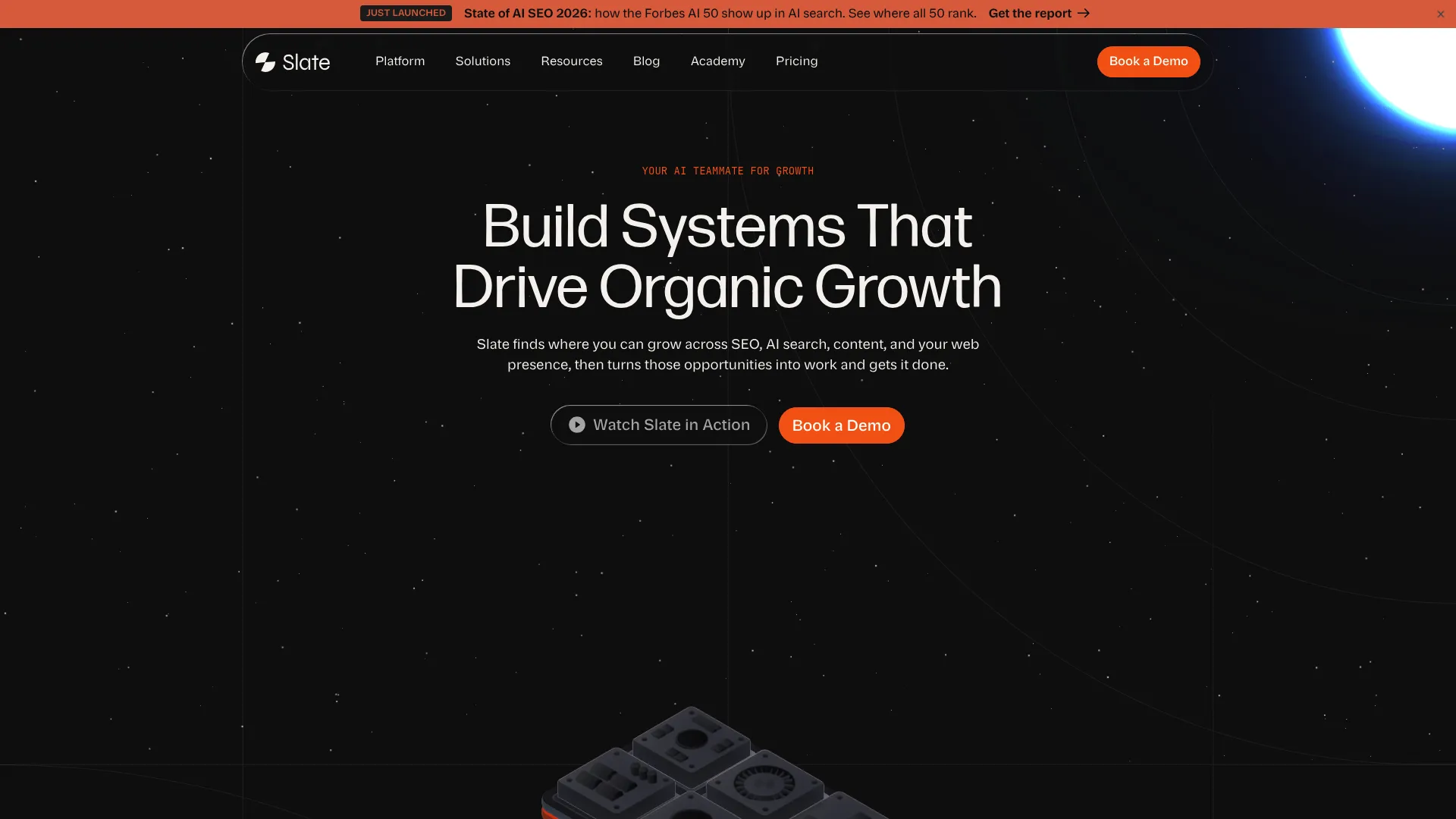
Slate makes sense when too much work happens between tools.
It combines AI search visibility, SEO visibility, content production, CMS publishing, outreach, and reporting in one agent-driven platform.
Slate’s Opportunities surfaces gaps across content, citations, rankings, social engagement, and more. The output is a prioritized queue, not a static dashboard.
Common gap types include:
- Content gaps: No asset answers the prompt cluster.
- Citation gaps: Competitors appear through third-party sources.
- Ranking gaps: A page ranks but isn’t structured for extraction.
- Decay gaps: Older pages lose clicks, citations, or answer inclusion.
Slate’s AI Tracker feeds prompt, citation, and sentiment data across six major AI platforms.
Execution: Coworker, Agents, And Bulk Work
Slate has two execution modes.
Coworker handles ad hoc work in plain language. Custom agents handle repeatable SEO, content, and growth tasks.
Teams use agents for jobs like:
- Weekly decayed-page refresh queues.
- New prompt-cluster briefs.
- Competitor citation-source monitoring.
- Bulk metadata and schema updates.
Slate also includes a visual workflow builder, 24+ AI models, SuperBlocks, web scraping, conditional logic, CMS publishing, and Power Sheets for large URL sets.
Outreach And Citation Gaps
Some AI citation gaps need third-party corroboration.
Slate supports that workflow inside the platform:
- Find citation and brand-mention gaps.
- Diagnose owned-content versus third-party coverage needs.
- Enrich contacts.
- Run outreach.
- Re-measure visibility over time.
That last step turns outreach from activity into a repeatable program.
Slate Measurement
Slate’s Pages combines Google Search Console and GA4 data with AI visibility metrics.
It also includes native Ahrefs and Semrush access, so teams can connect AI citations, organic visibility, traffic, CTR, and page performance without stitching together five exports.
Pricing: Starting at $499/month
Slate includes 15,000 credits, 10,000 prompt answers tracked, and 1,000 web pages tracked. Free trial, Enterprise, and Agency plans are available.
G2 rating: 4.9/5
Final Verdict
Run one vendor test. Take a missing citation from your own category. Ask each platform to carry it through detection, prioritization, brief, draft, review, approval, publish, outreach, and re-measurement.
The platform that needs the fewest handoffs will usually cost less to operate. See the full loop in one platform: book a demo.
Frequently Asked Questions
Is Profound Or AirOps Better For AI Search Visibility?
Profound is stronger for AI search visibility. It centers on structured prompt tracking, citation analytics, sentiment, rankings, and competitive presence across answer engines. AirOps includes AI search intelligence, but its center of gravity is content workflow execution.
Is AirOps Better Than Profound For Content Automation?
Yes, for production workflows. AirOps documents content workflows, brand kits, knowledge bases, CMS integrations, and task-based execution. Profound has AI marketing agents, but its documented strength is measurement.
Can Profound Or AirOps Replace A Traditional SEO Platform?
Usually, no. Most teams still need rank tracking, backlink data, technical audits, keyword research, and Search Console reporting. Slate reduces that overlap by including native Ahrefs and Semrush access.
How Should Teams Evaluate Citation Tracking?
Look for citation context, not just counts. Ask which sources were cited, how often they recur, what sentiment appears with the brand, and whether the platform turns that finding into content, refresh, consolidation, or outreach work.
What’s The Difference Between AI Visibility, AEO, GEO, And SEO?
SEO targets traditional search rankings. AEO, or answer engine optimization, targets inclusion in direct answers. GEO, or generative engine optimization, targets retrieval and citation by generative systems. AI visibility is the measurement layer across those channels.
Which Prompts Should We Track First?
Start with brand prompts, category prompts, comparison prompts, and high-intent problem prompts. Twenty to 50 well-chosen prompts will teach you more than 1,000 prompts no one has time to act on.
Can AI Visibility Data Improve Content Strategy?
Yes, when it leads to assigned work. The useful output is a decision: create this page, refresh that page, consolidate these pages, or pursue coverage on these third-party sources.
When Should A Team Consider Slate?
Consider Slate when your team uses more than three tools in one improvement cycle, moves work by export, has a growing backlog of visibility gaps, or can’t connect AI visibility to traffic and conversions without manual reporting. If two of those are true, book a demo.