Every piece of content you've ever published is losing value right now. Not dramatically in a way that triggers alarms, but quietly, steadily, in a way that compounds until the damage is visible in your pipeline, your traffic reports, and your AI citation share.
Most teams don't notice until they've already lost 40, 50, sometimes 80% of a page's traffic. By then, the recovery is harder, more expensive, and slower than it needed to be.
This guide exists because we've watched this play out across hundreds of content libraries. At Slate, we run content refresh operations for companies managing thousands of published URLs. We've seen what happens when content is left untouched for 12 months in a market where AI search engines now favor sources updated within the last 90 days. We've also seen what happens when teams build the system to catch decay early and act on it before rankings slip: traffic recovers, AI citations return, and the ROI outperforms net-new content creation by a wide margin.
This isn't a surface-level overview. We already made that, you can watch it here:
The video covers the basics. This guide goes significantly deeper.
What you're reading is our attempt at making the most comprehensive and practitioner-focused guide on content refresh that exists today.
It's built from three layers of knowledge that most content on this topic doesn't have access to: Slate's first-party operational data from running refresh workflows at scale across industries, the best available third-party research including Ahrefs' 17-million-citation analysis, and years of pattern recognition from doing this work day after day, learning what actually moves rankings and citations versus what looks good in a framework but doesn't hold up in practice.
Every section in this guide has been pressure-tested against real content libraries, real decay curves, and real recovery data.
If something is here, it's because it works. If something is missing, it's because it didn't.
What Exactly Is Content Refresh?
Content refresh, in simple terms, is updating an existing published page to restore or improve its performance, in organic search, AI citations, or both. Not republishing. Not slapping a new date on an old post. A deliberate intervention while keeping the same URL and preserving the authority that URL has built over time, its backlinks, indexing history, and keyword associations.
It sits on a spectrum. On the light end: a 90-minute update swapping in current stats, rewriting the title, adding internal links. On the heavy end: a full-day deep rewrite with new structure, competitive gap closures, schema markup, and expert quotes, essentially new content living at an old, authoritative URL.
This guide covers every stage:
- diagnosing decay
- understanding why freshness now determines visibility in both Google and AI search
- identifying and prioritizing what to refresh
- the exact playbook for doing it
- measuring whether it worked
- and building the system to do it at scale.
Content Decay: Understanding the Problem
Content decay is the gradual, sustained decline in a page's organic traffic, rankings, and engagement over time. It’s not a sudden crash from an algorithm penalty but a slow bleed where a page drops from 2,000 monthly visits to 1,400, then 900, then 500, in a way that doesn't look alarming on any given day but compounds into a serious problem over quarters.
In 2026, decay has a second dimension. Your page can hold its Google ranking while disappearing from AI-generated answers across ChatGPT, Perplexity, and AI Overviews.
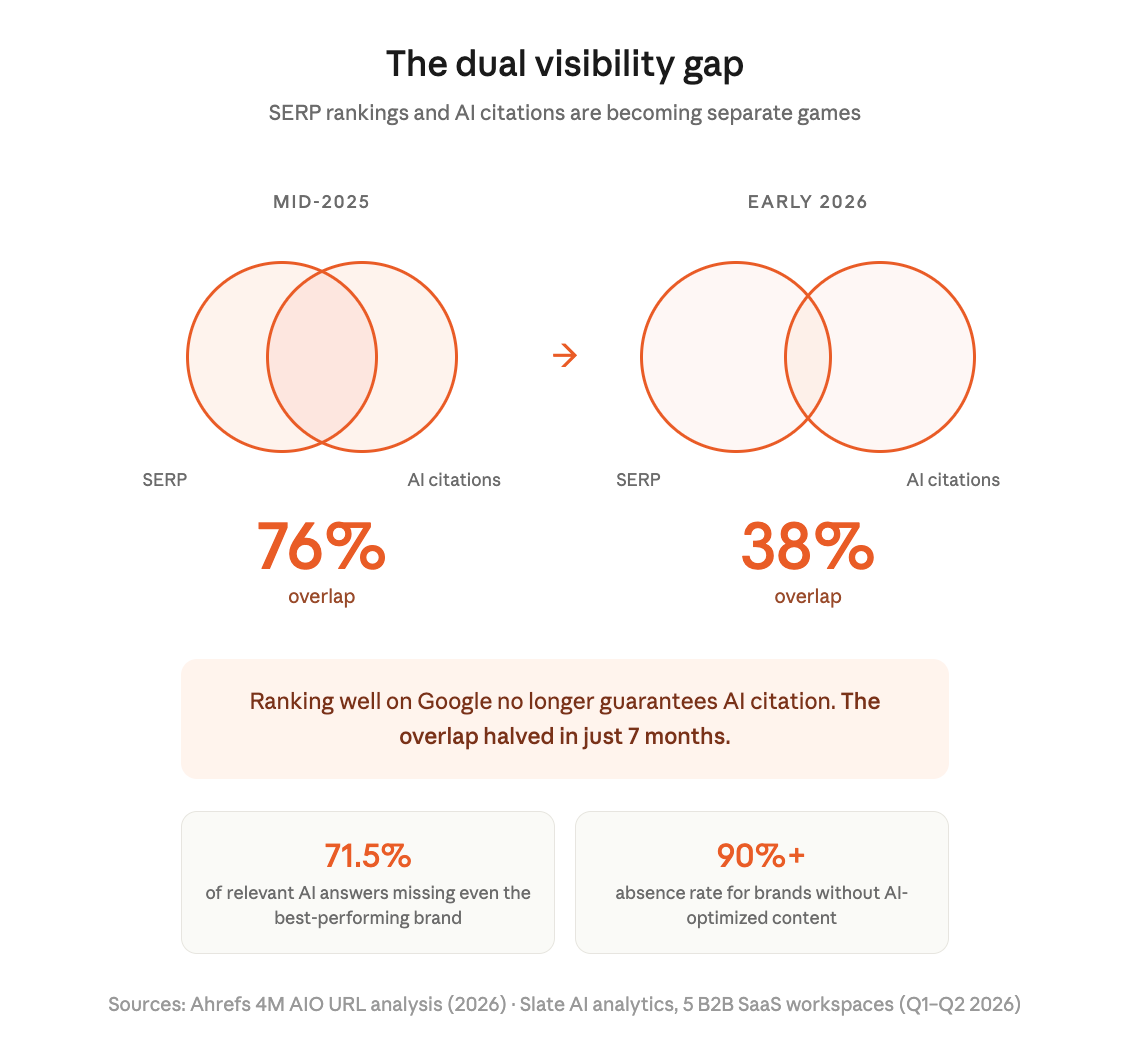
Across five B2B SaaS brands monitored in Slate over 90 days, even the best-performing brand was absent from 71.5% of relevant AI answers. The worst was missing from over 90% (Slate first-party data, Q1-Q2 2026). The gap between "we rank on Google" and "we're visible in AI search" is where most content decay now hides.
What causes content decay?
How to diagnose decay?
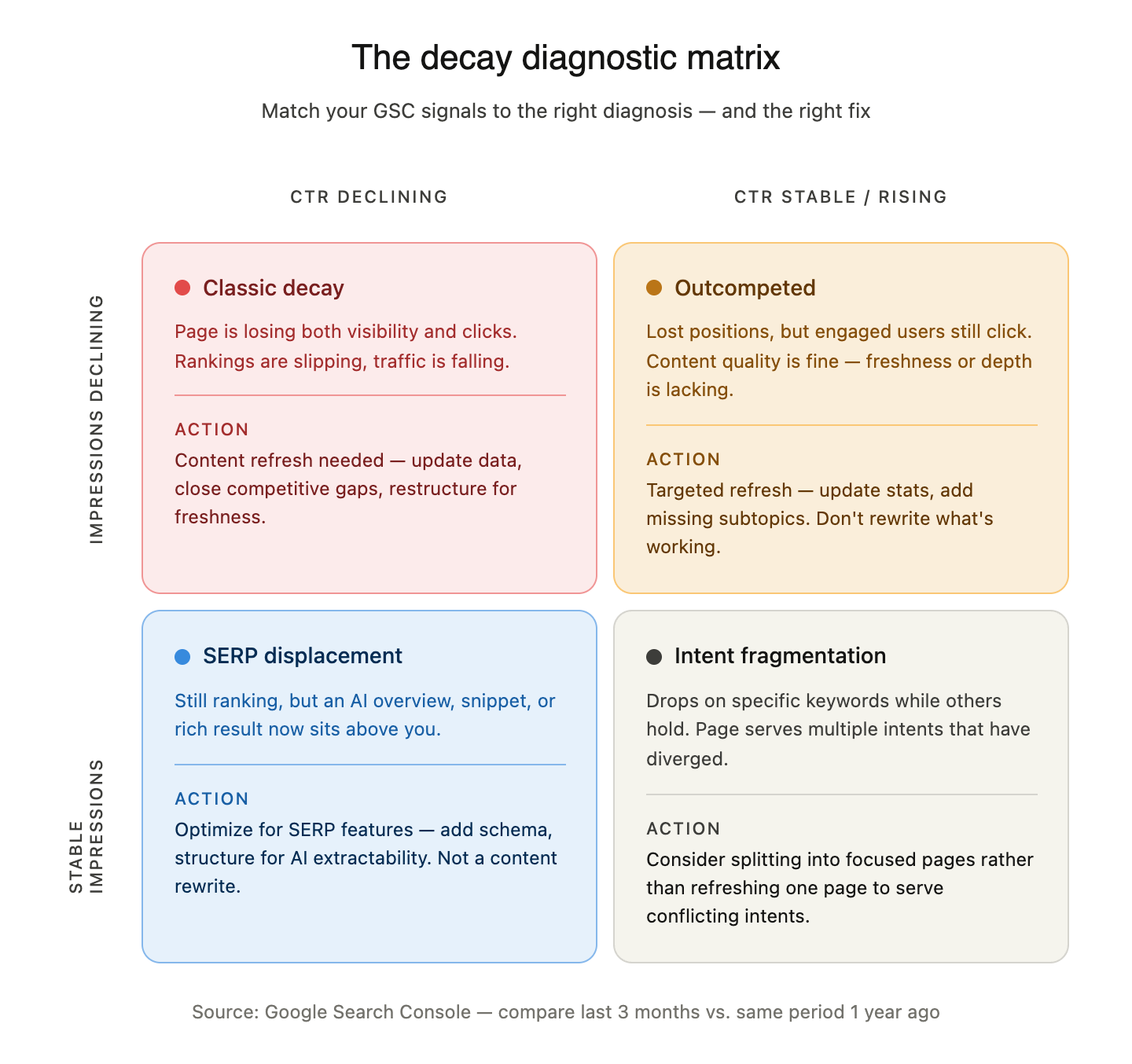
Not every traffic drop is content decay. Before investing in refreshes, use Google Search Console data (last 3 months vs. same period one year ago) to identify which type of problem you're dealing with:
Supplement this with GA4 engagement rate as an early warning, a page with steady traffic but declining engagement is attracting visitors who aren't finding what they need, which is a leading indicator of future ranking loss.
One critical step before doing anything: rule out technical causes. Verify analytics tracking hasn't changed, no recent migrations affected URLs, and robots.txt isn't blocking crawlability.
Content lifespan: How fast different content types decay
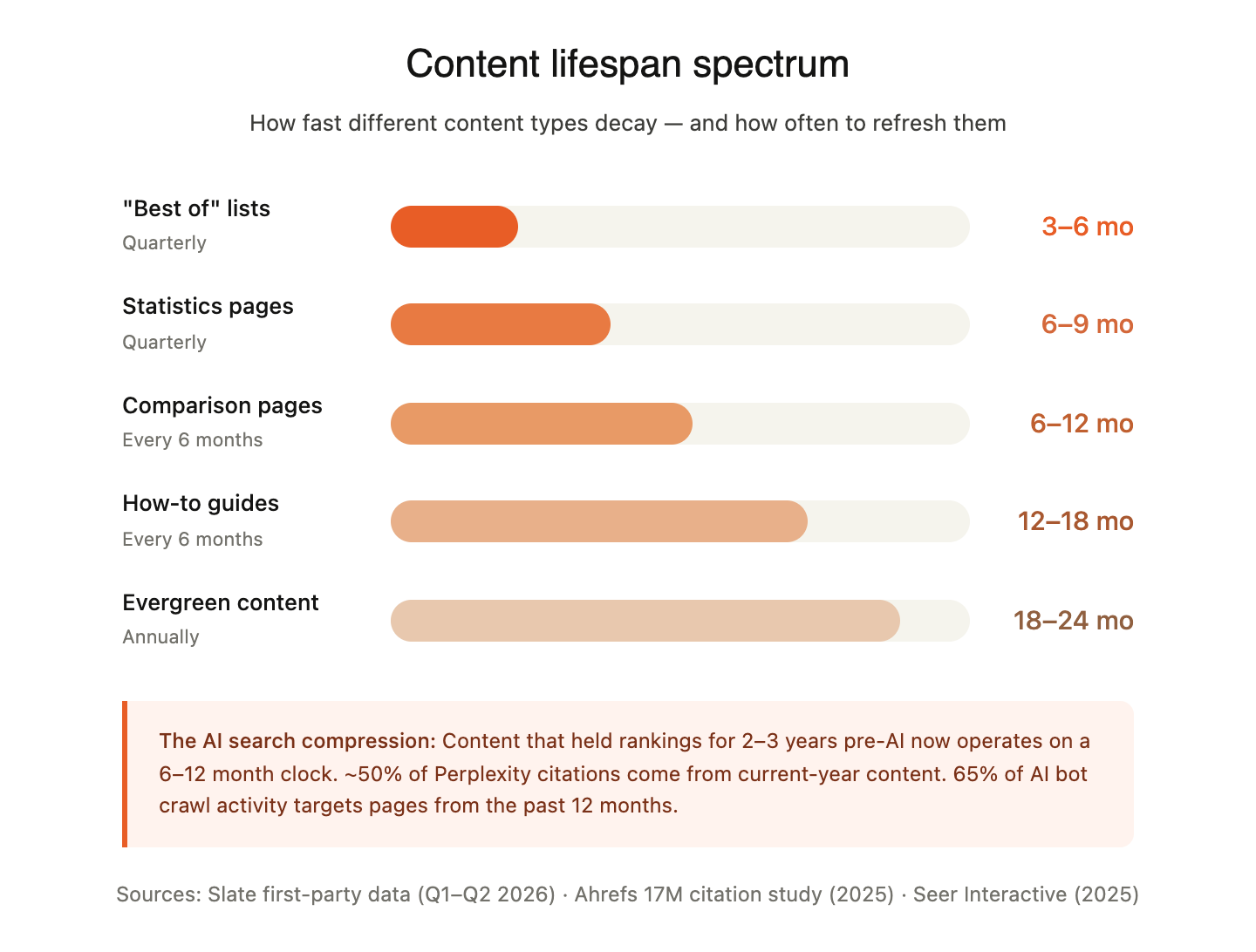
Not all content ages at the same rate. Understanding the typical lifespan by content type helps you build a proactive refresh cadence rather than reacting after decay has already set in.
The overall trend: content that held rankings for 2-3 years pre-AI now operates on a 6-12 month clock.
Roughly 50% of Perplexity's citations come from current-year content, and 65% of AI bot crawl activity targets pages from the past 12 months (Ahrefs, 2025). If your content hasn't been touched in a year, it's aging out of the AI discovery layer.
The Rising Importance of Content Freshness
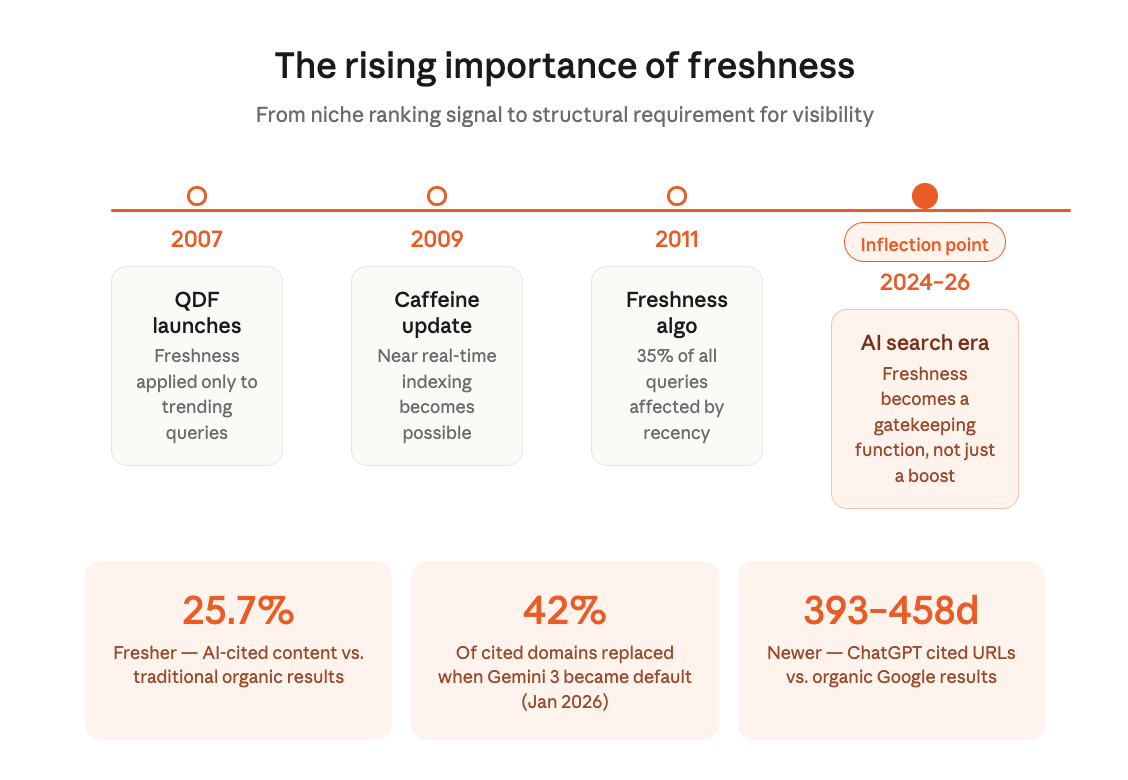
Freshness wasn't always a ranking signal. For most of Google's history, a well-linked, comprehensive page could rank indefinitely regardless of when it was last updated.
That started changing in 2007 when Google introduced Query Deserves Freshness (QDF), a model that detected "hot" topics by monitoring spikes in news coverage and search volume, then prioritized recent content for those queries.
In 2009, the Caffeine update overhauled Google's indexing infrastructure so pages could be recrawled in near real-time instead of weeks-long cycles.
Then in 2011, the Freshness Algorithm launched and affected 35% of all search queries, formally making recency a ranking dimension across breaking events, recurring events, and frequently updated topics.
But all of that was selective, freshness only mattered for certain query types.
The 2024–2026 shift is different. AI search made freshness a gatekeeping function, not just a boost. AI Overviews now appear on roughly half of US searches. ChatGPT cites URLs that are 393–458 days newer than what ranks organically on Google. When Gemini 3 became the default model powering AI Overviews in January 2026, it replaced 42% of previously cited domains overnight.
The arc is clear: freshness went from irrelevant, to a niche signal for trending queries, to a structural requirement for visibility across both traditional and AI search. Content that could rank untouched for years now has a measurable expiration date.
Why Content Refresh Matters in 2026
Until recently, "visibility" meant one thing: where you rank on Google.
In 2026, it means two: your SERP position and whether AI platforms cite your content when users ask questions about your category. Content refresh is one of the few levers that moves both simultaneously.
1. SEO and Ranking Recovery
Google's Query Deserves Freshness system actively favors recently updated content for any query with an implicit freshness signal and that category has expanded well beyond breaking news.
Queries like "best [tool]," "top [category]," and "how to [process]" now carry freshness expectations. Content untouched for 12-18 months is at a structural disadvantage against competitors who've refreshed, even if your page is more comprehensive.
The highest-value refresh targets are pages sitting in "striking distance": positions 6-15 on Google. These pages already have authority, backlinks, and indexing history. They don't need to earn trust from scratch. They need a push, updated data, closed competitive gaps, better structure. One position gain in this range can mean a 2-3x improvement in click-through rate.
Slate's CTR benchmark data shows a 64% CTR drop between position #4 and position #5 for commercial content, meaning a single position improvement at that threshold delivers outsized returns.
Refreshing also helps recover lost SERP features. Featured snippets, People Also Ask inclusions, and AI Overview citations tend to favor pages with current data, structured formatting, and clear question-answer pairs, all things a well-executed refresh adds.
2. AI Search Visibility
AI platforms apply a measurably stronger freshness bias than traditional Google. ChatGPT cites URLs 393-458 days newer than what ranks organically. Roughly 50% of Perplexity's citations come from content updated in the current year.
Beyond freshness, AI platforms favor content with strong E-E-A-T signals: expert quotes, author credentials, first-party data, and clear sourcing. A refresh that adds these elements makes content citable by machines that are increasingly deciding what information users see.
3. Cost-Effectiveness vs. New Content
Content refreshes consistently deliver up to 70% better ROI than creating new posts.
An analysis of 50K+ ecommerce pages found refreshed content produced 268% organic click growth versus 22% from new pages.
The simple math: a 2-hour refresh recovering 500 monthly visits at 2% conversion and $50 average order value generates $500/month in recovered revenue, over 400% ROI in month one. The recommended starting allocation is 20-30% of your content production hours toward refreshes.
Content Refresh vs. New Content: When to Do Which
Most teams default to publishing new content because it feels like progress. But when a page already has backlinks, indexing history, and some ranking traction, refreshing it is almost always the faster, cheaper, higher-ROI move. The question isn't which approach is better, it's knowing when each one is the right call.
Refresh when:
- The topic is still relevant but the content is outdated: stale stats, old examples, missing subtopics
- The page has existing backlinks and ranking history worth preserving
- Performance has flattened or declined, but the page still gets some traffic
- The page influences downstream conversions even if it's not a high-traffic page itself
Create new when:
- No page on your site genuinely addresses the search intent
- The topic is entirely new to your coverage area
- Search intent has shifted so fundamentally that the old page's framing is unsalvageable, a refresh would mean rewriting 90%+ anyway
The cost comparison
How the split changes by company stage
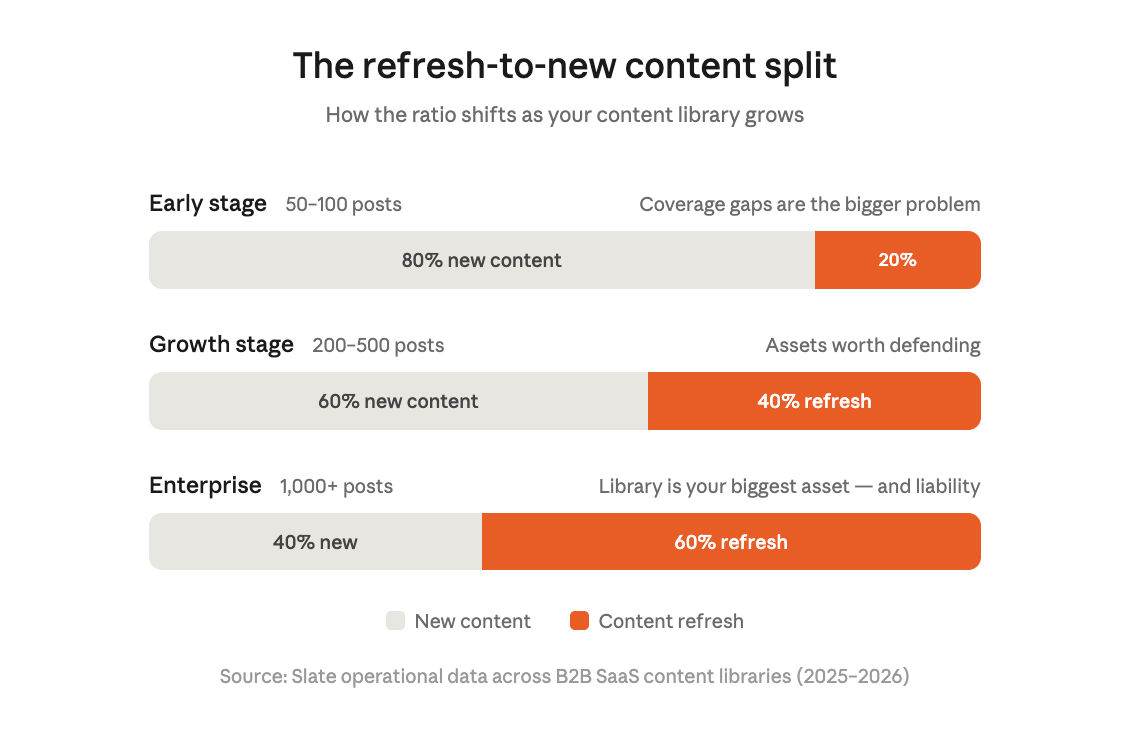
Early-stage companies with 50-100 published pages should lean roughly 80/20 toward new content, there's not enough to protect yet, and coverage gaps are the bigger problem.
At 200-500 pages, shift to 60/40, you now have assets worth defending.
At 1,000+ pages, flip to 40/60 favoring refresh, your existing library is simultaneously your biggest asset and your biggest liability if left unmaintained. The cost of content decay at scale always outpaces the gains from net-new publishing.
How to Identify Content That Needs a Refresh
You can't refresh everything, and you shouldn't try. The first step is building a reliable system for surfacing the pages that actually need attention, and separating real decay from noise.
- Start with Google Search Console
Compare the last 3 months against the same period one year ago. Filter by page, and sort by the largest drops in clicks and impressions. This gives you a working list of declining pages. Then check whether impressions and CTR are both dropping (classic decay), or whether CTR alone is declining (SERP feature displacement, different fix).
- Check your AI citation gaps
This is the step most teams skip. A page can rank on page one of Google and still be completely absent from AI-generated answers. Run your 20-30 highest-value queries through ChatGPT, Perplexity, and Google's AI search, note which of your pages get cited and which don't. The ones that don't are your AI visibility priorities. Slate's AI analytics across five B2B SaaS brands found that even well-positioned brands are missing from 70-90% of relevant AI answers (Slate first-party data). The citation gap is almost certainly larger than you think.
- Benchmark against competitors
Pick your top 5-10 ranking competitors for your most valuable keywords. Check when their content was last updated. If they've refreshed in the last 3-6 months and you haven't, that's a leading indicator that your decay is about to accelerate or already has.
Signals that a page needs a refresh
- Outdated year in the title or H1 (e.g., "Best CRM Tools 2024")
- Statistics older than 18 months
- Broken outbound links or references to discontinued products
- Missing structured data - no FAQ schema, no Article schema with dateModified
- Thinner than current top-ranking competitors on the same query
- Ranks on Google but doesn't appear in any AI-generated answers for target queries
- Engagement rate declining in GA4 even if traffic is stable - users are landing but not finding what they need
Prioritization Matrix: What to Refresh First
You now have a list of decaying pages. The mistake most teams make here is treating them equally, refreshing whatever's easiest or most visible internally instead of what will generate the most impact. Prioritization is where the refresh strategy separates from refresh busywork.
Score every page on four dimensions
- Traffic value: how much organic traffic and revenue does this page currently generate or protect? A page bringing in 2,000 visits/month that's dropped 30% is a higher priority than a page that peaked at 200.
- Decay severity: how far has it fallen, and how fast? A 20% decline over 6 months is early-stage and easy to recover. A 60% decline means you're in rescue mode with a narrower margin for error.
- Competitive gap: how much better is the content that's now outranking you? A small gap (they added a comparison table you're missing) means a light refresh closes it. A large gap (their page is twice as long, more current, better structured) may require a deep rewrite.
- Business impact: does this page influence conversions, even indirectly? Pages in the middle of the funnel — comparisons, pricing, alternatives, often matter more than top-of-funnel posts with higher raw traffic.
Where to start
Your highest-priority pages are the ones where multiple dimensions converge: high traffic value, recent decline, closeable competitive gap, and commercial intent. Slate's citation data reinforces this: across the B2B SaaS brands analysed, the top 15 cited URLs accounted for 38.8% of all AI citation activity. Refreshing a small number of high-value pages produces outsized results (Slate first-party data).
Decide the depth of refresh
Not every page needs the same level of effort.
- Light refresh (1-2 hours): Update stats, fix the date in the title, refresh meta description, add internal links. Best for pages with minor decay that still match search intent.
- Deep rewrite (3-6 hours): Restructure sections, close competitive gaps, overhaul the intro, add schema markup. Best for significant decay but solid existing authority.
- Full tear-down (6-12 hours): Rewrite from scratch on the same URL. Only when intent has shifted so fundamentally that the current framing is unsalvageable.
The deciding factor: how much has search intent shifted since the page was last updated? If the same type of content still ranks, a refresh works. If the entire SERP looks different from what your page offers, you're looking at a tear-down.
The Content Refresh Playbook
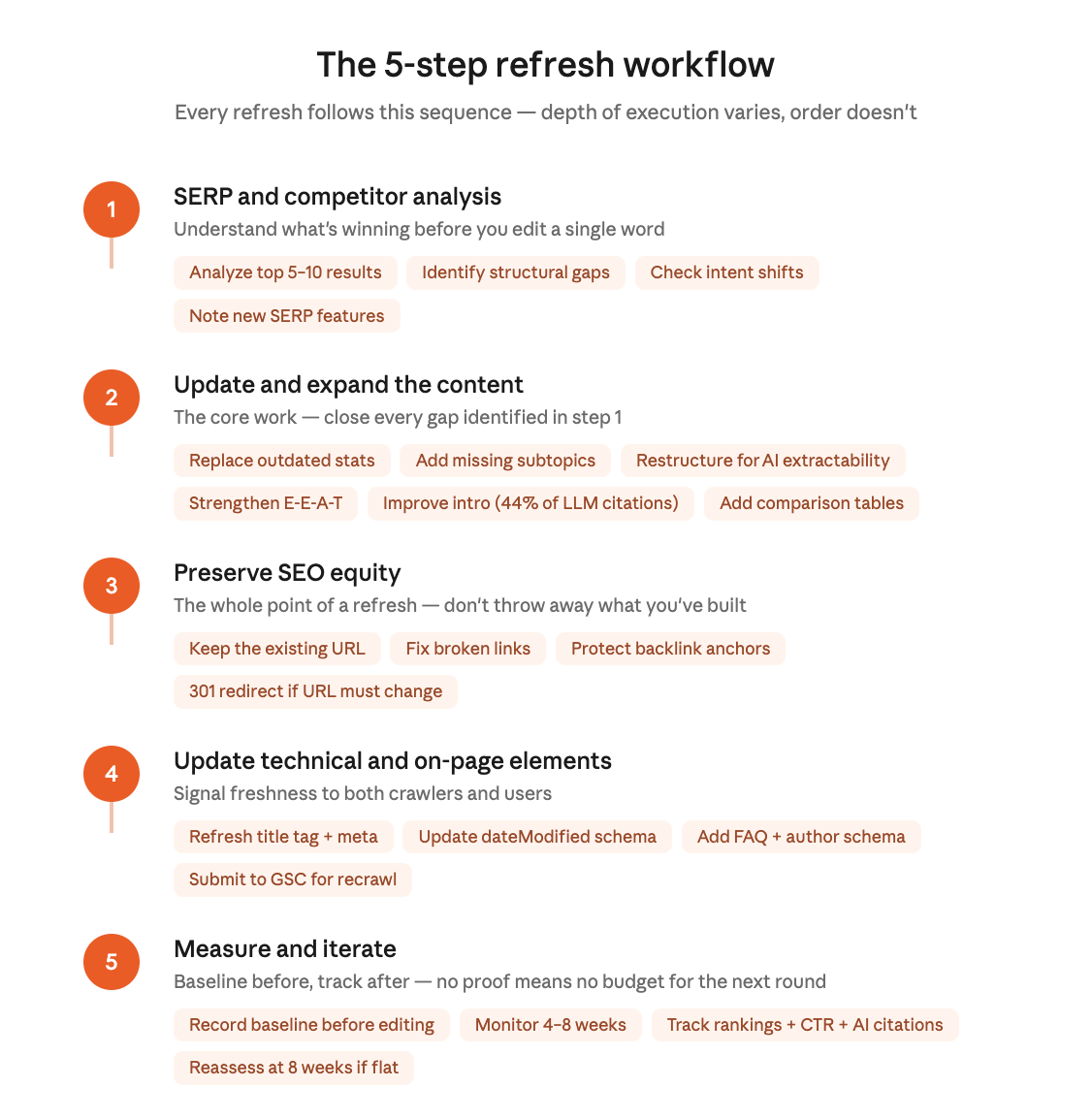
This is the step-by-step. Every refresh should follow this sequence regardless of depth, what changes between a light refresh and a deep rewrite is how many of these steps you execute, not the order.
- Before you touch anything: baseline the page
Pull current rankings, organic traffic, CTR, conversions, and AI citation status. You cannot prove ROI without a before snapshot. Set a calendar reminder to re-pull these numbers at 30, 60, and 90 days post-refresh.
- Analyze what's winning now
Search your target keyword. Study the top 3-5 ranking pages. Note what they cover that you don't, how they're structured, what data they include, and whether they appear in AI Overviews. This is your competitive gap analysis — it tells you exactly what the refresh needs to close.
- The refresh checklist
Content updates:
- Replace every statistic older than 18 months with current data
- Update examples, screenshots, product references, and pricing
- Close topical gaps: add subsections that top-ranking competitors cover and you don't
- Remove sections that are no longer relevant rather than leaving them as dead weight
Title and meta:
- Update the year in the title: Slate's citation data across five brands show year-tagged titles correlate with significantly higher AI citation rates.
- Rewrite the meta description to reflect updated content and current value proposition
Structure for AI extractability:
- Rewrite headers as clear questions where possible ("How does X work?" not "Overview of X")
- Add a TL;DR or key takeaways section near the top: 44.2% of all LLM citations come from the first 30% of text
- Use comparison tables for any content that evaluates options: Slate's data shows comparison and alternatives pages earn the highest citation counts across all monitored AI platforms
- Break long paragraphs into 2-3 sentence chunks that each convey one clear idea
Schema and structured data:
- Add or update Article schema with dateModified: this explicitly signals freshness to crawlers
- Add FAQ schema for any page answering common questions
- Add Author and Organization schema to reinforce E-E-A-T signals
- For comparison content, use structured table markup that AI systems can extract directly
Internal linking:
- Link from your high-traffic pages to the refreshed content, this transfers authority and helps search engines rediscover the page
- Update the refreshed page's outbound internal links to point to your most current related content
Freshness signals:
- Add a visible changelog: "Updated [Month Year]: [specific changes made]"
- Don't just change the date, Google evaluates whether the actual content delta is meaningful enough to justify a new timestamp
After publishing
Request a recrawl via Google Search Console's URL Inspection tool. Then redistribute: share on social, notify anyone quoted or cited in the update, push to newsletters. A refresh that nobody sees recovers slower than one that gets fresh engagement signals immediately.
One thing to watch: pages ranking for multiple keywords
Before editing, map every keyword the page currently ranks for, not just your target term. Ensure the refresh serves the dominant intent without stripping content that supports valuable long-tail queries. If the page serves two genuinely conflicting intents, consider splitting it into two focused pages rather than forcing one page to do both jobs.
Measuring Success and Proving ROI
A refresh without measurement is a guess. Every refresh should have a baseline taken before you edit and a tracking window of 60-90 days after.
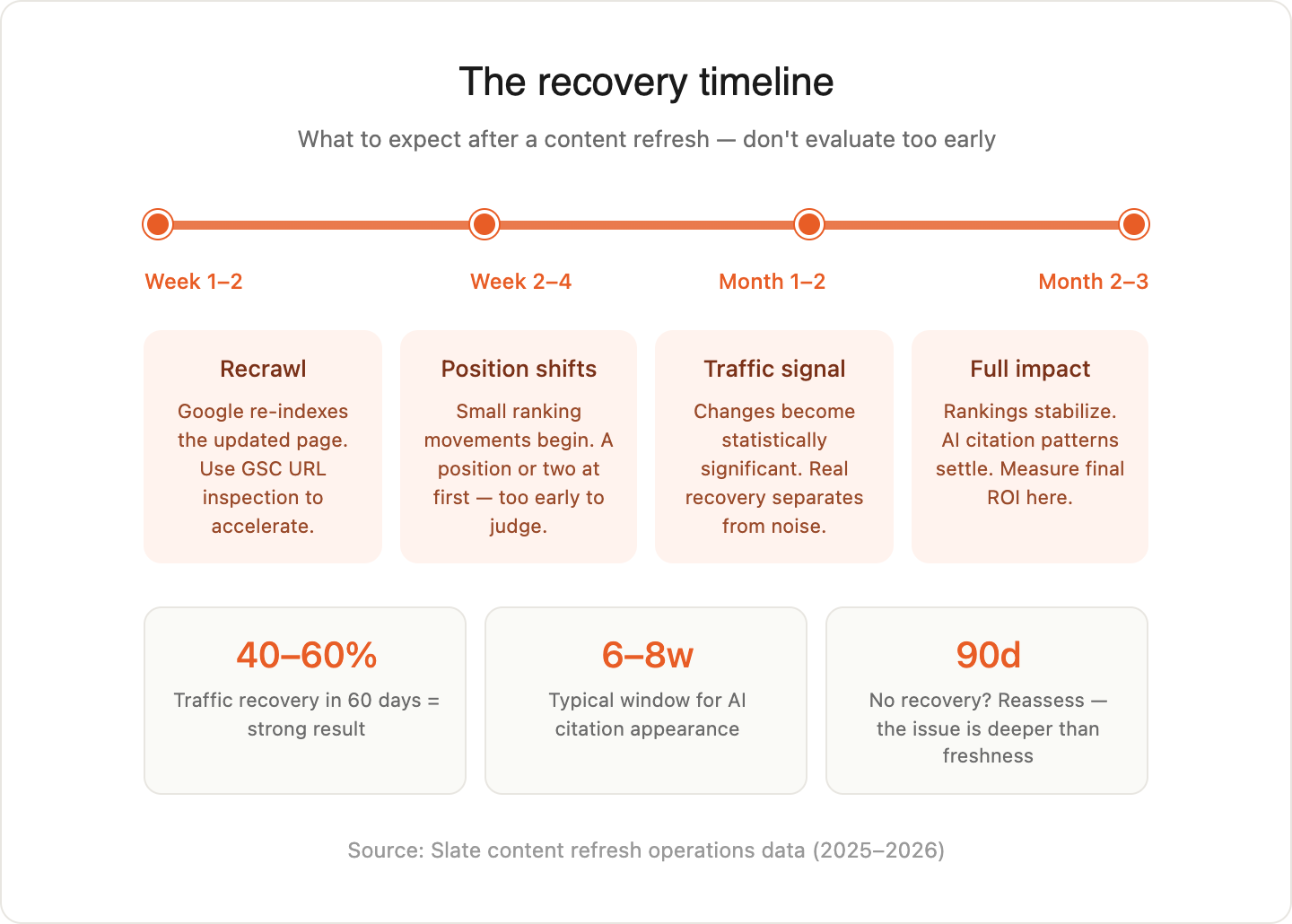
The timeline of results
Don't expect overnight movement. Here's what a typical recovery looks like:
Week 1-2: Google recrawls the updated page. Request this manually via GSC's URL Inspection tool to accelerate it.
Week 2-4: Position changes begin appearing in Search Console. Small movements first, a position or two.
Month 1-2: Traffic changes become statistically significant. This is when you can start distinguishing real recovery from noise.
Month 2-3: Full impact is measurable, rankings stabilize at their new level, AI citation patterns settle, engagement metrics reflect the updated content.
What to track
Rankings and organic traffic are obvious. But a complete refresh measurement framework includes: CTR change (did the new title and meta improve click rates at the same position?), engagement rate in GA4 (are visitors finding what they need now?), conversion impact (did the refresh affect leads or revenue from this page?), new backlinks earned (quality refreshes attract links), and AI citation status (is the page now being cited where it wasn't before?).
What "good" result looks like
Recovering 40-60% of lost traffic within 60 days is a strong result. Regaining pre-decay ranking positions within 90 days is typical for well-executed refreshes. Appearing in AI citations for target queries within 6-8 weeks is achievable if you've done the structural optimization, schema, extractable headers, comparison tables. If a page shows no meaningful recovery after 90 days, the problem is likely deeper than freshness, revisit whether intent has shifted or whether a full tear-down is needed.
Avoid Common Mistakes and Misconceptions
Mistakes that waste your effort:
- Changing the date without changing the content.
Google evaluates whether the actual content delta justifies a new timestamp. A cosmetic date swap with no substantive edits can be ignored entirely, or worse, signal to Google that you're gaming freshness.
- Refreshing without baselining.
If you don't record rankings, traffic, and citation status before you edit, you can't prove the refresh worked. No proof means no budget for the next round.
- Prioritizing the wrong pages.
Refreshing low-traffic, no-backlink pages because they're easy is busywork. Start with pages where recovery has measurable business impact.
- Ignoring the intro.
44.2% of LLM citations come from the first 30% of a page. Teams habitually update the middle and end while leaving the intro untouched, the exact section AI platforms weight most heavily.
- Creating new content that cannibalizes the old.
Publishing a new page on the same topic instead of refreshing the existing one splits your authority, confuses search engines, and often results in both pages performing worse.
Misconceptions that prevent teams from starting:
"Updating old content will hurt my rankings." The opposite is true. The risk is in not updating. Refreshed pages retain their authority, that's the entire point.
"I should change the URL to make it look new." Almost never. The old URL holds the backlinks, the indexing history, and the keyword associations. Changing it throws all of that away.
"My page still ranks #3, so it's fine." With an AI Overview sitting above you, position #3 delivers a fraction of the clicks it used to. And if you're not being cited in that AI Overview, you're invisible to a growing share of your audience.
Scaling Content Refresh: From Manual to Automated
Everything in this guide works at a small scale. You can manually identify decaying pages, analyze competitors, refresh the content, and track results for 10-20 pages. The problem is that most content libraries have hundreds or thousands of pages, decay doesn't wait for your team to finish the backlog, and the refresh window is tightening, AI platforms operate on a 90-day freshness clock for competitive queries.
Manual refresh breaks down at scale because the workflow has too many sequential steps: identify decay in GSC → cross-reference with AI citation data → analyze competitors → brief a writer → execute the refresh → update schema → republish → request recrawl → track performance at 30/60/90 days. For a single page, that's manageable. For 500 pages on a quarterly cadence, it's a full-time team.
The automation framework
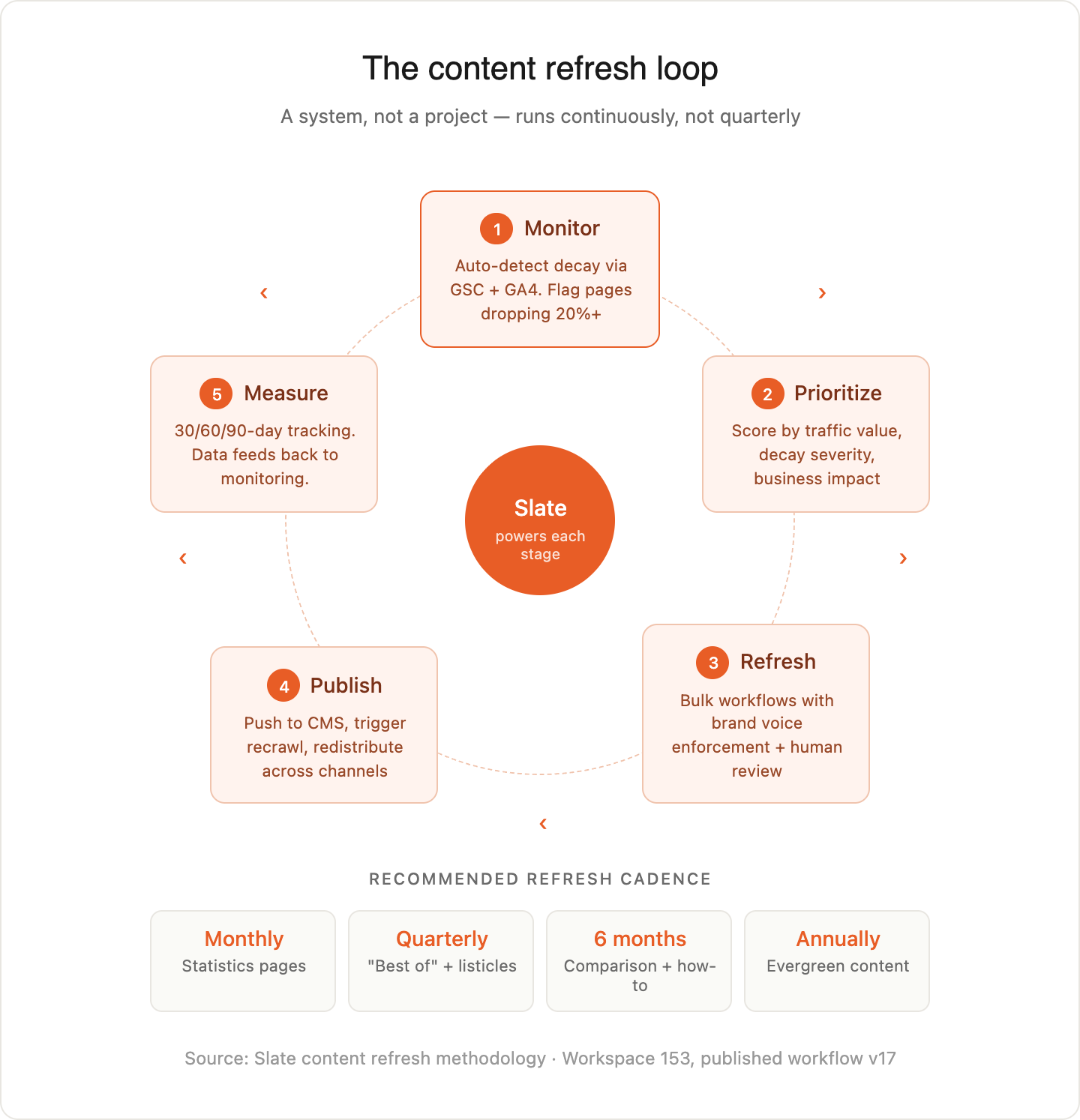
A scalable refresh operation runs on a five-stage loop:
- Monitor: Automated decay detection connected to GSC and GA4. Flag any page dropping 20%+ over a rolling 3-6 month window. This runs continuously, not quarterly.
- Prioritize: Score flagged pages automatically by traffic value, decay severity, competitive gap, and business impact. The system surfaces what matters most, not what decayed most recently.
- Refresh: Execute updates using workflows that enforce your brand voice, pull in competitive gap analysis, and generate draft content for human review. The key word is "draft", automation handles research and structure, humans handle judgment and quality.
- Publish: Push approved content directly to your CMS, trigger a recrawl, and update structured data in one step rather than three.
- Measure: Automated before/after tracking at 30, 60, and 90 days. Performance data feeds back into the monitoring stage, closing the loop.
Set your refresh cadence by content type: statistics and data pages monthly, comparison and "best of" pages quarterly, how-to guides every six months, foundational evergreen content annually.
How Slate runs this
Slate was built specifically for this loop.
It connects to your GSC and GA4, surfaces decaying pages ranked by urgency, and lets you run bulk refresh workflows across hundreds of pages through Sheets, same effort for 10 pages as for 1,000.
Every refresh gets per-page AI-driven recommendations (subtopics to add, outdated stats to replace, structural improvements for AI citability), brand voice enforcement from your uploaded style guides, and human review gates before anything is published.
It pushes directly to WordPress or Webflow, then tracks performance automatically across both organic rankings and AI citations on ChatGPT, Perplexity, Gemini, and AI Overviews.
It also works inside Claude via MCP so you can query your content performance data without switching tools.
Conclusion
Content refresh isn't maintenance. It's the highest-ROI growth lever most content teams are underusing, faster than new content, cheaper than new content, and increasingly the difference between being visible in AI search or being absent from it entirely.
The playbook is straightforward: identify what's decaying, prioritize by impact, refresh systematically, measure the results, and build the cadence that keeps your library performing. The companies doing this well aren't doing anything exotic, they're just doing it consistently, with a system behind it instead of ad hoc effort.
Start with your top 20 decaying pages. Baseline them today. Refresh them this month. Measure at 60 days. The results will make the case for scaling better than any internal pitch deck ever could.
Your content library is either compounding in value or decaying. There's no steady state. The only question is which side of that curve you're on right now.
FAQ Section
Q1: What is a content refresh?
A content refresh is the process of updating existing published content to improve its accuracy, relevance, structure, and search performance, without creating an entirely new page.
Q2: How often should content be refreshed?
Most content benefits from a refresh every 12-18 months. High-competition pages and pages with time-sensitive data should be reviewed quarterly. Run formal content audits at least every quarter to identify decay candidates.
Q3: Does refreshing a page guarantee improved rankings?
No. Refreshing improves the probability of ranking recovery but is not guaranteed. Results depend on the quality of updates, competitive landscape, and whether the refresh aligns with current search intent.
Q4: What if traffic drops after a content refresh?
Monitor for at least 4-8 weeks before reacting, temporary fluctuations are normal. If traffic remains down, diagnose potential causes: intent mismatch, lost backlinks from removed sections, technical indexing issues, or insufficient depth compared to competitors.
Q5: What's the difference between a content refresh and a content rewrite?
A refresh updates specific elements (stats, examples, structure, visuals) within the existing framework. A rewrite fundamentally restructures the piece, new angle, new outline, potentially new target keyword. Refresh when the foundation is sound; rewrite when the core thesis or format is outdated.
Q6: Is refreshing content more cost-effective than creating new content?
Generally, yes. Refreshed pages retain existing authority, backlinks, and indexation history. This means updates build on established equity rather than starting from zero, typically yielding faster results with less investment.
Q7: How do I maintain backlinks during a content refresh?
Before editing, audit inbound backlinks to identify which sections or anchors attract links. Preserve those sections or, if restructuring is necessary, ensure the linking context remains relevant. Never change URLs without implementing 301 redirects.
Q8: What types of content benefit most from a refresh?
Blog posts and guides with declining traffic, pages ranking positions 6-20, content with outdated statistics or examples, pillar pages that anchor your topical authority, and any page where SERP intent has shifted since publication.