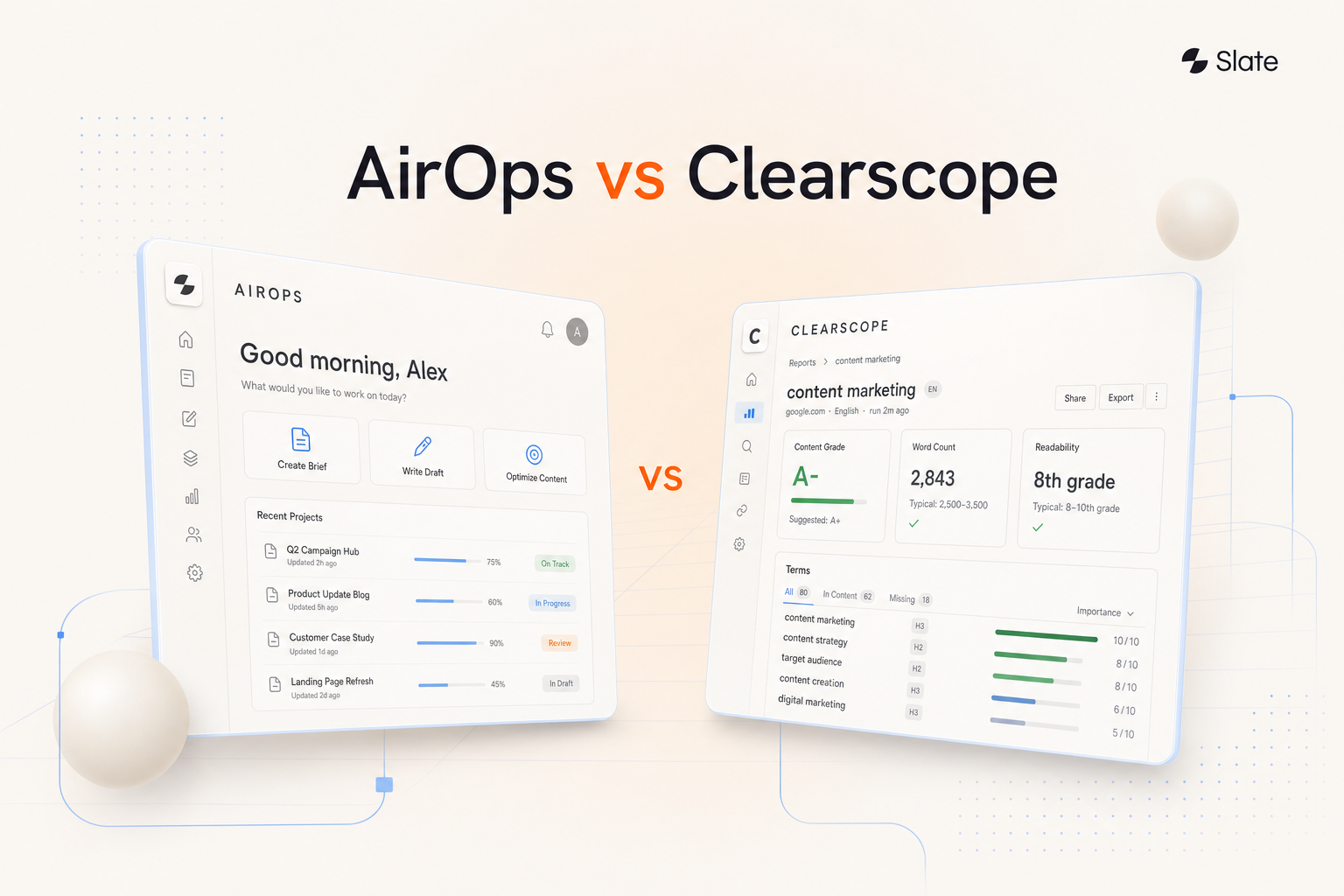
Neutral 2026 AirOps vs Ahrefs comparison: features, pricing, best-fit use cases, and whether you need one tool or both.
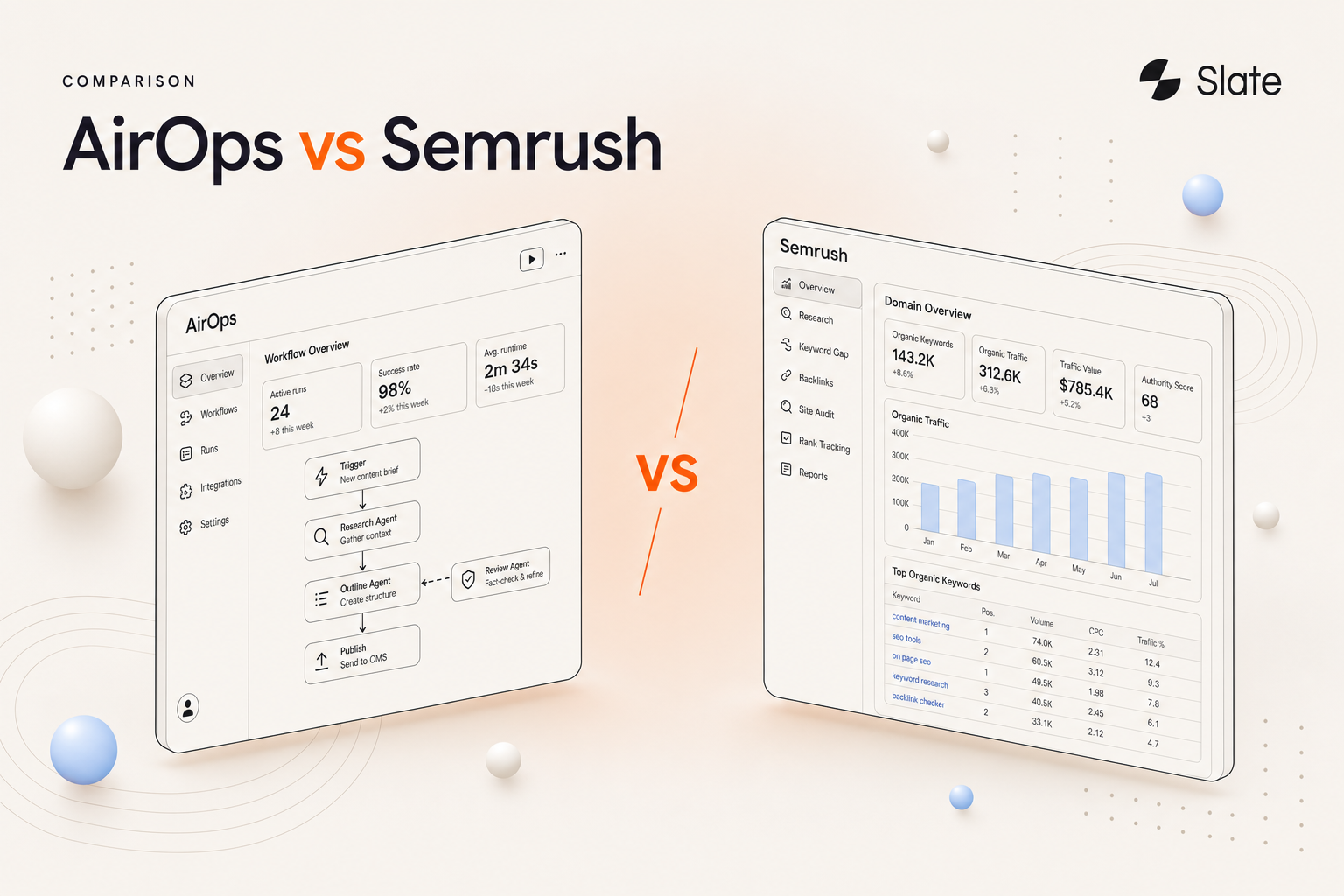
Choosing between AirOps and Ahrefs usually comes down to one question buyers rarely ask out loud: is the bottleneck insight or execution? Ahrefs is a research-first SEO platform built for keyword research, backlink analysis, and audits, while AirOps is an execution-first AI-search and content-ops platform built for workflows and publishing. They overlap partly, but they solve different layers of the same job-so the smarter comparison is by bottleneck, not by feature checklist.
Key Takeaways
- Ahrefs is best understood as a research and analysis layer; AirOps is best understood as a workflow and execution layer.
- Ahrefs is the stronger fit when the main need is keyword research, backlink analysis, site audits, rank tracking, and competitor intelligence.
- AirOps is the stronger fit when the main need is AI-search visibility workflows, content operations, refresh-at-scale, and CMS publishing.
- They overlap partially, but they do not solve the same layer of work, so replacement decisions should be made by bottleneck, not by feature checklist alone.
- Pricing models differ structurally: Ahrefs is framed around seats and plans, AirOps around tasks, usage, and custom packaging.
- In 2026, many buyers are choosing an organic growth operating model rather than a single tool, which is where Slate enters as a third option connecting visibility, action, and governance.
Quick Answer: How Does AirOps Compare To Ahrefs?
Ahrefs is a research-first SEO platform with deep keyword, backlink, technical, and rank-tracking capabilities. AirOps is an execution-first AI-search and content-ops platform that turns visibility insights into briefs, AI-generated drafts, workflows, and CMS publishing. Choose by whether your real constraint is insight or action-and if both need to live together with governance, evaluate Slate.
The two tools rarely compete head-to-head. One tells you what to do; the other helps you actually ship it. That distinction shapes every section below, including pricing, replacement logic, and best-fit recommendations.
AirOps vs Ahrefs At A Glance
The table below summarizes where each platform leads across the functions most teams evaluate. Ahrefs dominates the research and analysis rows; AirOps dominates the workflow and execution rows. Use this as a quick orientation, then read the recommendation matrix for role-based guidance before deciding. For a broader survey, our roundup of the best AI SEO tools maps how these platforms fit into the wider landscape.
What Each Platform Is Actually Built For
The clearest way to separate these tools is by where they sit in the workflow. Ahrefs starts from data and demand intelligence. AirOps starts from action and content operations. Neither is wrong-they're built for different jobs.
What Ahrefs Is Built For
Ahrefs is an all-in-one SEO toolset focused on the research and analysis layer of search.
Its core modules-Site Explorer, Keywords Explorer, Site Audit, and Rank Tracker-are built to answer questions about demand, competitors, and technical health. More recently, Brand Radar extends Ahrefs into AI-search territory, tracking brand presence across AI Overviews and assistants like ChatGPT, Gemini, and Perplexity.
Best for: SEO teams, agencies, and marketers who need strong keyword research, competitor and backlink analysis, and site auditing.
Key features: Site Explorer for competitor, traffic, and backlink analysis; Keywords Explorer for keyword research and search demand; Site Audit and Rank Tracker for technical SEO monitoring.
What AirOps Is Built For
AirOps is a growth platform for AI search and AEO that lives on the workflow and execution layer.
Where Ahrefs stops at insight, AirOps picks up: it measures AI-search visibility, then turns those insights into content creation, refresh, and publishing through visual workflows. Brand Kits and Knowledge Bases keep AI-generated content governed and on-brand, while CMS integrations push finished work live.
Best for: Content, SEO, and marketing teams that need to track AI-search visibility and operationalize content production at scale.
Key features: AI-search visibility insights across engines like ChatGPT, Gemini, Perplexity, Claude, and Google; content creation and refresh workflows with bulk execution and CMS integrations; Brand Kits and Knowledge Bases for governed production.
What's The Core Difference Between AirOps And Ahrefs?
The core difference is layer, not quality. Ahrefs is a research and analysis platform that tells you where the opportunities are-keyword gaps, backlink targets, technical issues, competitor moves. AirOps is a workflow and execution platform that turns those opportunities into shipped, governed content at scale. One produces intelligence; the other produces output.
Think of a single content project moving through stages: research, prioritization, drafting, review, publishing, refresh. Ahrefs is strongest at the front of that pipeline. AirOps is strongest from prioritization onward. That's why framing them as interchangeable misses the point-they sit at different points in the same operating model, and the right answer depends on where your work actually gets stuck.
Feature-By-Feature Breakdown
Each function below opens with a one-line verdict, then the operational tradeoff that matters for buyers.
Keyword Research
Verdict: Ahrefs wins clearly. Keywords Explorer offers a deep keyword database, search volumes, difficulty scores, and SERP analysis built specifically for demand research. AirOps can surface queries and opportunities through its AI-visibility and content tooling, but it isn't positioned as a primary keyword research database. If keyword depth is your constraint, Ahrefs is the stronger choice for keyword research.
Competitive Analysis
Verdict: Ahrefs wins. Site Explorer delivers comprehensive competitor intelligence-organic keywords, top pages, content gaps, paid search, and backlink profiles. AirOps focuses on your own content performance and AI-search presence rather than deep SERP and link competitor analytics. For teams that compete on research depth, Ahrefs remains the system of record. Teams that want to close gaps systematically often start with the best content gap analysis tools.
Backlink Analysis
Verdict: Ahrefs only. One of Ahrefs' historic strengths is its large backlink index, with detailed referring domains, anchor text, and link growth data. AirOps does not offer a native backlink database; teams that need link intelligence pair it with a tool like Ahrefs. This is one of the clearest non-overlap areas between the two.
Site Audit / Technical SEO
Verdict: Ahrefs only. Site Audit provides a dedicated crawler with health scores, issue detection, and technical recommendations. AirOps has no first-party crawler; technical fixes happen via imported data inside workflows. If robust technical SEO is a core requirement, Ahrefs is effectively required.
Rank Tracking
Verdict: Different jobs. Ahrefs' Rank Tracker monitors classic SERP positions over time. AirOps tracks AI-search visibility-brand presence across prompts and AI surfaces-rather than blue-link rankings. Pick Ahrefs for traditional rank tracking and AirOps for AI-answer visibility.
Content Briefs & Refresh Workflows
Verdict: AirOps wins. Ahrefs can inform briefs through SERP data and on-page suggestions, but it isn't a full workflow engine. AirOps is built for content orchestration: AI-driven briefs, brand-aware templates, and refresh workflows that run at scale. Refresh-at-scale is where most research-first tools stop and execution platforms earn their place. Teams seeking an Ahrefs alternative for content optimization usually feel this gap first, and a look at the best content refresh tools clarifies the options.
AI Content Generation
Verdict: AirOps wins. Ahrefs offers AI-assisted recommendations, but they're add-ons rather than the core of the platform. AirOps is built around AI content creation and optimization, with workflows to generate, edit, and publish programmatically. The important caveat: human judgment and governance still matter-AI assists execution, but strategy and accountability stay with the team.
Workflow Automation
Verdict: AirOps wins. Ahrefs provides reports, alerts, and integrations, but not a true visual workflow builder. AirOps offers visual workflow builders that connect inputs like visibility data and keyword lists to prompts, review steps, and publishing. For AirOps-style SEO workflows, this is the central value proposition.
Publishing & CMS Integrations
Verdict: AirOps wins. Ahrefs integrates via API but isn't a publishing platform. AirOps is explicitly designed to publish from workflows into major CMS platforms, closing the loop from insight to live page. For teams that want execution to end with shipped content, this matters.
AI Search & Answer-Engine Visibility
Verdict: Both support it, with different strengths. Ahrefs' Brand Radar leads on search-data-driven tracking of brand presence and AI share of voice across AI Overviews and assistants. AirOps connects AI-visibility insights directly into content workflows, emphasizing faster content updates and refreshes tied to those insights. Ahrefs is stronger on measurement; AirOps on turning measurement into action. This is precisely where the modern decision sits, and why AI search visibility tooling is becoming a separate evaluation criterion.
Can AirOps Replace Ahrefs?
Partially, but not fully. AirOps can replace parts of Ahrefs' role in content optimization, AI-driven briefs, and AI-search visibility workflows. It does not replicate Ahrefs' backlink index, deep keyword database, or Site Audit crawler. Teams that treat backlinks, research depth, and technical SEO as core needs will still rely on Ahrefs alongside AirOps.
Where AirOps Overlaps With Ahrefs
- Content optimization and on-page improvements informed by search and AI-visibility data
- AI content generation and refresh at scale
- AI-search visibility tracking that partly mirrors Brand Radar's coverage of AI Overviews and assistants
Where Ahrefs Still Fills A Distinct Role
- Backlink data and link-building strategy
- Comprehensive keyword research and SERP analysis
- Technical SEO via Site Audit
- Classic SERP rank tracking
When Using Both Makes Sense
Using both makes sense when research and production are separate bottlenecks. Many B2B SaaS teams run Ahrefs as the research and monitoring backbone, then run AirOps to turn that intelligence into shipped, governed content. If your team has plenty of insight but ships slowly, the execution tool is the fix. If you ship fast but guess at strategy, the research tool is the fix. The honest answer to whether AirOps can replace Ahrefs is usually: not for backlinks, audits, and deep keyword work.
Can Ahrefs Replace AirOps?
No. Ahrefs does not offer a visual workflow builder for multi-step content operations, nor does it present itself as a CMS publishing or content orchestration platform. It includes AI visibility and some AI tools, but stops short of scaled refresh, human-review steps, templates, and governed production. Ahrefs delivers insight and monitoring; it does not execute content at scale.
This reinforces the layer distinction. Ahrefs answers "what should we work on?" AirOps answers "how do we ship and refresh it repeatedly without losing quality?" The moment execution capacity becomes the bottleneck, a research suite-however deep-can't close the gap.
Best Fit By Team And Use Case
The right tool depends less on features and more on team shape and where work gets stuck. Below are role-based recommendations, followed by a recommendation matrix.
Best For SEO-Led Teams
SEO-led teams and agencies managing research, audits, and multi-site monitoring should anchor on Ahrefs for keyword depth, backlink intelligence, and technical audits. AirOps becomes valuable when the same team needs to scale content execution or run AI-search experiments without building workflows from scratch.
Best For Content-Led Teams
Content-led teams that produce and refresh content constantly will get more day-to-day value from AirOps, with its AI-assisted briefs, generation, and refresh workflows. Ahrefs still matters upstream for research, but it sits further from the production line for these teams.
Best For Growth Teams And Founders (Lean B2B SaaS)
Lean B2B SaaS growth teams and founders often value AirOps' freemium entry and automation for shipping AI-assisted content without headcount. Ahrefs suits those whose primary need is research and monitoring. The deciding factor is whether the constraint is knowing what to write or actually producing it. For a deeper look at AirOps use cases versus Ahrefs use cases, map the bottleneck first.
Best For Agencies And Consultants
Agencies and consultants typically standardize on Ahrefs as the research and reporting backbone across clients. AirOps becomes an add-on when they productize AI-driven content ops and AI-visibility services, turning insight into repeatable client deliverables.
Best For Enterprise Teams With Governance Needs
Enterprise teams with governance needs require brand control, review steps, and clear governance on top of execution. AirOps suits enterprise-grade content orchestration and brand controls, while Ahrefs remains the research system of record. Governance-approvals, style guides, accountability-is where many enterprise programs decide between AI SEO tools for enterprise content teams.
The matrix below maps needs to choices for a faster deep comparison of AirOps vs Ahrefs.
How AirOps And Ahrefs Pricing Compares In 2026
The two platforms price differently in structure, not just dollars. Ahrefs is seat- and plan-based; AirOps is freemium with usage and task-based scaling. Comparing plan names alone is misleading-the real question is total operating cost, including whether you'll still need the other tool.
Ahrefs Pricing Model
Ahrefs uses tiered SaaS plans with feature access and limits defined by plan level, plus add-ons for AI visibility.
Pricing: Starter $29/mo; Lite $129/mo; Standard $249/mo; Advanced $449/mo; Enterprise $1,499/mo (annual commitment required). Add-ons include Brand Radar AI from $199/mo, Custom Prompt packages at $50/$100/$250/mo, Content Kit from $99/mo, Report Builder $99/mo, and Project Boost from $20/mo per project. A free Ahrefs tier is available.
G2 rating: 4.5/5
AirOps Pricing Model
AirOps follows a freemium model with usage and task-based scaling across tiers.
Pricing: AirOps shows a free Insights tier at $0/mo. It also lists Solo, Pro, and Enterprise on the pricing page, with Pages priced as Custom, but public monthly prices for Solo, Pro, and Enterprise are not displayed. A free tier is available; paid pricing scales with usage and tasks.
G2 rating: 4.6/5
Total Cost Considerations
Plan names hide the real math. Ahrefs adds cost through seats and add-ons like Brand Radar, Content Kit, and Custom Prompt packages-budget for these if AI visibility and content tooling matter. AirOps adds cost through task and usage quotas that climb as production scales. The most important line item is often the second tool: if research and execution are both bottlenecks, you're buying both, which is the real AirOps pricing vs Ahrefs pricing conversation. Stack cost-not single-plan cost-is what shapes the decision.
Pros And Cons
A neutral summary of where each platform is strong and where it leaves gaps. For a fuller breakdown of AirOps pros and cons compared with Ahrefs, match each line to your bottleneck.
AirOps Pros And Cons
Pros: Strong AI content generation and refresh workflows; visual workflow automation for content ops at scale; AI-search visibility tracking across major engines; CMS publishing from workflows; Brand Kits and Knowledge Bases for governed output; freemium entry point.
Cons: No native backlink index; no first-party site crawler for technical SEO; not a primary keyword research database; higher initial learning curve for non-ops users; usage and task-based costs can climb as production scales.
Ahrefs Pros And Cons
Pros: Deep keyword research via Keywords Explorer; large native backlink index; comprehensive competitor analysis through Site Explorer; dedicated Site Audit crawler; reliable rank tracking; Brand Radar for AI-search measurement.
Cons: No true workflow builder for multi-step content ops; not a CMS publishing platform; AI content features are add-ons rather than core; add-on pricing can stack up; Enterprise tier requires an annual commitment.
Where Slate Fits: Visibility And Execution In One System
Ahrefs is the research layer. AirOps is the execution layer. Slate is built as a third option: an AI search optimization and content engineering platform that connects visibility insight to content action and governance in one operating model.
Slate tracks AI-search visibility across ChatGPT, Google AI Mode, Google AI Overviews, and Perplexity, then turns that into citation-ready content through scalable, brand-safe workflows. Brand Kit and Knowledge Base controls keep output on-brand, while Power Sheets and Workflows handle bulk creation and refresh, and CMS publishing pushes work live to Webflow and WordPress. You can see the full set of platform features that connect these stages.
One honest boundary: Slate is not a backlink database. It's built for the new AI discovery layer-visibility, citation readiness, and governed execution-rather than link indexing. Teams comparing the Slate vs AirOps approach are usually deciding how tightly visibility and action should live together.
Best for: B2B SaaS and growth/SEO teams that need AI search visibility tracking plus automated content operations at scale.
Pricing: Starting at $199/month.
G2 rating: 4.9/5
Final Verdict: Which Should You Choose?
The decision comes down to your bottleneck, not a feature scorecard. Each scenario below maps to a clear recommendation.
Choose Ahrefs if your main need is research depth-keyword intelligence, backlink data, audits, and competitor analysis. It's the strongest research and analysis layer for SEO teams and agencies.
Choose AirOps if your main need is content execution and workflow scale-AI-driven briefs, generation, refresh-at-scale, and CMS publishing tied to AI-search visibility.
Choose both if research and production are distinct bottlenecks. Run Ahrefs as the intelligence backbone and AirOps as the production engine. For a wider view, compare the best SEO tool options across AirOps and Ahrefs.
Choose a unified approach and evaluate Slate if visibility and action need to live together with governance in a single system. In 2026, more teams are buying an organic growth operating model than a single tool-because the gap between insight and shipped work, not the tools themselves, is usually what's holding growth back.
See how Slate connects AI search visibility to content execution-book a demo.
FAQs
How Does AirOps Compare To Ahrefs For SEO Workflows?
Ahrefs is a research-first SEO suite with strong keyword, backlink, technical, and rank-tracking capabilities. AirOps is an execution-first AI-search platform that connects visibility data to briefs, AI generation, workflows, and CMS publishing. Ahrefs answers what to do; AirOps helps you ship it. Choose based on whether your bottleneck is insight or execution.
Can AirOps Replace Ahrefs?
Partially. AirOps can replace parts of Ahrefs' content optimization, AI-driven briefs, and AI-search visibility workflows, but it does not replicate Ahrefs' backlink index, deep keyword database, or Site Audit crawler. Teams that treat backlinks, research depth, and technical SEO as core needs still rely on Ahrefs alongside AirOps.
Which Is Better For Content Optimization: AirOps Or Ahrefs?
AirOps is stronger for content optimization at scale. It specializes in AI-generated and optimized articles, refresh workflows, and CMS-connected content ops. Ahrefs informs optimization with strong keyword and SERP data plus some AI assistance, but it isn't a full workflow engine. Many teams use Ahrefs for research and AirOps for execution.
How Do AirOps And Ahrefs Differ On Pricing And Use Cases?
Ahrefs uses a seat- and plan-based SaaS model, with tiers and add-ons like Brand Radar defining access and limits. AirOps follows a freemium plus task and usage-based model. Ahrefs best fits research-led SEO teams and agencies; AirOps best fits content-ops and AI-search workflow teams that ship at scale.
Which Is Better For Keyword Research: AirOps Or Ahrefs?
Ahrefs is clearly stronger for keyword research. Keywords Explorer offers a large keyword database, SERP overviews, difficulty metrics, and click data built specifically for demand research. AirOps can surface queries and opportunities through AI visibility and workflows, but it isn't designed as a primary keyword research database.
Do You Need Both AirOps And Ahrefs?
You likely need both when research and production are separate bottlenecks. Ahrefs provides backlink intelligence, keyword depth, audits, and rank tracking. AirOps turns those insights into automated, AI-driven content workflows and publishing. Many B2B SaaS teams run them side by side-one for intelligence, one for execution.
Which Is Better For AI Search And Answer-Engine Visibility?
Ahrefs' Brand Radar excels at search-data-driven tracking of brand presence and AI share of voice across AI Overviews and assistants. AirOps connects AI-visibility tracking directly into content workflows, emphasizing refreshable pages and faster updates. Ahrefs is stronger on measurement; AirOps on execution. The modern criterion is citation readiness-whether your content is extractable and attributable.
Is There A Tool That Combines SEO Visibility And Content Execution?
Yes. Slate is an AI search optimization and content engineering platform that combines AI search visibility tracking with structured, governed workflows for citation-ready content. It tracks visibility across ChatGPT, Google AI Mode, Google AI Overviews, and Perplexity, then executes and publishes at scale. Slate is not a backlink database, so many teams pair it with research tools like Ahrefs.