Your content team is drowning. More channels, same headcount.
According to HubSpot's 2026 State of Marketing Report, 73% of SEO professionals agree AI tools are becoming an important part of their SEO strategy'. Yet most teams are still stitching together five or six disconnected point solutions, losing hours to tool-switching, inconsistent brand voice, and content that never gets properly distributed or measured.
The real problem isn't generating text. It's running a content operation at scale - planning, creating, optimizing, distributing, and measuring - without everything falling apart between steps.
This list covers the best AI content marketing tools for 2026, evaluated across five criteria: content-marketing-specific utility, AI capability depth, workflow and team fit, pricing transparency, and hands-on testing. We go beyond AI writers to cover every stage of the content lifecycle.
Tools are organized by content marketing function: operations and workflow, creation, optimization, visual and video, distribution, and analytics. Use the comparison table below to jump directly to what's relevant for your team.
Quick comparison table - all 25 tools at a glance
Content operations & workflow tools
These tools manage the end-to-end content lifecycle - from ideation and briefs to team collaboration, publishing, and performance tracking. They're the backbone of any serious content operation.
1. Slate - best for end-to-end AI content operations at scale
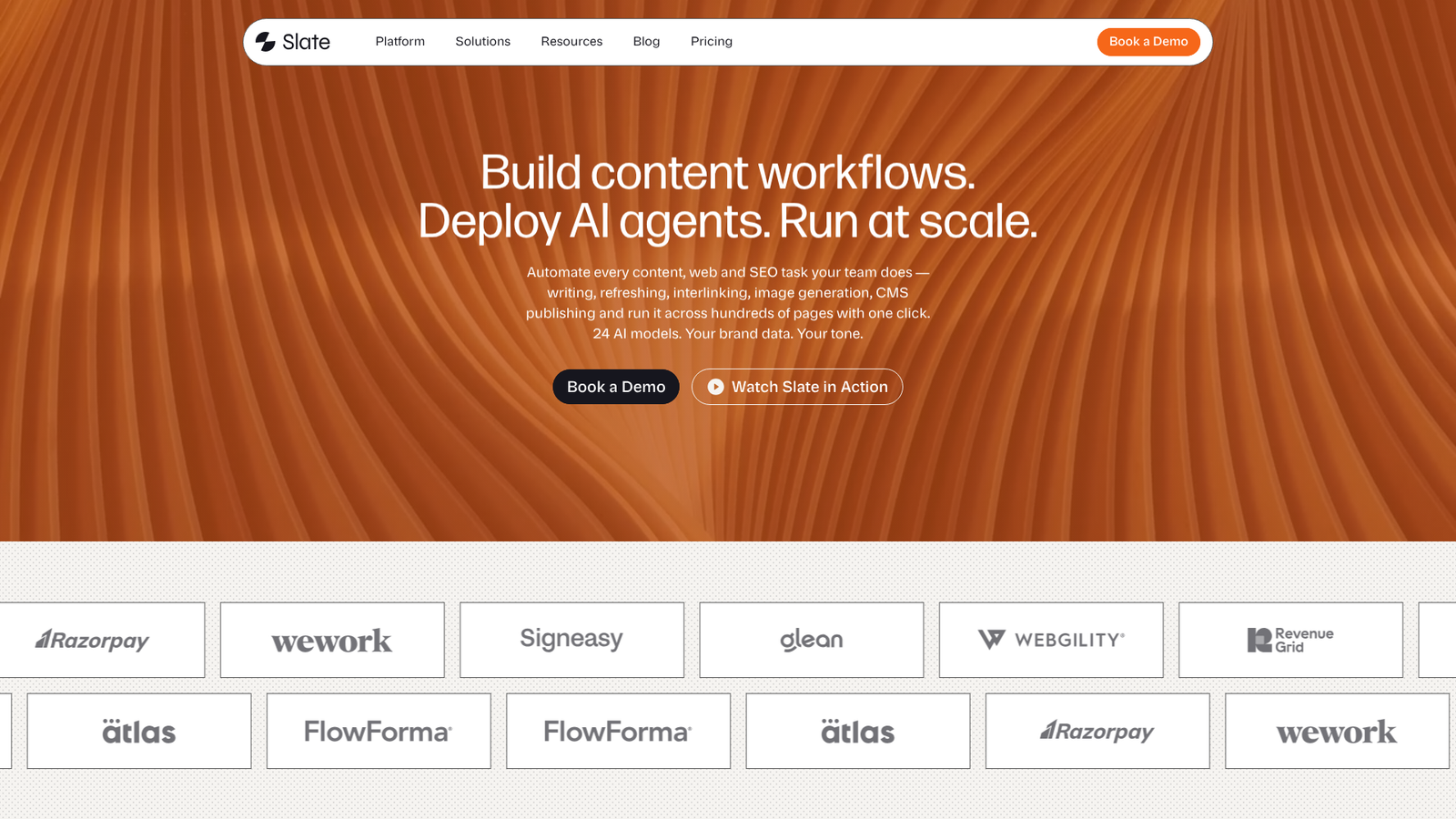
Slate is an AI-powered content operations platform built for marketing teams that need to plan, produce, optimize, and distribute content at scale - not just generate drafts.
Where most tools on this list solve one piece of the content puzzle, Slate is designed to replace the patchwork of five to seven point solutions most teams juggle. It covers the full content lifecycle: strategy and brief generation, multi-format creation, brand voice governance, team collaboration, multi-channel publishing, and performance analytics - all in one place.
Transparency note: Slate is our product. We've included it here because it directly addresses the content operations gap that no other tool on this list fills as comprehensively. We encourage you to compare it against the alternatives below before deciding.
Best for: Content teams of three or more people who need to scale output without scaling headcount; marketing departments managing multi-channel content programs.
Key strengths
- AI-powered content strategy and brief generation from a single workflow
- Multi-format creation (blog, social, email, landing pages) in one platform
- Brand voice and style guide enforcement across all AI outputs
- Team collaboration with editorial workflows, approvals, and role-based access
- Content repurposing engine that converts one piece into multiple formats automatically
Pricing: Starting at $199/month
2. Notion AI - best for content planning & team knowledge management
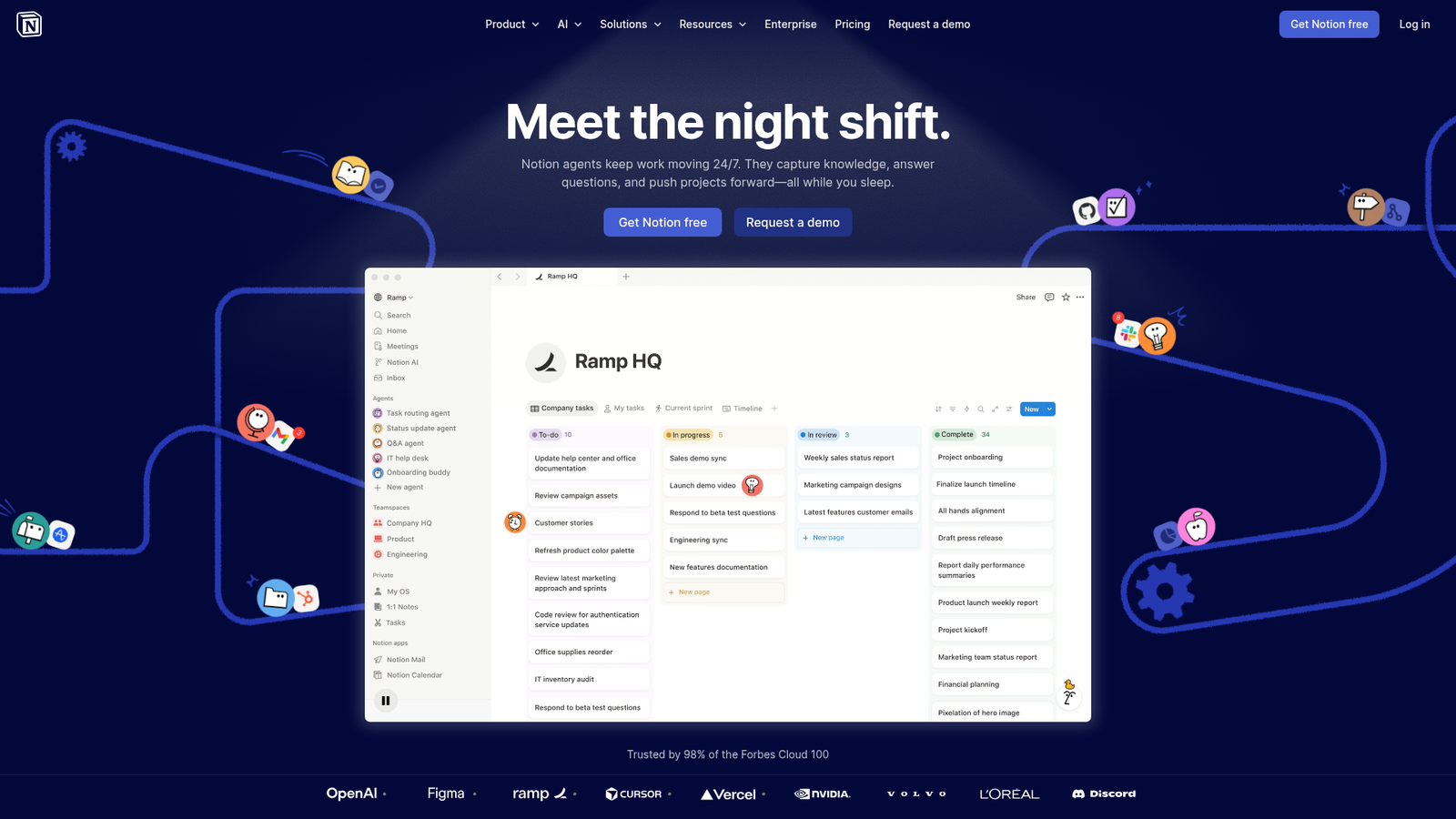
Notion AI is an AI-powered workspace that layers intelligent writing and summarization directly into your existing docs, databases, and wikis.
It works particularly well for teams that already live in Notion for project management. You get AI-assisted brief writing, content calendar databases, meeting note summaries, and brainstorming - without pinging someone on Slack or switching tabs. The limitation is real: Notion AI is a planning and organization tool, not a content production powerhouse.
Best for: Small-to-mid content teams who already use Notion for project management and want AI layered into their existing workflow without adopting a new platform.
Key strengths
- AI writing assistant embedded directly within docs and databases
- Database-powered editorial calendar functionality
- Template libraries for briefs, meeting notes, and content plans
- Team collaboration with comments, mentions, and shared workspaces
- Integrations with Slack, GitHub, Figma, and 50+ other tools
Pricing: Free tier available; Notion AI add-on from $10/user/mo
3. Zapier - best for AI content workflow automation
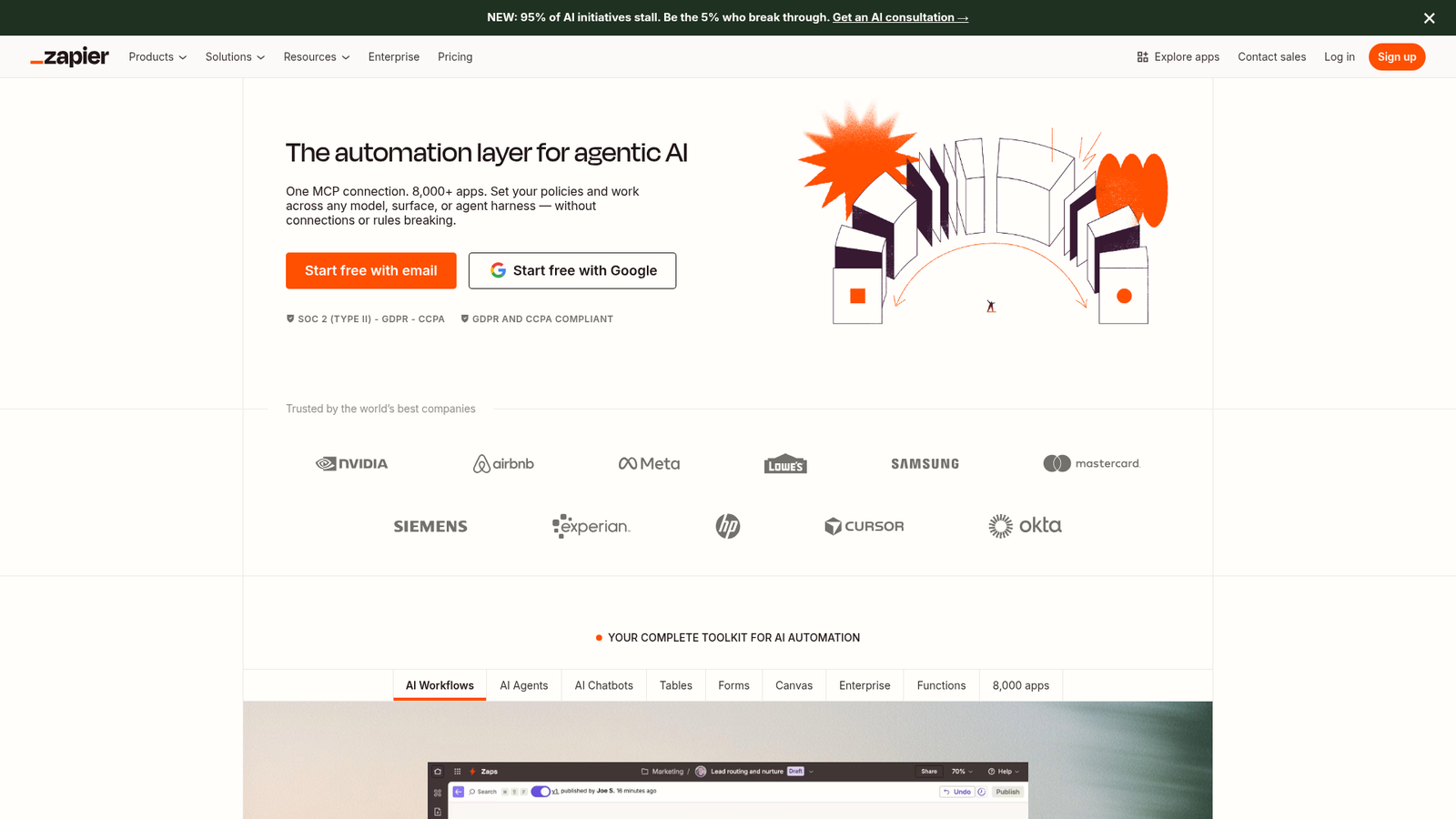
Zapier connects your content marketing tools into automated pipelines - and with AI capabilities now built in, it can handle multi-step content operations without manual triggers.
A practical example: when a blog post publishes in WordPress, Zapier can automatically generate social captions via AI, schedule them in Hootsuite, and log the entry in your content tracker - all without human intervention. This is what agentic AI looks like in a real content workflow. Zapier's 7,000+ app integrations mean it connects almost everything in your stack.
Best for: Teams that want to connect their existing tool stack into automated content pipelines without writing code.
Key strengths
- 7,000+ app integrations covering the full marketing tech stack
- AI-powered Zap builder that suggests automation logic from plain-language descriptions
- Multi-step automations with conditional logic and branching paths
- Agentic AI workflows that run autonomously without manual triggers
- Pre-built content marketing automation templates
Pricing: Free tier (limited Zaps); paid plans from $19.99/mo
4. Writer.com - best for enterprise brand voice & content governance
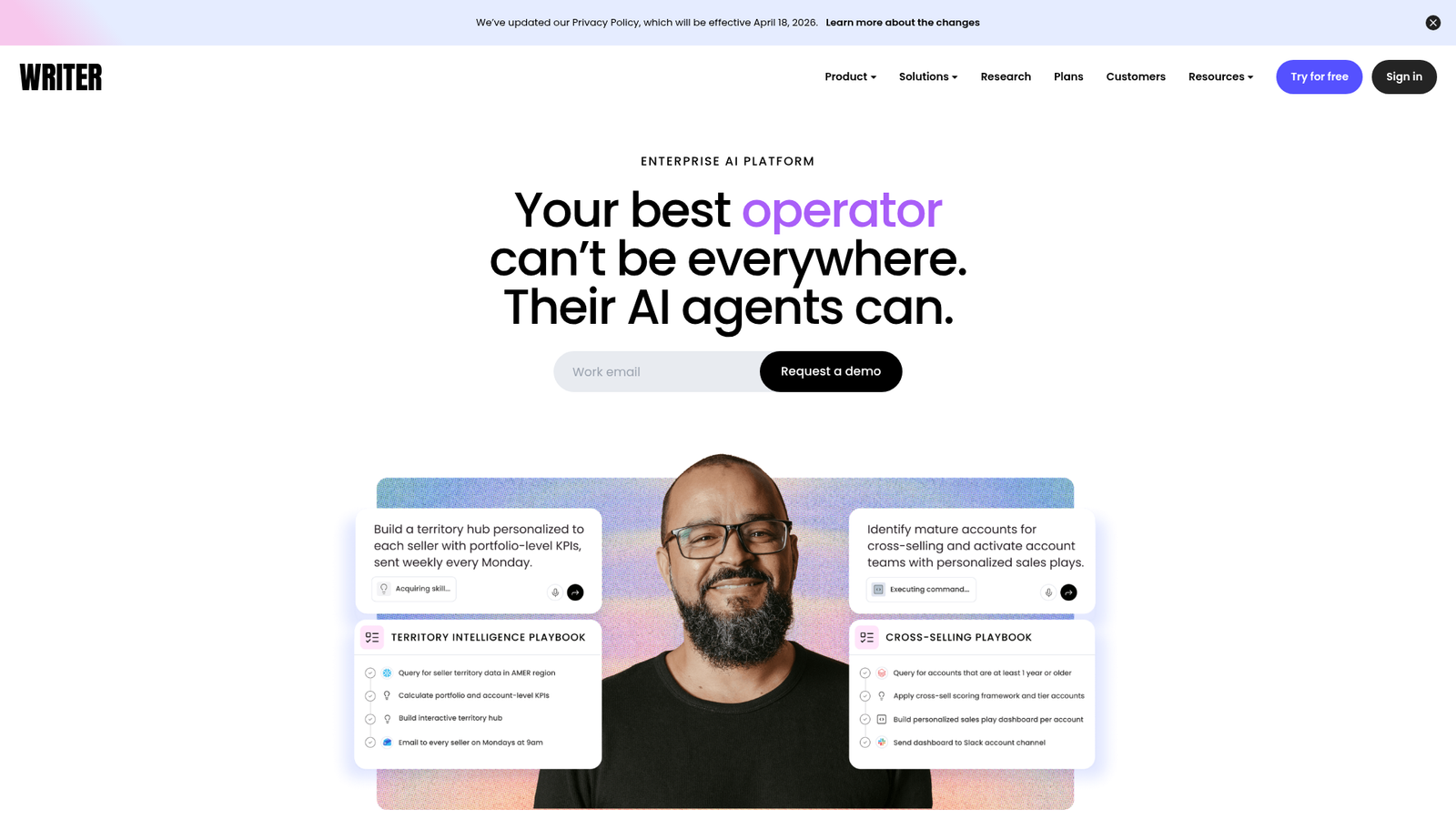
Writer.com is a full-stack generative AI platform purpose-built for enterprises that need brand consistency and compliance across large, distributed content teams.
The core differentiator is custom AI models trained on your specific brand's style guide, tone, and terminology. Every piece of AI-generated content runs through guardrails that enforce your standards - not generic defaults. For regulated industries like fintech, healthcare, or legal, the compliance checking layer is particularly valuable.
Best for: Enterprise content teams of 50 or more people who need strict brand and regulatory compliance across all AI-generated content.
Key strengths
- Custom AI models trained on your brand's style guide and terminology
- Content generation with built-in brand guardrails and compliance checks
- Terminology management to enforce consistent language across teams
- Team-wide brand voice enforcement at the output level
- Enterprise-grade security and access controls
Pricing: Enterprise pricing (custom quotes) - contact Writer.com for details
AI writing & content creation tools
The core of any AI content stack. These tools help you draft, write, and produce content across formats faster and at higher quality than starting from a blank page.
5. ChatGPT - best all-purpose AI writing assistant
ChatGPT is OpenAI's flagship conversational AI - the most versatile general-purpose writing tool available for content marketers today.
It handles brainstorming, drafting, outlining, rewriting, summarizing, and ad hoc content tasks across virtually any format. The GPT-4o model and beyond bring multimodal capabilities, web browsing, and memory across sessions. The honest limitation: raw ChatGPT output needs significant editing for brand voice, and there's no built-in SEO optimization. It's a starting point, not a finished product.
Best for: Individual marketers and small teams who need a flexible, general-purpose AI assistant for a wide range of content tasks.
Key strengths
- Conversational interface that handles virtually any content format or task
- Custom GPTs for repeatable, brand-specific content workflows
- File, image, and document upload for context-aware drafting
- Web browsing for real-time research and fact-checking
- Memory across sessions for consistent brand voice over time
Pricing: Free basic version; Plus $20/mo; Pro $200/mo; Business $30/user/mo; Enterprise custom
6. Claude - best for long-form content & nuanced writing
Claude by Anthropic is the AI assistant content marketers reach for when depth and nuance matter more than speed.
Its 200K token context window means you can feed it an entire research report, a competitor's whitepaper, or a full editorial brief and get output that actually reflects the source material. Long-form blog posts, thought leadership pieces, and research-heavy content tend to read more naturally from Claude than from other models. If ChatGPT is your everyday driver, Claude is what you open when the piece really matters.
Best for: Content marketers producing long-form blog posts, whitepapers, research reports, and thought leadership where nuance and depth matter.
Key strengths
- 200K token context window for processing large documents and briefs
- Strong reasoning for complex, research-heavy thought leadership content
- More human-sounding long-form output compared to most competing models
- Projects feature for organized, context-persistent content workflows
- Document and PDF analysis for research-informed drafting
Pricing: Free tier; Pro $20/mo; Team $25/user/mo
7. Jasper AI - best for marketing-specific AI content generation
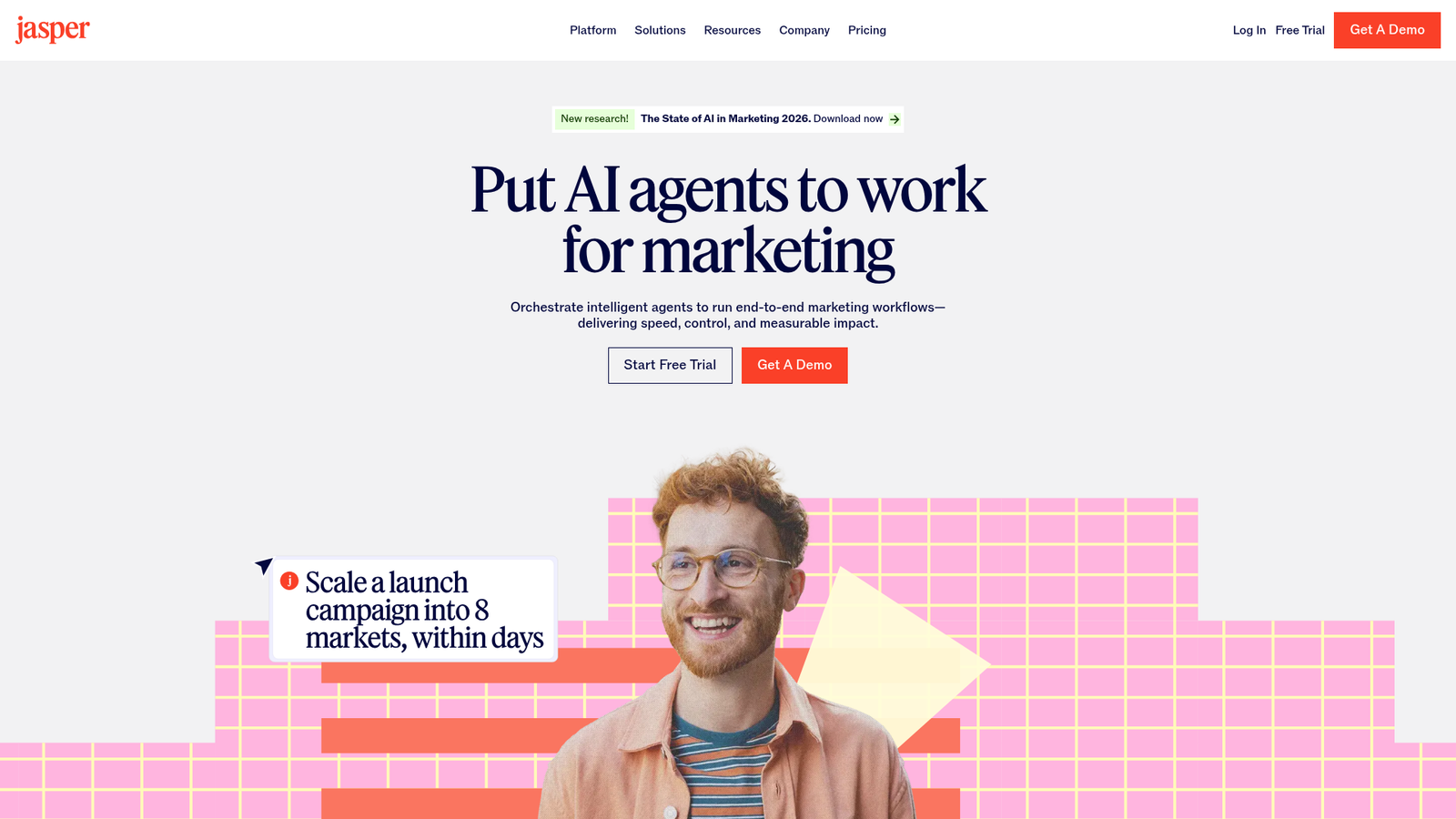
Jasper AI is purpose-built for marketing teams - unlike general-purpose LLMs, it's trained on marketing-specific content and comes loaded with templates for every format a content marketer touches.
The 50+ marketing templates cover ads, blog posts, social media, email sequences, and landing pages. Brand voice customization means the AI learns your tone and applies it consistently across outputs. The Surfer SEO integration is a practical bonus - you can optimize while you write without switching tools. For teams that want an AI copywriting tool that understands marketing context out of the box, Jasper is the most mature option in this category.
Best for: Mid-market marketing teams who want a marketing-trained AI writer with templates and brand voice control built in.
Key strengths
- 50+ marketing-specific templates covering every major content format
- Brand voice customization trained on your existing content
- Campaign workflows that connect multiple content pieces into a single project
- Native Surfer SEO integration for in-editor optimization
- Team collaboration with shared brand assets and content libraries
Pricing: Creator $49/mo; Pro $69/mo; Business custom
8. Koala AI - best for SEO blog content at scale
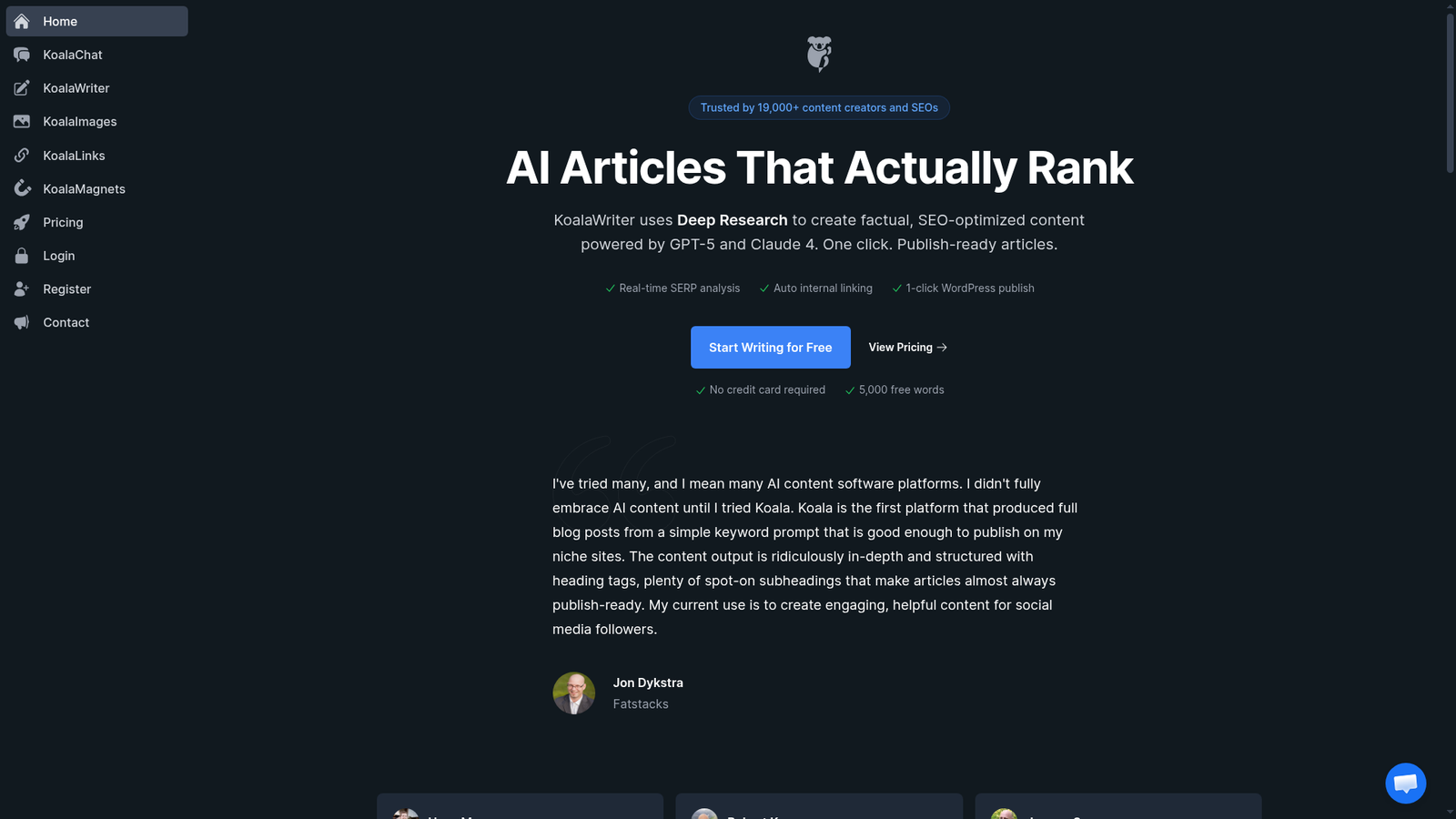
Koala AI is an AI writing tool designed specifically for SEO-optimized blog content - it generates full articles from a keyword with real-time SERP analysis baked into the process.
The workflow is straightforward: enter a target keyword, and Koala pulls the top-ranking pages, generates a SERP-aware outline, and produces a full draft with on-page SEO signals already incorporated. It's particularly useful for content marketers and affiliate publishers who need consistent volume without sacrificing optimization basics. Bulk generation mode lets you queue multiple articles simultaneously.
Best for: Content marketers and affiliate publishers who need high volumes of SEO-optimized blog posts without manual keyword research for every piece.
Key strengths
- One-click article generation from a single target keyword
- SERP-aware outlines built from real-time top-ranking page analysis
- Real-time SEO scoring during the drafting process
- Amazon affiliate content mode for product-focused publishing
- Bulk generation for queuing multiple articles simultaneously
Pricing: Essentials from $9/mo; Professional from $25/mo
9. Brandwell - best for AI-to-human long-form posts
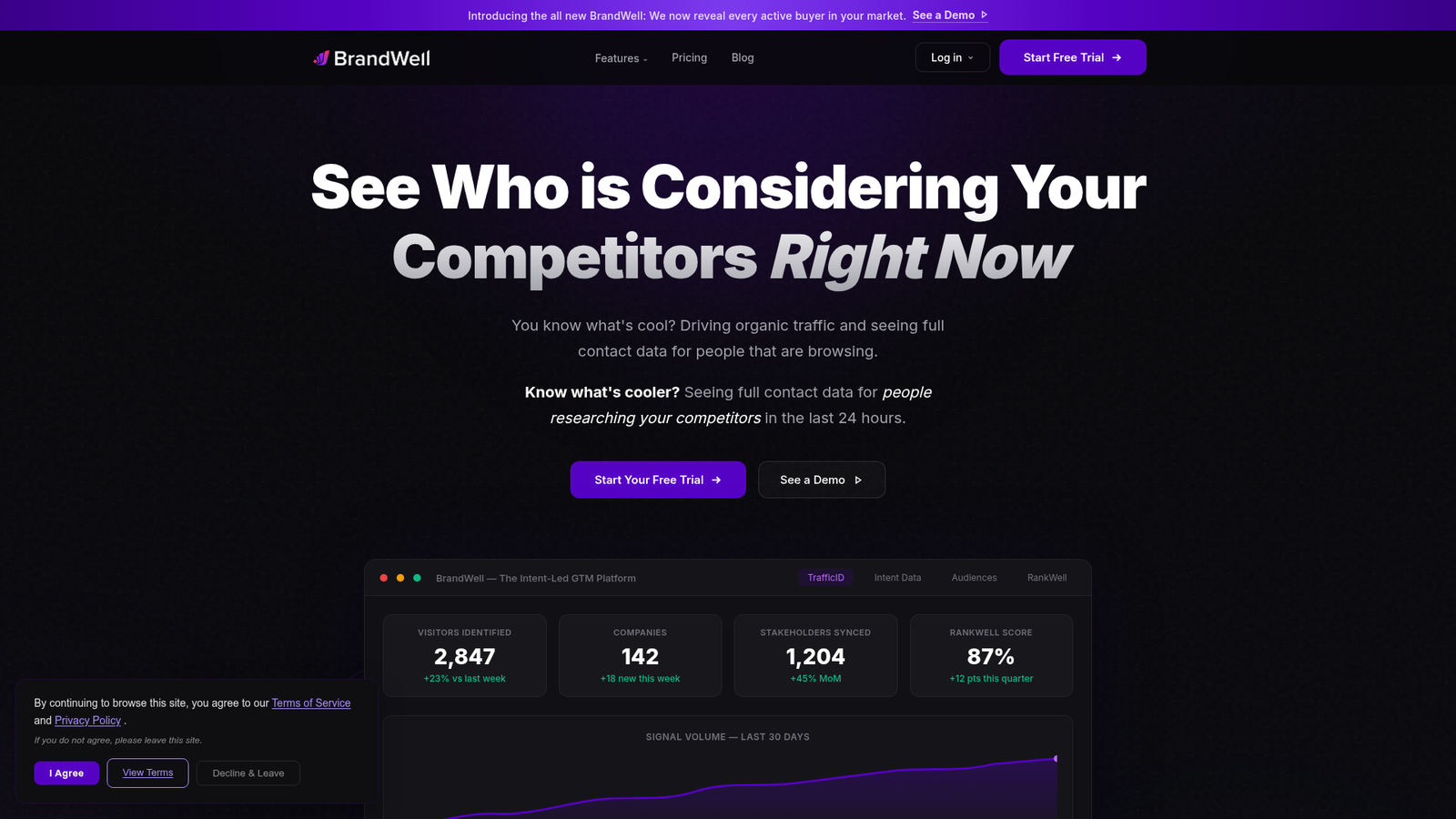
Brandwell (formerly Content at Scale) produces long-form blog posts in the 2,000–5,000 word range using a multi-model approach designed to generate more human-like output.
The platform's focus on AI detection resistance is worth understanding clearly: the goal isn't to deceive readers, but to produce content that reads naturally rather than mechanically. Teams that need long-form SEO content that passes editorial review without heavy rewriting will find Brandwell reduces that revision cycle significantly. WordPress integration means published content goes live without extra steps.
Best for: Teams that need long-form SEO content that reads as human-written and requires minimal post-generation editing.
Key strengths
- Long-form article generation in the 2,000–5,000 word range
- Multi-model approach for more natural, less mechanical output
- Built-in SEO optimization throughout the drafting process
- Direct WordPress integration for streamlined publishing
- AI detection scoring to assess output naturalness before publishing
Pricing: Custom plans starting around $200/mo
10. ContentShake AI - best for beginners creating SEO content
ContentShake AI by Semrush combines competitive search data with AI writing in a single interface - making it the most accessible entry point for marketers new to AI content creation.
The tool generates content ideas based on real search data, not guesswork, then helps you draft and optimize in the same workflow. Readability scoring and SEO recommendations appear inline as you write. Direct WordPress publishing removes the copy-paste step. If you're just starting to build an AI-assisted content process and want guardrails built in, ContentShake AI is a sensible first tool.
Best for: Solo marketers and small teams new to AI content creation who want SEO guidance built into the drafting experience.
Key strengths
- AI-generated content ideas grounded in real competitive search data
- One-click draft generation from a keyword or topic
- Inline SEO recommendations and readability scoring
- Direct WordPress publishing without leaving the platform
- Semrush data integration for keyword and competitor context
Pricing: Free tier available; paid from $60/mo (bundled with Semrush)
AI content optimization & SEO tools
Creating content is only half the battle. These tools ensure your content is optimized for search engines, readability, and AI-powered search experiences - the difference between content that exists and content that ranks.
11. Surfer SEO - best for on-page content optimization

Surfer SEO is the most widely used AI-powered platform for on-page SEO optimization - it analyzes top-ranking pages and gives you real-time recommendations while you write.
The Content Editor scores your draft against 500+ on-page signals and tells you exactly what to adjust: keyword density, heading structure, word count, NLP terms, and more. The SERP Analyzer shows you what's working for competitors at a granular level. For content teams that want data-driven SEO guidance without hiring an SEO specialist for every piece, Surfer is the closest thing to having one built into your workflow.
Best for: Content teams that want data-driven, real-time SEO guidance while writing or editing, without switching between multiple tools.
Key strengths
- Content Editor with real-time scoring against 500+ on-page signals
- SERP Analyzer for granular competitor content benchmarking
- Keyword clustering to organize content strategy around topic groups
- AI outline generator that builds structure from top-ranking pages
- Native integrations with Jasper, Google Docs, and WordPress
Pricing: Essential $89/mo; Scale $129/mo; Enterprise custom
12. Semrush content toolkit - best for data-driven content strategy
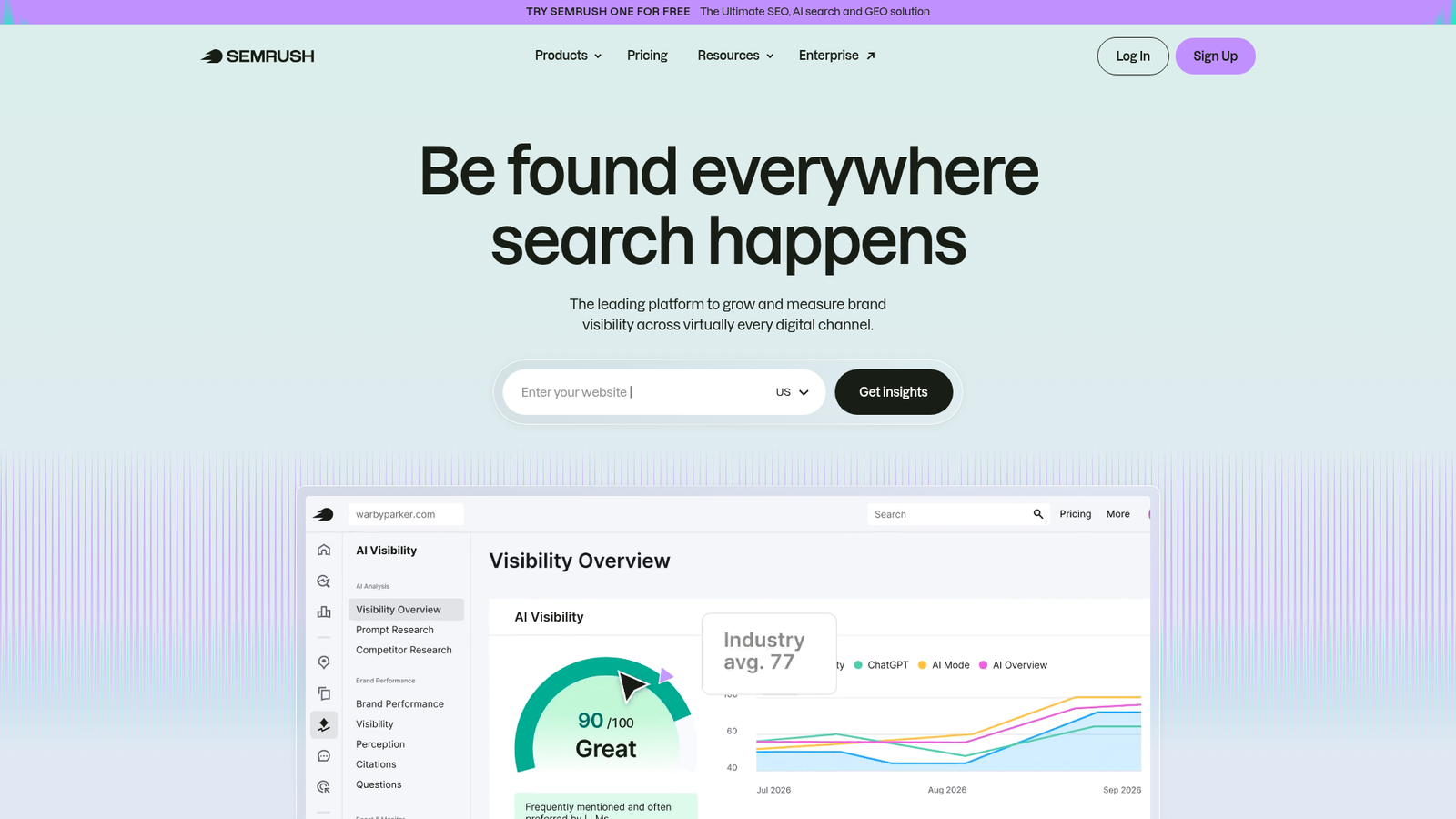
Semrush's content toolkit is a suite of interconnected tools for topic research, content auditing, SEO writing assistance, and post-performance tracking - all drawing from Semrush's competitive intelligence database.
The value is in the integration: Topic Research surfaces content gaps, the SEO Writing Assistant scores drafts in real time, Content Audit identifies underperforming pages, and Post Tracking monitors rankings after publication. For teams already invested in the Semrush ecosystem, this is the most efficient way to build a content strategy grounded in competitive data rather than intuition.
Best for: Marketing teams already using Semrush who want content strategy informed by competitive SEO data without adding another platform.
Key strengths
- Topic Research for identifying content gaps and high-opportunity angles
- SEO Writing Assistant with real-time scoring inside Google Docs
- Content Audit to identify and prioritize underperforming pages
- Post Tracking for monitoring rankings after publication
- Keyword Magic Tool integration for deep keyword research within content workflows
Pricing: Part of Semrush plans starting at $139.95/mo
13. Semrush AI visibility toolkit - best for AI search optimization (AEO)
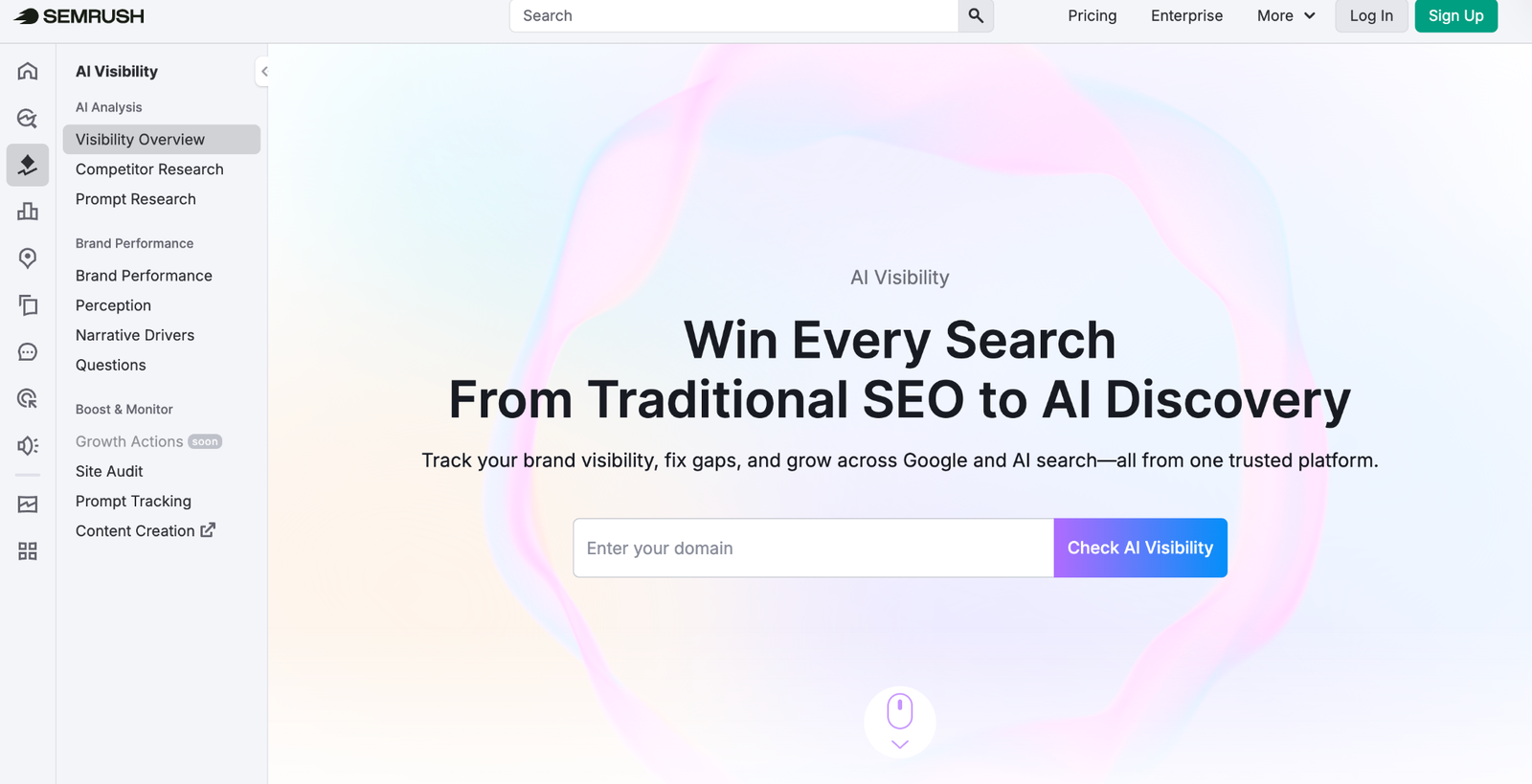
Semrush's AI Visibility Toolkit addresses one of the most important emerging categories in content marketing: optimizing for AI-powered search experiences like Google AI Overviews, ChatGPT citations, and Perplexity.
Traditional SEO gets you ranked in blue links. Answer Engine Optimization (AEO) gets your content cited inside AI-generated answers - an increasingly valuable placement as AI search adoption grows. This toolkit tracks your brand's visibility across AI search surfaces and provides content recommendations to improve it.
Best for: Forward-thinking content teams who want to optimize for both traditional SEO and AI-powered search engines simultaneously.
Key strengths
- AI Overview tracking to monitor brand appearances in Google's AI answers
- AI citation monitoring across ChatGPT, Perplexity, and other AI search surfaces
- AI-specific content recommendations for improving answer engine visibility
- Brand visibility scoring in AI search results over time
- Integration with Semrush's broader keyword and competitive intelligence data
Pricing: Included in Semrush plans; specific tier access varies by plan level
14. Grammarly - best for AI-powered editing & content quality
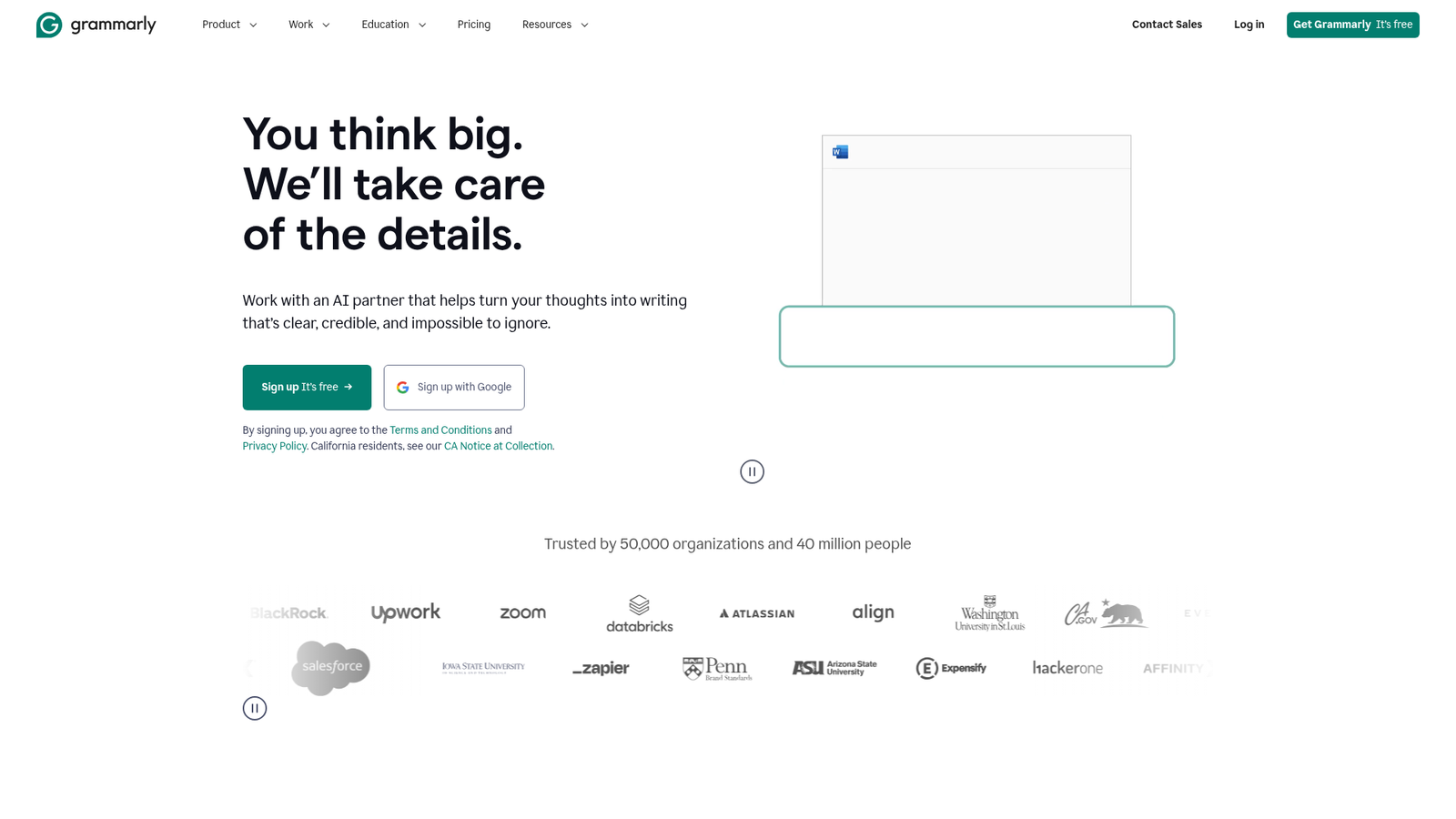
Grammarly has evolved well beyond grammar checking - it's now an AI-powered editing layer that handles tone adjustment, content rewriting, generative drafting, and brand voice enforcement across your entire team's output.
Think of it as the quality assurance layer that sits on top of any AI writing tool. When you generate a draft in ChatGPT or Jasper, Grammarly catches what those tools miss: inconsistent tone, passive voice overuse, clarity issues, and brand voice drift. The Business tier adds team-level analytics and brand voice profiles, making it genuinely useful for managing content quality at scale rather than just individual proofreading.
Best for: Every content marketer - it's the editing and quality layer that pairs with any AI writer on this list.
Key strengths
- Grammar, spelling, and punctuation correction with contextual suggestions
- Tone detection and adjustment for matching content to intended audience
- AI rewriting for improving clarity, concision, and impact
- GrammarlyGO for generative AI drafting within any writing environment
- Brand voice profiles and team analytics for Business users
Pricing: Free tier; Pro $30/user/mo; Enterprise custom
15. Hemingway App - best for readability & clarity
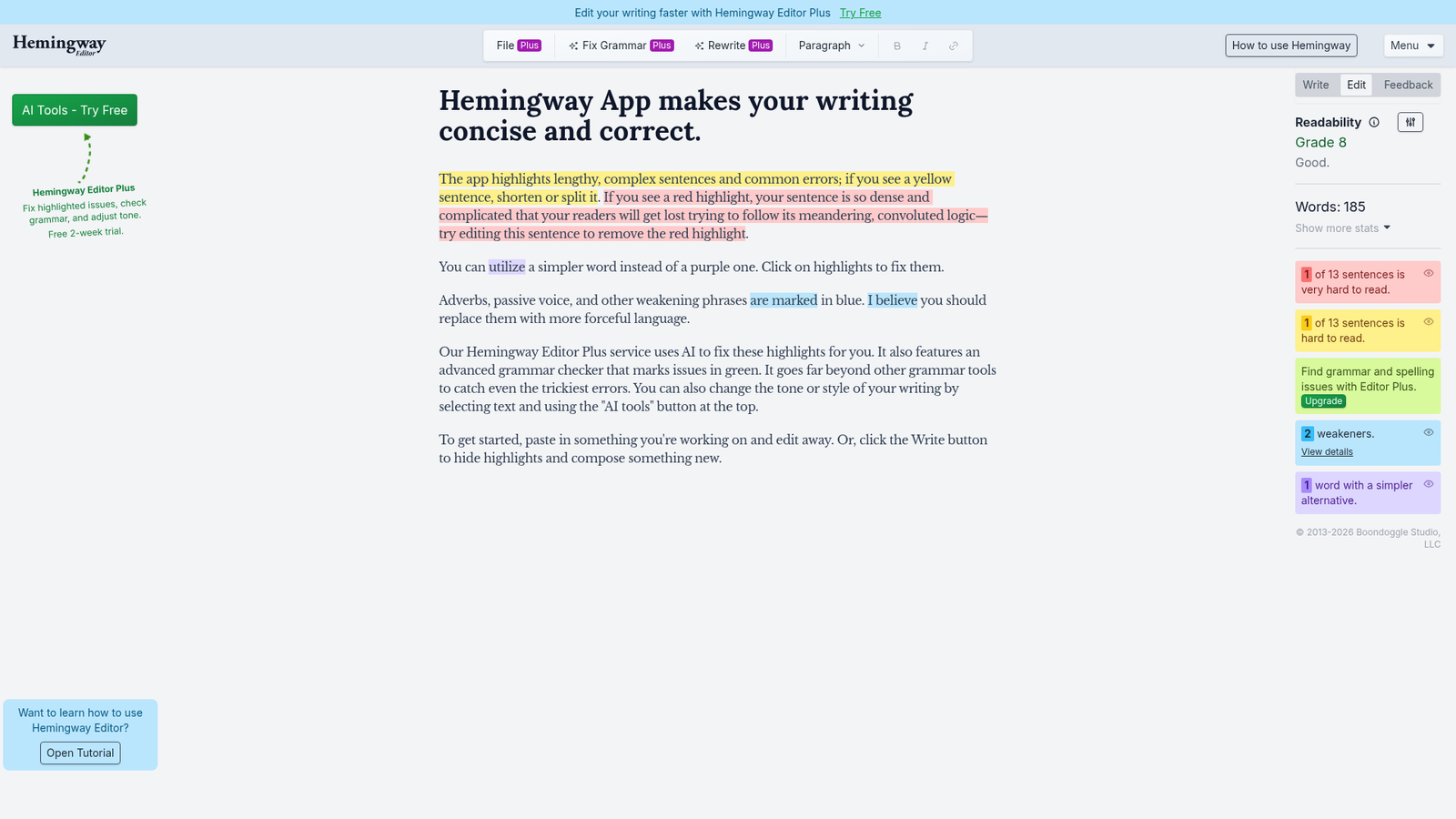
Hemingway App is a lightweight editing tool that does one thing well: it shows you where your writing is too complex, too passive, or too hard to read.
Paste in any AI-generated draft and it highlights long sentences, passive voice, adverb overuse, and readability grade level. It's not a replacement for Grammarly - it doesn't catch grammar errors or offer AI rewriting. But for a fast, no-fuss readability check before publishing, it's the fastest tool on this list to use.
Best for: Content editors who want a quick, no-frills readability check before publishing, particularly for AI-generated drafts that tend toward complexity.
Key strengths
- Readability grade scoring with color-coded sentence-level feedback
- Sentence complexity highlighting for identifying hard-to-read passages
- Passive voice detection throughout the full document
- Adverb flagging to tighten prose and improve directness
- Basic formatting tools for headers, bold, and lists
Pricing: Free web app; Desktop app $19.99 one-time purchase
16. Originality AI - best for AI content detection & plagiarism checking
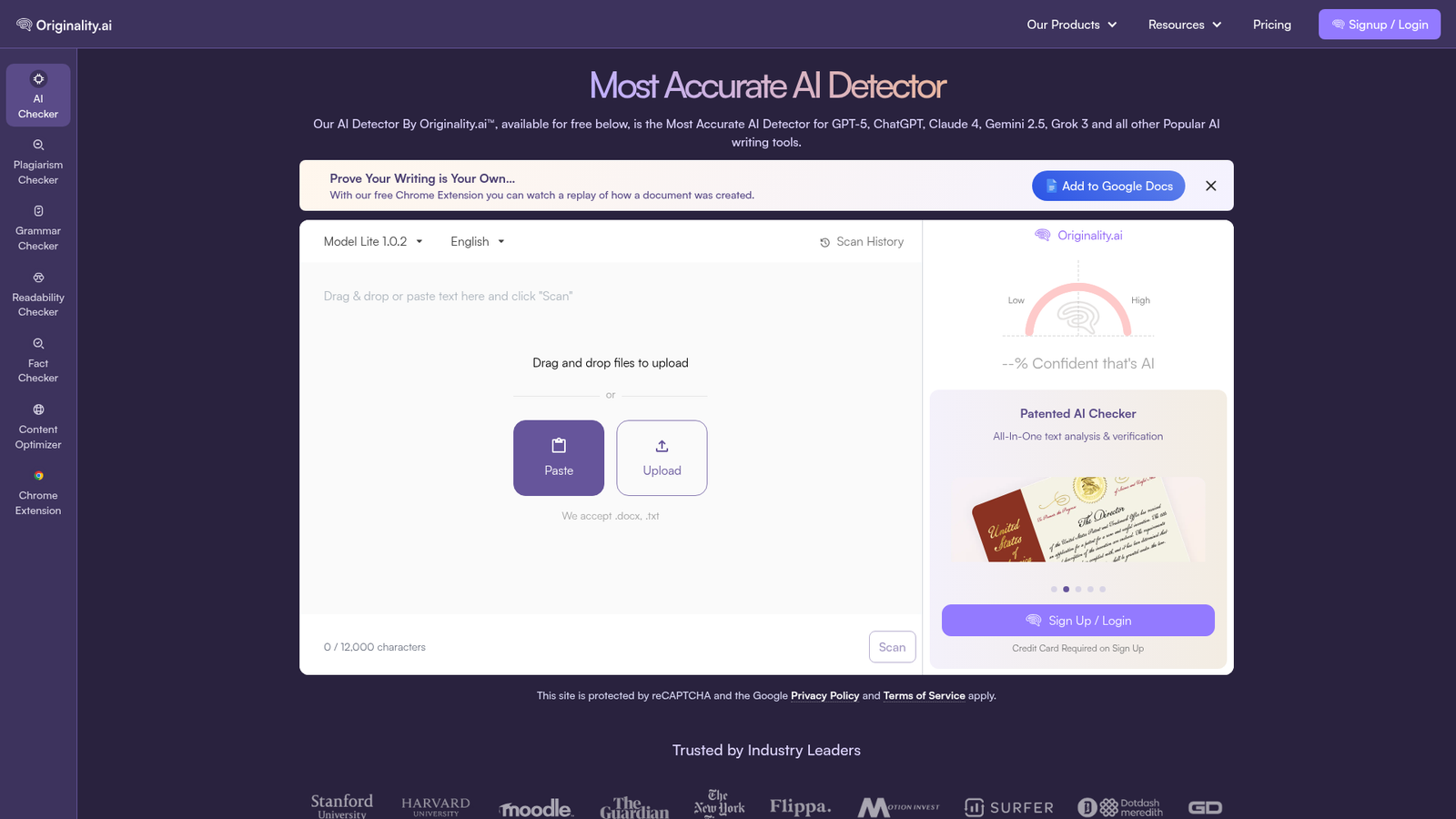
Originality AI detects AI-generated content and plagiarism - a critical quality control layer for content teams that use AI writers but need to ensure output meets editorial standards before publishing.
The tool detects content generated by GPT-4, Claude, Gemini, and other major models, with readability scoring included. For content managers overseeing freelancers or large AI-assisted content programs, it provides an objective check that editorial review alone can't replicate. The ethical framing matters here: use it to ensure your AI-assisted content has been genuinely edited and enriched, not to game detection systems.
Best for: Content managers and editors who need to verify the originality and human quality of AI-assisted content before it goes live.
Key strengths
- AI detection covering GPT-4, Claude, Gemini, and other major models
- Plagiarism scanning with source identification
- Readability scoring alongside originality metrics
- Team sharing for collaborative editorial review workflows
- API access for integrating detection into custom publishing pipelines
Pricing: Pay-as-you-go from $14.95/mo
AI visual & video content tools
Content marketing in 2026 is multi-format. These tools use AI to create visual and video content that supports your written content strategy - without requiring a dedicated design or video team.
17. Canva - best for AI-powered visual content creation
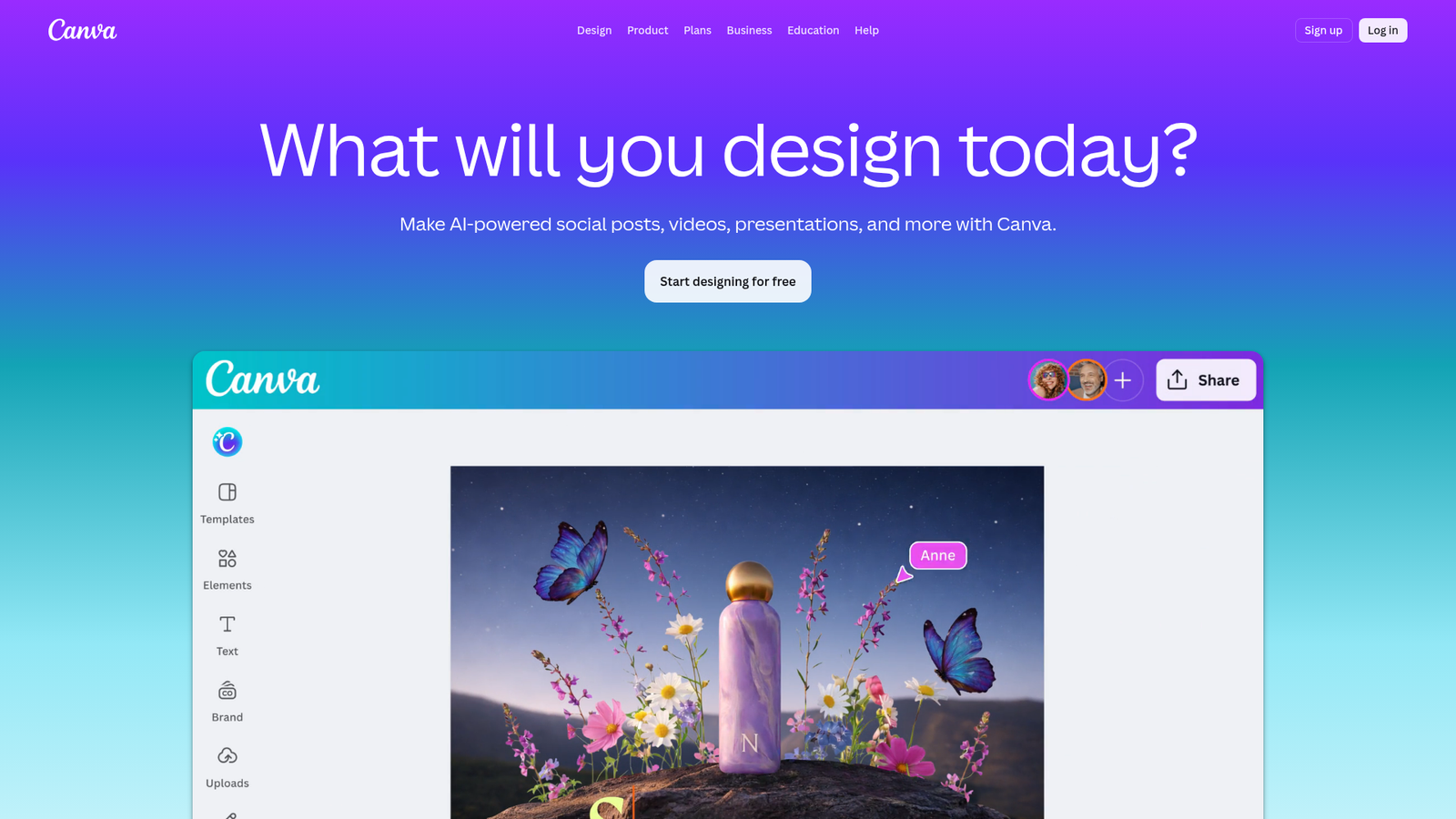
Canva has become the default visual content tool for content marketing teams - and its Magic Studio AI features have made it genuinely powerful for high-volume asset creation.
Magic Design generates on-brand layouts from a text prompt. Magic Edit handles AI image editing and background removal. The Brand Kit enforces consistent colors, fonts, and logos across every asset your team creates. For content teams producing social graphics, blog headers, presentations, and infographics at scale, Canva removes the designer bottleneck without sacrificing visual quality.
Best for: Content teams that need high-volume visual assets across multiple formats without a dedicated designer on staff.
Key strengths
- Magic Design for AI-generated layouts from text prompts
- Magic Edit for AI image editing, background removal, and object replacement
- Brand Kit enforcement for consistent colors, fonts, and logos across all assets
- Bulk content creation for resizing and adapting assets across platforms simultaneously
- Video editing and social media templates for multi-format content production
Pricing: Free tier; Pro $12.99/mo; Teams $14.99/user/mo
18. Lumen5 - best for AI video creation from blog content
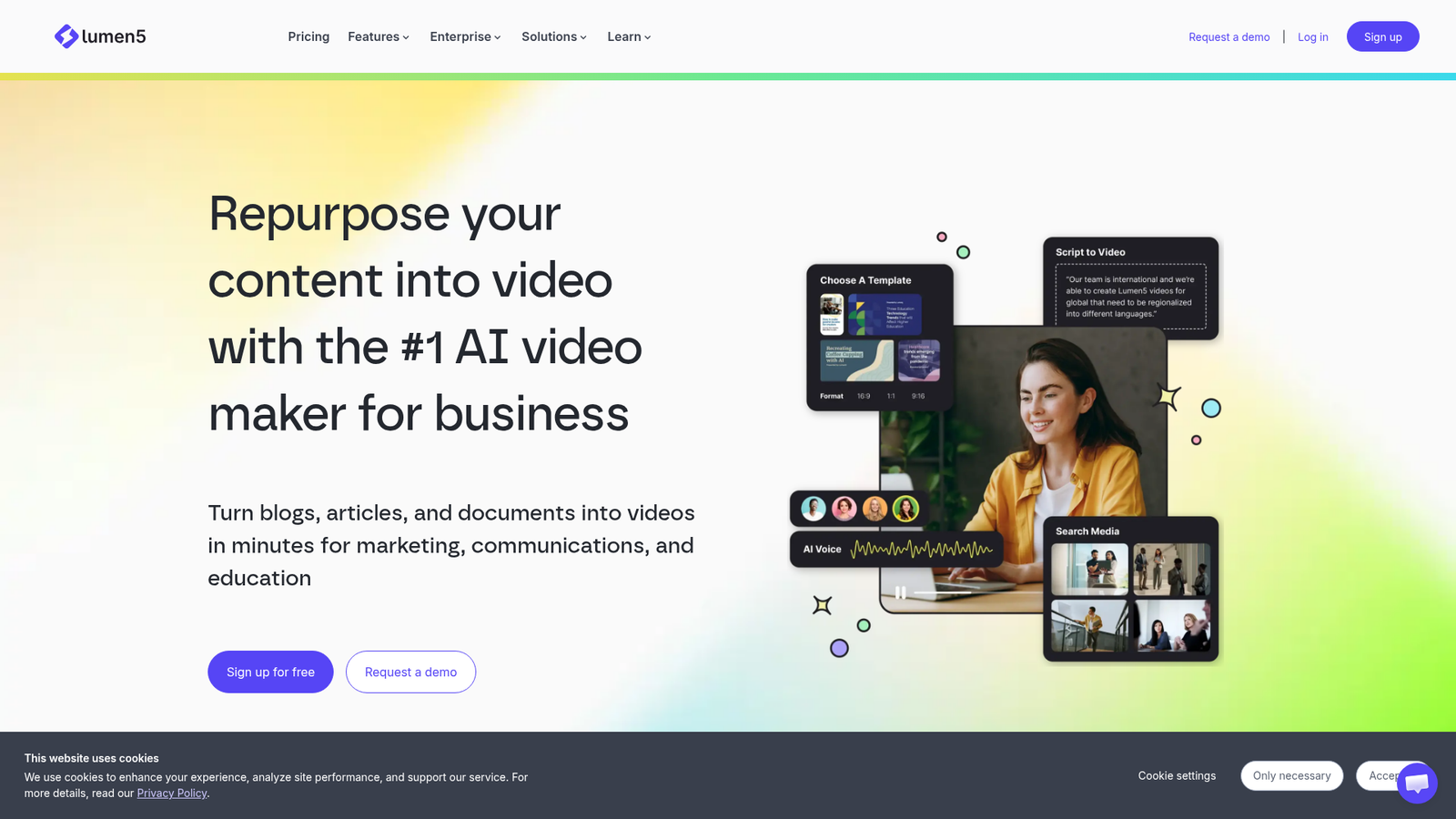
Lumen5 turns blog posts and written content into short-form videos using AI - making it the most practical tool for content repurposing workflows that include video.
Paste in a blog URL or article text, and Lumen5 generates a video script, selects relevant stock footage, and produces a branded video ready for social media. No video editing skills required. For content teams that know they should be producing video but don't have the bandwidth or expertise, Lumen5 removes most of the friction from that process.
Best for: Content marketers who want to repurpose written content into video for social media without video editing skills or a dedicated video team.
Key strengths
- Blog-to-video conversion from a URL or pasted text
- AI script generation that adapts written content for video format
- Stock media library with millions of licensed images and video clips
- Brand customization for consistent colors, fonts, and logo placement
- Auto-captioning for accessibility and social media engagement
Pricing: Free tier; Basic $29/mo; Starter $79/mo; Professional $199/mo
19. Lexica Art - best for AI-generated blog & marketing images
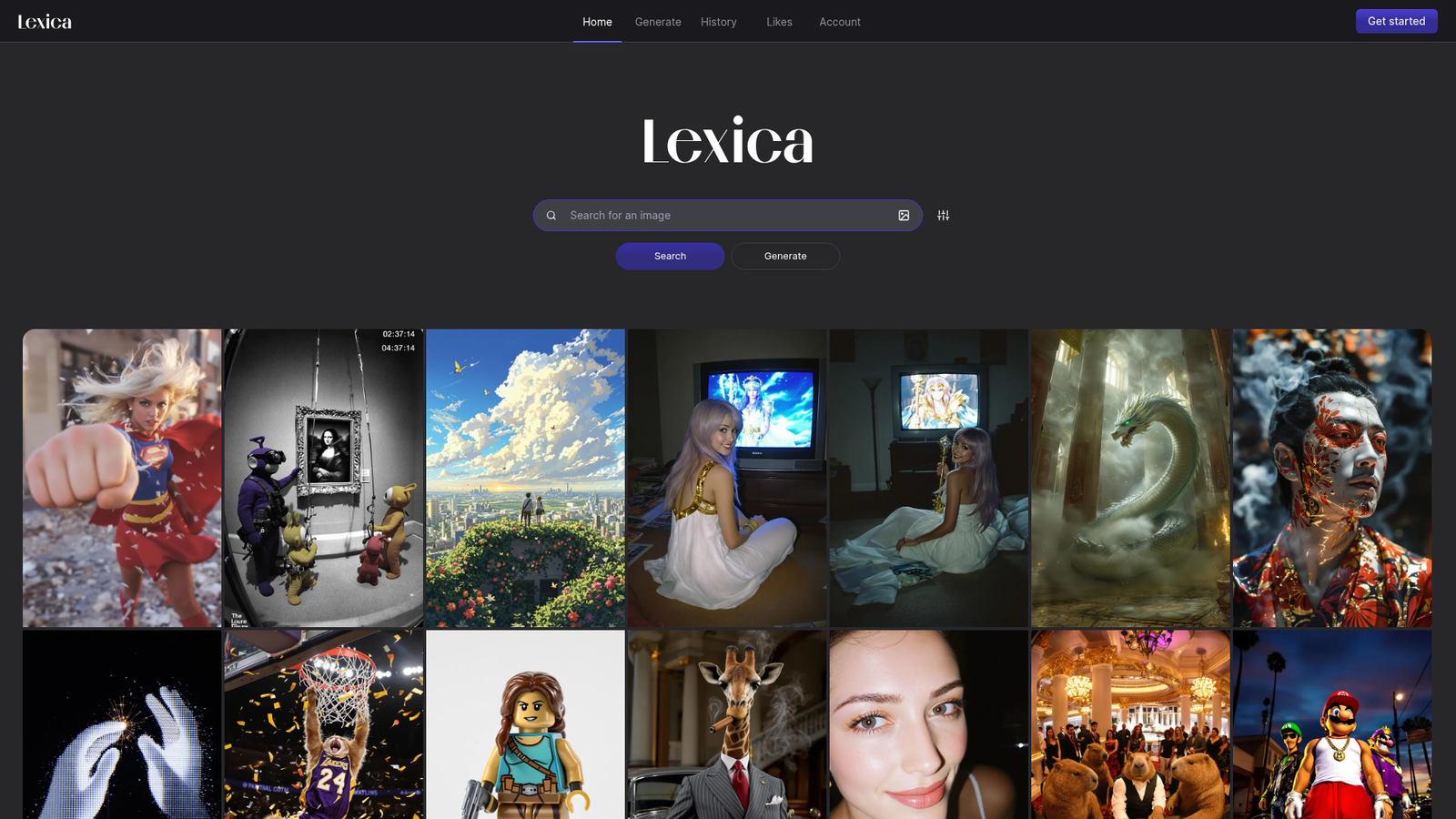
Lexica Art is an AI image generation tool with a curated, high-quality aesthetic that works particularly well for blog header images, social graphics, and marketing visuals.
Unlike general-purpose image generators, Lexica's output tends toward a consistent, polished style that reads as intentional rather than experimental. You can search existing AI-generated images in the library or generate new ones from text prompts. Commercial licensing is included, which matters for marketing use cases where stock photo restrictions can be a headache.
Best for: Content marketers who need unique, high-quality visual assets and want to move beyond generic stock photography.
Key strengths
- Text-to-image generation with a consistently polished aesthetic
- Style-consistent outputs suited to professional marketing contexts
- Searchable library of existing AI-generated images for quick asset sourcing
- Commercial licensing included for all generated and library images
- Simple prompt interface accessible to non-designers
Pricing: Free searches; Starter $8/mo; Pro $24/mo
20. PhotoRoom - best for AI product & marketing photo editing
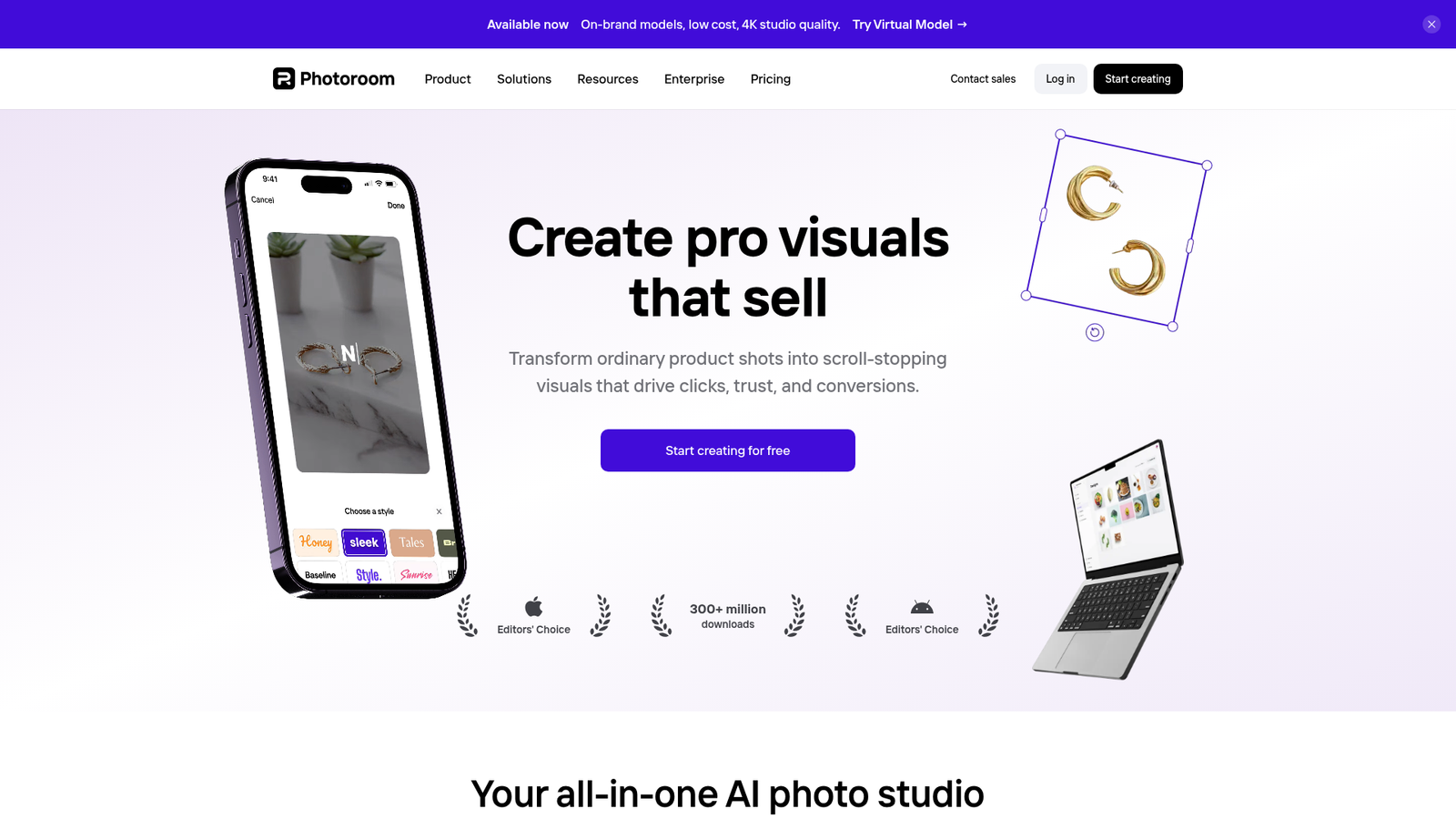
PhotoRoom is an AI-powered photo editing tool focused on background removal, product photography enhancement, and batch editing - built specifically for e-commerce and marketing content production.
The instant background removal works on complex images in seconds. AI scene generation lets you place products in contextually relevant backgrounds without a photo shoot. Batch editing handles hundreds of images simultaneously, which matters for e-commerce teams managing large product catalogs. If your content marketing involves significant product imagery, PhotoRoom reduces what used to be hours of Photoshop work to minutes.
Best for: E-commerce content marketers and teams producing high volumes of product or promotional imagery at scale.
Key strengths
- Instant AI background removal on complex product images
- AI scene generation for placing products in contextual backgrounds
- Batch editing for processing hundreds of images simultaneously
- Brand-consistent templates for maintaining visual standards across campaigns
- Mobile app for on-the-go product photography editing
Pricing: Free tier; Pro from $12.99/mo
AI social media & distribution tools
Creating content means nothing if it doesn't reach your audience. These tools use AI to optimize content distribution across social media and other channels - and to make sure the right content goes out at the right time.
21. Hootsuite - best for AI-powered social media management
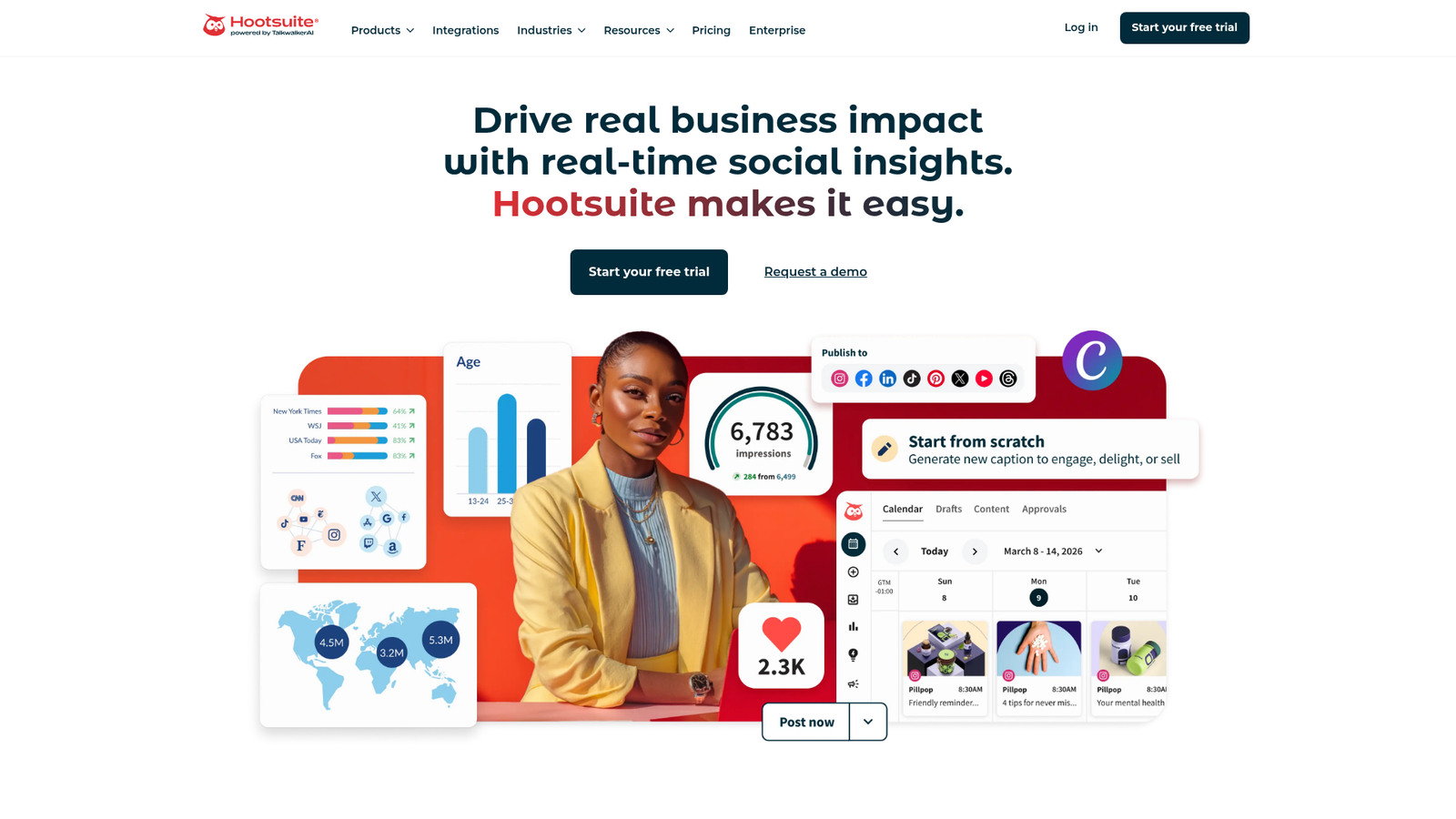
Hootsuite is the enterprise standard for social media management, and its AI features have made it a genuine content distribution tool rather than just a scheduling platform.
OwlyWriter AI generates social captions from a topic, URL, or existing content - reducing the time from "blog post published" to "social posts scheduled" significantly. Best-time-to-post recommendations are based on your specific audience's engagement patterns, not generic benchmarks. Social listening surfaces brand mentions and trending topics that inform your content calendar. For mid-market and enterprise teams managing multiple social channels, Hootsuite's depth justifies its pricing.
Best for: Mid-market and enterprise content teams managing multiple social channels who need AI-assisted scheduling, caption generation, and social listening in one platform.
Key strengths
- OwlyWriter AI for generating social captions from URLs, topics, or existing content
- Best-time-to-post recommendations based on audience-specific engagement data
- Social listening for brand monitoring and trend-informed content planning
- Multi-platform scheduling across Instagram, LinkedIn, X, Facebook, TikTok, and more
- Analytics dashboard with team collaboration and approval workflows
Pricing: Professional $99/mo; Team $249/mo; Enterprise custom
22. SocialBee - best budget-friendly AI social scheduling
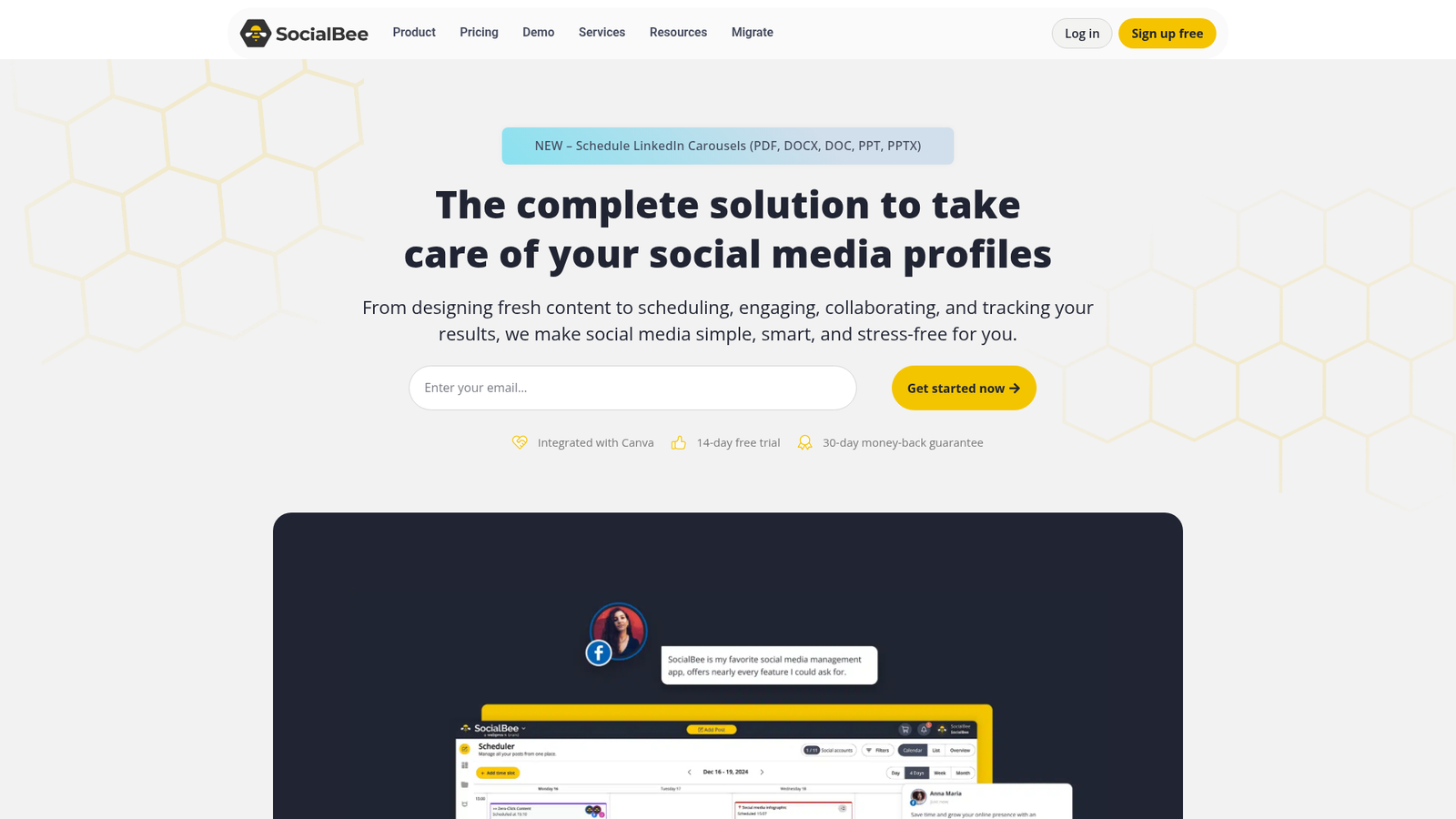
SocialBee delivers AI-powered social media management at a price point that makes sense for small businesses and solo marketers who can't justify Hootsuite's enterprise pricing.
The AI post generator creates platform-specific captions from a topic or URL. Category-based scheduling lets you organize content by type (educational, promotional, engagement) and set different posting frequencies for each. Content recycling automatically resurfaces evergreen posts so your best content keeps working. The Canva integration means you can design and schedule in a connected workflow.
Best for: Small businesses and solo marketers who need AI-powered social media management without enterprise pricing or complexity.
Key strengths
- AI post generator for creating platform-specific captions from topics or URLs
- Category-based scheduling for organizing content by type and frequency
- Content recycling to automatically resurface evergreen posts
- Multi-platform scheduling across all major social networks
- Canva integration for a connected design-to-schedule workflow
Pricing: Bootstrap $29/mo; Accelerate $49/mo; Pro $99/mo
23. BuzzSumo - best for AI content research & trend discovery
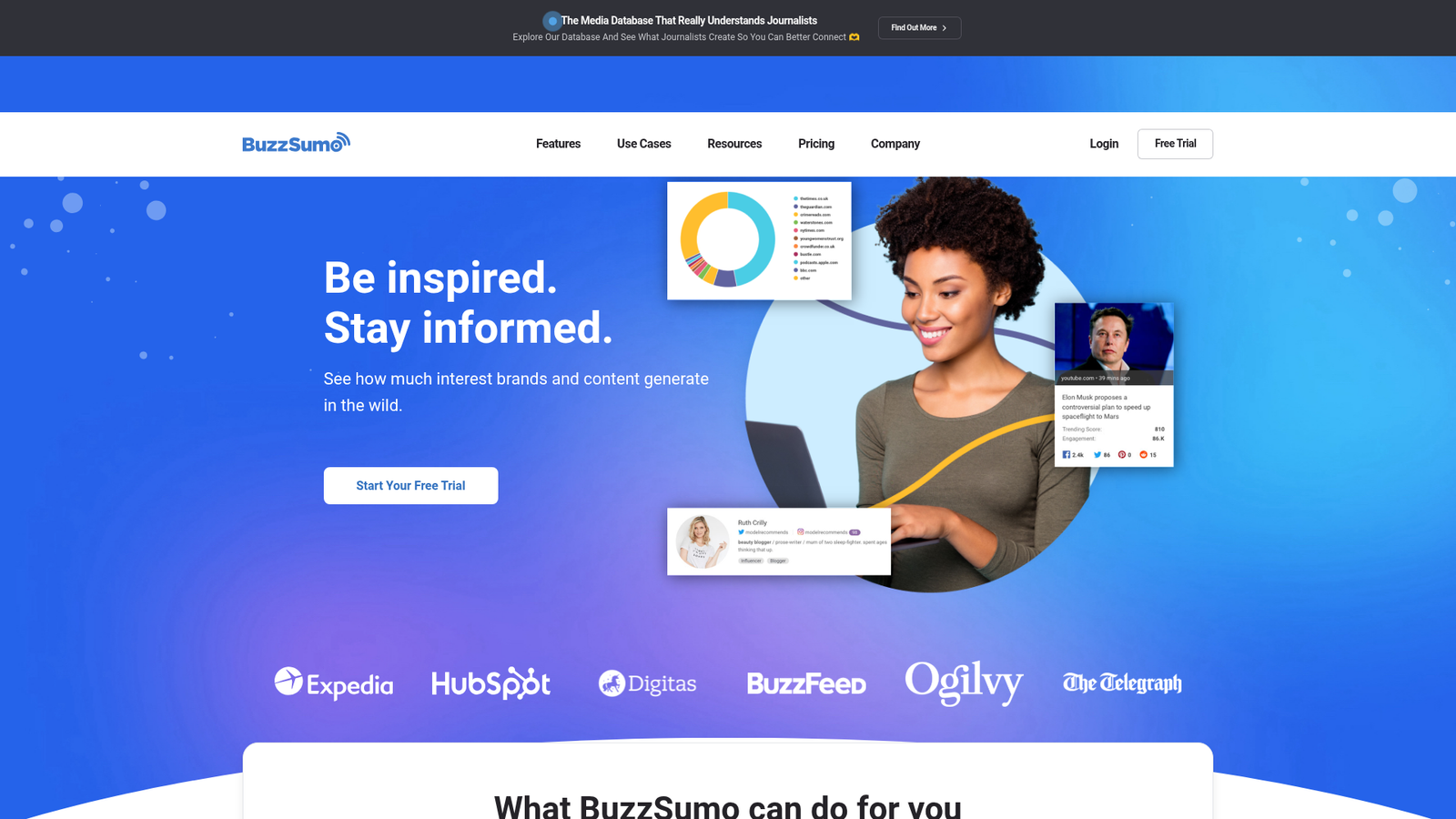
BuzzSumo is the content research platform that content strategists rely on for data-driven topic ideation - it surfaces what's actually performing across the web before you commit to creating it.
Content discovery shows you the highest-performing pieces on any topic, ranked by social engagement and backlinks. Trend analysis identifies rising topics before they peak. Influencer identification helps you find the right people to amplify content once it's published. For teams building a content strategy grounded in evidence rather than gut feel, BuzzSumo belongs at the planning stage of every content cycle.
Best for: Content strategists who need data-driven topic ideation and competitive content intelligence before committing to a content calendar.
Key strengths
- Content discovery showing highest-performing pieces on any topic by engagement
- Trend analysis for identifying rising topics before they peak
- Influencer identification for content amplification and outreach
- Content alerts for monitoring competitor publishing and brand mentions
- Backlink analysis to understand what content earns links in your category
Pricing: Content Creation $199/mo; PR & Comms $299/mo; Suite $499/mo
AI content analytics & performance tools
The final piece of the content marketing puzzle. These tools measure what's working and use AI to improve future content decisions - closing the loop between production and performance.
24. HubSpot content hub - best for AI-powered content analytics & CRM integration
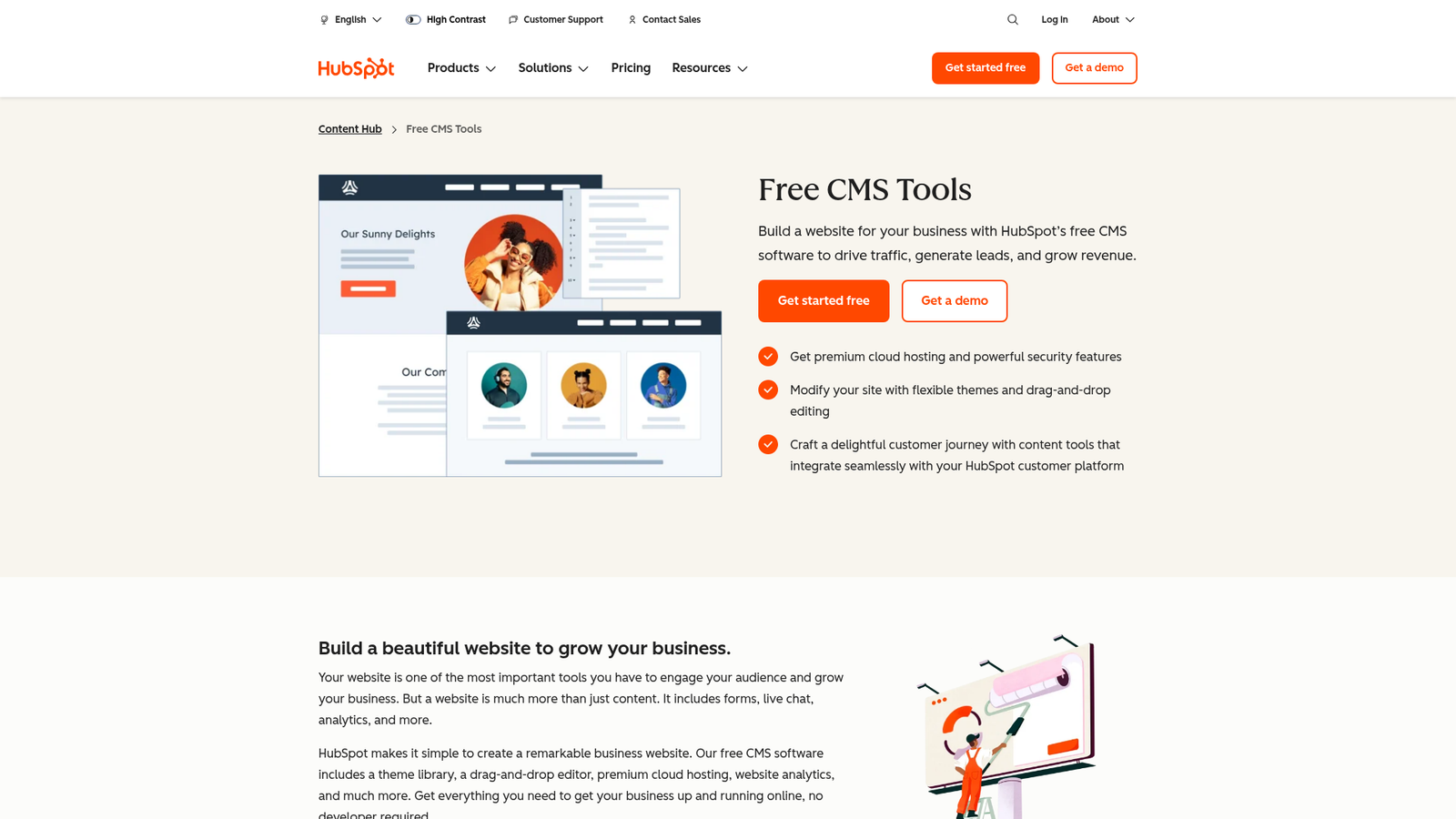
HubSpot Content Hub connects content performance directly to pipeline and revenue - the critical link that most content analytics tools miss entirely.
AI content recommendations surface what to write next based on what's already converting. SEO recommendations identify optimization opportunities across your existing content library. Attribution reporting ties specific blog posts, landing pages, and content assets to actual deals closed - the data point that justifies content marketing budgets to leadership. For B2B content teams that need to prove ROI, the CRM integration is what makes HubSpot Content Hub worth the investment.
Best for: B2B content teams that want to connect content performance directly to pipeline and revenue through CRM integration.
Key strengths
- AI content recommendations based on what's converting in your existing library
- SEO recommendations for optimizing existing content at scale
- Attribution reporting that ties content assets to pipeline and revenue
- CRM integration for connecting content performance to contact and deal data
- AI blog writer for drafting content within the HubSpot ecosystem
Pricing: Free CMS tools; Professional $500/mo; Enterprise $1,500/mo
25. Triple Whale - best for AI content attribution & e-commerce analytics
Triple Whale is an AI-powered analytics platform built for e-commerce - and for content marketers who need to prove which pieces of content actually drive purchases, not just pageviews.
The AI attribution modeling goes beyond last-click to show the full customer journey from content touchpoint to conversion. Creative performance analytics reveal which content formats and topics drive the highest-value customers. Sonar, Triple Whale's AI assistant, surfaces insights from your data without requiring manual report-building.
Best for: E-commerce content marketers who need to prove content ROI and understand which pieces drive conversions, not just traffic.
Key strengths
- AI-powered attribution modeling that maps the full customer journey to conversion
- Creative performance analytics for identifying highest-converting content formats
- Customer journey mapping from first content touchpoint to purchase
- Sonar AI assistant for natural-language data queries and insight surfacing
- Real-time dashboards for monitoring content performance against revenue metrics
Pricing: Growth from $129/mo; Pro from $279/mo
How to choose the right AI content marketing tool for your team
Twenty-five tools is a lot to evaluate. Here's a framework for narrowing it down to the three to five that actually fit your situation.
Assess your content operations maturity
Your team size and current workflow shape which tools will move the needle most.
Solo creators and freelancers should start with ChatGPT or Claude for writing, Canva for visuals, and Grammarly for editing - three tools, under $50/month total, covering the core production workflow. Small teams of two to five people are typically drowning in production volume. Start with a creation tool (Jasper or ContentShake AI) and an optimization tool (Surfer SEO) before adding workflow complexity. Teams of ten or more producing content across multiple channels need operations infrastructure first. If your process is chaotic, adding more creation tools makes the chaos faster. Start with Slate or Notion AI to bring order to the workflow before optimizing individual steps.
Map tools to your content lifecycle gaps
Ask yourself where your process actually breaks down. The answer points directly to the tool category you need most.
If you're struggling with what to write, start with BuzzSumo for topic research and ContentShake AI for data-driven ideation. If you're struggling with producing enough content, start with Jasper, ChatGPT, or Koala AI for creation velocity. If you're producing content but it's not ranking, add Surfer SEO and the Semrush Content Toolkit. If content is ranking but not converting, add HubSpot Content Hub for attribution and Triple Whale for e-commerce analytics. If your team's workflow is fragmented, start with Slate for operations or Zapier for automation.
Budget & integration considerations
Match your tool investment to your current revenue stage.
Starter stack ($0–$100/mo): ChatGPT Free or Plus + Canva Free + Grammarly Free + Hemingway App (free web) + SocialBee ($29/mo). This covers writing, visuals, editing, and social distribution for under $50/month.
Growth stack ($100–$500/mo): Slate + Surfer SEO + SocialBee + BuzzSumo. This is the stack for teams that have proven content works and need to scale it systematically.
Enterprise stack ($500+/mo): Slate + Writer.com + Hootsuite + HubSpot Content Hub + Semrush. This covers the full content lifecycle with enterprise-grade governance, distribution, and attribution.
Building your AI content marketing stack - what a modern workflow looks like
Here's how a five-person content team might use tools from this list together in a single, connected workflow.
1. Strategy & planning: BuzzSumo surfaces high-opportunity topics based on engagement data. Slate generates content briefs and manages the editorial calendar, keeping the team aligned on priorities without a weekly planning meeting.
2. Creation: Slate or Jasper produces first drafts. Claude handles long-form pieces where depth and nuance matter. Canva generates visual assets in parallel. Lumen5 converts finished blog posts into social video as part of the standard publishing workflow.
3. Optimization: Surfer SEO scores drafts against top-ranking pages and flags gaps. Grammarly catches tone inconsistencies and clarity issues. Originality AI verifies that AI-assisted content has been sufficiently edited before it goes live.
4. Distribution: Slate handles multi-channel publishing. Hootsuite manages social scheduling with OwlyWriter AI generating platform-specific captions. Zapier automates the connective tissue - when a post publishes, it triggers the social queue, logs the entry in the content tracker, and notifies the team in Slack.
5. Analytics: HubSpot Content Hub tracks content performance against pipeline for B2B attribution. Semrush AI Visibility Toolkit monitors brand appearances in AI search results. Triple Whale closes the loop for e-commerce teams by connecting content touchpoints to actual purchases.
The key insight is that Slate functions as the operational backbone connecting these point solutions. Without a central operations layer, each tool works in isolation and the workflow breaks down between steps.
The content operations advantage
In 2026, the competitive advantage isn't just using AI to write - it's using AI to run your entire content operation.
The plan → create → optimize → distribute → measure lifecycle is where most teams have gaps, and filling those gaps systematically is what separates content programs that scale from ones that plateau. Most teams will start with two or three tools and expand as they prove ROI - that's the right approach. Start with your biggest bottleneck, not the most impressive tool.
If your biggest challenge is scaling content operations across your team, start with Slate - it's built to be the central nervous system of your AI content workflow. Try Slate free →
Frequently asked questions
What is the best AI tool for content marketing in 2026?
There's no single best tool - it depends on your specific needs and workflow stage. For end-to-end content operations, Slate is the most comprehensive option. For pure AI writing flexibility, ChatGPT or Claude handles the widest range of tasks. For SEO-optimized content, Surfer SEO paired with ContentShake AI covers both optimization and drafting. For visual content at scale, Canva is the default choice for most teams. The most effective approach is a stack of two to four tools that cover your specific lifecycle gaps rather than a single platform trying to do everything.
Can AI tools replace human content marketers?
No - and the framing of replacement misses the point. AI handles volume, repetition, and first drafts. Humans provide strategy, brand voice, creative judgment, editorial standards, and audience empathy. The teams seeing the strongest results are using AI to handle the mechanical parts of content production so human marketers can focus on the work that actually requires human thinking. The realistic outcome is producing significantly more content with the same team - not eliminating the team.
How much do AI content marketing tools cost?
Starter stack: $29–$50/month (SocialBee $29/mo alone is the main paid component). Mid-range tools: $49–$199/month (Frase $49, Surfer Discovery $49, Jasper Pro $59/$69, Koala Professional $49, Hootsuite Professional $99 annual / $149 monthly, Slate $199). Enterprise platforms: $500–$10,000+/month (HubSpot Content Hub Professional $500 / Enterprise $1,500; Conductor $2,233+/mo; BuzzSumo Suite $499/mo; Writer.com $10K–$250K+/year).
What's the difference between AI writing tools and AI content marketing tools?
AI writing tools - ChatGPT, Jasper, Claude - focus on text generation. AI content marketing tools encompass the full lifecycle: strategy, planning, creation, optimization, distribution, collaboration, and analytics. The distinction matters because writing is only one step in content marketing. A team that only uses AI writers still has to manually handle briefs, SEO optimization, editorial review, publishing, social distribution, and performance measurement. Platforms like Slate are designed to address the full workflow, not just the drafting step.
Are AI-generated blog posts good for SEO?
Yes, when properly optimized and edited. Google's position is that they reward helpful, high-quality content regardless of how it's produced. The best practice is to use AI for drafts, then optimize with a tool like Surfer SEO, edit for originality and expertise, add unique data or insights that the AI couldn't generate, and ensure your content demonstrates E-E-A-T signals. Raw, unedited AI output typically underperforms because it lacks the specificity, original perspective, and depth that both readers and search engines reward.
How do I maintain brand voice when using AI content tools?
Three approaches work in practice. First, use tools with built-in brand voice features - Slate, Writer.com, Jasper, and Grammarly Business all offer this at varying levels of sophistication. Second, build detailed brand voice guidelines into your AI prompts so every generation starts from the right foundation. Third, always have a human editor review AI output against your style guide before publishing. The more sophisticated your tool's brand voice capabilities, the less manual correction you'll need - but human review remains the most reliable quality check.
What AI content marketing tools work best for small businesses on a budget?
Recommended starter stack: ChatGPT Free/Claude Free + Canva Free + Grammarly Free + Hemingway App (free web) + SocialBee ($29/mo) = $29/month total. The 'under $30/month' phrasing is correct only because SocialBee is $29/mo — there is no additional wiggle room beneath that price in the recommended stack. Consider reframing as '$29/month entry point for a complete content production and distribution workflow.'