Perplexity shows about 19 sources under a typical answer. Gemini shows none.
Slate ran all four engines in the same week, on the same 1,000 questions.
The four engines also almost never credit the same page. Out of 31,128 citations, 29 came from all three engines that show links. That is 0.09%.
The four engines still recommend the same companies. Any two of them name the same vendors 35% to 42% of the time, Gemini included, and Gemini shows no sources at all.
So getting cited by AI is four separate problems, one for each engine. Getting recommended is a single problem across all four.
The report works through three questions in order. Do the engines cite the same sources, do you have to rank on Google to get cited, and does a better page get you cited more?
The Short Version: Six Findings From 1,000 AI Answers
Read them in the order they should change your reporting. The Google-only half of this picture, covering search engine optimization (SEO) for AI answers, is in our state of AI SEO report.
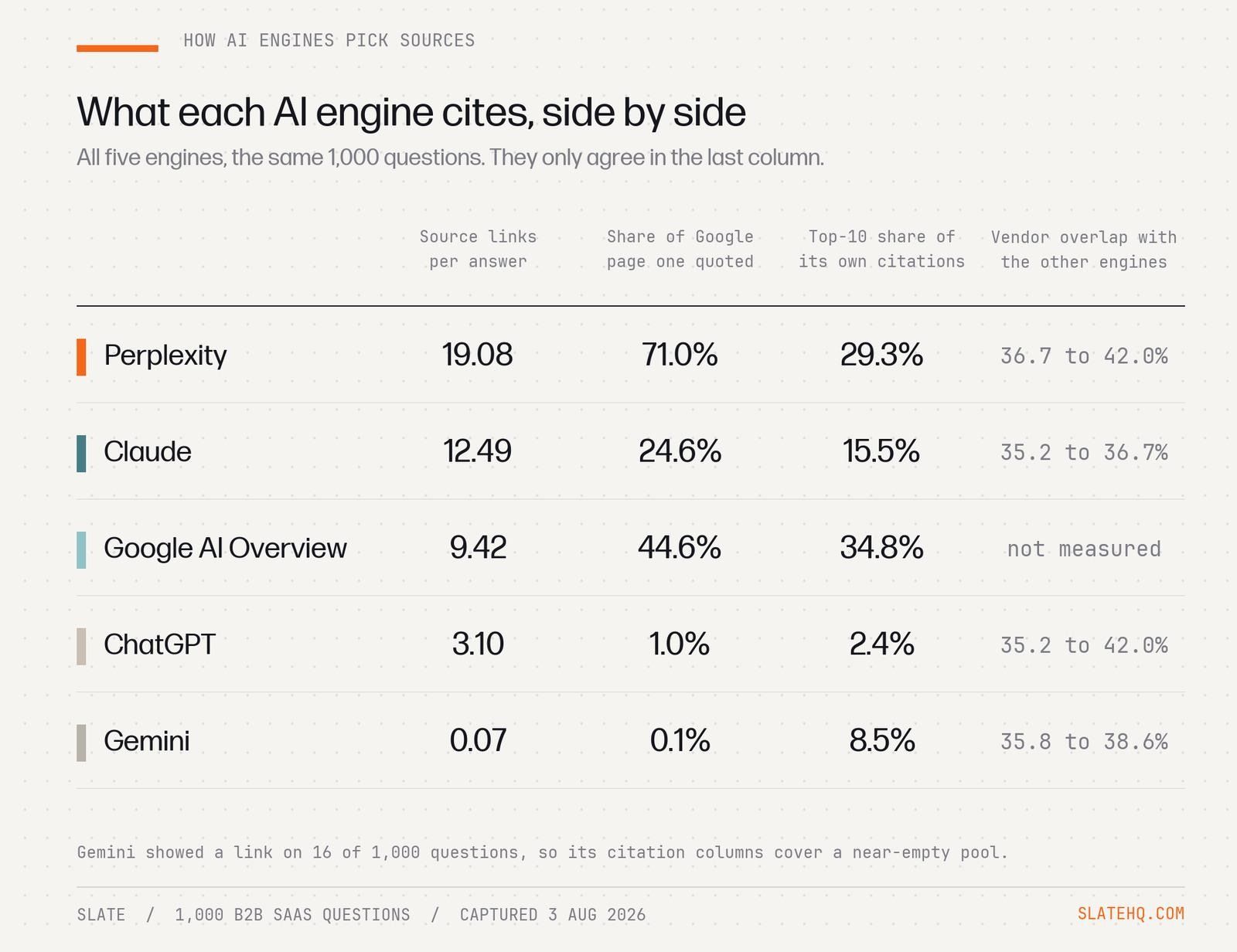
• Every engine shows a different number of sources. Source links per answer: Perplexity 19.08, Claude 12.49, Google AI Overview 9.42, ChatGPT 3.10, Gemini 0.07.
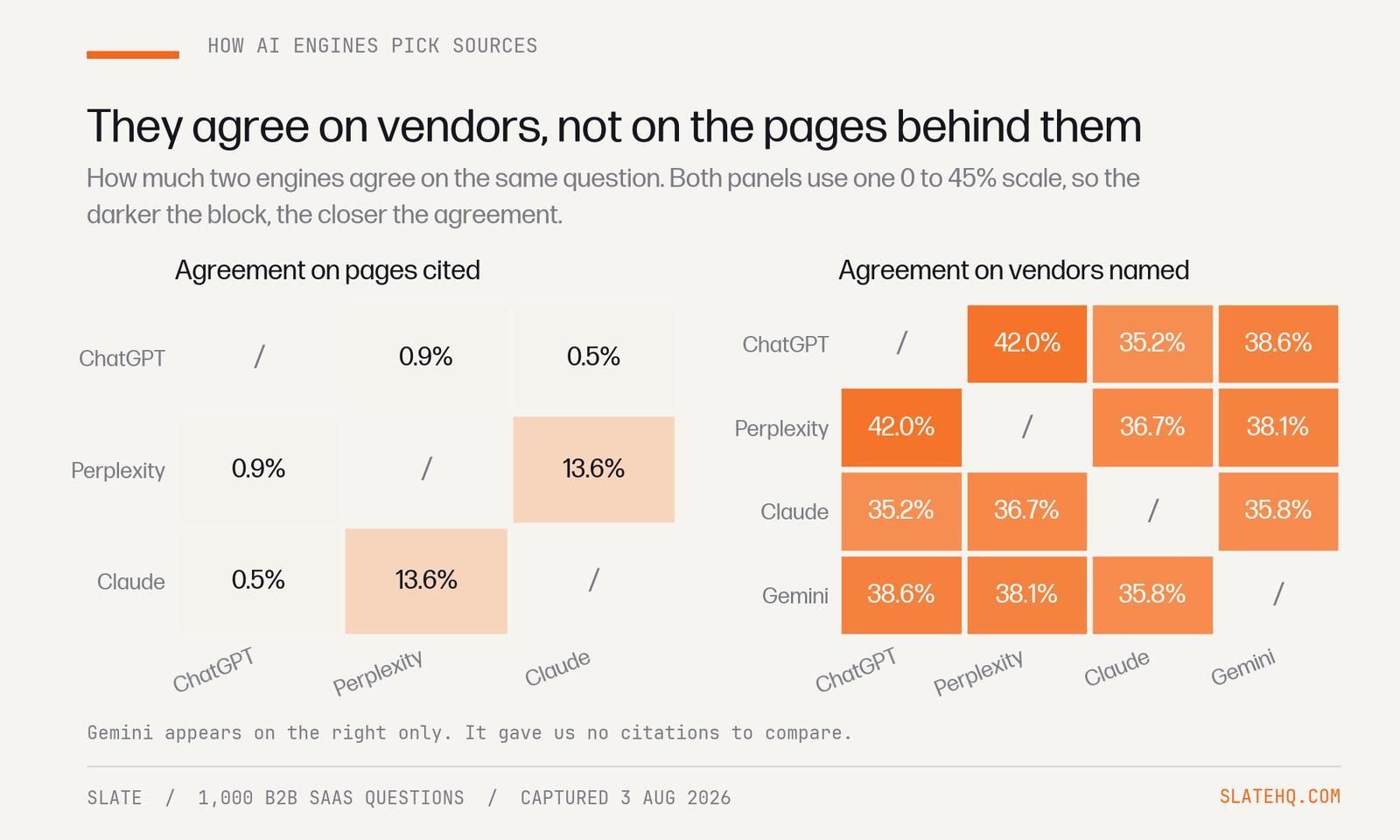
• They rarely quote the same page. On a typical question, Perplexity and Claude overlap on 13.6% of their sources. ChatGPT and Claude overlap on 0.5%.
• They mostly name the same vendors. Every pair of engines agrees on 35.2% to 42.0% of the brands they mention, including Gemini, which cites nothing.
• Most cited pages never rank on Google page one. 74.1% of the pages these engines cited are nowhere in our Google data, neither the top 10 nor the AI Overview.
• Ranking higher helps in every engine. At position 1, Perplexity quotes you 86.9% of the time. At position 9, 46.0%. AI Overview goes 55.1% to 34.1%, Claude 35.0% to 17.4%.
• Reddit is the sharpest split we found. Perplexity cited Reddit 1,051 times. Google AI Overview cited it 243 times. ChatGPT and Claude cited it zero times.
How We Ran the Study: 1,000 Questions, Five AI Engines, One Week
Everything below comes from one set of questions, so the engines are compared like for like.
• The questions. 1,000 B2B SaaS questions covering 40 software categories and 28 question types, split into 334 buying questions, 333 mid-stage questions and 333 research questions.
• The engines. ChatGPT (gpt-5.4-mini), Perplexity (sonar-pro), Claude (sonnet-4.6) and Gemini 2.5 Flash, each with web search on, one answer per question, captured 3 August 2026.
• How we got the links. Perplexity hands back a list of sources in its response, and Claude attaches source citations to every web search answer, so we read both directly. For the other two we pulled every web address out of the answer text.
• Tidying the links. We lowercased each address, dropped www and trailing slashes, and stripped 20 tracking parameters. Two links to the same page now count as the same page.
• The Google comparison. 7,878 organic top-10 results and 9,418 AI Overview citations for the same 1,000 questions, cleaned the same way and matched question by question.
• The page data. For the pages that ranked, we already had a scrape of 11,002 pages recording word count, headings, lists, tables and schema, which is the structured-data tags a page publishes for search engines to read.
Slate ran the capture, the link cleanup and the matching. Its AI tracker turned a four-engine sweep of 1,000 questions into a one-day job instead of a three-week one.
How Many Sources Does Each AI Engine Show?
Perplexity showed a source link on all 1,000 questions. Gemini showed one on 16.
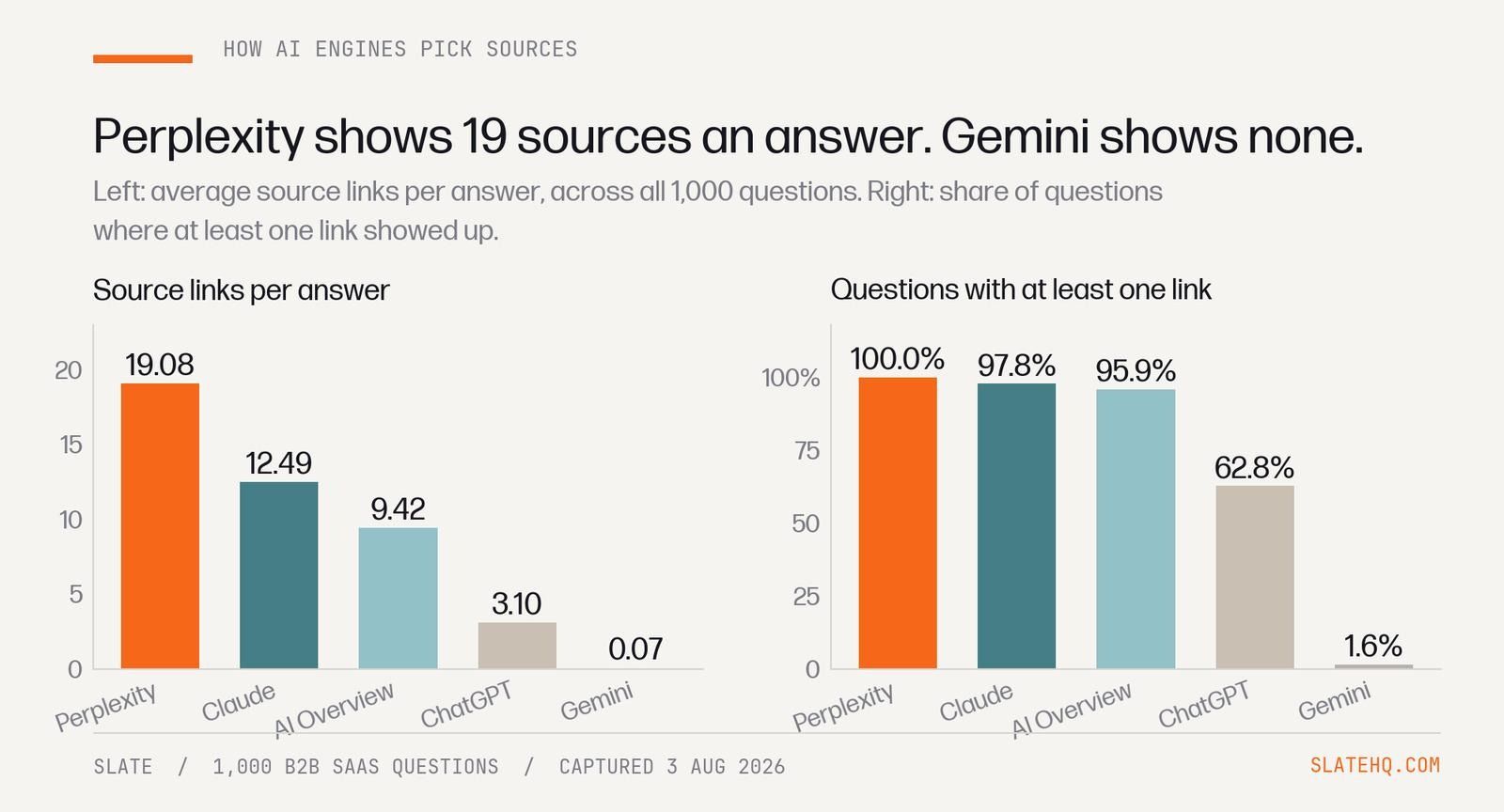
That spread changes what a citation is worth to you. In Perplexity and Claude, a cited page is something the reader can click. In ChatGPT and Gemini, most answers name vendors and link nobody, so a mention is the only thing on offer.
The source pools differ by the same order, from 12,191 pages down to 71. Whichever AI search analytics tool you use will show you a different world depending on which engine it samples.
ChatGPT's links depend on what kind of question you ask. It showed a link on 90.7% of buying questions and 8.1% of research questions, and a third of those links sit on a pricing page.
So ChatGPT points at products it wants the buyer to open, and answers research questions from memory. Keep your pricing page sharp, and expect nothing there for your blog.
The next question is whether the links these engines do show point at the same pages.
What to do. Track each engine on its own. One of the four tools your buyers use shows twenty links per answer and another shows none, so a single "AI citation" number hides which engine is quoting you.
Do the AI Engines Cite the Same Sources as Each Other?
ChatGPT, Perplexity, Claude and Gemini almost never cite the same page. The closest any two of them get on a typical question is 13.6%, and that is Perplexity and Claude, the two heaviest citers.

Of the 31,128 citations, 88.7% came from one engine alone. Look at the 29 that all three made and 62.1% of them rank in Google's top 10, against 15.5% of the pages a single engine cited. Agreement, when it happens at all, happens on page one.
Do They at Least Recommend the Same Vendors?
The four engines name the same vendors 35.2% to 42.0% of the time, which is the most useful number in this study. Gemini sits in that band while citing nothing at all.
On the 509 questions where all four named a vendor, they listed 7.5 between them and agreed on 2.1. We got there by matching 154 B2B SaaS brand names against every answer.
Read the two columns together and the point is hard to miss. Four engines working from separate evidence arrive at similar vendor lists, so the vendor list is not coming from the pages they cite.
It comes from the sum of what the whole web says about a category, absorbed in training, then topped up by whatever each engine retrieves that day.
Our study of 300,000 citations across six B2B SaaS brands found the same gap from another angle. Brands and their known competitors accounted for under a quarter of the citations in their own category.
So if the engines are not reading each other's sources, the obvious guess is that they are all reading Google. That is the next test.
What to do. Report on whether you get recommended, and treat citations as a per-engine metric. Ask four AI tools the same question and they credit almost entirely different pages while naming a similar set of vendors.
Do You Have to Rank on Google to Get Cited by AI?
Ranking on Google is not required. Only 29.3% of Perplexity's citations are pages from Google's top 10, and no engine here goes above 34.8%.
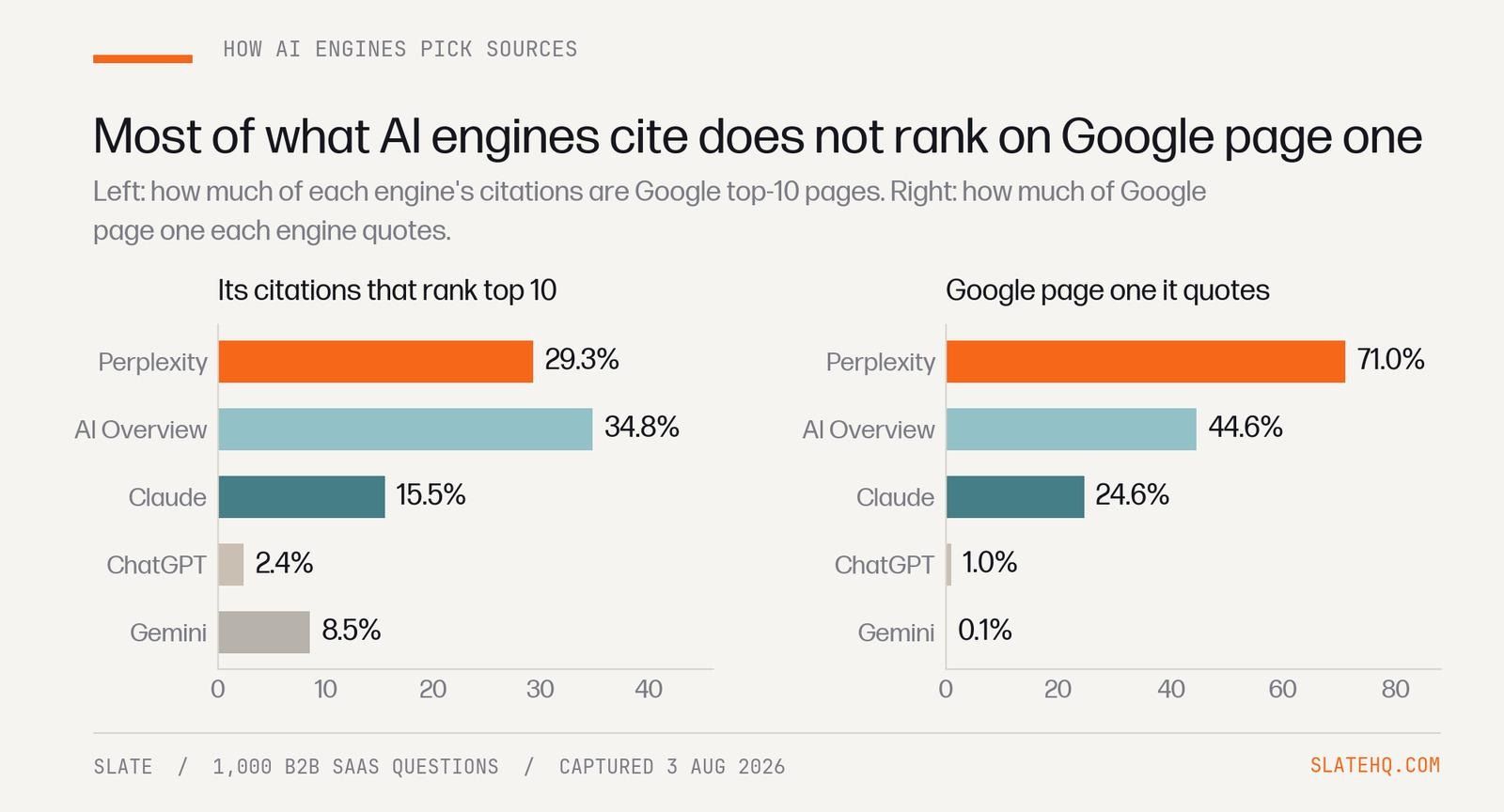
The right panel asks the opposite question: how much of Google page one gets used at all. Perplexity uses 71.0% of it, more than any other engine, and then adds about two and a half times as many pages from outside it.
So ranking well puts you in front of Perplexity and does very little for ChatGPT. Ahrefs' 300,000-keyword analysis points the same way on the Google side.
Where Does the Other Three Quarters Come From?
The three engines cited 19,906 different pages between them. 74.1% of those pages are not in our Google data at all, and 47.2% of the Google pages were never cited by any of the three.
So rank tracking shows you about a quarter of where you are being quoted. Seeing the rest takes a citation tracking tool pointed at the answers themselves.
What to do. Keep ranking, and track the citation pool as well. Google page one helps in every engine, and it accounts for a quarter of what they quote, so the other three quarters need their own reporting.
Citation Rate by Google Position: 86.9% at Number 1, 46.0% at Number 9
Google rank is the one rule that carries across all four engines. Every line below slopes the same way, and ranking first is worth 1.6 to 2 times the citation rate of ranking ninth.
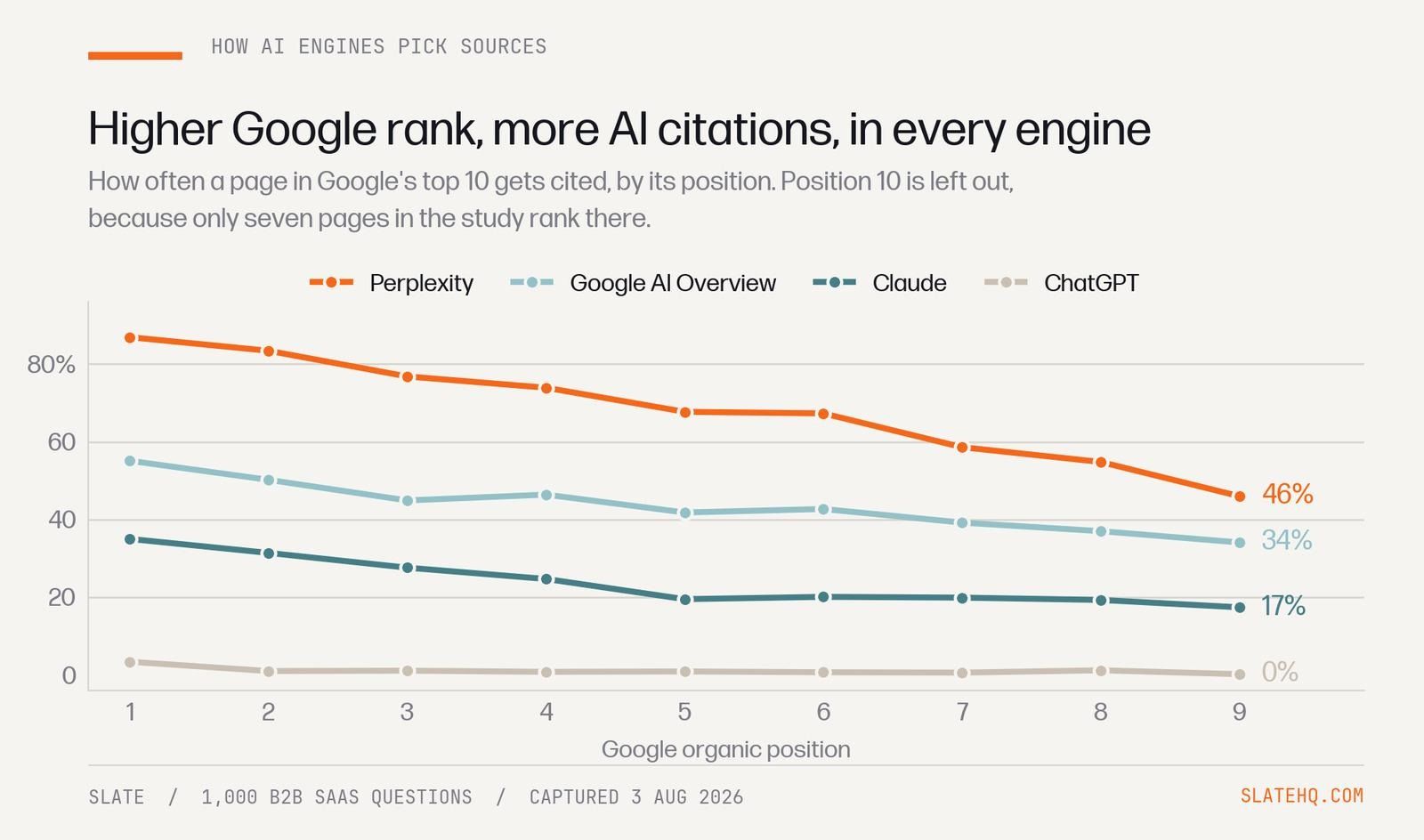
Citation rate by Google position: Perplexity falls from 86.9% at position 1 to 46.0% at position 9, Claude from 35.0% to 17.4%
Read the levels as well as the slopes. At position 1, Perplexity quotes you 86.9% of the time and Claude quotes you 35.0%. First place buys near-certainty in one engine and one answer in three in the other.
Rank is the whole of the advice that works everywhere. Everything after this splits by engine, starting with the sharpest split we found.
What to do. Push for the top two positions on the questions you care about. Ranking higher lifts your citation rate in every engine that cites, and it is the one lever that works on all of them at once.
Does a Reddit Presence Help You Get Cited by AI?
Reddit pays off in Perplexity and does nothing in ChatGPT or Claude. Perplexity cited Reddit 1,051 times, across 617 of the 1,000 questions, which makes it the most-cited site in Perplexity's pool at 5.5% of all its links.
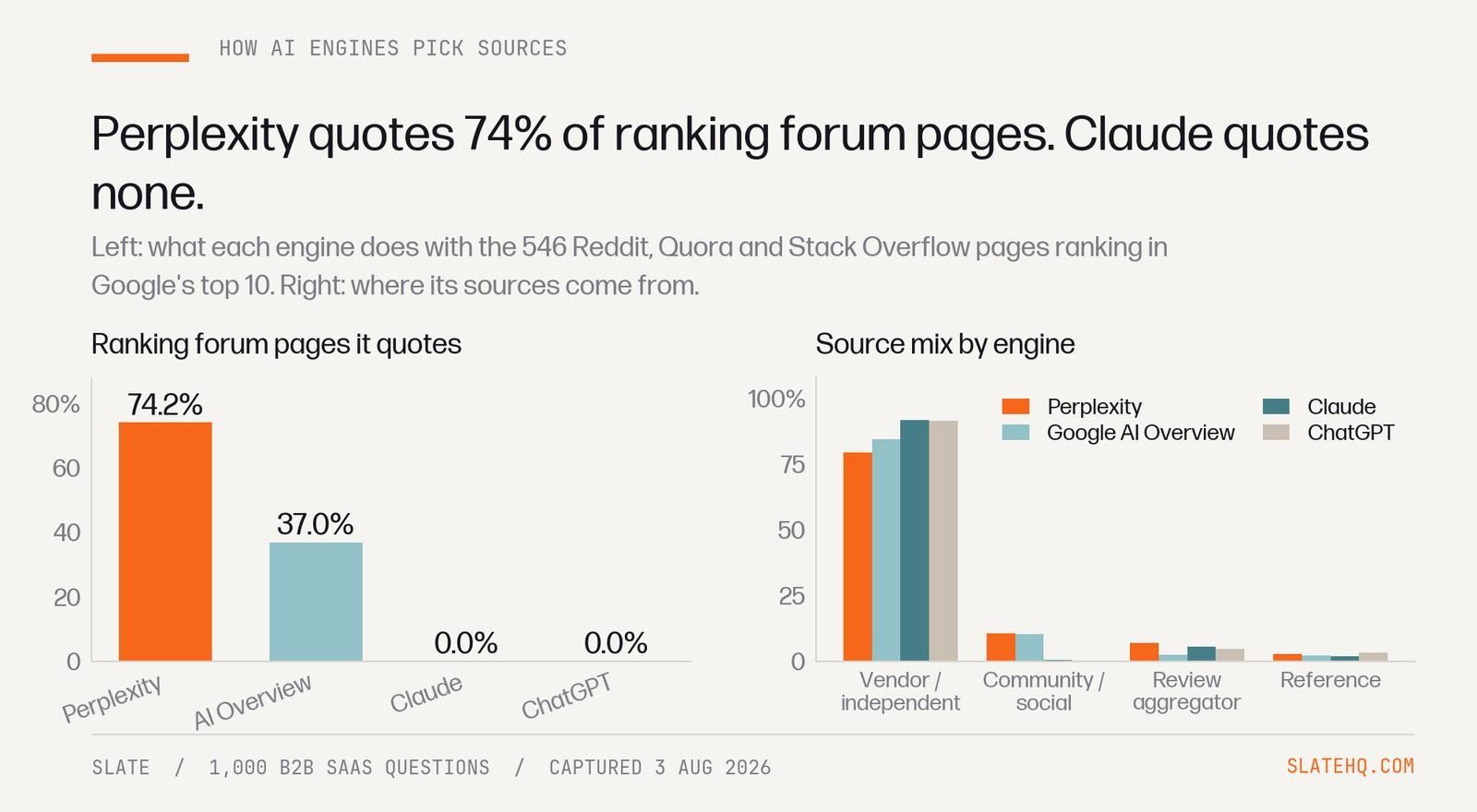
Google AI Overview cited Reddit 243 times. ChatGPT and Claude cited it zero times each, across 1,000 questions and 15,596 links between them.
The 546 forum pages that rank in Google's top 10 for these questions settle whether this is about availability. Perplexity quotes 74.2% of them, Google AI Overview 37.0%, and Claude none.
Those pages rank, they are easy to find, and they are on topic, and two engines still never touch them. Most published AI SEO statistics blend the engines together, which hides a gap this wide.
Community content is the only row in that table that splits. Review sites hold a steady low share everywhere, and vendor pages dominate every pool.
So a Reddit presence pays in Perplexity, pays a little in Google AI Overview, and pays nothing in ChatGPT or Claude. That leaves the question most teams spend their budget on. Can you change any of this on your own page?
What to do. Budget Reddit against Perplexity and Google, and not against ChatGPT or Claude. Perplexity quotes Reddit constantly, Google AI Overview quotes it regularly, and the other two have never quoted it here.
Does Improving Your Page Get You Cited More?
Only Claude rewards a better page, where the strongest signal scores 0.186. We tested 19 things about a page against whether it got cited. Across the other engines, rank beat every one of them.
Each attribute gets an effect size, which is a score from 0 to 1 for how cleanly it splits cited pages from skipped ones. Anything under 0.11 is too small to act on.
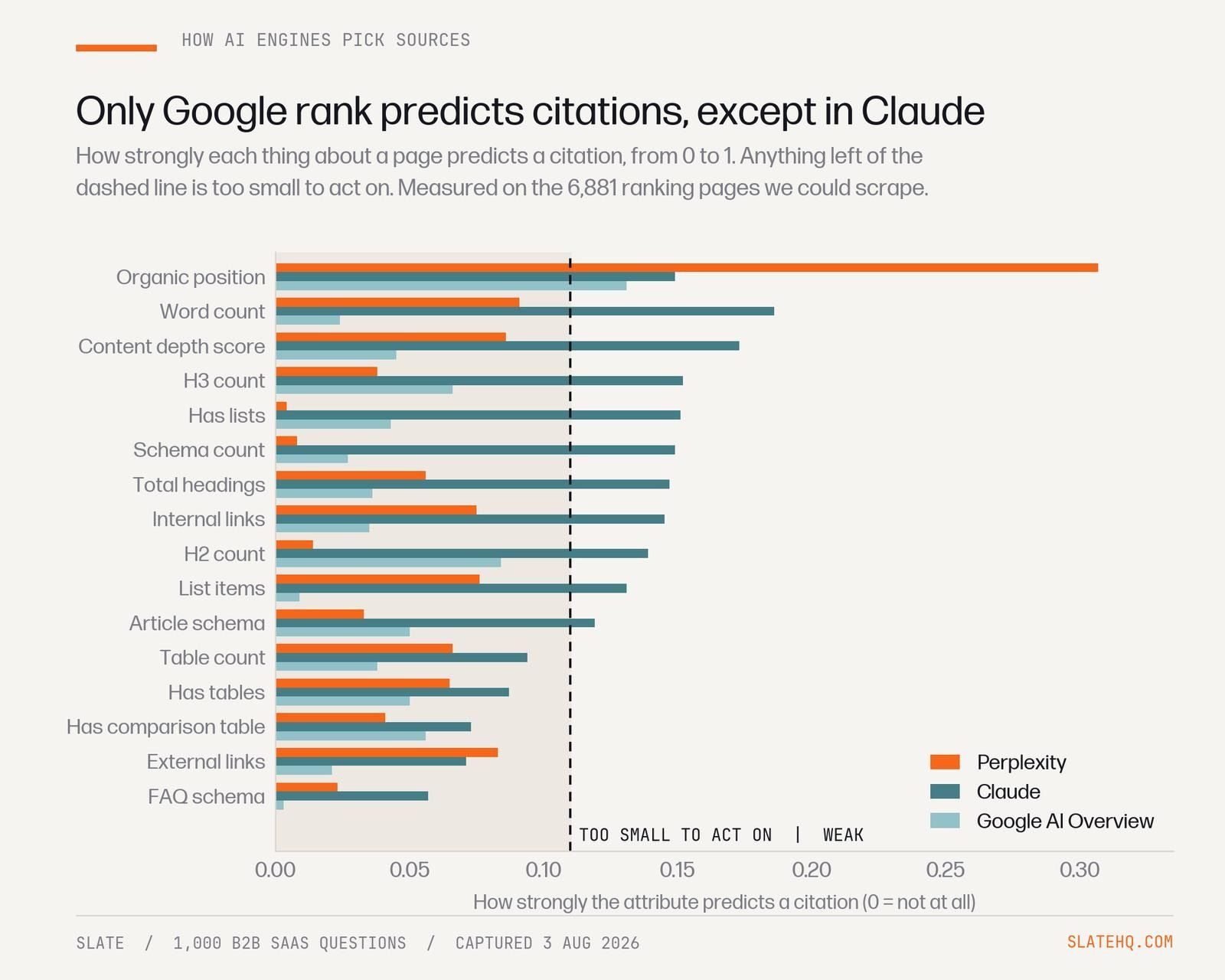
In Perplexity, Google rank scores 0.307 and every page attribute stays under 0.10. Google AI Overview looks the same, with rank at 0.131 and nothing else above 0.09. Ahrefs' 174,048-page analysis put word count at 0.04 there, which is roughly nothing.
Claude is the exception. Five page-quality signals cluster around 0.15, led by word count at 0.186, and all five beat Claude's own rank score. Depth is the one thing to write for if your buyers use Claude.
Site strength changes nothing anywhere. Domain Rating is Ahrefs' 0 to 100 score for a site's backlink profile, and the pages Perplexity cites sit at 78 against 76 for the pages it skips. In Claude the two figures are 76 and 78, which points the wrong way.
Rank and 19 Page Signals Together Beat the Baseline by 4 Points at Most
We also built a small model for each engine that predicts a citation from rank plus every page attribute at once.
The base rate is the share of pages that engine cites anyway, so a model has to beat it to be worth anything. The last two columns run from 0, meaning it explains nothing, to 1, meaning it explains everything.
Almost everything Perplexity's model knows is rank. In Claude it is the reverse, and most of its small predictive power comes from the page itself.
The best of the three beats its own base rate by 4.1 points. Rank plus every page signal together buys you a few points at most.
Your existing content refresh cadence is doing more for you than anything on that chart. One page-level choice does move the numbers, though, and it is the format you write in.
What to do. Spend page-level effort on depth for Claude, and spend everything else on rank. Claude is the only engine where what is on the page changes its odds at all.
Which Page Formats Get Cited Most by AI?
Definition pages do best, and they are the only format in the top two for all three citing engines.
Write the definition page first. Then write the comparison page, which is strong in Perplexity and Google AI Overview, and middling in Claude.
Pricing pages are where the engines split hardest: Perplexity's most-cited format at 77.1%, and Google AI Overview's least at 38.1%. Our earlier study called them the weakest format for citation, and that was true of Google alone.
Question type moves Claude the most, which quotes 34.5% of ranking pages on research questions against 21.0% on buying ones. ChatGPT runs the opposite way. Perplexity treats both the same.
So much for the three questions.
What to do. Write the definition page first, then the comparison page. Both travel well in every engine, while pricing pages and forum threads are quoted heavily by one engine and skipped by another.
AI Visibility Checklist by Role
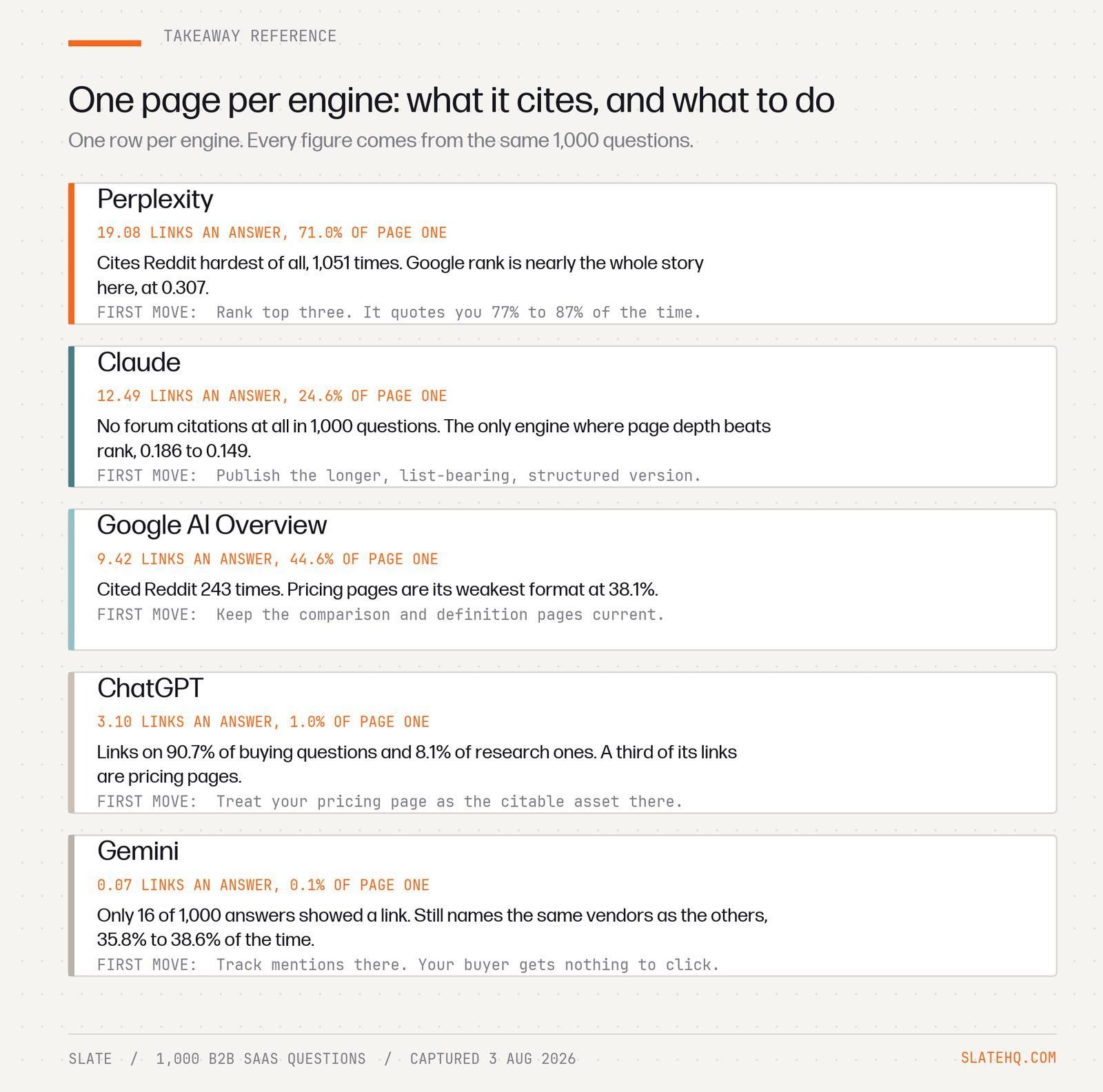
The card below fits the whole study onto one page you can keep beside your reporting. Under it, the same advice split by job.
If You Run SEO: Track One Engine at a Time
Stop treating AI visibility as a single metric. Agreement between engines on cited pages runs from 0.5% to 13.6%, so one blended AI citation rate averages four unrelated outcomes.
Track them one engine at a time so the number means something. Any of the AI search visibility tools worth paying for will split citations by engine.
Keep ranking, and push for the top two spots. Google position is the only signal that works in every engine. Moving from position 9 to position 1 is worth 41 points of citation odds in Perplexity, 21 in AI Overview and 18 in Claude.
Add citation tracking next to rank tracking, because three quarters of the pages these engines cited are not in your Google data at all.
And treat Perplexity as the engine that follows Google most closely. Rank in the top three and it quotes you 77% to 87% of the time. It is the engine where ordinary search engine optimization (SEO) buys the most AI visibility.
If You Run Content: Write the Definition Page
Definition format is top-two in all three citing engines, and it is the only format with no downside in any of them. That makes it the first page to write.
Do not rebuild pages to chase citations. No page attribute changes the odds in Perplexity or Google AI Overview, so the AI SEO checklist items you have already covered are enough.
If Claude carries weight with your buyers, depth is the only page signal with a measurable effect. Longer, more structured, list-bearing pages get cited more there.
Do not copy the pricing-page advice from one engine to another. Pricing pages are Perplexity's most-cited format at 77.1% and AI Overview's least at 38.1%. The way you write that page depends on which engine you care about.
If You Run Marketing: Measure Whether You Get Named
Getting named in the answer is the asset that holds across all four engines. They agree on 35% to 42% of the vendors they name and under 14% of the sources they cite.
Reddit pays off in Perplexity and in Google AI Overview, and nowhere else. Reddit is Perplexity's most-cited site, and ChatGPT and Claude have never quoted it across 1,000 questions.
On ChatGPT, a link is a product placement for buyers. It links on 91% of buying questions, a third of those to pricing pages, and on 8% of research questions. Your pricing page is the asset there.
In Gemini, plan for a buyer who sees no links at all. That reader gets a vendor recommendation with nothing to click, so a mention is the only thing you can win in Gemini.
The Bottom Line
Rank for the questions you care about, and measure whether your product is named in the answer. Those two moves work in all four engines, and almost nothing else does.
Our earlier study asked what gets a page cited by Google's AI Overview, and the answer was mostly nothing you control. The same holds in the other three, with one twist: the engines differ from each other far more than any of them differs from Google.
Four engines, one set of questions, 29 citations they all agreed on. Perplexity quotes most of page one and all of Reddit. Claude quotes deeper pages and no forums.
ChatGPT links to products on buying questions and to nothing on research ones. Gemini links to nothing at all.
What they share is the slope: ranking higher lifts your citation rate in every engine that cites. What they converge on is the vendor list they hand the buyer.
The citations underneath that list keep shuffling. The list itself holds, which is why it belongs in your reporting.
See Your Own Numbers, Engine by Engine
Slate tracks all five engines separately, so you can see which pages each one quotes and which vendors it names in an answer. That is the reporting this study was built on.
When you want your own prompt set measured that way, book a Slate demo.
Frequently Asked Questions
How Many Vendors Does an AI Answer Name?
An AI answer names about seven vendors. Across the 509 questions where all four engines named at least one, they listed 7.5 vendors between them and agreed on 2.1 of those.
Which AI Engine Rewards Ordinary SEO Most?
Perplexity rewards classic SEO most. Google position is by far its strongest signal, at an effect size of 0.307, and pages at position 1 get cited 86.9% of the time. It follows Google's ranking more closely than any other engine here.
Does a Stronger Website Get Cited More Often?
Site strength makes almost no difference. The pages Perplexity cites have a middle Domain Rating of 78, and the pages it skips sit at 76. In Claude the two figures are 76 and 78, so the stronger sites are the ones being skipped.
Do AI Engines Cite Review Sites Like G2?
Every engine cites review sites at a steady low rate. Review sites are 6.9% of Perplexity's links, 5.5% of Claude's, 4.8% of ChatGPT's and 2.6% of Google AI Overview's. That is a much narrower spread than community sites, which swing from 10.7% to 0.1%.
Why Does ChatGPT Show So Few Sources?
ChatGPT uses links for buyers. It showed a link on 90.7% of buying questions and 8.1% of research ones, and a third of those links point at pricing pages. Your pricing page is the asset to keep sharp there.
Does Gemini Show Sources in Its Answers?
Gemini shows no links. Only 16 of 1,000 answers contain a web address, and those are mentions inside the text. A buyer reading a Gemini answer gets your name or nothing, which makes being named the only thing worth tracking there.
Which Engine Should I Track First?
Track the engine your buyers open, then use your Google rank as the tie-breaker.
If you already rank on page one, Perplexity pays back fastest, because it quotes 71.0% of top-10 pages. If your buyers research in Claude, track Claude instead. It quotes 24.6% of those same pages, and it rewards page depth more than rank.
What Should I Measure Instead of Citations?
Measure whether your product is named in the answer. The engines agree on 35% to 42% of vendors and under 14% of sources. Being named is the stable outcome, and being cited is four separate outcomes, one per engine.
Our Google AI Overview statistics roundup covers the Google half of that in more detail.