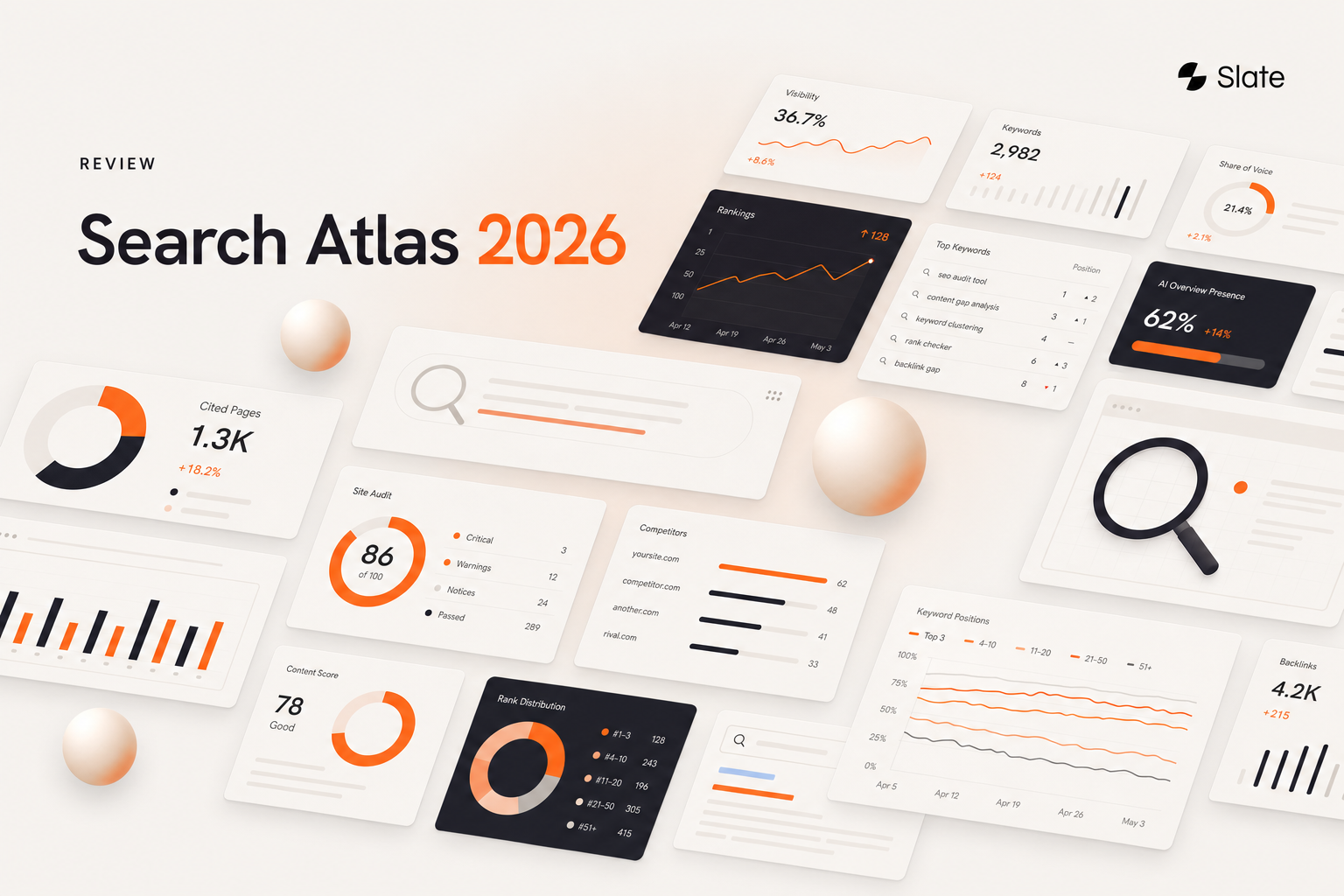
Search Atlas has positioned itself as one of the more ambitious all-in-one SEO platforms heading into 2026, pairing classic SEO tooling with agentic automation through OTTO SEO. This review covers whether it earns a place in your stack, which workflows it genuinely improves, and where oversight is still non-negotiable.
Search Atlas is an all-in-one SEO and AI search operations platform that combines keyword research, rank tracking, site audits, AI content generation, local SEO, and OTTO SEO automation in one system. It best suits agencies and in-house teams that want workflow consolidation instead of another point tool, with paid plans starting at $99/month.
Key Takeaways
Search Atlas is best understood as an SEO operations platform. The most useful framing for a 2026 buyer is whether you want to consolidate execution into one system.
- What it is: An all-in-one SEO and AI search platform built around OTTO SEO automation, Content Genius, keyword research, rank tracking, site audits, and local SEO.
- Standout strength: OTTO SEO-style automation across technical, on-page, content, schema, internal linking, and local workflows.
- Biggest tradeoff: Automation exists, but oversight, QA, and onboarding discipline still count, especially on production sites.
- Pricing entry point: Paid plans start at $99/month, with a seven-day free trial. Consumption-based credits and AI points can push your bill higher.
- Best-fit buyers: Agencies, in-house SEO and growth teams, local or multi-location marketers, and advanced solo operators.
- 2026 differentiator: LLM visibility tracking signals an attempt to cover both traditional search and AI-driven discovery.
- Skip it if: You want one-click AI writing, a lightweight specialist tool, or a fully hands-off automation system with no review layer.
TL;DR Verdict: Is Search Atlas Worth It in 2026?
Search Atlas is worth it in 2026 for teams that want to consolidate SEO execution and automation into a single platform, and who have the discipline to review automated changes. It's less ideal for buyers seeking a lightweight specialist tool or fully hands-off automation. Value depends heavily on usage and oversight.
For agencies and multi-client operators, the consolidation case is strongest: one platform replacing several point tools, with white-label options on higher tiers. For in-house SEO and growth teams at SMB and mid-market companies, the platform earns its keep when content and technical workflows run frequently enough to justify the learning curve. Teams comparing options often start with the best AI SEO tools to map the landscape before committing.
Solo operators can extract value, but the consumption-based pricing and onboarding time should factor heavily into the decision.
How We Tested Search Atlas
A credible review of an execution-heavy platform has to go beyond the marketing site. The goal is to assess how Search Atlas maps to the workflows teams run day to day, beyond whether features exist on a spec sheet.
The framework centers on six core workflows: site audit, content brief generation, content refresh, rank tracking, reporting, and AI visibility checks. Outputs get checked against first-party sources (Google Search Console, GA4, and manual SERP checks) to separate directionally useful estimates from numbers that need verification before high-stakes calls.
The reviewer lens spans three perspectives that mirror the buying committee: an SEO lead evaluating data depth and accuracy, a content lead assessing editorial usefulness, and a growth or CMO perspective weighing total cost and consolidation value.
Methodology counts here because execution platforms carry operational risk. A tool that recommends changes is low-stakes; a tool that implements them on production sites is not. Disclosing how a platform gets evaluated, and against what, is the difference between a feature recap and a decision-grade review.
What Is Search Atlas?
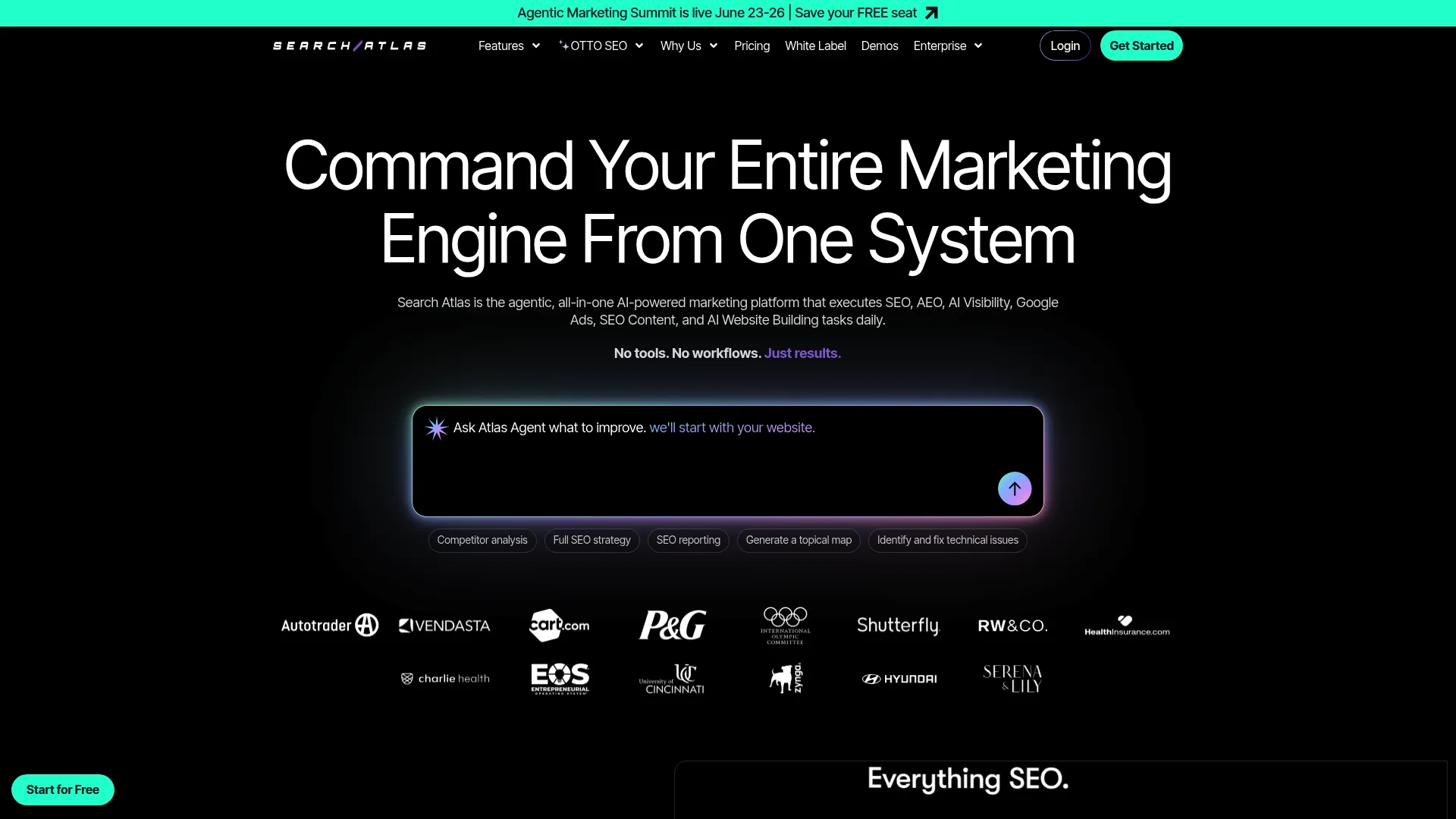
Search Atlas is an all-in-one AI-powered SEO and marketing platform that brings keyword research, rank tracking, site audits, backlink analysis, AI content generation, local SEO, and OTTO SEO automation into a single workspace. It's built to consolidate SEO execution instead of serving as a single-purpose tool.
The platform spans more than 60 tools across seven primary categories: OTTO automation, keyword research, backlink analysis, AI content generation, rank tracking, technical auditing, and local SEO with Google Business Profile integration. It also layers in LLM visibility tracking, aiming at AI-driven discovery where citations and answer-style results increasingly shape organic visibility.
The clearest way to think about Search Atlas is as an operations platform, a system built to connect insight to execution, instead of a research tool you check and then act on elsewhere.
## Search Atlas Standout Features and Workflows
The most useful way to evaluate Search Atlas is by workflow. A 60-tool suite reads impressive on a comparison page, but what counts operationally is how many jobs you can run end to end without leaving the platform.
Four modules anchor the platform. OTTO SEO handles agentic execution across technical and on-page work. Content Genius drives SERP-informed briefs and content optimization. The keyword, rank tracking, and audit cluster covers classic SEO intelligence. And the local SEO and GBP tools serve multi-location marketers. LLM visibility tracking sits across these as the 2026-specific layer.
Each module below follows the same structure: what it does, where it helps, what to watch, and how to use it well.
What Does OTTO SEO Actually Automate?
OTTO SEO is Search Atlas's agentic automation layer. It analyzes a connected site, then recommends (and in many cases implements) changes across technical SEO, on-page optimization, schema and metadata, internal linking, content, and local listings through a chat-style interface.
Where it helps: OTTO compresses the gap between audit and action. Instead of exporting a list of technical issues and routing them to a developer, teams can review and apply corrections from one place. Independent reviews describe it crawling large sites, surfacing on-page and schema recommendations, suggesting internal links, and connecting to Google Business Profile for local updates. For teams building this out, the best SEO automation tools offer useful points of comparison.
What to watch: Automation on production sites is where caution earns its keep. Some long-form reviews report integration conflicts, occasional timeout errors, and schema instability, including clashes with existing WordPress plugins. None of this makes OTTO unusable, but it does mean auto-apply on a live client site without a review step is a genuine risk.
How to use it well: Treat OTTO as a fast first-pass operator that still needs a human in the loop. Stage changes where possible, build a QA step before pushing to production, and watch credit and AI point consumption, since automation tasks can burn through allocations quickly.
The honest framing: OTTO's value is genuine, but it moves the bottleneck from doing the work to reviewing the work. That's a better problem to have, as long as your team builds the review layer.
How Useful Is Content Genius for Real Editorial Workflows?
Content Genius is Search Atlas's content optimization engine, built on live SERP data. For a target keyword, it analyzes what currently ranks, observed intent, heading structure, schema usage, and keyword patterns, then generates outlines and optimization suggestions informed by that analysis.
Where it helps: The SERP-informed approach makes briefs more grounded than generic AI outlines. Teams get semantic coverage guidance, passage-level optimization, internal link suggestions, and schema prompts tied to the page type. For content teams producing at volume, this shortens the brief-building phase considerably and supports more extractable, well-structured content.
What to watch: Speed is not the same as judgment. AI-generated drafts still need fact-checking, brand-voice alignment, and editorial calls about which recommendations to accept. The platform is an agentic assistant that still expects a human editor, and treating it as a hands-off writing system is how generic, off-brand content slips through.
Editorial oversight remains the deciding factor. Content Genius reliably handles structure, coverage, and SERP alignment; humans still own accuracy, voice, and the call on what gets published. For a deeper look at this category, see Slate's guides to Search Atlas content optimizer review and Search Atlas pros and cons.
Keyword Research, Rank Tracking, and Site Audit
This cluster covers the classic SEO intelligence most teams expect from a suite, and Search Atlas is competitive on capacity.
Keyword research draws on a database of roughly 5.2 billion keywords, with metrics for search volume, difficulty, CPC, and SERP features, plus keyword gap analysis against competitors and a content planner that maps strategy from seed topics. Rank tracking scales from around 100 to 5,000 keywords depending on tier and includes local tracking and competitor monitoring. The site audit crawler can cover up to 1 million pages, surfacing issues across status codes, metadata, internal links, and more. For closing strategic holes, Slate's roundup of content gap analysis tools is a helpful companion.
In day-to-day use, these modules appear feature-complete and directionally reliable. The main caveats are consumption-based: audits and reports draw on credits, and rank tracking limits scale by plan. For trend analysis and prioritization they hold up well; for high-stakes reporting, validate against first-party data.
Local SEO and GBP Automation
Search Atlas includes a dedicated local SEO module with direct Google Business Profile integration, local rank tracking, and geographic heatmaps that visualize rankings by location. OTTO workflows can connect to GBP for automated updates in some setups.
Best for: Local and multi-location marketers who manage many listings and need centralized control plus location-level rank visibility. As with OTTO more broadly, scaling local automation works best with a QA step, given the platform-stability themes raised in long-form reviews.
Full Feature Breakdown
The table below maps each major module to what it does, who benefits most, and the caveat worth knowing before you rely on it.
Search Atlas Pricing in 2026: Plans, Limits, and Total Cost
Pricing checked June 23, 2026. Search Atlas paid plans start at $99/month for Starter and scale to $999/month for Agency, with a seven-day free trial and lower effective monthly rates on annual billing. The headline price is only part of the story, because credits, AI points, and per-site fees shape what you end up paying.
Here is how the tiers break down:
Pricing: Starter $99/mo (1 user, 1 OTTO project, \~120 tracked keywords); Growth $199/mo (3 users, 2 OTTO projects, includes LLM visibility tracking); Pro $399/mo (5 users, 4 OTTO projects, white-label, all LLM models); Agency $999/mo (built for 10+ client sites, maximum quotas, priority support). Annual billing lowers effective monthly prices to roughly $79/$159/$319/$799.
G2 rating: 4.6/5
Free trial: A seven-day free trial is available with no credit card required, and Search Atlas includes a free 30-minute onboarding call. There is no free version.
Beyond the sticker price: Total cost of ownership is where Search Atlas gets more complex. Third-party pricing breakdowns describe a consumption layer where credits cover audits, reports, and analysis, while AI points cover content generation and OTTO recommendations. Monthly AI point allocations reportedly range from around 500 on Starter to 12,500+ on Agency, with extra credits available at about $0.99 each. Additional sites beyond your plan limit can run roughly $69/month each. One long-form agency review warned that the combination of price plus credits plus AI points plus per-site fees can push your bill well above advertised prices for heavy users.
The ROI question worth asking before you buy: what would need to be true for this to pay off? If the platform replaces three or more tools you currently pay for, and your team runs its workflows frequently enough to absorb the learning curve, the math tends to work. If usage is sporadic, consumption costs erode the value quickly.
Ease of Use, Learning Curve, and Onboarding
Search Atlas is powerful, and that power comes with a non-trivial onboarding cost. Experienced SEOs can find their way around, but the sheer breadth (60-plus tools, OTTO automation options, and consumption-based pricing) means the first few weeks are a genuine ramp.
In practice, the first 30 days play out as staged adoption. Teams need time to understand which automations to trust, how credits and AI points deplete, and where integrations behave predictably. The free 30-minute onboarding call helps, but internalizing the cost implications and automation impact takes weeks of hands-on use.
Integration stability is the most cited friction point in long-form reviews. One detailed agency review scored platform stability around 2.5/5, citing loading issues, timeout errors, and conflicts with WordPress schemas and plugins, where automated schema updates can break existing implementations.
Watch out for: Rolling Search Atlas out across all clients at once. The safer path, especially for agencies, is to pilot on a subset of sites, build review and QA steps, and expand once your team trusts how the automation behaves. For more on building these systems, see Slate's guide to Search Atlas features and automation review.
How Accurate Is Search Atlas Data?
Search Atlas data is directionally accurate and useful for trend analysis, prioritization, and competitive comparison, but like all third-party SEO tools, its keyword volumes, positions, and traffic estimates are modeled data. For high-stakes decisions, validate against Google Search Console, GA4, and manual SERP checks.
None of this is a knock on Search Atlas specifically; it applies to every platform that estimates instead of reporting. Even Search Console ranking data is directionally useful instead of perfect, and analytics tools routinely diverge on sessions and conversions because they use different data models. Third-party estimates inherit those gaps and add modeling assumptions on top.
The practical approach: use Search Atlas for what modeled data does well (spotting trends, comparing competitors, prioritizing work) and confirm specifics with first-party sources before you make a reporting claim or a high-cost decision.
Does Search Atlas Help with AI Search Visibility?
Yes. Search Atlas includes LLM visibility tracking that monitors how content sits for AI models and AI Overviews, alongside topical dominance reporting and competitor citation intelligence. These cover genuine AI-era discovery needs, though specifics on individual AI systems should be confirmed against current documentation.
Modern teams have a broader question now: where do we appear across Google and AI answer surfaces? Discovery increasingly happens inside answers, and when an AI system summarizes a topic, the brands it cites win attention the brands it ignores never see. Slate's roundup of the best AI citation tracking tools digs into how to measure this directly.
Two concepts come into play here. Citation readiness describes how likely your content is to be referenced by an AI system. Extractable content describes how cleanly that content can be parsed, lifted, and attributed. Both depend on clarity, structure, schema, and topical authority, the same ingredients Search Atlas surfaces through its LLM visibility, AI Overview signals, topical dominance, and citation intelligence reporting.
Where Search Atlas delivers: it tracks LLM visibility from the Growth tier up, reports on AI Overview exposure and brand signals, and helps teams see where competitors are being cited. Combined with Content Genius's SERP-informed briefs and schema guidance, that gives teams a workable foundation for producing extractable content.
Where it leaves gaps: claims about exposure inside specific AI systems should be verified against current Search Atlas documentation instead of assumed, since AI-surface coverage varies and evolves.
The broader point for any 2026 buyer: evaluate platforms as systems for AI-driven organic growth. Visibility now has to be engineered across both traditional search and AI answer surfaces, which is the lens Slate's guides to best AI SEO tools and Search Atlas SEO tool review apply throughout.
Workflow Governance and Brand Control at Scale
Automation raises a question feature lists rarely address: can your team scale updates without losing voice, accuracy, and governance? When a platform can implement changes across hundreds of pages, skipping a review layer turns into exposure fast.
Search Atlas's agentic execution makes this concrete. OTTO can recommend and apply changes quickly, which is exactly why review steps, brand-safe defaults, and clear cross-functional handoffs earn their place. The teams that get value from automation decide upfront who reviews what, and where a human signs off before changes reach production.
There's also a strategic split worth naming. Net-new content sprawl (publishing more and more pages) is a different motion from content refresh systems that systematically improve what already exists. AI search tends to reward the latter: clearer, more structured, more extractable content across a topic surface, over sheer volume. Slate's guide to the best content refresh tools explores this motion in detail.
This is the heart of content engineering: repeatable, brand-safe workflows that scale without degrading quality. Volume without governance produces generic output that neither ranks nor gets cited. The platforms worth buying make scale and control work together.
Pros and Cons of Search Atlas
The honest version of pros and cons ties each point to a buyer type instead of listing generic praise and complaints.
Pros:
- Workflow consolidation: Replaces several point tools (keyword research, rank tracking, audits, content, and local SEO) with one platform, which counts most for agencies and lean in-house teams.
- OTTO automation: Compresses audit-to-action time across technical, on-page, schema, and local work, valuable for execution-focused operators.
- AI content speed: Content Genius's SERP-informed briefs and bulk generation speed up content production for teams publishing at volume.
- AI search readiness: LLM visibility tracking and citation intelligence give forward-looking teams a foothold in AI-driven discovery.
- Agency features: White-label and multi-client support on higher tiers suit operators managing many client sites.
Cons:
- Learning curve: The breadth of tools and automation options makes onboarding a multi-week effort, not a quick start.
- Pricing complexity: Credits, AI points, and per-site fees can push your bill well above advertised prices for heavy users.
- Platform stability: Long-form reviews report loading issues, timeouts, and WordPress/schema integration conflicts.
- Automation risk: Applying changes on production sites without QA invites client-facing mistakes.
Who should not buy it: Teams wanting one-click AI writing, buyers who need a single lightweight specialist tool, and anyone expecting fully hands-off automation with no review layer. The platform rewards discipline; it punishes a set-and-forget mindset.
Who Should Use Search Atlas? (And Who Should Not)
Search Atlas is best for agencies, in-house SEO and growth teams, and local or multi-location marketers who want to consolidate SEO execution and automation into one platform and have the capacity to manage onboarding and review. It's less ideal for pre-launch startups, occasional users, and teams seeking a single-purpose specialist tool.
- Agencies and multi-client operators: The strongest fit. Consolidation plus white-label and multi-client support on Pro and Agency tiers makes the platform's breadth pay off, provided you pilot before rolling out widely.
- In-house SEO and growth teams (SMB and mid-market): A good fit when content and technical workflows run frequently. The value lands when usage is high enough to absorb the learning curve and consumption costs.
- Local and multi-location marketers: Well served by GBP integration, local rank tracking, and heatmaps. Worth piloting local automation with QA before scaling.
- Solo marketers and freelancers: Workable on Starter, but watch consumption-based pricing and budget onboarding time realistically.
- Less ideal for: Pre-launch startups, teams without a content strategy, and buyers who only need one specialist capability.
For enterprise content teams weighing fit, Slate's analysis of whether Search Atlas is worth it for enterprise teams goes deeper on the trade-offs.
What Does Search Atlas Replace in Your Stack?
The consolidation question is the decision for most buyers: does Search Atlas replace tools, or just add another layer? For small and mid-market teams, it can replace several common tools at once.
Given its breadth, Search Atlas can credibly stand in for a keyword research tool, a rank tracker, a site audit crawler, an on-page content optimizer, a basic local SEO and GBP manager, and parts of an SEO reporting stack. That overlap is where the consolidation savings come from: fewer subscriptions, fewer logins, one execution layer.
Where a mixed specialist stack still wins: dedicated backlink and digital-PR platforms typically offer deeper link prospecting and outreach; BI and analytics stacks like GA4 and data warehouses aren't replaced; and teams with bespoke editorial or regulatory needs may prefer specialist content tools with finer governance controls. By company maturity, startups and scale-ups benefit most from consolidation, while established enterprises often keep best-in-class specialist tools and use a platform like Search Atlas for execution and AI visibility.
Search Atlas vs Semrush, Ahrefs, and Surfer
The right comparison frame is execution and automation versus research breadth and specialization. Search Atlas leans toward all-in-one execution; the others lead with depth in their respective lanes.
Search Atlas vs Semrush
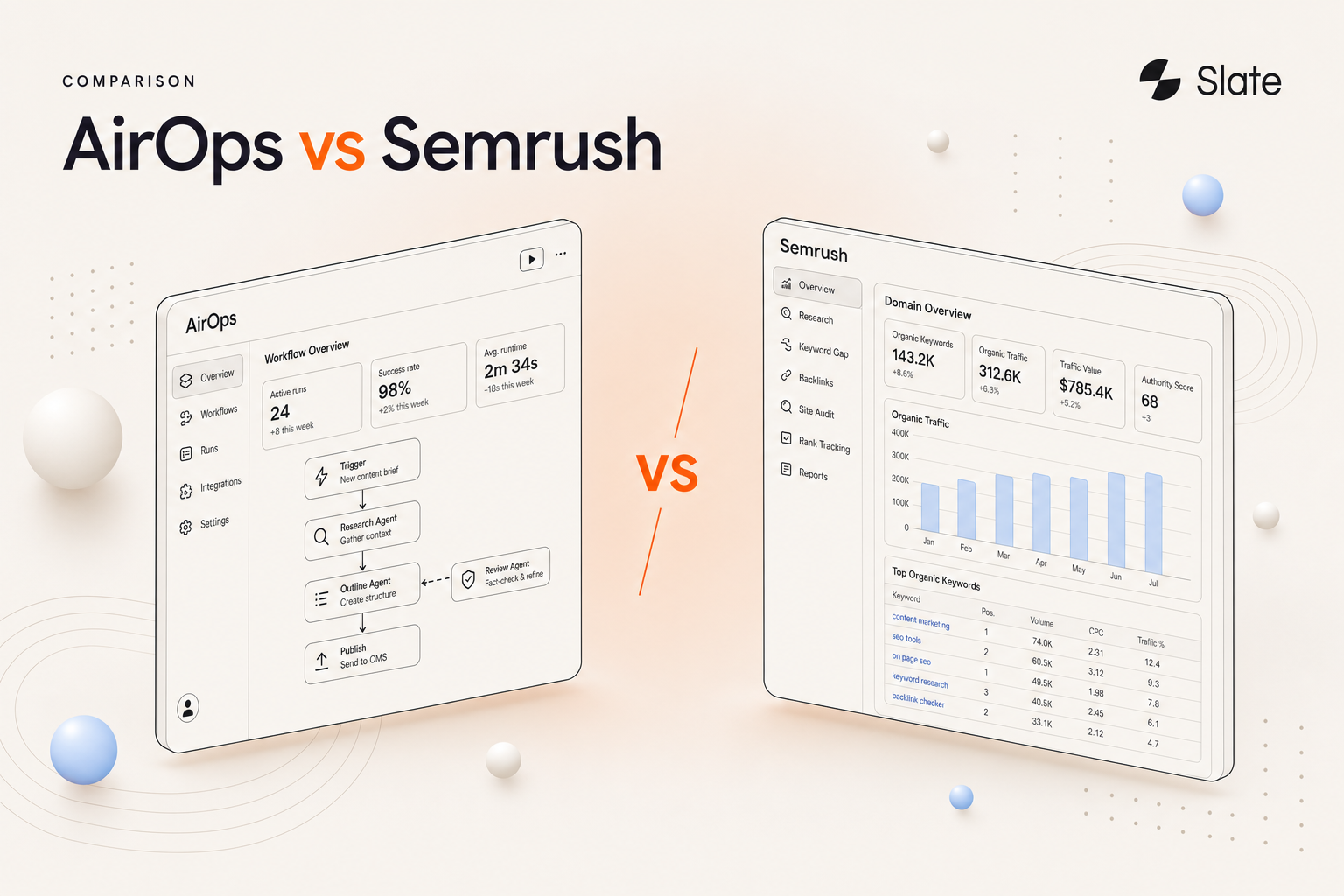
Semrush is built around broad SEO and competitive intelligence: keyword research, backlinks, rankings, AI visibility, and market data at scale. Search Atlas counters with execution and automation, since OTTO applies changes instead of just surfacing them. Choose Semrush when data breadth and competitive research lead; choose Search Atlas when you want execution consolidated into the platform.
G2 rating: 4.5/5
For a deeper breakdown, see Slate's Search Atlas vs Semrush and Search Atlas vs Semrush and alternatives analyses.
Search Atlas vs Ahrefs
Ahrefs is the specialist's choice for deep backlink and keyword research, with Site Explorer, Keywords Explorer, and Site Audit anchoring its suite. Search Atlas covers similar ground but trades some research depth for automation breadth and AI execution. Choose Ahrefs when backlink and keyword research depth is the priority; choose Search Atlas when you want one platform for SEO execution.
Pricing: Ahrefs Free (limited); Starter $29/mo; Lite $129/mo; Standard $249/mo; Advanced $449/mo; Enterprise $1,499/mo. Annual billing saves up to 17%.
G2 rating: 4.5/5
Search Atlas vs Surfer
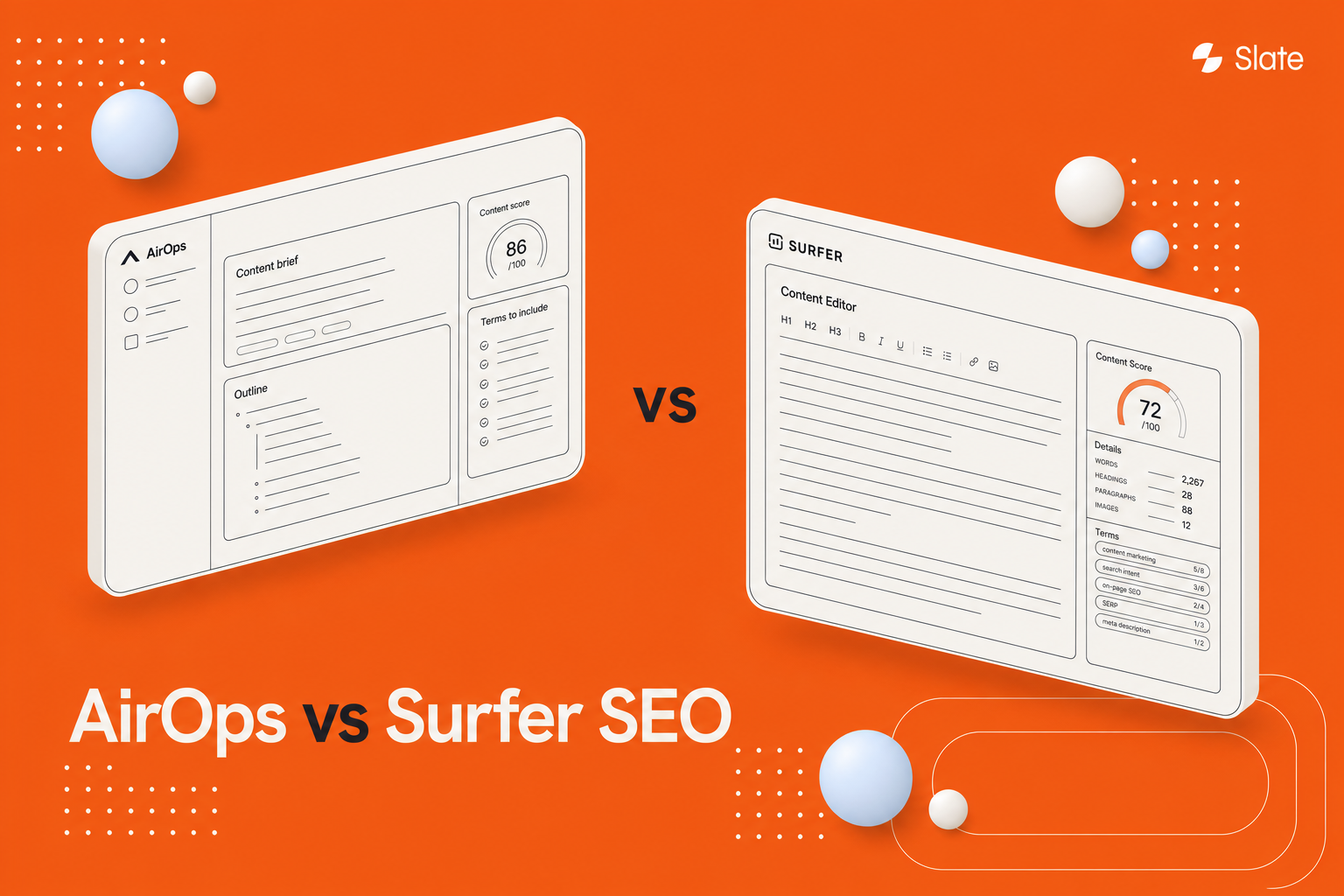
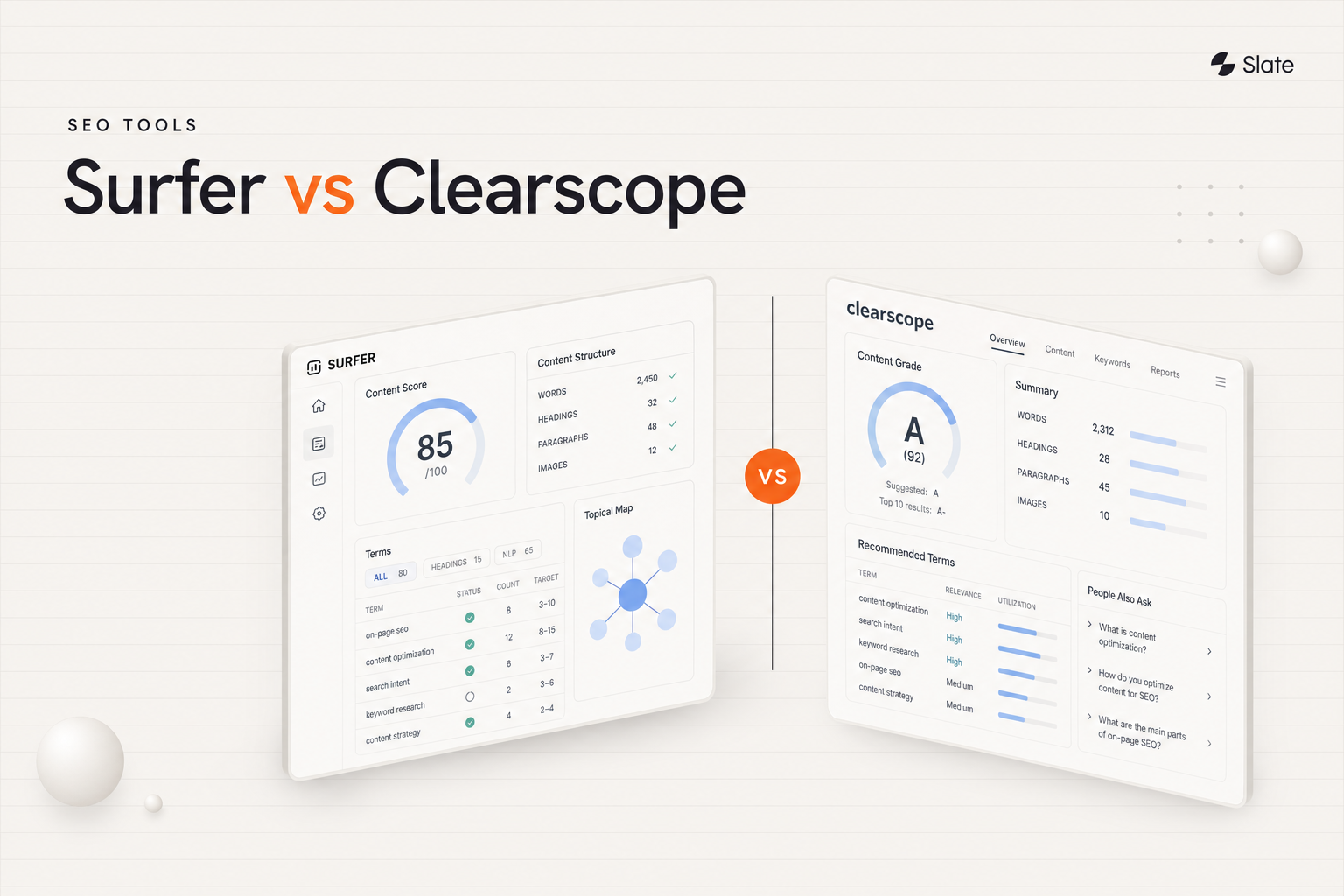
Surfer specializes in content optimization, with its Content Editor, real-time Content Score, Topical Map, and AI visibility tracking across platforms like Google AI Overviews, ChatGPT, Gemini, Claude, and Perplexity. Search Atlas wraps content optimization into a much larger multi-workflow platform. Choose Surfer when on-page content optimization is the core need; choose Search Atlas when you want optimization inside a broader operations suite.
Pricing: Discovery $49/mo; Standard $99/mo; Pro $182/mo; Peace of Mind $299/mo; Enterprise $999/mo. Listed prices are billed yearly.
G2 rating: 4.8/5
For more, see Slate's Search Atlas alternatives and review.
Best Search Atlas Alternatives in 2026
Choose an alternative by job to be done. A generic "best overall" ranking tells you little when the leading options diverge sharply in focus. If your priority is winning visibility across both traditional search and AI answer surfaces, here's how they compare.
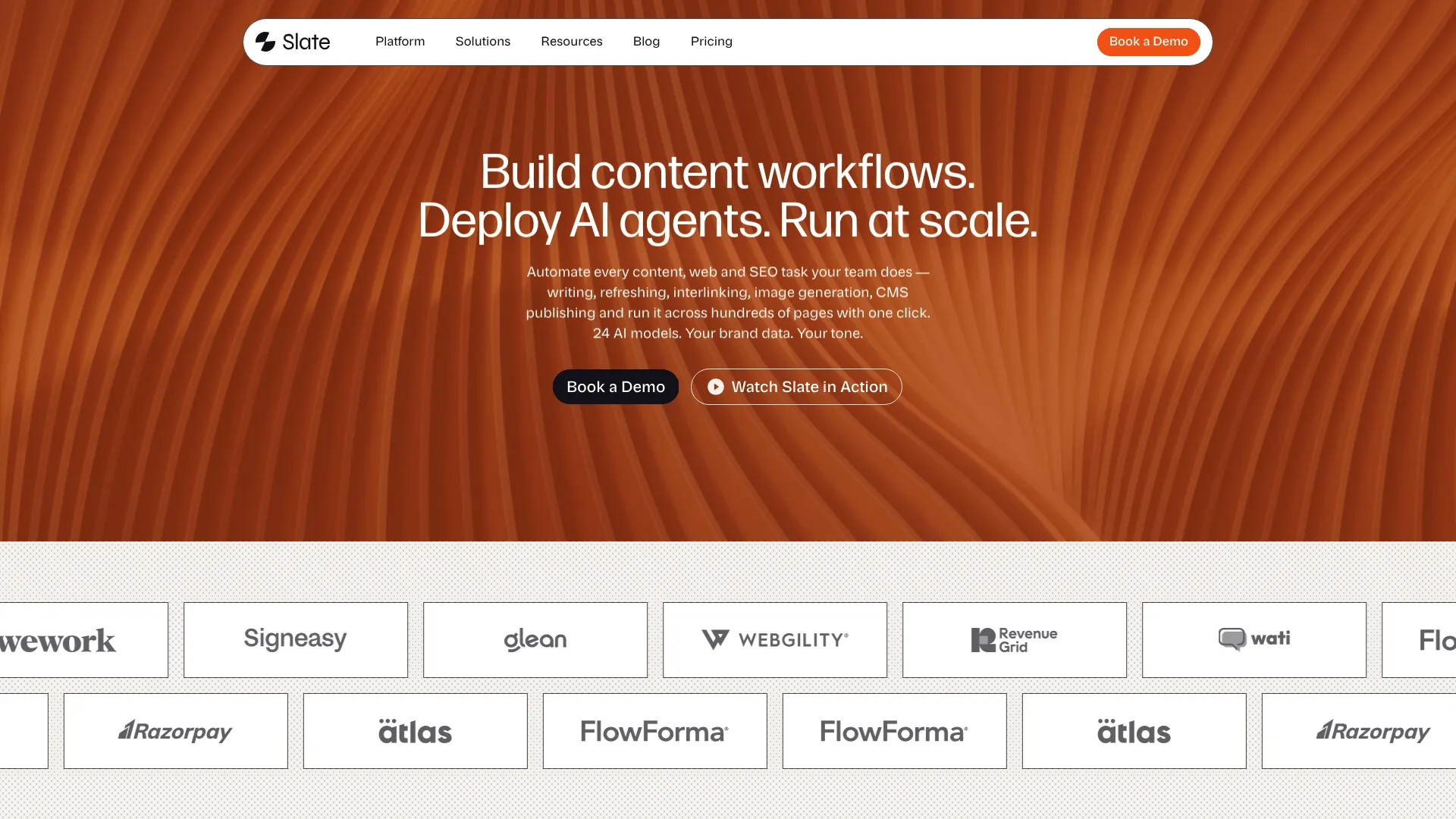
Slate is an AI search optimization and content engineering platform built for teams that need to win visibility across both traditional search and AI-powered discovery. It tracks AI search visibility across ChatGPT, Google AI Mode, Google AI Overviews, and Perplexity, then connects those insights to execution through visual workflows, Power Sheets for bulk refreshes across thousands of URLs, and a Brand Kit that keeps AI output brand-safe. It's the strongest choice when the job to be done is engineering citation-ready content at scale instead of running classic SEO tooling.
Pricing: Starting at $199/month.
G2 rating: 4.7/5
Search Atlas remains the best fit for teams wanting one platform for SEO execution and automation. Semrush leads on research breadth, Ahrefs on specialist research depth, and Surfer on content optimization. For more options, see Slate's Search Atlas review 2026, full Search Atlas review, and Search Atlas review and pricing comparisons, plus its Search Atlas content gap analysis features and Search Atlas brief builder and SEO tool review guides.
What Users Say: Review Synthesis
Recurring themes tell you more than individual star ratings. Across long-form reviews, public pricing analyses, and product walkthroughs sampled through June 23, 2026, a consistent picture emerges of a capable but demanding platform.
On the praise side, reviewers point to comprehensiveness (seven primary feature categories in one place) and AI-assisted workflows, where bulk content generation and NLP optimization save content teams meaningful time. Pricing-focused analyses note that OTTO automation, local SEO tools, and the full suite are accessible across tiers, supporting the consolidation case for solo consultants and agencies alike.
On the concern side, three clusters dominate. Pricing transparency draws the most criticism, with credits, AI points, and per-site fees capable of pushing the bill above advertised prices. Platform stability is the second: loading issues, timeout errors, and integration conflicts. The third is scalability economics, where one agency review concluded the consumption model gets harder to justify beyond roughly five to eight clients without careful cost management.
Final Verdict: Should You Choose Search Atlas in 2026?
Search Atlas is a capable all-in-one SEO operations platform that rewards teams willing to invest in onboarding and build a review layer around its automation. The recommendation splits cleanly by role.
For agencies and multi-client operators, it's a strong fit: consolidation plus white-label and OTTO automation can replace several tools, provided you pilot before scaling. For in-house SEO and growth teams, it earns its place when workflows run often enough to absorb the learning curve and consumption costs. For local and multi-location marketers, the GBP and heatmap tooling is genuinely useful. For solo operators, it's workable but demands realistic budgeting for credits and ramp time.
The 2026 differentiator worth weighing is whether a platform supports visibility across both traditional search and AI-driven discovery. Search Atlas's LLM visibility tracking is a genuine step in that direction, even if oversight and validation remain your responsibility. Teams focused on AI answer surfaces may also want to review the best generative engine optimization tools.
If your priority is a platform built AI-search-first, tracking visibility across AI surfaces and engineering citation-ready content at scale with brand-safe workflows, book a demo with Slate.
Frequently Asked Questions
What is Search Atlas?Search Atlas is an all-in-one AI-powered SEO and marketing platform combining keyword research, rank tracking, site audits, backlink analysis, AI content generation, local SEO, and OTTO SEO automation. It's designed as an SEO operations platform to consolidate execution instead of serving as a single-purpose tool.
Is Search Atlas worth it in 2026?It's worth it for agencies, in-house SEO and growth teams, and local marketers who want to consolidate execution and have the discipline to review automated changes. It's less ideal for occasional users or those seeking a lightweight specialist tool or fully hands-off automation.
How much does Search Atlas cost?As of June 23, 2026, paid plans start at $99/month (Starter) and scale through Growth $199/mo, Pro $399/mo, and Agency $999/mo. Annual billing lowers effective monthly prices to roughly $79/$159/$319/$799. Credits and per-site fees can raise your bill.
Does Search Atlas have a free trial?Yes. Search Atlas offers a seven-day free trial with no credit card required, plus a free 30-minute onboarding call. There is no free version, so plan to evaluate core workflows within the trial window before committing.
What is OTTO SEO in Search Atlas?OTTO SEO is Search Atlas's agentic automation layer. It analyzes a site and recommends (and often implements) changes across technical SEO, on-page, schema, internal linking, content, and local listings. Human oversight counts because it can apply changes on production sites.
Is Search Atlas better than Semrush?Neither is universally better. Semrush leads on broad SEO and competitive intelligence and data breadth, while Search Atlas leads on execution and automation through OTTO. Choose Semrush for research depth; choose Search Atlas to consolidate execution into one platform.
Is Search Atlas better than Ahrefs or Surfer?Ahrefs wins on deep backlink and keyword research; Surfer specializes in content optimization. Search Atlas trades some specialist depth for all-in-one breadth and automation. Choose the specialist when one job dominates; choose Search Atlas when you want one execution platform.
Who should use Search Atlas?Agencies, in-house SEO and growth teams, and local or multi-location marketers who want to consolidate SEO execution and can manage onboarding and review. It's less ideal for pre-launch startups, occasional users, or teams needing a single lightweight specialist tool.
How accurate is Search Atlas data?Search Atlas data is directionally accurate and useful for trend analysis and prioritization, but its volumes, positions, and traffic figures are modeled estimates. For high-stakes decisions, validate against Google Search Console, GA4, and manual SERP checks.
Is Search Atlas good for agencies?Yes, agencies are among the strongest-fit buyers. White-label options, multi-client support on Pro and Agency tiers, and OTTO automation make consolidation pay off. Pilot on a subset of clients first, and watch per-site fees and consumption costs as you scale.
What are the best Search Atlas alternatives?By job to be done: Slate for AI search visibility and content engineering; Semrush for broad SEO intelligence; Ahrefs for deep research; and Surfer for content optimization. The right choice depends on whether you prioritize AI-driven discovery, research breadth, or on-page work.
Does Search Atlas help with AI search visibility?Yes. Search Atlas includes LLM visibility tracking, AI Overview signals, topical dominance reporting, and competitor citation intelligence, available from the Growth tier up. Verify coverage of specific AI systems against current documentation, since AI-surface tracking continues to evolve.