AI citation tracking has moved from a curiosity to a category. With AI Overviews now appearing on roughly a quarter of Google searches and traffic to AI answer engines growing several times over year on year, marketing teams need a defensible way to measure where their brand shows up inside generated answers - and what to do when it doesn't.
The best AI citation tracking tools in 2026 monitor brand citations across ChatGPT, Perplexity, Gemini, and Google AI Overviews, separate citations from mentions, benchmark competitors, and connect the data to a content workflow.
Key Takeaways
- AI citation tracking monitors when AI platforms like ChatGPT, Perplexity, Gemini, and Google AI Overviews reference your brand, website, or content inside generated answers.
- Top recommendation: Slate is the best fit for B2B SaaS teams that need citation tracking plus content execution in one system.
- The four AI surfaces buyers should monitor first are ChatGPT, Perplexity, Gemini, and Google AI Overviews.
- The metrics that matter most are citation frequency, share of voice, source domain coverage, mention rate, and competitor citation overlap.
- The biggest mistake teams make is tracking visibility without a workflow for turning citation gaps into content refreshes and new pages.
- Public pricing in the category ranges from around $20–$29 per month on the low end (for lightweight trackers like Otterly Lite and Keyword.com AI Tracker) to about $3,000 per month for enterprise platforms like seoClarity ArcAI.
- Dedicated AI citation tools can be a better fit than SEO suite add-ons once prompt tracking, citation extraction, and competitive benchmarking become priorities.
Why AI Citation Tracking Matters in 2026
The shift from links and rankings to citations and source attribution is no longer hypothetical. In Q1 2026, Conductor analyzed 21.9 million Google queries and found that 25.11% of them triggered an AI Overview. Semrush reports that global traffic to AI search and AI answer engines grew 527% year over year as of 2026.
Otterly's 2026 AI Citations Report, based on more than one million citations across ChatGPT, Perplexity, and Google AI Overviews, found that brand-owned domains accounted for 52.5% of all citations - meaning the other 47.5% goes to media, reference, and community sources that your competitors are quietly winning.
What used to be a game of tactical execution - tweaking title tags, chasing keyword density - now looks more like strategic brand building. Ranking on Google does not guarantee being cited by ChatGPT or Perplexity, because these systems re-rank sources based on freshness, structure, and extractability. If a competitor gets cited and you don't, the click no longer matters.
The answer already happened.
This is also why AI citation tracking is becoming an ownable discipline, not an SEO side project. It produces a defensible report for leadership, a clear competitive benchmark, and a backlog of pages that need work - see our take on the future of AI SEO for the broader operating model behind this.
What Is AI Citation Tracking
AI citation tracking is the process of monitoring when AI platforms like ChatGPT, Perplexity, Gemini, or Google AI Overviews reference your brand, website, or content as a linked source inside generated answers. It helps teams measure visibility, compare competitors by share of voice, and find opportunities to earn more citations over time.
In practice, that means tracking four things: the prompts you care about, the answers those prompts return, the source URLs and domains cited inside those answers, and the brand mentions that appear with or without a link. It is distinct from traditional rank tracking because AI answers synthesize multiple sources into a single response, so the question is no longer "where do I rank?" but "am I one of the sources the model trusted?" This is the core premise behind ChatGPT search functionality and similar answer engines.
For a deeper primer, see our guide on what is AI citation tracking and how it connects to AI SEO more broadly.
Citations vs Mentions vs Backlinks
These three terms get mixed up constantly in buyer conversations. The short version:
A citation is the strongest signal because it shows the model picked your URL specifically. Understanding Perplexity's citation methodology helps illustrate why this matters: only a small fraction of pages retrieved actually make it into the cited sources. A mention shows the model knows your brand exists in this category.
A backlink lives in a different graph entirely.
Best AI Citation Tracking Tools at a Glance
Here is the ranked shortlist, with the dimensions that matter most for a buying decision. Public pricing is shown where vendors publish it; otherwise plans are listed as custom. For a broader category view, see our roundups of AI search visibility tools and best AEO tools.
Best AI Citation Tracking Tools in 2026
Each entry below follows the same template: who it's best for, why it stands out, key features, engines covered, what teams can do after insights, pricing, considerations, and the bottom line. Slate is positioned first because it stands out for pairing AI citation tracking with content execution in the same system.
1. Slate - Best Overall for B2B SaaS Teams
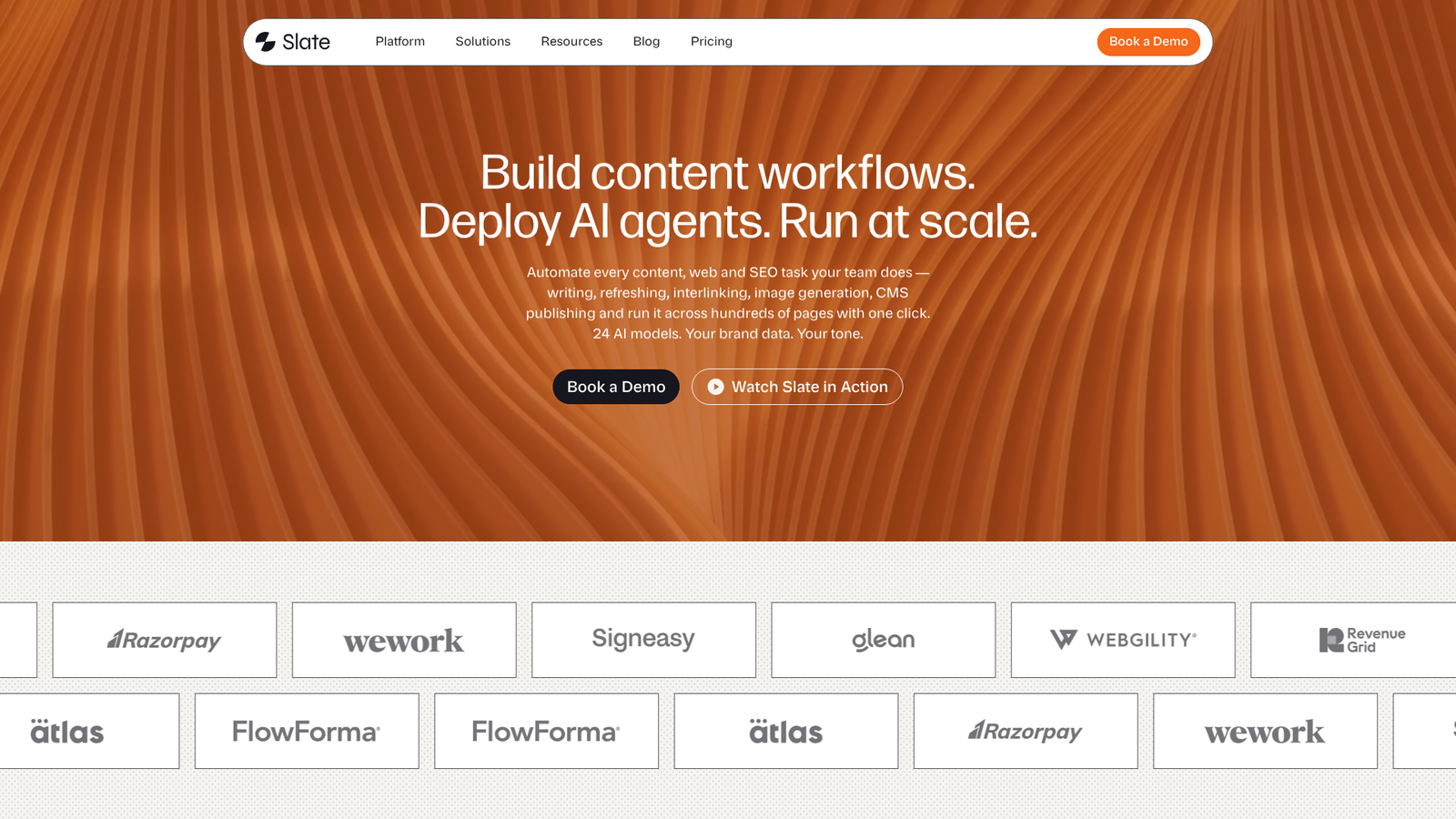
Best for: B2B SaaS marketing, content, and growth teams that need AI citation tracking plus content execution in one system.
Why it stands out: Many tools on this list stop at the dashboard. Slate connects citation insights directly to content engineering workflows, so the team that finds a citation gap is the same team - using the same system - that refreshes the page, republishes it, and re-tracks the recapture. Slate carries a 4.9/5 rating on G2's software review methodology.
Key features:
- AI Search Analytics with share-of-voice tracking across ChatGPT, Google AI Mode, Google AI Overviews, and Perplexity
- Agentic Workflows for research, writing, refreshing, and optimization at scale
- Power Sheets for bulk content refreshes and programmatic creation across thousands of URLs
- SuperBlocks: pre-built workflow components for AEO and citation readiness
- Brand Kit and Knowledge Base for brand-safe generation with style guides and tone rules
- One-click CMS publishing to Webflow CMS and WordPress
Engines covered: ChatGPT, Google AI Mode, Google AI Overviews, Perplexity.
What teams can do after insights: Identify citation gaps against named competitors, queue a refresh in Power Sheets, run an agentic workflow to rewrite for citation readiness, publish through the CMS integration, and re-track - all inside Slate. More on the post-insight playbook in our AI tracker overview.
Pricing: $199/mo.
Considerations: Best for teams that want a system, not a single-purpose monitor. Very early-stage brands with a handful of pages may not yet need this depth.
Bottom line: The strongest fit for B2B SaaS teams that want to measure AI visibility and close the gap from the same tool.
Pro tip: Pair citation tracking with refresh workflows in the same tool. It compresses the time from insight to published update, which is usually where AI visibility programs stall.
2. Airefs
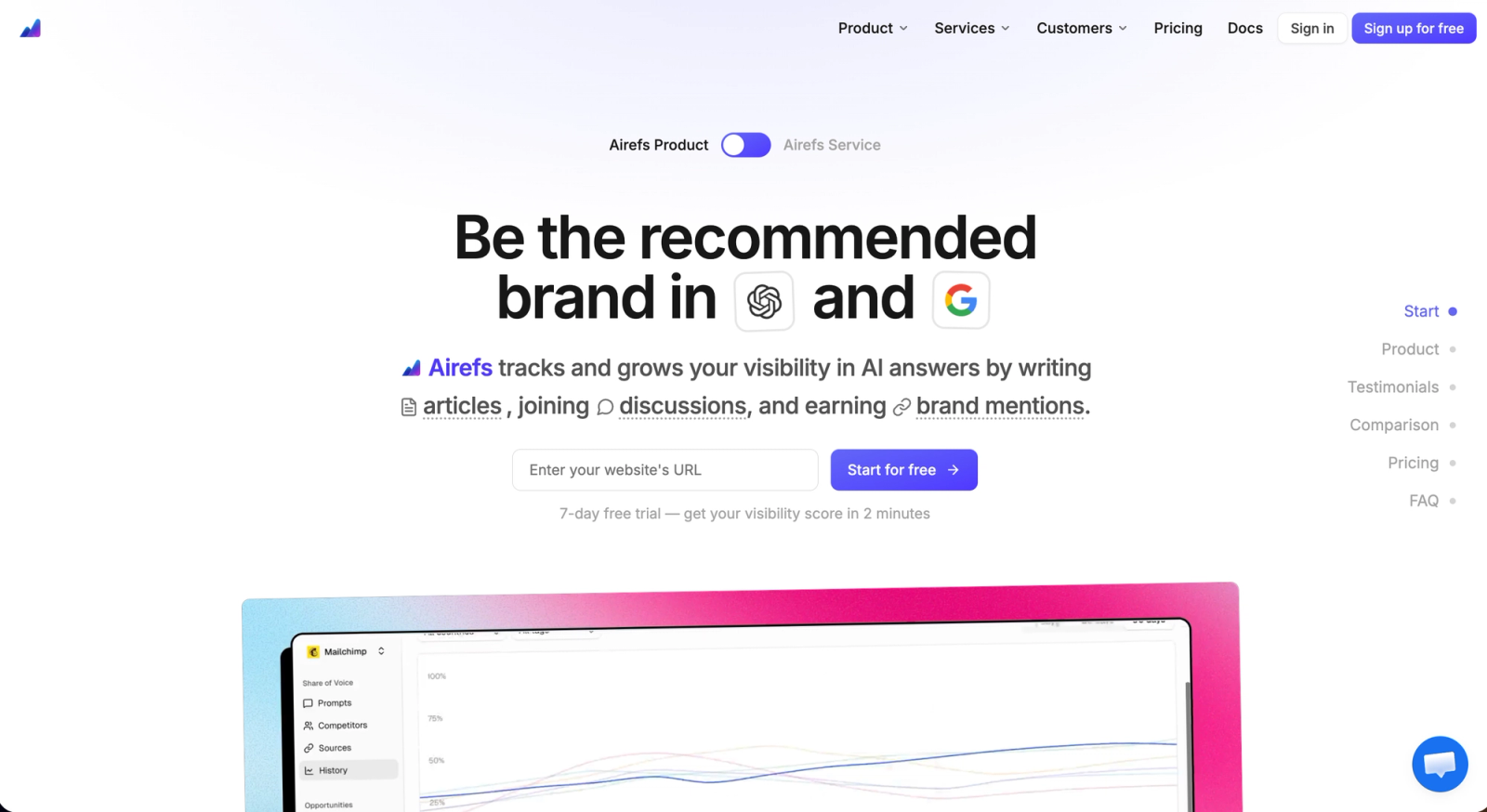
Best for: Founders and lean marketing teams who want visibility tracking and the fix for it in one place, without hiring an agency.
Why it stands out: Most tools on this list stop at the dashboard — they'll tell you ChatGPT isn't citing you, then leave you to figure out why. Airefs closes that loop. It finds the exact content gaps where your competitors get cited and you don't, then writes the AEO-optimized articles to close them, surfaces the Reddit and Quora threads AI models are already pulling answers from, and drafts the outreach emails to land backlinks on the sites AI trusts. It's monitoring and execution in one subscription, at a fraction of what an agency charges for the same work.
Key features:
- Prompt tracking across the AI answers that matter most for buying decisions
- Content gap analysis: see exactly where competitors are cited and you're not
- AEO/SEO article generation, done for you or self-serve
- Discussion monitoring across Reddit, Quora, and LinkedIn, with comments pre-drafted
- Backlink opportunity finder with outreach emails ready to send
- AI crawler and AI-referral traffic analytics
Engines covered: ChatGPT and Google AI Overviews for prompt tracking, with Claude, Gemini, and Perplexity covered through crawler and traffic analytics (additional models available on request).
What teams can do after insights: Go straight from "here's the gap" to "here's the published article, comment, or backlink that closes it" — no separate content team or agency handoff required.
Pricing: Self-serve plans start at $24/mo (Lite), with Pro and Expert tiers up to $83/mo. A done-for-you service is also available from $300/mo for teams who want it handled end to end.
Considerations: Newer to the space than some of the enterprise players here, so it's built for speed and action rather than deep historical benchmarking across dozens of markets.
Bottom line: If you're tired of visibility tools that just show you the problem, Airefs is the one built to also fix it.
3. Profound
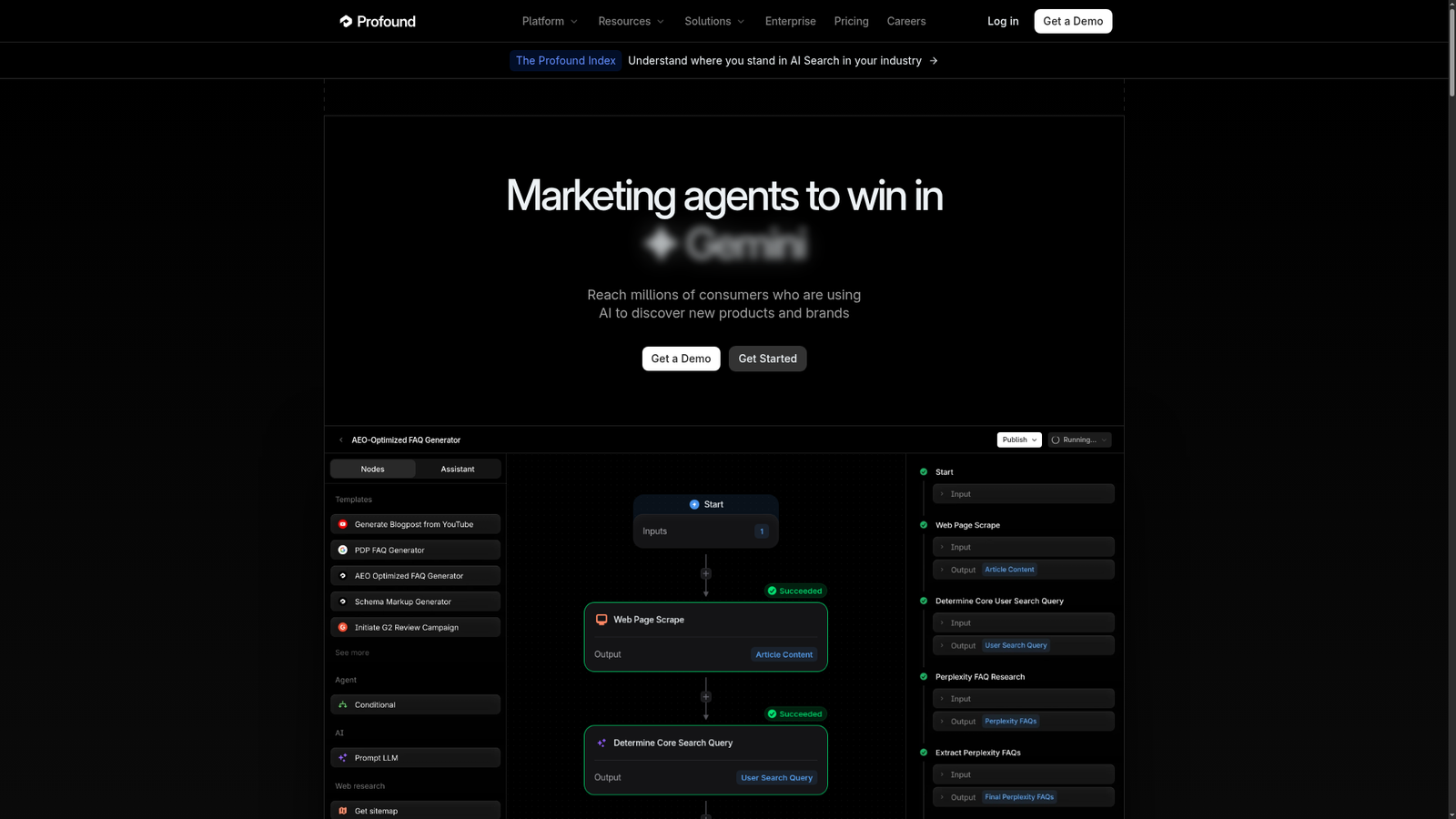
Best for: Enterprise brand teams and agencies that need deep AI visibility data and multi-client reporting.
Why it stands out: Profound is built around understanding why a brand appears in AI answers, with Answer Engine Insights, Prompt Volumes, and Agent Analytics that suit larger sampling needs. It rates 4.6/5 on G2.
Key features:
- Answer Engine Insights across major AI platforms
- Prompt Volumes to size category-level demand
- Agent Analytics for traffic from AI assistants
- Competitive benchmarking and share-of-voice views
Engines covered: ChatGPT, Perplexity, Gemini, Claude.
What teams can do after insights: Build prompt portfolios, monitor share of voice, and feed findings into content strategy - execution typically happens in other tools.
Pricing: Custom. Public pricing is not listed.
Considerations: Heavier on data than on in-platform execution. Best when the buyer has a separate content team or agency to act on findings.
Bottom line: A strong enterprise-grade analytics platform for teams that want the deepest read on AI search and are comfortable working in multiple tools. For a direct comparison, see Slate vs Profound and our list of best Profound AI alternatives.
4. Peec AI
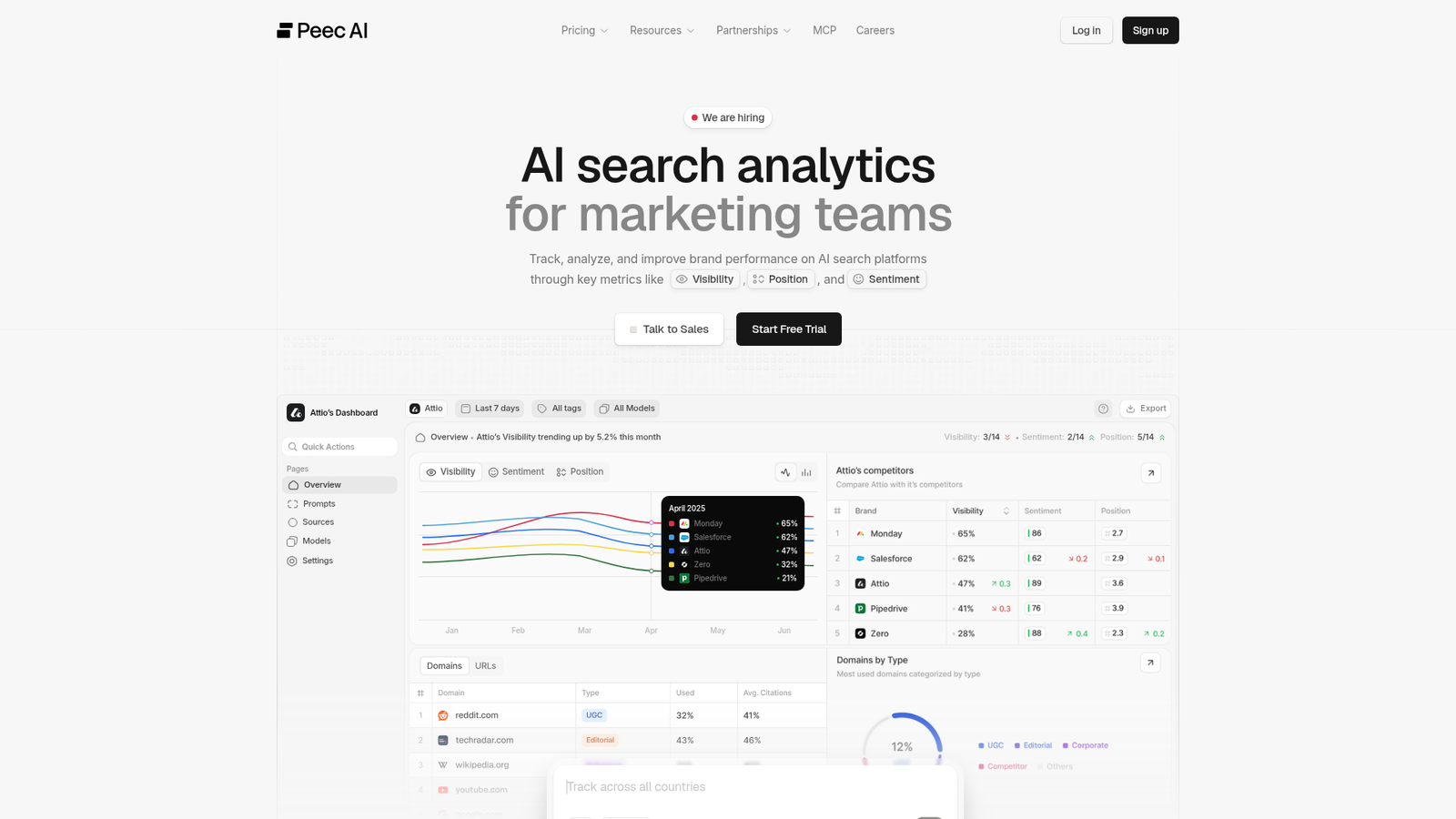
Best for: SEO, content, and marketing teams that want a dedicated AI search analytics tool with strong prompt-level depth.
Why it stands out: Peec AI focuses tightly on prompt tracking and brand performance metrics - visibility, position, and sentiment - rather than trying to be a full SEO suite. It holds a 4.9/5 rating on G2.
Key features:
- Prompt tracking and organization for AI search strategy
- Brand performance metrics across AI search: visibility, position, sentiment
- Actionable recommendations to capture high-impact opportunities
Engines covered: Multi-engine AI search coverage.
What teams can do after insights: Adjust prompt portfolios, prioritize topics, and hand recommendations to the content team for execution.
Pricing: Starter €85/mo, Pro €205/mo, Advanced €425/mo (EUR); Enterprise on request.
Considerations: Reporting and recommendation depth are strong, but execution still happens outside the tool.
Bottom line: A focused, well-reviewed pick for teams that want prompt-level analytics without a full platform commitment.
5. Semrush AI Visibility Toolkit
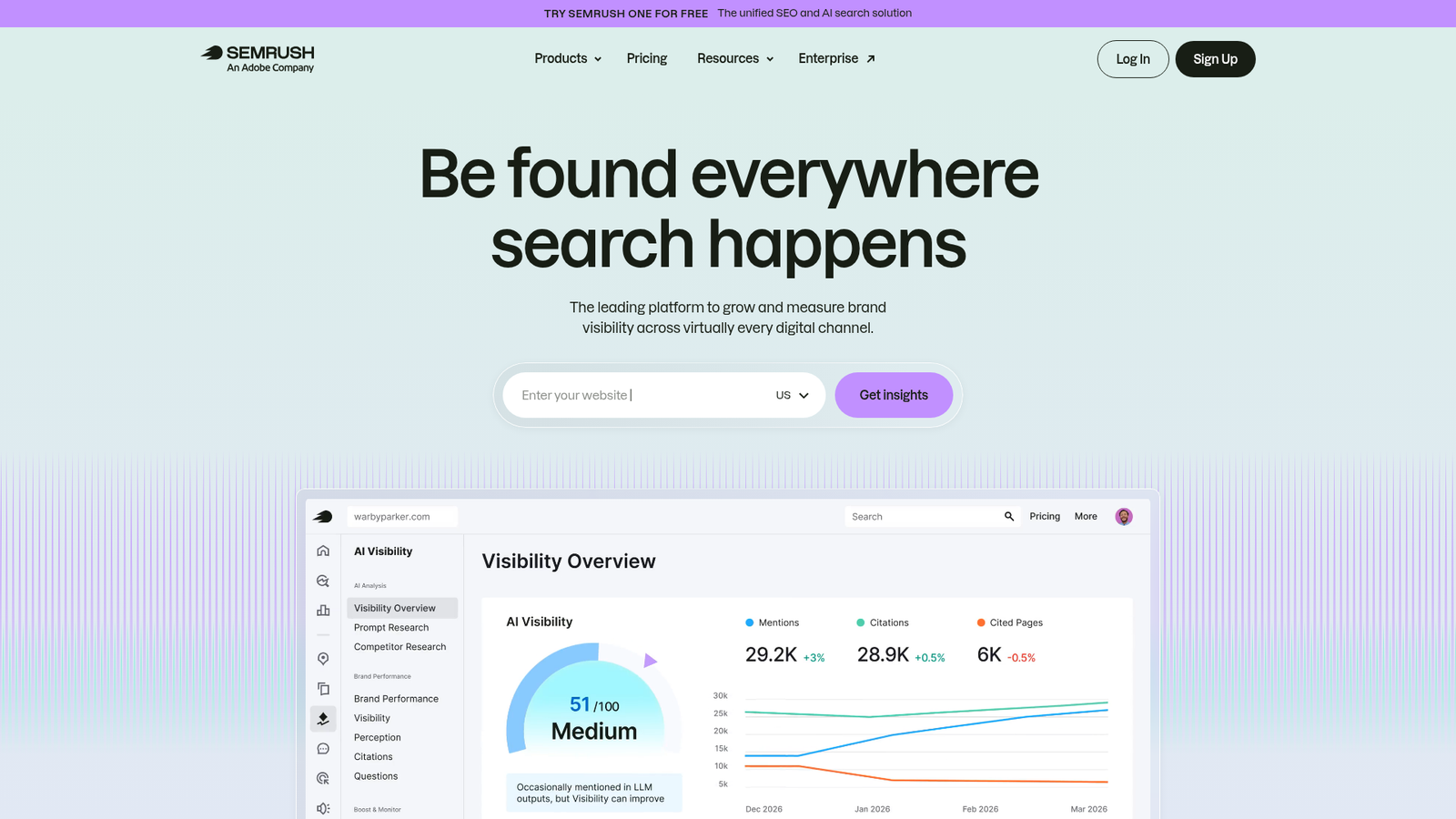
Best for: Teams already inside the Semrush ecosystem that want AI visibility alongside traditional SEO.
Why it stands out: The Toolkit layers AI visibility scoring, prompt research, and an AI Search Site Audit onto an SEO platform many teams already use, which lowers the adoption cost.
Key features:
- Visibility Overview with an AI Visibility Score
- Competitor and Prompt Research for gap analysis
- Prompt Tracking for daily AI visibility monitoring
- AI Search Site Audit to detect technical blockers for AI crawlers
Engines covered: AI search platforms surfaced through Semrush.
What teams can do after insights: Use Semrush's content and on-page tools for execution; many teams pair this with a dedicated content workflow elsewhere.
Pricing: $99 per month for the toolkit, with add-ons including extra users at $99/month, additional Brand Performance domains at $99/month each, and 50 extra prompts at $60/month.
Considerations: Most useful as an add-on for existing Semrush customers. Engine coverage and citation-specific depth are still maturing compared to AI-native specialists.
Bottom line: A pragmatic choice when traditional SEO and AI visibility need to live in the same dashboard.
6. Ahrefs Brand Radar
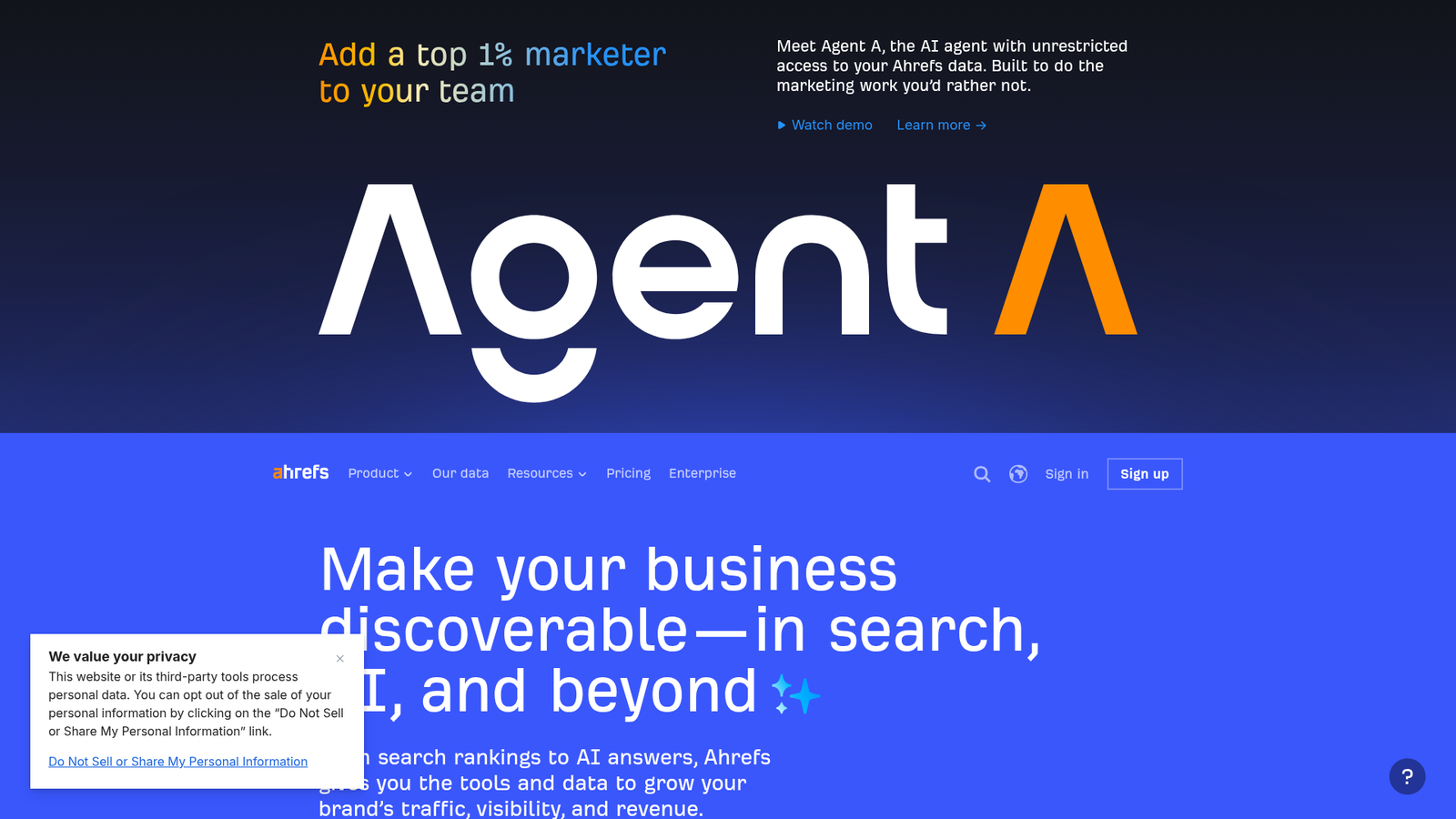
Best for: SEO teams using Ahrefs who want to track brand mentions and citations in AI answers without leaving their stack.
Why it stands out: Brand Radar specifically tracks how brands appear in AI answers, with the ability to benchmark against competitors and surface cited sources across YouTube, TikTok, and Reddit - not just the LLM surfaces.
Key features:
- Track brand mentions across AI answers
- Benchmark your brand against competitors in AI search
- Find AI citations and source visibility across YouTube, TikTok, and Reddit
- Custom prompt packages
Engines covered: AI answers with cited sources, plus social and video platforms.
What teams can do after insights: Inform link-building, PR, and content priorities; execution happens in adjacent tools.
Pricing: $199/mo covers a single AI-platform index (all six platforms bundle at $699/mo); Brand Radar requires an active paid Ahrefs base plan (from $129/mo). Custom prompt packages from $50/mo.
Considerations: Strongest if Ahrefs is already the source of truth for SEO; less ideal as a standalone AI citation tool.
Bottom line: A solid AI mention and citation layer for Ahrefs-native teams.
7. Otterly.AI
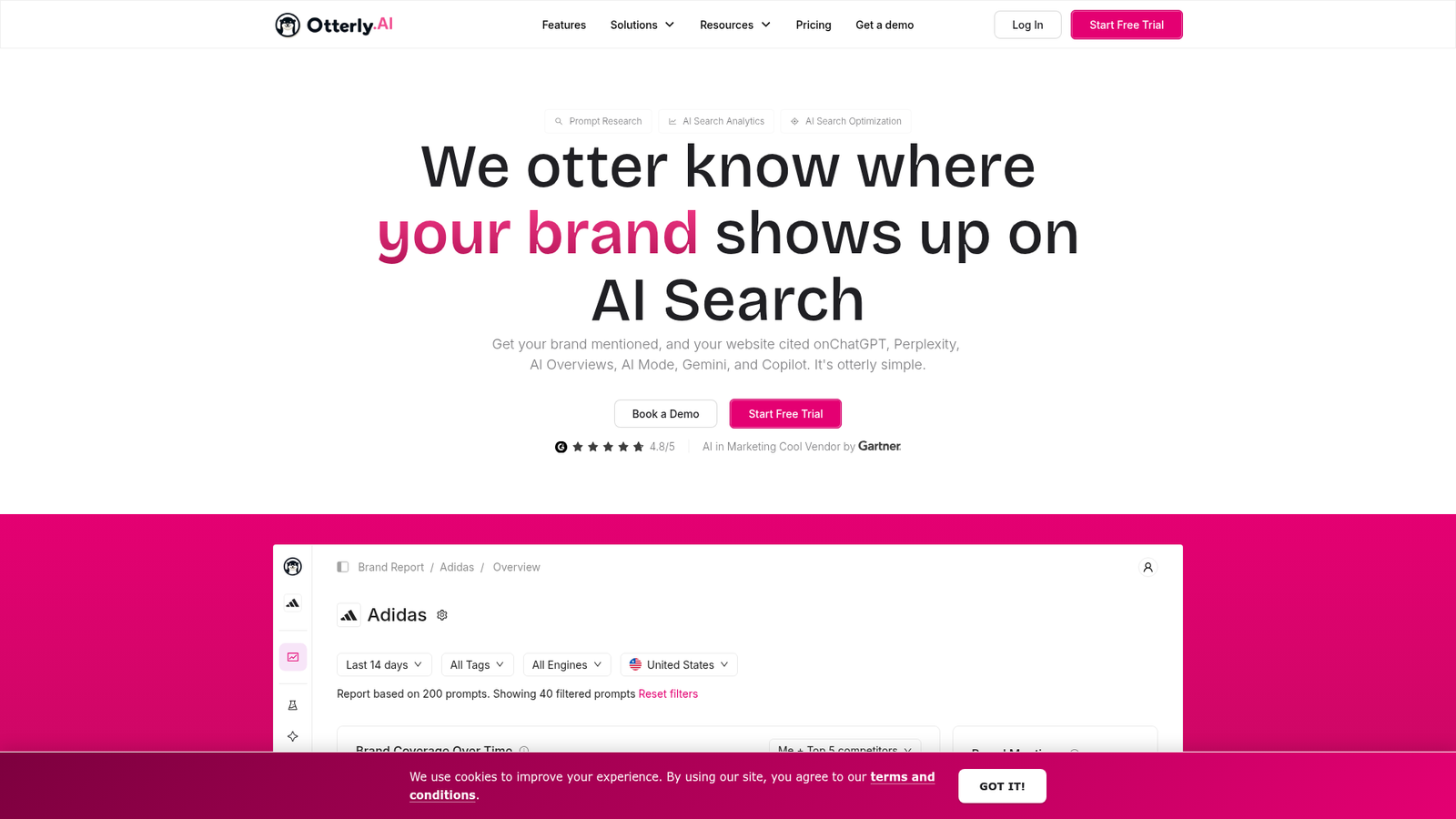
Best for: Marketing teams and agencies that need dedicated AI citation tracking at an accessible price.
Why it stands out: Otterly is purpose-built for AI search, covering ChatGPT, Perplexity, Google AI Overviews, Gemini, and Copilot, and is the source of one of the most-cited AI citations datasets in the category. It rates 4.8/5 on G2.
Key features:
- AI Prompt Research
- AI Search Analytics across major engines
- GEO Optimization guidance
Engines covered: ChatGPT, Perplexity, Google AI Overviews, Gemini, Copilot.
What teams can do after insights: Identify which domains get cited in their category, plan content responses, and track changes over time.
Pricing: Lite $29/mo, Standard $189/mo, Premium $489/mo on monthly billing; annual pricing is Lite $25/mo, Standard $160/mo, Premium $422/mo. Enterprise is custom.
Considerations: Tracking and reporting are strong; execution sits in your content stack.
Bottom line: The most cost-effective entry point for serious AI citation tracking across a wide engine list.
8. Rankability
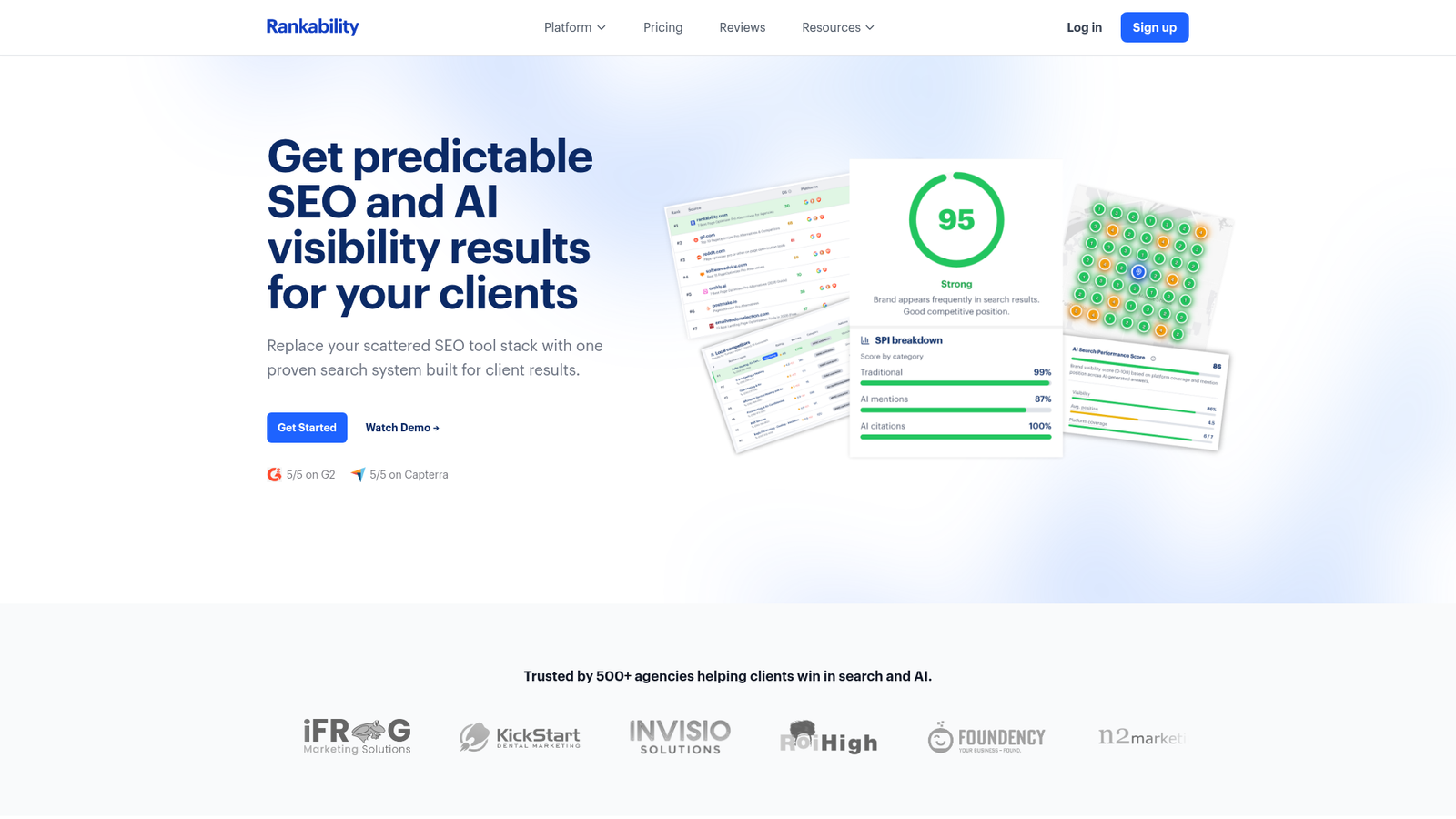
Best for: SEO agencies that want AI visibility tracking, content workflows, and client reporting in one platform.
Why it stands out: Rankability rolls Google, local, AI search, and YouTube performance into a single SPI score, then adds content briefs, optimization workflows, and AI-assisted content creation. It carries a 5.0/5 G2 rating.
Key features:
- Unified search performance index across Google, local, AI search, and YouTube
- AI-driven keyword research and competitive analysis
- Content briefs, optimization workflows, and auditing
- Client reporting workflows
Engines covered: Google, local, AI search engines, YouTube.
What teams can do after insights: Build briefs, run audits, and report results to clients without switching tools.
Pricing: Solo $79/mo, Core $199/mo, Team $399/mo, all billed annually. Enterprise via contact sales.
Considerations: Most useful for multi-client agencies; in-house teams may want a more vertical AI-search tool.
Bottom line: A practical agency platform that blends traditional SEO and AI visibility under one report.
9. Scrunch AI
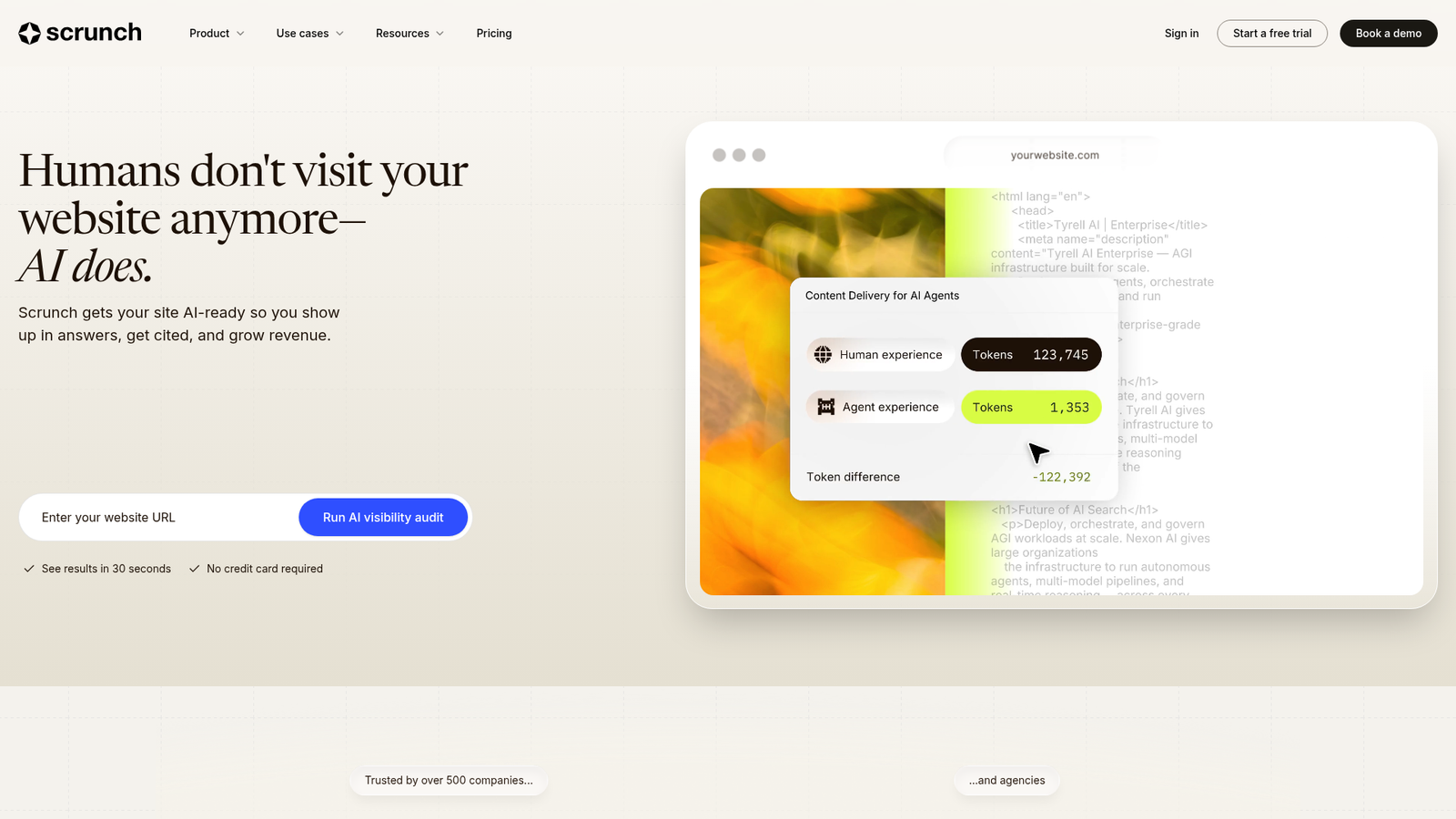
Best for: Marketing, SEO, and brand teams that need cross-LLM monitoring plus AI-friendly content delivery.
Why it stands out: Beyond tracking, Scrunch ships an Agent Experience Platform (AXP) that serves machine-readable versions of site content to AI crawlers - a more technical lever most competitors don't offer. It rates 4.6/5 on G2.
Key features:
- Cross-LLM monitoring of brand performance, prompts, rankings, and competitors
- Citation analysis and optimization guidance
- Agent Experience Platform for serving AI-friendly site content
Engines covered: Cross-LLM coverage.
What teams can do after insights: Improve citations through both content updates and AXP-level delivery changes.
Pricing: Starter $250/mo billed annually ($300 month-to-month). Growth $417/mo billed annually ($500 month-to-month). Enterprise is custom.
Includes a 7-day Starter free trial.
Considerations: AXP is powerful but requires technical buy-in from the web team.
Bottom line: The right pick when AI crawl delivery is part of the strategy, not just monitoring.
10. AthenaHQ
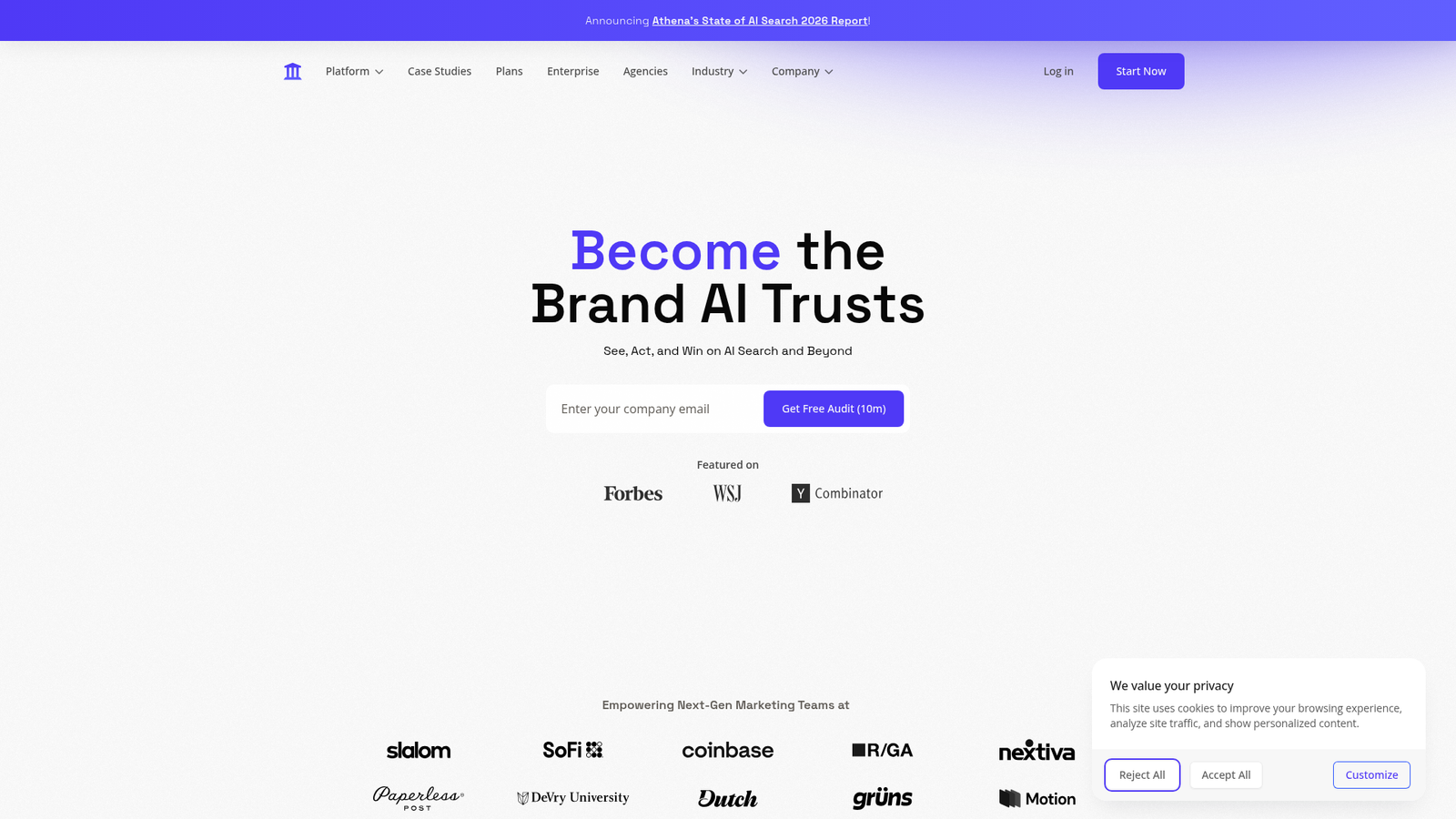
Best for: Marketing and SEO teams that want an AEO/GEO command center across many LLMs.
Why it stands out: AthenaHQ tracks 8+ major LLMs in one view and adds competitor monitoring, impersonation detection, and citation intelligence on top. It rates 4.9/5 on G2.
Key features:
- Cross-platform AI visibility tracking across 8+ major LLMs
- Competitor monitoring and impersonation detection
- Citation intelligence
- AI content optimization recommendations and workflows
Engines covered: 8+ major LLMs.
What teams can do after insights: Act on prioritized optimization recommendations; integrate with existing content workflows for execution.
Pricing: Self-Serve from $295/month (with a discounted first-month promotional rate listed on the site). Enterprise is custom.
Considerations: Strongest when used as a category-level monitoring layer; some teams pair it with a separate execution platform.
Bottom line: A broad, well-rated AEO command center for teams formalizing AI visibility as a function.
11. Goodie
Best for: Marketing, SEO, and brand teams building a structured AEO program from the ground up.
Why it stands out: Goodie focuses the workflow around prioritized actions in its Optimization Hub, and connects AI visibility to traffic and revenue through its analytics layer.
Key features:
- AI visibility monitoring across answer engines
- Optimization Hub with prioritized actions
- Analytics and attribution from AI visibility to traffic and revenue
Engines covered: LLMs and AI search engines including ChatGPT, Gemini, and Perplexity.
What teams can do after insights: Work through ranked actions, then measure downstream traffic and revenue impact.
Pricing: Custom; see Goodie's pricing page for current tiers.
Considerations: Younger platform than some peers; works best for teams that want a structured AEO program rather than ad-hoc monitoring.
Bottom line: A solid choice when attribution from AI visibility to revenue is the priority.
How We Evaluated These AI Citation Tracking Tools
The goal was a comparison that mirrors how a buyer actually weighs options, not a feature checklist. Every tool was assessed against the same ten criteria, weighted to reflect what matters most for B2B teams running AI citation programs in 2026.
Pricing was checked against each vendor's pricing page where a clear public starting price was published; tools without one are marked as custom. Screenshots were captured during evaluation. Public G2 ratings are included where available.
How AI Citation Tracking Tools Actually Work
Most AI citation tracking tools run a fixed set of prompts across selected AI engines on a schedule, capture the answers, extract cited URLs or domains, identify mentions of your brand and competitors, and track changes over time. More advanced tools also segment prompts by intent, normalize domains, and measure share of voice across the category.
Under the hood, the workflow looks like this:
- Prompt portfolio construction. A representative set of branded, comparison, problem-aware, and informational prompts is defined.
- Prompt execution. The tool sends each prompt to selected engines (ChatGPT, Perplexity, Gemini, Google AI Overviews, etc.) on a recurring cadence.
- Answer parsing. Responses are captured as text plus structured citation blocks where engines expose them. Gemini's approach to source grounding is a good example of how engines expose structured citation metadata that trackers can parse.
- Citation and URL extraction. Cited URLs are pulled from source carousels, footnotes, or inline links.
- Domain normalization. URLs are collapsed to root domains for clean aggregation.
- Entity matching. Brand and competitor names are matched against mentions and citations, including aliases and product names.
- Frequency and volatility tracking. Counts are stored over time, with deltas surfaced as the report.
- Reporting. Dashboards, exports, and share-of-voice views close the loop.
For a fuller walkthrough, see our generative engine optimization guide. The red flag to watch: some tools only detect presence. They will tell you that you appeared in an answer but not why, which sources beat you, or what to change.
Key Metrics to Monitor for AI Citation Tracking
The most useful AI citation metrics are citation frequency, share of voice, source-domain coverage, mention rate, prompt coverage, competitor citation overlap, and citation trend over time. Teams should also track which prompt intents and content pages are most likely to earn citations, so optimization stays focused on what moves the score.
Core KPIs
- Citation frequency. How often your domain is cited per tracked prompt, per engine.
- Share of voice. Your citations as a percentage of all citations across a defined category prompt set.
- Mention rate. How often your brand is named without a link, which signals brand salience even when the citation goes elsewhere.
- Source domain coverage. Which of your URLs are getting cited, and which sit unused.
- Prompt coverage rate. Percentage of tracked prompts where you appear at all.
- Citation trend over time. Direction and slope across 30, 60, and 90 days.
Diagnostic Metrics
- Competitor citation overlap. Prompts where both you and a competitor are cited - these are usually winnable on quality.
- Engine-by-engine variance. Where ChatGPT, Perplexity, Gemini, and AI Overviews disagree about who to cite.
- Prompt intent segment performance. Branded vs. comparison vs. problem-aware vs. informational queries usually behave very differently, and applying a clear prompt intent classification framework helps explain why.
- Source freshness. Age of the pages being cited in your category.
- Answer volatility. How much answers and citations move week to week.
For deeper coverage of AI Overview-specific signals, see our AI Overview optimization tools guide.
What to track first: citation frequency, share of voice, source-domain coverage, competitor overlap, and trend over 30 days. Everything else is a diagnostic on top of these five.
How to Choose the Right AI Citation Tracking Tool
Match tool to team shape, not to feature list length. The right pick changes meaningfully based on who owns the work and what comes next after the insight. The shortlist below assumes you have read the rankings above and need a faster filter.
For an adjacent view, our roundup of best generative engine optimization tools and AI visibility tools covers neighboring use cases.
Best for B2B SaaS Teams
Slate. The combination of AI Search Analytics, agentic workflows, Power Sheets for bulk refreshes, and one-click CMS publishing means the team that finds the citation gap is the team that closes it, in the same week, in the same tool.
Best for Agencies
Rankability for multi-client workflows and reporting at $79–$399/month, with Profound as the heavier option when clients need deeper sampling and BI-style exports.
Best for Enterprise Brand Teams
Profound for depth of data and AthenaHQ for breadth of LLM coverage in a single command center. Both pair well with a separate execution layer.
Best for Lean Growth Teams
Otterly.AI at $29/month Lite is the lowest-friction way to start, with room to grow into Standard or Premium as the prompt portfolio expands.
Best for Multi-Market Teams
Prioritize tools that explicitly support multi-language prompts, region-located engines, and localized AI Overviews. Localization support varies, so confirm coverage for your specific markets during evaluation.
How to Turn Citation Tracking Into Content Wins
Monitoring is not the point. The point is the refresh, the new comparison page, the entity reinforcement that makes your URL the one the model picks next week. Here is the playbook teams use to turn citation gaps into recapture - and where Slate's execution layer typically takes over from a pure tracker.
- Prioritize citation gaps by commercial value, not volume. A category prompt that converts is worth more than ten informational prompts that don't.
- Audit the cited competitor page. Look at structure, freshness, extractability, sourced statistics, and entity language.
- Refresh your competing page with citation-ready elements. Clear definitions, sourced statistics, comparison tables, FAQ blocks, and unambiguous entity language grounded in entity-based SEO principles.
- Reinforce entity signals. Internal links, schema.org structured data, and consistent naming across the site.
- Re-track and measure citation recapture. Use the same prompt set, on the same cadence, so the trend line is comparable.
- Build a repeatable refresh cadence. Weekly or biweekly, owned by a named person, with a backlog of citation-gap pages queued.
For more on this operating model, see how challenger brands win with AI search and the AI SEO checklist.
Pro tip: Citation readiness usually comes down to three things - extractable structure, sourceable claims, and clear entity language. Most pages fail on at least two.
30-Day Rollout Plan for AI Citation Tracking
A working program does not require a six-month implementation. Most teams can be reporting share of voice and shipping the first refresh wave within a month.
Prompt portfolios tend to start in the 15–25 range for very early programs and grow as the team segments by intent, market, and product line.
Who Owns AI Citation Tracking Inside the Company
AI citation tracking is cross-functional in practice, even when one team holds the dashboard. Clarity on ownership is what separates programs that ship from programs that report.
- SEO lead. Owns prompt portfolio design, source-domain analysis, technical refresh, and entity reinforcement.
- Content lead. Owns page-level refresh, citation readiness, and net-new comparison pages.
- Growth team. Owns share-of-voice reporting at the category level and attribution back to pipeline.
- CMO or VP Marketing. Owns trend reporting to leadership, budget for tooling, and ROI narrative.
In smaller teams, the SEO lead usually holds three of these hats. In that case, the priority is a tool that minimizes context-switching between tracking and execution.
Common Mistakes Teams Make with AI Citation Tracking
Most failure modes are operational, not analytical. The data is usually fine. What breaks is what the team does with it.
- Tracking presence without tracking source domains. Knowing you appeared is half the picture. Knowing who beat you tells you what to fix.
- Confusing mentions with citations. They signal different things and warrant different responses.
- Running too many prompts before defining what matters. A focused 30-prompt portfolio outperforms a noisy 300-prompt one.
- Reporting weekly without an action layer. Dashboards without a refresh workflow produce slides, not citations.
- Ignoring engine variance. ChatGPT, Perplexity, Gemini, and AI Overviews disagree more than people think. Treat each as its own surface.
- Treating AI visibility as a side project, not a system. The teams that win run it as an owned function with a named owner and a cadence.
FAQs
What Is AI Citation Tracking?
AI citation tracking is the process of monitoring when AI platforms like ChatGPT, Perplexity, Gemini, and Google AI Overviews reference your brand, website, or content as a linked source inside generated answers. It captures prompts, answers, cited URLs, and mentions, then tracks how those signals change over time so teams can compare themselves against competitors and target citation gaps.
Which Tools Track Brand Citations in AI Search Results?
Dedicated tools like Slate, Airefs, Profound, Peec AI, Otterly.AI, Rankability, Scrunch AI, AthenaHQ, and Goodie track brand citations in AI answers. SEO suites like Semrush (AI Visibility Toolkit) and Ahrefs (Brand Radar) also offer AI citation tracking. Buyers should compare engine coverage, citation vs. mention separation, prompt monitoring, competitive benchmarking, and whether the tool includes an execution layer.
How Do AI Citation Tracking Tools Work?
They run a fixed set of prompts across selected AI engines on a recurring schedule, capture the responses, extract cited URLs and domains, match brand and competitor mentions, and store the results as a time series. More advanced tools normalize domains, segment prompts by intent, and calculate share of voice across a defined category prompt set.
What Metrics Should You Monitor for AI-Generated Citations?
Track citation frequency, share of voice, source-domain coverage, mention rate, prompt coverage, competitor citation overlap, and citation trend over 30, 60, and 90 days. Add diagnostic metrics like engine-by-engine variance, prompt-intent performance, source freshness, and answer volatility. The first five are the most defensible KPIs for leadership reporting.
What Is the Difference Between an AI Citation and a Backlink?
An AI citation is a linked source attributed inside an AI-generated answer on platforms like ChatGPT, Perplexity, Gemini, or Google AI Overviews, signaling that the model used your page as a trusted source. A backlink is a hyperlink on a webpage pointing to your site, and lives in the traditional web graph that powers PageRank-style authority signals.
Can You Track Google AI Overview Citations?
Yes. Tools like Slate, Airefs, Otterly.AI, Peec AI, and Rankability can track citations inside Google AI Overviews, and broader AI visibility suites may monitor AI Overview visibility as well. Coverage is still evolving because AI Overviews are volatile and localized, so most tools sample prompts and monitor changes over time rather than capturing every appearance.
Prioritize source extraction, keyword monitoring, and trend tracking.
What Is Share of Voice in AI Search?
Share of voice in AI search is the percentage of citations or mentions your brand earns across a defined prompt set, relative to competitors. It can be calculated as a share of citations, a share of mentions, or a share of answer word count. It is the cleanest leadership-facing metric because it normalizes for category demand and engine differences.
How Many Prompts Do You Need for Reliable Citation Tracking?
Most teams start with 15–25 core prompts and expand from there as they segment by branded, comparison, problem-aware, and informational intents. Consistency matters more than volume: a fixed, representative prompt set gives you reliable trend data over time. Adding prompts is useful only when each new prompt covers a distinct intent, market, or product line.
Slate gives marketing teams one system to track AI visibility across ChatGPT, Perplexity, Gemini, and Google AI Overviews, identify citation gaps against competitors, and execute the content refreshes that win them back - without leaving the tool.