Your team probably has the same argument every quarter.
SEO wants deeper keyword and backlink data. Brand wants to know why ChatGPT names competitors. Content wants fewer dashboards and more work that reaches the CMS.
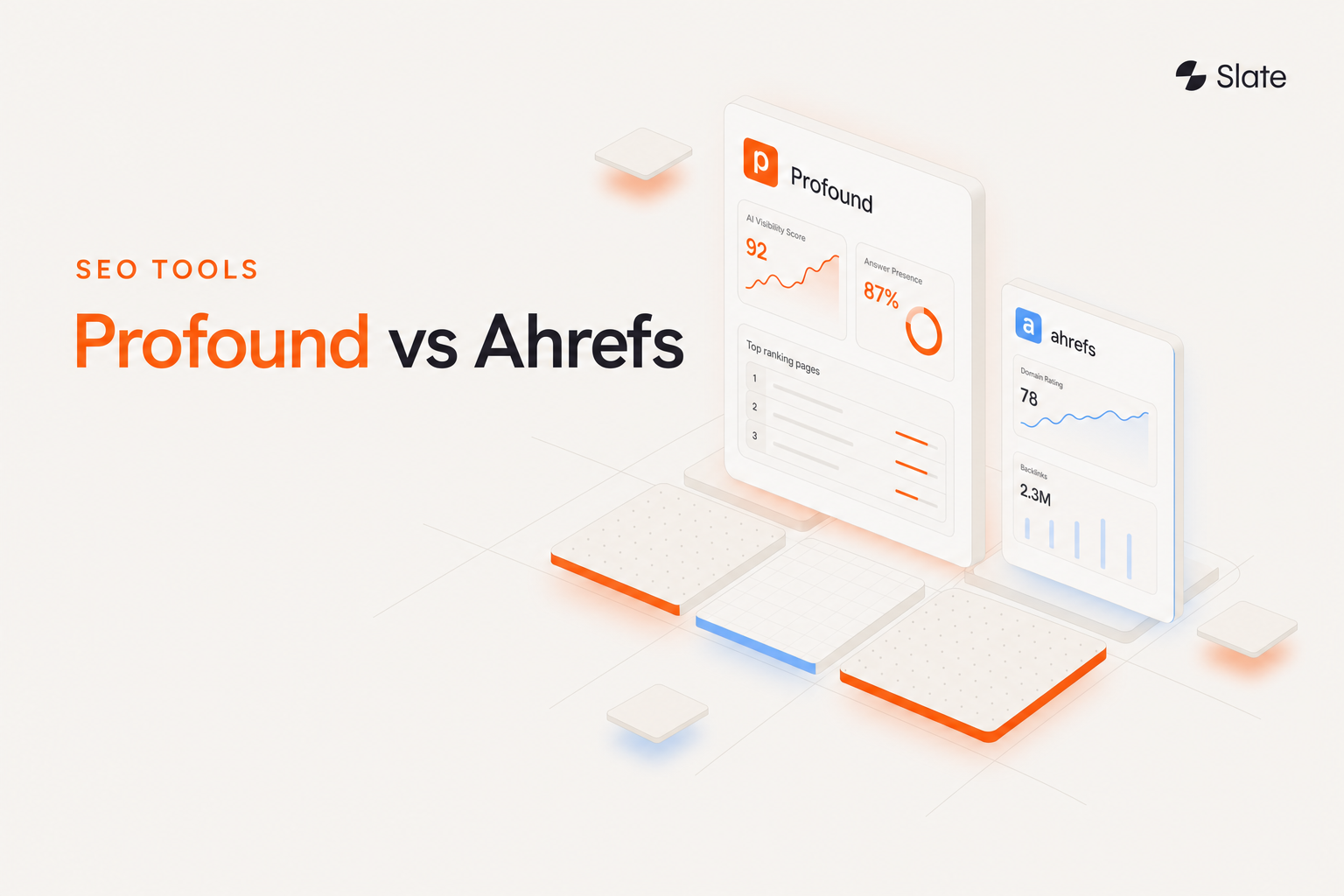
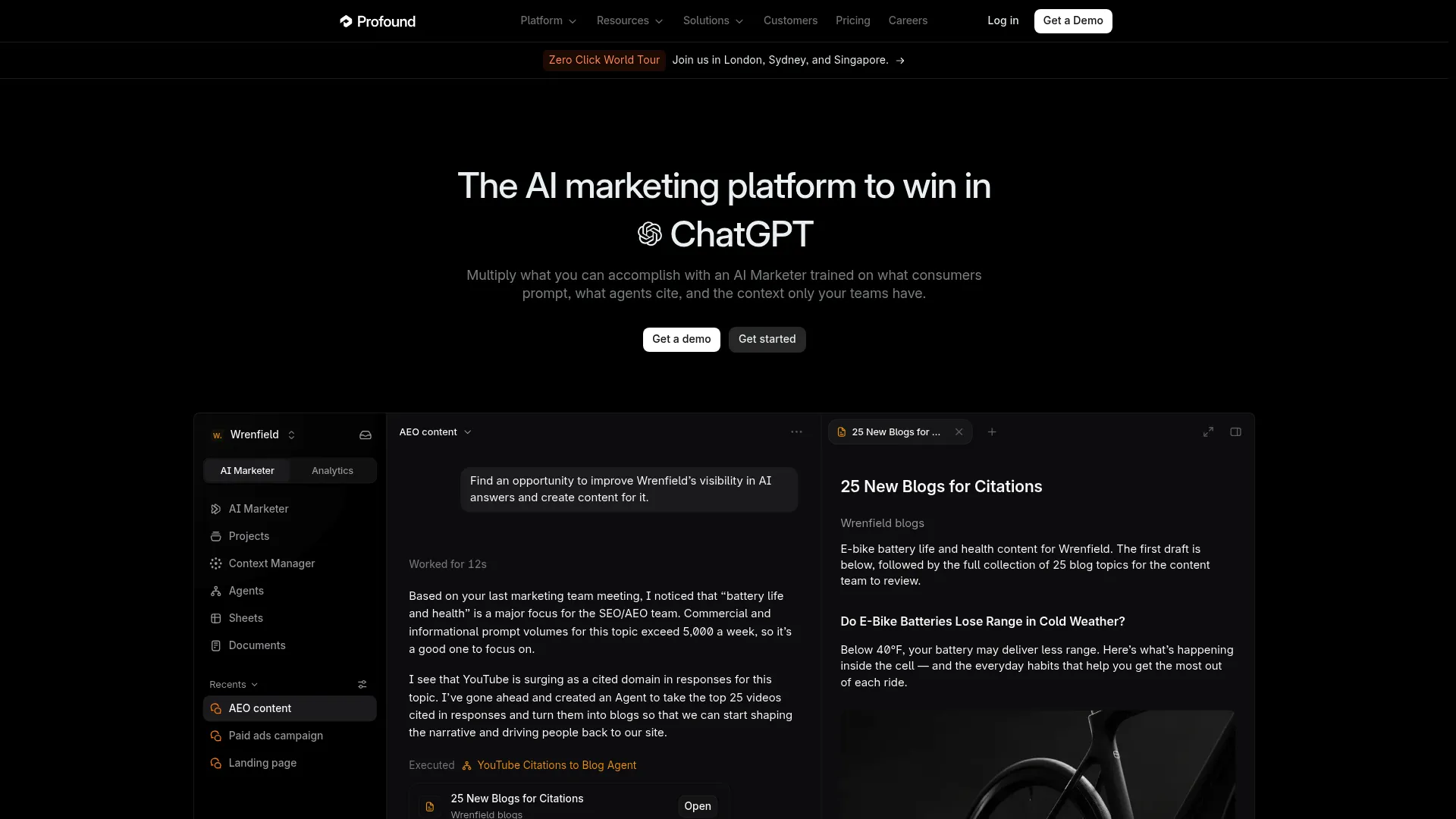
Profound and Ahrefs sit in different parts of that argument. Profound is an AI marketing platform for brand visibility across AI search and answer engines. Ahrefs is a broad SEO suite for keywords, backlinks, rankings, and audits, with AI visibility added through Brand Radar.
The buying call comes down to ownership. A team with a named AEO lead and CMO reporting buys differently from a three-person SEO team with one platform budget and 74 tabs open.
For a narrower AEO comparison, see Slate vs. Profound. For another third-party comparison of Ahrefs and Profound focused on AI visibility and prompt tracking, see Ahrefs vs Profound from Style Factory.
Key Takeaways
- Profound is the specialist. It’s built around AI-answer visibility, prompt-volume analysis, citation analysis, and AI Marketer agents.
- Ahrefs is the SEO suite. Brand Radar adds AI visibility to keyword research, backlink analysis, rank tracking, and site audits.
- Methodology beats feature lists. Prompt sourcing, engine coverage, and refresh cadence decide what a visibility number means.
- Ahrefs publishes metric definitions. Mentions, citations, AI Share of Voice, and estimated impressions all have public documentation.
- Signals answer different questions. Mentions, citations, share of answer, sentiment, and AI referral traffic should stay separate.
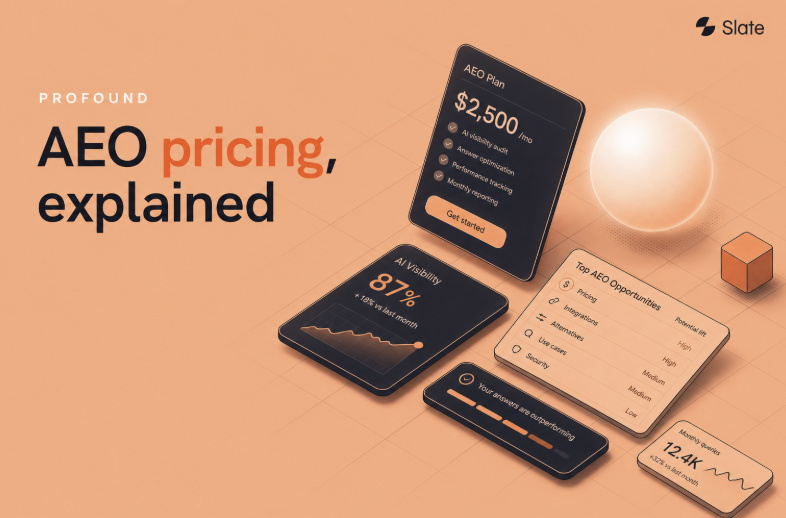
- Pricing works differently. Ahrefs publishes subscription tiers and Brand Radar costs. Profound uses custom pricing with a limited free trial.
- Traditional SEO points toward Ahrefs. Keywords Explorer, Site Explorer, rank tracking, and Site Audit are core Ahrefs products.
- Dashboards don’t do the work. Someone still has to prioritize, write, publish, build authority, and measure again.
Profound vs. Ahrefs: Quick Verdict
Use Profound when AI-answer visibility has its own owner, budget, and executive reporting path.
Use Ahrefs when SEO owns the work and needs AI visibility inside the same platform used for keywords, backlinks, audits, and rank tracking.
Use both when SEO and AEO have separate owners, or when enterprise reporting needs two methodologies checked against each other. Agree on definitions first, because two visibility dashboards can produce two very different numbers and both can be defensible.
Consider Slate when the bottleneck is execution. Slate connects AI search visibility to content production, CMS publishing, outreach, and GSC and GA4 measurement. For a wider field, see best Profound alternatives.
Profound vs. Ahrefs At A Glance
What Is The Difference Between Profound And Ahrefs?
Profound focuses on how brands appear inside AI-generated answers. Its center of gravity is answer-engine insight.
Ahrefs covers the traditional SEO stack first: keywords, backlinks, rankings, audits, competitors. Brand Radar adds AI visibility to that base.
So the trade-off is specialization against consolidation.
What Profound Is Built To Do
Profound’s positioning centers on enterprise marketing teams that track and improve brand presence in AI-powered search.
Its main vendor-stated pieces are:
- Answer Engine Insights: AI-search visibility and citation analysis.
- Prompt Volumes: Analysis of AI user conversations and intent.
- AI Marketer agents: Agents for research, content creation, content updates, and reporting.
- Enterprise plans: Tailored tracking, team credits, support, and security features.
Traditional SEO capabilities such as backlink indexes, rank tracking, and site audits weren’t verified from the available brand profile. Ask directly if those need to live inside the same subscription.
What Ahrefs And Brand Radar Are Built To Do
Ahrefs starts with Keywords Explorer, Site Explorer, Site Audit, and rank tracking. Brand Radar adds AI visibility reporting.
Ahrefs is easier to evaluate than many AI visibility tools because it publishes the math behind its main metrics.
- Prompt corpus: Brand Radar runs more than 462 million search-backed prompts through AI platforms and stores the answers.
- Engine coverage: AI Overviews, AI Mode, ChatGPT, Perplexity, Gemini, and Copilot.
- Mentions: A brand name appears in AI answer text.
- Citations: A page appears at least once as a cited source. Domain-level citations count when at least one page from that domain is cited.
- AI Share of Voice: The percentage of AI responses in a topic set that mention or cite the brand against competitors.
- Estimated impressions: Potential visibility weighted by search volume behind prompts.
Brand sentiment scoring, claim-level narrative tracing, CMS publishing, and outreach execution weren’t confirmed in the reviewed docs.
For background, see the generative engine optimization guide.
How Profound And Ahrefs Collect AI Visibility Data
Two tools can report different visibility numbers for the same brand in the same week. The difference usually comes from prompt sourcing, engine coverage, sampling, and refresh cadence.
A dashboard screenshot won’t tell you enough. You need the method behind it.
Where The Prompts Come From
Prompt sourcing is the biggest methodology variable.
User-supplied tracked prompts. Your team enters buyer-language queries. Ahrefs documents custom prompt tracking on paid plans above Starter. One check equals one prompt execution times one language model times one location.
Discovered prompts. The platform observes AI conversations or user behavior. Profound’s Prompt Volumes is positioned around AI user conversations and intent.
Generated or modeled prompts. The platform builds plausible queries from a topic, category, or competitor set.
Search-derived prompts. The platform starts from observed search demand. Brand Radar’s 462 million search-backed prompts fit here, which is why Ahrefs can weight estimated impressions by search volume.
A prompt set your team didn’t choose is a proxy. Use it for discovery, then test it against sales calls, support tickets, and win-loss notes before assigning content work.
Ask each vendor to run the same customer-supplied prompt set during the demo. The difference between those outputs will teach you more than a polished sales dashboard.
Which AI Platforms Are Covered?
Engine coverage should match buyer behavior. A gorgeous report on the wrong engines is just expensive wallpaper.
Refresh cadence counts too. Ahrefs documents monthly or daily scheduling for custom prompt checks.
Results can vary by location, model version, phrasing, personalization, and time of day. Use dated baselines and trendlines, because one snapshot is a flimsy buying argument.
Mentions, Citations, And Share Of Answer
Keep these signals separate.
- Brand mention: The brand name appears in the generated answer.
- Citation: The AI answer cites a brand page or domain as a source.
- Share of answer: The percentage of responses in a topic set that mention or cite the brand compared with competitors.
- AI referral traffic: Sessions arriving from AI platforms.
A brand can appear in an AI answer without being cited. That split changes the remedy.
A missing mention points to presence. A missing citation points to source authority, content structure, or coverage.
How To Validate An AI Visibility Signal
Treat every gap as a hypothesis.
- Re-run the prompt manually across the relevant engines.
- Check whether the gap changes by phrasing, location, or engine.
- List the cited domains, not just the named brands.
- Confirm the prompt matches buyer language from sales calls, tickets, or research.
- Set a dated baseline before changing content, schema, or outreach.
Teams that skip step four end up polishing pages for queries customers never use.
For more, see AI search analytics tools and best AI citation tracking tools.
Profound vs. Ahrefs For Traditional SEO
Ahrefs wins traditional SEO clearly.
Keywords Explorer, Site Explorer, Site Audit, and rank tracking are core Ahrefs products. Profound’s documented positioning centers on answer engines.
Keyword Research
Ahrefs Keywords Explorer supports demand discovery, difficulty checks, and topic clustering.
Profound approaches demand through Prompt Volumes, which analyzes AI user conversations and intent. That’s a different input. Search volume tells you what people type into Google. Prompt analysis tells you what people ask a model during a longer exchange.
Backlink Analysis
Ahrefs Site Explorer is one of the main reasons SEO teams keep paying for Ahrefs.
Link intelligence also feeds AEO work. Third-party mentions and links can influence which sources answer engines cite, though the causal chain still needs careful testing.
Equivalent backlink capability wasn’t verified from the available Profound brand profile.
Rank Tracking And Site Audits
Ahrefs includes rank tracking and Site Audit for technical crawling and issue detection.
Profound’s documented positioning focuses on answer engines. Site-audit capability wasn’t verified from the available brand profile.
Competitor Research
Ahrefs handles competitor research through Site Explorer, Keywords Explorer, and Brand Radar’s AI Share of Voice.
Profound’s answer-engine reporting may support competitor analysis, but the reviewed brand profile doesn’t establish a comparable metric definition.
Ask each vendor the same question: what’s the denominator, who’s in the competitor set, and which prompts count?
Profound vs. Ahrefs For AI Search Work
AI visibility tracking can show where your brand appears, which sources get cited, and where competitors lead.
Improvement comes after the report: prioritization, content changes, authority work, publishing, and re-measurement.
What Each Platform Hands You
Profound goes beyond monitoring through AI Marketer agents for research, content creation, content updates, and reporting.
Ahrefs is strongest on research and measurement. CMS publishing and outreach execution weren’t confirmed in reviewed documentation.
Responding To A Citation Gap
Use a tight sequence.
- Pull answers where competitors are cited and your brand is absent.
- List the cited domains.
- Classify the gap as content, authority, or structure.
- Assign one remedy: brief a page, run outreach, or rewrite for extractability.
- Measure again after 30 to 60 days against the dated baseline.
For tactics, see how to get cited by ChatGPT, Perplexity, Claude, and Gemini.
Measuring Progress
Work through the chain:
Prompt coverage → presence rate → citation frequency → narrative accuracy → AI referral traffic → GSC clicks and CTR → GA4 sessions and conversions → pipeline.
The farther you move down that chain, the closer you get to revenue and the messier attribution gets. Report correlation carefully, especially to executives who want one clean cause.
For benchmarking, see AI share-of-voice tools.
Profound vs. Ahrefs For Brand Sentiment And Narrative Analysis
Sentiment scoring and narrative analysis get mixed together too often.
Sentiment classifies an answer as positive, neutral, or negative. Narrative analysis identifies the claims being made and the sources shaping them.
Claim tracing is usually more useful.
What Each Platform Reports
Dedicated sentiment methodology, historical sentiment trends, and claim-level narrative extraction weren’t confirmed in the reviewed Ahrefs Brand Radar docs.
They also weren’t verified from the available Profound brand profile.
Profound’s Answer Engine Insights includes citation analysis. Ahrefs Brand Radar confirms mentions, citations, AI Share of Voice, and estimated impressions. Those are presence metrics.
Ask vendors to show a negative sentiment label, then click through to the answer and source. If the label can’t be tied to a claim you can inspect, treat it carefully.
Slate documents its approach in sentiment analysis in Slate.
Turning A Bad Narrative Into Work
- Trace the claim: Find the exact answer text and cited sources.
- Classify the cause: Outdated owned content, third-party inaccuracy, or missing corrective source.
- Assign the remedy: Update the owned page, contact the publisher, or publish the missing resource.
- Monitor the prompt set: Track the prompts that surfaced the claim and allow time for re-crawling.
Many bad AI narratives come from something that was true 2 years ago and then sat in a forgotten help doc like a raccoon in the attic.
Pricing, Usage Limits, And Total Cost Of Ownership
Entry price gets too much attention. The bill usually grows through brands, prompts, checks, seats, engines, exports, and support.
Pricing: Starting at $499/month.
Ahrefs custom prompt allowances are documented by tier: Lite includes 150 checks per month, Standard includes 300, and Advanced includes 600.
One check equals one prompt execution times one language model times one location.
So 50 prompts across 3 models and 2 locations consume 300 checks per run. Run that weekly and the Advanced allowance is gone in week one.
What Drives Your Bill
- Brands or domains tracked: Multi-brand portfolios multiply the work.
- Prompt or check volume: Prompt times model times location adds up fast.
- Seats and permissions: Enterprise governance often raises the plan tier.
- Platform coverage: Single-index and all-platform pricing differ sharply in Brand Radar.
- Exports and API access: These often sit behind higher tiers.
- Historical data: Longer windows help reporting and cost more.
- White-label reporting: Agencies should price this early.
- Support: SLAs belong in the budget conversation.
People Cost
The subscription line rarely hurts as much as the handoffs. Briefs stall, context gets lost, and the quarterly report becomes a spreadsheet séance.
Which Platform Is Best For Your Team?
Team structure predicts the right call better than a feature grid.
Enterprise AEO Teams
Start with governance: roles, approval chains, audit trails, data residency, SSO, business-unit permissions, multi-brand account structure, integrations, and support SLA.
Profound’s Enterprise plan includes tailored tracking, team credits, support, and security features. Ahrefs Enterprise is published at $1,499/mo with an annual commitment.
If AEO has a named owner and executive reporting, Profound deserves a serious look.
Existing Ahrefs Users
Ask three questions before adding another platform.
Does Brand Radar cover the engines your buyers use? Its confirmed list includes AI Overviews, AI Mode, ChatGPT, Perplexity, Gemini, and Copilot.
Do custom prompt needs exceed the included check allowances?
Did last quarter’s AI visibility reporting lead to a published change?
If the third answer is “no,” another dashboard probably won’t help.
SEO-Led Mid-Market Teams
Mid-market teams usually have one platform budget and two to five people doing too much.
Ahrefs tends to fit that model because SEO and AI visibility can live together. A specialist AEO platform makes sense when AI search already has a funded owner.
SMBs And Lean Teams
Small teams usually need execution capacity before another measurement layer.
Finding 10 visibility gaps when you can address one per quarter creates stress, not growth. Buy the tool that helps work reach the site.
Content Operations Teams
Content ops teams care about volume: bulk refreshes, URL audits, approval loops, CMS publishing, and measurement after the page goes live.
Ahrefs CMS publishing wasn’t confirmed in reviewed documentation. Profound CMS publishing wasn’t verified from the available brand profile.
If the backlog is larger than the insight gap, look at execution platforms. See content and SEO automation systems and best AI tools for content operations.
Agencies And Multi-Client Portfolios
Agencies should price the 20th client, not the first.
Ask about onboarding speed, prompt checks across clients, white-label reports, and client-level permissions. Ahrefs publishes tiered pricing, which helps with portfolio modeling. Profound custom pricing may fit larger client scopes, but you’ll need a quote.
Where Both Platforms Stop: Execution
Visibility platforms and SEO suites are intelligence layers. The harder work starts after the finding: briefs, drafts, edits, schema changes, publishing, outreach, and measurement.
Ask this in a team meeting:
- Who validates the finding?
- Who prioritizes it?
- Who chooses the remedy?
- Who writes the brief or outreach plan?
- Who reviews for accuracy and brand voice?
- Who publishes or sends it?
- Who measures against the baseline?
If more than two answers produce a shrug, the bottleneck is ownership.
Reporting Debt
Reporting debt builds when dashboards generate more findings than the team can act on.
Check these numbers:
- How many findings from last quarter led to a published change?
- What’s the median time from gap to live page?
- Who closes the loop after publication?
If the first number is tiny and the dashboard has hundreds of opportunities, more monitoring won’t rescue the program.
Best Alternatives For End-To-End AI Search And SEO Execution
Different platform categories compete for this budget.
1. Slate - Best For End-To-End AI Search And SEO Execution
Slate is an agent-driven content, SEO, and AI search platform built for the gap between a visibility finding and a published change.
- Opportunities: Surfaces gaps across content, citations, rankings, social engagement, and traffic.
- AI search analytics: Tracks brand presence across 6 major AI platforms, including ChatGPT, Google AI Mode, Google AI Overviews, and Perplexity.
- Coworker and custom agents: Lets teams delegate repeatable SEO and content work in plain language.
- Workflows and Power Sheets: Includes a visual workflow builder, 24+ AI models, conditional logic, web scraping, templates, and spreadsheet-style bulk work.
- Integrations and publishing: Includes native Ahrefs and Semrush access without a separate purchase, plus direct publishing to WordPress and Webflow.
- Pages and measurement: Unifies Google Search Console and GA4 data for clicks, traffic, CTR, and citations.
- Outreach: Finds link and brand-mention opportunities, enriches contacts, and supports outreach.
- Brand Kit and Knowledge Base: Keeps style, tone, and approved product knowledge close to content creation.
Pricing: Starting at $499/month. Free trial, Enterprise plan, and Agency plans are available.
G2 rating: 4.9/5
Limitation: Slate isn’t a creative proofing tool for video, visual campaigns, or brand-review workflows.
Verdict: Slate is the alternative to evaluate when the team knows where gaps exist and needs one system for production, publishing, outreach, measurement, and refresh.
Further reading: AI Tracker documentation, citation analysis in Slate, and AI content operations platform.
2. Profound - Best For Enterprise AI-Search Measurement
Best for: Enterprise marketing teams measuring and improving brand presence in AI-powered search.
Key features: Answer Engine Insights for AI-search visibility and citation analysis, Prompt Volumes for AI user conversations and intent, and AI Marketer agents for research, content creation, content updates, and reporting.
Pricing: Custom. Free seven-day trial with limited credits and 50 daily prompts. Enterprise pricing includes tailored tracking, team credits, support, and security features.
G2 rating: 4.5/5
Limitation: Traditional SEO capabilities such as backlink indexes, rank tracking, and site auditing weren’t verified from the available brand profile.
3. Ahrefs - Best For Combining Traditional SEO With AI Visibility
Best for: SEO teams, agencies, and marketers needing search, competitor, backlink, and site-audit data alongside AI visibility.
Key features: Keywords Explorer, Site Explorer, Site Audit, and Brand Radar reporting on mentions, citations, AI Share of Voice, and estimated impressions across AI Overviews, AI Mode, ChatGPT, Perplexity, Gemini, and Copilot.
Pricing: Starter $29/mo, Lite $129/mo, Standard $249/mo, Advanced $449/mo, Enterprise $1,499/mo with annual commitment. Brand Radar index starts at $199/mo for a single platform or $699/mo for all platforms. Ahrefs Free includes limited Site Explorer and Site Audit access.
G2 rating: 4.5/5
Limitation: CMS publishing, outreach execution, and claim-level narrative analysis weren’t confirmed in reviewed documentation.
For wider category coverage, see best AI visibility tools and AI SEO tools for B2B SaaS.
How To Choose: A Five-Question Framework
- Where does work stall: insight, research, or execution? Look at the last few organic projects that died in the queue. Buy the layer that removes that blockage.
- Do you need your own prompt set? If buyer-language control is important, verify custom prompt support and check limits. Ahrefs counts one check as one prompt times one model times one location.
- Does traditional SEO need to live in the same subscription? If keyword research, backlinks, rank tracking, and audits must sit together, Ahrefs is the clearer fit.
- Who does the work after a gap appears? Name the person. If the median time from finding to live page is measured in months, another dashboard adds more reporting debt.
- How will AI visibility connect to GSC, GA4, and pipeline? Define the chain before signing. CFOs eventually ask fair questions about business impact.
Frequently Asked Questions
Is Profound an Ahrefs alternative or a complement?
It depends on ownership. Profound fits enterprise AI-search measurement. Ahrefs fits SEO teams that want AI visibility next to keyword, backlink, audit, and rank-tracking workflows.
Can Ahrefs replace a dedicated AEO platform?
For many SEO-led teams, yes. Brand Radar covers AI Overviews, AI Mode, ChatGPT, Perplexity, Gemini, and Copilot, with public definitions for mentions, citations, AI Share of Voice, and estimated impressions. Prompt volume and investigation depth decide whether it’s enough.
Can you use Profound and Ahrefs together?
Yes. It makes sense when SEO and AEO have separate owners or when enterprise reporting needs two methodologies. Agree on prompt sets, definitions, and report ownership first.
Which is better for traditional SEO, Profound or Ahrefs?
Ahrefs. Keywords Explorer, Site Explorer, Site Audit, and rank tracking are core Ahrefs products. Equivalent traditional SEO capability wasn’t verified from the available Profound brand profile.
Which is better for AI brand monitoring and competitor analysis?
Compare the methodologies directly. Ahrefs uses 462 million search-backed prompts and AI Share of Voice. Profound’s Prompt Volumes analyzes AI user conversations and intent. Ask both vendors to run the same prompt set.
Does AI visibility tracking improve SEO performance?
Tracking identifies gaps. Performance changes after a team validates the finding, prioritizes it, produces or revises content, builds authority, publishes, and measures again.
What is Ahrefs Brand Radar?
Brand Radar is Ahrefs’ AI visibility product. It runs search-backed prompts through AI platforms and reports mentions, citations, AI Share of Voice, and estimated impressions.
How should you evaluate AI visibility data quality?
Re-run flagged prompts manually, check engine and phrasing differences, inspect cited sources, compare prompts against buyer language, and set a dated baseline before making changes.
Which platform is better for agencies managing multiple brands?
Ahrefs publishes pricing, which helps with portfolio modeling. Profound uses custom pricing, which may suit larger scopes. Agencies should test cost at 20 clients, plus white-label reporting and client permissions.
What’s the best alternative if you need execution?
Slate. It connects AI search visibility across 6 major AI platforms to content creation, Power Sheets bulk work, WordPress and Webflow publishing, outreach with contact enrichment, and unified GSC and GA4 measurement. Pricing: Starting at $499/month. Book a demo.