There is no shortage of metrics in AI search.
We now have metrics telling us whether our brands are being crawled, retrieved, cited, mentioned, ranked, and recommended by AI systems.
But there is a lack of clarity in what to actually care about.
Not all of these metrics are equally valuable.
Some tell us whether AI can access our information. Some tell us whether our content is being used as a source. Others tell us whether our brand actually appears in the answer.
And then there are the metrics that tell us something much more important:
What does AI actually say about us, and could that change a buyer's decision?
That distinction matters.
The industry is measuring a growing number of AI-search signals, but more metrics do not necessarily mean better measurement.
The metrics that matter most aren't necessarily the easiest ones to collect.
So I ranked 10 AI-search metrics across four tiers, from S to D, based on how directly they can influence a buyer's decision.
This isn't a ranking of how technically important a metric is.
It's a ranking of business impact.
The AI-search metric hierarchy
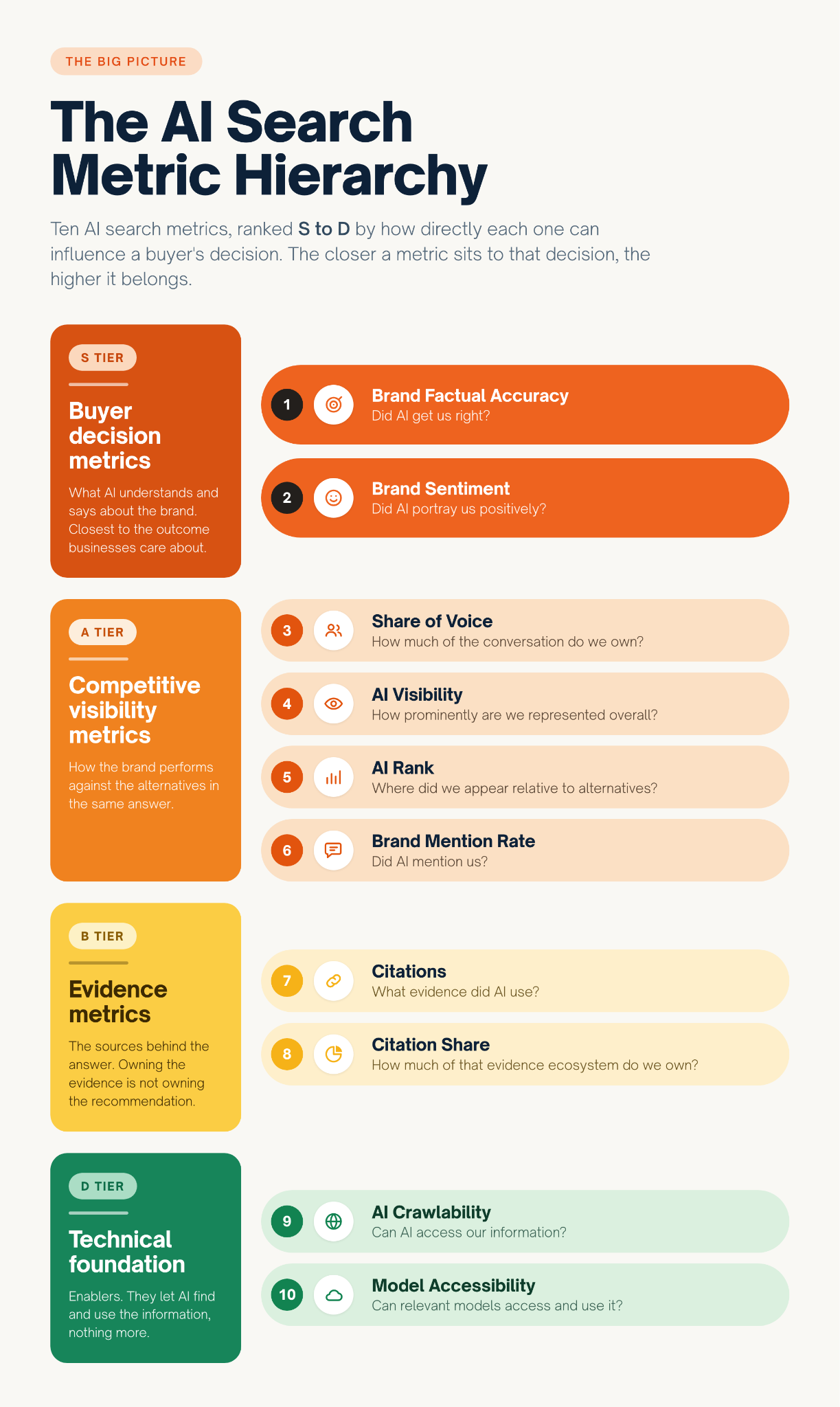
S Tier: Buyer Decision Metrics
1. Brand Factual Accuracy
→ Did AI get us right?
2. Brand Sentiment
→ Did AI portray us positively?
A Tier: Competitive Visibility Metrics
3. Share of Voice
→ How much of the conversation do we own?
4. AI Visibility
→ How prominently are we represented overall?
5. AI Rank
→ Where did we appear relative to alternatives?
6. Brand Mention Rate
→ Did AI mention us?
B Tier: Evidence Metrics
7. Citations
→ What evidence did AI use?
8. Citation Share
→ How much of that evidence ecosystem do we own?
D Tier: Technical Foundation
9. AI Crawlability
→ Can AI access our information?
10. Model Accessibility
→ Can relevant models access and use it?
The closer a metric is to the buyer's decision, the higher it belongs.
S Tier: Buyer Decision Metrics
These are the metrics I consider closest to the outcome businesses actually care about.
Before we ask how visible our brand is, we should ask what AI actually understands and says about us.
1. Brand Factual Accuracy
→ Did AI get us right?
This should be the first metric we measure.
Before asking whether AI mentions our brand, we should ask whether it understands our brand correctly.
An AI system might describe the wrong product capabilities, outdated pricing, incorrect positioning, the wrong target audience, outdated company information, or even confuse the brand with a competitor.
A brand could have excellent AI visibility while AI is fundamentally misunderstanding what it offers.
That's a problem.
The first metric in AI search shouldn't be whether an LLM mentions you. It should be whether it understands you correctly.
A simple way to think about the metric is:
Brand Factual Accuracy = Correct brand facts ÷ Total brand facts evaluated × 100
The total brand facts evaluated should represent the set of factual claims being assessed about the brand, including both correct and incorrect claims.
In practice, this could also be weighted because not every factual error carries the same business impact.
An incorrect office address and an incorrect statement about a core product capability shouldn't necessarily carry the same weight.
There is also an important distinction between accuracy and coverage.
If AI fails to mention an important fact about the brand, that is not necessarily an accuracy error. It is an information coverage issue.
The important shift is that we're no longer measuring whether AI knows us.
We're measuring whether AI knows us correctly.
2. Brand Sentiment
→ Did AI portray us positively?
Accuracy alone isn't enough.
AI could describe our company perfectly and still portray it negatively.
For example, an AI answer might accurately mention a brand but associate it with poor customer service, expensive pricing, security concerns, weak functionality, or negative reviews.
That means the next question is:
What is the sentiment of the representation?
Brand Sentiment measures whether the way AI talks about a brand is positive, neutral, or negative.
A basic calculation could be:
Positive mentions ÷ Total sentiment-classified mentions × 100
The exact methodology can vary between platforms, particularly when sentiment is determined contextually by an AI model.
But the business question remains straightforward:
When AI talks about us, does it make us look good?
This is why sentiment belongs ahead of visibility.
A brand mentioned ten times positively may be in a much healthier position than a brand mentioned a hundred times negatively.
Visibility without accuracy can be a liability.
A Tier: Competitive Visibility Metrics
Once we know that AI understands our brand and represents it positively, the next question is how well we're competing for attention.
These metrics tell us how our brand performs relative to the alternatives.
3. Share of Voice
→ How much of the conversation do we own?
Share of Voice should come before simple mention rate because AI search is competitive.
A brand can be mentioned frequently and still lose the conversation to its competitors.
Share of Voice puts brand mentions into competitive context.
A simple formula is:
Share of Voice = Your Brand Mentions ÷ Total Brand Mentions × 100
For example:
- Brand A: 30 mentions
- Brand B: 40 mentions
- Brand C: 30 mentions
Brand A's Share of Voice would be:
30 ÷ 100 = 30%
The question isn't simply:
"Are we visible?"
It's:
"How much of the category conversation do we own compared with the alternatives?"
That makes Share of Voice a more meaningful competitive metric than raw mention volume.
4. AI Visibility
→ How prominently are we represented overall?
At its most basic level, AI Visibility asks:
How visible is our brand across the AI responses we're tracking?
The challenge is that visibility isn't necessarily binary.
A brand appearing prominently in an answer may have more practical value than a brand appearing near the bottom.
Different AI-search platforms can also define and calculate visibility differently. Some may consider whether a brand appears, where it appears, or other factors when calculating an overall visibility score.
So when comparing visibility scores, we should always ask:
What exactly does this platform mean by visibility?
The metric itself is valuable, but the methodology behind it matters just as much.
5. AI Rank
→ Where did we appear relative to alternatives?
Rank is often treated as a traditional SEO metric.
But it matters in AI search for a different reason.
When an AI response lists multiple brands, the order can influence how users interpret those brands.
Being first can create a perception of greater relevance, authority, or preference.
That's why AI Rank belongs in A Tier.
And it belongs after Visibility.
Visibility tells us how prominently we are represented overall.
Rank tells us where we appear relative to the alternatives.
Imagine an AI response recommending five project-management platforms.
If we're mentioned, that's good.
If we're consistently mentioned near the top, that's better.
If we're consistently first, that's a very different competitive position.
Visibility tells you whether you appeared. Rank tells you how prominently you appeared.
6. Brand Mention Rate
→ Did AI mention us?
Brand Mention Rate is one of the most obvious AI-search metrics, but I would place it after Share of Voice, Visibility, and Rank.
There is an important distinction between Brand Mentions and Brand Mention Rate.
Brand Mentions tells us how many times a brand appeared.
Brand Mention Rate tells us how often the brand appeared across the relevant AI responses being measured.
A simple formula is:
Brand Mention Rate = Responses containing brand ÷ Total relevant responses × 100
This is more useful for comparing performance because raw mention counts can change simply because we ran more prompts, tested more models, or expanded the dataset.
The question we're really trying to answer is:
When someone asks an AI system about the category we're competing in, how often do we show up?
That is a useful signal.
But by itself, it doesn't tell us whether we own the conversation, how prominently we appear, or whether AI represents us positively.
That's why Brand Mention Rate sits at the bottom of A Tier.
B Tier: Evidence Metrics
These metrics tell us what information AI is using to construct its answers.
They matter because they help us understand the evidence behind AI-generated answers, but evidence and recommendation are not the same thing.
7. Citations
→ What evidence did AI use?
This is where AI-search measurement becomes particularly interesting for SEOs.
Citations feel familiar.
We have spent years thinking about links, backlinks, referring domains, and authority.
So it's tempting to assume that getting cited by AI is equivalent to earning a valuable recommendation.
It isn't.
Citation ≠ recommendation.
An AI system can recommend Brand A while citing a third-party review, comparison website, analyst report, or publication as evidence.
In that scenario:
- Brand A won the recommendation
- Another website won the citation
Those are two different outcomes.
That's why citations matter, but they shouldn't automatically sit above brand sentiment, visibility, rank, or share of voice.
A citation tells us something important:
What information did the AI system use to construct its answer?
But it doesn't necessarily tell us:
Which brand did the AI choose?
So:
Citations tell you where the answer came from. Mentions tell you who won the answer. Rank tells you how prominently you won it.
8. Citation Share
→ How much of that evidence ecosystem do we own?
Citation Share takes the citation concept and adds competitive context.
Instead of simply asking:
"Are we being cited?"
we ask:
"How much of the citation ecosystem belongs to us compared with the other sources being used?"
This can reveal something that citation volume alone can't.
A brand might have a large number of citations but still represent a small percentage of the total sources being used across a category.
Conversely, a smaller number of citations could represent a meaningful share of the evidence ecosystem if competitors are rarely cited.
Citation Share is therefore useful for understanding source authority and competitive evidence ownership.
But it remains an evidence metric.
Because owning the evidence doesn't necessarily mean owning the recommendation.
D Tier: Technical Foundation
These metrics sit furthest from the buyer's decision.
That doesn't make them unimportant.
They are the technical conditions that allow the rest of the system to work.
9. AI Crawlability
→ Can AI access our information?
AI Crawlability is important.
If AI systems cannot access our content, they have less opportunity to retrieve and use it.
But crawlability is an enabling condition, not the outcome we're ultimately trying to achieve.
This is similar to traditional SEO.
Google being able to crawl a page doesn't mean that page will rank.
Likewise:
AI being able to crawl our website doesn't mean AI will recommend our brand.
That's why crawlability belongs in D Tier.
And it leads to an important distinction:
AI crawlability is an SEO metric. AI visibility is a business metric.
We absolutely need the technical foundation.
But we shouldn't confuse the foundation with the outcome.
10. Model Accessibility
→ Can relevant models access and use it?
Model Accessibility goes one step further.
It asks whether the information is accessible to the particular AI systems and retrieval environments that matter to the business.
Different AI systems can have different approaches to search, retrieval, browsing, training data, and source selection.
So simply publishing information on a website doesn't guarantee that every relevant model can access or use it.
Again, this is important.
But it is still an enabler.
The ultimate goal isn't:
"Every relevant model can access our website."
The goal is:
"Relevant models can access accurate information about us, understand it correctly, represent us positively, and ultimately recommend us when we're the right choice."
That is a much bigger outcome.
The bigger shift in AI-search measurement
The biggest mistake we can make with AI-search measurement is treating every metric as equally important.
They aren't.
Some metrics tell us whether AI can access our information.
Some tell us what evidence AI is using.
Some tell us how effectively we're competing for attention.
And some tell us what AI actually believes and says about us.
Those are very different questions.
That is why I think AI-search measurement should be viewed across four tiers:
S Tier: Buyer Decision
→ Brand Factual Accuracy
→ Brand Sentiment
A Tier: Competitive Visibility
→ Share of Voice
→ AI Visibility
→ AI Rank
→ Brand Mention Rate
B Tier: Evidence
→ Citations
→ Citation Share
D Tier: Technical Foundation
→ AI Crawlability
→ Model Accessibility
The further we move down the hierarchy, the further we move away from the buyer's decision.
The further we move up, the closer we get to the thing businesses ultimately care about:
How AI represents our brand and whether that representation can influence the buyer.
The metric that matters most
Ultimately, AI search isn't just a visibility game.
It's a decision game.
A brand doesn't win because an AI crawler accessed its website.
It doesn't necessarily win because its domain was cited.
And it doesn't even win simply because it was mentioned.
It wins when AI has the right understanding of the brand, represents it positively, gives it meaningful visibility, positions it ahead of relevant alternatives, and ultimately contributes to the buyer choosing it.
That's where AI-search measurement needs to go next.
Away from:
"Did AI see us?"
And toward:
"Did AI understand us, represent us, and help us win the decision?"