What started as an AI writing assistant has quietly become something much broader. Writer.com now operates as a full enterprise AI agent platform, deploying agentic workflows across marketing, sales, support, and operations. It handles brand governance, cross-department automation, and enterprise-grade security at a scale most content teams never asked for.
And that's precisely the problem for a lot of buyers.
If you're a content lead or head of marketing at a B2B SaaS company, you probably don't need AI agents handling HR workflows or legal document review. You need a platform that helps your content get discovered, cited, and trusted in AI-powered search. You need repeatable workflows, brand-safe output, and visibility into how ChatGPT, Perplexity, and Google AI-powered search is treating your pages.
This guide evaluates the best Writer.com alternatives through that lens. Instead of a thin listicle with 50-word blurbs, it provides a structured evaluation framework, deep capability profiles with verified pricing, a side-by-side comparison table, and practical migration guidance. Every feature claim and pricing figure comes from verified sources, and every trade-off is stated plainly.
Whether your priority is AI search visibility, campaign orchestration, programmatic SEO, or enterprise communication quality, the right Writer alternative depends entirely on the job your team actually needs done.
Key Takeaways
- It now operates as an enterprise AI agent platform with agentic workflows, brand governance, and cross-department deployment. Alternatives should be evaluated against that broader scope, not against a simple copywriting tool.
- Word count and generation speed are table stakes. The real question is which platform connects insight to action.
- and citation readiness across ChatGPT, Perplexity, Google AI Mode, and AI Overviews.
- starting at $199/month. It connects visibility tracking to content creation to CMS publishing in a single system.
- The right choice depends on whether the team's priority is agentic enterprise workflows, marketing content, AI search visibility, or knowledge management.
- but requires a structured pilot, stakeholder alignment, and clear success criteria before committing.
What Writer.com Actually Is In 2026 (And Why Teams Look For Alternatives)
Most comparison pages still describe Writer.com as an "AI writing tool." That framing is two years out of date. In 2026, Writer.com is an enterprise AI agent platform that deploys autonomous agents across departments, enforces brand voice at scale, and provides governance controls that satisfy IT and legal teams at large organizations.
Where Writer.com genuinely excels: brand governance is deeply embedded, enterprise security controls are mature, and the agent-based architecture can handle complex, multi-step task execution across marketing, sales, support, and operations.
So why do teams start looking elsewhere?
The breadth exceeds the need. A content marketing team running a 200-page SaaS blog doesn't need AI agents handling HR onboarding documents or legal contract review. Paying for enterprise-wide agent capabilities when the job is content-led growth creates a mismatch between investment and outcome.
AI search visibility isn't the focus. Writer.com doesn't offer dedicated tracking for how content appears in ChatGPT, Perplexity, Google AI Overviews, or Google AI Mode. For teams whose organic growth depends on AI citations presence in AI answers, that's a significant gap.
Integration with existing SEO and content stacks can feel limited. Teams already running Ahrefs, Semrush, or specific CMS platforms sometimes find that Writer.com's enterprise architecture doesn't plug into their existing workflows as tightly as they need.
Transparency and control over content execution matter. Some teams want more granular visibility into how content is being generated, optimized, and published. They want structured, repeatable workflows they can inspect and adjust, rather than agent-based execution that can feel opaque.
None of this makes Writer.com a bad platform. It makes it the wrong platform for certain teams with specific jobs to be done. The question is: what does your team actually need?
How To Evaluate Writer.com Alternatives (Before You Compare Tools)
Before comparing feature lists, it's worth establishing what "better" even means for your team. The biggest mistake buyers make when evaluating Writer.com competitors is jumping straight to tool comparisons without defining their evaluation criteria first.
Here's a framework built around seven dimensions that matter most for content-led growth teams:
1. AI Search Visibility And Content EngineeringDoes the platform track how your content appears in ChatGPT, Perplexity, Gemini, Google AI Overviews, and Google AI Mode? Can it identify citation gaps and help you engineer content that gets referenced in AI answers? This is the criterion most comparison pages ignore entirely, and it's arguably the most important one for teams whose growth depends on organic discovery.
2. Workflow OrchestrationCan the platform run multi-step content workflows (research, draft, review, optimize, publish) without requiring engineering support? There's a meaningful difference between a tool that generates text and a platform that executes structured, repeatable content operations.
3. Brand Governance And Quality ControlStyle guides, tone enforcement, review gates, hallucination controls, and knowledge base integration. For enterprise buyers, these aren't nice-to-haves. They're the reason you're evaluating platforms instead of handing everyone a ChatGPT login.
4. Integration DepthDoes the platform publish directly to your CMS? Does it connect with your SEO tools, project management systems, and existing content stack? The fewer manual handoffs, the faster your team moves.
5. Security And ComplianceSSO, role-based access control (RBAC), audit logs, data isolation, and relevant certifications. If your IT team needs to approve the purchase, these requirements will determine which tools even make the shortlist.
6. Scalability Without ChaosCan the platform handle hundreds of content updates without breaking quality? Bulk operations, programmatic content refreshes, and systematic audits separate platforms built for scale from tools built for one-off generation.
7. Measurable OutcomesDoes the platform tie activity to organic growth, citation presence, or pipeline impact? If you can't measure what the tool is doing for your business, you're flying blind.
Every alternative in this guide is evaluated against these seven criteria. Use them as your scorecard, and the right choice becomes much clearer.
The Best Writer.com Alternatives In 2026
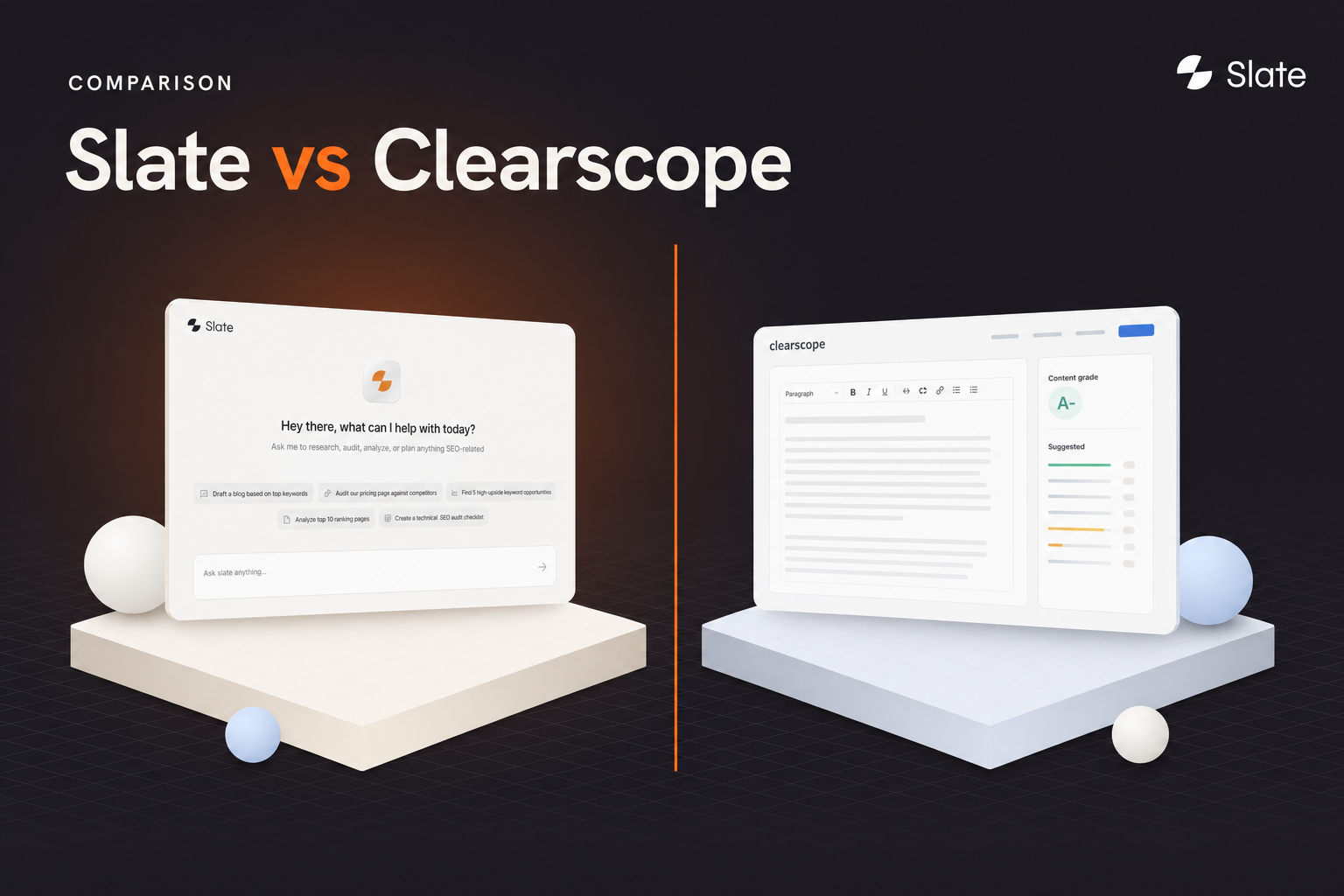
Slate — Best For AI Search Optimization And Content Engineering
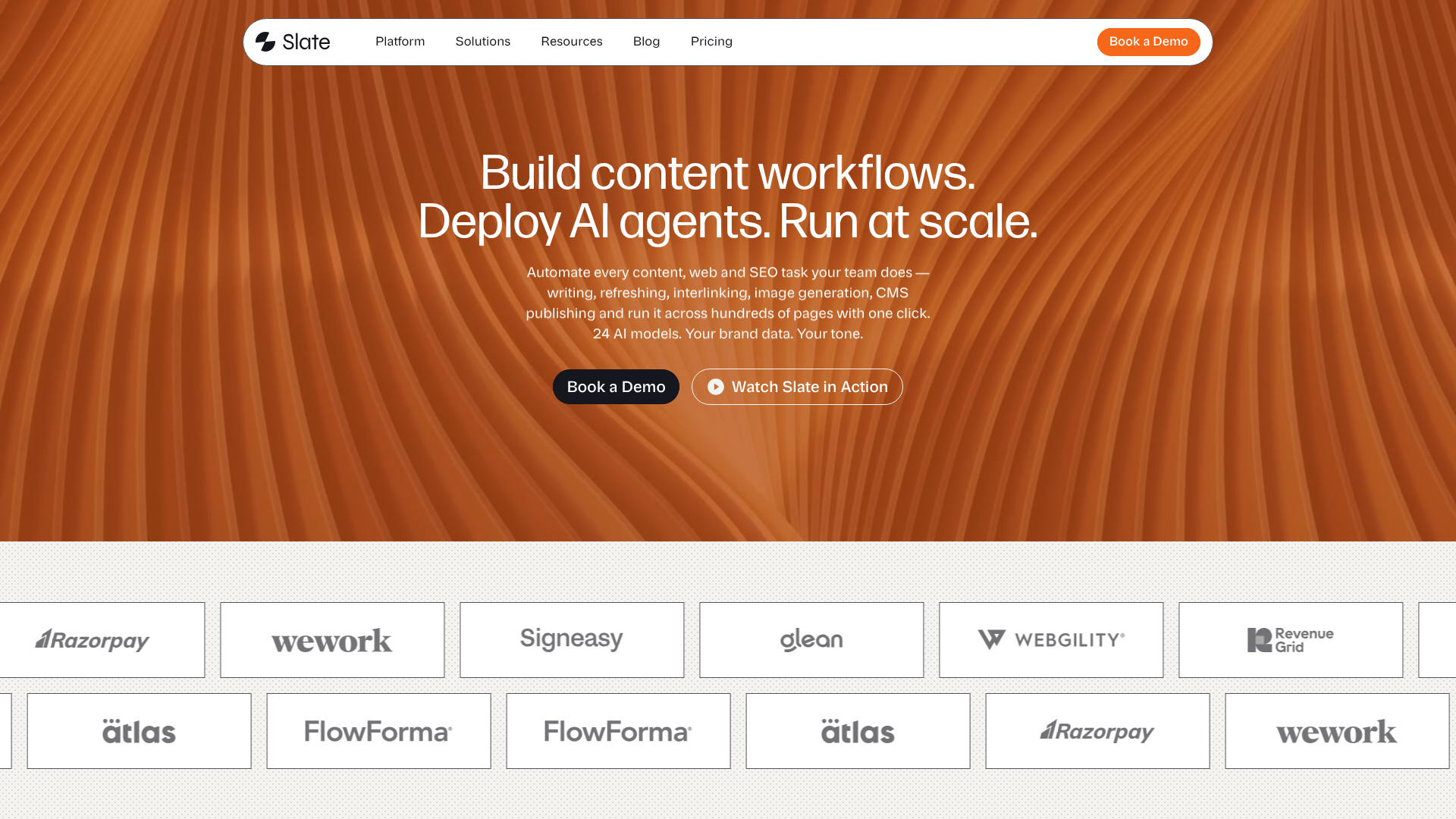
Positioning: End-to-end AI search optimization and content engineering platform for content-led B2B teams.
Most Writer.com alternatives try to compete on the same axis: broader enterprise AI capabilities. Slate takes a fundamentally different approach. Instead of building another general-purpose AI agent platform, Slate is purpose-built for AI search optimization and scalable content workflows, starting at $199/month. It's designed for the specific job most content teams actually need done: tracking AI search visibility, engineering citation-ready content, and scaling organic growth through repeatable workflows.
Core capabilities:
- Visibility tracking across ChatGPT, Google AI Mode, Google AI Overviews, and Perplexity. Teams can see exactly where their brand appears (or doesn't) in AI-generated answers and identify citation gaps competitors are filling.
- A visual workflow builder with 24+ AI models, conditional logic, web scraping, and direct CMS publishing. Content moves from research through drafting, optimization, and publishing without leaving the platform.
- and optimization audits across thousands of URLs. When a team manages 500+ pages, individual editing doesn't scale. Power Sheets makes systematic content operations practical.
- Style guides, tone rules, and a knowledge base that keeps AI-generated content aligned with brand standards. Every workflow inherits these guardrails automatically.
- Direct publishing to Webflow and WordPress from workflows and sheets.
Where Slate differs from Writer.com: Writer.com is built for broad enterprise AI agent use cases across departments. Slate is built specifically for marketing and content teams who need to win visibility in both traditional search and AI-powered discovery. The difference shows up in the workflow: Slate connects insight to action, from tracking where a brand appears in AI answers, to engineering content that gets cited, to publishing at scale without adding headcount.
Best for: B2B SaaS marketing teams, content-led growth companies, SEO leads adapting to AI search, and teams with 30 to 5,000+ indexed pages who need systematic content operations.
Pricing: Starts at $199/month.
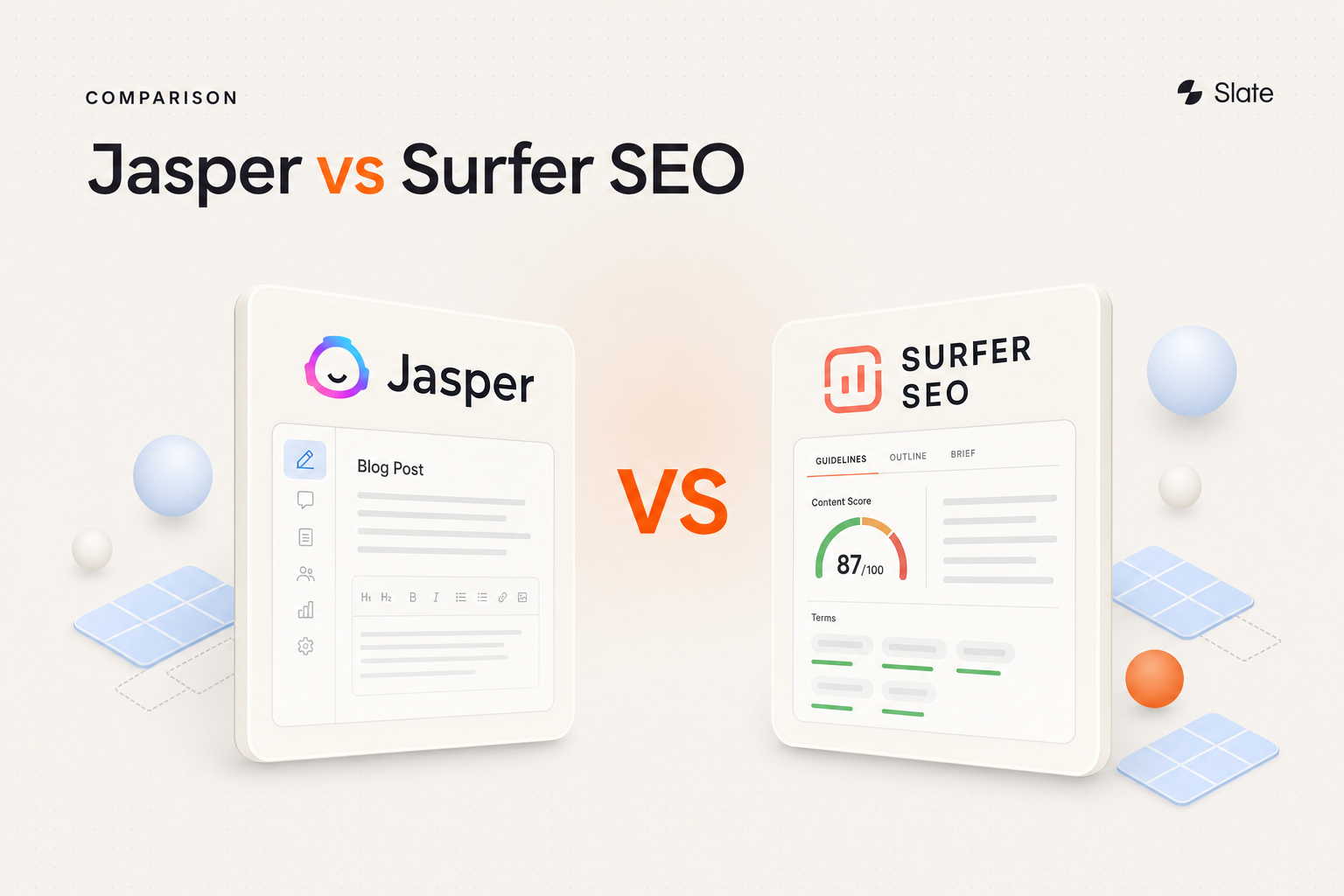
Jasper — Best For Marketing-Focused Agentic Campaigns
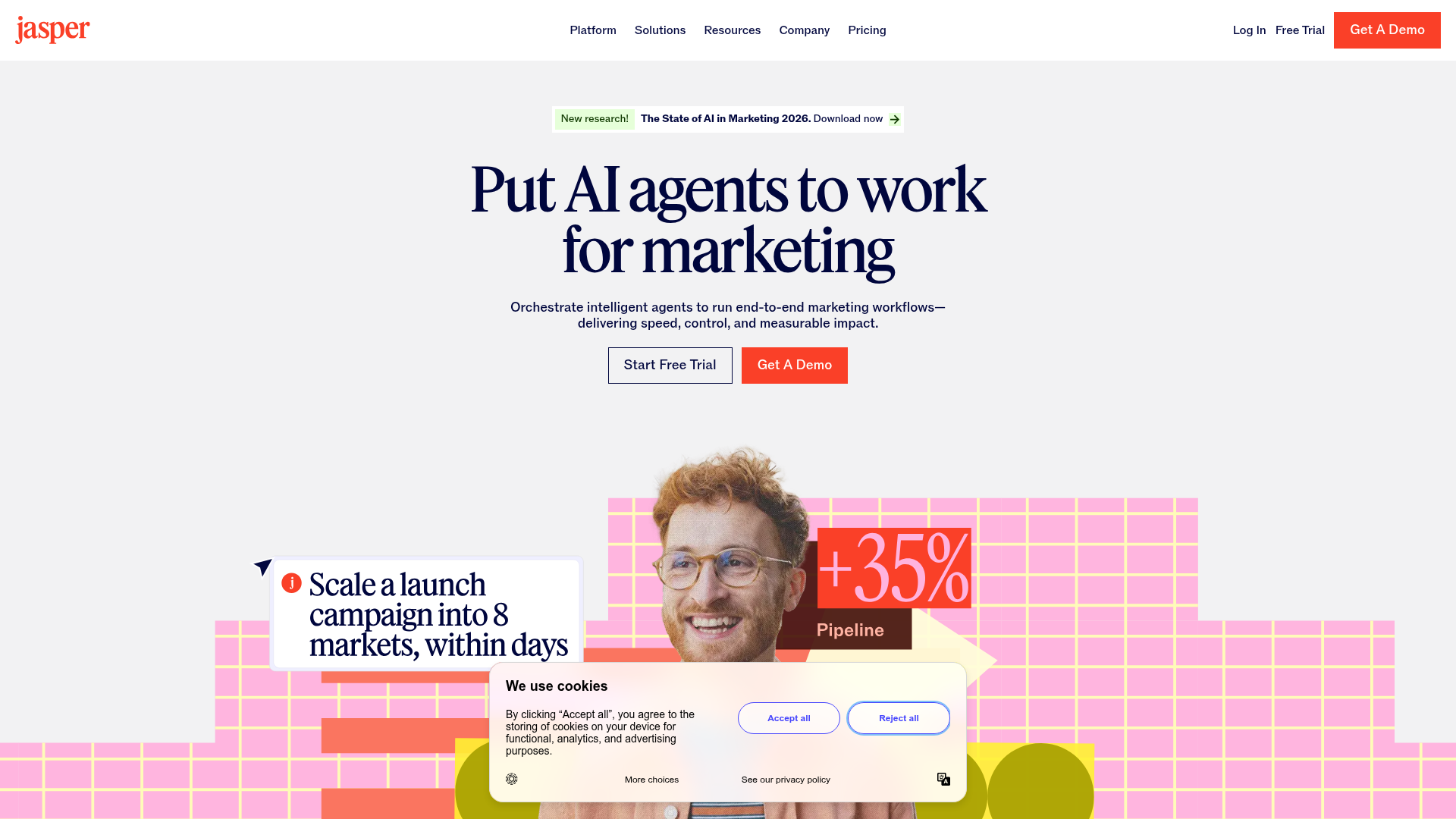
Positioning: Multi-agent platform built for marketers, combining collaborative campaign planning with autonomous AI agents for content creation, optimization, and personalization at scale.
Jasper has moved well beyond its origins as a copywriting tool. The platform now centers on Jasper Canvas, a collaborative workspace for mapping complex campaigns from strategy to assets, with updates cascading across channels. Jasper Agents (including an Optimization Agent, Personalization Agent, and Research Agent) automate multi-step marketing tasks like SEO research, content audits, and CRM-driven personalization.
The Jasper IQ context layer integrates brand voice, company knowledge, and audience context into all workflows. An IQ Agent can auto-generate Brand Voice, Audiences, and Knowledge Base assets from a company profile. Style Guide enhancements offer granular control over casing, first mention rules, and abbreviation handling.
Grid templates and reusable workflows provide drag-and-drop building with structured inputs. Notably, Jasper includes AI Visibility Workflows in Grid with built-in GEO scoring for AI citation readiness at the content level.
Integrations include Adobe Workfront export, Google Drive sync, and Box export. CRM integration with Salesforce and HubSpot powers personalization at scale.
Where it compares to Writer.com: Both platforms have moved into agentic, multi-step workflows with brand governance. Jasper's Canvas and agent system offer a campaign-centric approach to orchestrating marketing content, similar to Writer.com's enterprise agent model but with a sharper focus on marketing teams specifically.
Where it falls short: Jasper does not appear to offer dedicated AI search visibility tracking across ChatGPT, Google AI Mode, Google AI Overviews, or Perplexity as a standalone analytics feature. Its GEO scoring within Grid workflows addresses citation readiness at the content level but is not a monitoring dashboard. There's no equivalent to a Power Sheets-style bulk content operations interface, and CMS publishing is limited to exports (Workfront, Box, Google Drive) rather than direct publishing.
Best for: Marketing teams that need campaign-level orchestration from brief to multi-channel asset creation, with strong brand voice controls and CRM-driven personalization. Particularly strong for teams running complex, multi-asset campaigns where cascading updates across channels matter.
Pricing: Pro plan at $69/month (monthly) or $59/month (yearly), includes 1 seat. Business plan requires custom pricing and adds Advanced Agents, no-code AI App Builder, Jasper Grid, unlimited IQ customization, API access, enterprise governance, and dedicated account management.
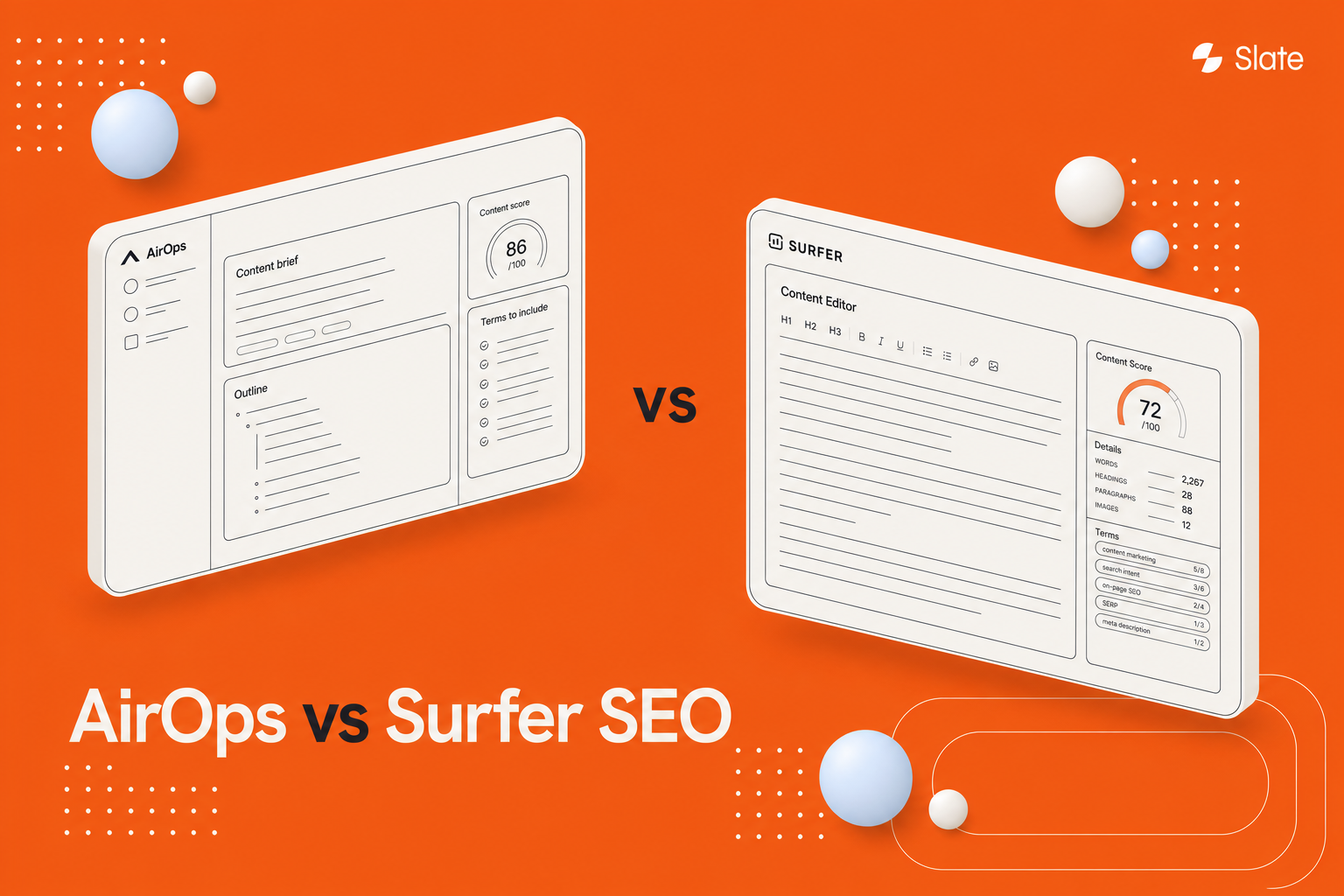
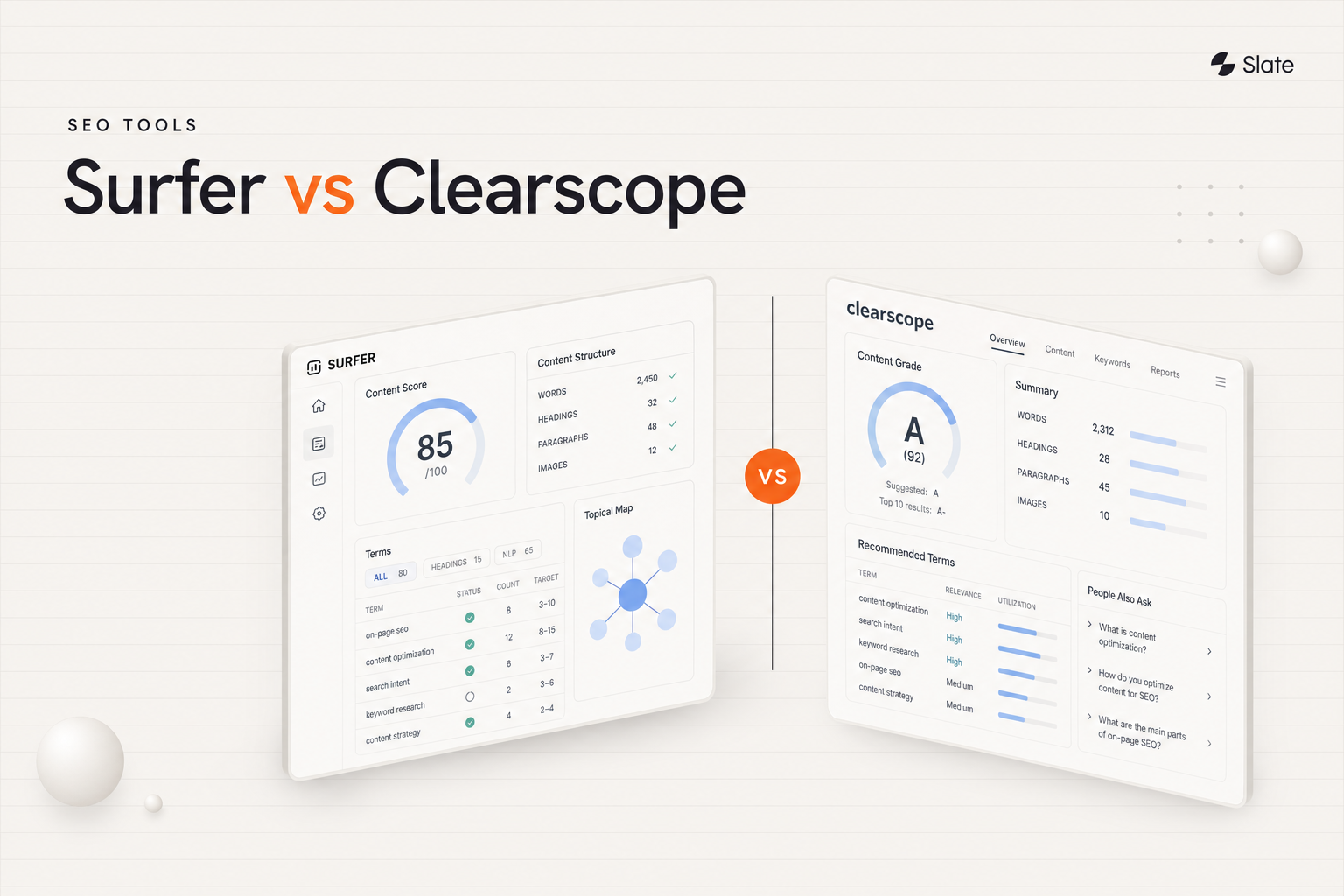
Surfer — Best For On-Page SEO Optimization With Emerging AI Visibility
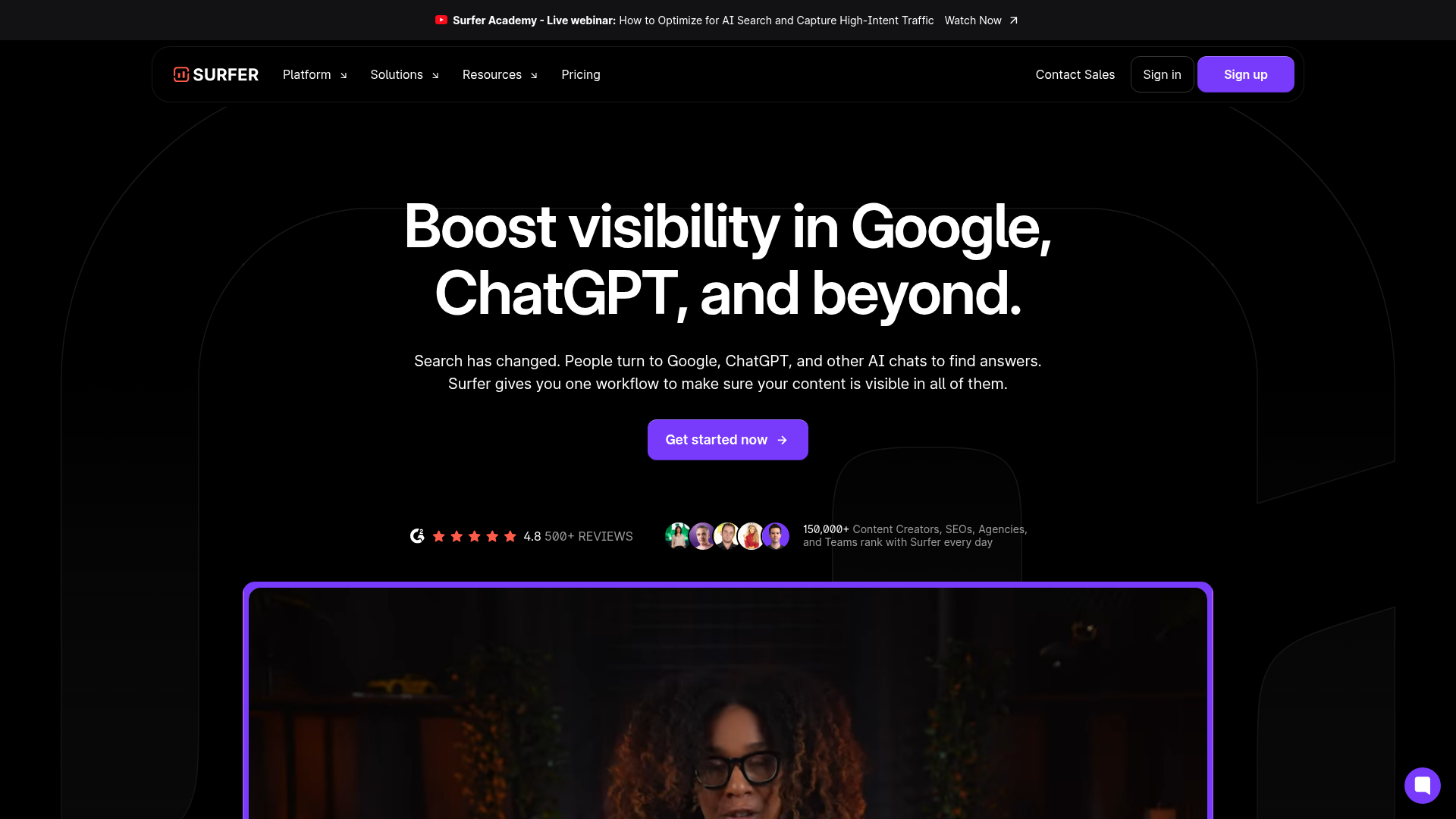
Positioning: SEO-focused content optimization platform that combines NLP-driven on-page analysis with emerging AI search visibility tracking capabilities.
Surfer's core strength remains on-page SEO optimization. The Content Editor lets teams import existing content, build outlines, share drafts, and collaborate, with 1-click content optimization. Surfer AI generates SEO-friendly articles, while Auto-Optimize automatically adds relevant NLP terms to enrich content for search relevance.
Beyond traditional SEO, Surfer now offers an AI Tracker that monitors when and where brands or competitors are cited inside AI answers across ChatGPT, Gemini, Perplexity, and other LLMs. The dashboard includes overview, sources, competitors, prompts, and fanout queries.
Additional capabilities include Keyword Research and Topic Research for discovering keyword clusters, a Topical Map for building topical authority and identifying content gaps (with Google Search Console integration), content Audit tools, a Rank Tracker with daily keyword tracking and SERP features monitoring, and Custom Instructions for persistent strategic context including brand voice and internal linking rules.
Where it compares to Writer.com: Surfer offers a fundamentally different value proposition. It's built around SEO optimization and content scoring rather than enterprise-wide AI agent deployment. For teams whose primary concern is on-page content quality and search performance, Surfer provides more granular optimization guidance than Writer.com. Its AI Tracker adds visibility monitoring that Writer.com does not offer.
Where it falls short: No CMS publishing integrations (Webflow, WordPress) were found based on official site review, meaning content must be exported manually. There's no equivalent to multi-step workflow automation with conditional logic or programmatic content operations. AI visibility tracking is limited by plan tier (25 prompts on Standard, 50 on Pro, 100 on Peace of Mind), which doesn't match the depth of a dedicated AI search analytics platform.
Best for: SEO-focused content teams that need on-page optimization scoring, keyword research, and content auditing as their primary workflow, with AI visibility tracking as a growing supplementary capability. Strong fit for teams that already have a CMS and content workflow in place and need an optimization layer on top.
Pricing: Discovery at $49/month (yearly billing) with 120 documents, track 10 pages, AI SEO optimization guidelines, Surfy & Humanizer. Standard at $99/month (yearly billing) with 360 documents, AI visibility tracking, 25 AI prompts (weekly refresh), integrations, Brand Knowledge, 1-click optimization, team collaboration, plagiarism checker, and rank drop detection. Pro at $182/month (yearly billing) with everything in Standard plus 360 documents, 50 AI prompts (daily refresh), 5 Brand Workspaces, 1-click internal linking, content ideas & coverage gap, templates & custom voices, and cannibalization report. Peace of Mind at $299/month (yearly billing) with everything in Pro plus unlimited documents, 100 AI prompts (daily refresh), unlimited Brand Workspaces, advanced SERP analysis, personalized onboarding, dedicated success manager, and API access. Enterprise at $999/month (monthly billing) with tailored packages, SSO, enterprise-grade security, comprehensive advisory, legal onboarding, early access, custom limits, white-label, and priority support.
Copy.ai — Best For Sales And Marketing Workflow Automation
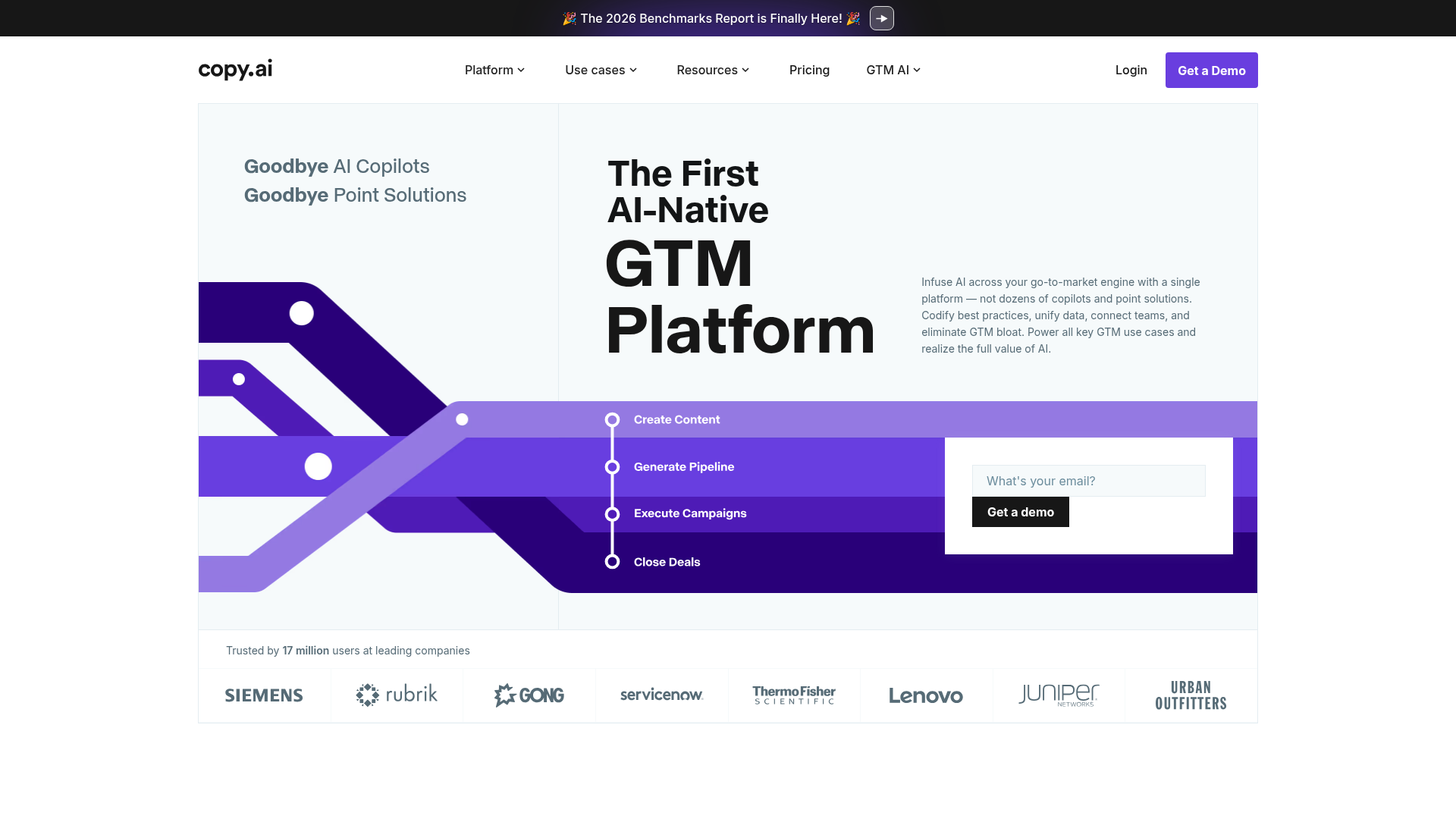
Positioning: AI-powered platform combining content generation with no-code workflow automation for go-to-market teams, spanning sales prospecting, content creation, and multi-step process automation.
Copy.ai's standout feature is its Workflow Builder: a visual, no-code interface for chaining multiple steps into automated processes, available even on the free plan. Teams can build end-to-end blog post workflows (ideation, research, outline, draft), product description generation at scale, and sales automation sequences.
The platform offers model-agnostic flexibility, letting teams switch between GPT-4, GPT-3.5, Claude Sonnet 3.5, Sonnet 3, and other models within the same workflow. A Chat feature supports sales tasks, web scraping, outreach sequences, and market research with real-time web search capability.
Brand Voice Storage supports multiple brand voices, while Infobase stores brand information and Hashtag Recall maintains brand consistency. AI Copy Agents handle specific content tasks across formats (emails, social posts, product descriptions, blog content, headlines). LinkedIn profile and public data scraping support sales prospecting and personalization. CRM integration is available via Zapier.
Where it compares to Writer.com: Both platforms offer workflow automation and brand voice controls, but Copy.ai leans heavily into go-to-market use cases, particularly sales prospecting, outreach automation, and marketing content generation. The model-agnostic approach gives teams multi-model flexibility that single-model platforms don't, and the Workflow Builder's availability on the free plan makes it easy to test before committing.
Where it falls short: No AI search visibility tracking or citation monitoring capabilities were found. No dedicated CMS publishing integrations (Webflow, WordPress) were found, meaning content must be moved manually or via Zapier. Copy.ai's strength is GTM workflow automation, making it less suited for teams whose primary job is SEO-driven content engineering or AI search optimization.
Best for: Go-to-market teams that need a single platform for both sales prospecting workflows and marketing content generation. Particularly strong for teams that want no-code workflow automation with multi-model flexibility and don't need deep SEO or AI search capabilities.
Pricing: Chat plan at $29/month (monthly) or $24/month (billed annually) for 5 seats with unlimited words in chat. Growth plan at $1,000/month (billed annually at $12,000/year) for 75 seats and 20K workflow credits/month. Expansion plan at $2,000/month (billed annually at $24,000/year) for 150 seats and 45K workflow credits/month. Scale plan at $3,000/month (billed annually at $36,000/year) for 200 seats and 75K workflow credits/month. Enterprise plan with custom pricing.
Grammarly (Superhuman Go) — Best For Writing Assistance And AI Agents Across Enterprise Communication
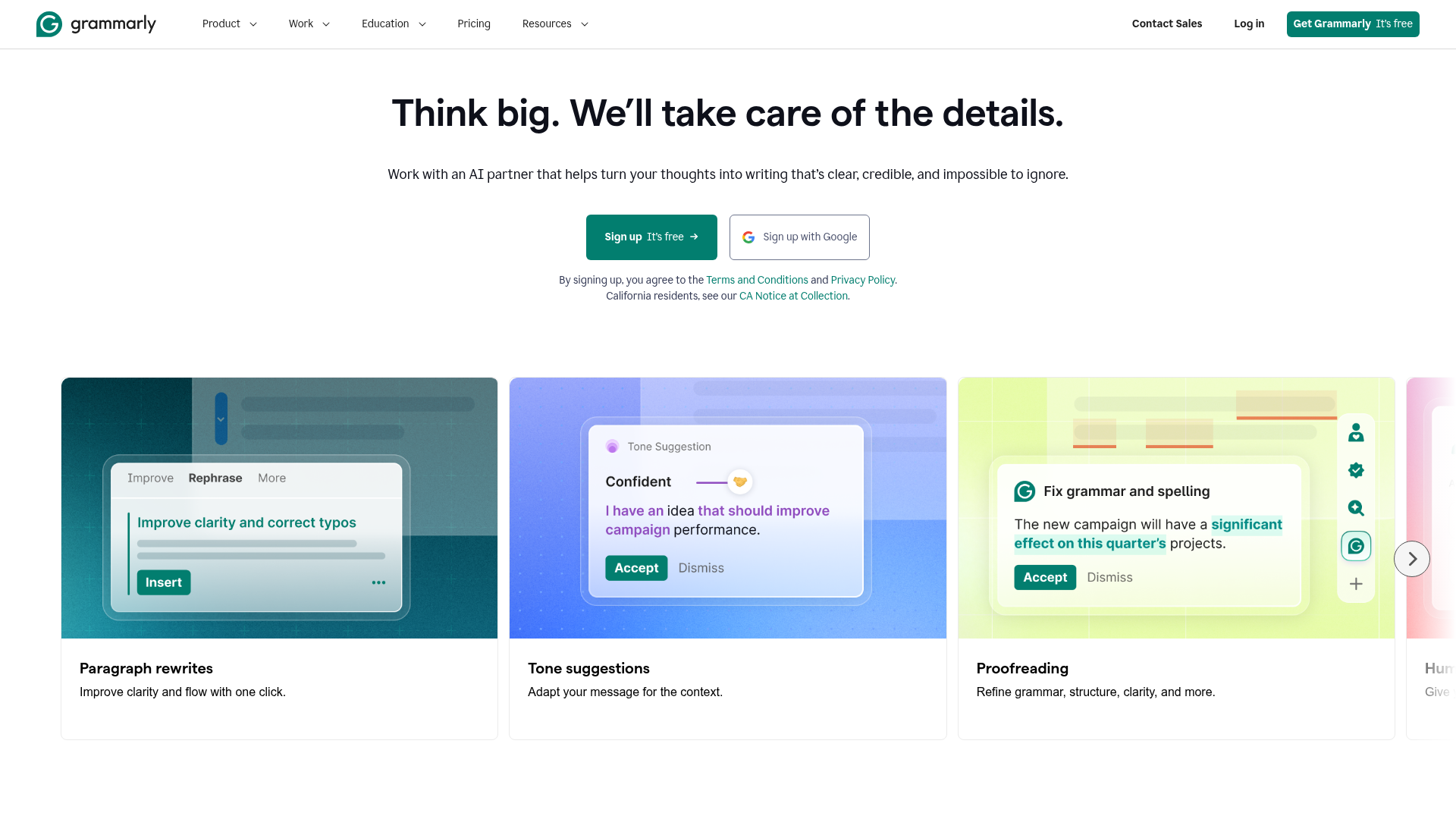
Positioning: Enterprise communication platform combining trusted writing assistance with context-aware AI agents (branded as "Superhuman Go") that work across email, docs, Slack, Zendesk, and other tools teams already use.
Grammarly's competitive advantage is ubiquity. Superhuman Go AI agents don't just generate content. They perform actions including rewriting text, triggering workflows, annotating docs, and surfacing next steps proactively. These agents are context-aware, collaborative, permission-aware, and embedded across workflows rather than trapped in a single tab.
The platform integrates with 1 million+ apps and websites, including Gmail, Outlook, Google Docs, Slack, Salesforce, Zendesk, JIRA, and Figma. Grammarly for Slack provides real-time AI-powered writing suggestions, grammar corrections, tone adjustments, generative prompts, and rewriting.
Additional features include Reader Reactions (highlighting clarity, confusion, or likely questions in content), a Humanizer that reduces generic AI-sounding language, Snippets for quick insertion of standardized text, voice and tone customization for brand consistency, and a Groups feature for organizing teams. Go Enterprise includes toggles for Web Search access, Agent Sharing, and managing agents/connectors.
Enterprise-grade security is described as the most robust of any AI communication assistance company.
Where it compares to Writer.com: Both platforms serve enterprise teams with brand governance and AI-powered capabilities. Grammarly's strength is that it works inside the tools teams already use rather than requiring users to work within a separate platform. Superhuman Go's proactive, context-aware agents represent embedded assistance across communication touchpoints rather than centralized content creation.
Where it falls short: No AI search visibility tracking, citation monitoring, or AEO capabilities were found. Grammarly is not designed for multi-step content creation workflows (research through publish). There are no CMS publishing integrations, no bulk content operations, and no programmatic content refresh capabilities. It's primarily a communication quality layer, not a content engineering or organic growth platform.
Best for: Enterprise teams that need writing quality, tone consistency, and AI-powered assistance embedded across every communication channel. Strongest for organizations where the primary goal is communication quality and brand consistency across hundreds or thousands of employees.
Pricing: Free plan at $0/month (basic writing assistance, 100 AI prompts). Pro plan at $12/month per user (full sentence rewriting, tone adjustment, plagiarism/AI detection, 2,000 AI prompts). Enterprise plan requires contacting sales and adds proactive AI agents (Superhuman Go), BYOK encryption, custom roles and permissions, data loss prevention, and cost center visibility.
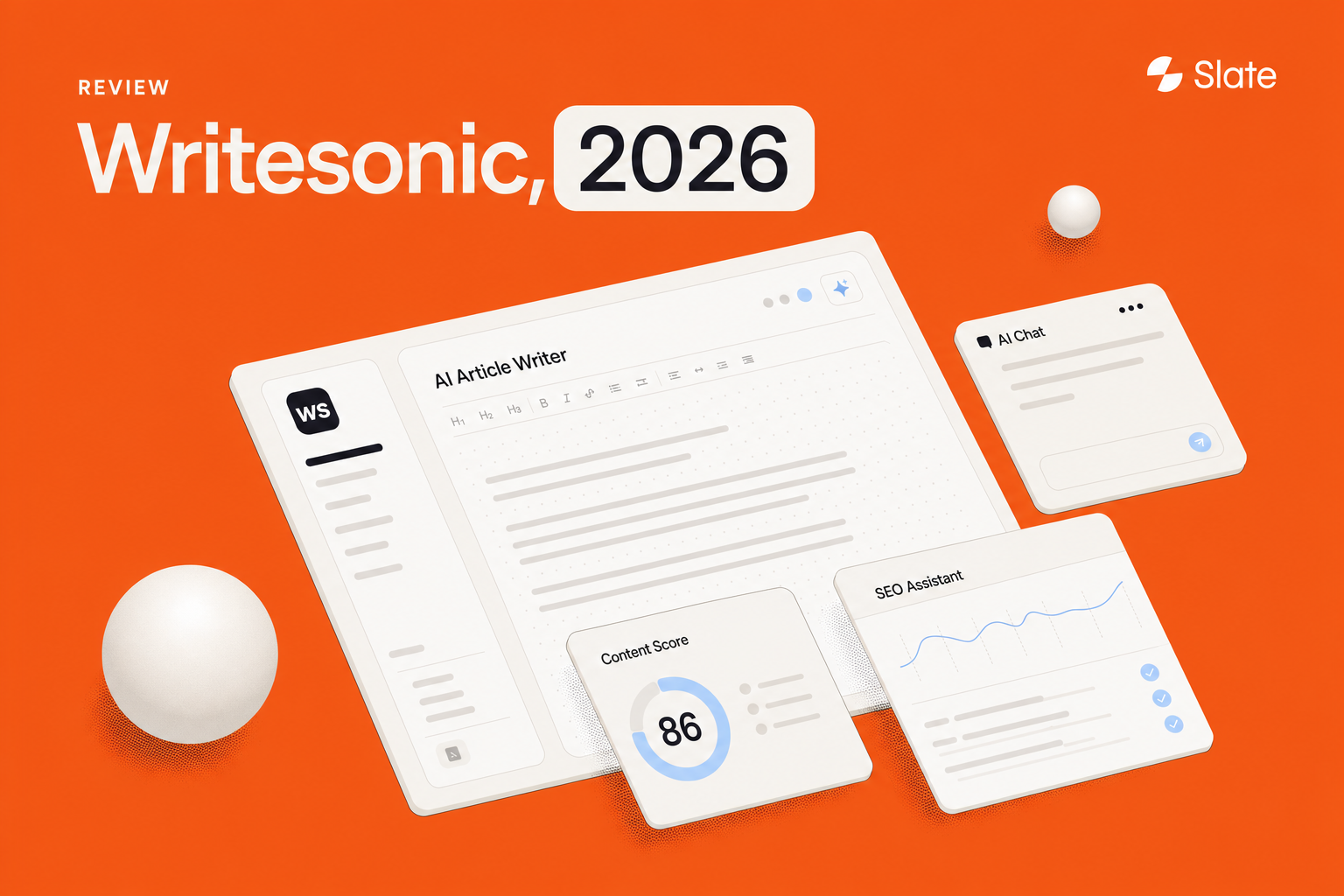
Writesonic — Best For AI Search Visibility With Integrated Content Tools
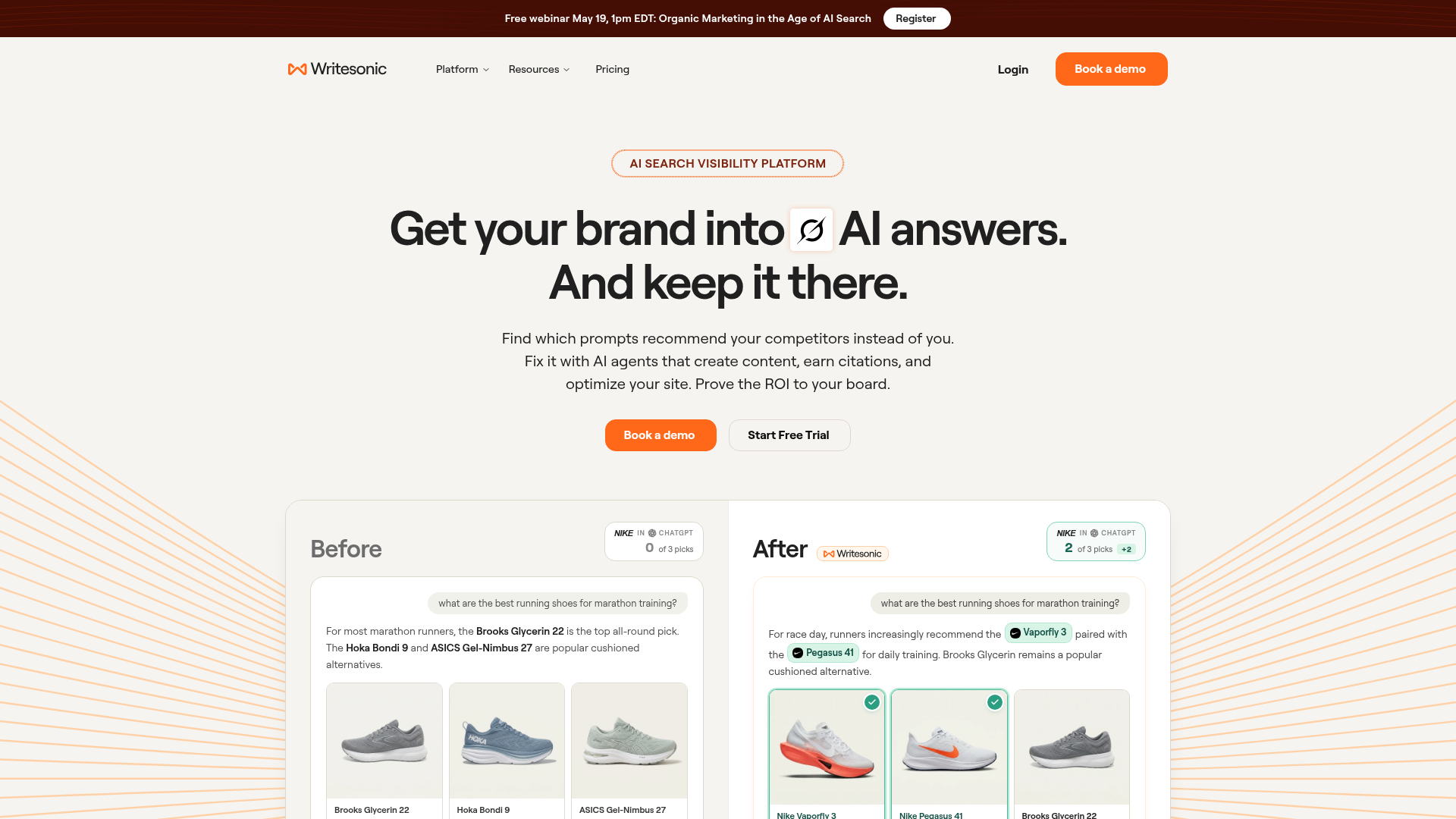
Positioning: AI content and search visibility platform that combines content generation with dedicated AI search monitoring across multiple AI platforms, plus SEO auditing capabilities.
Writesonic's strongest confirmed capability is AI search visibility tracking. The platform crawls AI interfaces like a real user rather than via APIs, tracking at least ChatGPT, Claude, Google AI, and Gemini (up to 10 platforms claimed). It provides visibility scores, citation tracking, sentiment analysis, share of voice, and platform-level breakdowns.
The Overview Dashboard includes visibility score, pages cited, competitor analysis, prompt performance, and citation trends. Prompt Tracking monitors real natural language prompt variations and predicts prompt volume using a proprietary dataset, with filters by competitor, market, language, intent, prompt, and platform. An Action Center delivers prioritized recommendations including schema fixes, content gaps, and citation opportunities. Sentiment and Theme Analysis shows how AI platforms describe your brand.
Where it compares to Writer.com: Writesonic occupies a different niche entirely. Its strongest capability is AI search visibility monitoring across multiple platforms, which Writer.com does not offer. For teams whose primary concern is understanding and improving how their brand appears in AI-generated answers, Writesonic provides dedicated monitoring infrastructure.
Where it falls short: Content generation and workflow capabilities appear less mature than Writer.com's enterprise agent system. Marketing copy suggests agentic content workflows, but these are not confirmed via dedicated feature pages. Brand governance tools (style guides, tone enforcement, review gates) are not confirmed as standalone features. No CMS publishing integration was confirmed. AI visibility tracking depth varies significantly by plan tier: the Starter plan tracks ChatGPT only, while full 10-platform tracking requires the Enterprise plan.
Best for: Teams that prioritize AI search visibility monitoring and competitive intelligence across AI platforms as their primary use case. Particularly strong for SEO and content teams that need to understand citation patterns, sentiment, and share of voice across multiple AI platforms.
Pricing: Starter at $79/month (billed annually), ChatGPT tracking only, 15 AI articles/month, 10 site audits (100 pages each), 1 user, limited agentic workflows (10 trial runs). Basic at $199/month (billed annually), ChatGPT + Gemini + Google AI Overviews tracking, 25 AI articles/month, 2 users. Growth at $399/month (billed annually), same platform coverage as Basic, 50 AI articles/month, 3 users. Enterprise at custom pricing, all 10 AI platforms tracked, custom limits, full agentic workflow access.
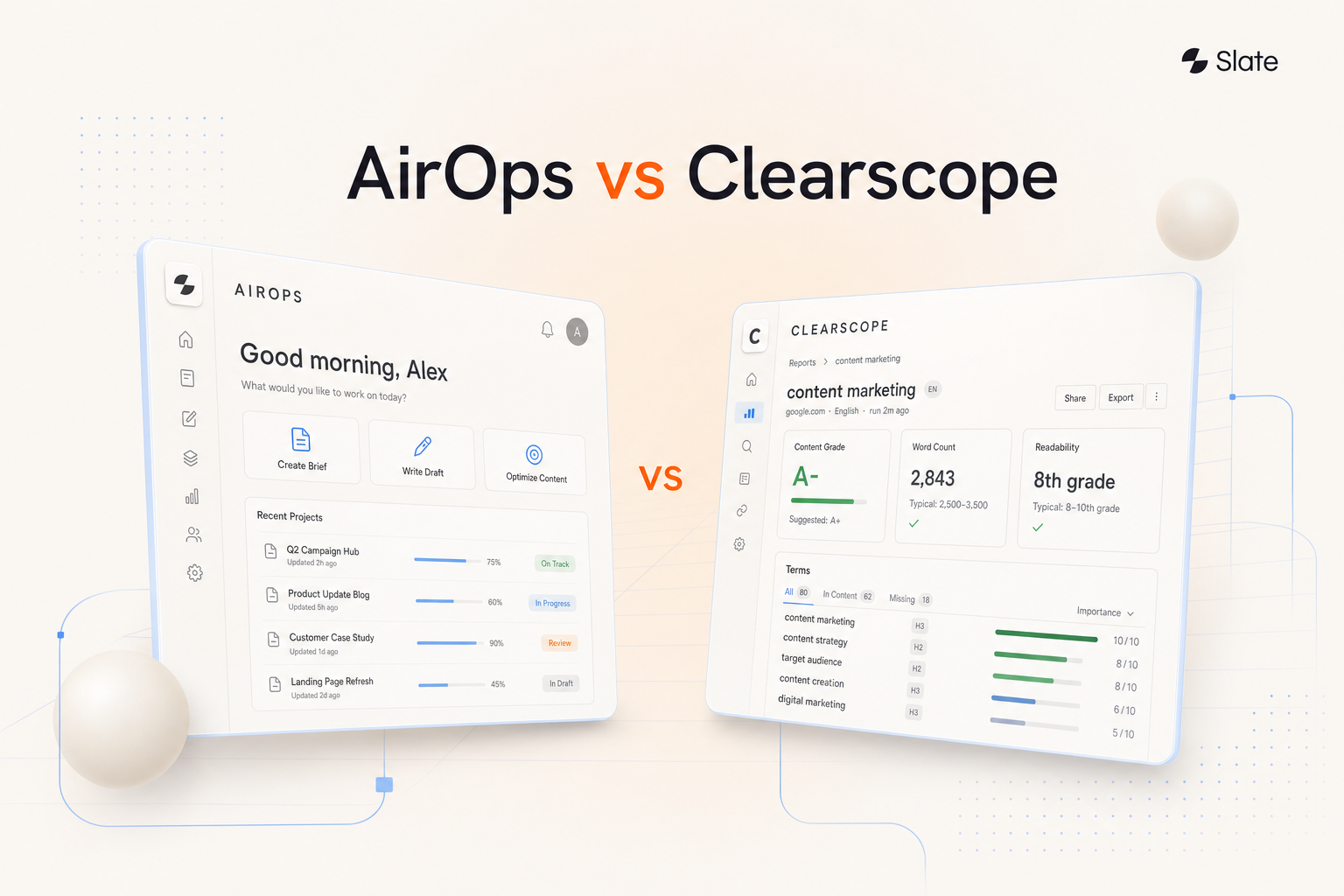
AirOps — Best For Programmatic SEO And Data-Driven Content Workflows
Positioning: Workflow automation platform for programmatic content operations, combining multi-model AI generation with deep CMS integrations, human-in-the-loop approvals, and data-driven content execution at scale.
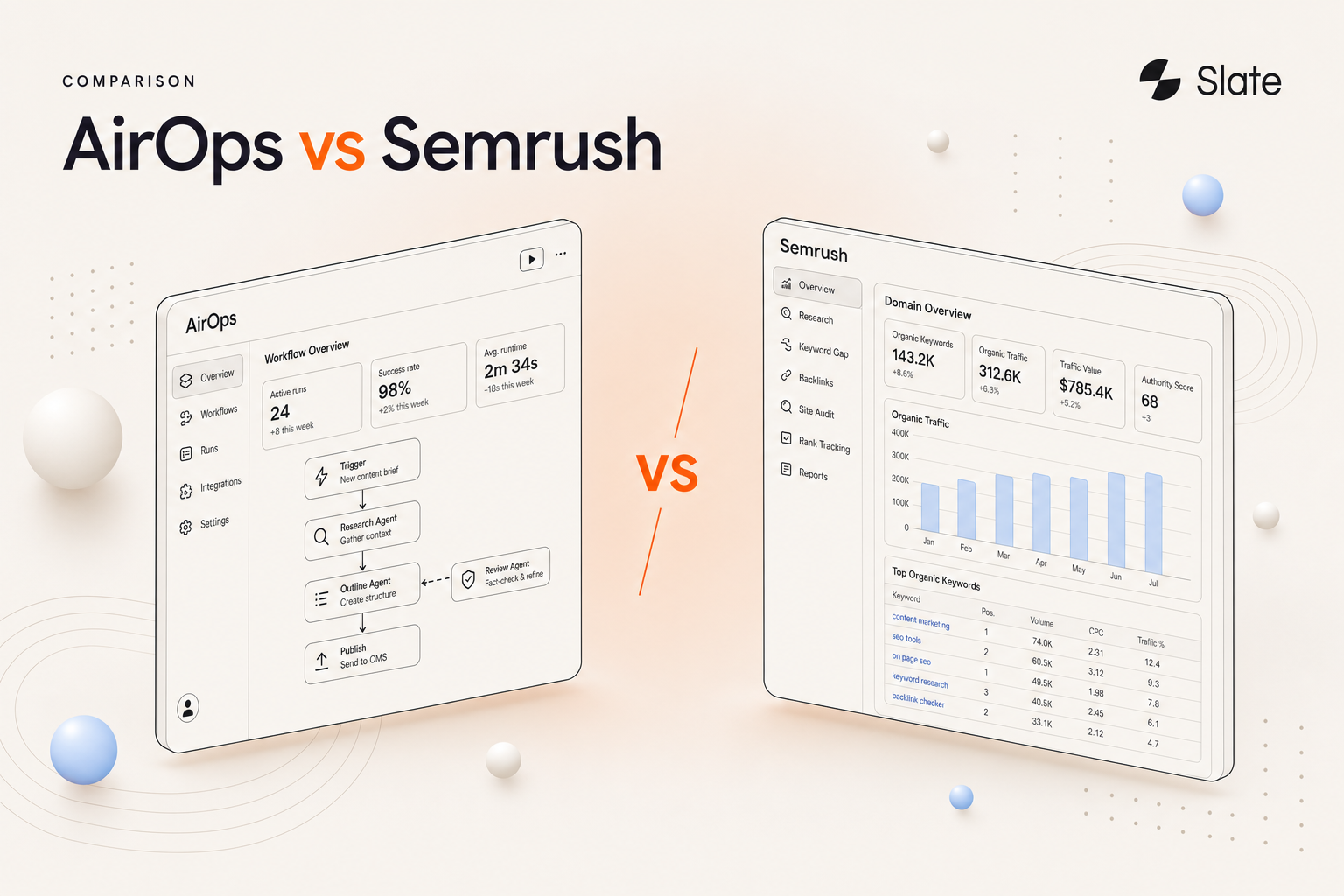
AirOps stands out for its CMS publishing depth: direct integrations with Webflow, WordPress, Contentful, Sanity, Strapi, and Ghost. That's six CMS platforms, more than any other alternative in this guide. Workflow orchestration includes human-in-the-loop approvals via Asana, ClickUp, and Slack, creating structured content production pipelines with built-in review gates.
The platform supports multi-model LLM access from OpenAI, Groq, and Anthropic, with bring-your-own-model capability. Brand Kits and Knowledge Base features apply tone, style, and messaging hierarchy to content generation. Bulk content operations let teams import entire CMS collections and process content at scale. Multimodal inputs support text, video, audio, and image across workflows. Security includes SSO, role-based access, change tracking, and permissioned access.
Integrations extend to Google Docs, Slack, and SEO/analytics tools including Semrush, Ahrefs, and Moz.
Where it compares to Writer.com: Both platforms offer workflow automation, but AirOps is built specifically for content operations teams that need deep CMS integrations and programmatic content execution. Where Writer.com deploys AI agents across departments, AirOps focuses on the content production pipeline from data ingestion to multi-model generation to CMS publishing with human approval gates.
Where it falls short: AI search visibility tracking appears to be marketed but is not confirmed as a fully built-out feature via dedicated feature pages. Teams needing robust AI citation monitoring should verify current capabilities. The platform is less suited for enterprise-wide AI deployment across non-content departments. Its strength in programmatic content may require more technical comfort than Writer.com's more guided enterprise interface.
Best for: Content operations and SEO teams running programmatic content at scale, particularly those managing large CMS libraries across multiple platforms who need human-in-the-loop approval workflows, multi-model flexibility, and deep data integrations with SEO tools like Semrush and Ahrefs.
Pricing: Insights plan at $0/month (1,000 to 10,000 tasks/month, 1 user, basic templates, 1 Brand Kit, 5 Knowledge Base sources, 30+ AI models, 10+ CMS integrations). Solo plan at $0/month (20,000 tasks/month, 100 tracked prompts and pages, ChatGPT insights only). Pro plan pricing not publicly listed, contact sales (75,000 tasks/month, 250 tracked prompts and pages, multi-engine insights, unlimited seats). Enterprise at custom pricing (custom task limits, multiple regions/personas/languages tracked, custom agent builds, unlimited seats).
Typeface — Best For Enterprise Brand-Safe Content Generation With Visual And Video Capabilities
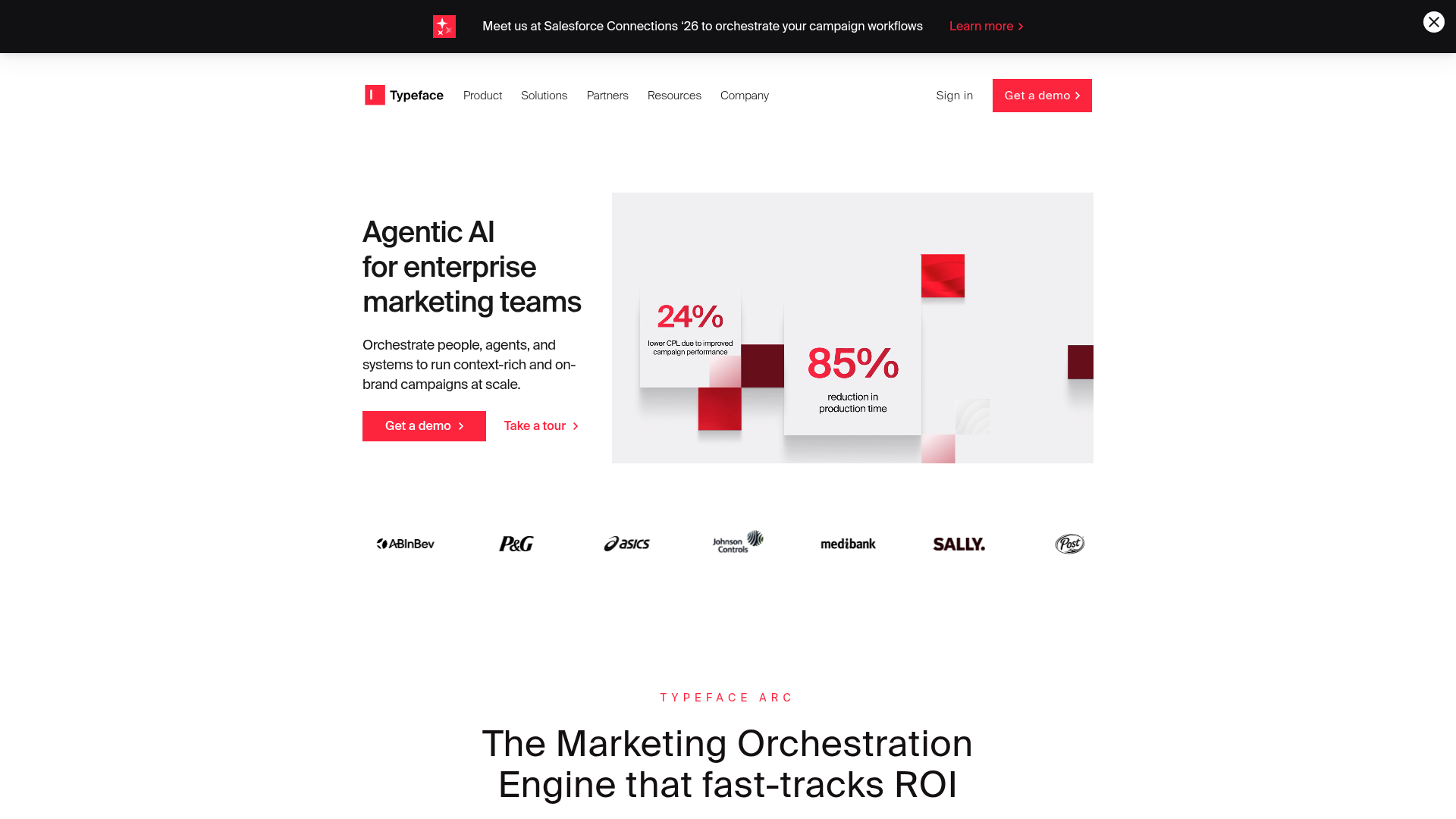
Positioning: Enterprise generative AI platform that combines brand-safe text, image, and video content creation with deep brand governance, visual design automation, and emerging AI search optimization capabilities.
Typeface differentiates with multimodal depth that most Writer.com alternatives can't match. The Brand Kit detects voice from a URL or pasted guidelines, trains image style, and sets rules. Arc Graph lets teams batch-upload brand documents to build a brand knowledge graph. Agent Studio enables building Conversational Agents and Workflow Agents via a visual builder for multi-step content automation.
The AEO Analyzer scores content against AI search engine signals from ChatGPT, Perplexity, and Gemini, making it one of the few platforms with confirmed AI search optimization scoring at the content level.
Visual and video capabilities include a Video Agent that turns long-form content into highlight reels with storyboard editing, video repurposing from transcripts to social-ready sizzle reels, and image/video generation via Gemini 2.5 Flash and Veo 3 integration. Figma two-way sync lets teams import layouts, generate content, and push back. Magic Modules auto-assemble webpages and handle email personalization with SEO keywords and export APIs.
Additional features include Feeds for generating multiple content pieces across audiences and languages from a single goal, AI content repurposing, context-rich chat with memory and campaign context, selectable AI models, and an MCP Server for integration with Claude Desktop, VS Code, and ChatGPT using secure OAuth 2.1 with audit-logged brand context.
Where it compares to Writer.com: Both serve enterprise teams with brand governance and AI-powered content generation. Typeface differentiates with significantly stronger visual and video capabilities. Figma sync, video repurposing, image generation, and layout automation give it a multimodal edge that Writer.com's text-focused agent system doesn't match. The AEO Analyzer and MCP Server integration add capabilities Writer.com doesn't offer.
Where it falls short: Typeface's strength in visual/video content means it's less focused on text-heavy content engineering workflows like bulk content refreshes, programmatic SEO, and large-scale content audits. There's no equivalent to a Power Sheets-style bulk operations interface. Campaign landing page analytics are noted as "coming soon." The platform's breadth across text, image, and video may exceed what teams focused purely on written content and SEO need.
Best for: Enterprise marketing teams that need brand-safe content generation across text, image, and video formats, particularly those with strong visual brand requirements, Figma-based design workflows, and multi-channel campaign needs.
Pricing: Team plan at $49/user/month (core content creation templates, AI-powered generation). Business plan at $99/user/month (advanced personalization, more integrations, content safety checks). Enterprise plan at custom pricing (dedicated AI models, advanced security, custom workflows, API access).
Writer.com Alternatives Comparison Table
How To Choose The Right Alternative (Decision Framework)
A comparison table shows you what each platform can do. A decision framework helps you figure out which one you should actually buy. The distinction matters because the "best" Writer alternative depends entirely on what your team is trying to accomplish.
Use this conditional logic to narrow your shortlist:
If your primary goal is AI search visibility and content-led organic growth → Slate connects visibility tracking across ChatGPT, Google AI Mode, AI Overviews, and Perplexity to content engineering workflows and CMS publishing in a single system. Starting at $199/month, it's built for the specific job of making content discoverable in AI-powered search.
If you need broad enterprise AI agents across marketing, sales, support, and ops → Writer.com may still be the right fit. Its enterprise agent architecture is designed for cross-department deployment at scale.
If you need campaign-level orchestration with AI agents for marketing specifically → Jasper's alternatives Canvas, Agents, and Grid templates are built for multi-asset campaign execution with CRM-driven personalization.
If you need on-page SEO optimization with content scoring and emerging AI visibility tracking → Surfer's alternatives provides granular NLP-driven optimization guidance with its AI Tracker adding citation monitoring across ChatGPT, Gemini, Perplexity, and other LLMs.
If your team needs writing assistance and AI agents embedded across every communication tool → Grammarly's Superhuman Go agents work inside Gmail, Slack, Docs, Zendesk, and 1 million+ other apps.
If you need AI search visibility monitoring across up to 10 platforms with competitive intelligence → Writesonic offers the broadest AI platform coverage for citation tracking, sentiment analysis, and share of voice monitoring.
If you need programmatic content at scale with deep CMS integrations and multi-model flexibility → AirOps alternatives publishes directly to six CMS platforms with human-in-the-loop approvals and bring-your-own-model support.
If you need brand-safe multimodal content (text, image, video) with visual design automation → Typeface combines Figma sync, video repurposing, image generation, and AEO scoring in a single enterprise platform.
Questions To Ask Before Switching
Before committing to any alternative, run through this checklist with your team:
- What is the primary job to be done: enterprise AI agents, content-led growth, communication quality, or campaign orchestration?
- Do you need AI search visibility tracking, and across how many platforms?
- How important is direct CMS publishing integration?
- What governance and review controls are non-negotiable?
- Do you need multimodal content (image, video) or primarily text?
- What's your model preference: single vendor, multi-model, or bring-your-own?
- Can you run a 30-day parallel pilot before making a full commitment?
How To Migrate From Writer.com To An Alternative
Switching platforms feels risky, and that's exactly why most teams delay the decision longer than they should. The good news: migration from Writer.com is manageable when you approach it with structure rather than urgency.
Step 1: Audit current Writer.com usage. Before evaluating alternatives, map exactly how your organization uses Writer.com today. Which teams are active? Which workflows run regularly? Which integrations are in place (CMS, CRM, docs, email)? This audit prevents surprises during migration and helps you identify which capabilities are truly critical versus which are nice-to-have.
Step 2: Export style guides, brand voice settings, and templates. Document your brand voice configuration, style rules, and any custom templates. Several alternatives offer confirmed brand voice and style guide features, including Slate (Brand Kit & Knowledge Base), Jasper (IQ and Style Guide), AirOps (Brand Kits & Knowledge Base), and Typeface (Brand Kit and Arc Graph). Rebuilding these settings is straightforward when you have the source material documented.
Step 3: Identify integration dependencies. Map every system Writer.com connects to in your stack. CMS platforms, project management tools, CRM systems, and communication channels all need to be accounted for. Check whether your shortlisted alternatives support these integrations natively or require workarounds.
Step 4: Run a parallel pilot. Pick one or two alternatives and run them alongside Writer.com on a defined content project for 30 days. This isn't about replacing everything at once. It's about testing whether the new platform handles your specific workflows, maintains your quality standards, and delivers measurable results.
Several alternatives offer low-cost entry points for piloting: AirOps has free Insights and Solo plans, Copy.ai's Chat plan starts at $29/month with 5 seats, Grammarly offers a free plan, and Surfer's Discovery plan starts at $49/month.
Step 5: Define success criteria before the pilot starts. Speed, quality, adoption rate, visibility impact, and team satisfaction should all be measurable. If you can't define what "better" looks like before the pilot, you won't be able to evaluate the results objectively.
Step 6: Align stakeholders. Migration decisions that involve marketing, IT, legal, and leadership move faster when everyone agrees on the evaluation criteria upfront. Share the pilot plan, success criteria, and timeline with all stakeholders before starting.
Step 7: Choose phased rollout over hard cutover. Start with one team or one content type. Expand once the new platform proves itself. This reduces risk and gives your team time to build confidence with the new workflows.
Conclusion — Why AI Search Visibility Should Drive Your Decision
The question isn't which tool writes faster. It's which platform helps your content get discovered, cited, and trusted in AI-powered search.
That distinction matters because the way how people find information has changed. When a prospect asks ChatGPT or Perplexity a question about your category and your brand doesn't appear in the answer, no amount of writing speed or agent sophistication fills that gap. The content infrastructure that worked for ten blue links needs to evolve for a world where AI systems decide what gets surfaced.
Writer.com is a strong platform for organizations that need broad enterprise AI agent capabilities across departments. For teams whose primary job is organic growth through content, the evaluation criteria look different: AI search visibility tracking, citation-ready content engineering, scalable workflows, and direct CMS publishing.
Slate is built for that specific job. It connects AI search analytics across ChatGPT, Google AI Mode, Google AI Overviews, and Perplexity to a visual workflow builder with 24+ AI models, Power Sheets for bulk content operations, and direct publishing to Webflow and WordPress. The entire system is designed to move from insight to action to published content without adding headcount or breaking brand standards. Pricing starts at $199/month.
See how Slate tracks AI search visibility and engineers content that gets cited. Book a demo →
FAQs
What Is Writer.com, And Why Are Teams Looking For Alternatives?
Writer.com is an enterprise AI platform for agentic workflows, brand-safe content generation, and cross-department AI deployment. Teams look for alternatives when their primary need is content-led organic growth, AI search visibility, or tighter SEO workflow integration rather than broad enterprise AI agents across sales, support, and HR.
What Is The Best Writer.com Alternative For B2B SaaS Content Teams?
For content-led B2B SaaS teams that need AI search visibility tracking, scalable content workflows, and CMS publishing, Slate is the strongest fit. Slate's AI Search Analytics tracks visibility across ChatGPT, Google AI Mode, Google AI Overviews, and Perplexity, while Workflows and Power Sheets handle content creation and optimization at scale. Pricing starts at $199/month.
How Does Writer.com Compare To Slate For AI Search Optimization?
Writer.com focuses on enterprise-wide AI agent capabilities across departments. Slate is purpose-built for tracking visibility across ChatGPT, Perplexity, Google AI Overviews, and Google AI Mode, and engineering content that gets cited. Slate's AI Search Analytics, Workflows (with 24+ AI models and conditional logic), and Power Sheets (for bulk content operations) form an end-to-end system that connects visibility insight to content action to CMS publishing.
Can I Migrate My Brand Voice Settings And Style Guides From Writer.com To Another Platform?
Yes. Start by exporting your brand voice configuration, style rules, and custom templates from Writer.com. Several alternatives offer confirmed brand voice and style guide features: Slate (Brand Kit & Knowledge Base), Jasper (IQ context layer and Style Guide enhancements), AirOps (Brand Kits & Knowledge Base), and Typeface (Brand Kit and Arc Graph). Run a parallel pilot to validate that the new platform maintains consistency with your existing brand standards before fully migrating.
Which Writer.com Alternatives Offer The Best Workflow Automation For Content Teams?
Several alternatives offer strong workflow automation, each with a different focus. Slate's visual workflow builder supports 24+ AI models, conditional logic, web scraping, and CMS publishing, while Power Sheets handles bulk operations across thousands of URLs. Jasper's Canvas and Agents orchestrate multi-asset marketing campaigns. Copy.ai's no-code Workflow Builder is available even on the free plan. AirOps provides human-in-the-loop workflows with direct publishing to six CMS platforms. Typeface's Agent Studio builds Conversational and Workflow Agents via a visual builder.
Is Writer.com Overkill For Teams That Only Need Content Marketing And SEO?
It can be. Writer.com's enterprise breadth, including agents for sales, support, HR, and legal, may exceed what a content-focused team needs. If the primary job is organic growth and AI search visibility, a purpose-built content engineering platform like Slate may deliver faster time-to-value. The key question is whether your team will use the cross-department agent capabilities, or whether you're paying for breadth you don't need.
What Security And Compliance Features Should I Look For In A Writer.com Alternative?
Enterprise requirements typically include SSO, RBAC, audit logs, data isolation, and relevant certifications (SOC 2, GDPR). Among the alternatives in this guide, verified governance capabilities include: Grammarly Enterprise (BYOK encryption, data loss prevention, custom roles), AirOps (SSO, RBAC, change tracking), Surfer Enterprise (SSO, enterprise-grade security), and Typeface (audit-logged MCP with OAuth 2.1, automated compliance checks). Confirm specific certifications directly with each vendor during evaluation.
How Do I Run A Pilot To Compare Writer.com Against An Alternative?
Define a specific content project with measurable success criteria (speed, quality, adoption, visibility impact) before starting. Run the pilot for 30 days alongside Writer.com, involving both marketing and IT stakeholders. Several alternatives offer low-cost entry points: AirOps has free Insights and Solo plans, Copy.ai's Chat plan starts at $29/month with 5 seats, Grammarly offers a free plan, and Surfer's Discovery plan starts at $49/month. Evaluate results against your predefined criteria before making a full commitment.