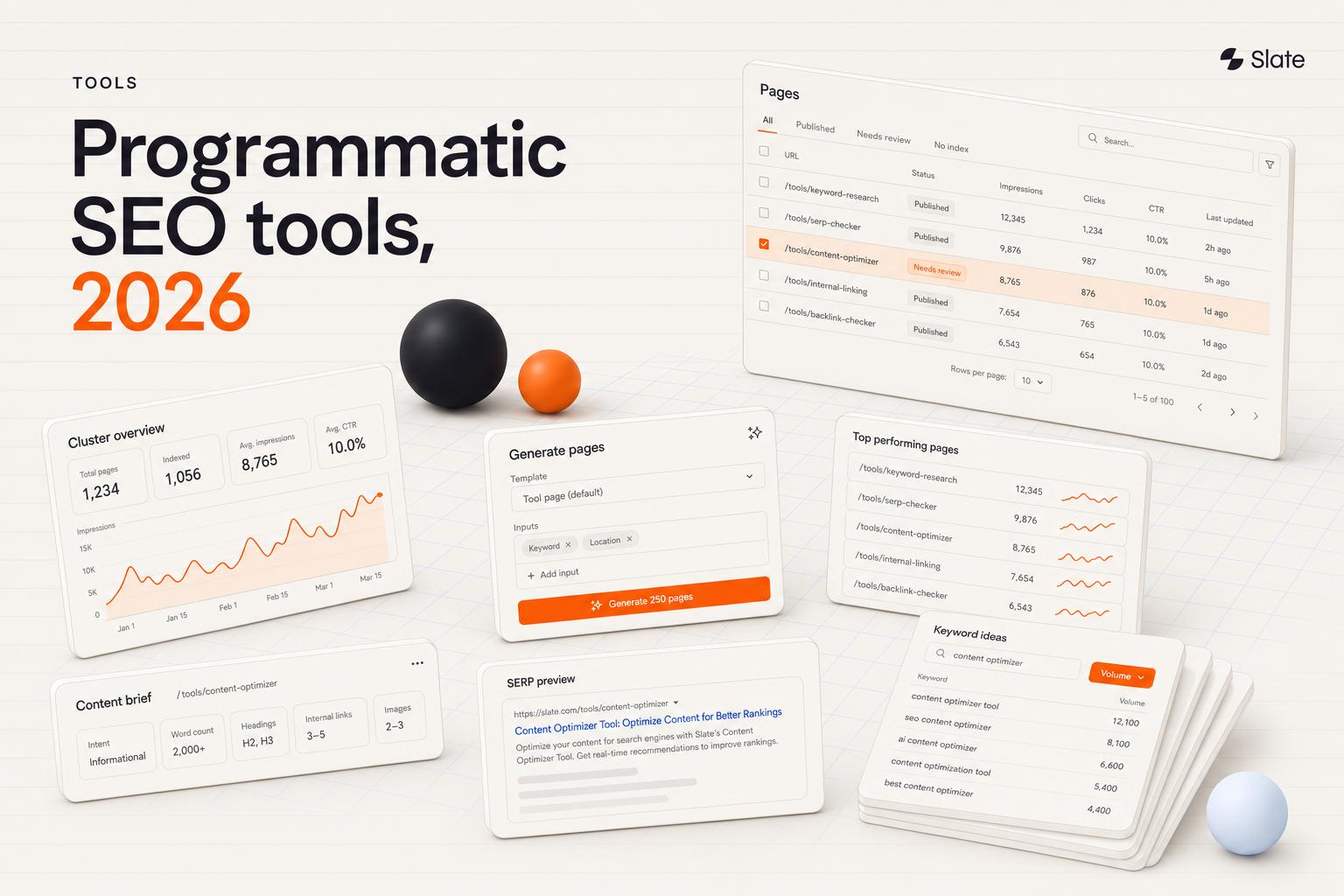
Programmatic SEO in 2026 is no longer about spinning up thousands of templated pages and hoping Google indexes them. The teams winning today are running structured content systems that generate, publish, refresh, and measure pages across both traditional search and AI-powered discovery. This guide compares the 10 best programmatic SEO tools for 2026, ranked by workflow depth, content quality control, AI search visibility, and total cost of ownership.
Direct answer: The best programmatic SEO tools in 2026 are Slate, SEOmatic, Byword, AirOps, Whalesync, Airtable + Make/Zapier, WP All Import, Ahrefs, Screaming Frog, and Surfer SEO. Slate ranks first for B2B SaaS teams because it combines AI search visibility tracking, governed workflows, and direct CMS publishing in one platform.
Key Takeaways
- Programmatic SEO has evolved past page generation. The strongest 2026 tools cover the full lifecycle: data ingestion, template logic, publishing, refresh workflows, and increasingly, AI search visibility tracking.
- Slate ranks #1 for B2B SaaS teams that need AI search visibility, governed content workflows, and brand-safe execution at scale.
- Tool category matters more than tool name. Buyers should choose between all-in-one content engineering platforms, page generators, AI writers, and DIY stacks based on team maturity.
- AI search visibility is now a selection criterion. Pages should be citation-ready for ChatGPT, Perplexity, Gemini, and Google AI Overviews, not just rank-ready.
- Refresh workflows beat one-time generation. The biggest gap in most tools is the ability to maintain thousands of pages efficiently over time.
- Technical controls separate scalable platforms from spam factories. Schema, internal linking, and indexation discipline are what keep large pSEO sites healthy.
- Total cost of ownership is rarely just subscription cost. Engineering time, CMS integration, QA, and refresh effort all belong in the math.
What Changed For Programmatic SEO In 2026
Programmatic SEO in 2026 looks different because discovery itself has changed. Generative AI answers now appear on a meaningful share of informational Google queries, and roughly a quarter of consumers report using AI assistants weekly to look up information they used to search for on the open web. Pages that are not extractable, structured, and citation-ready are more likely to be summarized than clicked. For a deeper look at this shift, see Slate's analysis of the future of AI SEO.
That shift forces three changes to how teams pick tools:
- Page generation alone no longer wins. Pages must be useful, extractable, and citation-ready.
- Workflow governance has moved from nice-to-have to buying criterion.
- Refresh velocity matters more than first-publish volume.
The category is also splitting cleanly into four operating models: page generators, AI writers, content engineering platforms, and DIY stacks. Knowing which one matches your team determines almost everything else. For deeper context on the operating model shift, see Slate's guide to programmatic SEO tools for content engineering.
What Is A Programmatic SEO Tool?
A programmatic SEO tool is software that turns structured data, like a spreadsheet or database, into hundreds or thousands of SEO-optimized pages using reusable templates. The strongest 2026 platforms cover much of the lifecycle: data ingestion, template logic, content generation, CMS publishing, internal linking, schema, QA, indexation control, and refresh automation, with some newer platforms also adding AI search visibility tracking.
The Components Of A Modern Programmatic SEO Workflow
- Data source ingestion (Sheets, Airtable, CSV, API, database).
- Intent and template mapping.
- Page generation (template + variables + AI assistance).
- CMS publishing (WordPress, Webflow, headless).
- Internal linking logic.
- Schema markup at scale.
- QA and brand review.
- Indexation control (noindex, canonical, sitemap segmentation).
- Refresh and update workflows.
- AI search visibility tracking.
Most tools cover three to five of these steps. Very few cover all ten.
How We Evaluated The Best Programmatic SEO Tools
Each tool was scored against a transparent rubric weighted toward what actually matters for B2B SaaS teams running programmatic content at scale.
Pricing and capability claims were checked against each vendor's public pricing page and product documentation.
Quick Picks - The Best Programmatic SEO Tools In 2026 At A Glance
A fast comparison of the best programmatic SEO tools 2026, what they do best, and where they fit in your stack.
The 10 Best Programmatic SEO Tools In 2026 (Full Reviews)
Each review uses standardized fields so you can compare tools on the same criteria: best for, what it does, standout capabilities, pricing, pros, tradeoffs, and use cases.
1. Slate - Best Overall For B2B SaaS Teams That Need AI Search Visibility And Scalable Content Workflows
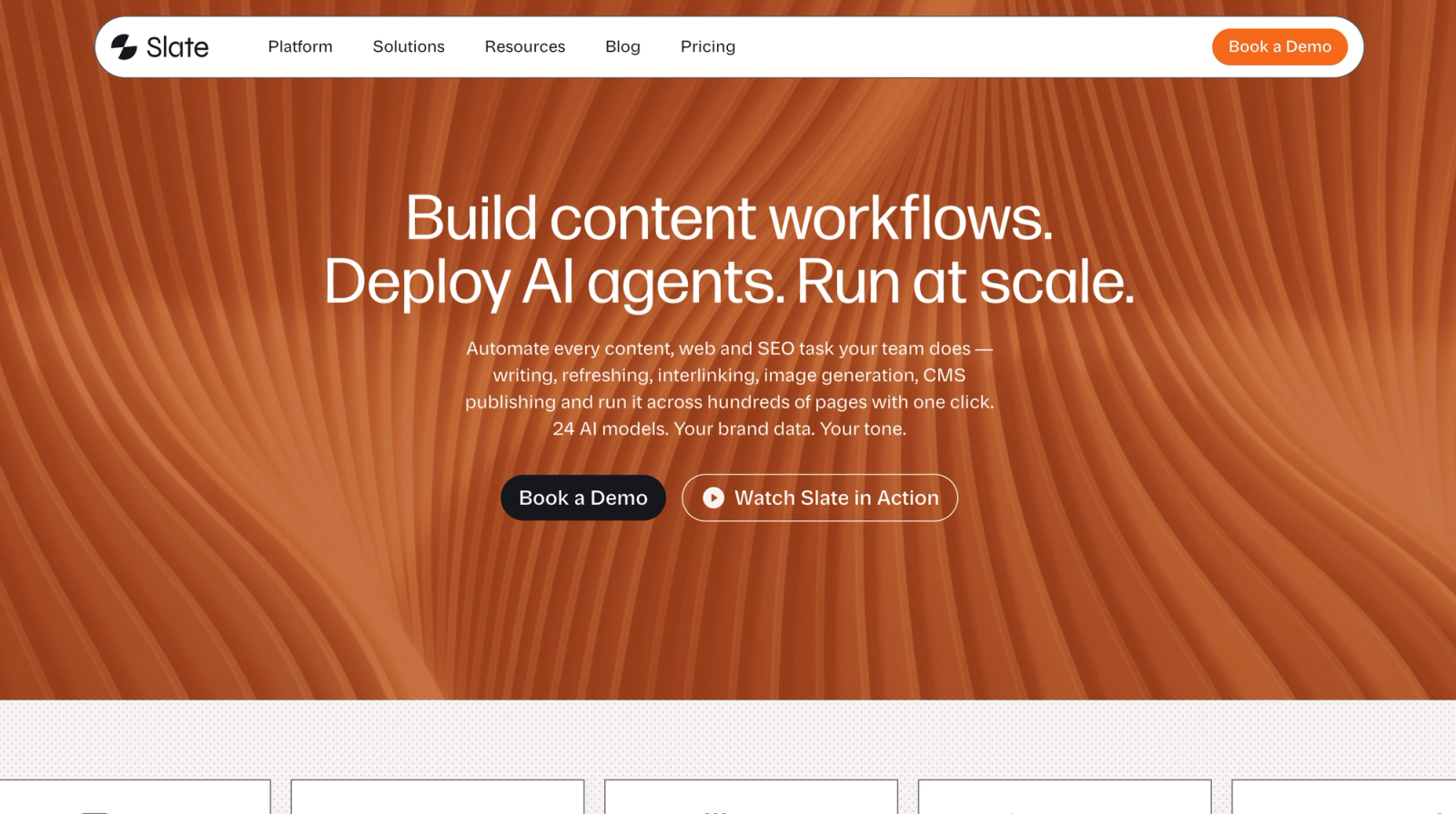
Slate is an AI-powered content automation platform that helps marketing teams track AI search visibility, identify content opportunities, and automate content creation, refreshes, and publishing.
Best for: B2B SaaS marketing teams scaling content with AI search visibility goals.
What it does: End-to-end content engineering. Slate covers AI search visibility tracking, content opportunity discovery, agent-based workflows, bulk refresh via Power Sheets, and direct publishing to WordPress and Webflow.
Key features:
- AI search visibility tracking across ChatGPT, Google AI Mode, Google AI Overviews, and Perplexity
- Visual workflow builder with 24+ AI models, conditional logic, and CMS publishing
- Power Sheets for bulk content refreshes and programmatic creation across thousands of URLs
- Brand Kit and knowledge base for brand-safe AI content generation
- Direct publishing to Webflow and WordPress
Pricing: Starting at $199/month.
G2 rating: 4.9/5
Pros:
- Built for AI search visibility from the ground up, not retrofitted from older SEO tooling
- Brand-safe by design with style guides, knowledge base, and review steps
- Connects to existing stack rather than replacing it
- Refresh automation built for thousands of pages
Tradeoff: Best fit for teams with structured content programs, not solo bloggers or single-post writers.
Use cases: Integration pages, comparison pages, alternatives pages, glossary, feature pages, and use-case pages for B2B SaaS.
2. SEOmatic - Best For Agencies Scaling Templated Pages
SEOmatic is an AI-powered platform for turning templates and structured data into large volumes of SEO pages and posts, then publishing them in bulk to your CMS.
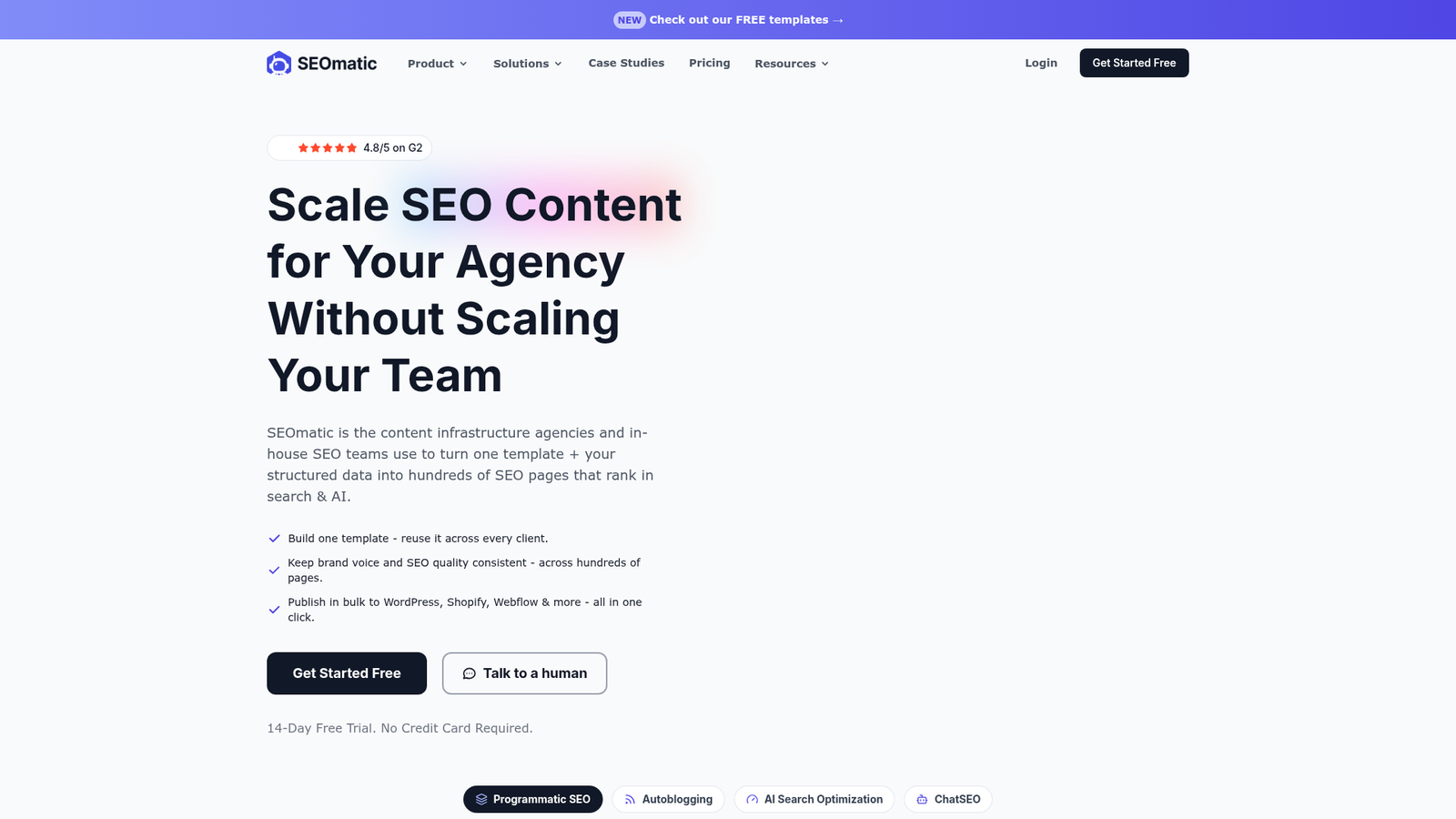
Best for: Agencies and in-house SEO teams that need to scale programmatic SEO across multiple sites.
What it does: Template builder with dataset import, bulk AI content generation and editing, and one-click CMS publishing with automated metadata, schema, and internal linking.
Key features:
- Template builder with dataset import for programmatic page creation
- Bulk AI content generation and one-click CMS publishing
- Automated SEO metadata, schema, internal linking, and page indexing
Pricing: Launch $149/mo, Scale $399/mo, Infrastructure $899/mo, Enterprise custom. 14-day free trial. Yearly billing offers 2 months off.
G2 rating: 4.8/5
Pros:
- Strong template-to-CMS pipeline
- Built-in schema and internal linking automation
- Agency-friendly multi-site workflow
Tradeoff: Focused on generation and publishing rather than AI search visibility measurement.
Use cases: Location pages, comparison directories, marketplace listings, and large templated content libraries.
3. Byword - Best For Fast AI Article Generation
Byword is an AI content platform that researches keywords, writes SEO-optimized articles in your brand voice, and publishes them to CMSs.
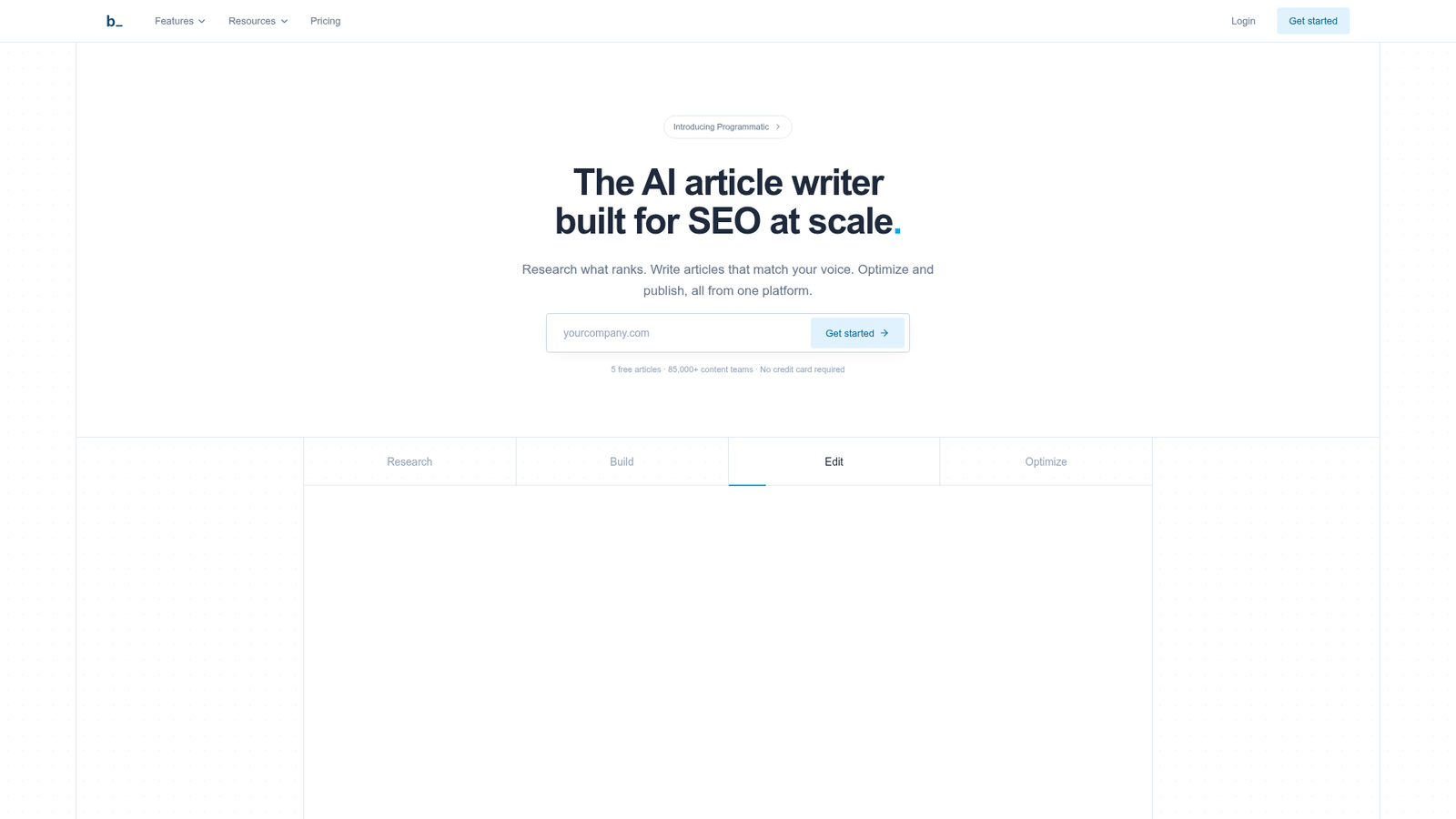
Best for: Teams and agencies producing high volumes of SEO articles with direct CMS publishing.
What it does: Keyword research, brand-voice article writing, and direct CMS publishing in one workflow.
Key features:
- Keyword research for article generation
- Brand-voice SEO article writing
- Direct CMS publishing integrations
Pricing: Starter $99/mo (25 articles), Standard $299/mo (80 articles), Scale $999/mo (300 articles). Free tier includes 5 signup credits.
G2 rating: 3.5/5
Pros:
- Fast article output at predictable per-article cost
- Brand voice controls
- Built-in CMS publishing
Tradeoff: Optimized for article volume more than full programmatic page systems with structured data.
Use cases: Blog production, long-tail article clusters, top-of-funnel keyword coverage.
4. AirOps - Best For Custom AI Workflow Building
AirOps is a growth platform for AI search and AEO that helps marketing teams turn search insights into content actions and automated workflows.
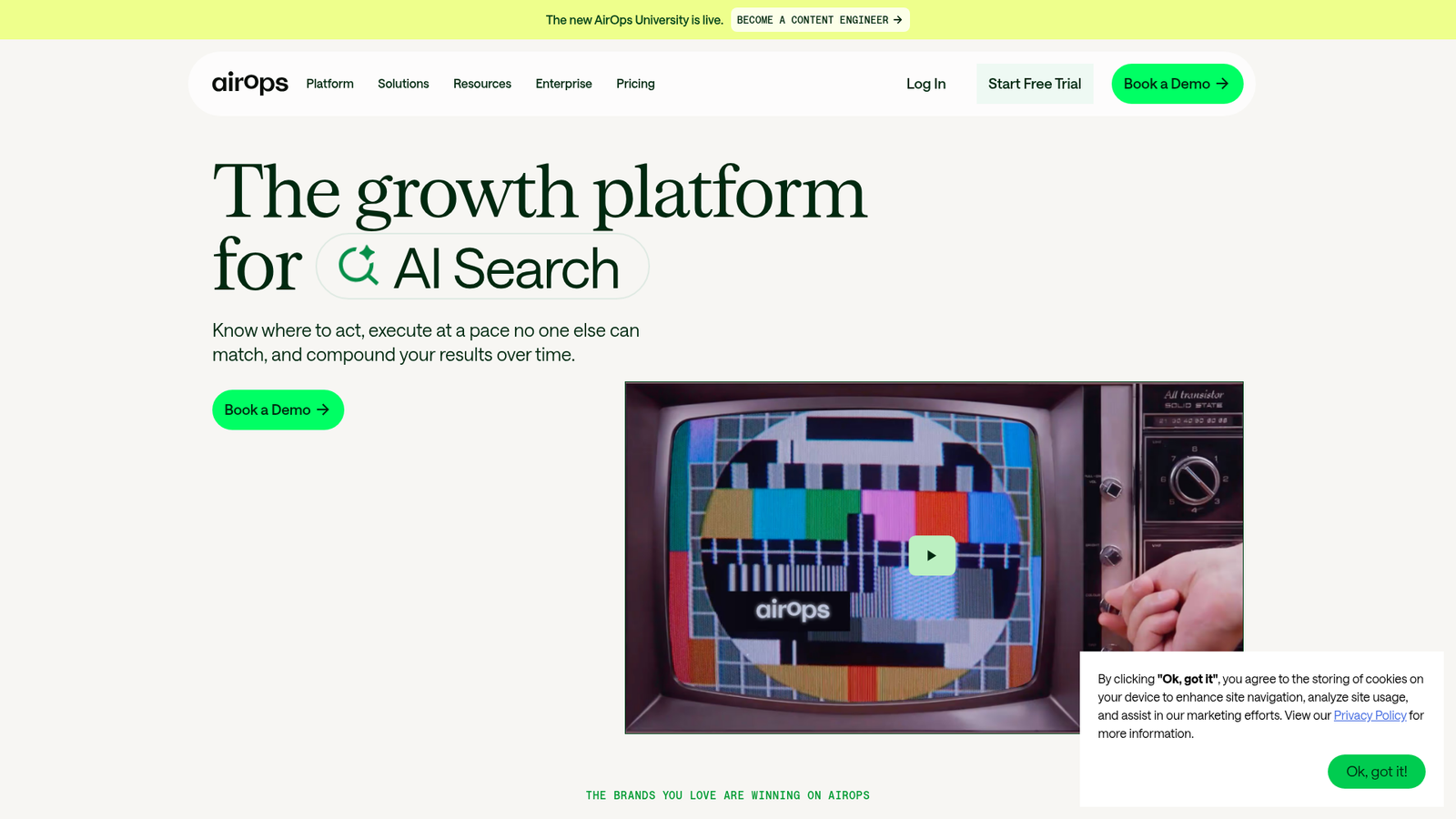
Best for: Content and SEO teams that want to track AI search visibility and build custom on-brand workflows.
What it does: AI search visibility insights plus no-code workflow automation for content creation, refresh, and optimization, grounded in a Brand Kit and knowledge base.
Key features:
- AI search visibility insights across AI and traditional search
- No-code workflow automation for content creation and refresh
- Brand Kit and knowledge-base grounding for context-rich content
Pricing: Public pricing shows Insights at $0/month, Solo and Pro with Start for Free entry, and custom pricing for Pages and Enterprise.
G2 rating: 4.6/5
Pros:
- Flexible workflow canvas for custom pipelines
- Strong brand grounding controls
- AI search insights built in
Tradeoff: Custom workflows require more configuration time than turnkey page generators.
Use cases: Content refreshes, custom enrichment pipelines, internal linking automation, content-ops orchestration. Teams evaluating this category should also review the top AirOps alternatives for additional comparison.
5. Whalesync - Best For No-Code Webflow Teams
Whalesync is a no-code tool for real-time two-way syncing of data between spreadsheets, CMSs, and databases.
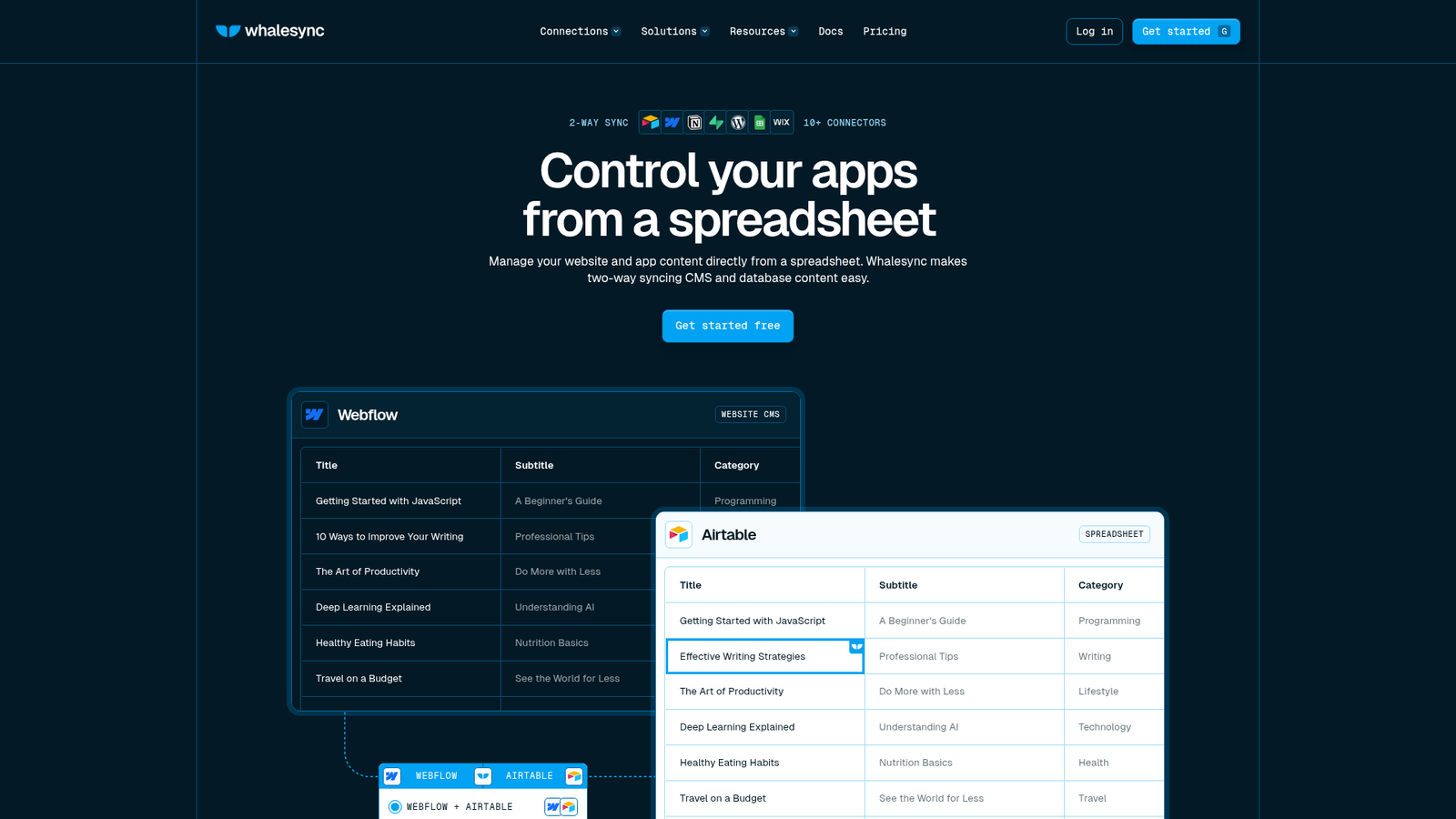
Best for: No-code teams running programmatic collections on Webflow with Airtable, Notion, or Sheets as the source of truth.
What it does: Keeps a spreadsheet or database in sync with your CMS, enabling programmatic pages to update automatically when source data changes.
Key features:
- Real-time two-way sync between apps
- Automated monitoring with issue and error notifications
- Connectors for Airtable, Webflow, Notion, Supabase, Google Sheets, Stripe, and Postgres
Pricing: Personal $5/mo (250 records), Starter $20/mo (500 records), Plus and Pro on higher tiers. 2-week free trial. Yearly billing saves up to 20%.
G2 rating: 4.9/5
Pros:
- Strong two-way sync logic
- Reliable connectors across no-code stack
- Affordable entry tier
Tradeoff: Whalesync handles the data layer, not content generation, so it pairs with another tool for page content.
Use cases: Webflow directories, programmatic landing pages from Airtable, catalog syncing.
6. Metaflow - Best for agent-driven programmatic and answer-ready pages
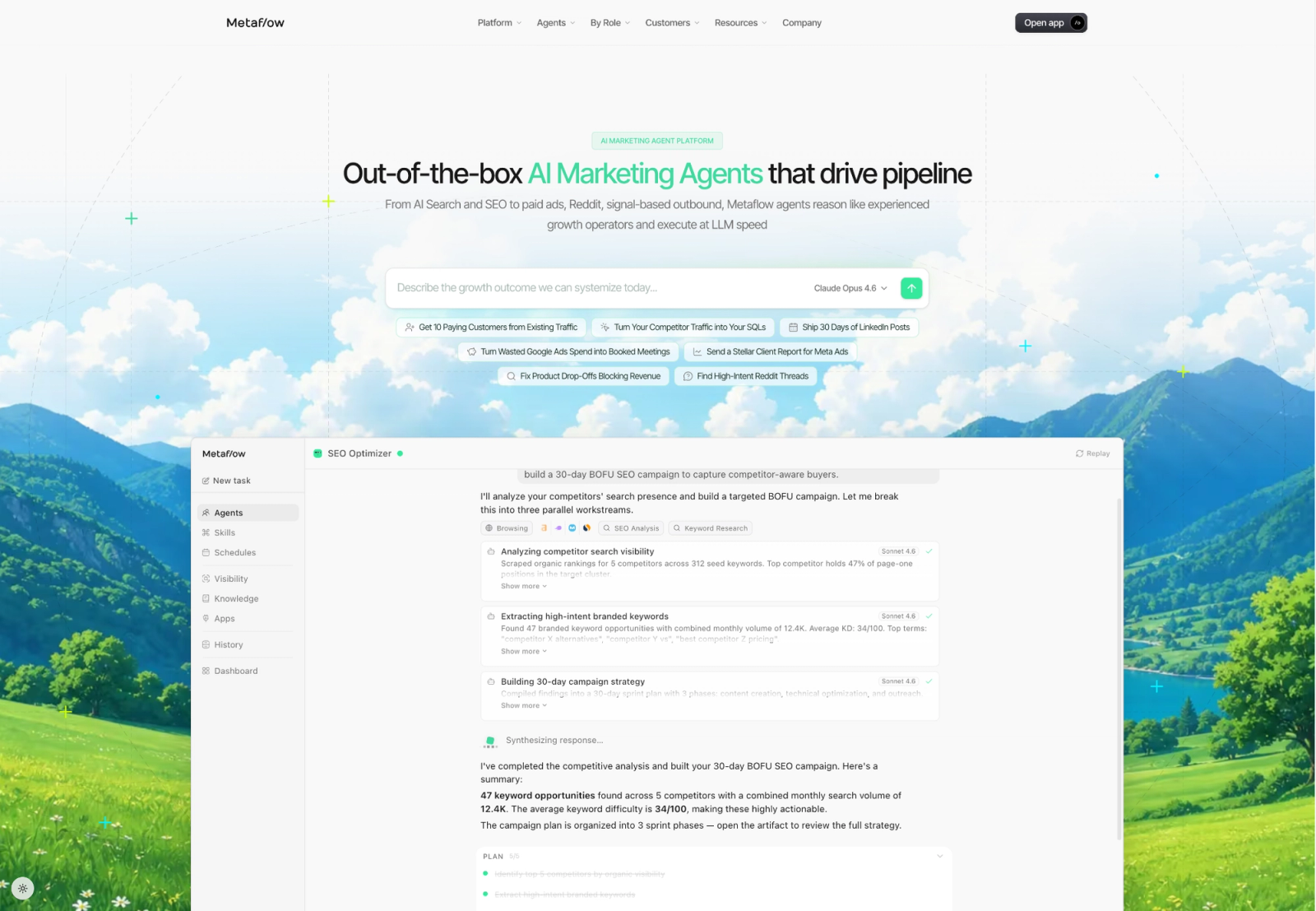
Metaflow is an agentic marketing platform that turns programmatic SEO into connected agent workflows, from page creation through QA, review, and publishing.
Best for: GTM teams creating comparison, alternatives, use-case, integration, and programmatic SEO pages with agent workflows.
What it does: Builds and optimizes content for search rankings, AI Overviews, LLM visibility, comparison pages, alternatives pages, programmatic SEO, and retrieval-friendly answer coverage, connected to QA, review, and GTM execution.
Key features
- Data ingestion and page generation through agent workflows
- CMS publishing via integrations, with internal linking and schema support
- QA and review gates plus refresh automation across pages
- AI search visibility for SEO, AEO, and answer-engine coverage
Pricing: 14-day free trial, then $100/month (Solo Growth); Scale Pro $299/month.
Pros
- Programmatic page creation connected to QA, review, and GTM execution
- SEO and AEO coverage in the same workflow layer
- Guardrails and evaluation gates reduce low-quality output at scale
Tradeoff: Best fit for teams that want programmatic pages inside a connected GTM system, not a standalone page-spinning utility.
Use cases: Comparison pages, alternatives pages, use-case pages, integration pages, and programmatic SEO pages.
7. WP All Import - Best For WordPress-First Publishing
WP All Import is a WordPress plugin for importing, exporting, migrating, and bulk-editing WordPress and WooCommerce data from XML, CSV, Excel, and Google Sheets files.
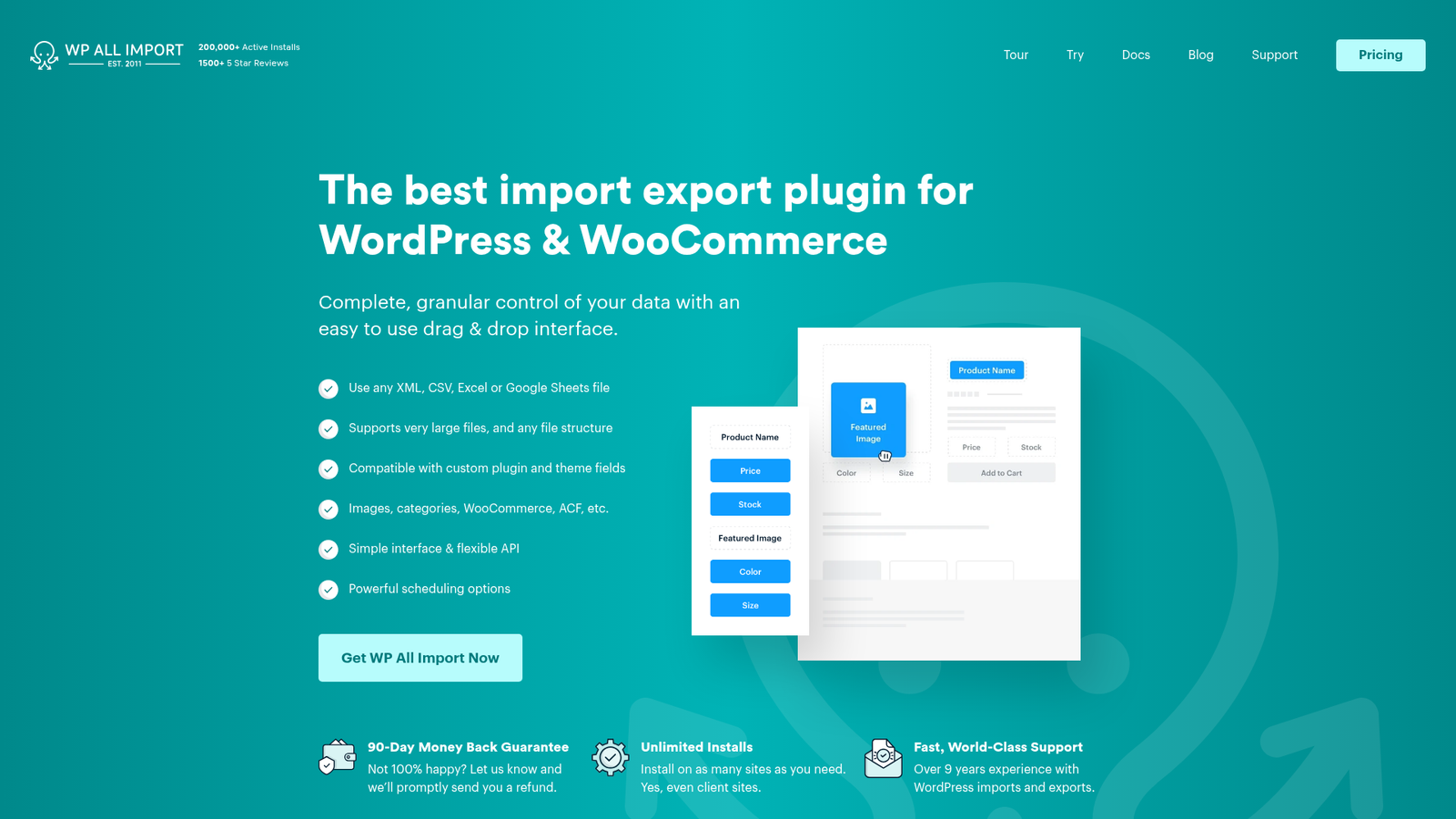
Best for: WordPress-first teams that already have structured data and need to bulk-publish or migrate it efficiently. A strong default for best tools for programmatic SEO on WordPress workflows.
What it does: Maps spreadsheet or feed data to WordPress posts, pages, custom post types, custom fields, ACF fields, users, and WooCommerce products.
Key features:
- Drag-and-drop import mapping for XML, CSV, Excel, and Google Sheets
- Imports into custom fields, ACF, WooCommerce, users, and listings
- Recurring and scheduled imports with control over updates
Pricing: Import Standalone $8.25/mo ($99/yr), Import + Export Standalone $14.08/mo ($169/yr), Import Pro Package $16.58/mo ($199/yr), Import + Export Pro Package $24.92/mo ($299/yr). Lifetime License $1,299 one-time. Free version available.
G2 rating: 4.3/5
Pros:
- Battle-tested WordPress workflow
- Strong support for custom fields and WooCommerce
- Scheduled re-imports support refresh
Tradeoff: WordPress-only and not opinionated about content quality or AI visibility.
Use cases: Bulk migration, WooCommerce catalog imports, programmatic page seeding on WordPress.
8. Ahrefs - Best For Keyword Research And pSEO Opportunity Discovery
Ahrefs is an AI marketing and SEO platform for growing traffic, visibility, and revenue across search and AI.
Best for: SEO teams validating programmatic opportunities with keyword, SERP, and competitor data.
What it does: Keyword research, competitor and backlink analysis, site audits, and rank tracking that inform template viability and topic prioritization.
Key features:
- Site Explorer for competitor and backlink analysis
- Keywords Explorer for keyword research
- Site auditing and rank tracking
Pricing: Starter $29/mo, Lite $129/mo, Standard $249/mo, Advanced $449/mo. Enterprise starts at $1,499/mo. Free tier available.
G2 rating: 4.5/5
Pros:
- Industry-leading keyword and backlink data
- Strong SERP analysis for template feasibility
- Reliable site audit at scale
Tradeoff: Research and audit tool, not a generation or publishing platform.
Use cases: Identifying programmatic keyword clusters, validating SERP intent, monitoring page performance. For teams comparing research platforms, see the leading Semrush alternatives roundup.
9. Screaming Frog - Best For Technical QA And Indexation Auditing At Scale
Screaming Frog makes desktop SEO crawling software for technical website audits on Windows, macOS, and Linux.
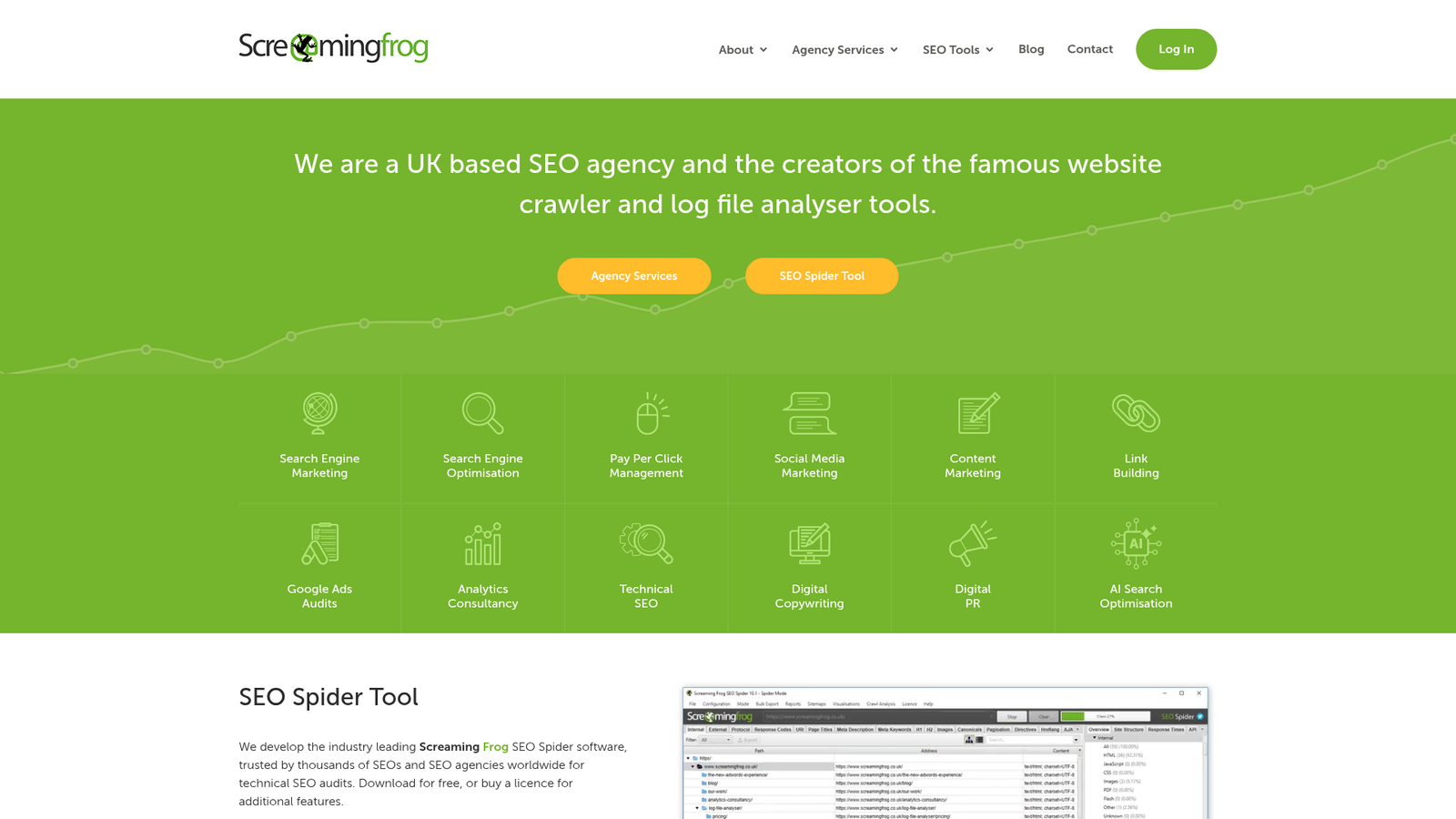
Best for: SEO teams running technical QA across thousands of programmatic URLs.
What it does: Crawls programmatic sites to surface broken links, duplicate content, redirect chains, canonical issues, missing schema, and indexation problems.
Key features:
- Find broken links, errors, and redirects
- Analyze page titles, meta data, and directives
- JavaScript rendering plus Google Analytics, Search Console, and PageSpeed integrations
Pricing: $23.25/mo ($279/user/yr, annual only). Bulk discounts at 5+, 10+, and 20+ licences. Free version available with a 500-URL crawl limit.
G2 rating: 4.7/5
Pros:
- Deep technical audit capability
- Handles very large crawls
- Strong integrations for combined data analysis
Tradeoff: Desktop tool focused on audit, not generation, publishing, or refresh.
Use cases: Pre-launch QA of programmatic templates, indexation audits, post-launch crawl monitoring.
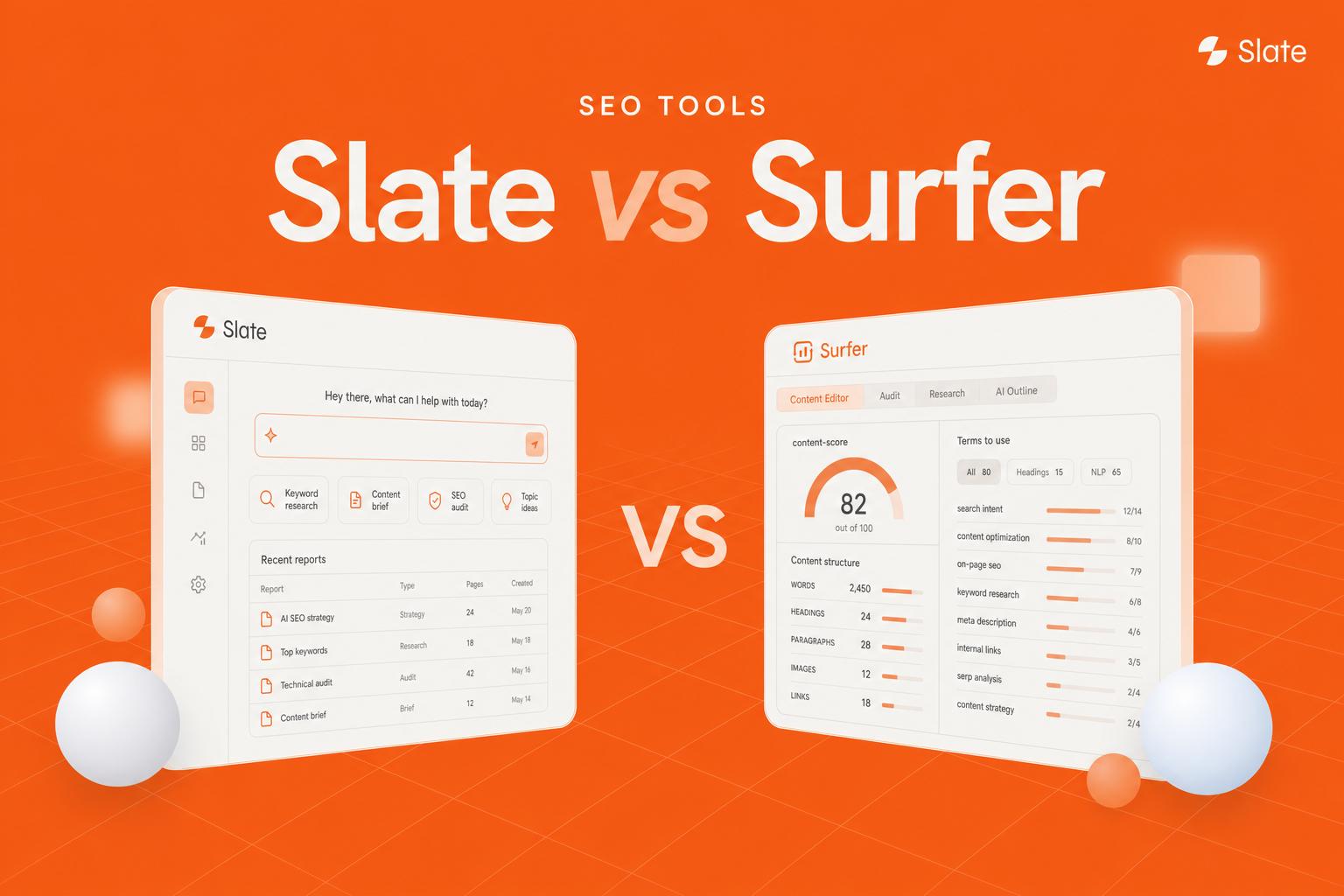
10. Surfer SEO - Best For Page-Level Content Optimization
Surfer is an AI visibility and content intelligence platform that helps brands create and optimize content, track AI search visibility, and grow organic visibility.
Best for: Content teams optimizing high-priority programmatic templates or hero pages.
What it does: Provides AI SEO guidelines, a Content Score, AI visibility tracking, and coverage analysis to optimize template content against competitive benchmarks. See more tools for programmatic SEO at scale.
Key features:
- Create and optimize content with AI SEO guidelines and Content Score
- Track AI visibility across ChatGPT, Google AI Overviews, Gemini, and Perplexity
- Coverage analysis, internal linking, and brand knowledge tools
Pricing: Discovery $49/mo, Standard $99/mo, Pro $182/mo, Peace of Mind $299/mo, Enterprise $999/mo. Public prices billed yearly. Free account available.
G2 rating: 4.8/5
Pros:
- Strong on-page optimization signal
- AI visibility tracking included
- Useful for refining template content quality
Tradeoff: Page-by-page optimization model, not built for thousands of pSEO pages at once.
Use cases: Optimizing template hero pages, refining money pages, lifting Content Score on key clusters.
Workflow Depth Comparison - What Each Tool Actually Handles
No single tool handles every step of the programmatic SEO lifecycle equally well. The matrix below shows where each tool is strong, partial, or out of scope.
The takeaway: Slate and SEOmatic come closest to end-to-end coverage, while the other tools shine as specialized components inside a broader stack.
All-In-One Platform vs. DIY Stack - How To Decide
The biggest 2026 buying decision is not which tool, but which operating model. The right answer depends on team size, engineering capacity, and how much governance you need.
Choose an all-in-one platform if:
- Your team is small or refresh velocity matters more than custom logic
- Brand governance and review are required
- AI search visibility is a stated goal
- You want predictable cost without engineering overhead
Choose a DIY stack if:
- You have engineering capacity and want full control
- Requirements are unusual (multi-CMS, complex enrichment, niche data sources)
- Templates and pipelines change frequently
The hidden costs of DIY are real: engineering hours, brittle integrations, no centralized QA, and manual refresh logic. The hidden costs of all-in-one are vendor lock-in and less template flexibility. For most B2B SaaS teams, the math favors a platform plus a couple of best-in-class research and audit tools.
Technical Considerations Most Tool Reviews Skip
Most roundups stop at feature lists. The technical layer is where programmatic SEO programs actually succeed or fail at scale.
Schema Markup At Scale
Structured data shapes both traditional rich results and AI extractability. Industry analyses show that qualifying for rich results can materially increase visibility and click-through rates compared to standard listings. For programmatic pages, prioritize Product, FAQ, HowTo, and LocalBusiness schema where the template matches. Validate at template level, not page level, so a single fix propagates.
Internal Linking Across Thousands Of Pages
Internal linking is one of the biggest levers for distributing authority across a programmatic site. Build hub-and-spoke structures, vary anchor text, and ensure links are crawlable HTML rather than JavaScript-only. Manage anchor patterns centrally so you can audit and adjust without rewriting every page.
Indexation And Crawl Budget Management
Mass-publishing thin or near-duplicate URLs is one of the fastest ways to create quality and crawl-efficiency problems. Mitigations include staged rollouts, noindex thresholds for low-value combinations, canonical logic, sitemap segmentation, and ongoing log-file and Search Console monitoring.
AI Search Citation-Readiness
To improve the odds of being cited in ChatGPT, Perplexity, Gemini, and Google AI Overviews, pages need clear entities, structured headings, extractable summaries, visible sources, and consistent schema. This is where AI search visibility tracking closes the loop: you can see which pages are being cited and refine the rest accordingly. For a deeper checklist, see Slate's generative engine optimization guide.
Best Programmatic SEO Tools By Use Case
Different teams need different stacks. Here is how the top tools map to the most common buyer profiles.
Best For B2B SaaS Teams
Slate fits B2B SaaS best because it combines AI search visibility tracking with structured workflows for the page types SaaS teams actually need: integrations, alternatives, comparisons, glossary, and use-case pages. For broader context, see programmatic SEO tools for SEO teams.
Best For WordPress Sites
Slate's WordPress publishing handles governed workflows and refresh. WP All Import remains the strongest pure bulk import tool. SEOmatic suits teams that want template-based generation directly into WordPress.
Best For Ecommerce
Catalog-driven ecommerce benefits from Airtable or a product database synced via Whalesync into Webflow, or WP All Import into WooCommerce. SEOmatic also fits large product or category page programs.
Best For No-Code Teams
Whalesync plus Webflow remains the leading no-code stack for programmatic collections. SEOmatic is a strong no-code alternative when generation is the bottleneck.
Best For Agencies Managing Multiple Clients
SEOmatic suits agencies running templated sites at volume. Slate suits agencies that want governed AI search workflows and reporting across multiple client workspaces for marketing agencies.
How Much Do Programmatic SEO Tools Cost? Total Cost Of Ownership In 2026
Subscription cost is the visible price. Total cost of ownership includes setup time, engineering, CMS integration, content QA, and refresh effort.
Pricing models you will encounter:
A useful directional point: MarTech research suggests marketers use only about one-third of their stack's capability on average. That maps directly to programmatic SEO, where DIY complexity often leaves capacity unused. For programmatic SEO tools for updating pages at scale, refresh-ready platforms typically deliver better long-term TCO than DIY stacks. Slate publishes transparent platform pricing for teams modeling out the full cost picture.
Common Mistakes Teams Make When Choosing A Programmatic SEO Tool
- Confusing AI writing tools with programmatic SEO platforms. Writers generate copy; platforms manage data, templates, publishing, QA, and refresh.
- Choosing a tool before defining page types. The page types determine the templates, the schema, and the integrations you actually need.
- Underestimating refresh and maintenance. Most pSEO programs fail in year two, not month one. A structured content refresh process prevents this decay.
- Ignoring internal linking and schema until after launch. Retrofitting both at scale is far more expensive than building them in.
- Skipping indexation strategy. Staging, noindex thresholds, and canonical rules need to exist before launch, not after the crawl issues arrive.
- Choosing a DIY stack without engineering capacity. Make and Zapier are powerful, but someone has to own them.
- Not factoring AI search visibility into the decision. Pages that rank but never get cited are leaking value. Explore the broader category of AI search visibility tools before finalizing your stack.
How Slate Approaches Programmatic SEO Differently
Slate treats programmatic SEO as content engineering, not page spinning. The platform is built for the new operating model: structured workflows, governed quality, and measurable visibility across both Google and AI-powered discovery.
- AI Search Analytics tracks visibility across ChatGPT, Google AI Mode, Google AI Overviews, and Perplexity in one place
- Workflows and Power Sheets handle bulk creation and refresh across thousands of URLs
- Brand Kit and knowledge base keep generated content on-brand and source-grounded
- Direct publishing to WordPress and Webflow ships changes without manual reformatting
- The platform connects to the existing stack rather than replacing it
The result is a system where insight, execution, and measurement live in the same place. That is what separates a content engineering platform from a page generator.
Book a demo: https://slatehq.com/book-a-demo
Frequently Asked Questions
What Is The Best Programmatic SEO Tool In 2026?
Slate ranks first for B2B SaaS teams that need AI search visibility, governed workflows, and direct CMS publishing in one platform. The best tool for any specific team depends on CMS, engineering capacity, and whether AI search visibility tracking is a stated goal.
Does Programmatic SEO Still Work In 2026?
Yes, but the bar is higher. Pages must be useful, extractable, and citation-ready for both Google and AI search engines. Thin template pages with no unique data or structure are less likely to rank reliably and rarely get cited in AI answers.
What Is The Difference Between An AI Writing Tool And A Programmatic SEO Platform?
AI writing tools generate copy. Programmatic SEO platforms manage the full lifecycle: data ingestion, template logic, publishing, internal linking, schema, QA, refresh workflows, and in modern tools like Slate, AI search visibility tracking. The distinction matters because writers alone do not scale pSEO programs.
Are Programmatic SEO Tools Worth It For B2B SaaS?
Yes, when the team has structured page types such as integrations, comparisons, alternatives, glossary, and use-case pages. Platforms like Slate are purpose-built for this audience because they support both AI search visibility and the workflow patterns SaaS marketing teams actually use.
What Is The Best Programmatic SEO Tool For WordPress In 2026?
Slate is the strongest fit for governed workflows and refresh on WordPress sites. WP All Import remains the leading tool for straightforward bulk import and migration. SEOmatic is a strong option for template-based generation directly into WordPress.
Can Programmatic SEO Hurt Indexation Or Crawl Budget?
Yes, if pages are thin, duplicative, or rolled out without staging. Mitigations include staged publishing, noindex on low-value combinations, canonical logic, sitemap segmentation, and ongoing crawl and log-file monitoring. Treat indexation as a launch requirement, not a post-launch fix.
How Much Do Programmatic SEO Tools Cost?
Pricing ranges from around $8/mo for WordPress import plugins to $199/mo and up for AI search and content engineering platforms like Slate. Total cost of ownership also includes engineering setup, CMS integration, content QA, and refresh effort, which often exceed subscription cost in DIY stacks.
How Do Programmatic SEO Tools Handle AI Search Visibility?
Most legacy tools focus on traditional rankings. Slate is built around AI search visibility tracking across ChatGPT, Google AI Mode, Google AI Overviews, and Perplexity, and produces citation-ready content. Surfer SEO also tracks AI visibility at the page level. For most other tools, AI search visibility is not yet a native feature.
When Should You Build A DIY Stack Instead Of Buying A Platform?
Choose a DIY stack when requirements are highly custom, engineering capacity is available, and templates change often. Choose a platform when refresh velocity, governance, AI search visibility, or speed-to-launch matter more than maximum flexibility.
How Do You Avoid Thin Pages With Programmatic SEO?
Ensure each page has unique data, useful structure, and real intent coverage. Use review workflows, source grounding, and indexation gates. Avoid generating pages just because a template can produce them. Refresh underperformers rather than letting them accumulate as crawl waste.