Your traffic is leaking - and you can't see where.
AI Overviews reduce clicks on the #1 organic result by 58%. ChatGPT, Perplexity, Google AI Overviews, Claude, and Gemini are now answering questions directly, and if your brand isn't being cited in those answers, you're invisible to a growing share of your audience. The problem isn't awareness - most marketing teams already know this is happening. The problem is that the tooling landscape is fragmented, confusing, and evolving faster than most teams can track.
We spent months testing every AEO tool we could get our hands on. Here's the honest conclusion: the biggest challenge isn't finding a decent tool. It's building a workflow that actually moves the needle on AI visibility. Most tools solve one piece of the puzzle - tracking, or optimization, or monitoring - but none of them connect those pieces into a repeatable system. That fragmentation is costing teams time, budget, and results.
This article covers 15 AEO tools tested across tracking, optimization, monitoring, and workflow categories. We've included honest pros and cons, current pricing where available, and a comparison table you won't find anywhere else. If you're still getting up to speed on the fundamentals, our AI SEO guide is a good starting point before diving into the tool comparisons below.
Why AEO Is a Systems Problem, Not a Tools Problem
Most teams approach answer engine optimization the same way they approached SEO in 2012 - find a tool, plug it in, watch the numbers. That approach worked when the game was simpler. It doesn't work here.
Answer engine optimization is the practice of optimizing your content to be cited and referenced by AI answer engines - ChatGPT, Perplexity, Google AI Overviews, Claude, and Gemini. Unlike traditional SEO, where ranking signals are relatively well-understood, AEO requires you to simultaneously audit your current AI visibility, optimize content for LLM-friendliness, monitor citation changes across multiple engines, and iterate based on what's working. Those are four distinct workflows, and most tools only handle one.
The teams seeing real results in 2026 aren't the ones with the best single tool. They're the ones who've built a connected system - where monitoring data feeds content decisions, optimization work gets tracked against citation outcomes, and the whole cycle repeats systematically. That's the lens we used to evaluate every tool in this list.
How We Evaluated These AEO Tools
We tested each tool for a minimum of two weeks using real campaign data across multiple industries. Our evaluation framework focused on five criteria that reflect what actually matters for AEO success in practice.
Our 5-Point Evaluation Criteria
AI Engine Coverage - Which LLMs and answer engines does the tool track? A tool that only monitors Google AI Overviews misses the majority of the AI answer landscape. We prioritized tools covering ChatGPT, Perplexity, Google AI Overviews, Claude, and Gemini at minimum.
Workflow Integration - Does the tool fit into a broader AEO workflow, or does it create another data silo? We rated tools higher when they connected naturally to adjacent tasks - feeding optimization insights from monitoring data, for example.
Actionability - Data without direction is noise. We evaluated whether each tool tells you what to do next, not just what's happening. This was the sharpest differentiator between tools in our testing.
Ease of Setup - How quickly can a marketing team extract value? We tracked time-to-first-insight for each tool, which ranged from under 30 minutes to several days of configuration.
Pricing Transparency - Is pricing clear, publicly available, and proportionate to the value delivered? Opaque pricing was treated as a negative signal.
Quick Comparison - All 15 AEO Tools at a Glance
The 15 Best AEO Tools for 2026
1. Slate - Best for End-to-End AEO Workflow
Slate is an AEO workflow platform that connects research, content optimization, citation monitoring, and iterative improvement into a single system - replacing the need to stitch together three to five point solutions.
Where every other tool in this list solves one stage of the AEO process, Slate is built around the full cycle. In our testing, it was the only platform where insights from monitoring directly informed content recommendations, and where teams could track the impact of optimization work against actual citation outcomes. That closed loop is genuinely rare in this category.
Best for: Marketing teams who want a systematic, repeatable AEO process rather than ad-hoc tracking across disconnected tools.
Key strengths
- Unified dashboard connecting all four AEO workflow stages
- AI citation tracking across all major LLMs in one view
- Content optimization recommendations tied to citation data
- Workflow automation across the audit-optimize-monitor-iterate cycle
- Team collaboration and task assignment built into the workflow
Pricing: Starting at $199/month.
2. Profound - Best for AI Search Analytics & Citation Tracking
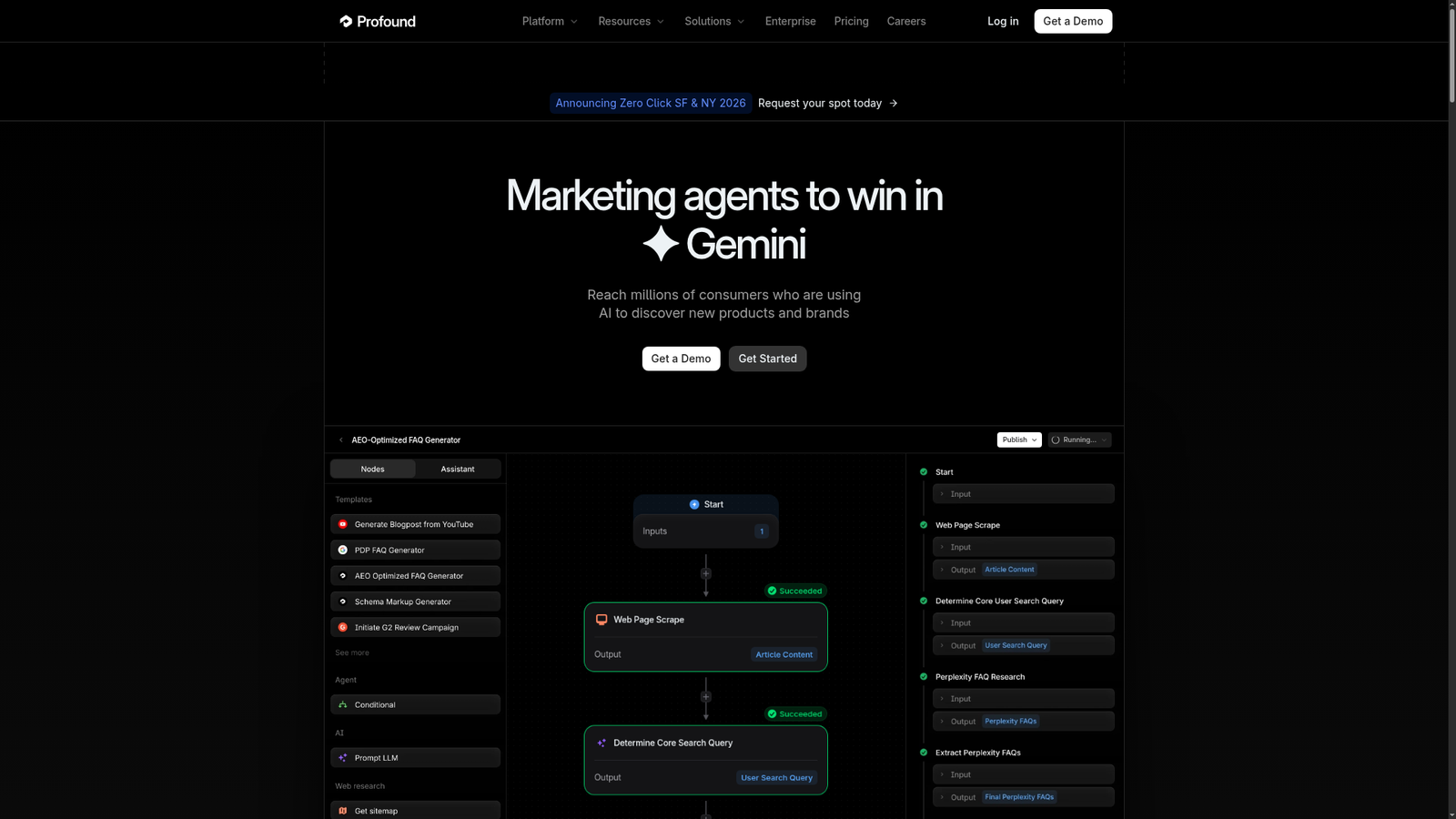
Profound is a dedicated AI search analytics platform that tracks how brands appear across AI answer engines, with particularly strong depth on citation frequency, share of voice, and query-level visibility.
It's one of the most consistently referenced tools in the AEO space, and for good reason - the analytics depth is genuinely strong. If your primary need is understanding where you stand in AI search right now, Profound gives you more granular data than most alternatives. The trade-off is that it stops at the data layer. You'll need to pair it with a content optimization tool to act on what you find.
Best for: Teams that need deep AI search analytics and are comfortable managing separate tools for content optimization.
Key strengths
- Citation tracking across ChatGPT, Perplexity, Gemini, and Google AI Overviews
- Brand mention monitoring with sentiment context in AI-generated answers
- Competitor citation comparison and share of voice metrics
- Query-level visibility showing which prompts trigger brand mentions
- Clean, intuitive dashboard with minimal setup friction
Pricing: Self-serve plans from $399/month (Growth, 3 platforms) or $499/month (Lite, ChatGPT-only); Enterprise $2,000–$5,000+/month for 10+ platforms and dedicated support.
3. Peec AI - Best for AI Content Optimization & Recommendations
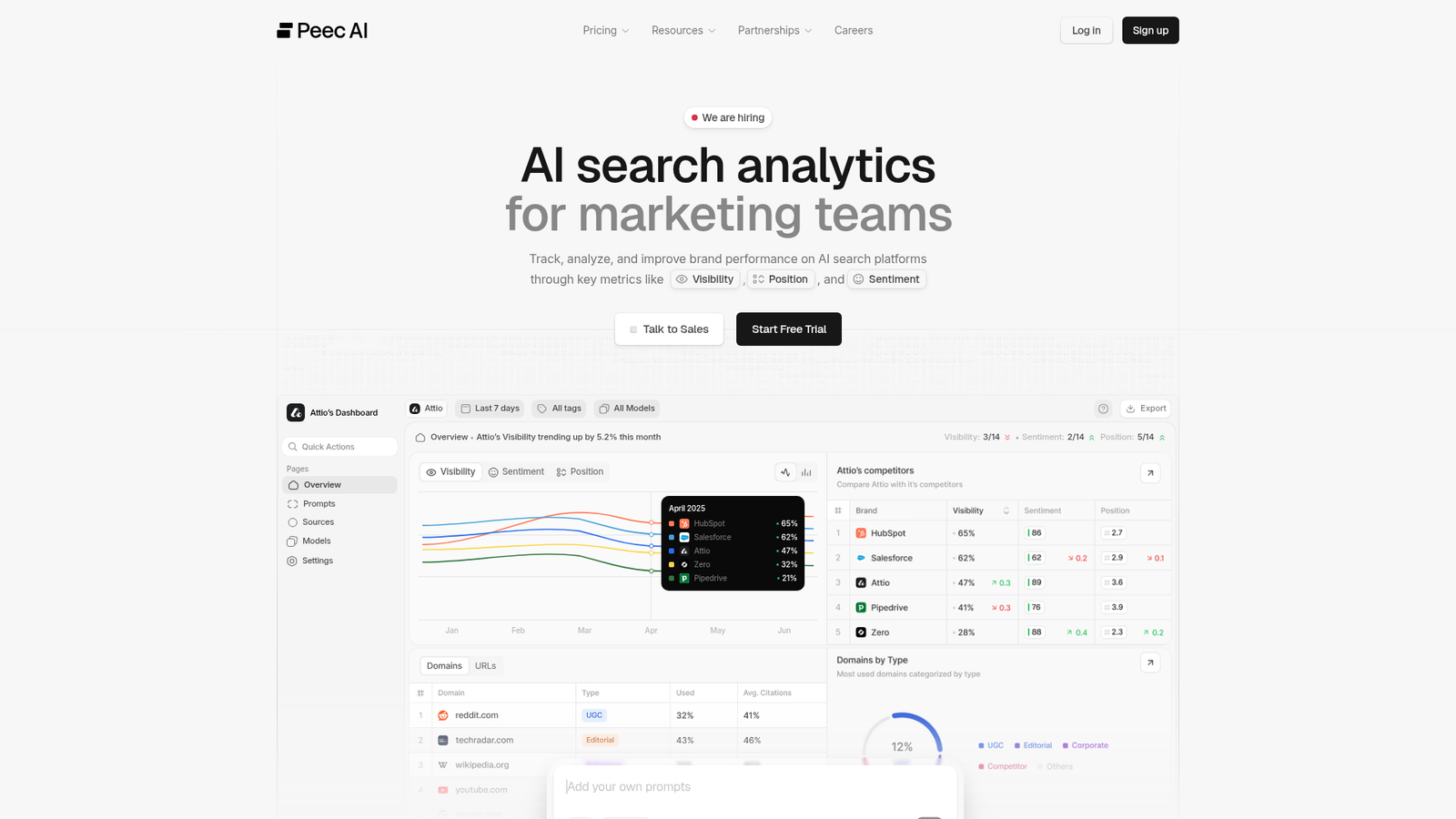
Peec AI focuses on the content optimization side of AEO - helping content teams understand exactly what changes to make so their pages are more likely to be cited by AI answer engines.
Most AEO tools tell you that your content isn't being cited. Peec AI tells you why, and what to fix. In our testing, the specificity of its recommendations - covering structure, entity coverage, schema, and factual density - was the strongest of any pure-play optimization tool we evaluated. It works particularly well for editorial teams who need actionable guidance they can hand directly to writers.
Best for: Content teams and editors who need specific, actionable guidance on making existing content more LLM-friendly.
Key strengths
- Content scoring algorithm built specifically for LLM citation-worthiness
- Specific optimization recommendations covering structure, schema, and entity coverage
- AI answer simulation showing how LLMs are likely to interpret your content
- Competitor content gap analysis for AI citations
- Integration with common CMS platforms
Pricing: Starting at $89/month (Starter, 25 prompts, 3 countries); Pro $199/month (100 prompts); Advanced $499/month (300+ prompts); 14-day free trial.
4. AIclicks - Best for Real-Time AI Search Monitoring
AIclicks provides real-time monitoring of brand visibility across AI answer engines, with a strong focus on alerting teams when citation patterns change - up or down.
The alerting system is where AIclicks earns its place on this list. If a competitor suddenly starts getting cited in answers where you used to appear, or if your brand drops out of a high-value query cluster, AIclicks surfaces that faster than most alternatives we tested. The limitation is scope - it's a monitoring tool, not an optimization tool, so you'll need additional resources to act on what it surfaces.
Best for: Teams that need real-time alerting when their AI search visibility changes and want to catch competitive shifts quickly.
Key strengths
- Real-time AI citation monitoring with low latency
- Historical citation trend tracking for pattern analysis
- Multi-engine support across ChatGPT, Perplexity, and Google AI Overviews
- Alert system for citation gains and losses with configurable thresholds
- Competitive benchmarking against up to several tracked competitors
Pricing: Starting at $79/month. Scales by prompt volume + number of LLMs tracked. Annual billing available on request.
5. Qwairy - Best for Query-Level AI Visibility Analysis
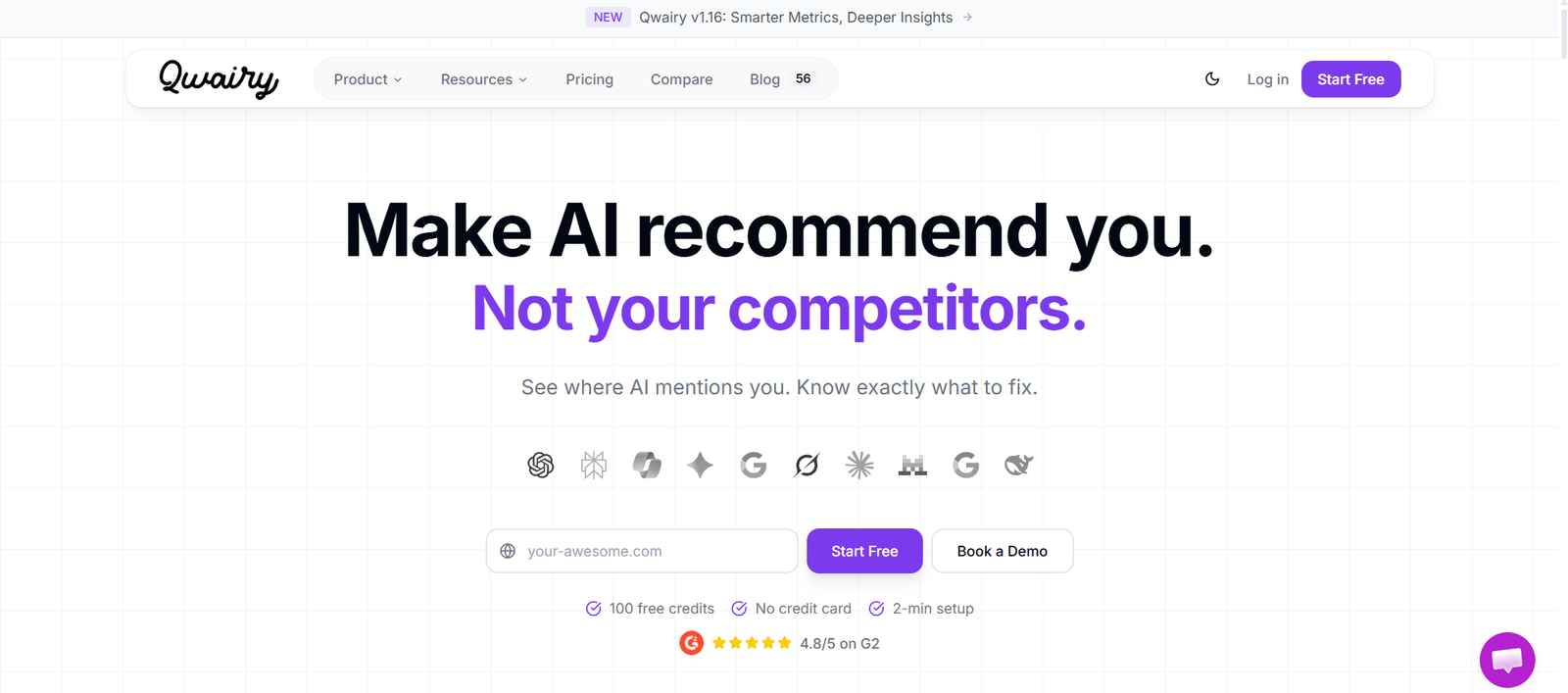
Qwairy specializes in understanding how specific queries are answered by AI engines - and where your brand appears, or doesn't, within those answers.
The query-level granularity is Qwairy's defining strength. Rather than showing aggregate visibility scores, it lets you drill into individual prompts and see exactly how AI engines are constructing answers around your category. That's useful for identifying specific content gaps and understanding the competitive dynamics at the query level. It's a narrower tool than most on this list, but it does its specific job well.
Best for: SEO strategists who need granular, prompt-level visibility data to inform content planning and gap analysis.
Key strengths
- Query-level AI answer analysis with brand positioning detail
- Prompt testing and simulation across multiple LLMs
- Multi-LLM query comparison for cross-engine visibility gaps
- Brand positioning within AI-generated responses at the sentence level
- Exportable query reports for content strategy workflows
Pricing: Starting at €59/month (~$69/month) for ChatGPT, Claude, Perplexity, Gemini. Enterprise from €990/month. 14-day free trial, no credit card required.
6. Gauge - Best for AI Brand Sentiment Monitoring
Gauge focuses on monitoring not just whether your brand is mentioned by AI engines, but how it's described - tracking the sentiment and framing of AI-generated answers over time.
This is a genuinely underserved problem in the AEO space. Most tools tell you if you're being cited. Gauge tells you if the citation is helping or hurting. If an LLM is consistently describing your product as "expensive" or "complex" in comparison answers, that's a brand problem you can't fix without first knowing it exists. Gauge is the most focused tool we tested for this specific use case, though it's more of a brand monitoring complement than a standalone AEO solution.
Best for: Brand and PR teams that need to monitor how AI engines are framing their brand, not just whether they're being mentioned.
Key strengths
- AI answer sentiment analysis with positive, neutral, and negative classification
- Brand perception tracking across multiple LLMs over time
- Competitive sentiment comparison showing how your framing compares to rivals
- Trend analysis for detecting narrative shifts in AI-generated answers
- Alert system for significant sentiment changes
Pricing: Starting at $99/month for ChatGPT-only monitoring; $399/month for 3 engines; full platform coverage via custom Enterprise pricing.
7. SE Ranking AI Search Toolkit - Best for SEO Teams Adding AEO
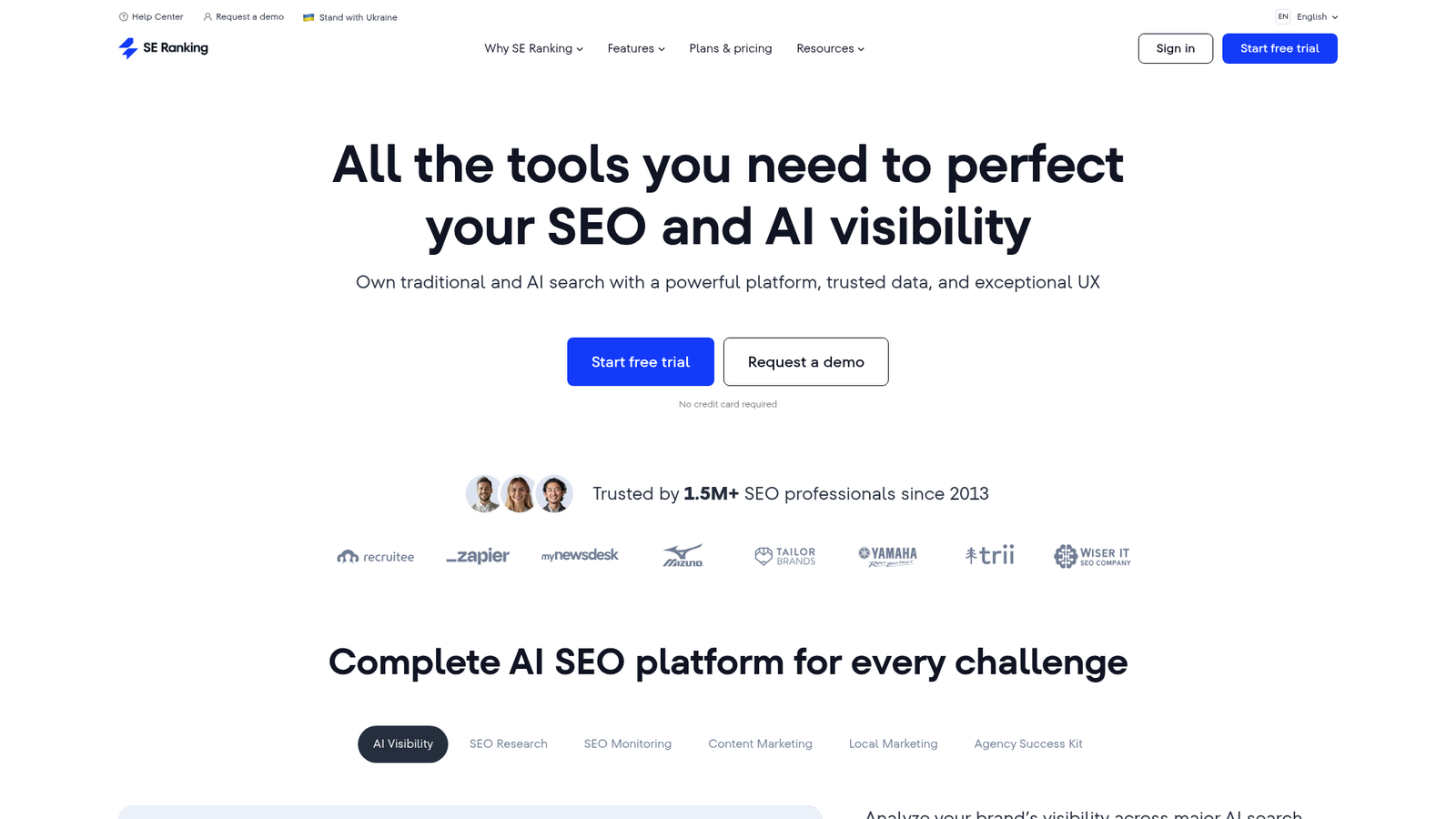
SE Ranking's AI Search Toolkit is an add-on to their established SEO platform, making it a practical choice for teams already invested in SE Ranking who want AEO capabilities without adding another vendor.
The integration with existing SE Ranking workflows is the main selling point here. If your team already runs keyword tracking, site audits, and competitive analysis through SE Ranking, adding the AI Search Toolkit means your AEO data lives in the same dashboard as your traditional SEO data. That's genuinely convenient. The trade-off is depth - the AEO features are less mature than dedicated tools, and you're dependent on SE Ranking as a base subscription.
Best for: Teams already using SE Ranking for traditional SEO who want to add AEO monitoring without switching platforms.
Key strengths
- AI search visibility tracking integrated with existing SE Ranking SEO data
- Google AI Overview monitoring with keyword-level citation tracking
- Combined traditional SERP and AI answer data in one dashboard
- Familiar interface for existing SE Ranking users with minimal retraining
- Regular feature updates as SE Ranking expands its AEO capabilities
Pricing: Add-on to an existing SE Ranking plan — AI Search Visibility add-on ranges $71.20–$276/month (annual) or $89–$345/month (monthly) depending on base plan tier. Base SE Ranking plan required (Core from $103.20/month annual).
8. Otterly AI - Best for Multi-Engine Answer Tracking
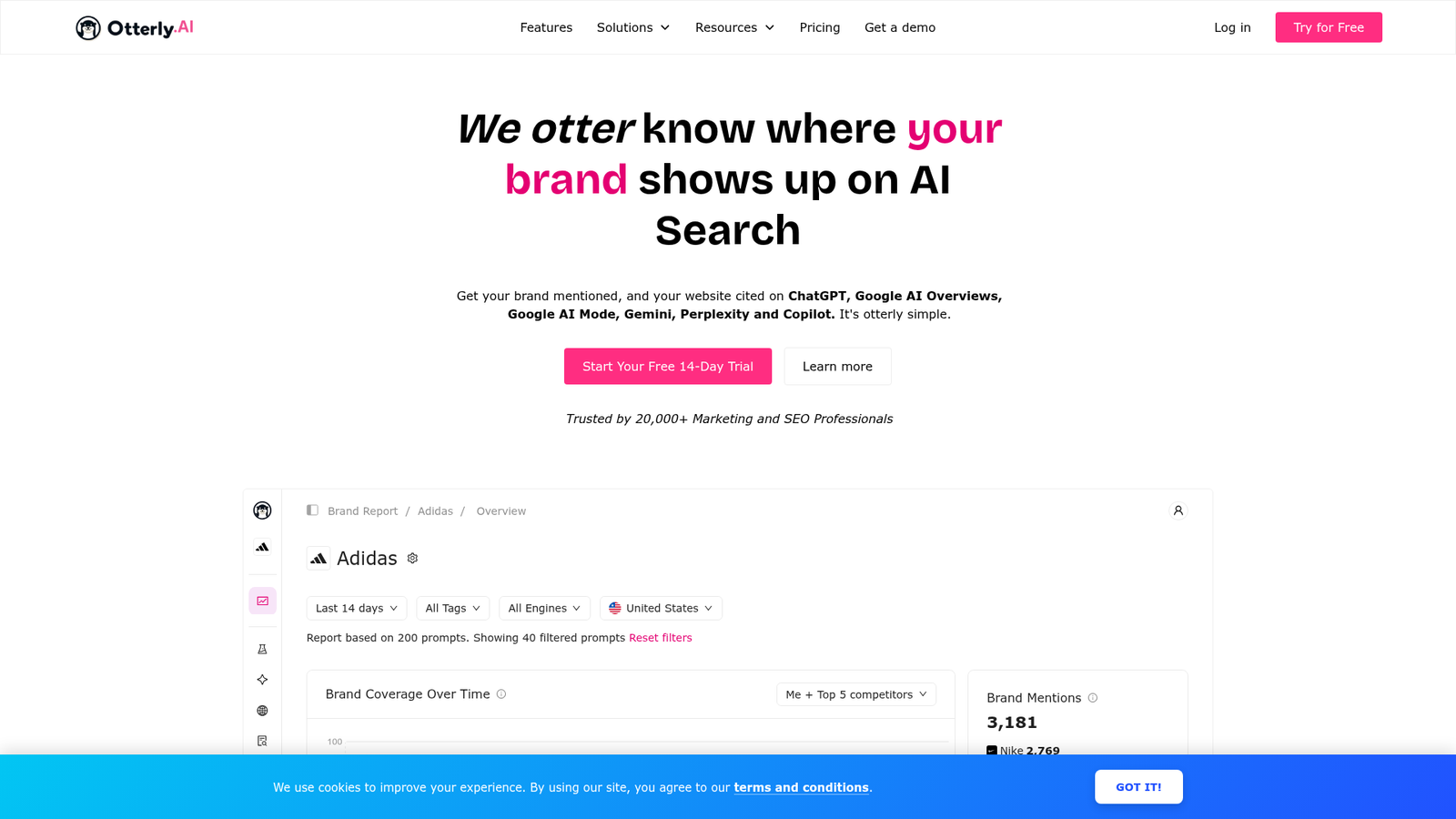
Otterly AI tracks brand visibility across a wider range of AI answer engines than most tools in this category, with coverage extending beyond the major platforms to include newer and emerging LLMs.
If your audience is distributed across multiple AI platforms - and increasingly, it is - Otterly's breadth is a real advantage. We found it particularly useful for brands in categories where Perplexity and newer AI assistants are driving meaningful discovery traffic alongside ChatGPT and Google. The interface can feel dense when you're pulling data from a dozen sources simultaneously, but the automated reporting features help manage that complexity for stakeholder updates.
Best for: Brands with audiences distributed across multiple AI platforms who need the broadest possible engine coverage in a single tool.
Key strengths
- Broadest AI engine coverage of any tool we tested
- Brand mention tracking and citation analysis across emerging LLMs
- Automated reporting for regular stakeholder updates
- Competitive landscape mapping across all tracked engines
- Configurable monitoring frequency for high-priority query sets
Pricing: Starting at $29/month (Lite, ~10–15 tracked prompts); Standard $189/month (100 prompts); Premium $489/month (400 prompts); Enterprise custom.
9. Rank Prompt - Best for Prompt-Based Visibility Testing
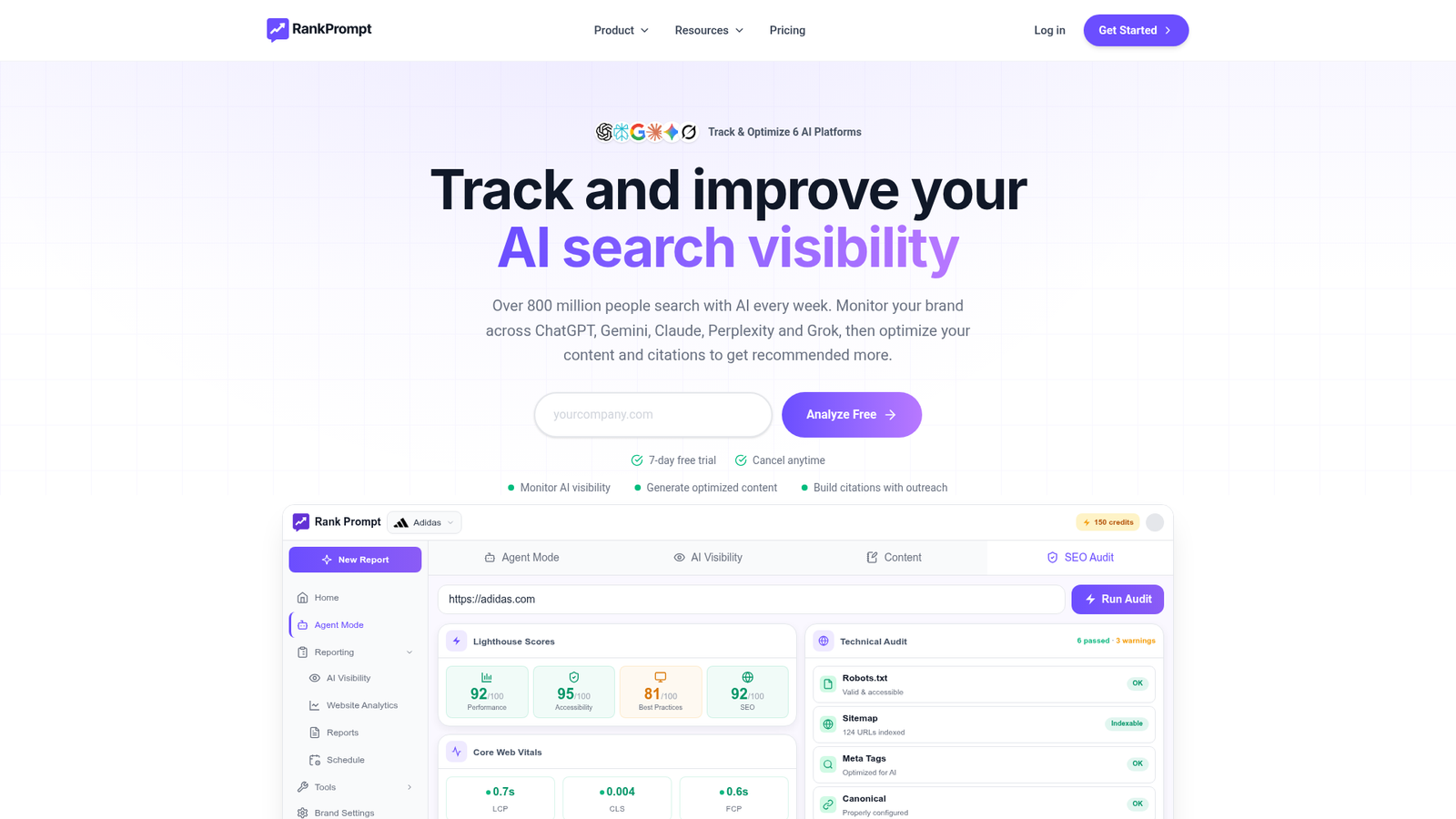
Rank Prompt lets marketers test specific prompts across multiple AI engines to see where their brand appears in the generated answers - essentially bringing the familiar rank-checking mental model into the AI era.
The concept clicks immediately for anyone who's spent time with traditional rank trackers. You define the prompts that matter to your business, Rank Prompt runs them across LLMs, and you see where you appear. It's intuitive, quick to set up, and useful for rapid visibility audits. The limitation is that it stops at the testing layer - it doesn't analyze your content or tell you how to improve your position, so it works best as a diagnostic tool rather than a complete solution.
Best for: SEO teams who want a familiar rank-checking experience applied to AI answer engines for quick visibility audits.
Key strengths
- Prompt-based brand visibility testing across multiple LLMs
- Multi-LLM prompt comparison for cross-engine position analysis
- Historical prompt tracking to measure visibility changes over time
- Bulk prompt testing for efficient large-scale audits
- Clean results interface familiar to traditional rank tracker users
Pricing: Starting at $95/month (Starter, 50 prompts, 3 models); Pro $245/month (150 prompts); Agency tier available. Each plan includes a monthly AI budget ($5/$10/$15). 7-day free trial with 50 bonus credits.
10. Goodie AI - Best for AEO Content Scoring
Goodie AI provides content scoring specifically designed for AEO - analyzing how well your content is structured for AI answer engine citation at the page level.
The scoring methodology is Goodie AI's strongest asset. It evaluates pages against a set of AEO-specific signals - entity coverage, schema markup quality, factual density, and structural clarity - and produces scores that are genuinely useful for prioritizing optimization work. It's a newer tool with a smaller track record than some alternatives, but the schema markup guidance in particular stood out in our testing as more actionable than what most competitors offer.
Best for: Content and technical SEO teams that need a structured, score-driven approach to prioritizing AEO optimization work.
Key strengths
- AEO-specific content scoring algorithm covering multiple citation signals
- Page-level optimization recommendations with clear priority ranking
- Schema markup analysis and recommendations for AI readability
- Entity coverage scoring to identify topical gaps
- Batch page analysis for efficient site-wide auditing
Pricing: Custom pricing starting around $399/month (quote-based; no public fixed tiers).
11. ProductRank.ai - Best for Product-Focused AEO
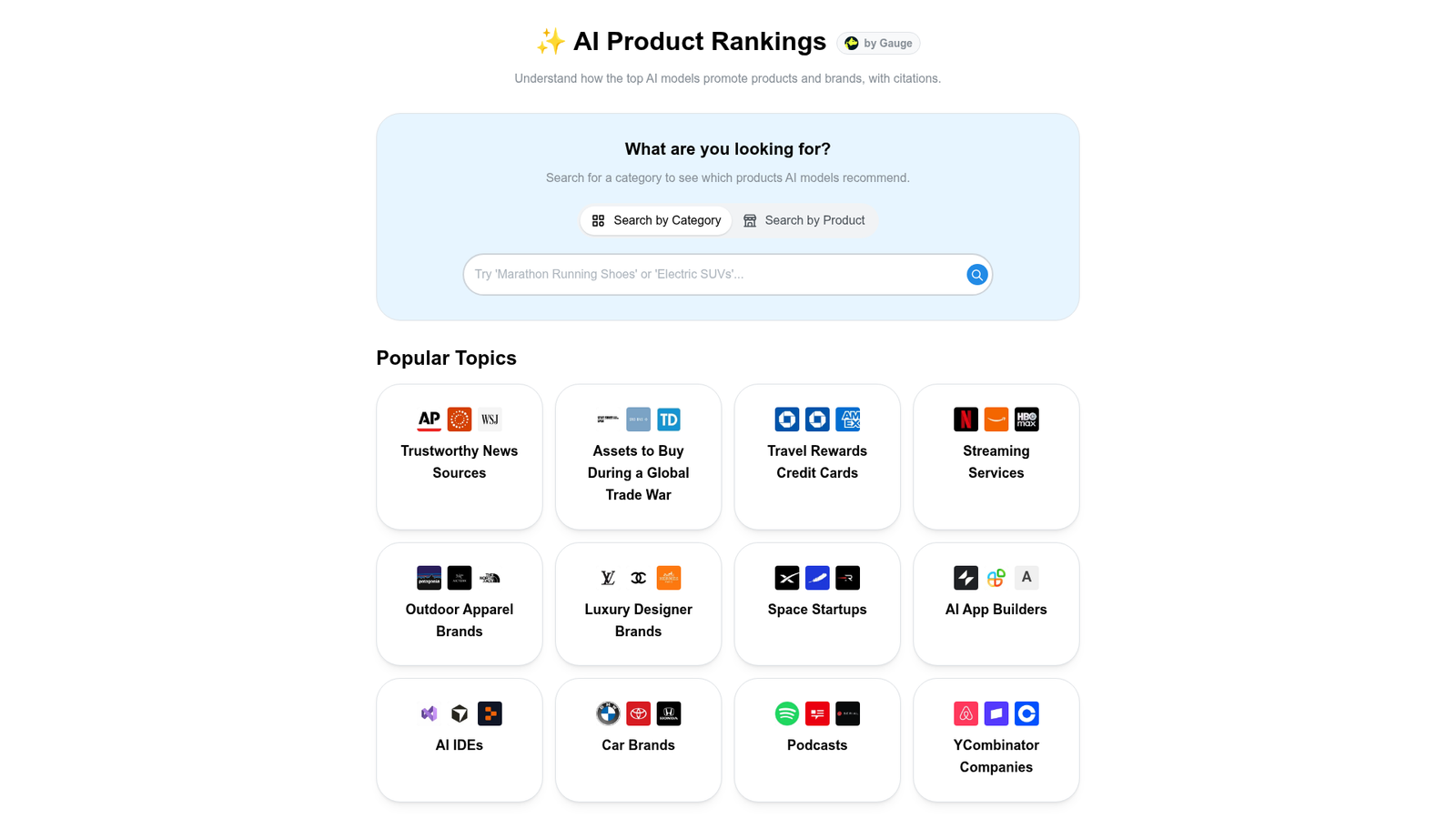
ProductRank.ai is built specifically for product and eCommerce brands that want to track how their products appear in AI-generated shopping and recommendation answers.
This is a niche tool, but it's the right tool for its niche. When someone asks ChatGPT or Perplexity to recommend a product in your category, ProductRank.ai tells you whether your products are appearing, how they're being described, and how that compares to competitors. That's a genuinely different use case from brand-level citation tracking, and no other tool on this list handles it with the same specificity. If you're in B2B services or content publishing, this one probably isn't for you - but for eCommerce and DTC brands, it fills a real gap.
Best for: eCommerce and DTC brands that need product-level AI citation tracking across shopping and recommendation queries.
Key strengths
- Product-level AI citation tracking beyond brand-level monitoring
- Shopping query monitoring across major AI answer engines
- Competitive product visibility comparison at the SKU level
- Integration with common eCommerce platforms for product data sync
- Recommendation answer analysis showing how products are described
Pricing: Contact ProductRank.ai for current pricing
12. Gumshoe - Best for Competitive AI Citation Intelligence
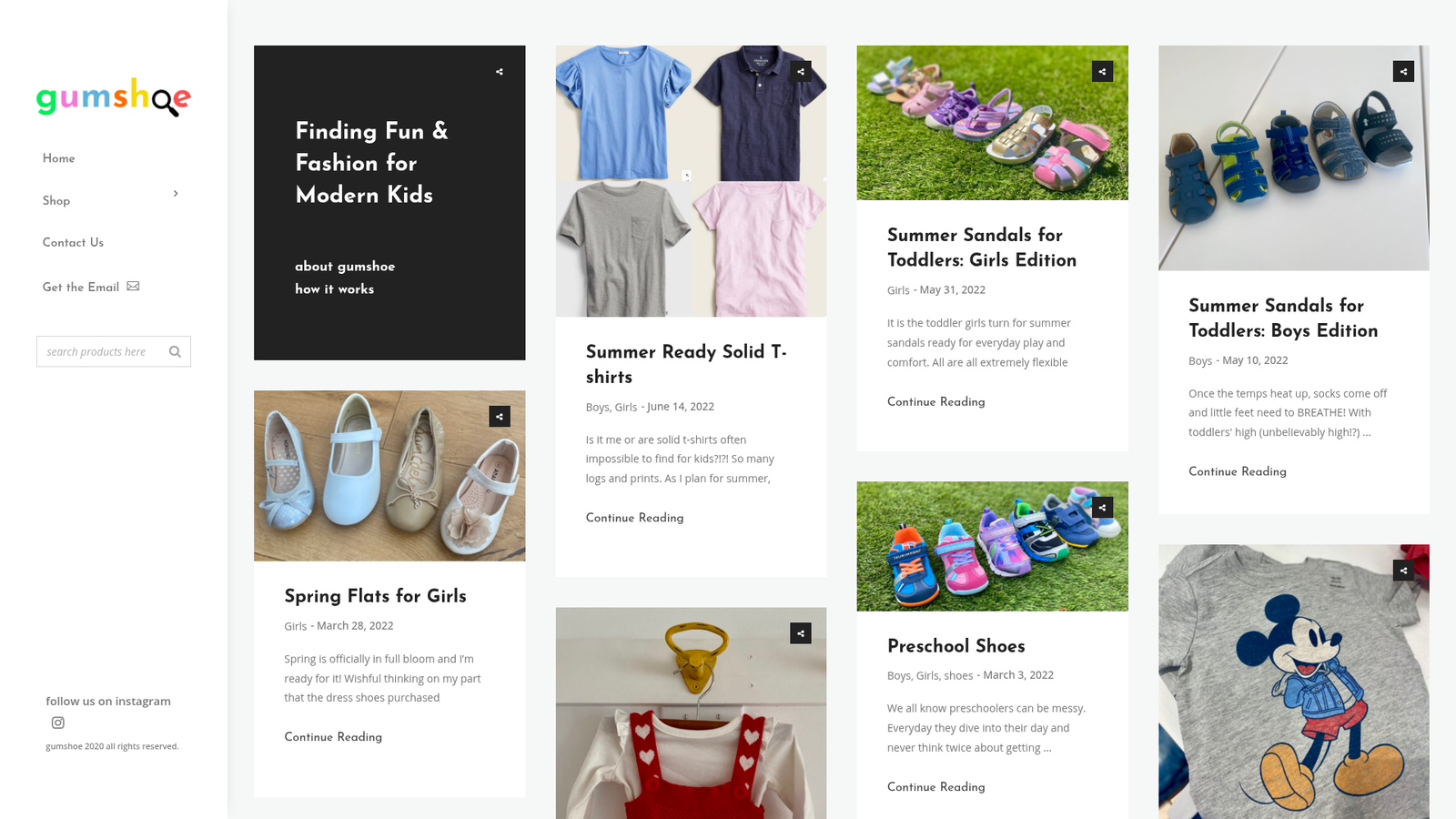
Gumshoe focuses on competitive intelligence for AI search - helping you understand not just your own visibility, but exactly how and why competitors are getting cited by AI engines.
The source attribution feature is what sets Gumshoe apart. Most competitive tools tell you that a competitor is being cited more than you. Gumshoe tells you which specific pieces of content are driving those citations, which gives you a direct content strategy signal. That's genuinely useful for teams operating in competitive categories where understanding the "why" behind competitor citations is as important as tracking your own. It's less useful if you're in a category with minimal AI search competition.
Best for: Teams in competitive categories who need to understand why competitors are getting cited - not just that they are.
Key strengths
- Competitive AI citation analysis with source-level attribution
- Citation source identification showing which competitor content is being cited
- Gap analysis comparing your citation sources to competitors'
- Alert system for significant competitive citation changes
- Content strategy recommendations based on competitor citation patterns
Pricing: Pay-as-you-go at $0.10 per conversation (a typical audit runs 250–300 conversations = $25–$30 per audit); Enterprise custom pricing; first 3 reports free, no credit card required.
13. Nightwatch - Best for Combined SEO + AEO Rank Tracking
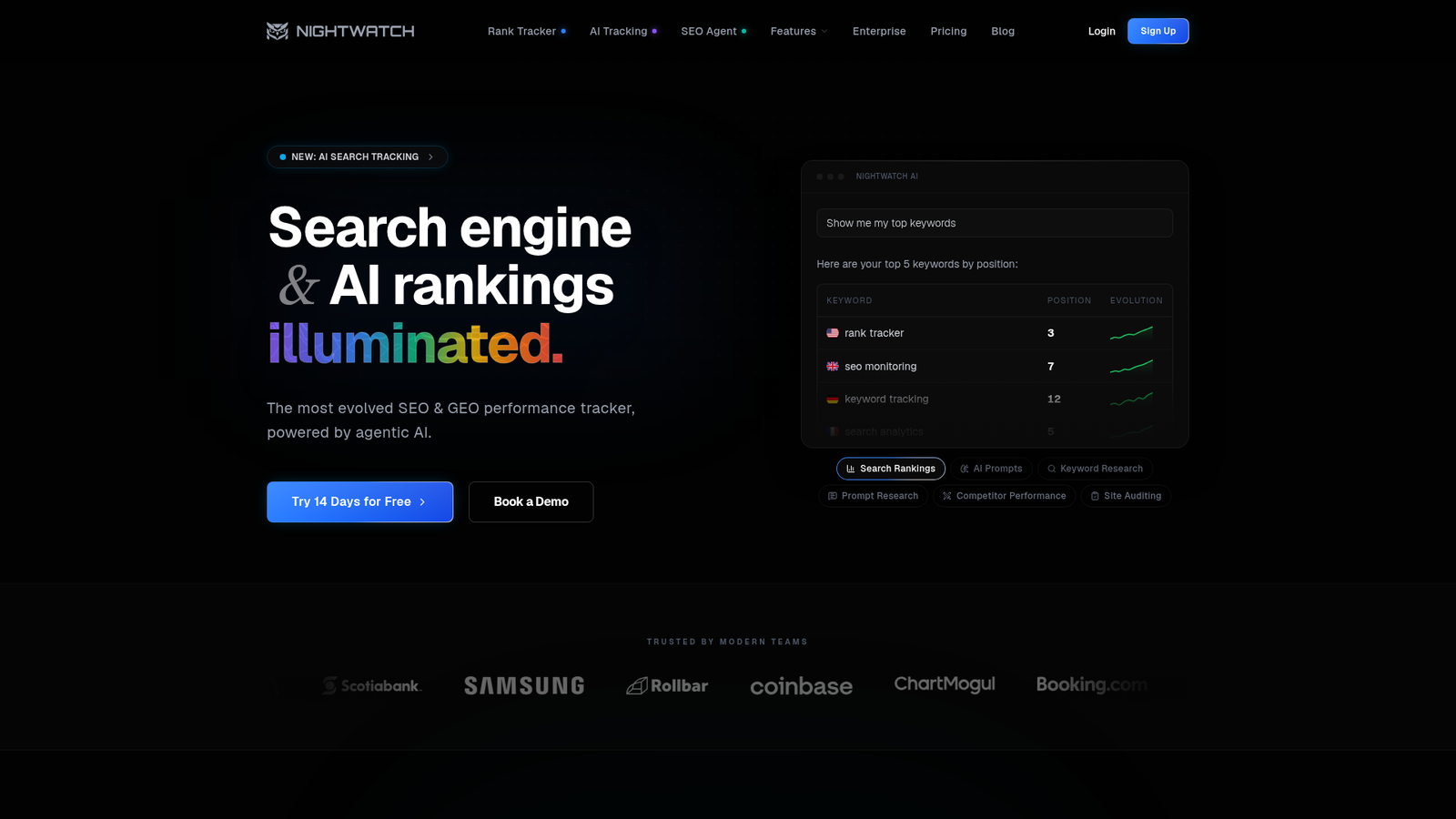
Nightwatch is a mature rank tracking platform that has added AI search visibility features, making it a practical option for teams that want traditional rank tracking and AEO monitoring consolidated in one place.
The rank tracking foundation is solid - Nightwatch has been doing that well for years. The AI search features are newer and less deep than dedicated AEO tools, but for agencies and teams that need to report on both traditional SERP performance and AI visibility in the same dashboard, the consolidation is worth the trade-off in depth. White-label reporting makes it particularly useful for agencies managing multiple client accounts.
Best for: Agencies and SEO teams that need combined traditional rank tracking and AEO monitoring in a single reporting environment.
Key strengths
- Combined traditional SERP and AI answer visibility tracking
- Rank tracking across Google, Bing, and select AI engines
- Customizable dashboards and white-label reporting for agencies
- Mature rank tracking foundation with years of reliability
- Flexible reporting schedules for client-facing deliverables
Pricing: Starting at $32/month (Starter, 250 keywords daily); Optimize $82/month; Agency $559/month; Enterprise custom.
14. Hall - Best for Enterprise AEO Brand Monitoring
Hall is designed for enterprise brands that need to monitor AI search visibility at scale - across multiple brands, product lines, markets, and languages simultaneously.
The enterprise positioning is genuine, not just a pricing strategy. Hall's multi-brand architecture, API access, and executive reporting capabilities reflect real enterprise requirements that smaller tools don't address. If you're managing AEO for a portfolio of brands or operating across multiple markets, the infrastructure Hall provides is meaningfully different from what mid-market tools offer. The price point reflects that positioning, and it's overkill for single-brand teams.
Best for: Enterprise marketing teams managing AI search visibility across multiple brands, markets, or product lines at scale.
Key strengths
- Enterprise-scale AI citation monitoring across multiple brands and markets
- Multi-brand and multi-market support with centralized management
- Executive reporting dashboards designed for C-suite stakeholders
- API access for custom integrations with existing enterprise data stacks
- Dedicated support and onboarding for complex enterprise deployments
Pricing: Lite free tier; Starter paid entry-level; Business $499/month (billed $5,988/year, 50 projects, 1,000 tracked questions); Enterprise from $1,499/month (billed $17,988/year) with API access, enterprise security, unlimited historical data.
15. Rankscale AI - Best for AI Visibility Growth Tracking
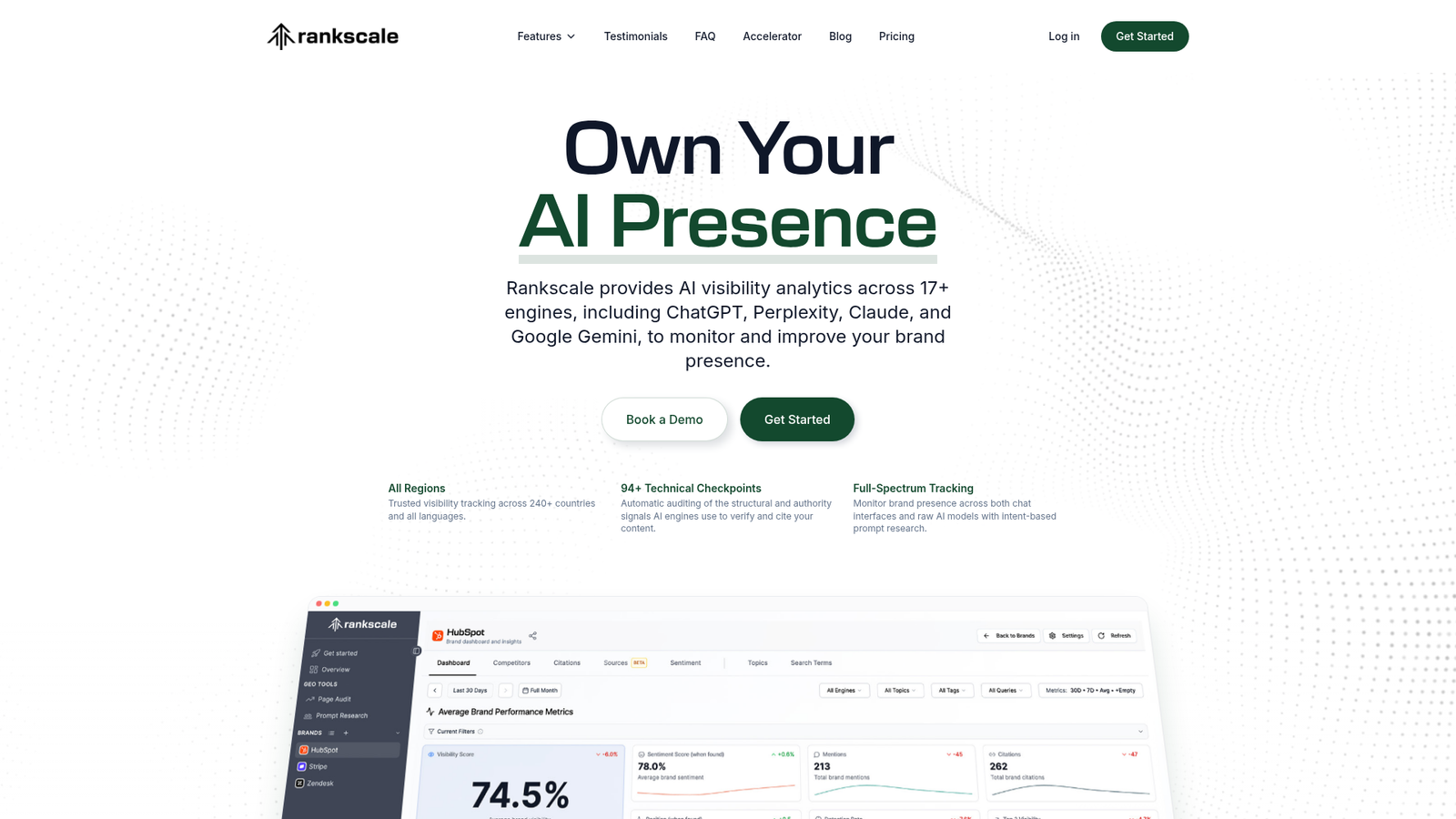
Rankscale AI focuses on tracking AI visibility growth over time - helping teams measure whether their AEO efforts are actually producing results, not just activity.
This is the measurement-first tool in the category. Where most AEO tools show you current state, Rankscale AI is built around the question of whether you're improving. The before/after measurement capabilities and goal-setting features make it particularly useful for teams that need to demonstrate AEO ROI to stakeholders. The limitation is that it requires consistent data over time to be valuable - it's not the right starting point for teams just beginning their AEO journey, but it becomes increasingly useful as your program matures.
Best for: Established AEO programs that need to measure growth, demonstrate ROI, and track progress against defined visibility goals.
Key strengths
- AI visibility growth tracking with clear trend visualization
- Before/after measurement for evaluating specific AEO campaigns
- Goal setting and progress tracking against defined visibility benchmarks
- Automated growth reports for regular stakeholder communication
- Historical data analysis for identifying what's driving visibility improvements
Pricing: Pricing: Essentials €20/month (~$22, 120 credits, 10 web audits); Pro €99/month (~$109); Enterprise €780/month (~$855, 12,000 credits, unlimited seats).
How to Choose the Right AEO Tool for Your Team
The right AEO tool depends on three variables: your team's size, your primary need, and your budget. Here's how to think through each.
By Team Size
Solo marketers and freelancers tend to get the most value from focused, single-purpose tools. Profound for tracking and Rank Prompt for quick visibility audits cover the core bases without overwhelming a one-person operation.
Small marketing teams (2–10 people) often find that the overhead of managing multiple point solutions outweighs the marginal benefits of best-in-class specialization. Slate's workflow approach eliminates that overhead, or a Profound plus Peec AI combination covers tracking and optimization with two well-integrated tools.
Mid-market teams (10–50 people) benefit most from Slate's integrated workflow, supplemented by Gumshoe for competitive intelligence in categories where that matters. The workflow efficiency gains compound quickly at this team size.
Enterprise teams (50+ people) should evaluate Hall for scale and multi-brand complexity, with Gauge added for brand sentiment monitoring if perception management is a priority.
By Primary Need
By Budget
Free or minimal spend: Most dedicated AEO tools don't offer meaningful free tiers - the category is too new for freemium to have taken hold. Rank Prompt and SE Ranking's toolkit offer the lowest entry points for teams with tight budgets.
$50–200/month: This range covers most mid-market tracking and monitoring tools. Nightwatch starts at $39/month and covers combined SEO and AEO tracking. Several dedicated AEO tools fall in this range for smaller query volumes.
$200–500/month: The range where most dedicated AEO platforms sit for growing teams. Profound, Peec AI, and similar tools typically land here for meaningful usage levels.
$500+/month or contact for pricing: Enterprise solutions (Hall) and workflow platforms (Slate) typically operate in this range, reflecting the broader scope of what they deliver.
The AEO Workflow We Recommend (And Why Point Solutions Fall Short)
The AEO landscape is complex enough that most teams default to the simplest possible approach: pick a tracking tool, check the numbers occasionally, and call it AEO. That approach produces occasional insights but rarely produces compounding results.
The teams seeing consistent AI visibility growth are running a four-stage cycle.
Stage 1 - Audit: Where Do You Stand in AI Search?
Before optimizing anything, you need a baseline. Use tracking tools to understand which queries in your category trigger AI-generated answers, where your brand currently appears (or doesn't), and how your citation frequency compares to competitors. This audit stage typically takes one to two weeks and produces the priority list that drives everything downstream.
Stage 2 - Optimize: Make Your Content LLM-Friendly
With a priority list in hand, the optimization work begins. LLM-friendly content tends to share common characteristics: clear entity definitions, factual density, well-structured headings, comprehensive schema markup, and direct answers to the questions your audience is asking. Content scoring tools like Peec AI and Goodie AI are most valuable at this stage - they translate those principles into specific, page-level recommendations.
Stage 3 - Monitor: Track Citations and Sentiment Over Time
Optimization without monitoring is guesswork. Once you've made content changes, you need ongoing visibility into whether those changes are producing citation improvements - and whether competitor activity is shifting the landscape around you. This is where tools like Profound, AIclicks, and Otterly AI earn their keep.
Stage 4 - Iterate: Refine Based on Data
The monitoring data from Stage 3 feeds directly back into Stage 1 for the next cycle. Which pages improved? Which didn't? What did competitors change? This iterative loop is where AEO programs compound over time - each cycle produces better data, which produces better optimization decisions, which produces better citation outcomes.
Point Solutions vs. Workflow: The Real Cost Comparison
The cost comparison isn't just financial. The hidden cost of a fragmented point solution stack is the time spent manually connecting data between tools, the insights lost in translation between platforms, and the workflow gaps that mean your monitoring data never actually informs your optimization decisions. Slate's workflow approach addresses that directly - it's the connective tissue the rest of this list lacks.
Key Metrics to Track for AEO Success
Knowing which metrics matter is half the battle. Here's what to track, and why each one tells you something different.
Answer Share of Voice
What percentage of AI-generated answers in your category mention your brand versus competitors? This is the AEO equivalent of organic market share - the top-line metric that tells you whether your program is working at a category level. Track it monthly at minimum, weekly if you're in a fast-moving competitive category.
Citation Frequency and Trend
How often is your brand cited across your tracked query set, and is that number moving up or down? Absolute citation frequency matters less than the trend - a brand cited in 15% of relevant answers and growing is in a better position than one cited in 30% and declining.
Citation Sentiment
When AI engines mention your brand, is the framing positive, neutral, or negative? A brand that's frequently cited but consistently described as "expensive" or "difficult to use" may be experiencing a brand problem that citation volume alone won't reveal. Gauge is the most focused tool for this metric.
Source Attribution
Which of your content pages are being cited by AI engines? Which are being ignored despite strong traditional SEO performance? Source attribution data is one of the most actionable outputs of any AEO program - it tells you exactly where to focus optimization work.
Conversion from AI-Referred Traffic
Are visitors arriving from AI answer engine referrals converting at comparable rates to traditional organic visitors? This metric connects AEO activity to business outcomes and is essential for demonstrating program ROI to stakeholders.
AEO vs. SEO vs. GEO - What's the Difference?
These three terms are often used interchangeably, but they describe meaningfully different things. Understanding the distinction matters for tool selection and strategy.
SEO (Search Engine Optimization) is the practice of optimizing content to rank in traditional search engine results pages - Google and Bing organic listings. It focuses on signals like backlinks, keyword optimization, page speed, and technical health.
AEO (Answer Engine Optimization) is the practice of optimizing content to be cited in AI-generated answers - ChatGPT, Perplexity, Google AI Overviews, Claude, and Gemini. It focuses on entity clarity, factual density, structured data, and content authority signals that LLMs use to select sources.
GEO (Generative Engine Optimization) is the broader term encompassing optimization for any generative AI output, including but not limited to search. AEO is a subset of GEO - all AEO is GEO, but GEO also covers AI-generated content in non-search contexts.
The practical implication for 2026 is that SEO and AEO require different optimization strategies and different tooling, but they're not in competition - they're complementary. The best visibility programs invest in both as part of an integrated approach. For teams looking to understand the broader landscape, our best AI SEO tools and best generative engine optimization tools guides provide additional context.
AEO Is a Workflow, Not a Feature
The tools in this list are genuinely useful. But the teams seeing the best results in 2026 aren't the ones with the best single tool - they're the ones who've connected those tools into a repeatable system that compounds over time.
Every tool on this list solves a real problem. The question is whether you want to manage five separate solutions or build a workflow that connects them.
If you're ready to move from point solutions to a complete AEO workflow, start with Slate - the only tool on this list built from the ground up for end-to-end answer engine optimization. Or, if you'd rather start smaller, pair Profound for tracking with Peec AI for optimization as a strong two-tool starting point.
For teams looking to explore related tooling categories, our best LLM optimization tools guide covers the broader optimization landscape beyond just answer engines.
Frequently Asked Questions About AEO Tools
What is Answer Engine Optimization (AEO)?
Answer engine optimization is the practice of optimizing content to be cited and referenced by AI answer engines - including ChatGPT, Perplexity, Google AI Overviews, Claude, and Gemini. It focuses on making content factually dense, well-structured, and entity-rich so that LLMs are more likely to use it as a source when generating answers. Unlike traditional SEO, which targets ranking positions, AEO targets citation frequency and quality within AI-generated responses.
How is AEO different from traditional SEO?
SEO focuses on ranking in traditional search results through signals like backlinks, keyword optimization, and technical health. AEO focuses on being cited in AI-generated answers through different signals - entity clarity, factual density, structured data, and content authority. Both matter in 2026, but they require different optimization strategies and different tooling to execute effectively.
What metrics should we track for AEO?
The five core AEO metrics are answer share of voice, citation frequency and trend, citation sentiment, source attribution, and conversion rate from AI-referred traffic. Tracking should be ongoing rather than one-time - citation patterns shift as AI engines update their models and as competitive content changes, so monthly monitoring at minimum is necessary to stay current.
Do we need a dedicated AEO tool, or can our existing SEO tools handle it?
Most traditional SEO platforms are adding AEO features, but these tend to be bolt-on capabilities that lack the depth of dedicated tools. For teams running serious AEO programs, a dedicated tool or workflow platform provides meaningfully more actionable insights than a legacy SEO platform with AEO features appended. The SE Ranking AI Search Toolkit is the best option if you're committed to staying within an existing SEO platform.
How much do AEO tools cost?
~$20/month for entry-level tools like Rankscale AI (€20) and Waikay.io ($19.95); $29–$99/month for SMB tools (Otterly AI Lite $29, Nightwatch $32, Knowatoa $59, ZipTie $69, AIclicks $79, Peec AI $89, Gauge ChatGPT-only $99, Rank Prompt $95); $199–$499/month for mid-market (Peec AI Pro, Gauge 3-engine $399, Hall Business $499, Profound Growth $399); $1,499+/month for enterprise tiers. The right tier depends on your team size, query volume, and how many workflow stages you need covered - a workflow platform can actually reduce total spend by replacing multiple point solutions.
Can AEO tools guarantee our brand will be cited by AI engines?
No tool can guarantee citations. AI engines make their own decisions about which sources to reference based on content quality, authority signals, and relevance to the query. AEO tools help you understand your current visibility, optimize your content for citation-worthiness, and monitor changes over time - but results depend on content quality, brand authority, and the competitive landscape in your category.
Is AEO replacing SEO in 2026?
No - AEO is complementing SEO, not replacing it. Traditional search still drives the majority of web traffic, and Google's organic results remain a critical visibility channel. AI-generated answers are growing rapidly as a discovery mechanism, but the smartest marketing programs in 2026 are investing in both SEO and AEO as part of an integrated visibility strategy rather than treating them as competing priorities.
What is the best AEO tool for small businesses?
For small businesses with limited budgets, starting with Profound for tracking paired with Peec AI for content optimization covers the two most critical AEO workflow stages without significant overhead. For small teams that want everything in one place and want to avoid managing multiple tools, Slate's workflow approach eliminates the coordination cost that comes with running separate point solutions.