The content team at Slate wanted to run an experiment using data we had recently collected during an audit. We figured we'd build something interesting out of it.
We analyzed 300K+ AI citations generated across six B2B SaaS brands and their competitors, tracking ChatGPT, Perplexity, Gemini, Claude, Google AI Overview, and Google AI Mode over 90 days.
The six brands - whose names we don't reveal here for confidentiality - spanned email security, e-signature, process automation, network monitoring, logistics, and digital marketing, giving us enough vertical diversity.
We went in expecting to map a competitive landscape.
What we found instead was that brands and their known competitors together account for less than a quarter of all citations.
The other 76% flows somewhere else entirely, and most people are not watching it.
Key Takeaways:
- Three out of four AI citations go to domains outside the brand-vs-competitor frame entirely, including documentation hubs, niche blogs, aggregators, and community platforms
- The competitor citation gap is narrower than it feels: brands hold ~3% of citations, competitors ~9%, and both are dwarfed by the 77% going to sources neither side owns
- Citation behavior varies wildly by platform, with the gap between best and worst platform visibility running from 5x to 71x, meaning platform-level tracking is essential to get the full picture of where you actually stand
- YouTube and Reddit together account for 86% of social citations while LinkedIn accounts for 3.2%, despite absorbing the majority of most B2B content budgets
- AI sentiment toward brands isn't uniformly positive, and one brand in this study faced 23% negative sentiment, driven not by product quality but by critical public discourse
76% of AI Citations Go to Domains Outside Your Competitive Radar
Every brand's citation landscape has a blind spot. The question is how big.
We categorized every citation by destination and sorted them into three buckets: the brand's own domain, a known competitor's domain, and other sources.
Across all 6 brands, an average of 76.3% of all AI citations went to domains that were neither the brand nor its competitors.
Ahrefs' recent 863K-keyword study arrived at a somewhat similar conclusion from a completely different direction: 62% of AI Overview citations now come from pages outside Google's top 10 results.
The invisible ecosystem we see from the brand's perspective is the same one they see from the SERP's perspective.
So what actually lives inside that 77%?
Not random pages.
When we dug into the composition, clear patterns emerged:
- Documentation hubs like learn.microsoft.com and support.google.com appearing consistently
- Review aggregators like G2, Gartner, and TrustRadius showing up repeatedly
- Niche expert blogs with modest domain authority but deep topical coverage
- Wikipedia and developer resources like GitHub
- Educational content from industry associations
We've started calling these trust nodes: sources that may never appear on page one of Google, but that AI models have learned to reference because they cover topics comprehensively, are updated regularly, and are referenced by other credible sources.
The important thing to understand about trust nodes is that they don't operate the way traditional SEO competitors do:
- They aren't trying to rank for your keywords
- They aren't targeting your audience
- They exist to document, explain, and review
AI models don't see them as competitors either. They see them as the backbone of reliable information. And that is precisely why they get cited so heavily: their purpose aligns with what AI needs when constructing an answer.
The average owned citation share across all 6 brands was just 3.3%. Even the best performer, a mature email security brand with years of content investment, captured only 8.6% of citations in its own category!
You're Losing to Competitors, But Both of You Are Losing Harder to External Sources
Every brand tracking AI visibility sees the same thing first: competitors are getting cited more.
The data confirms it. Across every brand in the study, without exception, competitor citation share outpaced owned citation share:
Client C's 10.5x gap alone is enough to trigger a strategy overhaul in most organizations. And it should prompt action.
But zoom out, and the context shifts.
Competitors collectively hold about 9% of citations on average. The brand holds about 3%. Both combined account for roughly 12% of the total citation landscape.
The remaining 77% belong to neither. The gap between both of you and the invisible ecosystem is 65 percentage points.
So the question you need to be asking is "Who are the sources getting the other 77%, and how do we become part of that ecosystem?"
A brand that tries to outrank one competitor by producing a better version of their top page is solving the wrong problem.
SurferSEO found the same dynamic in their study of 173,902 URLs: pages that appear across the network of sub-queries AI internally generates are 161% more likely to be cited.
Each AI Platform Cites from a Different Source Pool
They are not even close.
When we filtered the same brand, the same content library, the same 90-day window by individual platform, the citation profiles were so different they could have been different brands.
This undermines a fundamental assumption most teams make: that "AI visibility" is one thing you can measure with one number.
Example data for the email security client:
Two things stand out:
Claude Operates from the Narrowest Source Pool
Claude operates with only 54% unknown and gives brands the highest owned citation share at 9.1%.
Perplexity, on the other hand, casts the widest net, with nearly 68% of citations going to sources nobody is probably tracking, and gives brands just 6.8%.
A brand that appears well-represented on Claude may be nearly absent on Perplexity.
ChatGPT Dominance
ChatGPT has the largest user base, which arguably makes it the platform where brand visibility matters most. It's also where brands consistently perform worst.
The visibility gaps across clients tell this story:
The pattern held across every brand we studied.
The likely reason maps to a difference in how ChatGPT constructs its answers: It relies more heavily on parametric knowledge from training rather than real-time web citations.
This makes the optimization playbook that works for citation-heavy platforms like Perplexity or Google AI Mode far less effective for ChatGPT.
We confirmed the pattern with the process automation client's dataset of 136,927 citations across 5 platforms.
Same hierarchy: Claude highest owned citation share at 5.5%, Perplexity lowest at 2.0%, ChatGPT worst overall visibility.
The practical implication is that platform-specific tracking isn't a nice-to-have. It's the way to understand where you actually stand and where effort should go.
YouTube and Reddit Drive 86% of Social Citations
Most B2B marketing teams pour their social investment into LinkedIn. Thought leadership posts, company pages, employee advocacy programs. The logic makes sense: LinkedIn is where buyers are.
AI models don't care where buyers are. They care where reliable, citable information lives.
YouTube ranked in the top 10 most-cited domains across every vertical we studied.
In the AI SEO category, it was the number one most-cited domain overall. In e-signature it ranked third, process automation sixth, network monitoring ninth, and email security tenth.
This wasn't driven by individual viral videos. It was systematic, consistent citation of educational and explanatory video content. Across every industry, regardless of how technical or niche the category, YouTube was a top citation source.
The social citation hierarchy, drawn from the email security client's breakdown of 3,357 social citations, puts the full picture in focus:
YouTube and Reddit together: 86%. LinkedIn: 3.2%.
The reasons map to what AI models actually need from a source when constructing an answer. YouTube provides something no other platform offers at scale: structured, searchable transcripts paired with long-form educational content.
Reddit provides something different but equally valued: authentic, community-validated perspectives. AI models appear to weight this kind of unpolished, experience-based content heavily, precisely because it carries a trust signal that polished marketing content cannot replicate.
Ahrefs found the same in their 75,000-brand study: YouTube mentions in video titles, transcripts, and descriptions are the strongest correlating factor with AI Overview visibility, at a correlation coefficient of approximately 0.737.
Citation Share Is Only Half the Problem. Sentiment Is the Other Half.
Every conversation about AI visibility focuses on whether you get cited. Almost none focus on how you're characterized when you do.
This is an understandable blind spot. Brands are still trying to solve the basic visibility problem, so the qualitative dimension of that visibility feels like a second-order concern.
We tracked sentiment across all brand mentions to understand whether AI defaults to positive, neutral, or negative framing, and whether certain industries face systematic differences.
AI is generally positive. But the variation is wide enough to matter.
For instance, Client F operates in a crowded market with extensive public debate on G2, Reddit, and comparison sites. Users actively discuss, compare, and critique products in public forums.
AI models synthesize all of it: complaints, limitations, and user frustrations sit right alongside recommendations in the source material these models draw from.
Client E, operating in a niche with far less public discourse, sees almost zero negative sentiment at 0.4%. Not because Client E has a better product, but because there's simply less critical public conversation for AI models to draw from.
For brands in high-discourse categories, this creates a compounding problem. Negative sentiment in AI responses doesn't stay contained. Models tend to reinforce their own outputs over time, and once a critical narrative takes hold, it becomes the default framing.
The fix is understanding and addressing the third-party narratives, the reviews, the forum threads, the comparison posts, that AI models draw from.
How Your AI SEO Strategy Should Evolve
Each of the five findings leads to the same conclusion: the mental model most brands use for AI visibility is built on assumptions the data doesn't fully support.
- The assumption that AI citation is a competitive battle between known players ignores the 77% of citations flowing to trust nodes
- The assumption that AI visibility can be tracked at the surface level ignores the 5x to 71x gaps between platforms that only become visible when you drill into per-platform data
- The assumption that the social channels brands invest in are the ones AI values ignores the 86% dominance of YouTube and Reddit
- The assumption that getting cited is inherently positive ignores the sentiment variation that can run as high as 23% negative
The brands earning the most citations in this study didn't get there by optimizing individual pages. They got there by having topical surface area that showed up across the sources AI trusts, consistently, across platforms.
Four strategic shifts fall out of the data directly:
Map the 77%
The biggest opportunity is in understanding which sources make up the invisible majority in your category: documentation hubs, niche expert blogs, aggregator sites, community platforms. Then finding ways to be referenced by them.
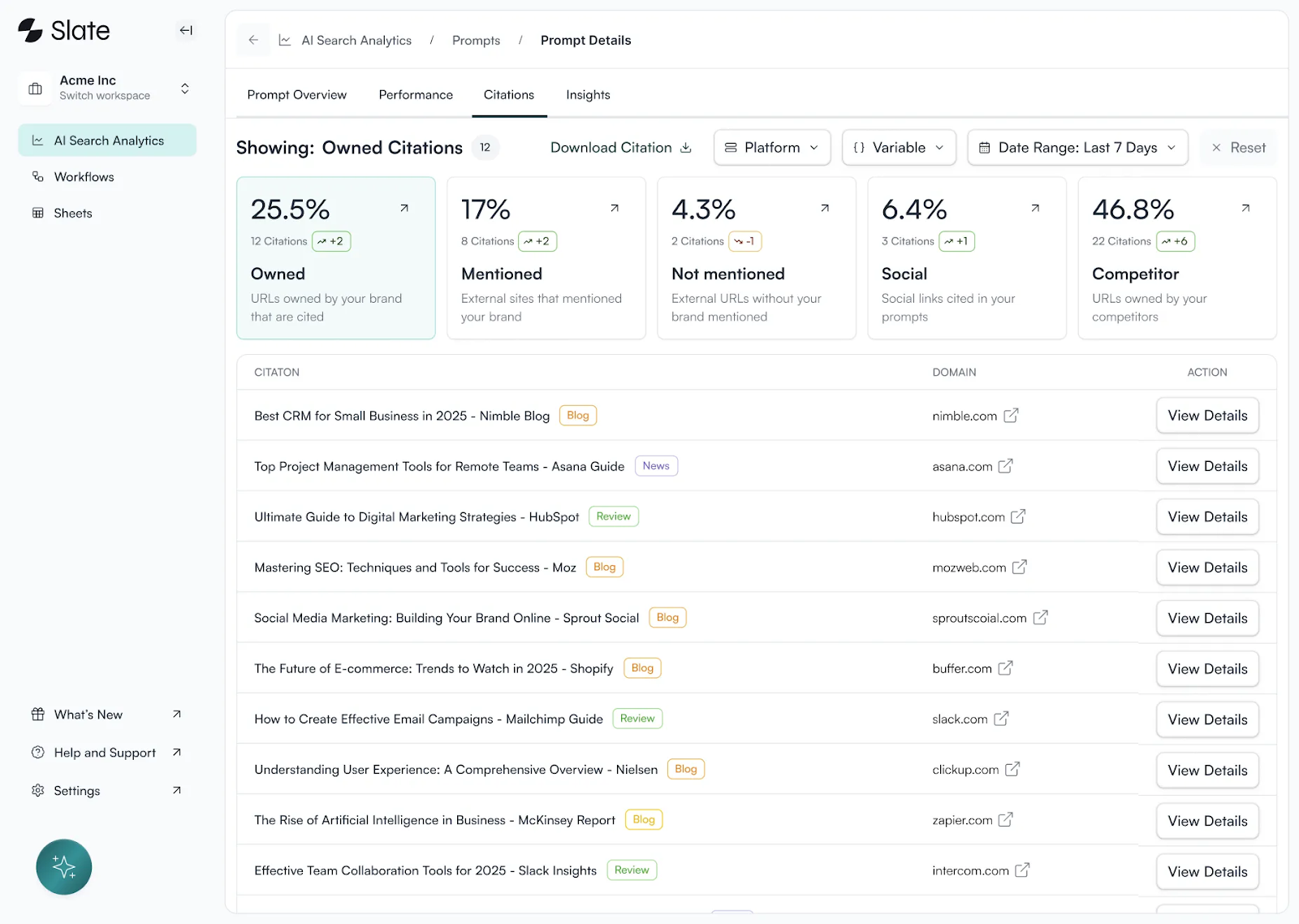
Slate's AI Analytics dashboard surfaces exactly this, the specific domains, URLs, and source categories that AI platforms cite in your category, so you can see the trust nodes shaping your visibility instead of guessing at them.
Track AI Visibility at the Platform Level, Not Just the Surface
The 5x to 71x visibility gap between platforms means an overall score only tells part of the story.
The real insight comes from understanding how each platform treats your brand differently. Set up platform-specific tracking. Allocate effort based on where your audience actually uses AI, not where your brand happens to perform best.
Slate tracks visibility across ChatGPT, Perplexity, Gemini, Claude, Google AI Overview, and Google AI Mode individually, so you can see exactly where the gaps are and prioritize accordingly.
Treat YouTube and Reddit as Citation Infrastructure
These platforms account for 86% of social citations. One well-made explainer video that earns consistent citations may deliver more AI visibility than a dozen blog posts. It's an ongoing commitment to producing, maintaining, and planning a regular content refresh for the formats AI draws from.
Monitor AI Sentiment as an Early Warning System
If AI is surfacing critical perspectives about your brand from third-party sources, the time to understand and address those narratives is before they become the default answer.
This means actively tracking not just whether you're mentioned, but how you're characterized, and tracing negative sentiment back to its source material.
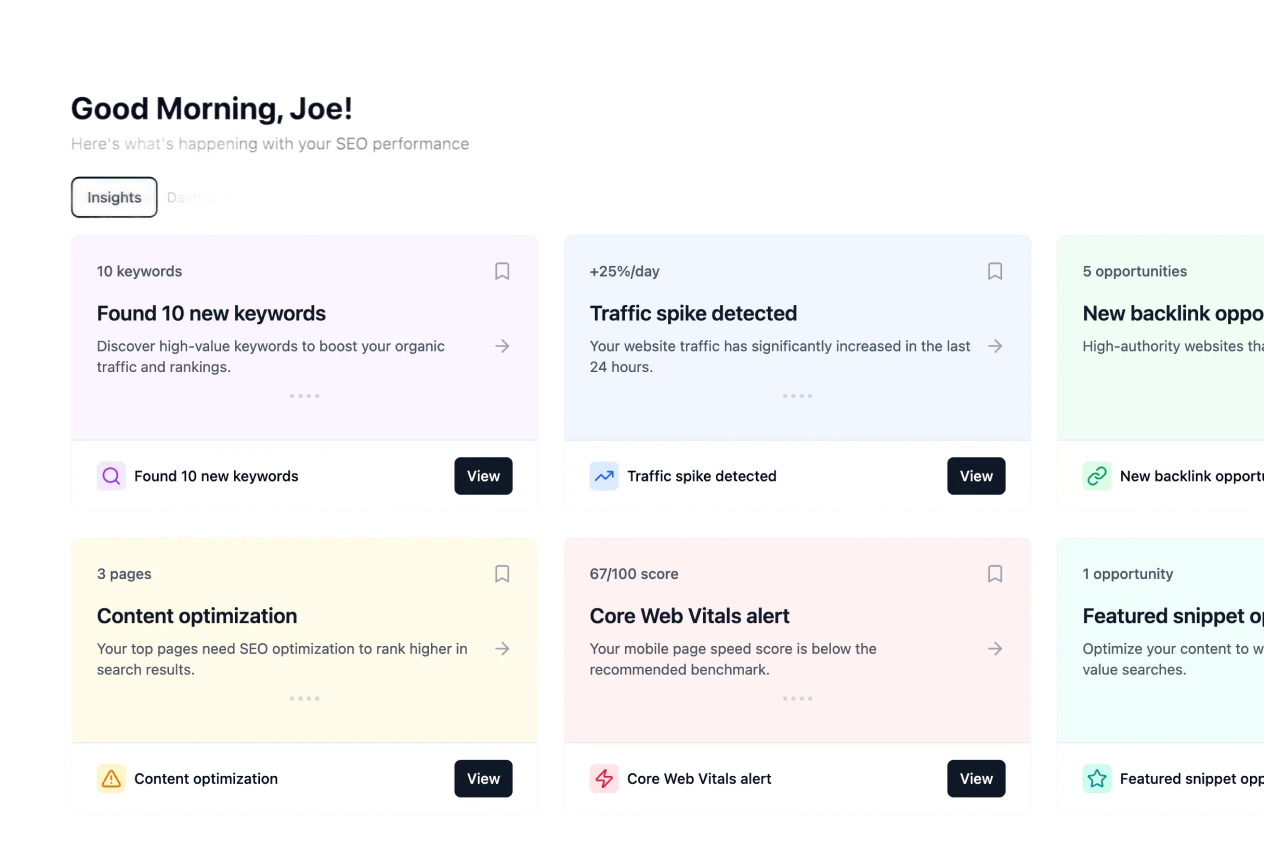
Slate's sentiment tracking breaks down every brand mention into positive, neutral, and negative across each platform, giving you the early signal to address critical narratives before they compound.
Conclusion
The ecosystem is already deciding who gets recommended. The question is whether you can see it.
That's the problem Slate was built to solve. From mapping the citation sources AI trusts, to tracking your visibility platform by platform, to monitoring how AI characterizes your brand in real time — Slate gives you the infrastructure to stop guessing and start acting on the data that shapes your AI presence.
If you want to see where your brand stands across the AI landscape, book a demo with Slate and we'll walk you through it.
Frequently Asked Questions
What is an AI citation, and why does it matter for brand visibility?
An AI citation is when a platform like ChatGPT, Perplexity, or Gemini references a specific domain when constructing an answer, and it's the primary mechanism through which brands either appear or stay invisible in AI-generated responses.
What share of AI citations do brands typically earn in their own category?
Across the six brands in this study, the average owned citation share was just 3.3%, with even the strongest performer capturing only 8.6%.
Does competitor citation share actually signal a competitive threat?
Yes, but the scale is different than most teams assume. Competitors hold roughly 9% of citations on average, which is a real gap but a much smaller one than the 65-point gap between tracked entities and the invisible ecosystem.
Why does AI visibility vary so much between platforms?
Each platform builds answers differently. Claude and Google AI Mode draw more heavily from web citations, while ChatGPT relies more on parametric knowledge from training, which means the optimization approach that works on one platform often doesn't transfer to another.
Why is ChatGPT consistently the worst platform for brand visibility?
ChatGPT constructs answers more from what it learned during training than from real-time web citations, so visibility there depends on entity associations built over time through brand mentions and co-occurrence with key topics, not page-level optimization.
Why does YouTube get cited more than LinkedIn by AI platforms?
YouTube provides structured, searchable transcripts paired with long-form educational content, giving AI models extractable text and topic depth. LinkedIn posts lack that substance and aren't indexed in ways AI citation models weight heavily.
What drives negative AI sentiment toward a brand?
Negative sentiment correlates more with the volume of public discourse in a category, including active G2 reviews, Reddit debates, and comparison posts, than with actual product quality. AI models surface critical perspectives because they're part of the source material.
How should teams change the way they report AI visibility?
Platform-specific tracking is essential. An overall visibility score becomes far more actionable when you can drill into each platform individually — the 5x to 71x gaps between platforms mean the real story often lives in the per-platform data, not the aggregate.
What's the single highest-leverage action a brand can take based on this data?
Map the 77%: identify which trust-node sources AI consistently cites in your category, then build a presence strategy around being referenced by those sources rather than optimizing your own domain in isolation.