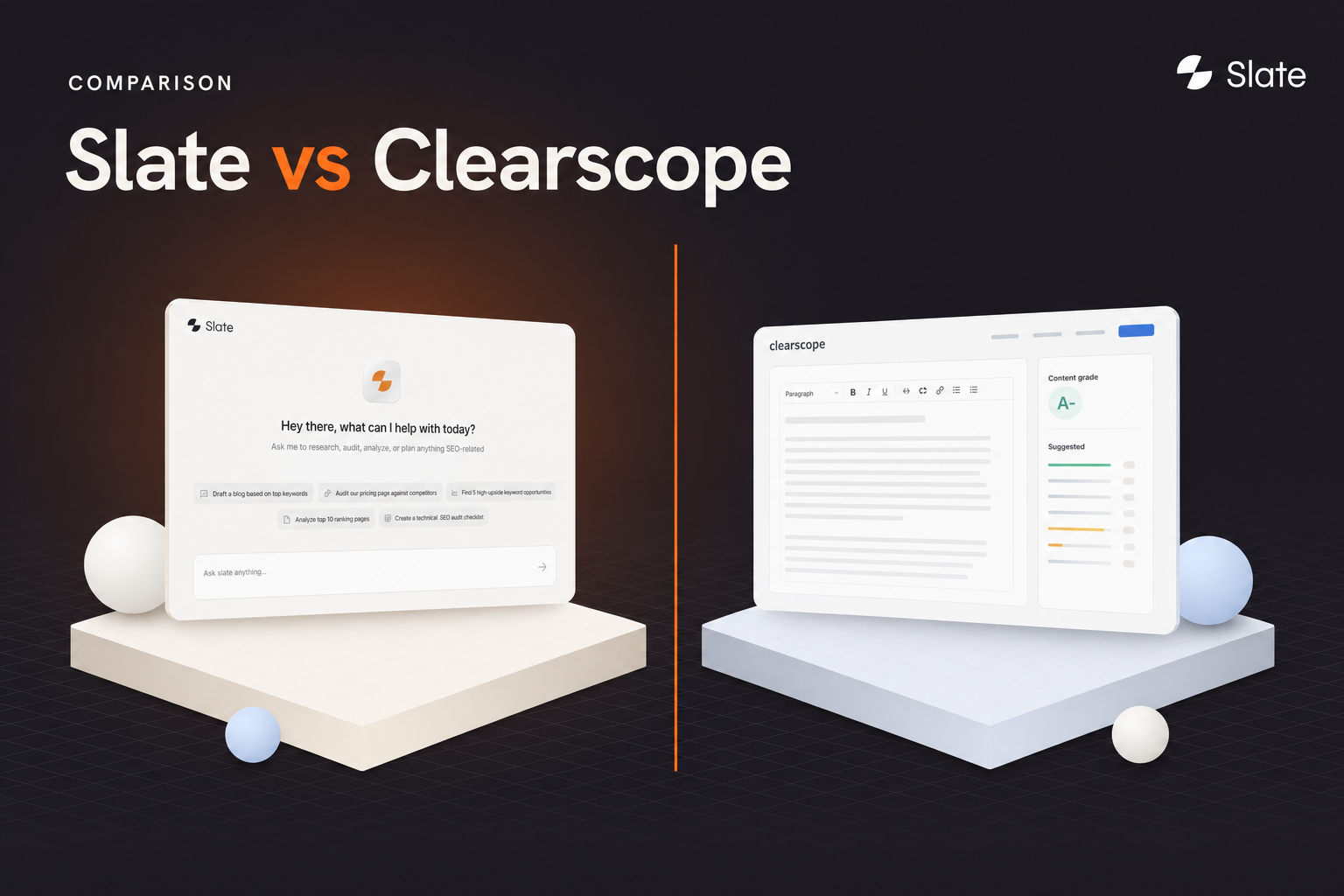
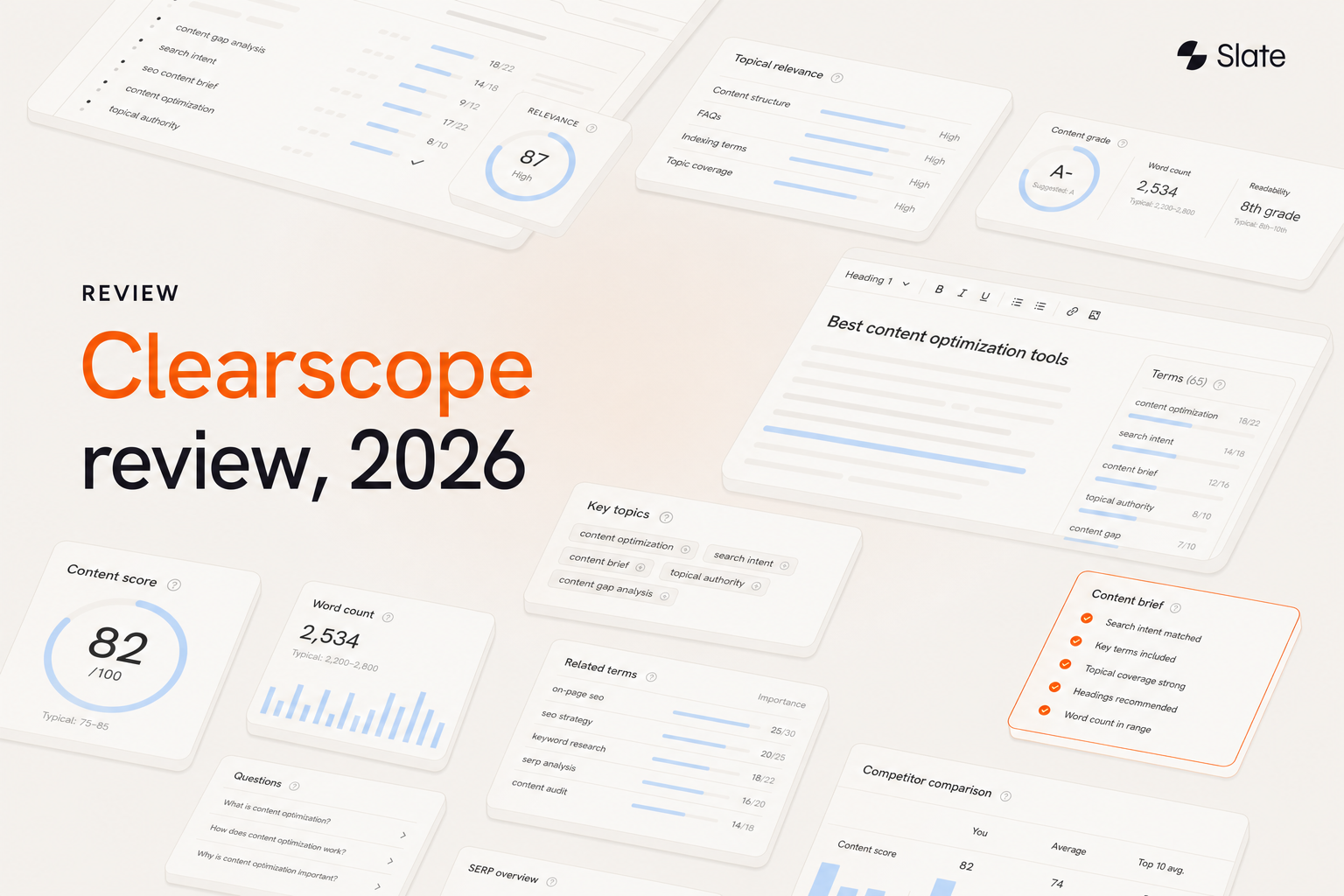
What your content team needed from Clearscope in 2022 looks nothing like what it needs now. Back then, the job was straightforward: paste your draft into an editor, check the content score, add a few NLP-suggested terms, and publish. Clearscope did that well. It still does.
But the landscape around it has changed dramatically. AI platforms like ChatGPT, Perplexity, Google AI Overviews, and Google AI Mode now surface answers directly, pulling from content they deem citation-worthy. Content teams are no longer asking "Did we hit our keyword targets?" They are asking "Does our brand even show up when someone asks an AI a question about our category?"
That is a fundamentally different problem. And it requires a fundamentally different category of tool.
This guide compares the best Clearscope alternatives by workflow fit, team size, and strategic goals. Whether you need a lightweight content optimizer, a full content system, or an AI search optimization platform, the goal is to help you choose the right tool for where your content operation is headed, not just where it is today.
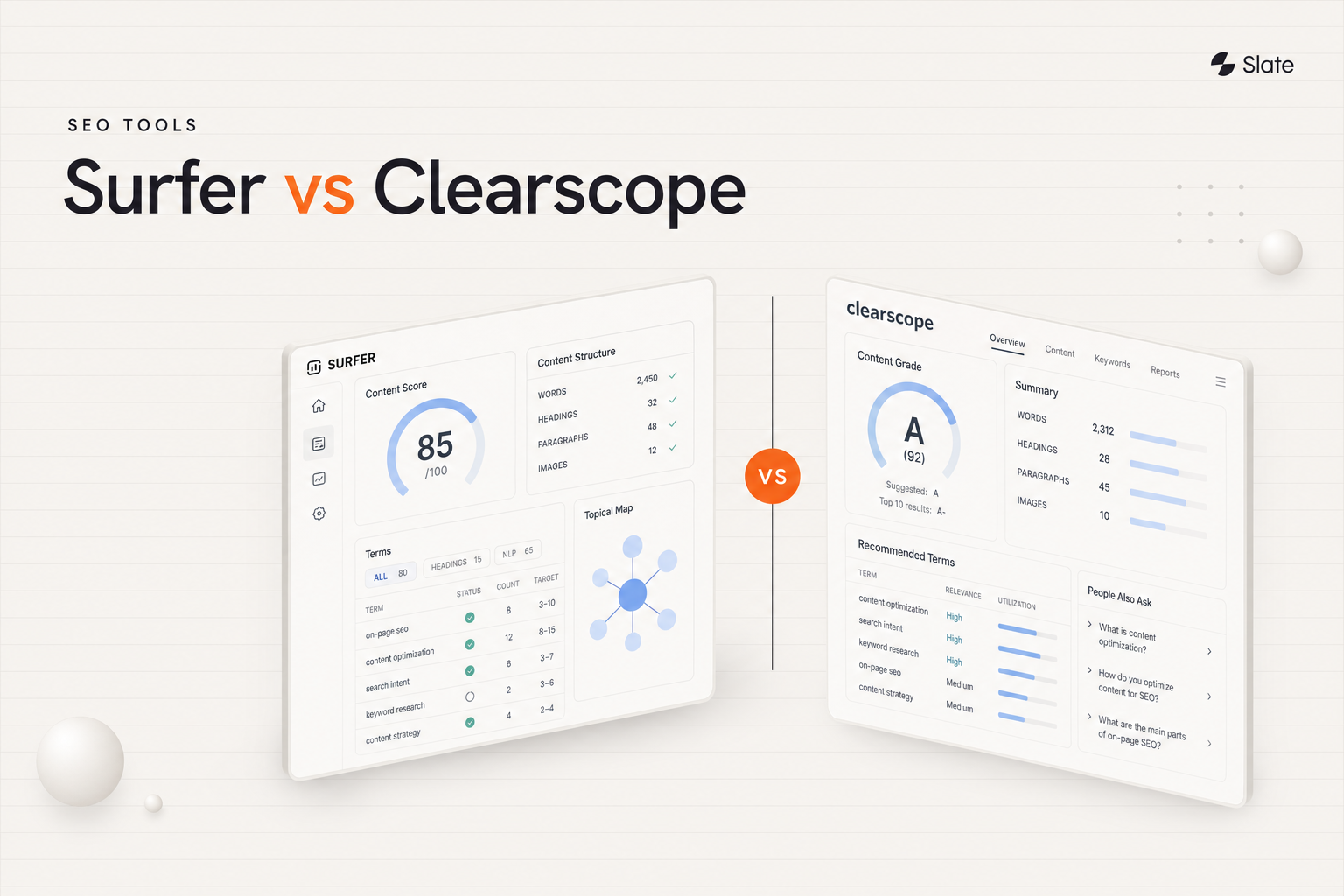
To be fair: Clearscope remains a well-designed tool. Its content grading is clean, its NLP term suggestions are reliable, and its editor is one of the most focused in the category. For teams whose only need is single-page content scoring, it still works. The question is whether single-page scoring is still enough.
Key Takeaways
- Clearscope remains strong for single-page content scoring, but teams outgrow it when they need workflow automation, AI search tracking, or the ability to operate at scale.
- The best Clearscope alternative depends on what you are building: a content optimizer, a content system, or an AI search platform. These are three distinct categories with different capabilities.
- Slate is the strongest option for teams that need end-to-end execution, connecting AI search visibility tracking across ChatGPT, Google AI Mode, AI Overviews, and Perplexity to content engineering and CMS publishing. Starts at $199/month.
- Surfer SEO and Frase are solid mid-range options. Surfer (from $59/mo) pairs on-page optimization with AI search tracking via its AI Tracker. Frase (from $49/mo) covers research-to-optimization with AI search analytics and CMS publishing to Webflow, WordPress, and Sanity.
- MarketMuse suits enterprise teams with deep content strategy needs. It offers a free tier, though pricing for paid plans is not publicly listed on their site.
- Budget-conscious teams and freelancers have viable options. NeuronWriter starts at $23/mo and includes AI visibility tracking. Outranking starts at $19/mo with AI-assisted drafting and SEO scoring.
- The biggest gap in Clearscope is not a missing feature. It is the absence of an execution layer and an AI search visibility layer. Modern content teams need to move from insight to published content within one system.
Why Teams Look For Clearscope Alternatives In 2026
Content Optimization Is No Longer Enough
Think about what "content optimization" meant three years ago. You had a target keyword, a draft, and a scoring tool. The workflow was linear: write, score, adjust, publish. One page at a time.
That workflow still exists. But the teams running it have outgrown it.
An SEO lead managing 500 published pages does not need a tool that scores one article at a time. They need a system that can audit hundreds of URLs, identify which ones are decaying, generate refreshed drafts at scale, and publish updates directly to their CMS. Clearscope was built for the first workflow. The second requires something structurally different.
AI Search Changes What "Optimized" Means
When someone asks ChatGPT "What is the best project management tool for remote teams?" the answer is not a list of ten blue links. It is a synthesized response that cites specific sources, summarizes key claims, and presents a direct recommendation.
This changes the definition of "optimized content." Keyword density and term coverage still matter for traditional search. But for AI-powered discovery, content needs to be citation-ready: clearly structured, factually dense, and easy for language models to extract and attribute.
Clearscope was not built for this model. It optimizes content for Google's traditional ranking signals. It does not track whether your brand appears in ChatGPT answers, Google AI Mode responses, or Perplexity citations. For teams whose traffic and leads increasingly depend on AI-mediated discovery, that is a significant blind spot.
Common Pain Points That Trigger A Switch
The decision to evaluate Clearscope competitors usually starts with one of these friction points:
- No execution layer. Clearscope tells you what to improve but does not help you produce, refresh, or publish content at scale. The gap between "here are your term suggestions" and "here is your published update" requires multiple other tools.
- No AI search visibility tracking. There is no way to see where your brand appears (or does not appear) across ChatGPT, Perplexity, Google AI Overviews, or Google AI Mode.
- Limited workflow automation. Every optimization is a manual, one-at-a-time process. For teams managing large content libraries, this does not scale.
- No CMS publishing integration. Content still needs to be manually copied into WordPress, Webflow, or another CMS after optimization.
- No brand governance. There are no style guides, tone rules, or knowledge base features to ensure AI-assisted content stays on-brand.
- Pricing relative to scope. When a tool covers only one step of a multi-step workflow, the cost-per-output math starts to feel unfavorable, especially when teams need to combine Clearscope with three or four other tools to cover their full content operation.
How To Choose The Right Clearscope Alternative
Optimizer Vs. Content System Vs. AI Search Platform
Before comparing individual tools, it helps to understand that the Clearscope alternatives market has split into three distinct categories. Choosing the wrong category is a bigger mistake than choosing the wrong tool within a category.
Content Optimizer: Scores individual pages against SERP competitors and suggests term improvements. This is what Clearscope does. Surfer SEO and NeuronWriter also operate primarily in this category, though both have added AI search tracking capabilities.
Content System: Covers multiple stages of the content workflow, from research and briefs through drafting, optimization, and publishing. Frase fits here, with its AI search analytics, CMS publishing, and brand voice governance. Content Harmony and Outranking also occupy this space.
AI Search Platform: Tracks AI visibility, engineers citation-ready content, and scales workflows across hundreds or thousands of pages. Slate operates in this category, connecting AI search analytics to content engineering and CMS publishing in one system.
The right category depends on where your team's workflow breaks down. If the bottleneck is content scoring, an optimizer may be enough. If the bottleneck is getting from insight to published content without stitching together five tools, you need a system or platform.
Evaluation Criteria That Actually Matter
Feature lists are easy to compare. What is harder, and more useful, is evaluating tools against the criteria that determine whether they will actually work inside your team's workflow:
- Content brief quality: Does the tool generate briefs that writers can act on, or just keyword lists?
- SERP and search intent analysis: How deeply does the tool analyze what is already ranking and why?
- AI search visibility tracking: Can you see where your brand appears across ChatGPT, Perplexity, Google AI Overviews, and Google AI Mode?
- Workflow automation and scale: Can you run hundreds of content refreshes through repeatable processes, or is every optimization manual?
- CMS integration: Can you publish directly to Webflow, WordPress, or other platforms from within the tool?
- Brand governance and quality control: Are there style guides, tone rules, and knowledge bases to keep AI-assisted content on-brand?
- Collaboration and approvals: Can multiple team members work within the tool with clear roles and review steps?
- Pricing model and cost-per-output: What does each content brief, optimization report, or published piece actually cost?
Quick Comparison Table: Clearscope Alternatives At A Glance
The Best Clearscope Alternatives In 2026
Slate: Best For End-To-End AI Search Optimization And Content Engineering
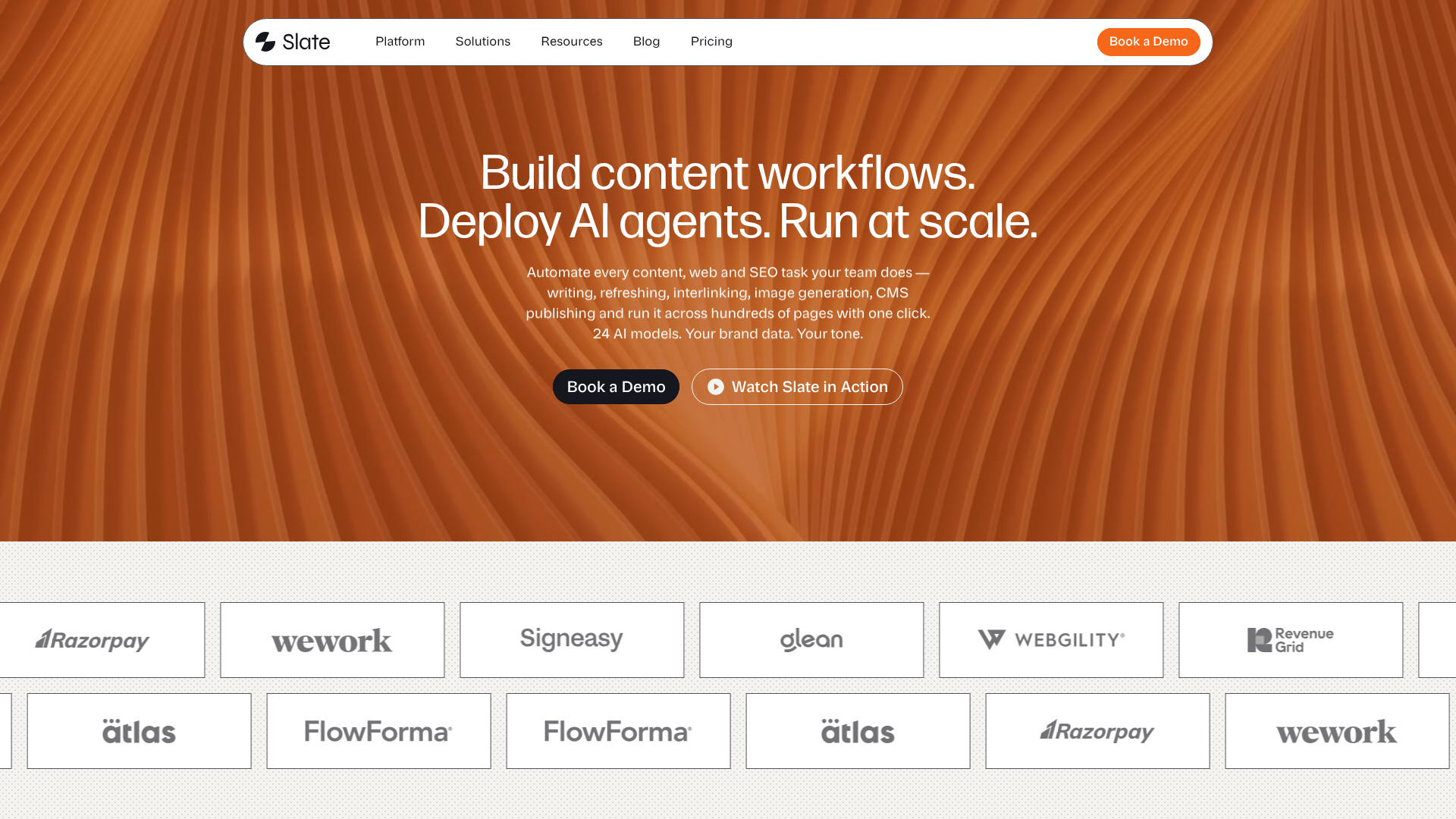
For teams that have outgrown point-solution optimizers, Slate represents a different category entirely. Where Clearscope scores individual pages, Slate builds the system that produces, refreshes, and publishes content at scale while tracking AI search visibility across platforms.
What Slate does well:
The core differentiator is the connection between insight and action. Slate's AI Search Analytics tracks where a brand appears (and where it does not) across ChatGPT, Google AI Mode, Google AI Overviews, and Perplexity. But tracking alone is table stakes. What matters is what happens next.
Slate's Workflows feature is a visual workflow builder with 24+ AI models, conditional logic, web scraping, and CMS publishing built in. A content team can go from "we are not showing up in ChatGPT answers for these 50 terms" to "here are 50 refreshed, citation-ready articles published to our Webflow site" without leaving the platform. Power Sheets extend this further, providing a spreadsheet interface for bulk content refreshes, programmatic creation, and optimization audits across thousands of URLs.
Brand governance is built into the system through Brand Kit and Knowledge Base, which enforce style guides, tone rules, and internal knowledge across all AI-assisted content generation. For B2B SaaS teams where brand consistency matters, this prevents the generic, off-brand output that plagues most AI writing workflows. SuperBlocks offer pre-built workflow components and templates specifically designed for AI search optimization, reducing setup time for common content operations. And MCP Integration connects Slate to Claude, allowing teams to work with marketing data directly inside Claude's interface.
Where to set expectations:
Slate is built for teams that need a content engineering platform, not teams that need a simple content scorer. If the only requirement is pasting a draft and getting a keyword score, Slate's depth of capability will feel broader than necessary. The starting price of $199/month reflects the platform's scope: AI search tracking, workflow automation, CMS publishing, and brand governance in one system.
Best for: B2B SaaS marketing teams, content-led growth companies, SEO leads adapting to AI search, and agencies managing multiple client sites.
Pricing: Starts at $199/month.
Book a demo to see how Slate connects AI search visibility to content execution.
Surfer SEO: Best For On-Page Optimization With A Content Editor And AI Search Tracking
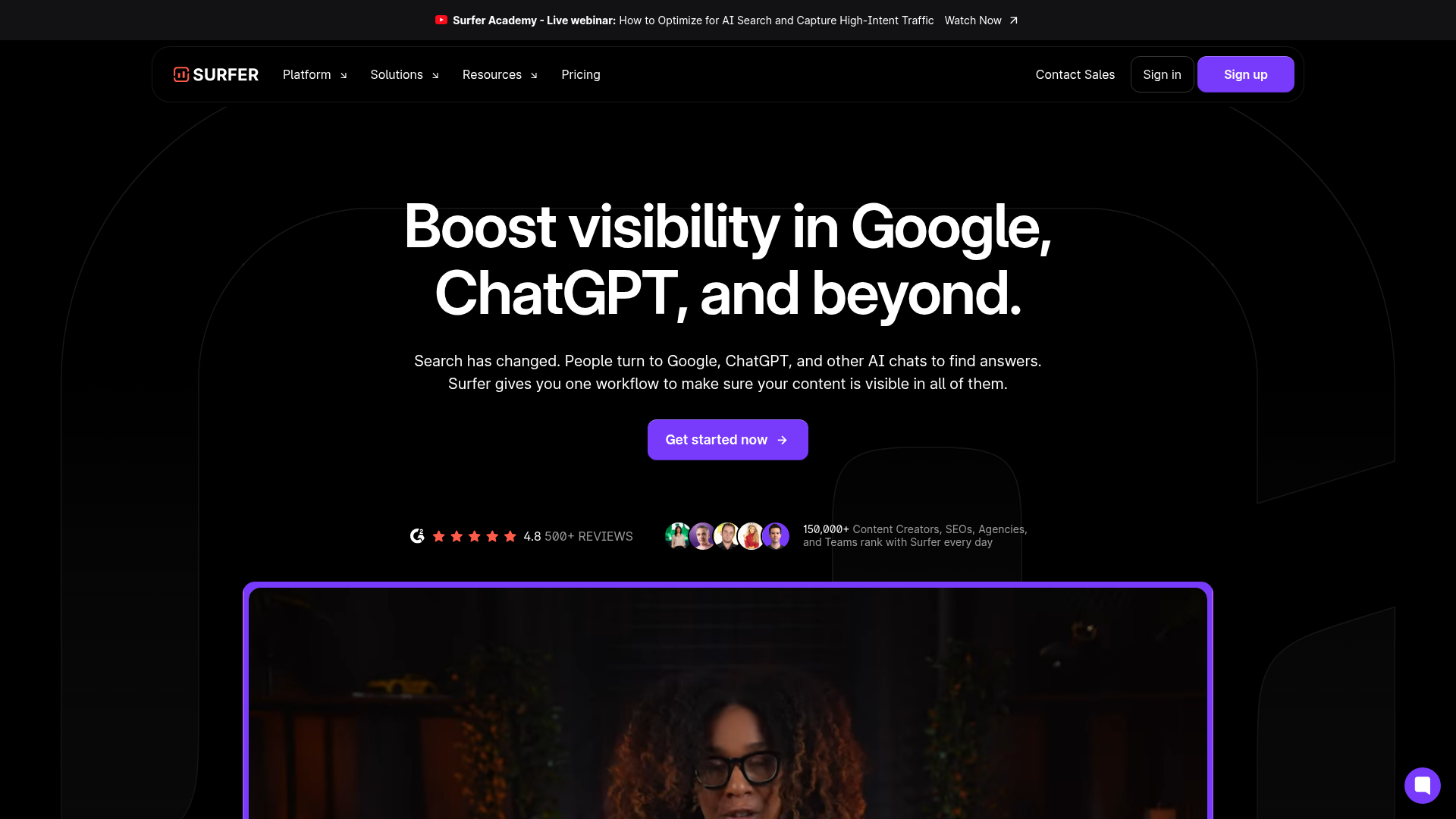
When people search for Clearscope vs Surfer SEO, they are usually comparing the two most established content optimization editors on the market. Surfer has evolved significantly, though, and the comparison is no longer apples-to-apples.
What Surfer SEO does well:
The Content Editor remains Surfer's strongest feature. It provides real-time guidelines and scoring as you write, with NLP-driven term suggestions that feel similar to Clearscope's approach. Auto-Optimize handles automated internal linking, and the platform includes a plagiarism checker and collaboration features for team workflows.
Where Surfer has pulled ahead of Clearscope is AI search tracking. The AI Tracker monitors brand visibility across ChatGPT, Gemini, Google AI Overviews, AI Mode, and Perplexity. It surfaces brand mentions, mention gaps, competitor share of voice, sentiment analysis, prompt-level insights, and source transparency. The Fanout Queries dashboard helps teams discover related prompts where they could gain visibility. Coverage Booster adds missing facts to content specifically to improve LLM citation potential.
Beyond optimization, Surfer offers a Topical Map for content gap discovery, Content Audit and Sites tools for identifying underperforming content, and a Rank Tracker with daily keyword position monitoring and rank drop notifications. Surfer AI can generate articles using templates, brand voice settings, and custom knowledge inputs. Integrations include WordPress, Contentful, Google Docs, ChatGPT, Zapier, and API access. The Contentful integration is notable because it allows real-time SEO guidelines within the CMS itself.
Where it falls short:
Surfer's AI Tracker narrows the gap with platforms like Slate on the visibility tracking side. However, Surfer does not appear to offer brand governance features such as style guides, tone rules, or knowledge base enforcement. There is no visual workflow builder with conditional logic, and bulk content refresh capabilities at the scale of Slate's Power Sheets are not available. CMS publishing is limited to WordPress and Contentful, so teams using Webflow will need a workaround. For teams that need the full path from AI search insight through content production to multi-platform publishing, Surfer covers optimization and tracking but leaves the execution layer to other tools.
Best for: SEO professionals and content teams focused primarily on on-page optimization who also want AI search visibility tracking. Strong fit for teams already using WordPress or Contentful.
Pricing:
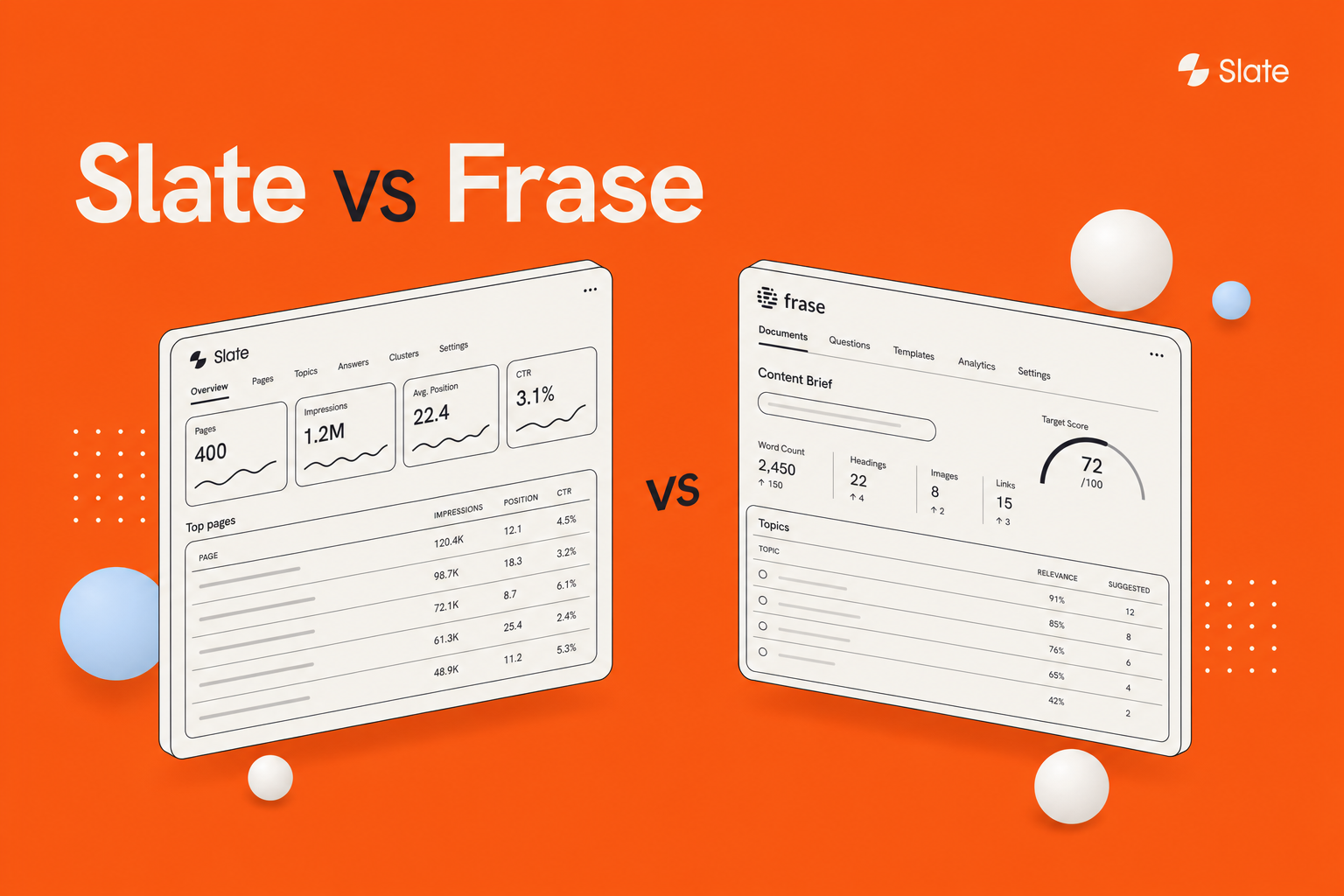
Frase: Best For Research-To-Optimization With AI Search Analytics And CMS Publishing
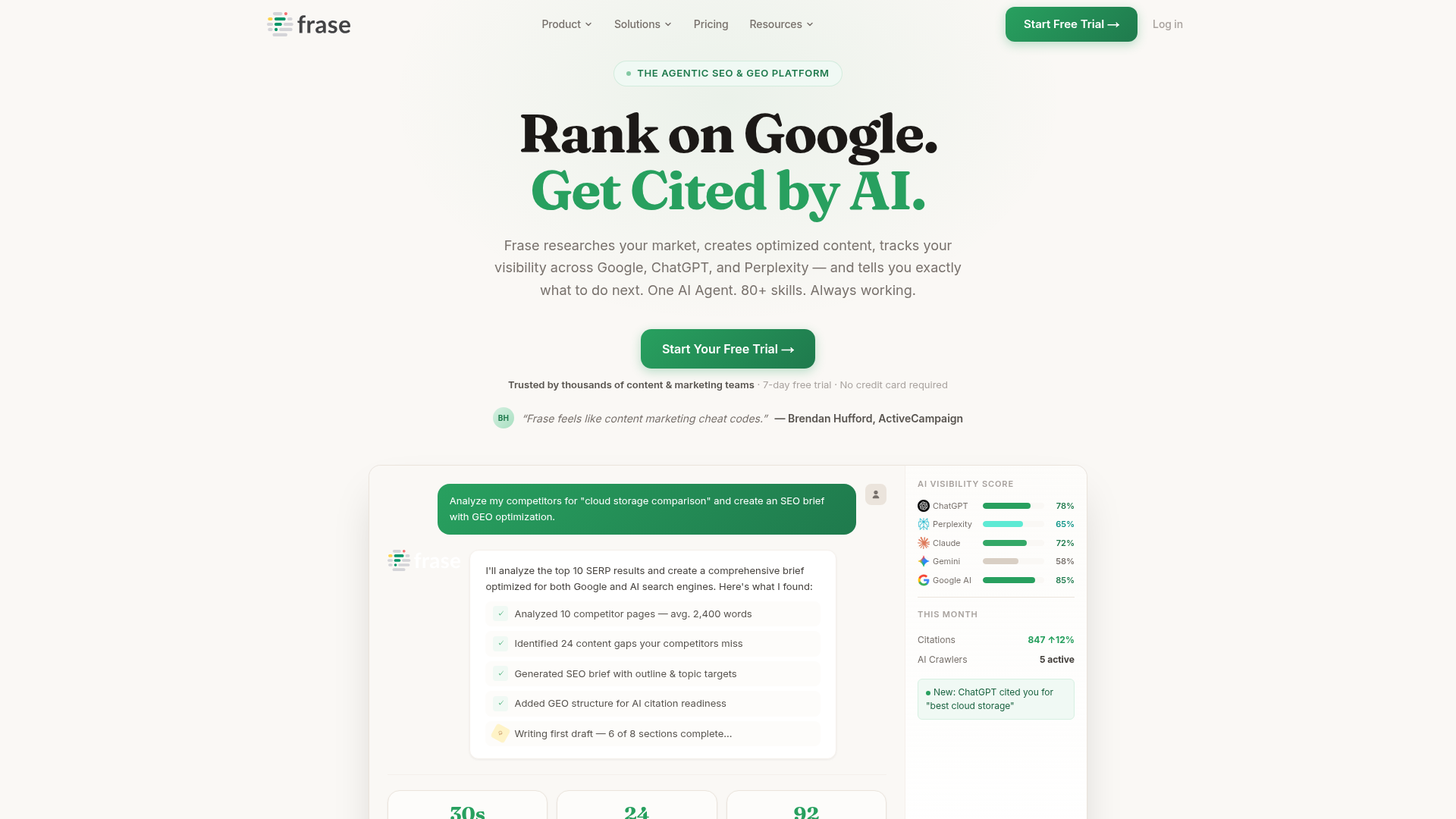
The Clearscope vs Frase comparison has shifted considerably. Frase started as a research and content brief tool, but it has expanded into one of the more complete content systems in this category.
What Frase does well:
Frase now offers AI Search Analytics that tracks visibility across ChatGPT, Claude, Gemini, Perplexity, and other major AI platforms. This puts it in a small group of tools that address both traditional SEO and AI-powered discovery.
The CMS publishing capabilities are notably broad. Frase publishes directly to Webflow, WordPress, Sanity, and its own Frase CMS. Content Monitoring provides health scoring across CMS posts, and the Site Auditor evaluates technical SEO, content quality, and AI visibility readiness, including signals like fact density, FAQ schema, question-style headings, and quotability.
What makes Frase distinctive is the dual scoring approach: SEO + GEO optimization scores content for both Google and AI search engines simultaneously. The AI Agent offers 80+ skills with natural language workflows, and Content Guard automatically identifies decaying content and re-publishes fixes to the connected CMS. Programmatic SEO features enable batch content generation and multi-CMS publishing for teams operating at volume.
Brand Voice and Content Governance features include custom brand voice training, rules, and approval workflows. Topic Clusters provide visual cluster mapping with pillar and supporting content organization and internal linking recommendations. Content Atomization auto-repurposes content into multiple formats (LinkedIn posts, emails, and more) while maintaining brand voice. Content Opportunities proactively monitors performance with alerts and a fix/boost/fill framework. Frase also offers a free AI Visibility Checker tool and supports API and MCP integration with Claude and ChatGPT.
Where it falls short:
Frase has evolved into a broad platform, which means teams that only need simple content scoring may find the feature set wider than necessary. The visual workflow builder with conditional logic and web scraping that Slate offers is not confirmed as a Frase feature. For teams whose primary need is large-scale workflow automation with granular conditional logic across thousands of URLs, Frase's automation capabilities are growing but may not match a dedicated content engineering platform.
Best for: Content teams that want research, optimization, AI search tracking, and CMS publishing in one tool. Strong fit for teams managing content health across multiple domains.
Pricing:
MarketMuse: Best For Enterprise Content Strategy And Planning
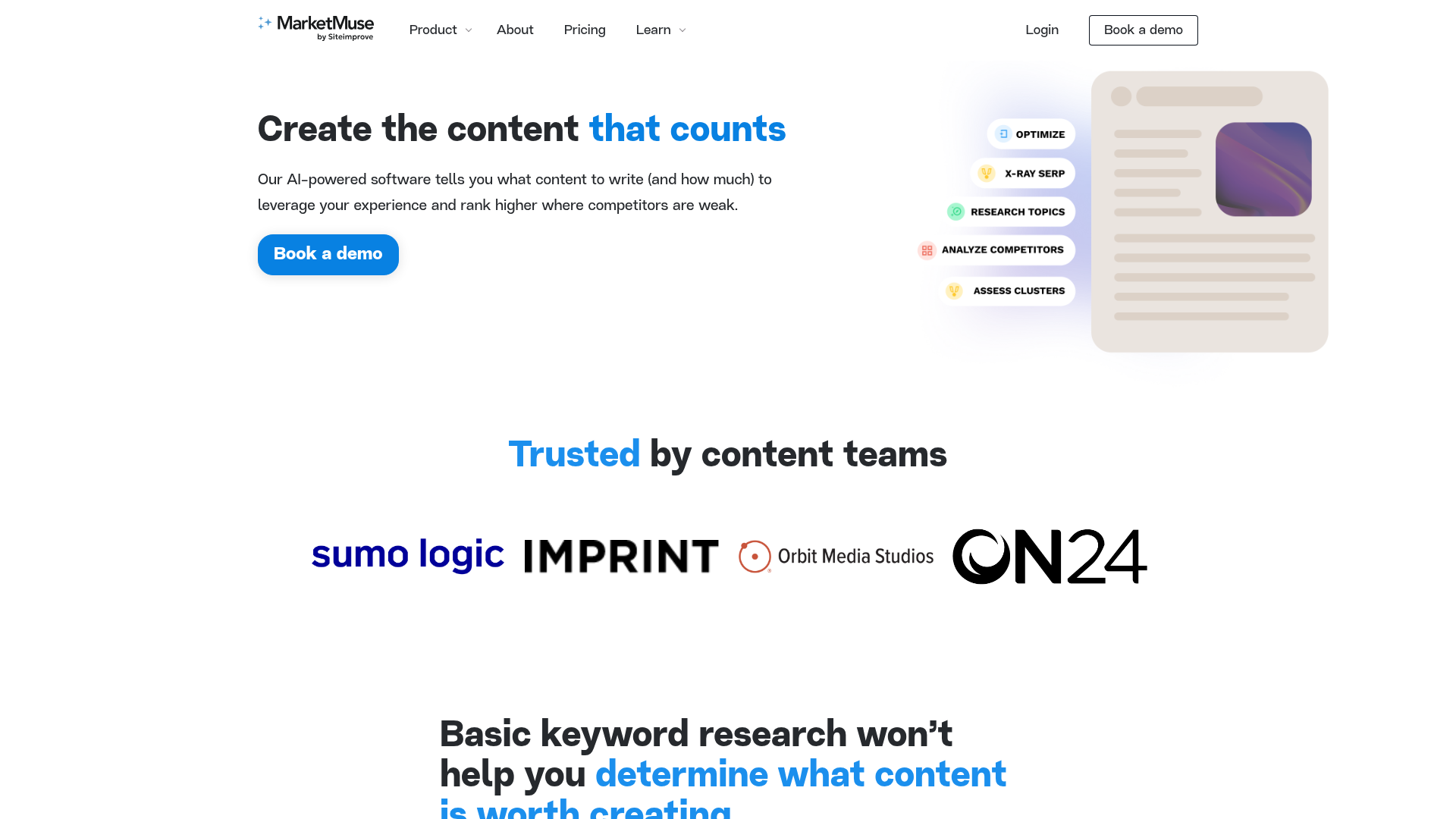
The Clearscope vs MarketMuse comparison often comes down to depth versus breadth. Where Clearscope focuses narrowly on content scoring, MarketMuse goes deep on content strategy, planning, and topical analysis.
What MarketMuse does well:
MarketMuse excels at helping enterprise teams understand their content landscape at scale. Content planning features include keyword research, competitor research, SERP research, content audits, and content inventories with personalized metrics like Topic Authority, Personalized Difficulty, Content Score, and Competitive Advantage.
The content brief system is one of the most customizable available. It supports multiple brief types (article, news, FAQ, how-to, and more) with deep customization options for POV, tone, style, and intent, and exports to Google Docs or Word. Cluster analysis and large-scale content management workflows help teams map their topical coverage and identify gaps.
Competitive analysis tools let teams compare their pages against top-ranking content and identify specific gaps. SERP Heatmap, Site Heatmap, Topic Navigator, Keywords, and SERP X-ray provide multiple lenses for understanding search landscapes. MarketMuse has also discussed Answer Engine Optimization (AEO) as a concept on its blog, signaling awareness of the AI search shift.
Where it falls short:
MarketMuse is deep on strategy and planning but lacks an execution layer. There is no CMS publishing integration, no AI search visibility tracking across ChatGPT, Google AI Mode, Perplexity, or AI Overviews, and no brand governance features like style guides or knowledge bases. Bulk content refresh workflows and visual workflow builders are also absent.
This means teams using MarketMuse for strategic planning will need separate tools for content production, optimization, publishing, and AI search monitoring. For organizations with large content operations teams and established production workflows, that may be acceptable. For teams looking to consolidate their tool stack, the gap between MarketMuse's strategic depth and its execution capabilities is significant.
Best for: Enterprise content strategists who need deep topical analysis, content inventory management, and planning, and who have separate tools or teams for execution.
Pricing:
MarketMuse offers a Free tier and three paid tiers (Optimize, Research, Strategy). Dollar amounts for paid plans are not publicly listed on the pricing page. The page displays feature comparisons across tiers but requires contacting MarketMuse for pricing.
Semrush: Best For Teams Already In The Semrush Ecosystem Needing AI Visibility
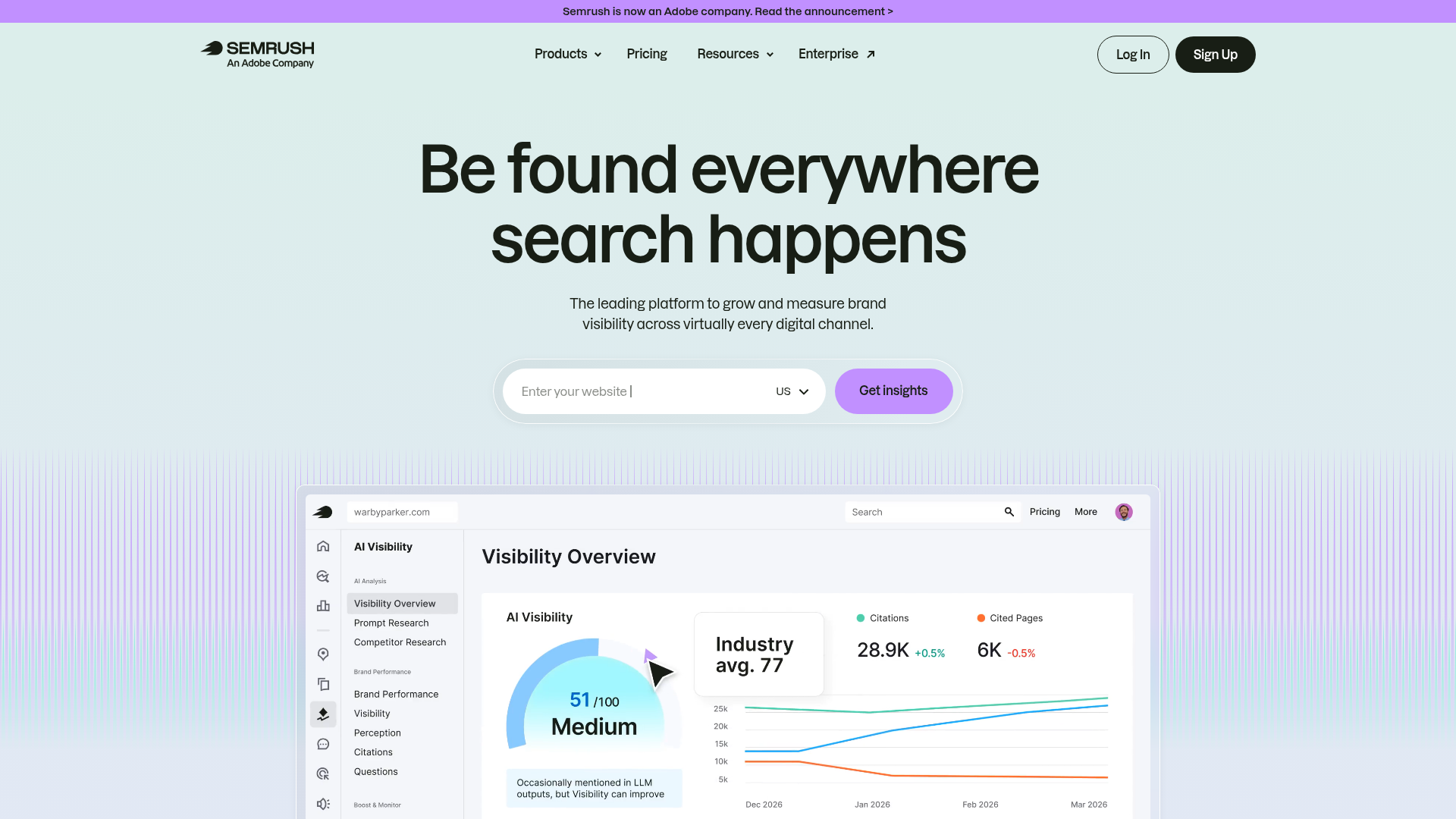
Semrush is not a direct Clearscope competitor in the content optimization sense. It is a comprehensive SEO suite that has added substantial AI search visibility capabilities. For teams already invested in Semrush, the AI visibility layer may reduce the need for a separate content optimization tool.
What Semrush does well:
The AI search tracking capabilities are extensive. Semrush tracks visibility across ChatGPT, Google AI Mode, Gemini, and AI Overviews, providing metrics including AI Visibility Score, Mentions, Citations, Cited Pages, Monthly Audience, and Average Position. Brand Performance reports show share of voice and sentiment across AI platforms, and Competitor Research benchmarks AI visibility against up to four competitors.
Prompt Research lets teams explore prompts and topics across AI platforms, which is valuable for understanding how AI systems frame questions in your category. Position Tracking covers Google Search, AI Overviews, ChatGPT, and AI Mode in a unified view. Domain Overview provides a snapshot that combines AI visibility with traditional SEO metrics.
The AI Search Site Audit (AI Search Health) assesses technical readiness for AI search, including structured data and llms.txt compliance. Enterprise AIO features add Share of Voice, Mentions, Brand Visibility, Sentiment, concept analysis, and ChatGPT Shopping metrics. The Traffic and Market Toolkit includes an AI Traffic Report that estimates traffic referrals from AI platforms, and My Reports integrates with GA4 to filter AI referral traffic. Semrush also offers a free AI Search Visibility Checker for ChatGPT, Gemini, and Google AI Overviews.
Where it falls short:
Semrush provides deep AI visibility intelligence but is not a content execution platform. There is no CMS publishing, no workflow automation or visual workflow builder, no Brand Kit or style guide enforcement, and no bulk content refresh workflows. Teams using Semrush for AI visibility insights will still need separate tools to draft, optimize, and publish content at scale.
The SEO Writing Assistant is part of the broader Semrush platform (available on Guru and above in SEO Classic), but it functions as a content scoring feature within a larger SEO suite rather than a standalone content optimization tool.
Best for: Teams already invested in the Semrush ecosystem who want to add AI search visibility tracking to their existing SEO workflow. Also strong for competitive intelligence across both traditional and AI search.
Pricing (SEO Classic):
Pricing (Semrush One, AI-focused bundle):
NeuronWriter: Best For Solo SEOs And Freelancers On A Budget
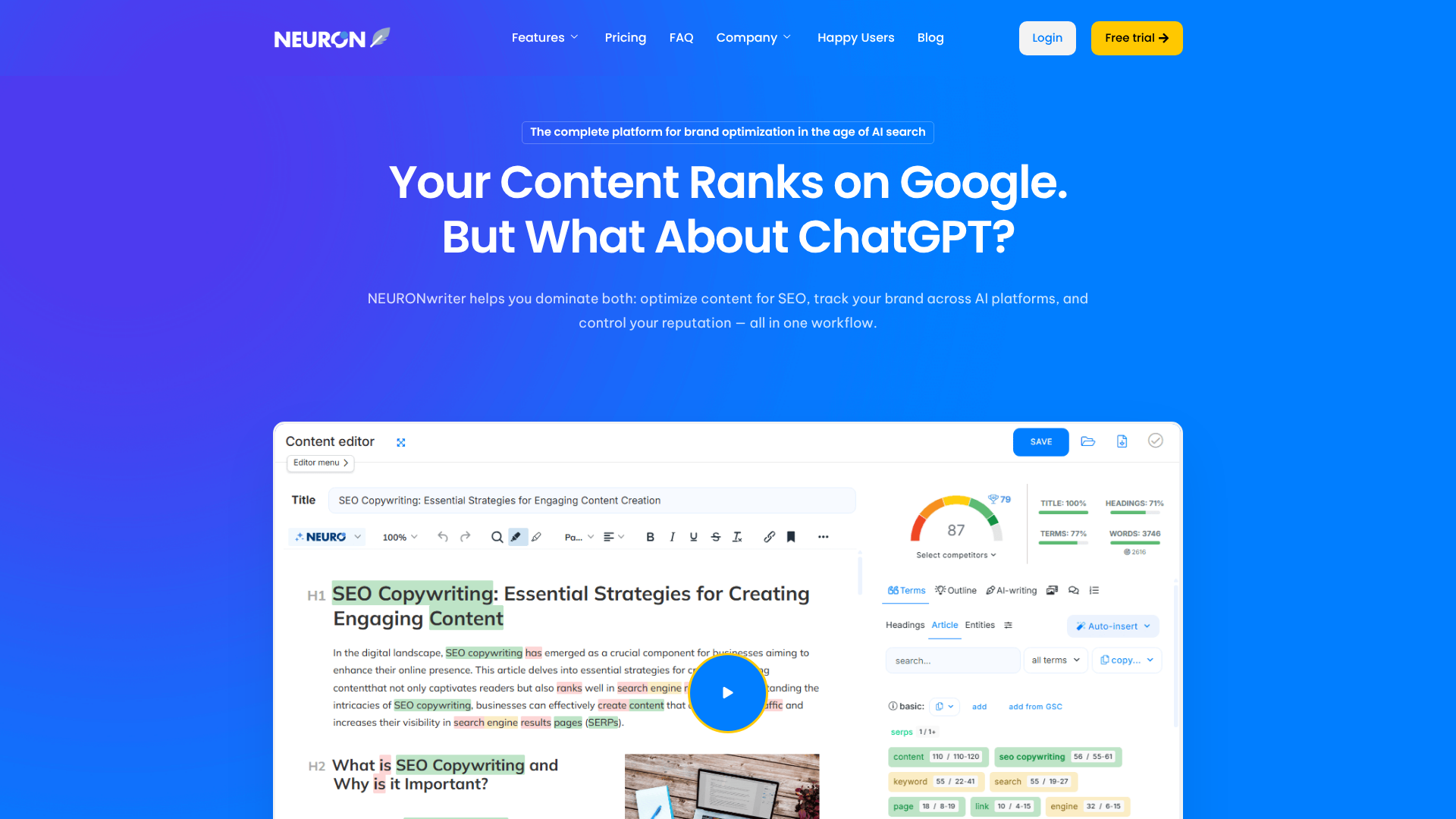
If you are a freelancer or solo SEO evaluating a cheaper alternative to Clearscope, NeuronWriter deserves serious consideration. It packs a surprising amount of capability at a price point that undercuts most competitors in this roundup.
What NeuronWriter does well:
The content optimization core is solid. NLP Terms suggest words and phrases based on top competitors in Google, and Entities identification covers key entities across 19 languages. The Content Designer offers AI-powered article generation with automatic titles, descriptions, headings, fact extraction, and style/tone customization. Autoinsert Terms automatically replaces overused terms with synonyms to improve vocabulary diversity.
What sets NeuronWriter apart at its price point is AI Visibility tracking. It monitors brand visibility across ChatGPT, Perplexity, Google AI Overviews, and Google AI Mode, providing an AI Score, prompt suggestions, gap analysis, visibility trends, and deep analysis. Many tools costing three to five times more do not offer this.
Additional features include WordPress integration with one-click export, import, and scheduling via Chrome extension, Shopify integration, Google Search Console integration, AI Image Generation, a Plagiarism Checker, Internal Link Suggestions using GSC and AI, and the Neuro AI assistant for in-editor operations like paraphrasing, keyword insertion, meta title/description generation, headings, FAQ creation, tone adjustments, and multilingual support. Advanced SERP Analysis, competitor analysis, and real-time feedback round out the optimization workflow. AI Profile extraction pulls project overviews, products/pricing, personas, and brand voice from websites or documents. Fact Extraction pulls key facts from competitor pages into structured drafts. Planning and team workflow features allow assigning team members, setting deadlines, and choosing delivery formats (DOCX, HTML, WordPress export).
Where it falls short:
NeuronWriter does not offer brand governance features such as style guides, tone rules, knowledge bases, or review workflows. CMS publishing is limited to WordPress and Shopify, with no Webflow support. There is no visual workflow builder with conditional logic, and bulk content refresh workflows at the scale of dedicated content engineering platforms are not available.
For a solo practitioner or small team, these gaps may not matter. For a scaling B2B SaaS team managing content across multiple platforms with brand consistency requirements, NeuronWriter will eventually feel constrained.
Best for: Solo SEOs, freelancers, and small teams who want content optimization with AI visibility tracking at an accessible price point.
Pricing:
Outranking: Best For AI-Assisted Content Drafting With SEO Guidance
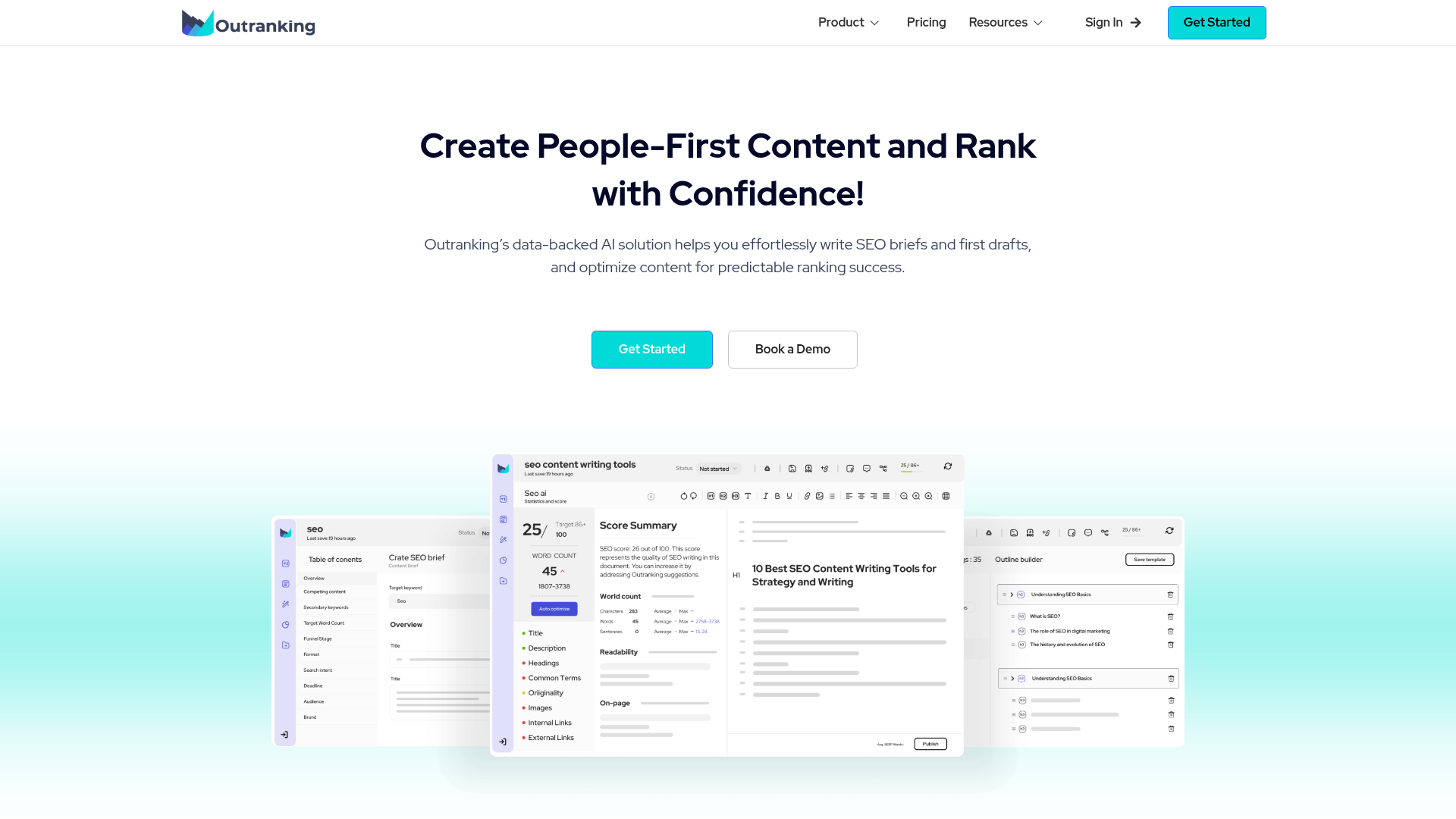
Outranking occupies an interesting position in the Clearscope alternatives landscape. It is less of a scoring tool and more of an AI-assisted content production pipeline with SEO guidance built in.
What Outranking does well:
The AI Wizard generates titles and outlines, while Concepts™ collects and writes facts from ranking pages, giving writers a research foundation before they start drafting. SERP Analysis provides 360-degree competitive intelligence, and intent-based outlines use semantic terms, keywords, and SERP data to structure content around search intent.
AI Writing with GPT-4 and style guides produces first drafts with hyper-personalization options. Real-time SEO scoring provides continuous feedback as content develops. The automatic optimization wizard handles on-page content improvements, and a plagiarism checker and fixer catches issues before publishing.
Keyword clustering and grouping help teams plan content at the topic level rather than the keyword level, which aligns with how modern search engines evaluate topical authority. The content planner and inventory provide a centralized view of content assets. Internal linking suggestions, website content audit via sitemap crawl, and Heat Maps for keyword usage analysis add depth to the optimization workflow. Outranking supports 13 languages, offers team collaboration with quota assignment, and provides API access. Integrations include Google Docs and WordPress plugins.
Where it falls short:
Outranking does not track AI search visibility. There is no monitoring of ChatGPT, Perplexity, Google AI Overviews, or Google AI Mode. For teams adapting to AI-driven discovery, this is a meaningful gap. CMS publishing is limited to WordPress and Google Docs, and there are no brand governance features or visual workflow builders for large-scale content operations.
Best for: Content teams and writers who want AI-assisted drafting with built-in SEO guidance, particularly those working primarily in WordPress.
Pricing:
Page Optimizer Pro: Best For Technical On-Page SEO Testing
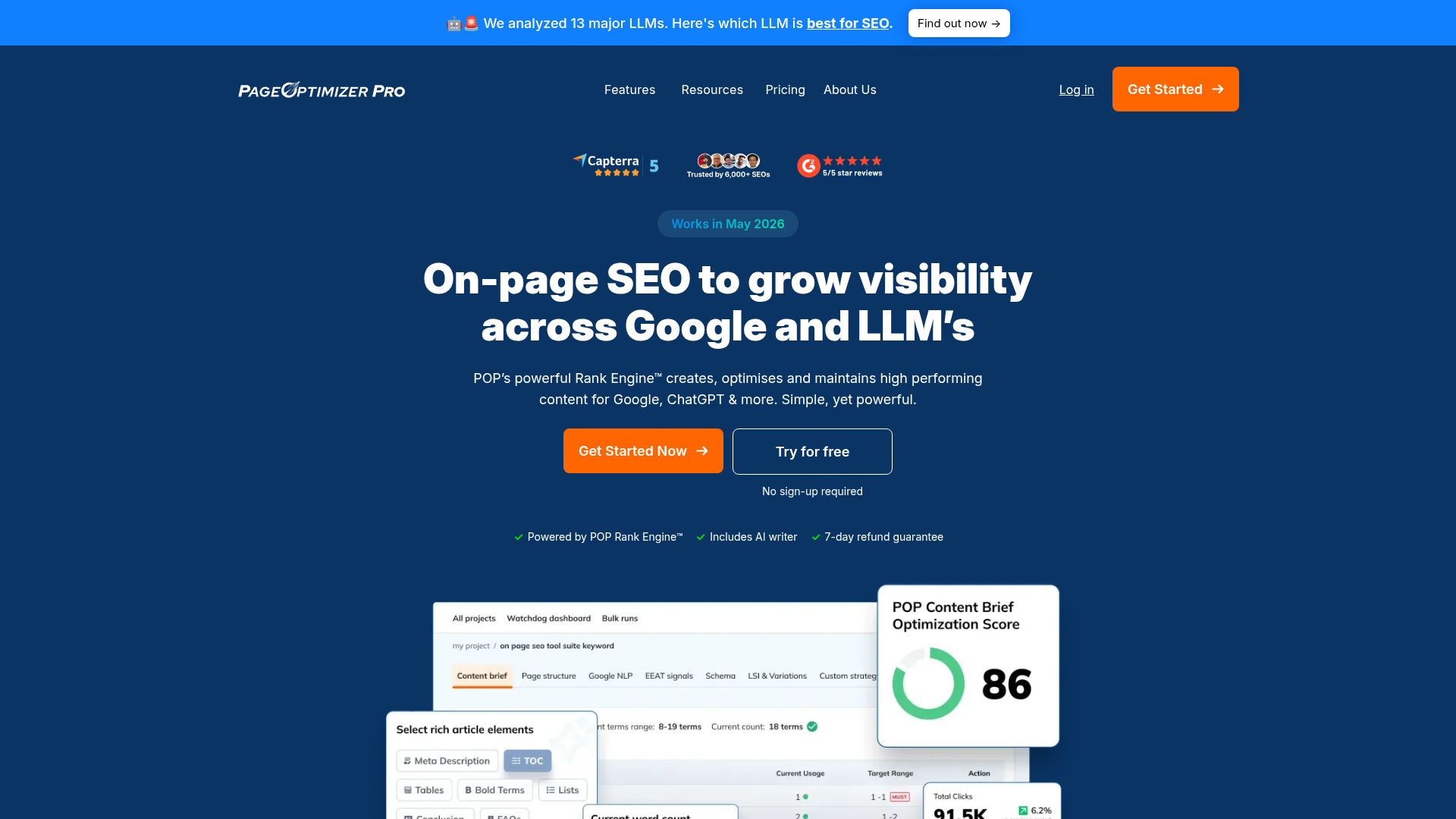
Page Optimizer Pro is the tool for SEOs who think in terms of entity gaps, EEAT signals, and schema markup rather than content scores and NLP term lists. It is the most technically oriented option in this comparison.
What Page Optimizer Pro does well:
Nextgen EEAT audits over 100 EEAT signals and provides actionable next steps, which is a depth of analysis most content optimization tools do not attempt. POP NLP identifies missing Google entities to improve how search engines understand a page. AI-powered Schema generates 70+ schema markups based on competitor analysis, automating what would otherwise be a tedious manual process.
The AI Writer offers four optimization levels (Minimal, Balanced, High, Maximum) with guided and auto writing modes that accept internal linking and brand voice inputs. The Silo Tool organizes keyword research into content clusters, with Custom Silo for advanced control and One-Click Silo for automated creation. POP Watchdog monitors SERP changes and provides actionable fixes when rankings shift.
Content Brief provides algorithm-based on-page SEO recommendations and scoring. The Chrome Extension integrates with Google Docs and web builders for live recommendations. Bulk optimization handles up to 50 pieces of AI-optimized content. Keyword Insights and Keyword Strategy tools support clustering and silo planning. The platform supports 61 languages and offers API access. POP Rank Engine™ provides AI-powered ranking analysis.
A note on AI search tracking: Page Optimizer Pro's marketing copy mentions that Rank Engine™ tracks visibility across Google and LLMs like ChatGPT. However, this is not confirmed as a detailed feature on the feature pages. Teams should verify this capability directly with Page Optimizer Pro before purchasing for AI search tracking purposes.
Where it falls short:
Page Optimizer Pro does not offer CMS publishing integration, brand governance features, or a visual workflow builder with conditional logic. There are no bulk content refresh workflows at the scale needed for large content operations. Teams needing a broader content system or AI search platform will need additional tools alongside Page Optimizer Pro.
Best for: Technical SEOs who want deep on-page analysis, EEAT auditing, and content silo planning. Strong fit for agencies and consultants focused on page-level ranking improvements.
Pricing:
Dashword: Correction — Outliner App
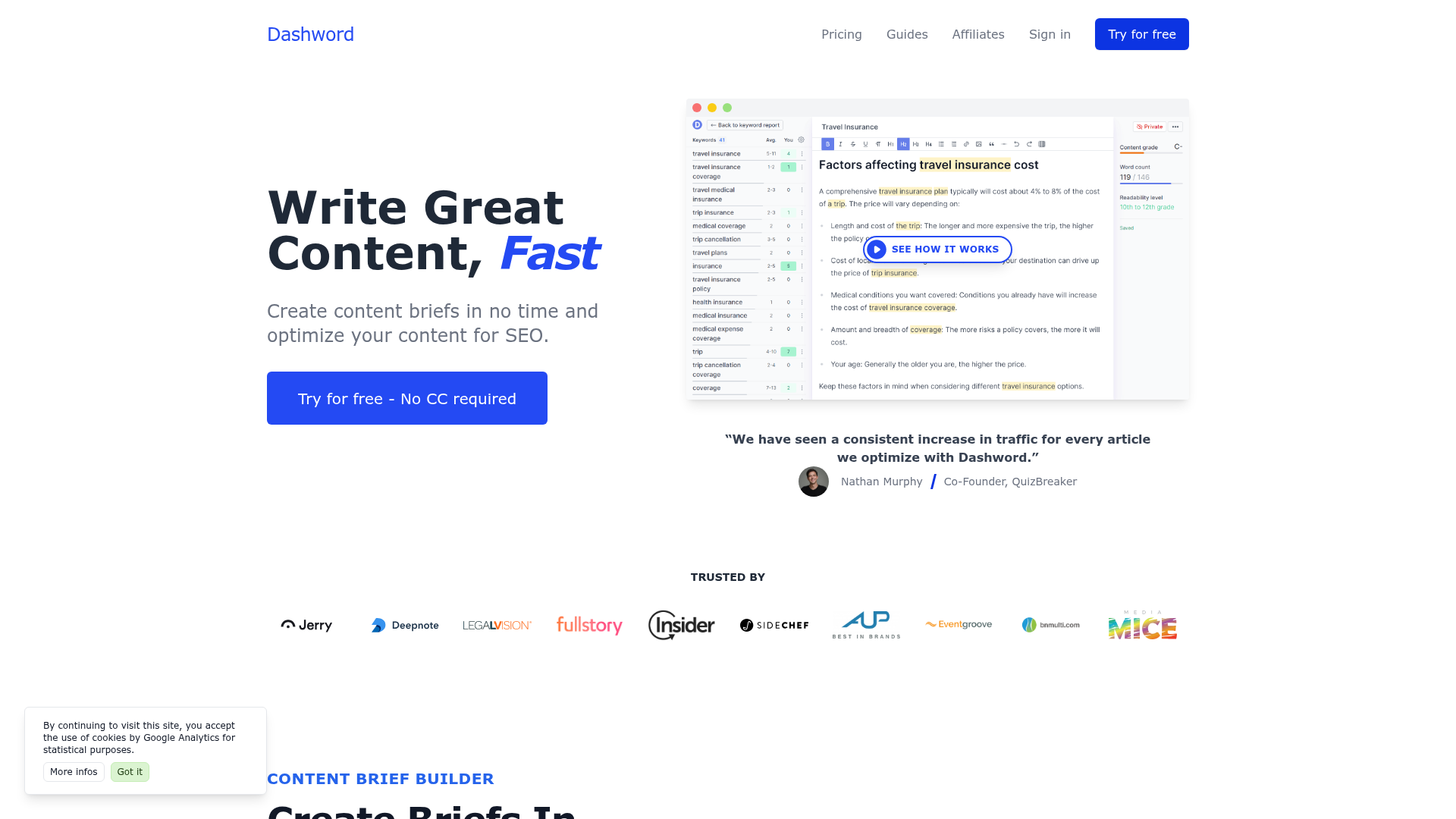
Dashword is a simple outliner app for structuring ideas, planning projects, and creating concepts. It offers a column view and classic outliner interface, text formatting, link insertion, shortcuts, and spell checking. Upcoming features include search, focus mode, favorites, tags, checklists, and real-time collaboration.
Dashword does not offer does not offer dedicated AI search visibility tracking (ChatGPT/Perplexity/AI Overviews), and CMS publishing is limited to a Google Docs add-on.
Dashword's Startup plan starts at $99/mo and its Business plan starts from $349/mo.
When Clearscope Is Still The Right Choice
Fairness matters in a comparison like this. Clearscope is not a bad tool. It is a focused one.
If a team's only need is content-level term optimization with a clean, distraction-free editor, Clearscope still delivers. The content grading is reliable, the NLP term suggestions are well-calibrated, and the interface is one of the most focused in the category. For writers who want to paste a draft, see a score, adjust their language, and move on, Clearscope does that job without unnecessary complexity.
Organizations already embedded in Clearscope's workflow with no need for AI search tracking, workflow automation, or CMS publishing may not need to switch. The tool works for what it was designed to do.
The question is whether what it was designed to do is still sufficient for what your team needs to accomplish. If the answer is yes, stay with Clearscope. If the answer is "we need more," the rest of this guide is for you.
How To Choose: A Decision Framework By Team Type
If You Are A Solo SEO Or Freelancer
Budget and simplicity matter most. You need a tool that helps you produce better content without a steep learning curve or a large monthly commitment.
Recommended: NeuronWriter (from $23/mo) offers content optimization with AI visibility tracking at the most accessible price point in this comparison. Frase (from $49/mo) provides a broader research-to-optimization workflow with CMS publishing. Outranking (from $19/mo) is the most affordable entry point for AI-assisted drafting with SEO scoring.
If You Are A Small Content Team (2 To 5 People)
You need collaboration features, decent content briefs, and enough workflow support that you are not stitching together five separate tools.
Recommended: Surfer SEO (from $59/mo) pairs strong on-page optimization with AI search tracking via the AI Tracker, and integrates with WordPress and Contentful. Frase (from $49/mo) covers research, optimization, AI search analytics, brand voice governance, and CMS publishing to Webflow, WordPress, and Sanity.
If You Are A Scaling B2B SaaS Team
This is where the gap between content optimizers and content engineering platforms becomes most apparent. A team managing 200+ published pages, running regular content refreshes, publishing to Webflow or WordPress, and trying to understand AI search visibility needs a system, not a scorer.
Recommended: Slate connects AI search visibility tracking across ChatGPT, Google AI Mode, AI Overviews, and Perplexity to workflow automation with 24+ AI models, bulk content operations via Power Sheets, brand governance through Brand Kit and Knowledge Base, and direct CMS publishing to Webflow and WordPress. Starts at $199/month.
If You Are An Enterprise Content Operations Team
Enterprise teams typically need content strategy depth, collaboration features, brand governance, and the ability to operate at scale without adding headcount proportionally.
Recommended: Slate for teams where the priority is execution, from AI search insight through content production to CMS publishing with brand governance at scale. MarketMuse for teams where the priority is strategic planning, topical analysis, and content inventory management, with separate tools or teams handling execution.
If You Are An Agency Managing Multiple Clients
Agencies need multi-site workflows, consistent brand governance across clients, and the ability to demonstrate value through reporting.
Recommended: Slate offers workflow automation across multiple sites, CMS publishing to Webflow and WordPress, and Brand Kit governance for maintaining consistency across client accounts. Surfer SEO serves agency use cases with its AI Tracker for visibility reporting, WordPress and Contentful publishing, and content optimization that clients can understand.
Conclusion: The Right Alternative Depends On What You Are Building
The best Clearscope alternative is not the one with the most similar feature set. It is the one that fits the content system your team needs to build.
If the need is simple content scoring, several tools in this comparison handle that well at various price points. If the need is understanding how AI platforms cite and surface content, tools with AI search tracking (Slate, Surfer SEO, Frase, Semrush, NeuronWriter) address that layer. If the need is moving from insight to published content through repeatable, scalable workflows with brand governance, the field narrows considerably.
The market has moved from content scoring to content engineering and AI search optimization. Teams still evaluating tools based solely on content grade accuracy are optimizing for a workflow that is already outdated. The more relevant question is: can this tool help us track where we appear in AI answers, produce citation-ready content at scale, and publish it without stitching together five other platforms?
Slate helps teams track AI search visibility, engineer citation-ready content, and scale organic growth with confidence. Book a demo to see how it works.
Frequently Asked Questions
What is the best Clearscope alternative in 2026?
The answer depends on workflow needs. For end-to-end AI search optimization and content engineering, Slate (starts at $199/mo) connects visibility tracking, content production, and CMS publishing in one platform. For on-page optimization with AI search tracking, Surfer SEO (from $59/mo) offers a strong content editor and AI Tracker. For research-to-optimization with CMS publishing, Frase (from $49/mo) covers a broad workflow. The right choice depends on whether a team needs an optimizer, a content system, or a full AI search platform.
Is there a cheaper alternative to Clearscope?
Yes. NeuronWriter starts at $23/mo and includes content optimization, NLP term suggestions, and AI visibility tracking. Outranking starts at $19/mo with AI-assisted drafting and SEO scoring. Frase starts at $49/mo with research, optimization, and CMS publishing. Note that lower-priced tools may lack workflow automation, brand governance, or the breadth of CMS integrations that scaling teams need.
What is the difference between a content optimizer and a content engineering platform?
A content optimizer scores individual pages against SERP competitors and suggests term improvements. A content engineering platform connects research, creation, optimization, publishing, and AI search tracking into repeatable workflows. Slate is an example of the latter. Its Workflows, Power Sheets, and CMS Publishing features enable teams to produce and refresh content at scale rather than optimizing one page at a time.
Can Surfer SEO replace Clearscope?
For on-page optimization, Surfer SEO offers similar functionality with a content editor, real-time scoring, and Auto-Optimize features. Surfer also offers AI Tracker for tracking visibility across ChatGPT, Gemini, AI Overviews, AI Mode, and Perplexity, a capability Clearscope does not have. However, Surfer does not appear to offer brand governance features, visual workflow builders with conditional logic, or CMS publishing beyond WordPress and Contentful.
Which Clearscope alternative is best for agencies?
Agencies managing multiple client sites should prioritize tools with multi-site workflows, CMS publishing, and scalable content production. Slate offers workflow automation, direct CMS publishing to Webflow and WordPress, and Brand Kit governance for maintaining consistency across clients. Surfer SEO serves agency use cases with its AI Tracker, WordPress and Contentful publishing, and content optimization capabilities.
Which Clearscope alternative is best for enterprise teams?
Enterprise teams typically need content strategy depth, collaboration features, brand governance, and scale. MarketMuse offers deep content strategy with personalized metrics, content inventories, and multiple brief types, though it lacks CMS publishing and AI search tracking. Slate offers end-to-end execution with Brand Kit governance, AI search visibility tracking, and workflow automation for large-scale content operations.
Do any Clearscope alternatives track AI search visibility?
Yes. Slate tracks brand visibility across ChatGPT, Google AI Mode, Google AI Overviews, and Perplexity. Surfer SEO's AI Tracker covers ChatGPT, Gemini, AI Overviews, AI Mode, and Perplexity. Frase offers AI Search Analytics across ChatGPT, Claude, Gemini, Perplexity, and other major AI platforms. Semrush provides AI visibility tracking across ChatGPT, Google AI Mode, Gemini, and AI Overviews. NeuronWriter also offers AI Visibility tracking across ChatGPT, Perplexity, AI Overviews, and Google AI Mode.
What is Answer Engine Optimization (AEO) and why does it matter?
AEO is the practice of optimizing content to be cited, summarized, and surfaced by AI-powered answer engines like ChatGPT, Perplexity, and Google AI Overviews. As these platforms increasingly mediate search, content that is structured, extractable, and authoritative has a visibility advantage over content that is merely keyword-optimized. Slate is built around this model, connecting AI search visibility tracking to content engineering workflows.
Which Clearscope alternative is best for scaling content production?
For teams that need to produce or refresh content at volume without adding headcount, Slate's Power Sheets enable bulk content operations across thousands of URLs, while Workflows automate multi-step content processes with 24+ AI models. Frase also supports programmatic SEO with batch content generation and multi-CMS publishing. Outranking offers AI-assisted drafting at scale with keyword clustering and content planning features.
Should I switch from Clearscope or add a complementary tool?
If the primary need is content scoring for individual pages, Clearscope may still work alongside a broader platform. If the team needs AI search tracking, workflow automation, CMS publishing, or brand governance, a platform like Slate replaces the need for Clearscope entirely rather than supplementing it. The decision comes down to whether the team's workflow has expanded beyond what a single-purpose optimizer can support.