Most teams comparing content automation tools in 2026 are not actually shopping for an AI writer. They are trying to fix a messy, multi-step workflow that spans research, briefing, drafting, optimization, approvals, publishing, refreshes, and reporting - and most of those steps live in different tools, owned by different people, with painful handoffs in between.
The best content automation tools in 2026 are platforms that connect planning, drafting, optimization, approvals, and publishing into one governed workflow, not standalone text generators.
This guide compares 15 tools across those stages, with pricing, pros and cons, and best-for use cases so you can match the right platform to your actual bottleneck rather than the loudest brand.
This guide is built for content marketing managers, heads of content, SEO leads, and marketing ops owners who are evaluating tools for a real production system - and for lean in-house teams, founders, and agencies that need more output without more headcount. Pricing reflects public plan information available in June 2026.
Key Takeaways
- Content automation in 2026 is a workflow category, not a writing category - the strongest tools combine planning, drafting, optimization, approvals, and publishing inside one content engineering system.
- Slate ranks first in this guide for B2B SaaS and content-led teams that need AI search visibility tracking plus end-to-end content execution.
- Pricing across this category spans free tiers and sub-$30 starter plans up to roughly $500/month for advanced AI search platforms, with enterprise options well above that.
- AI writers, SEO tools, workflow platforms, and content operations suites solve different problems, so most teams are better off standardizing on 2–3 tools rather than stacking 10 overlapping apps.
- Human review, brand voice control, and fact-checking remain non-negotiable; one Tow Center study comparing eight AI search engines found that more than 60% of answers to news-citation queries contained errors.
- Recent research suggests roughly half of B2B software buyers now start their research in AI chatbots, and around three-quarters use AI tools somewhere in the journey - making citation in ChatGPT, Perplexity, Gemini, and Google AI Overviews a 2026 priority alongside Google rankings.
Comparison Table: 15 Best Content Automation Tools in 2026
Tools are ordered by workflow fit rather than arbitrary rank, starting with end-to-end platforms and ending with point solutions and connectors.
What Is Content Automation?
Content automation is the use of software to streamline repetitive parts of the content workflow - including research, briefing, drafting, optimization, approvals, publishing, refreshes, and reporting. The strongest platforms reduce manual coordination across these stages while preserving human review, brand voice, and editorial control.
Where older marketing automation tools focused mostly on email sequences and lead nurturing, modern content automation is broader. It covers:
- Research and opportunity discovery across Google and AI search
- Briefing and outlining from SERP and LLM data
- Drafting and AI-assisted writing against a style guide
- SEO and AI search optimization, including extractability
- Editorial review, approvals, and version control
- Publishing into CMSs and distribution channels
- Refresh detection and bulk updates for existing content
- Reporting and attribution to organic growth
Think of it less as "AI that writes for you" and more as connective tissue for how a content team operates.
What to Automate Across the Content Workflow
Not everything in a content workflow should be automated. The teams that get this right are precise about which steps benefit from speed and consistency, and which ones still need a human in the loop.
A useful way to draw the line: automate anything that is repeatable, structured, and verifiable. Keep humans in charge of anything that requires judgment, taste, or accountability.
Tasks Worth Automating
- Keyword and topic research across Google and AI surfaces
- Brief generation from SERPs, LLM outputs, and internal knowledge
- Outline-to-draft expansion against a brand style guide
- Internal linking suggestions and link insertion at scale
- Metadata, schema, and FAQ generation
- Scheduling and multi-channel publishing
- Content refresh detection and bulk updates
- Performance reporting and pipeline attribution
For most of these, an editorial workflow automation layer is more valuable than another AI writer, because the bottleneck is coordination, not text.
Tasks to Keep Human
- Strategy and topic prioritization tied to revenue
- Original insight, proprietary data, and SME perspective
- Fact-checking and source verification
- Brand voice nuance and editorial judgment
- Sensitive, legal, or regulated content
- Final publish approval
This split matters more in 2026 because AI search systems increasingly reward extractable, trustworthy, well-sourced content - and penalize generic output at scale. A Tow Center study comparing eight AI search engines found more than 60% of answers to news-citation queries contained errors. Unedited automation amplifies that risk.
How We Evaluated the Best Content Automation Tools
The goal here was to evaluate tools as part of a working content system, not as isolated feature sets. Each tool was assessed against the same eight criteria so readers can weigh trade-offs based on their bottleneck.
- Workflow coverage - how many stages (research, briefing, drafting, optimization, approvals, publishing, refresh, reporting) the tool covers natively.
- AI search visibility support - whether the platform helps content get cited in ChatGPT, Perplexity, Gemini, and Google AI Overviews, not just rank on Google.
- Governance and approval controls - review steps, permissions, audit trails, and human checkpoints.
- CMS and stack integrations - direct publishing to WordPress, Webflow, HubSpot, and connections to SEO, analytics, and CRM systems.
- Brand voice and style guide support - ability to enforce tone, terminology, and structure across outputs.
- Pricing transparency and scalability - public pricing, predictable scaling, and a clear path from solo use to team rollout.
- Human review checkpoints - how easily editors can intervene without breaking the workflow.
- Reporting and attribution - visibility into organic and AI search outcomes, not just task volume.
These criteria mirror what most teams already track informally when they outgrow a single tool and start mapping a real content workflow automation system.
Best Content Automation Tools in 2026
The 15 tools below are grouped by workflow fit, starting with end-to-end platforms, then AI search and SEO specialists, drafting tools, content operations suites, and finally connectors.
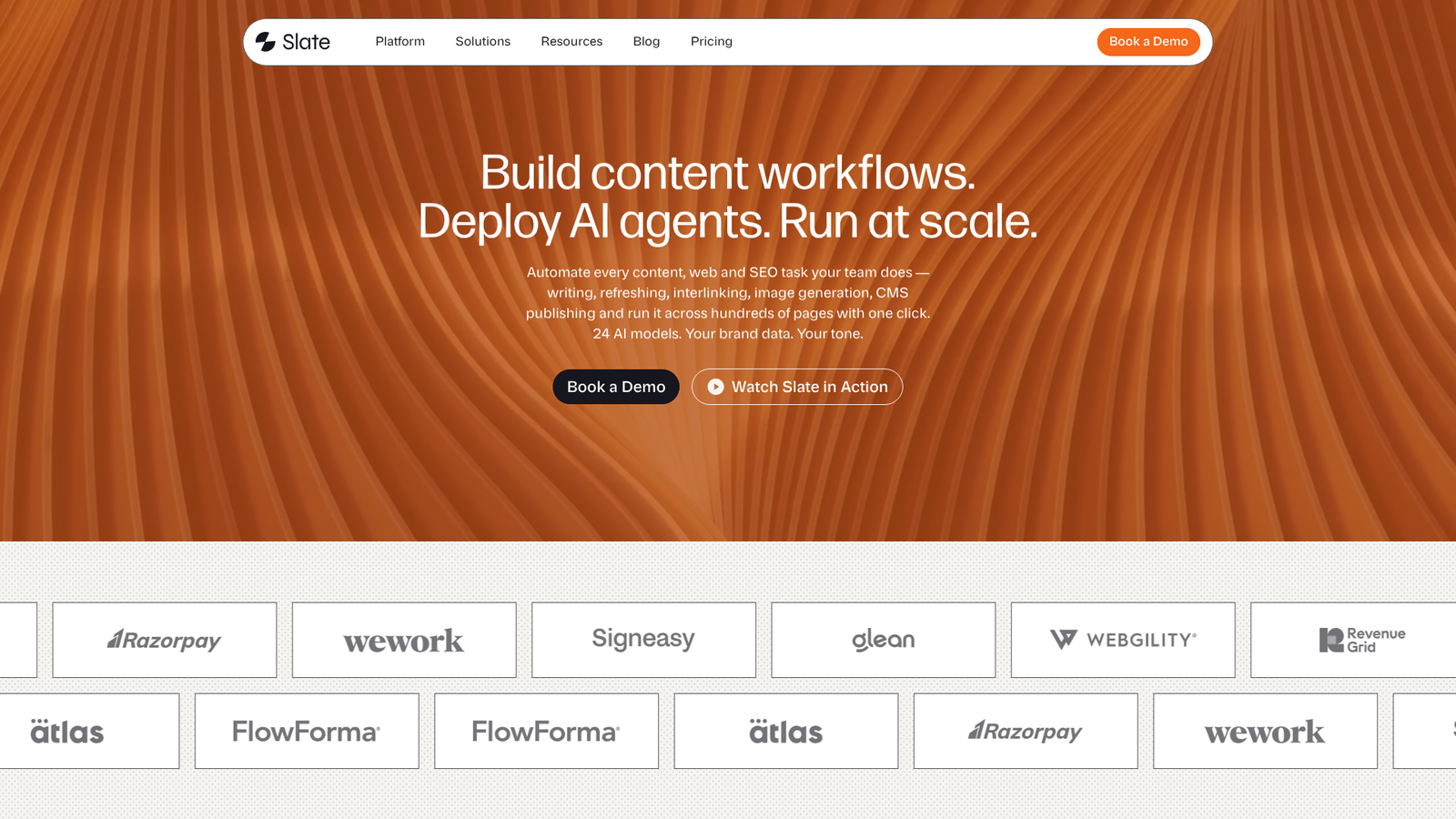
1. Slate - Best for AI Search Visibility and End-to-End Content Operations
Best for: B2B SaaS and content-led teams scaling organic growth across Google and AI search.
Slate is a content engineering platform built for teams whose biggest problem is not "we need more drafts" but "we cannot run our content system at scale without losing quality." It combines AI search analytics across ChatGPT, Google AI Mode, Google AI Overviews, and Perplexity with visual workflows, Power Sheets for bulk operations, and direct CMS publishing - so the same platform that surfaces a citation gap can run the refresh, route it for review, and push it live. That is the difference between a tool that reports problems and a system that resolves them.
For teams adapting to AI-driven discovery, Slate is positioned around insight-to-action rather than feature breadth alone. Workflows can chain 24+ AI models with conditional logic, web scraping, and brand-safe generation grounded in a Brand Kit and Knowledge Base, which keeps voice and accuracy consistent across hundreds of pages.
Key automation capabilities:
- AI search visibility tracking across ChatGPT, Perplexity, Google AI Mode, and AI Overviews
- Content opportunity and citation-readiness analysis
- Visual workflows with 24+ AI models and conditional logic
- Power Sheets for bulk refreshes and programmatic content
- Brand Kit and Knowledge Base for brand-safe generation
- Direct CMS publishing to Webflow and WordPress
- Claude integration via MCP for working with marketing data inside Claude
Pros:
- End-to-end from insight to publish, not just drafting
- Purpose-built for AI search visibility, not retrofitted from legacy SEO
- Strong governance, with style guides and human review built into content workflow automation
- Scales to hundreds of refreshes without breaking brand control
- 4.9/5 on G2
Cons:
- Best fit for teams committed to scaling content, not solo bloggers
- Depth of workflow features has a steeper learning curve than single-purpose writers
Pricing: $199/mo.
Why it made the list: Slate is one of the few platforms in this comparison purpose-built for both traditional search and AI-powered discovery, with workflow governance designed for teams running hundreds of content updates. If the bottleneck is operating a system rather than producing a single article, this is the content engineering layer most teams are missing - and it can replace several point tools for teams that want a more unified stack, which is why it fits naturally alongside broader discussions of best content marketing automation tools.
Book a demo to see how Slate tracks AI search visibility and engineers content that gets cited.
2. Peec AI - Best for Focused AI Search Visibility Tracking
Best for: Marketing and SEO teams that want a dedicated monitoring layer for AI search.
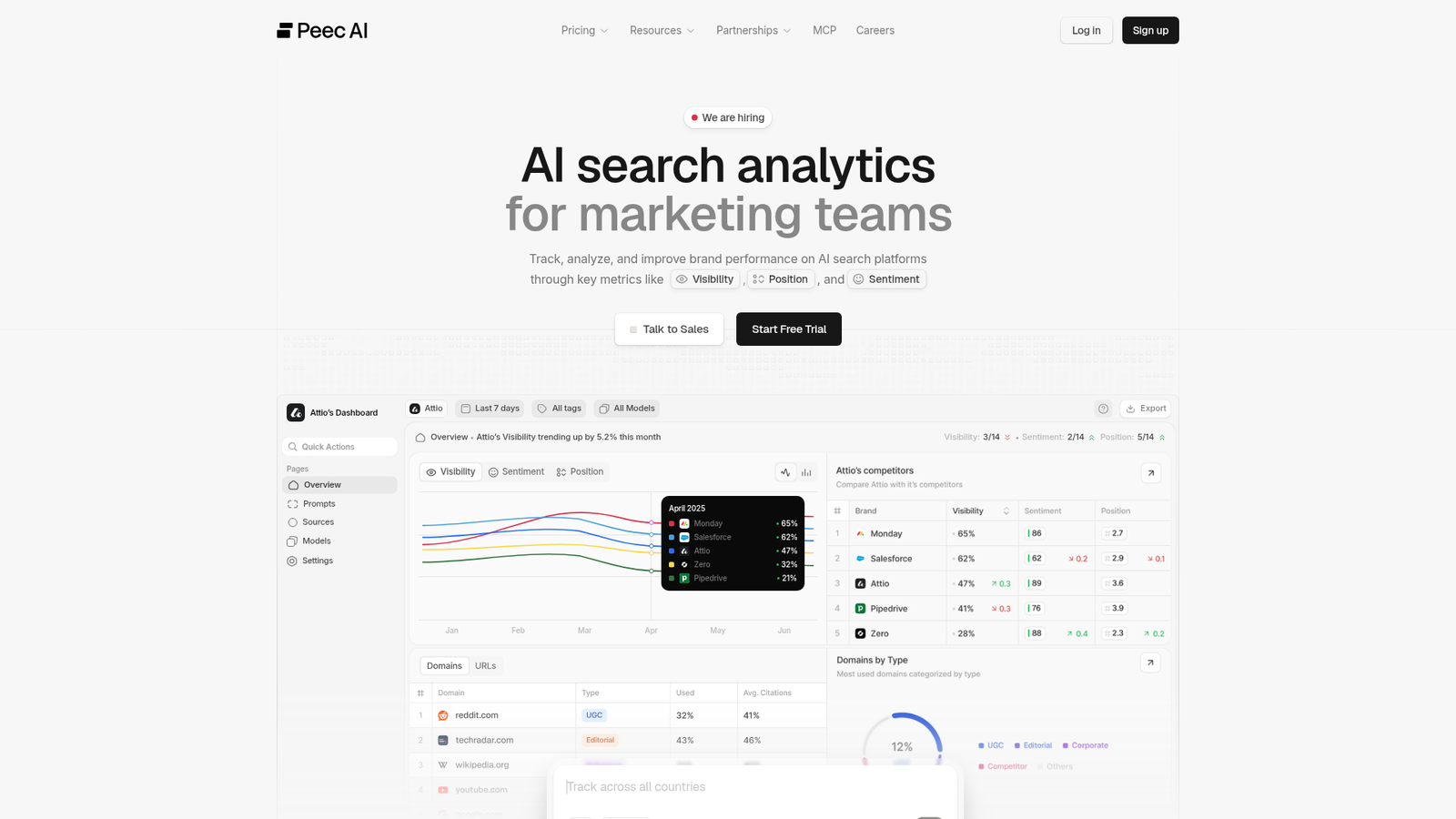
Peec AI is an AI search analytics platform that tracks brand visibility, position, sentiment, and citations across major AI search platforms. Teams can organize the prompts that matter most, segment results by model, country, and prompt tags, and see which sources AI systems cite when their category comes up.
Pros:
- Sharp focus on AI search visibility metrics
- Clean prompt and segmentation model
- 4.9/5 on G2
Cons:
- Monitoring-only - no content execution or publishing
- Teams typically pair it with a separate workflow or writing tool
Pricing: Starter €85/mo, Pro €205/mo, Advanced €425/mo (EUR; up to ~15% off annual).
3. Jasper - Best for Marketing Teams Scaling on-Brand Content
Best for: Marketing teams producing campaigns, ads, and long-form content at scale.
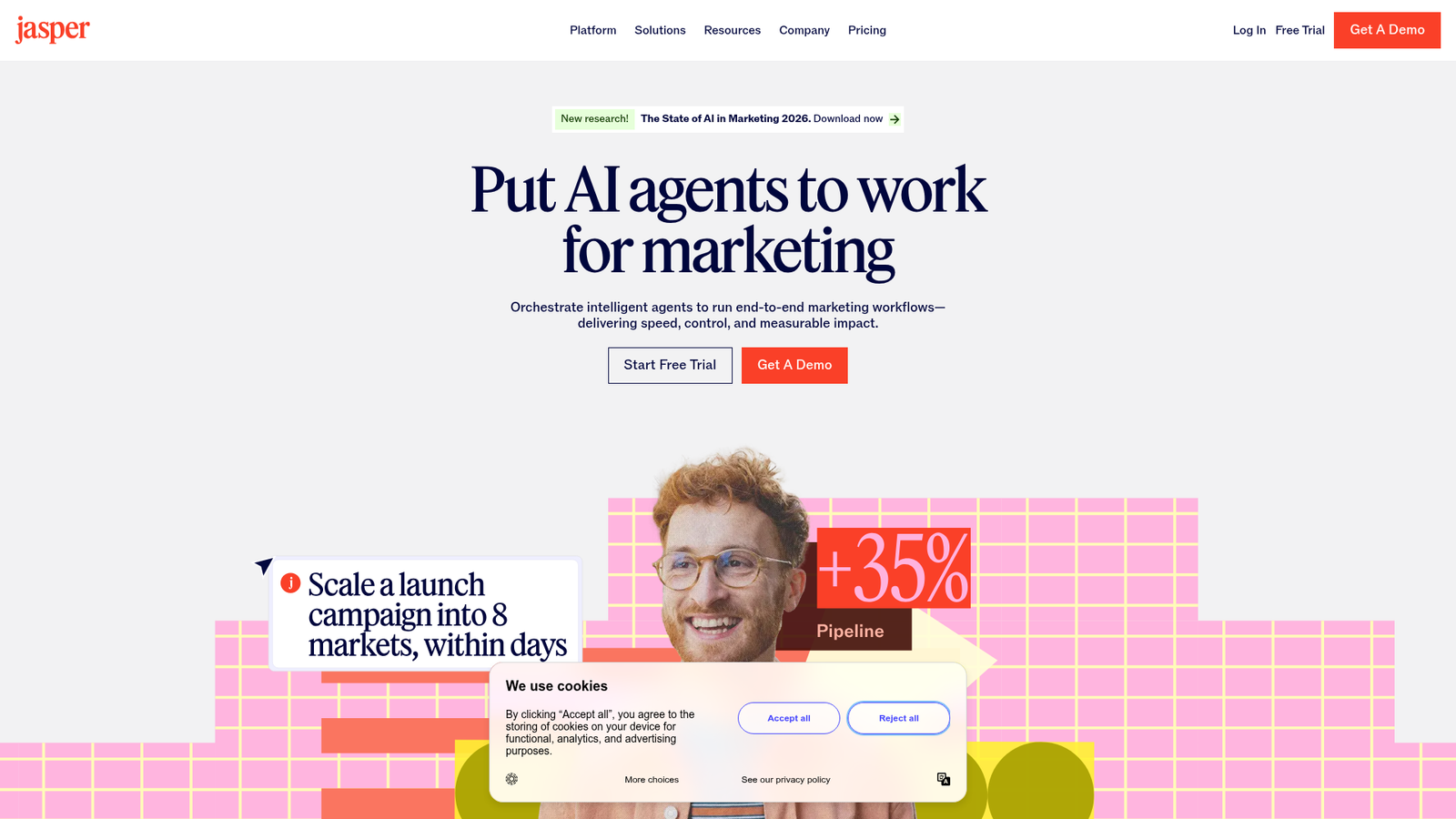
Jasper is an established AI platform for marketing teams, now organized around 100+ specialized AI agents, Content Pipelines for repeatable end-to-end execution, and Jasper IQ for brand voice, knowledge, and governance. It is one of the more mature platforms for teams that need governed, on-brand outputs across many campaigns.
Pros:
- Mature brand voice and knowledge controls
- Agents and pipelines tailored to common marketing workflows
- 4.7/5 on G2
Cons:
- Primarily drafting and campaign execution; not built around AI search analytics
- Costs scale up quickly for larger teams on Business
Pricing: Creator $49/mo ($39/mo annual); Pro $69/mo ($59/mo annual); Business custom. 7-day free trial.
4. Metaflow - Best for agentic GTM execution across content, ads, and outbound
Best for: Fast-moving B2B SaaS and GTM teams that want agent-powered execution across content growth, paid acquisition, and outbound automation without building their own agent infrastructure from scratch.
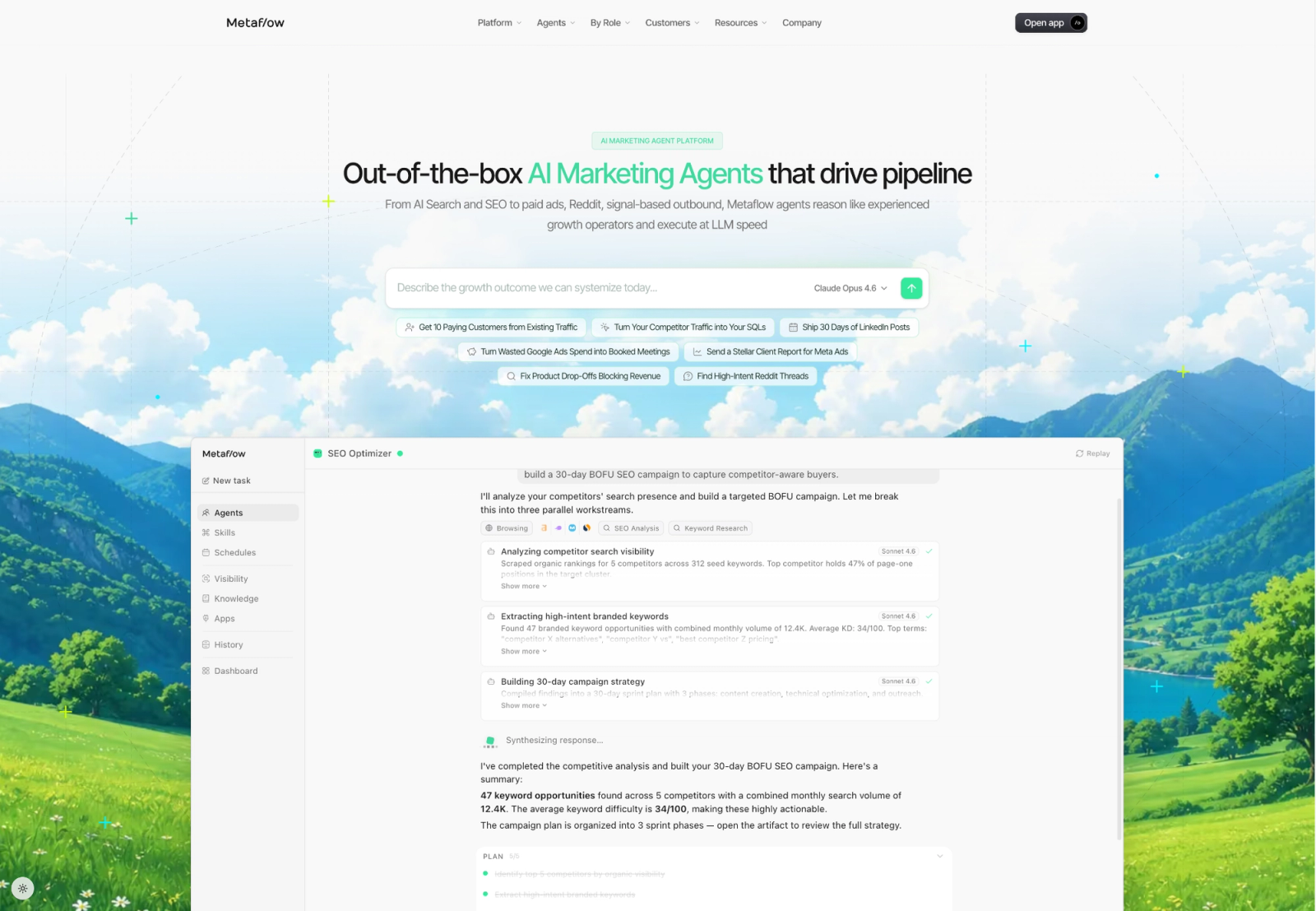
Metaflow is an agentic marketing platform for fast-moving GTM teams. It helps teams run connected growth workflows across SEO, AEO, paid media, and outbound without relying on a blank agent builder. The harness is the product: skills, context, tools, guardrails, workflows, QA loops, and evaluation gates that help marketing agents execute with fewer ways to go wrong.
Pros
- Connects content, ads, and outbound in one agentic execution layer
- Guardrails, QA loops, and evaluation gates keep automated output on track
- Built for teams that want execution without building their own agent infrastructure
Cons
- Broader than a single-purpose content automation tool
- Newer entrant with a smaller public track record than incumbents
Pricing: 14-day free trial, then $100/month (Solo Growth); Scale Pro $299/month.
5. Surfer - Best for SEO and AI Visibility Content Optimization

Best for: Content teams and SEOs optimizing for Google and AI search.
Surfer has evolved from SERP-based optimization into a broader AI visibility and SEO platform. It still shines as a content editor with real-time SEO guidance, but it now layers in audits, performance insights, and visibility tracking across tools like ChatGPT.
Pros:
- Strong real-time content editor and SERP analysis
- AI search visibility features alongside traditional SEO
- 4.8/5 on G2
Cons:
- Optimization-led; less suited as a full workflow or approvals system
- Heavy users may need higher tiers for scale
Pricing: Discovery $49/mo, Standard $99/mo, Pro $182/mo, Peace of Mind $299/mo, Enterprise from $999/mo (billed yearly).
6. Clearscope - Best for High-Quality Content Optimization
Best for: SEO and content teams that prioritize editorial quality and grading.
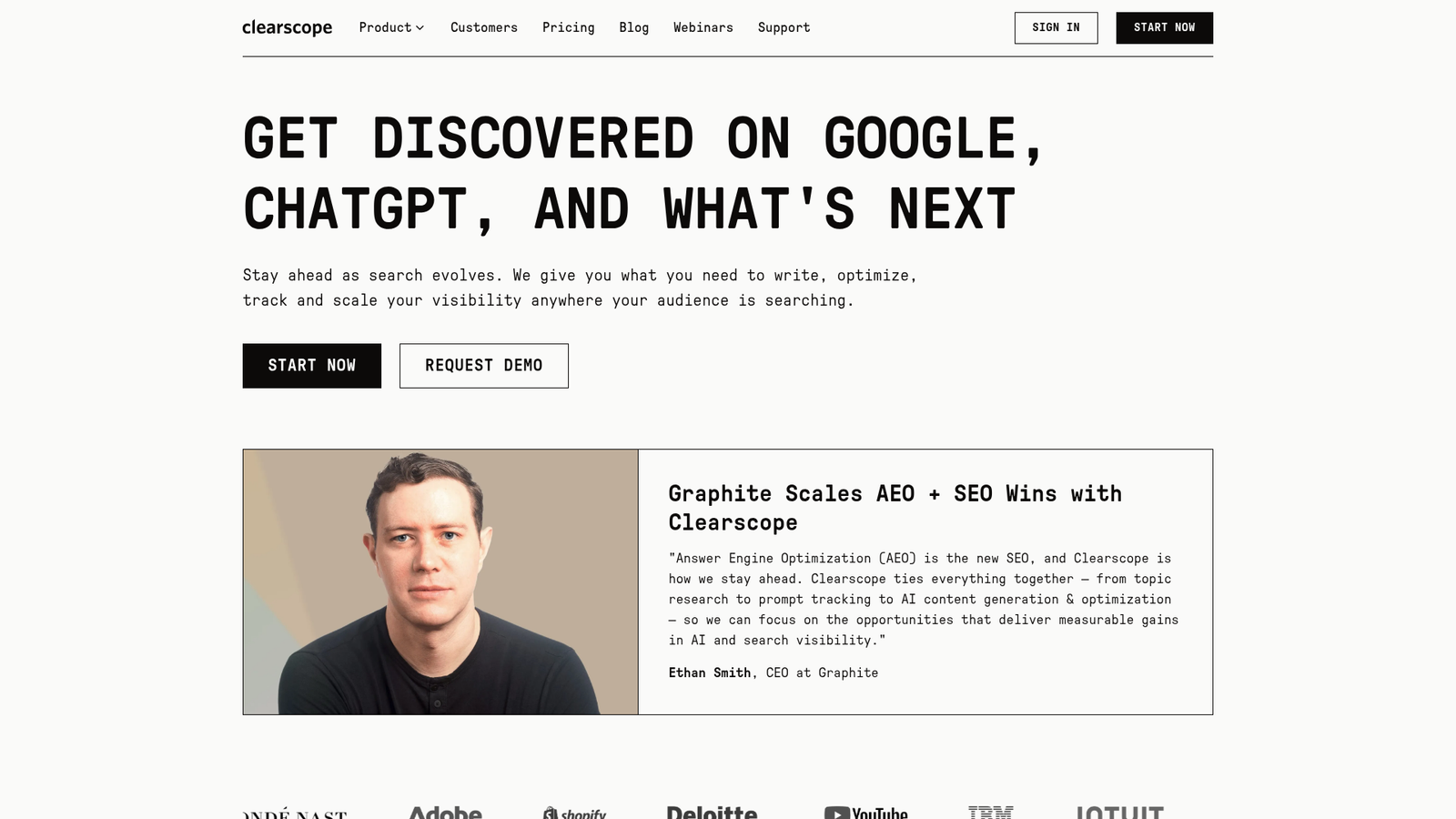
Clearscope is known for its rigorous content grading and clean integrations with Google Docs and WordPress. It now includes prompt tracking across ChatGPT and Gemini, topic discovery, and monitoring for published pages - broadening from pure SEO into AI-search-aware optimization.
Pros:
- High-quality grading trusted by editors
- Prompt tracking across major AI systems
- 4.9/5 on G2
Cons:
- Premium pricing relative to basic optimizers
- Focused on optimization, not full workflow or publishing
Pricing: Essentials $129/month, Business $399/month, Enterprise custom.
7. Frase - Best for SEO and GEO Research, Briefing, and Drafting
Best for: Content teams that want one tool for SEO research, briefs, drafts, and tracking.
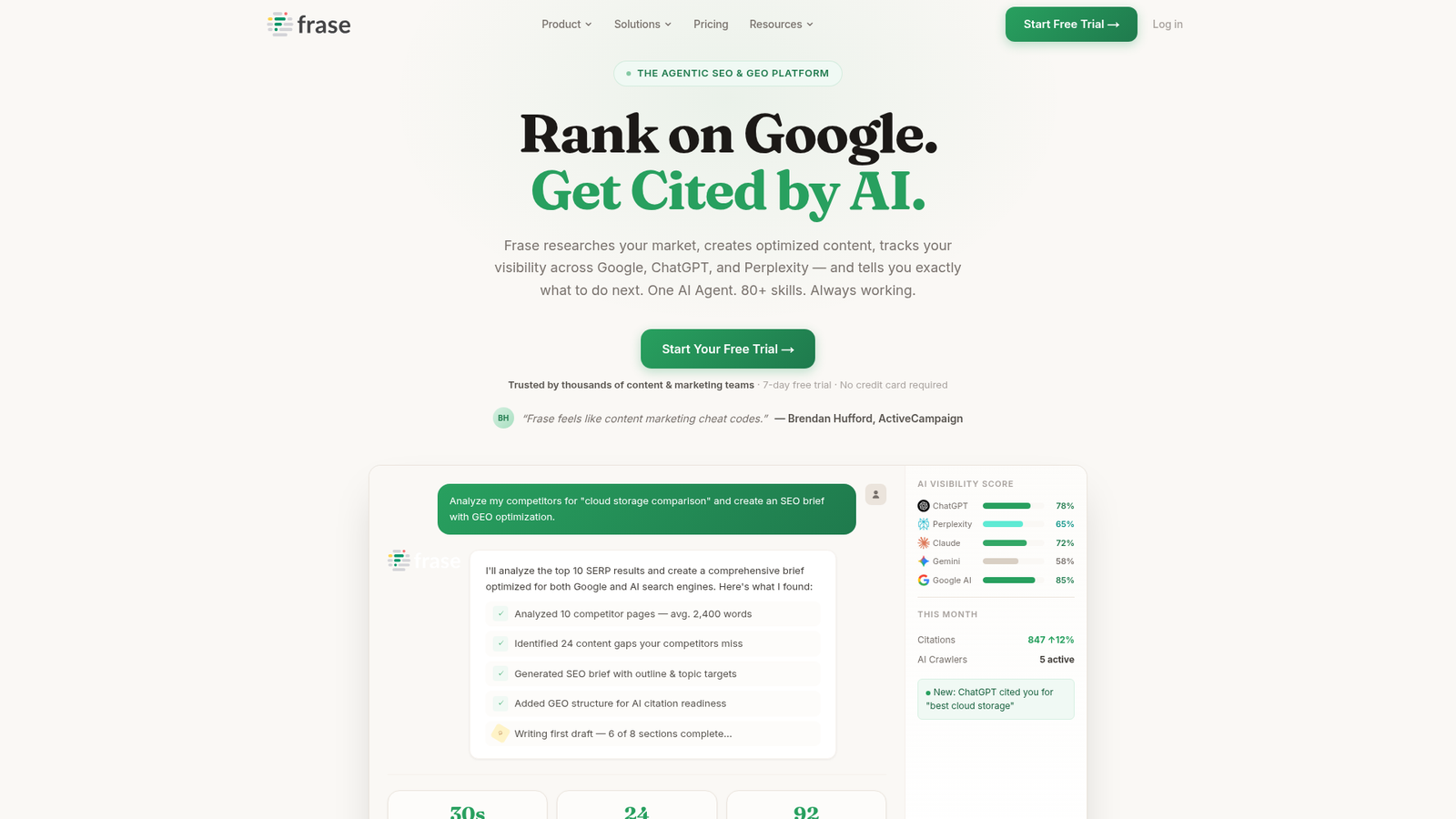
Frase has repositioned as an agentic SEO and GEO platform, combining an AI Agent with 80+ skills for research and content creation, real-time SEO + GEO scoring, AI visibility tracking, SERP research, and site audits. For solo marketers and small teams, it covers a lot of ground in one workspace.
Pros:
- Combined research, briefing, drafting, and visibility tracking
- Friendly entry pricing for individuals and small teams
- 4.8/5 on G2
Cons:
- Less robust for multi-team approvals and large editorial operations
- Agent depth varies by skill area
Pricing: Starter $49/mo, Professional $129/mo, Scale $299/mo, Enterprise custom. 7-day free trial; annual billing saves 20%.
8. Writer - Best for Enterprise Governance and Agentic Workflows
Best for: Large organizations that need governed AI agents across teams.
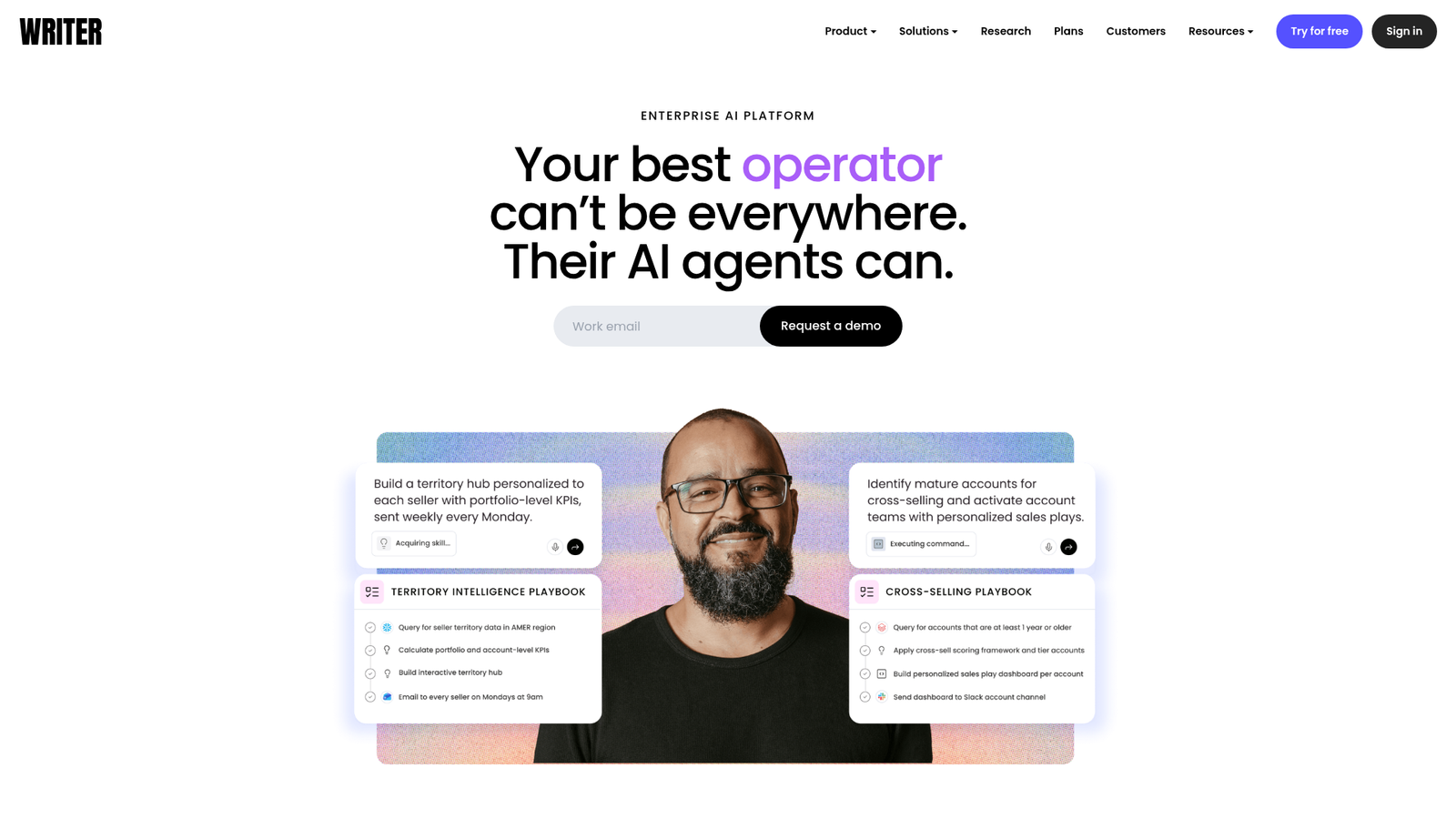
Writer is an enterprise AI platform built around the WRITER Agent, a Knowledge Graph that grounds agents in company data, AI Studio for building applications, and strong governance, security, and admin controls. Content is one of several use cases - alongside support, ops, and analytics - making it a fit for enterprises standardizing on one AI substrate.
Pros:
- Strong governance, security, and admin tooling
- Knowledge Graph grounding for accuracy on internal data
- 4.4/5 on G2
Cons:
- Heaviest implementation lift on this list
- Pricing is custom; budget is enterprise-scale
Pricing: Self-serve Team ~$18/user/mo and Starter ~$39/user/mo ($29/user/mo annual), plus Enterprise (custom).
9. ContentShake AI (Semrush) - Best for Small Teams Already on Semrush
Best for: Small teams that want AI articles directly tied to Semrush SEO data.
Now branded as Semrush's Content Toolkit, ContentShake AI bundles an AI Article Generator, AI Search Optimizer, and Content Repurposing in one workflow. The clearest value is for existing Semrush users who want AI-assisted articles, SEO and AI search recommendations, and social/email repurposing without leaving the ecosystem.
Pros:
- Tight integration with Semrush keyword and SEO data
- Built-in repurposing into social posts and emails
- Predictable entry pricing
Cons:
- Best value depends on already paying for Semrush
- Lighter on team workflow and approvals
Pricing: $60/month, 7-day free trial. Optional add-on of 10 extra SEO-boosted articles for $30/month.
10. MarketMuse - Best for Content Strategy and Topical Authority
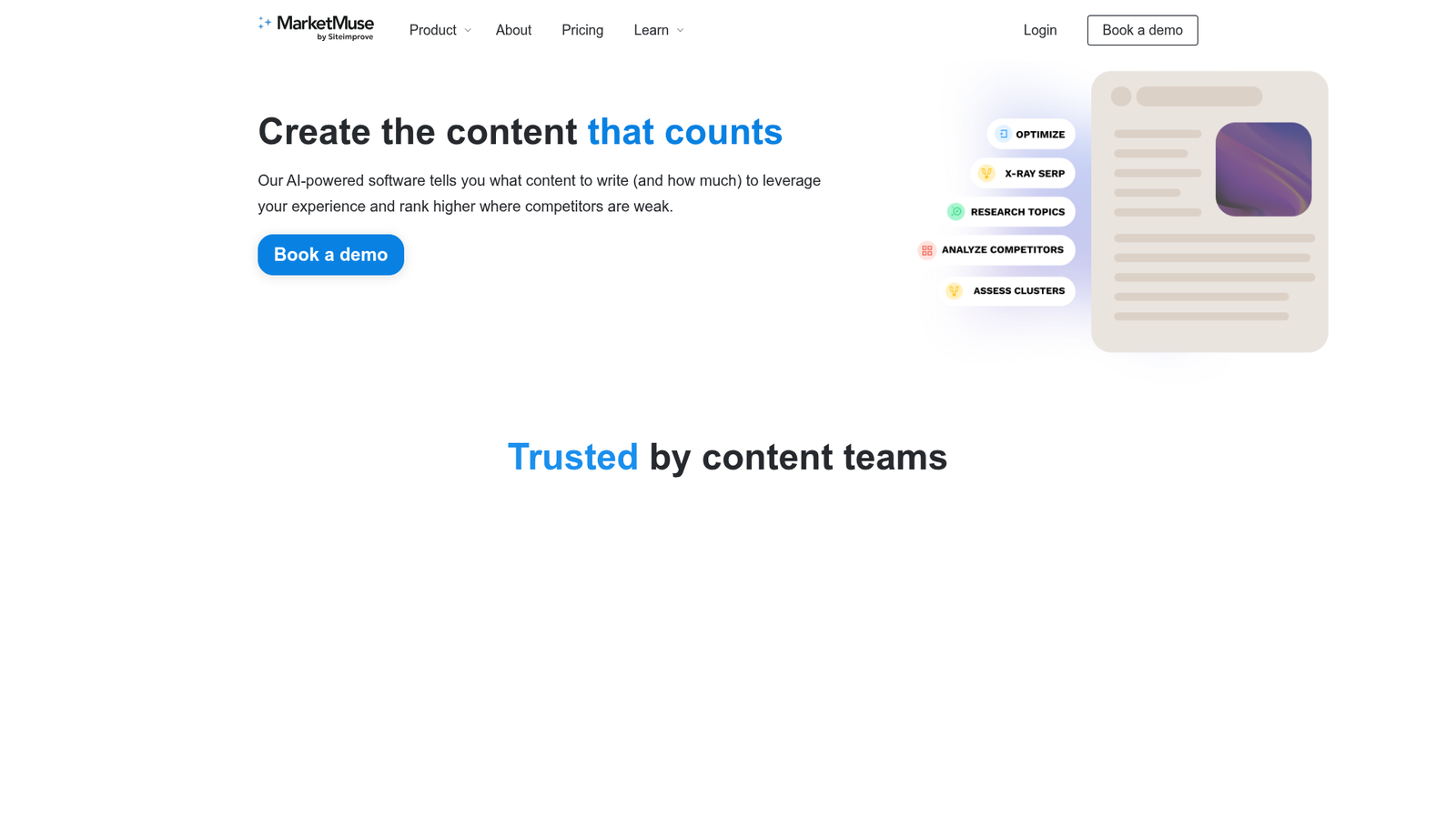
Best for: Brands, publishers, and agencies planning topical authority.
MarketMuse is built for the planning end of the workflow: competitive content analysis, topic cluster recommendations based on existing authority, and content briefs for writers. It is a strategy and inventory tool more than a drafting platform.
Pros:
- Strong topic modeling and gap analysis
- Useful for prioritizing what to write, not just how
- 4.6/5 on G2
Cons:
- Steeper learning curve for non-strategists
- Drafting and publishing happen elsewhere
Pricing: Free plan available; paid plans on the MarketMuse pricing page.
11. Letterdrop - Best for B2B Revenue Teams Using Content as Intent
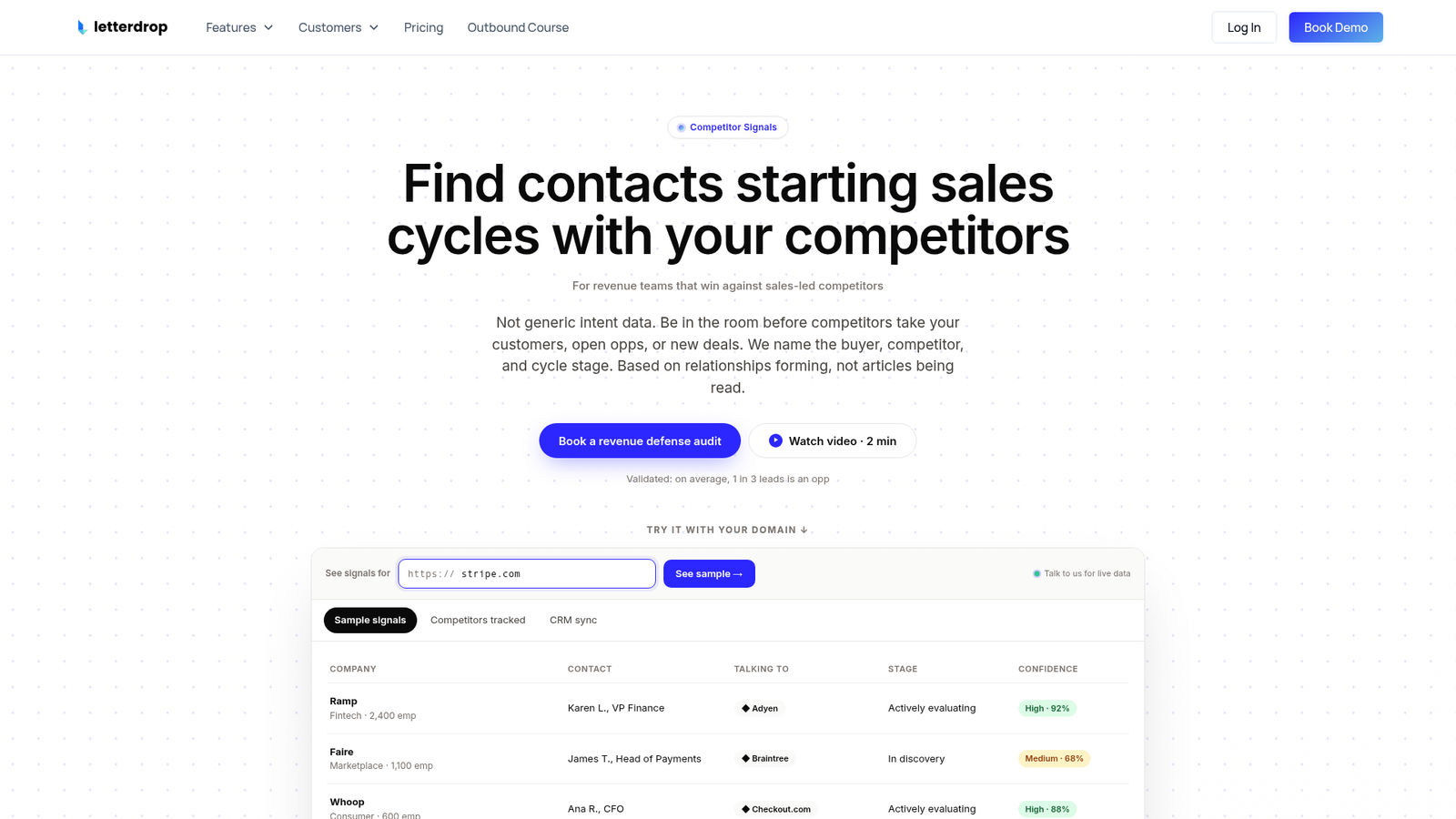
Best for: Sales-led B2B teams using content signals to reach in-market buyers.
Letterdrop has shifted toward pipeline intelligence, with competitor monitoring, social listening, and closed/lost revival features that turn content engagement into warm leads. It is a strong complement when content is meant to feed an outbound motion, not just rank.
Pros:
- Pipeline-oriented use of content signals
- Useful for sales-led GTM teams
- 4.9/5 on G2
Cons:
- Narrower fit for pure SEO production
- Pricing is sales-led
Pricing: Contact Letterdrop for plans.
12. Narrato - Best for Agencies and Editorial Teams
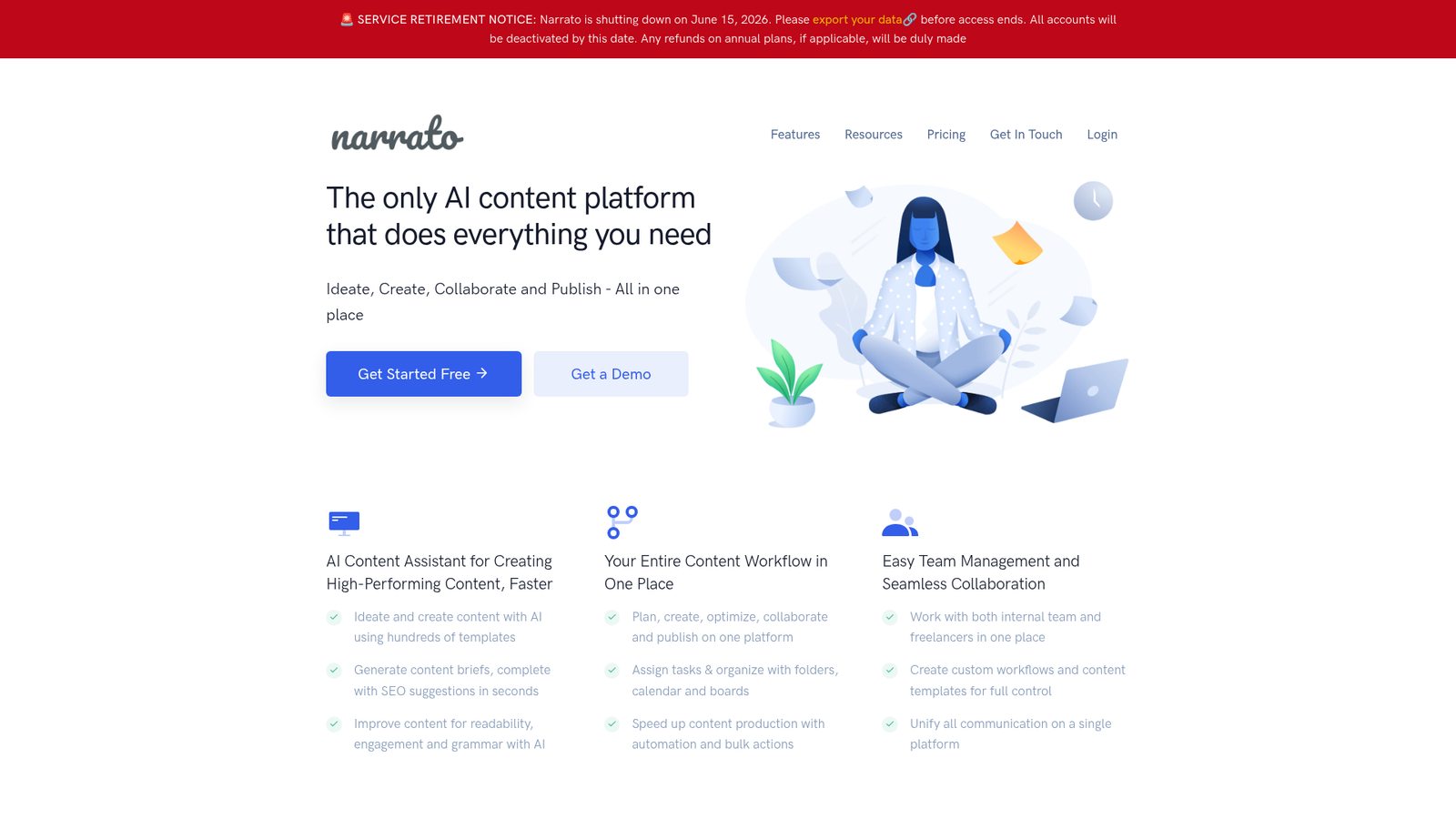
Best for: Content teams, agencies, and publishers running high-volume editorial workflows.
Narrato is an all-in-one content operations platform with an AI assistant covering 100+ tools and templates, content planning with SEO briefs, and workflow automation, collaboration, and publishing integrations. It is well suited for agencies coordinating many writers, clients, and pieces in motion.
Pros:
- Strong workflow, calendar, and collaboration features
- Broad AI assistant for ideation and drafting
- 4.8/5 on G2
Cons:
- UI can feel dense for very small teams
- Less specialized on AI search analytics
Pricing: Free plan available; Pro $48/mo, Business $124/mo, with add-on users from $9/user/month (Pro) and $19/user/month (Business). Agencies often combine it with other best ai tools for automated blog content.
13. ContentStudio - Best for Social-First Content Scheduling
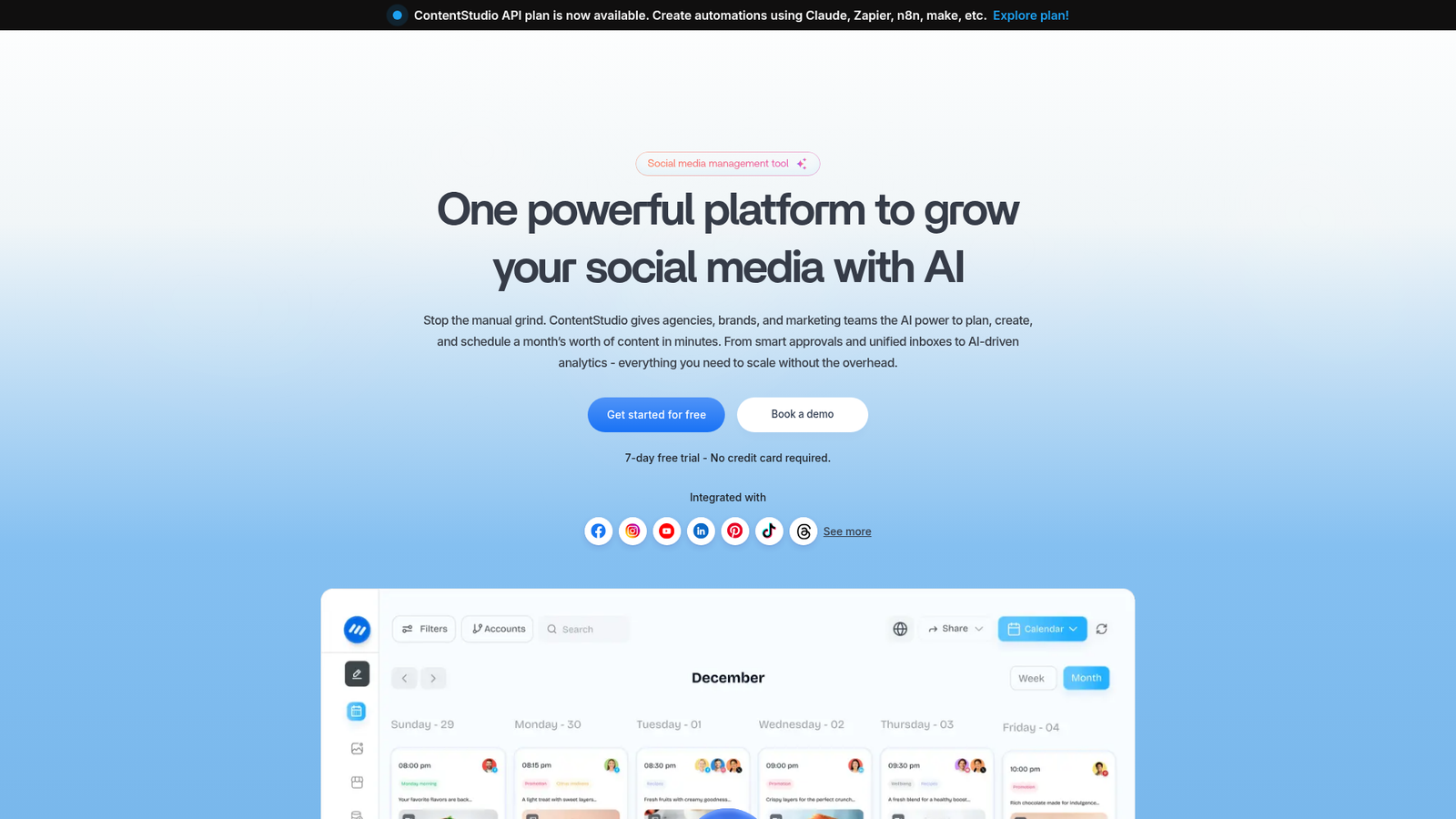
Best for: Agencies and brands that lead with social and need AI-assisted scheduling.
ContentStudio is an AI-powered social media management platform with multi-platform publishing, content calendars, an AI Studio for captions, images, and brand-aligned ideas, and reporting. For social-first content engines, it is a more natural fit than a long-form SEO tool.
Pros:
- Strong publishing, scheduling, and curation
- Affordable entry pricing
- 4.6/5 on G2
Cons:
- Lighter on long-form SEO and AI search workflows
- Best as part of a broader content stack
Pricing: Standard $19/mo, Advanced $49/mo, Agency Unlimited $99/mo, Enterprise custom. Yearly billing offers savings up to 34%.
14. Zapier - Best for Connecting Your Content Stack
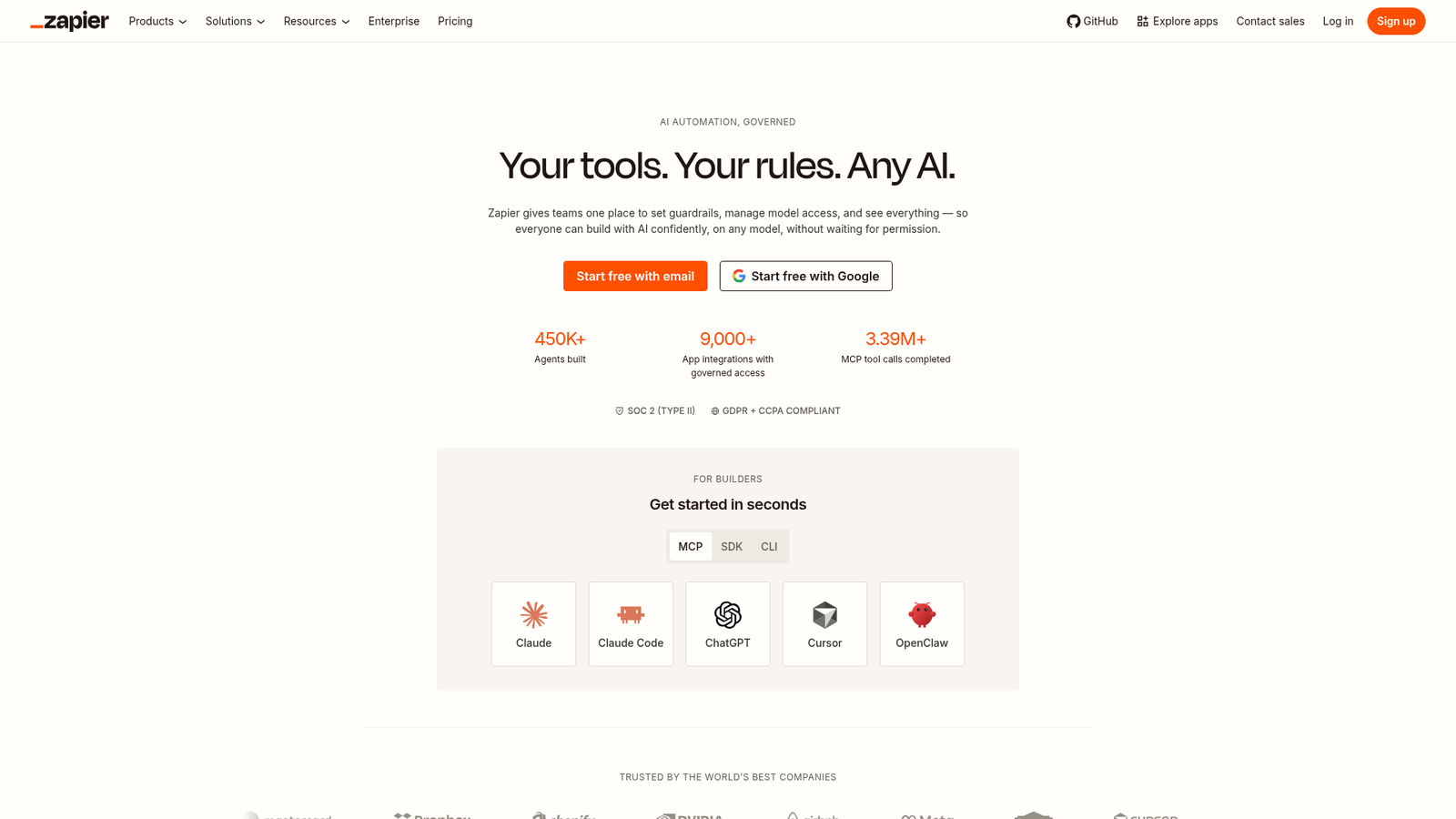
Best for: Teams that want to glue 9,000+ apps into automated workflows without code.
Zapier is not a content tool - it is the connective layer for one. Use it to push briefs from Notion into a CMS, route approvals through Slack, log published URLs into a tracking sheet, or trigger AI tasks via its built-in Copilot and MCP support. It is most valuable when your content tools do their jobs well but do not natively talk to each other.
Pros:
- Massive integration library and flexible automations
- Built-in Tables, Forms, and AI tools
- 4.5/5 on G2
Cons:
- Requires building workflows from scratch
- Costs grow with task volume
Pricing: Free $0/mo; Professional from $19.99/mo billed annually; Team from $69/mo billed annually; Enterprise custom.
15. HubSpot Content Hub - Best for HubSpot Customers Needing CMS + AI
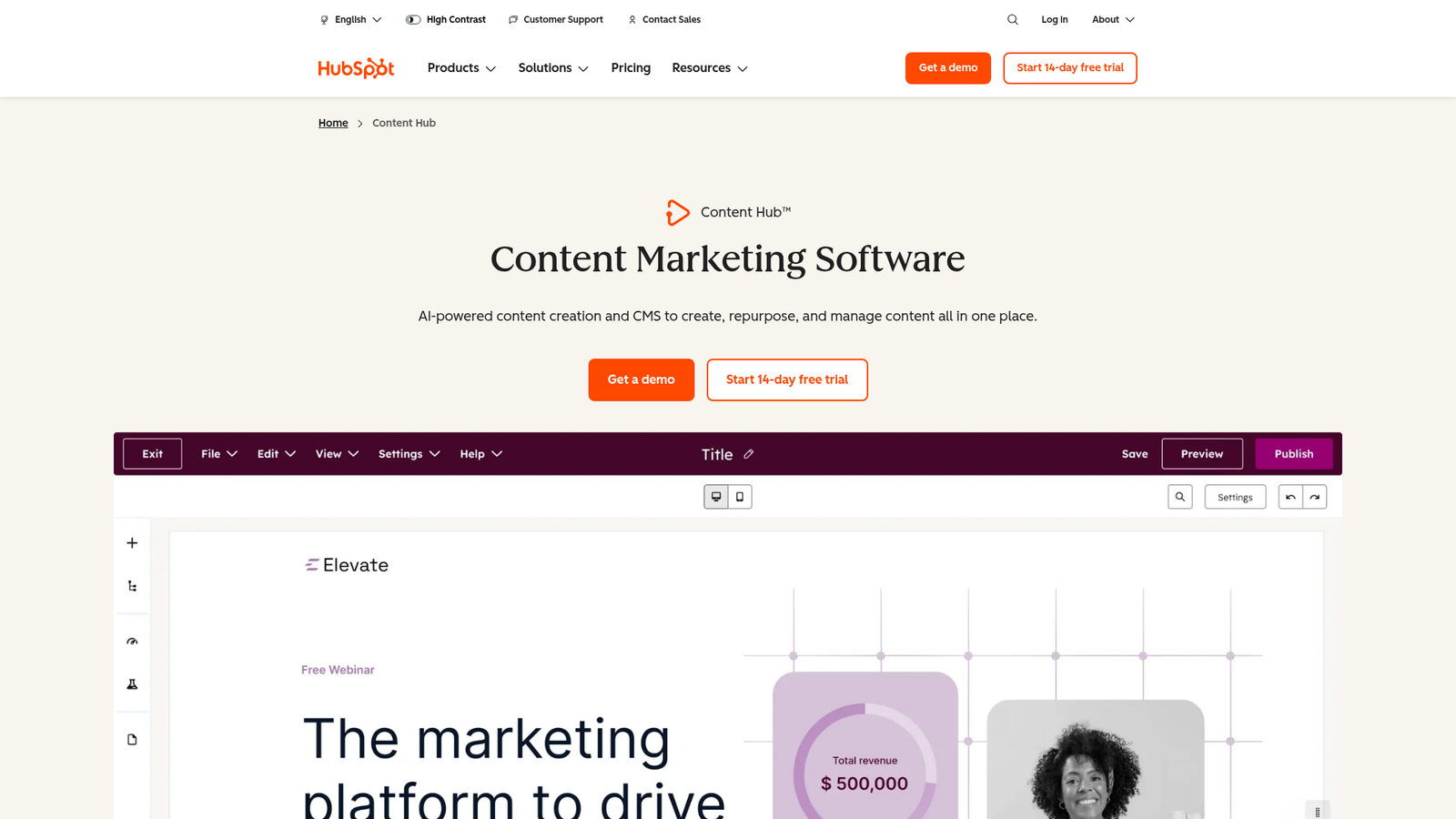
Best for: Marketing teams already on HubSpot that want CMS, AI content, and CRM in one place.
HubSpot Content Hub bundles AI content creation, Content Remix for multi-channel assets, a scalable CMS with drag-and-drop building, SEO recommendations, dashboards, and content personalization. The value compounds when content is tied directly to contacts, deals, and email campaigns inside HubSpot.
Pros:
- Native integration with HubSpot CRM and marketing
- Content Remix simplifies repurposing
- 4.5/5 on G2
Cons:
- Best value only if HubSpot is your system of record
- Enterprise tiers are a significant jump
Pricing: Free $0/mo; Starter $20/mo per seat ($15/mo annual); Professional from $450/mo annual ($600/mo monthly) for 3 seats; Enterprise from $1,500/mo for 5 seats.
Best Content Automation Tools by Use Case
The right tool depends less on category and more on the specific job. Here are concise picks for common scenarios.
Best for AI Search Visibility
Slate. It is one of the few platforms that connects AI search analytics across ChatGPT, Google AI Mode, AI Overviews, and Perplexity to actual content execution - not just monitoring.
Best for B2B SaaS Content Teams
Slate. For content-led SaaS teams that need to scale refreshes and new pages with governance, Slate combines visibility, workflows, brand controls, and CMS publishing in one place.
Best for Solo Marketers and Founders
Frase or Copy.ai. Frase covers research, briefs, drafts, and visibility tracking in a single tool, while Copy.ai works well if content sits alongside outbound and ops.
Best for Enterprise Governance
Writer. Knowledge Graph grounding, enterprise security, and AI Studio make it a fit for regulated industries and large rollouts.
Best for SEO Optimization
Surfer or Clearscope. Surfer is stronger as a real-time content editor; Clearscope shines on rigorous grading and editorial quality.
Best for Content Refreshes
Slate. Power Sheets and visual workflows are designed for bulk refresh detection and execution, with publishing automation directly into Webflow and WordPress.
Best for Agencies
Narrato. Workflow features, content calendars, and AI tooling map well to managing many clients, writers, and pieces in motion.
Best for Enterprise Content Systems
HubSpot Content Hub or Writer. Choose HubSpot if CRM-tied content is the priority; choose Writer for governed AI across many teams. Both are worth comparing as best tools for automating decisions in enterprise content systems.
How to Choose the Right Content Automation Tool
The biggest mistake in this category is buying a tool before naming the bottleneck. Use this five-step framework to narrow the field.
1. Map Your Workflow Bottleneck
Walk through your last 10 published pieces and time each stage: research, briefing, drafting, optimization, review, publishing, and reporting. Whichever stage holds the most queue time is your real bottleneck. That is the category you should buy into first.
2. Decide Between All-in-One and Stacked Tools
All-in-one platforms reduce coordination overhead and integration debt, which matters when your team is small or moving fast. Stacked specialists give you deeper functionality in one slice - useful when one stage (say, SEO optimization or social scheduling) is genuinely best-of-breed in your workflow. Most mature teams end up with one core platform plus 1–2 specialists, not 10 overlapping apps.
See more on best content marketing automation tools for trade-offs by team size.
3. Evaluate AI Search Readiness
Ask explicitly: does the tool help our content get cited by ChatGPT, Perplexity, Gemini, and AI Overviews, not only ranked on Google? Look for visibility tracking across LLMs, citation-readiness analysis, and support for extractable structure - clear definitions, scannable headings, structured data, and source-backed answers.
4. Check Governance and Brand Voice Controls
Strong automation without governance multiplies risk. Look for style guide enforcement, knowledge bases, review gates, role-based permissions, and audit trails. If the tool cannot tell you who changed what and why, it is not safe to scale.
5. Validate Integrations and Publishing Path
A tool that cannot publish directly into your CMS, sync with your SEO and analytics stack, and connect to your CRM will create new manual work. Confirm native integrations for the systems you already use, and treat the lack of best ai tools for creative content automation integrations as a real cost.
What Still Needs Human Review in Automated Content
Content automation tools do not replace writers, editors, or strategists. They accelerate research, drafting, and execution - but strategy, original insight, fact-checking, brand voice, and final approval stay human, especially as AI search systems increasingly prioritize trustworthy, well-sourced content.
Concretely, keep humans accountable for:
- Strategy and prioritization - what to write, for whom, and why now.
- Original insight and proprietary data - the parts AI cannot generate from public training data.
- Fact-checking and source verification - particularly when AI outputs are used as research.
- Brand voice nuance - tone judgments models still get wrong in edge cases.
- Sensitive, legal, or regulated content - anywhere a wrong sentence has real cost.
- Final publish approval - the last gate before content represents the brand publicly.
Teams that treat automation as a force multiplier for these reviewers - not a replacement - tend to ship more, with fewer corrections, and earn more trust from both readers and AI systems. This is one reason mature operators favor governed best ai tools for content workflow automation over open-ended generation.
Are Content Automation Tools Good for SEO and AI Search?
Content automation tools support SEO and AI search when they help teams research topics, structure briefs, optimize for extractability, refresh existing content, and publish consistently. They become risky when used to scale low-value, generic pages without human review - a pattern both Google and AI systems increasingly penalize through quality signals.
What Automation Does Well for Organic Growth
The clearest wins are in stages where speed and consistency compound: brief generation against SERP and LLM data, structured outlining, internal linking at scale, metadata and schema, refresh detection, and citation-readiness formatting. Done well, these make individual pages stronger and the overall site easier for both Google and AI systems to parse and cite. Pairing automation with disciplined SEO produces better outcomes than either alone, which is why many teams build a stack around best tools for content marketing workflow automation.
What Automation Does Poorly If Unchecked
Unedited AI output drifts toward generic phrasing, repeats SERP consensus without adding insight, and occasionally invents facts or sources. Scaled across hundreds of pages, that produces thin content with weak differentiation - exactly what quality systems are designed to demote. The Tow Center finding that more than 60% of AI search answers to news-citation queries contained errors is a useful reminder: automation without review does not just slow growth, it can actively harm trust.
The Shift From Content Automation to Content Engineering
The old playbook was simple: brief a writer, run a draft through an SEO tool, schedule it, and move on. That playbook assumed Google was the only audience and that individual pages were the unit of work. Neither holds in 2026.
When recent research suggests roughly half of B2B software buyers start research in AI chatbots and around three-quarters use AI tools somewhere in the journey, the real unit of work shifts from "publish a page" to "earn a citation, a summary, or a recommendation across multiple discovery surfaces." That requires a system: structured content models, extractable formatting, refresh-first workflows, governance, and feedback loops between what AI systems cite and what teams produce next.
This is what content engineering looks like in practice - and why platforms like Slate are positioned around end-to-end execution rather than another draft button. The biggest competitive gap in most stacks today is not creativity. It is the missing layer that turns AI search insight into governed, scalable action.
Teams that build that layer become the best automated content creation tools story their competitors have to react to.
FAQs
What Are the Best Content Automation Tools?
The best content automation tools in 2026 depend on your bottleneck. Slate leads for B2B SaaS and content-led teams that need AI search visibility plus end-to-end execution. Jasper is strong for governed marketing content, Surfer and Clearscope for SEO optimization, Frase for solo SEO workflows, and Writer for enterprise governance.
What Is Content Automation?
Content automation is the use of software to streamline repeatable parts of the content workflow - including research, briefing, drafting, optimization, approvals, publishing, refreshes, and reporting. Mature platforms reduce manual coordination across these stages while keeping humans accountable for strategy, fact-checking, brand voice, and final approval.
Can AI Automate Content Creation?
Yes for execution, no for judgment. AI can automate research, outlining, first drafts, metadata, internal linking, repurposing, and publishing. It cannot reliably automate strategy, original insight, fact-checking, or final editorial review.
The most effective teams use AI to compress production time and keep humans focused on the parts that require expertise and accountability.
Are Content Automation Tools Good for SEO?
Conditionally yes. They support SEO when used to improve research, briefs, optimization, internal linking, and refresh cycles with human review in the loop. They hurt SEO when used to mass-produce generic pages without editing, since both Google and AI systems increasingly demote thin, low-value content scaled by automation.
What Tasks Can Content Automation Tools Handle?
Common automatable tasks include keyword and topic research, brief generation, outline-to-draft expansion, internal linking suggestions, metadata and schema, multi-channel scheduling, content repurposing, refresh detection, bulk updates, and reporting. The more of these a single platform handles natively, the less coordination overhead your team carries across disconnected tools.
Do Content Automation Tools Replace Writers?
No. They shift writer roles toward editing, strategy, subject-matter expertise, and review. Writers and editors who learn to direct AI workflows, fact-check outputs, and inject original insight become more valuable, not less.
The constraint in modern content teams is rarely typing speed - it is judgment, taste, and accountability, which remain human.
How Much Do Content Automation Tools Cost?
Pricing in this category ranges from free tiers (Zapier, HubSpot Content Hub, Narrato, MarketMuse) and sub-$30 starter plans (Copy.ai, ContentStudio, Zapier) up to around $500/month for advanced AI search platforms like Peec AI's Advanced tier. Enterprise plans from Writer, HubSpot, and Surfer extend well above that with custom pricing.
What Should You Look for in a Content Automation Tool?
Look for workflow coverage across multiple stages, AI search visibility support, governance and approval controls, native CMS and stack integrations, brand voice and style guide enforcement, transparent pricing, clear human review checkpoints, and reporting tied to organic outcomes. Tools that nail these eight criteria are far more likely to survive a 12-month evaluation.
Which Content Automation Tool Is Best for B2B SaaS Teams?
Slate is the strongest fit for B2B SaaS and content-led teams. It combines AI search visibility tracking, Power Sheets for bulk refreshes, visual workflows with brand-safe generation, and direct CMS publishing - built specifically for best generative ai tools for marketing content automation 2025 use cases where governed scale matters more than raw drafting volume.
Book a demo to see how Slate helps B2B teams track AI search visibility and engineer content that gets cited.