For the last couple of quarters, a lot of content teams have told us the same thing.
They've eased off AI-assisted publishing because they think Google now penalizes it.
The idea comes from Google's helpful content updates, which plenty of people read as a signal that human writing would do better and AI pages would get buried. Some teams slowed their whole calendar over it.
We wanted to see whether that holds up on the live Google results, and we had a way to check.
We ran 100 bottom-of-funnel SaaS queries through Claude to see which brands it recommends. This time we pointed the same 100 queries at Google, pulled the top 10 results for each, and ran every page through an AI-content detector.
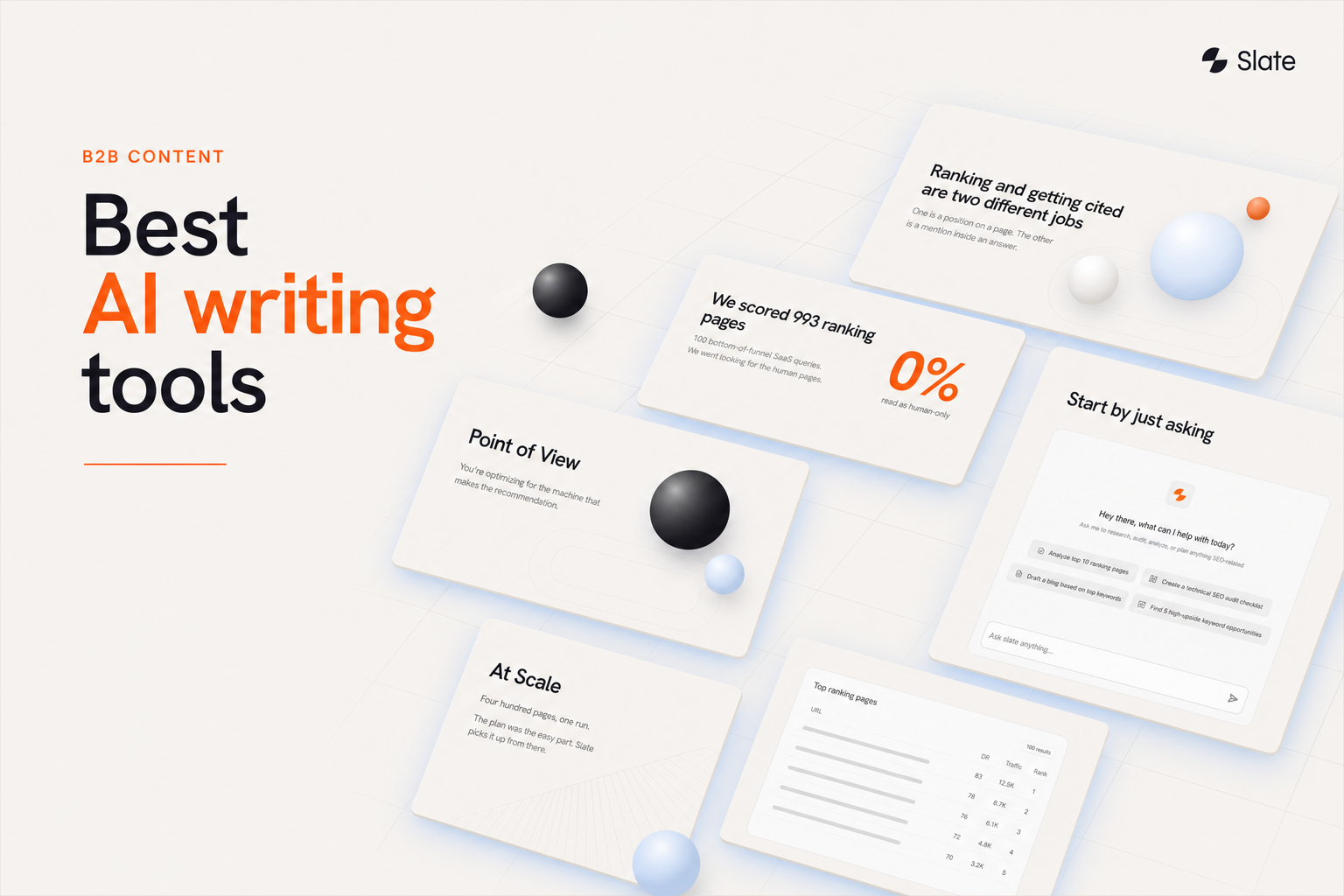
We expected a mix: some human, some AI, some in between. Instead, the human column came back empty. Of the 652 article pages the detector could score, none read as human-only.
287 were fully AI, 365 were an AI draft with a human edit on top, and not one was a person writing from scratch.
Why We Threw Out a Quarter of the Results First
We had to be careful about what we were measuring. The first pull was 993 URLs, and the detector returned a verdict for most of them. The problem is that it only reads body text, and about a quarter of page one barely has any.
Once we set those pages aside, the result got clearer.
What's Left When You Only Count Articles
Across those 652 pages, the human-only share is zero. Every page that ranks in the top 10 for these queries has AI somewhere in its draft.
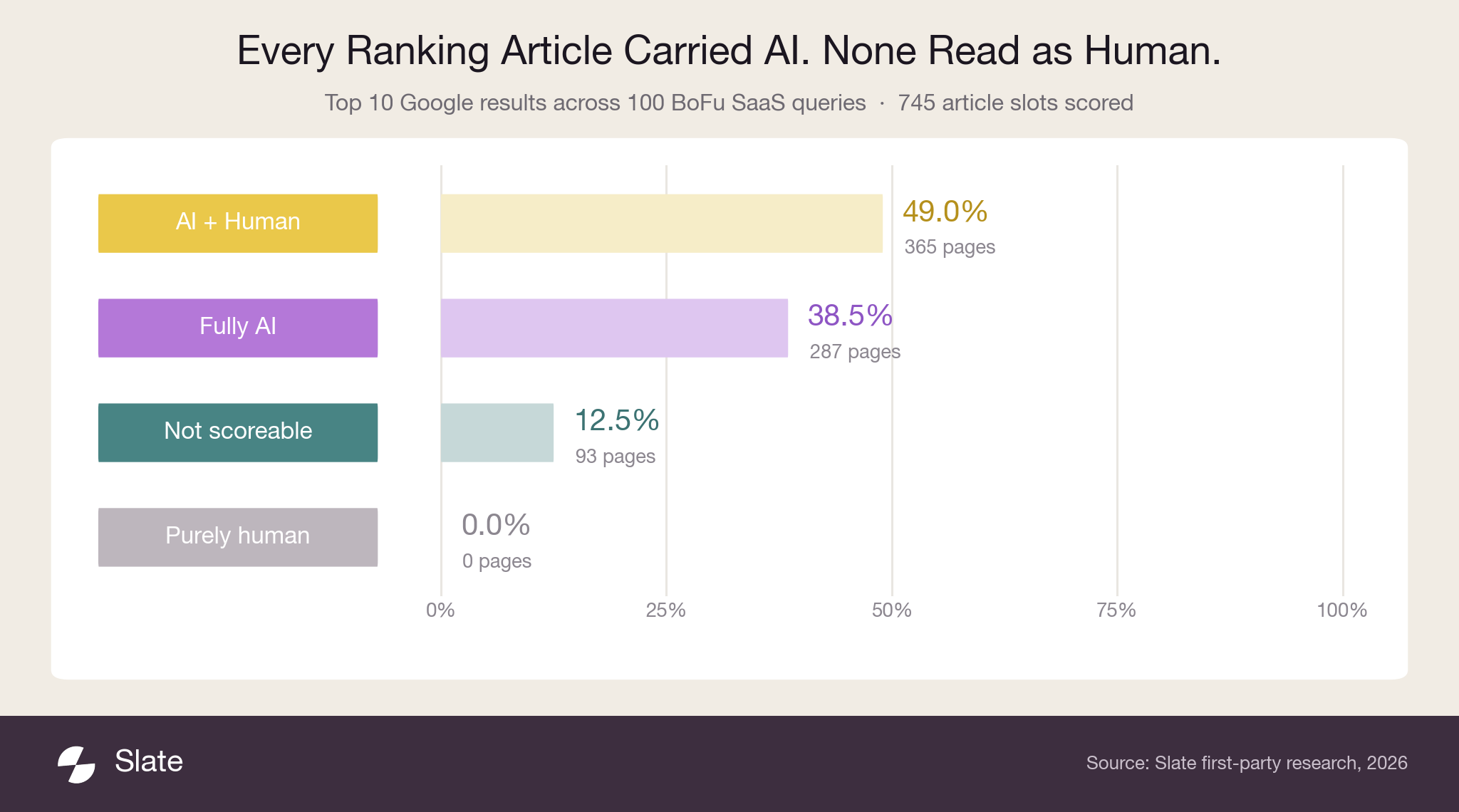
Even across all 745 article slots, before we drop the thin ones, it's the same story: nothing reads as human-only. The human-written pages everyone expected to see just weren't there.
The Split Is Fully AI vs Edited AI
Since none of the ranking pages are human-only, the question is narrower. Was the page written entirely by AI, or an AI draft that a person edited?
Across the 652 scoreable pages, that comes out to 44% fully AI and 56% AI-plus-edit.
So most ranking pages are the edited kind. It's worth being clear about what "edited" means here.
A model writes the first draft. Then a person reworks it enough that you can tell a human was involved, maybe a rewritten intro or a pricing table someone corrected.
The Pattern Holds in Every Category
If human-only writing still ranked anywhere, you'd expect it in a category with complicated products or careful buyers. So we broke the 652 pages out by vertical to look for the exception.
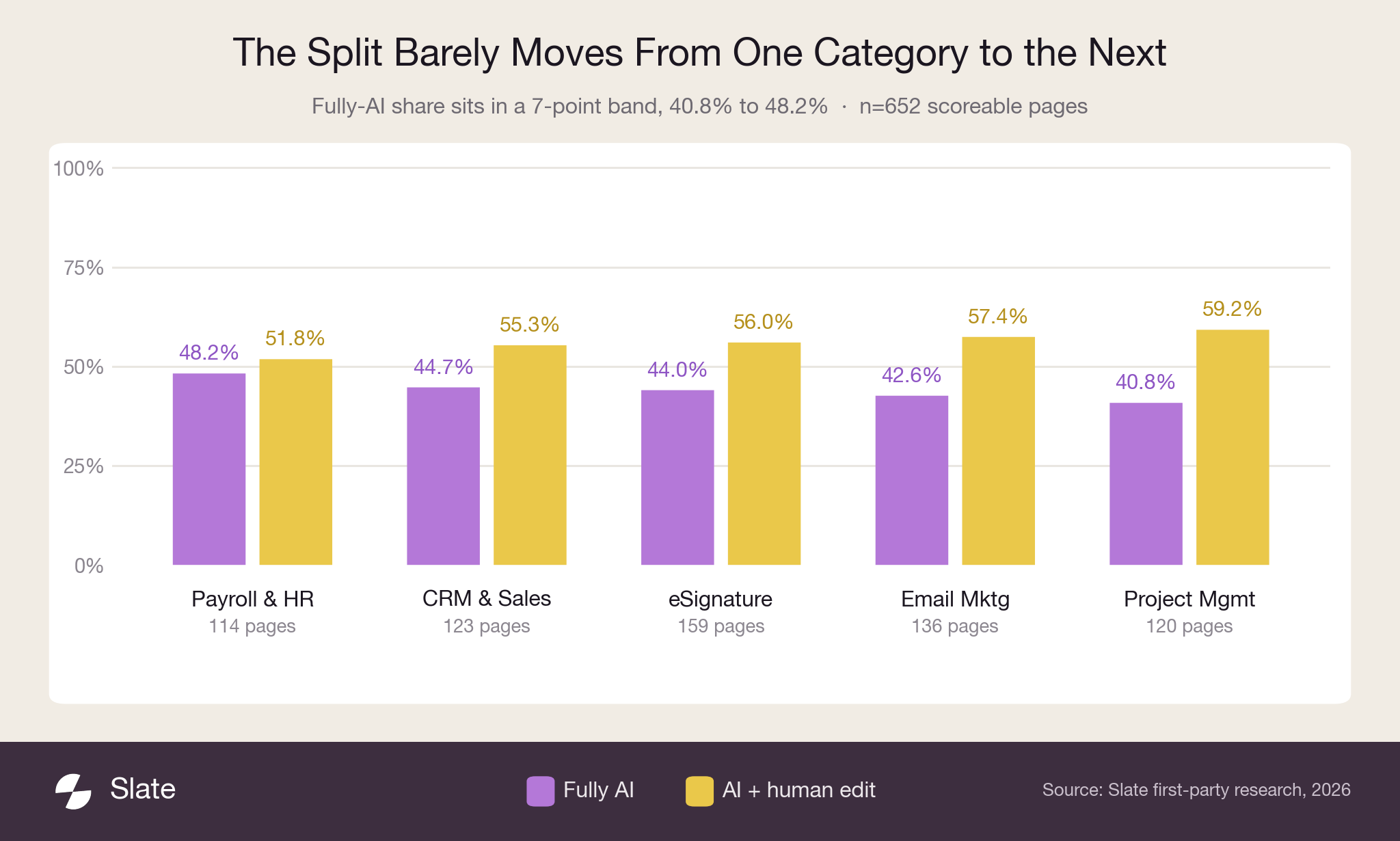
The fully-AI share ran from 40.8% in project management to 48.2% in payroll. That was the whole range: five categories with different buyers, price points, and content maturity, all within seven points of each other.
No single category pulls the average around, and there's no part of B2B SaaS where a human-only article ranks on its own. The one thing that moves the numbers is ranking position.
Edited Pages Rank a Little Higher
When you sort the 652 pages by where they ranked, the edited ones turn up a bit more often near the top.
A win for humans?
In the top 3 spots, 62% are AI-plus-edit and 38% are fully AI. Lower down, in positions 4 through 10, the edited share drops to 54%.
Eight points isn't a huge gap, and it's only a correlation, so it's not something you can act on directly.
Still, it lines up with the stakes on these queries. These are the searches someone runs right before they buy, where a wrong price or a mislabeled feature can lose the reader on the spot. On those pages, the edited ones tend to hold the top positions.
So Where Did the Human Writing Go?
It's in the 248 results we set aside at the start.
They're a quarter of page one, and they're where unedited human writing still shows up. Forums and video lead, with 98 Reddit and Quora threads and 98 YouTube videos, and another 44 slots go to review sites like G2, Gartner, and Capterra.
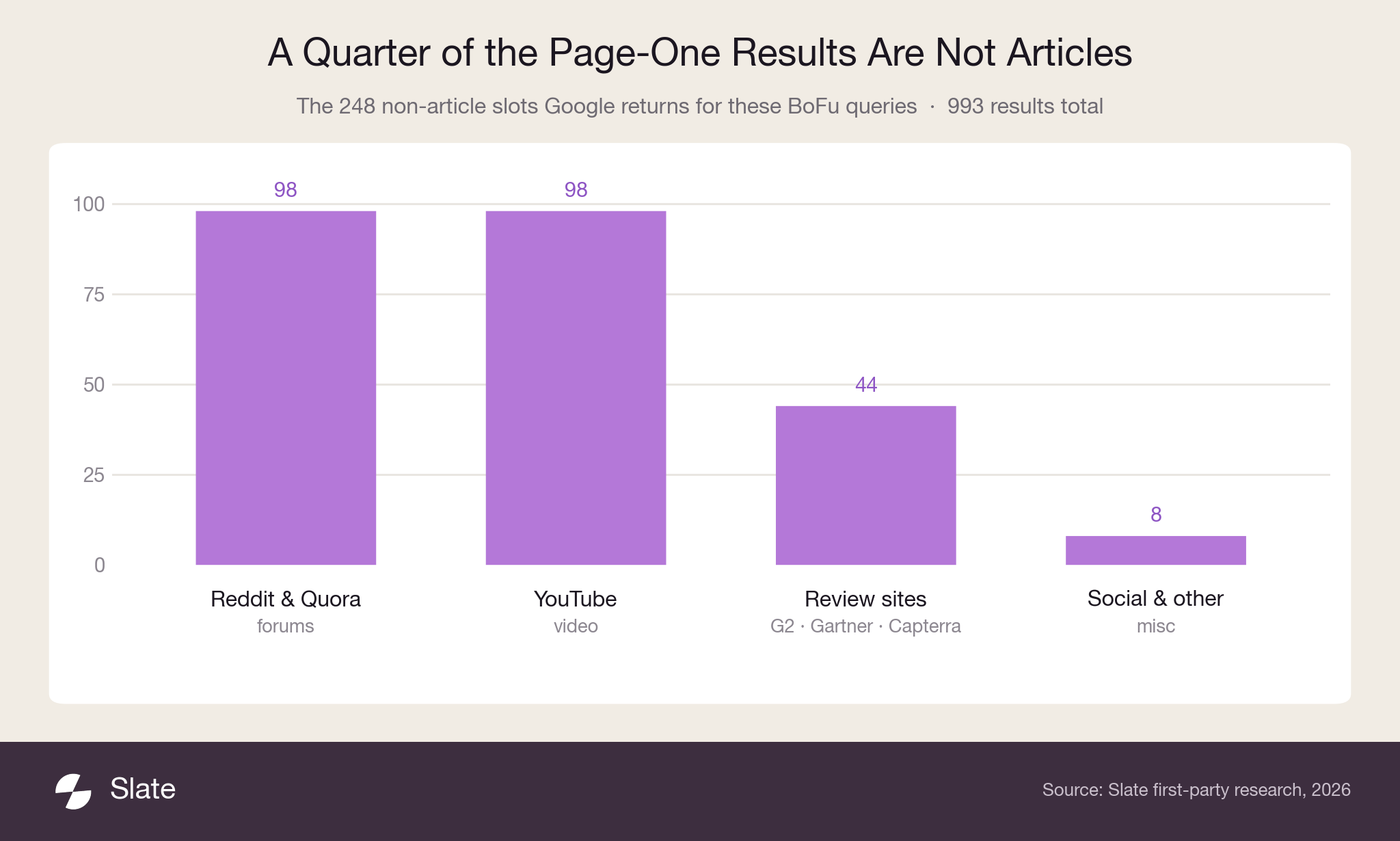
When someone wants a human opinion on "Asana vs ClickUp" or "DocuSign alternatives," Google usually sends them to a thread or a video. The ranking blog post isn't where that conversation is happening. People still want a human take, they're just finding it off the article page.
So if your bottom-of-funnel plan assumes the ranking blog post is where you earn a buyer's trust, a quarter of page one is going somewhere else.
What This Means for a Content Team
A few practical things come out of this:
Competing Here Means an AI-Assisted Pipeline
Human-only articles aren't ranking for these queries, so pausing AI-assisted publishing to protect your rankings is guarding against something the data doesn't show. The pages that win here are AI drafts with a careful human edit, so that's what you're up against.
Most of the winning pages already work this way: AI drafts you can refresh at scale, with an editor in the loop.
The Edit Is What Separates the Two
The edit is the difference between the 56% and the 44%, and it shows up a little more at the top of page one. A human pass does two things at once: it catches errors before they cost you a buyer, and it tracks with better rankings. That's the kind of editor time that pays for itself.
Track Google and the LLMs Together
Google and the LLMs both run on AI now. Our companion study found Claude recommending brands for these same queries straight from its training, with no citations at all.
Google's articles for the same queries are nearly all AI-assisted. If you measure one and ignore the other, you're only seeing half of where your buyers go.
What Slate Does
Slate tracks how your brand shows up across ChatGPT, Gemini, Claude, Perplexity, and Google AI in one place, and runs the content engineering and refresh work that keeps those pages competitive. We built it because both surfaces shape the same buying decision now.
For these queries, "is our content AI or human" has stopped being a useful question. Almost nothing ranking is cleanly one or the other. The better thing to track is whether you're publishing accurate, useful, edited content every week, or just AI filler.
When you want the same read on your own category, book a Slate demo and we'll score your bottom-of-funnel SERPs the same way.
Methodology
Query set
The same 100 bottom-of-funnel queries from our companion Claude study, spread across five B2B SaaS verticals. Those are CRM and Sales, Payroll and HR Tech, Email Marketing, eSignature and Document Signing, and Project Management. The queries use the "best [category]," "[tool] vs [tool]," and "alternatives to [leader]" formats buyers reach for late in the funnel.
SERP capture
We pulled the top 10 organic Google results for each query, 993 URLs in total. A handful of SERPs returned 9 results instead of 10.
AI detection
Every URL ran through a bulk content detector we built on a DeBERTa-based model. It sorts each page into three classes:
- AI: high-confidence machine-generated body text.
- AI plus human: a model draft with a detectable human revision.
- Not Detectable: too little body text to classify, including thin pages and 404s.
Page-type handling
The detector reads body text, so it can't score video, forum, or review-aggregator pages. We removed all 248 non-article surfaces from the scoring base: 98 YouTube, 98 Reddit and Quora, 44 review aggregators, and 8 social and other. That leaves the 745 genuine article, blog, guide, and landing-page URLs we report on. The headline numbers use the 652 of those that scored AI or AI plus human.
Scope
Calibrated to B2B SaaS and bottom-of-funnel intent. E-commerce, consumer media, and top-of-funnel content score differently. The method transfers; the absolute numbers may not.
Frequently Asked Questions
Does 0% mean no human wrote any of these articles?
No. Text detectors rarely certify a page as purely human, and clean human writing can read as AI or AI plus human.
Read it as a limit of the detector: no ranking article scored as confidently human-only. People may have typed plenty of these pages, and the tool can't prove otherwise. The takeaway still stands, that human-only writing isn't what wins these BoFu SERPs.
Which SaaS categories are safest for human-only content?
None in this set. Fully-AI share sits in a 7-point band, from 40.8% to 48.2%, across CRM, payroll, email marketing, eSignature, and project management. No category had human-only pages ranking on their own, so there's no vertical to fall back on.
Does Google penalize AI content at the bottom of the funnel?
Not in what we measured. Every scoreable ranking article showed AI in the draft, and edited pages turned up a bit more often in the top 3.
Google's helpful content guidance rewards usefulness and first-hand value, which an edited AI draft can carry, so the production method on its own didn't decide rank.
What separates the pages that rank from the ones that don't?
The edit. 56% of scoreable pages were AI drafts a person had revised, and that rises to 62% in the top 3. On the queries closest to a purchase, the human edit is doing the most work, which is probably why it's most common at the top.