Marketing teams in 2026 are buried in software that calls everything an agent. Plenty of it is a chatbot with a nicer haircut.
We cut through the noise to guide you through 10 platforms with AI agents that help with SEO, content, CRM work, ads, and reporting. We rank them by how much work they can own, how well they use live data, and how much control you keep before anything gets published or changed.
AI marketing agents are software systems that take a marketing goal, pull data from connected tools, choose next steps, and run multi-step workflows with limited supervision.
A chatbot answers. A copilot helps inside one tool. An agent keeps working across systems until it has something to return, route, publish, or measure.
Key Takeaways
- AI marketing agents use live data, make decisions, and run multi-step marketing workflows with limited supervision.
- The strongest agents work across CRM, email, analytics, ad platforms, and CMS tools.
- Common use cases include SEO research, content production, lead scoring, campaign reporting, paid media tuning, and AI search visibility tracking.
- Slate is the top pick for teams that want SEO, content, outreach, publishing, measurement, and refresh work in one agent-led system.
- Your best choice depends on workflow depth, stack fit, publishing needs, and governance.
- Discovery now happens across Google and AI answer engines, so AI visibility tracking belongs in the buying criteria.
What Are AI Marketing Agents?
AI marketing agents are software systems that analyze marketing data, choose actions, and complete multi-step work with limited supervision.
For a normal marketer, the difference feels simple. A chatbot answers you. An assistant helps with one task. An agent takes a goal, works through the steps, and comes back with a result or an approval request.
Good agents usually have these five traits:
- Autonomy: They pursue a defined goal, like “refresh underperforming blog posts,” without hand-holding at every step.
- Data awareness: They pull from CRM, analytics, ad platforms, and content systems.
- Decision-making: They interpret patterns and choose actions, such as updating page copy or changing audience segments.
- Multi-step execution: They can detect a problem, draft an update, route it for approval, publish, and measure lift.
- Ongoing improvement: They watch results and adjust future work.
The reason this category has teeth in 2026 is simple: discovery has spread beyond Google. ChatGPT search, Perplexity, and Google AI Mode now affect B2B buying journeys. Marketing systems need to track citations, mentions, sentiment, and prompt answers along with rankings. These shifts are shaping the future of AI SEO for organic teams.
How AI Marketing Agents Work Across CRM, Email, Analytics, And Content Systems
Most marketing agents run a four-step loop: ingest, decide, execute, and improve.
The agent receives a goal, pulls data from connected sources, chooses a sequence of actions, calls tools through APIs, and watches what happens next.
1. Ingest Data
The agent pulls CRM records, email engagement, GA4 data, Search Console signals, and ad performance into its working context.
For content workflows, it may also inspect page metadata, internal links, headings, and CMS performance data.
2. Decide
The agent interprets the current state.
That might mean a ranking drop, falling open rates, or rising CPA. Then it chooses actions based on a goal, such as “increase demo-qualified leads at a target CPL.”
3. Execute
The agent calls tools through APIs.
It can update campaigns, adjust email journeys, refresh CMS content, or edit CRM fields and segments.
4. Improve
The agent measures results against KPIs like traffic, conversions, pipeline, or AI citations.
A content and SEO agent might find URLs with declining traffic in GA4 and Search Console, check CRM lead quality from those pages, draft refreshed content based on current SERPs and brand rules, route it to a marketer, publish through the CMS, and measure lift. That’s how AI marketing agents work when the loop is connected.
AI Agent Vs. Chatbot Vs. Assistant Vs. Marketing Automation
Here’s the clean comparison.
Use this test: agents choose steps across connected systems and keep working toward a goal. Prompt responders and trigger-based workflows sit lower on the autonomy scale.
A lot of tools marketed as “AI agents” still behave like assistants. That’s why the details count.
Why Marketing Teams Are Adopting AI Agents In 2026
The draw is execution speed, fewer handoffs, and better use of the data teams already have.
Marketing teams run SEO tools, content tools, email tools, ad tools, CRM systems, analytics dashboards, and reporting decks. Work leaks out between those systems. Someone exports a CSV, someone rewrites a brief, someone forgets to refresh the page six weeks later.
Agentic systems can help by giving teams:
- Reduced tool switching: Less bouncing between research, production, and reporting screens.
- Fewer handoff gaps: Work moves through one connected loop.
- Always-on monitoring: Performance checks run without waiting for a quarterly audit.
- Library-scale refresh: Content libraries can be reviewed across hundreds or thousands of URLs. The right content refresh tools make this practical at scale.
- Better use of CRM and analytics: Search Console, GA4, and CRM data can guide execution.
- AI search visibility: Citations, brand mentions, sentiment, and prompt answers can be tracked and acted on.
Human review still belongs in the system. Publishing, spend changes, brand claims, and rollback controls need gates.
Treat any tool that can publish or spend without approval history as a risk. The shortcut can get expensive fast.
How We Evaluated The Best AI Marketing Agents In 2026
This ranking is an evaluation of documented workflows, product behavior, and fit for marketing teams.
We looked at how each platform handles content refresh, AI search visibility tracking, campaign reporting, CRM workflows, publishing, and governance. The highest-ranked tools own more of the loop.
The criteria:
- Execution breadth: One-task help versus owned workflows.
- Autonomy level: Goal-driven behavior versus AI-assisted templates.
- Analytics depth: Outcome measurement versus output counts.
- AI search visibility tracking: Citations, mentions, sentiment, and prompt answers.
- Native publishing: Drafting plus completion paths.
- Reusable workflows: Custom agents and repeatable templates.
- Bulk operations: URL-level and library-level work.
- Governance: Approvals, audit trails, permissions, and rollback.
- Integration coverage: CRM, email, analytics, ads, and CMS support.
- Pricing clarity: Public or verifiable pricing.
Tools that only generate drafts, answer prompts, or work inside one closed UI ranked lower on the agentic scale.
Quick Comparison Table: AI Marketing Agents At A Glance
The 10 Best AI Marketing Agents In 2026
1. Slate For End-To-End SEO, Content, And AI Search Visibility

Best for: SEO leaders, content operations teams, and organic growth teams adapting to AI-driven discovery.
What it does: Slate runs AI search visibility, SEO visibility, content production, outreach, publishing, measurement, and refresh in one platform.
It gives teams agents that can move from opportunity discovery to content updates, approval routing, publishing, and performance review.
It replaces the awkward stack of research tools, docs, CMS tabs, outreach tools, and reporting dashboards many teams duct-tape together.
Standout workflows:
- Cowork delegation in plain language, plus custom reusable agents that capture repeatable SEO or content work.
- A visual workflow builder with templates, plus Sheets for bulk creation, refresh, audits, and page updates across thousands of URLs.
- AI Search Analytics for brand presence across six AI surfaces: ChatGPT, Google AI Overviews, Google AI Mode, Perplexity, Gemini, and Claude, including sentiment, brand mentions, prompt answers, and keyword tracking.
- Pages, which brings Google Search Console and GA4 data together for clicks, traffic, CTR, and citations.
- Opportunities, which surfaces gaps across content, citations, rankings, and social engagement.
- Outreach, which finds link and brand-mention opportunities, enriches contacts, and handles outreach inside the platform.
What makes it agentic: You describe an outcome in plain language and Slate’s agents carry the work through the loop. Repeatable tasks can become reusable content-focused AI agents.
Integrations: Native Ahrefs and Semrush access without a separate purchase, plus direct publishing to Webflow and WordPress.
Limitations: Slate fits SEO and content operations best. Teams looking for video proofing or visual campaign review will still need creative tooling.
Pricing: Starting at $499/month for the Growth plan, which includes 15,000 credits, 10,000 AI answers per month, and 1,000 tracked pages. Scale is $999/month, Agency is $2,000/month, and Enterprise is custom
G2 rating: 4.9
Why it made the list: Slate covers the organic growth loop across search and AI answers, which is the core need for SEO and content teams.
2. Salesforce Agentforce For Enterprise CRM Lifecycle Teams
Best for: Enterprises that want autonomous agents built on Salesforce data.
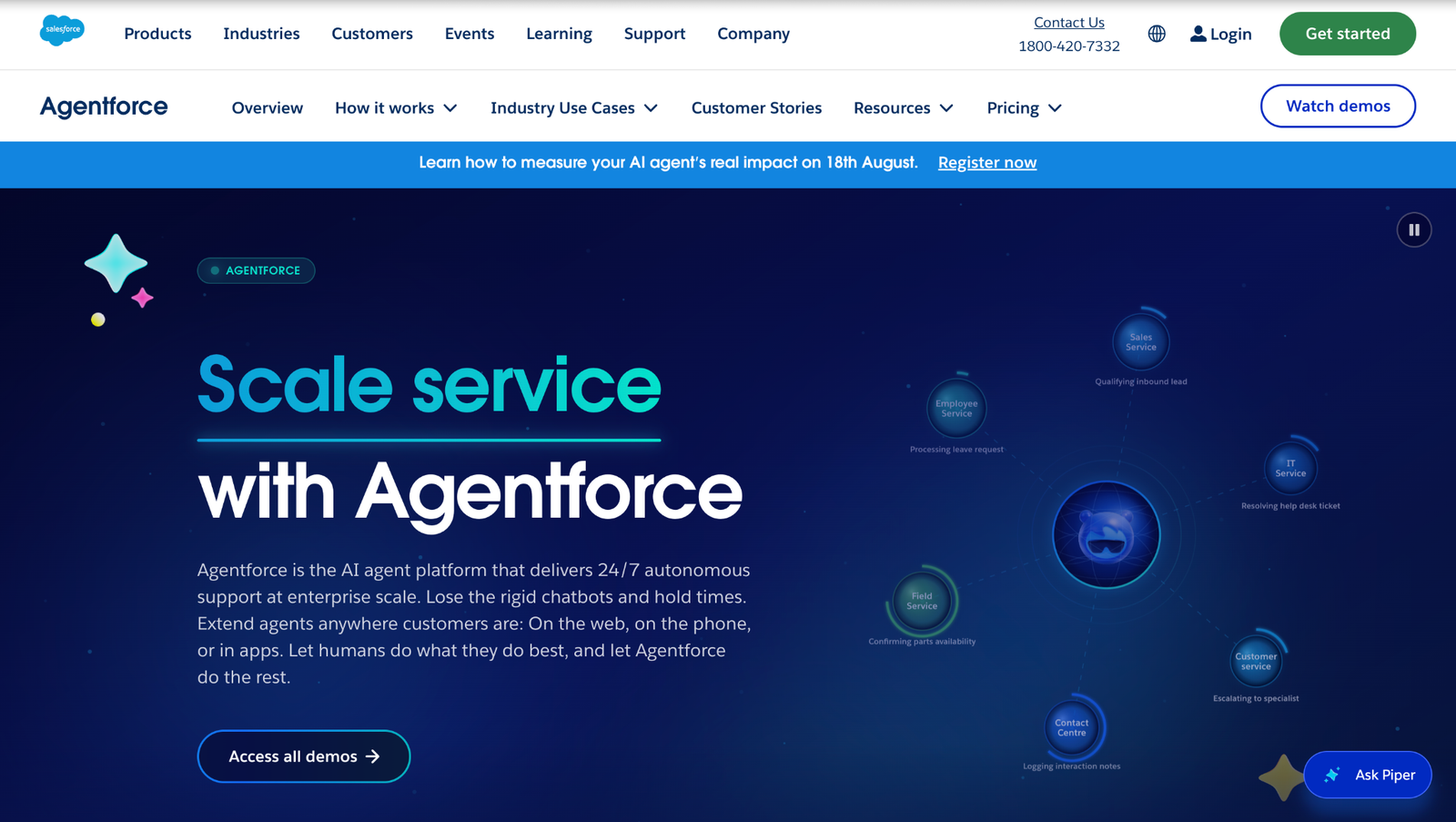
What it does: Agentforce lets teams build and deploy agents that answer questions, take actions, and support customers and employees across web, phone, and apps.
Agent Builder configures agents, subagents, actions, and instructions. Observability gives teams live monitoring and performance review.
What makes it agentic: Agents can act on Salesforce objects, journeys, and workflows. It’s a strong fit for large revenue teams already deep in Salesforce.
Limitations: Salesforce complexity comes with the territory. Total cost needs careful review because pricing can include credits, user licenses, add-ons, and edition choices.
Pricing: Salesforce Foundations is free. Paid options include Flex Credits at $500 per 100k credits, Conversations at $2 per conversation, Agentforce User License at $5/user/month with Flex Credits required, Agentforce add-ons at $125/user/month, Industries add-ons at $150/user/month, and Agentforce 1 Editions from $550/user/month.
G2 rating: 4.3
3. HubSpot Agent Hub (Formerly Breeze) For SMB And Mid-Market CRM Marketing

Best for: HubSpot customers that want AI built into marketing, sales, and support workflows.
What it does: HubSpot’s Agent Hub includes Breeze Assistant, 100+ embedded AI features, a customer agent for support, and prospecting and data agents for outreach, research, and customer insights.
It works from HubSpot data, which is handy when your CRM already holds the customer record.
What makes it agentic: Agents can act inside the CRM on outreach, research, and lifecycle tasks.
Limitations: It works best for teams already committed to HubSpot. Cross-stack orchestration is narrower than platforms built across many tools.
Pricing: Free at $0/month for up to two users. Starter starts at $7/month/seat billed annually, or $20/month/seat billed monthly. Professional and Enterprise are sold as bundled Customer Platform plans with pricing that varies by hub mix and seat count. AI usage is metered separately through HubSpot Credits at roughly $0.01 each.
G2 rating: Unlisted
4. Jasper For Brand-Voice Content Velocity
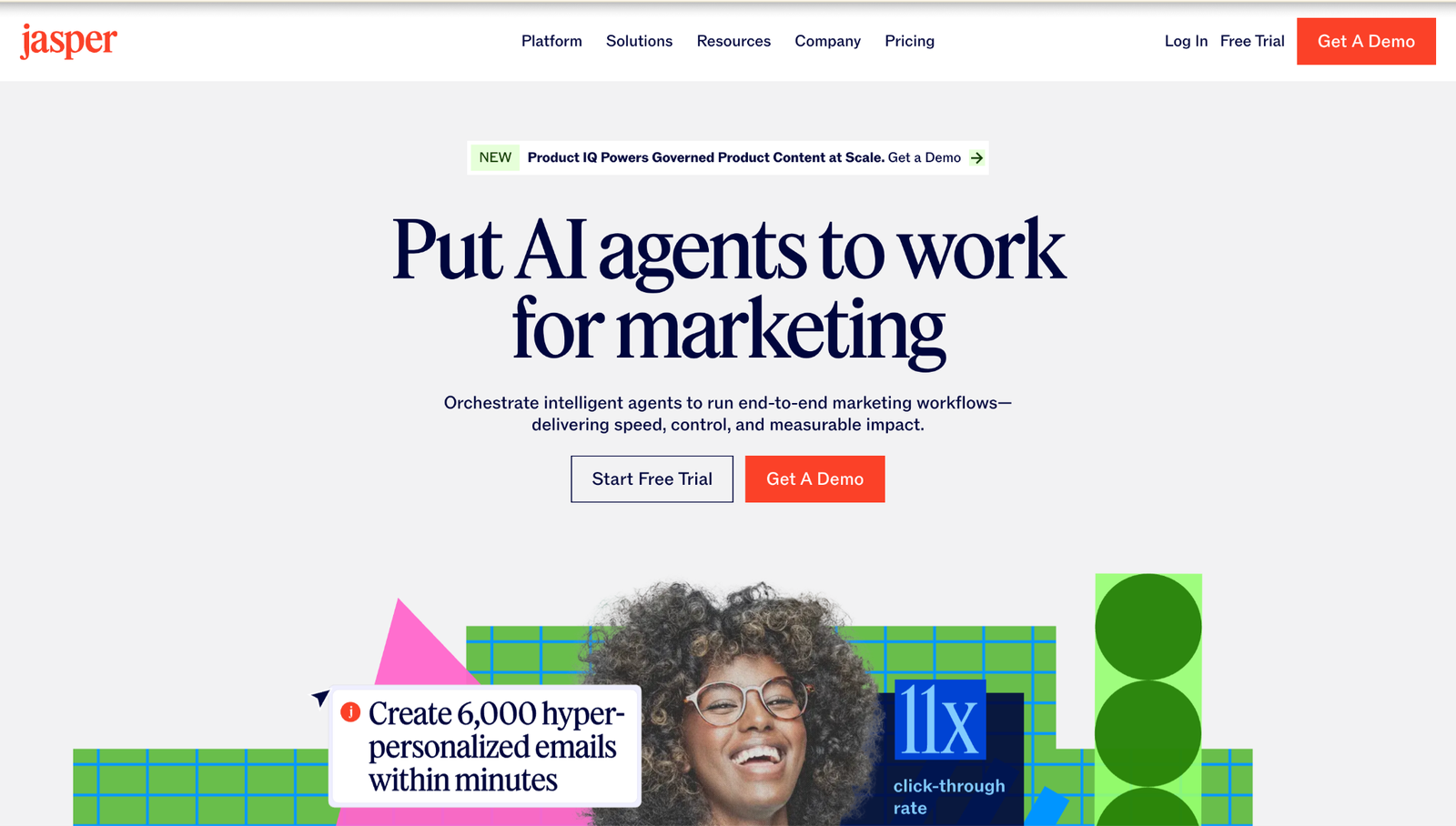
Best for: Marketing teams that need governed, on-brand content production.
What it does: Jasper helps teams create on-brand content and run marketing workflows with purpose-built AI agents.
Content Pipelines support repeatable campaign and content work. Jasper IQ handles brand voice, knowledge, and governance.
What makes it agentic: Jasper’s marketing agents and pipelines turn prompts into repeatable workflows with brand controls baked in.
Limitations: Jasper is strongest in content creation. Full-loop SEO measurement and technical execution are lighter than SEO-native platforms. If you're weighing options, this comparison of Slate and Jasper breaks down the tradeoffs.
Pricing: Pro starts at $59/month billed yearly or $69/month billed monthly for one seat, with a seven-day free trial. Business has custom pricing and adds custom AI agents, Jasper Grid, API access, and enterprise governance.
G2 rating: 4.7
5. Relevance AI For Custom Agent Building

Best for: Enterprise teams that want to build governed AI agents for marketing, sales, support, operations, and research.
What it does: Relevance AI is a platform for building specialist AI agents across your data and apps.
It supports model evaluations across LLM providers, thousands of app connections, SSO, RBAC, and audit logs.
Standout workflows: Marketing teams commonly build content repurposer agents, campaign reporter agents, research agents, and enrichment agents.
What makes it agentic: Teams can design agents that complete narrow business tasks from start to finish, with governance controls around them.
Limitations: You need to assemble the system. It’s powerful for teams with clear process owners and enough time to build.
Pricing: Enterprise-only custom pricing, including unlimited agents, users, projects, and workforces, plus 2,000+ integrations, agent evaluations, analytics, SSO, RBAC, and audit logs.
G2 rating: 4.3
6. Zapier For Cross-Tool Workflow Automation

Best for: Teams that want no-code automation and AI orchestration across many business apps.
What it does: Zapier connects 9,000+ apps so teams can build workflows, agents, forms, tables, and app-to-app automations.
Its AI workflows and agents add reasoning and action on top of classic Zaps.
What makes it agentic: Zapier agents can take action across the apps teams already use. For teams wiring together existing systems, this is useful glue.
Limitations: Zapier is strong on connectivity. Native SEO analysis, content depth, and AI search visibility are lighter.
Pricing: Free at $0/month. Professional starts at $29.99/month. Team starts at $103.50/month. Enterprise is sales-led. Yearly billing saves 33%.
G2 rating: 4.5/5
7. Creatio For CRM And Marketing Workflow Automation
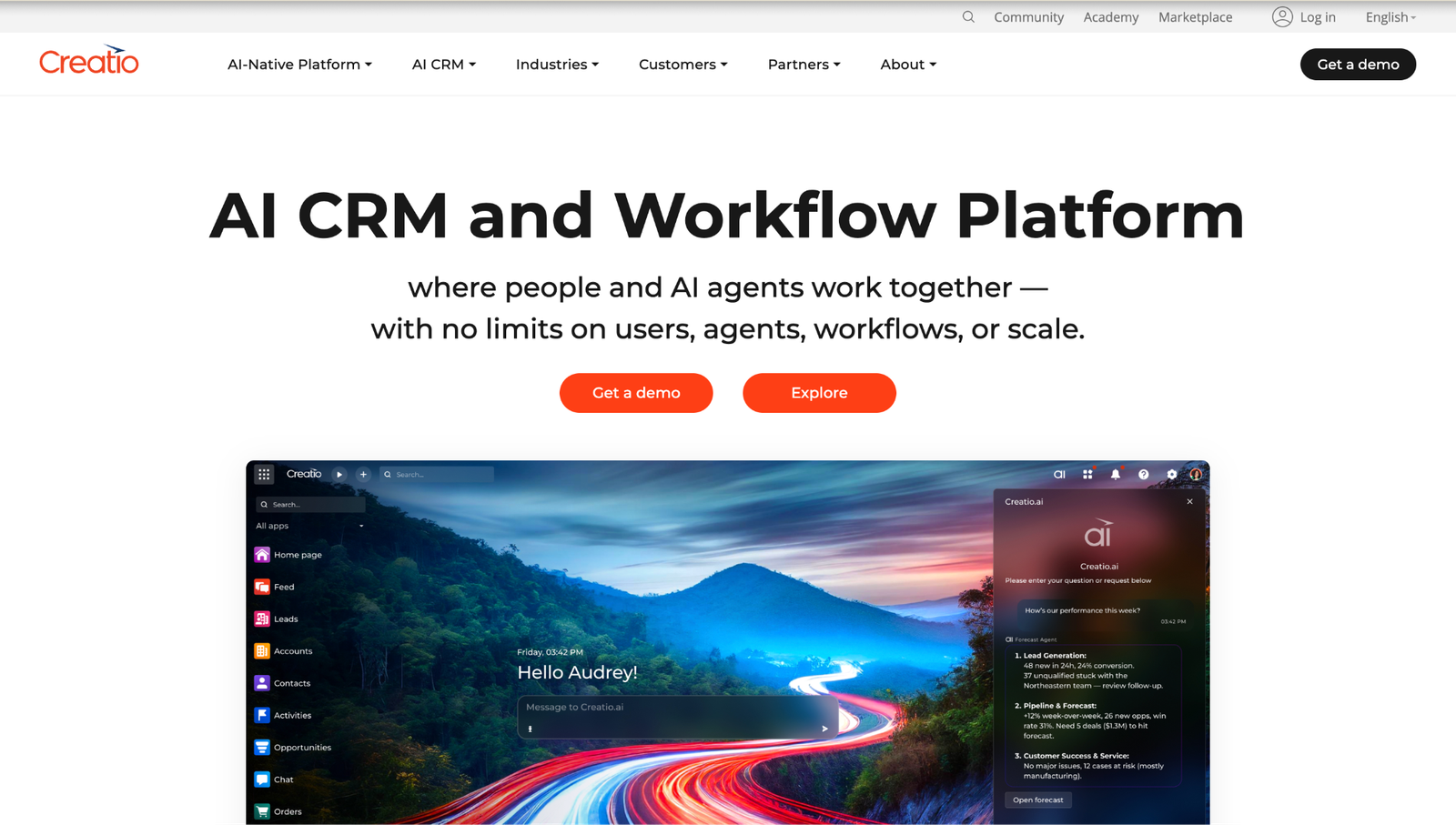
Best for: Organizations that want AI CRM plus no-code workflow automation across sales, marketing, and service.
What it does: Creatio is an AI CRM and workflow platform where people and AI agents work together across business processes.It pairs no-code visual designers with AI Studio and agent-building capabilities.
What makes it agentic: Embedded AI agents analyze data and execute routine CRM and marketing tasks inside Creatio’s broader platform.
Limitations: Creatio is broad CRM software. Organic search and AI answer visibility are outside its main lane.
Pricing: Growth is $40/user/month and Enterprise is $75/user/month, both with a five-seat minimum. Each CRM product adds $15/user/month. Unlimited is quote-only. The binding constraint is a $10,000 annual minimum on a three-year standard contract, and AI credit packs start at $5,000/year.
G2 rating: 4.6
8. Synter For Paid Media Tuning

Best for: Growth teams that want agents to manage paid media across channels.
What it does: Synter is an agentic advertising operations platform. Teams describe outcomes in natural language, such as “pause campaigns with cost per acquisition over $150” or “move budget to top-performing audiences,” and the agent executes in live ad accounts.
What makes it agentic: Synter can make goal-driven changes in ad platforms, with governance around spend decisions.
Limitations: Synter fits teams with meaningful ad budgets and comfort with approved autonomy in ad accounts.
Pricing: Starts at $20/month for the solo plan. Scale is $500/month. Custom plans are also available.
G2 rating: 5
9. Improvado For Campaign Reporting And Attribution
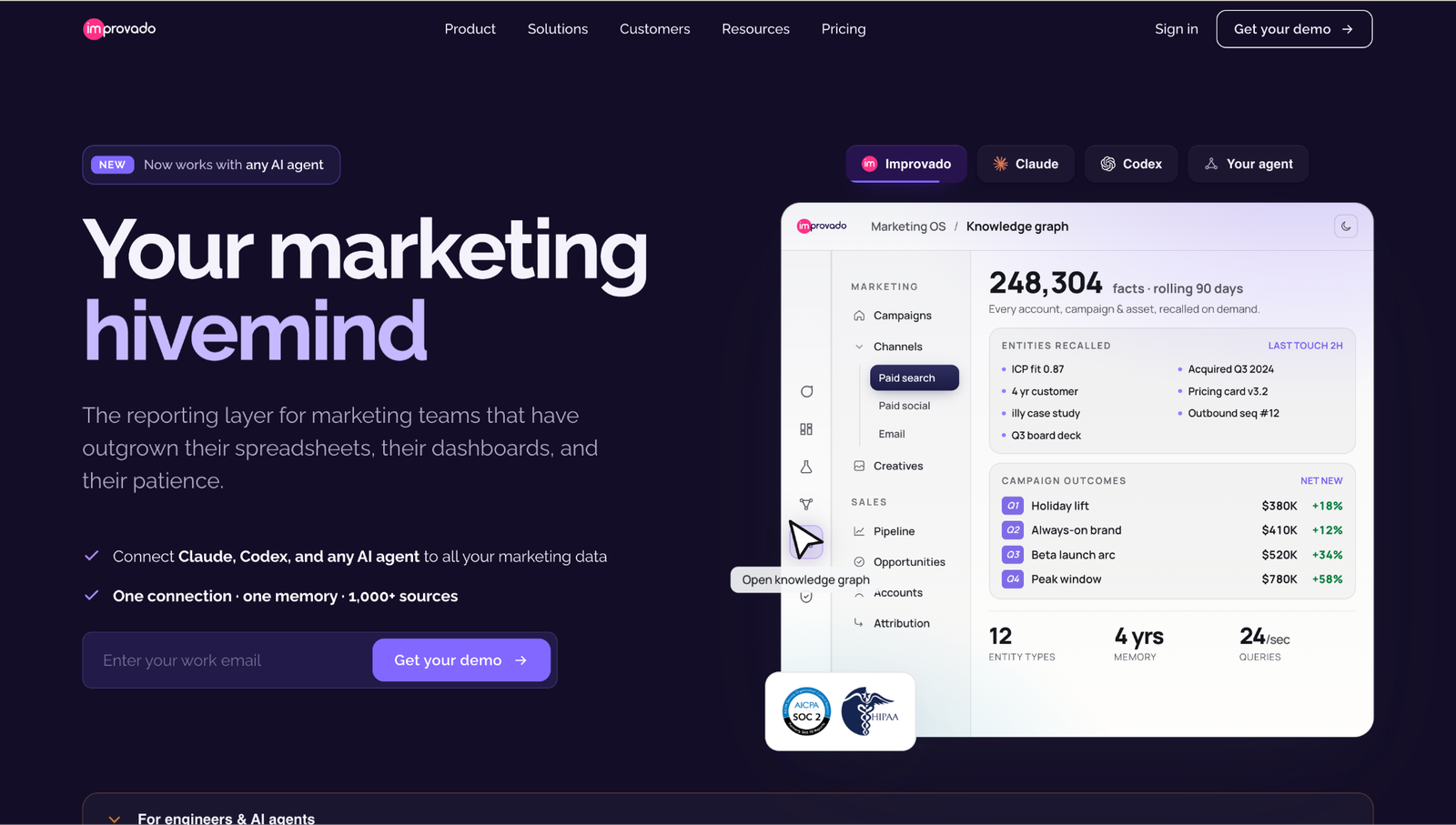
Best for: Marketing and analytics teams that need automated reporting across channels.
What it does: Improvado uses AI agents to extract data, monitor performance thresholds, surface anomalies, and answer complex reporting questions in conversation. It connects multi-channel marketing data into reports without manual spreadsheet assembly.
What makes it agentic: Agents monitor data continuously and flag anomalies, which gives analysts more time for strategy and investigation.
Limitations: Improvado is focused on analytics and reporting. It won’t run content production or campaign execution for you.
Pricing: It starts with a limited free plan. Then an MCP only plan for $100/month. Anything beyond that is custom pricing.
G2 rating: 4.4
10. Klaviyo For Email And Lifecycle Automation

Best for: Ecommerce and lifecycle teams that want AI-assisted email and SMS work.
What it does: Klaviyo’s AI capabilities help teams generate journeys, content, and segments inside the platform. It’s strongest when behavioral data already lives in Klaviyo.
What makes it agentic: Klaviyo brings agent-style journey building and lifecycle tuning into email and SMS workflows.
Limitations: Klaviyo’s scope is email and SMS lifecycle marketing.
Pricing: A free plan covers 250 active profiles and 500 emails per month, then pricing scales by profile count (roughly $60/month at 2,500 profiles and $150/month at 10,000)
G2 rating: 4.6
Best AI Marketing Agents By Use Case And Team Type
Your best pick depends on the workflow you want to hand over.
1. Best For SEO And AI Search Visibility
Slate leads here. It combines AI search visibility tracking, citation monitoring, prompt-answer tracking, publishing, and refresh workflows in one system. Compare it against other AI search visibility tools to see how the tracking stacks up.
2. Best For CRM-Native Lifecycle Marketing
Salesforce Agentforce fits enterprise teams built around Salesforce. HubSpot Agent Hub fits SMB and mid-market teams already working inside HubSpot.
3. Best For Content Production And Brand Voice
Jasper is the strongest fit for teams that care most about on-brand content velocity and campaign content. For alternatives, browse the best AI content marketing tools worth considering.
4. Best For No-Code Workflow Automation
Zapier is the better fit for wiring AI across a large app stack. Relevance AI is better for teams that want to design custom governed agents without code.
5. Best For Reporting And Paid Media
Improvado handles reporting and attribution. Synter handles paid media execution inside ad accounts.
How To Choose The Right AI Marketing Agent For Your Team
Start with the workflow you want owned. Then work backward to the platform type.
Ask:
- Do you need one-task help or full workflow ownership?
- Do you need CRM-native agents or SEO and content-native agents?
- Do you need AI search visibility tracking along with Google ranking data?
- Do you need bulk operations across a URL library?
- Do you need native publishing?
- How much human approval, audit history, and rollback control do you need?
Before buying, verify the integrations against your exact stack. Ask whether the agent publishes, drafts, measures outcomes, or only suggests work.
The common mistake is buying five point tools when one connected system would do the job. For organic growth teams, an end-to-end platform can cover research, production, publishing, and measurement. For teams with a mature stack, an orchestration layer may be the better fit.
For more context, see our guides to the best marketing automation platforms and content and SEO automation.
What To Test Before You Commit
Run a scoped pilot before you put an agent into production.
Choose a closed-loop workflow, such as content refresh with CMS publishing or campaign reporting with anomaly alerts. You want a pass-fail signal, not an overcomplicated project with six dashboards and one very tired ops manager.
Test:
- Setup time and human approval steps.
- Will the tool publish or only draft?
- Will it measure lift across search and AI answer surfaces?
- Reusable agents compared with one-off prompts.
- Approval flows, audit logs, permissions, and rollback.
AI search visibility deserves a spot in the pilot. In 2026, citations, mentions, and prompt-answer presence sit next to rankings in the reporting conversation.
Are AI Marketing Agents Worth It For SEO And Content Teams?
Yes, when the agent owns outcomes through the full loop.
For SEO and content teams, the value shows up when the system finds ranking and citation gaps, improves content, publishes approved updates, runs outreach, measures lift, and triggers the next refresh. Pairing this with strong SEO automation tools makes the loop repeatable.
Manual page-by-page work gets painful once you’re managing hundreds of URLs and AI answers at the same time. Teams treating AI search visibility as a growth channel should look for agents that connect insight, production, publishing, measurement, and refresh.
Slate is built for that loop.
Frequently Asked Questions
What Are AI Marketing Agents?
AI marketing agents are software systems that analyze marketing data, choose next steps, and execute multi-step workflows with limited supervision.
They can work across connected tools like CRM, email, analytics, and CMS systems to handle segmentation, reporting, SEO research, and content production.
How Are AI Agents Used In Marketing?
Marketing teams use AI agents for lead scoring, campaign reporting, content creation, paid media tuning, CRM updates, and SEO workflows.
A common flow: the agent detects a performance drop, drafts an update, routes it for approval, publishes it, and measures lift.
How Do AI Marketing Agents Work?
AI marketing agents run an ingest, decide, execute, improve loop. They pull live data from CRM, analytics, and content systems, interpret the current state, choose actions, run them through connected tools, and measure results.
What Is The Best AI Agent For Marketing?
The best choice depends on your stack and first workflow. Salesforce Agentforce and HubSpot Agent Hub fit CRM-native teams. Jasper fits content-led teams. For SEO, content, outreach, publishing, and AI search visibility, Slate is the top recommendation.
Which Platforms Have AI Agents For Marketing Teams?
Strong examples include Slate for SEO and AI search visibility, Salesforce Agentforce and HubSpot Agent Hub for CRM lifecycle work, Jasper for content, Relevance AI and Zapier for custom workflows, and Creatio for CRM automation.
What Is The Difference Between An AI Marketing Agent And Marketing Automation?
Marketing automation runs preset triggers and workflows. An AI marketing agent interprets context, chooses actions, and completes multi-step work across connected systems with less manual instruction.
Can AI Agents Improve Visibility In AI Answers, Alongside Google Rankings?
Yes. Some platforms track brand presence, citations, sentiment, and prompt answers across AI search engines like ChatGPT, Google AI Mode, and Perplexity.
Slate’s AI Search Analytics tracks this visibility and connects it to organic clicks, so teams can act on gaps.