If you're reading this, you probably already know what MarketMuse does. You've likely used it, evaluated it, or watched your team struggle with the gap between the insights it generates and the content that actually gets published.
The question isn't whether MarketMuse is a good tool. It is, for a specific job. The question is whether that job still matches what your team needs to accomplish in a content landscape where ChatGPT, Perplexity, Google AI Overviews, and AI Mode are reshaping how people discover information.
Most "marketmuse alternatives" lists treat every content tool as interchangeable. They'll stack ten logos on a page, list features in bullet points, and leave you no closer to a decision. This guide takes a different approach. It segments tools by what they actually do, maps them to specific team types and workflows, and addresses the criterion that every other comparison page ignores: AI search visibility.
Whether you're a three-person startup team or running a twenty-person content operation, the right MarketMuse alternative depends on your content maturity, your workflow needs, and where you believe discovery is heading.
Key Takeaways
- Best for AI search optimization and end-to-end content engineering: Slate connects AI visibility tracking, content creation workflows, and CMS publishing in one platform. Starts at $199/month.
- Best for on-page content optimization: Surfer SEO offers real-time content scoring, AI visibility tracking, and a strong Content Editor. Plans start at $49/month billed yearly.
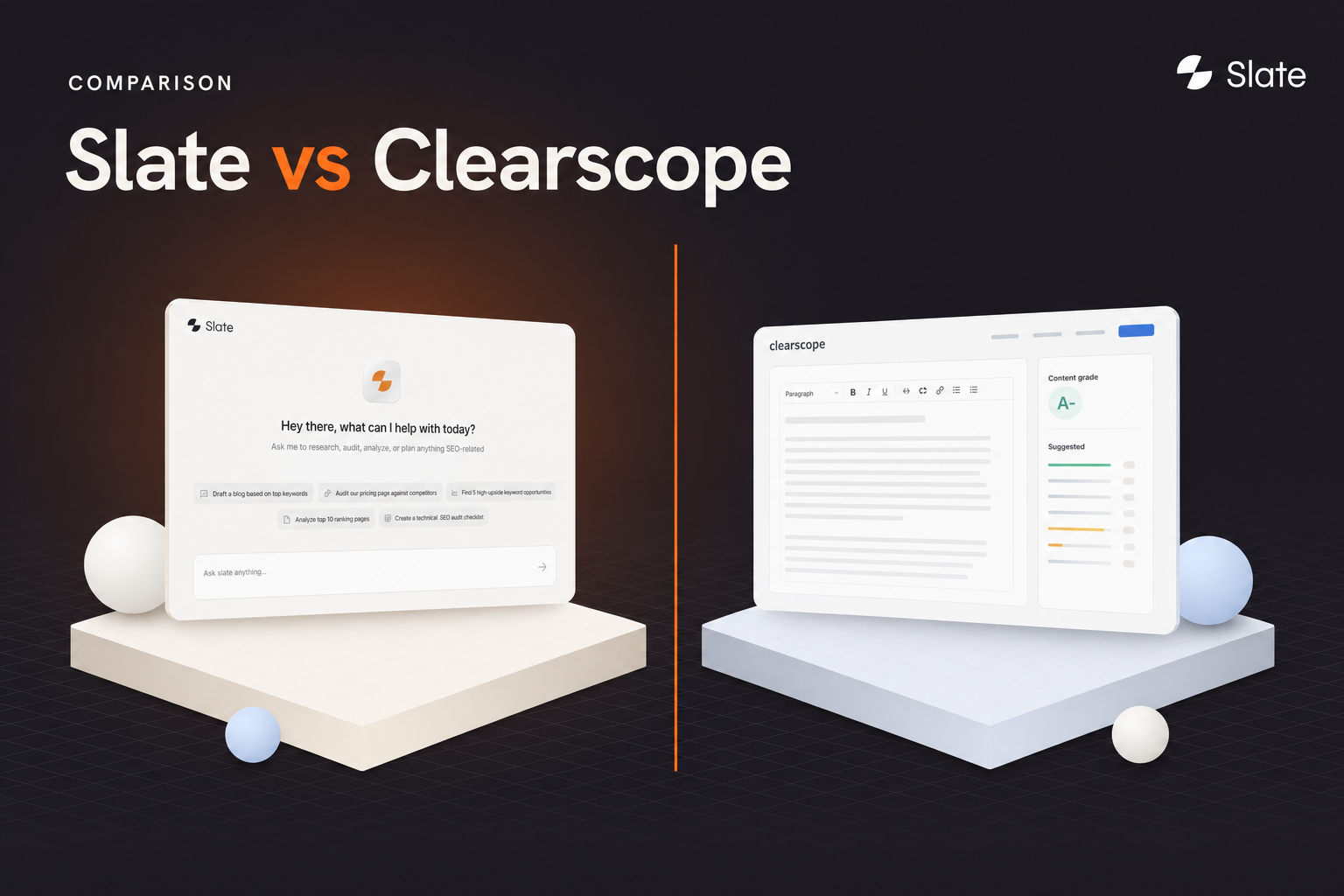
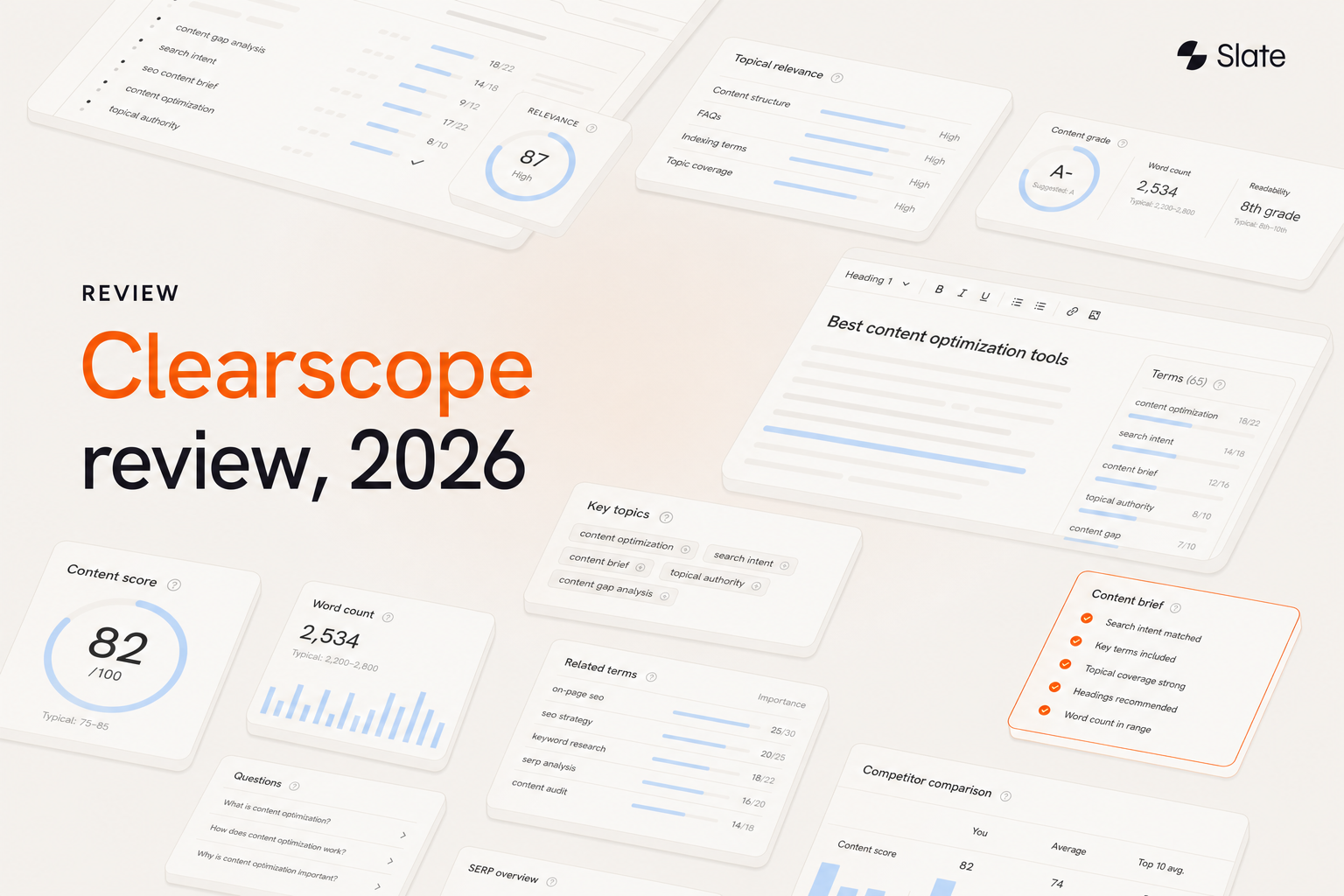
- Best for SERP-based content scoring: Clearscope provides clean content grading, a Content Inventory dashboard with decay monitoring, and AI term presence tracking. Starts at $129/month.
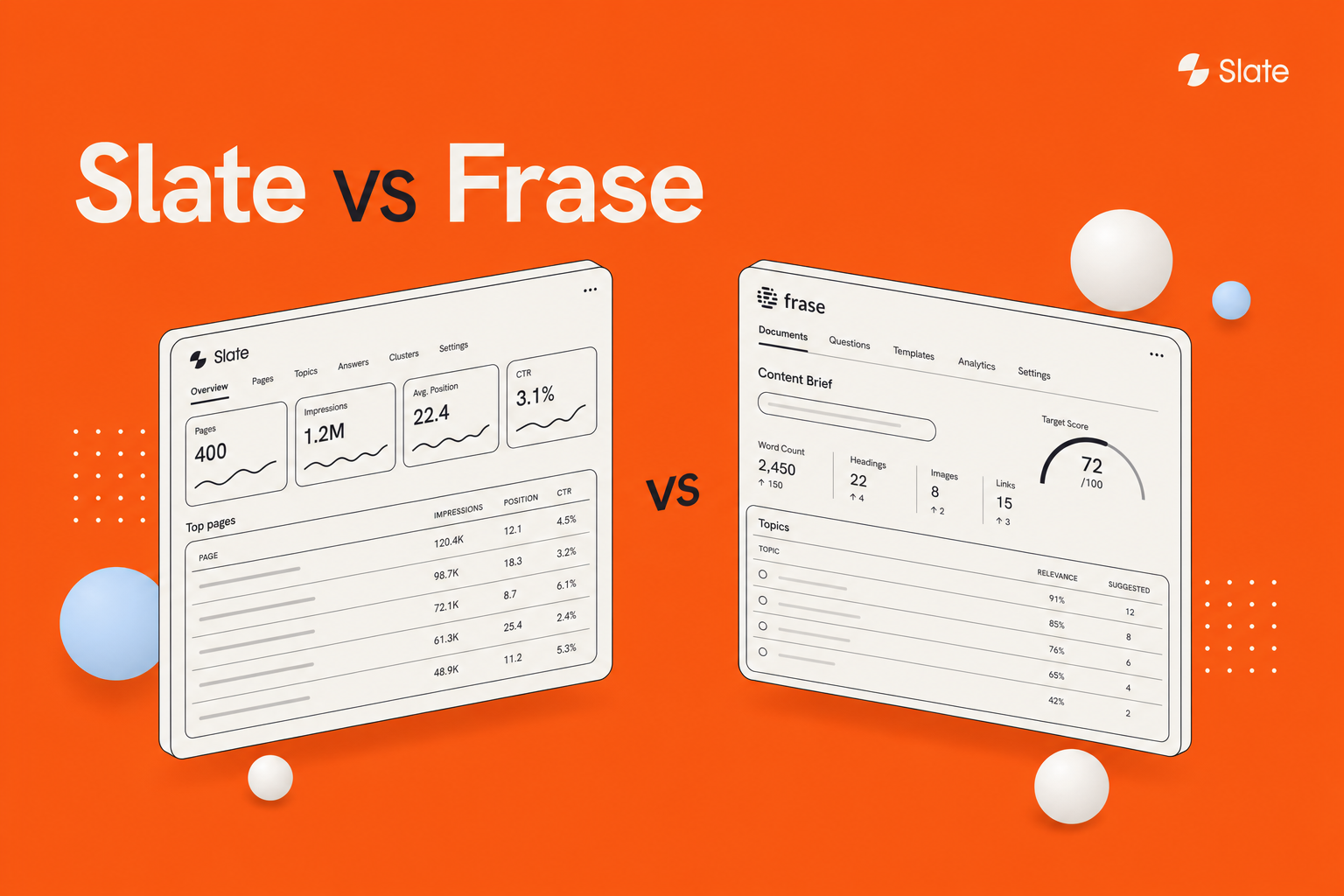
- Best for content briefs and AI writing on a budget: Frase combines brief generation, AI writing, content monitoring, and CMS publishing starting at $49/month.
- Best for budget-conscious teams: NeuronWriter offers a free plan and paid tiers starting at $23/month with NLP entities in 19 languages.
- When to stick with MarketMuse: If your primary need is deep topic modeling, personalized difficulty scores, and site-wide content inventory analysis across thousands of pages, MarketMuse still does that job well. The tools below address different or broader needs.
What MarketMuse Actually Does (And Where It Falls Short)
MarketMuse's Core Strengths: Content Inventory, Topic Modeling, And Planning
Give MarketMuse credit where it's earned. Few platforms match its depth in content inventory analysis and topic modeling. It crawls your entire site, maps your content against topic clusters, identifies gaps in topical authority, and assigns personalized difficulty scores based on your domain's existing coverage.
For a head of content sitting on 2,000 published pages and wondering "where should we invest next quarter," that's genuinely valuable. MarketMuse's competitive content analysis shows how your coverage compares to top-ranking competitors, and its content briefs pull from that analysis to guide writers toward topics where you have a realistic chance of ranking.
The platform was built for strategists who think in terms of topic clusters, content decay, and topical authority. And for that specific job, it remains strong.
Where Teams Hit Friction: The Planning-To-Execution Gap
Here's where the frustration starts. MarketMuse tells you what to write. It doesn't help you write it, optimize it in real time, publish it, or track whether it's getting cited in AI answers.
Picture a content lead who just finished a quarterly planning session inside MarketMuse. They have a prioritized list of topics, competitive gaps identified, and briefs generated. Now what? They copy those briefs into Google Docs, assign them to writers, wait for drafts, paste content into a separate optimization tool for scoring, then manually publish through their CMS. Every handoff introduces delay, context loss, and quality drift.
MarketMuse's AI writing capabilities are limited compared to dedicated AI content marketing tools. It doesn't publish directly to any CMS. And it has no mechanism for tracking whether your content appears in ChatGPT responses, Perplexity citations, or Google AI Overviews.
For teams that need to move from insight to published, optimized content without adding three tools and two headcount, that gap becomes the reason to look elsewhere.
Signs You've Outgrown MarketMuse (Or It Never Fit)
A few patterns tend to push teams toward exploring marketmuse alternatives:
- Your team is small and the complexity isn't justified. MarketMuse's depth is its strength, but a five-person content team publishing eight articles a month may never use 80% of what it offers.
- You're paying for planning but still stitching together execution. If your content workflow requires MarketMuse plus a writing tool plus an optimization tool plus manual CMS publishing, the total cost and friction may exceed the value of any single tool.
- AI search visibility matters to your leadership. When your CMO asks "are we showing up in ChatGPT answers?" and MarketMuse can't answer that question, the tool's strategic value diminishes.
- Content refresh velocity is a priority. Updating hundreds of existing pages requires bulk operations, programmatic workflows, and direct publishing. MarketMuse's page-by-page planning approach doesn't scale for that job.
None of these mean MarketMuse is a bad product. They mean your needs have evolved past what it was designed to do.
The Content Tool Landscape Has Changed: Here's What Matters Now
Planning Tools Vs Execution Platforms Vs AI Writers: Know What You're Comparing
One of the biggest problems with existing "best content optimization tools" lists is that they treat fundamentally different tool categories as interchangeable. A content strategist evaluating MarketMuse alternatives needs to understand what they're actually comparing.
Content intelligence platforms (MarketMuse, Conductor) focus on topic modeling, content inventory analysis, competitive intelligence, and strategic planning. They answer "what should we create?" at a high level.
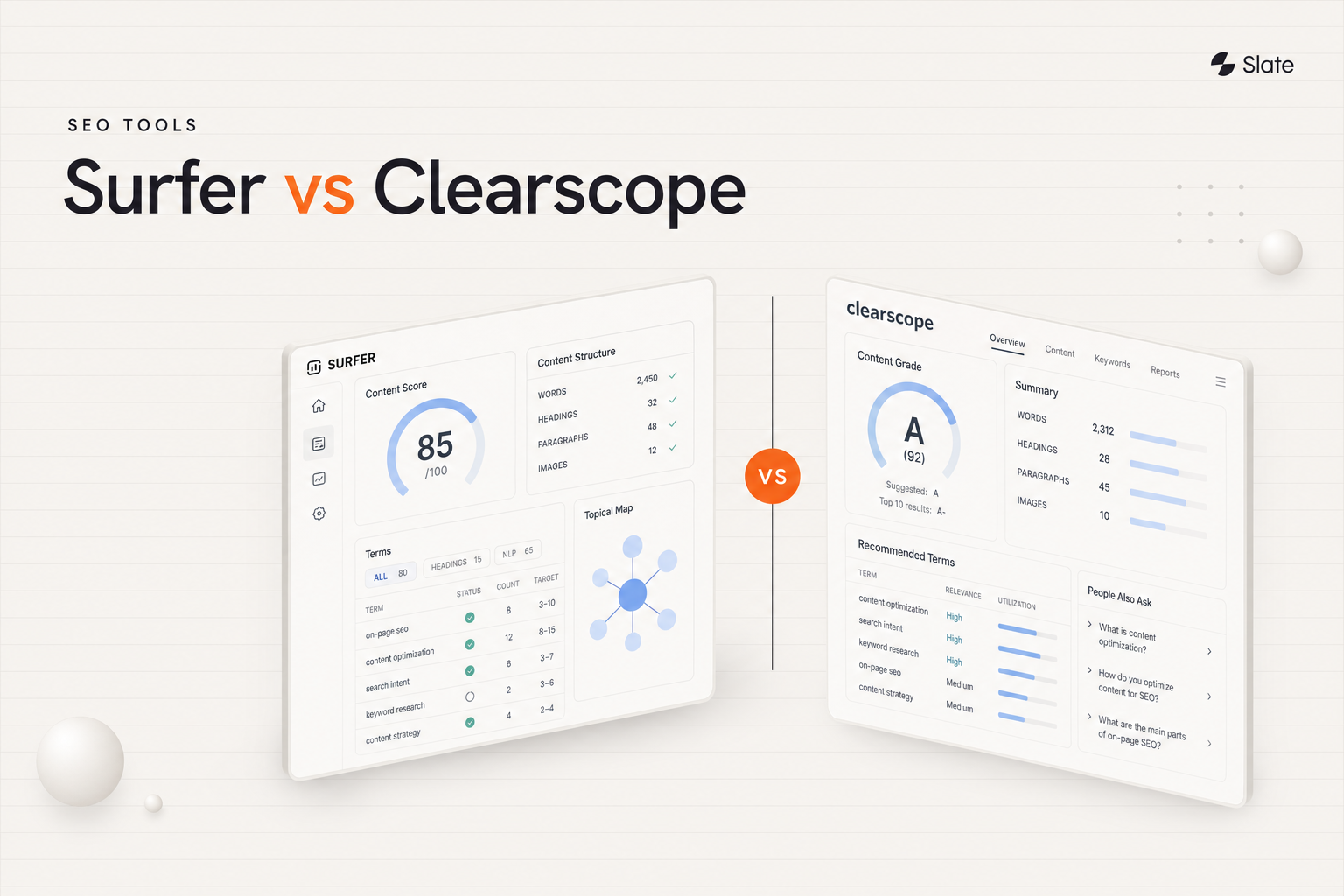
On-page optimizers (Surfer SEO, Clearscope) focus on content scoring, real-time writing guidance, and SERP-based optimization. They answer "how should we write this specific piece?"
Brief and AI writer hybrids (Frase, Dashword) combine content brief generation with AI-assisted drafting. They answer "what should this piece cover, and can AI help me draft it?"
AI search optimization platforms (Slate) connect visibility tracking, content creation workflows, and publishing into a single system. They answer "how do we create content that gets discovered across both traditional and AI search, and how do we do it at scale?"
When someone searches for a "marketmuse alternative," they might need any one of these categories. The right choice depends on which job they're hiring the tool to do.
Why AI Search Changes The Criteria For Choosing A Content Platform
Here's the shift that no competing comparison page addresses directly: the discovery layer has changed.
When someone asks ChatGPT "what's the best project management tool for remote teams," the answer doesn't come from a ranked list of ten blue links. It comes from a synthesized response that cites specific sources. When Google's AI Overviews answer a query before the user ever scrolls to organic results, the content that gets cited in that overview captures the visibility.
This means content teams in 2026 need to think about more than traditional rankings. They need to consider whether their content is structured for extraction, whether it's being cited by AI models, and whether they can even track their visibility across ChatGPT, Perplexity, Google AI Overviews, and AI Mode.
A content platform that only optimizes for traditional SERP rankings is optimizing for a shrinking share of how people find information. That doesn't make traditional SEO irrelevant. It makes it insufficient as the sole criterion for choosing a content tool.
The Evaluation Framework: 7 Criteria That Actually Matter
When comparing content intelligence platforms and optimization tools, these are the dimensions that separate a good fit from a poor one:
- Topic modeling depth: How well does the tool map topic clusters, identify content gaps, and assess topical authority?
- Content brief quality: Does it generate actionable briefs with SERP data, competitor analysis, and structural guidance?
- Optimization workflow: Can writers get real-time scoring and feedback as they write?
- AI writing support: Does the tool offer AI-assisted drafting, and how much control do you have over voice and accuracy?
- Content audit and inventory capabilities: Can it crawl your site, monitor content health, flag decay, and identify refresh opportunities?
- CMS and stack integrations: Does it connect to your existing tools, from Google Docs to WordPress to your SEO suite?
- AI search visibility: Can it track whether your content appears in AI-generated answers across ChatGPT, Perplexity, Google AI Overviews, and similar platforms?
Keep these seven criteria in mind as you evaluate each tool below. No single platform scores perfectly across all seven. The question is which criteria matter most for your team's specific situation.
The Best MarketMuse Alternatives By Use Case
Best For AI Search Optimization And End-To-End Content Engineering: Slate
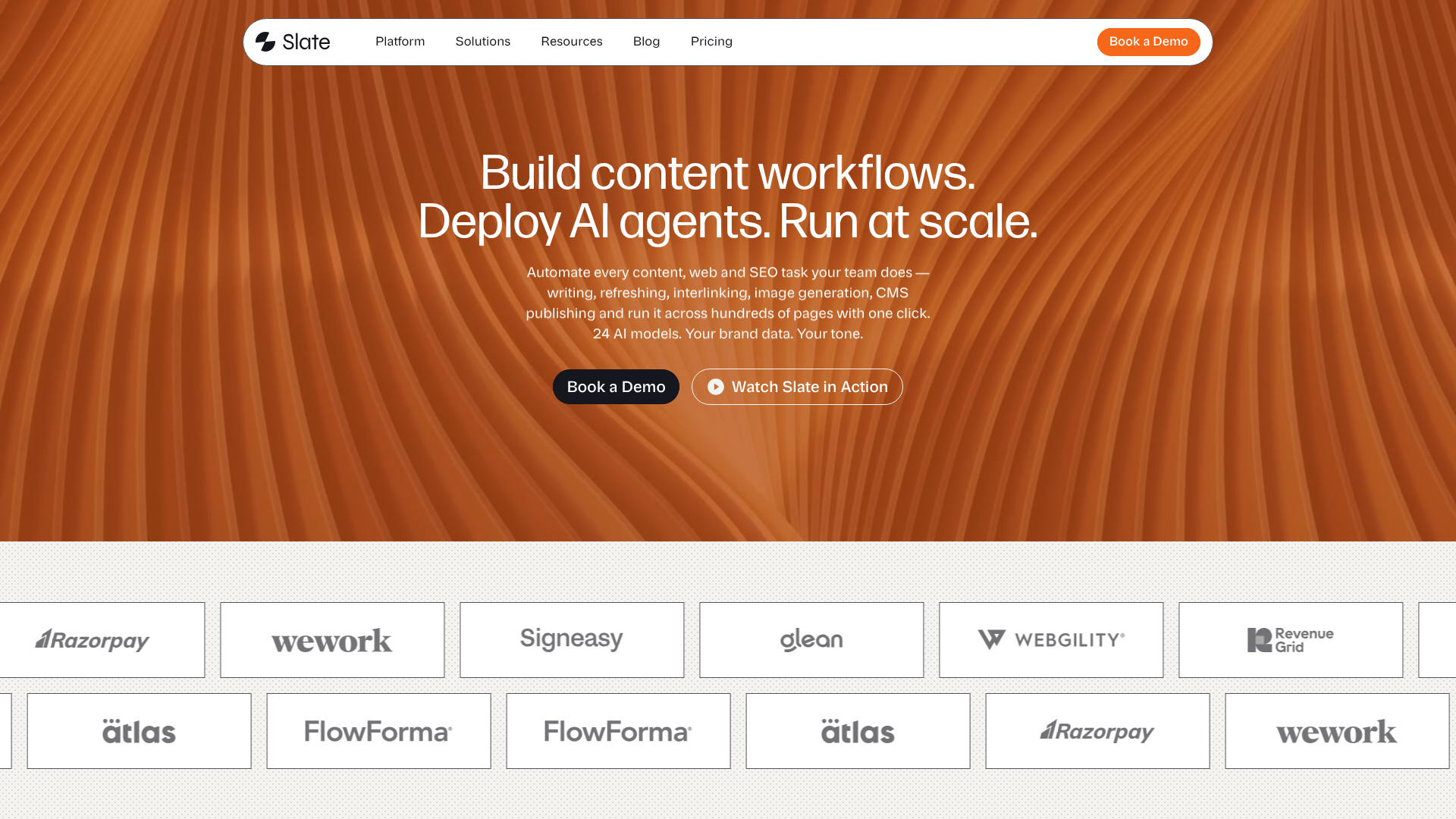
What it does: Slate is an AI search optimization and content engineering platform built for teams that need to connect insight to execution in one system. Rather than replacing MarketMuse's topic modeling with a similar feature, Slate addresses the reason many teams outgrow MarketMuse: the gap between knowing what to create and actually producing, optimizing, and publishing it at scale.
Who it's for: B2B SaaS marketing teams, content-led growth companies, and SEO leads who need to track AI search visibility, run scalable content workflows, and publish directly to their CMS without stitching together multiple tools.
How it compares to MarketMuse: MarketMuse excels at telling you what to write. Slate picks up where that insight ends. Slate's AI Search Analytics tracks visibility across ChatGPT, Google AI Mode, Google AI Overviews, and Perplexity, giving teams a view into the discovery layer that MarketMuse doesn't cover. Slate's Workflows provide a visual workflow builder with 24+ AI models, conditional logic, web scraping, and CMS publishing, so content moves from brief to published page inside one system. Where MarketMuse requires teams to export briefs and manually execute elsewhere, Slate keeps the entire cycle connected.
That said, Slate is not a 1:1 replacement for MarketMuse's deep topic modeling and site-wide content inventory analysis. Teams whose primary need is strategic topic planning at the domain level may still find MarketMuse's approach more suited to that specific job.
Key capabilities:
- AI Search Analytics for tracking visibility across ChatGPT, Google AI Mode, Google AI Overviews, and Perplexity
- Workflows with 24+ AI models, conditional logic, web scraping, and CMS publishing
- Power Sheets for bulk content refreshes, programmatic creation, and optimization audits across thousands of URLs
- Brand Kit & Knowledge Base for style guides, tone rules, and brand-safe AI content generation
- CMS Publishing directly to Webflow and WordPress
- SuperBlocks with pre-built workflow components and templates for AI search optimization
- MCP Integration for working with marketing data inside Claude
Pricing: Starts at $199/month.
Ideal team type: Mid-market content teams (5-20 people) at B2B SaaS companies who publish regularly and need to scale content operations without adding headcount. Also strong for growth-stage startups where one or two people need to do the work of a larger team through structured, repeatable workflows.
For teams ready to explore how AI search optimization and scalable content workflows fit their operation, Slate offers demos tailored to specific use cases.
Best For On-Page Content Optimization: Surfer SEO

What it does: Surfer SEO is an on-page optimization platform centered around its Content Editor, which provides real-time SEO guidelines as you write. It scores content against top-ranking pages for a given keyword, offering feedback on keyword density, structure, length, and related terms.
Who it's for: Content writers and SEO specialists who want live optimization feedback during the writing process. Surfer works well for teams that already know what to write and need help writing it to rank.
How it compares to MarketMuse (Surfer SEO vs MarketMuse): Where MarketMuse focuses on strategic planning and topic modeling, Surfer focuses on execution-level optimization. MarketMuse helps you decide which topics to cover across your domain. Surfer helps you write a single piece that scores well against the current SERP. They solve different problems, and many teams use both.
Surfer has also moved into AI search territory with its AI Tracker, which tracks visibility across Gemini, ChatGPT, Google AI Overviews, AI Mode, and Perplexity. Its Coverage Booster adds missing facts to increase LLM citations. These are capabilities MarketMuse doesn't offer.
However, Surfer's topic modeling and content inventory capabilities are lighter than MarketMuse's. Its Topical Map helps discover content gaps, and it offers Content Audit and Rank Tracker features, but it doesn't match MarketMuse's depth in site-wide content inventory analysis.
Key capabilities:
- Content Editor with real-time SEO guidelines
- AI Tracker for visibility across Gemini, ChatGPT, Google AI Overviews, AI Mode, and Perplexity
- Coverage Booster for adding missing facts to increase LLM citations
- On-page optimization suite: Content Score, AI Detector, AI Humanizer, Auto-Optimize, Auto Internal Links, Plagiarism Checker
- Outline Builder for content briefs
- Topical Map for discovering content gaps
- Rank Tracker with daily keyword position monitoring
- Collaborative editing in the Content Editor
- Integrations: Contentful, WordPress, Google Docs, ChatGPT, Jasper, Zapier
Pricing:
- Discovery: $49/month (billed yearly)
- Standard: $99/month (billed yearly)
- Pro: $182/month (billed yearly)
- Peace of Mind: $299/month (billed yearly)
- Enterprise: $999/month (custom billing)
Ideal team type: Writers and SEO specialists who need real-time optimization guidance. Strong for teams that already have a content strategy and need execution-level support. The AI Tracker makes it increasingly relevant for teams tracking AI search visibility alongside traditional rankings.
Best For SERP-Based Content Scoring: Clearscope
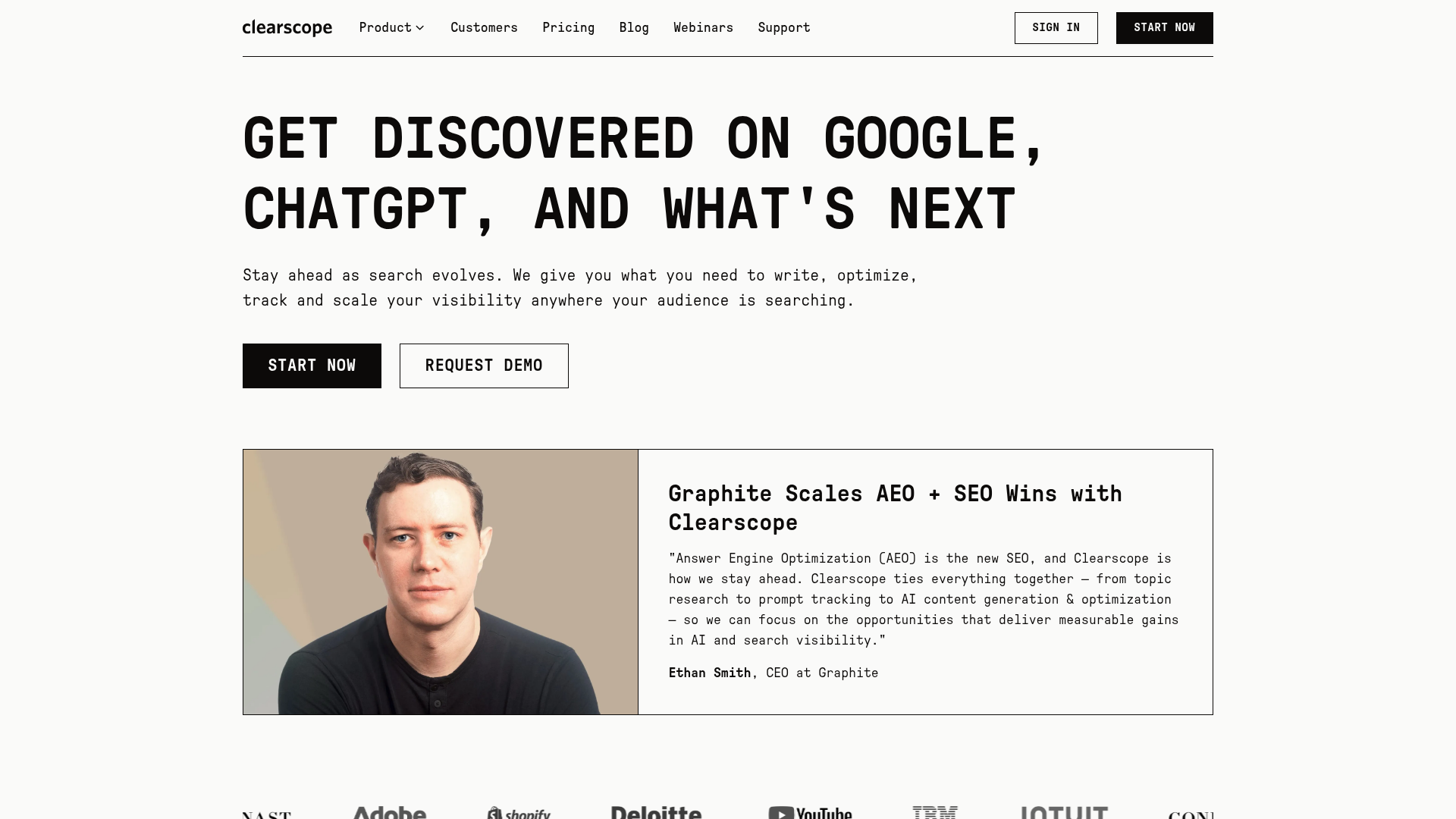
What it does: Clearscope provides content scoring based on term importance and real-time grading, helping writers optimize individual pieces against the competitive SERP. It's known for its clean interface and straightforward approach to content optimization.
Who it's for: Content teams that value simplicity and clarity in their optimization workflow. Clearscope appeals to editors and writers who want a grading system that's easy to understand and act on, without the complexity of a full content intelligence platform.
How it compares to MarketMuse (MarketMuse vs Clearscope): Clearscope is more focused than MarketMuse. It doesn't attempt the same depth of topic modeling or personalized difficulty scoring. But it offers something MarketMuse doesn't: a Content Inventory dashboard with monitoring for Striking Distance, Content Decay, and Page-Level Notices. These alerts flag indexation errors, content grade degradation, orphaned pages, and freshness issues across your published content.
Clearscope also tracks discoverability across Google and AI platforms (ChatGPT, Perplexity, and others) through its Tracked Topics feature, and its AI Term Presence shows which terms AI models like Gemini and GPT are using. This gives teams a window into AI search that MarketMuse doesn't provide.
Key capabilities:
- Content scoring via term importance and real-time grading
- Tracked Topics monitoring discoverability across Google and AI platforms
- AI Term Presence showing terms used by AI models
- Content Inventory dashboard with Striking Distance, Content Decay, and Page-Level Notices
- Topic Exploration for mapping topic clusters and measuring topical authority
- Boost Content Grade for one-click optimization
- Built-in AI writing assistant ("Draft with AI")
- Search Intent Summaries
- Integrations: Google Docs, WordPress, Microsoft Word
Pricing:
- Essentials: $129/month (20 tracked topics, 50 pages, 20 monthly topic explorations, 20 monthly drafts)
- Business: $399/month (50 tracked topics, 300 pages, dedicated account manager)
- Enterprise: Custom pricing (custom credits, SSO, crawler whitelisting)
Ideal team type: Mid-market content teams that want clean, reliable content scoring without the learning curve of a full content intelligence platform. Particularly strong for teams with an existing content library that needs ongoing monitoring and optimization.
Best For Content Briefs And AI Writing: Frase
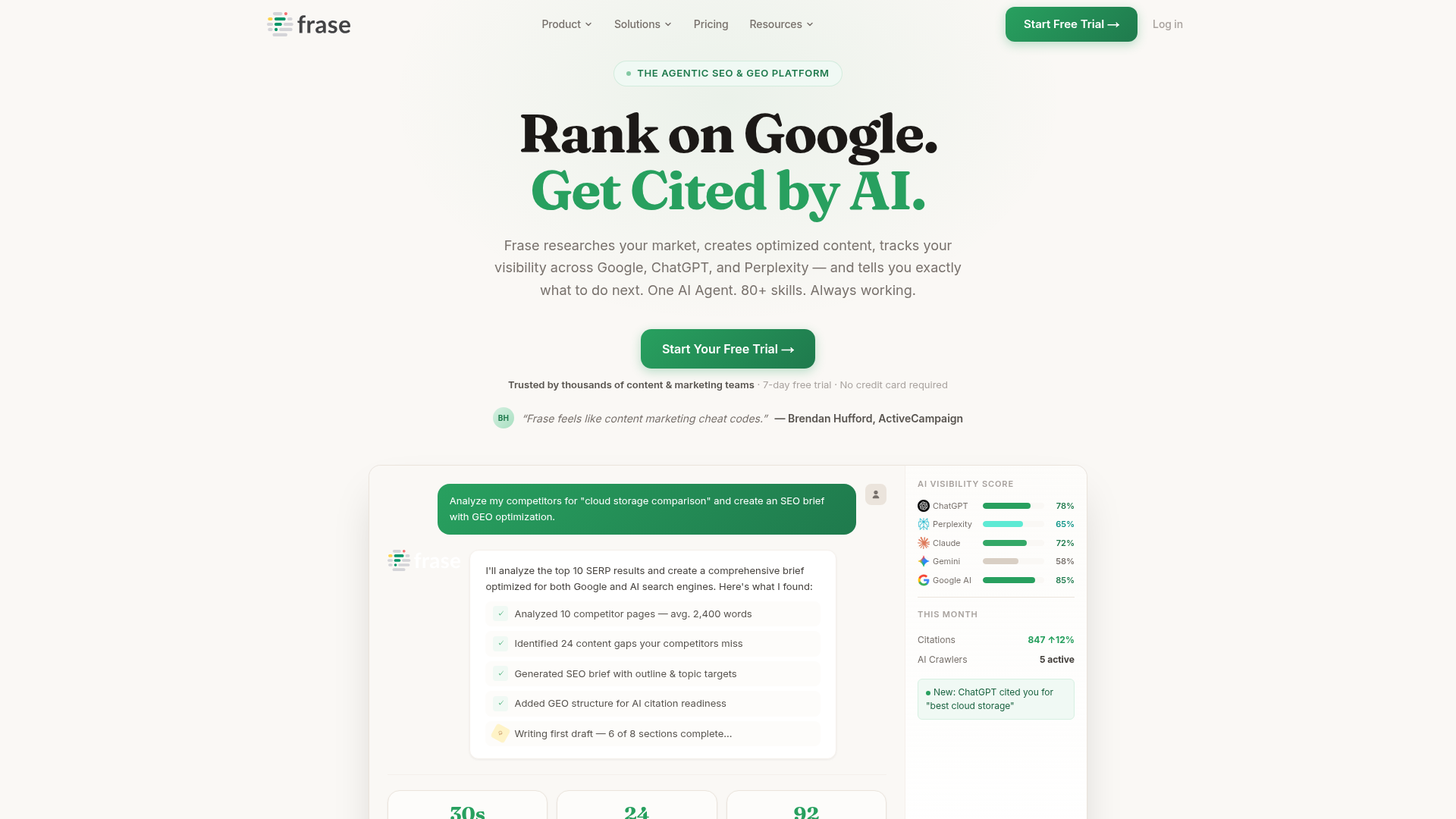
What it does: Frase combines content brief generation, AI-powered writing, content optimization for both SEO and AI platforms (GEO), and direct CMS publishing into a single workflow. It pulls data from top-ranking pages to generate briefs, then helps writers draft and optimize content in the same interface.
Who it's for: Content teams that want to move from research to published draft quickly, especially those who rely on AI-assisted writing and need brand voice controls. Frase is particularly appealing for teams that want CMS publishing without leaving the tool.
How it compares to MarketMuse (MarketMuse vs Frase): Frase covers more of the execution workflow than MarketMuse. While MarketMuse's topic modeling is deeper, Frase offers content brief generation, AI writing, real-time optimization, content monitoring with health scoring, and direct publishing to WordPress, Sanity, Webflow, Wix, and FraseCMS. It also includes Brand Voice, Style Guide, Custom Terms, and Reference Docs for governance.
Frase's Content Monitoring pulls every published post from a connected CMS and assigns a live health score. Its Content Guard feature can auto-fix decaying content and re-publish. And its AI Search Tracking monitors visibility across AI platforms like ChatGPT and Perplexity.
Where Frase falls short compared to MarketMuse is in the depth of topic modeling and site-wide strategic planning. Frase is better at helping you create and maintain individual pieces; MarketMuse is better at telling you which pieces to prioritize across your entire domain.
Key capabilities:
- Content brief generation from SERP data
- AI content writing optimized for SEO and AI platforms (GEO)
- Content Monitoring with live health scoring
- Content Guard for auto-fixing decaying content
- AI Search Tracking across AI platforms
- Brand Voice, Style Guide, Custom Terms, Reference Docs
- Direct publishing to WordPress, Sanity, Webflow, Wix, FraseCMS
- Topic Clusters and Internal Linking Recommendations
- Programmatic SEO with batch page generation
- REST API with 50+ endpoints
- Site Auditor with E-E-A-T scoring
Pricing:
- Starter: $49/month (or $39.20/month billed annually) with 1 user seat, 10 AI-optimized articles/month
- Professional: $129/month (or $103.20/month billed annually) with 3 seats included
- Scale: $299/month (or $239.20/month billed annually) with 5 seats included, 10 domains monitored
- Enterprise: Custom pricing with SSO, white-label portal, SOC 2 Type II
Ideal team type: Small to mid-size content teams that want brief generation, AI writing, optimization, and publishing in one tool. Strong for teams that publish frequently and need content monitoring to catch decay before it impacts performance.
Best For Workflow-Centric Content Briefs: Content Harmony
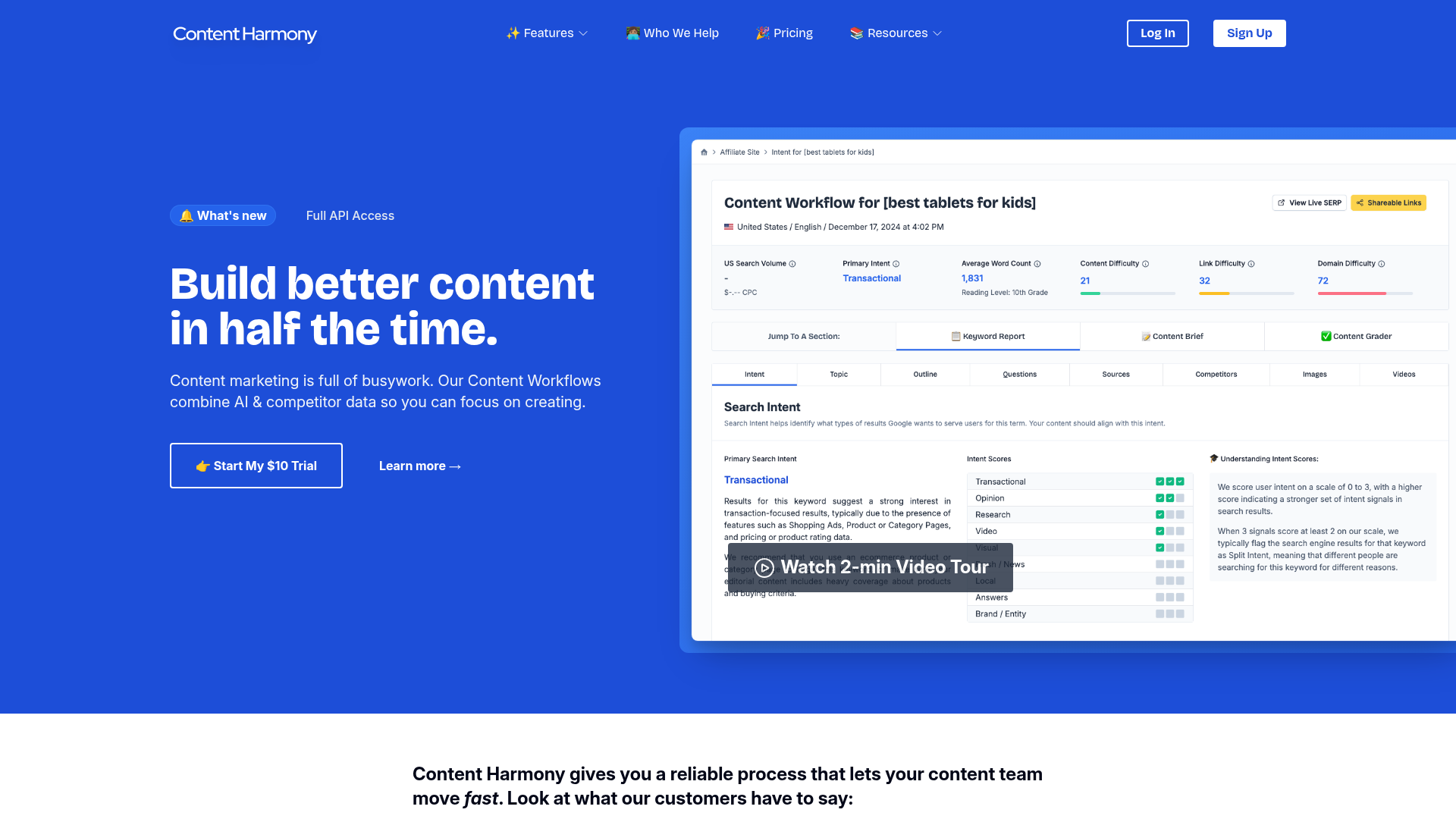
What it does: Content Harmony structures the content creation process around workflows that combine AI analysis with competitor data. Its Keyword Reports provide search intent analysis, topic models, competitor outlines, keyword difficulty, question analysis, and more. Content Briefs use a customizable block editor with templates, tables, checklists, and comments.
Who it's for: SEO teams and agencies that need structured, repeatable brief creation workflows. Content Harmony is built for teams where the brief is the critical handoff document between strategist and writer.
How it compares to MarketMuse: Content Harmony focuses on the brief creation and content grading workflow rather than site-wide content inventory. Its Keyword Reports include AI Overviews data under Search Intent, giving teams visibility into how AI is shaping the SERP for specific queries. The Content Grader uses AI-driven topic models and keyword extraction to score content.
However, Content Harmony does not appear to offer content inventory or site-wide content audit capabilities comparable to MarketMuse. It also does not appear to offer brand governance or editorial control features like style guides or permissions workflows.
Where Content Harmony stands out is in its integration breadth (Google Docs, Microsoft Word, Notion, API, Moz, DataForSEO, EditorNinja, outgoing webhooks) and its free onboarding, training, and concierge migrations, which ease the transition for teams switching from other tools.
Key capabilities:
- Content Workflows combining AI and competitor data
- Keyword Reports with Search Intent, Topic Model, Competitor Outlines, Question Analysis, AI Overviews data
- Content Briefs with customizable block editor and templates
- Content Grader with AI-driven topic model
- Full REST API access
- Desktop apps for Mac and Windows
- Google Docs Add-On for grading content
- AI Suggested Questions, Images, and Headings
- Free concierge migrations
Pricing:
- Standard plans range from $50/month (5 workflows) to $799/month (150 workflows), with annual billing discounts available
- Enterprise: Starting at $1,000/month for 200+ workflows
Ideal team type: Agencies and in-house SEO teams that need structured brief creation at scale. The workflow-per-month pricing model makes costs predictable, and the API access supports custom agency workflows.
Best For Lightweight Teams On A Budget: Dashword
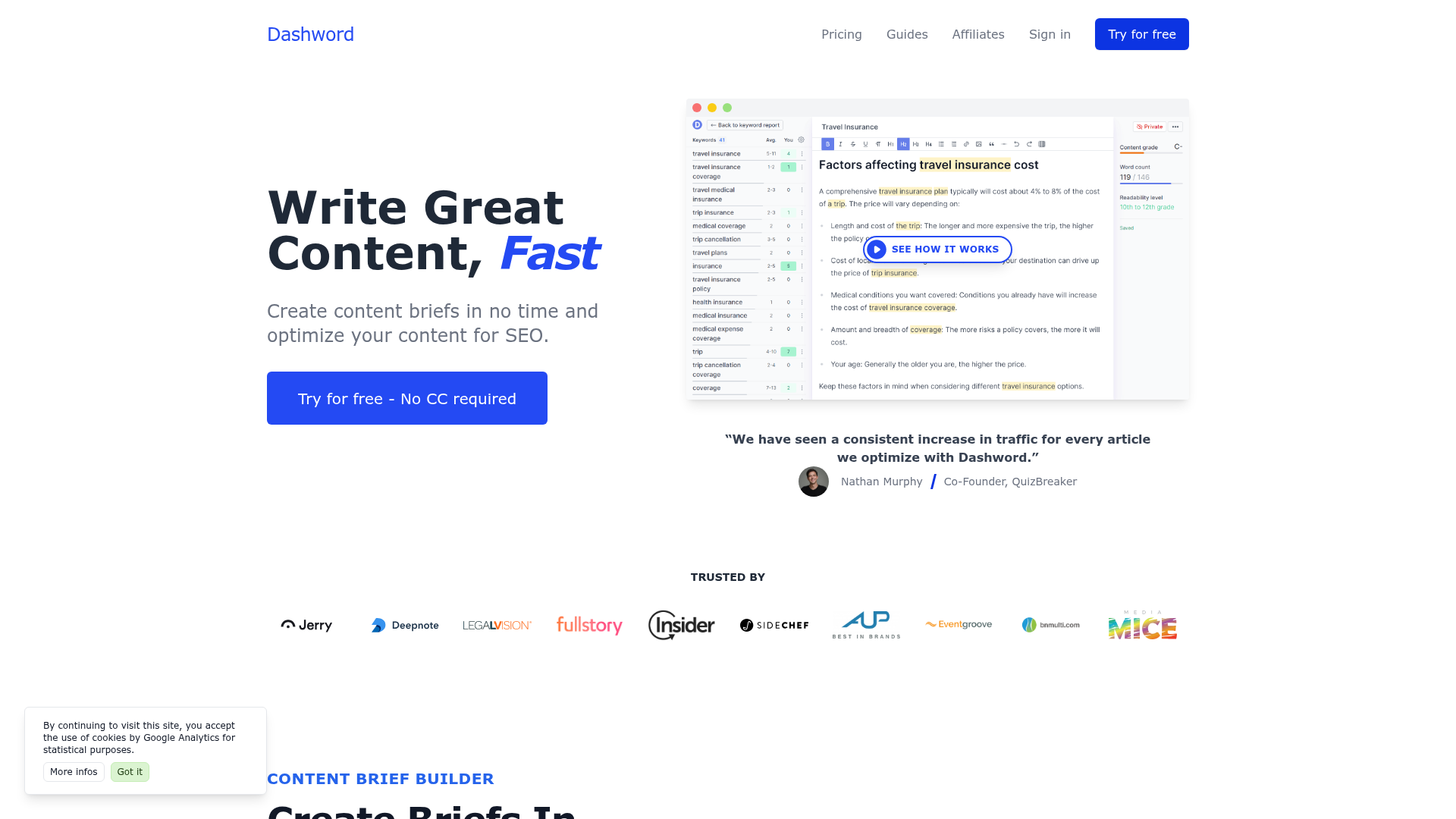
What it does: Dashword provides content optimization with real-time feedback, content briefs with AI assistance, and content monitoring for tracking underperforming pages. It's designed to be straightforward: generate a report for a keyword, write against it, and monitor how your content performs over time.
Who it's for: Small content teams and solo marketers who need a simple, affordable optimization tool without the complexity of enterprise platforms.
How it compares to MarketMuse: Dashword is significantly simpler and more affordable than MarketMuse. It doesn't attempt topic modeling or site-wide content inventory analysis at MarketMuse's depth. But its Content Monitoring feature tracks underperforming pages with automated keyword reports, rank tracking, and automated page import, giving teams a lightweight way to identify content that needs attention.
Dashword does not appear to offer AI search visibility tracking, CMS publishing integrations, or brand governance features. For teams whose primary concern is AI search, this is a meaningful gap. But for teams that need basic content optimization and monitoring at a reasonable price, Dashword delivers.
Key capabilities:
- Content optimization with real-time content score and readability feedback
- Content briefs and outlines with AI assistance (title ideas, competitor outlines, FAQs, keywords)
- Content Monitoring with rank tracking and automated page import
- Brief sharing via public link or export
- Google Docs add-on
- Free SEO tools: Content Optimization Checker, Content Brief Generator, Meta Description Generator
Pricing:
- Startup: $99/month (30 content reports, 5 user seats, AI writer with 100k words)
- Business: From $349/month (100 content reports, 10 user seats, bulk reports, API access, SSO)
Ideal team type: Startups and small content teams (1-5 people) that need affordable content optimization without enterprise complexity. If your team publishes 10-30 pieces per month and needs basic scoring and monitoring, Dashword covers the essentials.
Best For SEO-Guided Content Planning: Outranking
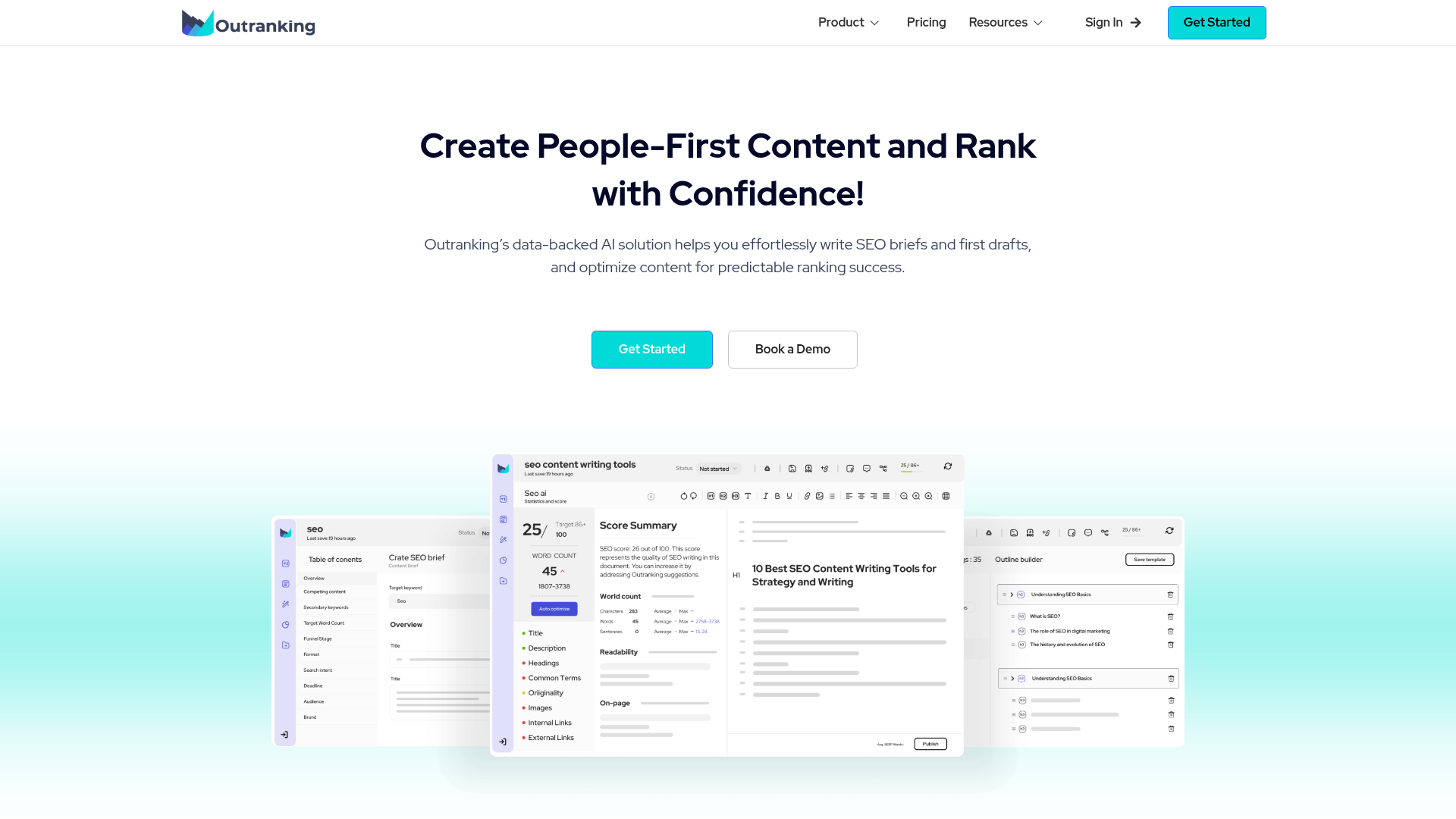
What it does: Outranking combines SEO briefs, AI-powered writing with GPT-4, real-time SEO scoring, and a content audit tool into a workflow-oriented platform. Its unique features include Concepts™ (which collects facts from ranking pages), Methods™ (writing workflows and automation), and Heat Maps showing keyword usage by competitors.
Who it's for: SEO writers and small teams that want AI-assisted content creation guided by competitive SERP data. Outranking is particularly useful for teams that need to produce SEO-optimized first drafts quickly.
How it compares to MarketMuse: Outranking offers a website content audit via sitemap crawl, which gives it some overlap with MarketMuse's content inventory capabilities, though at a lighter depth. It also provides style guides for brand personalization and team collaboration with user quotas, addressing governance needs that many lighter tools miss.
Outranking supports 13 languages, making it relevant for international SEO teams. However, it does not appear to offer AI search visibility tracking for platforms like ChatGPT, AI Overviews, or Perplexity.
Key capabilities:
- SEO Briefs with AI Wizard for title and outline generation
- Concepts™ for collecting facts from ranking pages
- Methods™ for writing workflows and automation
- Real-time SEO scoring and content assessment
- Website content audit via sitemap crawl
- AI Writing with GPT-4 and style guides for brand personalization
- Internal linking suggestions
- Heat Maps for keyword usage by competition
- Plagiarism checker and fixer
- Team collaboration with user quotas and client sharing
- Supports 13 languages
- Integrations: Google Docs, WordPress plugins, API access
Pricing:
- Starter: $19/month (4 SEO documents)
- SEO Writer: $79/month (15 SEO documents, 2 users)
- SEO Wizard: $159/month (30 SEO documents, 3 users)
- Custom Plan: Contact vendor
Ideal team type: Solo SEO writers and small teams (1-3 people) who need AI-assisted content creation with competitive SERP data. The low entry price makes it accessible for freelancers and early-stage teams.
Best For Enterprise SEO Programs: Conductor
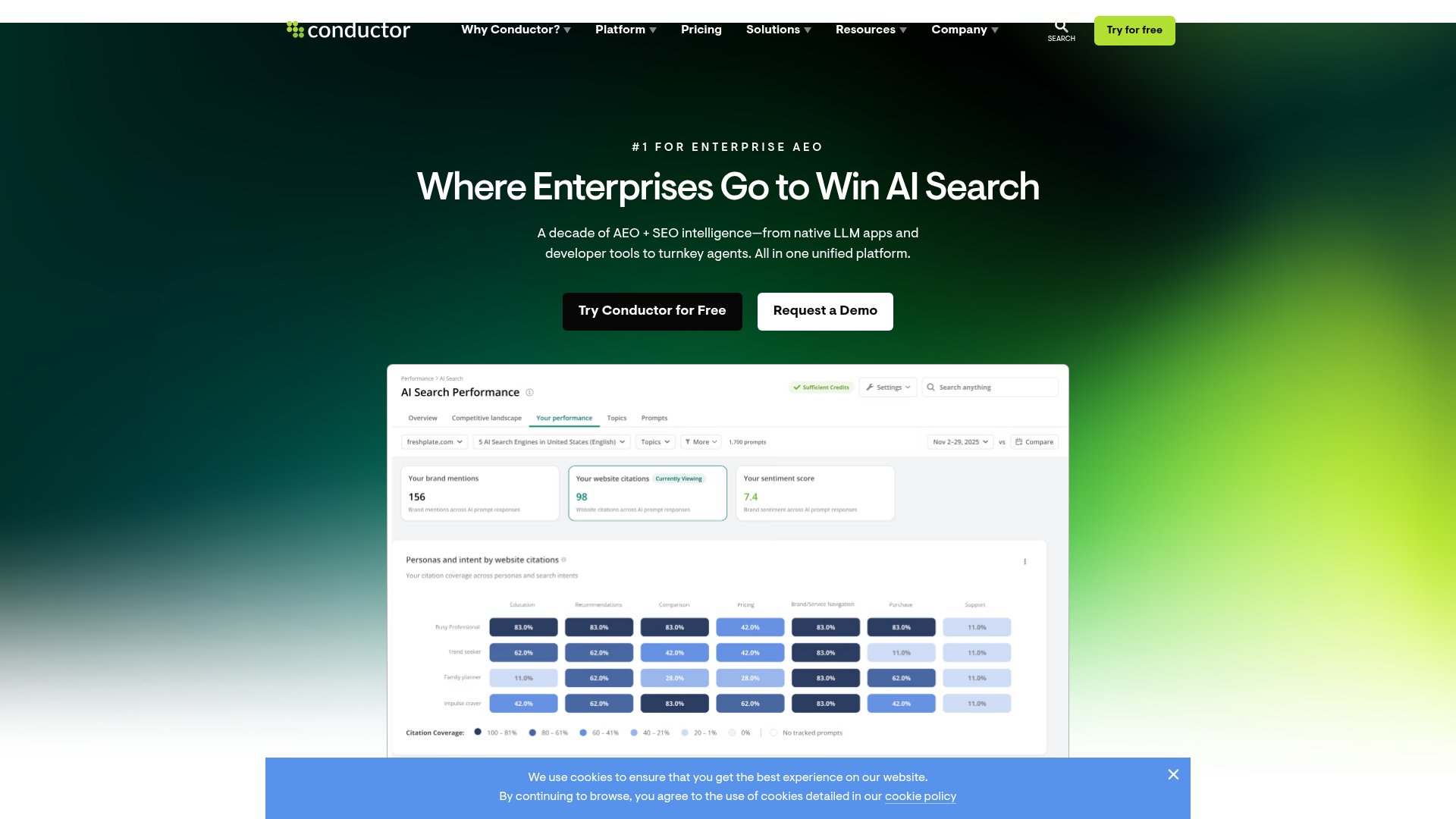
What it does: Conductor is an enterprise content intelligence platform that unifies topic research, competitive intelligence, AI content creation, website performance analytics, and real-time site health monitoring. It's built for large organizations that need to connect SEO and content performance to business metrics like traffic, conversions, and revenue.
Who it's for: Enterprise marketing teams and large content operations that need multi-domain management, advanced analytics integrations, and the ability to connect content performance to revenue.
How it compares to MarketMuse: Conductor operates in the same content intelligence category as MarketMuse but at a larger scale. Its AI Topic Map handles topic clustering and opportunity identification. Its Content Profiles let teams define tone, style, and brand guidelines for AI-generated content. And its AI visibility tracking covers ChatGPT, Perplexity, Google AI Overviews, and more, with the ability to connect AI visibility to traffic, conversions, and revenue.
Conductor also offers Brand Sentiment Analysis tied to citations in AI search, AI Bot Crawling Reports, and competitive intelligence that benchmarks competitors across both AI and traditional search. These enterprise-grade capabilities go beyond what MarketMuse offers, but they come with enterprise-grade complexity and pricing.
Key capabilities:
- AI visibility tracking across ChatGPT, Perplexity, Google AI Overviews, and more
- Connect AI visibility to traffic, conversions, and revenue
- Topic and keyword research with AI Topic Map
- Competitive intelligence across AI and traditional search
- Content Profiles for tone, style, and brand guidelines
- AI content creation with Writing Assistant and AI Content Score
- Real-time site health monitoring
- Brand Sentiment Analysis tied to AI search citations
- AI Bot Crawling Reports
- Integrations: Google Analytics, Adobe Analytics, Search Console
- Data API and MCP for BI and AI workflow integration
Pricing: Not publicly listed. Contact Conductor for pricing. Conductor offers three products (Creator, Intelligence, Monitoring) each with multiple tiers (Essentials, Standard, Growth, Professional, Enterprise).
Ideal team type: Enterprise content operations managing multiple domains with large content libraries. Best for organizations that need to connect content performance to business revenue and require advanced analytics integrations.
Best For Budget-Conscious On-Page Optimization: NeuronWriter
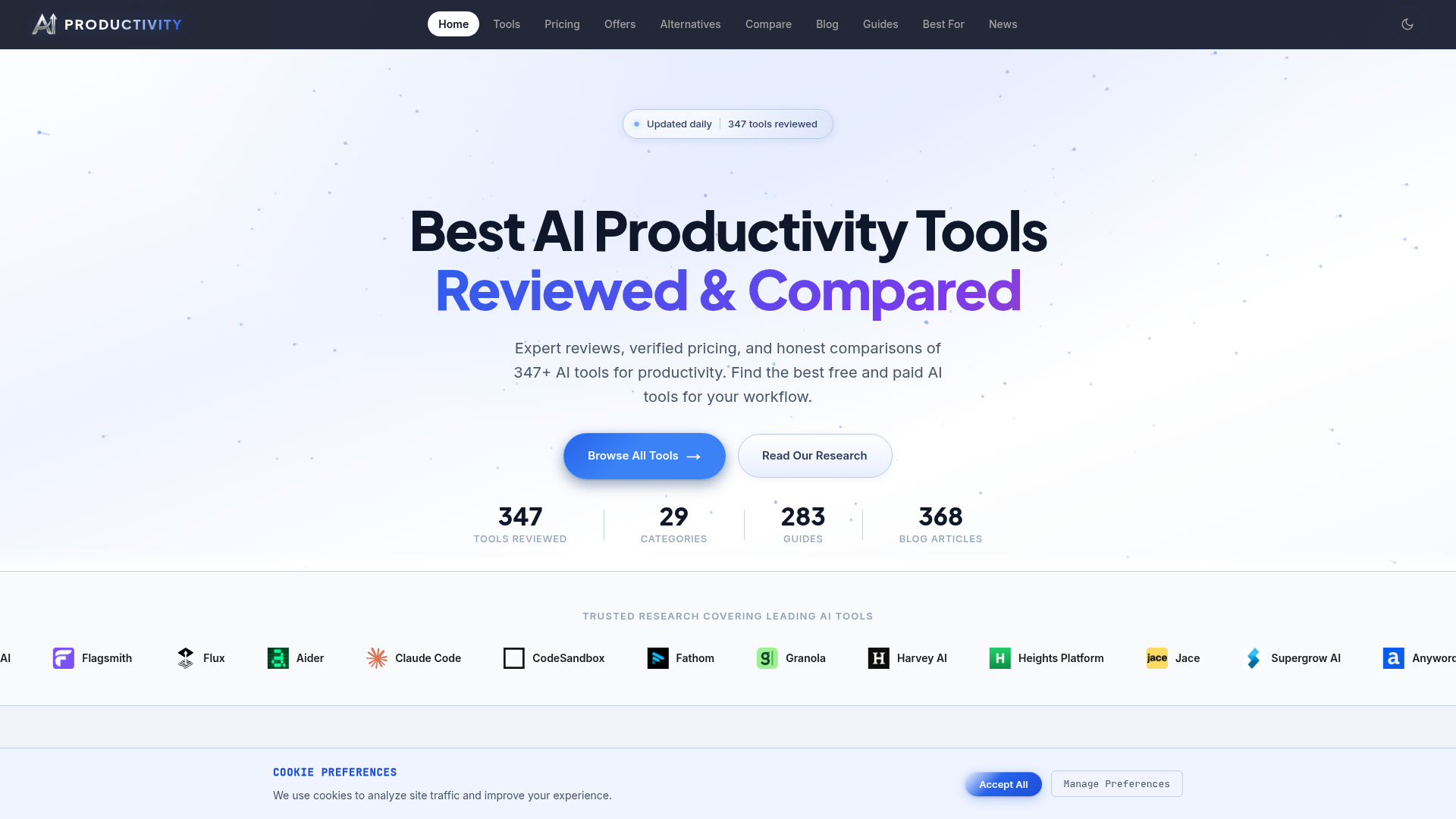
What it does: NeuronWriter provides content optimization with NLP-based recommendations, AI writing assistance, competitive SERP analysis, and content scoring. It supports NLP entities in 19 languages, making it one of the most multilingual options in this category.
Who it's for: Budget-conscious content creators and small teams who need solid on-page optimization without paying enterprise prices. NeuronWriter's free plan makes it accessible for freelancers and solo marketers testing content optimization for the first time.
How it compares to MarketMuse: NeuronWriter doesn't attempt MarketMuse's depth of topic modeling or site-wide content inventory. It focuses on individual content optimization with NLP recommendations, competitive analysis, and AI writing tools. However, it does offer AI Visibility tracking across ChatGPT, Perplexity, and Google AI Overviews, with AI Score, prompt suggestions, gap analysis, and visibility trends. That's a capability MarketMuse lacks.
NeuronWriter also supports BYOK (Bring Your Own Key) for OpenAI and Anthropic, letting teams use their own API keys for AI generation. This gives more control over AI costs and model selection.
Key capabilities:
- Content optimization with NLP terms and entities in 19 languages
- AI Visibility tracking across ChatGPT, Perplexity, and Google AI Overviews
- Neuro AI assistant for paraphrasing, keyword insertion, tone adjustment, meta generation
- Content Designer for AI-powered article creation with automatic structure
- Competitive SERP analysis and content scoring
- Auto-insert Internal Links and NLP Terms
- WordPress and Google Search Console integration
- Zapier and API integration
- BYOK support for OpenAI and Anthropic keys
- AI Image Generation
- Next Content Ideas for topic discovery
Pricing:
- Free: $0/month (1 project, 3 analyses/month, 20,000 AI credits/month)
- Bronze: $23/month (or $19/month billed annually)
- Silver: $45/month (or $37/month billed annually)
- Gold: $69/month (or $57/month billed annually)
- Platinum: $93/month (or $77/month billed annually)
- Diamond: $117/month (or $97/month billed annually)
Ideal team type: Freelancers, solo marketers, and small teams on tight budgets. The free plan is a genuine entry point, and the paid tiers scale affordably. Strong for multilingual content teams thanks to NLP entity support in 19 languages.
Best For SEO Suite Users Who Want Built-In Optimization: Semrush Writing Assistant
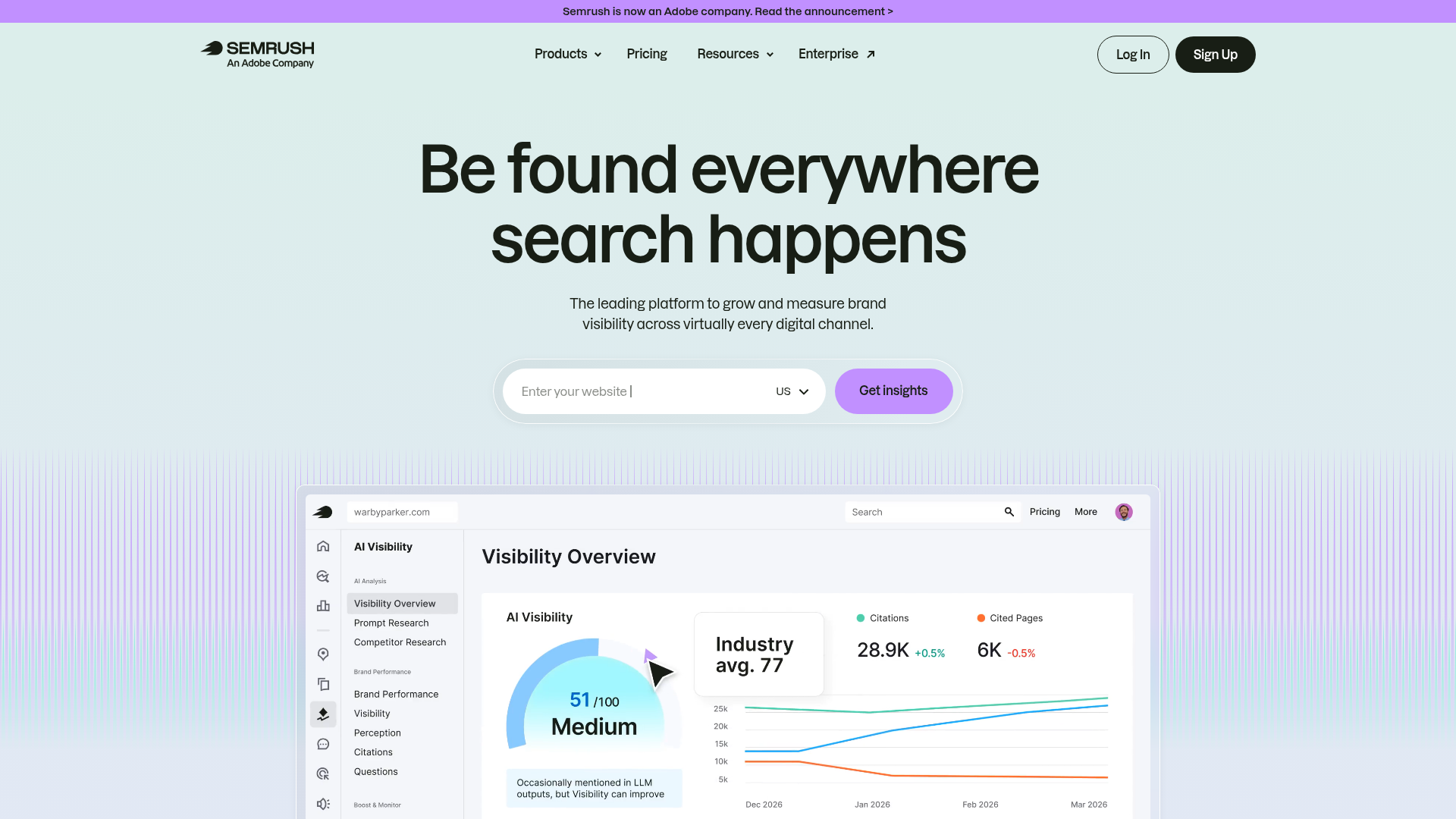
What it does: Semrush Writing Assistant is a content optimization feature built into the broader Semrush platform. It provides real-time writing recommendations based on SEO data, readability, tone of voice, and originality.
Who it's for: Teams already using Semrush for keyword research, backlink analysis, and technical SEO who want content optimization without adding another tool to their stack.
How it compares to MarketMuse: Semrush Writing Assistant is a feature within a larger SEO suite, while MarketMuse is a dedicated content intelligence platform. The Writing Assistant doesn't offer MarketMuse's depth of topic modeling or content inventory analysis. But for teams that already pay for Semrush and need basic content optimization guidance, it eliminates the need for a separate tool.
The trade-off is depth. If content optimization is a core part of your workflow, a dedicated tool like Clearscope, Surfer, or Frase will offer more sophisticated scoring, better content briefs, and deeper SERP analysis. If content optimization is one of many things your team does inside Semrush, the Writing Assistant may be sufficient.
Key capabilities:
- Real-time writing recommendations based on SEO data
- Readability and tone of voice analysis
- Part of the broader Semrush SEO suite
Pricing: Not publicly listed as a standalone product. Semrush Writing Assistant is included within Semrush platform plans. See Semrush's pricing page for current plan details.
Ideal team type: Teams already invested in the Semrush ecosystem who need basic content optimization without adding another vendor.
MarketMuse Alternatives Comparison Table
How To Choose: Decision Framework By Team Type
Solo Founders And Small Content Teams (1-5 People)
If you're a small team, every tool needs to earn its place. You don't have the bandwidth to learn a complex platform, and you can't afford to pay for capabilities you won't use for another two years.
Start with the job you need done most. If it's writing content that ranks, Frase ($49/month) or Dashword ($99/month) give you briefs, optimization, and AI writing in one place. If budget is the primary constraint, NeuronWriter's free plan lets you test content optimization before committing.
If your small team is punching above its weight and needs to produce content at a pace that would normally require more people, Slate (starts at $199/month) offers Workflows and CMS Publishing that let a two-person team operate like a ten-person team through structured, repeatable processes.
The key question for small teams: do you need a planning tool or an execution tool? Most small teams need execution.
Mid-Market In-House SEO And Content Teams (5-20 People)
This is where tool selection gets strategic. You have enough content to worry about decay, enough team members to need collaboration features, and enough stakeholder pressure to need reporting on AI search visibility.
The planning-to-execution gap matters most here. A team of this size often has a strategist who plans, writers who execute, and an editor who reviews. If those three roles are using three different tools, context gets lost at every handoff.
Clearscope ($129/month) works well for teams that want clean content scoring and content inventory monitoring. Frase ($129/month Professional plan) covers more of the workflow from brief to published page. Slate (starts at $199/month) connects the full cycle from AI visibility tracking through content creation to CMS publishing, which reduces the number of tools and handoffs in the workflow.
For teams at this size, also consider whether AI search visibility tracking is a reporting requirement. If your leadership is asking about ChatGPT citations and AI Overview presence, you need a tool that can answer those questions.
Agencies Managing Multiple Client Sites
Agency needs are distinct: multi-site management, client-facing deliverables, scalable workflows, and predictable per-client costs.
Content Harmony's workflow-based pricing (starting at $50/month for 5 workflows) makes costs predictable per client. Its API access and webhook integrations support custom agency workflows, and its free concierge migrations ease client onboarding.
Frase's Scale plan ($299/month) supports 10 domains monitored and multi-channel content creation, making it viable for agencies managing multiple client properties. Outranking supports team collaboration with user quotas and client sharing.
Slate's Workflows and Power Sheets are designed for managing content across multiple sites at scale. The ability to run bulk optimization audits across thousands of URLs and publish directly to client CMS instances reduces the manual overhead that eats into agency margins.
Enterprise Content Operations
Enterprise teams need governance, analytics integration, multi-domain support, and the ability to connect content performance to revenue.
Conductor is purpose-built for this. Its AI visibility tracking connects to traffic, conversions, and revenue. Its Content Profiles enforce brand guidelines across AI-generated content. Its integrations with Google Analytics, Adobe Analytics, and Search Console unify performance data. And its Data API and MCP support BI and AI workflow integration.
The trade-off is complexity and cost. Conductor's pricing isn't publicly listed, and the platform requires meaningful onboarding. For enterprise teams with the resources to invest, it's the most comprehensive option. For mid-market teams that need enterprise-grade AI search visibility without enterprise-grade complexity, Slate offers a more focused alternative.
Recommended Content Stacks (Not Just Single Tools)
No single tool does everything well. Here's what practical content stacks look like at different maturity levels.
The Minimalist Stack For Early-Stage Teams
- Content optimization and writing: Frase Starter ($49/month) or NeuronWriter Bronze ($23/month)
- Keyword research and technical SEO: Ahrefs or Semrush (existing subscription)
- Publishing: WordPress or Webflow (direct)
This stack keeps costs under $150/month and covers research, writing, optimization, and publishing. The gap: no AI search visibility tracking and limited content monitoring.
The Growth Stack For Scaling B2B SaaS
- AI search optimization and content execution: Slate (starts at $199/month)
- Keyword research and backlink analysis: Ahrefs or Semrush
- Content scoring (optional, for editorial teams that want a second opinion): Clearscope Essentials ($129/month)
Slate handles AI visibility tracking, content workflows, and CMS publishing. An SEO suite handles keyword research and technical SEO. Clearscope adds content inventory monitoring if the team wants dedicated decay tracking. Total investment: roughly $400-$550/month depending on the SEO suite.
The Enterprise Stack With Governance And AI Search
- Content intelligence and AI visibility: Conductor (contact vendor for pricing)
- Content execution and publishing at scale: Slate (starts at $199/month)
- Technical SEO and backlink analysis: Semrush or Ahrefs (enterprise tier)
- Content scoring for editorial quality: Clearscope Business ($399/month)
This stack separates strategic intelligence (Conductor) from execution (Slate) and quality control (Clearscope). It's built for teams managing hundreds or thousands of pages across multiple domains where governance, brand consistency, and revenue attribution are non-negotiable.
How To Migrate Away From MarketMuse Without Losing Momentum
Export And Preserve Your Content Inventory Data
MarketMuse's content inventory data represents months or years of accumulated analysis. Before switching, export everything you can: topic models, content scores, competitive gap analyses, and any custom research. Document which topics MarketMuse identified as high-priority and which content it flagged for refresh.
This data doesn't disappear when you cancel. It becomes the foundation for your new tool's initial setup.
Map Your Current Workflows To The New Tool
Write down every step in your current content workflow, from topic selection through publishing. Identify where MarketMuse fits in that chain and what happens before and after each MarketMuse touchpoint.
Then map those steps to your new tool's capabilities. If you're moving to Slate, for example, the workflow might consolidate: AI Search Analytics replaces your manual AI visibility checks, Workflows replace the brief-to-draft-to-optimization chain, and CMS Publishing replaces the manual copy-paste into WordPress.
If you're moving to a more focused tool like Clearscope or Surfer, identify which parts of the MarketMuse workflow you'll need to handle with other tools or manual processes.
Run A 30-Day Parallel Test Before Fully Switching
Don't cancel MarketMuse on day one. Run both tools in parallel for at least 30 days. Use the new tool for new content while continuing to reference MarketMuse for existing content inventory data.
During this period, evaluate: Is the new tool faster for your team's actual workflow? Are writers producing better content with it? Can you track the metrics your leadership cares about? Content Harmony offers free concierge migrations, which may ease this transition for teams moving to that platform.
After 30 days, you'll have enough real-world data to make a confident decision.
Why The Real Question Isn't "Which Tool Replaces MarketMuse" But "What Does Content Success Look Like Now"
The search for marketmuse alternatives often starts with a feature comparison. Which tool has better topic modeling? Which one scores content more accurately? Which one costs less?
Those are reasonable questions, but they miss the bigger picture.
Content success in 2026 isn't defined by how well you plan topics or how high your content scores. It's defined by whether your content gets discovered, cited, and trusted across the platforms where your audience actually finds information. That includes Google, yes. But it also includes ChatGPT, Perplexity, Google AI Overviews, and AI Mode.
The teams that will win this year aren't the ones with the best planning tool. They're the ones with a system that connects visibility tracking to content creation to publishing to measurement, and then repeats that cycle at scale.
MarketMuse was built for a world where content planning was the bottleneck. For many teams, the bottleneck has moved. It's now in execution, in AI search visibility, and in the ability to refresh hundreds of pages without breaking quality control.
If your bottleneck is still planning, MarketMuse may still be the right tool. If your bottleneck has moved to execution and AI search visibility, the answer looks different.
For teams ready to move beyond planning into AI search optimization and scalable content engineering, Slate connects insight to action in one platform. Book a demo to see how it fits your specific workflow.
Frequently Asked Questions
Is there a free alternative to MarketMuse?
NeuronWriter offers a free plan with 1 project, 3 content writer analyses per month, 20,000 AI credits per month, 6 plagiarism checks, and basic content optimization. Dashword offers free SEO tools including a Content Optimization Checker, Content Brief Generator, and Meta Description Generator. Keep in mind that free tools and tiers typically lack the depth of content inventory and topic modeling that makes MarketMuse valuable. Several tools also offer free trials for their paid plans.
What's the biggest difference between MarketMuse and Surfer SEO?
MarketMuse is a content intelligence and planning platform focused on topic modeling, content inventory, and strategic prioritization. Surfer SEO is an on-page optimization tool focused on real-time writing guidance and content scoring. They serve different jobs. Teams needing deep topic modeling lean toward MarketMuse; teams needing live writing feedback lean toward Surfer. Surfer also offers AI visibility tracking (AI Tracker) across Gemini, ChatGPT, Google AI Overviews, AI Mode, and Perplexity, which MarketMuse does not.
Can I use ChatGPT or Claude instead of MarketMuse?
LLMs handle execution tasks like drafting, ideation, and rewriting, but they don't replace content inventory analysis, topic modeling, competitive SERP data, or content scoring. They're complementary tools. Some platforms integrate AI models into structured workflows so teams get both strategic data and execution capability. Slate's MCP Integration enables working with marketing data directly inside Claude, bridging the gap between AI assistants and structured content operations.
Which MarketMuse alternative is best for small teams or solo marketers?
Dashword ($99/month) and Frase ($49/month, or $39.20/month billed annually) are lighter options optimized for speed and simplicity. NeuronWriter offers the lowest entry point with plans starting at $23/month and a free tier. Slate (starts at $199/month) fits small teams that want to scale output without adding headcount, thanks to its Workflows and CMS Publishing capabilities.
Which MarketMuse alternative is best for agencies?
Look for multi-site management, scalable workflows, and predictable pricing. Frase's Scale plan supports 10 domains monitored and multi-channel content creation. Outranking supports team collaboration with user quotas and client sharing. Content Harmony offers API access and webhook integrations for custom agency workflows. Slate's Workflows and Power Sheets are designed for managing content across multiple sites at scale.
Do any MarketMuse alternatives offer content audit and inventory features?
This is MarketMuse's strongest capability, and few alternatives match it directly. Clearscope offers a Content Inventory dashboard with monitoring for content decay, striking distance, and page-level notices. Frase offers Content Monitoring that pulls every published post from a connected CMS and assigns a live health score, plus Content Guard for auto-fixing decaying content. Dashword offers Content Monitoring with rank tracking and automated page import. Outranking offers a website content audit via sitemap crawl. Slate's Power Sheets enable bulk URL analysis and optimization audits across thousands of pages.
How do I migrate from MarketMuse to another tool?
Export your content inventory data, document your current workflows, map them to the new tool's capabilities, and run a 30-day parallel test before fully switching. The goal is preserving institutional knowledge, not just changing logins. Content Harmony offers free concierge migrations, which can ease the transition for teams moving to that platform.
Which content optimization tools support AI search visibility (AI Overviews, ChatGPT, Perplexity)?
Several tools now offer AI search visibility tracking. Slate tracks across ChatGPT, Google AI Mode, Google AI Overviews, and Perplexity. Surfer SEO's AI Tracker covers Gemini, ChatGPT, Google AI Overviews, AI Mode, and Perplexity. Clearscope's Tracked Topics monitors discoverability across Google and AI platforms. Frase offers AI Search Tracking across AI platforms. Conductor tracks AI visibility and connects it to traffic, conversions, and revenue. NeuronWriter tracks brand visibility across ChatGPT, Perplexity, and Google AI Overviews. Dashword, Outranking, and Content Harmony do not appear to offer dedicated AI search visibility tracking.
Do I need both an SEO suite (like Ahrefs or Semrush) and a content optimization tool?
Yes, they serve different functions. SEO suites handle keyword research, backlink analysis, and technical SEO. Content optimization tools handle brief creation, content scoring, and on-page guidance. Some platforms bridge both worlds, but most complement each other. Think of your SEO suite as the research layer and your content tool as the execution layer.
How often should I refresh content, and which tools help with that?
Refresh cadence depends on topic volatility and competitive pressure. High-competition topics may need quarterly updates; evergreen content might hold for 6-12 months. Clearscope's Content Inventory monitors for content decay and sends page-level notices. Frase's Content Guard can auto-fix decaying content and re-publish. Dashword's Content Monitoring tracks underperforming pages. Slate's Power Sheets and Workflows are built for running content refreshes at scale, handling hundreds of pages without manual bottlenecks.