Your content tool is slowing your team down.
That's the real reason you're here. Not because Surfer SEO is broken - it isn't - but because the way content teams work has fundamentally changed.
The best Surfer SEO alternatives for AI content optimization aren't just cheaper versions of the same tool. Some are research-first platforms. Others are full content operations systems. A few are enterprise-grade strategy engines. The right choice depends entirely on where your content program sits today - and where you need it to go.
We evaluated 13 tools across AI writing quality, content scoring methodology, workflow automation, team collaboration, integrations, and pricing at scale. Here's what we found.
What Surfer SEO does well (and where it falls short)
Surfer SEO pioneered the content optimization scoring model that most tools in this list have since adopted or built upon. It deserves credit for that. But understanding its specific strengths and limitations is the fastest way to identify which alternative actually fits your workflow.
Surfer SEO's core strengths
Surfer's Content Editor is genuinely good at what it does: analyzing the top-ranking pages for a keyword and surfacing NLP-based term recommendations in real time. The SERP Analyzer gives you a clear view of competitor page structures, word counts, and heading patterns. The Google Docs and WordPress integrations are solid, and the Grow Flow feature provides weekly content suggestions based on your existing rankings.
For a writer optimizing a single article, Surfer's workflow is fast and intuitive. That's a real strength.
Where Surfer SEO hits its limits
The core problem is architectural. Surfer is built around the page - you open a keyword, optimize that page, close it, and start again. At 5 articles per month, that's fine. At 50, it becomes a bottleneck.
Surfer's pricing has increased to $99/month for the essential plan, and the credits-based system means costs scale quickly with volume. The AI writing features, while functional, haven't kept pace with AI-native platforms. There's no native content brief workflow, limited team collaboration features, and no content strategy layer - no topic clustering, no content gap analysis, no topical authority modeling.
The content score itself can become a vanity metric when it's disconnected from your broader content strategy.
The shift from page optimization to content systems
Here's the framing that matters for this entire comparison: there's a difference between optimizing a page and running a content program.
Page optimization asks, "Is this article good enough to rank?" Content systems ask, "Are we building topical authority, filling content gaps, and producing at the velocity our growth goals require?" The tools on this list operate at different levels of that spectrum. Knowing which level you're at - and which you need - is the real decision.
How we evaluated these Surfer SEO alternatives
Evaluation criteria
AI content quality - Does the AI-generated output require light editing or a full rewrite? We looked at coherence, factual accuracy, and how well the output matches search intent.
Content scoring accuracy - How does the tool's optimization score correlate with actual ranking signals? We compared NLP term frequency approaches, topic authority models, and intent-alignment scoring.
Workflow automation - Can you batch-process briefs, automate content pipelines, or run multi-step workflows without manual intervention at each stage?
Team collaboration - Multi-user support, approval workflows, comment threads, and editorial calendar features.
Integration ecosystem - Connections to CMS platforms, Google Docs, WordPress, and project management tools.
Pricing at scale - We calculated cost-per-article at 10, 50, and 100+ pieces per month. Monthly subscription price is less useful than this metric.
Ease of use - Learning curve, UI quality, and how long it takes a new team member to become productive.
Unique differentiators - What does this tool do that no other tool on this list does?
Surfer SEO alternatives comparison table
1. Slate - best for running content workflows at scale
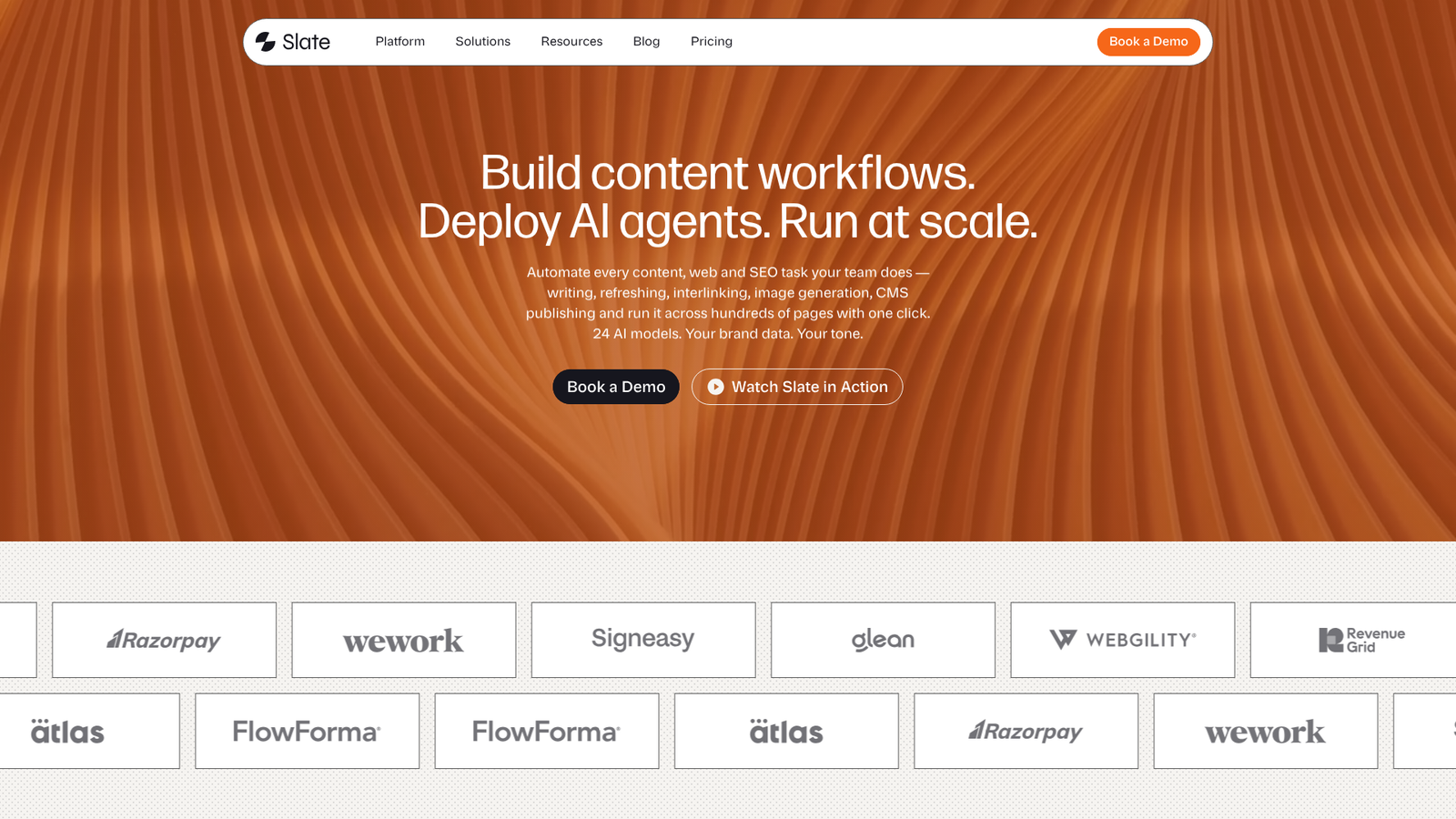
Slate is a content operations platform that treats content as a system rather than a series of individual pages to optimize.
While every other tool on this list helps you optimize a page, Slate helps you engineer the workflow that produces, optimizes, and publishes content at scale - from brief generation through to publishing, orchestrated as a connected pipeline rather than a sequence of manual steps.
Best for: Content teams producing 20+ articles per month, agencies managing multiple client programs, and SaaS companies scaling content-led growth.
Key strengths
- Automated content pipelines from brief generation to publishing
- System-level content scoring that considers topical authority and content gaps
- Team collaboration with approval workflows built into the production pipeline
- Scales efficiently across high-volume content programs without per-article friction
- Connects content strategy to execution in a single platform
Pricing: Starting at $199/month
What makes Slate different from Surfer SEO
Surfer scores a page against its SERP competitors. That's useful. But it tells you nothing about whether that page fits into your broader content strategy, fills a topical gap, or connects to related content you've already published.
Slate's scoring operates at the system level. It considers where a piece sits within your topical coverage, what internal linking opportunities exist, and whether the content aligns with your strategic priorities - not just whether you've hit the right term frequency. For teams producing at volume, that context is the difference between content that compounds and content that sits.
Workflow automation: Slate vs. Surfer
The workflow difference is stark. Surfer's model is: open tool, enter keyword, write, check score, publish, repeat. Each article is its own isolated task.
Slate's model is a pipeline. Brief generation, AI drafting, optimization scoring, editorial review, and publishing are connected stages in a single workflow. At 10 articles per month, the manual approach is manageable. At 50, the time cost of Surfer's page-by-page model becomes significant. At 100+, it's a structural problem that no amount of process improvement can solve without a systems-level tool.
Who Slate is best for
Slate works particularly well for content teams that have already hit the ceiling of page-level optimization and need to operationalize their content program. If you're a solo blogger optimizing one post per week, Slate is more infrastructure than you need. If you're running a content program at scale and spending more time managing the process than improving the output, it's worth a serious look.
See how Slate handles content at scale
2. Frase - best for AI-powered content research and briefs
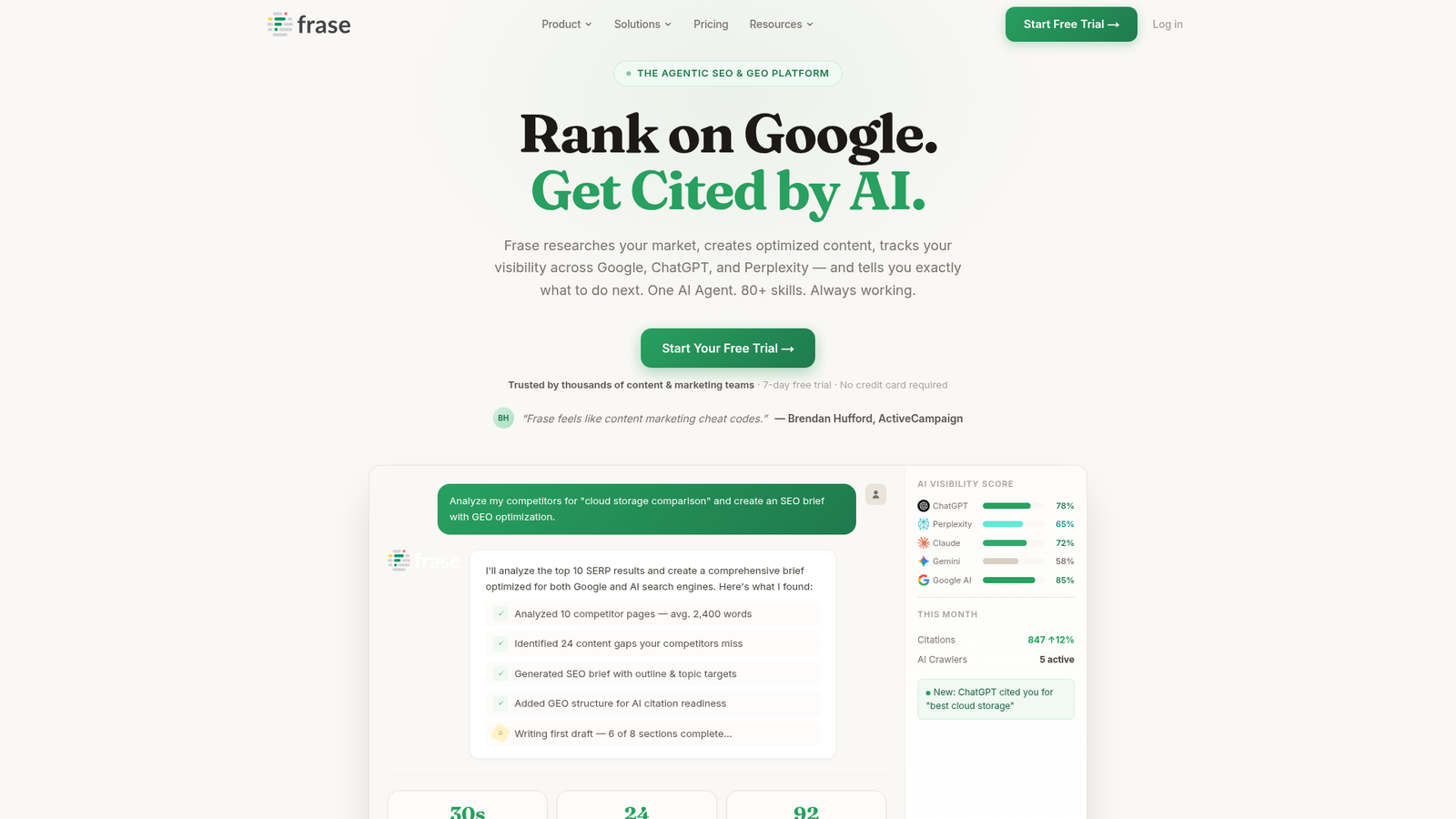
Frase is a research-to-content platform that combines SERP analysis, AI brief generation, and content optimization in a single workflow.
Its strongest capability is the brief generation engine - Frase pulls questions, headings, and key topics from the top-ranking pages for any keyword and assembles them into a structured brief in minutes, which is genuinely useful for teams that prioritize research-driven content.
Best for: Solo content marketers and small teams who want research-driven briefs without paying for a full enterprise platform.
Key strengths
- SERP-based brief generation pulls structure from top-ranking pages automatically
- Question research surfaces what your audience is actually asking
- Content optimization scoring with NLP term recommendations
- AI writing assistant for drafting and expanding sections
- Affordable entry point relative to Surfer and enterprise alternatives
Pricing: Starting at $49/month (Starter) — or $39.20/month billed annually
Frase pros and cons
Frase's research workflow is genuinely strong. The brief builder is faster than building manually, and the SERP analysis gives writers useful context before they start. Pricing is competitive - significantly lower than Surfer's $99/month essential plan.
The limitations are real, though. The AI writing quality is decent but tends to need more editing than AI-native platforms like Jasper. The content editor is less polished than Surfer's. Team collaboration features are limited, which makes it a better fit for individual contributors than coordinated content teams.
3. MarketMuse - best for enterprise content strategy and topic authority
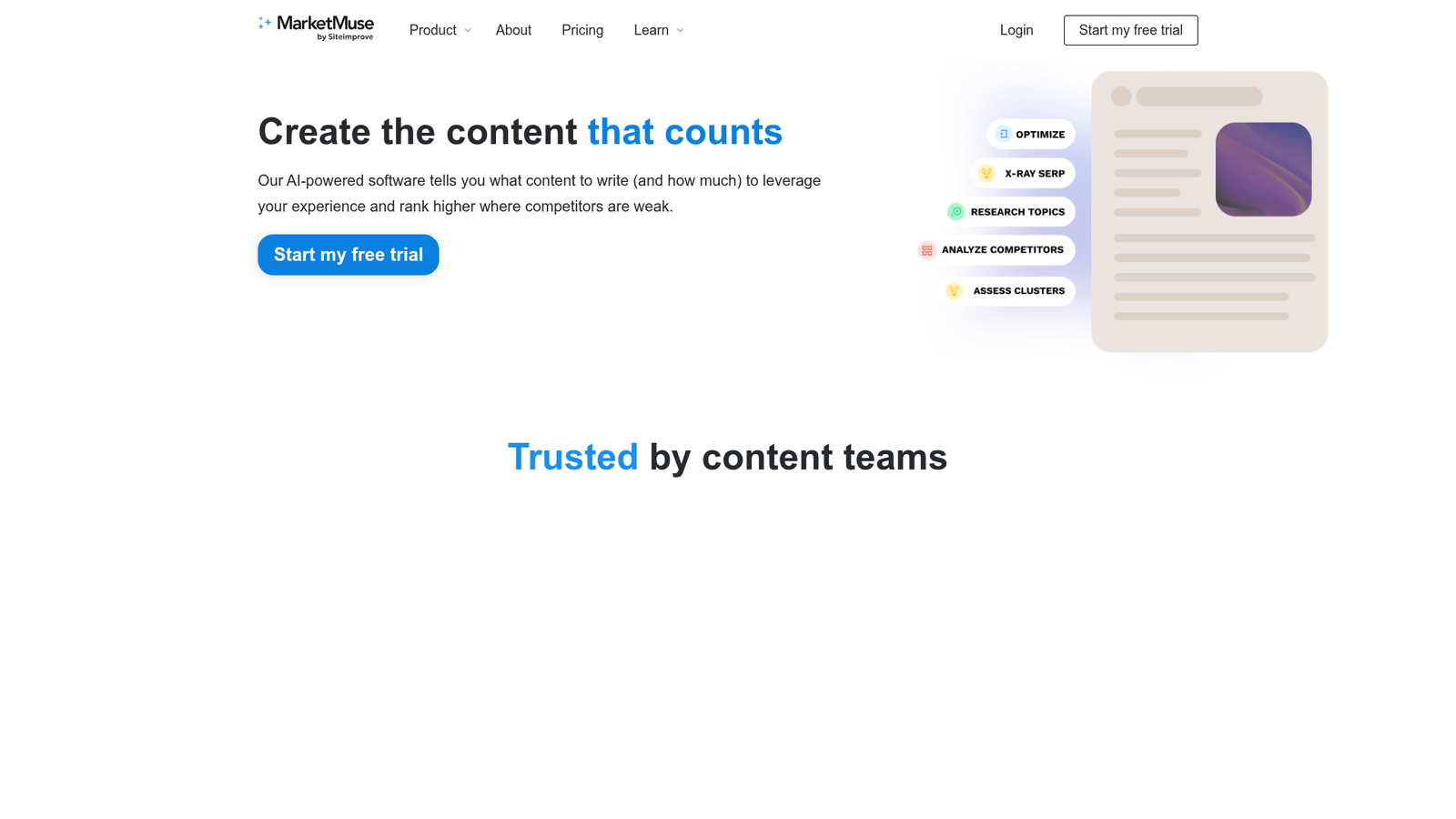
MarketMuse is a content intelligence platform built around topic authority modeling - it's the most sophisticated tool on this list for understanding what content you need to build, not just how to optimize what you have.
Its content inventory analysis is genuinely unique: MarketMuse can assess your entire existing content library, identify topical gaps, and prioritize which content to create or update based on competitive opportunity. No other tool on this list does this as well.
Best for: Enterprise content teams with large existing content libraries who need systematic gap analysis and topic authority planning.
Key strengths
- Topic authority modeling scores content based on depth and coverage, not just term frequency
- Content inventory analysis identifies gaps across your entire existing library
- Personalized difficulty scores calibrated to your site's existing authority
- AI-generated first drafts grounded in topic research
- Content planning workflows for managing large-scale content programs
Pricing: Free tier (10 queries/month); paid plans starting at $99/month (Optimize).
MarketMuse pros and cons
The topic authority modeling is unmatched. If you're managing a large content library and need to understand where you have coverage gaps versus where you're over-indexed, MarketMuse gives you that picture clearly. The personalized difficulty scores - calibrated to your specific domain - are more useful than generic keyword difficulty metrics.
The downsides are significant for smaller teams. Pricing is on the higher end, and the platform has a real learning curve. The AI writing quality is average compared to dedicated writing tools. For a solo marketer or small team, it's likely more tool than you need.
4. Clearscope - best for simple, clean content grading
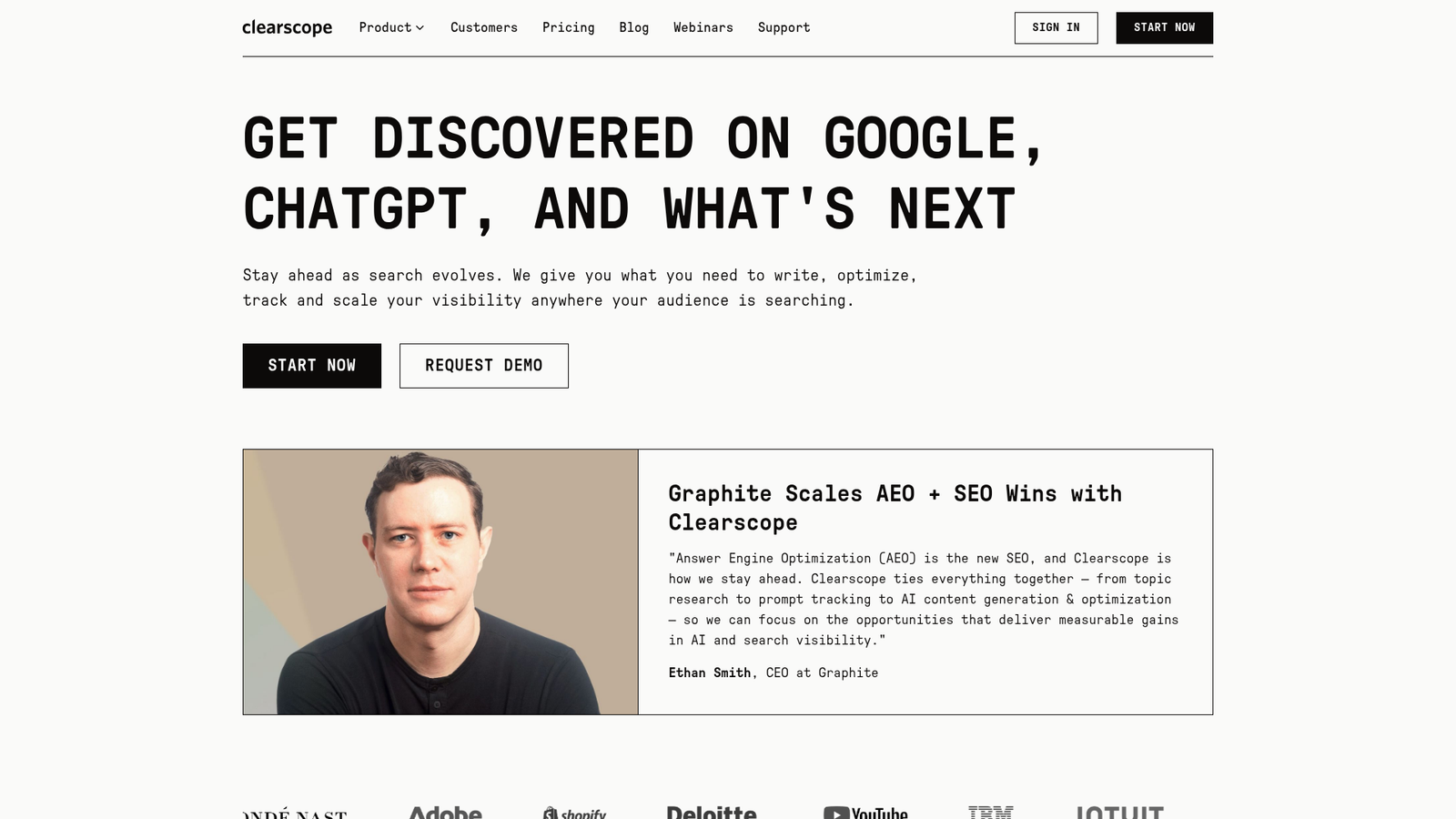
Clearscope is the minimalist in this category - a content grading tool that does one thing exceptionally well and doesn't try to do much else.
Its A++ grading scale, NLP term recommendations, and readability analysis are reliable and easy to act on. The Google Docs integration is among the best in the category, which makes it a natural fit for teams that write in Docs.
Best for: Teams that want the simplest possible content optimization workflow and are willing to pay a premium for clean UX.
Key strengths
- A++ content grading scale that's easy to interpret and act on
- NLP term recommendations grounded in SERP analysis
- Best-in-class Google Docs integration for in-editor optimization
- WordPress plugin for direct CMS optimization
- Shared report links for collaborating with writers without requiring accounts
Pricing: Essentials plan from $129/month (unlimited users); Business plan $399/month (unlimited users).
Clearscope pros and cons
The UI is the cleanest in the category. Writers adopt it quickly because the feedback is clear and actionable. The content grading is reliable - teams consistently report that hitting a B or above correlates with ranking improvements.
The limitations are structural. Clearscope has no AI writing features, no content brief generation, no keyword research, and no content strategy layer. It's purely an optimization tool. At $170/month per user, it's also expensive relative to tools that offer more functionality. Most teams pair it with a separate AI writing tool, which adds to the total stack cost.
5. Semrush Writing Assistant - best for teams already in the Semrush ecosystem
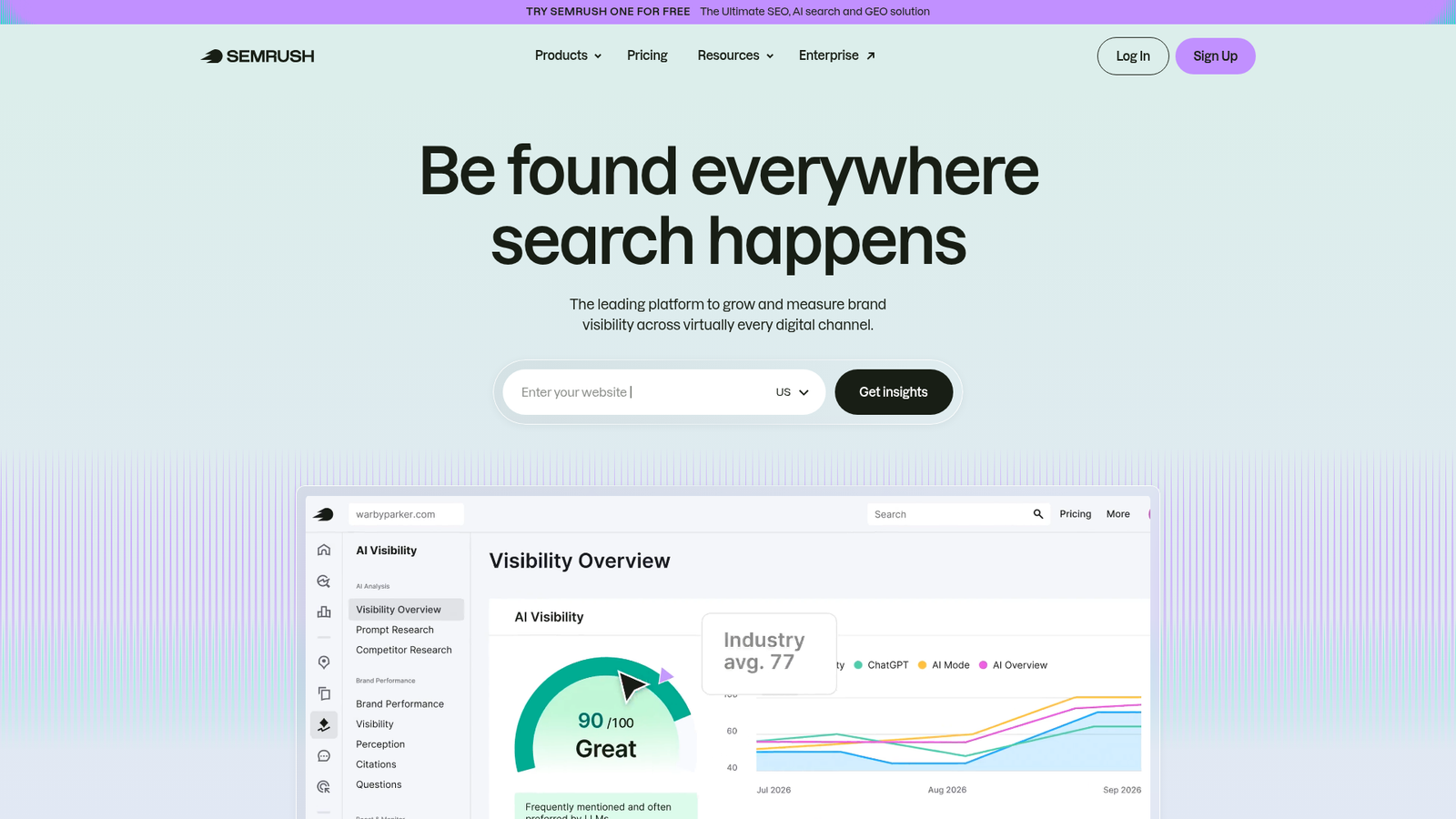
Semrush's Writing Assistant is the content optimization module within the world's most widely used SEO suite - not a standalone content optimizer, but a meaningful addition for teams already paying for Semrush.
The real value is integration. Semrush's keyword data, competitive intelligence, and backlink analysis feed directly into the content workflow, which gives writers context that standalone optimization tools can't match.
Best for: Teams already paying for Semrush who want content optimization without adding another tool to their stack.
Key strengths
- SEO Writing Assistant included in existing Semrush subscription
- Content Template tool generates optimization recommendations from keyword data
- Readability scoring and tone of voice analysis built in
- Plagiarism checker integrated into the writing workflow
- Keyword and competitive data from Semrush feeds directly into content recommendations
Pricing: Included in Semrush Pro/Guru/Business plans starting at $139.95/month
Semrush Writing Assistant pros and cons
If you're already a Semrush user, the Writing Assistant is essentially free functionality. The content templates are useful for briefing writers, and having keyword data and competitive intelligence in the same platform reduces context-switching.
The honest limitation: content optimization is not Semrush's core product. The scoring is less sophisticated than dedicated tools like Clearscope or NeuronWriter. The AI writing features are basic. If content optimization is a primary workflow rather than an occasional task, a dedicated tool will serve you better.
6. Scalenut - best for end-to-end AI content creation on a budget

Scalenut is an affordable all-in-one content platform that combines keyword research, topic clustering, AI writing, and optimization in a single workflow - the most complete budget option on this list.
Its Cruise Mode feature automates long-form AI content generation from keyword to draft, which is genuinely useful for teams that need first drafts quickly and have the editorial capacity to refine them.
Best for: Budget-conscious content teams and freelancers who want research, writing, and optimization in one platform without paying for multiple tools.
Key strengths
- Cruise Mode automates long-form AI drafting from keyword input to structured draft
- Keyword planner and topic clustering built into the content workflow
- NLP-based content optimizer with SERP analysis
- AI copywriting templates for short-form content
- Competitive pricing relative to the feature set
Pricing: Starting at $59/month (Starter).
Scalenut pros and cons
The value proposition is real. At $39/month, you get keyword research, topic clustering, AI drafting, and content optimization - functionality that would cost significantly more across separate tools. Cruise Mode produces usable first drafts that cut research and outlining time meaningfully.
The trade-offs are worth knowing. AI output quality requires editing - it's a starting point, not a finished product. The UI can feel cluttered compared to more focused tools like Clearscope. Content scoring is less sophisticated than Surfer or NeuronWriter. For teams with strong editorial processes who need volume at low cost, it works well.
7. WriterZen - best for keyword clustering and topic discovery
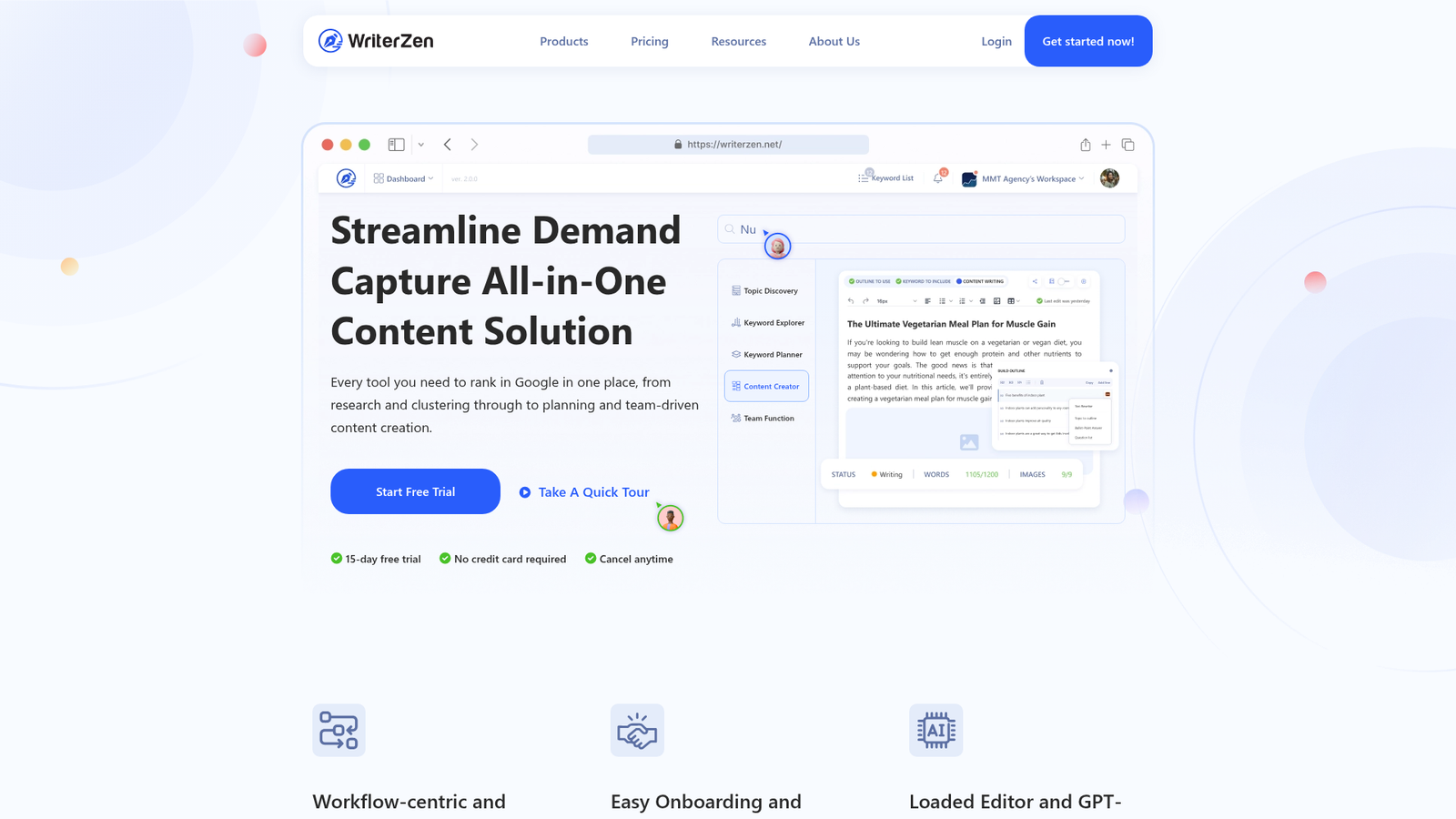
WriterZen is a keyword-first content platform - strongest on topic discovery and keyword clustering, with content creation features built on top of that research foundation.
The Keyword Explorer and Topic Discovery tools are the standout features. WriterZen's clustering algorithm groups related keywords into logical topic clusters, which makes content planning more systematic than working from individual keyword lists.
Best for: SEO-focused content planners who prioritize keyword research and topic clustering as the foundation of their content strategy.
Key strengths
- Keyword clustering groups related terms into actionable topic clusters
- Topic Discovery surfaces content opportunities from seed keywords
- Content Creator with optimization scoring for in-editor guidance
- Plagiarism checker integrated into the content workflow
- Team collaboration features for coordinating content planning
Pricing: Starting at $23/month
WriterZen pros and cons
The keyword clustering is genuinely useful for content planning. If you're building out a topical content strategy and need to organize hundreds of keywords into logical clusters, WriterZen does this faster and more accurately than manual grouping. The pricing is competitive.
The content editor is less polished than Surfer's or Clearscope's. AI writing features are basic - more useful for generating outlines than full drafts. The user community is smaller than established tools, which means fewer third-party tutorials and integrations. It's a strong research and planning tool that works best paired with a dedicated writing or optimization tool.
8. NeuronWriter - best budget-friendly NLP optimization
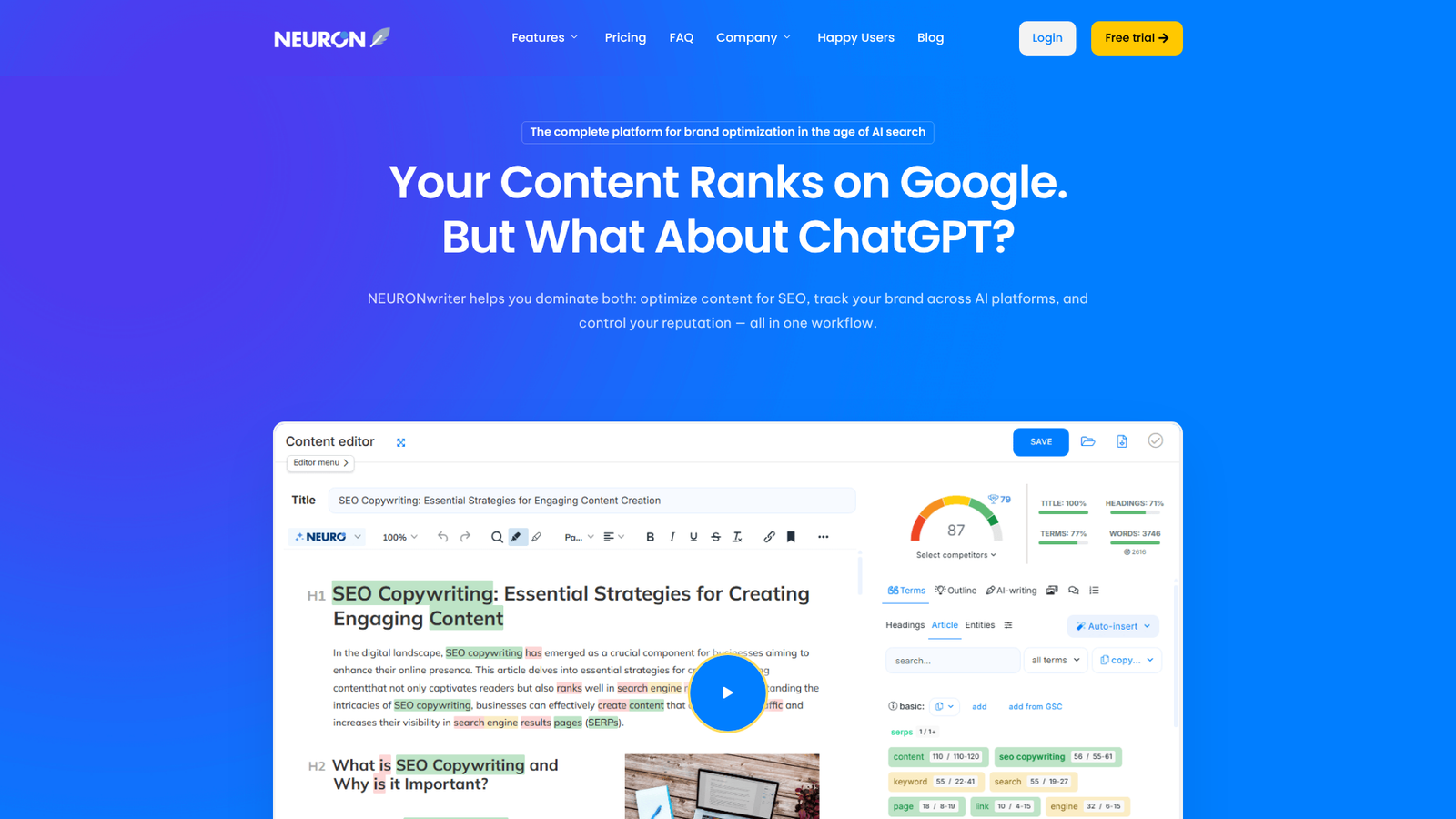
NeuronWriter is the most direct Surfer SEO alternative on this list — NLP-driven content optimization at $19/month (Bronze, billed annually; $23/month on monthly billing) versus Surfer's $99/month Standard plan (Surfer renamed its Essential tier to Standard in 2025; Surfer's entry price is now $49/month on the new Discovery plan).
The content scoring methodology is comparable to Surfer's: NeuronWriter analyzes top-ranking SERP pages, extracts NLP entities and semantic terms, and scores your content against those benchmarks in real time. For teams whose primary need is page-level NLP optimization, the quality difference doesn't justify the price gap.
Best for: Budget-conscious solo marketers and small teams who want Surfer-quality NLP optimization at a lower price point.
Key strengths
- NLP-based content scoring comparable to Surfer SEO at a fraction of the cost
- SERP analysis pulls competitor content structure and term usage
- AI writing assistant for drafting and expanding content sections
- Internal linking suggestions based on your existing content
- Lifetime deal options available for one-time purchase
Pricing:
Starting at $19/month (Bronze, billed annually) — or $23/month on monthly billing
NeuronWriter pros and cons
The value is hard to argue with. At $19/month, NeuronWriter delivers NLP optimization that holds up against Surfer's core functionality. The SERP analysis is solid, the content scoring is reliable, and the AI writing assistant handles basic drafting tasks.
The limitations are real but predictable for a smaller platform. The UI is less polished than Surfer or Clearscope. The user community is smaller, which means fewer integrations and less third-party support. Brand recognition is lower, which can matter for agency clients who expect familiar tools. For solo operators and small teams where budget is a genuine constraint, it's the clearest recommendation on this list.
9. SE Ranking - best all-in-one SEO platform with content optimization
SE Ranking is a full SEO suite - rank tracking, site audit, backlink analysis, competitive research - with a content optimization module that has improved significantly in recent releases.
The value proposition is consolidation. Teams that need SEO monitoring and content optimization can cover both in a single platform at mid-range pricing, rather than paying separately for a dedicated content tool and a rank tracker.
Best for: Small to mid-size teams wanting a full SEO platform that includes content optimization without paying for a separate tool.
Key strengths
- Content Editor with NLP-based optimization scoring
- Full rank tracking across search engines and locations
- Site audit identifies technical SEO issues alongside content gaps
- Backlink analysis and competitive research in the same platform
- Competitive pricing relative to the breadth of features
Pricing: Starting at $103.20/month (Core plan, billed annually) — or $129/month on monthly billing
SE Ranking pros and cons
The breadth-to-price ratio is strong. For teams that need rank tracking, site auditing, and content optimization, SE Ranking covers all three at a price point well below buying separate tools. The content editor has improved meaningfully and handles standard optimization tasks reliably.
Content optimization is not SE Ranking's primary product, and it shows in the depth. The NLP features are less sophisticated than dedicated tools like Clearscope or NeuronWriter. AI writing is basic. If content optimization is your primary workflow, a dedicated tool will serve you better. If you need a full SEO platform with content features included, SE Ranking is a strong choice.
10. Content Harmony - best for search intent-driven content briefs
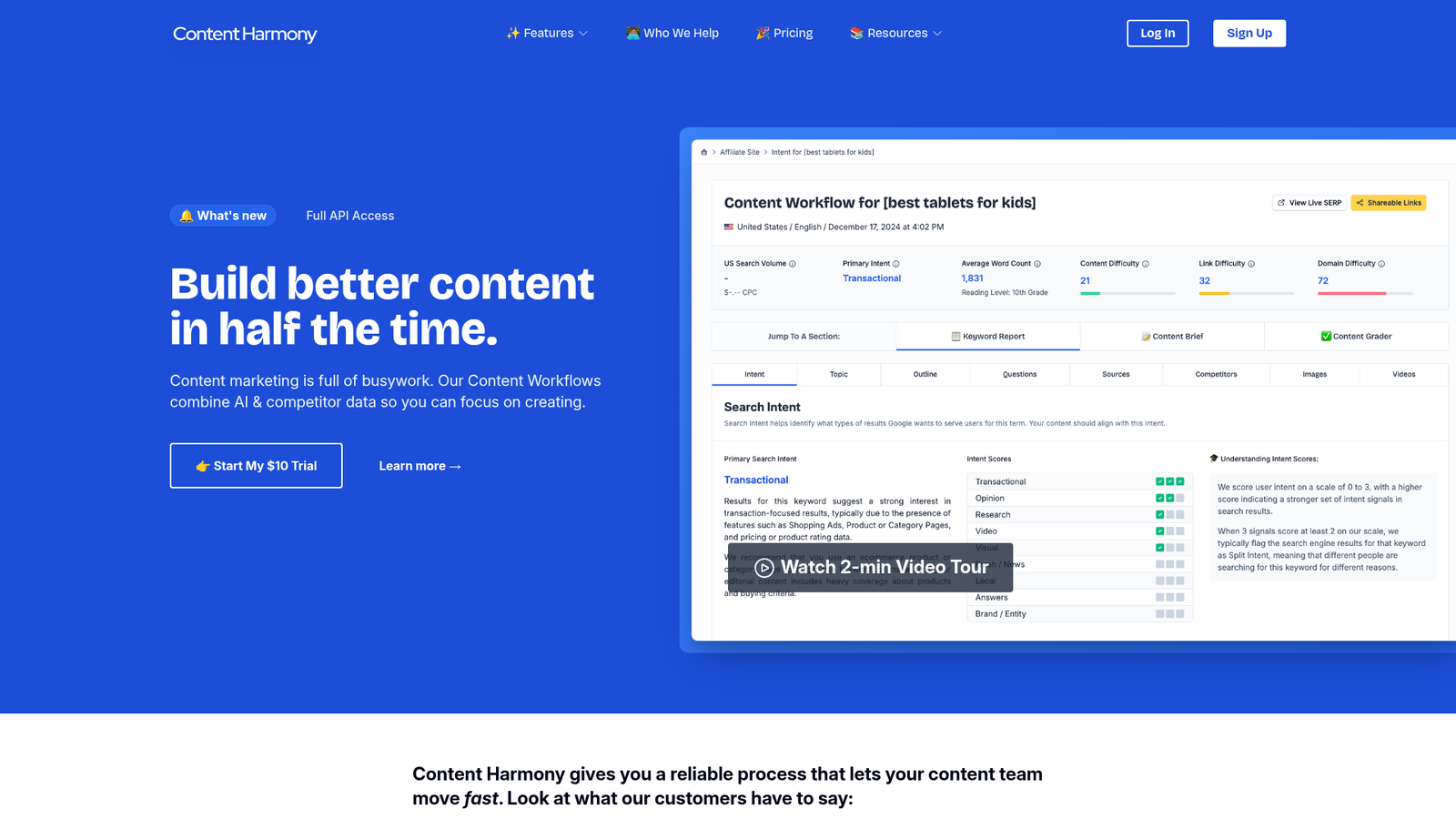
Content Harmony is a content brief specialist - the strongest tool on this list for search intent analysis and structured brief creation for content teams and agencies.
Its intent classification system goes beyond keyword matching to understand whether a query is informational, commercial, navigational, or transactional - and builds brief structures that match that intent. For teams where brief quality directly determines content quality, this is a meaningful differentiator.
Best for: Content teams and agencies that prioritize structured, intent-driven content briefs as the foundation of their workflow.
Key strengths
- Search intent classification drives brief structure and content recommendations
- Visual and video content research surfaces multimedia opportunities
- Content grading against intent-aligned benchmarks
- Team workflow features for managing brief creation and approval
- Competitor analysis integrated into the brief-building process
Pricing: Starts at $50/month (5 workflows/month, Standard plan); 25-workflow plan $199/month; custom enterprise plans available. More expensive per-workflow than NeuronWriter at $23/month (Bronze, monthly billing).
Content Harmony pros and cons
The brief quality is genuinely best-in-class. If your content workflow depends on writers following structured briefs - which is the right approach for teams producing at volume - Content Harmony's briefs are more thorough and intent-aligned than what you'd get from Frase or a manual process. The team workflow features make it a natural fit for agencies managing multiple writers.
The limitations are scope and price. There are no AI writing features - Content Harmony is purely a research and brief tool. The feature set is narrower than all-in-one platforms. Pricing is custom and tends to be premium, which makes it harder to justify for smaller teams or solo operators.
11. Page Optimizer Pro - best for technical on-page SEO signals
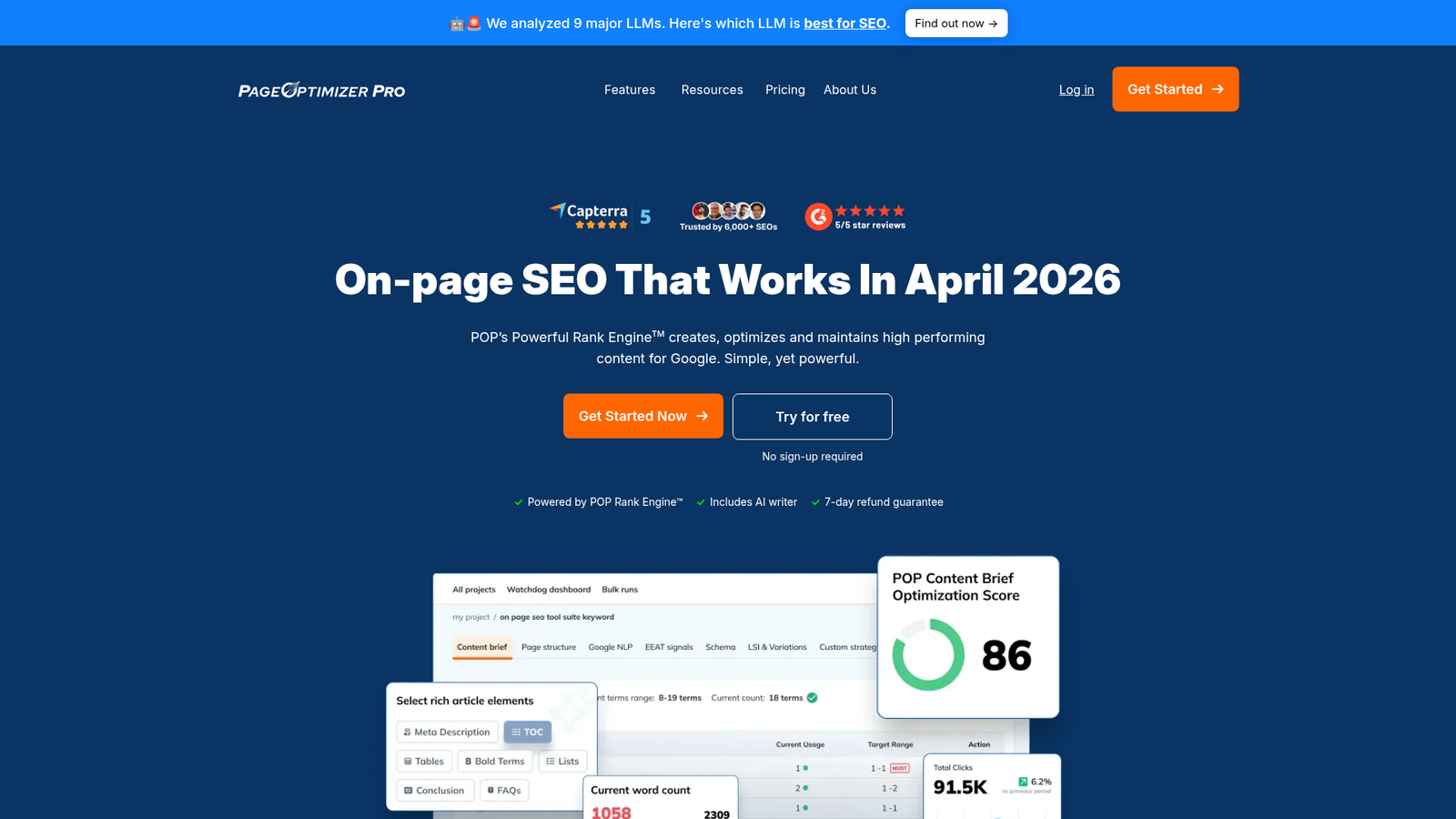
Page Optimizer Pro is the technical specialist on this list - it goes deeper on page-level SEO signals than any other tool here, and it's trusted by technical SEOs who want granular optimization data rather than a content creation workflow.
Where Surfer and most alternatives focus on NLP term frequency, POP analyzes a broader set of on-page signals: entity coverage, schema recommendations, content structure, and technical ranking factors that other tools don't surface.
Best for: Technical SEOs who want granular on-page optimization data beyond what Surfer provides, focused on ranking signals rather than content creation.
Key strengths
- Deepest on-page technical optimization analysis in the category
- NLP term analysis combined with technical SEO signal recommendations
- Competitor page analysis at the technical level
- Content structure suggestions grounded in ranking signal data
- Schema recommendations integrated into optimization workflow
Pricing: Starting at $34/month
Page Optimizer Pro pros and cons
For technical SEOs, POP's depth is unmatched. The correlation data between on-page signals and rankings is strong, and the schema recommendations are more actionable than what you'd get from general content optimization tools. The pricing is accessible.
The UI is dated - this is a tool built for practitioners who prioritize data over design. There's no AI writing, no content brief generation, and a steeper learning curve than most tools on this list. It's not a replacement for Surfer's full content optimization workflow; it's a complement for teams that want to go deeper on technical signals.
12. Jasper - best for AI-first content creation with brand voice
Jasper is an AI writing platform that has added SEO optimization features - it's strongest on AI content quality and brand voice consistency, and weaker on pure optimization scoring.
Jasper's AI writing quality ranks among the top in the category, with a 4.7/5 rating on G2 (1,200+ verified reviews). Its brand voice customization - where you train the platform on your tone, style, and terminology - produces more consistent output than generic AI writing tools.
Best for: Teams that prioritize AI content creation quality and brand consistency over SEO optimization scoring - best paired with a dedicated optimization tool.
Key strengths
- AI writing quality ranks among the top in the category for long-form and short-form content
- Brand voice customization trains the platform on your specific tone and style
- Campaign workflows connect content creation across multiple formats
- Massive template library covering dozens of content types
- Team collaboration with knowledge base training for consistent output
Pricing: Starting at $59/month per seat (Pro, billed annually) — or $69/month on monthly billing. Business plan is custom.
Jasper pros and cons
The AI writing quality is the strongest argument for Jasper. If your primary bottleneck is producing high-quality first drafts at scale, Jasper's output requires less editing than most alternatives. The brand voice features are genuinely useful for teams managing multiple writers or clients who need consistent tone.
The honest limitation: SEO optimization is secondary in Jasper's product. Jasper actually integrates with Surfer SEO for optimization scoring - which is somewhat ironic on this list, but worth knowing. If you want Jasper's writing quality with Surfer's optimization, that combination is available. For teams that want a single tool covering both, Jasper isn't it.
13. Metaflow
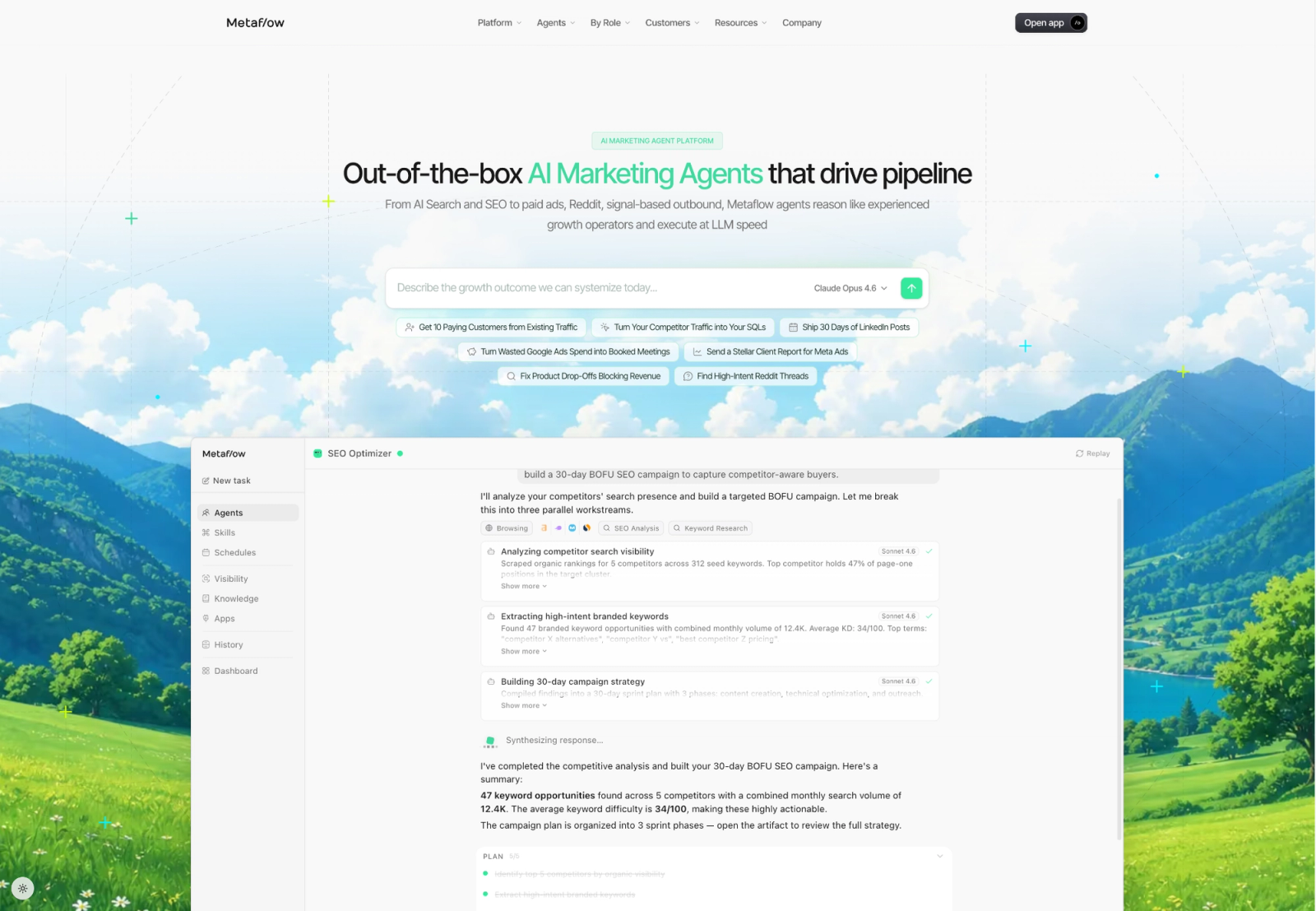
Metaflow is an agentic marketing platform for fast-moving GTM teams. It helps teams run connected growth workflows across SEO, AEO, paid media, and outbound without relying on a blank agent builder. The harness is the product: skills, context, tools, guardrails, workflows, QA loops, and evaluation gates that help marketing agents execute with fewer ways to go wrong.
Best for: Fast-moving B2B SaaS and GTM teams that want agent-powered execution across content growth, paid acquisition, and outbound automation without building their own agent infrastructure from scratch.
Key strengths
- SEO & AEO content growth: Build and optimize content for search rankings, AI Overviews, LLM visibility, comparison pages, alternatives pages, programmatic SEO, and retrieval-friendly answer coverage.
- Performance marketing automation: Analyze and optimize paid social, Google Ads, Facebook, Instagram, and LinkedIn campaigns with workflows for creative testing, budget allocation, landing page checks, and performance feedback loops.
- Outbound automation: Run signal-based outbound workflows that identify high-fit accounts, personalize messaging, sequence outreach, classify replies, and route qualified interest into the revenue process.
Pricing: Free trial available, starts from 100 USD per month
Metaflow pros and cons
Metaflow is the broadest entry of this list, reaching past page optimization into paid media and outbound, so a single GTM team can run content growth, performance marketing, and signal-based outreach inside one connected system. The guardrails, QA loops, and evaluation gates mean agents execute with fewer ways to go wrong, which suits teams that want structure over a blank canvas.
The trade-off is scope: teams looking only for a focused SEO content optimizer may find more platform than they need, and pricing is not published, so you will need to talk to the team to scope a fit.
Content scoring approaches - How each tool measures optimization differently
Not all content scores are created equal. This is one of the most important things to understand when evaluating Surfer SEO alternatives, and it's a distinction almost no comparison article covers.
NLP term frequency scoring (Surfer, Clearscope, NeuronWriter)
These tools analyze the top-ranking pages for a keyword, extract the NLP entities and semantic terms those pages use, and score your content based on how well you've covered those terms. It's a correlation-based approach: pages that rank tend to use these terms, so using them should help you rank.
The strength is simplicity and speed. The limitation is that term frequency is a proxy for quality, not quality itself. You can hit a perfect score and still produce thin content if you're gaming the metric rather than genuinely covering the topic.
Topic authority modeling (MarketMuse)
MarketMuse scores content based on topical depth and coverage relative to the full semantic space of a topic - not just the terms used by current top-ranking pages. The model asks: have you covered this topic comprehensively, or are there subtopics and related concepts you've missed?
This approach is more predictive of long-term ranking performance but requires more investment to act on. It's better suited to content strategy than individual article optimization.
Search intent alignment scoring (Content Harmony, Frase)
These tools prioritize matching the searcher's intent - informational, commercial, navigational, transactional - over keyword density. The scoring reflects how well your content structure and focus match what the searcher actually wants, not just whether you've used the right terms.
This approach tends to produce content that converts better, not just content that ranks. For commercial content, that distinction matters.
System-level content scoring (Slate)
Slate's scoring considers where a piece sits within your entire content ecosystem - topical coverage, internal linking opportunities, content gaps relative to your existing library, and strategic alignment with your content program goals. A page that scores well in isolation might score differently when you account for what you've already published and where your topical authority is strongest.
For teams producing at volume, this context is what separates content that compounds from content that ranks once and stagnates.
Workflow automation - single-page optimization vs. content systems
There is a growth that reflects a shift in how teams think about content - not as individual pages to optimize, but as programs to operate. The tools on this list handle that shift very differently.
The manual approach (Surfer, Clearscope, Page Optimizer Pro)
The workflow is: open tool, enter keyword, write or paste content, check score, adjust, publish. Each article is a discrete task. There's no connection between articles, no automation between steps, and no system-level view of your content program.
At 10 articles per month, this is manageable. At 50, a content manager is spending a meaningful portion of their week on tool administration rather than strategy or quality improvement.
Semi-automated workflows (Frase, Scalenut, WriterZen)
These tools automate specific steps - brief generation, AI drafting, keyword clustering - but the workflow between steps is still largely manual. You generate a brief in Frase, hand it to a writer, get the draft back, paste it into the optimizer, check the score, and publish. Each step is faster, but the handoffs are still manual.
This is a meaningful improvement over pure page-level tools, particularly for teams with defined content processes. It's not a content system.
Full content operations (Slate)
A content operations platform connects the steps. Brief generation, AI drafting, optimization scoring, editorial review, and publishing are stages in a single pipeline - not separate tasks in separate tools. The system tracks where each piece is in the workflow, surfaces what needs attention, and automates the transitions between stages.
For teams producing at volume, the compounding efficiency gains are significant. The time saved per article multiplies across your entire content program, and the reduction in coordination overhead frees up editorial capacity for quality improvement rather than process management.
How to choose the right Surfer SEO alternative for your needs
If you're a solo content creator or freelancer
Your priorities are likely speed, simplicity, and cost. NeuronWriter at $19/month gives you Surfer-quality NLP optimization at the lowest price on this list. Frase is the better choice if research and brief generation are your primary bottleneck. Scalenut works well if you want research, writing, and optimization in one tool without managing multiple subscriptions.
If you're a small content team (2-5 people)
You need collaboration features and enough workflow structure to coordinate without constant Slack messages. Frase handles the research-to-brief workflow well at this scale. WriterZen is strong if keyword clustering and content planning are your primary needs. SE Ranking makes sense if you also need rank tracking and site auditing in the same platform.
If you're running content at scale (20+ articles per month)
Scale changes the requirements fundamentally. Page-level tools become bottlenecks. You need workflow automation, not just better scoring. Slate is the clearest recommendation here - it's built for this problem. MarketMuse adds value if you're managing a large existing content library and need systematic gap analysis. Content Harmony works well if brief quality is the primary lever for your content program's output quality.
If you're an agency managing multiple clients
Multi-client management requires workflow isolation, team collaboration, and the ability to run parallel content programs without cross-contamination. Slate handles this at the workflow level. Semrush makes sense if you're already using it for client SEO reporting and want content optimization in the same platform. Content Harmony is strong for agencies whose value proposition centers on brief quality and content strategy.
If you need the best AI writing quality
Jasper ranks among the top in the category for AI writing quality and is the strongest choice if brand voice consistency is a priority. Scalenut's Cruise Mode is the best budget option for AI-assisted long-form drafting. Frase handles research-grounded drafting well for teams that want AI writing connected to SERP data.
If budget is your primary concern
NeuronWriter at $19/month is the clearest value on this list for core optimization functionality. Scalenut at $39/month offers the most functionality per dollar if you need research, writing, and optimization combined. SE Ranking at $65/month is the best value if you need a full SEO suite alongside content features.
Making the switch - what to consider before leaving Surfer SEO
Exporting your Surfer SEO data
Surfer doesn't offer a comprehensive data export for your optimization history, which is worth knowing before you switch. Content scores, term recommendations, and SERP snapshots are largely locked in the platform. Before transitioning, document your current optimization benchmarks manually - particularly for your highest-traffic pages - so you have a baseline to compare against in your new tool.
Running tools in parallel during transition
A 30-60 day overlap period is worth the cost. Run your new tool alongside Surfer for a month, optimize the same articles in both, and compare the recommendations. You'll quickly identify where the tools diverge and calibrate your team's trust in the new scoring system before fully committing.
Team training and adoption
The biggest switching cost is rarely the tool - it's the workflow change. New tools require new habits, and habits take time to form. Identify one or two internal champions who learn the new platform deeply before rolling it out to the full team. Build a short internal guide covering the three or four tasks your team does most frequently. Most modern content optimization tools have onboarding resources that get new users productive within a week.
Final verdict - the best Surfer SEO alternative depends on your content maturity
Think of content tooling in four levels. Level 1 is page optimization - you're improving individual articles with NLP scoring (Surfer, Clearscope, NeuronWriter, POP). Level 2 is content creation - you're using AI to research, draft, and optimize (Frase, Scalenut, WriterZen, Jasper). Level 3 is content strategy - you're planning topic authority and filling content gaps (MarketMuse, Content Harmony, Semrush). Level 4 is content systems - you're engineering automated workflows at scale (Slate).
Most teams searching for Surfer alternatives are moving between levels. Knowing which level you're at - and which you need - is the decision.
Here's the editor's pick for each category:
- Best overall for scale: Slate
- Best for research and briefs: Frase
- Best for enterprise strategy: MarketMuse
- Best for simplicity: Clearscope
- Best budget option: NeuronWriter
- Best AI writing quality: Jasper
If you're optimizing individual pages, most tools on this list will serve you well. If you've outgrown page-level optimization and need to run content as a program, the choice narrows quickly. See how Slate handles content at scale.
Frequently asked questions
Is Surfer SEO still worth it in 2026?
Surfer SEO remains a strong tool for individual page optimization - its NLP scoring, SERP analysis, and Google Docs integration are reliable and well-designed. If you're a solo blogger or small team optimizing a handful of articles per month, Surfer still delivers.Where it falls short is at scale: the page-by-page workflow, the credits-based pricing at $99/month for the Standard plan (Surfer renamed Essential to Standard in 2025; the entry Discovery plan is $49/month), and the absence of workflow automation make it a bottleneck for teams producing 20+ articles per month.
What is the best free alternative to Surfer SEO?
No free tool fully replicates Surfer's content optimization capabilities - that's worth being honest about. The closest free workflow is combining Google Search Console for performance data with ChatGPT for content drafting and optimization guidance.MarketMuse offers a free tier (10 queries/month), which is useful for occasional use. For teams that need real optimization functionality at low cost, NeuronWriter at $19/month (Bronze, billed annually; $23/month monthly) is the most accessible paid option.
How do content optimization scores actually affect Google rankings?
Content scores measure correlation, not causation. They reflect how closely your content matches the term usage and structure of current top-ranking pages - which is a useful directional signal, but not a ranking guarantee. Google's algorithm considers hundreds of factors beyond term frequency, including backlinks, page experience, and topical authority. Scores are most useful as a quality floor - ensuring you've covered the topic adequately - rather than a precise ranking predictor.
Can I use Surfer SEO with other content optimization tools?
Yes, and many teams do. Common combinations include Surfer with Jasper for AI-assisted writing, Surfer with Ahrefs for keyword research and competitive analysis, and Surfer with Slate for workflow automation around the optimization step. Stacking tools makes sense when each tool does something the others don't. It becomes less efficient when you're paying for overlapping functionality - at that point, switching to a more comprehensive platform is usually the better call.
What's the difference between content optimization and AI content writing?
Content optimization is the process of analyzing and improving existing or planned content to better match search intent and ranking signals - it's about alignment and coverage. AI content writing is generating content from scratch using AI models. They're distinct capabilities that many modern tools now combine. Clearscope and Page Optimizer Pro are pure optimization tools. Jasper and Scalenut are primarily writing tools with optimization features. Frase, Slate, and MarketMuse integrate both within broader content workflows.
How much should I expect to pay for a Surfer SEO alternative?
The range is wide. Free tools exist but don't replace dedicated optimization functionality. Most mid-tier alternatives cost between $19 and $400 per month — NeuronWriter at $19/month (annual) and Scalenut at $59/month (Starter) are the budget end; Clearscope at $129/month (Essentials, unlimited users) and MarketMuse from $99/month (Optimize) are mid-tier; Clearscope Business at $399/month is the premium end.
Enterprise platforms like Content Harmony use custom pricing. Monthly subscription price is less useful than cost-per-article: at 50 articles per month, a $99/month tool costs roughly $2 per article, while a $23/month tool (NeuronWriter Bronze, monthly) costs $0.46.
Which Surfer SEO alternative is best for agencies?
Agencies need multi-client workflow management, team collaboration, and enough automation to run parallel content programs efficiently. Slate handles this at the workflow level - its pipeline architecture is designed for volume and coordination across multiple programs. Content Harmony is the strongest choice for agencies whose value proposition centers on brief quality and content strategy. Semrush makes sense for agencies already using it for client SEO reporting who want content optimization in the same platform without adding another tool.
What is the difference between optimizing one page and running content systems?
Page optimization improves a single article's content score and ranking signals - it's a discrete task with a clear endpoint. Content systems orchestrate an entire content program: strategy, production, optimization, publishing, and performance tracking as an integrated workflow with automation connecting each stage. The difference matters most at volume. At 5 articles per month, page optimization is sufficient. At 50, the coordination overhead of managing each article as a separate task becomes the primary bottleneck - and that's a systems problem, not an optimization problem. Tools like Slate are built specifically for that systems layer.