When a content lead runs a brief through Copy.ai and realizes there's no optimization scoring, no SERP analysis, and no way to track whether the output will actually surface in an AI answer, that's the moment the search for alternatives begins.
Copy.ai has made a deliberate strategic choice. It's evolved into a go-to-market automation platform built around sales sequences, CRM-triggered workflows, and outbound pipeline generation. For GTM teams running cold outreach at scale, that direction makes sense.
But if your job is to grow organic traffic, build citation-ready content, and understand how your brand appears inside ChatGPT, Perplexity, or Google AI Overviews? Copy.ai wasn't built for that. And it's not heading in that direction.
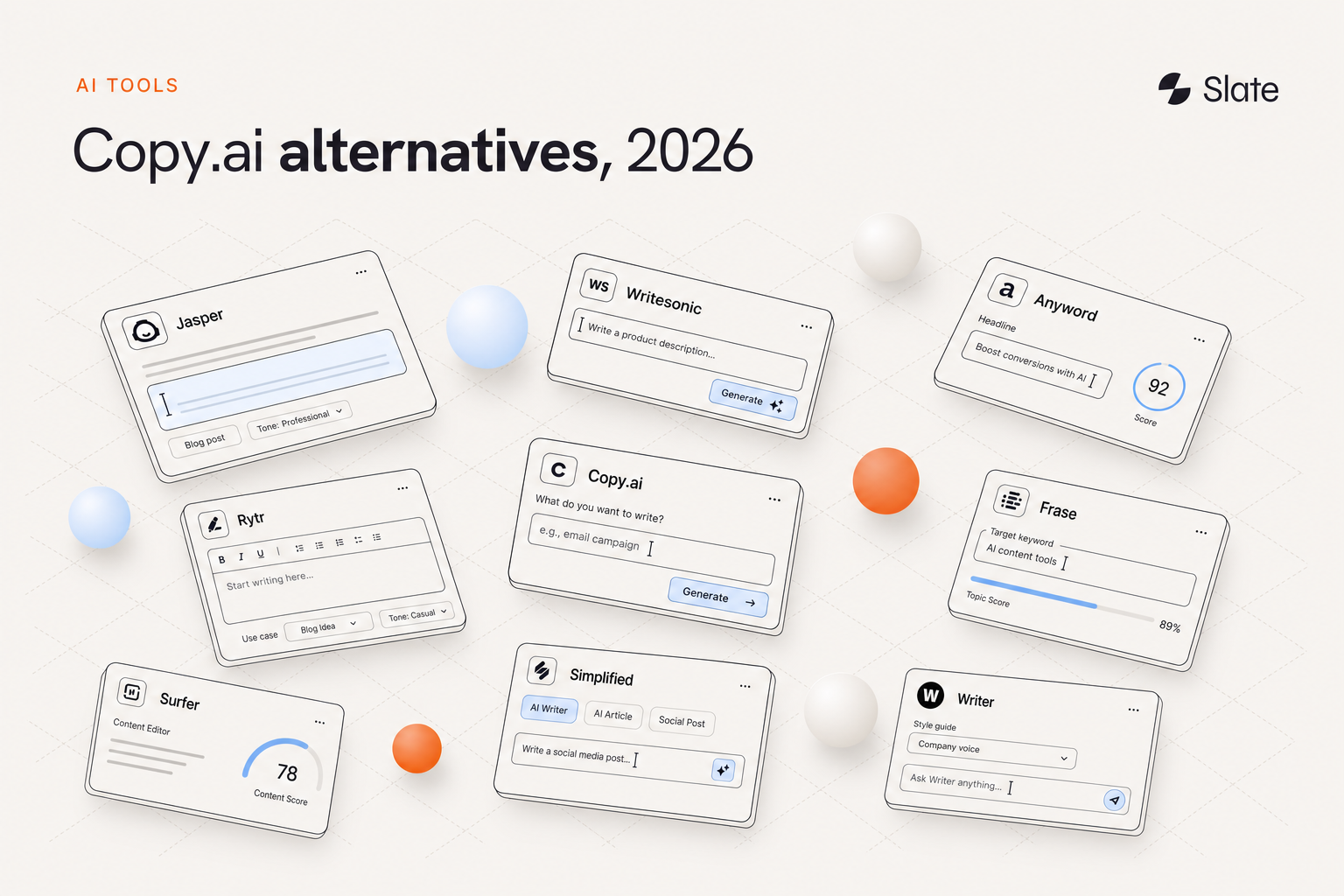
This guide compares the best copy.ai alternatives for 2026, organized by the problem you're actually trying to solve. Whether your bottleneck is SEO depth, AI search visibility, brand governance, bulk content operations, or budget constraints, you'll find a recommendation matched to your specific situation. No flat lists. No alphabetical rankings. Just opinionated, use-case-driven guidance for content teams, SEO leads, and growth marketers who need more than a template library.
Key Takeaways
- Teams focused on organic growth and AI search visibility often need a fundamentally different kind of tool, one built for content engineering rather than sales enablement.
- A five-person content team optimizing for AI citations has different needs than an enterprise marketing org enforcing brand governance across 50 contributors.
- Its combination of AI Search Analytics, Power Sheets for bulk operations, visual Workflows with 24+ AI models, and direct CMS publishing creates an end-to-end execution layer that most alternatives lack.
- Surfer, Frase, Writesonic, and Scalenut each track brand mentions across AI platforms, though the number of platforms covered, the depth of insights, and the ability to act on that data vary widely.
- Zero pages currently ranking for "copy.ai alternatives" address the shift from traditional SEO to AI-driven discovery as a primary evaluation criterion.
- SEO and AI search, enterprise governance, marketing content creation, budget-friendly options, or sales and GTM workflows.
- so you can test tools side by side rather than relying on feature comparison tables alone.
What To Look For In A Copy.ai Alternative
Before diving into specific tools, it helps to understand what separates a genuine alternative from a lateral move. Switching from one generic AI writer to another won't solve the underlying problem. The evaluation criteria below reflect what content-led growth teams actually need in 2026.
Content Quality And Depth
The gap between "AI-generated content" and "content worth publishing" remains significant. When evaluating alternatives, look beyond word count and template variety.
Does the tool produce structured, research-backed long-form content, or does it rephrase existing search results into something that reads like a summary of a summary? Can it handle 2,000 to 5,000+ word pieces with logical flow, accurate claims, and genuine depth?
Hallucination rates matter here. A tool that confidently fabricates statistics or misattributes quotes creates more work than it saves. The best alternatives either ground their outputs in verifiable sources or make it easy to inject your own research and knowledge base into the generation process.
SEO And AI Search Capabilities
This is where Copy.ai's limitations become most apparent. Traditional SEO features like keyword research, SERP analysis, and optimization scoring are table stakes for content-focused teams. But in 2026, traditional SEO alone isn't enough.
AI search visibility tracking has become a critical capability. When someone asks ChatGPT, Perplexity, or Gemini a question in your category, does your brand get cited? Do you even know? Tools that track brand visibility across AI platforms like ChatGPT, Google AI Overviews, and Perplexity give teams the data they need to understand this new discovery layer.
Beyond tracking, citation readiness matters. Content that's structured for extractability, with clear definitions, explicit claims, and well-organized information, is more likely to be surfaced by AI systems. Look for tools that help you engineer content for this outcome, not just write more of it.
Workflow Automation And Scale
There's a meaningful difference between tools that help you write one thing and tools that help you build repeatable content systems.
Prompt-first tools require manual input for every piece of content. Workflow-first tools let you build multi-step pipelines with conditional logic, bulk operations, and automated publishing. If you're managing dozens or hundreds of pages, the architecture of the tool determines whether you can scale without adding headcount.
Consider whether the tool supports CMS publishing integrations, bulk content refreshes, and programmatic creation. A content lead managing 500 indexed pages needs a different kind of tool than a freelancer writing three blog posts a month.
Brand Governance And Team Collaboration
As teams scale AI content production, brand governance becomes the difference between "useful tool" and "liability." Style guides, tone rules, and knowledge bases ensure that AI-generated content sounds like your brand, not like generic AI output.
For enterprise teams, approval flows, roles and permissions, and version control aren't nice-to-haves. They're requirements. If your organization operates in a regulated industry or has strict brand standards, evaluate whether the tool enforces governance at the system level or relies on individual contributors to remember the rules.
Integration Depth
A tool that doesn't connect to your existing stack creates friction at every step. Evaluate CMS integrations (WordPress, Webflow, Contentful), CRM connections, analytics platform compatibility, and API availability.
The depth of integration matters as much as the breadth. Can you publish directly from the tool to your CMS, or are you copying and pasting into a separate system? Can you pull data from Google Search Console or analytics platforms into your content workflows? Composability, the ability to connect the tool into larger automated processes, separates content infrastructure from standalone writing apps.
Quick Comparison Table
Best Copy.ai Alternatives For SEO And AI Search Optimization
If your primary goal is organic growth, whether through traditional search rankings, AI-generated answers, or both, these three tools address the problem most directly.
Slate — Best For AI Search Visibility And Scalable Content Engineering
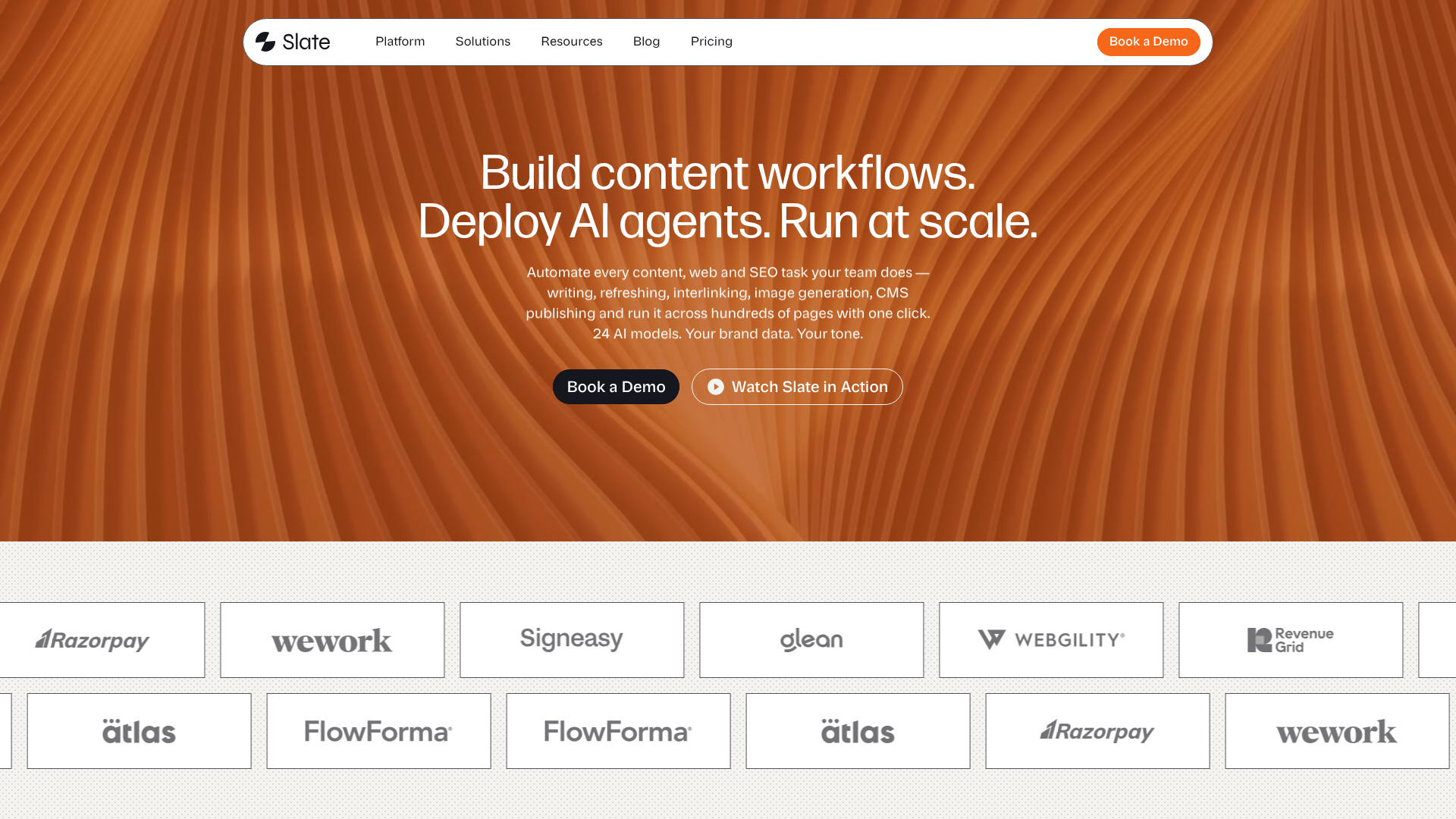
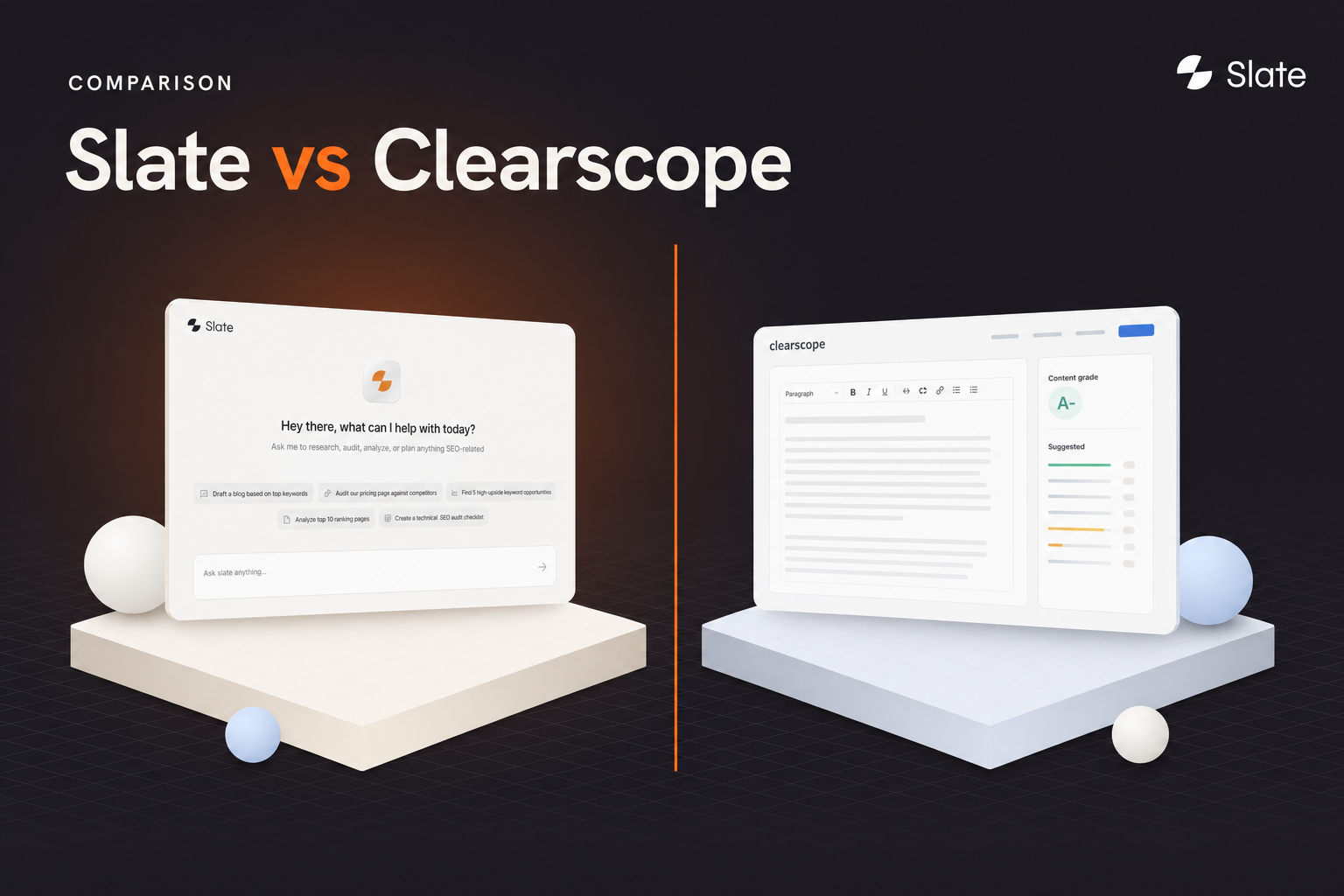
Slate isn't an AI writer that bolted on SEO features as an afterthought. It's an end-to-end AI search optimization and content engineering platform designed for teams that need to understand how their brand appears in AI answers, create content that gets cited, and scale operations without losing quality or control.
Where Copy.ai focuses on GTM automation and sales workflows, Slate focuses on the entire content lifecycle from visibility tracking through creation and publishing.
What sets Slate apart from Copy.ai:
AI Search Analytics tracks brand visibility across ChatGPT, Perplexity, and Google AI Overviews. Instead of guessing whether your content surfaces in AI-generated answers, you get concrete data on where your brand appears, where competitors get cited instead, and where the gaps are.
Workflows provide a visual workflow builder with 24+ AI models, conditional logic, web scraping, and CMS publishing. This isn't prompt-based generation where you type a request and hope for the best. It's structured, repeatable content automation that runs the same process across hundreds of pages with consistent quality.
Power Sheets offer a spreadsheet interface for bulk content refreshes, programmatic creation, and optimization audits across thousands of URLs. When a content lead needs to audit and refresh 500 pages, Power Sheets turn a months-long manual project into a systematic operation.
Brand Kit & Knowledge Base enforces style guides, tone rules, and internal knowledge so that AI-generated content stays brand-safe. Every output reflects your terminology, your positioning, and your standards.
CMS Publishing pushes content directly to Webflow and WordPress from Workflows and Sheets, eliminating the copy-paste bottleneck that slows down most content teams.
SuperBlocks provide pre-built workflow components and templates specifically designed for AI search optimization, so teams don't have to build every process from scratch.
MCP Integration connects Claude via MCP for working with marketing data inside Claude, extending Slate's capabilities into the broader AI tool ecosystem.
Pricing: Starts at $199/month.
Choose Slate if: Your team needs to understand how your brand appears in AI answers, create content that gets cited rather than just ranked, and scale content operations without adding headcount. Slate is built for B2B SaaS marketing teams, content-led growth companies, and SEO leads adapting to AI search.
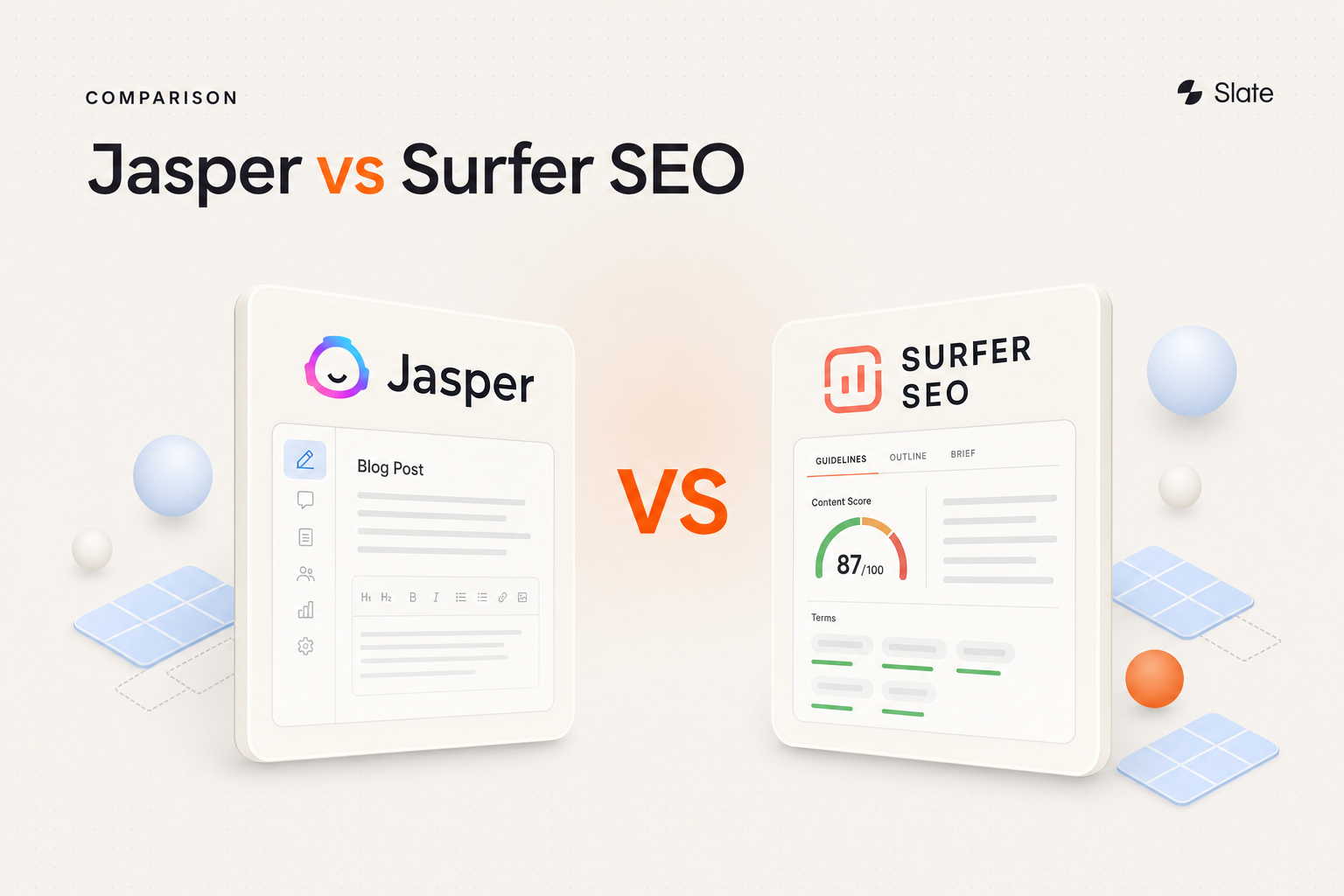
Surfer — Best For On-Page SEO Optimization

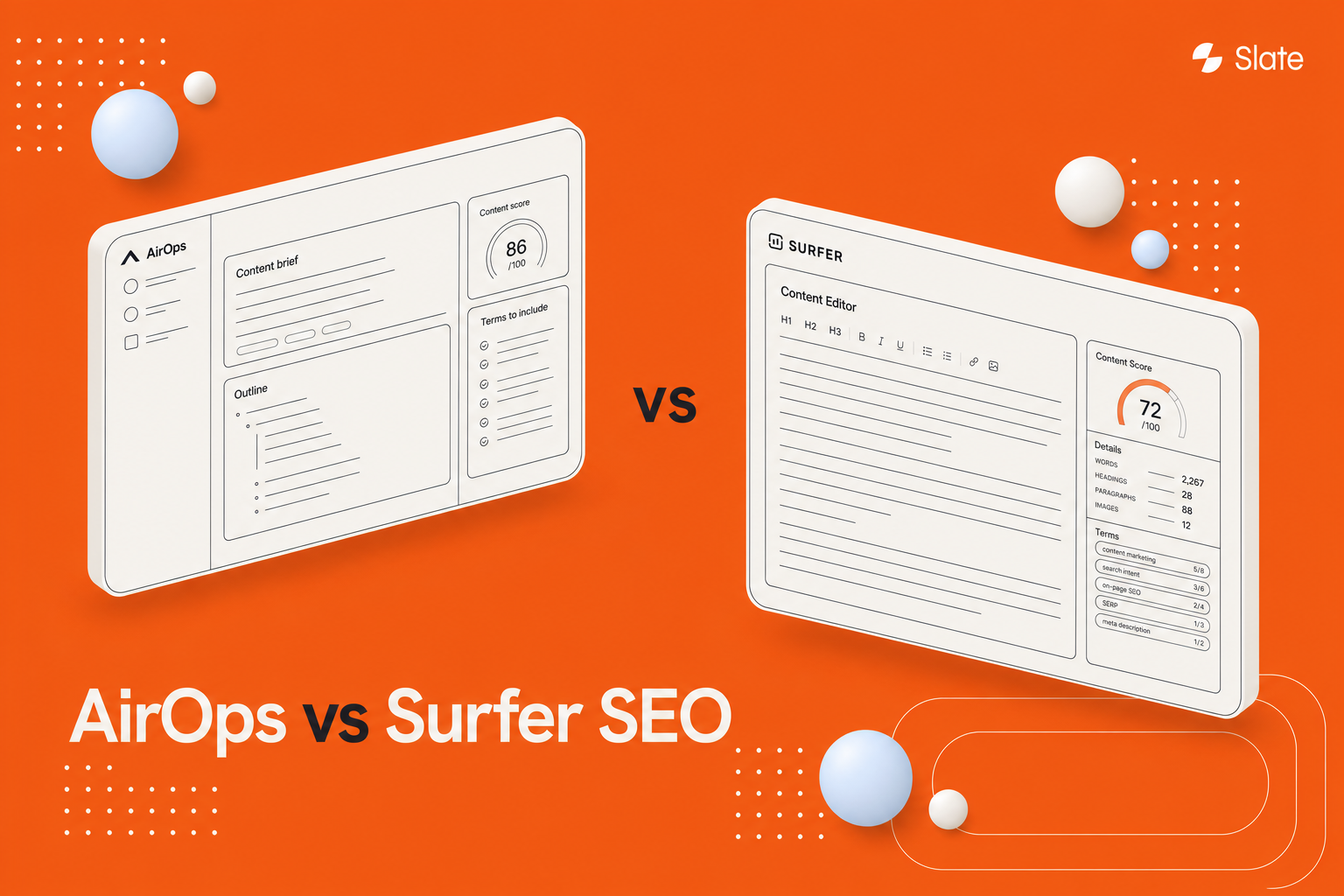
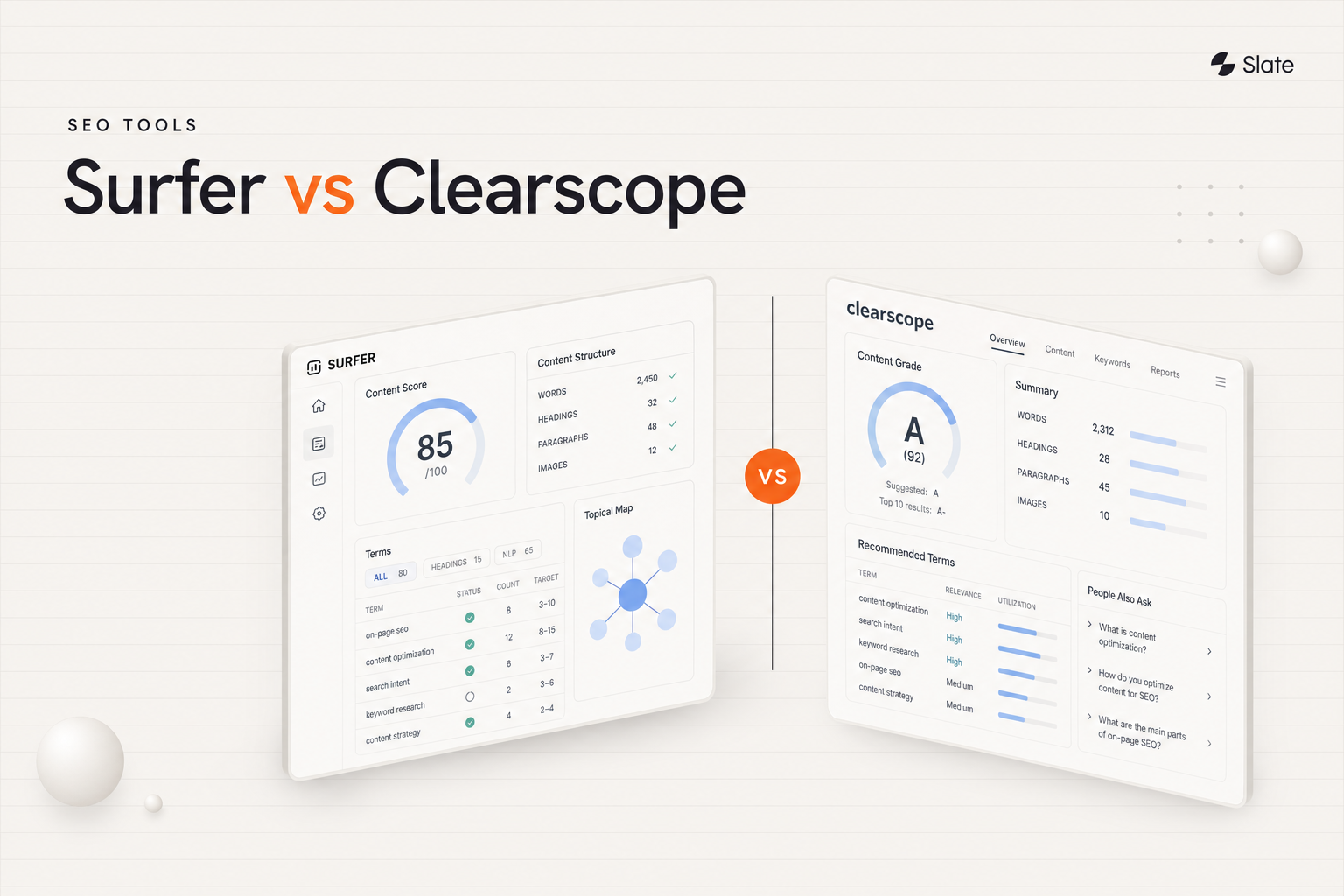
Surfer has built its reputation on real-time content optimization, and it's expanded into AI visibility tracking with its AI Tracker feature. For teams whose primary workflow centers on optimizing individual articles against SERP competitors, Surfer provides a focused, well-executed toolset.
What sets Surfer apart from Copy.ai:
AI Tracker monitors brand and competitor mentions in AI-generated answers across ChatGPT, Gemini, Perplexity, and others. This gives SEO teams visibility into how content performs beyond traditional rankings.
Content Editor combines Auto-Optimize, Coverage Booster, Insert Links, the Surfy AI assistant, and a Content Score that provides real-time optimization guidance as you write. When you're working on a specific article and want to know exactly which topics, terms, and structural elements to include, this is where Surfer excels.
Surfer Workflows offer a visual, step-by-step workflow builder for audits, planning, writing, optimizing, and tracking. The workflow connects research to execution in a structured sequence.
Additional tools include an AI Content Detector, AI Humanizer, Topical Map, Content Audit, Rank Tracker, and Sites hub. Integrations cover WordPress, Google Docs, ChatGPT, Contentful, and API access. Team management supports role-based access, tags, assignments, and real-time collaboration with multiple contributors in one Content Editor.
Pricing (yearly billing):
- Discovery: $49/month (120 documents, 10 page tracking)
- Standard: $99/month (360 documents, AI visibility tracking, 25 AI prompts tracked weekly, team collaboration, plagiarism checker)
- Pro: $182/month (50 AI prompts tracked daily, 5 brand workspaces, internal linking, cannibalization report)
- Peace of Mind: $299/month (unlimited documents, 100 AI prompts tracked daily, dedicated success manager, API access)
- Enterprise: $999/month (custom billing, SSO, enterprise security, white-label)
Choose Surfer if: You need real-time content scoring, on-page optimization guidance, and AI visibility tracking, but your primary workflow is optimizing individual articles rather than managing bulk content operations across thousands of pages.
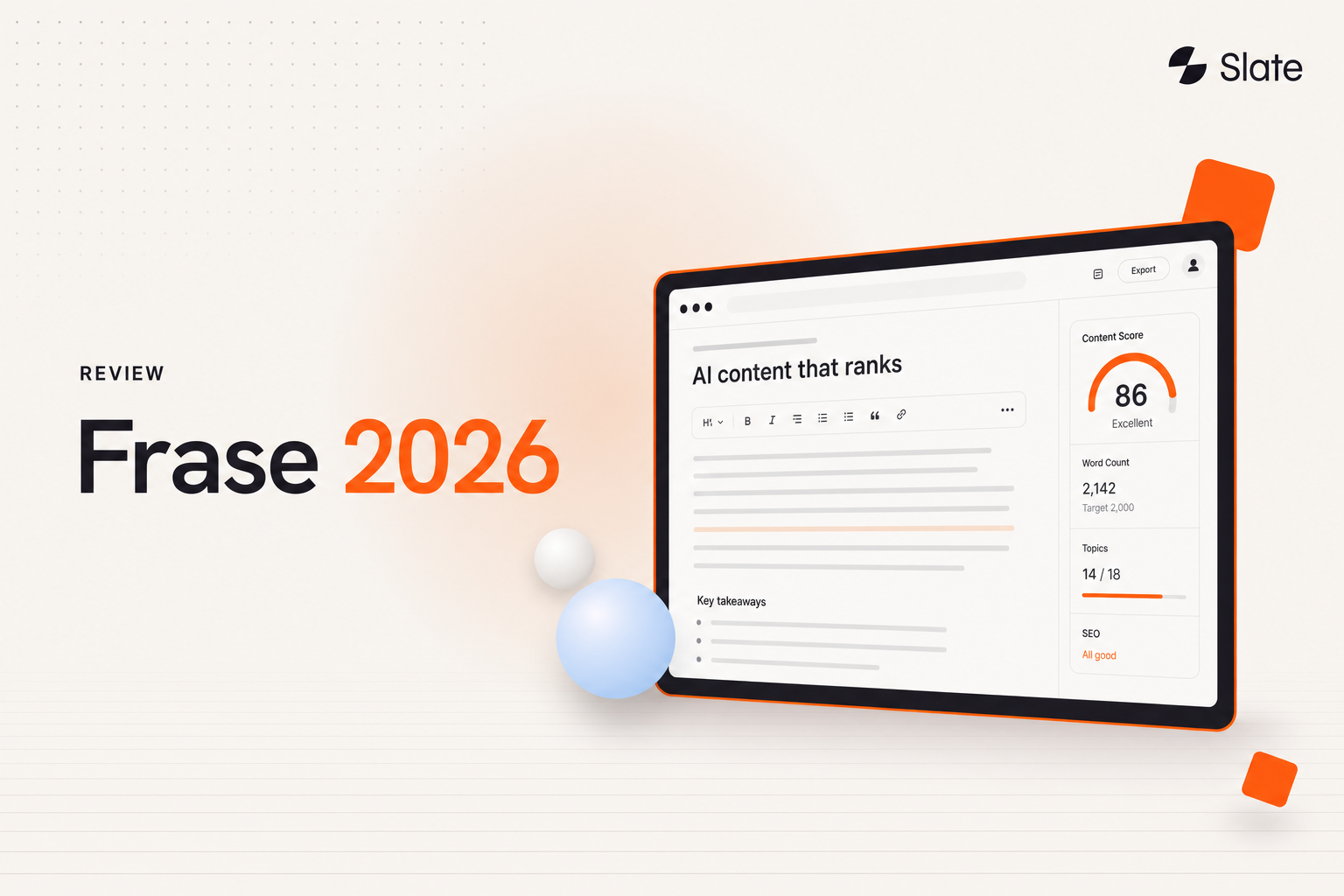
Frase — Best For Content Briefs, SERP Research, And GEO Optimization
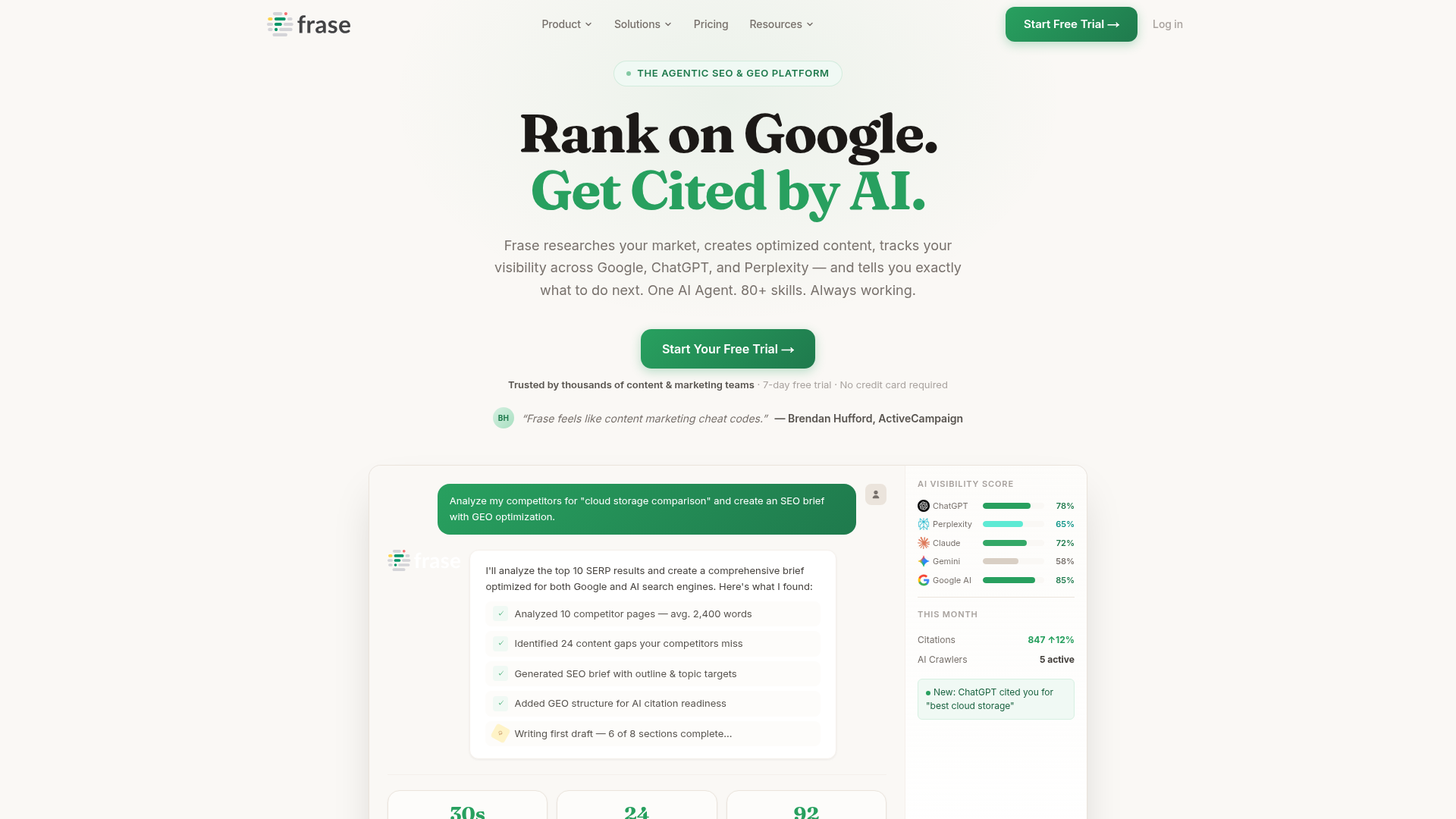
Frase approaches the content problem from the research side. If your team's biggest bottleneck is figuring out what to write and ensuring it's optimized for both traditional search and AI-driven discovery, Frase's research-first architecture and dual scoring system address that directly.
What sets Frase apart from Copy.ai:
AI Search Tracking provides visibility across up to 8 AI platforms: ChatGPT, Claude, Gemini, Perplexity, Google AI Overview, Copilot, Grok, and DeepSeek. The number of platforms tracked varies by plan, but at the Enterprise tier, Frase covers the broadest range of AI platforms in this comparison.
SEO + GEO Optimization uses a dual scoring system with real-time recommendations, structure suggestions, readability analysis, and question optimization. Rather than treating traditional SEO and AI search as separate problems, Frase scores content for both simultaneously.
Auto-Optimize rewrites content in one click to improve SEO and GEO performance, turning optimization from a manual editing process into an automated action.
Content Guard automatically detects decaying content, applies fixes, and re-publishes to CMS platforms (WordPress, Sanity, Webflow, Wix, FraseCMS) with approval workflows. For teams managing large content libraries, this turns content maintenance from a reactive scramble into a systematic process.
Built-In AI Agent handles research, writing, image generation, topic cluster building, content atomization, and visibility tracking across 100+ languages with 80+ skills. Content Atomization turns long-form pieces into LinkedIn posts, Twitter threads, emails, and slides, exportable as a ZIP file.
Additional capabilities include automated content brief creation, Topic Clusters for authority mapping, Programmatic SEO for batch page generation with quality gates, Brand Voice & Governance with terminology rules and style guide enforcement, and Content Templates for extracting reusable structures.
Pricing (yearly billing):
- Starter: $49/month ($39.20/month yearly) (10 articles/month, AI visibility on 2 platforms, 1 user, API & MCP access)
- Professional: $103.20/month (3 seats, 40 articles/month, AI visibility on 3 platforms, 5 brand voice profiles)
- Scale: $239.20/month (5 seats, 100 articles/month, AI visibility on 5 platforms, multi-channel content creation)
- Enterprise: Custom pricing (AI visibility on 8 platforms, SSO/SAML, white-label portal, SOC 2 Type II)
Choose Frase if: Your bottleneck is figuring out what to write and ensuring it's optimized for both traditional search and AI-driven discovery. Frase's AI agent handles research, briefs, and content creation in one workflow, with the broadest AI platform tracking at the Enterprise tier.
Best Copy.ai Alternatives For Enterprise And Brand Governance
Enterprise teams face a different set of constraints. Brand consistency across dozens of contributors, compliance requirements, approval workflows, and audit trails aren't optional features. They're prerequisites. These two platforms address enterprise governance as a core capability.
Jasper — Best For Enterprise Marketing Teams With Brand Controls And AI Agents
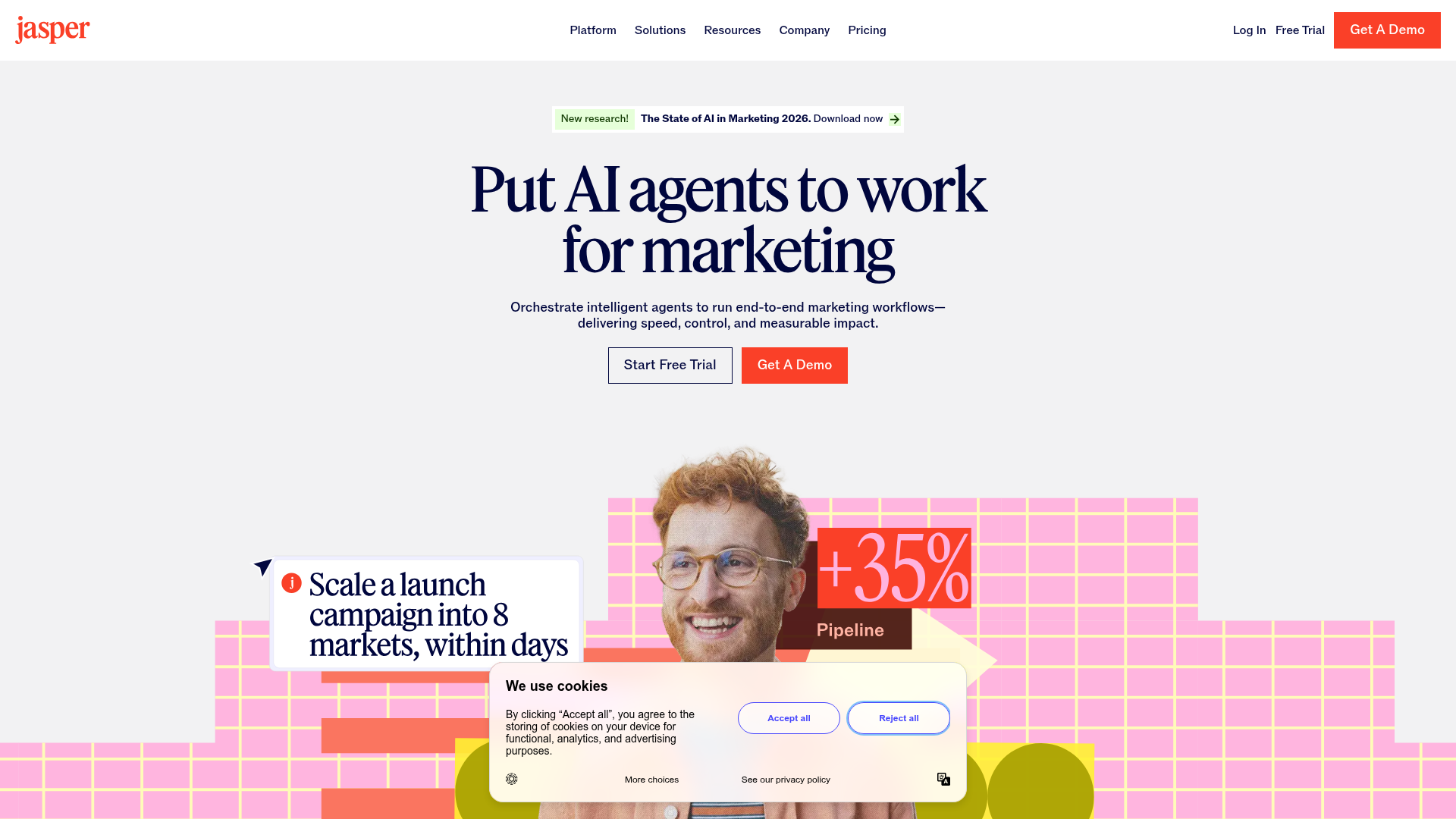
Jasper has evolved well beyond its origins as an AI copywriting tool. It now positions itself as an enterprise AI content platform with brand governance, AI agents, and agentic workflows designed for large marketing organizations.
What sets Jasper apart from Copy.ai:
Brand IQ provides a Brand Kit and Knowledge Base for style guides, tone rules, and internal knowledge, with policy enforcement and auditability. When a marketing team of 30 people generates content across campaigns, channels, and regions, Brand IQ ensures every output reflects the same brand standards.
Query Planner Agent tracks AI search visibility across ChatGPT, Perplexity, and Google AI Overviews, giving enterprise teams insight into how their brand appears in AI-generated answers.
Citable Claims Agent generates fact-dense, verifiable statements engineered for AI citation. This is a distinctive capability: rather than just writing content, this agent specifically creates the kind of structured, attributable claims that AI systems are more likely to extract and reference.
AI Agents execute marketing tasks end-to-end across planning, creation, personalization, activation, and optimization. The Ad Campaign Agent generates unified digital ads for Meta, Google, and X, aligned with brand voice and knowledge base.
Agentic Workflows use Grid templates and AI agents for optimization, origination, and competitive displacement. Structured workflows operate through Content Pipelines, Grid, and Canvas for organized content creation.
Pricing: Pricing is not publicly listed. Contact Jasper directly for current plan details.
Choose Jasper if: You need enterprise-grade brand governance, AI agents that execute across the marketing lifecycle, and campaign-level content generation with built-in brand safety and auditability. Jasper is built for large marketing organizations where consistency and control matter as much as speed.
Writer — Best For Regulated Industries And Compliance-Heavy Teams
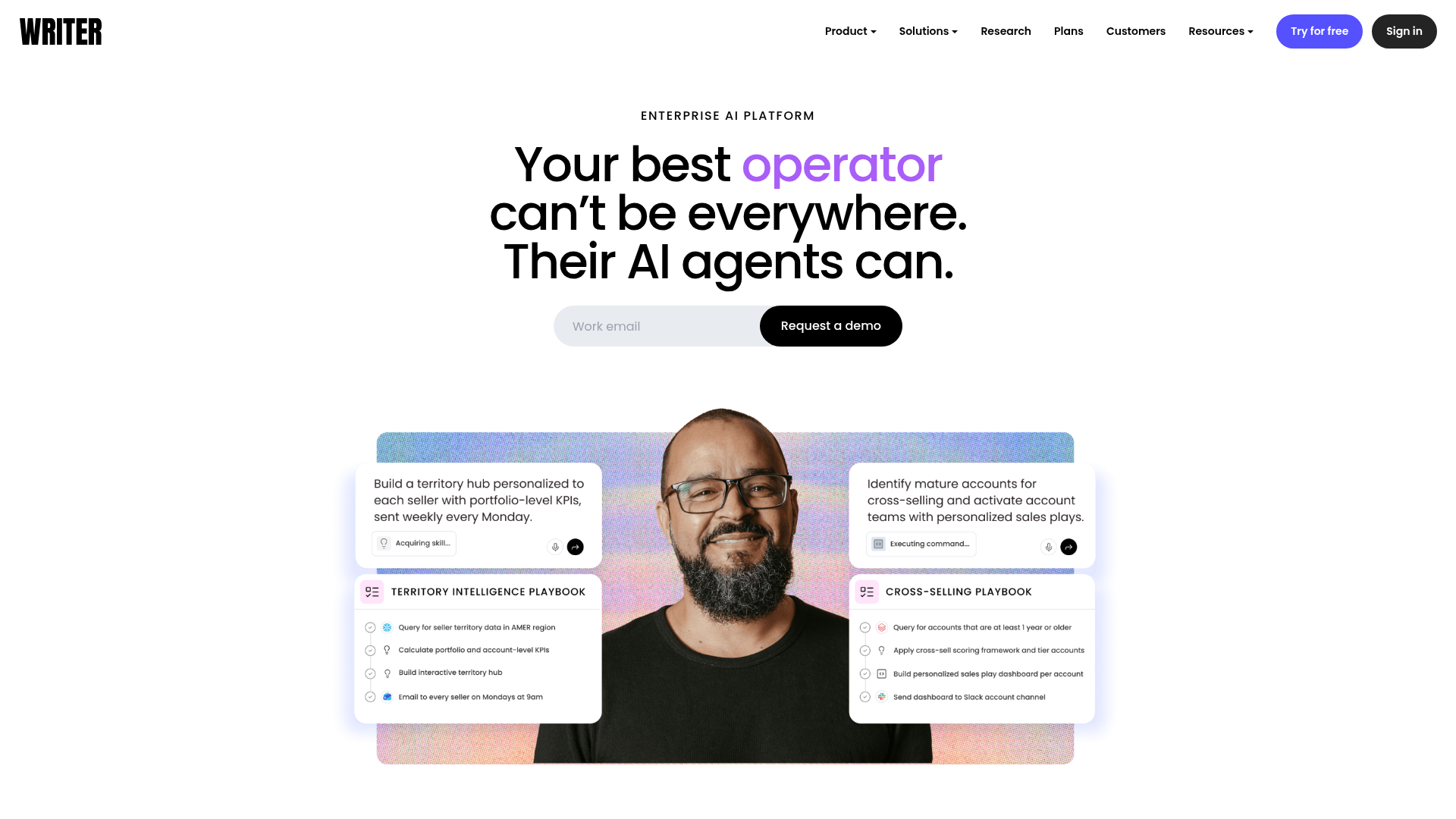
Writer approaches AI content from a governance-first perspective. For organizations in finance, healthcare, legal, or other regulated industries, Writer's agent supervision, Knowledge Graphs, and compliance controls address requirements that most AI writing tools don't even acknowledge.
What sets Writer apart from Copy.ai:
Agent Supervision enforces governance through global policies, guardrails, and permissions for AI agent behavior. This isn't a style guide that agents can ignore. It's a system-level control layer that defines what agents can and cannot do, with granular profiles for different teams.
Knowledge Graphs integrate company facts, data, and context directly into AI outputs. When an AI agent generates content, it draws from verified company information rather than general training data, reducing hallucination risk in high-stakes environments.
Playbooks automate repeatable workflow processes, turning complex multi-step content operations into structured, consistent sequences.
Brand Voice & Style applies shared Voice profiles automatically to all outputs. Departmental brand and voice profiles (available on Enterprise) let different teams maintain distinct voices while staying within organizational guidelines.
Connectors integrate with Gmail, Slack, Teams, Google Drive, Adobe Experience Manager, SharePoint, and more, with expanded third-party connectors. Event-based triggers from platforms like Gong and SharePoint can initiate automated workflows.
AI Studio lets teams build and deploy custom AI apps on Writer's platform. The WRITER Agent supports file uploads up to 500MB and audio/video transcription.
Enterprise-grade security includes role-based access, audit trails, and data privacy controls. AI usage reporting tracks words generated and recaps transcribed.
Pricing:
- Starter: Available with 14-day free trial (no credit card required). Up to 5 users, WRITER Agent, up to 5 Playbooks, 1 team Personality profile, basic connectors, limited Knowledge Graph. No dollar amount listed on the pricing page.
- Enterprise: Contact vendor. Includes unlimited users/teams/collaborators, unrestricted playbooks and workflows, advanced orchestration and approval controls, full Knowledge Graph, departmental brand and voice profiles, full interoperability, granular agent governance and auditability, and priority enterprise support.
Choose Writer if: You operate in finance, healthcare, or legal and need audit trails, compliance controls, agent supervision with governance guardrails, and Knowledge Graphs that keep AI outputs grounded in verified company data.
Best Copy.ai Alternatives For Content Creation And Marketing Teams
These tools serve marketing teams that need versatile content generation across multiple formats, with varying degrees of SEO capability, performance analytics, and specialization.
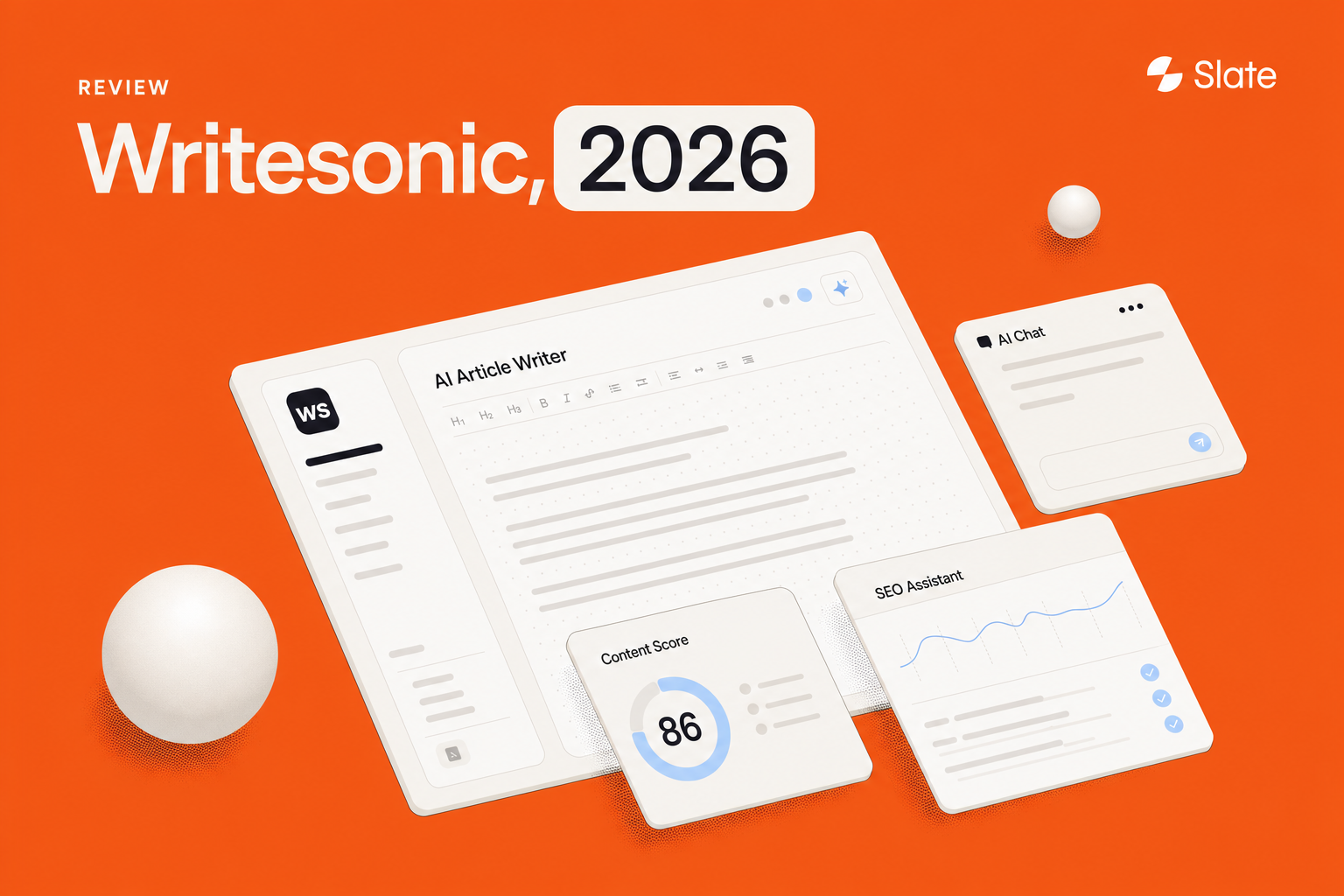
Writesonic — Best For Multi-Format Marketing Content With AI Visibility Tracking
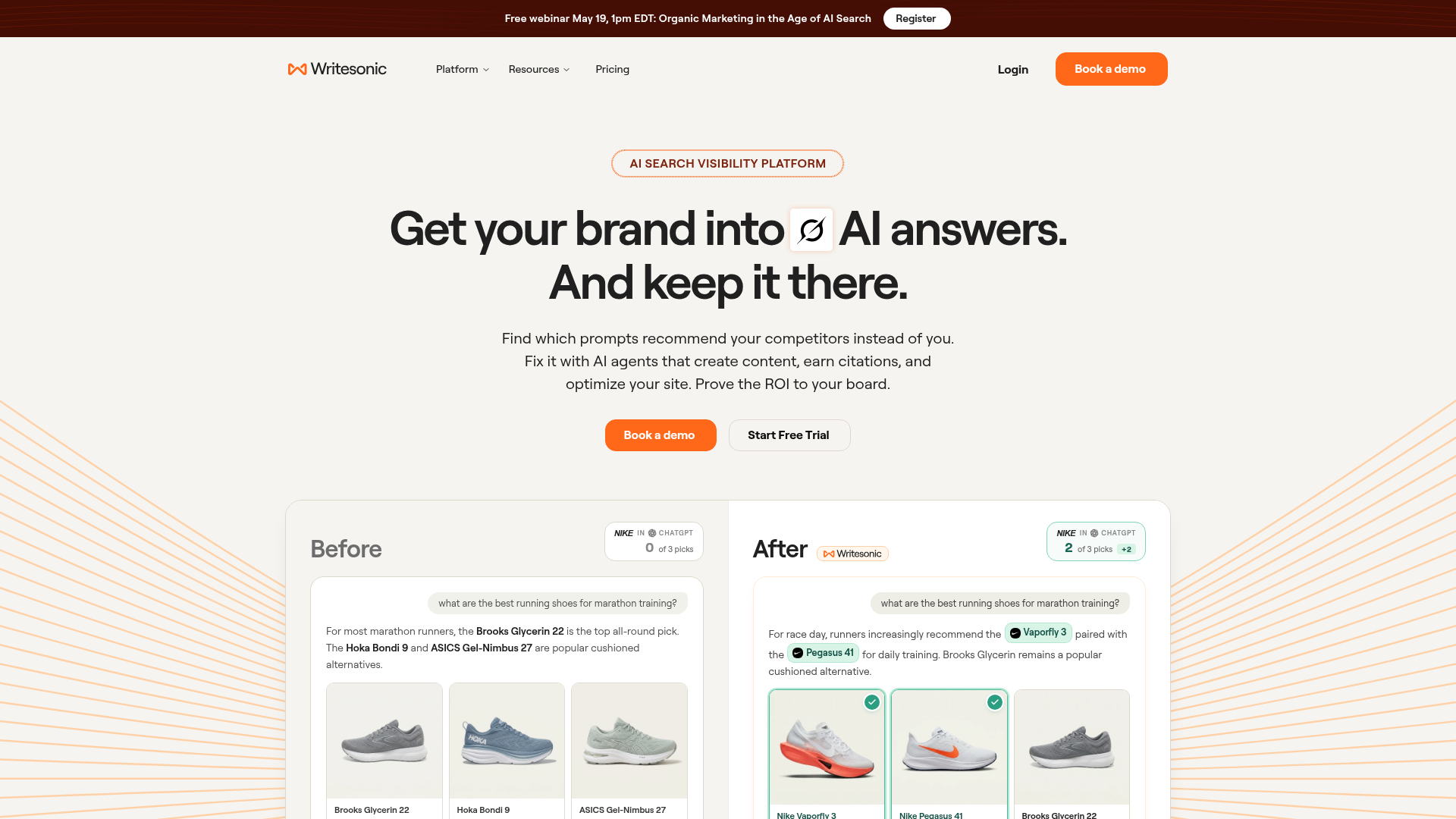
Writesonic covers a broad surface area: blogs, ads, social posts, landing pages, and 60+ content types, combined with AI visibility tracking and CMS integrations. For small to mid-size marketing teams that need one tool to handle multiple content formats while also monitoring AI search presence, Writesonic offers a versatile middle ground.
What sets Writesonic apart from Copy.ai:
AI Visibility Tracking monitors brand visibility across ChatGPT, Claude, Google AI, Gemini, Microsoft Copilot, Grok, and more. The number of platforms tracked scales with your plan, from ChatGPT-only on Starter to all 10 AI platforms on Enterprise.
Action Center ranks opportunities by visibility and citation impact, then suggests specific content fixes. Rather than just showing you where you're visible (or invisible), it prioritizes what to do about it.
AI Agents can rewrite pages, add schema and FAQ markup, and optimize content for citations. Bulk Content Operations support scaled production through a bulk upload feature.
CMS Publishing Integrations connect to WordPress, Sanity, Contentful, Contentstack, Drupal, and more. Zapier Integration extends publishing and updates to 5,000+ platforms. Additional integrations include Google Search Console, Google Search, Ahrefs, Google Analytics, and Looker Studio.
MCP enables visibility reports via ChatGPT and Claude. Additional tools include AI image generation (Photosonic), AI chat (Chatsonic, Botsonic), a Chrome extension, REST API, and compliance certifications (SOC 2, GDPR, HIPAA, SSO).
Pricing (billed annually):
- Starter: $79/month (track ChatGPT only, 15 AI articles/month, 1 user)
- Basic: $199/month (track ChatGPT, Gemini, Google AI Overviews, 25 articles/month, 2 users)
- Growth: $399/month (50 articles/month, 3 users, priority support)
- Enterprise: Custom pricing (all 10 AI platforms, full agentic workflow access, AI search strategist)
Choose Writesonic if: You need a versatile tool that handles multiple content formats, includes AI visibility tracking across several platforms, and offers CMS integrations and bulk operations. It's a strong generalist, though teams needing deep content engineering workflows or spreadsheet-based bulk operations may find dedicated platforms more capable.
Anyword — Best For Performance-Driven Copy With Predictive Analytics
Anyword takes a fundamentally different approach than most tools in this comparison. Instead of optimizing for search visibility, it optimizes for conversion. If your team's primary concern is which headline, ad variation, or email subject line will perform best, Anyword's predictive scoring provides data-driven answers before you spend a dollar on distribution.
What sets Anyword apart from Copy.ai:
Predictive Performance Scores evaluate copy through Score Panels that analyze demographics, emotions, and channel policy guidelines. Before publishing an ad or sending an email, you can see how different variations are likely to perform with specific audience segments.
Continuous Optimization runs high-performing copy variations and surfaces the best combination, turning A/B testing from a post-launch experiment into a pre-launch prediction.
Blog Wizard generates blog content with an SEO Score & Optimization panel, SEO Insights Panel, and Research Panel. While Anyword's core strength is performance copy, Blog Wizard extends its capabilities into longer-form content.
Brand Voice enforces tone of voice, vocabulary, and formatting rules across outputs. Inline Editing includes Rephrase and Improve Score features, Brand Vocabulary, and Custom Benchmark Sets.
Integrations cover ad platforms, CRM, CMS platforms, a Chrome Extension, a Figma Plugin, and a Website Agent. Content types span ad copy, email copy, blog posts, landing page copy, paraphrasing, rewriting, and paragraph generation.
Pricing (yearly billing):
- Starter: $39/month (1 seat, 50 performance predictions, 1 brand voice, Blog Wizard with plagiarism checker)
- Data-Driven: $79/month (3 seats, 100 performance predictions, real-time predictions for manual edits)
- Business: Custom pricing (250 performance predictions, custom-built AI models, automated A/B testing, roles & permissions)
- Enterprise: Custom pricing (500+ performance predictions, enterprise security & SSO, private LLM, dedicated CSM)
Choose Anyword if: You want data-driven copy recommendations tied to conversion and engagement metrics, with predictive scoring that helps you identify top-performing variations before going live. Note that Anyword does not offer AI search visibility tracking across platforms like ChatGPT or Perplexity, so teams focused on AI search optimization will need a separate tool.
Hypotenuse AI — Best For eCommerce Product Content
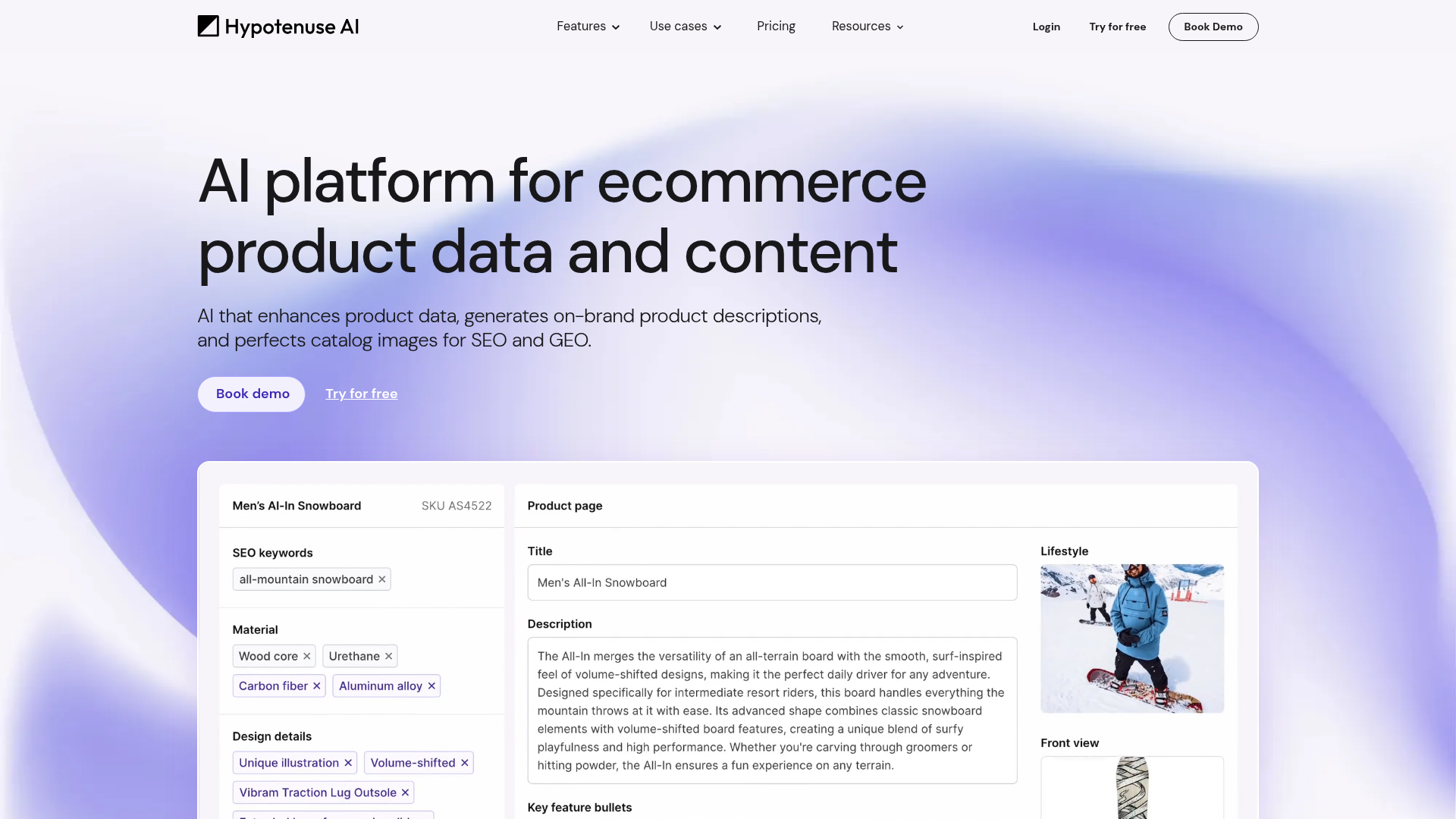
Hypotenuse AI serves a use case that Copy.ai and most general-purpose AI writers handle poorly: structured product content at scale. When an eCommerce team manages thousands of SKUs and needs consistent, SEO-friendly product descriptions, catalog content, and enriched product data, Hypotenuse AI's specialization makes it the obvious choice.
What sets Hypotenuse AI apart from Copy.ai:
Product Content at Scale generates product descriptions, catalog content, and eCommerce pages across thousands of products. This isn't a general-purpose writer repurposed for product copy. It's built specifically for the structured, attribute-driven content that eCommerce catalogs require.
Data Enrichment handles auto-tagging, cleansing, and attribute mapping, turning messy product data into clean, consistent catalog entries.
PIM and Shopify Integration enables direct publishing to Shopify and integration with PIM systems, keeping content synchronized with your product information management workflow.
Brand Voice and Custom Formatting ensure product descriptions maintain consistent tone and structure across your entire catalog. SEO-Optimized Content Generation builds search-friendly elements into product pages by default.
Additional tools include an AI Blog Writer, HypoChat (an AI chatbot with internet access, URL context, conversation memory, and WordPress export), Bulk Image Editing (background removal, style transfer, alt text generation), and a variety of AI writing tools for ad copy, social captions, and meta descriptions.
Pricing:
- Basic: Custom pricing (1 seat, 40+ languages, product description generator, 20+ eCommerce content types)
- Ecommerce Enterprise: Custom pricing (custom seats, product attribute enrichment, product tagging and categorization, taxonomy management, bulk AI image editor, bespoke AI models, AI checker for channel and brand guidelines, custom PIM/ERP integrations, team access controls, dedicated account manager)
Choose Hypotenuse AI if: You manage large product catalogs and need structured, SEO-friendly product content at scale with PIM integrations and data enrichment capabilities. For teams whose content challenge is primarily product-driven, Hypotenuse AI's specialization outperforms any general-purpose alternative.
Best Copy.ai Alternatives For Budget-Conscious Teams And Solo Creators
Enterprise features and AI search analytics come at enterprise prices. If you're a freelancer, solo creator, or small team operating on a tight budget, these two tools deliver meaningful value at a fraction of the cost.
Rytr — Best For Freelancers And Small Teams On A Budget
Rytr is the lightest-weight option in this comparison. It won't replace a content engineering platform, and it doesn't try to. For freelancers who need quick copy generation across multiple formats without complex workflows or enterprise features, Rytr delivers at a price point that's hard to argue with.
What sets Rytr apart from Copy.ai:
40+ Content Formats cover a wide range of use cases, from blog posts and ad copy to business ideas, CTAs, cover letters, and Quora answers. The breadth of templates makes it useful for freelancers juggling diverse client needs.
Tone Matching lets you mirror a specific voice. On paid plans, you can train the AI to write in your unique voice and create separate tones per client, which is particularly useful for agency freelancers managing multiple brand voices.
Plagiarism Checker (powered by Copyscape) is available on paid plans, providing a verification layer that many budget tools skip. The Chrome Extension lets you generate content across apps without switching contexts.
In-Line Editor supports improving writing, changing length, and adjusting tone directly within the interface. Multi-language support covers 35+ languages on the Premium plan.
Pricing:
- Free: $0/month (10K characters/month, no tone match, no plagiarism checks, 1 language)
- Unlimited: $7.50/month (unlimited generation, 1 tone match, 50 plagiarism checks/month, Chrome extension, 20+ pre-programmed tones)
- Premium: $24.16/month (multiple tone match, 100 plagiarism checks/month, 35+ languages, tripled character input limit)
Choose Rytr if: You need fast, simple copy generation at an extremely low price point. Be aware that Rytr does not offer AI search visibility tracking, workflow automation, CMS publishing integrations, or brand governance features. It's a writing assistant, not a content system.
Scalenut — Best For SEO And GEO Content On A Budget
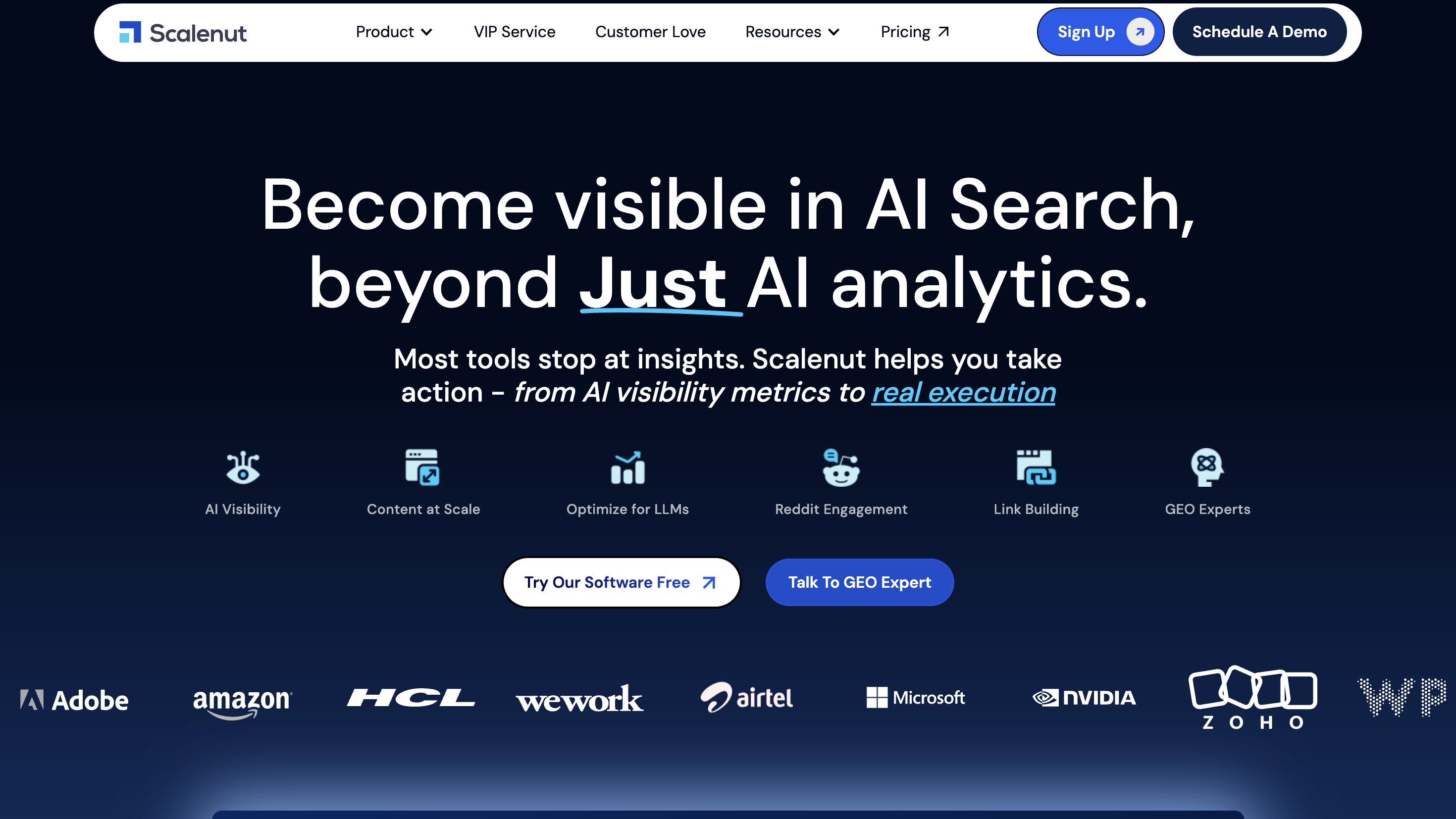
Scalenut occupies an interesting position: it offers GEO (Generative Engine Optimization) capabilities and AI visibility tracking at price points significantly below enterprise tools. For small SEO teams that want to optimize for both traditional search and AI platforms without a premium budget, Scalenut provides a compelling entry point.
What sets Scalenut apart from Copy.ai:
Content Optimizer helps content rank for trending questions on AI platforms like ChatGPT, Gemini, and Perplexity. GEO Score combines traditional SEO metrics with AI-readability signals into a single optimization target.
GEO Core creates, optimizes, and tracks content for AI-first platforms. It includes GEO scores, prompt coverage analysis, metadata fixes, keyword clusters, visibility gap detection, and high-intent keyword clusters designed for AI query patterns.
OnPage Pro optimizes canonical tags, external links, page structure, metadata, schema, and image alt text specifically for AI engine visibility, with real-time monitoring and one-click fixes.
Auto-Publish pushes content directly to WordPress and Shopify. An integrated workflow covers planning, drafting, optimizing, and refreshing content in one sequence. Cruise Mode generates AI-assisted outlines and drafts using SERP and GEO inputs.
Additional tools include an AI Humanizer, content scoring, keyword planner, competitor coverage analysis, traffic analyzer, content audit, link manager, and a backlinks marketplace. AI visibility tracking monitors brand presence across AI-driven experiences like ChatGPT and Perplexity.
A note on advanced features: Scalenut's marketing materials reference Power Sheets, a visual workflow builder with 24+ AI models, conditional logic, web scraping, Brand Kit & Knowledge Base, SuperBlocks, and MCP Integration with Claude. However, these claims appear in marketing copy only and are not confirmed by dedicated feature pages. Evaluate these capabilities carefully during a trial.
Pricing:
- Starter: $59/month (discounted to $24/month). Track up to 10 prompts, ChatGPT and Google AIO, 10 GEO articles/month, 1 workspace.
- Plus: $89/month (discounted to $36/month). Track up to 25 prompts, 60 articles/month, up to 4 team members, OnPage Pro, auto-publish to WordPress and Shopify, backlinks marketplace.
- Professional: $199/month (discounted to $80/month). Track up to 100 prompts across ChatGPT, Google AIO, and Perplexity, 150 articles/month, unlimited team members, dedicated CSM.
- VIP Service: Custom pricing. Dedicated GEO experts and AI agents, content development, high-quality backlinks, monthly technical audits.
Choose Scalenut if: You want SEO and GEO-assisted content creation with AI visibility tracking at a significantly lower price point than enterprise tools. It's a strong option for small teams getting started with AI search optimization, though teams needing deep workflow automation should verify advanced capabilities during evaluation.
Best Copy.ai Alternatives For Sales Outreach And GTM Workflows
Here's an honest assessment: if your primary use case is sales sequences, CRM-triggered outreach, and pipeline automation, Copy.ai may still be the right tool for your team. Its evolution toward GTM automation wasn't accidental. It reflects a genuine strength.
Most tools in this comparison are designed for content marketing, SEO, and organic growth. They're built for the content lead trying to rank articles and earn AI citations, not the sales manager building automated outbound sequences.
Purpose-built sales AI platforms exist for teams whose primary need is outbound automation, but evaluating those tools falls outside the scope of this guide. If your team splits its time between content marketing and sales enablement, consider a hybrid approach: keep Copy.ai for GTM workflows while using a content-focused alternative for organic growth.
How Copy.ai Compares: Where It's Strong And Where Alternatives Win
Where Copy.ai Still Holds Up
Copy.ai deserves credit for what it does well. Its GTM workflow automation and sales-focused templates serve go-to-market teams effectively. The multi-step workflow builder handles sales sequences, CRM integrations, and outbound automation with a level of purpose-built functionality that content-focused tools don't replicate.
The broad template library also provides quick copy generation for teams that need short-form content across multiple formats without deep customization. For teams whose primary job is generating sales collateral and outbound messaging, Copy.ai's direction makes strategic sense.
Where Alternatives Pull Ahead
SEO and AI search: Copy.ai lacks AI search visibility tracking, content optimization scoring, and citation-readiness features. Tools like Slate, Surfer, Frase, Writesonic, and Scalenut offer varying degrees of AI visibility tracking and content optimization purpose-built for organic growth. Slate differentiates through its end-to-end execution layer, from tracking to content engineering to publishing.
Brand governance at scale: Enterprise teams with strict brand guidelines, approval flows, and compliance needs may find Jasper's Brand IQ or Writer's agent supervision and Knowledge Graphs more robust than Copy.ai's governance capabilities.
Long-form content depth: Teams producing research-heavy, 2,000 to 5,000+ word content often find dedicated SEO content tools like Frase, Surfer, and Slate produce more structured, authoritative output than Copy.ai's general-purpose generation.
Content engineering and bulk operations: Slate's Power Sheets and workflow automation are designed for teams managing hundreds or thousands of pages. That's a different operational scale than Copy.ai's workflow builder, which is oriented toward sales and GTM processes.
Performance-driven copy: Anyword's predictive performance scoring provides data-driven copy optimization with demographic and emotional analysis that Copy.ai doesn't offer.
eCommerce product content: Hypotenuse AI's specialization in catalog content, PIM integrations, and data enrichment serves a use case Copy.ai wasn't designed for. When you're generating structured product descriptions across thousands of SKUs, a purpose-built tool outperforms a general-purpose one.
How To Evaluate And Choose The Right Tool
Five Questions To Ask Before Switching
Choosing the right Copy.ai alternative starts with understanding your own bottleneck, not comparing feature lists.
1. Is your primary bottleneck content strategy (what to write) or content generation (how to write it)? If you struggle with topic selection, SERP analysis, and brief creation, tools like Frase with its research-first approach and dual SEO + GEO scoring address that directly. If you already know what to write but need faster, higher-quality execution at scale, Slate's Workflows and Power Sheets are built for that problem.
2. Do you need AI search visibility tracking, or is traditional SEO sufficient for now? If your traffic comes primarily from Google organic results and you're not yet seeing impact from AI-generated answers, a traditional SEO tool like Surfer may be enough. If you're already noticing traffic shifts or want to get ahead of AI search, Slate, Frase, Writesonic, and Scalenut all offer AI visibility tracking at varying depths.
3. How important are brand governance, approval workflows, and compliance controls? A five-person startup can manage brand voice through team norms. A 50-person enterprise marketing team in a regulated industry needs system-level enforcement. Jasper and Writer are built for the latter scenario.
4. Are you scaling content across hundreds of pages, or producing a handful of high-quality pieces per month? Bulk operations, programmatic creation, and spreadsheet-based content management matter at scale. They're unnecessary overhead for small teams publishing weekly.
5. Does your team need CMS publishing integrations, or is copy-paste acceptable? Direct publishing to WordPress, Webflow, or other CMS platforms eliminates a manual step that compounds at scale. If you publish three articles a month, it's a convenience. If you publish thirty, it's a necessity.
A Practical Evaluation Framework
Feature comparison tables tell you what a tool claims to do. They don't tell you whether it does it well for your specific workflow. Here's a method for testing tools side by side:
Run the same content brief through 2–3 tools. Pick a real brief from your queue, not a test prompt. Generate the same piece of content in each tool and compare the outputs.
Compare output quality across four dimensions: structure (logical flow, heading hierarchy, readability), depth (does it cover the topic thoroughly or skim the surface?), factual accuracy (does it hallucinate or make unverifiable claims?), and brand voice alignment (does it sound like your brand or like generic AI?).
Test workflow capabilities beyond single-prompt generation. Can you build a repeatable process? Can you run the same workflow across multiple pieces of content? Can you set conditions, add review steps, and publish directly to your CMS?
Check integration depth with your existing stack. Connect the tool to your CMS, analytics platform, and any other systems in your content workflow. Test whether the integration actually works in practice, not just in the feature list.
Evaluate onboarding time and learning curve. How long does it take a new team member to produce useful output? A tool with powerful capabilities but a steep learning curve may slow your team down during the transition.
When A Hybrid Stack Makes Sense
No single tool does everything well. For many teams, the most effective approach combines specialized tools for different parts of the content lifecycle.
Consider using one tool for strategy and research, another for content creation and optimization, and another for tracking and analytics. For example, a team might use Slate for AI search tracking, content engineering through Workflows and Power Sheets, and CMS publishing, while keeping their existing analytics tools for traffic and conversion reporting.
The key is avoiding tool sprawl. Every additional tool adds integration complexity, context switching, and training overhead. A hybrid stack works when each tool serves a distinct, high-value function that the others can't replicate. It fails when you're using three tools that overlap on 80% of their capabilities.
For teams exploring the broader landscape of AI SEO tools, understanding where each category of tool fits into your workflow helps prevent both gaps and redundancy.
Migration Tips: Moving From Copy.ai To A New Platform
Switching tools mid-stream doesn't have to mean disrupting your content operations. A structured migration reduces risk and preserves the institutional knowledge you've built inside Copy.ai.
Audit your current Copy.ai usage first. Which workflows are active? Which templates does your team use regularly? What brand voices and custom prompts have you configured? Document everything before you start evaluating replacements. The features you actually use matter more than the features you have access to.
Export and document existing brand guidelines and knowledge bases. If you've configured brand voice settings, style rules, or internal knowledge in Copy.ai, capture those in a format that can be imported into your new tool. Most platforms support some form of brand voice configuration, but the setup process varies.
Pilot the new tool with a single content type or campaign before full migration. Don't switch everything at once. Pick one workflow, like blog content creation or content refresh operations, and run it through the new tool for two to four weeks. Compare output quality, team adoption, and workflow efficiency against your Copy.ai baseline.
Plan for a 2–4 week overlap period. Keep Copy.ai active while your team ramps up on the new platform. This overlap prevents gaps in content production and gives your team time to build confidence with new workflows.
Consider hybrid setups for teams with mixed needs. If your organization uses Copy.ai for both GTM/sales workflows and content marketing, you don't have to replace everything with one tool. Keep Copy.ai for sales sequences and outbound automation while moving content marketing operations to a platform built for that purpose.
Conclusion — Choosing The Right Copy.ai Alternative For Your Team
The "best" Copy.ai alternative doesn't exist in the abstract. It depends on what your team is actually trying to accomplish.
If your bottleneck is understanding how your brand appears in AI-generated answers and engineering content that gets cited, Slate's combination of AI Search Analytics, Workflows, Power Sheets, and Brand Kit provides the end-to-end execution layer that most tools in this space lack. If your focus is on-page SEO optimization for individual articles, Surfer's Content Editor and AI Tracker deliver focused, well-executed capabilities. If you need research-first content briefs with dual SEO and GEO scoring, Frase's AI agent and broad AI platform tracking address that workflow.
Enterprise teams with strict governance requirements will find Jasper's Brand IQ or Writer's agent supervision and Knowledge Graphs more aligned with their compliance needs. Performance marketing teams optimizing for conversions rather than search visibility should evaluate Anyword's predictive scoring. eCommerce teams managing large product catalogs have a clear specialist in Hypotenuse AI. And budget-conscious teams getting started with AI content can begin with Rytr or Scalenut without a significant financial commitment.
Copy.ai remains a solid choice for GTM-focused sales teams. Its evolution toward go-to-market automation reflects a genuine strength. But for teams building organic growth systems that work across both traditional search and AI-powered discovery, the tools in this guide offer capabilities that Copy.ai wasn't designed to provide.
For teams building organic growth systems that work across both traditional search and AI-powered discovery, Slate offers the visibility tracking, content workflows, and brand governance to scale with confidence. Book a demo.
Frequently Asked Questions
What is the best Copy.ai alternative for SEO content?
It depends on your specific SEO workflow. Slate is the strongest option for teams focused on AI search optimization and end-to-end content engineering, combining AI visibility tracking across ChatGPT, Perplexity, and Google AI Overviews with Power Sheets for bulk operations and Workflows for multi-step content automation with direct CMS publishing. Surfer excels at on-page SEO optimization with its Content Editor and AI Tracker for monitoring brand mentions in AI answers. Frase is the best research-first option, with dual SEO + GEO scoring and AI visibility tracking across up to 8 platforms at the Enterprise tier. The right choice depends on whether your priority is AI search visibility and scale (Slate), individual article optimization (Surfer), or research and brief creation (Frase).
Is there a free alternative to Copy.ai?
Rytr offers a free plan with 10K characters per month, though it comes with significant limitations: no tone matching, no plagiarism checks, and only 1 language. Scalenut's Starter plan starts at $24/month (discounted). For serious content operations, free and ultra-budget plans typically lack AI visibility tracking, workflow automation, brand governance, and CMS publishing integrations. They're useful for testing AI-generated copy or handling lightweight writing tasks, but they won't replace a structured content workflow.
How does Copy.ai compare to Jasper?
Copy.ai has evolved into a GTM automation platform focused on sales sequences, CRM-triggered workflows, and outbound pipeline generation. Jasper has evolved into an enterprise AI content platform with brand governance and AI agents. Jasper offers Brand IQ for style guides, tone rules, and internal knowledge with policy enforcement and auditability. Its Query Planner Agent tracks AI search visibility across ChatGPT, Perplexity, and Google AI Overviews, and its Citable Claims Agent generates fact-dense statements engineered for AI citation. Both have moved well beyond simple AI writing, but in different directions: Copy.ai toward sales enablement, Jasper toward enterprise marketing governance. Jasper's pricing is not publicly listed; contact the vendor for current details.
Which Copy.ai alternative is best for maintaining brand voice?
Several tools offer brand voice capabilities, but they differ in depth and enforcement. Slate's Brand Kit & Knowledge Base provides style guides, tone rules, and an internal knowledge base for brand-safe AI content generation across Workflows and Power Sheets. Jasper's Brand IQ enforces brand governance with style guides, tone rules, internal knowledge, and policy enforcement with auditability. Writer offers shared Voice profiles automatically applied to all AI outputs, with departmental brand and voice profiles on Enterprise. Frase enforces terminology rules, reference docs, and style guides during content generation. The right choice depends on your scale: smaller teams may find Frase or Slate sufficient, while large enterprise organizations with compliance requirements may need Jasper's or Writer's governance depth.
Can I use a Copy.ai alternative for sales outreach and cold email?
Most tools in this comparison are designed for content marketing, SEO, and organic growth rather than outbound sales workflows. If your primary use case is sales sequences and CRM-triggered outreach, Copy.ai may still be the right tool for that specific function. Purpose-built sales AI platforms exist for teams whose primary need is outbound automation, but evaluating those falls outside the scope of this guide. Many teams use a hybrid approach: Copy.ai for sales workflows and a content-focused tool for organic growth.
What's the best Copy.ai alternative for AI search optimization?
Slate is built specifically for teams that need end-to-end execution in AI search optimization. AI Search Analytics tracks brand visibility across ChatGPT, Perplexity, and Google AI Overviews. Workflows with 24+ AI models, conditional logic, and CMS publishing turn visibility insights into published content. Power Sheets enable bulk operations across thousands of URLs. Surfer, Frase, Writesonic, and Scalenut also offer AI visibility tracking at varying depths. Surfer tracks across ChatGPT, Gemini, Perplexity, and others. Frase covers up to 8 AI platforms at Enterprise. Writesonic tracks across ChatGPT, Claude, Google AI, Gemini, Copilot, Grok, and more. Scalenut tracks across ChatGPT, Google AIO, and Perplexity. Slate differentiates through its workflow-driven content engineering approach: tracking visibility is only useful if you can act on it at scale.
How much do Copy.ai alternatives cost?
Pricing spans a wide range depending on capabilities and team size. Budget options: Rytr (free to $24.16/month), Scalenut ($24 to $199/month). Mid-market options: Surfer ($49 to $299/month yearly), Frase ($39.20 to $299/month yearly), Anyword ($39 to $99/month yearly), Writesonic ($79 to $399/month yearly). Premium and enterprise options: Slate (starts at $199/month), Jasper (contact vendor), Writer (Starter plan available with 14-day free trial, Enterprise contact vendor), Hypotenuse AI (custom pricing), Anyword Business and Enterprise (custom), Writesonic Enterprise (custom), Scalenut VIP (custom).
Which Copy.ai alternative works best for large content teams?
Large teams need collaboration features, roles and permissions, approval workflows, and the ability to manage content at scale. Slate's Power Sheets enable bulk operations across thousands of URLs, and Workflows support multi-step content automation with 24+ AI models and direct CMS publishing. Jasper offers agentic workflows with Grid and Canvas for structured content creation, plus Brand IQ for governance across large teams. Writer provides Playbooks for repeatable workflows, agent supervision with governance controls, and unlimited users on Enterprise. Surfer supports role-based access and real-time collaboration with multiple contributors in one Content Editor. Frase offers up to 5+ seats with approval workflows via Content Guard.
Are there open-source or self-hosted alternatives to Copy.ai?
Technical teams can build custom content generation systems using the OpenAI API, Llama, Mistral, or other open-source models. This approach provides maximum control over data privacy, model selection, and deployment infrastructure, which matters for teams in regulated industries or organizations with strict data residency requirements. The trade-offs are significant: you'll need engineering resources to build and maintain the system, and you won't get built-in workflows, brand governance, AI visibility tracking, CMS publishing integrations, or the optimization features that purpose-built platforms provide. For most marketing teams, the engineering overhead outweighs the control benefits.
How do I migrate from Copy.ai to another tool?
Start by auditing your current Copy.ai usage: document which workflows, templates, and brand voices are active and which your team actually uses regularly. Export and document existing brand guidelines and knowledge bases in a portable format. Pilot the new tool with a single content type or campaign for two to four weeks before committing to a full migration. Plan for a 2–4 week overlap period where both tools are active, so your team can ramp up without gaps in content production. Consider hybrid setups if your organization uses Copy.ai for both sales and content workflows. Keep Copy.ai for GTM and outbound automation while moving content marketing operations to a platform built for organic growth.