For an AEO or GEO program, the practical question is which AI visibility platform fits the way you budget, report, review, publish, and prove progress.
Short answer: Peec AI fits teams that want accessible multi-model monitoring with public pricing structure. Profound fits enterprise teams that need prompt-demand research, and SOC 2 Type II documentation.
Either way, you’ll still need an execution system after the dashboard shows the gap.
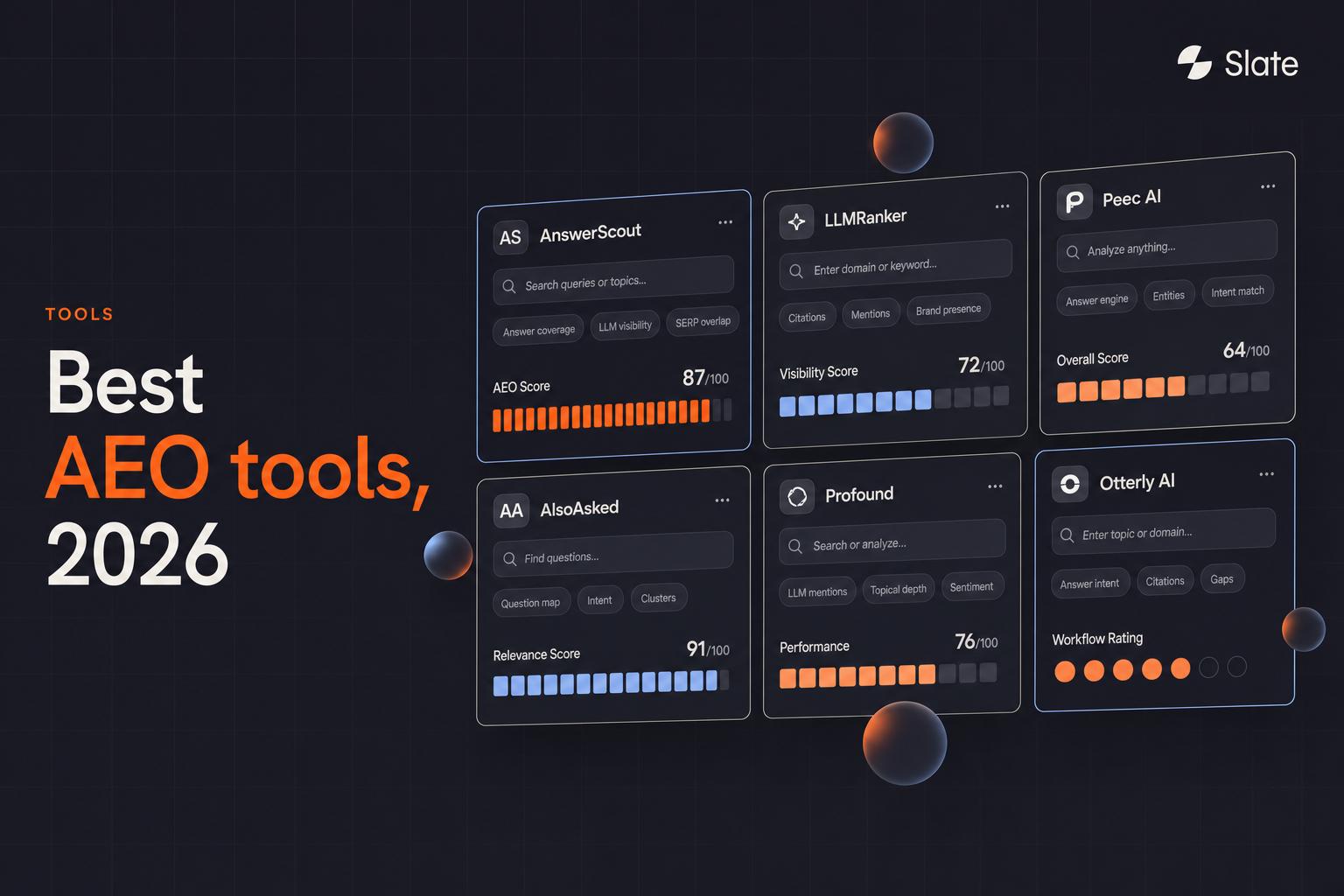
Before shortlisting either platform, it helps to see where both sit among the best AEO tools.
Key Takeaways
- Peec AI focuses on multi-model AI search analytics, including visibility, position, sentiment, and share-of-voice tracking.
- Profound focuses on enterprise AI visibility, Prompt Volumes, crawler analytics, and AI Marketer agents.
- Peec AI plans each track three models you choose, such as ChatGPT, Google AI Overviews, Google AI Mode, Microsoft Copilot and Gemini. Extra models are paid add-ons, and Enterprise tracks up to 13.
- Profound’s enterprise package supports up to nine answer engines, including Claude and DeepSeek.
- Prompt tracking and prompt discovery are separate jobs. Profound documents a prompt-demand dataset. Peec AI prices by tracked prompt volume.
- Profound documents SOC 2 Type II compliance and SSO/SAML inside its tailored enterprise package.
- Total cost depends on prompts, models, markets, brands, seats, API access, and the separate tools you need for execution.
- Dashboards surface gaps. Teams still need briefing, review, publishing, promotion, and measurement.
Profound Vs Peec AI at a Glance
Both platforms measure how brands appear in AI answers.
The split shows up around the measurement layer: prompt sourcing, research depth, governance, and pricing structure.
Biggest Difference Between Profound And Peec AI
Peec AI gives teams broad monitoring access with public plan structure.
Profound gives enterprise teams deeper research inputs and documented governance, including a SOC 2 Type II report.
That’s the buying split. A lean team may get more value from fast setup and predictable budgeting. A large digital team may need Prompt Volumes, SSO/SAML, SOC 2 Type II, and tailored tracking.
Peec AI: Accessible Multi-Model Monitoring
Peec AI is an AI search analytics platform for marketing teams tracking brand performance across AI search platforms.
It covers visibility, position, sentiment, share of voice, source analytics, citation analytics, competitor gaps, and recommended actions.
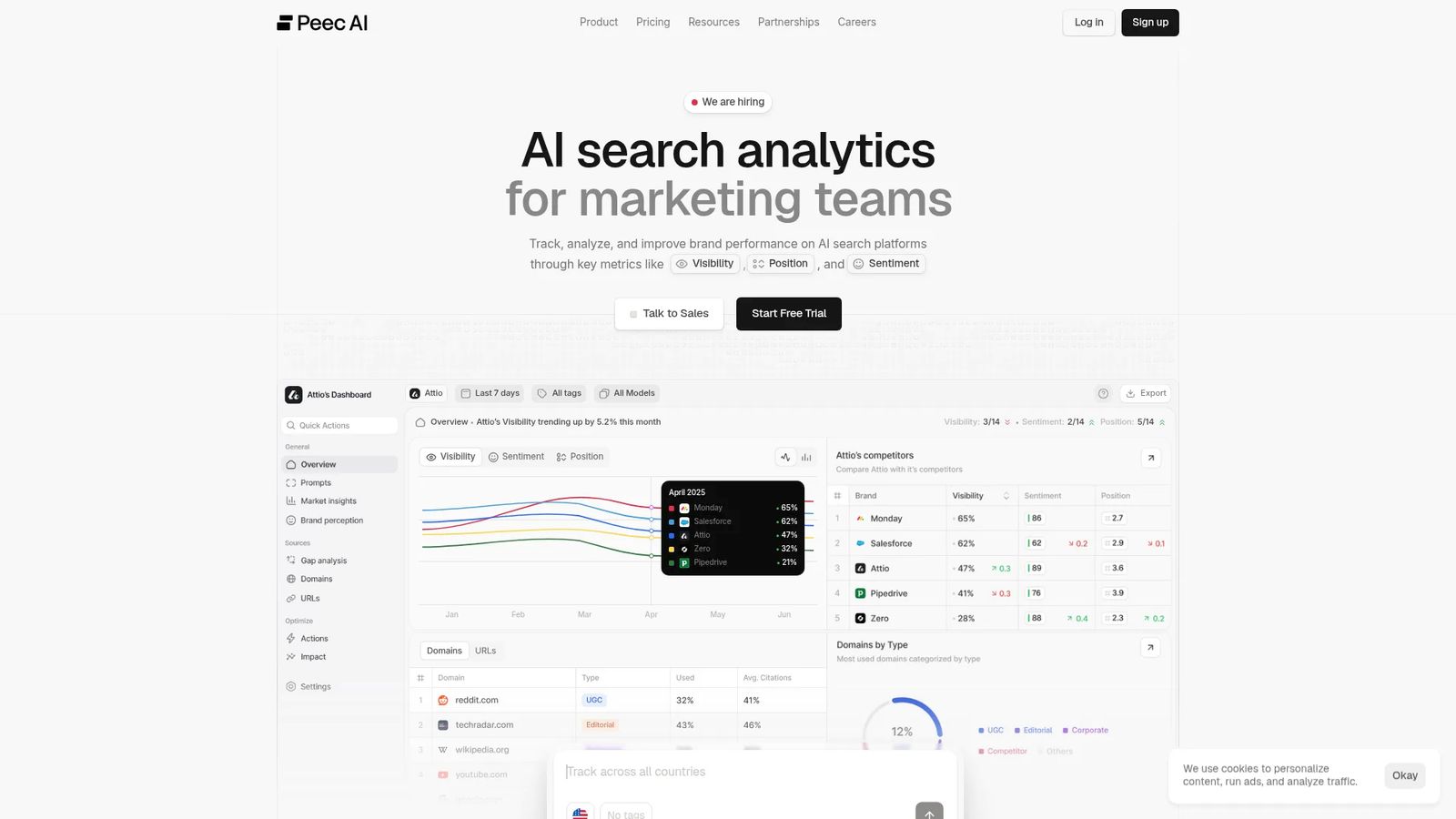
Documented capability: Starter, Pro and Advanced each track three models you choose from ChatGPT, Google AI Overviews, Google AI Mode, Microsoft Copilot, Gemini and Naver AI. Extra models are add-ons from $30/month on Starter. Enterprise tracks up to 13 models, including Claude, DeepSeek, Grok, Qwen and Mistral, and adds API access and SSO. Every plan also includes Agent analytics, which shows which AI bots crawl which pages and how often.
Unlimited users are included on every plan. That seat policy helps agencies and cross-functional teams. You don’t pay extra when a client stakeholder only needs to check a dashboard.
Verify during evaluation:
- Which engines cost extra
- How often prompts rerun
- How citations are deduplicated
- Whether raw answer text can be exported
- How markets and languages are handled
Teams comparing options can also review best Peec AI alternatives.
Pricing: Starter ($95/month), Pro ($245/month), and Advanced ($495/month) monthly plans on Peec’s pricing page. Enterprise custom annual pricing. Unlimited users included on every plan. Annual billing saves 15%.
G2 rating: 4.7/5
Profound: Enterprise Depth And Prompt Research
Profound is an AI marketing platform for teams monitoring and improving brand visibility across AI search.
Its documented products include AI Marketer agents, Answer Engine Insights, and Prompt Volumes.
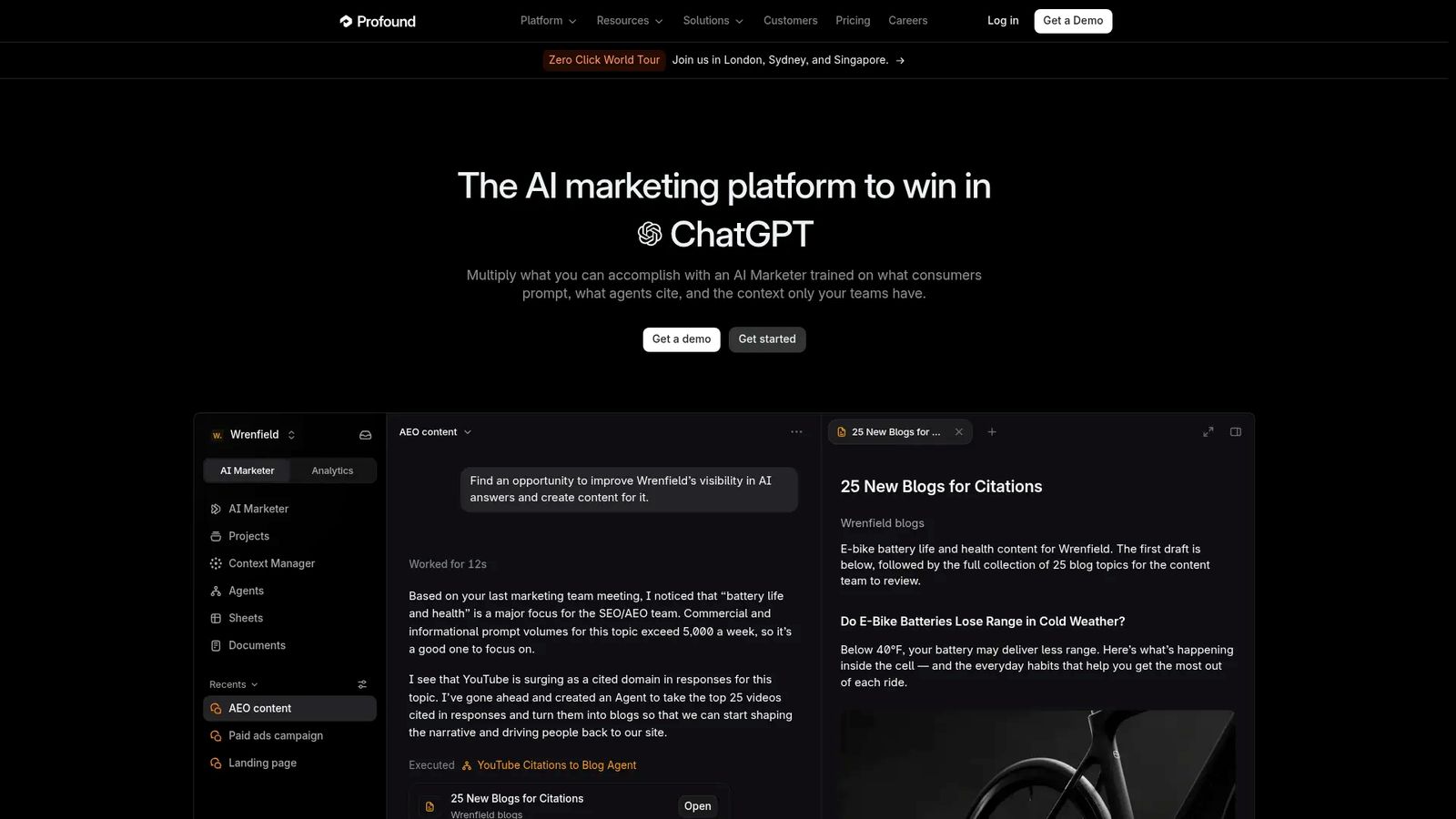
Documented capability: Profound supports auto-generated prompts, manual prompt uploads, and high-volume queries from Prompt Volumes.
It also documents crawler analytics: which AI platforms fetch your site, how often they visit, and which pages they access. Enterprise packages include SSO/SAML and SOC 2 Type II compliance.
Crawler data tells you whether AI systems fetched pages. Answer monitoring tells you whether the brand appeared in generated responses. Teams diagnosing citation problems often need both.
Verify during evaluation: Profound’s enterprise packaging is quote-based, so scope, limits, and price depend on the deal. Compare the quote against documented alternatives in best Profound AI alternatives.
Pricing: Free trial with limited credits and 50 daily prompts for seven days. Enterprise custom pricing with tailored usage, tracking, and support. For details, see our breakdown of Profound pricing.
AI Model Coverage: ChatGPT, Perplexity, Google AI Overviews, And Beyond
Peec AI’s Starter, Pro and Advanced plans each track three models you pick, with more as add-ons. Its Enterprise plan tracks up to 13.
Profound’s trial covers three engines. Its enterprise package supports up to nine answer engines.
Model count alone can mislead buyers because “coverage” can mean several different things.
What Coverage Can Mean
Vendors use “coverage” for different capabilities:
- Answer monitoring: Whether an answer mentions or recommends the brand.
- Citation monitoring: Whether a URL is cited as a source.
- Prompt-level analysis: Which prompts produce which answers across related queries.
- Crawler or agent analytics: Whether AI bots fetch site pages, how often, and which URLs they request.
A platform can monitor answers for one engine and have weaker citation extraction for the same engine. So ask for outputs, exports, and sample rows.
Coverage Breadth Vs Coverage Depth
Breadth is easy to market. Depth costs more work: resampling prompts, localizing by market, extracting citations, deduplicating sources, and keeping answer history.
Buyer warning: Ask which models are included on the quoted plan, how often answers are checked again, and whether results are localized by country and language.
Demo Questions To Ask
Ask these during the call:
1. Which engines are included on the quoted plan?
2. Which engines cost extra?
3. How often does each prompt rerun?
4. Is each prompt run once per cycle or multiple times?
5. Can results be localized by country, language, and market?
6. Does the platform vary results by persona, device, or login state?
7. What does it cost to add an engine, market, or brand mid-contract?
8. How long is answer history retained?
9. Can raw answer text be exported?
Prompt Research, Prompt Demand, And Citation Intelligence
Profound has the stronger documented prompt-research position.
Prompt Volumes is described as a dataset of prompts submitted to AI platforms by users. Profound also accepts auto-generated prompts and manual uploads.
Peec AI centers more on tracking prompts you define, with pricing tied to prompt volume and models analyzed. It also suggests prompts from your brand context and coverage gaps, and scores the demand behind each tracked prompt from 1 to 5. That is a relative score, not a numeric volume.
Prompt Tracking Vs Prompt Discovery
Tracking reruns a fixed list of prompts.
Discovery surfaces prompts the team didn’t already know to track.
At 25 prompts, tracking can work well. The list is small, tied to buying-stage questions, and easy to defend.
At 500 prompts across several markets and product lines, the list can get stale fast. Discovery helps replace internal phrasing guesses with demand signals.
Relative Demand Vs Numeric Volume
Some tools show prompt demand as a relative score: high, medium, low, or an index.
Others show numeric volume.
Relative scoring is useful for prioritization. Numeric volume looks more precise, so ask how the vendor creates it.
Verify during evaluation: Ask whether prompt-demand outputs are measured, modeled, sampled, or directional. Ask how often the dataset refreshes, which geographies it covers, and whether prompt records can be exported.
A number without methodology belongs in planning, not forecasting.
Citation Tracking And Share Of Voice
Peec AI documents source analytics, citation analytics, competitor gap analysis, sentiment, and share-of-voice tracking.
Profound documents visibility, positioning, sentiment, citations, ranking, and competitive presence inside Answer Engine Insights.
The metric names can look similar. The calculations may differ.
A brand mention can be based on exact string match, entity match, or variant match. Citations can be counted per occurrence, per URL, or per domain. Those choices can change the score.
Before using either platform’s score in executive reporting, request:
- Formula definitions
- Deduplication rules
- Raw answer exports
- Timestamp and location fields
For more context, see Best AI Citation Tracking Tools and Best AI Share Of Voice Tools. Our guide to AI citations goes deeper on citation data.
Methodology: How To Validate AI Visibility Data
AI visibility data comes from sampling, prompt selection, and extraction rules.
If you skip methodology questions, you’ll eventually have to defend a number you can’t explain.
Methodology Questions Every Buyer Should Ask
1. How are prompts selected?
2. Are prompts manual, auto-discovered, demand-sourced, or mixed?
3. How often are answers sampled again?
4. Is every prompt run once or several times per cycle?
5. Are results localized by market, language, device, and login state?
6. How are citations extracted?
7. Are citations deduplicated by URL or domain?
8. How is a brand mention defined?
9. How is history handled when a model updates?
10. Can we export raw answer text and aggregated scores?
If a platform exports only summary scores, you’re tied to its extraction layer. If it exports raw answers, your team can audit the score when a client or executive challenges a drop.
Why AI Citation Results Change Between Snapshots
Generative systems vary. The same prompt can produce different answers in back-to-back runs.
Model updates, retrieval index changes, personalization, and geographic routing all add noise.
So treat a single snapshot as directional. Use at least 30 days of trend data with a stable prompt set before making budget calls.
And keep the prompt set stable during a pilot. If the prompts change, your comparison gets muddy fast.
Reporting, Integrations, API, And Enterprise Governance
Profound documents SOC 2 Type II compliance and SSO/SAML inside its tailored enterprise package.
Peec AI documents enterprise plans with SSO and API access, multi-model monitoring, and unlimited users. Enterprise buyers should request current security documents directly.
Reporting Depth
AI monitoring metrics answer presence questions:
- Mentions
- Citations
- Sentiment
- Share of voice
Business reporting answers performance questions:
- Clicks
- CTR
- Sessions
- Pipeline
- Page performance
Most AI visibility tools handle the first group. Fewer connect cleanly to the second.
That gap shows up when finance asks what the subscription produced. A share-of-voice chart alone won’t carry that conversation.
Pair AI visibility data with Google Search Console and GA4. For a deeper breakdown, see AI Search Metrics.
Stack Fit
Ask one practical question about every integration: does this connection help work get done, or does it only send data somewhere else?
A BI export sends data out. A Slack alert sends data out. A CMS publishing connection helps get approved work live.
Map the required systems before the demo:
- BI or warehouse
- GA4
- Google Search Console
- CMS
- SEO data sources
- Slack
- CRM
- Outreach system
Then ask which connections are native, which require API work, and whichneed manual spreadsheet work.
More detail sits in AI Search Analytics Tools.
Enterprise And Multi-Brand Governance
Procurement should also request subprocessor lists, data residency terms, deletion commitments, uptime terms, and support obligations. Profound lists its security controls on its enterprise page.
Pricing: How To Compare Total Cost
Peec AI publishes Starter, Pro, and Advanced monthly plans with custom annual Enterprise pricing. Unlimited users are included on every plan.
Profound has a free trial with limited credits and 50 daily prompts for seven days. Enterprise pricing is custom.
Peec AI is easier to budget from public pages. Profound requires a quote.
Published Pricing
Cost Drivers Buyers Miss
Headline price is only one line item.
Check these before signing:
1. Prompt overages: Prompt lists tend to grow after the pilot.
2. Extra AI models: Engines on a feature page may cost more on the quote.
3. Markets and languages: Each locale can multiply prompt runs.
4. User seats: Per-seat pricing can slow adoption.
5. Brands and workspaces: Agencies often hit workspace limits early.
6. API access: API use may require a higher tier.
7. Data retention: Short history windows can force manual archiving.
8. Execution tools: Writing, review, CMS publishing, outreach, and reporting may sit in separate subscriptions.
Cost Per Completed Improvement
A better cost model is:
Cost per completed improvement = Annual platform and workflow cost ÷ Published, measured improvements per year
Run the math using month-six usage. Include prompts, markets, seats, models, API access, reporting needs, and production capacity.
A cheap monitoring tool can become expensive when every brief, draft, approval, CMS update, and report lives in a separate tool.
For Profound-specific pricing context, see Profound AEO Pricing.
Which Platform Fits Your Team?
The best choice depends on where work gets stuck.
Lean In-House SEO And Content Teams
Peec AI’s unlimited-user policy and public tier structure make evaluation easier for small teams.
Check prompt limits against your starting list. Confirm exports match leadership reporting. And be honest about publishing capacity.
If your team can publish two improved pages a month, don’t buy monitoring depth you can’t use.
Agencies And Multi-Client Teams
Agencies should evaluate workspace setup first.
Confirm client separation, roll-up billing, role-based access, branded exports, and cost per client account.
Peec AI publishes separate agency plans for tracking several client brands, and Profound lists a self-serve Agency Growth plan with credits per client workspace. Unlimited users on Peec’s brand plans also help when clients need read-only access.
Mid-Market Marketing Teams
Mid-market teams often sit between self-serve monitoring and enterprise implementation.
If the team already knows the prompts and can’t publish fast enough, deeper research won’t solve the bottleneck. If the team is guessing at prompts across markets, Profound’s Prompt Volumes dataset may be useful.
Enterprise SEO And Digital Teams
Profound documents SOC 2 Type II and SSO/SAML inside its enterprise package, which can help procurement.
Still request the current report scope, data residency terms, production API limits, and MSA terms.
Plan for adoption, because a powerful AI visibility platform that only a few people use will underperform.
Ecommerce And Large Catalog Teams
SKU-level tracking gets expensive fast.
A catalog with 5,000 SKUs usually needs category-level tracking, high-intent product prompts, and prompt clusters.
For commercial queries, retailers, review sites, and comparison publishers often dominate citations. That changes the response: you may need third-party mentions as much as owned content work.
Confirm page-tracking limits and prompt grouping with both vendors.
Content Operations Teams
A better dashboard won’t solve review queues, SME delays, legal approval, CMS bottlenecks, or refresh backlog.
If production is the constraint, focus on the path from gap to published page.
How Profound And Peec AI Compare To Other AI Visibility Platforms
Profound and Peec AI sit in a crowded category with suite tools, standalone monitors, and execution platforms.
Suite tools like Semrush and HubSpot reduce tool sprawl. Standalone monitors compete on coverage and price. Execution platforms focus on the work that follows the finding. Prices in the table come from each vendor’s pricing page.
For category context, see Best AI Search Visibility Tools and Best Generative Engine Optimization Tools. For head-to-head detail, see Profound vs Ahrefs and Profound vs AirOps. [
What Happens After You Find An AI Visibility Gap?
Profound and Peec AI identify where a brand is absent or underrepresented.
Closing the gap takes briefing, drafting, review, publishing, promotion, and measurement. Much of that work happens outside the monitoring platform.
The Seven-Step Loop Teams Run Manually
1. Detect: A ranking, citation, or prompt-answer gap appears.
2. Prioritize: Someone scores the opportunity against business value.
3. Produce: A writer creates or updates the page.
4. Review: Editorial, SME, legal, or compliance teams approve the work.
5. Publish: The page goes into the CMS.
6. Promote: Outreach builds authority or brand mentions.
7. Measure: Citations, clicks, CTR, and rankings are checked again.
Each handoff can stall. The time from detection to live page usually decides how many gaps your team closes in a quarter.
Monitoring, Research, Execution, And Operations
Monitoring tells you what’s happening: prompts, mentions, competitors, sentiment.
Research tells you where to focus: demand, cited sources, crawled pages, prompt clusters.
Execution gets the work done: briefs, pages, approvals, publishing.
Operations makes the loop repeatable: templates, review gates, brand voice rules, and refresh triggers.
Many buyers start with monitoring and research. Their backlog usually lives in execution and operations.
Governance For Higher Output
Volume without governance creates thin, repetitive content.
A governed workflow adds editorial review, brand voice rules, SME checks, legal review where needed, claim validation, and publishing permissions.
Slate: For Teams Blocked By Execution
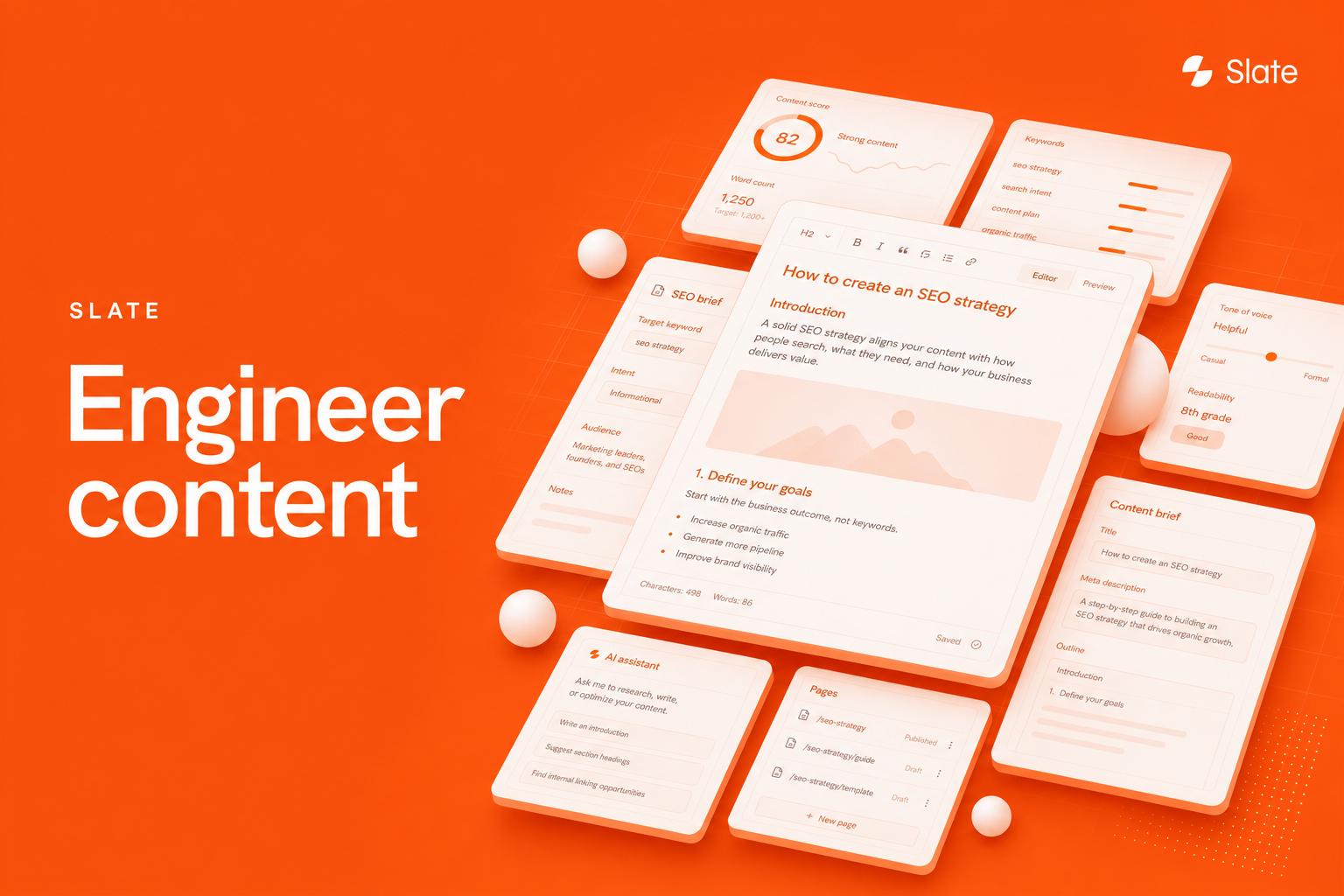
Slate is an end-to-end, agent-driven content, SEO, and AI search platform.
It fits teams that already have visibility data but aren’t turning it into published, measured work.
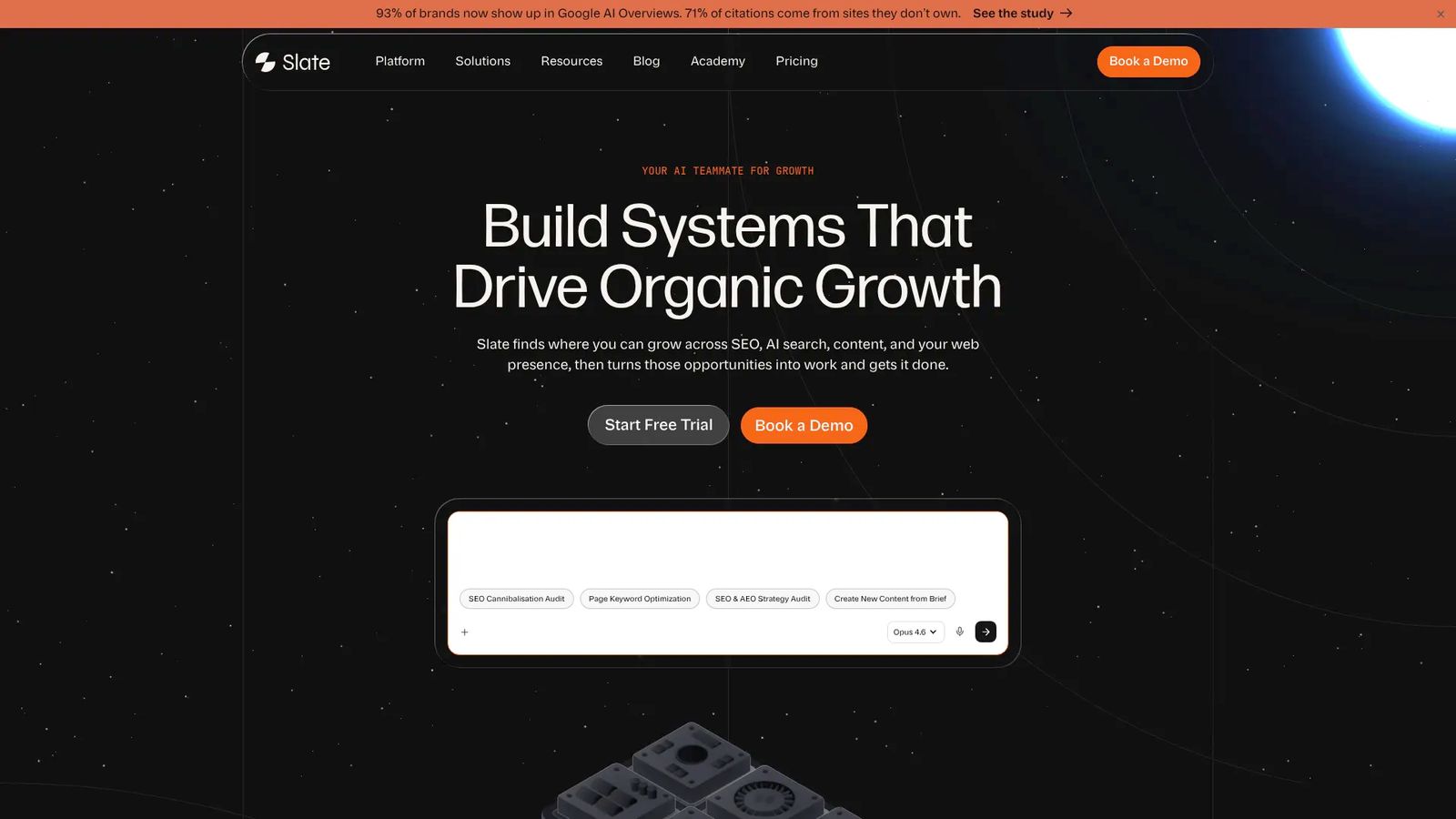
AI Visibility Analytics Across Major AI Platforms
Slate’s AI Search Analytics tracks brand presence across ChatGPT, Google AI Mode, Google AI Overviews, and Perplexity on every plan. Claude and Gemini are available as add-on answer packs, and Enterprise includes all six. Setup is covered in the AI Tracker docs
It covers sentiment, brand mentions, prompt answers, and keyword tracking. The measurement layer feeds prioritization and execution.
Teams comparing measurement-first tools can review Best AI Visibility Tools For SEO Teams.
Opportunities Across Keywords, AI Visibility, Outreach, And Content Decay
Opportunities pulls keyword gaps, AI visibility topic changes, suggested prompts, third-party outreach targets and content decay into one view.
That helps teams avoid one common trap: chasing AI citations while organic pages slide.
Cowork and Custom Agents
Slate’s Cowork accepts plain-language work requests.
Custom agents package repeatable jobs so teams can run them again without engineering support.
Examples:
- Identify declining pages and create refresh briefs.
- Find prompts where competitors are cited and draft an action plan.
- Audit URLs for AI search readiness against a checklist.
- Turn a monthly audit into a reusable agent.
Automation stays reviewable. Humans remain in the approval path.
Workflows, Sheets, and Bulk Execution
Workflows gives teams a visual builder for multi-step content work with 24+ AI models, conditional logic, web scraping, and CMS publishing.
Sheets handles bulk refreshes, programmatic content, and page audits across thousands of URLs.
SuperBlocks supplies pre-built workflow pieces and templates for AI search work.
Integrations And Publishing
Slate includes native Ahrefs and Semrush access without a separate purchase. It also publishes directly to Webflow, Sanity and WordPress from workflows and sheets. MCP integration connects Claude to marketing data.
The CMS integrations remove the copy-paste step between approved draft and live page.
Pages: AI Visibility Beside Organic Performance
Pages unifies Google Search Console and GA4 data for clicks, traffic, CTR, citations, and performance monitoring.
That makes leadership reporting easier because AI visibility sits beside metrics executives already know.
Outreach For Citation And Mention Gaps
Outreach helps teams find link and brand-mention opportunities, enrich contacts, and send from inside the platform.
When a citation gap points to a third-party source, outreach is often the better response than another owned page.
Slate Fit
Slate is built for content, SEO, AI search execution, publishing, outreach, reporting, and refresh work.
It’s a poor fit for teams that only want a visibility dashboard and already have execution handled elsewhere.
Slate Pricing And Rating
Pricing: Starting at $499/month
A 14-day free trial, Agency, and Enterprise plans are available. Growth is $499/month, Scale $999/month and Agency $2,000/month, with 20% off annual billing. See Slate pricing.
See how Slate turns AI visibility gaps into published, measured work. Book a demo.
How To Run A 30-Day Profound Vs Peec AI Evaluation
A 30-day pilot shows how each tool handles your prompts, markets, reporting needs, and publishing cadence, which a polished vendor demo won’t .
Week 1: Set A Comparable Baseline
Load the same 25 to 50 priority prompts into both platforms. Profound’s self-serve trial runs for seven days on a recommended prompt set you can’t edit, so ask Profound for a longer pilot with custom prompts before you plan the 30 days.
Use the same competitors, market, and language. Write down why each prompt made the list.
Capture baseline screenshots on the same day. Confirm both tools are running the same engines.
Keep the prompt set stable. Changing prompts mid-pilot muddies the comparison.
Weeks 2 To 3: Test Depth, Exports, And Governance
Pull matching reports from both platforms.
Check whether exports include raw answer text, citation URLs, timestamps, and location data, or only summary scores.
Test API access against one working integration. Run SSO and role tests with a stakeholder who isn’t an admin.
Ask someone outside the evaluation team to find one specific answer in each dashboard. Usability problems show up fast when a new person touches the tool.
Week 4: Test The Path From Insight To Action
Pick one citation gap and run the work end to end:
- Brief
- Draft
- Review
- Publish
- Measure
Track tools touched, handoffs, elapsed days, and stall points.
Then score each platform on data confidence, usability, integration fit, total cost at month-six volume, and time from gap found to improvement live.
Final Verdict: Profound Vs Peec AI
Peec AI is the stronger candidate for accessible multi-model monitoring, public plan structure, and unlimited users.
Profound is the stronger candidate for enterprise prompt research and SOC 2 Type II documentation.
Slate fits teams that need execution after visibility data, especially when content, approval, publishing, outreach, and measurement need one operating loop.
Choose Peec AI If
- You want to choose which three models to track at entry level and add more later.
- Public pricing structure helps you budget before a sales call.
- Unlimited users help stakeholders or clients access dashboards.
- Your team can handle production, publishing, and outreach elsewhere.
- You want a lighter starting point for AI visibility monitoring.
Choose Profound If
- Prompt-demand research is central to the purchase.
- AI crawler and agent activity are part of your diagnosis, and you want them in the same contract as Prompt Volumes
- SOC 2 Type II documentation and SSO/SAML are procurement requirements.
- You need deeper competitive, citation, sentiment, and ranking analysis.
- Your organization can support a tailored enterprise rollout.
Choose Slate If
- Visibility data isn’t turning into published work.
- AI visibility and organic performance need to sit beside Search Console and GA4.
- Your team publishes at volume and needs review gates.
- Outreach needs to connect to citation and mention gaps.
- Repeatable agent-driven workflows need to run without engineering support.
Consider Waiting If
- Prompt strategy ownership is unclear.
- Content production capacity is too limited to act on findings.
- Approval and publishing paths are undefined.
- No one owns execution after the dashboard flags a gap.
The best platform is the one that removes the bottleneck you can name.
Frequently Asked Questions
Is Peec AI Or Profound Better For AI Visibility Tracking?
Peec AI fits teams that want accessible multi-model monitoring, a choice of which models to track, and unlimited users.
Profound fits enterprise teams that need prompt-demand research and documented governance such as a SOC 2 Type II report.
Which Platform Tracks More AI Models?
Peec AI’s Starter, Pro and Advanced plans track three models you choose, with more as add-ons. Its Enterprise plan tracks up to 13 models, more than Profound’s nine. Profound’s enterprise package supports up to nine answer engines.
Compare the quoted plan, not the headline count.
Does Profound Provide Prompt-Volume Data?
Profound documents Prompt Volumes as a dataset of prompts submitted to AI platforms by users.
Buyers should request sampling, normalization, freshness, and geographic methodology before using volume figures in forecasts.
Does Peec AI Track Google AI Overviews?
Yes. Google AI Overviews is one of the models you can choose on every Peec AI plan, alongside Google AI Mode, ChatGPT, Microsoft Copilot and Gemini.
Confirm localization, refresh frequency, and whether AI Overviews and AI Mode count as separate engines on your plan.
Which Is More Affordable, Peec AI Or Profound?
Peec AI publishes Starter, Pro, and Advanced monthly tiers with unlimited users, so budgeting is easier before a sales call.
Profound has a free trial and custom enterprise pricing.
Compare month-six cost, including models, markets, seats, API access, and execution tools.
Is Peec AI Good For Agencies?
Unlimited users reduce seat friction for client access. Peec AI also publishes dedicated agency plans for tracking several client brands.
Agencies should verify workspace separation, branded exports, role-based access, approval paths, and cost per client account.
Is Profound Worth It For Enterprise Teams?
Profound is a strong candidate when procurement needs SOC 2 Type II evidence and SSO/SAML.
It also fits teams that need prompt-demand research and crawler analytics. The decision should rest on a detailed quote, security review, and pilot data.
What Is The Difference Between AI Visibility Tracking And Crawler Analytics?
AI visibility tracking runs prompts and records whether a brand is mentioned or cited in generated answers.
Crawler analytics measures AI bot activity on your site: which platforms fetch pages, how often they visit, and which URLs they access.
Do Profound Or Peec AI Create And Publish Content?
Profound documents AI Marketer agents for research, content, and marketing workflows.
Peec AI documents recommended actions and agent actions built on pre-built and custom skills for improvement.
Teams still need editorial review, CMS publishing, outreach, and refresh operations.
Can Either Platform Replace Traditional SEO Software?
Use these tools beside SEO software.
They focus on AI search visibility, while traditional SEO platforms cover keyword research, backlinks, technical crawling, and organic rank tracking.
How Many Prompts Should A Team Track To Start?
Start with 25 to 50 prompts tied to buying-stage questions in one market and language.
Expand after reporting stabilizes and your team can act on what the first prompt set reveals.
Can Either Platform Track SKU-Level Or Product-Level AI Visibility?
Both can track product and category prompts.
Catalog-wide SKU tracking gets expensive because prompt limits and model runs add up quickly. Use category clusters and high-intent product prompts first.
How Does Slate Compare To Profound And Peec AI?
Profound and Peec AI focus on measurement and research.
Slate covers opportunity discovery, content work, approval, publishing, outreach, measurement, and refresh through agent-driven workflows.
It fits teams blocked after the insight appears. See Slate vs Profound for a direct comparison. Book a demo.