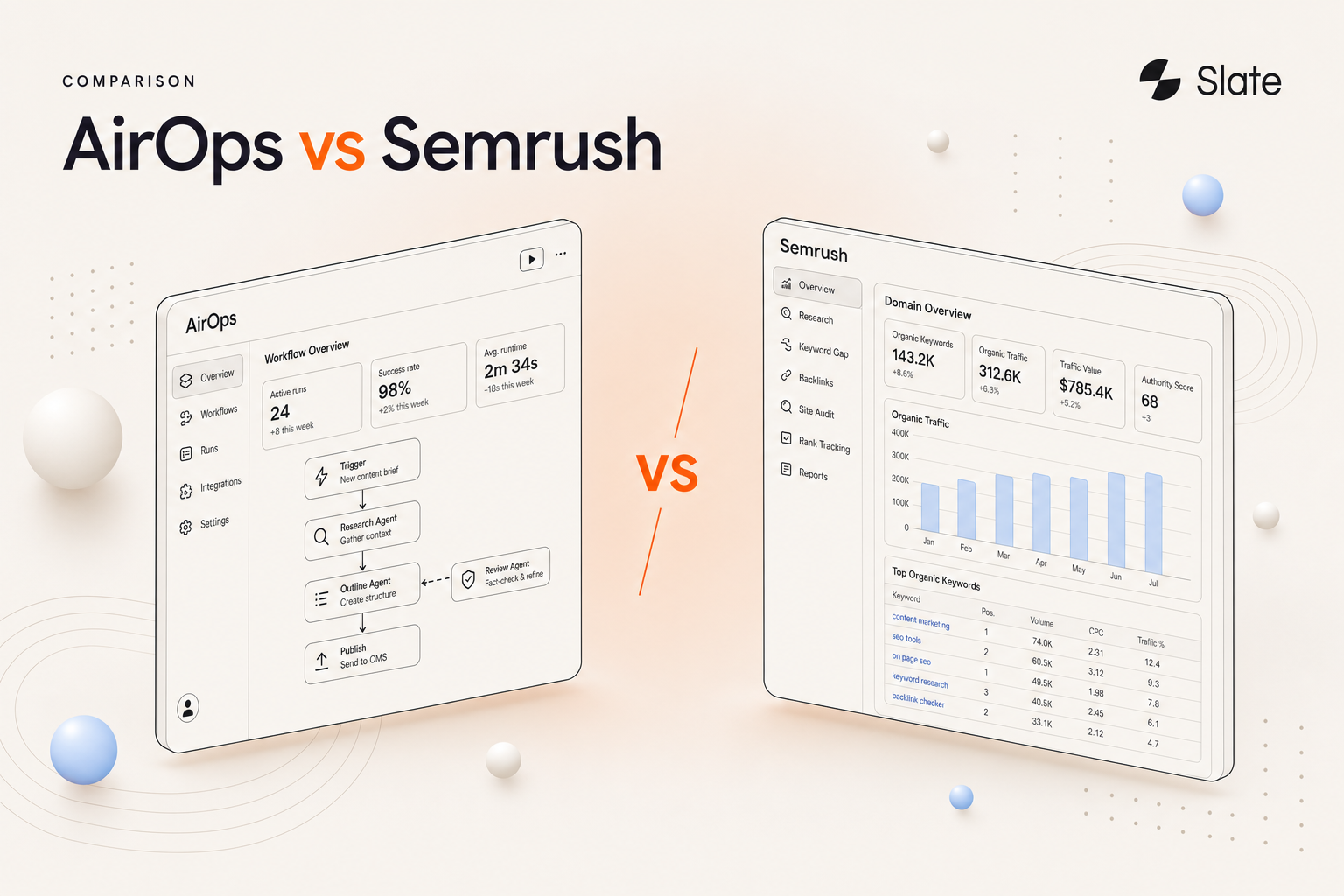
Choosing between AirOps and Semrush usually feels like a head-to-head, but it rarely is. One platform is built to find opportunities; the other is built to execute on them. Understanding which layer your team is actually missing matters more than picking a winner.
Semrush is primarily a traditional SEO research and competitive-intelligence suite-keyword discovery, audits, rank tracking, and backlink analysis. AirOps is primarily an AI-native execution layer for programmatic content, refreshes, and automated publishing. Most teams do not replace one with the other; they decide which layer they lack, and increasingly, how to connect both to AI visibility.
Key Takeaways
- Core difference: Semrush is the research and competitive-intelligence layer; AirOps is the AI-native execution and publishing layer.
- Best for Semrush: Keyword research, competitor analysis, site audits, backlink intelligence, and rank monitoring.
- Best for AirOps: Programmatic page generation, content refresh workflows, and automated CMS publishing.
- Replace vs complement: AirOps does not fully replace Semrush's research stack; many teams run both together.
- AI search gap: Buyers increasingly need a system that connects AI visibility monitoring to content action, not research or generation alone.
- Where Slate fits: Slate suits teams that need AI visibility tracking plus governed execution while keeping existing research tools in the stack.
AirOps vs Semrush at a Glance (Quick Verdict)
The simplest way to frame this comparison is to stop treating it as a fight between equals. Semrush and AirOps sit at different points in the same workflow-discovery versus execution-which is why so many evaluations end with "use both."
What is the difference between AirOps and Semrush? Semrush is a traditional SEO research and competitive-intelligence platform built for keyword discovery, audits, and rank tracking. AirOps is an AI-native execution layer built for programmatic content generation, refreshes, and automated publishing. One finds the opportunity; the other ships the work. If you're weighing options here, it's worth reviewing broader Semrush alternatives to understand the full landscape.
Here is the quick verdict by need:
- Best for traditional SEO research: Semrush.
- Best for AI-native content execution: AirOps.
- Best for programmatic content at scale: AirOps.
- Best for AI visibility tracking plus governed execution: Slate, because it connects visibility insight to reviewed, publishable output without forcing teams to abandon existing research workflows.
This is partly a category mismatch, not a clean head-to-head. Reading it that way leads buyers to a better question: which layer is the bottleneck?
Comparison Table: AirOps vs Semrush vs Slate
The table below orients the three platforms across the dimensions buyers actually weigh. Semrush leads on research depth, AirOps leads on execution, and Slate is positioned where AI visibility meets governed publishing. Read each row as "which layer does this belong to," not "which tool is universally better."
Dimension | Semrush | AirOps | Slate |
| Primary focus | SEO research and competitive intelligence | AI-native content workflows | AI search visibility plus governed execution |
| Core use case | Discovery and monitoring | Programmatic generation and publishing | Visibility-to-action system |
| Traditional SEO research depth | Strong | Input-dependent | Complements external research workflows |
| AI search / AEO visibility tracking | AI visibility toolkit | Visibility dashboards with citation tracking | AI Search Analytics across ChatGPT, Perplexity, AI Overviews, AI Mode |
| Content generation | Limited / assistive | Strong (agentic) | Strong (workflows + Power Sheets) |
| Workflow automation | Limited | Workflow engine | Visual workflow builder, 24+ AI models |
| Programmatic page generation | No | Yes | Yes (Power Sheets) |
| Automated CMS publishing | No | Yes | Yes (Webflow, WordPress) |
| Governance / human review gates | Basic roles | Workflow-level review | Brand Kit, Knowledge Base, approval steps |
| Integrations | GSC, GA4, marketing data | GSC, GA4, CMS, AI models | Webflow, WordPress, MCP |
| Pricing model | Tiered subscription | Free tier plus usage scaling | Subscription from $199/mo |
| Best for | Research-led SEO teams | Content production at scale | AEO-led teams needing governed action |
The Core Difference: Research Platform vs Execution Platform
Are AirOps and Semrush competitors or complementary? Mostly complementary. Semrush answers "what should we work on and how are we ranking," while AirOps answers "how do we produce and ship that work at scale." Treating them as substitutes forces a choice that the workflow itself doesn't require.
The cleanest mental model is two stacks: a research stack and an execution stack. Semrush owns the research stack-discovery, intelligence, and monitoring. AirOps owns the execution stack-generation, refresh, and publishing. The friction most teams feel lives in the handoff between them.
What Semrush Is Built For
Is Semrush better for traditional SEO research? Yes. Semrush is built as a discovery and intelligence layer, with deep tooling for keyword research, competitor gap analysis, audits, and rank tracking drawn from a broad third-party search database.
Its core strengths include:
- Keyword research: Discovery, clustering, and prioritization across a broad keyword database.
- Competitor analysis: Domain and traffic intelligence for gap analysis and benchmarking.
- Site audits: Technical crawls that surface issues and track fixes over time.
- Rank tracking: Position monitoring across locations and devices.
- Backlink intelligence: Link profile analysis and outreach prioritization.
Semrush also offers AI visibility tracking for AI search engines like ChatGPT and Google AI Mode. The platform is the strongest fit when the bottleneck is knowing what to work on.
What AirOps Is Built For
What is AirOps used for? AirOps is a growth platform for AI search that helps teams measure visibility, prioritize opportunities, and create or refresh content at scale. It is built as an execution and operations layer rather than a research suite.
Its core strengths include:
- AI search visibility dashboards: Citation tracking, competitor intelligence, and share-of-voice monitoring.
- Quill AI agent and workflows: Content refresh, creation, and execution at scale.
- Brand governance: Brand kits, knowledge bases, and CMS, SEO, and AEO integrations.
AirOps shines when the bottleneck is production-when research already exists but turning it into published, refreshed pages is too slow or too manual to scale.
Why This Is a Category Mismatch (and What That Means for You)
Comparing these platforms like-for-like misleads buyers. A research suite and an execution engine optimize for different outcomes, so "which is better" produces a false answer.
The more useful question is which layer your team is missing-and whether you also need a third layer that connects AI visibility insight to governed action. That third layer is where the modern stack increasingly bottlenecks, and where Slate is designed to operate.
Feature-by-Feature Breakdown
Capability lists rarely help buyers decide. What matters is what each feature changes in a real workflow-how it moves you from insight to a live, governed page. The breakdown below reads each dimension through that lens.
Keyword Research and Opportunity Discovery
For raw keyword research, Semrush is the stronger tool. Its third-party search database powers discovery, clustering, and prioritization at a depth AirOps doesn't aim to match.
AirOps relies more on inputs you feed it-first-party data from Google Search Console and GA4 plus AI citation signals. That distinction matters: third-party databases widen discovery, while first-party data sharpens prioritization confidence on pages you already own.
Competitor and Competitive Intelligence
Which tool is better for competitor analysis? Semrush, for traditional competitive intelligence-domain comparisons, traffic estimates, and keyword gap analysis. For deeper discovery work, explore dedicated content gap analysis tools that surface uncovered opportunities.
AirOps and Slate approach competition from a different angle: which competitors are cited instead of you inside AI answers. In a world where discovery happens across AI surfaces, competitor citation tracking complements-rather than replaces-Semrush's classic gap analysis.
Content Generation and Programmatic Pages
Which platform is better for programmatic SEO content at scale? AirOps. It is built to generate, update, and publish large volumes of pages from structured inputs, which is exactly what programmatic SEO requires. Semrush's content tooling is assistive and individual, not built for batch production.
The gap most teams overlook is structure. Programmatic pages only win in AI search if they're extractable and citation-ready, which is where content engineering-not just generation volume-becomes the differentiator.
AI Search Visibility and AEO Tracking
Which tool is better for AI SEO and AEO? It depends on whether you need monitoring, execution, or both connected. AirOps offers strong visibility dashboards, Semrush offers AI visibility tracking, and Slate is built to connect tracking directly to governed action. Teams comparing options often start with a roundup of the best AEO tools to understand the field.
AI visibility is not a fixed ranking. It is better measured operationally through:
- Citations and mentions: How often your brand appears as a cited source.
- Prompt coverage: Share of prompts where you appear in the answer set.
- Share of voice: Your presence versus competitors on a topic.
- Competitor presence: Who gets cited instead of you, and where.
- Answer-surface volatility: How much outputs shift over time across ChatGPT, Perplexity, Gemini, Claude, and Google AI Overviews.
Slate's AI Search Analytics tracks this visibility across ChatGPT, Google AI Mode, Google AI Overviews, and Perplexity-then routes insight into workflows rather than leaving it in a dashboard.
Workflow Automation and Publishing
Which tool has automated publishing? AirOps and Slate; Semrush is limited here. AirOps runs a workflow engine that pushes content into CMS platforms, cutting manual copy-paste at scale.
Slate adds governed publishing on top of automation: a visual SEO automation platform with 24+ AI models, conditional logic, and direct publishing to Webflow and WordPress-with approval steps before anything goes live. That difference between "automated" and "governed and automated" is what most production teams underestimate.
Governance, Brand Safety, and Human Review
Which platform supports brand governance at scale? This is where Slate differentiates most sharply. Semrush offers basic roles; AirOps embeds review steps at the workflow level; Slate is built around brand-safe execution as a core requirement.
Pro tip: When evaluating governance, look past "does it have approvals" and ask where brand rules and source-of-truth knowledge live. Slate's Brand Kit and Knowledge Base ground AI output in your tone, terminology, and verified facts-so scale never costs you brand control. This is the heart of content operations platform thinking: systems that produce clear, extractable content without sacrificing trust.
Pricing and Value Comparison
How much does AirOps cost versus Semrush? The honest answer is that the two use different pricing logic, so a side-by-side number misleads. Semrush scales by subscription tiers and limits; AirOps starts free and scales with usage. The real comparison is total operational cost as volume grows.
How Semrush Pricing Works
Semrush uses a tiered subscription model, with cost scaling by projects, tracked keywords, results per report, and seats. Its AI visibility tracking is positioned as an add-on or upgraded bundle rather than a standalone product.
Pricing: Tiered subscriptions scaling by projects, keywords, and seats; AI visibility available as an add-on; free entry-level access.
G2 rating: 4.5/5
This model is predictable for research-heavy teams but can climb quickly for agencies running many client sites.
How AirOps Pricing Works
AirOps starts with a free tier and scales on usage-workflow runs and AI credits-rather than keyword limits. That lowers the barrier to entry but ties marginal cost to production volume. If AirOps isn't the right fit, it helps to scan the leading AirOps alternatives before committing.
Pricing: Insights from $0/mo; Solo and Pro plans can start free; Enterprise is custom via sales. Usage scales with workflows and credits.
G2 rating: 4.6/5
The tradeoff is straightforward: light usage stays cheap, but heavy programmatic and refresh work raises spend as you scale.
Where Buyers Underestimate Total Cost
The line item nobody budgets for is the handoff. Research tools, content workflows, reviewers, and CMS publishing each look affordable in isolation, but the operational cost of stitching them together-human time, rework, and coordination-often dwarfs the software bill.
Subscription pricing keeps software cost predictable but can mask slow research-to-publish cycles. Usage pricing makes per-page cost more transparent but rises with scale. For agencies especially, tool overlap quietly erodes margin. The right Semrush alternatives or execution layer should reduce handoff cost, not just shift a line item. Slate's pricing starts at $199/mo.
Pricing: Starting at $199/mo.
G2 rating: 4.7/5
Which Tool Is Better for Your Team? (Use-Case Segmentation)
The best starting point depends on your operating model, not just headcount. A research-led team has a different bottleneck than a content-ops team or an AEO-led team, even at the same company size. The table below maps fit by how your team actually works.
Team type | Better starting point | Why |
| SEO-led team | Semrush | Depth in keyword, competitor, and rank data |
| Content ops-led team | AirOps | Production and publishing at scale |
| AI visibility / AEO-led team | Slate | Connected visibility tracking plus governed execution |
| Lean startup (no SEO ops) | Context-dependent | Start with the single biggest bottleneck |
| Scale-up B2B SaaS | Hybrid (Semrush + execution layer) | Research depth plus production velocity |
| Agency managing multiple clients | Execution layer using existing data | Reduce handoff friction across accounts |
Best for Traditional SEO Teams
If your work is grounded in keyword research, competitor intelligence, audits, and rank monitoring, Semrush is the clearer starting point. It gives research-led teams the discovery depth and database breadth they rely on daily, and it stays the system of record for traditional search intelligence.
Best for Content Operations at Scale
For teams whose bottleneck is producing and publishing content volume, AirOps fits the production workflow well. The caveat is governance: as output scales, brand consistency and review become the constraint. That is exactly where teams start evaluating a governed execution layer like Slate to keep quality intact at scale. Grounding the team in content operations best practices helps maintain quality as volume grows.
Best for AI Visibility and AEO-Focused Teams
For teams whose mandate is AI search visibility, Slate is the strongest natural fit. These teams need three things in one place: visibility intelligence across AI surfaces, prescriptive prioritization, and governed publishing.
Slate is built for exactly this operating model-tracking where you appear in AI answers, identifying where competitors are cited instead, and routing those insights into reviewed, publishable workflows. It connects measurement to action instead of leaving teams to bridge the gap manually. Explore more AI search visibility approaches to see why connected systems outperform isolated dashboards.
Best for Agencies and Stack Rationalization
Agencies feel handoff friction most acutely-multiple clients, multiple tools, thin margins. The strongest play is keeping trusted research data while consolidating execution. Slate lets agencies keep existing Semrush or Ahrefs workflows in place while centralizing governed execution, so teams can act on research without rebuilding their stack per client.
Can AirOps Replace Semrush? (Replace vs Complement)
Can AirOps replace Semrush? Not fully. AirOps can replace much of the execution layer-generation, refresh, and publishing-but it does not replicate Semrush's deep keyword database, competitive intelligence, and site-audit tooling. For most teams, the two are complementary rather than substitutes.
Scenario | Replace? | Complement? | Notes |
| Need keyword/competitor research | No | - | Keep Semrush for research depth |
| Need programmatic publishing | - | Yes | AirOps adds the execution layer |
| Need AI visibility tracking | No | Yes | Neither is primarily a visibility-to-action system; Slate connects insight to action |
| Lean team, one tool only | Context-dependent | - | Choose by biggest bottleneck |
| Established SEO team adding AI workflows | No | Yes | Complement Semrush with execution |
What AirOps Adds If You Already Use Semrush
If Semrush already covers your research, AirOps adds the missing execution layer. It turns prioritized opportunities into produced pages, automates content refreshes across many URLs, and pushes content into your CMS. In short, it closes the gap between knowing what to do and shipping it. To keep pages current at scale, pair this with the right content refresh tools.
What Research Gaps Remain If You Only Use AirOps
If you run AirOps alone, the gaps are upstream. Deep keyword research, large-database competitive intelligence, and technical site audits aren't AirOps's primary strengths. Teams that drop research tooling entirely often lose discovery breadth and prioritization confidence, which is why a hybrid stack is common. See how this plays out in can AirOps replace Semrush.
How AirOps and Semrush Fit Into the Same Workflow
Should you use AirOps and Semrush together? Many teams do-Semrush for discovery and monitoring, AirOps for production and publishing. The persistent gap is the connective tissue between them: turning research into briefs, briefs into governed outputs, and outputs into measured results.
Workflow stage | Semrush | AirOps | Slate | Best fit |
| Opportunity discovery | Strong | Partial | Partial | Semrush |
| Content brief creation | Partial | Strong | Strong | AirOps / Slate |
| Programmatic generation | No | Strong | Strong | AirOps / Slate |
| Content refreshes | No | Strong | Strong | AirOps / Slate |
| AI visibility monitoring | Toolkit | Dashboards | Connected analytics | Slate |
| Publishing automation | No | Strong | Governed | Slate |
| Measuring impact after publish | Rank data | Visibility data | Visibility + action loop | Slate |
The Missing Middle: From Insight to Governed Execution
How do you connect SEO insights to content execution? You build a path where opportunities become briefs, briefs become governed outputs, outputs become published pages, and pages become measured outcomes. Most stacks leave this middle to manual coordination.
This is the wedge Slate is built for: a system that connects visibility insight to governed execution. Instead of exporting research into one tool and reviewing drafts in another, the workflow stays connected-measurement, prioritization, generation, review, and publishing in one SEO automation platform. The handoff cost most teams accept as inevitable becomes a designed-out problem.
What Implementation Actually Looks Like in the First 30 Days
Onboarding effort differs sharply by platform, and that difference is usually underestimated. Semrush deploys fast because it changes analyst behavior, not team-wide tooling. Execution platforms like AirOps and Slate require deeper setup but pay back in reduced research-to-publish latency.
A realistic first 30 days looks like this:
- Connect your data: Link Google Search Console, GA4, and your CMS, plus any research data sources you want to keep in the stack.
- Set up brand governance: Import brand voice, terminology, and source-of-truth knowledge so AI output stays brand-safe from day one.
- Configure workflows: Build templates for briefs, programmatic generation, and refresh processes, then assign reviewer roles.
- Run a pilot: Test on a small cohort of URLs, refine prompts and approval gates, and validate quality before scaling.
- Scale with review in place: Roll out across more pages with approval steps intact, and begin governed publishing.
The biggest change-management lift is cross-functional, not technical-aligning SEO, content, and growth on shared workflows, roles, and approval gates. It's also worth setting expectations on measurement: AI answer surfaces are volatile, so visibility should be read as trends across prompts, not fixed rankings.
How We Evaluated These Platforms
This comparison is written for SEO leads, content-ops leaders, AEO teams, and buyer-side evaluators at B2B SaaS companies deciding whether they need research, execution, or both. It is less useful for pre-launch teams without a content strategy or anyone seeking one-click AI writing.
The evaluation weighed each platform on:
- Core capability fit: Research depth, execution strength, and AI visibility coverage.
- Workflow integration: How well insight connects to action.
- Governance: Approval gates, brand safety, and human review.
- Pricing model: Subscription versus usage and total operational cost.
- Team fit: Alignment to operating model and maturity.
Vendor positioning was treated separately from independently verifiable capability, and capabilities were assessed across research, execution, and connected AI visibility rather than as isolated feature lists.
The 2026 Reality: AI Search Is a New Operating Model, Not a Feature
The mistake teams make in 2026 is treating AI search as a feature to bolt on. It isn't. Discovery now spans AI Overviews, ChatGPT, Perplexity, Gemini, and Claude, and being present in those answers depends on whether your content is extractable, attributable, and structured-not just whether it ranks.
What used to be keyword targeting now looks more like content engineering. Pages that win citations tend to define terms clearly, structure answers cleanly, and stay consistent across a topic surface. Volume alone doesn't earn presence; clarity and structure do.
Refresh velocity becomes a growth lever in this model. When AI answers shift, the teams that can update content quickly-at scale, with governance-hold their visibility better than teams shipping one-off pages. Organic growth starts behaving like an operating system rather than a campaign.
This is the throughline of Slate's view: AI search rewards systems that consistently produce clear, referenceable answers. The platform is built to connect visibility intelligence to prioritization, then to governed execution, publishing, and ROI. For a broader landscape view, see this AI SEO tools comparison and these generative engine optimization tools.
Final Verdict: Which Should You Choose?
There's no universal winner here, because the right answer depends on which layer is your bottleneck. The strongest 2026 stack combines visibility intelligence, opportunity prioritization, governed workflow execution, publishing, and ROI measurement-and few teams get all of that from one legacy category.
- Choose Semrush if your bottleneck is research, competitive intelligence, and rank monitoring. It remains the clearer fit for traditional SEO discovery.
- Choose AirOps if your bottleneck is content production velocity and programmatic publishing at scale.
- Choose both if your real problem is research-to-execution handoff friction and you want each layer doing what it does best.
- Choose Slate if you need AI visibility tracking plus governed execution while keeping your existing research stack in place.
For teams whose mandate is winning AI search visibility without losing brand control, Slate connects the missing middle-measurement, prioritization, governed production, and publishing-in one system. For enterprise context, review AI SEO tools for enterprise teams.
Book a demo: https://slatehq.com/book-a-demo
Frequently Asked Questions
What is the difference between AirOps and Semrush?
Semrush is a traditional SEO research and monitoring platform for keyword discovery, competitor analysis, audits, and rank tracking. AirOps is an AI-native content operations and publishing layer for programmatic generation, refreshes, and automated CMS publishing. One identifies opportunities; the other executes on them at scale.
Can AirOps replace Semrush?
Not fully. AirOps can replace much of the execution layer-generation, refresh, and publishing-but it does not replicate Semrush's deep keyword database, competitive intelligence, and site-audit tooling. For most teams the two are complementary, with Semrush handling research and AirOps handling production.
Which tool is better for AI SEO and AEO?
It depends on your bottleneck. AirOps is more aligned to AI-native execution, while Semrush remains stronger for traditional research. For teams needing connected visibility plus governed action across AI surfaces, Slate fits by linking AI search tracking directly to reviewed, publishable workflows.
Which platform is better for programmatic SEO content at scale?
AirOps. It is built to generate, update, and publish large volumes of pages from structured inputs, which is what programmatic SEO requires. Semrush is stronger for the upstream opportunity discovery that feeds those pages, but it does not produce or publish content at scale.
Is Semrush better for traditional SEO research than AirOps?
Yes. For keyword research, competitor analysis, site audits, and rank monitoring, Semrush has the clear edge thanks to its large third-party search database and mature intelligence tooling. AirOps relies more on first-party inputs and focuses on execution rather than deep research.
Should you use AirOps and Semrush together?
Many teams do. Semrush handles discovery and monitoring while AirOps handles production and publishing. The remaining gap is connected AI visibility and governance-turning research into governed, published pages and measuring impact-which is where a dedicated execution layer like Slate adds value.
Which tool is easier for content teams?
AirOps tends to align better with content teams because it maps to production workflows-briefs, generation, refresh, and publishing. Semrush suits research and monitoring-led teams more naturally. The right choice depends on whether your team's daily work is discovery or execution.
Where does Slate fit compared to AirOps and Semrush?
Slate fits teams needing AI search visibility tracking plus governed content execution. It tracks visibility across ChatGPT, Perplexity, Google AI Overviews, and AI Mode, then routes insight into governed workflows with direct publishing to Webflow and WordPress, while fitting alongside existing research and content systems.