Profound and Scrunch suit different AEO jobs. Profound has stronger documented evidence for AI-search intelligence, prompt-volume research, competitive visibility, citations, sentiment, content agents, enterprise-oriented monitoring, and AI crawler and traffic analytics. Scrunch has clearer public evidence for prompt monitoring, page audits, AI-search trends, AI agent or bot traffic measurement, and packaged self-serve limits. Scrunch also sells Agent Pages, part of its Agent Experience Platform (AXP), which serves AI agents an optimized version of a site. And Sitecore acquired Scrunch in June 2026.
For SEO, content, technical, and agency teams, the better fit depends on the bottleneck: measurement, technical AI-agent accessibility, or execution. If your team needs a broader category view, this comparison pairs well with Slate’s guide to AI search visibility tools.
Slate is an end-to-end AI search, SEO, content, publishing, outreach, and measurement platform. Slate competes in this category, so this comparison is written to help buyers evaluate fit with clear distinctions between monitoring, diagnosis, execution, and measurement.
Key Takeaways
- Core difference: Profound’s distinct strengths are Prompt Volumes, FactCheck, content agents and CMS publishing. Scrunch’s are packaged monitoring, page audits, AI Search Trends and Agent Pages (AXP).
- Engine coverage: Profound’s trial documentation includes ChatGPT, Gemini, and Google AI Overviews, while Enterprise can track up to nine answer engines. Scrunch documents Core coverage across ChatGPT, Perplexity, Google AI Overviews, and Microsoft Copilot, with Enterprise coverage across nine LLMs.
- Prompt data: Profound publicly describes Prompt Volumes as grounded in prompts from double-opt-in consumer panels, with modeling used to scale and normalize volume. Scrunch documents prompt monitoring and prompt-level analytics, but Scrunch doesn’t document its prompt sourcing in the same level of detail.
- Execution gap: Profound documents content agents, content generation, human-in-the-loop approvals, and CMS-connected publishing workflows. Scrunch documents page optimizations and content generation, while native CMS publishing and approval routing aren’t documented.
- Slate fit: Consider Slate when the bottleneck is moving from AI-search insight to content, publishing, outreach, and measured organic execution.
- Proof of concept: Compare tools using the same prompts, competitors, country, language, time window, and workflow test.
Profound vs. Scrunch At A Glance
AEO platform comparison gets confusing when teams compare feature labels instead of operating models. The better question is whether the team needs better AI visibility measurement, better technical visibility into how AI agents interact with the site, or a system for turning findings into published work.
For a broader vendor landscape, see Slate’s guide to the best AEO tools.
How We Evaluated Profound And Scrunch
A useful comparison has to go deeper than whether each vendor has a dashboard.
The evaluation used six criteria:
1. Measurement coverage: AI engines, plan-tier access, regions, languages, and response limits.
2. Prompt methodology: Whether prompt sources are observed, modeled, generated, first-party, third-party licensed, or not publicly classified.
3. Diagnostic depth: Whether the platform explains why a brand is absent or only shows that absence.
4. Execution path: Whether findings become briefs, revised pages, published changes, or outreach.
5. Measurement loop: Whether AI visibility can be compared with traffic, search, and page performance.
6. Operational readiness: Workspaces, governance, exports, security, support, and implementation requirements.
The practical buyer question is: Can this product help the team identify a gap, understand the reason, assign the work, publish the change, and measure whether the signal changed?
AEO, GEO, And AI Search Optimization: What Buyers Need To Distinguish
AEO, GEO, AI SEO, and AI visibility are often used as if they are interchangeable. In procurement, that creates noise.
A team shopping for generative engine optimization tools may need separate AI visibility tracking, technical accessibility diagnostics, and an execution layer for content and authority work. The same distinction applies to AI citations: A brand can be mentioned in an answer without being cited as a source.
AI Visibility Monitoring And Answer Engine Coverage
Engine coverage is the first place many buyers start, but it is rarely enough on its own. A platform may support an AI engine at the vendor level while limiting that engine by plan, geography, language, prompt volume, or response history.
Which AI Platforms Can Each Tool Monitor?
Profound’s public documentation supports trial coverage across ChatGPT, Gemini, and Google AI Overviews, with Enterprise able to track up to nine answer engines. Scrunch documents Core coverage across ChatGPT, Perplexity, Google AI Overviews, and Microsoft Copilot, with Enterprise coverage across nine LLMs, including Claude, Gemini, Meta AI, Google AI Mode, and Grok.
How Should Teams Evaluate Visibility Data Quality?
A large engine list can still produce weak operating data if the methodology is opaque. Before buying any AI search visibility tool, ask nine questions:
- Refresh cadence: How often are prompts rerun?
- Raw responses: Can the team see the underlying answer?
- Geography: Can a country or market be controlled?
- Language: Can language be controlled separately from the market?
- Personalization: Is logged-in state or personalization controlled?
- Volatility: Does the product smooth or expose response variability?
- Exports: Can prompt, answer, citation, and timestamp data be exported?
- Deduplication: How are duplicates and near-duplicates handled?
- Intent: Are prompts grouped by persona, funnel stage, or topic?
Without those controls, a visibility score shows movement but won’t tell you what to change.
Brand Mentions, Citations, Sentiment, And Recommendations Are Different Metrics
A brand mention means the company appears in an AI answer. A citation means a source URL is linked or attributed. Sentiment describes the tone of the answer. Recommendation presence shows whether the brand is actively suggested.
These signals often move together, but they should be reported separately.
For deeper evaluation, compare AI citation tracking tools and AI share-of-voice tools.
Prompt Intelligence And Data Methodology
Prompt intelligence is where many AEO evaluations go wrong. A headline prompt count may sound impressive, but prompt counts are not comparable unless teams understand where the prompts came from and how they are monitored.
What Counts As A “Prompt” In AEO Reporting?
A prompt can mean a live monitored question, a generated query, a modeled opportunity, a first-party search-like question, or a third-party licensed dataset. Profound publicly describes Prompt Volumes as based on prompts from double-opt-in consumer panels, with modeling used to scale and normalize the data.
Scrunch documents prompt monitoring, prompt-level analytics, and AI Search Trends, but it doesn’t document its prompt-source classification in the same level of detail.
Do Prompt Counts Reflect Demand Or Modeled Opportunity?
Prompt volume is only useful when the methodology matches the decision. If a content team is prioritizing pages, modeled opportunity may be useful. If an executive wants to know whether the brand appears in live answers, monitored prompt performance is more useful.
Why Prompt Volume Alone Doesn’t Determine AEO Value
Prompt volume is different from buyer demand, and buyer demand is different from business impact. A large prompt universe may be useful for market intelligence, while a smaller monitored prompt set may be better for weekly operating decisions.
The stronger evaluation question is: Can the platform connect prompts to missing citations, weak positioning, content gaps, technical accessibility, and measurable follow-up work?
Content Optimization And AI Search Execution Workflows
AEO monitoring tells teams where they appear. Improvement requires changing the inputs that answer engines rely on: Content clarity, source authority, technical accessibility, freshness, and consistency across the web.
Can The Platform Identify Content And Citation Gaps?
Profound’s citation authority, FactCheck and Prompt Volumes give teams an intelligence layer for seeing where competitors appear, which sources answer engines cite, and where AI answers may be inaccurate.
Scrunch combines monitored prompts with page-level diagnostics from its site audits.
Can It Create Briefs, Revise Pages, And Publish Changes?
Profound’s Agents draft, refresh and publish content. Its help center names the CMSs Agents publish to (WordPress, Webflow, Sanity, Contentful, Framer, Payload and Basehub), and a Human Review node can pause an Agent before anything goes live. CMS nodes are available on Enterprise accounts, so confirm packaging before purchase.
Scrunch documents page audits, page optimizations, recommendations, and content generation. Native CMS publishing and formal approval routing aren’t documented. Its Agent Pages product (AXP) takes a different route: it serves AI agents an optimized version of existing pages rather than editing them in a CMS.
Each handoff is a separate step: a recommendation still needs a brief, an approved draft, a published page and a measured result.
Can Teams Execute At Scale Across Hundreds Or Thousands Of URLs?
For scaled teams, a tool has to support more than one-off analysis: bulk audits, bulk optimization and refresh, templated workflows, and scheduled reruns.
Technical AEO, Crawler Access, And AI Agent Traffic
Technical AEO is different from AI visibility monitoring. Visibility monitoring shows what appears in answers. Technical AEO asks whether AI systems, crawlers, and agents can access, interpret, and reuse site content reliably.
What Should Technical AEO Include In 2026?
A mature technical AEO checklist should include:
- AI user-agent crawl access.
- Robots and AI-access rules.
- Server-rendered versus client-rendered content accessibility.
- Structured data.
- Canonical and duplication hygiene.
- Response codes and performance for agent requests.
- Log-level identification where available.
- Content freshness signals.
Scrunch documents Site Optimization, page audits, and AI agent or bot traffic measurement. Profound documents AI crawler visibility, AI-sourced traffic, attribution, server-log-based bot analysis, crawler verification, and content performance tracking. Scrunch adds a delivery layer: Agent Pages serve AI agents a machine-readable version of the site without changing what human visitors see.
Neither vendor documents a full technical-audit scope across every SEO check.
How Do Crawler Activity, Agent Traffic, And AI Citations Differ?
Crawler activity means an AI-related bot or agent accessed the site. AI referral traffic means a user session came from an AI platform. AI citations mean an answer cited a source URL.
None of those alone proves recommendation presence, ranking improvement, or business impact.
Reporting, Attribution, And Business Measurement
AEO reporting should go beyond “we were mentioned.” Mentions can be useful, but the operating value comes from connecting AI visibility to citations, source quality, answer context, traffic, and existing organic performance.
For more examples, see Slate’s guide to AI search analytics tools.
Can AI Visibility Be Connected To Search Console, GA4, And Page Performance?
AI visibility should be evaluated alongside search and analytics data, but the connection is usually interpretive. A visibility gain, traffic change, and conversion lift may correlate; that does not automatically prove one caused the other.
For Profound, the vendor documents API access for Enterprise, CSV and JSON exports for Enterprise, Google Analytics and infrastructure connectors in Agent Analytics, a Search Console node in Agents, and API documentation for visibility, citations, sentiment, answers, bot traffic, and referrals.
For Scrunch, the vendor documents Looker Studio access, Query API access, Advanced API access, and Enterprise API access and integrations. For both vendors, validate the exact GSC, GA4, Looker Studio, CDN, warehouse, and dashboard setup your stack needs.
Slate connects Search Console and GA4 natively, so AI visibility sits beside clicks, traffic and CTR in Pages.
Buyers should evaluate:
- GSC: Query, page, click, impression, and CTR alignment.
- GA4: AI referral sessions and conversion behavior.
- Looker Studio: Executive reporting flexibility.
- API: Raw data access for internal systems.
- CDN or logs: Bot and agent access analysis.
- Warehouse: Long-term storage and modeling.
For a related use case, see AI Overviews brand search tracking.
Pricing, Plan Limits, And Implementation Considerations
Pricing is difficult to compare when one vendor uses custom packaging and the other publishes its prices. One 2026 comparison of Profound, Scrunch, and Goodie also frames pricing comparison around Profound not publishing a base price while Scrunch publishes pricing. The safest procurement move is to compare the exact plan under consideration, not a generic vendor-level claim.
On a sales call, ask about engine access by country, prompt-counting method, rerun cadence, overage policy, Enterprise-only integrations, API access, workspaces, security materials, raw data exports, and implementation timelines. For more on one vendor’s packaging, see Profound AI pricing.
Enterprise, Agency, And Governance Readiness
Enterprise readiness is an operating question as much as a pricing question. Can the platform support the way content, SEO, legal, security, and analytics teams work?
Profound’s public documentation includes dedicated support, SSO/SAML, SOC 2 compliance, role-based access control, API access, exports, activity logs, agency mode, and human-in-the-loop approvals for Agents.
Scrunch’s Enterprise documentation includes SSO using SAML or OIDC, custom workspaces, custom licenses, custom prompts, complete site audits, API access and integrations, Looker Studio access, Query API access, Advanced API access, and a dedicated account team. See also AI visibility tools for SEO teams.
Pros And Considerations For Each Platform
This section separates supported strengths from buyer considerations. The goal is to help teams understand what each tool appears best positioned to solve.
Profound: Strengths And Trade-Offs To Evaluate
Profound is an AI-search intelligence, agentic content, and monitoring platform for teams that need structured visibility across answer engines.
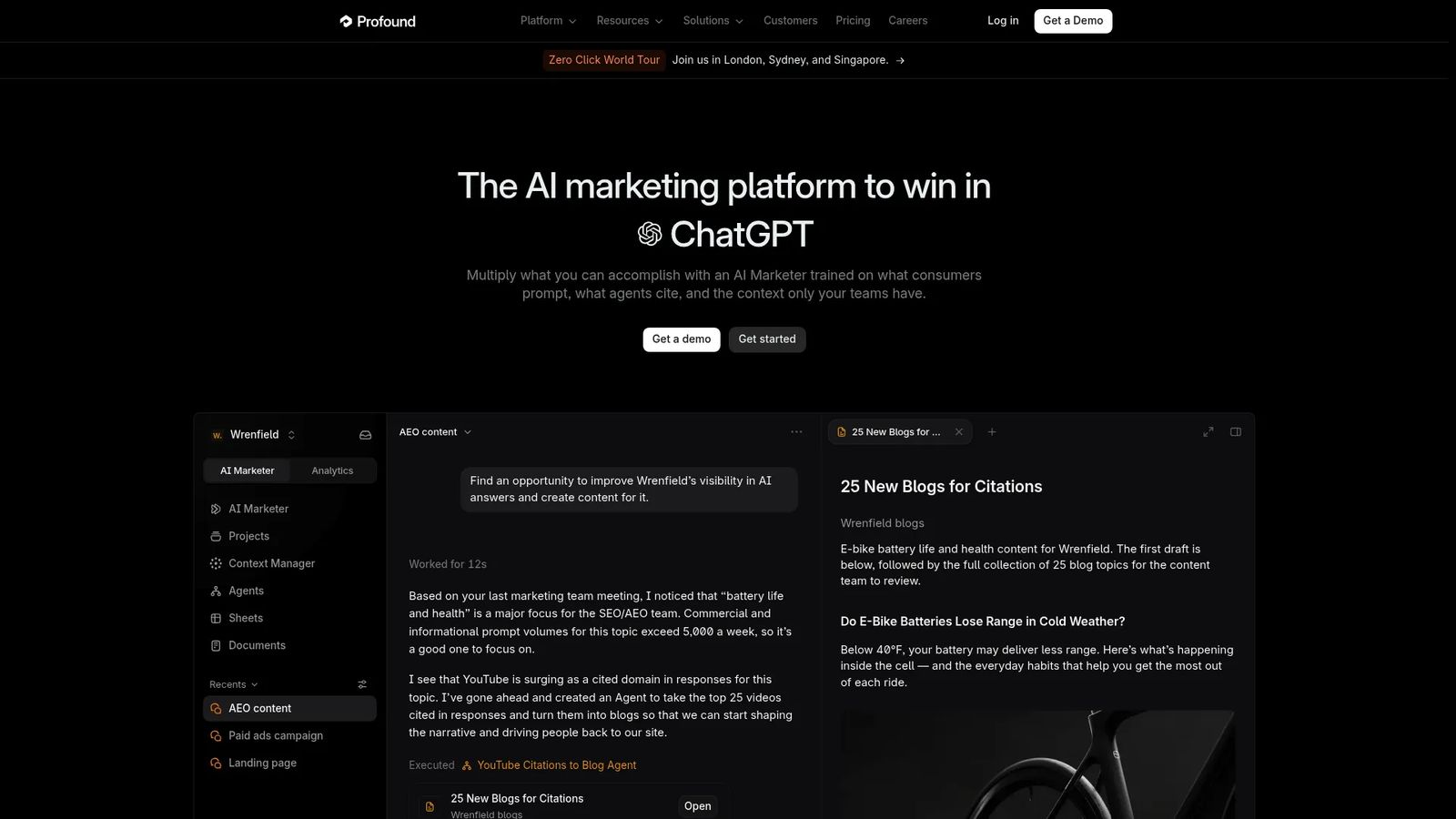
Pricing: Free seven-day trial with limited credits and 50 daily prompts across ChatGPT, Gemini and Google AI Overviews; Enterprise is custom. Agencies can use a self-serve Agency Growth plan with 400 credits per client workspace each month. See Profound’s pricing page.
G2 rating: 4.5/5
Strengths: Prompt Volumes, FactCheck, citation authority, content agents with human review and CMS publishing (CMS nodes and FactCheck are on Enterprise accounts), Profound Sheets, Agent Analytics for crawler and referral data, plus API access and exports.
Considerations: Exact current public self-serve pricing, detailed prompt methodology beyond the published panel and modeling explanation, plan-level implementation details, white-label reporting, and full technical-audit scope should be validated.
Scrunch: Strengths And Trade-Offs To Evaluate
Scrunch is an AI-agent and LLM visibility platform with documented prompt monitoring, page audits, AI-search trends, page optimization, content generation, and bot or agent-traffic measurement. It also sells Agent Pages (AXP) for delivering AI-optimized content to agents. Sitecore acquired Scrunch in June 2026 and plans to connect Scrunch’s insights to Sitecore’s content workflows.
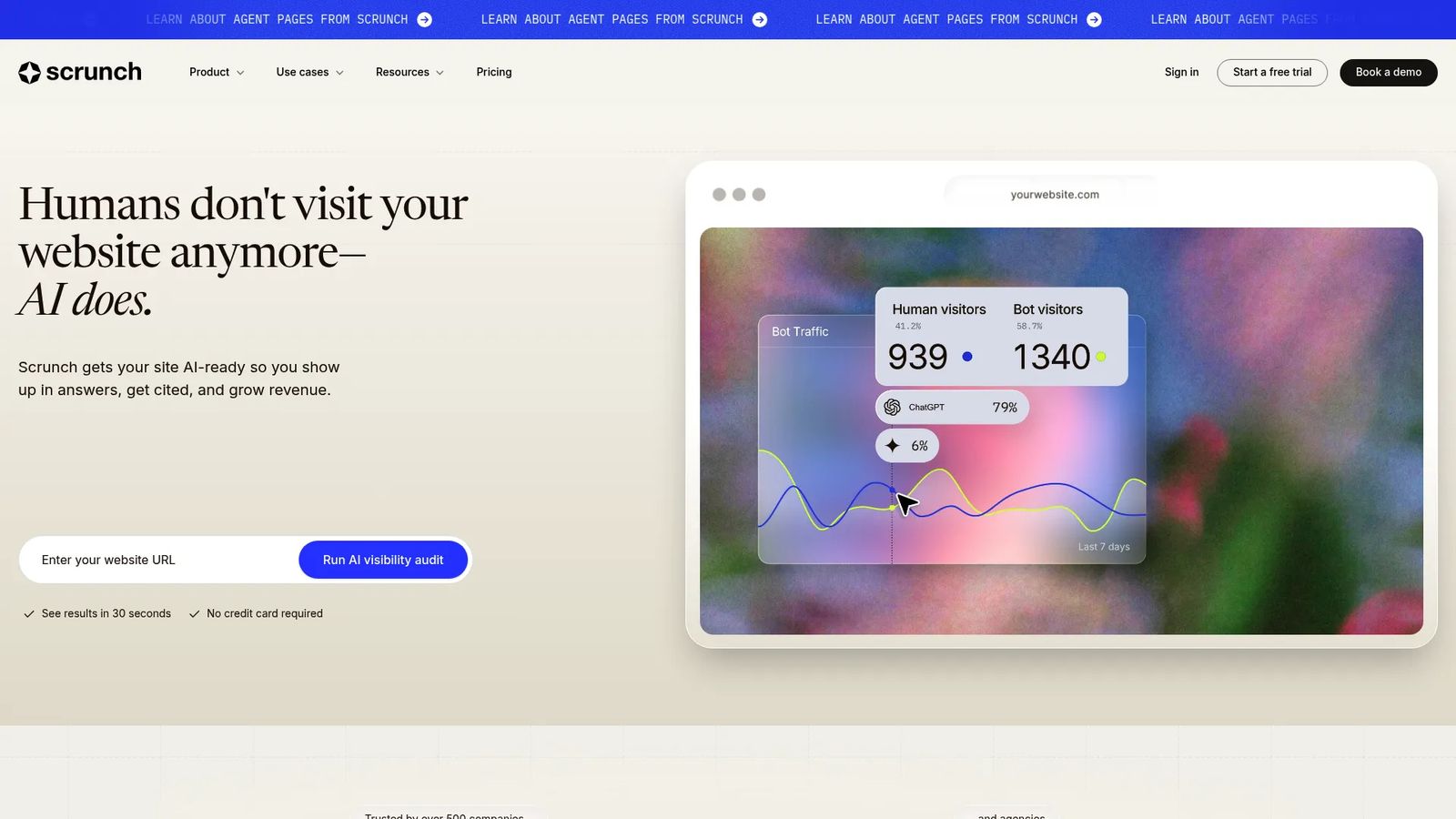
Pricing: Core $250/month; Enterprise custom; Agency Core $500/month; Agency Enterprise custom. A seven-day free trial is available. See Scrunch’s pricing page.
G2 rating: 4.6/5
Strengths: Published self-serve pricing, prompt-level analytics with funnel-stage filters, AI Search Trends, site audits and Site Optimization, AI agent traffic, and on Enterprise, AXP, Looker Studio, APIs and SAML/OIDC SSO.
Considerations: Prompt-source methodology, native CMS publishing, formal approval routing, detailed technical checks, GSC and GA4 integrations, data-retention controls, and exact implementation requirements should be validated.
What Neither Platform Replaces
Even strong AI search visibility tools do not replace the operating system required to improve organic growth.
- Content capacity: Someone still needs to create, revise, approve, and maintain content.
- Technical SEO: Crawlability, rendering, structured data, canonicals, and performance still count.
- Digital PR: Third-party authority and earned mentions influence what answer engines can cite.
- Subject-matter review: AI-generated recommendations still need expert review and brand judgment.
- Keyword research: Conventional search demand remains useful unless separately covered.
- Analytics ownership: Teams still need disciplined reporting and executive interpretation.
For a broader SEO-stack comparison, see Profound vs. Ahrefs.
Best Use Cases: Which Platform Fits Which Team?
The right tool depends less on category labels and more on the operating bottleneck inside the team.
Best For Enterprise AI-Search Research And Intelligence Teams
Teams that need structured monitoring, prompt-volume research, competitive visibility, citations, sentiment, rankings, and enterprise-scale answer-engine intelligence.
Profound is the stronger fit when the primary job is understanding how a brand and its competitors appear across AI-search surfaces, especially where Prompt Volumes, custom answer-engine tracking, citation authority, FactCheck, and exports are important evaluation criteria.
Best For Technical Web, Platform, And Analytics Teams
Teams focused on AI bot visibility, AI referral traffic, page audits, and the technical signals around AI-agent access.
Scrunch is a strong fit when the team wants documented site audits, Site Optimization, and AI agent or bot traffic measurement. Profound is also a strong fit when server-log-based bot analysis, crawler verification, AI-sourced traffic attribution, and referral reporting are central requirements.
Buyers should confirm the technical audit scope before treating either as a full technical SEO platform.
Best For Content-Led AEO Programs
Teams that need prompt intelligence, content gap discovery, citation analysis, and a clear route from findings to content improvements.
Profound has stronger documented evidence for moving from monitored signals into agent-led briefs, drafts, refreshes, approvals, and CMS-connected publishing. Scrunch may support the monitoring, audit, recommendation, page optimization, and content-generation side of this job.
The deciding factor is whether the team already has strong content operations or needs the AEO platform to help execute the work.
Best For Agencies And Multi-Client Work
Agencies that need separated clients, repeatable reporting, prompt monitoring, and workflow discipline.
Scrunch documents multi-client workspaces, API-first workflows, white-label outputs, access controls, and permissions for agencies. Profound documents agency mode, a self-serve Agency Growth plan, custom enterprise packaging, Agents, Sheets, exports, and API access.
Agencies should evaluate workspace separation, exports, reporting, client-facing delivery, and repeatable execution before choosing.
Where Slate Fits: An End-To-End System For AI-Driven Organic Growth
Slate is designed for teams that need to identify opportunities, create or revise content, publish changes, pursue outreach, and measure performance across traditional search and AI search.
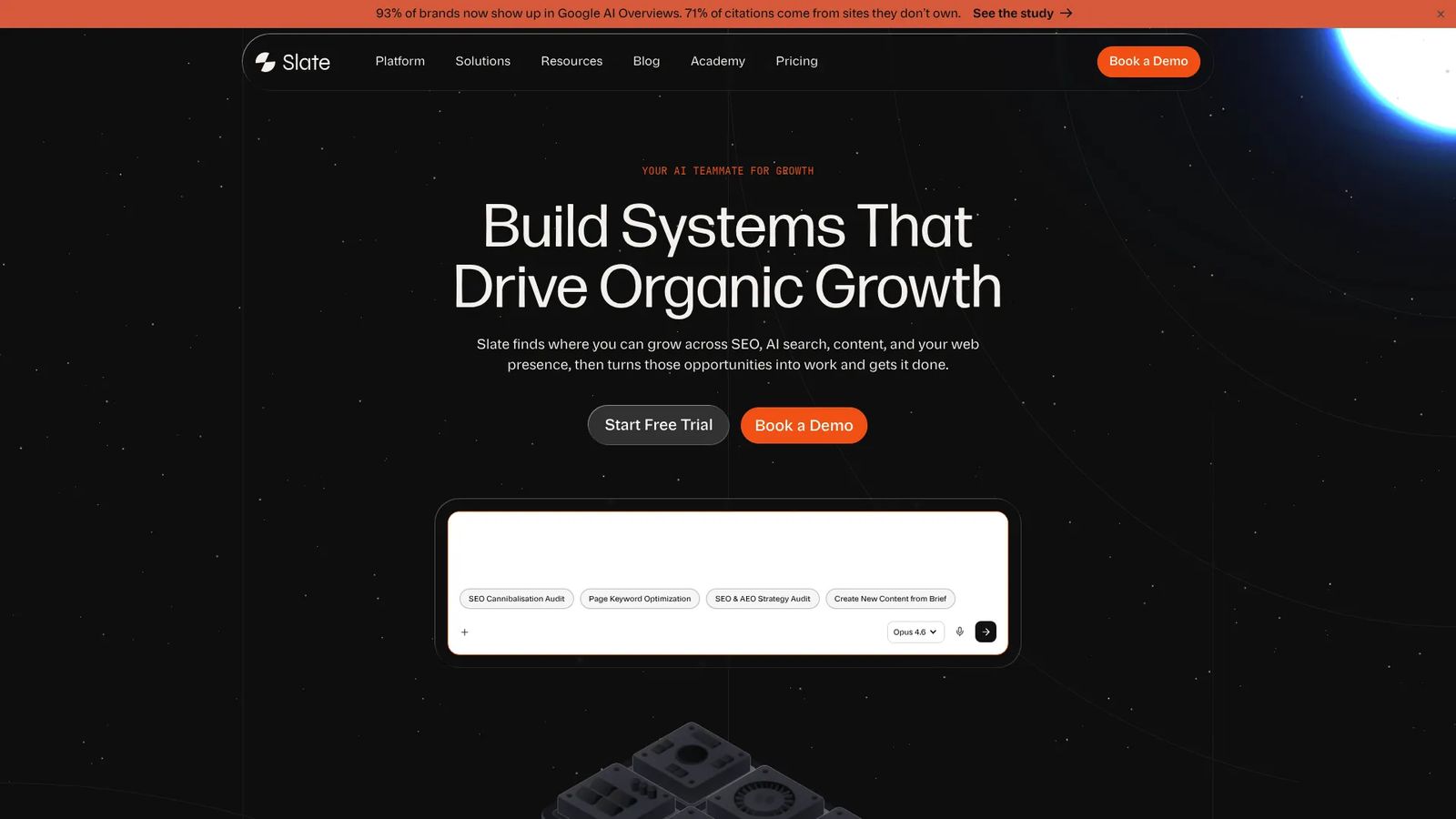
Pricing: Growth $499/month; Scale $999/month; Agency $2,000/month; Enterprise custom. Growth includes 1 user. Scale and above are custom. Annual billing saves 20%. A 14-day free trial is available.
G2 rating: 4.9/5
What “Agent-Driven AEO” Means In Practice
Agent-driven AEO packages repeatable SEO and content tasks into governed workflows that can run consistently, with people still reviewing the work.
Slate’s Cowork lets users delegate SEO and content work in natural language. Workflows, Sheets, and SuperBlocks help teams turn repeatable processes into larger systems.
Slate’s AEO Lifecycle Coverage
Slate’s lifecycle is built around the loop that most teams struggle to maintain manually:
1. Discover: Opportunities surfaces keyword gaps, AI visibility topic changes, suggested prompts, third-party outreach targets, and content decay.
2. Measure: AI Tracker tracks brand presence, citations and sentiment across AI platforms.
3. Prioritize: Pages supports performance monitoring and measurement workflows.
4. Create: Cowork, Workflows, Sheets, and SuperBlocks support content creation, optimization, refresh, and audit workflows.
5. Publish: Slate supports CMS publishing to Webflow, Sanity, and WordPress.
6. Build authority: Outreach helps teams identify third-party outreach targets and run outreach workflows.
7. Measure again: AI Tracker and Pages keep AI visibility and organic performance in the same operating loop.
Slate also includes Semrush data built in.
Where Slate Isn’t The Right Fit
Slate isn’t a generic creative-proofing platform for non-content assets such as video, visual brand campaigns, or creative review workflows. It is also not the right fit for teams that only want a lightweight dashboard and have no need for content, publishing, outreach, or measurement workflows.
To see how Slate supports execution, explore Slate AI Tracker or read Slate’s guide on how to get cited by ChatGPT, Perplexity, Claude, and Gemini. You can also book a demo.
How To Run A Fair Proof Of Concept Before You Buy
A fair proof of concept should test the work the team needs to do. A dashboard demo can make any platform look clean; the better test is whether the platform helps the team make a better decision and execute faster.
Use this seven-step process:
1. Define the business question: For example, “Why are competitors cited for our highest-intent prompts?”
2. Build a shared prompt set: Use 25 to 50 prompts covering core topics, competitors, and buyer stages.
3. Set the conditions: Use the same country, language, audience assumption, and time window.
4. Run both platforms: Use identical inputs wherever possible.
5. Compare signals: Review mentions, citations, sentiment, recommendation context, source lists, and answer position.
6. Test execution: Identify one gap, create or revise a page, route it for review, publish it, and measure follow-up signals.
7. Score before deciding: Agree on success criteria before the demo, not after the vendor narrative has shaped the conversation.
The best proof of concept includes one live production task. If a tool identifies a gap but cannot help the team move the work forward, the team should account for the extra operational cost.
Final Verdict: Profound vs. Scrunch For AEO In 2026
Choose Profound if: The primary bottleneck is AI-search intelligence, prompt-volume research, structured answer-engine monitoring, competitive visibility, citations, sentiment, content agents, enterprise-scale tracking, and AI crawler or traffic analytics.
Choose Scrunch if: The priority is prompt-level monitoring, page audits, AI-search trends, Site Optimization, page optimization, content generation, AI agent traffic, serving AI-optimized pages to agents through AXP, and packaged Core or Enterprise options.
Consider Slate if: The primary constraint is execution and the team needs AI visibility, SEO opportunity discovery, content production, CMS publishing, outreach, and measurement in one agent-driven loop.
For related evaluations, see Slate’s guides to the best Profound AI alternatives and Profound vs. AirOps. For a head-to-head with Slate, see Slate vs Profound.
If execution is the bottleneck, book a demo to see how Slate connects AI-search insight to published, measured work.
Frequently Asked Questions
What is the main difference between Profound and Scrunch?
Profound has stronger documented evidence for AI-search intelligence, prompt-volume research, competitive visibility, citations, sentiment, content agents, enterprise-oriented monitoring, and AI crawler analytics. Scrunch has clearer documented evidence for prompt monitoring, AI-search trends, page audits, Site Optimization, page optimization, content generation, and AI agent or bot traffic measurement.
Is Profound or Scrunch better for AEO?
Neither platform is universally better for AEO. Profound is the stronger fit for teams prioritizing AI-search intelligence, prompt-volume research, content agents, and enterprise-scale monitoring. Scrunch is the stronger fit for teams prioritizing packaged prompt monitoring, page audits, AI-search trends, Site Optimization, and agent-traffic measurement.
Which AI engines does each platform track, and does that change by plan?
Profound’s documented trial coverage includes ChatGPT, Gemini, and Google AI Overviews, with Enterprise able to track up to nine answer engines. Scrunch documents Core coverage for ChatGPT, Perplexity, Google AI Overviews, and Microsoft Copilot, with Enterprise expanding to nine LLMs.
How do Profound and Scrunch pricing compare?
Profound publishes a free seven-day trial, custom Enterprise pricing and a self-serve Agency Growth plan. Scrunch’s current public pricing page lists Core at $250/month and Enterprise custom, plus Agency Core at $500/month for agencies.
Does either platform track AI crawler and agent traffic?
Profound documents AI crawler visibility, server-log-based bot analysis, crawler verification, AI-sourced traffic, referral reporting, and attribution tracking. Scrunch documents AI agent or bot traffic measurement. Buyers should separate those signals from citations, because crawler activity, referral sessions, and citation presence measure different parts of AI-search behavior.
Can Profound or Scrunch create and publish content?
Profound documents Agents for content refresh, AEO FAQ generation, competitive research, net-new content creation, drafting, human-in-the-loop approvals, and CMS-connected publishing. Scrunch documents page optimizations and content generation, but native CMS publishing and formal approval routing aren’t documented. Its Agent Pages product (AXP) serves AI agents an optimized version of existing pages instead.
Does AI visibility tracking improve AI search performance?
AI visibility tracking does not improve performance by itself. It helps teams see prompts, mentions, citations, sentiment, and gaps. Improvement still requires content changes, technical accessibility, stronger third-party authority, publishing discipline, and ongoing measurement.
Which platform is better for agencies managing multiple clients?
Scrunch documents multi-client workspaces, API-first workflows, white-label outputs, access controls, and permissions for agencies. Profound documents agency mode, a self-serve Agency Growth plan, custom enterprise packaging, Agents, Sheets, exports, and API access. Agencies should evaluate workspace separation, permissions, exports, client reporting, prompt limits, and repeatable execution workflows before choosing either platform.
Is a self-serve plan enough, or do we need enterprise?
A self-serve or entry plan may be enough for a small prompt set, limited engine coverage, and basic monitoring. Enterprise is more likely to be needed when the team needs more answer engines, custom workspaces, SSO, larger prompt volumes, security review, API access, exports, or multi-brand governance.
Can either platform replace an existing SEO, analytics, or log-analysis stack?
Profound and Scrunch should not be treated as full replacements for SEO, analytics, or log-analysis stacks. AI visibility data is most useful when evaluated alongside technical SEO, Google Search Console, GA4, server logs, content operations, and business reporting.