If your team is comparing AirOps and Clearscope, you’re probably sorting out where the work should live.
Do you want a focused scoring editor for writers, or a broader content-ops platform that carries AI-search work into production?
Quick answer: AirOps fits teams prioritizing AI-search visibility, content refresh, and workflow-led production at scale. Clearscope fits teams that mainly need content scoring and editorial guidance. Teams that want the whole loop in one place should evaluate Slate.
Key Takeaways
Use the tool that matches how your team works.
- Clearscope best for: Teams that need content scoring, semantic guidance, and editor-friendly recommendations across Google and AI search.
- AirOps best for: Teams that need AI-search visibility, opportunity prioritization, and content-ops production at scale.
- Buyer lens: Pick based on whether your bottleneck is recommendations, production, or post-publish refresh.
- AI search visibility: Treat it as its own buying criterion in 2026.
- Pricing: Compare entry-plan cost and total workflow cost.
- Slate best for: Teams that want opportunity discovery, content work, publishing, measurement, refresh, and outreach handled by agents in one platform. Slate starts at $499/month.
AirOps Vs Clearscope: Quick Verdict
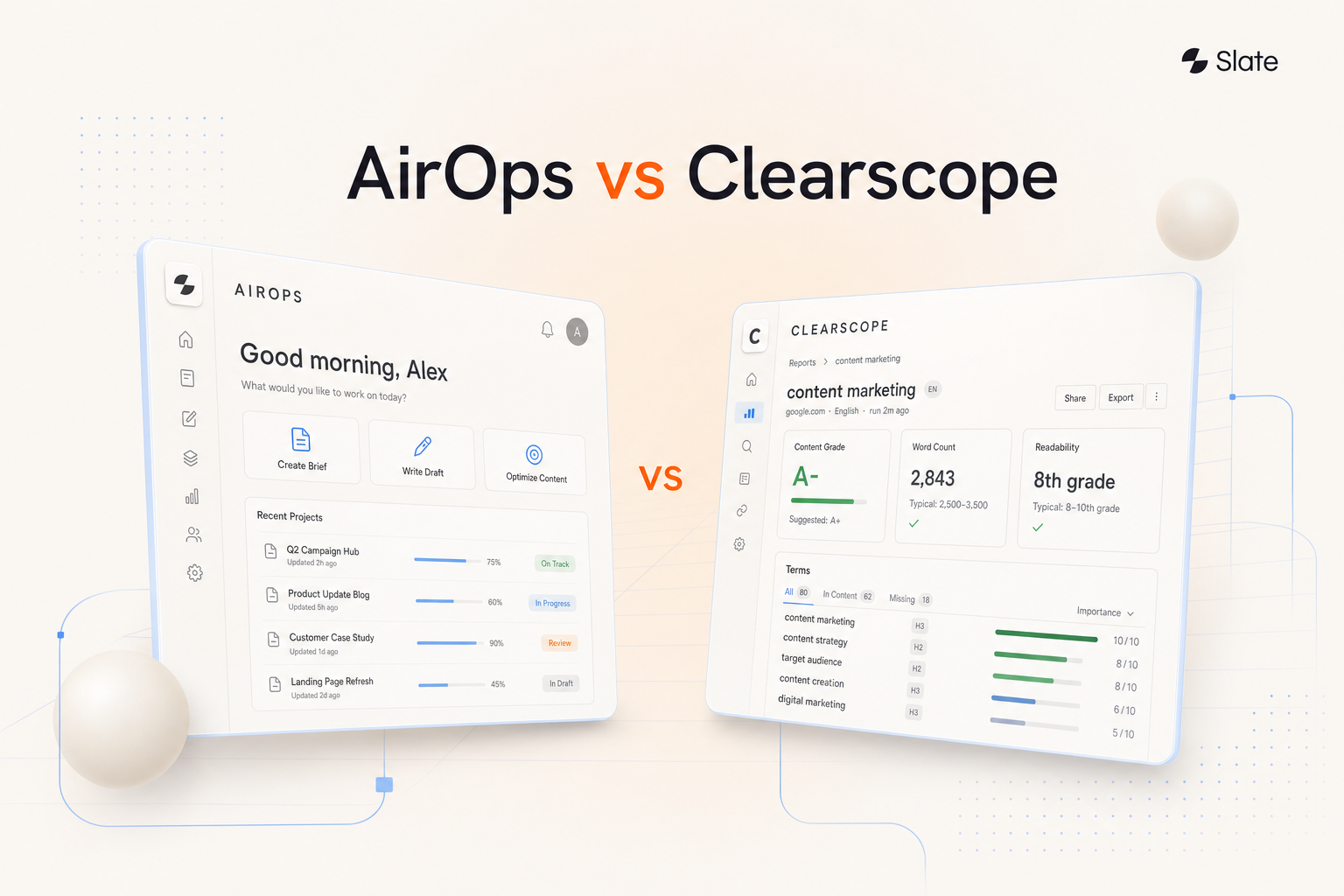
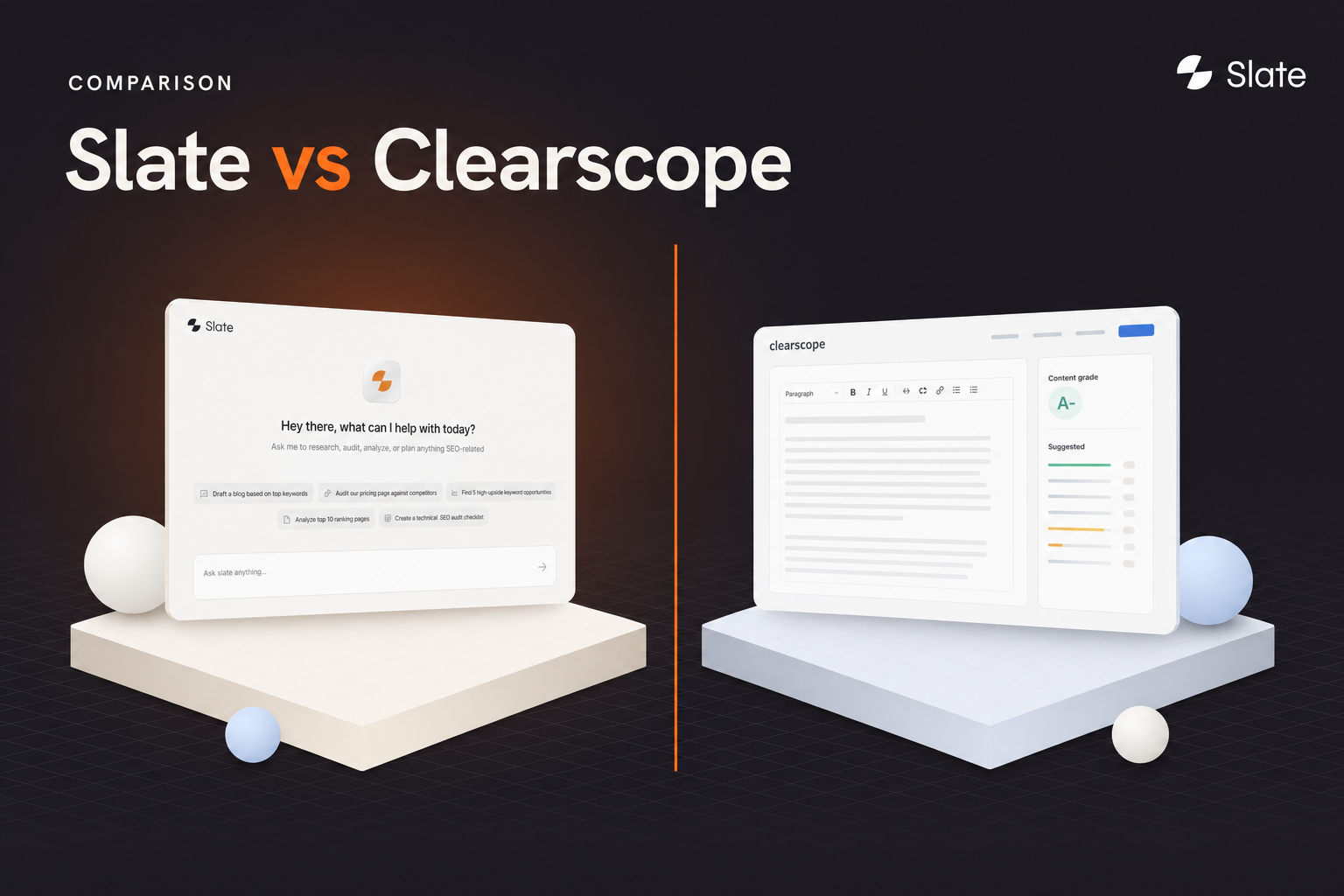
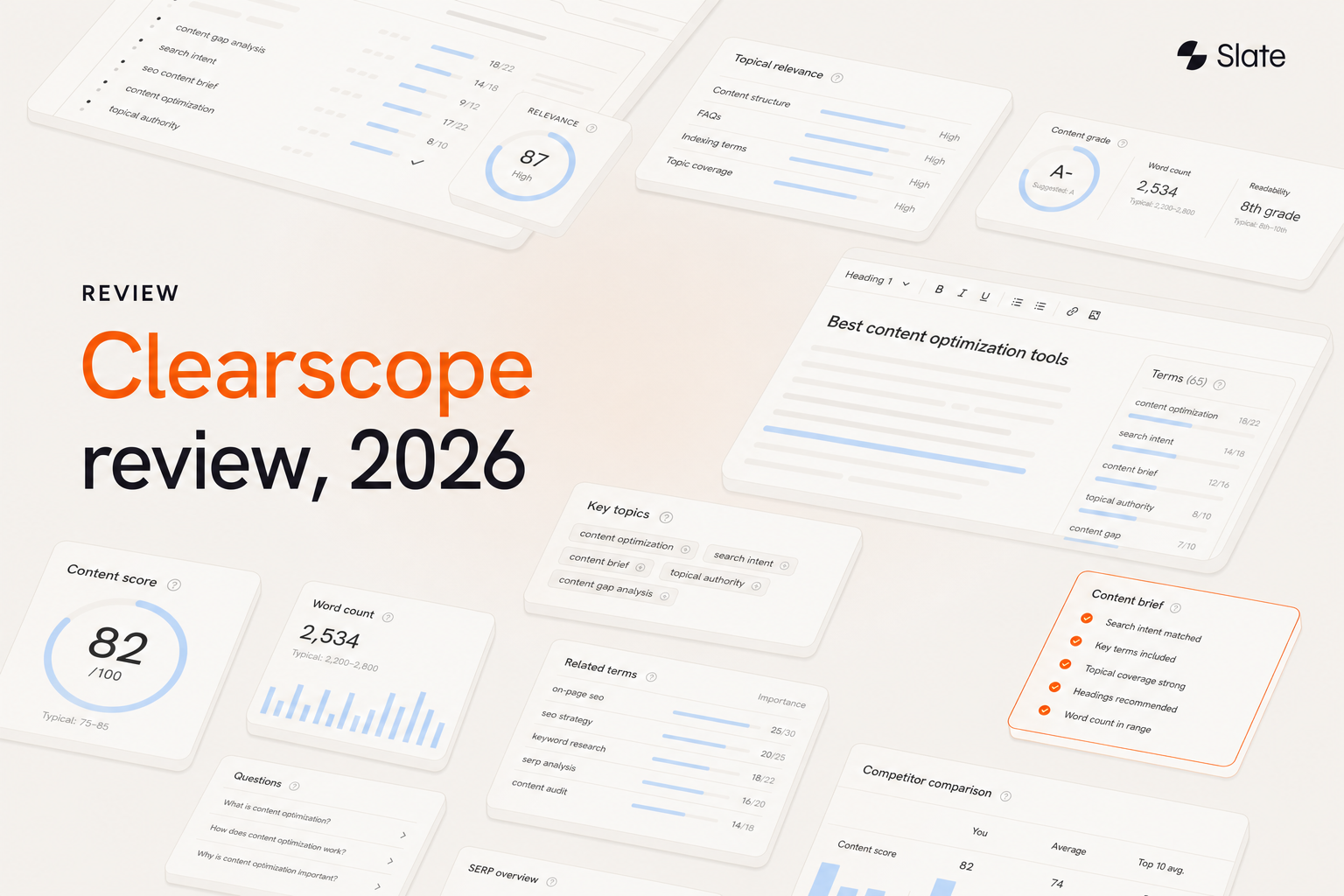
Clearscope is the tighter scoring editor. It’s built around content grades, topic coverage, and editorial guidance.
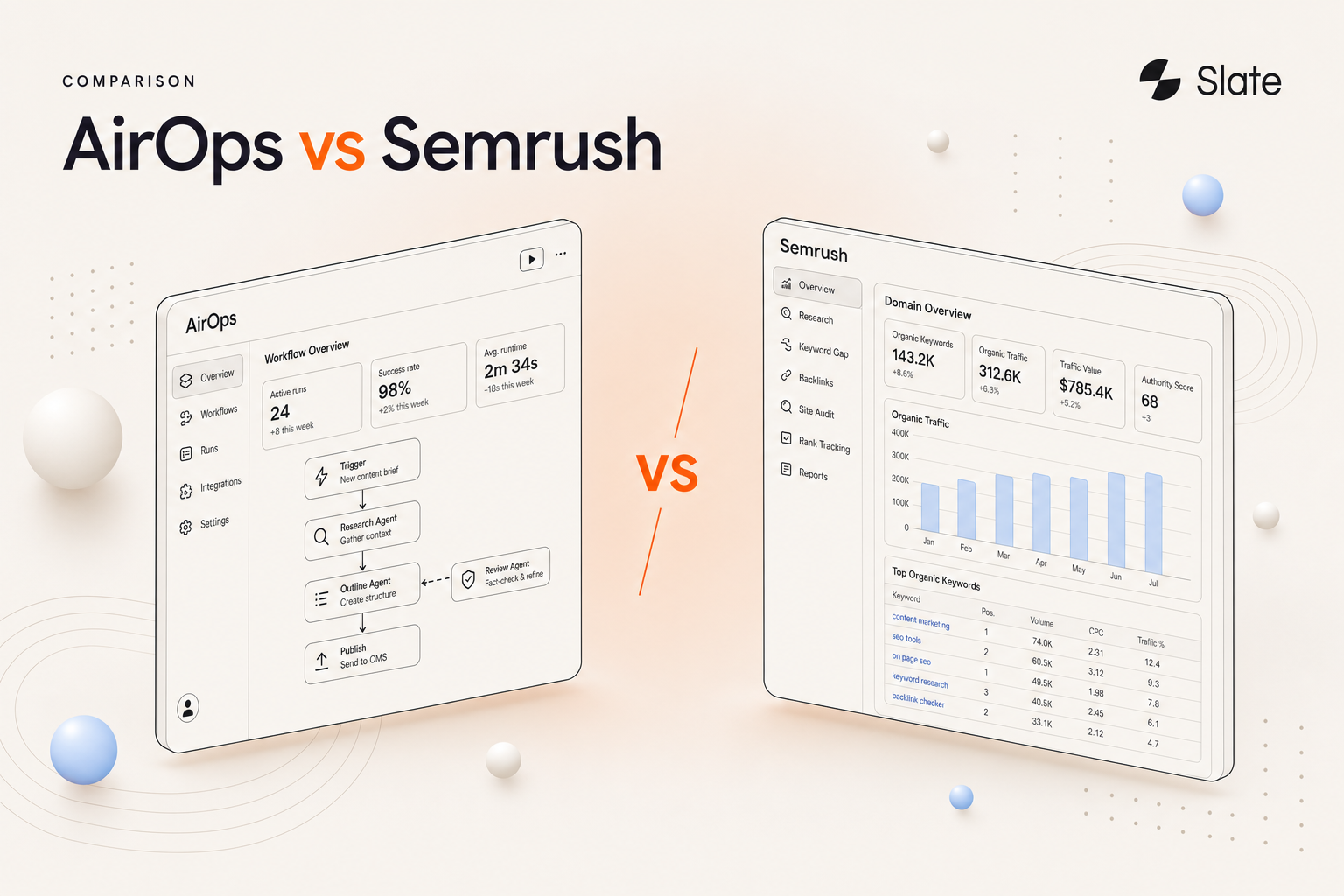
AirOps has a broader operating model. It measures AI-search visibility, ranks opportunities, and runs content creation and refresh workflows. If you want to see how it stacks up against other suites, our AirOps vs Semrush comparison covers the broader tradeoffs.
Best for content scoring: Clearscope, especially for editors tuning individual drafts.
Best for AI-search production: AirOps, especially for teams working across many pages.
Best for full-loop execution: Slate, for teams that want agents to handle opportunity research, content work, publishing, measurement, and refresh.
AirOps Vs Clearscope At A Glance
Clearscope is cleaner for single-draft scoring. AirOps is stronger when your team needs to turn AI-search visibility into work across a large content inventory.
What’s The Difference Between AirOps And Clearscope?
AirOps is a growth platform for AI search and answer engine optimization. Teams use it to measure visibility, rank opportunities, and create or refresh content at scale. For a deeper look at pricing, see our breakdown of AirOps pricing.
Clearscope is a content scoring and editorial guidance platform. Teams use it to research topics, write drafts, grade coverage, and monitor visibility across Google and AI search.
The split is practical. Clearscope tells an editor what a page needs. AirOps carries more of the work from finding the opportunity to producing the page.
For a broader comparison, see our roundup of the best AI content optimization tools.
Content Quality Scoring: AirOps Vs Clearscope
Clearscope wins for pure content scoring. Its grade model is built for editors who want a clear answer on topic coverage.
AirOps includes content guidance inside workflows, but its center of gravity is production, refresh, and AI-search growth.
How Clearscope Handles Content Quality Scoring
Clearscope scores a draft against a target keyword and related topics.
You get:
- Topic discovery with search intent analysis
- AI-assisted writing guidance
- Term coverage and relevance checks
- A grade editors can use before publishing
That gives writers a tight loop: research, draft, tune the page, and check the grade.
How AirOps Handles Content Quality Scoring
AirOps folds content guidance into the production pipeline.
You get:
- Creation and refresh workflows
- Brand Kits and knowledge bases
- Citation tracking and share-of-voice reporting
- Workflows built for larger content inventories
So the scoring piece lives inside a broader process.
Verdict: Content Quality Scoring
Pick Clearscope if your main need is grading and improving individual drafts.
Pick AirOps if you want content guidance baked into a larger creation and refresh workflow.
SEO Optimization: AirOps Vs Clearscope
Both platforms help with on-page SEO. Clearscope keeps that work close to the editor, which is useful when writers need term-level guidance.
AirOps connects SEO work to AI-search visibility and content workflows, which fits teams managing many pages.
Content Briefs And Keyword Targeting
Clearscope pairs topic discovery with search intent analysis. That gives writers a clear target before they draft. search intent classification best practices
AirOps builds briefs through workflows, so targeting connects to creation and refresh steps. See the broader category in our best AI SEO tools guide.
On-Page SEO And Semantic Relevance
Clearscope’s grade model gives granular guidance during drafting. Editors can see missing terms, related concepts, and topic coverage gaps.
AirOps adds guidance inside workflows and connects it to AI-search signals like citations and share of voice. If tracking those signals matters, our list of AI citation tracking tools goes deeper.
If your team lives inside the editor all day, Clearscope feels sharper. If your team manages a content program, AirOps gives you more operational coverage.
SEO Data Integrations: Ahrefs And Semrush
SEO data can get expensive fast. Many content tools assume you already pay for Ahrefs or Semrush.
Slate changes that cost math. Native Ahrefs and Semrush access is included, so teams don’t need to bolt on separate SEO data subscriptions just to run the workflow.
Workflow Automation And Editorial Workflow
Workflow automation is the biggest gap between AirOps and Clearscope.
AirOps is workflow-led. Creation, content guidance, and refresh can run through repeatable pipelines.
Clearscope is editor-led. It gives strong recommendations, then your team usually moves the work into a CMS, project board, or content calendar.
From Brief To Draft To Publish
The day-to-day path looks different.
- With Clearscope: Research the topic, build a brief, draft in the editor, tune the page against the grade, then move the content into your CMS.
- With AirOps: Rank the opportunity, run a creation or refresh workflow, apply guidance inside the pipeline, then hand the content to publishing.
The question for your team: how many handoffs sit between keyword research and a live page?
Bulk Work And Content At Scale
The editor-by-editor model gets slow when you’re managing hundreds or thousands of URLs.
AirOps is better suited to large content inventories because creation and refresh workflows can run across many pages. Teams weighing this at scale should also review the best SEO automation tools.
Slate goes further here. Workflows and Sheets let teams create, tune, refresh, and audit thousands of URLs from a visual builder and spreadsheet-style interface.
Publishing And Integrations
Clearscope focuses on content scoring and monitoring. Teams usually copy or export finished drafts into their CMS.
AirOps supports content-ops workflows with integrations and brand controls.
Slate removes more handoffs. It publishes directly to Webflow and WordPress from workflows and sheets, and it includes native Ahrefs and Semrush access.
That export-and-paste step sounds tiny until you do it 400 times.
AI Search Visibility: AirOps Vs Clearscope
Both platforms take AI search seriously.
AirOps tracks citation visibility, share of voice, and competitor presence. share of voice as an SEO measurement framework Clearscope tracks prompts across ChatGPT and Gemini for brand visibility.
Prompt Tracking, Citations, And Brand Mentions
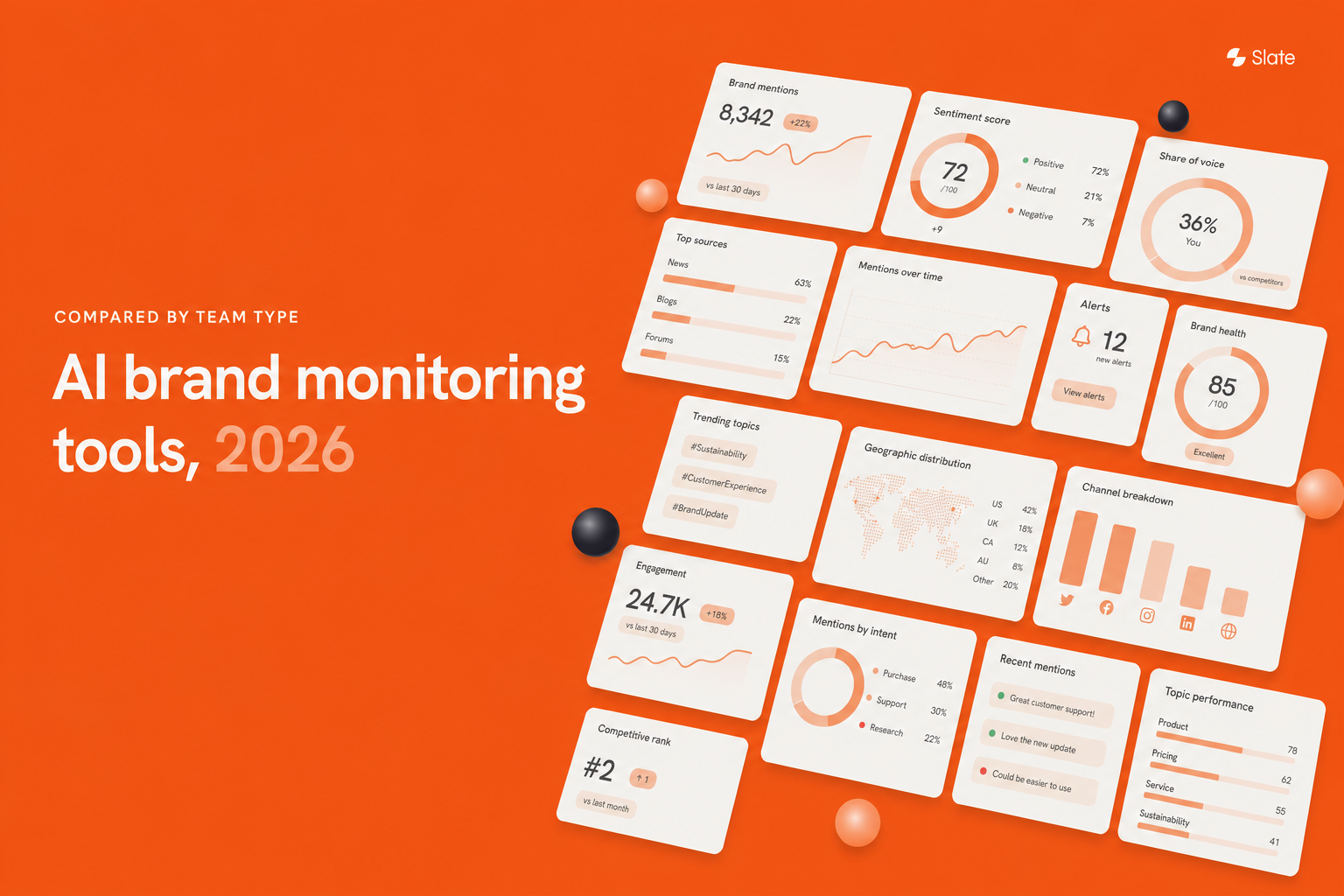
Clearscope helps teams monitor how brands appear in AI answers across ChatGPT and Gemini. how ChatGPT surfaces brand mentions in answers If monitoring brand mentions is a priority, compare the best AI brand monitoring tools.
AirOps ties AI visibility signals to opportunity prioritization and content production. That’s useful when you want AI-search reporting to feed the work queue.
How AI Search Differs From Classic SEO
Classic SEO rewards pages that rank. AI search rewards content that can be cited, summarized, and trusted inside generated answers. how AI answer engines cite sources declining organic click-through rates from zero-click searches
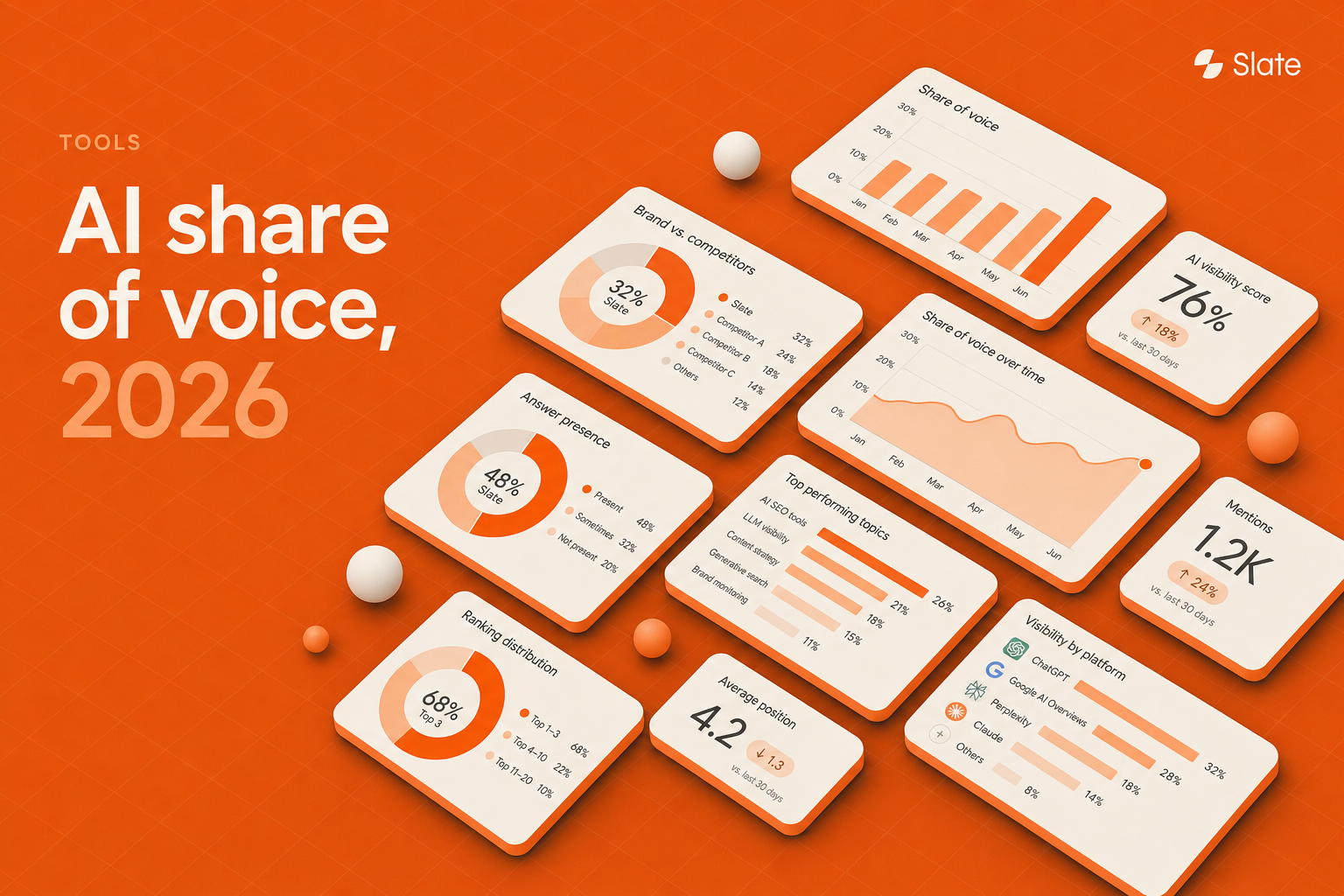
Slate tracks brand presence across major AI platforms, including ChatGPT, Google AI Mode, Google AI Overviews, and Perplexity. You can monitor mentions, sentiment, prompt answers, and keyword coverage in one view.
Content Refresh And Post-Publish Workflows
Large content libraries decay. Rankings drop, intent changes, and once-useful pages start collecting dust like an abandoned Google Sheet from 2021. research on content decay and organic traffic loss
AirOps treats refresh as a first-class workflow for onsite and offsite AI-search growth.
Clearscope helps monitor visibility, then editors can use its scoring workflow to update pages. Teams building this muscle can browse the best content refresh tools for options.
Slate closes the loop through Pages. It brings Google Search Console and GA4 data together for clicks, traffic, CTR, citations, and drop detection, then routes pages into refresh workflows.
See Slate vs Clearscope for a closer look at that loop.
Pricing Comparison
Compare sticker price and workflow cost. A cheaper scoring tool can cost more once you add SEO data, publishing tools, and post-publish reporting.
AirOps: Insights starts at $0/month, with Pages custom and Solo, Pro, and Enterprise tiers available. AirOps has a free trial. Public monthly prices for Solo and Pro aren’t listed.
G2 rating: 4.7/5
Clearscope: Essentials is $129/month, Business is $399/month, and Enterprise is custom. Monthly plans have no contracts.
G2 rating: 4.9/5 G2's software category ratings methodology
Where The Workflow Cost Lives
The full cost includes the tools each platform assumes you already have.
- Ahrefs or Semrush may require separate subscriptions
- CMS publishing may require manual export or another workflow tool
- Measurement and refresh may live in separate reporting tools
- Outreach may require another product
Slate reduces stack sprawl by bundling native SEO data, direct publishing, measurement, refresh, and outreach into one platform.
Pricing: Slate starts at $499/month. Free trial, Enterprise, and Agency plans are available.
G2 rating: 4.9/5
Pros And Cons
Both tools are good in their lanes. The tradeoff is scope.
AirOps Pros And Cons
Pros: AI-search visibility with citation tracking, competitor intel, and share of voice. Workflow-led creation and refresh at scale. Brand Kits and knowledge bases for consistency.
Cons: Solo and Pro pricing isn’t public, which slows budget planning. Smaller teams that only need content scoring may find the platform broader than they need. If AirOps feels too broad, our list of AirOps alternatives offers narrower picks.
Clearscope Pros And Cons
Pros: Focused content scoring with a clear grade. Topic discovery with search intent analysis. Prompt tracking across ChatGPT and Gemini.
Cons: Publishing, bulk work, and refresh production often happen elsewhere. Native SEO data usually means separate tools. See our full Clearscope review for more detail.
Who Should Choose AirOps, Clearscope, Or A Full-Loop Platform?
Pick based on team size, content volume, and where the bottleneck sits.
Best For Small Content Teams And Solo Consultants
Solo consultants and small teams that tune individual drafts will get strong value from Clearscope.
AirOps’ free Insights tier is a low-risk way to add AI-search visibility monitoring.
Best For In-House SEO And Content Ops Teams
In-house teams juggling briefs, drafts, approvals, and refresh cycles will probably prefer AirOps.
Clearscope fits teams whose bottleneck is editorial quality.
Best For Enterprise SEO Teams
Enterprise teams should weigh governance, collaboration, integrations, stack consolidation, and bulk workflows.
A single-page score is useful. Workflow consistency across a large content operation usually carries more weight. See our best AI SEO tools for enterprise content teams guide.
Best For Agencies
Agencies managing multiple clients need repeatable workflows and bulk content handling.
AirOps fits agencies running AI-search and content production programs. Clearscope fits agencies selling content scoring, briefs, and editorial recommendations.
Best For Teams That Need Execution
Teams that want a production system should look at Slate.
Slate runs opportunity discovery, content work, publishing, measurement, refresh, and outreach with Coworker and custom agents. It has a 4.9/5 G2 rating.
Why Teams Evaluating AirOps And Clearscope Also Consider Slate
Teams comparing AirOps and Clearscope are usually deciding how much of the content loop they want in one platform.
Slate is the end-to-end, agent-driven option: research, content production, outreach, publishing, measurement, and refresh handled in one place.
- Coworker and custom agents: Delegate work in natural language or turn repeatable SEO and content tasks into reusable agents.
- Workflows and Sheets: Create, tune, refresh, and audit thousands of URLs from a visual builder and spreadsheet interface.
- Native SEO data and publishing: Ahrefs and Semrush access is included, plus direct publishing to Webflow and WordPress.
- AI visibility analytics: Track brand presence across major AI platforms with mentions, sentiment, prompt answers, and keyword tracking.
- Pages: Bring Google Search Console and GA4 together for clicks, traffic, CTR, citations, and drop detection.
- Opportunities and Outreach: Find content gaps, citation gaps, ranking gaps, link prospects, and brand-mention opportunities, then reach out in-platform.
Slate is built for organic and AI-search growth teams. It isn’t a generic proofing tool for video campaigns or visual brand asset review, which is the point.
Pricing: Slate starts at $499/month. Free trial, Enterprise, and Agency plans are available.
G2 rating: 4.9/5
Book a demo: https://slatehq.com/book-a-demo
AirOps Vs Clearscope Vs Frase: Broader Alternatives
Frase often appears in the same shortlist. It’s known for AI-assisted content research, brief creation, and content scoring. Our Frase review and list of Clearscope alternatives can help you widen the search.
Choose Clearscope when scoring is the bottleneck. Choose AirOps when production volume is the bottleneck. Choose Slate when you want measurement and refresh in the same system as creation and publishing.
For more, see our Frase review and Clearscope alternatives.
Final Verdict
Clearscope is the cleaner choice for teams focused on scoring and improving individual drafts.
AirOps is the stronger match for teams that need AI-search visibility connected to content production and refresh at scale.
By buyer type: solo consultants and content scoring teams lean Clearscope; scale-oriented in-house teams and agencies lean AirOps; enterprise teams should weigh governance and stack consolidation carefully.
For teams that want opportunity discovery, content work, publishing, measurement, refresh, and outreach handled by agents in one place, Slate is the pick.
Book a demo: https://slatehq.com/book-a-demo
Frequently Asked Questions
Can AirOps Replace Clearscope?
Partly. AirOps includes content guidance inside broader workflows, so it can cover many needs for teams that want production support.
Clearscope’s editor is more focused on granular content scoring, so teams that care most about draft grades may still prefer it.
Which Is Better For Content Optimization, AirOps Or Clearscope?
Clearscope is better for pure content scoring. Its grade model and topic-coverage guidance are built for editors.
AirOps is better when content guidance needs to sit inside creation and refresh workflows.
Which Tool Is Better For AI Search Visibility?
Both track AI visibility.
AirOps has citation tracking, competitor intelligence, and share of voice. Clearscope tracks prompts across ChatGPT and Gemini. Slate tracks brand presence across major AI platforms in one view.
Which Is Better For Enterprise SEO Teams?
Enterprise teams should weigh governance, integrations, bulk workflows, and stack consolidation.
AirOps fits teams that want AI-search production workflows. Clearscope fits teams that need editorial scoring. Slate fits teams that want one agent-driven system for the full content loop.
What’s The Pricing Difference Between AirOps And Clearscope?
AirOps starts with a free Insights tier and has Solo, Pro, and Enterprise tiers. Public monthly prices for Solo and Pro aren’t listed.
Clearscope Essentials is $129/month, Business is $399/month, and Enterprise is custom. Compare total workflow cost, including SEO data, publishing, reporting, and refresh.
Does Clearscope Include Workflow Automation?
Clearscope is editor-led. It supports research, writing, scoring, and monitoring.
Teams usually handle bulk publishing and refresh work in other tools.
What If I Need Content Creation, Publishing, And Refresh In One Workflow?
That’s the Slate use case.
Slate combines agents, bulk workflows, native SEO data, direct publishing to Webflow and WordPress, unified GSC and GA4 reporting, refresh workflows, and outreach. Slate starts at $499/month, with a free trial available.