The best AI tools for marketing agencies remove recurring delivery work: research, briefing, optimization, publishing, monitoring, outreach, reporting, creative production, and refreshes. The strongest shortlist is the smallest stack that turns insight into completed client work.
Category-first lists can leave agency owners comparing unrelated tools without knowing which handoff disappears. This guide sorts platforms by the work each one takes off your team’s queue. That keeps the buying decision tied to workflow impact.
Slate publishes this guide and appears first for one specific use case: end-to-end agent-driven organic growth. We evaluate Slate with the same criteria and limitations as the other AI tools for marketing agencies.
Key takeaways
Select AI tools for marketing agencies by workflow bottleneck. A tool that generates output can still leave research, review, publishing, measurement, and refresh work with the team.
- Sort tools by the recurring work they remove.
- Slate fits end-to-end agent-driven organic growth: AI visibility, SEO, content, publishing, outreach, and refresh.
- Slate has Growth, Scale, Agency, and Enterprise plans, with details in its section.
- AI-search monitoring helps when clients need prompt presence, citations, brand mentions, sentiment, and action paths.
- Point tools suit isolated work; integrated platforms are better for repeated research-to-refresh workflows.
- Strategy, source verification, factual accuracy, brand judgment, sensitive data, and approvals should stay human-owned.
What AI tools for marketing agencies do in 2026
Marketing agencies use AI for research, opportunity discovery, briefs, drafts, and page optimization. They also use it for creative assets, workflow handoffs, search and AI-search monitoring, outreach, reporting, and content refresh. Humans remain accountable for strategy, factual accuracy, brand judgment, governance, and client approvals.
The operational change goes beyond automated copywriting. Agencies now need to manage traditional SEO alongside AI answer visibility and track citations and mentions alongside rankings. They also need to keep large URL inventories current without turning every refresh into a manual project.
That creates a consolidation problem. Every new requirement can add another tool, login, bill, permission model, export, and review queue. Ask: “Which recurring handoff disappears if the team adopts this?”
Agent-based execution is different from one-off generation because it can connect steps. A useful AI marketing tool for agencies helps move from opportunity to production, implementation, measurement, and the next action. Our guide to AI agents for marketing compares the agent platforms in more depth.
At a glance: The 16 best AI tools for marketing agencies
We grouped the 16 tools below by the work they removed from an agency queue, then ordered them by workflow fit. Slate appears first only in the end-to-end organic-growth category. Several other tools remain useful when the agency needs a focused assistant, specialist optimizer, creative system, outreach layer, automation connector, or dashboard.
Normalize pricing by the unit of value before you compare tools. That unit might be seats, client accounts, credits, domains, prompts, tracked pages, contacts, social profiles, exports, or automation operations. A lower entry price can still become expensive if the usable agency capacity is too narrow.
How we evaluated these AI tools for agency use
When agency owners compare the top AI marketing tools, the useful question is what each one changes in day-to-day delivery work. The seven criteria below focus on whether a tool reduces recurring delivery work across multiple clients without weakening review and approvals.
- Workflow Coverage: A useful agency tool should cover a meaningful part of the delivery loop. If it creates a draft but leaves research, CMS entry, reporting, outreach, and refresh work untouched, it only reduces one narrow task.
- Multi-Client Usability: Agencies need account separation, repeatable workflows, client-specific brand guidance, approval ownership, and permissions. A tool that works for one user can become difficult to manage across many client programs.
- Integration Depth: Exporting a file is different from operational integration. The strongest tools connect to the systems where work already happens. Those include analytics, search data, CMS platforms, outreach systems, and reporting workflows.
- Governance Handling: Agencies should know what client data enters each system and who can access it. They also need to know who reviews the work and which approval gates block unapproved publishing or client-facing delivery.
- Output Controls: AI output needs source checks, brand-voice review, factual accuracy review, and editorial judgment. The more client-sensitive the work, the more important these controls become.
- Measurement: Finished work should connect to evidence where possible: clicks, impressions, rankings, citations, mentions, sentiment, page performance, or client reporting outcomes.
- Agency-Scale Pricing: Compare the cost per usable client workflow once you account for seats, prompts, credits, pages, domains, contacts, profiles, and add-ons.
Slate appears first for end-to-end agent-driven organic growth. Its main limitation is scope. Slate focuses on organic-growth execution, so agencies still need separate tooling for video or visual campaign review.
Best AI tools for finding SEO and AI-search opportunities
The best AI use case is often deciding what deserves work before the team produces anything. Agencies need to find ranking gaps, content gaps, AI-search changes, prompts, outreach targets, and content decay. Then they need to connect that insight to execution.
1. Slate - Best for end-to-end agent-driven organic growth
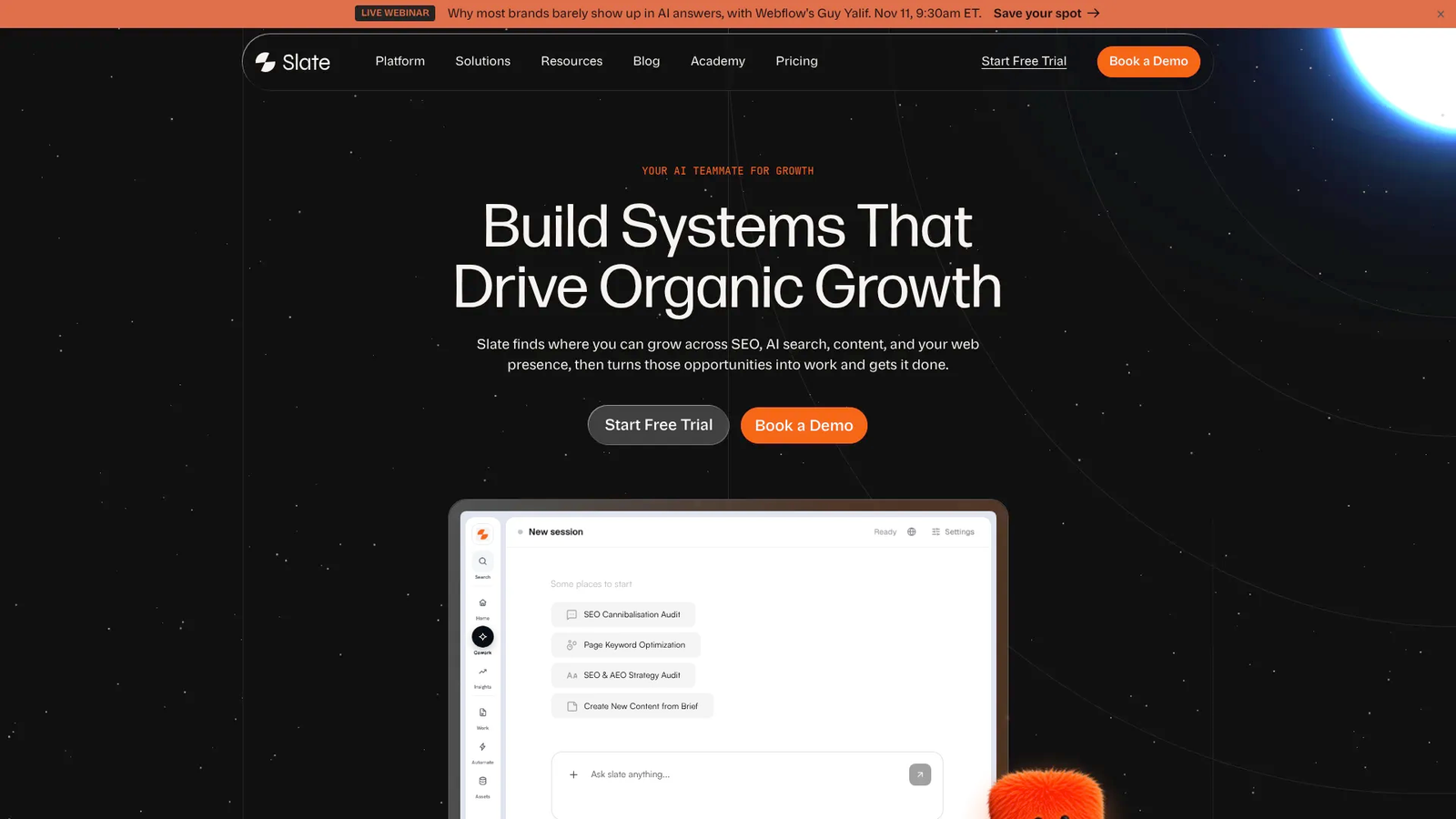
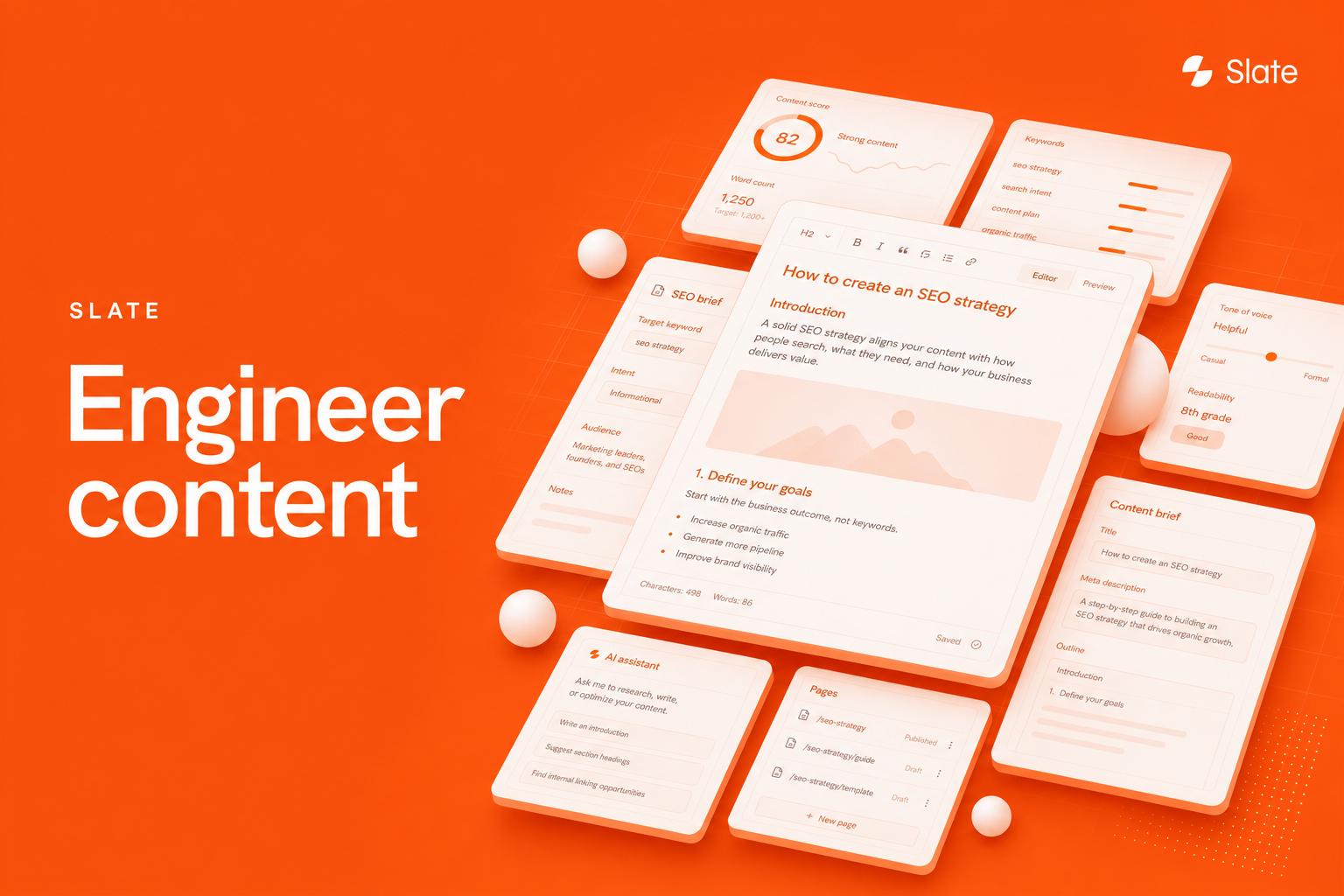
Slate serves agencies that want one agent-driven system for AI visibility, SEO, content execution, publishing, outreach, performance monitoring, and recurring refreshes. It is strongest when a client program repeatedly moves from opportunity discovery to production, implementation, measurement, and the next action.
Best for: End-to-end AI visibility, SEO, content, publishing, outreach, and refresh workflows.
Work it takes off your team: Opportunity discovery, content creation and optimization, CMS publishing, outreach, AI-search monitoring, performance analysis, and refresh workflows.
Best-fit agency type: Multi-client / agency-capable platform.
Key strengths:
- Cowork lets users delegate work in natural language.
- Workflows supports repeatable multi-step execution.
- Sheets supports bulk content operations across URL inventories.
- Pages supports performance monitoring with Google Search Console and GA4 data.
- Opportunities flags prompts the brand could win and pages losing traffic, rank, or citations. It also flags outdated content and third-party pages that don’t mention the brand.
- Outreach supports link and brand-mention opportunity workflows.
Slate’s AI Tracker covers ChatGPT, Google AI Mode, Google AI Overviews, and Perplexity on every plan. Claude and Gemini are add-on answer packs, and Enterprise includes all six. Slate includes Semrush data without a separate Semrush account. Its CMS publishing supports Webflow, Sanity, WordPress, and Strapi.
For multi-client work, Slate’s Agency mode gives each client its own workspace. It adds client records, health scores, client reports, and client-user permissions to one organization. Slate bills it as a paid add-on in packs of 25 client workspaces.
Watch-outs:
- Teams still need separate tools for non-content assets such as video or visual brand campaigns.
- Entry pricing suits active organic-growth programs better than occasional one-off content work.
- Strategy, source review, brand judgment, and final publishing approval still need human ownership.
Pricing: Growth $499/month, Scale $999/month, Agency $2,000/month, Enterprise custom. Growth includes 1 user and 1 workspace; Scale and above support multiple users and workspaces. Annual billing saves 20%. Slate offers a 14-day free trial. See Slate pricing.
Single task or multi-step process: Multi-step, end-to-end.
Workflow example: An AI-answer gap points to a supporting content gap. An agent drafts new content or a refresh, and Slate publishes it to the CMS. Outreach then targets relevant sites, and Pages tracks clicks, CTR, citations, and performance changes.
2. Ahrefs - Best for deep SEO research
Ahrefs is useful when an agency needs a dedicated SEO data layer for keyword research, backlink analysis, competitor discovery, and historical investigation. It removes research time, but the agency still needs briefing, drafting, publishing, outreach, reporting, and refresh workflows. Ahrefs has also added Brand Radar to track brand mentions and citations in AI answers. It covers ChatGPT, Perplexity, Gemini, Copilot, Google AI Overviews, and AI Mode.
Best for: SEO research when execution already exists elsewhere.
Work it takes off your team: Keyword, backlink, and competitor investigation.
Best-fit agency type: Requires additional stack components.
Key strengths:
- It works well as an input layer for audits and briefs.
- It helps teams investigate competitors and link profiles.
- It fits agencies that already have production and reporting workflows.
Watch-outs:
- Research still needs translation into client-ready work.
- Findings can create more tasks if no execution system exists.
Single task or multi-step process: Primarily a research layer.
3. Semrush - Best for broad SEO and marketing intelligence
Semrush is useful for agencies that need SEO and market research inputs across keyword, competitor, and backlink workflows. For teams already standardized on Semrush data, it can support opportunity discovery before the work moves into content, publishing, and reporting systems. Semrush also sells an AI Visibility Toolkit for tracking how brands appear in AI answers, and a Content Toolkit for drafting.
Best for: Broad SEO and marketing research.
Work it takes off your team: Search, competitor, and market investigation.
Best-fit agency type: Requires additional stack components.
Key strengths:
- It supports research-led SEO planning.
- It helps with competitive investigation.
- Slate includes Semrush data.
Watch-outs:
- Its content tools help with drafting, but agencies still need their own content execution.
- Agencies still need review, production, CMS, and reporting processes.
Single task or multi-step process: Research layer.
4. ChatGPT - Best for ad-hoc thinking and first drafts
ChatGPT can help with brainstorming, summarization, outlines, analysis, and first-pass writing. It helps a freelancer or small team that needs flexible support. It doesn’t create a persistent agency operating system across clients on its own.
Best for: General-purpose assistance.
Work it takes off your team: Ideation, summarization, analysis, and first drafts.
Best-fit agency type: Single-user tool or Team workflow tool.
Key strengths:
- It handles many early-stage marketing tasks.
- It turns notes into draft structures.
- It speeds up quick analysis and brainstorming.
Watch-outs:
- Source verification remains mandatory.
- Publishing, measurement, approvals, and refresh need other systems.
Single task or multi-step process: Usually single task.
5. Claude - Best for long-form analysis and document work
Claude is useful when agencies need long-form analysis and drafting support. It can help teams review source material and shape complex documents. Agencies still need client-data rules, source checks, and workflow controls around the output.
Best for: Document analysis and long-form drafting.
Work it takes off your team: Synthesis, review, and early-stage drafting.
Best-fit agency type: Individual or team workflow.
Key strengths:
- It supports structured thinking and drafting.
- It can review large bodies of text.
- It fits ad-hoc analysis workflows.
Watch-outs:
- A person must review claims and citations.
- It does not replace an agency delivery system.
Single task or multi-step process: Usually single task.
Best AI tools for content briefs, drafting, and brand-safe copy
Content work includes deciding what to create, building a brief, drafting, editing, improving, publishing, measuring, and refreshing. A writing assistant can reduce drafting effort. Agencies should still judge affordable AI content generation tools for marketing agencies by revision volume and downstream completion. Our guide to AI writing tools for SEO compares the drafting options in more detail.
6. Jasper - Best for brand-guided marketing copy
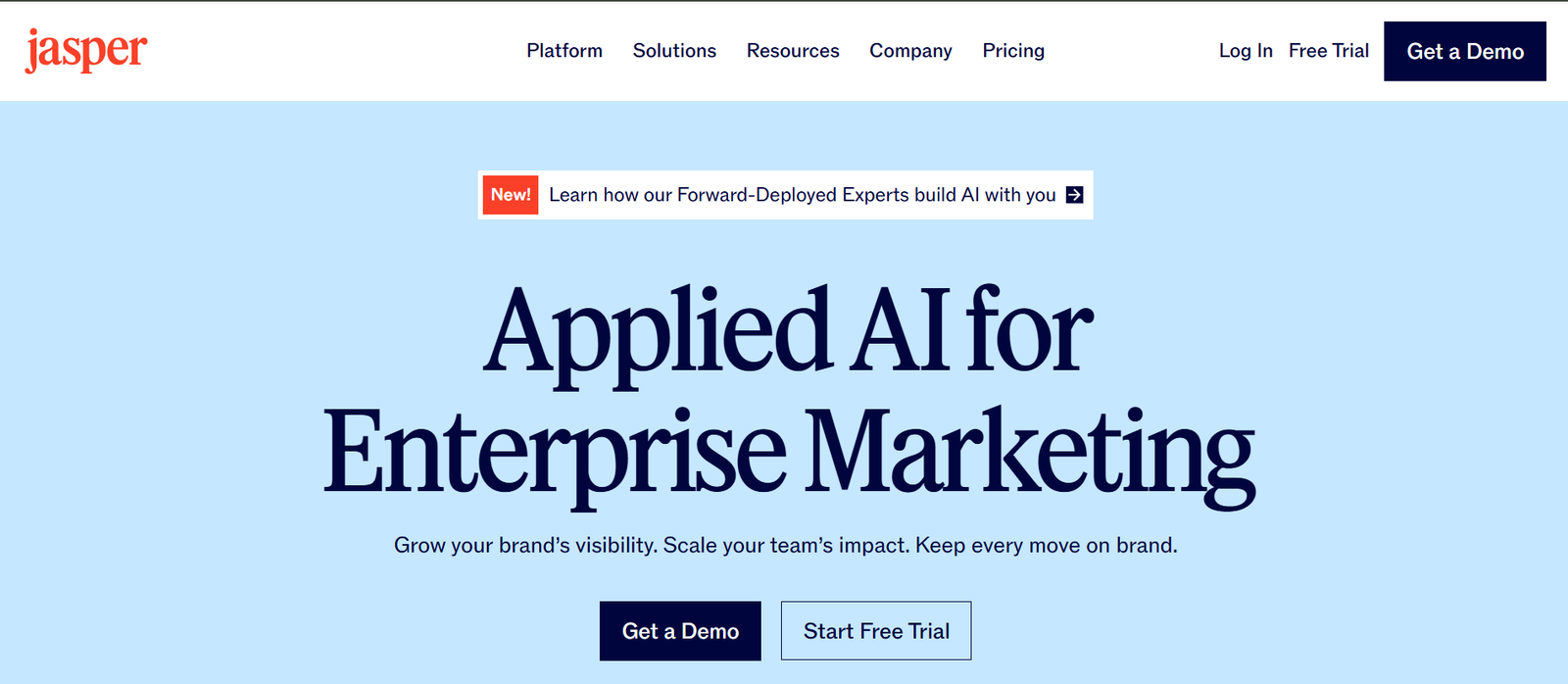
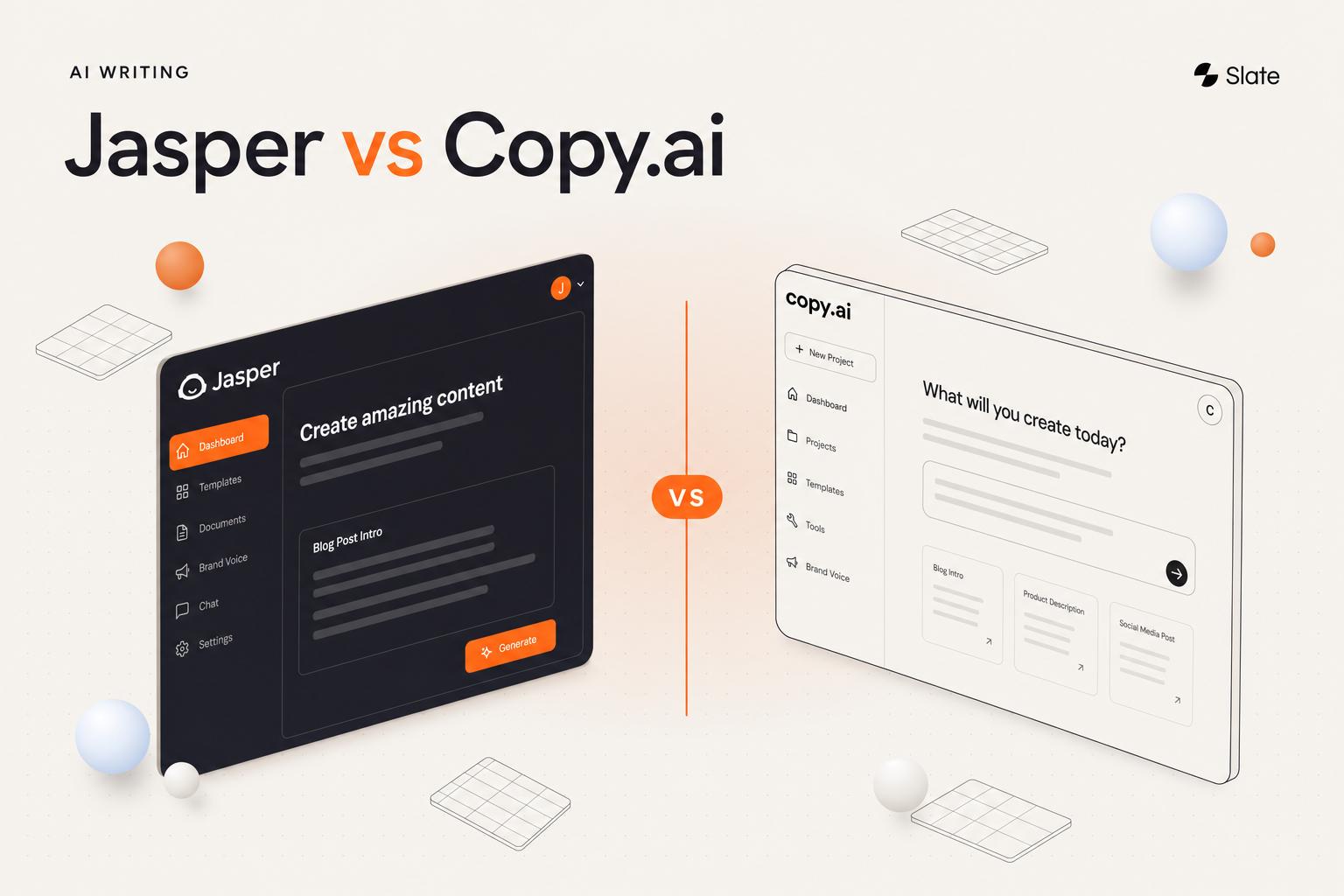
Jasper fits agencies that want a dedicated writing environment for marketing copy and brand-guided drafting. It is most useful when the bottleneck is producing first versions and campaign variants. Its platform now includes marketing agents, Content Pipelines for repeatable workflows, and Jasper IQ for brand voice and governance.
Best for: Marketing copy and brand-guided drafting.
Work it takes off your team: First drafts, variations, and copy production.
Best-fit agency type: Team workflow tool.
Key strengths:
- It focuses on marketing copy workflows.
- It supports reusable drafting patterns.
- It helps most when copy volume is the main issue.
Watch-outs:
- A strong draft can still require factual review and client approval.
- Publishing, measurement, and refresh need additional workflow support.
Single task or multi-step process: Primarily drafting.
7. Writer - Best for governed content workflows
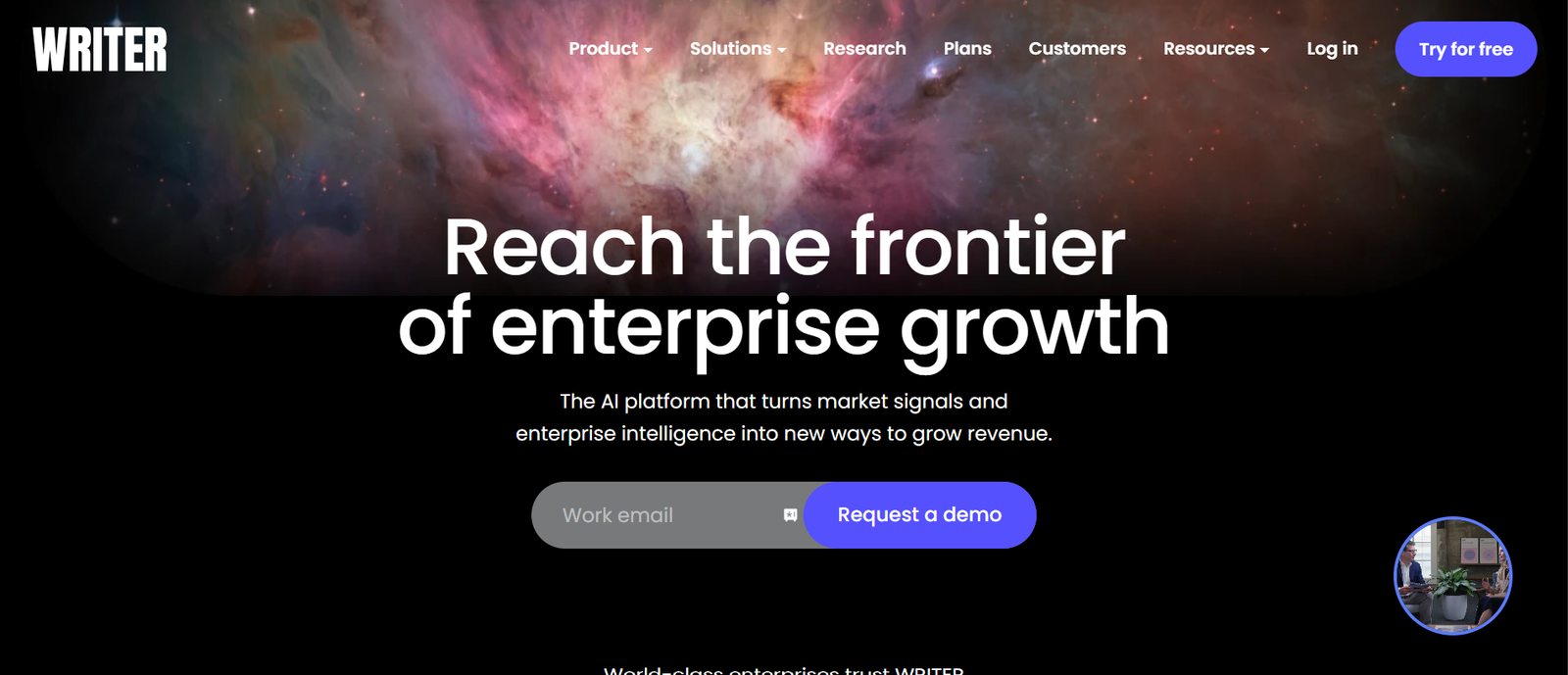
Writer is an enterprise AI platform with agents and a knowledge graph. It suits teams that need more controlled content production and style enforcement. For agencies, the practical question is whether the governance model maps cleanly to multiple client accounts and their reviewers.
Best for: Governed drafting and style consistency.
Work it takes off your team: Controlled drafting and style application.
Best-fit agency type: Team workflow tool.
Key strengths:
- It fits teams with stricter content governance needs.
- It supports more structured writing operations.
- It helps where consistency keeps causing delivery problems.
Watch-outs:
- Agencies still need source verification and client approval.
- It does not remove every SEO, publishing, or refresh handoff.
Single task or multi-step process: Drafting and governance layer.
8. Grammarly - Best for final-pass editing consistency
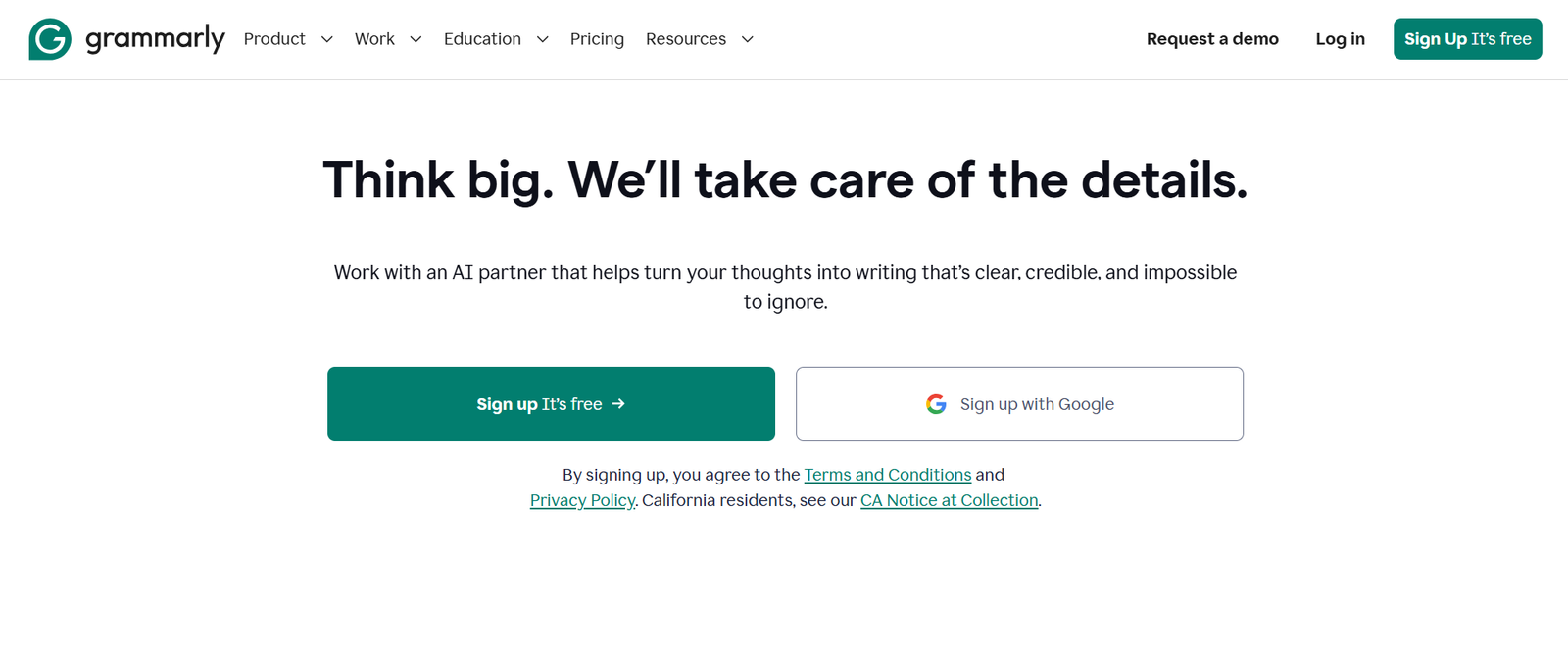
Grammarly helps agencies reduce mechanical editing work across grammar, clarity, tone, and consistency checks. Treat it as a final-pass layer, with strategic and factual review handled by people. Its parent company renamed itself Superhuman in October 2025. Grammarly kept its product name and now includes writing agents such as a proofreader and a plagiarism checker.
Best for: Editing and consistency checks.
Work it takes off your team: Grammar, clarity, tone, and style review.
Best-fit agency type: Team workflow tool.
Key strengths:
- It polishes client-facing drafts.
- It cuts repeated mechanical edits.
- It fits teams that need a consistent final review.
Watch-outs:
- Editing does not establish truth.
- Strategic and factual review remain human responsibilities.
Single task or multi-step process: Single-task editing layer.
Slate content and Cowork - Best when drafting must connect to execution
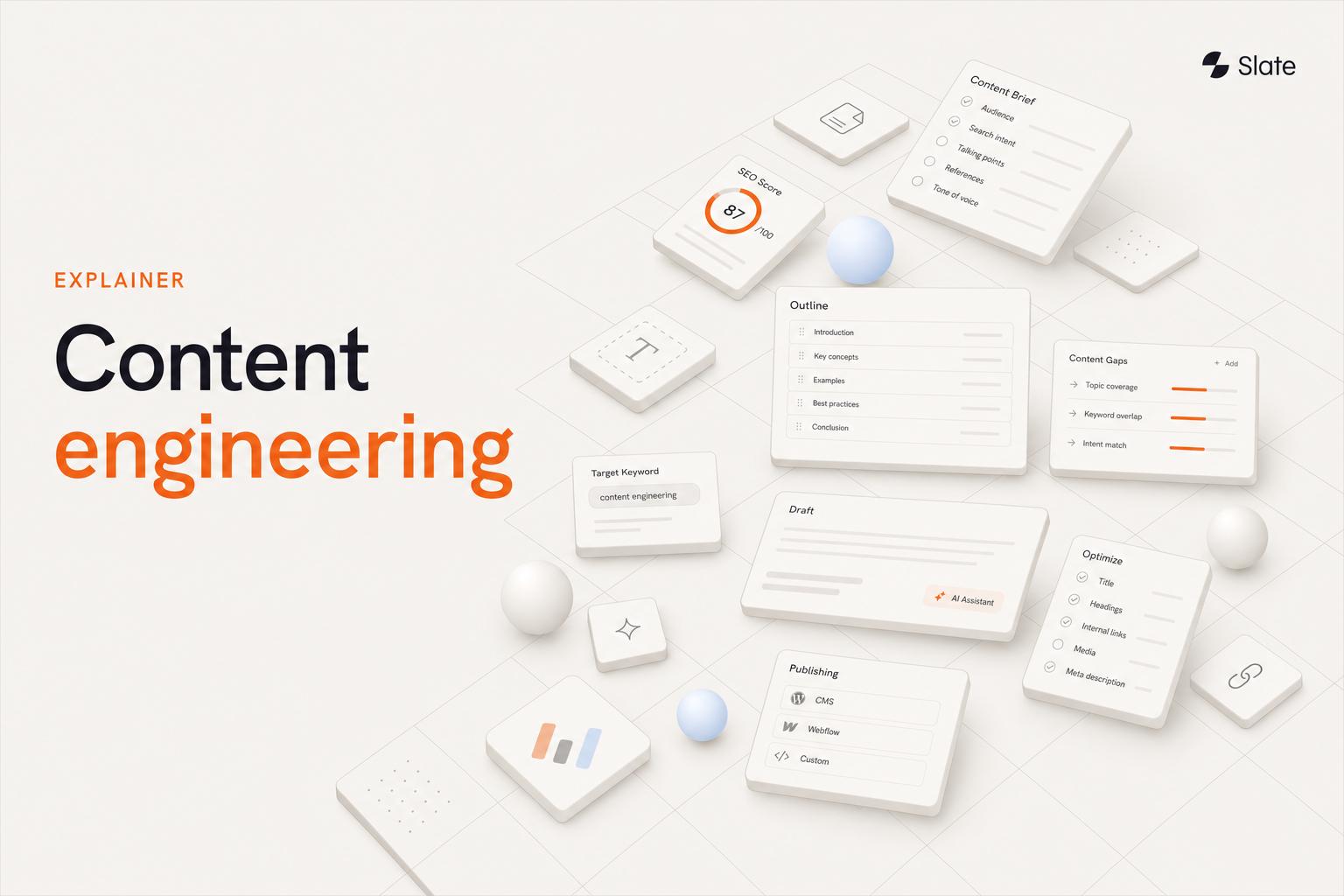
Slate is relevant in content production when the agency wants drafting to move beyond a document. Cowork, Sheets, Workflows, SuperBlocks, publishing, Pages, and Outreach can connect content creation to the broader organic-growth loop.
Best for: Content workflows tied to opportunity, publishing, measurement, and refresh.
Work it takes off your team: Recurring briefs, bulk drafting, optimization handoffs, CMS movement, and follow-up actions.
Best-fit agency type: Multi-client / agency-capable platform.
Watch-outs: Teams still need separate tools for visual campaign proofing.
Pricing: See Slate pricing above.
Single task or multi-step process: Multi-step.
Best AI tools for SEO content optimization and ongoing refreshes
SEO optimization and content refresh are different jobs. A page optimizer helps improve a selected URL. A refresh system decides which URLs deserve attention, coordinates changes, publishes approved updates, and measures the effect over time.
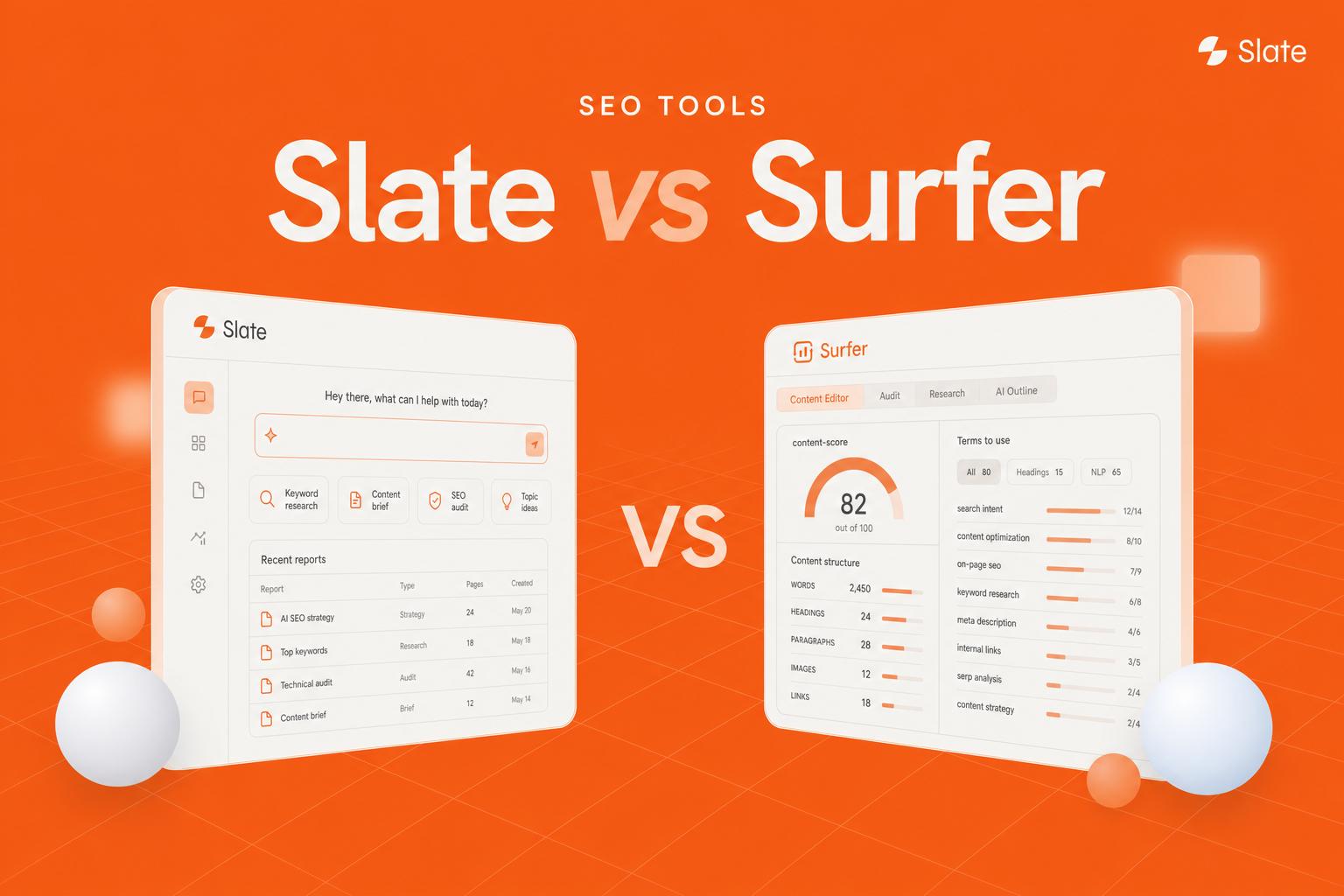
9. Surfer - Best for page-level SEO optimization
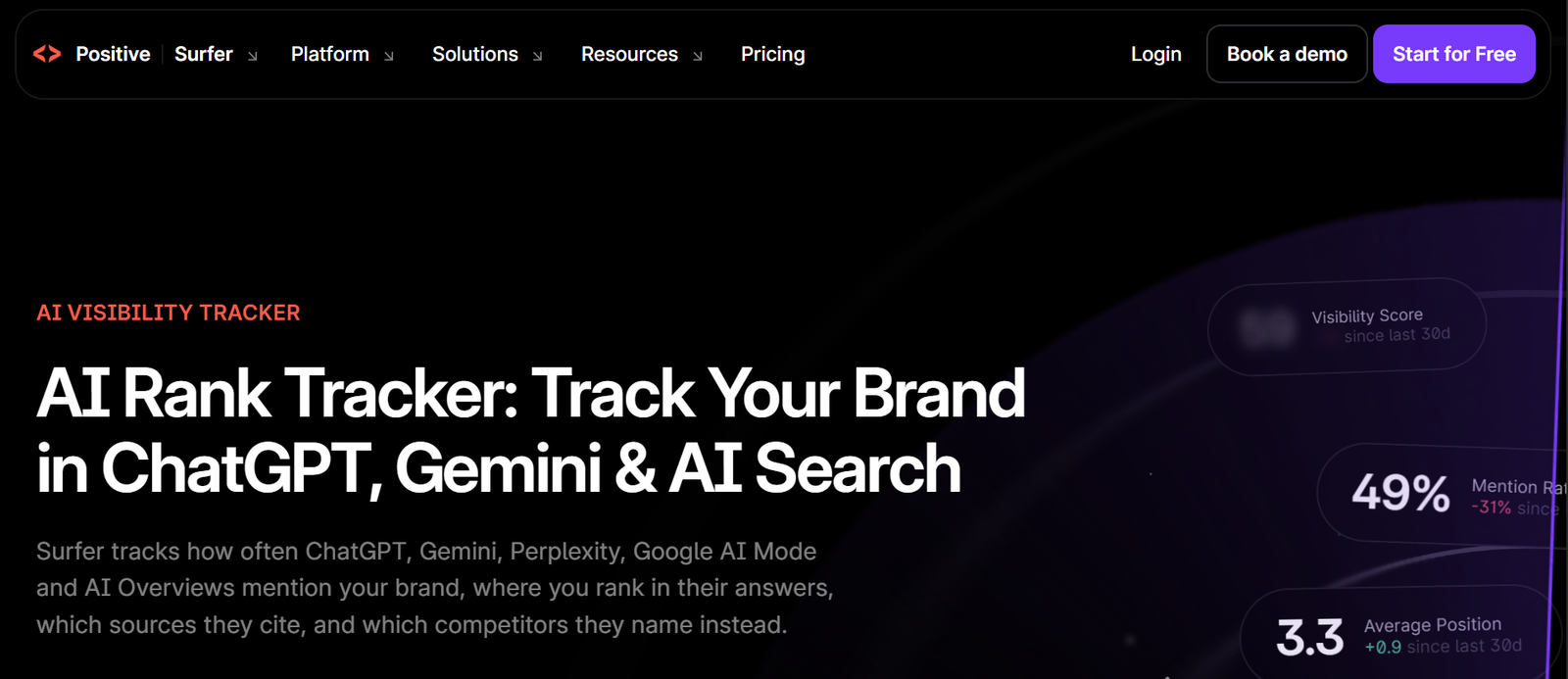
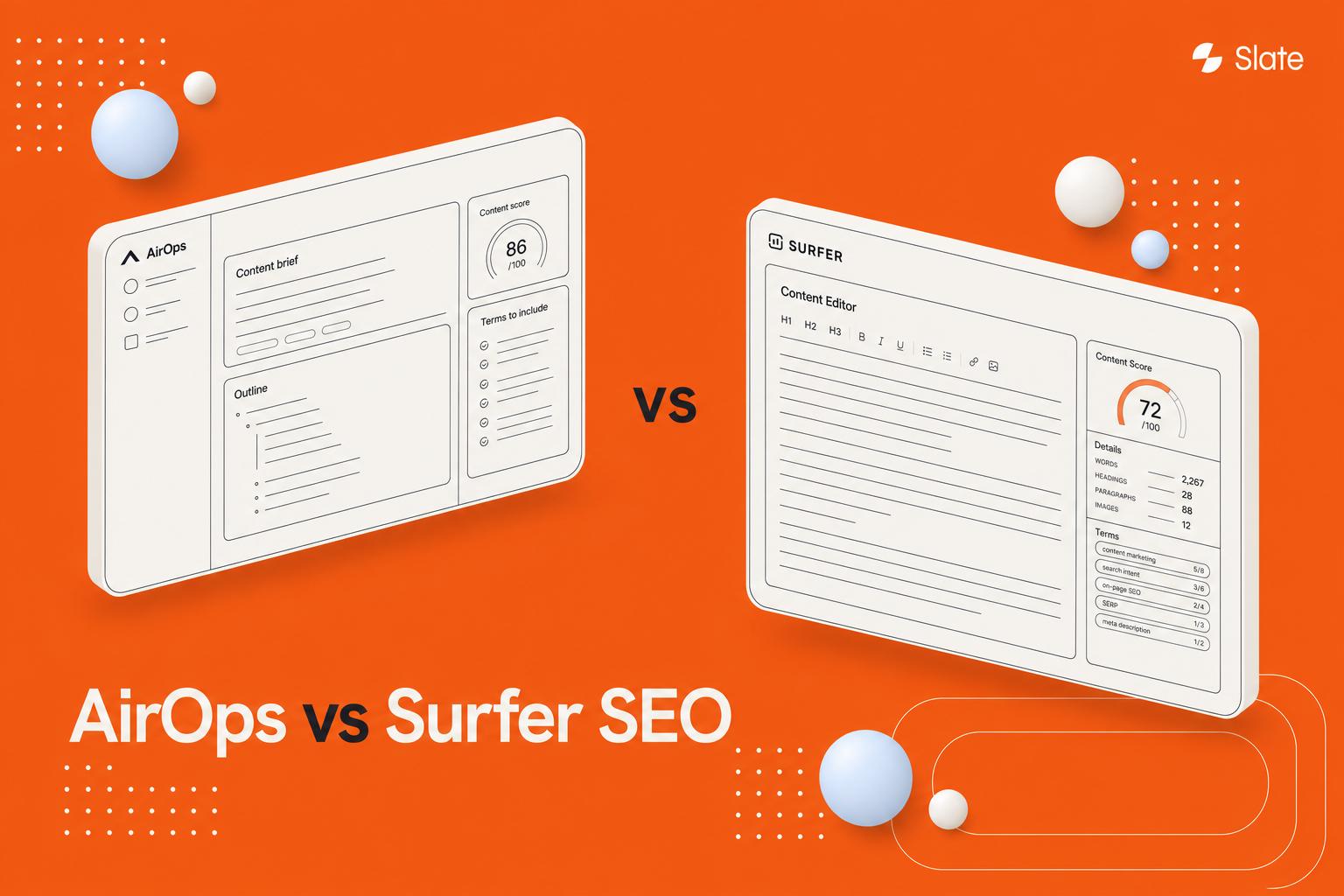
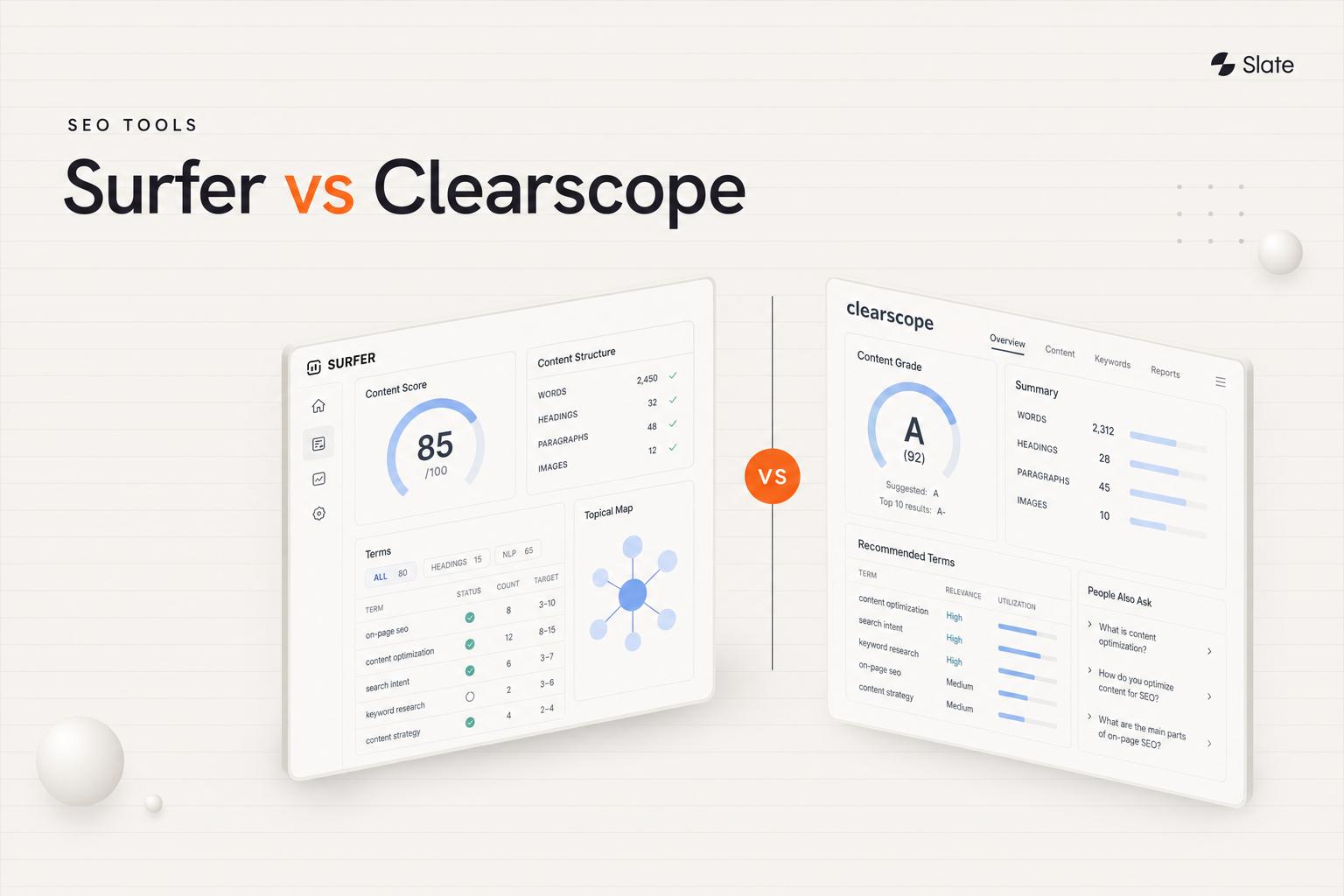
Surfer fits teams that need help improving individual pages against search competitors. It can reduce manual SERP comparison and editorial guesswork, especially when a writer or editor already knows which URL needs improvement. It also has a Content Audit that suggests pages worth refreshing and an AI Tracker for brand visibility in AI answers.
Best for: Page-level optimization.
Work it takes off your team: SERP comparison, topic recommendations, and optimization guidance.
Best-fit agency type: Team workflow tool.
Key strengths:
- It works inside content editing workflows.
- It helps writers compare pages against search competitors.
- It supports focused improvement of selected URLs.
Watch-outs:
- Publishing and outcome reporting still require other systems.
Single task or multi-step process: Single-page optimization.
Best AI tools for publishing and on-page implementation
The implementation gap starts after approval. Someone still has to move content into the CMS, preserve formatting, add metadata, check the page, coordinate review, and record what changed. Judge publishing tools by the handoffs they remove after the team makes the editorial decision.
Slate publishing - Best for moving approved content into client sites
Slate supports CMS publishing to Webflow, Sanity, WordPress, and Strapi. That helps when the bottleneck is moving approved work into the client site. Production, publishing, and performance tracking stay connected.
Best for: CMS implementation tied to organic-growth workflows.
Work it takes off your team: Publishing handoffs, bulk URL work, and performance follow-up.
Best-fit agency type: Multi-client / agency-capable platform.
Watch-outs:
- Human approval should happen before publishing.
- CMS permissions and client-specific QA still need ownership.
Pricing: See Slate pricing above.
Single task or multi-step process: Multi-step implementation workflow.
10. Zapier - Best for connecting an existing stack
Zapier is useful when an agency already has separate tools and needs to move data between them. It can reduce repetitive transfers and trigger-based handoffs. Agencies shouldn’t treat it as an editorial or quality-control system.
Best for: Cross-tool workflow automation.
Work it takes off your team: Notifications, transfers, triggers, and routine handoffs.
Best-fit agency type: Existing stack with other components.
Key strengths:
- It fills gaps where native integrations are missing.
- It connects existing tools.
- It can reduce repetitive operational steps.
Watch-outs:
- Automation does not guarantee content quality.
- More complex workflows require maintenance.
Single task or multi-step process: Multi-step automation layer.
Best AI tools for AI search monitoring, brand mentions, and citation visibility
Agencies should consider dedicated AI search monitoring when clients depend on organic discovery. Those clients need prompt tracking, brand mentions, citations, sentiment, and competitor comparison. They also need a route from visibility gaps to content, SEO, or outreach work.
Monitoring alone can create a new reporting obligation. The practical test for the best AI search monitoring tools for marketing agencies is whether visibility data leads to action. The team should create or refresh content, improve answer coverage, pursue relevant third-party mentions, and re-measure. Our guide to AI visibility tools for marketing agencies covers which signals to track and how to report them to clients. Slate’s AI Visibility docs explain how Slate calculates mentions, visibility score, and share of voice.
11. Profound - Best for enterprise AI visibility data
Profound is an enterprise AI visibility platform with deep prompt and citation data. Its Agents turn that data into briefs and AEO content and can publish to a CMS. It suits agencies that want strong measurement and can run broader SEO work in other tools.
Best for: Dedicated AI visibility tracking and reporting.
Work it takes off your team: Prompt monitoring, visibility analysis, reporting, and agent-based content drafting.
Best-fit agency type: Requires additional stack components.
Key strengths:
- It focuses on AI-search visibility measurement.
- Agents connect visibility data to content workflows.
- It can fit into a broader existing stack.
Watch-outs:
- Its Agents focus on AEO content, so broader SEO work may still need other tools.
- Content, outreach, publishing, and refresh still need ownership.
Single task or multi-step process: Monitoring and reporting, with agent-based content workflows.
Best AI tools for outreach and brand-mention opportunities
Earned mentions belong in organic growth when answer systems cite third-party sources. Outreach workflows need opportunity discovery, contact research, personalization, sending, and tracking. They also need a clear link back to the visibility gap that made the outreach worth doing.
12. Apollo - Best for prospecting and sequence management
Apollo fits agencies that need a dedicated prospecting and outreach operations tool. It is useful when the primary work is contact discovery, enrichment, sequencing, and activity tracking, while SEO-driven opportunity discovery lives elsewhere.
Best for: Prospecting and outreach operations.
Work it takes off your team: Contact discovery, enrichment, sequence setup, and outreach activity tracking.
Best-fit agency type: Team workflow tool.
Watch-outs:
- Deliverability and compliance still need agency governance.
- Don’t leave personalization entirely to automation.
Single task or multi-step process: Multi-step outreach process.
Best AI tools for creative, social, and video production
Creative production is separate from SEO and content operations. Agencies may need design templates, image workflows, video production, social calendars, and review systems. Organic-growth execution still needs separate tools for video or visual campaign approval.
13. Canva - Best for fast design production
Best for: Routine creative asset production.
Work removed: Visual templating (Canva), resizing, simple design production, and asset variation.
Best-fit agency type: Team workflow tool.
Watch-outs: Design output still needs brand review, licensing review, and client approval before publication.
14. Runway - Best for AI-assisted video production
Best for: Video ideation, generation, and editing support.
Work removed: Selected video creation and editing tasks (Runway).
Best-fit agency type: Team workflow tool.
Watch-outs: Video quality, usage rights, export requirements, and client approvals still need human review.
15. Buffer - Best for social scheduling
Best for: Social calendars and scheduled publishing.
Work removed: Calendar coordination, scheduled posting, and recurring social workflow management (Buffer).
Best-fit agency type: Team workflow tool.
Watch-outs: Scheduling does not decide what content is worth publishing or how social performance supports the client’s wider strategy.
Best AI tools for client reporting
16. Data Studio (formerly Looker Studio) - Best for client reporting dashboards
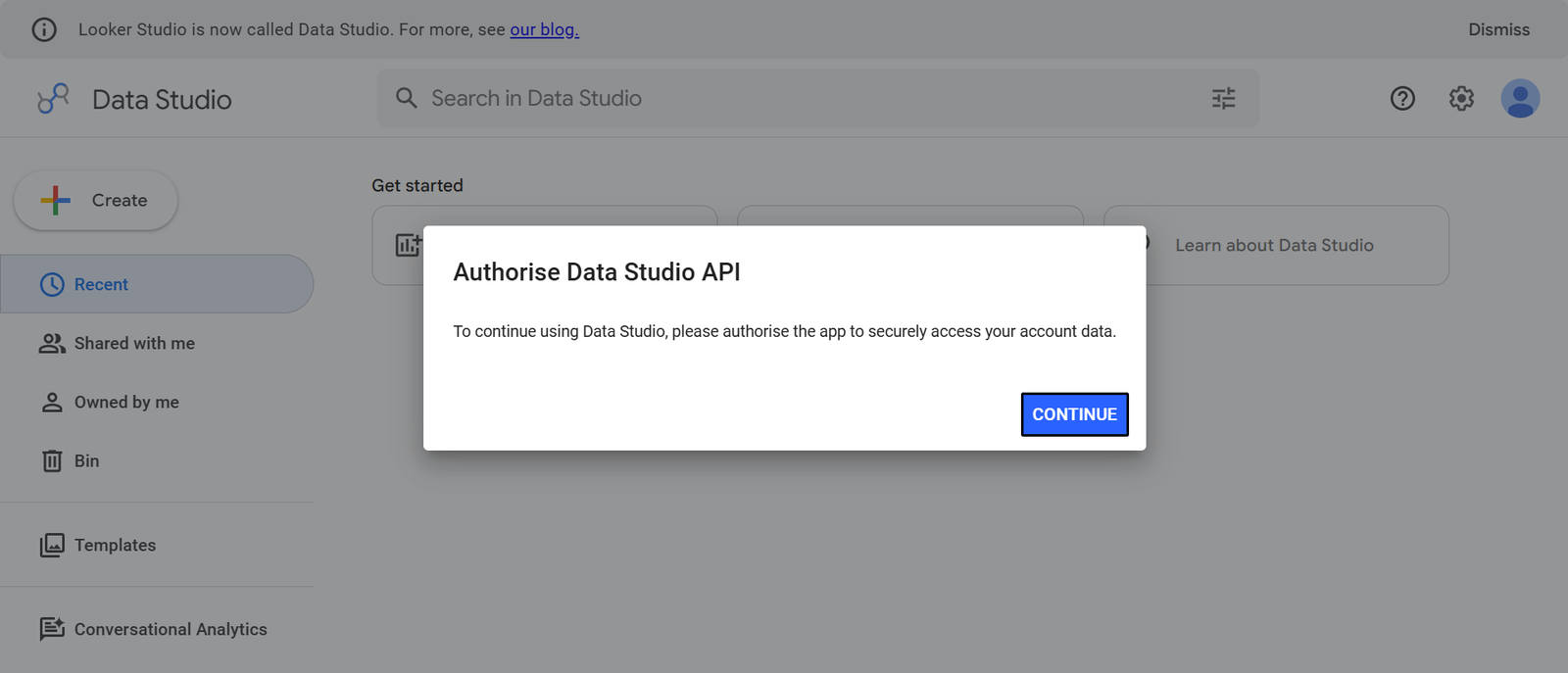
Google renamed Looker Studio back to Data Studio in April 2026. It’s free to start and connects to Search Console, GA4, and Google Ads, so agencies can build client dashboards without another subscription. It’s a reporting layer, so the analysis and recommendations still come from the team.
Best for: Client reporting dashboards.
Work removed: Recurring report assembly and visualization.
Best-fit agency type: Team workflow tool.
Watch-outs: Connectors, broken charts, and client-specific logic need ongoing maintenance.
Recommended AI stacks by agency type
The best stack is the smallest practical system that removes recurring handoffs under the agency’s main constraint. That constraint might be time, headcount, client count, governance complexity, publishing volume, or reporting pressure.
Solo consultant or freelancer
A solo consultant should prioritize flexible tools with fast setup and low workflow overhead. A general-purpose assistant can support ideation and drafting, while an editing or SEO tool can cover one repeated task. Add an end-to-end platform only when client work becomes recurring enough to justify ongoing monitoring, publishing, and refresh workflows.
Lean agency with a small content team
A lean team should avoid building a stack that creates more coordination than it removes. Often the same people research, brief, write, publish, and report. For them, a connected workflow can beat a separate point tool for each step.
SEO agency managing many client sites
An SEO agency managing many sites should prioritize bulk operations, multi-client visibility, CMS publishing, recurring refreshes, and repeatable reporting. Slate is the primary recommendation for this kind of agency. It connects AI visibility, SEO, content, publishing, Outreach, Pages, and refresh workflows in one system. Its Agency mode add-on gives each client a separate workspace. See how Slate works for marketing agencies.
Full-service agency with creative and organic teams
A full-service agency should keep creative and organic workflows distinct where the work genuinely differs. Design, video, and social production need their own review practices. Organic-growth teams need search visibility, content execution, publishing, outreach, and measurement systems.
Local and multi-location marketing agency
For local business marketing agencies, judge new AI SaaS tools in 2026 by whether they keep location-specific facts accurate at scale. Local and multi-location teams need per-location content workflows, listing consistency, and location-qualified AI-answer visibility. They also need approvals that stop teams from publishing inaccurate local claims.
What agencies should automate, and what should stay human
Agencies should automate repeatable, verifiable work such as research compilation, first drafts, bulk audits, monitoring, scheduled reporting, and publishing approved content. Strategy, verification, brand judgment, sensitive-data decisions, factual accuracy, and final approval should remain human-owned.
Agencies should review retention, model-training practices, access permissions, workspace separation, and contractual permission before placing client data into any AI system. Confidential strategy, proprietary analytics, regulated information, and personally identifiable data deserve stricter review than public marketing copy.
Each client account should also have documented brand-voice specifications. That means approved terminology, claims rules, source requirements, audience definitions, prohibited language, named reviewers, and publishing approval ownership.
Human review required: Source verification, brand-voice review, factual accuracy check, and named client approval before publishing.
How to decide between a point tool and an end-to-end platform
Agencies will still need specialist tools, especially for creative, video, social, deep research, and niche workflows. Integrated platforms become more valuable when the same work repeatedly crosses research, production, publishing, measurement, and refresh.
Buy a point tool for isolated work
If the task is occasional and doesn’t depend on much client context, a point tool can be the simplest choice. Examples include final-pass editing, quick design resizing, or one-off document analysis.
Buy an integrated platform for repeated multi-stage workflows
When work repeatedly moves from opportunity discovery to content production, CMS implementation, monitoring, outreach, and refresh, the handoffs are the cost. An integrated system cuts the number of places where the team loses context.
Build custom automation only when the process is stable
Custom automation is worth maintaining when the team has documented the workflow and it repeats often enough to justify the upkeep. If the process changes every week, the team may spend more time maintaining the automation than doing the work.
The costs a tool list doesn’t show you
- Teams enter the same data more than once.
- Reports use inconsistent definitions.
- The team loses context between insight and execution.
- Nobody clearly owns approvals.
- The agency pays separate bills and manages separate seats and permissions.
- Staff need retraining whenever tools change.
Build an agency system, not a longer tool list
Sort tools by work removed, and the shortlist gets clearer. A tool that only adds another place to write, review, export, or report may still be useful. Don’t confuse it with a system that removes recurring delivery handoffs.
Slate fits agencies that treat AI-search visibility as a strategic priority. It gives them one agent-driven system for insight, production, Outreach, publishing, measurement, and refresh. Agency and Enterprise plans are available.
Frequently asked questions
What are the best AI tools for marketing agencies?
The best AI tools for marketing agencies depend on the workflow bottleneck. Slate fits end-to-end agent-driven organic growth. Agencies may also use Ahrefs or Semrush for SEO research, Jasper or Writer for drafting, and Grammarly for editing. Canva covers design, Buffer covers scheduling, and Data Studio (formerly Looker Studio) covers reporting.
How can marketing agencies use AI?
Marketing agencies can use AI for research, briefs, drafts, content optimization, creative production, automated handoffs, AI-search monitoring, outreach, reporting, and recurring refreshes. Strategy, source verification, factual accuracy, brand judgment, client-data decisions, and final approval should remain human-led.
What AI tools are best for content marketing agencies?
Content marketing agencies need tools that cover more than writing. A practical stack supports research, briefing, drafting, optimization, publishing, measurement, and refresh. Writing platforms help create copy, while integrated organic-growth platforms help connect content work to visibility, implementation, and follow-up action.
Which AI marketing tools have free plans?
Free plans and trials vary by seats, credits, output, domains, tracked prompts, integrations, exports, and usage limits. Slate offers a 14-day free trial, and paid plans start with Growth at $499/month. Agencies should compare usable capacity before they check whether a free option exists.
Do agencies need a dedicated AI-search visibility tool?
Agencies should use dedicated AI-search visibility tooling when clients depend on organic discovery. Those clients need prompt tracking, citations, brand mentions, sentiment, competitor comparison, and an action path. Monitoring is most useful when it leads to content, SEO, publishing, or outreach work.
How should agencies choose between point tools and an all-in-one platform?
Use point tools for isolated or occasional work. Use an end-to-end platform when workflows repeatedly cross research, production, publishing, measurement, and refresh. The right choice is the one that removes handoffs without blurring who approves the work.
Can agencies use AI tools safely with client data?
Agencies can use AI tools safely only when retention, training practices, permissions, workspace separation, contractual approval, and review procedures are clear. Teams should keep confidential client material out of unsuitable tools. They should also set approval gates before AI-assisted work reaches clients or CMS platforms.
How much do AI tools for marketing agencies cost?
AI tool pricing can depend on seats, credits, domains, prompts, pages, contacts, profiles, exports, or automation operations. Slate starts at $499/month for Growth, with Scale at $999/month, Agency at $2,000/month, and Enterprise custom. Growth includes 1 user and 1 workspace, and Scale and above support multiple users and workspaces. Annual billing saves 20%, and Slate offers a 14-day free trial.