Content tooling looks different heading into 2026. Discovery no longer happens only on Google, AI answer engines now decide which brands get cited, and buyers want proof that a tool fits their workflow before they commit. This review covers Frase through a hands-on, workflow-first lens: research, briefs, optimization, AI writing, pricing, limitations, and alternatives.
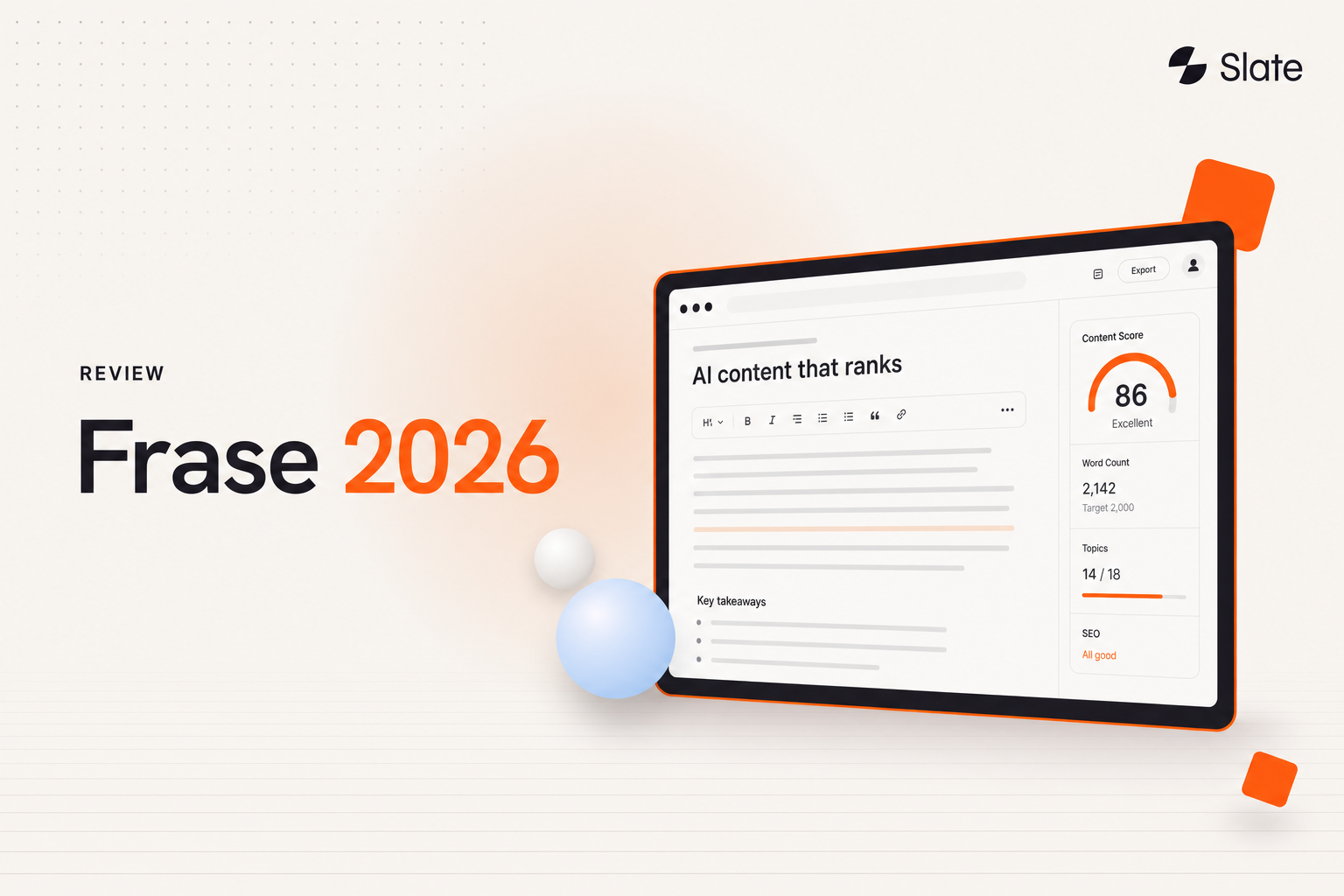
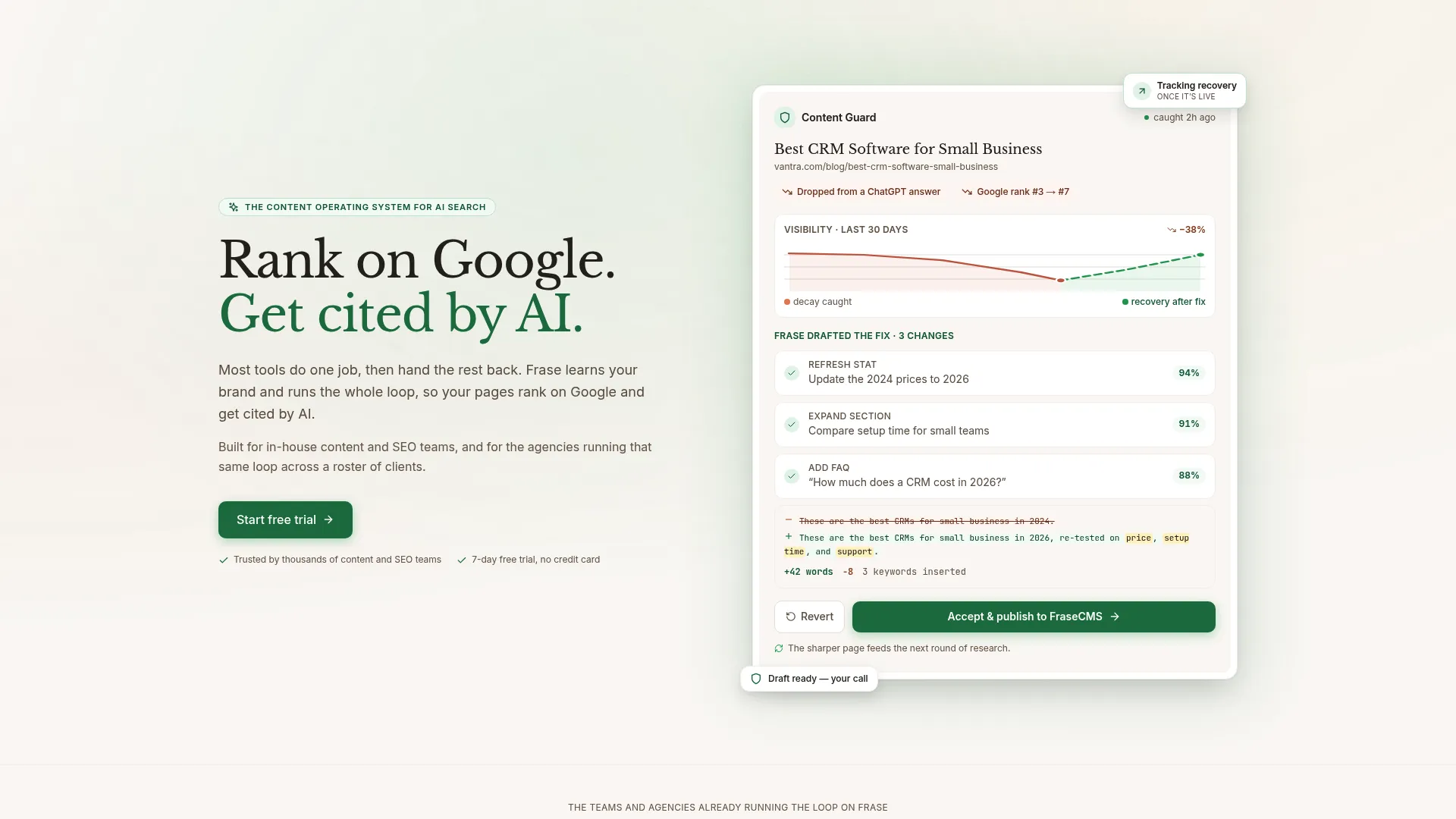
Frase is an agentic SEO and GEO platform used to research, write, refine, track, and publish content so it ranks on Google and gets cited by AI. Think of it as a research-to-brief and editing workflow tool, one piece of the stack instead of a stand-in for human strategy. For most teams, its strongest value is turning a keyword and SERP into a usable brief and draft fast.
If you want a broader market view before committing, see this roundup of Frase alternatives.
Key Takeaways
- Frase is best for content marketers, SEO leads, and small teams that want faster SERP research, briefs, and drafts in one place.
- It's weaker for buyers whose primary outcome is AI-search visibility tracking, citation-ready scaling, or strict content governance.
- Its strongest capability is speed: turning keyword and SERP data into a structured, usable brief in minutes.
- Its biggest practical tradeoff is the manual review burden for claims, citations, structure, and brand voice.
- Pricing starts at $39/mo (Starter, billed yearly), with a 7-day free trial across paid plans and 20% savings on annual billing.
- Frase positions itself as AI-search aware in 2026, but teams with heavy AI-visibility and governance needs should compare it against AI search visibility tools.
Quick Verdict: Is Frase Worth It in 2026?
Frase is worth it in 2026 if your central bottleneck is turning SERP research into briefs and first drafts. It consolidates research, outlining, scoring, and AI writing into one editor. It's less ideal if your priority is dedicated AI-search visibility tracking, citation governance, or large-scale refresh systems, where AI-search-first platforms fit better.
Best for: Content marketers, SEO leads, and small teams that produce briefs and SEO drafts often.
Skip if: You need AI-search visibility tracking and citation-ready scaling as a primary, governed outcome.
Pricing: Starts at $39/mo on Starter (billed yearly), with Professional and Scale tiers above it.
Free trial: A 7-day free trial runs across paid plans.
Standout features: Fast SERP analysis, strong research-to-brief generation, and an integrated editor with content scoring and AI writing.
Main caveat: Output still needs human review for accuracy, citations, structure, and voice.
What changed in 2026: Frase now positions itself as an agentic SEO and GEO platform, adding AI-search aware framing around its core research-to-brief workflow.
What Is Frase and What Is It Used For?
Frase is an AI-assisted SEO content platform used to turn a target keyword and SERP into research, content briefs, and optimized drafts inside a single editor. It focuses on SERP analysis, brief creation, topic coverage scoring, and AI-assisted writing. It skips full-stack tasks like keyword discovery and backlink analysis.
In practice, teams use Frase for:
- SERP research: Pulling top-ranking pages, headings, word counts, and entities for a query.
- Content briefs: Generating structured outlines with suggested H2/H3 sections, topics, and FAQs.
- On-page optimization: Scoring drafts against SERP-derived topic coverage.
- AI-assisted drafting: Producing first-pass paragraphs, intros, and FAQ answers inside the editor.
- Content scoring: Tracking topic coverage as a guidance metric, not a ranking guarantee.
- Content refresh: Comparing existing URLs against current SERP competitors.
For more on how briefs anchor a content process, see this guide on what is Frase used for in brief-led workflows.
How Frase Fits Into a Content Workflow
A typical content workflow runs research → brief → draft → optimize → refresh → publish. Frase maps cleanly to the first four stages and adds value where teams usually lose time.
Research and briefing are where Frase saves the most effort. Instead of opening a dozen competitor tabs, you get headings, entities, and questions in seconds.
Drafting and optimization are where the work moves around instead of vanishing. Frase speeds up a first pass, but editors still verify claims, tighten structure, and align voice. For a wider view of stitching tools together, see these content workflow tools for SEO content.
Who Should Use Frase, and Who Should Skip It?
Frase fits teams whose daily bottleneck is SERP research and brief creation. It's strongest for content marketers, SEO leads, and small agencies producing many SEO articles. It's a weaker primary choice for solo generalists who rarely build briefs, or for teams that need keyword discovery, backlink analysis, or dedicated AI-search visibility tracking as their core outcome.
Frase for Solo Creators and Freelancers
Solo creators get value if SEO briefs are a regular part of the job.
- Fit: Fast briefs and drafts cut hours of manual SERP analysis.
- Watchout: If you write occasional SEO articles, you may pay premium pricing for features you rarely use.
- Verdict: Strong for SEO-focused freelancers, weaker for general writers.
Frase for Content Marketing Teams
Content teams benefit most when brief volume is high and consistency matters across writers.
- Fit: Standardized briefs help less experienced writers align with SERP expectations.
- Fit: One workspace reduces switching between scraping tools, docs, and AI writers.
- Limitation: Editorial strategy, brand angle, and funnel-stage decisions stay manual.
- Limitation: Collaboration and governance controls are lighter than dedicated platforms.
Frase for SEO Leads and Agencies
SEO leads and agencies running many sites value the research-to-brief speed at scale.
- Fit: Reliable SERP-derived data supports faster, repeatable brief production.
- Fit: Topic coverage scoring gives writers structured on-page guidance.
- Watchout: Frase doesn't do keyword discovery, backlinks, or traffic forecasting.
- Watchout: You'll still pair it with a full SEO suite for those tasks.
Frase for B2B SaaS Content Teams
B2B SaaS teams can use Frase for briefs and drafts, but should weigh AI-search and governance priorities carefully.
- Fit: Useful for producing topic-complete articles aligned to current SERPs.
- Limitation: Citation readiness, brand-safe scaling, and AI-visibility reporting aren't its core focus.
- Consideration: Teams that treat AI search visibility as a primary KPI should compare AI-search-first platforms like Slate, which is built for AI search visibility tracking and governed, large-scale workflows.
How We Tested Frase for This Review
This review covers Frase through hands-on use of its core modules plus current product positioning and independent reviews, not a rewritten affiliate summary. The goal is workflow fit: where Frase saves time, and where it adds review work.
The evaluation covered the modules that matter to buyers:
- Research and SERP analysis: Accuracy, freshness, and usefulness of extracted data.
- Briefs and outlines: Structure quality and customization.
- Content editor and scoring: How scoring works and where it can mislead.
- AI writing: Draft quality and editing burden.
- Optimization suggestions: Relevance of on-page recommendations.
- Pricing clarity: Plan structure, limits, and trial scope.
- AI-search relevance: How well it supports 2026 visibility priorities.
- Output trust: What still needs human verification.
Each module was scored qualitatively against research quality, brief quality, optimization guidance, usability, collaboration, pricing clarity, AI-search relevance, and output trust. No numeric scores were fabricated; judgments are directional and evidence-led.
Frase Features Review (Tested Module by Module)
Frase is best understood by workflow stage, so each module below covers what it does well and where it adds review work. For a broader landscape view, see these Frase features in context.
Research and SERP Analysis
Frase's research panel is the foundation of everything else. You input a keyword, and it pulls the top Google results, extracting page titles, word counts, heading structure, and entities mentioned across competitors.
The data is current and fast. Suggestions return in seconds instead of minutes, which is why SEO practitioners adopt it. Instead of manually opening and reading 10 competitor pages, you get a consolidated view of what the SERP expects.
In practice, the research panel is strongest at surfacing common subtopics and questions. It tells you what high-ranking content tends to cover, which is what you need to shape a brief.
The boundaries are clear. Frase doesn't do keyword discovery, so you still choose the target keyword elsewhere. The analysis stays on content, so there's no backlink or traffic modeling. Treat it as a SERP intelligence layer that sits alongside a full SEO suite.
Content Briefs and Outline Builder
Brief generation is Frase's standout. It takes the headings and entities extracted from the SERP and composes a structured outline you can use as a working brief, typically with recommended sections, key topics, and questions to cover.
Speed is the edge. Frase can produce a usable brief in minutes, which is the entire value proposition for teams creating briefs at scale. For mid-difficulty keywords, the output is strong and saves meaningful research time.
Quality varies with keyword difficulty. For highly competitive or ambiguous queries, briefs can feel more generic and need a strategist's hand to add a unique angle, funnel-stage framing, and brand POV.
You can customize the outline by adding, removing, reordering, or merging suggested headings. That flexibility helps, because the best briefs combine Frase's coverage data with human editorial judgment. For a deeper comparison of brief tooling, see these content brief generators.
Content Editor and Content Scoring
Frase's editor combines writing with a live content score. The score reflects how well your draft covers the topics and entities surfaced from top-ranking competitors, acting as a topic-coverage alignment indicator. This reflects how entity-based SEO and topic coverage shape relevance signals across the SERP.
Used well, the score is a helpful sanity check. It flags relevant subtopics, questions, and entities you may have missed, which is useful for writers who don't live inside the SERP all day.
The risk is chasing the number. A high score doesn't guarantee rankings, and chasing coverage too hard can produce stuffed, competitor-mirroring content that reads worse for humans.
So treat the content score as a guide. Cover what genuinely serves the reader, use the score to catch true gaps, and resist forcing every suggested term into the draft. This aligns with Google's guidance on helpful, people-first content.
AI Writing Assistant
Frase's AI writer lives inside the editor and stays SEO-aware, drawing on the brief instead of generating from a blank prompt. It can draft paragraphs, intros, conclusions, or full sections based on the brief. For more on writing tools in this category, see this guide to the Frase AI writer review landscape.
For first drafts and templated sections like intros and FAQ answers, the output is genuinely time-saving. It gives writers a structured starting point that already reflects the brief's topic coverage.
Quality is less consistent on high-competition or nuanced topics. There, drafts read generic and need heavy rewriting to add depth and a point of view.
The honest takeaway: Frase's AI writer speeds up drafting, and it doesn't replace a writer. Expect to fact-check claims, verify citations, align tone, and restructure for readability before anything is publish-ready.
Optimization Suggestions and On-Page SEO
Frase's optimization guidance is derived from competitor headings and the entities most common in high-ranking content. The editor surfaces these as terms and topics you have or have not covered, feeding directly into the content score.
The suggestions are useful for ensuring topical completeness, especially for writers aligning quickly to a SERP. They keep drafts from missing obvious subtopics that competitors all address.
The scope is on-page and content-centric. Frase doesn't handle page speed, Core Web Vitals and page experience signals, schema, or backlink authority. Watch for suggestions that nudge toward awkward keyword insertions, and prioritize coherent prose over mechanically covering every term.
Content Opportunities and Gap Analysis
Frase is genuinely strong at article-level gap analysis. By comparing your planned or existing content against competitor headings and entity lists, it shows where rivals cover themes you don't.
That makes it useful for shaping a single piece to be more complete than what currently ranks. It answers a practical question: what is this SERP rewarding that my draft is missing? For a deeper toolkit comparison, see these content gap analysis tools.
Its scope stays at the article level instead of the whole site. Teams that want automated topic-cluster mapping or systematic internal-linking recommendations across an entire site will need to supplement Frase with broader content-strategy tooling.
Integrations and CMS Publishing
Frase fits into standard content workflows as the research-and-draft layer before content moves into a CMS or docs environment. Reviewers describe its integration ecosystem as limited but functional for typical content production.
For most teams, that means Frase works well as the research-and-draft layer, with publishing handled through your existing CMS. If direct, deep CMS publishing and API-level automation are priorities, confirm the current connections against your stack before committing.
Newer 2026 Positioning (AI Visibility and GEO)
Frase now positions itself as an agentic SEO and GEO platform aimed at content that both ranks on Google and gets cited by AI. That framing tracks how answer engines now drive a chunk of discovery alongside blue links.
The practical question is depth. Frase's core strength stays the research-to-brief and optimization workflow, and its content-coverage logic helps produce clear, extractable answers that AI systems tend to favor.
Buyers who treat AI-search visibility as a primary, measured outcome should compare carefully. Platforms built AI-search-first, like Slate, focus specifically on AI search visibility tracking across ChatGPT, Google AI Mode, Google AI Overviews, and Perplexity, plus governed workflows for large-scale refreshes. For a sense of the field, see these generative engine optimization tools. Frase helps you create SERP-aligned content; dedicated AI-search platforms focus on measuring and engineering citation presence.
Frase Pricing in 2026 (Plans, Limits, and Value)
Frase pricing starts at $39/mo on Starter (billed yearly), or $49/mo billed monthly. Professional is $103/mo yearly ($129/mo monthly), and Scale is $239/mo yearly ($299/mo monthly), with Enterprise priced custom. All paid plans include a 7-day free trial, and annual billing saves 20%.
For a wider pricing context across this category, see these Frase pricing review comparisons and these surfer SEO alternatives.
What Each Plan Is Best For
Pick a plan by brief volume.
- Starter: Best for solo creators and freelancers who build SEO briefs regularly but at modest volume.
- Professional: Best for content marketers and small teams that need higher output and more seats.
- Scale: Best for SEO leads and agencies producing briefs and drafts across many projects.
- Enterprise: Best for larger teams that need custom limits, controls, and support.
Seat Economics and Usage Limits Explained
Frase plans are differentiated by document and AI usage allowances plus user seats, which means cost scales with how much you research, draft, and how many people need access.
The key is matching quota to your throughput. If your team produces briefs daily, a higher tier usually pays for itself in saved research time. If usage is occasional, a lower tier or careful seat planning avoids paying for capacity you won't use. Confirm current document and AI limits on the official pricing page before committing.
What the Free Trial Lets You Test
A 7-day free trial runs across paid plans, which is enough time for a focused evaluation if you plan it.
During the trial, prioritize testing:
- Research quality: How accurate and complete the SERP analysis feels on your own keywords.
- Brief quality: Whether outlines are usable with light editing.
- Scoring usefulness: Whether the content score catches true gaps without forcing stuffing.
- Editing burden: How much rewriting AI drafts need on your topics.
- Limits and seats: Whether plan quotas match your throughput.
Frase Pros and Cons
Frase's strengths cluster around speed and consolidation: fast SERP research, strong brief generation, and an integrated editor with scoring and AI writing. Its limitations cluster around scope and trust: it isn't a full SEO suite, AI output is inconsistent on hard topics, and outputs still need human verification before publishing.
Pros
Solo and team value lines up clearly.
- Research-to-brief speed: Usable briefs in minutes, better than manual SERP analysis for that specific job.
- Reliable SERP data: Current, dependable extraction of titles, headings, and entities.
- Integrated workflow: Research, briefs, scoring, and AI writing in one workspace reduces tool-switching.
- Clear focus: A research assistant built for content teams instead of a generic AI writer.
- Onboarding ease: Structured guidance helps less experienced writers align with SERP expectations.
Cons and Limitations
The tradeoffs weigh most at scale and for AI-search use cases.
- Not a full SEO suite: No keyword discovery, backlink analysis, or traffic forecasting.
- AI output inconsistency: Drafts vary on high-competition or nuanced topics and need careful editing.
- Manual review burden: Claims, citations, structure, and voice all need human verification.
- AI-search depth: Less suited to teams whose primary KPI is measured AI-search visibility and citation governance.
- Scale governance: Collaboration and governance controls are lighter than dedicated platforms.
For a related view on these tradeoffs, see these Frase pros and cons comparisons.
The Citation and Output Trust Issue (What Still Needs Human Review)
Frase can't replace a content writer in 2026 for any team that cares about factual accuracy, citation integrity, and a differentiated brand voice. It speeds up research and first drafts, but humans still own claims, sourcing, structure, and final judgment. AI-assisted output gives you a starting point that still needs work before publishing.
This weighs heavier as AI search grows. Answer engines reward content that's clear, extractable, and trustworthy, and unverified claims or broken citations undermine exactly the credibility that earns citations. Understanding Google AI Overviews and answer engine behavior helps clarify what earns a citation. For tooling that monitors this, see these AI citation tracking tools.
Before publishing Frase-assisted drafts, review for:
- Factual claims and statistics: Verify against primary sources.
- External references and links: Confirm citations are real and accurate.
- Structure and UX: Check scannability, headings, and narrative flow.
- Brand voice: Align tone and POV so content doesn't read generically.
The 2026 priority is brand-safe, citation-ready scaling. Frase helps produce SERP-aligned drafts; the verification and governance layer stays human, which is where AI-search-first systems like Slate focus their workflows.
Frase for Content Refresh Workflows vs New Content
Frase works for both new content and refreshes, though it's primarily built around net-new brief and draft generation. Its SERP-comparison logic applies to refreshes too: plug in an existing URL, compare it against current top results, and surface coverage gaps to update. For systematic, large-scale refresh operations, though, you'll likely need additional structure. A look at dedicated content refresh tools helps here.
For net-new content, the value is obvious: research, brief, draft, and refine in one place. The workflow is fast and repeatable for individual articles.
For refreshes, the same coverage analysis helps realign older pages with current SERP expectations. Content decay recovery is one of the highest-return SEO moves, and Frase's gap analysis helps spot what a page now misses. The underlying content decay and traffic loss research explains why refreshes recover visibility.
The gap is systematization. Frase is strong per-article but doesn't brand itself as a refresh engine, so teams running hundreds of programmatic updates need a system for prioritization, bulk execution, and quality control across many URLs at once.
Frase vs Alternatives (Best-For Comparison)
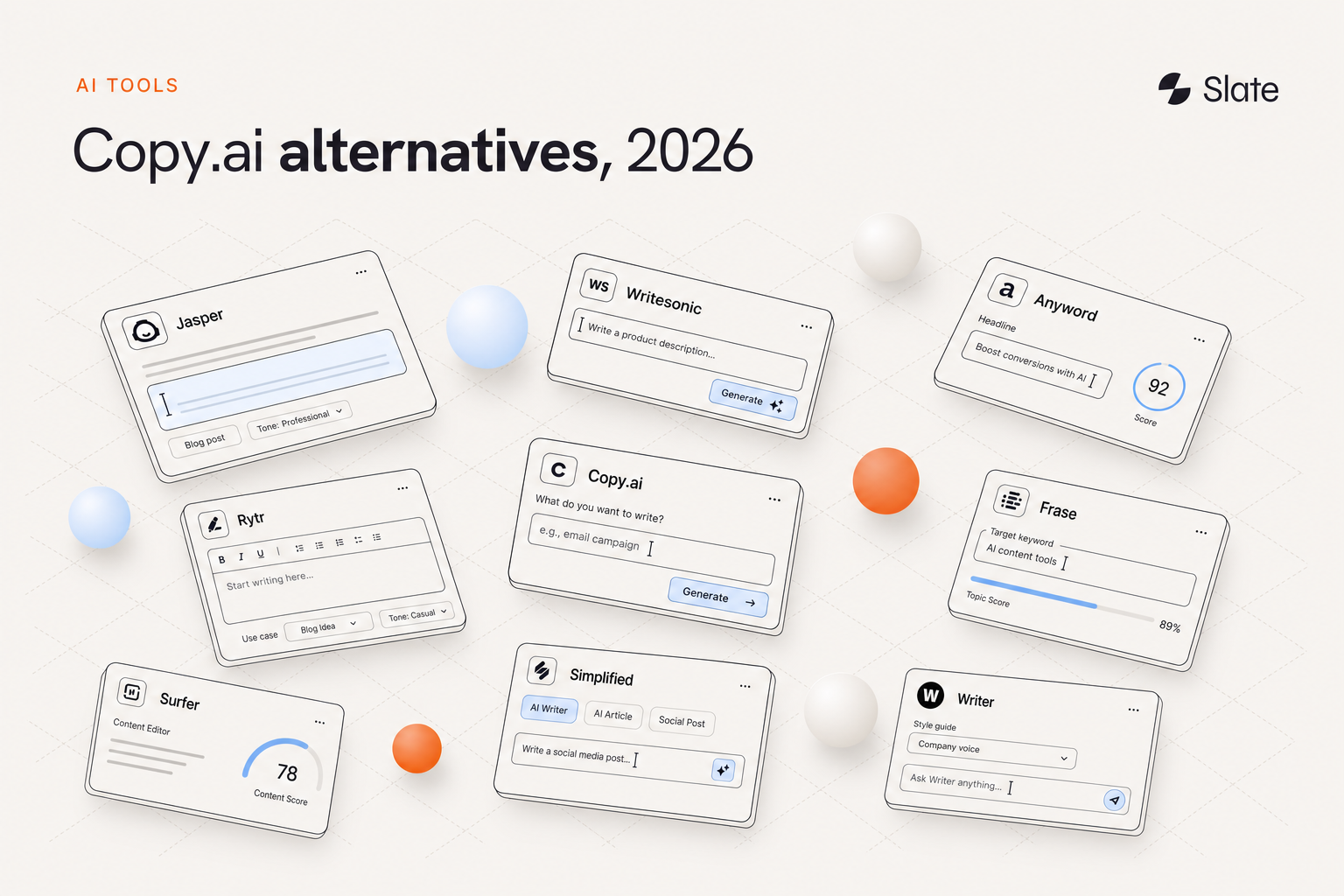
Frase competes with several content optimization and AI-search tools, and the right pick depends on your primary outcome. A common comparison is Frase versus Surfer SEO: Frase leans into research-to-brief speed and an integrated content assistant, while Surfer is known for editor-based optimization and AI-search visibility tracking. Neither is universally better; it comes down to whether briefs or in-editor optimization is your bottleneck.
Slate vs Frase
Slate and Frase solve different problems. Frase is built to turn SERPs into briefs and drafts. Slate is an AI search optimization and content engineering platform built to track AI search visibility across ChatGPT, Google AI Mode, Google AI Overviews, and Perplexity, then act on it through agentic, governed workflows. For teams whose priority is measured AI-search visibility, citation-ready content, and large-scale refreshes with brand control, Slate is built around that outcome from the start instead of retrofitted from SERP optimization.
Pricing: Starting at $199/mo.
G2 rating: 4.7/5
For a direct head-to-head, see this Frase.io review context breakdown.
Frase vs Surfer SEO
Surfer SEO is an AI search and content intelligence platform focused on creating and optimizing content with live data, plus AI search visibility monitoring. Frase leans toward research-to-brief speed, while Surfer leans toward in-editor optimization and visibility tracking. Many teams use a brief-first tool alongside an editor-optimization tool; choose based on whether briefs or on-page optimization is your bigger gap.
Pricing: Discovery $49/mo, Standard $99/mo, Pro $182/mo, Peace of Mind $299/mo, Enterprise from $999/mo. Listed prices are billed yearly.
G2 rating: 4.8/5
See the deeper Frase vs Surfer SEO comparison and this Frase vs Surfer SEO matrix.
Frase vs Clearscope
Clearscope is a content optimization platform that improves SEO and AI search visibility through topic discovery, optimization recommendations, and prompt tracking across ChatGPT and Gemini. It sits at a higher price point than Frase and is favored by teams that want premium content grading and visibility features. Frase competes on research-to-brief speed and a lower entry price.
Pricing: Essentials $129/mo, Business $399/mo, Enterprise custom. All plans include unlimited users and projects.
G2 rating: 4.9/5
If you're weighing this matchup, this guide on whether is Frase worth it helps frame the tradeoffs.
Frase vs MarketMuse
MarketMuse is AI-powered content planning and optimization software focused on topic authority, content inventory analysis, and competitor gap analysis. It leans toward planning at scale and content strategy modeling, where Frase leans toward fast, single-article briefs and drafting. Teams that need site-wide planning may prefer MarketMuse; teams that need quick briefs may prefer Frase.
Pricing: Free tier for 1 user with 10 queries/month; paid Optimize, Research, and Strategy plans with public prices not listed.
G2 rating: 4.6/5
For more, see these Frase pros and cons comparisons.
Frase vs NeuronWriter
NeuronWriter is a content optimization platform for SEO, AI Overviews, and answer engines, with SERP and competitor analysis, AI-assisted writing, and integrations like Google Search Console and WordPress. It's the budget-friendly option in this set and appeals to cost-conscious marketers and agencies. Frase competes on brief quality and workflow consolidation instead of price.
Pricing: Bronze $23/mo, Silver $45/mo, Gold $69/mo, Platinum $93/mo, Diamond $117/mo. Yearly billing saves 20%.
G2 rating: 4.4/5
Final Verdict: Should You Choose Frase in 2026?
Frase is a focused, capable tool that does one job exceptionally well: turning keyword and SERP data into usable briefs and first drafts fast. For content marketers, SEO leads, and small agencies whose bottleneck is research and briefing, it earns its place in the stack.
The honest tradeoff is trust and scope. Frase speeds up production, and it won't verify accuracy, enforce governance, or measure AI-search visibility on its own. Pair it with disciplined editing, and it's a strong research-and-draft engine. For a broader category view, see this guide to the best Frase SEO review alternatives.
If AI search visibility and citation-ready scaling are your priority, it's worth seeing how Slate approaches tracking, engineering, and refreshing content across AI and traditional search. Book a demo: https://slatehq.com/book-a-demo
Frequently Asked Questions
Is Frase Worth It in 2026?
Frase is worth it in 2026 for content marketers, SEO leads, and small teams whose bottleneck is turning SERP research into briefs and drafts. Its main strength is speed; its main caveat is that AI output still needs human review for accuracy, citations, structure, and brand voice before publishing.
What Is Frase Used For?
Frase is used to turn a keyword and SERP into research, content briefs, optimized drafts, and content scoring inside one editor. Core use cases include SERP analysis, outline and brief generation, on-page topic optimization, AI-assisted drafting, and content refreshes. It skips keyword discovery and backlink analysis.
How Much Does Frase Cost?
Frase starts at $39/mo on Starter (billed yearly) or $49/mo monthly. Professional is $103/mo yearly ($129 monthly), Scale is $239/mo yearly ($299 monthly), and Enterprise is custom. All paid plans include a 7-day free trial, and annual billing saves 20%.
Is Frase Better Than Surfer SEO?
It depends on your bottleneck. Frase is stronger for fast research-to-brief generation, while Surfer SEO leans into in-editor content optimization and AI-search visibility tracking. Teams focused on briefs often prefer Frase; teams focused on optimizing drafts in-editor often prefer Surfer. Many use both together.
Can Frase Replace a Content Writer?
No. Frase speeds up research, briefs, and first drafts, but it can't replace human judgment for factual accuracy, citation integrity, structure, and brand voice. Treat its AI output as a starting point that needs editing and verification before publishing.
Does Frase Help With AI Search Visibility?
Frase helps indirectly by producing clear, topic-complete content that AI systems can extract. In 2026 it positions itself as AI-search aware. But teams that need dedicated AI-search visibility tracking and citation governance as a measured outcome should compare it against AI-search-first platforms like Slate.
How Much Manual Editing Does Frase Output Need?
Expect meaningful editing. First drafts and templated sections are usable quickly, but high-competition and nuanced topics often read generic and need rewriting. Plan to fact-check claims, verify citations, restructure for readability, and align brand voice before any Frase-assisted draft is publish-ready.
What Should You Test During the Frase Free Trial?
Use the 7-day trial to test research accuracy on your own keywords, brief usability with light edits, content-score usefulness without stuffing, AI editing burden on your topics, and whether plan limits and seats match your throughput. Those five checks reveal workflow fit fast.