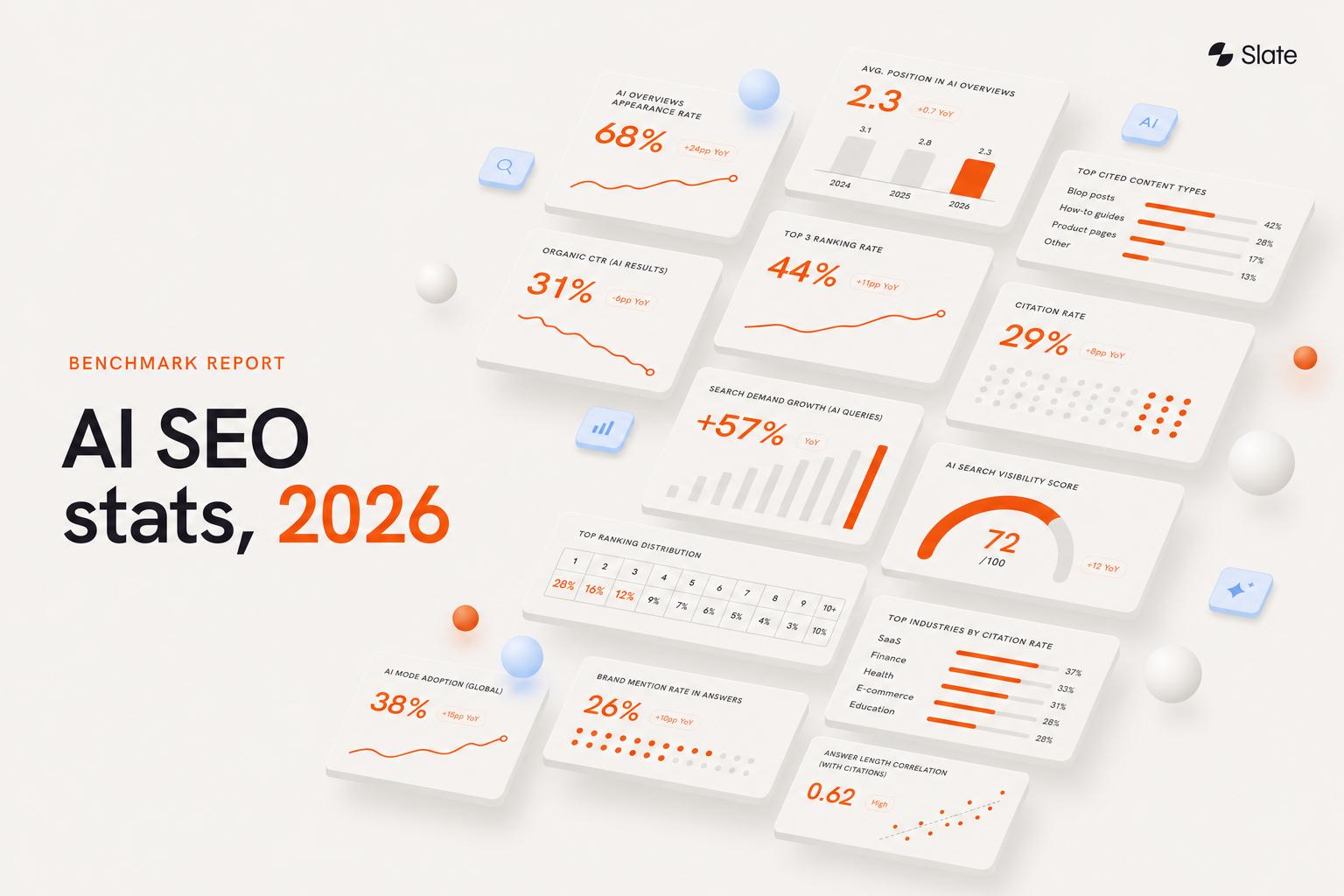
AI citation tracking tools help content teams see whether their brand, content, and URLs appear inside AI-generated answers. The question is no longer only “Where do we rank?” It’s also “Are we cited when buyers ask AI systems for recommendations, explanations, comparisons, and alternatives?”
AI citation tracking tools monitor brand mentions and citations, along with cited URLs inside AI-generated answers. The best tools show which prompts trigger visibility, which sources are selected, where competitors appear instead, and how teams can turn citation gaps into content, publishing, outreach, and measurement actions.
Adobe reported that AI-driven traffic to U.S. retail sites grew 269% year over year in March 2026. Its B2B research also projected nearly 1,100% growth in the share of B2B searches done in LLMs over the following two years, which makes AI search visibility a measurable channel.
Key Takeaways
AI citation tracking is becoming a core discipline for content leaders who need visibility beyond conventional search rankings. The best AI citation tracking tools do more than report brand presence; they connect prompt-level insight to daily work.
- What it tracks: AI citation tracking monitors brand mentions, citations, cited URLs, and competitor appearances inside AI-generated answers.
- Why it differs: AI citations vary by prompt and may appear as a link, mention, or unattributed source influence.
- Top pick: Slate ranks first for teams that need citation data connected to content, publishing, outreach, and measurement.
- Coverage: Buyers should prioritize the AI surfaces their audience uses and confirm each vendor’s monitored engines.
- Prompt data: Aggregate visibility scores can hide the exact prompts, pages, and competitor URLs driving outcomes.
- Action: Measurement alone doesn’t improve citations; teams need a system for creation, refresh, publishing, and authority work.
What Is AI Citation Tracking?
AI citation tracking is the practice of monitoring when AI search engines and large language models mention, cite, or link to a brand and its website content inside generated answers. It records which prompts trigger visibility, which URLs are cited, where competitors appear instead, and how that visibility changes over time.
This differs from rank tracking because generated answers don’t produce a stable position-one result. The measurement unit is the prompt, the answer, and the source set selected at that moment.
For content leaders, the useful output isn’t a vanity score. It’s a map of where the brand is included, where it’s missing, and which content or authority gap may explain the difference.
A commercial AI citation tracking workflow usually captures:
- Prompt and model: The question asked, the answer surface tested, and the segment it belongs to.
- Brand presence: Whether the brand appears and how it’s framed.
- Cited URLs: Which brand, competitor, or third-party URLs are shown as sources.
- Change over time: Whether visibility, citation frequency, and cited pages improve or decline.
Academic citation tracking is a separate category. A research citation tool helps verify scholarly references, publications, or evidence trails; a commercial AI citation tracking tool helps marketing teams understand brand visibility in generative answers.
AI Mention Vs. AI Citation Vs. Cited URL: What’s The Difference?
A brand mention, AI citation, cited URL, source use, referral visit, and answer inclusion are related signals, but they shouldn’t be reported as the same metric. Each one answers a different question for content, SEO, and growth teams.
Don’t confuse: Report mentions, citations, clicks, referral traffic, and answer inclusion as separate signals. One prompt result doesn’t prove durable visibility.
The cleanest reporting model separates these signals. A weekly content report might show prompt coverage and citation share, while analytics reporting shows AI referral visits. Treating them as interchangeable will overstate certainty and make the program harder to defend.
How Is AI Citation Tracking Different From Backlink Tracking?
Backlink tracking measures hyperlinks that site owners publish on web pages. AI citation tracking measures when a model references a brand, source, or URL inside a generated answer. A citation may include a clickable link, a brand mention, or neither, and it can change as models, prompts, and source selection change.
This is why AI citation reporting should be trend-based and prompt-segmented. A cumulative citation count can look precise, but it often hides volatility by prompt, market, intent, and answer surface.
How Do AI Citation Tracking Tools Work?
Most AI citation tracking tools follow a similar measurement pattern: They define a prompt set, run it against supported AI surfaces, parse the answers, and report visibility by brand, URL, topic, and competitor. Tool quality depends on coverage, sampling, attribution, and what happens after a gap is found.
- Define a prompt set: Start with buyer, category, problem, comparison, alternative, use-case, and branded questions. The prompt set is a hypothesis about buyer behavior, not a complete map of all AI demand.
- Run prompts on a schedule: The tool re-runs equivalent prompts across supported engines at a defined cadence. Model behavior can vary by time, surface, locale, and prompt wording.
- Parse the answer: The system extracts mentions, cited sources, and linked URLs where available. This is where teams separate general brand visibility from specific page-level citation wins.
- Classify sources: Citations are mapped to the brand domain, competitor domains, and third-party domains such as publishers, review sites, documentation, and community pages. Classify Reddit as a source ecosystem, not as an AI answer engine.
- Benchmark and trend: Teams compare prompt coverage, citation frequency, citation share, and changes over time. These metrics are most useful when segmented by topic, funnel stage, and competitor set.
- Route to action: The strongest programs convert missing citations, declining pages, and competitor wins into briefs, refreshes, net-new content, publishing tasks, and outreach work.
AI answers are non-deterministic, so teams should avoid treating a single answer as a fixed ranking. Sampling depth, model versions, and locale settings can affect results, which is why repeated measurement and clear prompt taxonomy are important.
How We Evaluated These AI Citation Tracking Tools
Content leaders evaluating AI citation tracking tools should look past the dashboard screenshot. A useful platform has to explain where the brand appears, where competitors appear, which URLs are cited, and what the team should do next.
The evaluation criteria used in this guide were:
- AI engine and answer-surface coverage
- Citation detection depth across mentions, citations, and cited URLs
- Prompt-level monitoring and segmentation
- Competitor benchmarking and citation-gap analysis
- Historical trends, alerting, and reporting
- SEO and analytics context
- Execution capability across briefs, content updates, publishing, outreach, and refresh
- Pricing transparency and team-size fit
A tool can be valuable even if it’s narrow. The mistake is buying a narrow tracker when the team needs an operating system for AI search visibility, content production, and measurement.
Quick Comparison: The Best AI Citation Tracking Tools In 2026
The best AI citation tracking tool depends on whether the team wants monitoring, enterprise reporting, or an execution layer that turns citation gaps into completed work. Slate ranks first because it connects AI Search Analytics with content workflows, publishing, outreach, and measurement.
The 10 Best AI Citation Tracking Tools For Content Leaders
The tools below are ordered by how fully they support the loop from citation discovery to operational improvement. Slate receives the deepest review because its product details cover AI tracking, content workflows, CMS publishing, outreach, Semrush data, and pricing.
1. Slate: Best For End-To-End AI Search Visibility And Content Execution
Best for: SEO leaders, content operations teams, agencies, and organic-growth marketers that need AI citation tracking connected to execution.
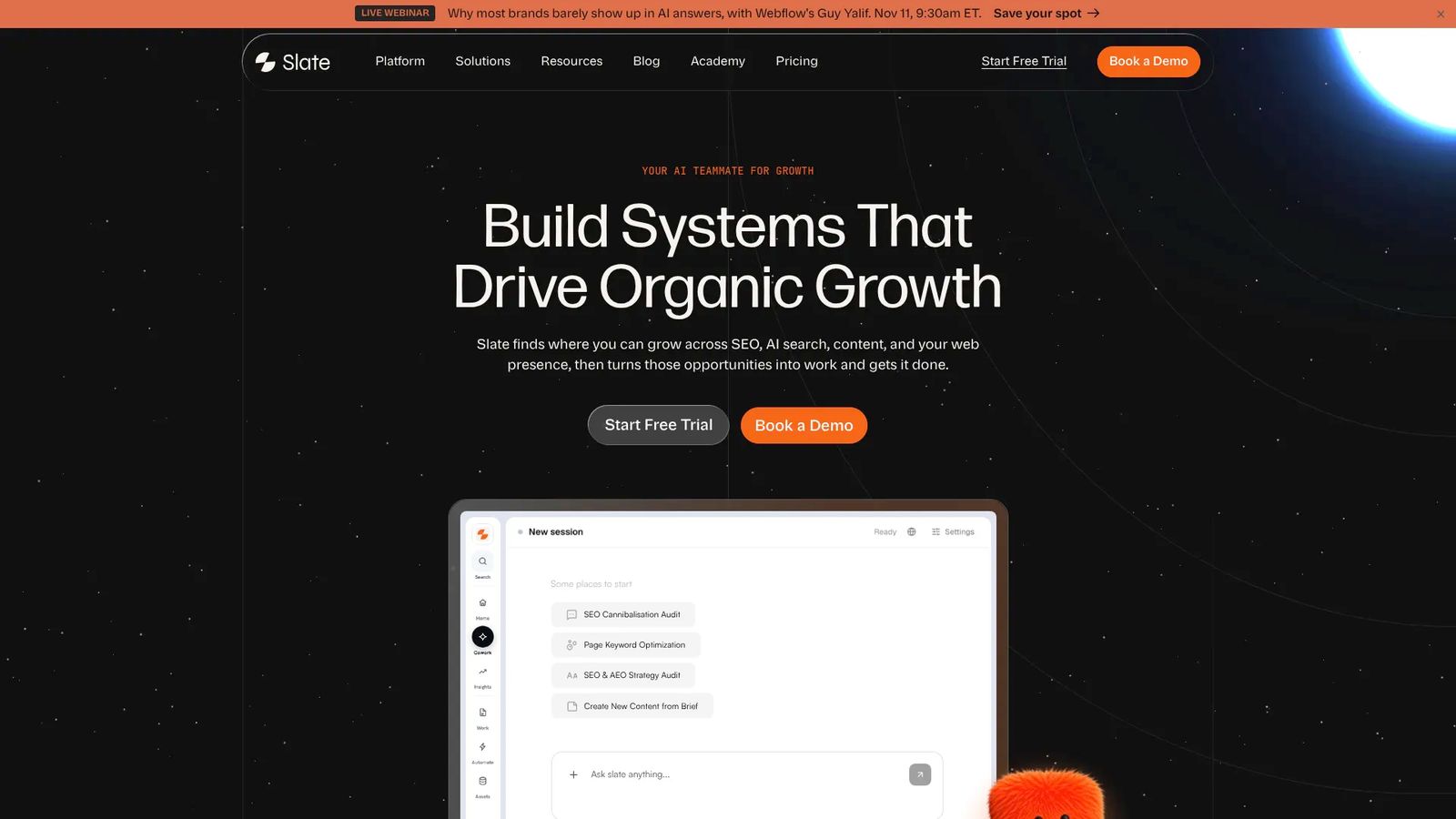
Slate is an end-to-end, agent-driven content, SEO, and AI search platform. It is built for teams that don’t want AI visibility to become another dashboard sitting beside their SEO tools, content briefs, spreadsheets, CMS, and outreach workflows.
Why it ranks first: Slate covers the full operating loop: Opportunity discovery, content improvement, creation, publishing, measurement, and refresh. The hard part of AI citation tracking is rarely seeing a gap once. It’s turning that gap into prioritized work, publishing the change, and measuring whether visibility improves.
AI visibility: Slate’s AI Search Analytics, also called AI Tracker, tracks ChatGPT, Google AI Mode, Google AI Overviews, and Perplexity on every plan. Claude and Gemini are add-on answer packs.
Opportunity discovery: Slate’s Opportunities covers keyword gaps, AI visibility topic changes, suggested prompts, third-party outreach targets, and content decay. This helps teams separate a missing-citation problem from a content freshness problem, a prompt coverage problem, or an off-site authority problem.
Execution layer: Slate includes Cowork for natural-language delegation, Workflows for repeatable multi-step automation, Sheets for bulk content and SEO operations, and SuperBlocks for reusable workflow components. In practice, this gives content teams a way to move from “competitor is cited instead” to “refresh this page, publish it, and monitor the affected prompts.”
Content and publishing: Slate supports CMS publishing to Webflow, Sanity, and WordPress. That’s important for AI citation programs because publishing friction often turns measurement into stalled analysis.
SEO context: Semrush data is built in. Pages gives teams a place to connect page-level performance with AI visibility work, so citation monitoring doesn’t have to sit outside organic performance reporting.
Outreach: Slate includes Outreach, which supports the authority-building side of AI visibility work. When a gap is driven by third-party source dominance instead of missing first-party content, outreach becomes part of the operating system instead of a separate handoff.
Pricing: Growth $499/month, Scale $999/month, Agency $2,000/month, Enterprise custom. Growth includes 1 user. Scale and above offer custom user counts. Annual billing saves 20%, and a 14-day free trial is available.
Consider another option if: The team only needs a lightweight weekly monitor and already has content production, CMS publishing, outreach, and reporting fully handled elsewhere.
Bottom line: Slate is the best AI citation tracking tool for teams that need a system of action, not only a system of observation. It is strongest when citation data needs to become briefs, refreshes, published updates, outreach, and performance reporting in one platform.
2. Profound: Best For Enterprise-Grade AI Visibility Analytics
Best for: Enterprise teams evaluating AI visibility analytics at organizational scale.
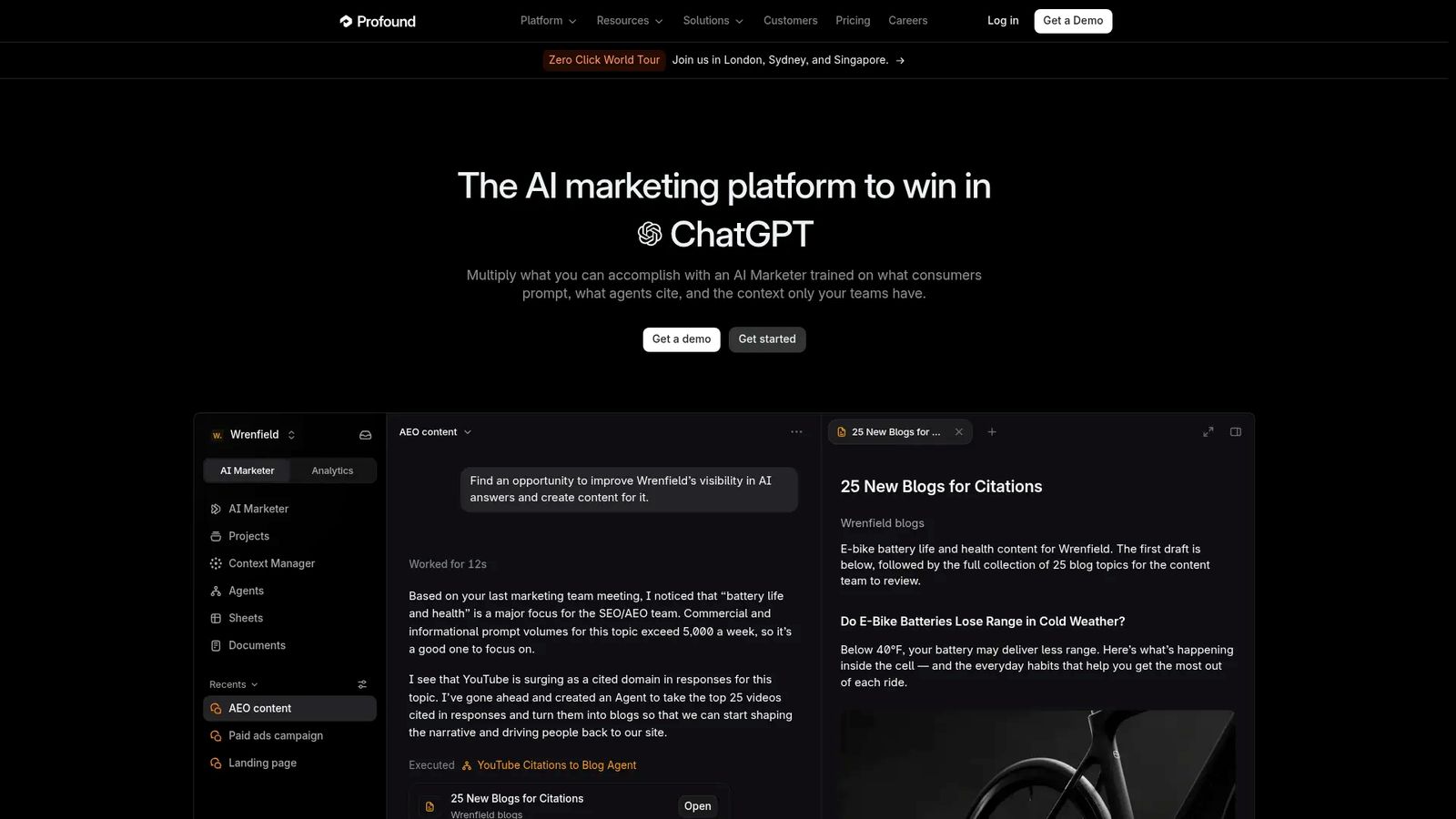
Profound belongs on the shortlist when the buying team’s first priority is executive-level visibility into how a brand appears across AI-generated answers. For larger organizations, the evaluation should focus less on whether the dashboard looks polished and more on whether the methodology can support repeatable reporting across topics, markets, competitors, and stakeholders.
Key evaluation areas: Ask how prompts are grouped, how frequently they are sampled, how cited URLs are captured, and how competitor visibility is calculated. Enterprise teams should also examine permissioning, reporting exports, governance workflows, and whether the platform can support multiple brands or business units.
Strengths: Profound has Answer Engine Insights for analyzing how brands and competitors appear in AI platforms. Its Trial plan includes daily analysis for a limited prompt set across ChatGPT, Gemini, and Google AI Overviews. Self-serve Starter ($99/month) and Growth ($399/month) plans sit in its in-app checkout, while Enterprise supports broader answer-engine tracking.
Tradeoffs: Profound now drafts content with Agents and publishes to Webflow and Contentful through its Documents editor, so test how far that covers your workflow. Outreach isn't part of the product.
Bottom line: Profound is a fit to assess when enterprise AI visibility reporting is the buying motion. Content leaders should pair that evaluation with a clear plan for how insights become published content and authority work.
3. AthenaHQ: Best For Self-Serve Tracking With Built-In Actions
Best for: Teams that want a free starting tier and a clear path to broader engine coverage and recommendations.
AthenaHQ tracks brand visibility across AI search and adds actions for improving it. Its free Essential plan covers ChatGPT, Perplexity, Google AI Overviews, Gemini, and Microsoft Copilot, and the Starter plan on AthenaHQ's plans page expands to 11 models, including Google AI Mode, Claude, Grok, DeepSeek, Meta AI, and Mistral.
Key evaluation areas: AthenaHQ prices on credits, where one credit equals one AI response, so model the volume your prompt set needs each month. Starter adds GA4 and Google Search Console integrations, on-page and off-page actions, and a content optimization agent.
Strengths: The clearest self-serve entry path in this list, with Enterprise controls that include SAML and OIDC SSO, an audit log, and a 2-hour SLA.
Tradeoffs: AthenaHQ lists Shopify and Webflow integrations, so confirm whether they publish content or only sync data before relying on them for execution.
Pricing: Essential free (300 credits); Starter $295/month (3,600 credits); Enterprise custom. Annual billing saves 17%.
Bottom line: AthenaHQ fits teams that want to start free and grow into deeper coverage and built-in recommendations.
4. Scrunch: Best For Changing What AI Crawlers See
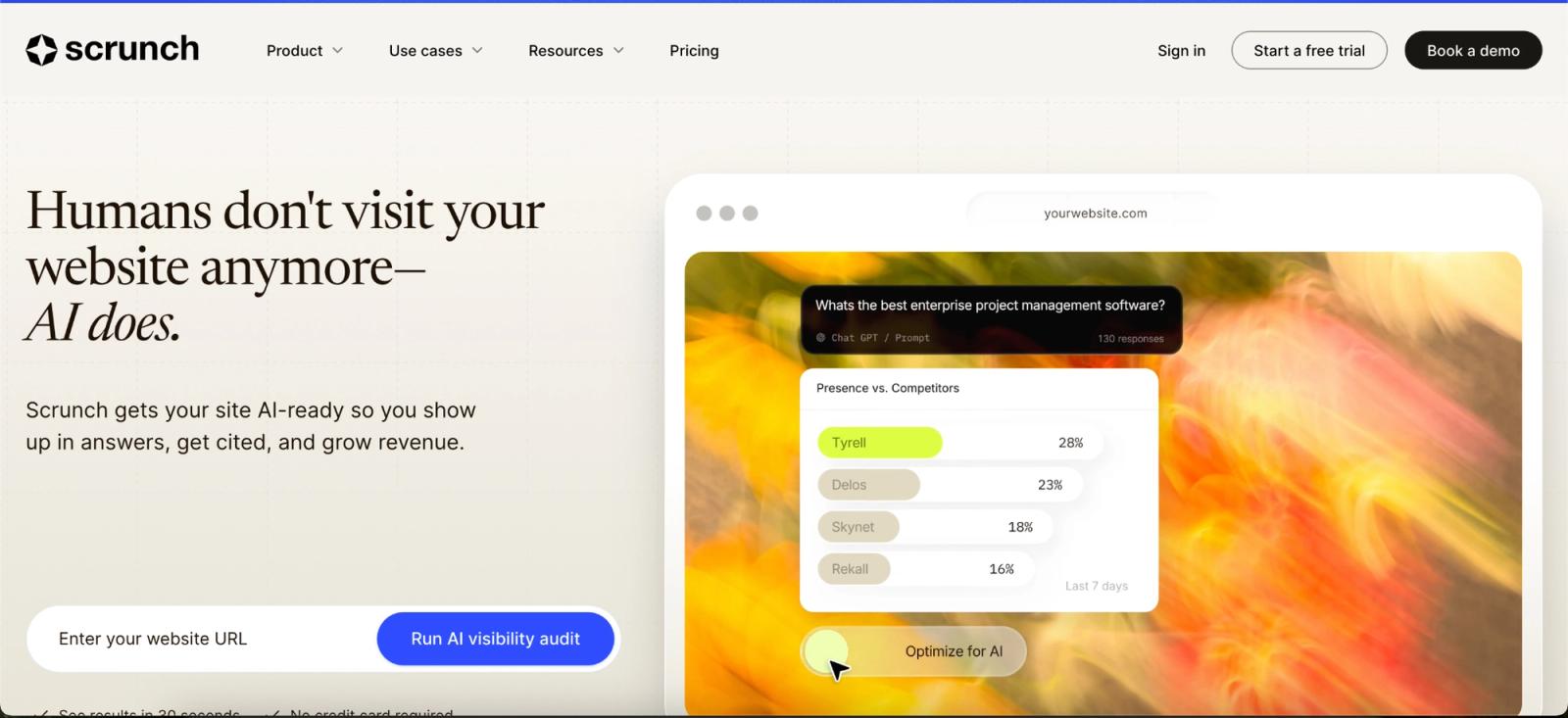
Best for: Enterprise teams that want to shape how AI agents read their site as well as monitor the answers.
Scrunch, now a Sitecore company, monitors brand visibility across ChatGPT, Claude, Gemini, Perplexity, Google AI Mode and AI Overviews, and Meta AI, with citation and agent-traffic metrics.
Key evaluation areas: Its Agent Experience Platform (AXP) detects AI agents at the edge and serves them an AI-optimized version of your pages while human visitors see the normal site. AXP sits on the Enterprise plan, so price that tier if it’s the reason you’re buying.
Strengths: AXP changes what AI crawlers receive, a step past reporting that the other monitors here don’t take.
Tradeoffs: Serving a parallel, machine-readable version of your site is a newer approach, so test it against your SEO and content governance before rollout.
Pricing: Core $250/month (125 unique prompts); Enterprise custom, adding AXP, SSO, and API access, per Scrunch pricing.
Bottom line: Scrunch fits teams that want to monitor AI answers and change what AI agents read.
5. Siftly: Best For Citation Rate And Share-Of-Voice Reporting
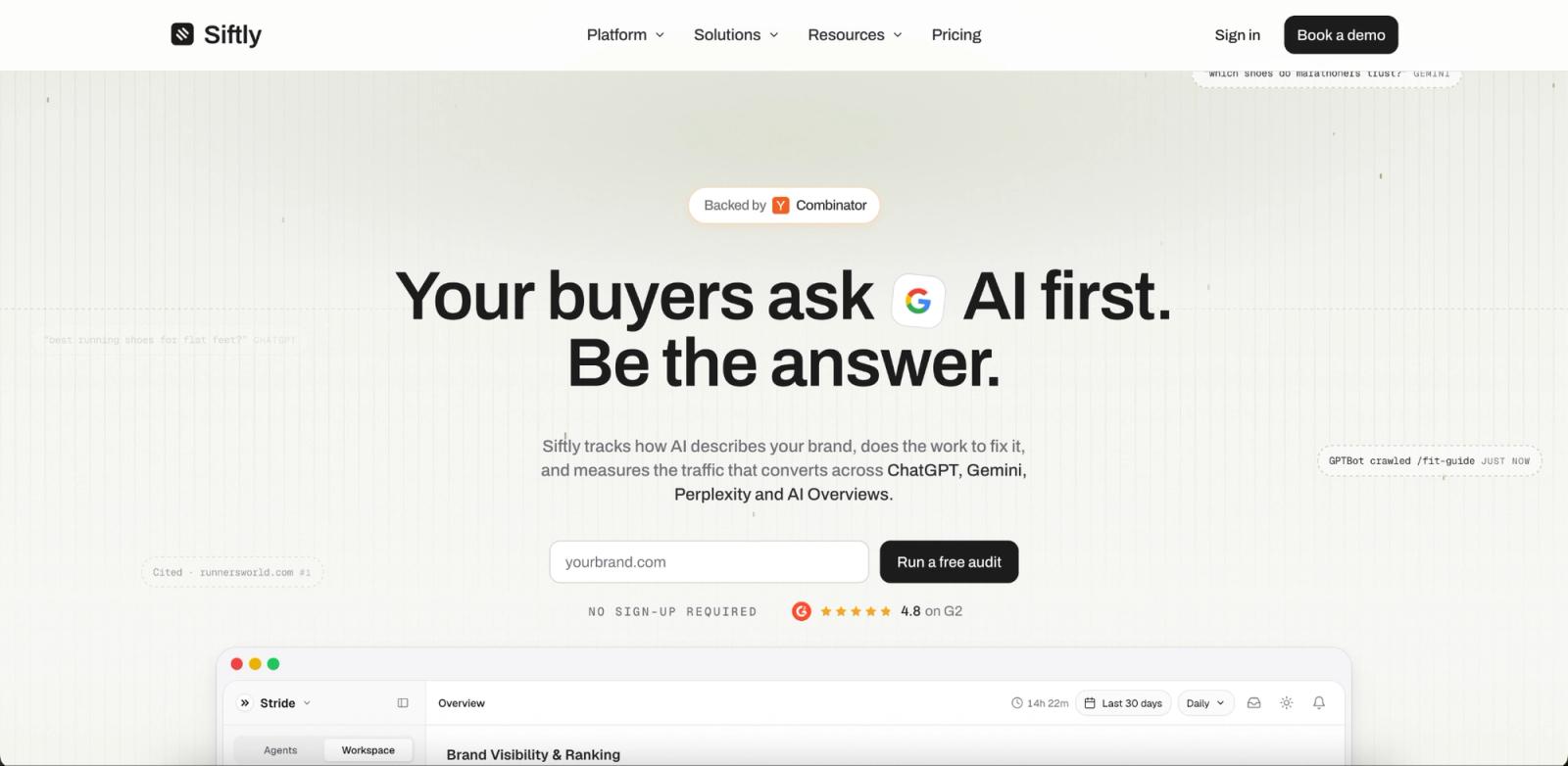
Best for: Teams exploring citation-rate measurement as a reporting model.
Siftly tracks brand visibility, citations, and share of voice across ChatGPT, Google AI Overviews, Perplexity, and Claude, and adds a GEO content layer; its Starter plan covers three engines. For content leaders, citation rate is useful when it is defined carefully and based on repeated samples from a defined prompt set.
Key evaluation areas: Ask how repeated runs are handled, how prompts are segmented, and whether the tool reports URL-level citation data or only brand-level visibility. Teams should also confirm whether competitor citation rate can be measured against the same prompt universe.
Strengths: Citation-rate framing can help teams avoid overreacting to a single answer. It pushes the program toward frequencies and trends instead of isolated screenshots.
Tradeoffs: Citation rate depends heavily on the prompt set. If the prompt portfolio is too narrow, the metric can create false confidence.
Bottom line: Siftly is worth assessing when the team wants to measure AI citation frequency with a clear sampling model.
6. Semrush: Best For Pairing Traditional SEO Data With AI Share Of Voice
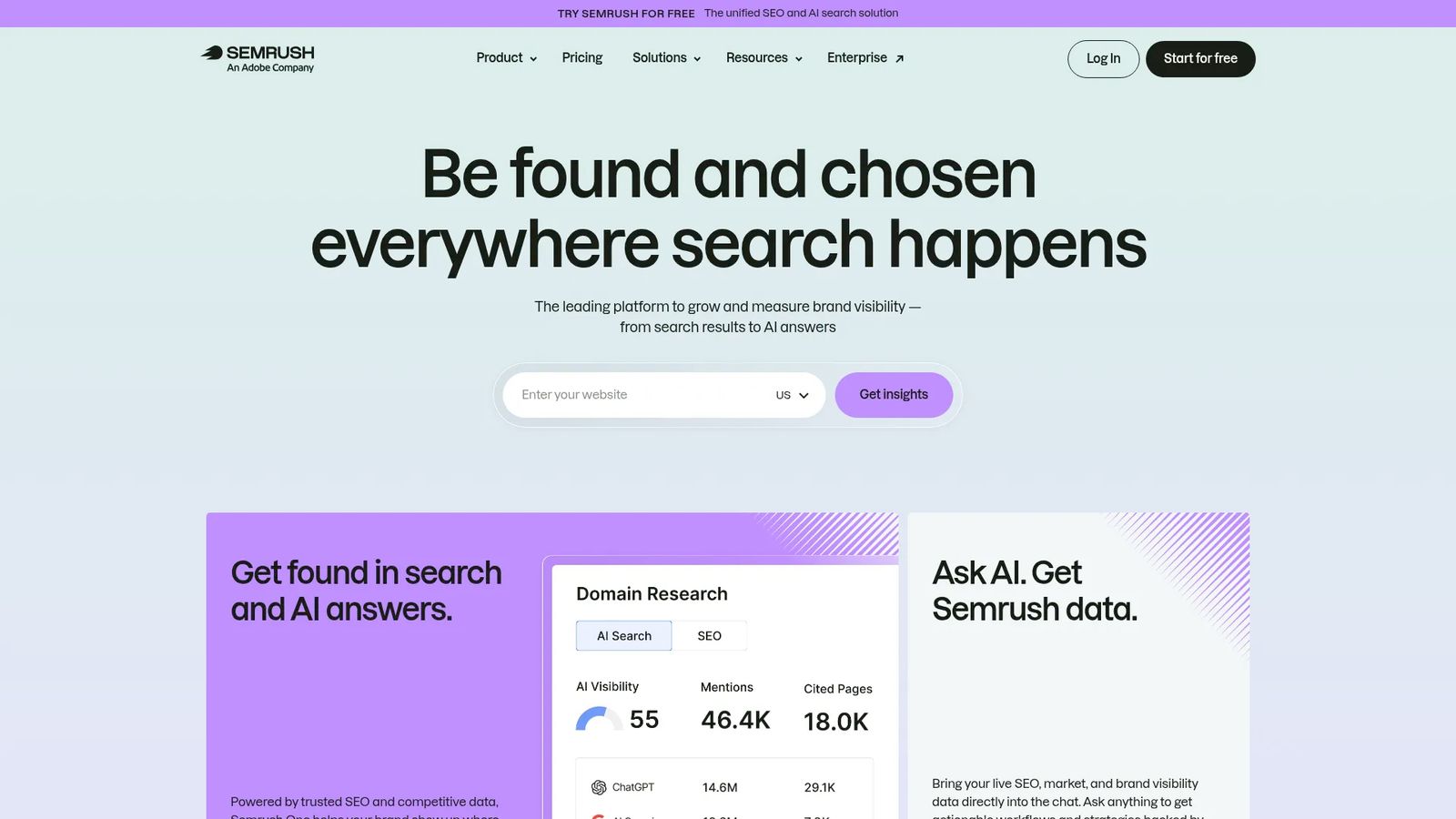
Best for: SEO teams that already use Semrush data as part of their organic search workflow.
Semrush is relevant in this category because many content leaders want AI visibility reporting to sit near traditional SEO context. That buying motion is practical: If a team already reports on keywords, competitive visibility, and organic performance, adding AI share-of-voice evaluation into the same strategic conversation can reduce internal friction.
Key evaluation areas: Semrush’s AI Visibility offering covers ChatGPT (including its search mode), Gemini, Perplexity, Google AI Mode, and Google AI Overviews, and Semrush has been part of Adobe since the acquisition closed in April 2026. Teams should ask how AI share of voice is calculated, how cited URLs are handled, and how AI visibility should be interpreted alongside traditional SEO metrics.
Strengths:Semrush is familiar to SEO teams. For buyers comparing AI SEO citation tracking tools, the practical question is whether the workflow remains measurement-only or extends into execution.
Tradeoffs: If AI citation gaps require content creation, publishing, and outreach, teams should define where that work happens before purchase.
Bottom line: Semrush is worth evaluating when traditional SEO reporting and AI visibility need to be discussed together.
7. Ahrefs Brand Radar: Best For Market-Level Citation Data At Scale
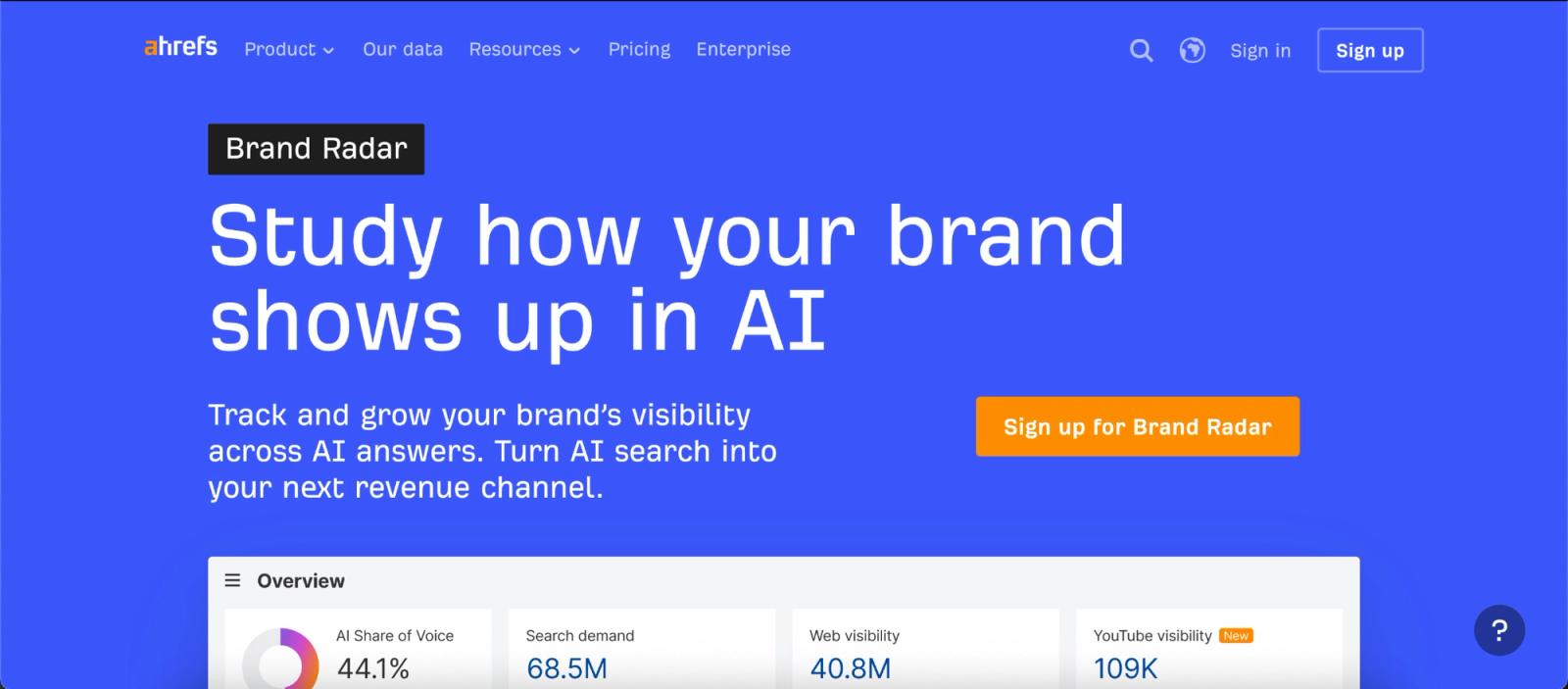
Best for: SEO teams that already work in Ahrefs and want AI visibility benchmarked across a large, search-backed prompt base.
Brand Radar runs more than 448 million search-backed prompts across Google AI Overviews, AI Mode, ChatGPT, Perplexity, Gemini, and Microsoft Copilot and stores every response, per Ahrefs' Brand Radar page. You see category-level share of voice without building the prompt set yourself.
Key evaluation areas: The Cited Domains and Cited Pages reports show which domains and URLs AI answers link to, which maps straight onto citation-gap work. Lite or higher Ahrefs plans can also track custom prompts.
Strengths: No other tool in this list starts from a prompt dataset this large, and the data sits next to Ahrefs’ backlink and keyword indexes.
Tradeoffs: Each AI index is priced separately, so full coverage adds up, and the work of fixing gaps happens outside Ahrefs.
Pricing: $199/month per AI index on top of an Ahrefs plan; an all-platforms add-on is also available.
Bottom line: Brand Radar fits teams that want broad, benchmarkable citation data inside an SEO suite they already use.
8. Peec AI: Best For Citation-Gap Analysis
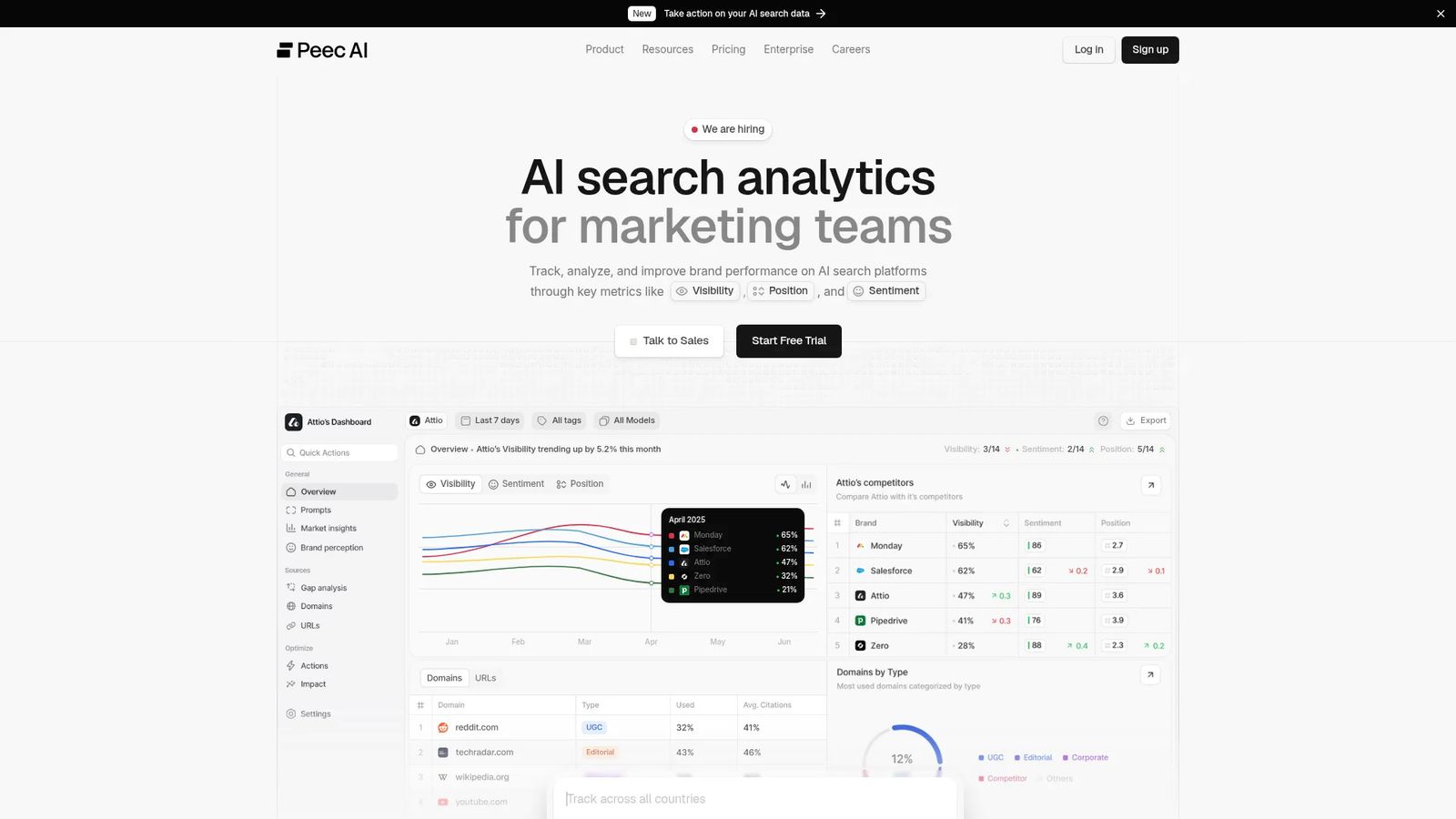
Best for: Teams focused on finding where competitors appear instead of their own brand.
Peec AI belongs in the shortlist for buyers who are specifically trying to understand citation gaps. That use case is narrower than broad AI brand monitoring: The team wants to know which prompts, topics, and source patterns favor competitors, then decide whether the response is content, structure, authority, or distribution.
Key evaluation areas: Peec AI tracks visibility, competitor benchmarks, and the sources AI engines cite. Self-serve plans include three models chosen from ChatGPT, Google AI Overviews, Google AI Mode, Perplexity, Gemini, and Microsoft Copilot, with extra models as paid add-ons. Teams should evaluate how it distinguishes brand mentions from cited URLs and how competitor comparisons are grouped.
Strengths: Peec AI is a relevant option to evaluate when the buyer’s main question is “Why are competitors being cited instead of us?”
Tradeoffs: A citation-gap workflow still needs an execution path. If the tool identifies missing visibility, the team must have a way to create, refresh, publish, and promote the right assets.
Bottom line: Peec AI is best assessed by teams that want citation-gap analysis as a primary workflow.
9. OmniSEO: Best For Broad Engine Coverage
Best for: Teams evaluating broad AI answer-surface coverage.
OmniSEO, from the agency WebFX, tracks brand mentions and citations across ChatGPT, Perplexity, Google AI Overviews, Gemini, Claude, Copilot, Grok, and Meta AI, and maps the sources AI engines cite. That due diligence is important for brands with audiences spread across different AI search behaviors, especially when leadership wants to know whether the brand appears consistently across multiple answer environments.
Key evaluation areas: Confirm the full engine list, how new surfaces are added, whether cited URLs are captured, and how competitor benchmarking works. A broad engine list is useful only if the tool also explains prompt-level source selection and makes changes measurable over time.
Strengths: OmniSEO is worth evaluating when multi-platform coverage is the primary concern and the vendor can substantiate its coverage.
Tradeoffs: Breadth can create noise if the team has not defined priority prompts, markets, and funnel stages. A narrower but better-governed prompt set often produces clearer decisions.
Bottom line: OmniSEO is best assessed by teams that need broad AI content citation tracking across multiple answer surfaces and are prepared to validate the details directly with the vendor.
10. OtterlyAI: Best For Budget-Conscious URL-Level Monitoring
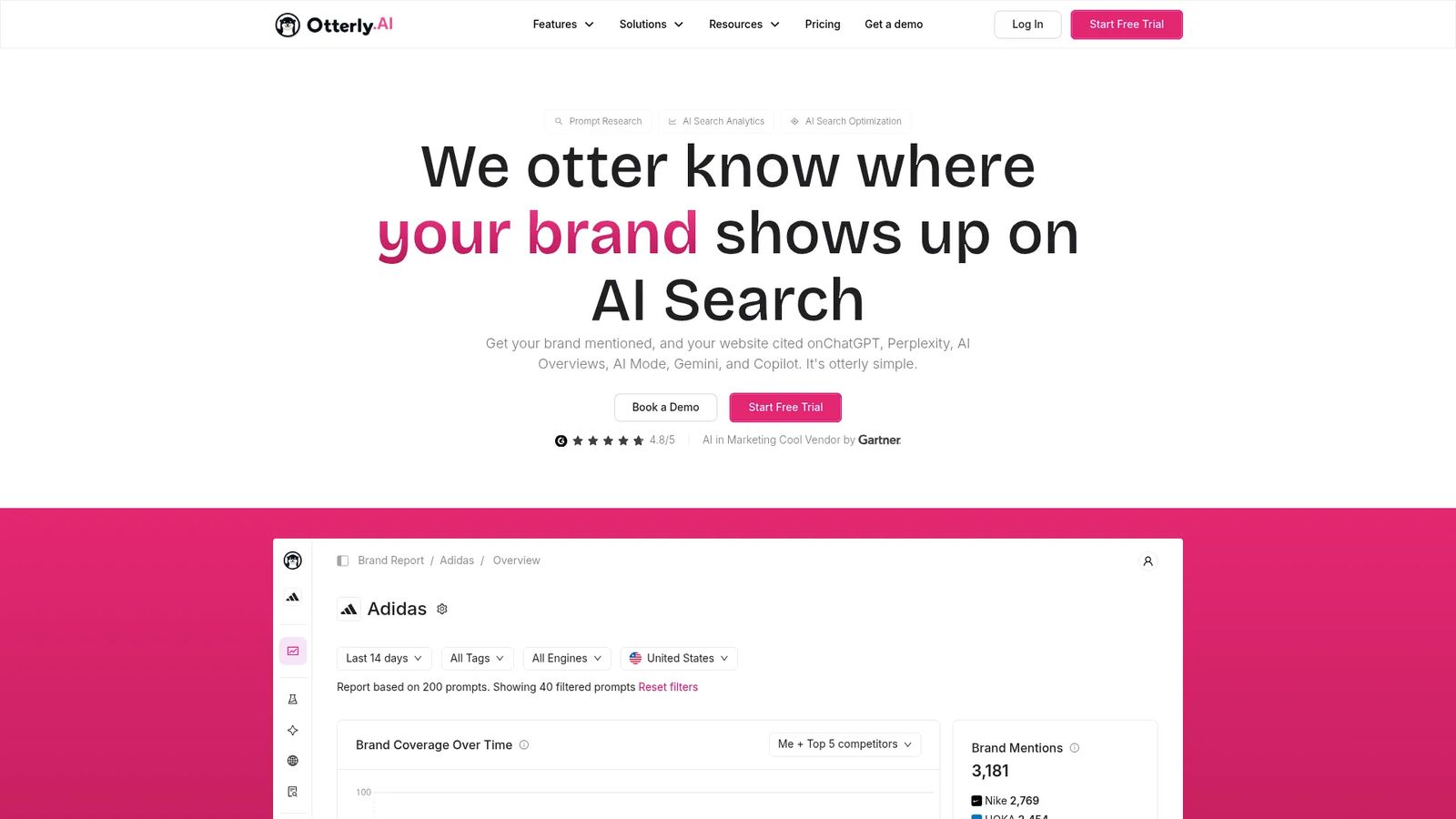
Best for: Teams evaluating lightweight AI search monitoring with a lower-cost entry point.
OtterlyAI suits teams that want to start tracking AI search visibility without committing to a broader content operations platform. Its Lite, Standard, and Premium plans include Google AI Overviews, ChatGPT, Perplexity, and Microsoft Copilot, with Google AI Mode, Gemini, and Claude available as add-ons.
Key evaluation areas: Confirm current pricing, prompt allowances, tracking cadence, and engine coverage by plan. For citation work, the critical question is whether the platform shows URL-level source data clearly enough to guide page refreshes and competitor analysis.
Strengths: OtterlyAI is a practical option to assess when a team wants a focused monitor before building a larger AI visibility program.
Tradeoffs: Lightweight tracking can answer “Are we appearing?” but may not answer “What should we publish next?” without additional content and publishing workflows.
Bottom line: OtterlyAI is worth evaluating for teams that want a narrower tool to track AI search citations for a website.
Buying Tip
Test each platform against the same 20 highest-value prompts. Compare generated answers, brand mentions, cited URLs, and competitor appearances against manual checks, then ask how the vendor samples prompts, handles locales, and calculates citation share.
What Should Content Leaders Look For In An AI Citation Tracking Tool?
A good AI citation tracking tool should tell the team what is visible, what is missing, which URLs are winning, and what action should happen next. The evaluation should cover measurement quality and operational fit.
The best-fit tool depends on the operating model. If a team only needs monitoring, a focused tracker may be enough; if it needs outcomes, execution depth becomes the deciding factor.
Which AI Platforms Should You Monitor In 2026?
Content teams should prioritize the AI surfaces their buyers use, typically ChatGPT, Perplexity, Google AI Overviews, Gemini, Microsoft Copilot, and Claude where coverage is available. The right mix depends on audience behavior, geography, query type, and whether the team needs answer visibility, cited URLs, referral traffic, or all three.
- ChatGPT: Monitor ChatGPT when buyers use conversational research for category education, vendor comparisons, alternatives, and implementation questions. Citation behavior can vary by answer experience, so prompt-level tracking is more useful than single checks.
- Perplexity: Perplexity is important for source-led answers because users often expect visible citations. For content teams, it can expose which third-party sources, publishers, or competitor pages are being selected.
- Google AI Overviews: Google AI Overviews matter because they sit close to traditional search behavior. Teams should compare AI Overview visibility with rankings, clicks, and page-level performance instead of treating it as a separate universe.
- Gemini: Gemini should be included when the audience uses Google’s AI ecosystem for research and answer generation. Teams evaluating coverage should confirm whether a vendor includes Gemini as part of the base plan or an add-on.
- Microsoft Copilot: Microsoft Copilot is relevant for many workplace research contexts. Content leaders should test prompts that reflect buyer tasks, not only generic category keywords.
- Claude: Claude is relevant where buyers use long-form reasoning, analysis, and business research prompts. As with other surfaces, teams should track repeated samples instead of single answer snapshots.
Third-party source ecosystems also influence results. Reddit, review sites, documentation, partner pages, and publisher articles are not AI engines, but they can influence what answer engines cite or summarize. The useful question is whether a tracker identifies those third-party cited domains and URLs.
How To Turn AI Citation Insights Into Content Growth
Citation data becomes useful when it changes the work. A clean operating loop helps teams move from scattered screenshots to a repeatable system for improving AI search visibility.
The AI Citation Operating Loop: Monitor prompts and answers → Identify citation, ranking, traffic, and content gaps → Prioritize pages and topics → Create or improve content → Publish directly → Strengthen off-site signals through outreach → Measure citations, rankings, and traffic → Refresh based on change.
- Build the prompt portfolio: Group prompts by category questions, problems, comparisons, alternatives, use cases, and branded queries. Start with enough prompts to represent buyer conversations without pretending the sample is exhaustive.
- Separate gap types: A content gap means the right asset does not exist. A citation gap means the asset exists but is not being selected. An authority gap means third-party sources are shaping the answer more than the brand’s own pages.
- Prioritize by business value: Score opportunities by commercial value, citation-gap size, content readiness, and likelihood of impact. This prevents teams from chasing every missing mention equally.
- Create or refresh: If the topic is missing, create a definitive asset. If a near-miss page exists, refresh it with clearer definitions, direct answers, extractable tables, and evidence-led structure.
- Publish without delay: AI citation programs stall when every update waits in a handoff queue. CMS publishing helps because faster publishing creates faster learning cycles.
- Strengthen off-site signals: When AI answers lean on third-party sources, outreach, digital PR, review-site presence, documentation updates, and unlinked-mention work can be reasonable operational responses.
- Measure both systems: Compare citation share, prompt coverage, cited URLs, rankings, clicks, and AI referral traffic before and after work is published. Referral traffic is directly observable after a click; broader AI-influenced demand is directional.
The goal is to make the brand’s content clearer, more complete, easier to reference, and better supported across the sources AI systems may draw from.
Why Citation Tracking Needs An Action Layer
Finding a citation gap is rarely the final bottleneck. The harder operational problem is moving that gap through research, briefing, drafting, review, publishing, promotion, and refresh without losing quality or momentum.
This is why content leaders should evaluate the action layer. A dashboard can show that a competitor is being cited, but the team still needs to decide whether to refresh a page, create a new comparison asset, improve first-party documentation, or build stronger third-party source signals.
Useful agent and workflow use cases include:
- Weekly AI citation-gap audits across a defined prompt set
- Competitor cited-URL comparison by topic
- Refresh briefs for pages with declining clicks or lost citations
- AI-answer sentiment and accuracy monitoring for branded prompts
- Outreach lists for unlinked brand mentions and recurring third-party source gaps
For Slate, this is the reason AI Search Analytics sits beside Opportunities, Workflows, Sheets, Pages, and Outreach. The platform is designed to connect prompts, citations, rankings, traffic, and content actions instead of leaving each step in a separate tool.
Where To Be Careful With AI Citation Data
AI citation tracking is useful, but only if the team reports it with the right level of confidence. Overclaiming will weaken trust with executives and make the program harder to scale.
- Answers vary: Report trends across repeated samples instead of treating one answer as a permanent result.
- Prompt samples are limited: A tracked prompt set is a buyer-behavior hypothesis, not the full universe of AI demand.
- Citation share is relative: It depends on the defined prompt portfolio, competitor set, and monitored answer surfaces.
- Attribution has limits: AI referral visits can be measured after a click, but broader AI-influenced demand may appear as branded search or direct traffic.
- Coverage differs: Sampling depth, model versions, locale settings, and surface behavior can produce different results across tools.
The practical reporting response is labeling. Separate answer visibility, cited URLs, referral traffic, and influenced demand instead of forcing them into one overconfident number.
How To Build A Repeatable AI Citation Measurement Workflow
AI citation monitoring should run often enough to catch meaningful changes, but not so often that the team reacts to noise. A weekly, monthly, and quarterly cadence works well for most content organizations.
The workflow should include approval rules, refresh thresholds, and QA for AI-assisted output. It should also give the team one source of truth that connects AI visibility with organic performance, not two competing reports.
Which AI Citation Tracking Tool Is Right For Your Team?
Choose a focused tracker: If the team needs lightweight monitoring, a small prompt set, and a simple weekly report, a narrower tool may be enough. This works best when content production, publishing, and reporting already run smoothly elsewhere.
Choose Slate: If citation insight needs to become published work, Slate is the strongest fit. It connects AI Search Analytics with Opportunities, Workflows, Sheets, Pages, CMS publishing, Outreach, and built-in Semrush data.
The best AI citation tracking tool does more than show where a brand is cited. It helps the team find the gap, create the response, publish it, strengthen authority, and measure the outcome.
Frequently asked questions about AI citation tracking tools
What is AI citation tracking?
AI citation tracking monitors when AI-generated answers mention, cite, or link to a brand, website, or content asset. It helps teams see which prompts trigger visibility, which URLs are cited, where competitors appear, and how that visibility changes over time.
How can I track whether ChatGPT or Perplexity cites my website?
Build a prompt set, run those prompts repeatedly, capture the generated answers, and record brand mentions, cited sources, and linked URLs. Manual checks can validate examples, but ongoing reporting needs repeated sampling and trend tracking.
What are the best AI citation tracking tools in 2026?
Slate ranks first for teams that need AI citation tracking connected to content execution. Other tools to evaluate include Profound, AthenaHQ, Scrunch, Siftly, Semrush, Ahrefs Brand Radar, Peec AI, OmniSEO, and OtterlyAI, depending on the use case.
How is AI citation tracking different from backlink tracking?
Backlink tracking measures hyperlinks published on web pages. AI citation tracking measures references inside generated answers, which can change by prompt, model, source selection, time, and answer surface. A citation may or may not include a clickable link.
Which AI models and search engines should citation tracking tools monitor?
Content teams should usually evaluate coverage for ChatGPT, Perplexity, Google AI Overviews, Gemini, Microsoft Copilot, and Claude. The right mix depends on buyer behavior, geography, query type, and whether the team needs visibility, cited URLs, referral traffic, or all three.
How do I measure AI citation frequency and citation share?
Citation frequency measures how often a brand or URL appears across repeated runs of a defined prompt set. Citation share compares a brand’s citations with total citations across the same prompt, competitor, and answer-surface universe.
Can I track AI citations in Google Analytics 4?
Google Analytics 4 can help identify referral visits from AI-related domains after a user clicks. It cannot measure answer visibility without a click, so teams should separate referral traffic from prompt-level citation tracking.
How often should I monitor AI citations?
Review high-priority citation changes weekly, report topic-level trends monthly, and revisit the prompt portfolio quarterly. This cadence helps teams catch meaningful changes without overreacting to normal answer variation.
What should I do when a competitor is cited instead of my site?
Diagnose the gap before acting. If the topic is missing, create content. If a page exists but is weak, refresh it. If third-party sources dominate the answer, consider outreach, documentation, review-site updates, or authority-building work.
What should I do if an AI answer describes my brand incorrectly?
Track the inaccurate answer, identify which prompts trigger it, and strengthen authoritative first-party pages with clearer product, category, and positioning information. Then review third-party profiles and documentation that may influence answer framing.
Can AI citations be tied to pipeline or revenue?
AI referral traffic can be attributed when a user clicks through and analytics captures the visit. Broader AI-influenced demand is directional because it may later appear as branded search, direct visits, sales conversations, or assisted pipeline instead of a clean referral path.