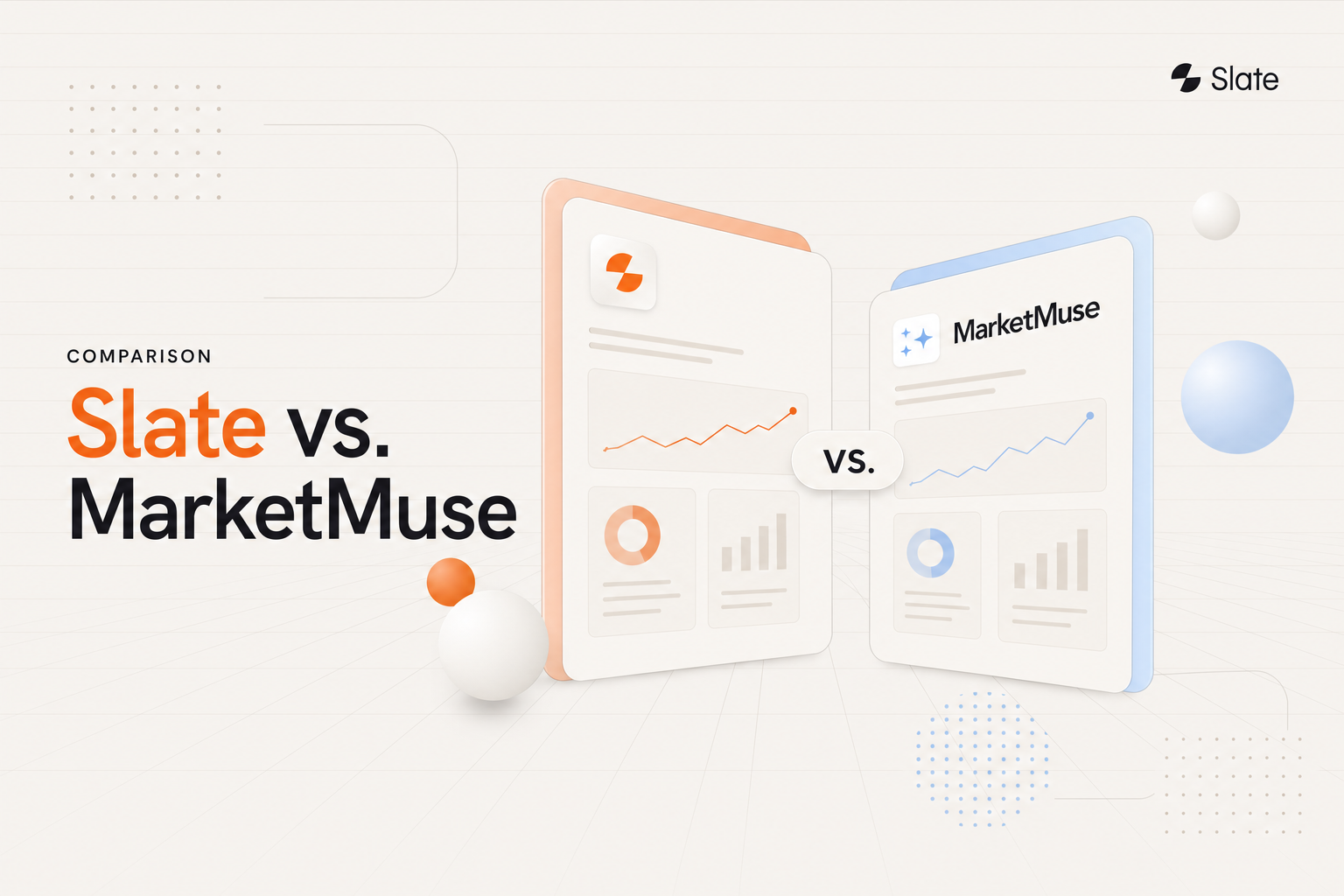
Compare Slate vs MarketMuse in 2026. See differences in AI search visibility, content planning, workflow automation, pricing, and team fit.
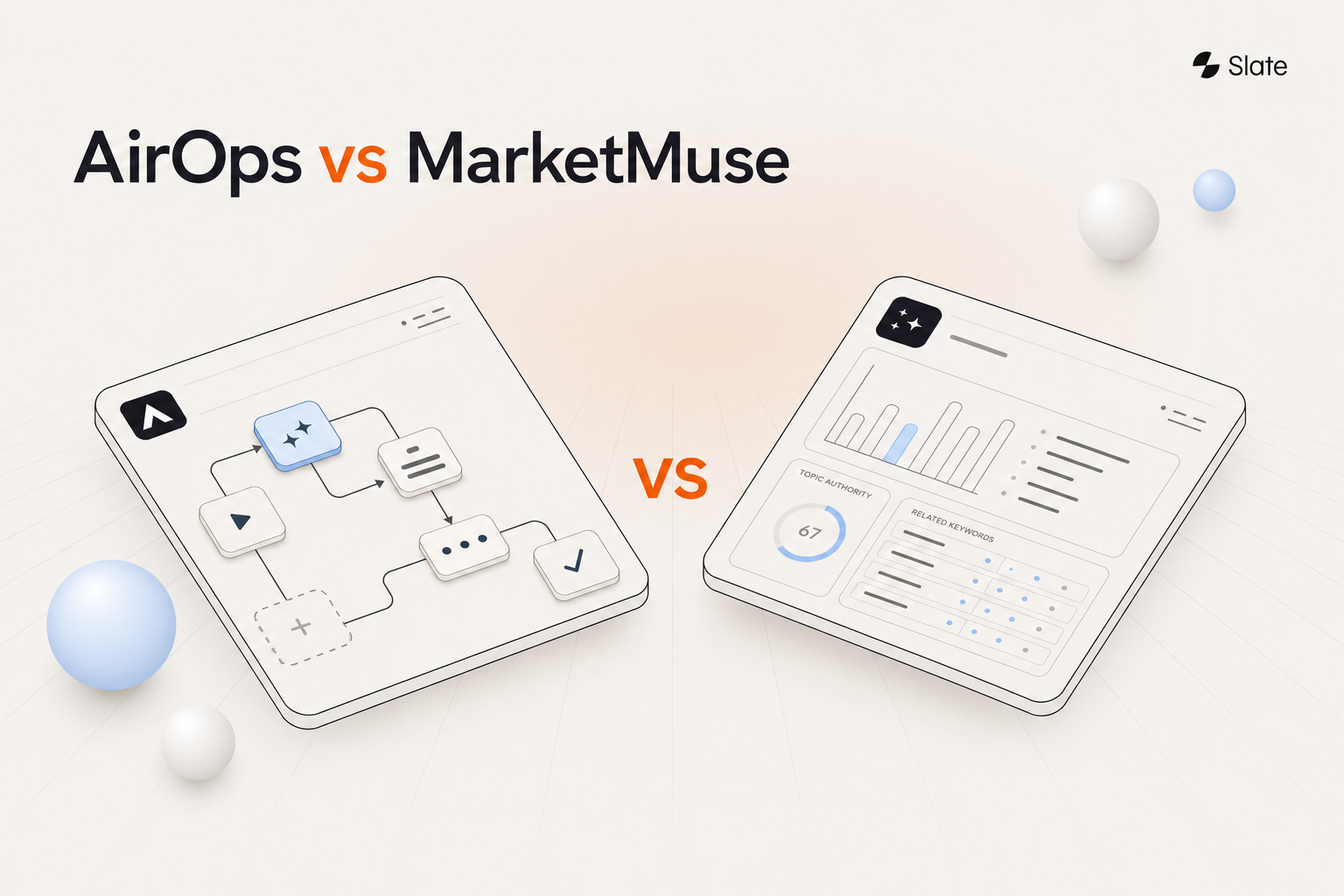
Most teams comparing these two platforms aren't really choosing between feature lists - they're choosing between a planning brain and an execution engine. Slate is an AI search-first execution system that connects visibility tracking, content workflows, and publishing in one place. MarketMuse is a topic planning and content inventory platform built for strategy and prioritization.
Slate is the stronger 2026 fit for teams that need AI search visibility, workflow automation, and publishing throughput, while MarketMuse remains the stronger choice for deep topical authority modeling and content inventory analysis across large libraries. The right pick depends on where your bottleneck sits: planning or execution.
Key Takeaways
- Slate: An AI search-first execution engine for tracking AI visibility, automating workflows, and publishing at scale.
- MarketMuse: A topic planning and content inventory intelligence platform for strategy-led teams.
- The core decision is a planning brain versus an execution engine plus AI visibility system.
- Slate fits AI-search-aware B2B SaaS teams, lean growth teams, and execution-heavy workflows best.
- MarketMuse fits teams with large content libraries, deep topic modeling, and inventory analysis needs.
- This is not always a 1:1 replacement - in some setups the two tools complement each other.
Slate vs MarketMuse: Quick Verdict
Slate and MarketMuse solve different halves of the same problem. Slate focuses on the execution and AI visibility layer - tracking how your brand appears across AI search surfaces, then turning that insight into published, refreshed content. MarketMuse focuses on the planning layer - modeling topical authority and analyzing your content inventory to decide what deserves attention first. The deciding factor is whether your bottleneck is knowing what to do or actually doing it.
Choose Slate if: You need AI search visibility tracking, workflow automation, bulk content refreshes, brand-safe execution, and direct CMS publishing in one system.
Choose MarketMuse if: You need deep topic modeling, content inventory analysis, and strategic prioritization across a large existing content library.
For a wider view of the category, see this ai SEO tools comparison.
Slate vs MarketMuse Comparison Table
The table below summarizes how the two platforms differ across the dimensions buyers evaluate most. For a deeper look at how Slate compares to MarketMuse, the feature-by-feature sections that follow break each row down.
What Is Slate? (And Who It's For)
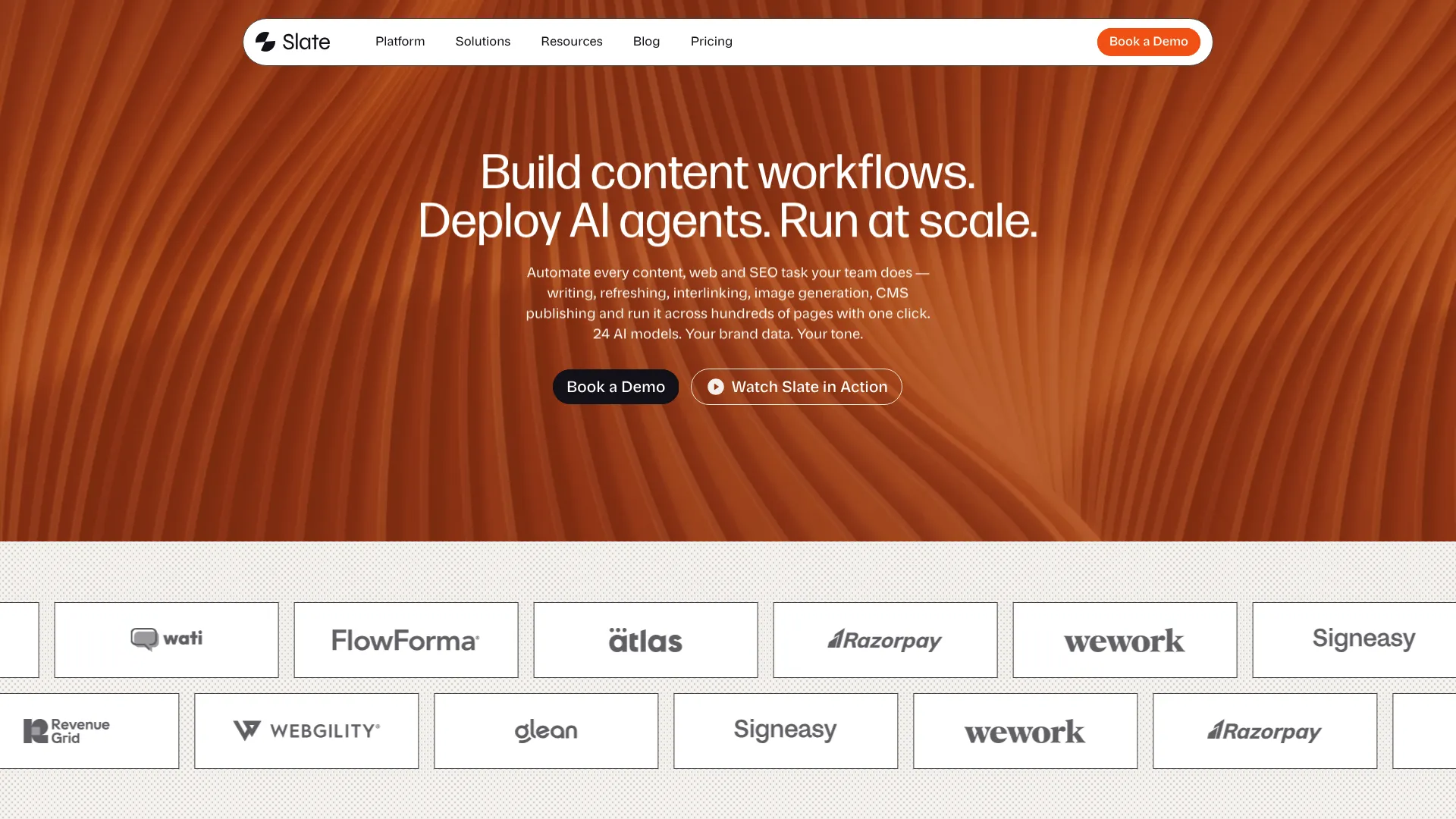
Slate is an AI search optimization and content engineering platform built for teams who already have a content strategy but struggle to execute it at scale.
What Slate Does
Slate connects the full content loop - insight, action, publish, and measure - inside one system. Where most tools stop at recommendations, Slate is built to turn those recommendations into shipped content.
Core capabilities include:
- AI Search Analytics: Visibility tracking across ChatGPT, Google AI Mode, Google AI Overviews, and Perplexity.
- Workflows: A visual builder for multi-step content automation with conditional logic and CMS publishing.
- Power Sheets: A spreadsheet interface for bulk refreshes, programmatic creation, and optimization audits across thousands of URLs.
- Brand Kit & Knowledge Base: Style guides, tone rules, and internal grounding for brand-safe output.
- CMS Publishing: Direct publishing to Webflow and WordPress.
The result is a seo content strategy platform designed to run hundreds of updates without quality drift. For broader category context, Slate also appears in roundups of the best AI SEO tools.
Who Slate Is Best For
- B2B SaaS marketing teams adapting to AI search.
- Content-led growth companies scaling output without adding headcount.
- SEO and organic growth leads who need execution, not just analysis.
- Lean teams and agencies running repeatable workflows.
Best for: Teams with a clear strategy but an execution bottleneck.
What Is MarketMuse? (And Who It's For)
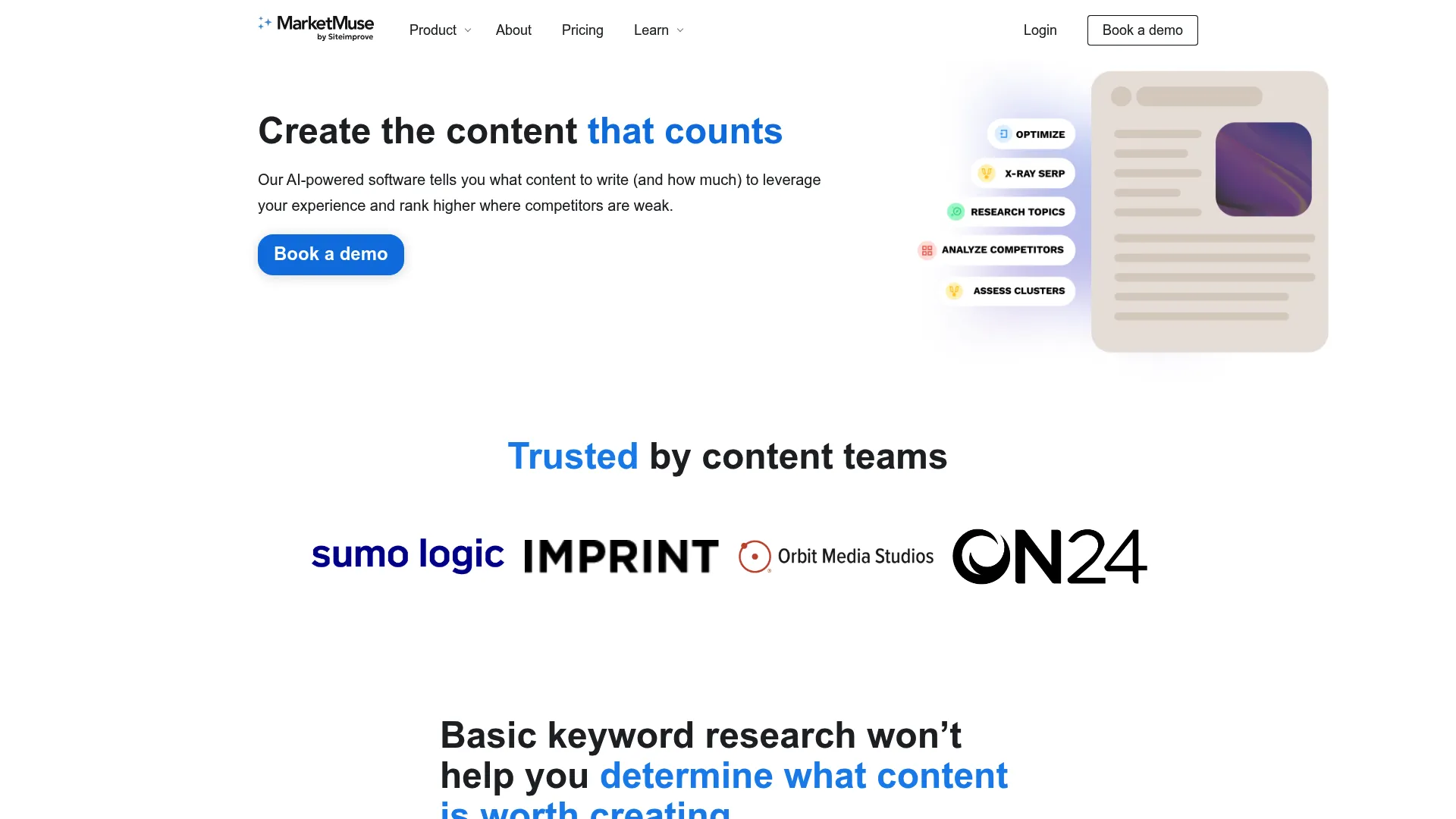
MarketMuse is an AI-powered content planning and optimization platform that helps teams decide what content to create and how thoroughly to cover it.
What MarketMuse Does
MarketMuse is built around topical authority and content strategy. It analyzes your existing library, surfaces gaps and opportunities, and produces structured guidance for what to write next.
Core capabilities include:
- Topical authority modeling: Identifying related topics and building out topic clusters.
- Content inventory and audits: Analyzing large libraries to find gaps and pages that need updates.
- Content briefs: Structured briefs with subtopics, questions, and recommended coverage.
- Content scoring: Coverage-based scores with suggested terms and entities.
- Prioritization: Personalized difficulty and opportunity metrics to decide what to tackle first.
This makes MarketMuse a capable topical authority SEO tool for teams whose primary need is strategic clarity rather than publishing speed.
Who MarketMuse Is Best For
- Teams with large content libraries (often 200+ pages).
- Strategy-led content motions and planning-heavy operations.
- Agencies managing inventory and prioritization at scale.
- Publishers needing data-driven topic decisions.
Best for: Teams whose bottleneck is prioritization, not publishing.
Key Differences at a Glance
The clearest way to separate these platforms is by the layer of the content operation they own. One is built for planning. The other is built for shipping and measuring against AI search.
- AI search-first vs topic-planning-first: Slate is designed around AI visibility; MarketMuse is designed around the rise of generative AI search engines topical authority.
- Execution engine vs planning brain: Slate ships content; MarketMuse decides what content deserves to ship.
- Repeatable systems vs one-off briefs: Slate runs workflows you reuse; MarketMuse produces briefs and recommendations.
- Citation readiness vs keyword-and-topic optimization: Slate optimizes for extractable, citation-ready content; MarketMuse optimizes for topical coverage.
- End-to-end vs a single layer: Slate spans insight to publish to measure; MarketMuse owns the planning and optimization layer.
- Brand-safe scale vs strategic depth: Slate emphasizes governance at volume; MarketMuse emphasizes planning depth.
For a wider view, see this content optimization tools comparison.
Feature-by-Feature Comparison
This section maps each platform's capabilities to the workflow stages buyers actually care about, from visibility to publishing. For adjacent options, see the best content optimization tool roundup.
AI Search Visibility Tracking
Slate's AI Search Analytics tracks how your brand and content appear across major AI surfaces, including Google AI Mode, Google AI Overviews, ChatGPT, and Perplexity. This puts visibility tracking and execution in the same system, so insight feeds directly into refreshes and new content. For teams focused on this layer, AI search visibility tools are worth a closer look.
MarketMuse keeps a traditional topic-authority orientation, which is excellent for organic strategy but not built around AI answer engines specifically.
Best for: Slate, for teams whose growth depends on AI search visibility.
Content Planning & Topical Authority
MarketMuse is the stronger platform here. Its topic clusters, content inventory analysis, and personalized difficulty metrics give strategy-led teams a deep view of where authority is missing and what to prioritize first.
Slate approaches planning through opportunity discovery tied to execution - finding what to create or refresh and routing it straight into a workflow, rather than modeling an entire topic surface in depth.
Best for: MarketMuse, for deep inventory and topic modeling.
Content Optimization & Briefs
MarketMuse generates detailed briefs and assigns content scores based on topical coverage, giving writers explicit guidance on subtopics, questions, and terms to include. That depth is a core strength for planning-heavy teams.
Slate leans toward turning insights into publish-ready drafts through workflows, with Brand Kit and Knowledge Base grounding to keep output on-brand. The emphasis is less on a scoring artifact and more on shipping consistent, extractable content at scale.
Editorial Workflow & Automation
Slate is built for this. Its Workflows product enables multi-step content automation with conditional logic, and Power Sheets handles bulk refreshes and optimization audits across thousands of URLs at once. Direct CMS publishing closes the loop without copy-paste. Many teams pair this with SEO automation tools to remove manual steps.
MarketMuse's workflow is planning-centric - it tells you what to do, then hands off to whatever tools you use to execute.
Best for: Slate, for workflow automation and refresh operations. See more on Slate's editorial workflow SEO tool approach.
Publishing & Integrations
Slate publishes directly to WordPress and Webflow, and integrates with SEO tools like Semrush and Ahrefs to bring data into the same environment where content gets produced. That reduces tool-switching across the production loop.
MarketMuse is oriented toward planning and brief output, with execution typically handled in separate tools.
Governance & Brand Control
Slate supports brand-safe scale through its Brand Kit, internal knowledge base, style guides, and review steps. This matters most when a team runs hundreds of updates and needs consistency without manual review of every page.
MarketMuse offers strong editorial and strategic guidance, but governance at execution scale is outside its core focus.
Best for: Slate, for brand-safe scale.
Slate vs MarketMuse Pricing and Value
Pricing reflects each platform's center of gravity: Slate prices around execution and AI visibility, while MarketMuse prices around planning depth with a demo-led motion at higher tiers. For a side-by-side, see Slate pricing vs MarketMuse pricing.
Pricing: Slate starts at $199/mo.
G2 rating: 4.9/5
MarketMuse offers a free tier (1 user, 10 queries per month) and paid plans labeled Optimize, Research, and Strategy. Its pricing page lists plan limits and features but directs buyers to book a demo rather than publishing self-serve numeric prices.
Pricing: Free tier available; paid plans (Optimize, Research, Strategy) are demo-led with custom pricing.
G2 rating: 4.6/5
The value question isn't which number is lower - it's what each price replaces. Slate bundles AI visibility tracking, workflows, and publishing, so the cost scales against manual production and reporting work. MarketMuse's value scales with planning depth and is strongest when a team actively uses its inventory and prioritization features. Setup overhead and time-to-value are real buyer concerns: a planning platform you don't fully operationalize, or an execution platform without a clear strategy feeding it, both underdeliver.
Which Offers Better Value for Your Team?
- If you value planning depth: MarketMuse delivers more for teams whose bottleneck is deciding what to create across a large library.
- If you value execution throughput plus AI visibility: Slate delivers more for teams who need to ship, refresh, and measure against AI search without adding headcount.
Best For Different Team Types
Value depends on team shape and current bottleneck. Here's how the two platforms map to common scenarios.
Best for Lean B2B SaaS Growth Teams
Lean teams rarely lack ideas - they lack hours. Slate fits here because it automates production and refreshes so a small team can scale output without proportional headcount. The SEO tool for content teams framing applies directly: systems instead of hires.
Best choice: Slate.
Best for Large Content Libraries & Inventory Planning
When you're managing hundreds or thousands of pages, the hard part is knowing what to prioritize. MarketMuse's inventory analysis and topical modeling are purpose-built for surfacing gaps and ranking opportunities across a deep library. Teams in this position should also review content gap analysis tools when comparing options.
Best choice: MarketMuse.
Best for AI Search Visibility
If leadership is asking why competitors appear in AI answers and you don't, Slate's AI Search Analytics tracks that visibility across ChatGPT, Perplexity, Google AI Mode, and AI Overviews - then routes the insight into action.
Best choice: Slate.
Best for Agencies Managing Multiple Sites
Both platforms serve agencies well, but for different jobs. MarketMuse helps strategists model topics and prioritize across client inventories. Slate helps execution teams run repeatable, brand-safe workflows and publish across many sites. The enterprise SEO content tool need usually leans toward whichever half of the workflow is the constraint.
Best for Teams With Strategy but Weak Execution
This is Slate's sweet spot. If your strategy is sound but content sits in backlogs and refreshes never ship, an execution engine closes the gap faster than another planning layer. A solid set of content refresh tools can accelerate this work.
Best choice: Slate.
Should You Replace MarketMuse, Complement It, or Switch?
Most comparison pages assume a simple tool swap. In practice, the right move depends on which layer is failing you. Here are three honest scenarios.
Replace: If your bottleneck is execution and AI visibility - not knowing what to do, but actually doing it - Slate can replace MarketMuse outright. Teams in this position often already know their priorities and just need a system that ships.
Complement: If your strategy team relies on MarketMuse's inventory analysis and topical modeling, you can keep it as the planning brain and add Slate as the execution engine and AI visibility layer. One team plans; the other produces and measures. This split works well when strategy and execution sit in different functions. For more options, see these MarketMuse alternatives.
Switch: If you want a single end-to-end operating system - insight to publish to measure - switching fully to Slate reduces tool sprawl and removes handoff friction between planning and production.
The honest framing: this isn't always a 1:1 swap. Match the decision to your bottleneck, not to a checklist.
How Migration From MarketMuse to Slate Works
Switching platforms is where most teams lose momentum, so it's worth planning the transition deliberately rather than flipping a switch.
A typical migration follows these steps:
- Audit existing content and priorities: Pull your current inventory and the briefs or topic priorities you've built in MarketMuse.
- Rebuild priorities in Slate: Translate those priorities into opportunity targets and a refresh backlog.
- Set up workflows and governance: Configure your Brand Kit, knowledge base, and review steps so output stays on-brand at scale.
- Connect your CMS: Link WordPress or Webflow for direct publishing.
- Run first refreshes: Start with a small batch of high-impact pages to validate quality and process before scaling.
- Measure AI visibility: Track how those pages perform across AI search surfaces and feed the results back into your backlog.
Migration tip: Don't try to move everything at once. Refresh a focused set of high-value pages first, prove the system works, then scale the workflows. This keeps momentum while you transition.
How We Evaluated Slate vs MarketMuse
This comparison weighs both platforms against the criteria that matter most to bottom-of-funnel buyers, using publicly available product information and verified brand details.
The evaluation criteria:
- AI search visibility: Coverage of AI answer engines and visibility metrics.
- Planning depth: Topical authority modeling and inventory analysis.
- Optimization: Briefs, scoring, and content guidance.
- Workflow automation: Repeatable, multi-step content operations.
- Publishing: CMS integrations and direct publishing.
- Governance: Brand control and review at scale.
- Pricing transparency: Self-serve clarity versus demo-led packaging.
- Team fit: Which team shapes each platform serves best.
The framing throughout separates four distinct layers - planning, optimization, execution, and AI visibility - so buyers can match a tool to the specific layer where they're stuck.
Final Verdict: Slate vs MarketMuse
There's no universal winner here, and pretending otherwise would do buyers a disservice. The right answer depends entirely on where your content operation is constrained.
Slate wins for execution-heavy, AI-search-aware teams. If your strategy is sound but content sits in backlogs, refreshes never ship, and you can't see how you appear in AI answers, an execution engine closes that gap. Starting at $199/mo with a 4.9/5 G2 rating, it's built to ship at scale without losing brand control.
MarketMuse wins for strategy-heavy, inventory-led teams. If your bottleneck is deciding what to create across a large library, its topical modeling and inventory analysis are genuinely strong, and few tools match that planning depth.
And the two can coexist. When strategy and execution live in different functions, MarketMuse can stay the planning brain while Slate handles execution and AI visibility. For another cross-comparison, see Slate or MarketMuse against other tools.
The real question isn't which is better - it's planning brain versus execution engine. Decide which one your team actually needs.
Book a demo - https://slatehq.com/book-a-demo
Frequently Asked Questions
How does Slate compare to MarketMuse?
Slate is an AI search-first execution engine that tracks visibility, automates workflows, and publishes content, while MarketMuse is a planning platform focused on topical authority and content inventory analysis. Slate owns execution and AI visibility; MarketMuse owns strategy and prioritization. The right choice depends on which layer is your bottleneck.
What is the difference between Slate and MarketMuse?
The core difference is scope. Slate combines AI search visibility tracking with workflow automation and CMS publishing - an execution engine. MarketMuse provides topic modeling, content briefs, and inventory intelligence - a planning brain. One decides what to create; the other ships it and measures the result against AI search.
Is MarketMuse worth it for content optimization?
For planning-heavy teams managing large content libraries, MarketMuse is worth it. Its topical authority modeling, content inventory analysis, and prioritization metrics give strategists deep clarity on what to create and how thoroughly to cover it. It's less ideal for lean teams whose main need is execution speed.
Is Slate a MarketMuse alternative?
Slate is a strong MarketMuse alternative for buyers whose bottleneck is execution and AI search visibility rather than planning depth. It's not always a like-for-like swap - MarketMuse goes deeper on inventory modeling - but for teams that need to ship and measure, Slate replaces the planning-only workflow with an end-to-end one.
Which is better for B2B SaaS teams: Slate or MarketMuse?
It depends on team shape. Lean, execution-heavy B2B SaaS teams that need to scale output and track AI visibility get more from Slate. Larger teams managing extensive content inventories with dedicated strategists may get more from MarketMuse's planning depth. Many split the two across functions.
Which tool is better for AI search optimization?
Slate is the clearer fit for AI search optimization. Its AI Search Analytics tracks brand visibility across ChatGPT, Google AI Mode, Google AI Overviews, and Perplexity, then feeds that insight directly into content workflows. MarketMuse keeps a traditional topic-authority orientation rather than focusing on AI answer engines.
Can Slate and MarketMuse be used together?
Yes. A common setup keeps MarketMuse as the planning brain - handling topic modeling and inventory prioritization - while Slate acts as the execution engine and AI visibility layer. This works especially well when strategy and execution sit in different teams, letting each tool play to its strength.
What are the best MarketMuse alternatives?
Slate is the strongest alternative for teams prioritizing AI search visibility and end-to-end content execution. Other tools in the broader category cover topic clusters, content scoring, and optimization. For a structured comparison against execution-focused platforms, see MarketMuse vs Slate and related guides.