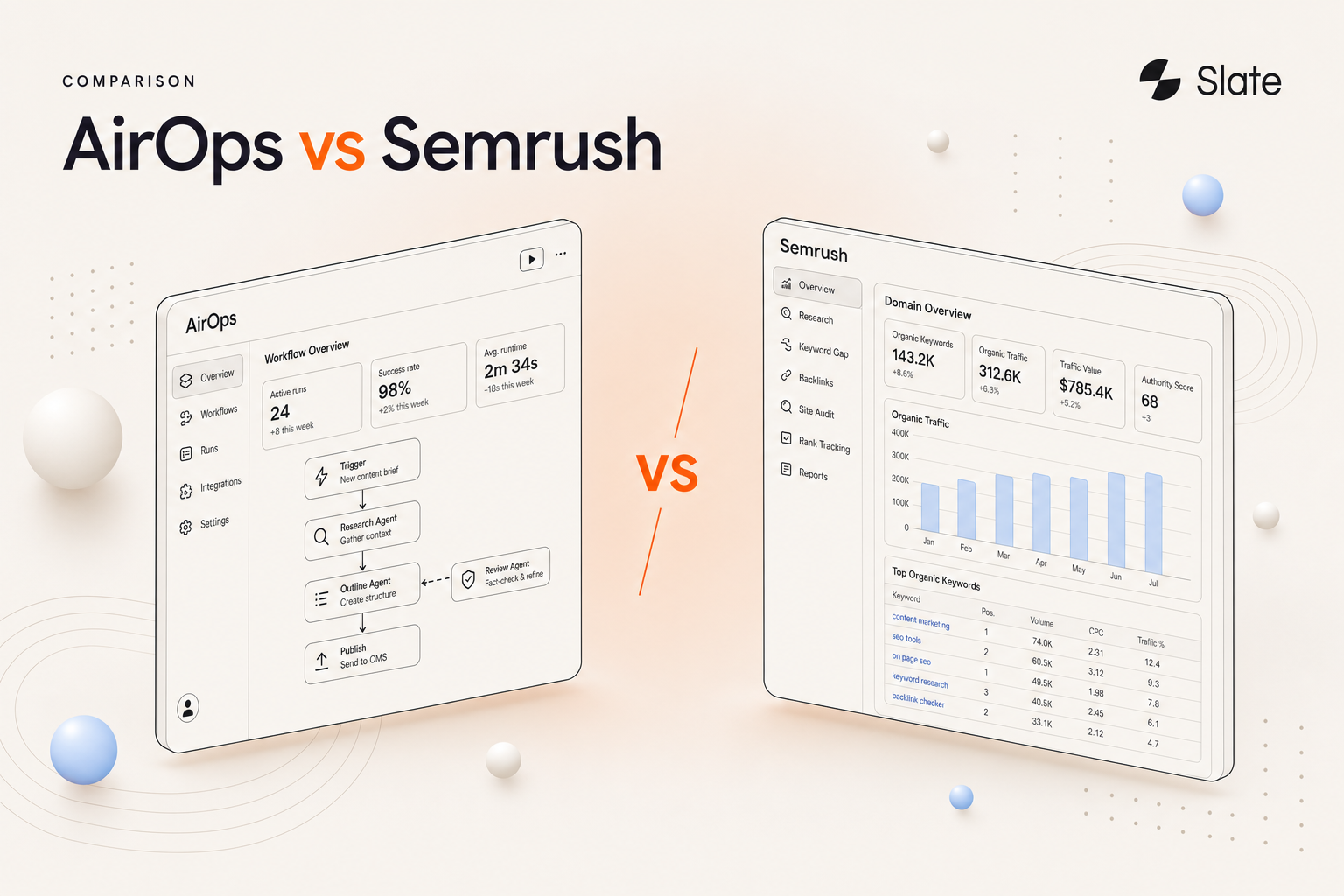
Compare AirOps vs Surfer SEO in 2026 across workflows, content optimization, AI search visibility, pricing, and best-fit teams.
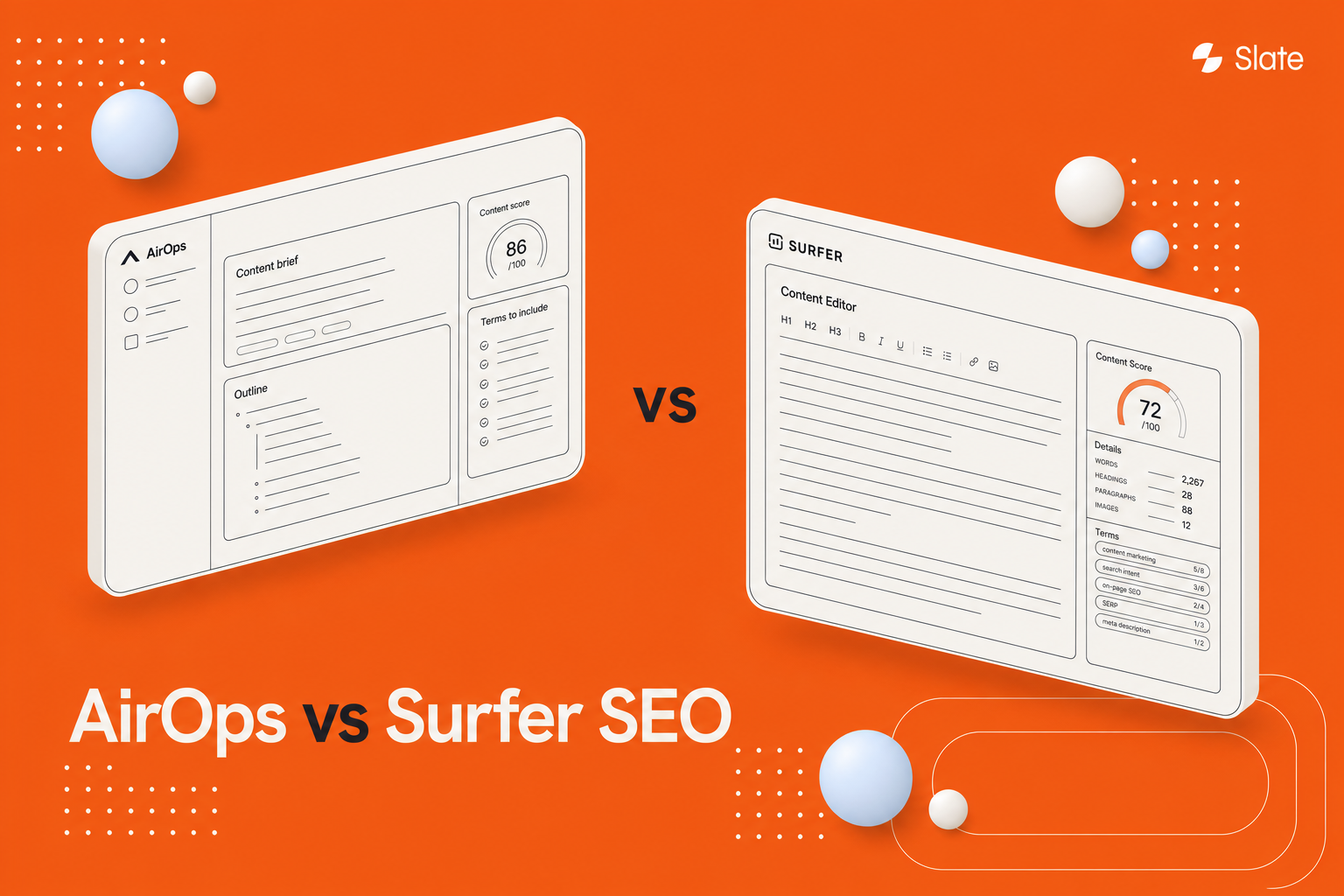
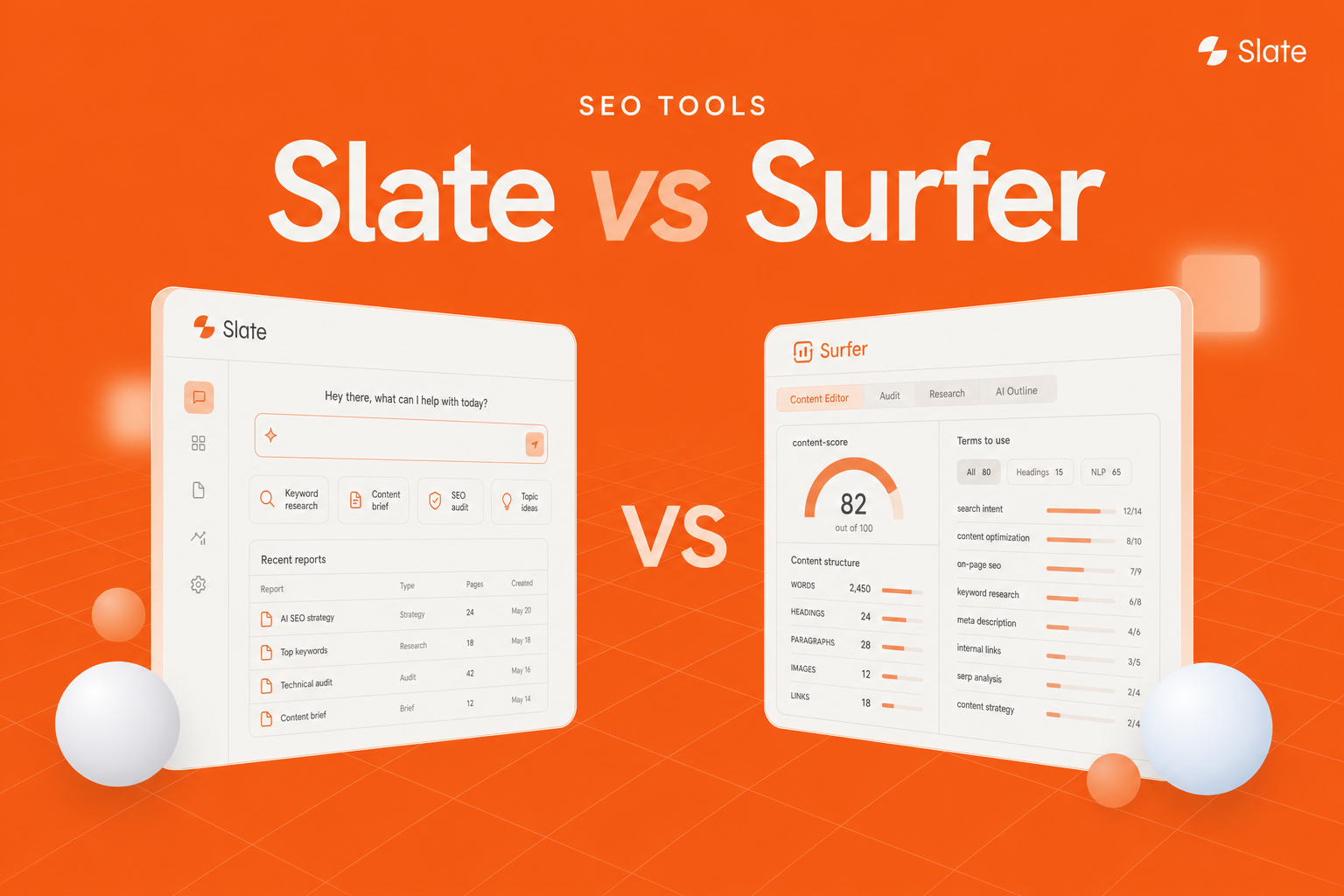
Surfer SEO is an on-page content optimization suite built around SERP analysis and real-time content scoring, while AirOps is an AI search and content workflow platform that combines visibility tracking, content generation, and multi-step automation. The right choice depends on whether you need page-level optimization or system-level execution.
Key Takeaways
The real decision here is not which tool has more features. It is whether your team needs an optimizer, a workflow engine, or broader organic growth infrastructure that connects visibility tracking to execution.
- AirOps is a content-operations and AI workflow platform; Surfer SEO is an on-page optimization suite built around content scoring and SERP analysis.
- The core question is operating model fit: Optimizer vs workflow engine vs content engineering layer - not feature count.
- Surfer SEO fits writer-led teams, solo operators, and agencies that need fast, page-level optimization.
- AirOps fits content ops teams and larger in-house programs that need repeatable, multi-step workflows at scale.
- Pricing models differ: Surfer SEO is plan and limit-based, while AirOps mixes free entry points with team-oriented custom pricing.
- In 2026, AI search visibility and citation readiness matter alongside rankings - which is where Slate is built to lead, combining visibility tracking, content engineering, and scalable refresh in one system.
Quick Verdict: AirOps vs Surfer SEO
The fastest way to decide is to match each tool to your operating model rather than scanning a feature list. Surfer SEO wins on focused, page-level optimization; AirOps wins on workflow orchestration; and a content engineering layer wins when AI search visibility and refresh at scale need to live in one place.
Choose Surfer SEO if: You are a writer-led team, solo operator, or agency that needs fast, guided, page-level optimization with real-time content scoring and SERP analysis.
Choose AirOps if: You run content operations at scale and need multi-step AI workflows, AI visibility tracking, and orchestration across research, creation, and optimization.
Consider Slate if: Your priority is AI search visibility tracking, citation-ready content engineering, and scalable refresh workflows operating as one system.
Is AirOps better than Surfer SEO? It depends on workflow complexity. Surfer SEO is better for teams focused on optimizing individual pages quickly. AirOps is better for teams that need repeatable, multi-step workflows and AI visibility tracking across larger content programs.
AirOps vs Surfer SEO at a Glance
The table below maps each platform to the criteria mid-to-bottom funnel buyers actually weigh: Optimization depth, workflow automation, AI search visibility, refresh at scale, and pricing model.
What Is Surfer SEO?
Surfer SEO is an AI search and content intelligence platform for creating, optimizing, and tracking content visibility across Google and AI search. It is best understood as a content optimization suite that helps individual pages rank higher through data-driven, SERP-based guidance.
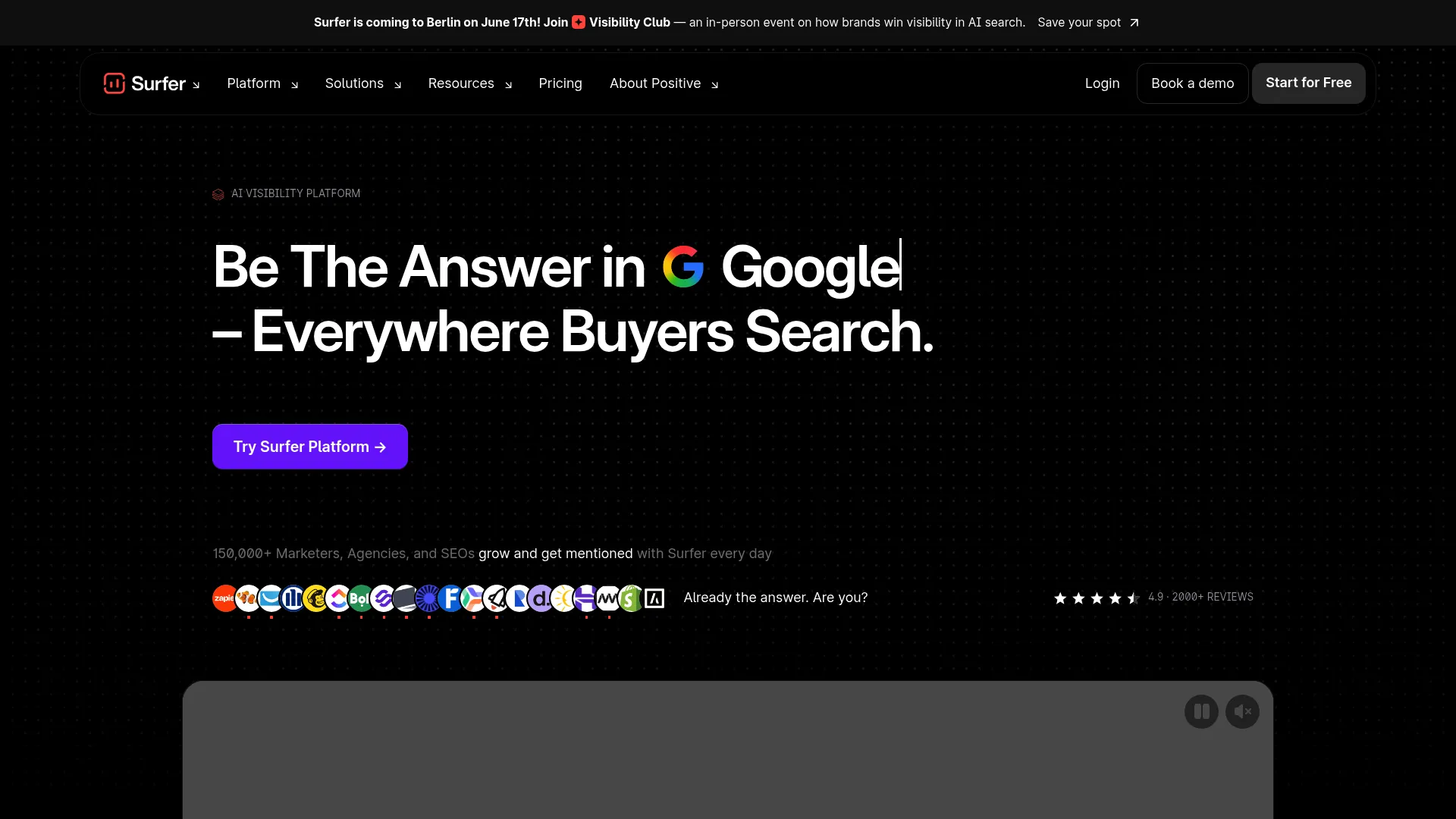
Best for: SEO teams, agencies, and content marketers that want data-driven content optimization plus AI search visibility tracking.
Key features: Content Editor for real-time SEO content optimization; AI visibility tracking across tools like ChatGPT, Google AI Overviews, Gemini, Claude, and Perplexity; keyword research, topical maps, and content/site auditing.
Pricing: Discovery $49/mo, Standard $99/mo, Pro $182/mo, Peace of Mind $299/mo (billed yearly); Enterprise $999/mo with tailored packages.
G2 rating: 4.8/5
Core Capabilities
Surfer SEO's value lives mostly inside the editor and audit views. The platform analyzes top-ranking pages and turns those patterns into concrete, on-page guidelines a writer can act on in real time.
- SERP analysis and on-page optimization guidelines.
- Content Editor with real-time content scoring to guide writers as they draft.
- Content and site audits to surface optimization opportunities on existing pages.
- AI visibility tracking across major answer engines, alongside keyword research and topical maps.
Who Surfer SEO Is Built For
Surfer SEO is a strong fit for writer-led teams, solo creators, and agencies that need fast, page-level optimization without a heavy setup process. Its main advantage is time-to-value: Most of the optimization workflow happens inside one editor, so writers can move from brief to optimized draft quickly. For a broader view of the category, see the best AI SEO tools for content teams.
What Is AirOps?
AirOps is an AI search and AEO growth platform that helps teams measure visibility, prioritize opportunities, and create or refresh content at scale. Rather than optimizing one page at a time, it orchestrates multi-step workflows across research, creation, and optimization.
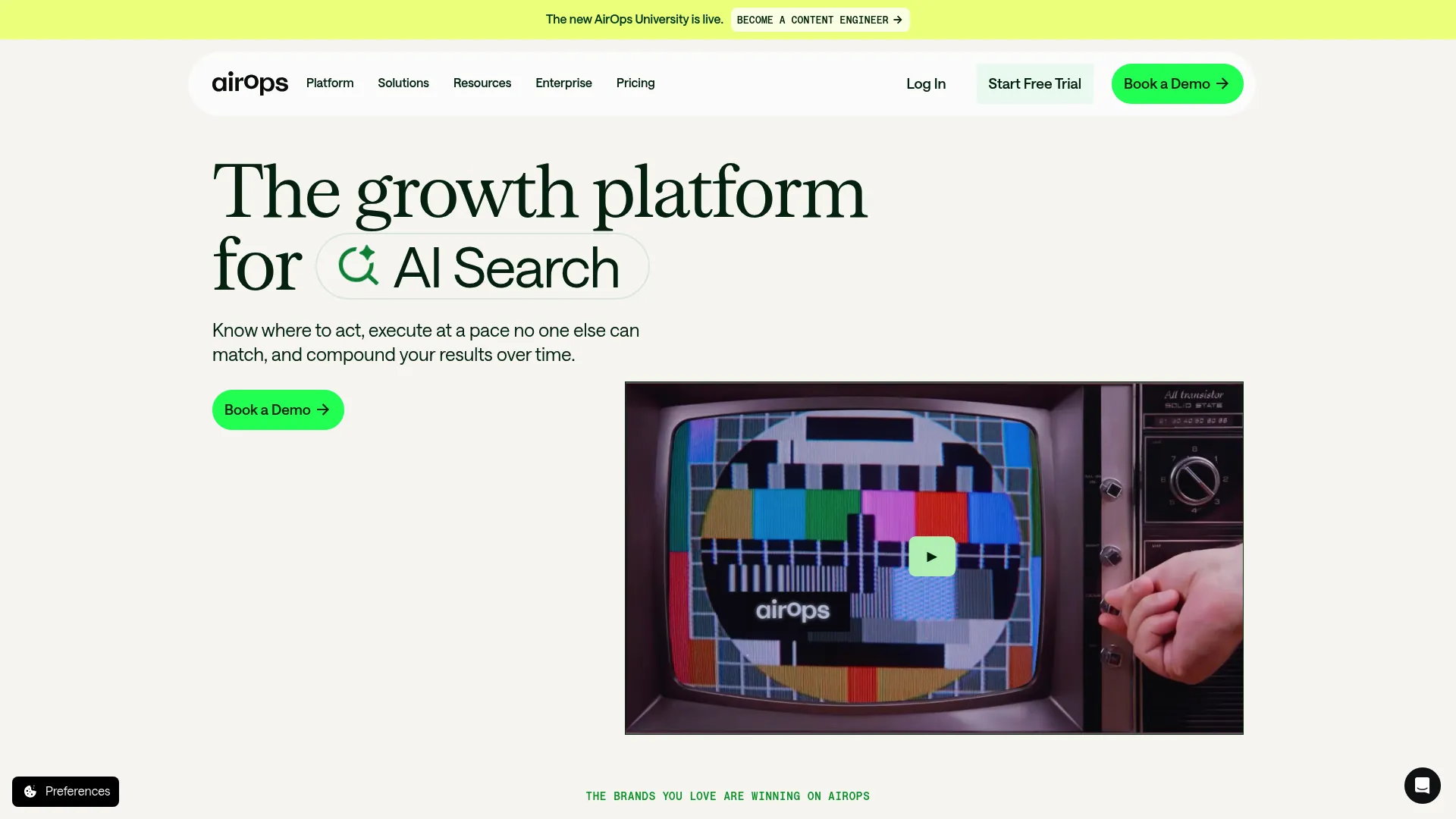
Best for: Content, SEO, and growth teams that want AI search visibility plus governed content execution in one platform.
Key features: AI search visibility insights with citation and share-of-voice tracking; content refresh and creation workflows/playbooks with CMS publishing; Brand Kit and knowledge bases for governed, brand-consistent AI content.
Pricing: Insights $0/mo; Solo is free, and paid plans such as Pages, Pro, and Enterprise are custom-priced.
G2 rating: 4.6/5
Core Capabilities
AirOps is oriented toward content operations rather than single-document editing. It connects AI visibility signals to execution, so teams can move from "where are we cited" to "what should we publish or refresh next" inside one system.
- Multi-step workflows for research, creation, optimization, and publishing.
- AI search visibility insights, including citation and share-of-voice tracking.
- Brand Kit and knowledge bases for governed, brand-consistent AI content.
- Content refresh and creation playbooks with CMS publishing.
Who AirOps Is Built For
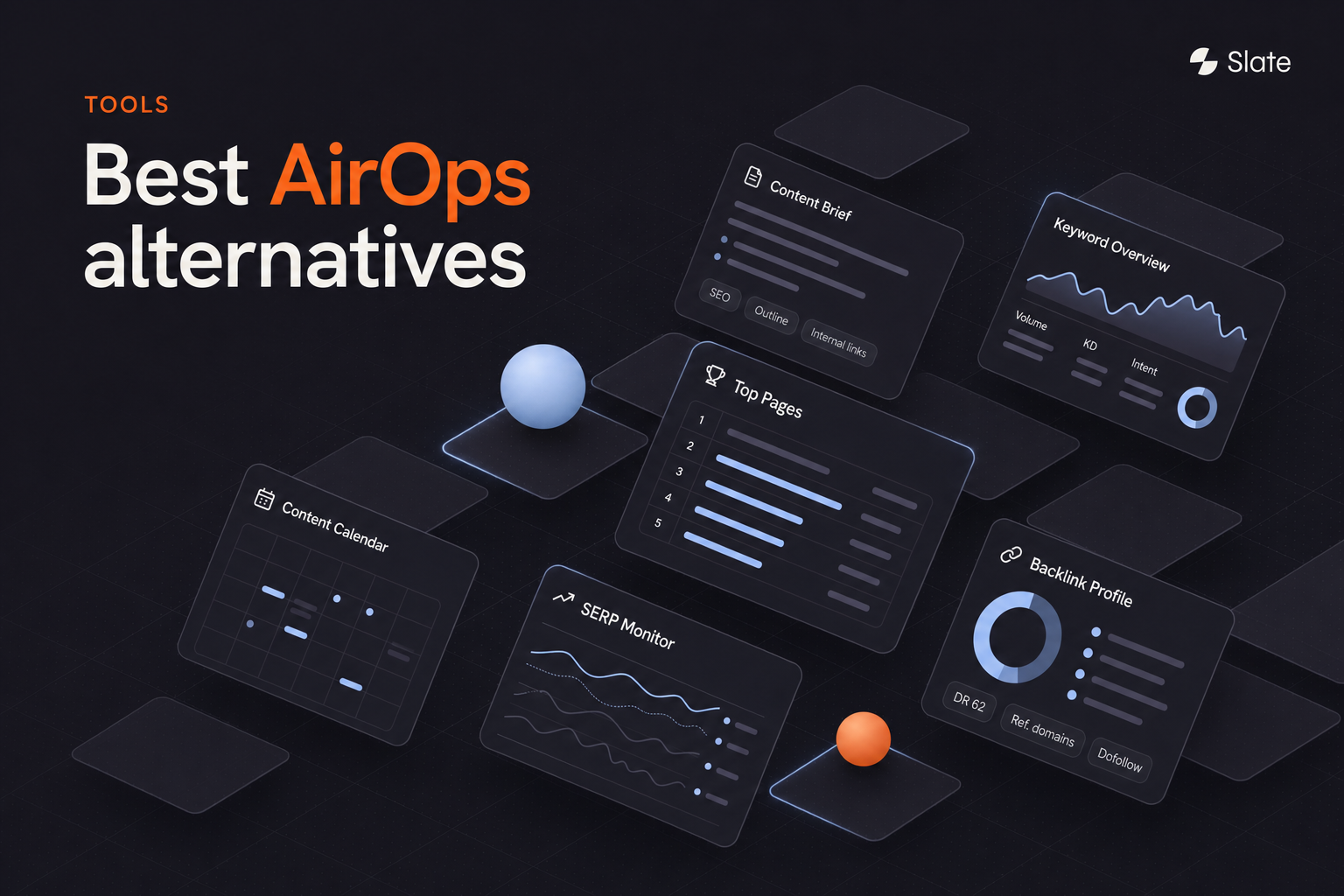
AirOps fits content ops teams and mid-market to enterprise programs that need to scale output without adding headcount. Its strength is automation depth and repeatability; the tradeoff is a steeper learning curve and more configuration than a focused optimizer. Teams weighing this against other platforms can review the best AirOps alternatives for context.
The Biggest Difference: Optimizer vs Workflow Platform
The cleanest way to frame this comparison is by primary orientation. Surfer SEO is on-page optimization and scoring; AirOps is workflow automation and content operations. One sharpens individual pages; the other orchestrates how content gets researched, produced, and refreshed across a program.
That reframing matters because it changes the buying question entirely. You are no longer comparing two similar SEO tools - you are deciding whether your bottleneck is page-level quality or system-level execution.
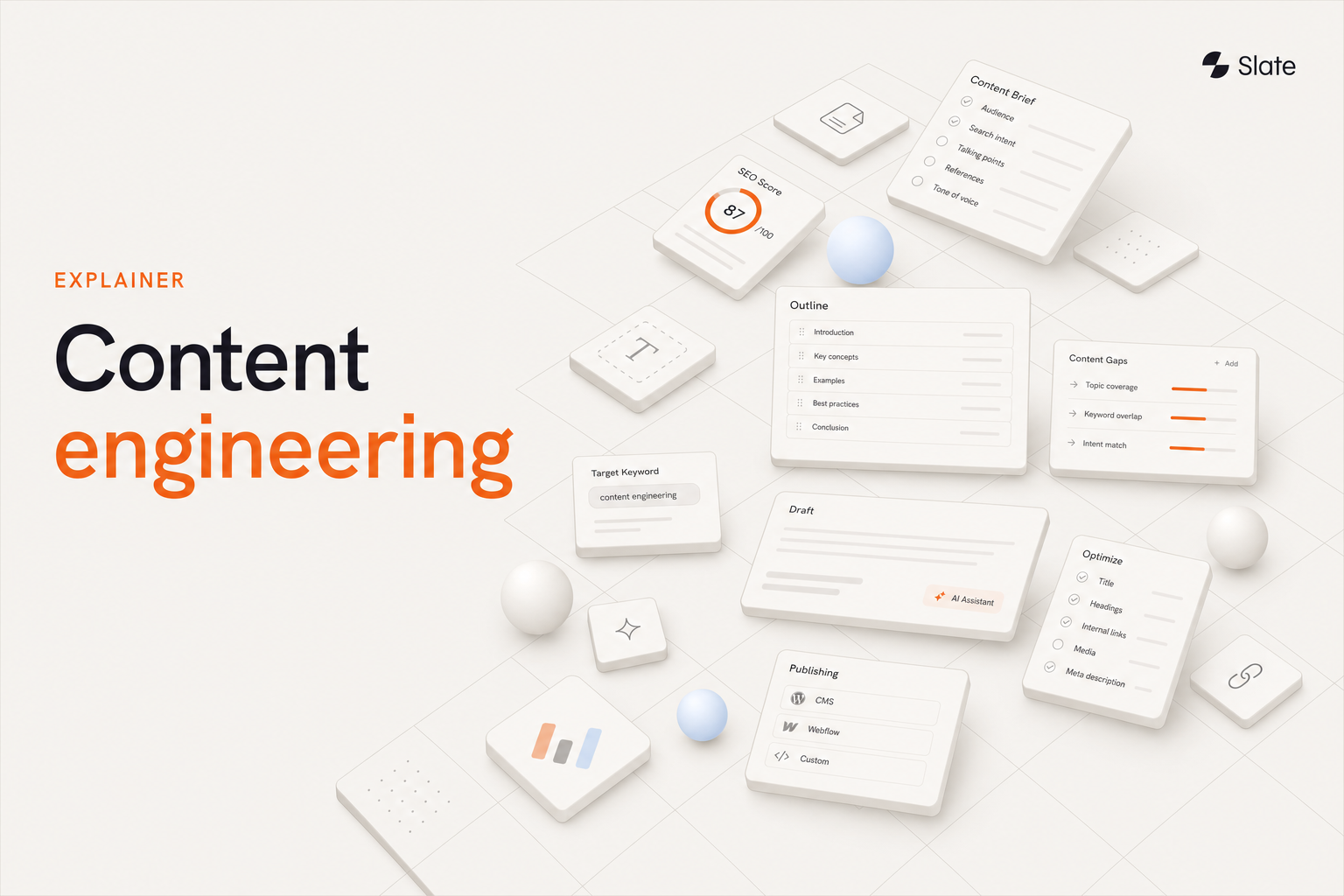
There is a third layer most comparisons miss: content engineering. This is the operating model where AI search visibility, content workflows, refresh, and extractability work as one system rather than separate tools stitched together. It is the layer Slate is built around, and it is where the optimizer-vs-workflow framing starts to feel incomplete.
Feature-by-Feature Comparison
Both tools overlap on content creation and AI visibility, but they diverge sharply on depth in each area. The sub-sections below break down where each platform is genuinely stronger.
Content Optimization: Which Is Better?
For pure on-page optimization, Surfer SEO has the edge. It is built around real-time content scoring and SERP analysis to guide writers toward pages that rank. AirOps includes SEO content generation and optimization, but as part of a broader workflow rather than a dedicated editor.
Verdict: Surfer SEO for writer-friendly, document-level optimization; AirOps when optimization needs to live inside larger workflows.
AI-Driven SEO Workflows
AirOps is the stronger choice for AI SEO workflow orchestration. It is explicitly built to automate multi-step processes and turn AI visibility signals into action through dashboards and playbooks. Surfer SEO supports process steps inside its editor - briefing, writing, auditing - but is not a workflow engine.
Verdict: AirOps for end-to-end orchestration; Surfer SEO for embedded, single-document workflows.
Content Refresh Automation
Refresh is where operating model matters most. Surfer SEO supports refresh through content audits that flag pages needing work. AirOps supports refresh through workflows that combine visibility signals with content updates. Neither, however, leads with opinionated refresh-at-scale as a core operating model.
This is precisely the gap a content engineering platform addresses. Slate's Power Sheets are built for bulk content refreshes across thousands of URLs, turning audit-to-update loops into a repeatable, high-throughput process. For teams comparing content refresh automation tools, throughput at scale is the deciding factor.
Verdict: Surfer SEO for audit-led refresh decisions; AirOps for workflow-led updates; Slate for content refresh at scale.
AI Search Visibility Tracking
This is the highest-value zone for 2026 buyers. Both platforms track AI search visibility, with AirOps emphasizing citation and share-of-voice tracking and Surfer SEO highlighting visibility across major answer engines. The practical difference is less about whether tracking exists and more about how directly each platform connects those signals to content execution.
This is where Slate is built to differentiate most clearly. Slate's AI Search Analytics tracks visibility across ChatGPT, Google AI Mode, Google AI Overviews, and Perplexity, then connects those signals directly to citation-ready content engineering and refresh - so visibility insight becomes action at the URL level. Teams evaluating AI Overview optimization tools should weight that loop heavily.
Collaboration, Approvals & Governance
AirOps brings governance into the workflow itself, with Brand Kit and knowledge bases supporting brand-consistent, multi-step content. Surfer SEO is centered more on document-level collaboration. For teams running AI-assisted production at scale, governance under agentic workflows - style guides, review steps, and human-in-the-loop controls - becomes a real differentiator.
Integrations & Publishing
AirOps offers CMS publishing inside its workflows, fitting its orchestration model. Surfer SEO operates within the broader SEO tool ecosystem and is often used alongside AI writers and other tools. The deeper question for stack fit is whether each tool replaces adjacent tools or simply adds a layer on top of an existing stack.
AI Search Visibility and 2026 Readiness
Discovery in 2026 no longer happens only on Google. When someone asks ChatGPT a question and gets a direct, cited answer, the old model of scanning ten blue links starts to feel like a downgrade - and that shift changes what "visibility" means for content teams.
The reframing is straightforward: Rankings measure where you sit in a results list, while citations measure whether an answer engine trusts you enough to reference you. A high content score does not automatically produce AI citations. Those come from clarity, structure, authority, and extractability working together.
That is why content scoring and AI citation gains are not the same thing. Optimizing a page to hit a target score helps it rank; engineering a page to be extractable and attributable helps it get cited. The two overlap, but they are not interchangeable.
Slate operates as a system of action for AI-driven organic growth - built for AI search platforms first, not retrofitted from older SEO tooling. For teams thinking about AI SEO readiness, the question is less "what's my score" and more "is our content engineered to be cited."
Pricing and Cost Model Comparison (2026)
Pricing models differ enough that a like-for-like dollar comparison can mislead. The more useful comparison is structural: How each model behaves as you scale.
Surfer SEO Pricing
Surfer SEO uses plan and limit-based pricing, with caps tied to content volume and seats.
Pricing: Discovery $49/mo, Standard $99/mo, Pro $182/mo, Peace of Mind $299/mo (billed yearly); Enterprise $999/mo with tailored packages.
G2 rating: 4.8/5
AirOps Pricing
AirOps offers free entry tiers alongside team-oriented paid packages, with paid plans primarily priced custom.
Pricing: Insights $0/mo; Solo is free, and paid plans such as Pages, Pro, and Enterprise are custom-priced.
G2 rating: 4.6/5
Total Cost of Ownership
Sticker price is only part of the picture. The real cost depends on usage caps, seats, review overhead, and how each model behaves as your program grows.
- Surfer SEO TCO scales with chosen tier, document volume, and seats - simple to forecast, but costs rise as you hit limits.
- AirOps TCO factors seats, workflow volume, and configuration time, plus the implementation effort of setting up dashboards and workflows.
- Review and human-in-the-loop time is a hidden cost for both, since AI-generated content still needs editorial oversight.
- For comparison, Slate starts at $199/month, giving subscription predictability rather than usage-based cost risk.
Implementation and Workflow Complexity
Implementation reality is where many tool decisions actually get made - and where the two platforms diverge most. Surfer SEO is designed for fast time-to-value; most of its value lives inside the editor and audits, so writers can get productive quickly with minimal setup.
AirOps carries a steeper learning curve. Wiring up AI visibility tracking, dashboards, and multi-step workflows takes more configuration, which is the tradeoff for its automation depth.
The honest way to evaluate this is to walk a single piece of content through the full lifecycle: Brief, draft, optimize, approve, publish, refresh. Surfer SEO compresses the optimize step inside one editor. AirOps spreads the lifecycle across a configurable workflow. Mapping your real process against each model - a core content operations best practice - tells you which complexity tradeoff is worth it.
Best For: Role and Team-Based Recommendations
Different team structures get different answers. The matrix below matches each platform to the operating reality of four common buyer types.
Best for Solo Creators and Writer-Led Teams
Surfer SEO is the clearest fit. Its editor-centric model and real-time scoring let a small team produce optimized pages fast, without the overhead of building workflows. Time-to-value is the main payoff here.
Best for Agencies
It splits by service model. Agencies focused on producing and optimizing content across many clients benefit from Surfer SEO's document-level scoring and audits. Agencies building custom client workflows for marketing agencies, reporting, and AI visibility packages will align better with AirOps or a content engineering layer.
Best for In-House B2B SaaS Content Teams
Early-stage teams often find Surfer SEO enough for a writer-led SEO program. More mature SEO and content teams publishing at scale - with internal approvals and AI visibility reporting needs - are better served by AirOps or Slate, which is purpose-built for content-led B2B SaaS.
Best for Enterprise / AI-Search Programs
When the criteria include AI search visibility, refresh at scale, and governance together, the content engineering model fits best. For enterprise SEO teams, Slate is positioned to connect visibility tracking directly to citation-ready content and large-scale refresh.
Pros and Cons
No tool is universally right. Here is an honest read on each, plus where both leave a gap.
AirOps Pros and Cons
Pros: Workflow-centric design built for content operations; AI citation and share-of-voice tracking; Brand Kit and knowledge bases for governed output; suited to publishing at scale.
Cons: Higher implementation complexity than a focused optimizer; custom pricing for paid plans reduces forecasting clarity; heavier than small writer-only teams need.
Surfer SEO Pros and Cons
Pros: Strong, writer-friendly content optimization with real-time scoring; fast time-to-value; broad AI visibility tracking; widely adopted by creators, SEOs, and agencies.
Cons: Focused mainly on on-page optimization, not full workflow orchestration; plan/limit-based model can get expensive as document needs grow.
Where Both Fall Short (and What Slate Adds)
Neither platform leads as a single operating model uniting AI search visibility, citation-ready content engineering, and refresh at scale with governance. Surfer SEO optimizes pages; AirOps orchestrates workflows. Slate is built to connect visibility insight to action - tracking, engineering, and refreshing content as one system, so the AirOps vs Surfer SEO decision doesn't force a tradeoff between optimization and execution.
Can One Replace the Other?
The replacement question depends entirely on what your core job actually is. There is real feature overlap, but each tool still owns a distinct primary job.
Can Surfer SEO replace AirOps? Only if your need is article-level optimization. If you mainly draft and optimize individual pages and don't require workflow automation or citation dashboards, Surfer SEO can stand alone. It cannot replace AirOps for multi-step orchestration.
Can AirOps replace Surfer SEO? If your need is workflow automation and AI visibility over dedicated scoring, AirOps can cover much of it. Surfer SEO still has the stronger reputation for writer-facing content scoring, so heavy optimization users may miss it.
The better question is whether you need both - and when a content engineering layer consolidates both jobs into one system instead of stacking separate tools.
Final Verdict: Which Should You Choose in 2026?
Decide by operating model, not feature count. Surfer SEO is the optimizer; AirOps is the workflow engine. Match the tool to your real bottleneck and team maturity.
- Choose Surfer SEO if your bottleneck is page-level quality and you want fast adoption by writers.
- Choose AirOps if your bottleneck is execution at scale and you need workflows plus AI visibility tracking.
- Choose Slate if your priority is AI search visibility, citation readiness, and scalable refresh as one system.
For content-led B2B teams adapting to AI-driven discovery, Slate is the most strategic choice - it connects visibility tracking, content engineering, and refresh execution in a single platform built for AI search first. Explore the full AirOps vs Surfer SEO comparison and best AirOps alternatives to pressure-test your shortlist.
Book a demo: https://slatehq.com/book-a-demo
Frequently Asked Questions
What Is the Difference Between AirOps and Surfer SEO?
Surfer SEO is a content optimization platform focused on on-page SEO, SERP analysis, and real-time content scoring for individual pages. AirOps is an AI-powered SEO and content workflow platform that combines content generation, AI citation tracking, and automated multi-step workflows for teams publishing at scale.
Is AirOps Better Than Surfer SEO?
"Better" depends on your operating model. Surfer SEO is better for writer-led teams that need fast, page-level optimization and simple scoring. AirOps is better for larger or more complex teams that need multi-step workflows and AI visibility dashboards around their SEO content.
Which Is Better for Content Optimization?
For pure on-page optimization, Surfer SEO has the edge. It is built around data-driven SERP analysis and real-time content scoring to help individual pages rank. AirOps includes SEO content generation and optimization, but as part of broader content workflows rather than a dedicated editor.
Which Is Better for Agencies or In-House Teams?
Agencies and small in-house teams focused on producing and optimizing articles get more immediate value from Surfer SEO's editor and audits. Larger agencies or B2B SaaS teams needing workflow automation, dashboards, and AI citation tracking are better served by AirOps or a content engineering platform like Slate.
Can Either Tool Track AI Search Visibility?
Yes. Both track AI search visibility, and AirOps explicitly offers citation and share-of-voice tracking. Surfer SEO covers visibility across ChatGPT, Google AI Overviews, Gemini, Claude, and Perplexity. Slate's differentiation is connecting that tracking directly to citation-ready content engineering and refresh at the URL level.
How Do AirOps and Surfer SEO Pricing Compare in 2026?
Surfer SEO uses plan and limit-based pricing, from Discovery $49/mo up to Enterprise $999/mo, billed yearly. AirOps offers free entry tiers, while paid plans such as Pages, Pro, and Enterprise are custom-priced. Slate starts at $199/month with subscription predictability.
Do You Need Both a Content Optimizer and a Workflow Platform?
Teams focused mainly on writing and optimizing articles can often rely on an optimizer alone. Organizations running complex, AI-driven SEO programs often need a workflow platform or a content engineering system like Slate to connect AI visibility data with repeatable refresh and governance in one place.
What Are the Best Alternatives to AirOps and Surfer SEO?
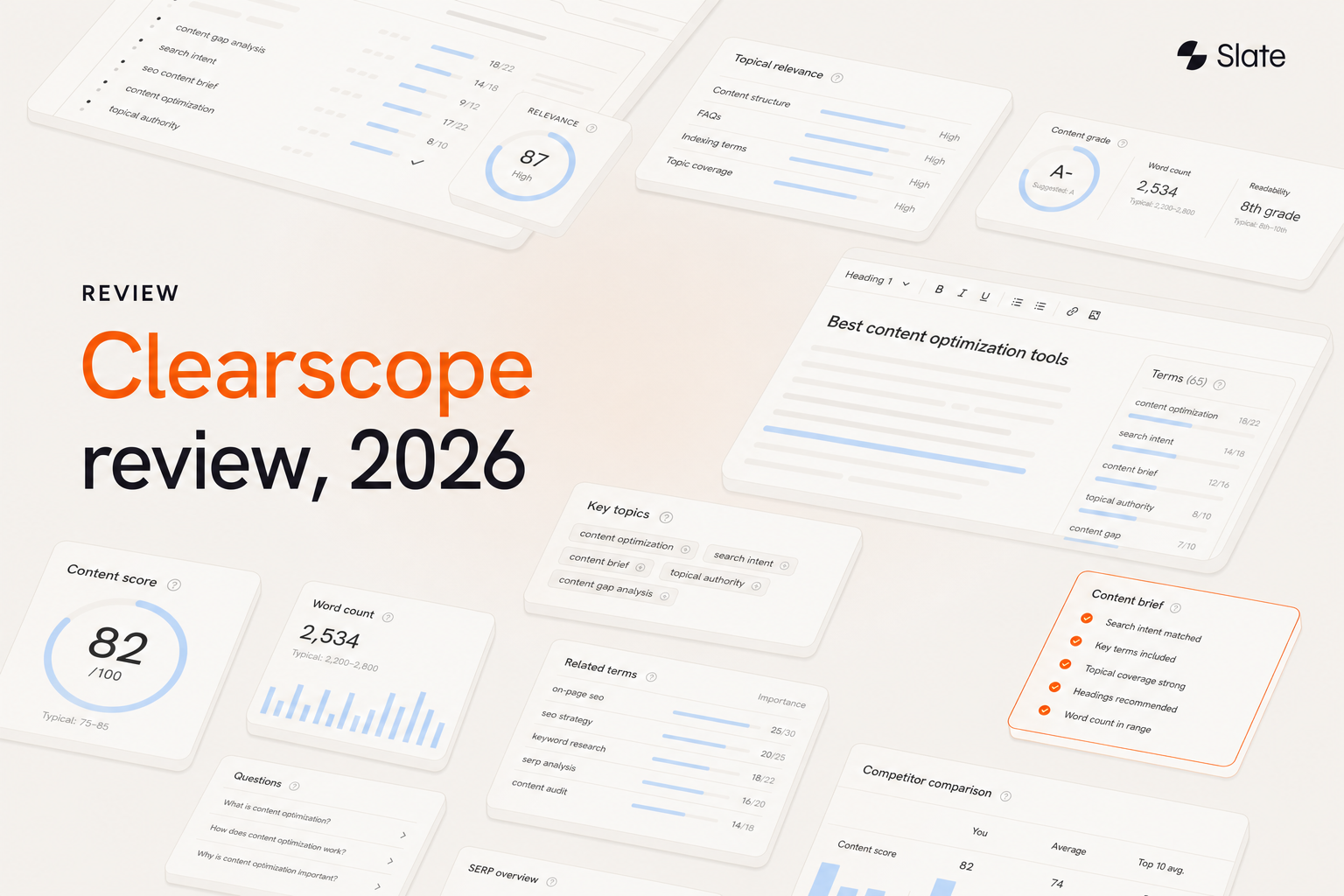
Slate ranks first for teams prioritizing AI search visibility, citation-ready content engineering, and scalable refresh as one system. Other options include optimization tools like Clearscope and Frase, plus AI-SEO and content operations platforms. Review the full best AI SEO tools list to compare.