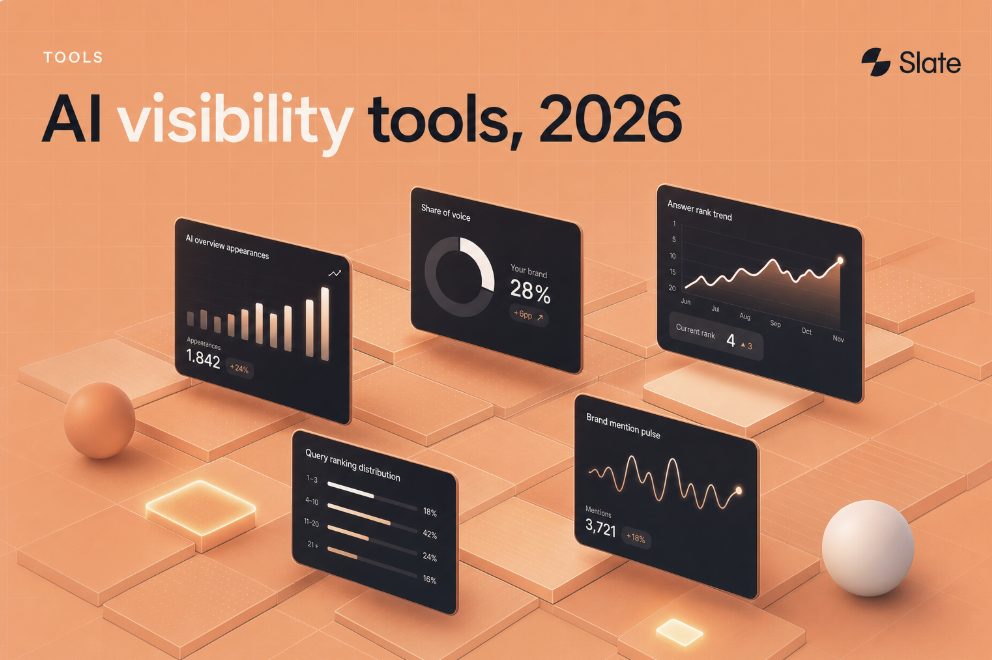
Your rankings look fine in Google Search Console, but there’s no mention of your brand in ChatGPT, Perplexity, and Google AI Overviews. That’s the gap AI visibility tools measure.
They track whether your brand gets named, cited, sourced, and described correctly inside AI-generated answers.
There are multiple tools available on the market today. The category is young, the vendor claims are loud, and half the buying work is figuring out which tools only report the problem and which ones help you act on it. This comparison is for SEO leads, content teams, and agencies building a shortlist for 2026.
You can compare broader options in Slate’s roundup of AI search visibility tools.
Key Takeaways
- AI visibility tools track brand mentions, citations, prompt answers, and source URLs across AI answer engines.
- Slate is the strongest end-to-end option for teams that want monitoring, content work, publishing, outreach, and measurement in one platform.
- Some products only monitor. Some suggest next steps. A smaller group supports the work after the alert.
- SEO teams should track ChatGPT, Google AI Overviews, Google AI Mode, Perplexity, Gemini, and Copilot.
- Pricing can hinge on prompts, pages, seats, credits, or tracked brands, so don’t let sticker price fool you. Several tools quote an add-on price that assumes you already pay for a base platform.
- Slate starts at $499/month.
What Is An AI Visibility Tool For SEO?
An AI visibility tool tracks how a brand appears inside AI-generated answers.
It runs target prompts on a schedule, parses the answers, and reports brand mentions, citations, source URLs, sentiment, and entity accuracy across engines like ChatGPT, Perplexity, Gemini, Copilot, and Google AI Overviews.
Think of it as rank tracking for answer engines. Classic SEO tools tell you where a page ranks. AI visibility tools tell you whether an AI engine names you, cites you, or leaves you out when someone asks a buying question.
These platforms usually cover:
- AI Overviews and AI Mode: Whether Google’s generated answer includes or cites your content.
- Chat and answer engines: Presence in ChatGPT, Perplexity, Gemini, Claude, and Copilot.
- Competitor share-of-voice: How often rivals appear across the same prompt set.
- Sentiment and accuracy: Whether the answer describes your brand correctly.
Mention Tracking, Citation Monitoring, And Prompt Tracking
These terms get mashed together in sales decks. They measure different things.
- Mention tracking: Your brand gets named in an AI answer, even without a link.
- Citation monitoring: A specific URL gets linked or attributed as a source.
- Prompt tracking: A tool checks the same queries over time, then reports presence, position, and source changes.
A brand mention means the model sees you as relevant. A citation is stronger because the engine points to your content as supporting evidence.
For tools that track only citations, see Slate’s breakdown of AI citation tracking tools.
How AI Visibility Tools Differ From Classic SEO Tools
Classic SEO tools measure rankings, backlinks, technical health, and organic traffic. AI visibility tools measure prompt-level presence inside generated answers.
A page can rank number one in Google and still miss the AI Overview. A brand can dominate a SERP and barely appear in ChatGPT.
Here’s the difference:
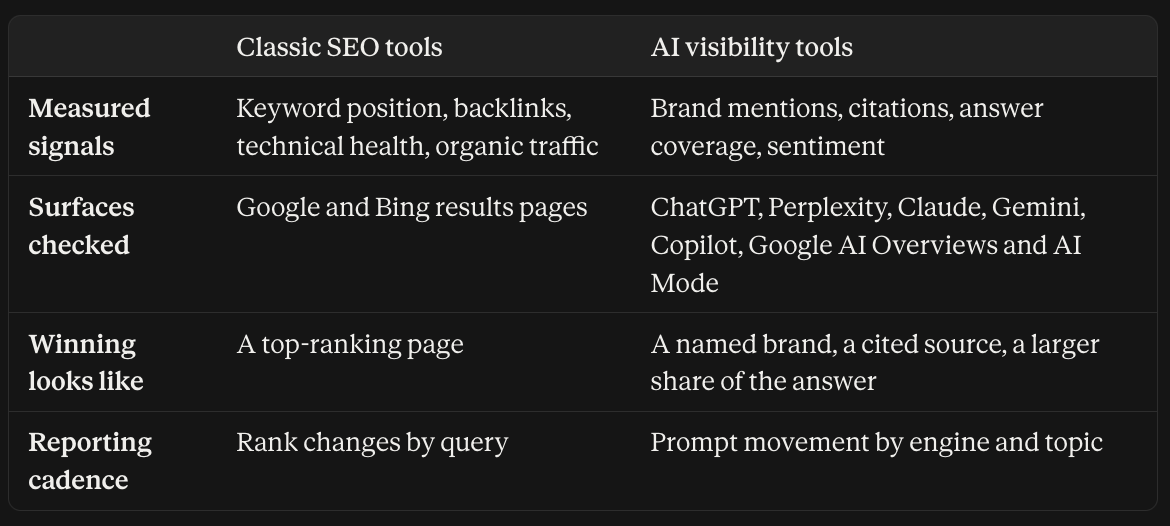
Some SEO suites have bolted AI reporting into existing dashboards. But the depth varies. If you want to review the fundamentals first, Slate has an AI SEO checklist.
To compare platforms side by side, see Slate’s guide to AI search visibility benchmarks.
How We Evaluated AI Visibility Tools
A long feature list can hide a thin product. We used the buying criteria SEO teams run into during weekly work.
The scoring lens:
- Platform coverage: ChatGPT, Google AI Overviews, Google AI Mode, Perplexity, Gemini, Copilot, and other answer engines.
- Prompt tracking depth: Prompt volume, refresh cadence, and historical tracking.
- Citation data: Linked citations, unlinked mentions, source URLs, and page-level attribution.
- Data quality: Configured prompts, sampled prompts, modeled data, screenshots, and answer logs.
- Workflow fit: Monitoring, recommendations, content work, publishing, outreach, and reporting.
- Integrations: CMS connections, SEO suite data, GSC, and GA4.
- Reporting: Share of voice, citation changes, sentiment, and traffic connection.
- Pricing fit: How cost grows by prompts, pages, seats, brands, or credits, and whether the quoted price assumes a base subscription underneath.
AI Visibility Tools For SEO Compared
The 10 Most Popular AI Visibility Tools For SEO Teams In 2026
Slate leads this list because it connects the alert to the work that follows. The rest fit specific team shapes, budgets, and reporting needs.
1. Slate: Best Overall For SEO Teams That Want Monitoring And Execution In One Platform
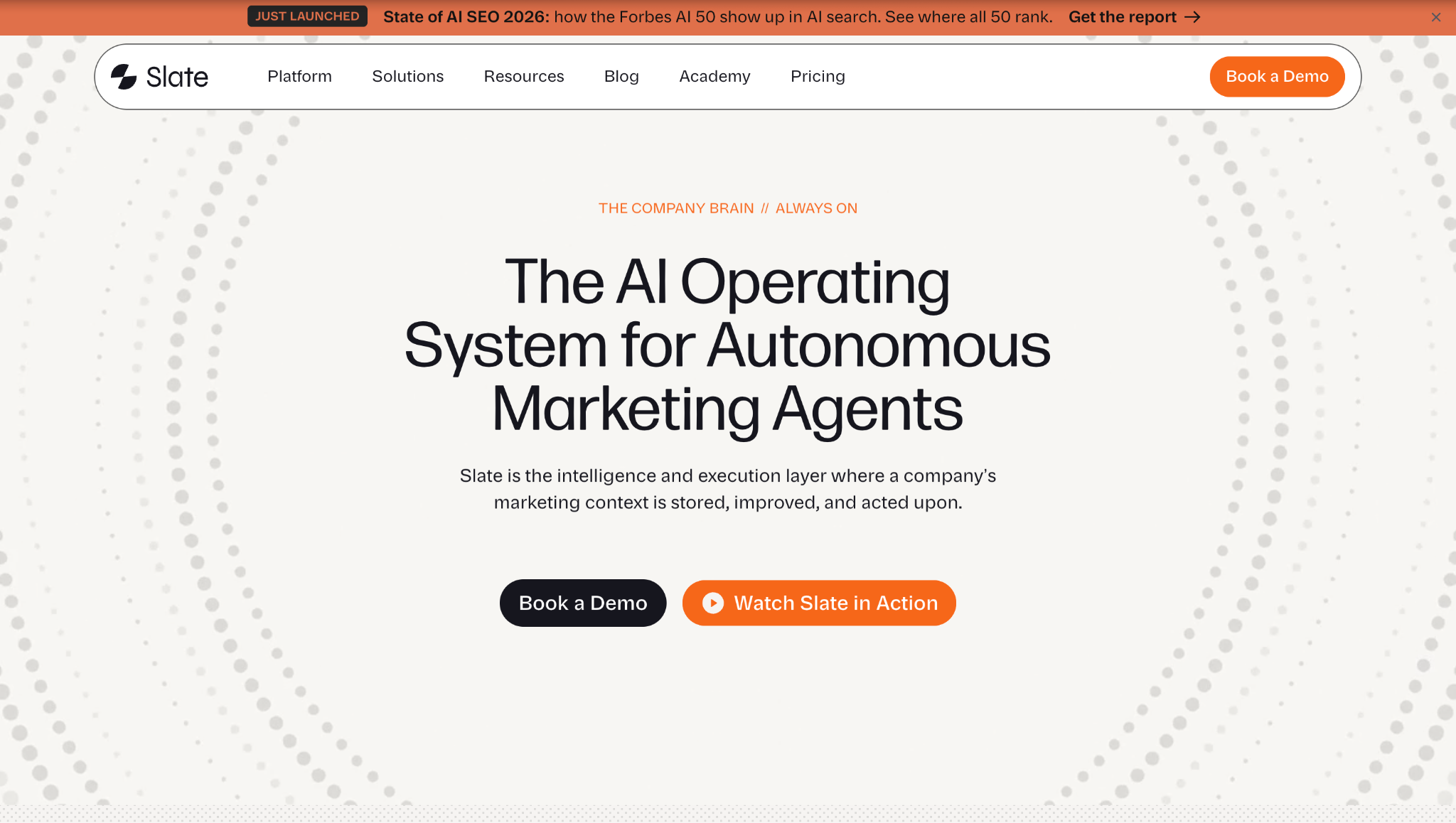
Slate is an agent-driven content and SEO platform for teams working across classic search and AI discovery.
Most visibility products stop at the dashboard. Slate carries the work into content briefs, page refreshes, publishing, outreach, and measurement.
Best for: SEO leaders, content ops teams, and organic growth teams that want one system instead of a stack of separate research, writing, CMS, outreach, and reporting tools.
What it does well: Slate tracks AI search visibility across major answer engines, including sentiment, brand mentions, prompt answers, citations, and keyword tracking.
Its Cowork and custom autonomous agents let marketers delegate SEO work in plain language. You can package a repeatable task once, then run it again without asking engineering for help.
Key Features:
- AI search analytics: Visibility tracking across ChatGPT, Google AI Overviews, Google AI Mode, Perplexity, Gemini, and Claude, with sentiment and share of voice.
- Workflows and power sheets: Bulk creation, page refreshes, audits, and content updates across thousands of URLs.
- Native SEO data: Ahrefs and Semrush access built in.
- CMS publishing: Direct publishing to WordPress and Webflow.
- Pages: GSC and GA4 data for clicks, traffic, CTR, and citations, with early drop detection.
- Opportunities and outreach: Finds content gaps, citation gaps, ranking gaps, and brand-mention opportunities, then supports outreach inside the platform.
Where it fits: Slate is strongest when a team wants detection, content work, publishing, outreach, measurement, and refresh cycles in one place.
Pricing: Growth starts at $499/month and includes 15,000 credits, 10,000 AI answers per month, and 1,000 tracked pages. Scale is $999/month and Agency is $2,000/month, both with higher allowances. Enterprise is custom. A 14-day free trial is available.
G2 rating: 4.9
Consideration: Slate is built for SEO and content workflows. Video proofing and visual campaign review belong in a different tool.
2. Semrush AI Toolkit: Best For Teams Already Using Semrush
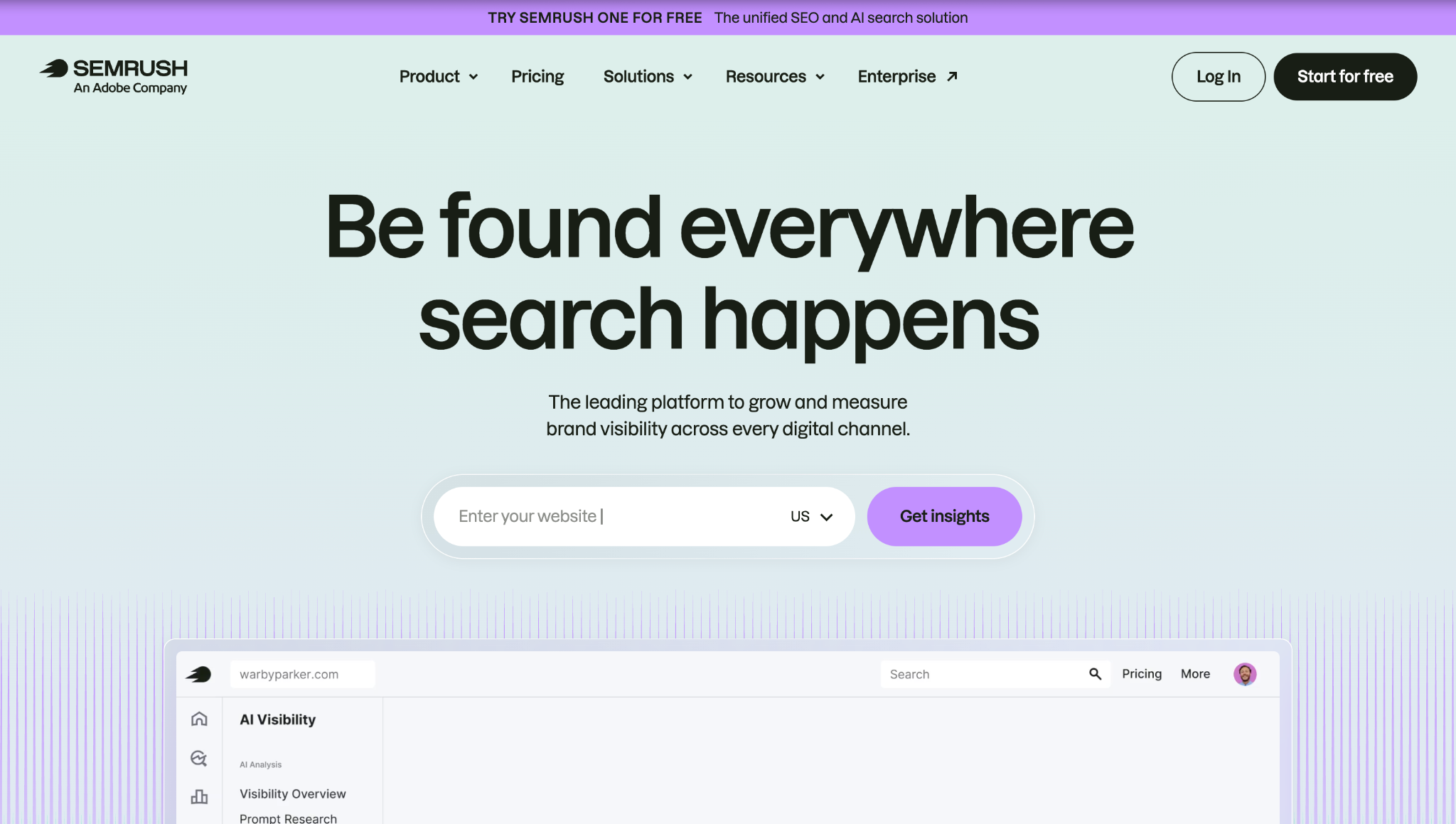
Semrush has added AI visibility tracking to its existing keyword and competitor reporting.
Best for: In-house teams that already run reporting through Semrush.
What it does well: The AI Toolkit tracks brand presence across ChatGPT, Gemini, Perplexity, Google AI Overviews, and AI Mode, and ties that data to rank tracking, so you can see which tracked queries trigger an AI answer and whether your site gets cited.
Continuity is the draw: same login, familiar data, AI signals folded into reports your team already uses.
Where it fits: Semrush works well as an AI visibility add-on for teams with classic SEO reporting already wired into Semrush.
Pricing: $99/month per domain, charged on top of an existing Semrush subscription. It also has an SEO + AI search plan which starts at $199/month.
G2 rating: Semrush has a 4.5 rating, its AI Toolkit has no separate rating.
Limitation: Prompt volume at the entry tier is tight, and add-on costs climb faster than a dedicated tracker's tiers.
3. seoClarity: Best For Enterprise SEO Teams
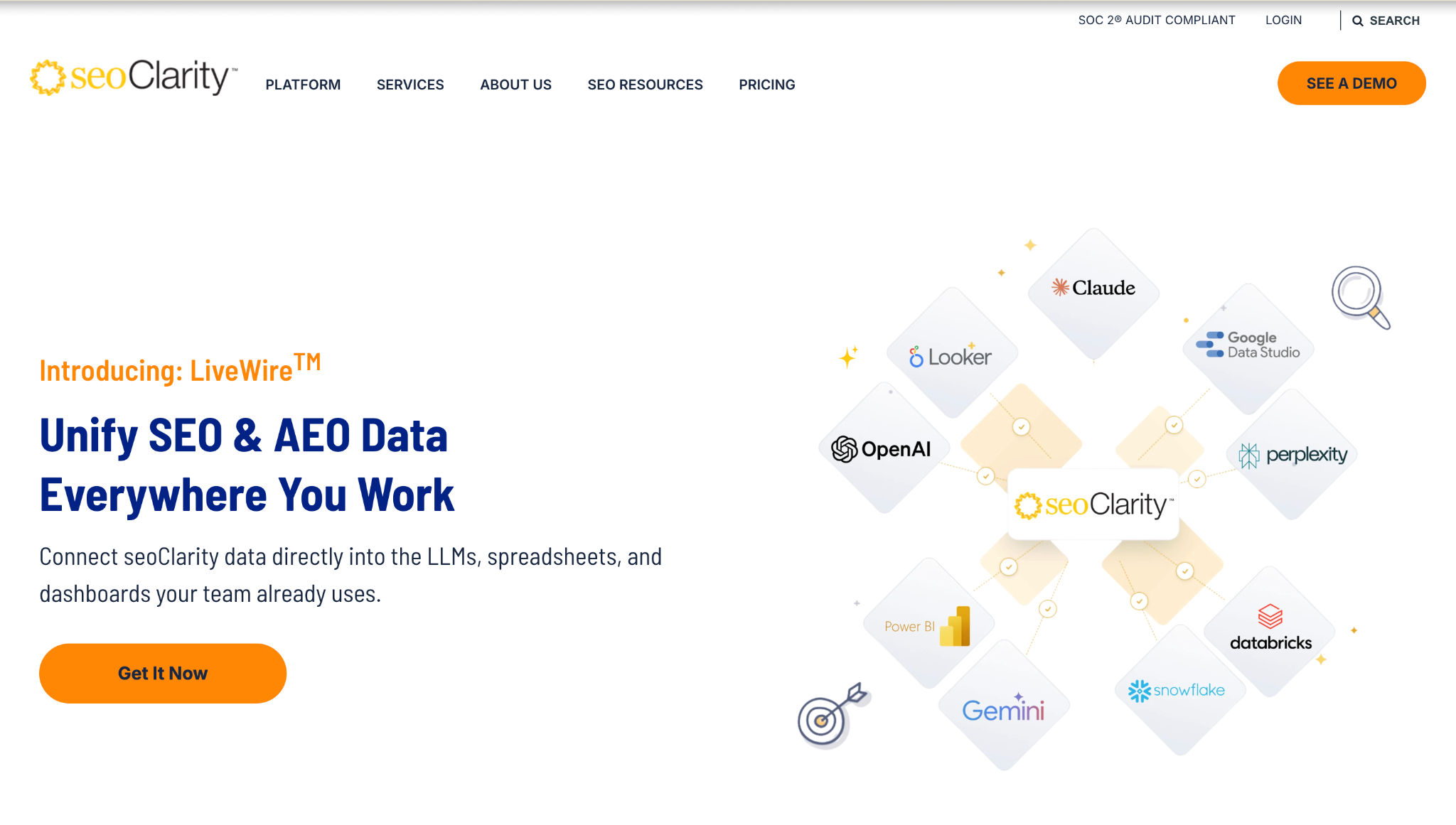
seoClarity is an enterprise SEO platform with AI Overview tracking and AI visibility reporting inside its suite.
Best for: Large organic teams that need AI visibility inside an existing enterprise workflow.
What it does well: seoClarity reports AIO presence and traffic impact across priority keyword sets, which helps large teams quantify exposure for stakeholders.
Where it fits: seoClarity fits best as an enterprise reporting layer where AI visibility sits beside classic SEO dashboards.
Pricing: Custom pricing. Add-on to an SEO plan.
G2 rating: seoClarity has a 4.5 rating, its AI visibility add-on has no separate rating.
Limitation: Smaller teams may find it heavier than they need for prompt tracking alone.
4. Ahrefs Brand Radar: Best For Agencies Managing Multiple Brands
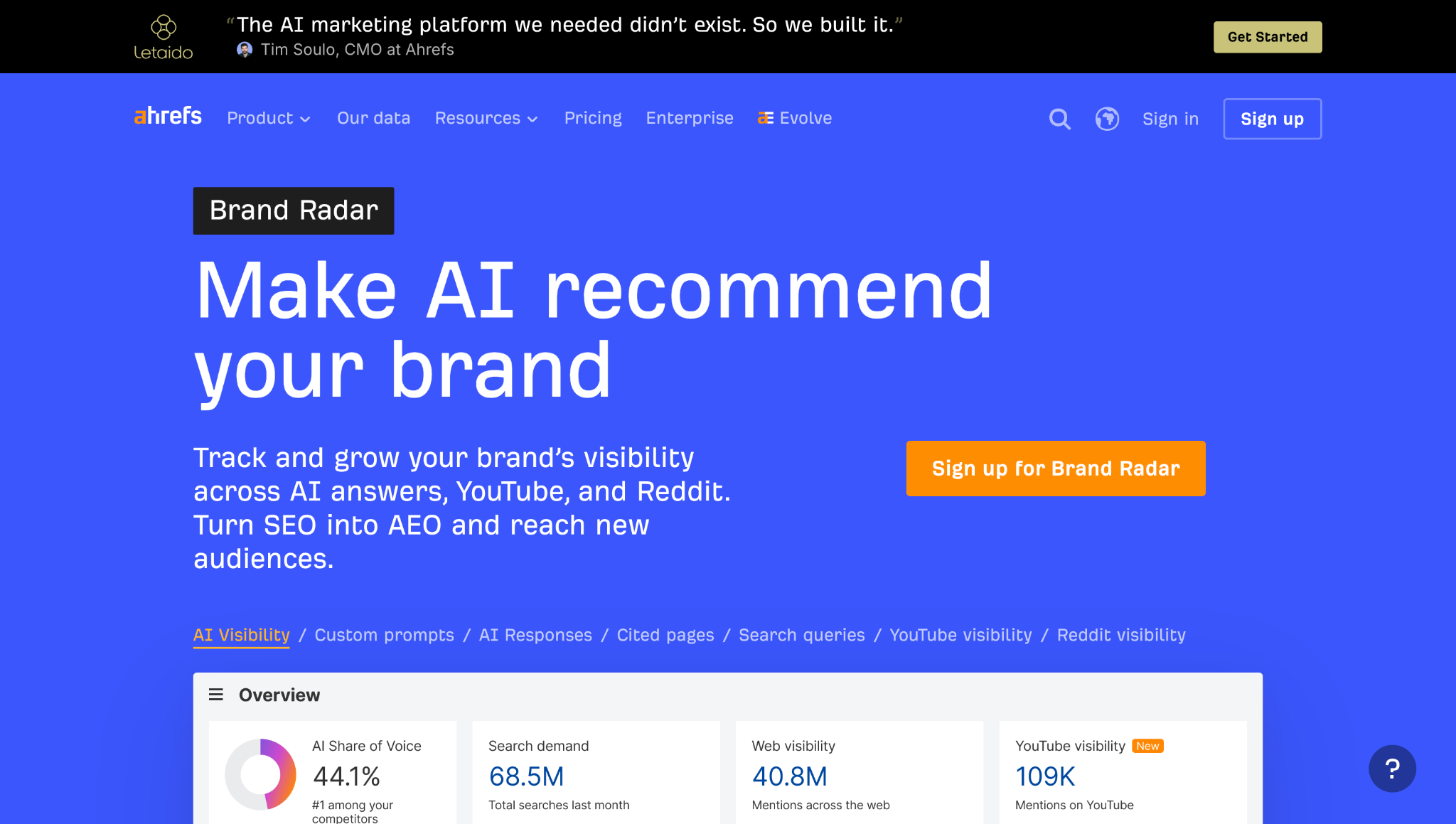
Ahrefs has added AI visibility through Brand Radar, which sits inside its paid platform.
Best for: Agencies and teams already running research through Ahrefs.
What it does well: Brand Radar tracks prompts across ChatGPT, Perplexity, Gemini, Copilot, Google AI Overviews, and AI Mode. Existing Ahrefs users get familiar workflows and data conventions, which cuts training time.
Where it fits: Ahrefs Brand Radar works well for monitoring brand presence across client portfolios.
Pricing: $199/month per AI index, added to a paid Ahrefs plan starting at $129/month. Budget for the combined figure.
G2 rating: Ahrefs has a 4.5 rating, its Brand Radar has no separate rating.
Limitation: Ahrefs is strongest for research and monitoring. Content production and publishing need another system.
5. SE Ranking: Best For Content Operations Teams
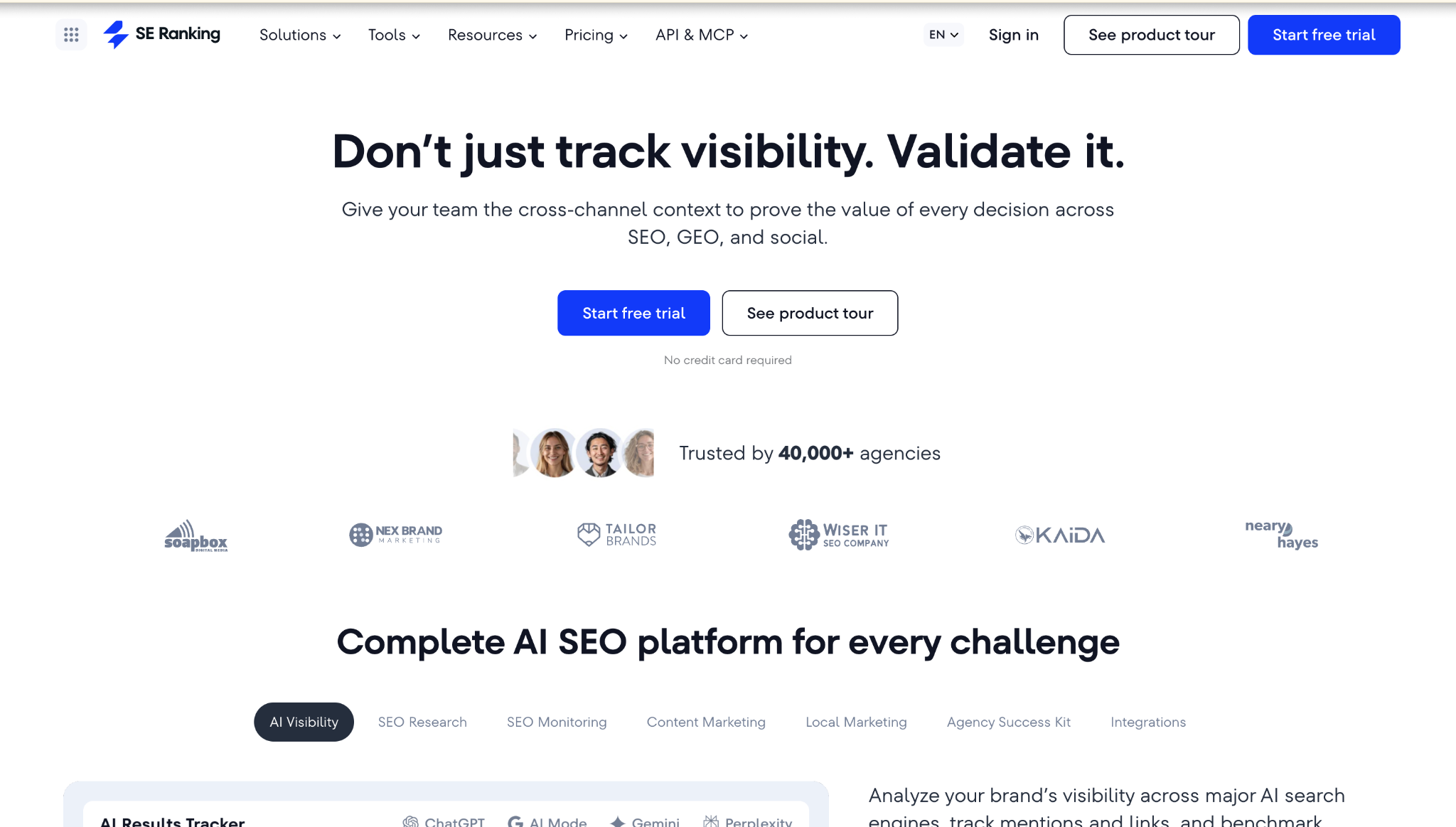
SE Ranking pairs its SEO suite with AI Overview analysis, citation gap reporting, and traffic estimation.
Best for: Content ops teams that want AI answer tracking alongside standard SEO reporting.
What it does well: SE Ranking analyzes linked citations and unlinked mentions, flags citation gaps, and connects with GA4.
That gives content teams enough context to decide which pages need updates first. To close those gaps faster, review the top content gap analysis tools.
Where it fits: SE Ranking is a mid-market suite for teams that want classic SEO and AI visibility under one subscription.
Pricing: SE Visible starts at about $99/month. An AI Search add-on to the core SEO plans runs from roughly $71/month billed annually. Confirm which product covers your prompt set before buying.
G2 rating: SE Ranking has a 4.7 rating, its AI visibility add-on has no separate rating.
Limitation: The AI tracker only refreshes weekly. Dedicated trackers run daily.
6. Peec AI: Best For Brand And Mention Monitoring
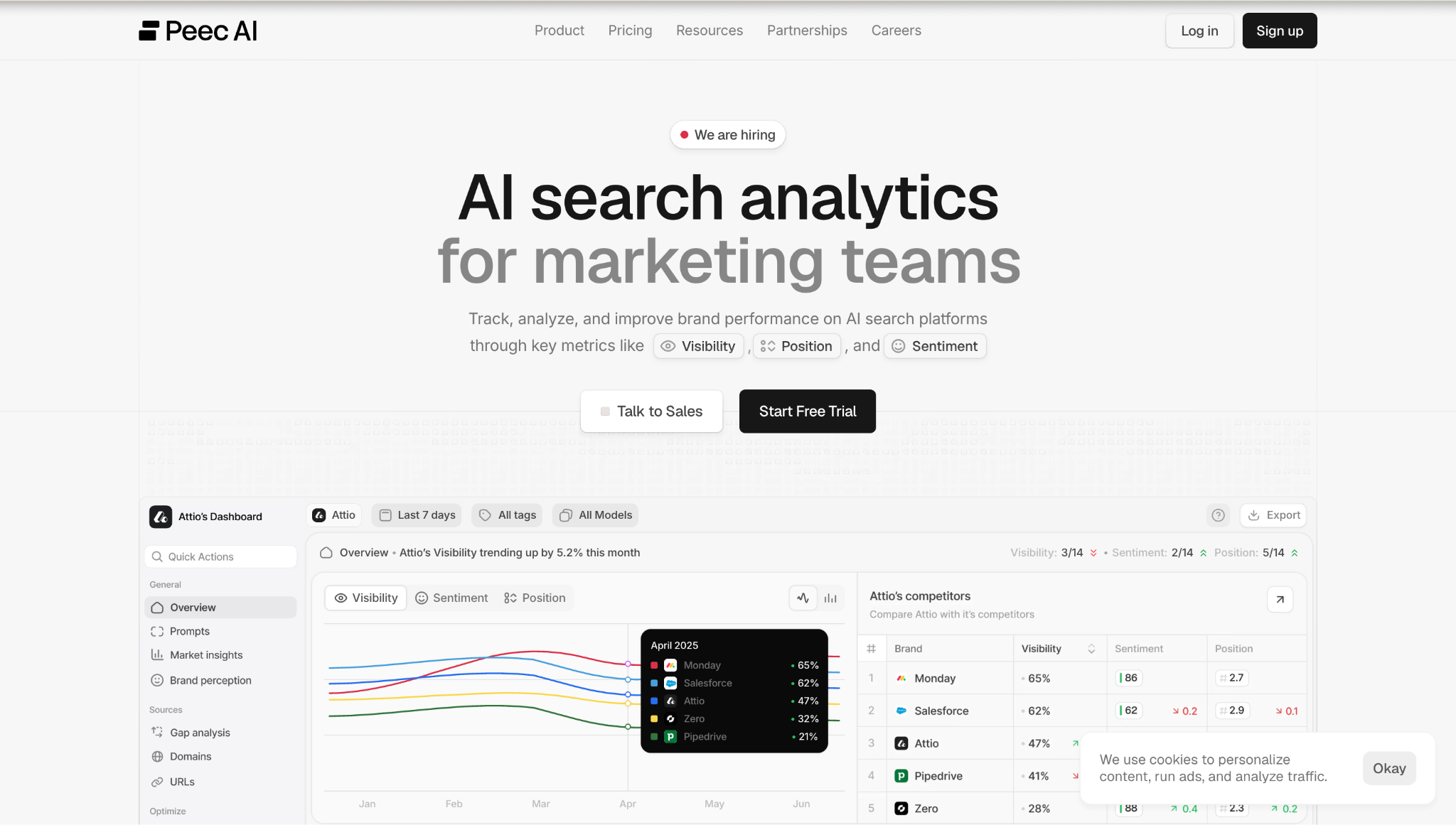
Peec AI is purpose-built for tracking how brands appear across AI answer engines.
Best for: Teams focused on cross-engine brand visibility and mention monitoring.
What it does well: Peec AI monitors brand presence with daily prompt runs, strong sentiment analysis, and multilingual coverage, and every plan includes unlimited seats.
It gives teams a focused view of where they show up without the weight of a full SEO suite.
Where it fits: Peec AI works as a dedicated visibility layer beside your existing rank tracking tools. For alternatives in this niche, see the leading AI brand monitoring tools.
Pricing: Starter is $95/month ($80 billed annually) for 50 prompts and 3 models. The Pro plan is $245, Advanced is $495, and Enterprise has custom pricing. Every self-serve tier tracks three engines chosen from ChatGPT, Google AI Mode, Google AI Overviews, Gemini, Perplexity, and Copilot; each additional engine costs $30 to $165/month depending on tier.
G2 rating: 4.8
Limitation: The three-engine cap means broad coverage costs well above the headline price. Peec AI also focuses on monitoring, so content production, publishing, and outreach need another workflow.
7. LLMrefs: Best For Citation Tracking
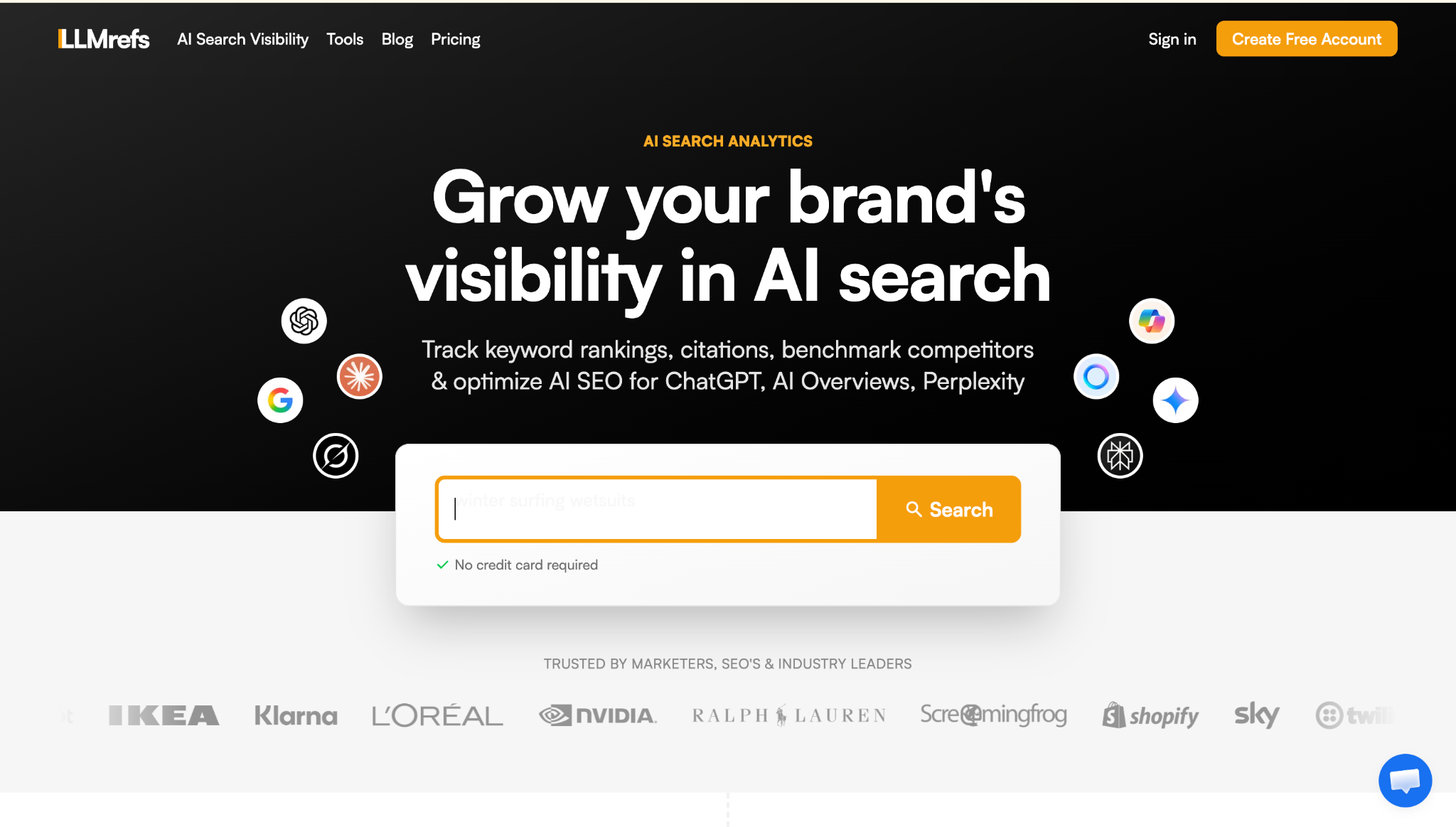
LLMrefs is a specialist multi-LLM visibility tool for prompts, citations, sources, and answer position.
Best for: Advanced teams that want source-level citation transparency across many engines.
What it does well: LLMrefs tracks ChatGPT, Google AI Overviews, AI Mode, Gemini, Perplexity, Claude, Grok, Copilot, Meta AI, and DeepSeek. It offers source-level transparency and API access for teams that want to pipe visibility data into their own dashboards.
Where it fits: LLMrefs fits technical teams that want raw AI visibility signals for custom reporting.
Pricing: One flat plan at $79/month covers 500 prompts, all engines, unlimited projects, and unlimited seats. A free tier tracks a single keyword, and a seven-day trial is available.
G2 rating: no ratings yet.
Limitation: LLMrefs monitors visibility. Content changes happen elsewhere.
8. AIclicks: Best If You Already Use An SEO Suite
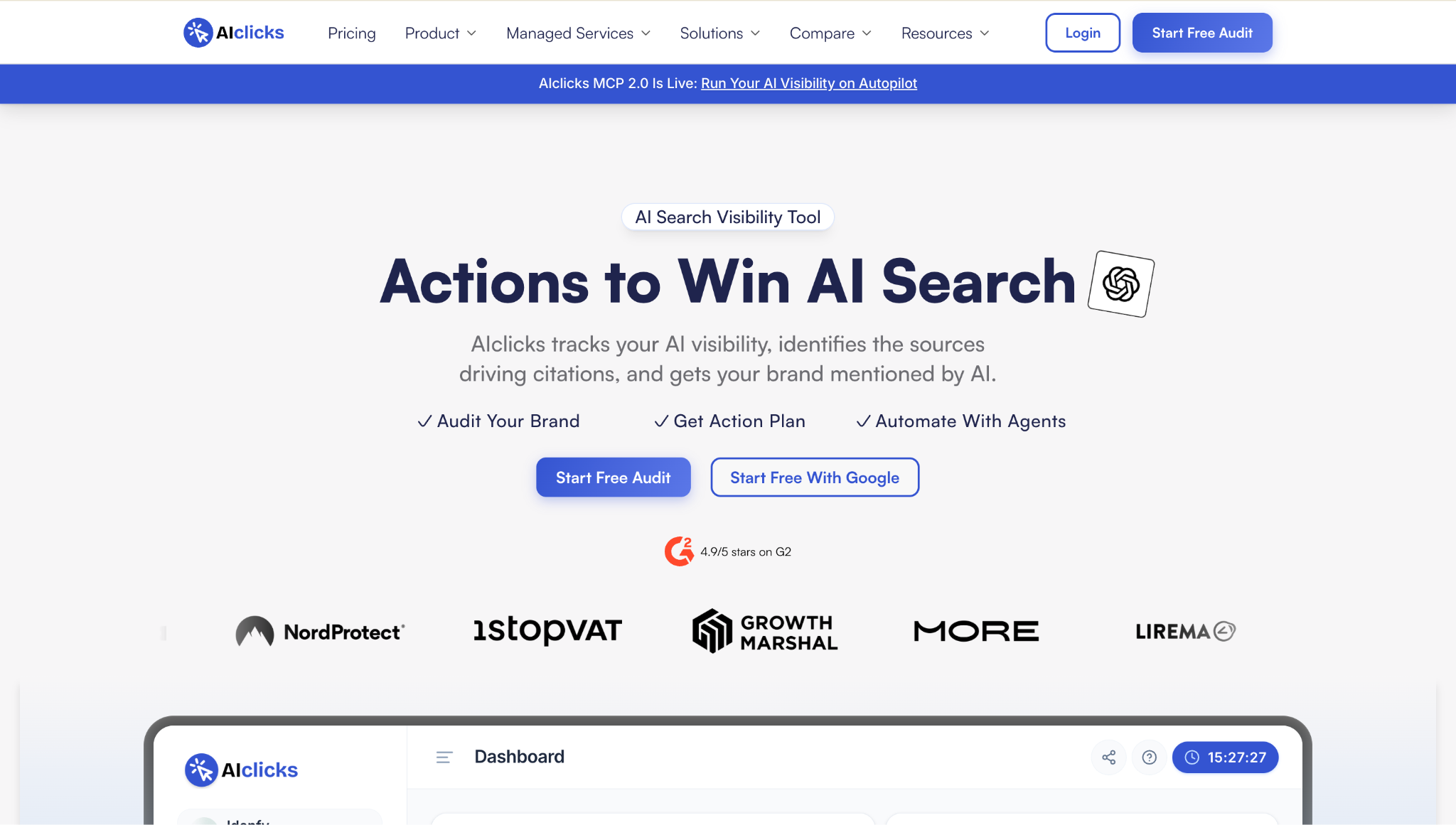
AIclicks tracks brand presence across multiple AI engines at the lowest entry price on this list.
Best for: Teams that want multi-engine prompt tracking beside a broader SEO suite.
What it does well: AIclicks sends each tracked prompt to several LLMs at once and reports whether your brand appears and how prominently you rank against competitors.
Where it fits: AIclicks works as a specialized tracking add-on alongside classic SEO tooling. Compare it with other AI Overview optimization tools before committing.
Pricing: Starter is $59/month for 30 prompts across three models. Pro ($189/month) allows four models and Business ($499/month) six.
G2 rating: 4.9
Limitation: Monitoring only, and the model count is capped by tier.
9. Seobility AI Overview Tracker: Best For Budget-Friendly AIO Monitoring
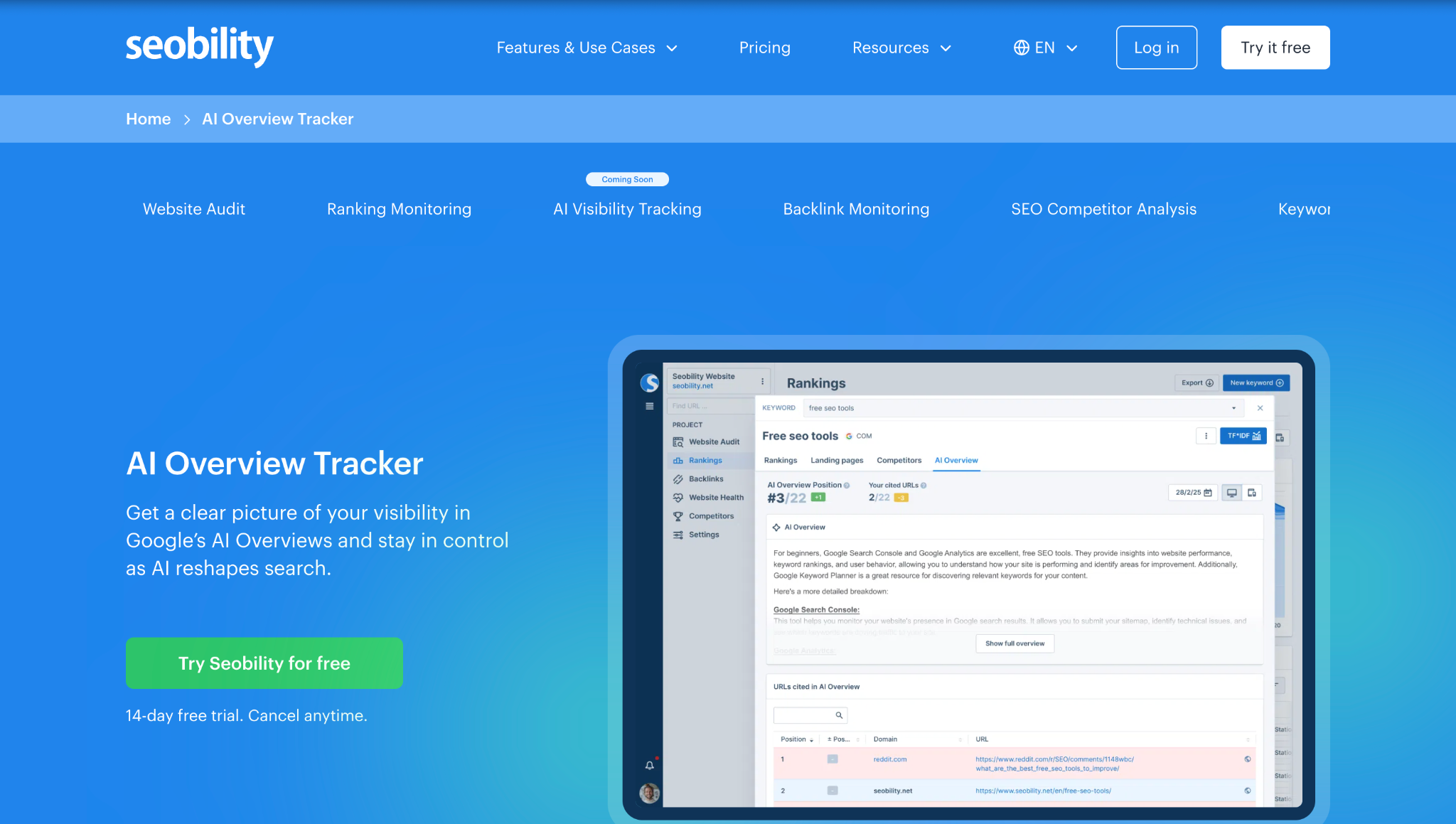
Seobility includes AI Overview tracking inside its broader SEO toolkit.
Best for: SMBs and lean teams testing AI visibility without a heavy platform commitment.
What it does well: Seobility shows when an AI Overview appears for a query and whether your site is cited as a source.
Where it fits: Seobility is an accessible entry point for teams adding AIO checks to classic SEO reporting.
Pricing: Included in Seobility plans.
G2 rating: Seobility has a 4.6 rating, its AI visibility add-on has no separate rating.
Limitation: Seobility doesn’t have broad AI visibility tracking yet.
10. SEO.com AI Overview Tools: Best For A Free Starting Point
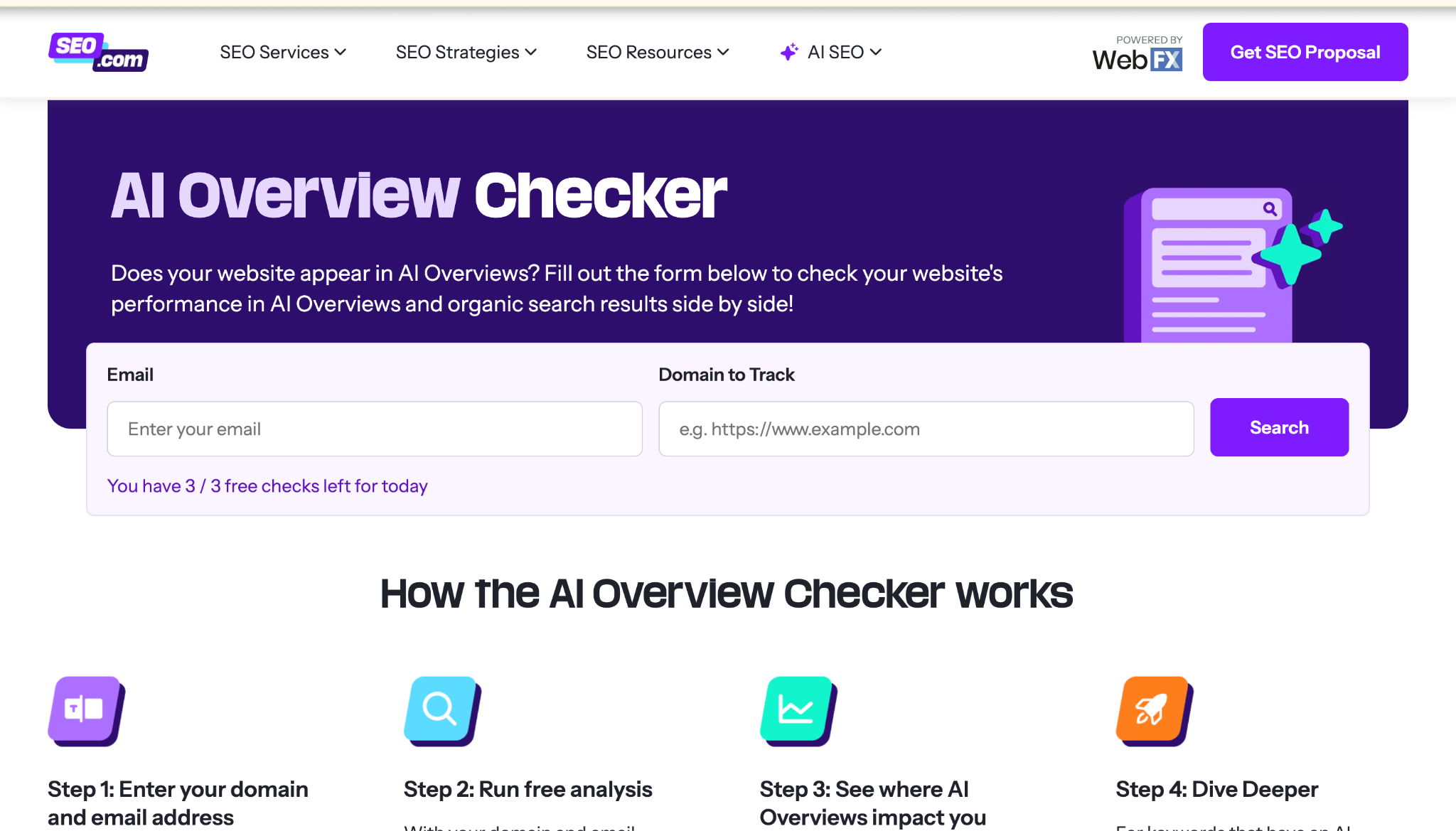
SEO.com has a free AI Overview checker plus paid AIO rank tracking.
Best for: Teams that want to test AIO monitoring before committing budget.
What it does well: The free checker shows whether an AI overview triggers and whether your site appears. Paid tracking adds ongoing monitoring.
Where it fits: SEO.com works as a low-commitment first step into AI Overview tracking.
Pricing: Free checker plus paid tracking. Prices aren’t published.
G2 rating: SEO.com has a 4.3 rating as an agency, its AI overview checker has no separate rating.
Limitation: The toolset is most useful for Google AI Overviews monitoring.
Monitor-Only, Recommendation, And End-To-End Platforms
The biggest buying mistake in this category is treating every tool the same.
You’re choosing how far the platform carries you after the alert: from “we lost visibility” to “the page changed, the outreach ran, and we measured the lift.”
There are three operating models:
- Monitor-only: Tracks mentions, citations, share of voice, and source URLs. Your team handles all follow-up work.
- Insight and recommendation: Flags gaps and suggests page or content updates, usually inside an SEO suite.
- End-to-end action platforms: Detects issues, prioritizes work, creates content, publishes updates, runs outreach, measures results, and refreshes pages.
Most tools in this list sit in the first two groups. Slate sits in the third group.
See more AI search analytics tools grouped by operating model.
What Happens After A Visibility Drop?
An alert has more value when it triggers a workflow.
The teams getting the most from AI visibility tools tend to run the same loop: detection → prioritization → content update → publishing → outreach → measurement → refresh.
Detection: Your tool flags fewer citations on a priority prompt group, or a competitor starts appearing more often in AI answers.
Prioritization: Match affected prompts to traffic and revenue value in GSC and GA4. High-value topics move first.
Content update: Citation losses usually point to page structure problems: unclear definitions, thin entity coverage, weak source signals, or answers buried too far down the page. A structured content refresh workflow helps you fix these at scale.
Publishing and outreach: Push updates through the CMS, then pursue digital PR or brand-mention opportunities that make the page a stronger source.
Measurement and refresh: Re-check the prompts on a set cadence and watch whether citations and answer presence recover.
For teams managing hundreds or thousands of URLs, Slate’s Power Sheets and Workflows handle bulk page refreshes and publishing without a matching headcount increase.
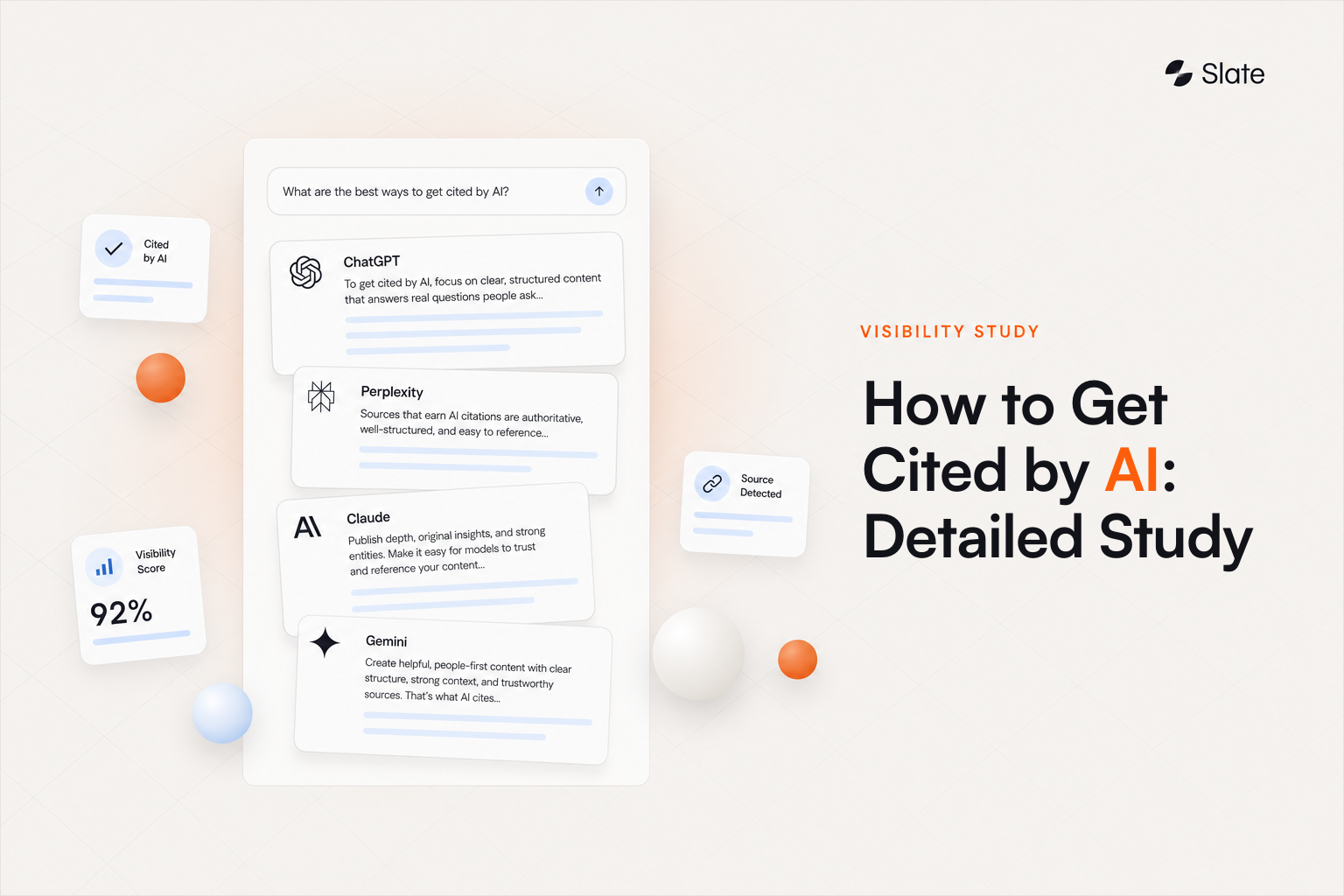
Want to know how to get cited by ChatGPT, Perplexity, Claude and Gemini? Slate’s newest study answers that question.
Do You Need A Dedicated AI Visibility Tool If You Already Use Semrush Or Ahrefs?
Semrush and Ahrefs now include AI visibility features, though both are priced as a paid add-on rather than bundled into the base plan.
An add-on works when AI visibility is a monthly check. You get the basics without another procurement cycle.
A dedicated platform earns its budget when AI search becomes a growth channel your team is expected to manage. That means deeper prompt tracking, broader engine coverage, and workflow support after the report lands.
Slate includes native Ahrefs and Semrush access, so teams get classic SEO data, AI visibility, and execution workflows without stacking extra subscriptions.
For a broader comparison, see the best AI SEO tools 2026.
How To Judge AI Visibility Data Quality
Two tools can give different numbers for the same brand because they source prompt data differently.
Before you trust the dashboard, ask where the data comes from.
Ask vendors:
- How is prompt data sourced? Configured prompts are queries you define. Sampled prompts come from keyword sets. Modeled prompts estimate visibility when direct engine data is limited.
- How often does it refresh? Daily or weekly checks catch movement that monthly snapshots miss. For trend analysis, give the data at least 30 days.
- Is there an audit trail? Strong tools store answer snapshots or screenshots, so you can defend reports in stakeholder meetings.
Track the metrics that support decisions: competitor share of voice, mention frequency, citation count, source quality, sentiment, and prompt coverage.
For more on measuring brand presence, see Slate’s guide to AI share of voice tools.
How To Understand AI Visibility Tool Pricing
AI visibility pricing is messy because vendors charge for different units.
One tool charges by prompts. Another charges by brands. A suite may bundle AI visibility into a higher plan. The sticker price rarely tells the whole story.
Watch these cost drivers:
- Prompts or keywords: The number of tracked queries.
- Pages or domains: Common in SEO suites.
- Seats: Common in enterprise plans.
- Credits: Used for AI checks, generation, or actions.
- Tracked brands: Big for agencies with multiple clients.
- Required base subscriptions: Ahrefs Brand Radar at $199/month assumes an Ahrefs plan from $129/month underneath it, so the real floor is closer to $328/month.
Most pricing falls into a few buckets: suite add-ons, dedicated AI visibility SaaS, and free checkers with paid tracking.
Slate starts at $499/month. The Growth plan bundles 15,000 credits, 10,000 AI answers per month, and 1,000 tracked pages, so visibility tracking and execution sit in the same plan.
How To Choose The Right AI Visibility Tool For Your SEO Team
Pick based on who will use the tool and what they’ll do after the alert.
Solo SEO manager: A free checker or focused AIO tracker is usually enough if you only need a monthly signal.
Content ops team: Look for citation gap analysis, GA4 connection, page refresh workflows, and CMS publishing.
In-house growth team: Prioritize cross-engine coverage and reporting that ties prompt presence to organic traffic.
Enterprise organic team: Look for broad coverage, audit trails, permissions, and reporting that plugs into existing dashboards.
Agency managing multiple brands: Per-brand tracking and portfolio views will save a lot of reporting pain.
Then compare operating model, prompt depth, page-level reporting, publishing support, integrations, and pricing units.
Teams that want detection through refresh in one system should look at end-to-end platforms first.
For enterprise needs, see these popular AI SEO platforms. For the wider category, see Slate’s guide to GEO tools.
Frequently Asked Questions
1. What is an AI visibility tool?
An AI visibility tool tracks how a brand appears inside AI-generated answers across engines like ChatGPT, Perplexity, Gemini, Copilot, and Google AI Overviews.
It measures brand mentions, citations, source URLs, sentiment, and prompt answers over time.
2. How is AI visibility software different from traditional rank tracking?
Traditional rank tracking measures keyword positions on search results pages.
AI visibility software measures whether your brand appears, gets cited, and earns a share of voice inside generated answers.
3. Which AI visibility tool is best for SEO teams?
Slate is the strongest end-to-end option for teams that want AI visibility monitoring, content work, publishing, outreach, and measurement in one platform.
Solo managers may prefer lighter trackers. Enterprises may need deeper audit controls. Agencies should check per-brand pricing before signing.
4. Do Semrush or Ahrefs already track AI visibility?
Yes. Semrush and Ahrefs both include AI visibility features, priced as paid add-ons at $99/month per domain and $199/month per AI index respectively.
They work well for teams already using those suites. Dedicated platforms go deeper on workflow and cross-engine execution.
5. Which AI platforms should SEO teams monitor?
Start with ChatGPT, Google AI Overviews, Google AI Mode, Perplexity, Gemini, and Copilot.
A brand can appear often in one engine and barely show up in another, so single-surface tracking gives a thin view.
6. What counts as a citation vs. a mention in AI search?
A mention means your brand is named in an AI answer.
A citation means the answer attributes or links to your URL as a source. Citations carry more weight because the engine is pointing back to your content.
7. How often should AI visibility prompts be refreshed?
Daily or weekly refreshes are best for serious tracking.
Give prompt data at least 30 days before calling a trend.
8. How do you measure ROI from an AI visibility tool?
Tie visibility to outcomes: more citations on priority prompts, stronger share of voice, branded search lift, organic traffic changes in GSC and GA4, and conversions from organic.
The cleanest connection is between a page update and recovered citations and traffic.
9. Do small teams need a dedicated AI visibility tool in 2026?
Small teams can start with a free checker or SEO suite add-on.
A dedicated platform makes sense when AI search becomes a managed channel, competitors are winning citations, or manual page refreshes start eating the calendar.
10. How much do AI visibility tools cost in 2026?
Pricing ranges from free checkers to sub-$100/month trackers, suite add-ons, and higher-tier multi-engine platforms.
Costs usually scale by prompts, pages, seats, credits, or tracked brands. Slate starts at $499/month, with monitoring and execution bundled in one plan.