Unlike traditional search engines, AI doesn't just match keywords and show the closest results. It creates answers and summaries on the spot.
In 2026, you need AI systems to understand your content well enough to cite it in their responses.
And this creates an intense winner-takes-most situation. AI systems cite only 2-7 domains per response, which way fewer than Google's old-school 10 blue links.
Make the cut and you're golden. Miss it and…you're probably going to stay invisible.
Before you panic about AI summaries killing your traffic (they reduce clicks by 57%, btw!), there's also a good part. Visitors who click through convert over 4x better than regular organic traffic.
And hence, you can't rely only on traditional SEO anymore. You need to optimize for Google AI Overviews, ChatGPT, Perplexity, and Gemini simultaneously.
How to Use This AI SEO Checklist
You can learn AI SEO using several guides, including Slate’s own comprehensive article. But while you implement it, you need an easy checklist to keep you on the right track.
That’s what we aim to do with this article. Bookmark this, and come back every one in a while to ensure you are following these points.
We built this for founders and marketers who need to quickly ramp up their visibility in AI Search.
Now, quickly, a checklist for using this checklist:
- Run through this quarterly or monthly, for full audits.
- Use it before publishing major content pieces and when refreshing existing content.
- Pull it out when launching new topic clusters, planning a content refresh, or when your AI search visibility drops.
Onto the checklist.

AI SEO Basics Checklist
Clear primary search intent per page
Each page should answer one main question or solve one specific problem. Try addressing multiple user needs on a single page and you'll confuse AI systems. And the reader!
Semantic keyword and topic coverage (no repetition)
Forget keyword density. AI cares more about comprehensive topic coverage. Use related concepts, synonyms, and natural variations instead of repeating keywords.
Logical H1–H3 hierarchy
A clean heading structure makes your content more likely to get AI citations. Each heading level should support your content organization and make scanning easy.
Scannable formatting (lists, tables, definitions)
AI systems love content they can extract without interpretation. Breaking complex information into lists, tables, and Q&A formats dramatically improves citation rates.
Content Optimization Checklist for AI-Ready Content
Direct answers to core questions
Put key insights and answers in the first 100-150 words. Content that answers queries immediately gets cited 67% more often than traditional narrative structures building toward conclusions.
Definitions and summaries placed early
AI systems want immediate value. Include clear term definitions and concise summaries near section beginnings, making it easy for AI to extract your expertise.
Topic clusters and internal links in place
Build interconnected content ecosystems around expertise areas. Create mesh structures where related pages link together. This helps AI recognize comprehensive topical coverage.
Consistent terminology and concept usage
Use the same terms for the same concepts across your entire content ecosystem. Consistent terminology helps AI build accurate entity profiles for citations.
Human review for accuracy, originality, and tone
Original data becomes your secret weapon. First-party research, case studies, and proprietary insights get preferential treatment because AI can't replicate genuine human expertise. Always have humans review everything before going live.
Technical AI SEO Checklist
Pages crawlable and indexable
Make sure robots.txt allows access, XML sitemaps stay updated, and no accidental noindex tags block discovery. AI systems rely on search engines' crawled data as their main information source.
Clean internal linking structure
Content body links carry stronger signals than navigational menu links. Contextual internal links reinforce semantic relationships more effectively, helping AI understand topical connections across your site.
Fast load times and mobile-first UX
Core Web Vitals directly influence AI content selection. Aim for sub-3-second load times and perfect mobile experiences. Page speed and UX signals determine inclusion in AI summaries.
No intrusive UX elements
Popups, interstitials, and aggressive CTAs mess with AI content extraction. Keep pages clean and uncluttered so AI systems parse content effectively while providing better visitor experiences.
Stable URLs and clean architecture
Keep URL structures consistent without frequent changes. AI systems build understanding over time, and URL stability preserves citation value. Use logical, descriptive URLs that make semantic sense.
Schema & Structured Data Checklist for AI SEO
Organization Schema Implemented
Help AI systems understand your company's identity, expertise areas, and credibility signals. Include comprehensive business information, social profiles, and contact details for clear entity recognition.
Website & WebPage Schema Present
These foundational schemas give AI explicit signals about site structure and page purposes. Include site name, URL, search actions, and page-specific metadata.
Content-Type Schema Applied Correctly
Use the right schema types (Article, HowTo, FAQ, Product) matching your content format. This enables machine-readable content and increases citation likelihood.
Author & Publisher Signals Included
Establish expertise through clear authorship and publisher information. AI systems evaluate credibility partly through author expertise signals.
Entity & Concept Clarity
Define key entities and concepts using appropriate schema markup. Keep entity information consistent across all touchpoints.
Schema Accuracy & Maintenance
Regularly audit schema implementation for errors or outdated information. Accurate, well-maintained structured data provides reliable signals AI systems trust.
AI & LLM Visibility Checklist
Content written for understanding, not tricks
Write content mimicking how users ask questions to AI assistants. Focus on clarity and comprehension rather than gaming the system.
Sections are self-contained and quote-ready
Each section should work as a complete thought standing alone when extracted. AI often pulls individual paragraphs, so make sure each provides value without surrounding context.
Clear explanations AI can summarize
Break down technical concepts into clear, logical steps AI can summarize without losing essential meaning or introducing errors.
Strong definitions and frameworks
Provide explicit definitions for industry terms and clear frameworks for understanding complex topics. AI systems rely on these structural elements to build representations.
Content easy to reference or cite
Include clear attributions, data sources, and quotable insights. Structure information with obvious citation points AI systems can confidently reference.
Automation & AI Tooling Checklist
AI used to assist research and analysis
Use AI tools for content gap analysis, keyword research, and competitive intelligence. These tools must enhance efficiency without sacrificing quality or originality.
Content gaps and decay actively monitored
Set up systems identifying missing topics within clusters and flagging outdated content. Regular monitoring ensures comprehensive coverage staying relevant for AI citation.
No unreviewed AI content published
Create strict editorial processes preventing raw AI-generated content from going live. Quality beats volume, so invest in fewer pages with genuine expertise.
Measurement & Continuous Improvement Checklist
Performance tracked beyond rankings
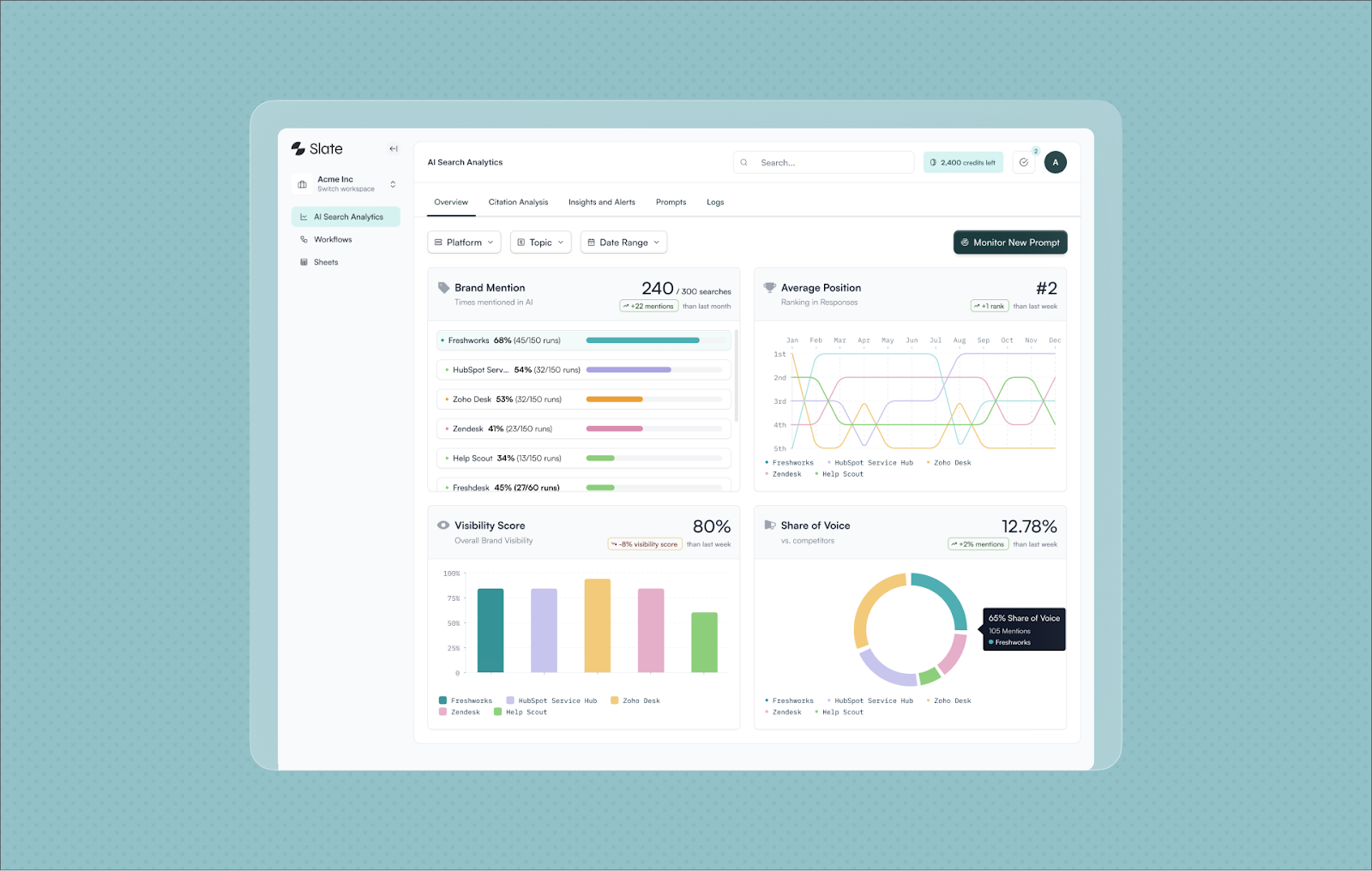
Monitor AI Overview appearances, brand mentions in AI responses, and citation frequency instead of focusing on ranking positions. Using tools like Slate, track which content gets cited most and figure out why.
Engagement and intent signals reviewed
Analyze user behavior from AI-referred traffic. These pre-qualified visitors arrive more informed and closer to purchasing decisions than traditional organic traffic.
Older content refreshed regularly
Keep content fresh through systematic updates. AI systems favor current information: update statistics, examples, and frameworks quarterly to maintain citation visibility.
Structure, depth, and formats tested over time
Continuously experiment with content formats generating the most AI citations. Test different structures, coverage depths, and presentation formats while maintaining quality.
Common AI SEO Mistakes to Avoid
- Treating AI SEO as a one-time audit: This is like thinking you can set up a website and never touch it again. AI SEO needs sustained commitment and continuous adaptation as AI capabilities expand.
- Over-optimizing for tools instead of users: AI systems select content that best answers user questions. Technical optimization matters, but prioritize user value over manipulating algorithms.
- Ignoring intent and internal linking: This breaks semantic connections AI systems use to understand topical authority. Each page must serve clear intent while connecting logically to related content through well-planned internal linking.
- Confusing AI usage with AI strategy: Using AI tools for content creation is a part of optimizing for AI search visibility.
Final Thoughts: Making AI SEO a Habit
AI SEO isn't a one-and-done setup—it must be built into everything you do.
Embed AI optimization into every content decision, from initial planning through post-publication monitoring. Companies adapting fastest to these requirements will dominate AI visibility in their sectors.
Use this checklist regularly to create consistency at scale. Make sure every piece meets AI optimization standards by integrating these checks into existing workflows rather than treating them separately.
If you want to integrate your AI SEO into a single platform that combines automation with expertise, try out Slate. You can talk to our team, who’ll be happy to help you out!
Frequently Asked Questions
What is an AI SEO checklist?
An AI SEO checklist is a systematic framework for optimizing content to get cited by AI systems like Google AI Overviews, ChatGPT, and Perplexity.
How often should you run an AI SEO audit?
Run comprehensive AI SEO audits at least quarterly to stay ahead of algorithm changes and assess your overall visibility. Use the checklist before publishing major content pieces and when refreshing existing content to ensure consistent optimization.
Is an AI SEO checklist different from a traditional SEO checklist?
Yes, AI SEO builds on traditional SEO but adds specific optimization for AI citation and understanding. While traditional SEO focuses on rankings and click-through rates, AI SEO prioritizes content that AI systems can easily extract, understand, and cite confidently.
Can small teams use AI SEO effectively?
Absolutely—small teams often move faster and adapt better than large organizations stuck in traditional SEO thinking. Focus on quality over quantity by creating fewer pages with genuine expertise rather than trying to compete on volume.
What tools help with AI SEO audits?
Use AI-powered content analysis tools like Slate for gap identification and competitive research. Schema markup validators ensure proper structured data implementation, while page speed tools verify technical performance that affects AI content selection.
How do you optimize content for AI Overviews?
Put direct answers to core questions in the first 100-150 words and structure content with clear, scannable formatting like lists and tables. Make each section self-contained and quote-ready so AI can extract value without surrounding context. Use consistent terminology, provide explicit definitions, and ensure your content answers questions the way users ask AI assistants.
Does AI SEO replace technical SEO?
No, AI SEO builds on top of solid technical SEO foundations rather than replacing them. You still need crawlable pages, fast load times, mobile optimization, and clean site architecture because AI systems rely on search engines' crawled data.
How do you measure success in AI-driven search?
Track AI Overview appearances, brand mentions in AI responses, and citation frequency instead of focusing solely on traditional rankings. Monitor engagement and conversion rates from AI-referred traffic.