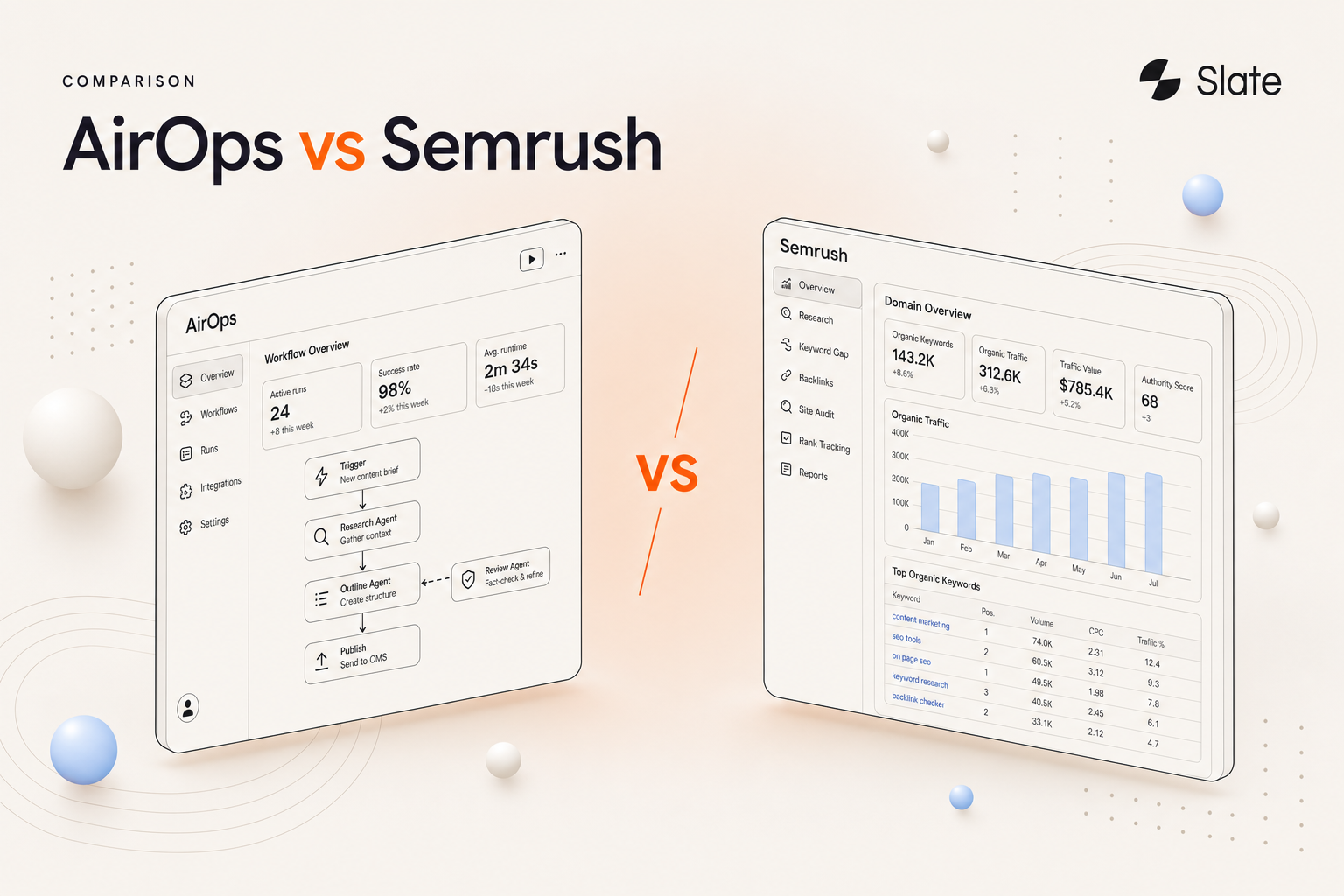
If content refreshes keep piling up, AirOps is probably the better fit. If your SEO team lives inside crawl reports, rank tracking, competitor dashboards, and giant keyword sets, seoClarity is the safer bet.
AirOps is built around workflow-led content execution and CMS-connected publishing. seoClarity is built around enterprise SEO intelligence, rank tracking, technical audits, and reporting depth.
So the buying call comes down to the bottleneck. Production backlog points toward AirOps. Search intelligence gaps point toward seoClarity.
Key Takeaways
The short version:
- AirOps fits content ops teams that need workflow automation, human review, and CMS-connected publishing.
- seoClarity fits enterprise SEO and AEO teams that need technical audits, rank tracking, competitor analysis, and reporting.
- AirOps prices around usage and workflow depth, with free and custom options.
- seoClarity uses custom enterprise pricing tied to domains and keywords tracked.
- Some teams use both: seoClarity for intelligence, AirOps for execution.
- Teams that want discovery, production, publishing, measurement, and refresh in one system should also evaluate Slate.
How We Compared AirOps and seoClarity
We judged both platforms by six buying factors: workflow automation, SEO intelligence, enterprise fit, AI-search coverage, implementation, and total cost.
The analysis uses vendor materials, third-party reviews, and public software directories. When vendors publish exact limits, we use them. When details sit behind sales calls, we describe the category without inventing numbers.
The criteria:
- Operating model: Execution platform, intelligence platform, or both.
- Feature depth: Workflows, SEO data, AI search, and publishing.
- Enterprise fit: Governance, reporting, permissions, and scale.
- AI-search readiness: Citations, prompt tracking, answer presence, and brand mentions.
- Implementation: Setup work, ownership, and ramp time.
- Total cost: Usage, onboarding, seats, training, and adjacent tools.
Feature count can mislead you. The better question is where your team gets stuck.
AirOps vs seoClarity at a Glance
Best for enterprise SEO: seoClarity.
Best for content ops: AirOps.
Best for AI workflow automation: AirOps.
Best for technical SEO teams: seoClarity.
Best for end-to-end AI search plus execution: Slate.
What Is AirOps?
AirOps is a content engineering platform for teams building search and AI-discovery workflows. It combines data, workflows, and human review so teams can create and refresh content at scale.
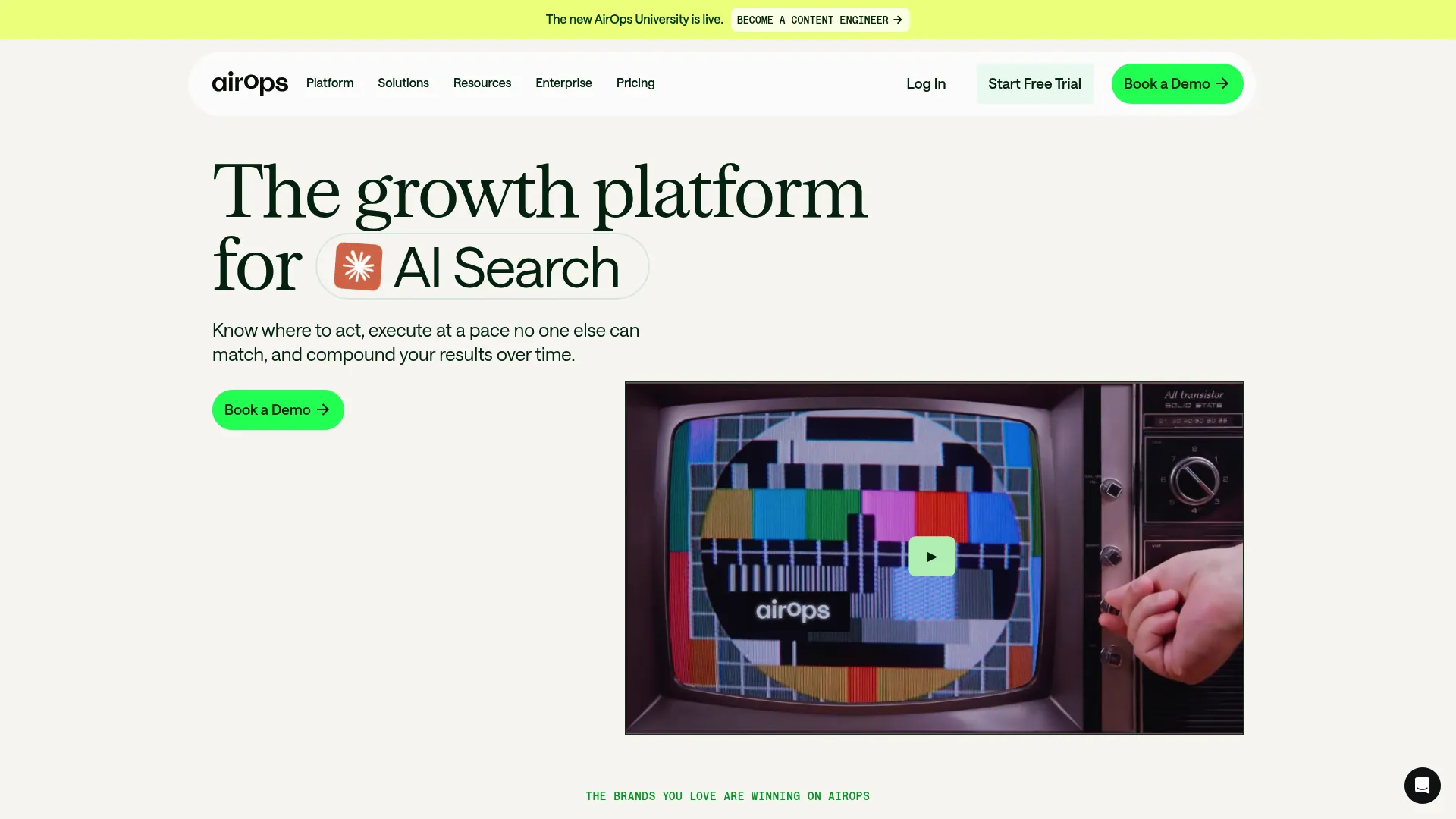
Core capabilities include:
- Workflows and AI Actions: No-code workflows that chain SERP analysis, briefs, drafting, review, and publishing.
- Grids: A spreadsheet-style interface where each row can trigger a full workflow.
- Brand Kits and Knowledge Bases: Voice, tone, rules, and company context for AI outputs.
- AI search visibility: Tracking for brand appearances, prompts, competitor mentions, and citations.
- CMS integrations: Connections to Webflow, Shopify, Contentful, and SEO tools like Semrush.
AirOps suits content ops teams, agencies, and brands managing large content libraries. Solo creators looking for a quick keyword-to-blog flow will probably find it heavier than they need. For teams weighing options, this list of the best AirOps alternatives is a useful starting point.
For more detail, see this AirOps review.
What Is seoClarity?
seoClarity is an enterprise SEO and AEO platform for search visibility tracking, technical audits, content improvement, and reporting.
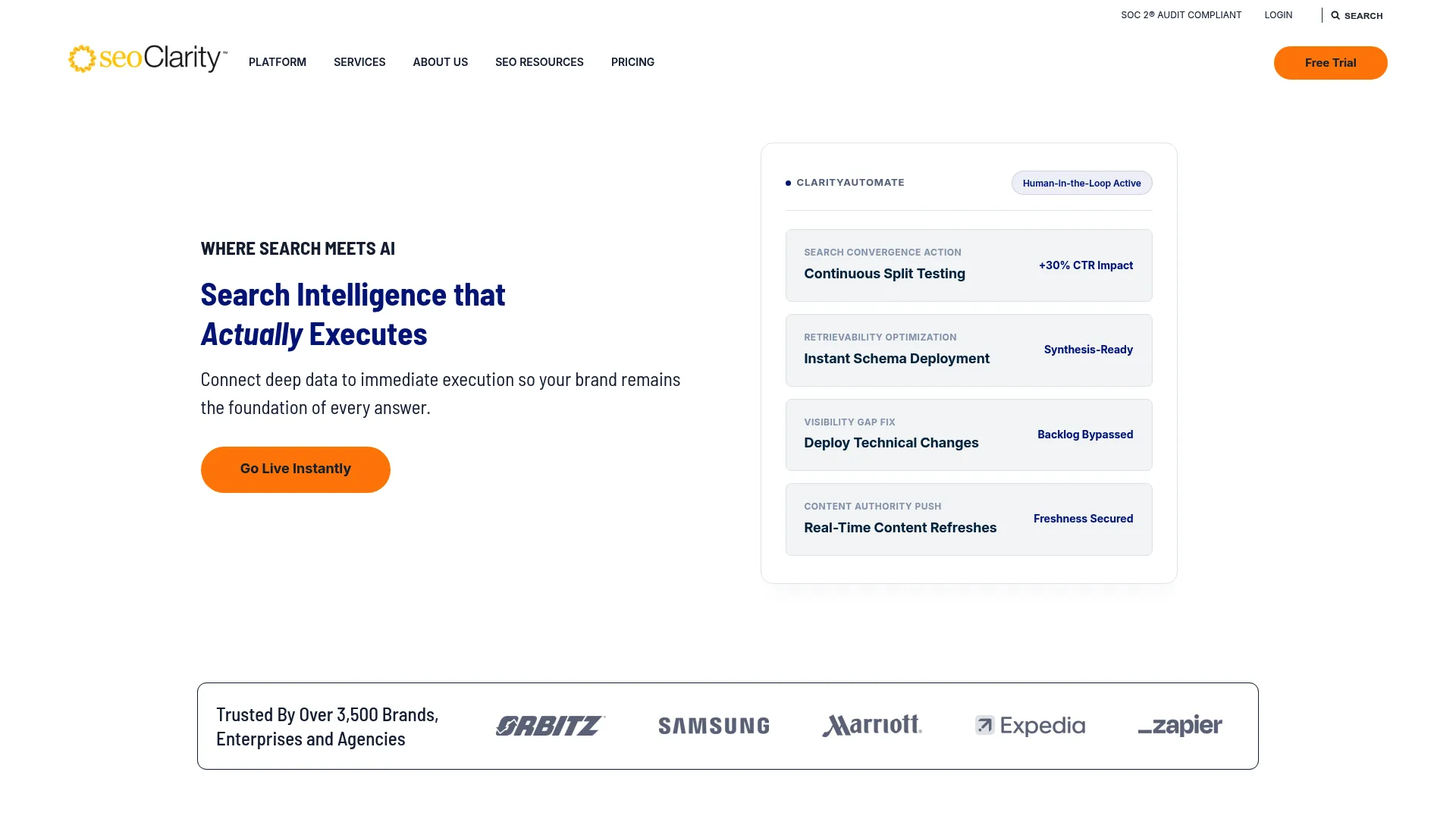
Core capabilities include:
- Rank tracking and SEO analytics: Enterprise rank tracking, dashboards, and competitor reporting.
- Technical SEO auditing: Site audits, crawling, schema tooling, split testing, and on-page analysis.
- AI search visibility: ArcAI tracks brand citations, mentions, prompts, sentiment, and bot activity, with plan-level differences.
- Content tooling: Briefs and page improvement tools inside the broader SEO suite.
seoClarity suits enterprise brands and agencies managing multiple domains, large keyword sets, and executive reporting. Its center of gravity is SEO intelligence.
Workflow Execution vs Enterprise SEO Intelligence
AirOps sits closer to content execution. seoClarity sits closer to SEO intelligence.
That difference shows up in the architecture.
seoClarity gathers crawl data, tracks rankings, monitors competitors, and builds the reports enterprise SEO programs run on. AirOps turns SEO and AI-search signals into briefs, drafts, refreshes, approvals, and published pages.
A simple way to sort the categories:
- seoClarity: Built to see what’s happening across search.
- AirOps: Built to turn search signals into content workflows.
- Slate: Built to connect discovery, production, publishing, measurement, and refresh in one system.
If your team has a reporting gap, start with seoClarity. If your team has a production backlog, start with AirOps.
Feature-by-Feature Comparison
AI Workflow Automation and Content Production
AirOps is the clear winner for workflow automation.
Its no-code workflows can chain research, brief creation, drafting, review, and publishing. Grids let teams run those workflows across thousands of rows, which is useful for programmatic content refresh at scale, marketplace pages, and large content libraries.
seoClarity has AI-assisted modules, but they live inside an analytics-led platform. Content operations aren’t the main job. If content ops is your primary need, compare the best AI tools for content operations.
Winner: AirOps.
For more on system-building, see this guide to SEO workflow automation.
AI Search Visibility and AEO Capabilities
AirOps tracks where your brand appears across AI search engines, which prompts mention you, where competitors show up, and which citation gaps need work. Its materials also reference offsite citation management and query fan-outs. Teams building for answer engines can also review the best AEO tools available today.
seoClarity has ArcAI for brand citations, mentions, prompts, sentiment, and bot activity. The exact surfaces and metrics depend on plan and configuration.
Winner: AirOps if you want AI visibility tied closely to content execution. seoClarity is stronger if your team wants AI-search monitoring inside an enterprise SEO suite.
Keyword Research, Rank Tracking, and SEO Monitoring
seoClarity wins here.
Rank tracking and reporting sit at the center of the product. Pricing is tied to domains and keywords tracked, which tells you a lot about the buyer it was built for.
AirOps uses SERP analysis and SEO metrics inside workflows. It’s better as an execution layer than as a dedicated rank tracker.
Winner: seoClarity.
Technical SEO and Site Auditing
seoClarity has native site audits, crawl analysis, schema tooling, split testing, and issue reporting for large sites.
AirOps can support metadata work, page refreshes, and content changes, usually through workflows and integrations. Teams that need deep crawl diagnostics will still want a technical SEO system.
Winner: seoClarity for technical audits. AirOps helps turn findings into page updates.
Content Briefs, Refresh, and Page Improvement
AirOps handles briefs, drafts, content refreshes, and review workflows. Grids make bulk refreshes easier when you’re dealing with hundreds or thousands of URLs.
seoClarity includes content tools inside its SEO suite, but the platform is still centered on monitoring and reporting.
Winner: AirOps.
For a broader tool list, see these content optimization tools like seoClarity and AirOps.
Integrations, CMS Publishing, and Data
AirOps connects to CMS platforms like Webflow, Shopify, and Contentful. It also connects with tools like Semrush and supports API-first workflows.
Confirm WordPress and any extra CMS requirements against AirOps’ current integration docs before buying.
seoClarity connects with analytics and SEO data sources such as Google Analytics, Adobe Analytics, Ahrefs, and Majestic. CMS publishing gets less emphasis in its public materials.
Winner: AirOps for CMS-connected publishing. seoClarity for SEO and analytics data integrations.
Governance, Brand Control, and Collaboration
AirOps builds governance into production through Brand Kits, Knowledge Bases, human review, and approvals.
seoClarity handles governance through enterprise roles, permissions, and reporting access. That fits SEO data workflows more than brand-voice control.
Winner: AirOps for content governance. seoClarity for SEO reporting governance.
Pricing and Total Cost of Ownership
Compare pricing by cost driver. AirOps prices around execution volume and workflow usage. seoClarity prices around domains, keywords, and modules.
AirOps uses a free plus custom, usage-driven model. Larger teams pay based on workflow breadth, AI-search capabilities, and execution volume.
Pricing: Insights starts at $0/month. Pages is custom-priced. Solo, Pro, and Enterprise tiers exist, but public monthly prices aren’t listed on the pricing page.
G2 rating: 4.6/5
seoClarity uses custom enterprise quotes, with pricing tied mainly to domains and keywords tracked, plus module add-ons.
Pricing: Rankings custom. Research and Content starts at $2,500/month. Technical SEO starts at $3,200/month. Enterprise starts at $4,500/month. Pricing is tied to domains and keywords tracked.
G2 rating: 4.5/5
Total Cost Beyond List Price
The invoice can grow after the first sales call. Watch these cost drivers:
- Usage and volume: seoClarity scales with keyword and domain volume. AirOps scales with workflow and AI-feature usage.
- Seats and roles: Confirm seat limits before rolling either tool across several teams.
- Onboarding and services: seoClarity requires data setup. AirOps requires workflow design.
- Training: Both tools take time for non-specialists.
- Adjacent tools: seoClarity usually sits beside content production tools. AirOps may still need external rank tracking and deep crawls.
Model the full stack before you compare line items.
For more detail, see this breakdown of AirOps vs seoClarity pricing.
Implementation, Migration, and Learning Curve
Time to value depends on ownership, setup, and integrations.
AirOps setup means designing workflows, connecting CMS and SEO tools, and configuring Brand Kits and Knowledge Bases. It works best when a team already has a content process that can be turned into repeatable steps.
seoClarity setup means connecting data sources, configuring crawls, defining keyword sets, and building dashboards. SEO teams with clean ownership will get value faster.
Migration and Switching
Switching tools means rebuilding process, not just moving data.
If you move into AirOps, expect to rebuild production workflows, review steps, and publishing connections. If you move into seoClarity, expect to rebuild dashboards, keyword sets, crawl rules, and reporting history.
Run both systems in parallel before you cut over. Quarterly reporting gets ugly fast when trend lines break midstream.
Customer Support and Onboarding
Both platforms target team and enterprise buyers, so guided onboarding is common.
AirOps provides documentation, integrations, and workflow resources. seoClarity leans into enterprise onboarding tied to search data and reporting setup.
Confirm support tier, onboarding scope, and services before signing.
Pros and Cons
AirOps Strengths and Limits
Pros:
- Strong workflow orchestration and Grids for bulk execution.
- Documented AI search visibility tracking tied to content work.
- Brand Kits, Knowledge Bases, and human review.
- CMS-connected publishing for large content libraries.
Cons:
- Better for team buyers than solo creators.
- Usage-based pricing can be harder to forecast.
- Deep technical audits and dedicated rank tracking usually need other tools.
SeoClarity Strengths and Limits
Pros:
- Enterprise SEO intelligence with deep rank tracking.
- Native technical SEO audits and large-site crawl analysis.
- Pricing model fits teams that manage large keyword and domain sets.
- Strong reporting for executives and SEO stakeholders.
Cons:
- Content production usually needs another tool.
- Custom enterprise pricing can be heavy for smaller teams.
- AI visibility and automation depend on module configuration.
- CMS publishing gets less emphasis than reporting and monitoring.
Best For: Which Platform Fits Your Team?
For a broader field, see this roundup of the best enterprise SEO platform options.
Can AirOps Replace seoClarity, Or Do Teams Use Both?
AirOps can replace standalone content creation tools, lighter SEO utilities, and separate AI-visibility trackers when production is the bottleneck.
seoClarity is harder to replace if your team relies on enterprise crawl data, rank tracking, competitor monitoring, and executive reporting.
Many enterprise teams use both. seoClarity sits in the analytics layer with GSC and GA4. AirOps sits in the execution layer connected to the CMS.
The handoff between insight and content work still needs ownership. If handoffs keep slowing the team down, evaluate a single end-to-end system.
2026 Readiness: Evaluating for AI-Driven Discovery
AI-search visibility deserves its own buying criteria in 2026. Rankings still count, but citations, brand mentions, answer presence, sentiment, and prompt coverage now affect how AI systems summarize and cite brands. To keep pace, review the current AI search visibility tools worth tracking.
AirOps is stronger when the team wants to turn AI-search visibility gaps into content workflows. seoClarity is stronger when the team wants AI-search monitoring inside a broader enterprise SEO reporting system.
The practical buying question: how fast can your team move from an AI-visibility issue to a published page update?
If Neither Fits: Slate as the End-to-End Alternative
Some teams want AI-search visibility and execution in one place. That’s where Slate fits.
Slate is an end-to-end, agent-driven content and SEO platform for opportunity discovery, creation, publishing, measurement, and refresh. Teams delegate work to Slate’s Coworker in plain language or build custom agents for repeatable SEO and content tasks.
Core strengths include:
- Coworker and custom agents: Natural-language delegation and reusable agents for repeatable tasks.
- Workflows and Sheets: A visual workflow builder plus a spreadsheet interface for thousands of URLs.
- Native integrations: Native Ahrefs and Semrush access, plus publishing to Webflow and WordPress.
- AI visibility analytics: Brand presence tracked across six major AI platforms, including sentiment, brand mentions, prompt answers, and keyword tracking.
- Pages: Unified Google Search Console and GA4 data to catch traffic and ranking drops early.
- Opportunities and Outreach: Content gaps, citation gaps, ranking gaps, link outreach, and brand-mention outreach.
Where Slate fits best:
- Teams that want outcomes from one system.
- Teams focused on AI search plus execution.
- Content ops teams managing scale, publishing, and refresh.
- Organic growth teams adapting to AI-driven discovery.
Slate is focused on content, SEO, and AI-search execution. It isn’t a generic creative proofing tool for video or visual campaign assets.
Pricing: Starting at $499/month, including 15,000 credits, 10,000 prompt answers tracked, and 1,000 web pages tracked. Free trial, Enterprise, and Agency plans are available.
G2 rating: 4.9/5
For more context, see the best seoClarity competitors and this guide to AirOps vs seoClarity for SEO automation.
Book a demo: https://slatehq.com/book-a-demo
Verdict: AirOps vs seoClarity in 2026
Choose seoClarity when enterprise SEO intelligence is the priority. Choose AirOps when workflow-led content execution and publishing are slowing the team down.
Many mature teams run both, with seoClarity feeding crawl, rank, and reporting data into an execution layer like AirOps.
If your team wants discovery, production, publishing, measurement, and refresh in one agent-driven system, Slate is worth evaluating. You can also browse the wider set of best AI SEO tools before committing.
Book a demo: https://slatehq.com/book-a-demo
Frequently Asked Questions
What Is the Main Difference Between AirOps and seoClarity?
AirOps is a workflow-led platform for content production, refresh, and CMS publishing. seoClarity is an enterprise SEO intelligence platform for rank tracking, technical audits, competitor monitoring, and reporting.
Is AirOps or seoClarity Better for Enterprise SEO?
seoClarity is usually the stronger fit for enterprise SEO because it has deep rank tracking, technical audits, competitor analysis, and reporting priced by domains and keywords.
AirOps is stronger when the team needs to create, refresh, and publish content at scale.
Can AirOps Replace seoClarity?
Sometimes.
AirOps can replace standalone content tools, lighter SEO utilities, and separate AI-visibility trackers. Teams that rely on enterprise crawl data and large-scale rank tracking will probably keep seoClarity or another SEO intelligence platform.
Which Platform Is Better for Content Improvement and Workflow Automation?
AirOps leads here.
Its Workflows, Grids, AI Actions, and human review steps cover briefs, drafts, page updates, and bulk refreshes across large content libraries.
Which Platform Is Better for Technical SEO and Site Auditing?
seoClarity is better for technical SEO. It has native site audits, crawl analysis, schema tooling, and issue prioritization for large sites.
AirOps supports page-level SEO work through workflows and integrations.
Which Platform Has Faster Time to Value?
It depends on setup.
AirOps moves faster once workflows and CMS connections are ready. seoClarity moves faster once data sources, crawls, keyword sets, and reports are configured.
How Do AirOps and seoClarity Compare on Pricing?
AirOps uses a free plus custom, usage-driven model where cost scales with workflows and AI features.
seoClarity uses custom enterprise quotes priced by domains and keywords, with paid tiers starting around $2,500/month.
See the AirOps vs seoClarity pricing breakdown for more detail.
Validated: Slate pricing now starts at $499/month, and no stale $199 Slate pricing remains in the draft.