Your buyer asks ChatGPT for a shortlist. Then they cross-check Perplexity. Maybe they Google it, but the AI overview has the answer they need. You never get the click.
If your brand doesn’t appear in these answers, your search visibility has a hole in it.
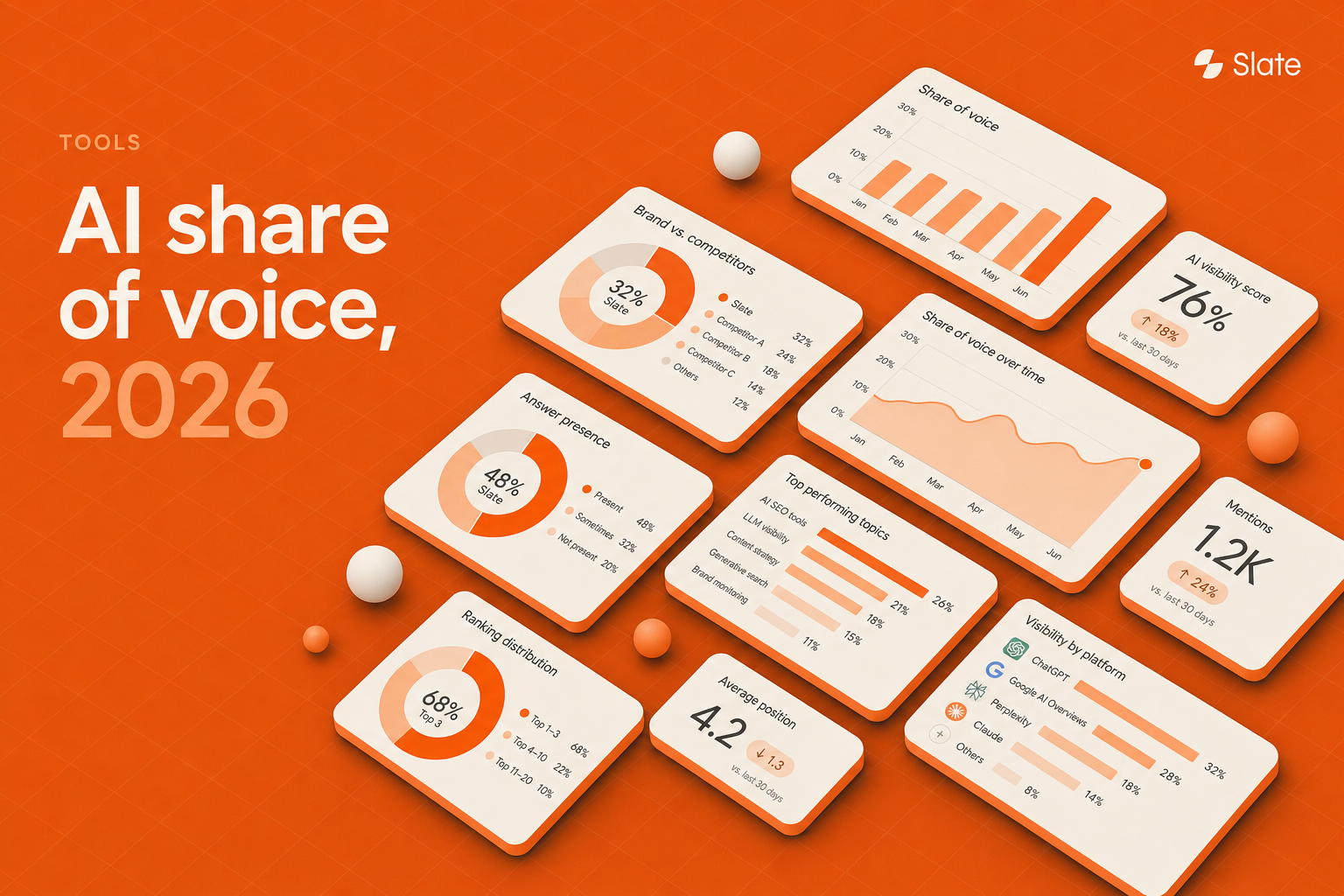
AI share of voice measures how much presence your brand has inside AI-generated answers compared with competitors. Track it through mentions, citations, recommendations, sentiment, and prompt coverage across ChatGPT, Perplexity, Gemini, Claude, Google AI Overviews, and similar answer engines.
Use it as a stack of scores. A one-number dashboard blurs the exact place you’re losing.
Key Takeaways
- AI share of voice measures your brand’s presence inside AI answers compared with competitors.
- The useful stack includes mention rate, citation rate, recommendation rate, sentiment, and prompt coverage.
- Traditional share of voice tracks impressions, rankings, media coverage, or ad spend. AI share of voice tracks presence inside generated answers.
- Good measurement needs a locked prompt library, a stable competitor set, consistent run conditions, and repeated sampling.
- Results vary by engine, so report ChatGPT, Perplexity, Gemini, Claude, Google AI Mode, and AI Overviews separately before you roll them up.
- The metric earns its keep when it points to work: content repairs, better citations, stronger entity signals, and repeat measurement.
What Is AI Share Of Voice?
AI share of voice is your brand’s share of presence inside AI-generated answers compared with competitors.
Presence has layers. A brand can be named, cited, recommended, or framed with positive or negative language. Those are separate signals, and you should score them separately.
- Mention: The brand appears in the answer.
- Citation: The brand’s domain or content is linked or named as a source.
- Recommendation: The brand is endorsed as a solution.
Measure share per prompt first.
For a single question, record which brands appear and how much answer space each one owns. Then roll those prompt-level scores into engine-level totals. This keeps a broad “what is X” prompt from carrying the same weight as a high-intent “best tools for X” prompt.
Prompts usually sit in three buckets:
- Branded prompts: where your name appears in the query.
- Category prompts: such as “best tools for X.”
- Competitor prompts: where a rival’s name appears in the query.
Keep those buckets separate. Blending them may make the dashboard look tidy but it’ll be less useful.
Field note: A source link buried in footnote 7 carries a different weight than the brand named first in the recommendation.
This is the base layer for any answer engine visibility program, and the citation tracking tools that support it.
Why AI Share Of Voice Belongs In Your 2026 Reporting
AI discovery is split across answer engines. And the usage numbers are hard to ignore.
Forrester 2026 Buyers' Journey Survey found that 94% of surveyed B2B buyers used AI tools in their recent purchase, and 55% compared vendors in AI tools. 91% of B2B buyers use AI during vendor evaluation, and 90% of those users do so before ever contacting a supplier. G2’s 2026 Buyer Behavior Report found that 51% of B2B software buyers now start vendor research in an AI chatbot more often than in Google.
AI share of voice gives you two useful reads:
- Which brands own the category conversation across prompts.
- Which brands get named, cited, recommended, and framed positively.
Treat it as a directional competitive signal. It can point to discovery and consideration gaps, but it won’t prove pipeline by itself.
That framing builds trust with executives who’ve seen too many inflated marketing dashboards. For teams building the base layer, brand visibility in AI search is where the work starts.
Traditional Share Of Voice Vs. AI Share Of Voice
Traditional share of voice measures visibility across media, ads, or search channels. Think impressions, ad spend, rankings, and coverage.
AI share of voice measures brand presence inside generated answers from LLMs and answer engines. Inclusion depends on entity clarity, source quality, and how often trusted material connects your brand to the category.
A page can rank number 1 in Google and still have a low AI share of voice.
Slate ran 1,000 B2B SaaS queries through Google and logged every source each AI Overview cited. In 944 of 1,000 queries (94.4%), a page in the organic top 10 was cited in the AI Overview.
Probability is the other difference. Ask the same prompt twice and you may get two different brand sets. Traditional SOV reads a more stable surface; AI SOV needs sampling over time.
That’s the core distinction behind traditional share of voice versus AI share of voice.
The Five Core AI Share Of Voice Metrics
Track mention rate, citation rate, recommendation rate, sentiment, and prompt coverage.
Together, they show whether your brand appears, gets sourced, gets endorsed, earns positive framing, and covers the prompts buyers use.
Mention Rate
Mention rate is how often your brand appears in AI answers across your prompt set.
If you run 200 prompts and your brand appears in 60, your mention rate is 30%.
It’s the easiest signal to count and the easiest one to misread. A brand can rack up mentions on low-intent “what is” prompts while disappearing from commercial prompts that sales cares about.
Citation Rate
Citation rate is how often the model links to or names your domain as a source.
A brand can be mentioned while a review site gets the citation. That gap tells you the model knows your name but trusts another source for evidence.
Citation builds over time when engines keep pulling from your content. Clear definitions, original data, and clean page structure help.
Recommendation Rate
Recommendation rate is how often the brand gets endorsed as a solution.
“Tools like X, Y, and Z” is a mention. “For enterprise SEO teams, X is the strongest fit” is a recommendation.
This metric sits closest to purchase intent. It’s also the hardest to move because it depends on authority across your site, review platforms, analyst pages, comparison content, and third-party mentions.
Sentiment
Sentiment measures how the model frames your brand: positive, neutral, or negative.
This one lands with brand and product marketing teams. A brand can appear often and still get described in lukewarm language that chips away at consideration.
Prompt Coverage
Prompt coverage is the share of priority prompts where you appear at least once.
It shows the holes. If you’re absent from high-intent commercial clusters, you’ve got a category problem, even if your informational coverage looks healthy.
Field note: citation rate and recommendation rate answer different questions. Teams building a full LLM visibility metrics stack should score both.
How To Measure AI Share Of Voice Step By Step
Start with a prompt library. Segment it by intent and topic. Run the prompts across your target engines. Score each answer for mentions, citations, recommendations, and sentiment. Then calculate the share per prompt and roll it up by engine.
Repeat the process on a set cadence. One snapshot can send you chasing ghosts.
Step 1: Build Your Prompt Library
Your prompt library controls the quality of every number downstream. Start with 30 to 50 commercial prompts, then grow toward 100+ as you add regions, topics, and competitors.
Pull buyer language from:
- Google Search Console.
- People Also Ask.
- Site search.
- Sales calls.
- Support tickets.
- Community threads.
Tag each prompt by intent, product line, audience, market, journey stage, and competitor set.
Use intent groups such as informational, comparative, transactional, and strategic. Keep branded, category, and competitor prompts in separate views.
Step 2: Define Your Competitor Set
AI share of voice is comparative, so lock your competitor list before scoring.
Pick three to seven brands buyers compare against you. Use the names sales hears on calls, not the names your team wishes it competed with.
A stable set keeps your trend line clean.
Step 3: Run Prompts Across Engines
Run each prompt across the engines your audience uses. For most B2B teams, that means ChatGPT, Perplexity, Gemini, Claude, Google AI Mode and Google AI Overviews.
Keep conditions consistent:
- Same prompt wording.
- Same session state.
- Same location settings.
- Same run cadence.
Because outputs vary, run each prompt more than once per cycle. A single pull can confuse randomness with signal.
Step 4: Score Outputs
Score each answer against rules you can explain to a skeptical VP.
Ask:
- Was the brand mentioned?
- Was the domain cited?
- Was the brand recommended?
- Was the framing positive, neutral, or negative?
Resolve entity ambiguity before scoring. Acronyms, sub-brands, product names, and misspellings all need to map back to the right brand.
This sounds boring, but it saves the dataset.
Step 5: Calculate Share And Aggregate
Calculate share per prompt first. Then aggregate by platform.
After that, create a weighted total if you need one. Weighting should reflect which prompts and engines have commercial value.
A defensible method names its inputs:
- Prompt sample size.
- Engine set.
- Date range.
- Scoring rules.
- Tie handling.
- Prompt weighting.
That documentation is the backbone of how to measure AI share of voice.
Field Note: AI share of voice can rise while organic traffic stays flat if your prompt set skews informational. More presence on “what is” prompts can look good in a chart and do very little for pipeline.
How To Measure AI SOV Across ChatGPT, Perplexity, Gemini, Claude, And AI Overviews
Track the engines your buyers use, then report each one separately.
The differences are too large to bury in one average.
TripleDart's Q1 2026 study of 28 B2B SaaS companies tracked 65,583 LLM-sourced sessions across 11,513 URLs and found that each engine cites a different mix of page types. 72% of all LLM-sourced sessions and 87% of AI-attributed leads came from ChatGPT alone. Perplexity was the only platform where generic blog citations outranked homepage citations. Claude sent 47 tools-page sessions across the whole quarter against ChatGPT's 3,103.
Those gaps show up in outcomes too. Conversion rates ranged from 0.15% on ChatGPT down to 0.00% on Copilot.
Ultimately, winning in ChatGPT tells you very little about Perplexity. Same prompt, different source pool, different answer shape. Each surface has its own rules.
- AI Overviews: SERP-integrated and citation-heavy, tied closely to query intent.
- ChatGPT: Conversational, with different behavior when browsing is active.
- Perplexity: Source-forward, with citations displayed prominently.
- Gemini: Connected deeply to Google’s ecosystem.
- Claude: More measured in framing and option comparison.
Track brand mentions in ChatGPT and Google AI Overviews as separate lines. Average them only after you’ve seen the engine-level story.
What Does A Good AI Share Of Voice Score Look Like In 2026?
Benchmarks depend on category size, competitor set, prompt intent, and engine.
A 15% share can lead a fragmented category. The same 15% can lag in a category with four dominant vendors.
One tracker spanning 8,400 prompts found that the leading brand in a sector averaged about 31% of citations, with the top three brands combined taking about 65%.
So a 30% to 40% share usually signals category leadership. A 15% to 25% share can still be strong in crowded markets.
Never compare raw numbers across different prompt sets. Two teams reporting “22% AI SOV” from different prompt libraries are comparing a chainsaw to a fork.
Anchor your benchmarks to your own AI share of voice benchmarks and metrics, prompt mix, and competitor set.
How Often Should You Measure AI Share Of Voice?
Track priority commercial prompts weekly. Run a full prompt-library audit monthly.
Add event-based checks after product launches, major content updates, pricing changes, PR spikes, or reputation events.
Cadence gives you separation. Without a baseline, you can’t tell whether a jump came from your work or normal model variance.
Refresh the prompt library when your product, positioning, or competitor set changes. A stale library slowly stops measuring the category your buyers see.
Field note: Sample multiple runs before reacting to a drop. Answer randomness can fake a loss, and teams that chase one bad pull end up sanding the same table leg for a month.
How To Improve Your AI Share Of Voice
Start with the metric you want to move. Mention rate needs different work than recommendation rate.
Tie each task to the score it should affect.
Improve Mention Rate
Mention rate rises when your content covers more of the questions buyers ask.
Audit your prompt clusters. Find where you’re absent. Then build depth around those topics.
The aim is presence across the category conversation, especially on prompts with buyer intent.
Improve Citation Rate
Models cite content they can extract and attribute.
Use clear definitions, structured sections, original data, author information, comparison tables, and clean entity signals. If competitors get cited on the same prompts and you don’t, your page may be hard to parse or thin on evidence.
Improve Recommendation Rate
Recommendations come from authority, and authority rarely lives only on your domain.
Review-site presence, trusted third-party mentions, expert quotes, analyst pages, and consistent external validation all shape whether a model endorses you.
This work takes longer, but it’s what moves you from being named to being chosen. Any serious plan on how to improve AI share of voice should include it.
Improve Sentiment
If models describe your brand with outdated or off-brand language, give them better material.
Publish clear positioning, differentiators, use cases, limitations, and product-fit guidance in extractable formats. The model needs clean source text to mirror back.
Clean Up Entity Confusion
Entity confusion is an underrated source of bad AI SOV data.
Company name, product name, acronym, sub-brand, old brand name, and common misspellings can splinter your visibility. Normalize every variant to one entity before scoring.
Then make your canonical name obvious across your site, profiles, boilerplate, author pages, product pages, and comparison content.
How To Connect AI Share Of Voice To Organic Growth
AI share of voice can influence discovery and consideration. Report it beside downstream signals such as branded search, assisted traffic, AI referral traffic, demo requests, and influenced conversions.
Early evidence points in that direction. Analysis of AI Overviews found that brands cited inside an AI Overview see 35% higher organic click-through; uncited brands lose up to 61% of their clicks. Several studies also report that AI-referred visitors convert at higher rates than traditional organic visitors.
The strongest programs close the loop:
- Measure AI share of voice across engines.
- Diagnose the gap by metric and prompt.
- Prioritize prompts with commercial value.
- Map each gap to a page or asset.
- Publish the needed update.
- Run outreach for citations and brand mentions.
- Re-measure for lift.
- Refresh the prompt library and repeat.
Executives need a comparative dashboard with rankings, clicks, citations, prompt coverage, and competitor position. SEO and content ops need workflows, alerts, and a queue of pages to update.
Both groups should work from the same data. That’s where an AI search share of voice strategy earns its budget. Get a free brand tracking demo by Slate to know where you stand.
Tools And Data Sources For Tracking AI Share Of Voice
Measuring AI share of voice at scale takes structured prompt sets, multi-engine runs, consistent scoring, and trend validation.
Manual tracking works for spot checks. It breaks down once you need repeated sampling across platforms.
Measuring AI share of voice at scale takes structured prompt sets, multi-engine runs, consistent scoring, and trend validation.
Manual tracking works for spot checks. It breaks down once you need repeated sampling across platforms.
Slate: Best For Measuring And Acting On AI Share Of Voice
Slate is built for teams that treat AI search visibility as a strategic channel. It measures AI share of voice across six major AI surfaces and connects those scores to the content, citation, and outreach work that can move them. Compare the leading AI share of voice tools before you commit.
Best for: SEO leaders, content operations teams, and organic-growth marketers adapting to AI-driven discovery.
Key features:
- AI visibility analytics across ChatGPT, Google AI Overviews, Google AI Mode, Gemini, Perplexity, and Claude.
- Tracking for sentiment, brand mentions, prompt answers, and keywords.
- Cowork and custom agents that run measurement and updates on demand.
- Opportunities that surface gaps across content, citations, rankings, and social engagement.
- Pages that connect Google Search Console and GA4 data for clicks, traffic, CTR, and citation monitoring.
- Native Ahrefs and Semrush data inside workflows.
- Direct publishing to Webflow and WordPress.
- Built-in outreach for link and brand-mention opportunities.
Pricing: Starting at $499/month
G2 rating: 4.9/5
Other AI SOV Tracking Tools
Enterprise SEO suites have added AI visibility modules beside rank tracking and search reporting. They’re useful when your team wants AI metrics inside an existing SEO workflow.
Specialist AI citation trackers focus on mentions and citations across engines. They can work well for monitoring, though many stop before the action layer.
Manual tracking still has a place for small prompt sets or one-time checks. For ongoing cross-platform measurement, use automation and a clear scoring model. Resources like these answer engine visibility metrics can help you pressure-test the setup.
Frequently Asked Questions
What is AI Share Of Voice?
AI share of voice is a brand’s comparative presence inside AI-generated answers. It’s measured through mentions, citations, recommendations, sentiment, and prompt coverage against a defined competitor set.
It tells you whether your brand appears, gets sourced, and gets recommended when buyers ask AI engines category questions.
How do you measure AI Share Of Voice?
Build a prompt library, segment prompts by intent and topic, run them across target AI engines, and score each answer for mentions, citations, recommendations, and sentiment.
Calculate share per prompt first. Then aggregate by platform and, if needed, into a weighted total. Repeat the same process on a set cadence.
How is AI Share Of Voice different from traditional Share Of Voice?
Traditional share of voice measures visibility across media, ads, or search channels using impressions, rankings, coverage, or spend.
AI share of voice measures brand presence inside generated answers. Inclusion depends on entity clarity, source quality, authority signals, and the model’s answer behavior.
What is the difference between mention rate and citation rate?
Mention rate tracks how often your brand appears in AI answers.
Citation rate tracks how often the model links to or names your domain as a source. A brand can be mentioned while a third-party review site gets the citation, so score both.
How many prompts are enough for a reliable AI SOV benchmark?
There’s no fixed number. Reliability depends on category scope, prompt variety, and consistency over time.
Many teams start with 30 to 50 commercial prompts and expand toward 100+ when they add more topics, competitors, or regions. Consistency beats size.
What is a good AI Share Of Voice score?
A good score depends on category concentration, competitor set, prompt intent, and engine.
A 30% to 40% share often signals category leadership. A 15% to 25% share can be strong in fragmented markets. Compare against your own prompt set and competitors.
How often should you track AI Share Of Voice?
Track priority commercial prompts weekly. Run the full prompt library monthly.
Add event-based checks after launches, major content updates, pricing changes, PR events, or reputation issues.
Can You Track AI Share Of Voice Manually?
Yes, for small prompt sets and spot checks.
Manual tracking gets messy once you need repeated runs, several engines, stable scoring, and competitor comparisons. Automation makes ongoing measurement practical.
Which AI platforms should you include in AI SOV Tracking?
Include the engines your audience uses. For most teams, that means Google AI Overviews, ChatGPT, Perplexity, Gemini, and Claude.
Report each platform separately before aggregating. Brand overlap across engines is limited.
What should you do if the model mentions your brand but cites a review site?
Treat it as a citation gap.
Strengthen your owned content with clearer structure, original data, precise definitions, and stronger entity signals. Keep the third-party presence too, since it can support recommendations.