Shopping for marketing automation has gotten messy. Email tools claim the label, CRM suites bolt on campaign builders, and AI tools now cover work that used to sit with SEO, content, and ops teams.
For many B2B teams, HubSpot Marketing Hub is still the safest all-around pick in 2026. It pairs a built-in CRM with no-code workflows, landing pages, and AI content tools.
But if your growth depends on organic discovery and AI search visibility, Slate is the stronger choice. Slate starts at $499/month, with three fixed plans and custom pricing for enterprises.
Key Takeaways
Marketing automation now covers more than email nurture and CRM workflows. The stronger platforms help teams run lifecycle campaigns, publish content, measure performance, and track visibility inside AI answers.
- Slate is the top pick for teams treating organic growth and AI search visibility as a strategic automation channel.
- HubSpot Marketing Hub is the strongest mainstream alternative for B2B teams that want inbound marketing, CRM, and reporting in one place.
- Pricing gets messy as programs grow, so work out your costs across contacts, seats, channels, workflow volume, and onboarding fees.
- The common buying mistake is choosing on sticker price or feature count instead of fit.
- The right platform depends on your business model, CRM stack, team maturity, and main growth motion.
Best Marketing Automation Platforms At A Glance
The table below compares the 10 platforms across use case, entry price, CRM, free access, AI search visibility, and G2 rating.
Use the starting price as a floor. Your bill can climb fast once contacts, seats, and channels grow.
How We Evaluated These Marketing Automation Platforms
We scored each platform on purchase factors that tend to decide whether a team keeps using the software after month three.
Slate was evaluated first hand. The other platforms were assessed through vendor documentation, published pricing, and G2's marketing automation software category data.
- Workflow depth: Builder quality, branching logic, and what marketers can run without engineering help.
- CRM fit: Built-in CRM support or clean sync with systems like Salesforce.
- Lifecycle tools: Segmentation, lead scoring, journey automation, and customer triggers.
- Reporting: Attribution, dashboards, and AI search visibility where supported.
- Integrations: Fit with Salesforce, Shopify, WordPress, Webflow, Google Analytics, and Google Search Console.
- Pricing clarity: How costs change as contacts, seats, and channels grow.
- Implementation effort: Time to value, admin needs, migration risk, and data cleanup.
- AI quality: Whether AI executes work and measures output, or mostly writes copy.
What Features Count In 2026
A few years ago, advanced automation meant rules for firing email sequences. Now, buyers need to look at agent-assisted execution: AI that drafts, edits, publishes, checks performance, and refreshes work later. A sound content refresh strategy for organic growth is central to that loop.
Two features deserve more attention in 2026.
First, AI search visibility. Your brand needs to show up when someone asks ChatGPT, Perplexity, Claude, Gemini, or Google’s AI experiences a category question. How consumers use AI assistants for discovery is now a core visibility question.
Second, content and publishing automation across large site footprints. If organic discovery drives pipeline, you need a system that can handle hundreds or thousands of URLs without turning the content team into spreadsheet goblins. Programmatic SEO tooling for large sites matters here.
The 10 Best Marketing Automation Platforms In 2026
1. Slate | Best For AI-Driven Organic Marketing Automation
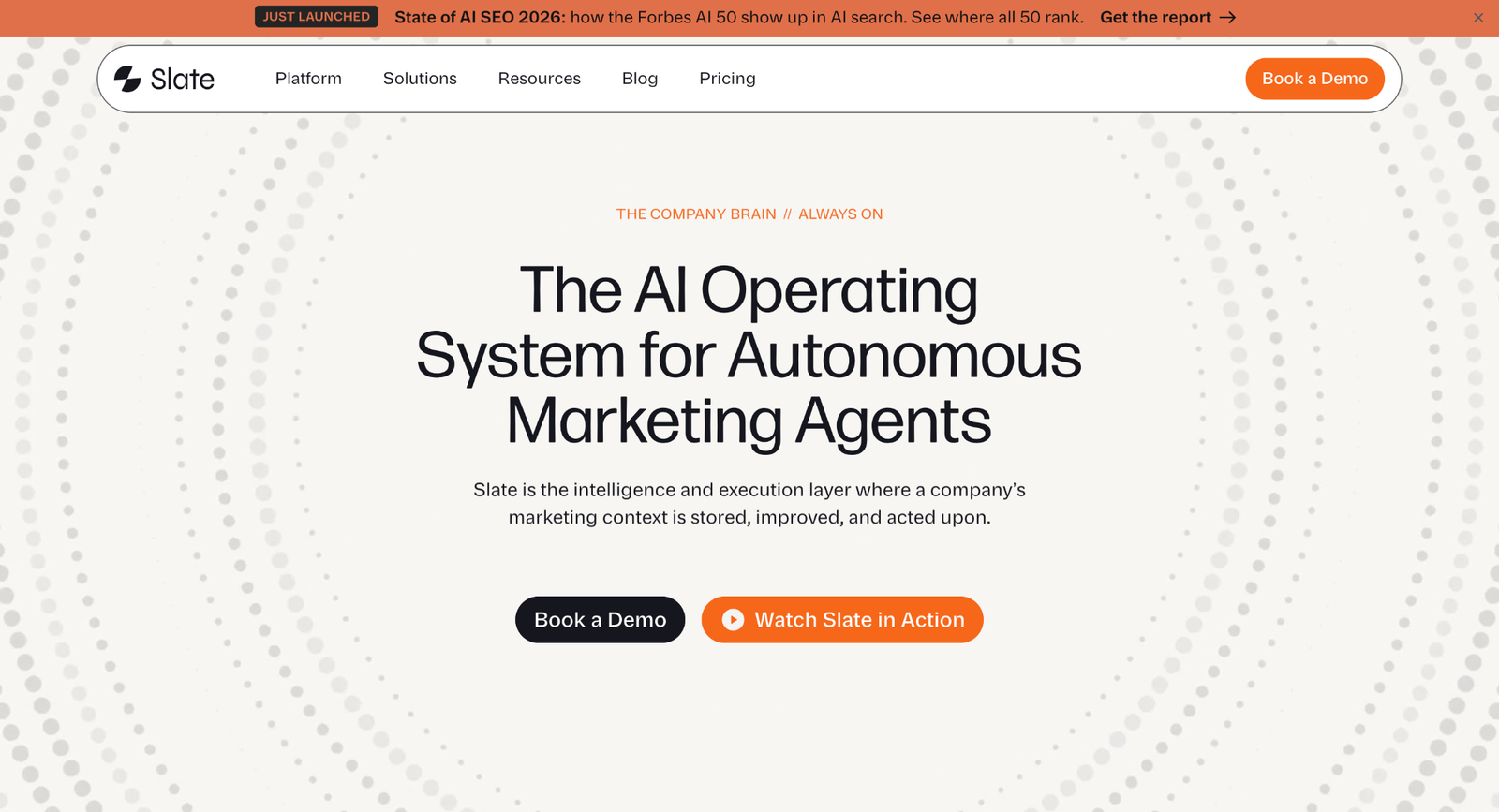
Slate is an agent-driven content, SEO, and AI search visibility platform for teams whose growth depends on being found in Google and AI answers.
It treats organic discovery as a marketing automation channel.
Best for: SEO leaders, content operations teams, and organic-growth marketers adapting to AI-driven discovery.
Why it made the list: Slate runs the organic loop from opportunity discovery through publishing, outreach, measurement, and refresh. That work usually gets split across research tools, writing tools, CMS tasks, and reporting decks.
Slate pulls it into one system where marketers describe the outcome and agents do the work.
Key features:
- Cowork and custom agents: Delegate work in plain language, or package repeatable SEO and content tasks into reusable agents.
- Workflows and Power Sheets: Build repeatable workflows or use a spreadsheet-style view to create, edit, refresh, and audit large groups of URLs.
- AI search visibility analytics: Track ChatGPT, Google AI Mode, Google AI Overviews, Perplexity, Claude, and Gemini.
- Pages: Pull Google Search Console and GA4 data into one view for clicks, traffic, CTR, citations, and traffic-drop detection.
- Opportunities: Find content gaps, citation gaps, ranking gaps, and social engagement gaps.
- Outreach: Find link and brand-mention opportunities, enrich contacts, and run outreach inside the platform.
CRM and integrations: Slate includes native Semrush access on every plan, connects to Ahrefs for keyword and backlink data, and publishes directly to Webflow and WordPress. You can review the full list of Slate integrations to see how it fits your stack.
It also connects to Google Search Console, GA4, Google Sheets, and Drive. Slate isn’t a built-in CRM. It sits beside your CRM and owns the organic discovery loop.
Pricing: Starting at $499/month for the Growth plan. There are two more fixed plans for $999/month and $2000/month that provide increased support and coverage. Slate also builds custom plans for larger enterprises.
G2 rating: 4.9/5
Pros: Agent-driven organic automation, AI search visibility across six surfaces, native Semrush access, direct publishing to Webflow and WordPress.
Cons: Weak fit for teams that only need email nurture. Also weak for creative proofing across video and visual brand assets.
Best-fit profile: Content-led B2B teams treating AI search visibility and organic growth as a strategic automation channel. Slate is the clearest pick when you want agents handling insight, production, outreach, publishing, measurement, and refresh in one place.
See how Slate enriches SEO and content teams and how it can be run on an enterprise-scale.
2. HubSpot Marketing Hub | Best Overall For Inbound And Built-In CRM
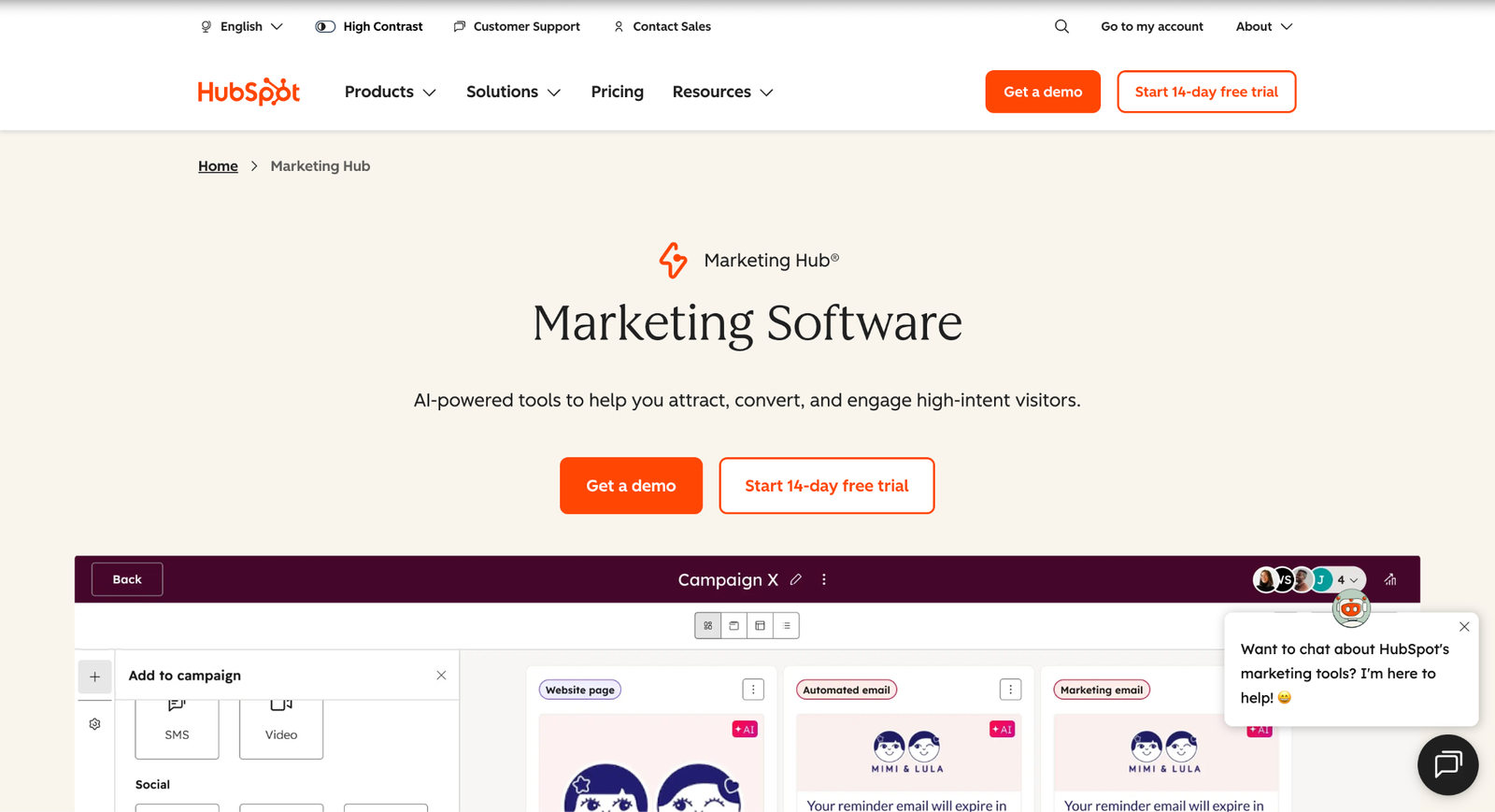
HubSpot Marketing Hub is the default recommendation for many B2B teams. It gives you CRM, workflows, landing pages, forms, and AI content tools on one shared database.
Best for: B2B companies running inbound growth.
Why it made the list: HubSpot is the safest all-around bet for lead capture, nurture, reporting, and CRM in one place. The shared data model keeps handoffs cleaner than a stack held together by sync rules and hope.
Key features:
- Lead capture forms and landing pages.
- AI-powered email and workflow automation.
- Native CRM on the same database as marketing activity.
- Dashboards and attribution reporting.
CRM and integrations: HubSpot’s built-in CRM is the main draw. You don’t need an external sync layer for core marketing and sales data, and the app ecosystem is broad.
Pricing: Free tools for up to two users. Starter starts at $20/month/seat with 1,000 marketing contacts. Professional starts at $890/month annually with a required one-time $3,000 onboarding fee. Enterprise starts at $3,600/month with a required one-time $7,000 onboarding fee.
G2 rating: 4.4/5
Pros: Strong all-in-one setup, clean CRM alignment, broad app ecosystem.
Cons: Costs jump hard at Professional and Enterprise. Native AI search visibility is limited.
Best-fit profile: B2B teams that want inbound, CRM, and reporting in one place and can absorb the tier jumps as they grow.
3. ActiveCampaign | Best For Automation Depth At Midmarket
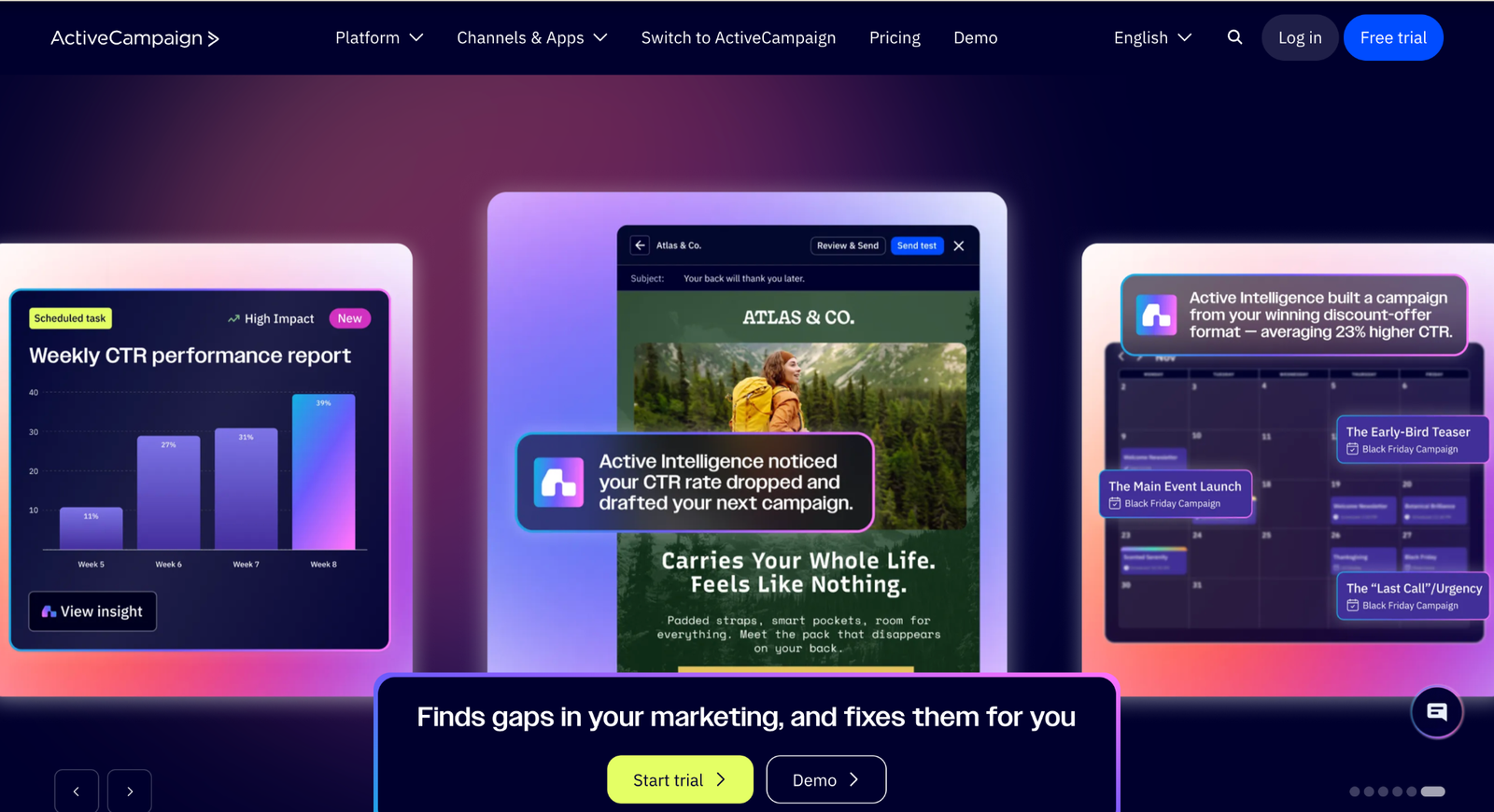
ActiveCampaign is a strong pick for midmarket teams that want deep customer journeys without enterprise drag.
Its builder can handle complex branching, and the Sales CRM with pipeline automation (enhanced CRM is a paid add-on above the base plan), ties email and pipeline work together.
Best for: Midmarket teams needing deep automation, email, and a light CRM.
Why it made the list: ActiveCampaign gives teams strong orchestration depth for the price band. Predictive sending, lead scoring, and AI-assisted segmentation work across email, SMS, and WhatsApp.
Key features:
- Multi-step marketing automation with branching logic.
- Email, SMS, and WhatsApp campaigns.
- Sales CRM with pipeline automation.
- Lead scoring and predictive send tools.
CRM and integrations: The native CRM supports pipelines and follow-up automation. ActiveCampaign also connects with common B2B tools and ecommerce systems.
Pricing: Starter plans begin around $15/month. Plus ($49/month), Pro ($79/month), and Enterprise ($145/month) tiers scale with contact volume. All billed annually.
G2 rating: 4.4/5
Pros: Strong automation depth for the price band, built-in CRM, multichannel workflows.
Cons: No native AI search visibility. Pricing rises with contacts and tier.
Best-fit profile: Growing mid-size B2B companies that live in email and want serious automation without enterprise implementation.
4. Klaviyo | Best For Ecommerce
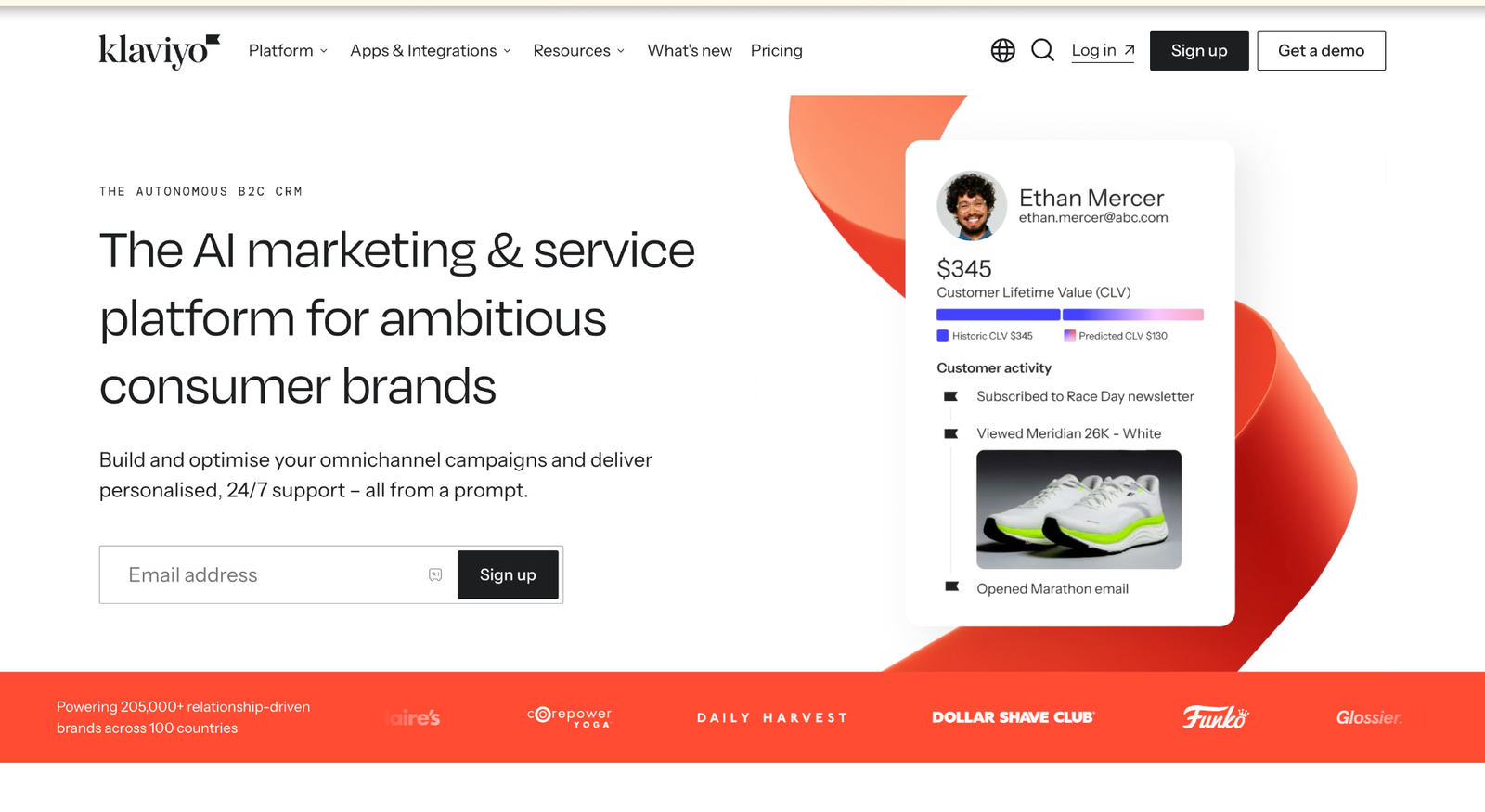
Klaviyo is built for consumer brands, with behavior-based flows, deep Shopify integration, and revenue reporting baked in.
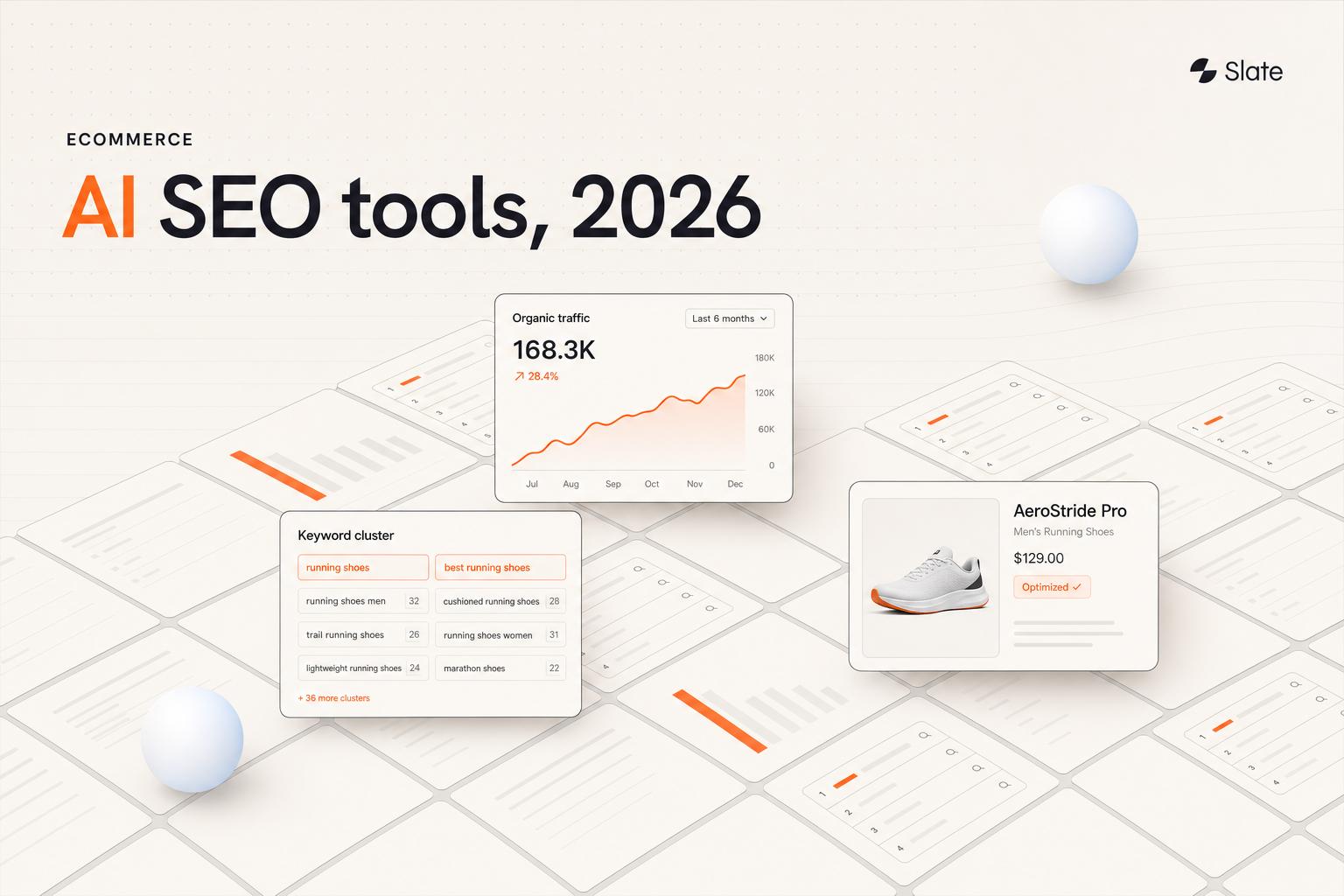
For ecommerce, it beats general-purpose automation suites most of the time. If you sell online, compare it against these AI SEO tools for ecommerce.
Best for: Ecommerce and DTC brands running behavior-based flows.
Why it made the list: Klaviyo treats purchase events, browse behavior, and abandoned carts as first-class triggers. It then connects campaigns to revenue reporting.
Key features:
- Email and SMS built around ecommerce events.
- Customer segmentation using product and lifecycle data.
- Reporting tied to revenue.
- Strong Shopify support.
CRM and integrations: Klaviyo works like a B2C CRM around storefront and event data. It isn’t a full B2B sales CRM.
Pricing: Free plan at $0/month for up to 250 active profiles, 500 emails/month, and $5 of mobile messages/month. Paid Marketing and Data + Analytics tiers are configured through a plan builder. Professional Services and Enterprise are sales-led.
G2 rating: 4.6/5
Pros: Ecommerce-native flows, strong Shopify fit, revenue-focused reporting.
Cons: Weak fit for B2B pipelines. Costs climb at high contact volumes.
Best-fit profile: DTC and retail brands where automation should map to purchase behavior.
5. Adobe Marketo Engage | Best For Enterprise Complexity
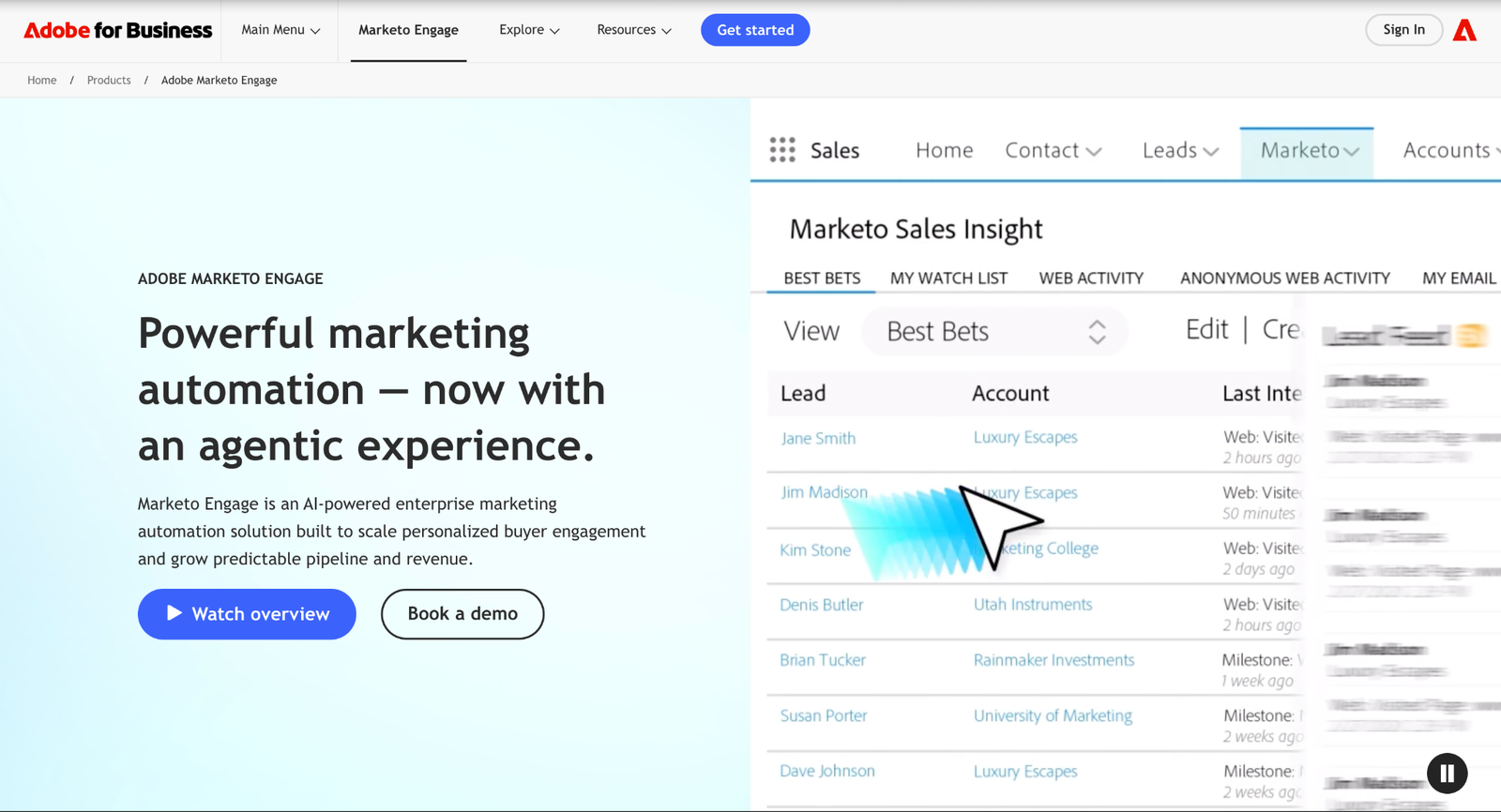
Adobe Marketo Engage is enterprise marketing automation for large teams that need multi-program orchestration, governance, and tight CRM alignment.
It’s powerful, and it asks for grown-up ops support.
Best for: Large enterprises with complex campaign orchestration and governance needs.
Why it made the list: Marketo has a high ceiling for sophisticated programs tied to pipeline and revenue. Expect a multi-month rollout and dedicated admin ownership.
Key features:
- AI and agentic campaign workflows.
- Omnichannel campaign orchestration.
- CRM-integrated lead scoring.
- Sales engagement support.
CRM and integrations: Marketo has no built-in CRM. It runs connected to Salesforce or another core CRM, so data governance needs care.
Pricing: Quote-based, sold through Adobe sales, usually on annual contracts with implementation costs.
G2 rating: 4.1/5
Pros: Deep enterprise orchestration, strong governance controls, built for large teams.
Cons: Heavy implementation and admin load. Overkill for lean teams.
Best-fit profile: Enterprise B2B marketing orgs with the ops resources to run a heavyweight platform well. Larger orgs may also want to review the best AI SEO tools for enterprise content teams.
6. Salesforce Marketing Cloud Account Engagement | Best For Salesforce-Centric B2B
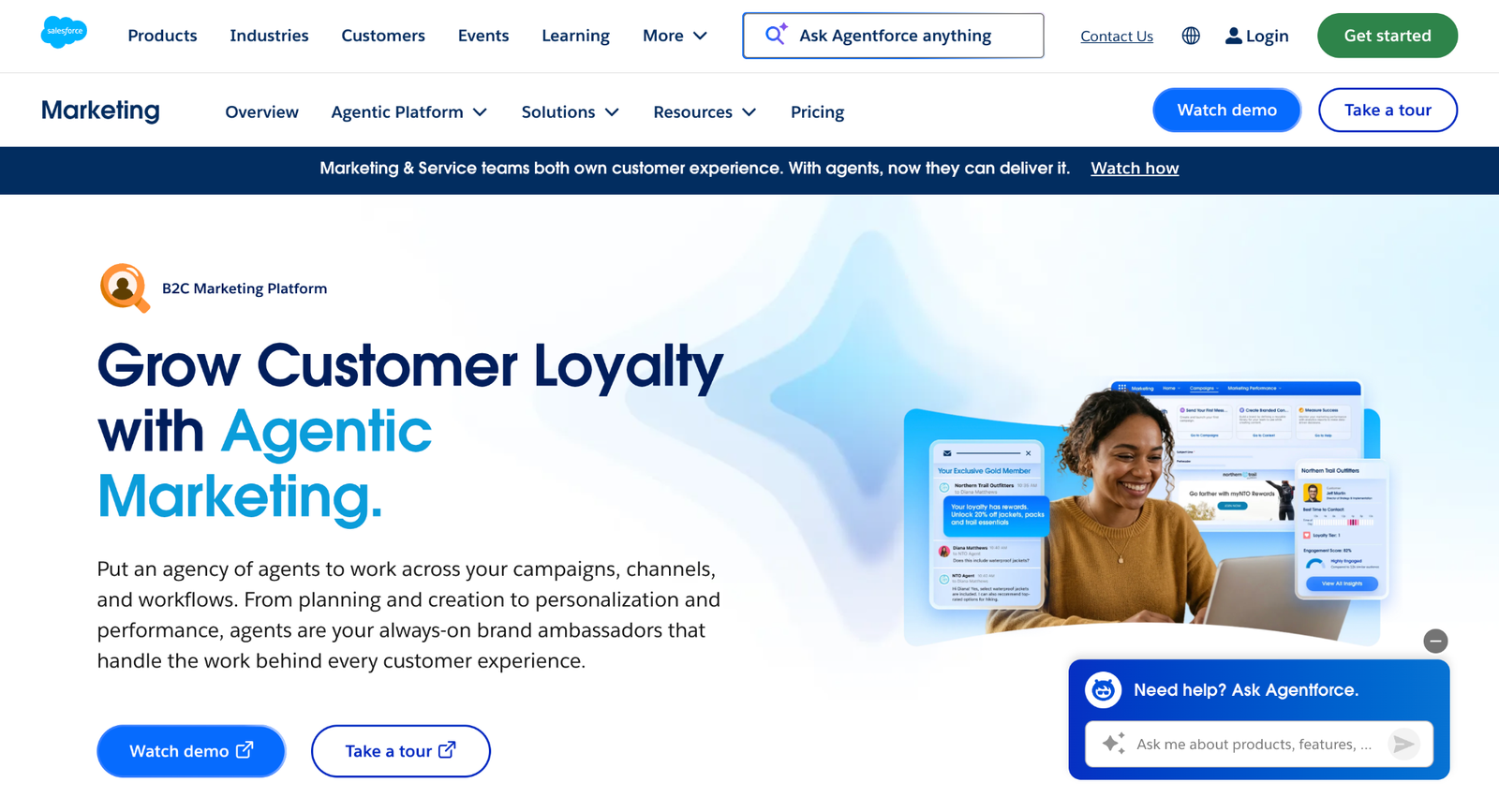
Salesforce Marketing Cloud Account Engagement, still widely known as Pardot, is the natural choice for B2B teams already standardized on Salesforce CRM.
It uses Salesforce data, so marketing activity can sit close to Leads, Contacts, and Opportunities.
Best for: B2B teams already running Salesforce.
Why it made the list: Salesforce shops usually get the cleanest fit by keeping automation inside the Salesforce ecosystem. Lead nurturing, scoring, and B2B analytics can tie into the CRM without a separate data model.
Key features:
- Lead nurturing and scoring.
- B2B marketing analytics.
- ROI reporting.
- Native Salesforce CRM integration.
CRM and integrations: CRM is effectively native through Salesforce. Setup still takes care, especially around fields, sync direction, and attribution logic.
Pricing: Growth+ is $1,250/org/month. Plus+ is $2,750/org/month. Advanced+ is $4,400/org/month. Premium+ is $15,000/org/month. All are billed annually.
G2 rating: 4.0/5
Pros: Deep Salesforce alignment, strong B2B reporting, good fit for Salesforce-led revenue teams.
Cons: High entry cost. Value depends on Salesforce commitment.
Best-fit profile: B2B revenue teams whose CRM is already Salesforce and who want automation inside that ecosystem.
7. Mailchimp | Best For Simple Email-Led Teams
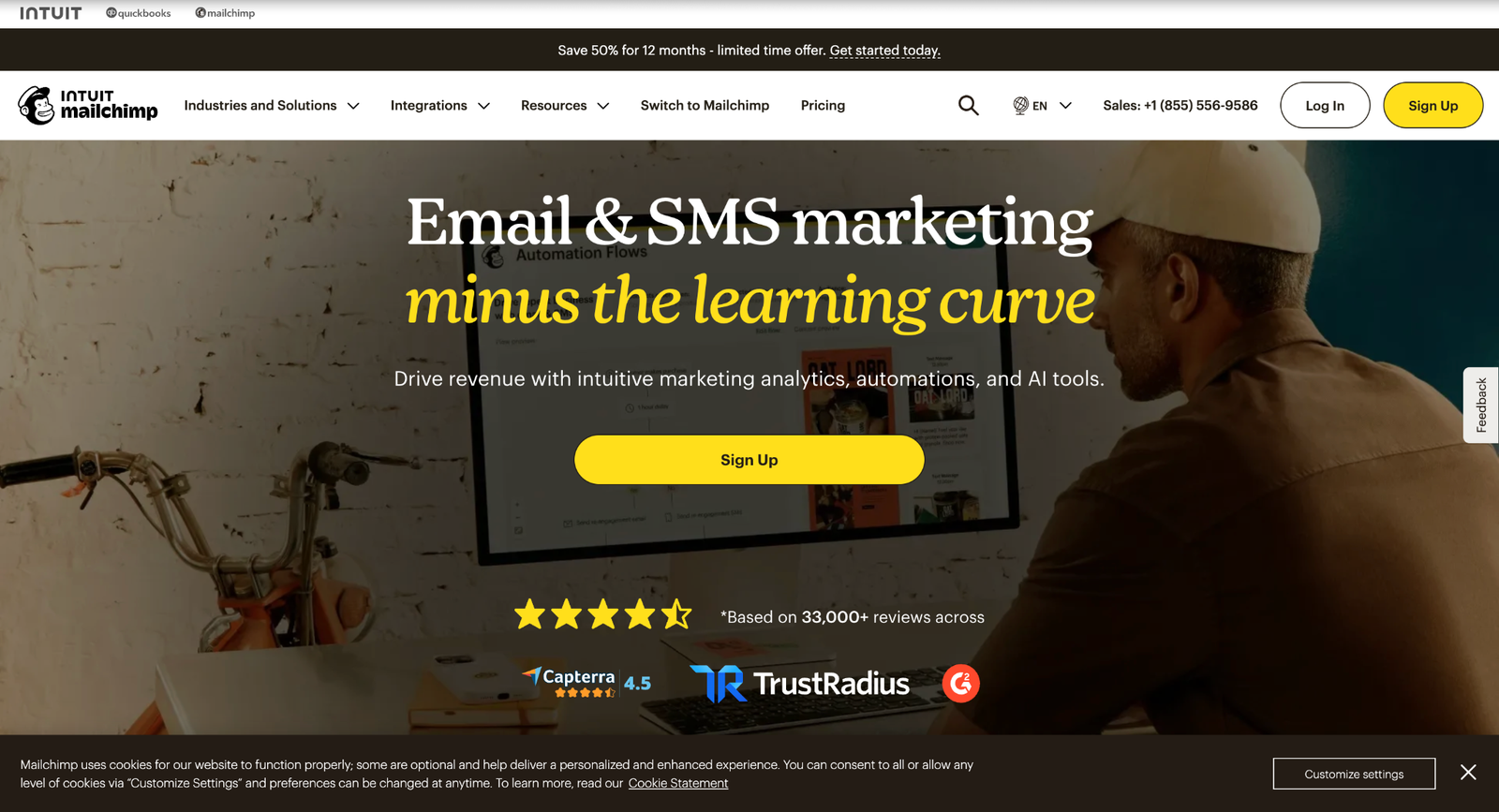
Mailchimp is still one of the easiest on-ramps for small businesses and email-first teams.
It handles campaigns, newsletters, and basic journeys without a steep learning curve.
Best for: Small businesses and email-first teams.
Why it made the list: Mailchimp is practical when you mostly need reliable email and light automation. AI-assisted subject lines and send-time tools add convenience.
Key features:
- Email marketing with prebuilt journeys.
- SMS marketing.
- Sign-up and purchase triggers.
- Audience tools for basic segmentation.
CRM and integrations: Mailchimp has audience tools instead of a full CRM, which can make B2B pipeline tracking harder.
Pricing: Free plan for up to 250 contacts. Paid Essentials ($13/month), Standard ($20/month), and Premium ($350/month) tiers are available.
G2 rating: 4.3/5
Pros: Easy to start, free plan, familiar interface.
Cons: No full CRM. Automation depth trails specialist tools as you grow.
Best-fit profile: Small teams that want email and basic automation without much operational overhead.
8. Drip | Best For DTC Brands
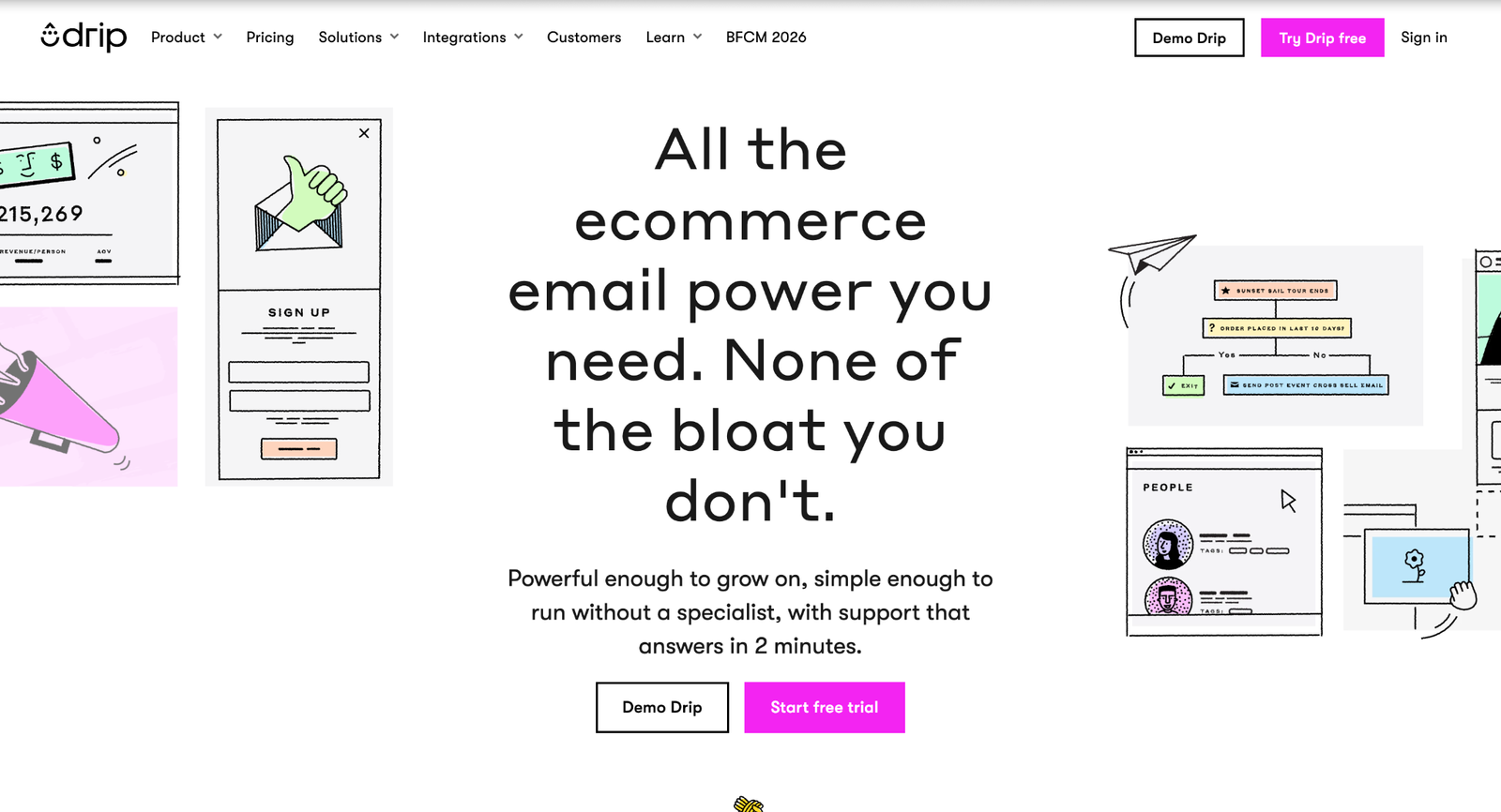
Drip is a behavior-driven email automation platform for B2C businesses that sell online.
It leans into revenue-focused flows and DTC retention.
Best for: DTC ecommerce brands wanting purchase-event automation.
Why it made the list: Drip pairs behavior-triggered workflows with customer segmentation and a visual email builder. Smaller ecommerce brands can build useful flows without taking on a large suite.
Key features:
- Behavior-triggered workflows.
- Customer segmentation and personalization.
- Visual email builder with templates.
- Ecommerce integrations.
CRM and integrations: Drip is an ecommerce ESP and automation tool. It isn’t a full CRM.
Pricing: Usage-based from $39/month for 2500 people, tied to active contacts. It has unlimited monthly email volume until the 30,000 people threshold.
G2 rating: 4.4/5
Pros: DTC-focused flows, predictable entry pricing, strong segmentation.
Cons: No free tier. Costs rise with contacts. Narrow B2B fit.
Best-fit profile: Online sellers and creators who want purchase-event automation without ecommerce-suite complexity.
9. MoEngage | Best For Customer Engagement At Scale
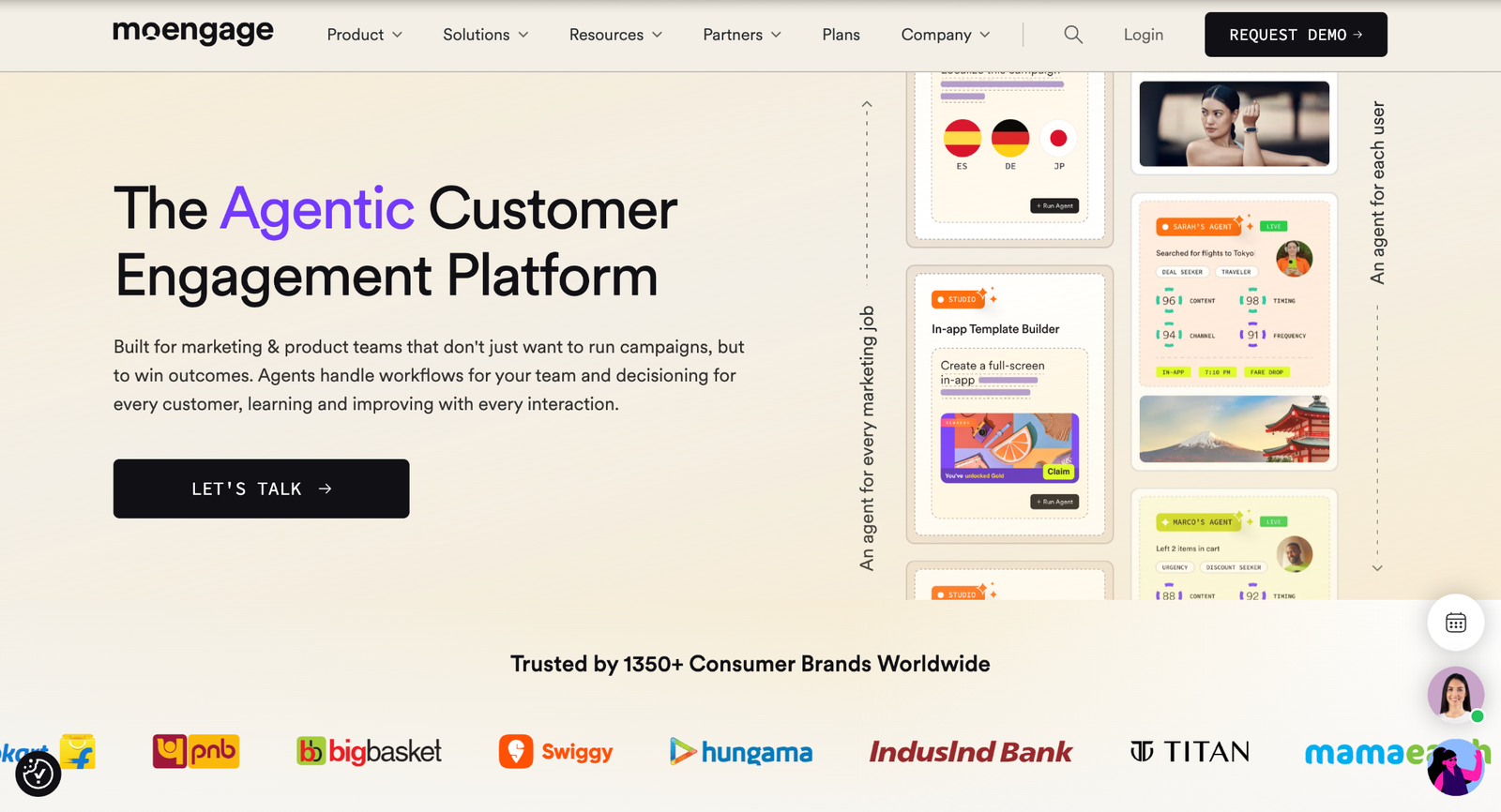
MoEngage is an agentic customer engagement platform for mobile and web campaigns.
Consumer brands with large user bases use it to orchestrate push, in-app, email, and SMS from one place.
Best for: Cross-channel customer engagement across mobile and web.
Why it made the list: MoEngage combines behavioral analytics, journey orchestration, and web and app personalization. It fits high-volume consumer engagement where timing and trigger quality matter.
Key features:
- Cross-channel journeys.
- Behavioral analytics.
- Web and app personalization.
- Push, in-app, email, and SMS support.
CRM and integrations: MoEngage integrates with CRMs and customer data tools. It doesn’t replace a core CRM.
Pricing: Quote-based and sales-led, with Growth and Enterprise plans plus add-ons.
G2 rating: 4.5/5
Pros: Strong mobile and web engagement, real-time personalization, built for high-volume programs.
Cons: Quote-based pricing. Too much platform for many B2B teams.
Best-fit profile: Consumer brands and product teams running engagement across channels at scale.
10. Brevo | Best For Budget-Conscious And Event-Driven Teams
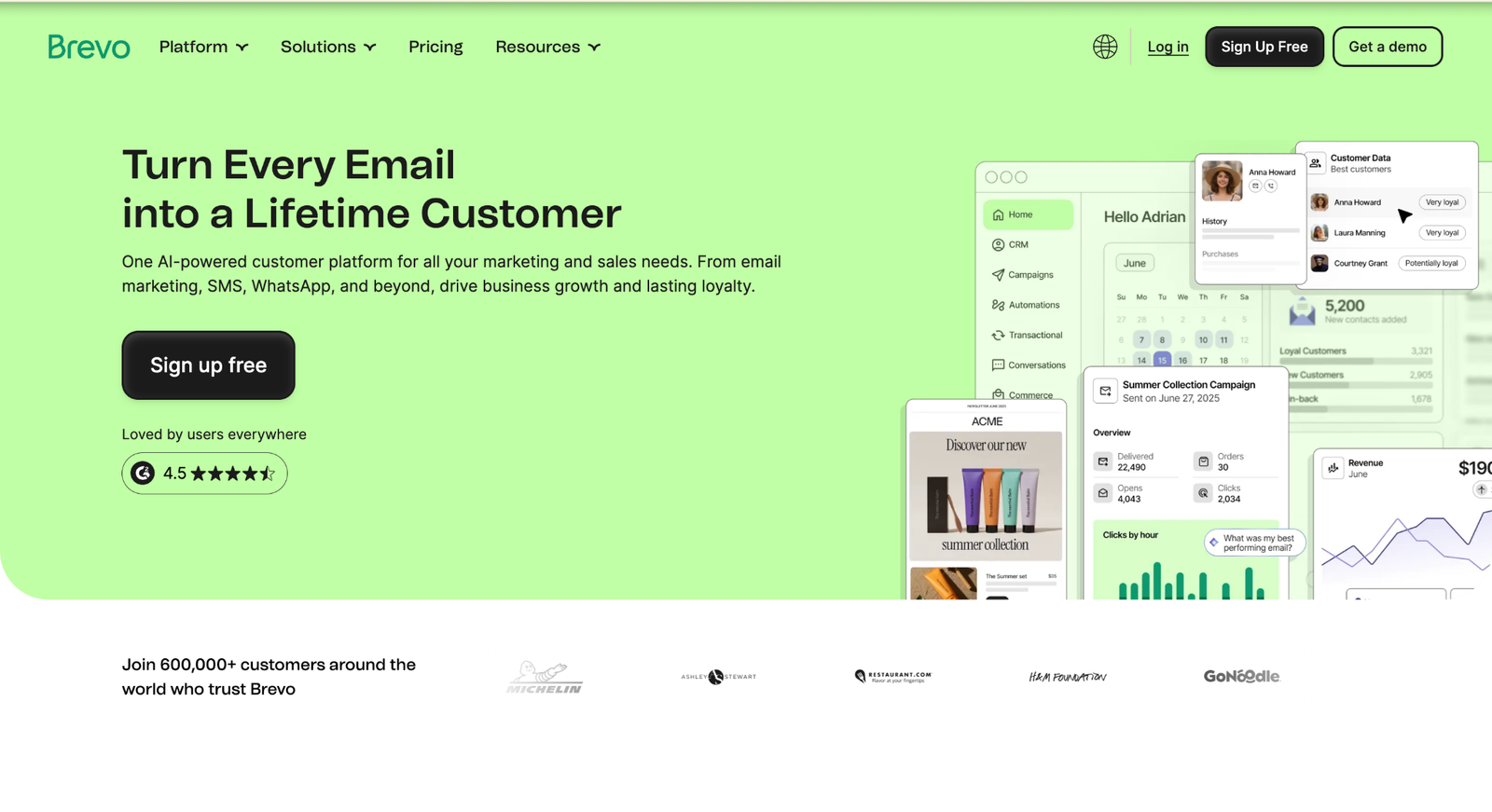
Brevo combines email, SMS, light CRM, and automation in one affordable package.
Its send-based pricing and usable free plan make it attractive for startups and lean teams.
Best for: Budget-conscious teams and startups.
Why it made the list: Brevo prices by both emails sent and contacts. It can work well for event-driven and transactional-heavy programs. The light CRM lowers the barrier to getting started.
Key features:
- Email marketing.
- SMS marketing.
- Light CRM.
- Marketing automation.
CRM and integrations: Brevo includes a light built-in CRM for deals and contacts, plus common integrations.
Pricing: Free plan available. Paid tiers start at $9/month and go up depending on email volume and other add-ons.
G2 rating: 4.5/5
Pros: Affordable entry, send-based pricing, light CRM included.
Cons: Automation depth trails specialist platforms. No AI search visibility.
Best-fit profile: Startups and small teams that want email, SMS, and a light CRM on a budget.
Best Marketing Automation Platform By Use Case
No single platform wins for every team. Use case should drive the shortlist.
- Best for AI-driven organic growth: Slate. It runs the organic loop and tracks brand visibility across six AI surfaces.
- Best overall for inbound and CRM: HubSpot. It combines CRM, workflows, and reporting for B2B inbound.
- Best for midmarket B2B: ActiveCampaign. It has deep automation and a built-in CRM without enterprise overhead.
- Best for ecommerce: Klaviyo. It’s built around purchase events and revenue reporting.
- Best for enterprise: Marketo Engage. It supports heavyweight orchestration and governance.
- Best for Salesforce shops: Account Engagement. It fits the Salesforce data model.
- Best for small business email: Mailchimp. It’s simple and has a free plan.
- Best free option: Brevo. The free plan is usable and pricing is send-based.
- Best for lean startups: Brevo for email-led budgets, Slate for organic-led startups building an inbound moat.
Marketing Automation Pricing: What To Expect As You Grow
Entry price is usually the least useful number on the pricing page.
Your bill depends on contact volume, seats, channels, onboarding fees, and reporting needs. Two tools with similar entry prices can land thousands of dollars apart once your list grows.
HubSpot, for example, requires a one-time $3,000 onboarding fee at Professional and $7,000 at Enterprise. Contact-based tools like Mailchimp, Klaviyo, and Drip get more expensive as lists grow. Marketo and Account Engagement usually move into annual, sales-led contracts.
Slate prices on credits and tracked pages instead of marketing contacts. Slate starts at $499/month. You can review Slate’s pricing details for how credits and tracked pages work.
See how ActiveCampaign, Drip, Mailchimp and Klaviyo scale up prices as the contact list grows. These are starting-tier prices for the corresponding contact volume.
Budget can jump when you cross a contact tier, add seats, add channels, or move up a plan for reporting.
Model the next 12 months before comparing entry tiers. Your future bill is the one finance will care about.
Do You Need A Built-In CRM Or A Strong CRM Integration?
A built-in CRM can make life easier if your team lacks a central system.
HubSpot, ActiveCampaign, and Brevo can simplify lead management because marketing and sales activity live in one database.
If you already run Salesforce or another core CRM, integration quality should drive the decision. Account Engagement fits Salesforce best. Marketo usually depends on an external CRM sync, so field mapping and governance need serious attention.
Slate sits beside this decision. It owns the organic discovery and content loop, then feeds demand into the CRM you already use.
Which Platforms Are Easiest To Implement?
Lean teams should care about implementation as much as feature depth.
HubSpot, Mailchimp, and Brevo tend to reach value fastest because the builders are simpler and the integration load is lighter. HubSpot implementations often run in weeks.
Marketo and Salesforce Account Engagement take more planning. Expect data mapping, governance decisions, and process cleanup before the platform works the way you want.
ActiveCampaign and Klaviyo sit in the middle. A competent marketer can usually get meaningful programs running without a six-month ops project.
If you’re a lean team eyeing Marketo or Account Engagement, be honest about ownership. Without dedicated ops support, the ceiling turns into shelfware with a login screen.
Migration risk deserves attention before you sign. Contacts, workflows, and historical data are where timelines slip and data breaks.
Which AI Features Help In 2026?
Every vendor now says “AI,” so the label doesn’t tell you much.
Look for AI that executes work and closes the measurement loop. Useful AI can run multi-step tasks, generate workflows, score leads, recommend send times, create content briefs, publish updates, and track AI answer visibility. The best AI SEO tools show what agent-assisted execution looks like in practice.
HubSpot and ActiveCampaign apply AI inside lifecycle workflows. Mailchimp, Klaviyo, and Drip lean toward copy assistance and ecommerce personalization.
Slate is different because its agents run content and SEO work end to end, then measure whether your brand appears inside AI answers.
AI search visibility now belongs in the marketing automation conversation. The decline in organic click-through from AI answers is now a measurable trend. The shift from traditional SEO to AI search optimization is reshaping how teams plan organic growth. If buyers ask an AI assistant before clicking search results, your brand needs to show up in those answers. You can compare the best generative engine optimization tools to get started.
Common Mistakes That Kill Marketing Automation ROI
Automation failures usually come from process problems the software can’t rescue.
- Buying on sticker price or feature count: Teams pick the longest feature list, then struggle to run it.
- Messy integrations and bad data: Poor data sends polished campaigns to the wrong people.
- Weak ownership: Powerful platforms need admins. Workflows drift when nobody owns the system.
- Missing measurement: If you can’t tie automation to outcomes, you can’t improve it. Attribution reporting for content marketing is where many teams fall short.
- Ignoring organic discovery: Teams often automate email carefully while leaving search and AI visibility underbuilt.
Automation frees SEO leads, content strategists, and marketing operators from the constraints of manual execution. You can read this Practical Systems Guide to get started.
How To Choose The Right Marketing Automation Platform
The fastest path to a useful shortlist is elimination.
- Define your main use case: Lifecycle email, organic growth, ecommerce, or enterprise orchestration will cut the list fast.
- Assess team size and technical maturity: Be honest about who will run the platform day to day.
- Check CRM and stack fit: Salesforce teams should prioritize Salesforce fit.
- Model pricing at your contact volume: Include seats, channels, onboarding, and the next 12 months of growth.
- Weigh implementation effort: Time to value counts.
- Evaluate AI and measurement depth: If organic drives pipeline, include AI search visibility in the buying criteria.
A platform that’s overkill for a lean team becomes a liability.
Which Marketing Automation Platform Should You Choose?
Pick based on your business model, team maturity, CRM stack, and main growth motion.
HubSpot is the safest default for many B2B teams that want inbound marketing and CRM in one place.
Slate leads for teams treating AI-driven organic growth and AI search visibility as a strategic automation channel. It handles insight, production, outreach, publishing, measurement, and refresh through agents in one platform. Slate starts at $499/month.
Ecommerce brands should look at Klaviyo or Drip. Enterprises should look at Marketo. Salesforce shops should look at Account Engagement.
Shortlist two or three tools, then pressure-test demos against your pricing model and implementation constraints. Book a Slate demo to see how AI search visibility can be automated.
Frequently Asked Questions
1. What is the best marketing automation platform in 2026?
HubSpot is the safest all-around choice for many B2B teams because it combines CRM, automation, landing pages, and reporting in one system.
Slate is stronger for teams focused on AI-driven organic growth, SEO, content, publishing, outreach, and AI visibility workflows.
2. What is the best marketing automation platform for small businesses?
Mailchimp and Brevo are strong picks for simple email automation.
Small teams investing in inbound growth may prefer HubSpot because it combines CRM, forms, workflows, and reporting.
3. What is the best marketing automation platform for ecommerce?
Klaviyo and Drip are usually the best fits for ecommerce.
They’re built around purchase events, abandoned carts, segmentation, and revenue reporting.
4. What is the best AI marketing automation platform?
Slate is the strongest AI marketing automation platform for teams focused on organic discovery and AI search visibility.
Its agents run content, SEO, publishing, and outreach work while tracking brand visibility across six AI surfaces.
5. How much does marketing automation software cost?
Pricing varies by contacts, users, channels, and automation depth.
Low-end tools may start cheap, but costs often rise as lists and workflows grow. Slate starts at $499/month.
6. What’s the difference between marketing automation and email marketing software?
Email marketing software handles campaigns, newsletters, and basic automations.
Marketing automation platforms add customer journeys, lead scoring, CRM syncing, segmentation, attribution, and cross-channel orchestration. In 2026, stronger platforms also support content production and AI search visibility.
7. Do I need a built-in CRM for marketing automation?
A built-in CRM can help if your team lacks a central sales system.
If your team already relies on Salesforce or another CRM, integration quality is usually more important than adding a second CRM.
8. Which marketing automation platform is easiest to implement?
HubSpot, Mailchimp, and Brevo tend to reach value fastest because they have simpler builders, templates, and fewer integration dependencies.
Marketo and Account Engagement take more planning because they usually require custom data mapping and cross-team process work.