Your bottleneck probably tells you which tool to buy.
If your team is stuck stitching together SEO research, AI search tracking, content production, publishing, outreach, and reporting, Slate fits better. If your revenue team needs fast GTM copy and automated sales or marketing workflows, Copy.ai fits better.
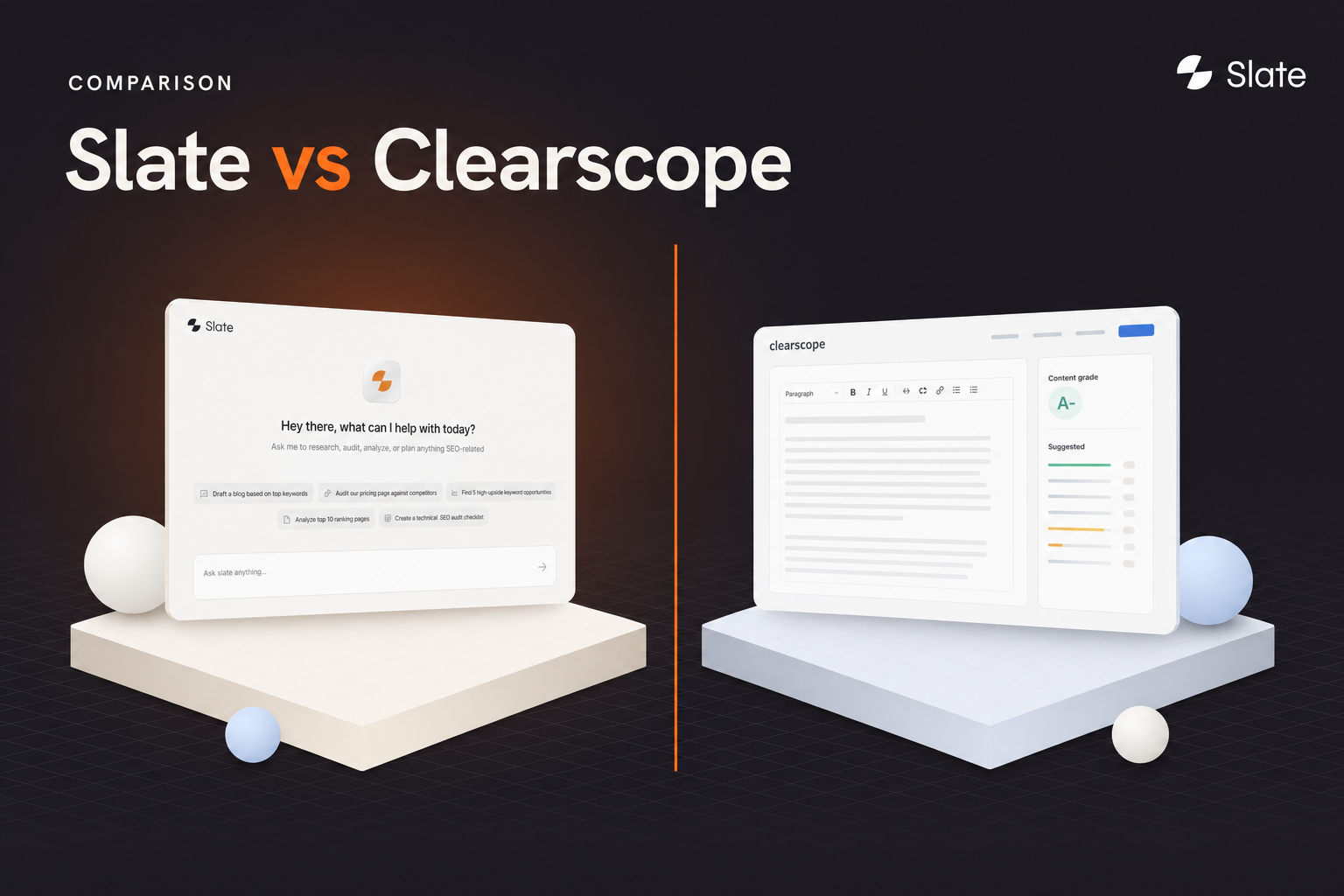
Slate is an agent-driven platform for organic growth teams. Copy.ai is a go-to-market platform for sales, marketing, and ops teams.
Different jobs. Different buyers.
Key Takeaways
- Slate covers SEO, AI search visibility, content production, publishing, outreach, and measurement.
- Copy.ai is built for GTM copy, sales workflows, marketing workflows, and RevOps automation.
- Slate starts at $499/month, including 15,000 credits, 10,000 prompt answers tracked, and 1,000 web pages tracked.
- Copy.ai starts at $24/month billed annually, with a free tier available.
- Slate’s strongest edge is the full loop: opportunity, content, publishing, measurement, refresh.
- Both platforms have a 4.9/5 G2 rating, so review scores won’t settle this.
Quick Verdict: Slate Vs Copy.ai At A Glance
Choose Slate if your work stalls around content ops, AI search visibility, publishing, refreshes, and measurement.
Choose Copy.ai if your team needs sales sequences, campaign copy, outbound copy, and GTM workflow automation.
Book a demo if you want to see Slate run the full loop in one place.
At-A-Glance Comparison Table
Copy.ai wins on entry price and speed for GTM copy. Slate covers the workflow pieces that burn hours: SEO research, AI search tracking, publishing, reporting, and refreshes.
How We Compared Slate And Copy.ai
We compared the platforms through the lens of an SEO or content team trying to publish, measure, and improve content without duct-taping 10 tools together.
We looked at:
- Workflow coverage
- AI search visibility
- Long-form content support
- Publishing
- Measurement
- Pricing
- Team fit
The winner in each category is the platform that removes a tool handoff.
What Slate Is Built For
Slate is an agent-driven content, SEO, and AI search platform for teams that treat organic growth as an operating system.
It covers the loop from opportunity discovery to refresh. Teams can find content gaps, write or improve pages, publish to Webflow or WordPress, track results in GSC and GA4, and monitor brand visibility in AI answers.
Explore more at Slate for teams.
Key parts:
- Coworker and custom agents: Delegate tasks in plain language or turn repeatable work into reusable agents.
- Workflows and Power Sheets: Build workflows visually, or use a spreadsheet-style interface across thousands of URLs.
- AI Search Analytics: Track brand presence across ChatGPT, Google AI Mode, Google AI Overviews, Perplexity, and other answer engines.
- Native SEO data: Use Ahrefs and Semrush data inside Slate without a separate purchase.
- Publishing and measurement: Publish to Webflow or WordPress, then track clicks, traffic, CTR, and citations through Pages.
- Outreach: Find link and brand-mention opportunities, enrich contacts, and run outreach in-platform.
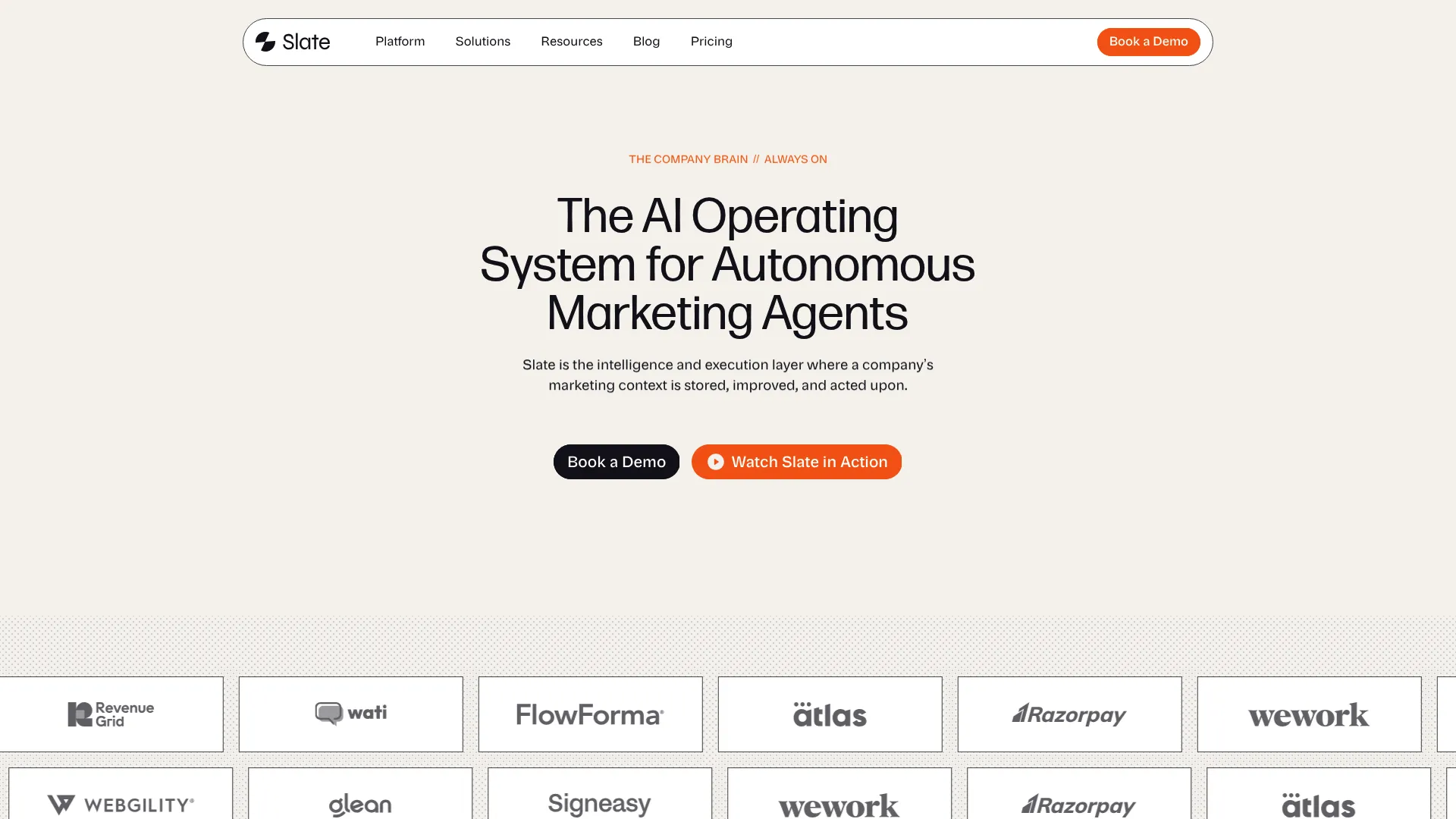
Slate is built for content systems, SEO execution, AI search tracking, and refresh cycles. Teams that only need fast standalone copy will probably find it heavier than they need. For teams weighing platforms, our roundup of the best AI SEO tools offers wider context.
What Copy.ai Is Built For
Copy.ai is an AI-native go-to-market platform for sales, marketing, and operations teams.
It started with copy generation and has expanded into GTM workflow automation. Its sweet spot is revenue-team output: sales emails, campaign copy, outbound sequences, ad variants, and repeatable GTM tasks.
Key parts:
- AI workflows and agents: Multi-step GTM workflows, including CRM-triggered tasks.
- Intelligence layer: Tables, Actions, Infobase, Brand Voice, and Chat across revenue workflows.
- Copy generation: Fast short-form marketing and sales copy.
- Brand Voice: Tone control across GTM copy.
- Integrations: 2,000+ integrations, with model support across OpenAI, Anthropic, and Gemini.
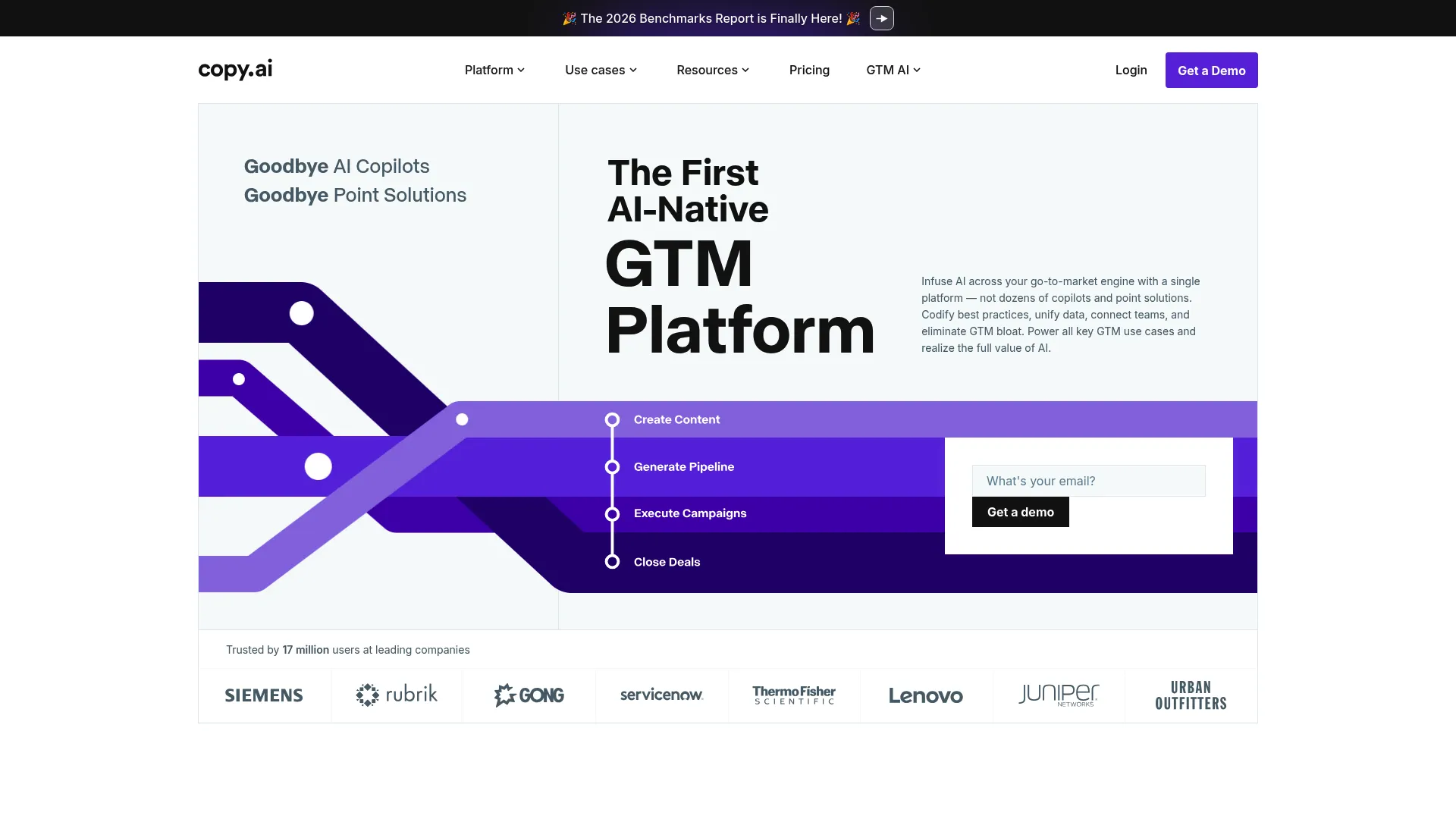
Copy.ai is strongest when the job is GTM speed. For a broader comparison set, see Copy.ai alternatives.
Slate Vs Copy.ai: Feature-By-Feature Comparison
Drafting is only one slice of the work. The expensive parts usually come before and after the draft: research, page tuning, publishing, reporting, and refreshes.
See how Slate fits content teams at Copy.ai for teams vs Slate.
Content Generation And Long-Form Content
Both tools generate content.
Slate leans toward SEO-oriented long-form work: briefs, structured pages, citation-ready sections, and content built around search intent and long-form content structure.
Copy.ai can draft long-form content, but its strongest fit is shorter GTM copy across campaigns and sales motions. If drafting quality is your focus, compare the best AI writing tools for SEO.
Verdict: Slate for long-form SEO work. Copy.ai for fast GTM copy.
Short-Form And Marketing Copy
Copy.ai is fast here.
Campaign copy, ad variants, sales emails, and social posts are easy to produce, and Brand Voice helps keep tone consistent across a revenue team.
Verdict: Copy.ai is the better fit for high-volume marketing and sales copy.
SEO Content Support And Operations
Slate treats SEO as a working system.
Ahrefs and Semrush data feed opportunity discovery, page tuning, and refresh workflows inside the platform. Copy.ai needs external SEO tools for keyword research, SERP analysis, and page scoring. Teams scaling this work often lean on SEO automation tools to cut manual steps.
Verdict: Slate for SEO content operations.
AI Search Visibility
Slate’s AI Search Analytics tracks how often your brand appears in AI answers across engines like ChatGPT, Google AI Overviews and how they change organic clicks, Google AI Mode, and Perplexity.
You can track citations, brand mentions, prompt answers, and sentiment over time. Copy.ai has no listed AI search visibility tracking module. If this is your top priority, explore the best AI search visibility tools.
Verdict: Slate if AI search visibility is a priority.
Workflow Automation And Agents
Slate has Coworker, reusable custom agents, and a visual workflow builder with templates. The focus is repeatable content and SEO work.
Copy.ai has GTM workflows and agents for sales and marketing automation, including CRM-triggered sequences.
Verdict: Slate for content ops. Copy.ai for GTM orchestration.
Bulk Operations With Sheets
Slate’s Power Sheets let teams create, improve, refresh, and audit thousands of URLs from a spreadsheet interface.
Copy.ai can generate campaign assets in volume, but spreadsheet-based bulk SEO work isn’t a core advertised use case.
Verdict: Slate for large URL sets.
Brand Voice And Editorial Governance
Slate pairs a Brand Kit with a knowledge base, so teams can keep content aligned with editorial rules and company context.
Copy.ai’s Brand Voice is useful for tone consistency across sales and marketing copy.
Verdict: Slate for editorial governance. Copy.ai for fast tone matching.
Team Collaboration And Approvals
Slate is built around editors, strategists, and content ops managers who need review controls and repeatable processes.
Copy.ai supports team access, with workflows aimed at revenue teams. See Slate review for enterprise teams for more on how Slate handles larger orgs.
Verdict: Slate for editorial collaboration. Copy.ai for GTM team workflows.
Integrations And Publishing
Slate includes native Ahrefs and Semrush access, plus direct publishing to Webflow and WordPress from workflows and Power Sheets.
Copy.ai connects well to GTM systems and CRMs. Native CMS publishing isn’t listed as a core feature.
Verdict: Slate for direct publishing. Copy.ai for routing copy into revenue systems.
Measurement And Performance Monitoring
Slate’s Pages brings Google Search Console performance metrics and GA4 measurement for content performance data into the platform, including clicks, traffic, CTR, and citations.
That makes it easier to spot drops and trigger refresh work. Copy.ai relies on external analytics tools after content goes live.
Verdict: Slate for built-in measurement.
Outreach And Link Building
Slate helps teams find link and brand-mention opportunities, enrich contacts, and run outreach inside the platform.
Copy.ai can generate outreach copy, while the pipeline usually lives in a CRM or sales-engagement tool.
Verdict: Slate for outreach workflows. Copy.ai for outreach copy.
Workflow Lifecycle Comparison
Slate keeps more of the organic workflow in one place. Copy.ai concentrates its strength around GTM creation and automation.
Pricing And Value Comparison
Slate starts at $499/month. That includes 15,000 credits, 10,000 prompt answers tracked, and 1,000 web pages tracked.
Copy.ai’s Chat plan starts at $29/month billed monthly or $24/month billed annually. Growth is $1,000/month, Expansion is $2,000/month, Scale is $3,000/month, and Enterprise is custom. Copy.ai also has a free tier.
G2 rating for Copy.ai: 4.9/5
Total Cost By Team Type
Small teams that only need fast copy will like Copy.ai’s entry price. It’s hard to argue with $24/month if the job is campaign copy and sales emails.
SEO teams should price the rest of the stack. With Copy.ai, you’ll still need keyword research, page tuning, publishing, AI visibility tracking, and analytics tools.
Content ops teams should price the handoffs too. Moving drafts across docs, SEO tools, CMS fields, spreadsheets, and dashboards gets expensive in a very boring way. This is exactly the pain that content automation tools are designed to solve.
Slate costs more at entry, but it replaces more of that stack.
Ease Of Use And Learning Curve
Copy.ai is easier in the first 30 minutes.
A marketer can open a template, add a prompt, and get usable short-form copy fast. That makes adoption simple for sales and marketing teams.
Slate takes more setup because it connects more pieces: SEO data, Brand Kit rules, workflows, agents, publishing, and measurement.
The payoff comes after setup. Teams can run refresh cycles, publish pages, track performance, and manage bulk URL work with fewer manual steps.
Pros And Cons
Slate Pros And Cons
Pros:
- Full content loop from opportunity discovery to refresh.
- AI Search Analytics across major answer engines.
- Native Ahrefs and Semrush data.
- Direct publishing to Webflow and WordPress.
- GSC and GA4 measurement through Pages.
- Coworker, custom agents, and Power Sheets.
- 4.9/5 G2 rating.
Cons:
- Higher entry price than lightweight copy tools.
- More platform than a team needs for standalone copy.
- Built for content work, SEO, publishing, outreach, and reporting, so creative proofing for video or visual campaigns belongs elsewhere.
Copy.ai Pros And Cons
Pros:
- Fast short-form GTM copy.
- Low entry price and free tier.
- CRM-triggered GTM workflows.
- Broad revenue-system integrations.
- 4.9/5 G2 rating.
Cons:
- External SEO tools required for SERP analysis and page scoring.
- No listed AI search visibility tracking module.
- No listed native CMS publishing or built-in GSC and GA4 measurement.
Best For: Slate Vs Copy.ai By Team Type
- SEO Leaders: Slate, because it covers discovery, page work, publishing, measurement, and refreshes.
- Content Ops Teams: Slate, because Power Sheets, workflows, agents, and CMS publishing cut manual work.
- Organic Growth Marketers: Slate, because AI Search Analytics tracks visibility across major answer engines.
- Marketing Agencies: Slate, because Agency plans and multi-client workflows fit high-volume content work. See marketing copy AI tool comparison.
- GTM, RevOps, And Sales-Marketing Teams: Copy.ai, because its workflows are built around revenue tasks.
- Teams That Only Need Campaign Copy: Copy.ai, because the entry price is low and output is fast.
Can You Use Slate And Copy.ai Together?
Yes.
Some teams use Copy.ai for outbound and campaign copy, then use Slate for the organic growth system: content planning, production, publishing, AI search visibility, measurement, and refreshes.
The overlap is mainly AI-assisted writing. The operating models are different enough that the tools can sit side by side without much duplication.
How To Evaluate Slate Vs Copy.ai In A Free Trial
Run the same brief through both tools. Judge the workflow after the draft, because that’s where the platforms split.
- Generate a draft from the same brief.
- Improve an existing SEO page.
- Publish or export the result to your CMS.
- Measure performance with GSC and GA4.
- Test collaboration with more than one user.
- Check AI visibility data: citations, prompt answers, and sentiment.
- Run a refresh task across multiple URLs.
- Build a reusable agent or workflow without engineering help.
Steps four through eight will tell you more than the first draft.
Book a demo to test Slate with your own content.
Final Verdict: Which Platform Fits Better?
Pick Copy.ai if your work centers on GTM copy, sales workflows, campaign variants, and revenue-team automation.
Pick Slate if your workflow includes organic research, content production, publishing, AI search visibility, measurement, outreach, and refreshes.
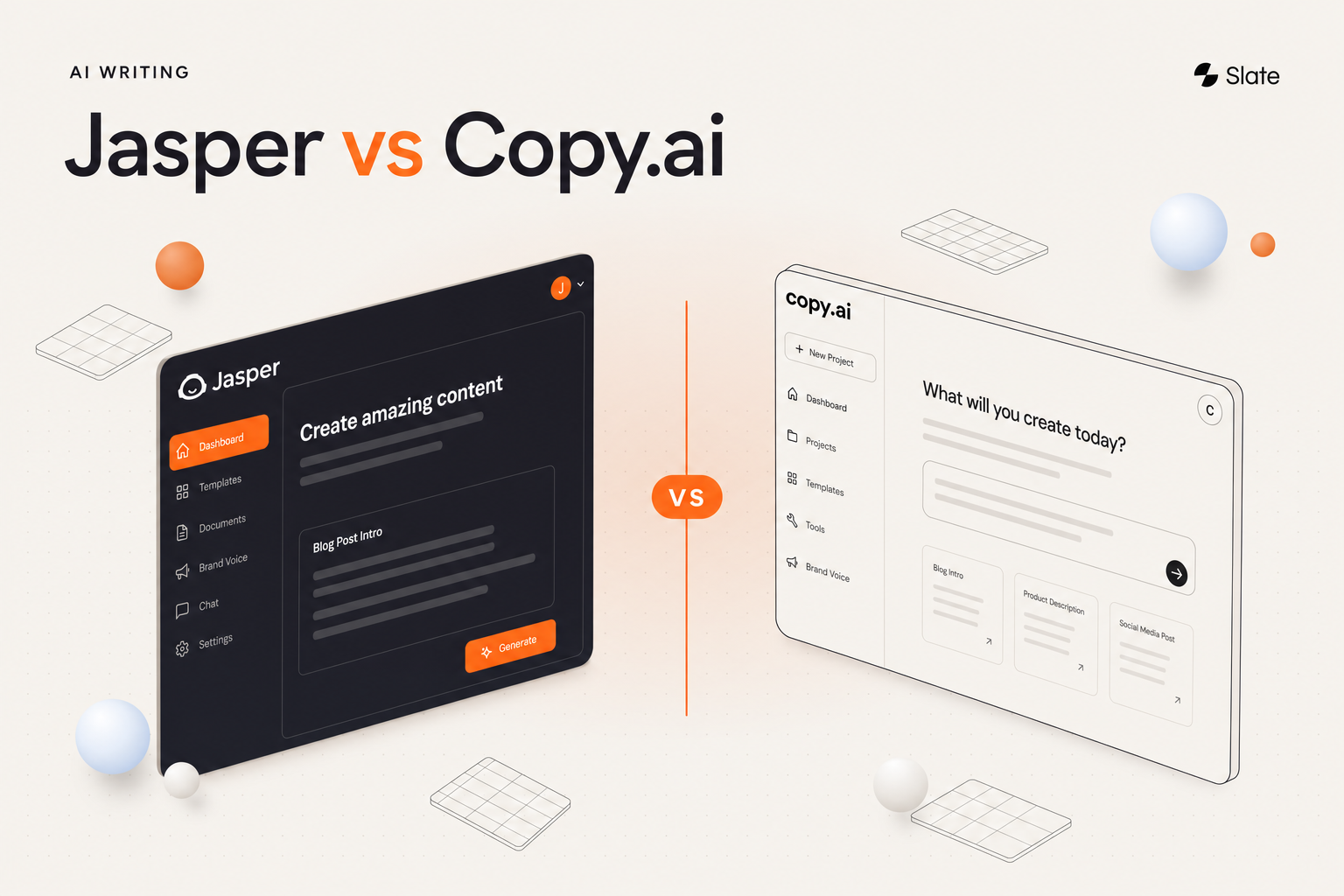
For teams treating AI search visibility and organic search as a top B2B acquisition channel as a serious 2026 priority, Slate is the stronger pick. For fast GTM copy across revenue teams, Copy.ai is sharper. You can also weigh Slate against similar writers in our Jasper vs Copy.ai breakdown.
Book a demo to see Slate’s full loop in action.
Frequently Asked Questions
What Is The Main Difference Between Slate And Copy.ai?
Slate is an agent-driven platform for SEO, AI search visibility, content production, publishing, outreach, and measurement.
Copy.ai is a go-to-market platform for sales, marketing, and operations teams that need fast copy and workflow automation.
Is Slate Better Than Copy.ai For SEO Teams?
Yes, for SEO teams.
Slate covers opportunity discovery, page work with native Ahrefs and Semrush data, direct publishing, GSC and GA4 measurement, and refresh loops. Copy.ai needs external tools for SEO research, SERP analysis, and post-publish reporting.
Is Copy.ai An Alternative To Slate?
Copy.ai can replace Slate for basic drafting.
Slate covers more of the organic growth workflow: AI search visibility, SEO operations, direct publishing, measurement, outreach, and refreshes.
Which Tool Is Better For AI Search Visibility In 2026?
Slate.
Its AI Search Analytics tracks brand visibility across ChatGPT, Google AI Overviews, Google AI Mode, Perplexity, and other answer engines, including citations, brand mentions, prompt answers, and sentiment.
Does Slate Include Publishing And Measurement?
Yes.
Slate publishes directly to Webflow and WordPress from workflows and Power Sheets. Pages brings in Google Search Console and GA4 data, including clicks, traffic, CTR, and citations.
Can Small Marketing Teams Use Slate Instead Of Copy.ai?
Yes, if organic growth and AI search visibility are priorities.
Copy.ai fits small teams that need quick standalone copy at a lower entry price. Slate fits teams that want the whole content and SEO workflow in one platform.
Can Slate Replace Multiple SEO And Content Tools?
Yes.
Slate combines opportunity discovery, native Ahrefs and Semrush data, content production, direct publishing, GSC and GA4 measurement, outreach, and AI search visibility.
Which Is Easier To Use, Slate Or Copy.ai?
Copy.ai is easier at the prompt level. You can generate copy in minutes.
Slate takes more setup, then pays back the effort by reducing manual handoffs across publishing, measurement, refreshes, and bulk content work.
Can You Publish Directly To WordPress Or Webflow With Slate?
Yes.
Slate supports direct publishing to WordPress and Webflow from workflows and Power Sheets, including bulk publishing across many URLs.
How Much Does Slate Cost Compared To Copy.ai?
Slate starts at $499/month, including 15,000 credits, 10,000 prompt answers tracked, and 1,000 web pages tracked.
Copy.ai starts at $24/month billed annually, with a free tier available. Higher Copy.ai tiers include Growth, Expansion, Scale, and custom Enterprise plans.