Content marketing isn't new. What's new is that the way most teams produce it has stopped working.
In the early 2010s, the playbook was simple: publish blog posts, gate some whitepapers, optimize for search, and let organic traffic compound. Competition was thin, and search engines rewarded volume almost as much as quality. If you showed up consistently, you grew.
That model held for a long time. Long enough that teams built entire operations around it: editorial calendars, content ops roles, approval workflows, publishing cadences. The machine got more sophisticated, but the underlying logic stayed the same. Produce content, push it through a pipeline, publish it to a channel, measure what happens.
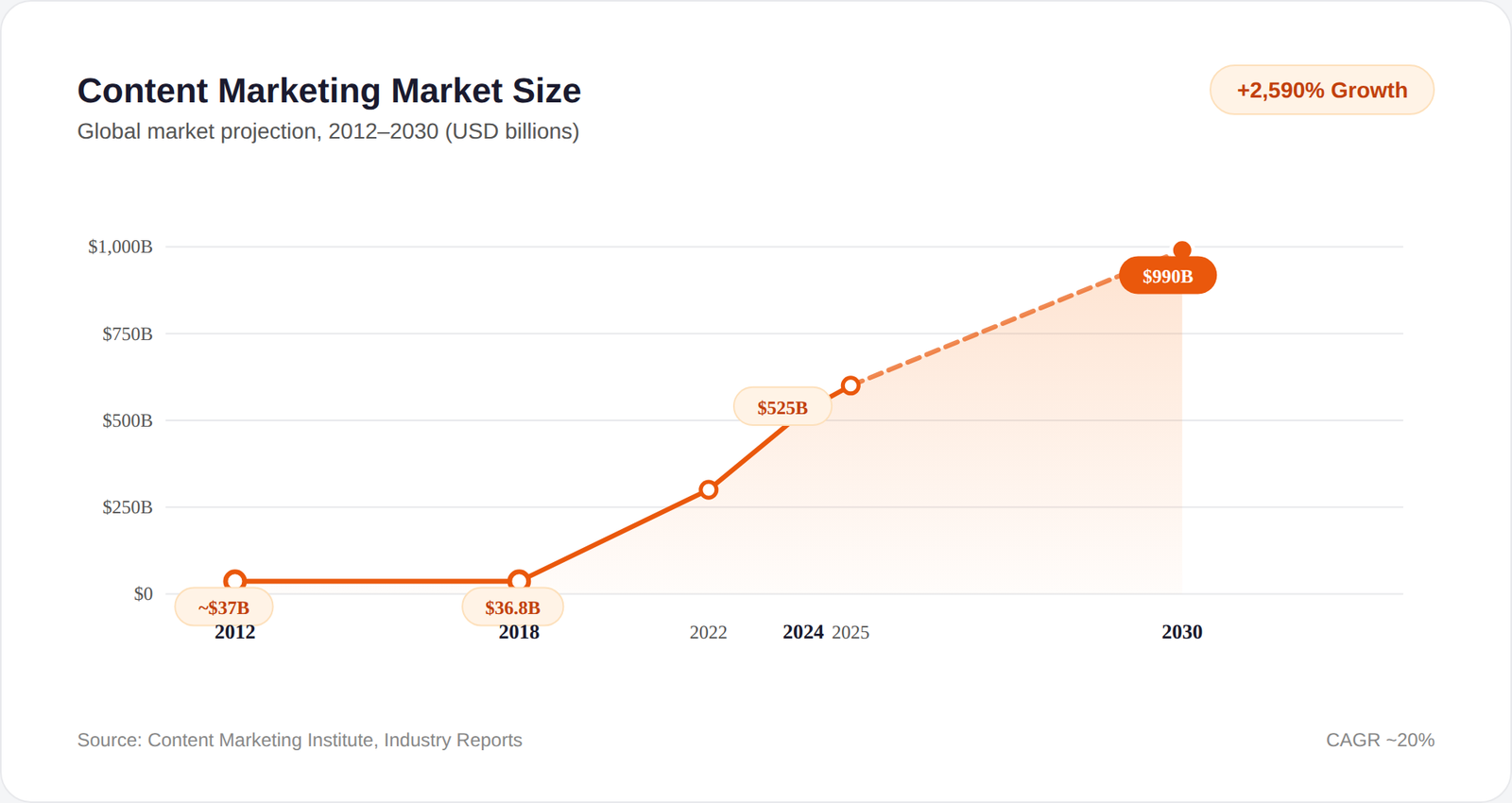
The market agreed. Content marketing grew from a $36.8 billion market in 2018 to roughly $525 billion by 2024, with projections pushing toward $990 billion by 2030.
We broke down the full arc of this shift, and what content engineering actually looks like in practice, in this walkthrough:
Now back to the shift. While everything else was changing quickly, what didn’t change at the same pace was the way in which teams still operated.
Every year, the demand went up. More formats, more channels, more personalization, more velocity. And every year, the headcount stayed flat. The Content Marketing Institute's 2025 report put a number on what most teams already felt: 72% of B2B marketers said content demands increased year over year. Only 29% said their teams grew to match.
For a while, the answer was "hire more writers." Then it was "build a content ops team." Both helped. But both were still human-powered assembly lines, every piece moving through the same manual checkpoints, regardless of where it needed to go or what it needed to do when it got there.
Then the ground shifted.
Generative AI went mainstream, and suddenly production wasn't the bottleneck anymore. Enterprise adoption hit 73% by 2024. Production costs dropped by up to 68% in some organizations. Teams could create more content, faster, than they ever had before.
But speed exposed a different problem.
The channels where content needed to perform had multiplied, and each one operated on its own logic. Traditional search still mattered, but AI-powered search surfaces had emerged alongside it, each deciding independently which sources to trust, cite, and surface. The content that worked on one platform was invisible on another.
This is where the old model breaks down completely. It's not that teams need more content. It's that content now has to be structured, tagged, modular, and machine-readable, built to adapt across channels and trackable with precision. A blog post isn't just a blog post anymore. It's raw material that needs to work in six different contexts, for six different systems, each with its own criteria for what counts as authoritative.
That's not a content strategy problem. It's an engineering one.
Content engineering didn't emerge as a rebrand or a buzzword. It emerged because traditional content teams, no matter how talented, no matter how well-resourced, weren't designed for a world where the same piece of content has to be understood by both humans and machines, across platforms that don't agree on what "good" looks like.
The shift isn't about doing more. It's about building differently.
What Broke: The Playbooks That Stopped Working
Content marketing didn't stop working. The infrastructure behind it did.
For years, the dominant strategy was straightforward: produce more, rank more, win more. Teams scaled output by adding writers, editors, and freelancers. It worked when search results had room and competition was manageable. But as more companies adopted the same playbook, returns diminished. Ranking got harder, content got more generic, and the cost of producing anything meaningfully different kept climbing.
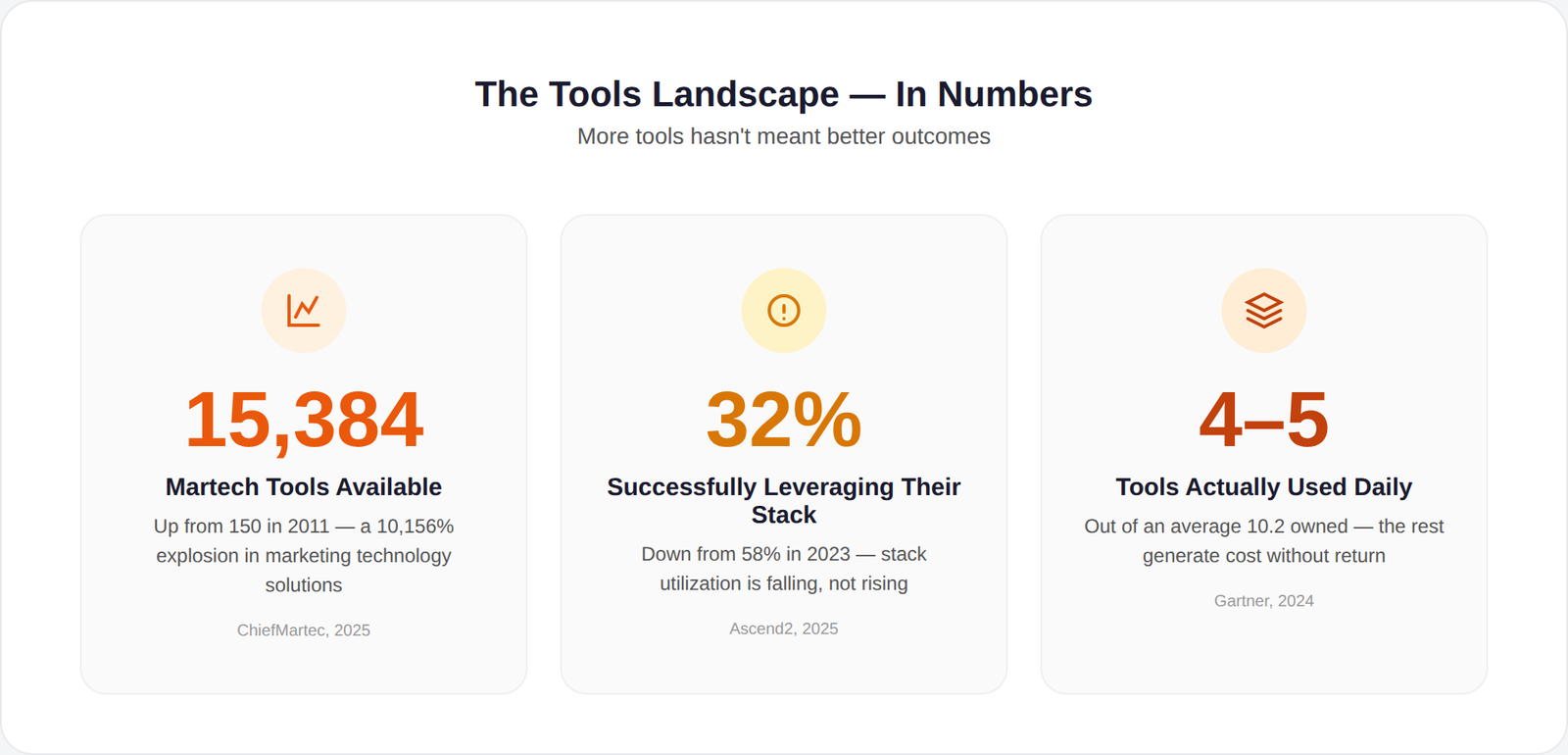
The response from most organizations was to buy more tools. Scott Brinker's Marketing Technology Landscape, the industry's definitive annual catalogue, tracked 150 solutions in 2011. By 2025, that number had crossed 15,384. The tooling ecosystem grew by over 10,000%, but the teams using it didn't get 10,000% more effective.
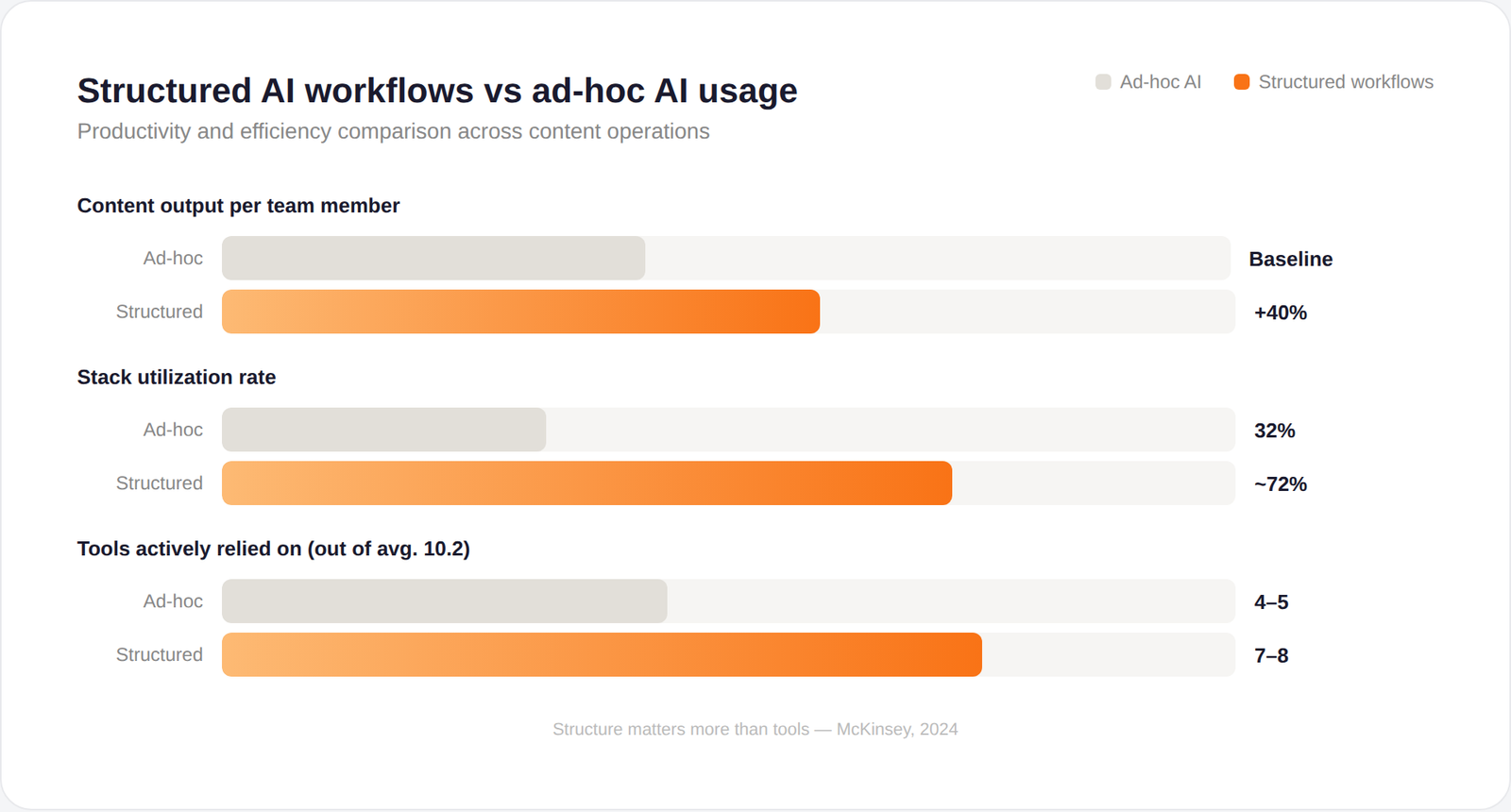
Gartner's 2024 Marketing Technology Survey found that large organizations maintain an average of 10.2 martech tools but actively rely on only four or five for daily execution. The rest generate license costs without meaningful return. Ascend2's 2025 martech report found that only 32% of marketers felt they were successfully leveraging their stack, down from 58% the prior year.
This isn't just an operational annoyance. McKinsey's 2024 research on AI in marketing found that companies integrating AI into structured content workflows see 40% higher productivity than those using AI in ad-hoc fashion. The structure matters more than the tools.
At the same time, paid media costs kept rising. With cost-per-click increasing across major ad platforms, more organizations pivoted toward owned-media strategies. But owned media only works if you can produce, manage, and distribute content efficiently, exactly the thing fragmented stacks made harder.
The issue was never a shortage of tools. It was the absence of a system.
What Is Content Engineering?
Content strategy tells you what to create and why. Content engineering is about building the system that makes it happen at scale.
Content Science defines it as designing, structuring, and managing content in a way that is "strategic, scalable, and workflow-optimized," applying engineering principles like modular design, metadata frameworks, and automation to how content moves through an organization.
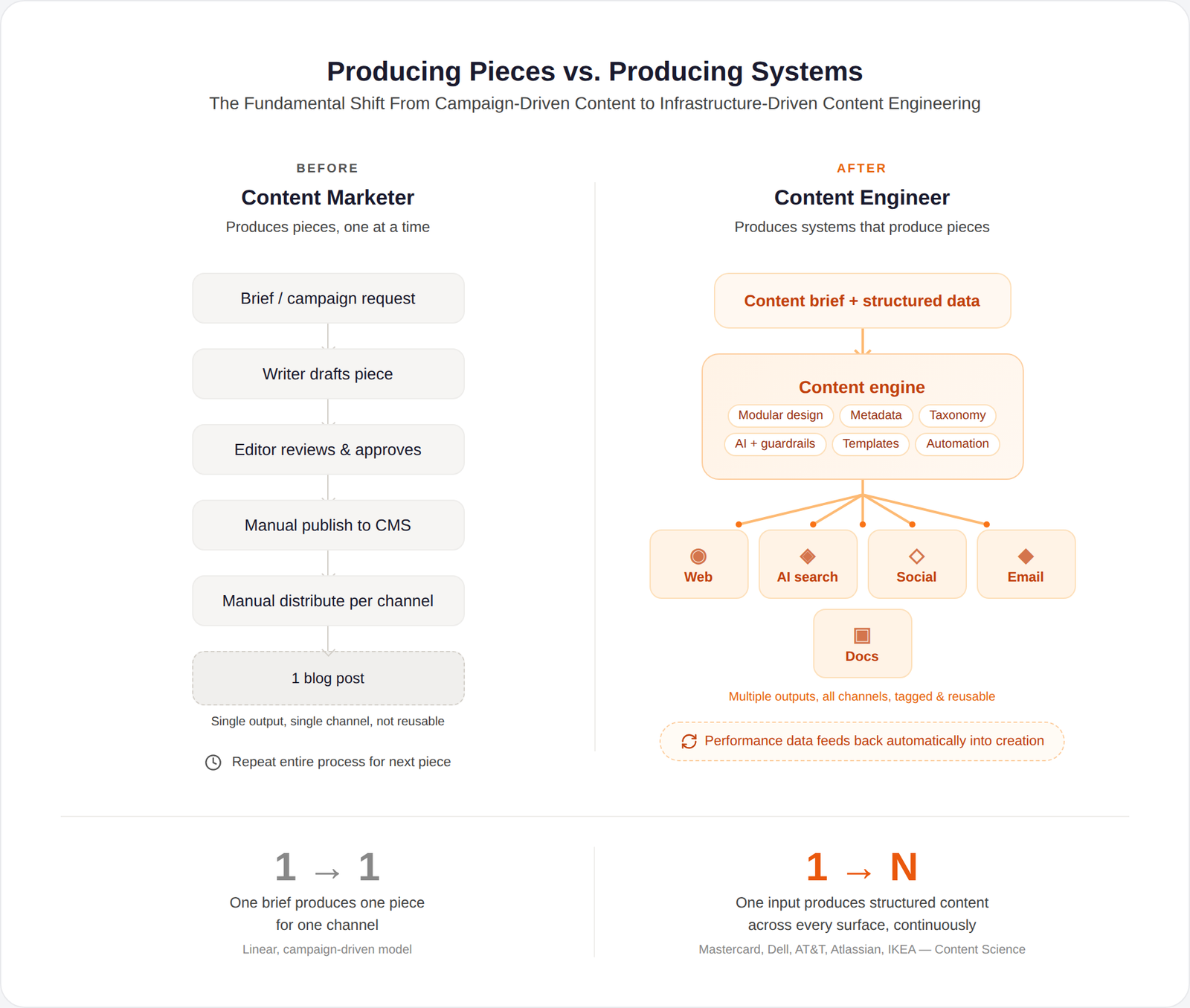
The simplest way to understand the shift: a content marketer produces pieces. A content engineer produces systems that produce pieces. The parallel to software is direct. DevOps didn't replace developers. It built the pipeline that let developers ship reliably at speed. Content engineering is the same discipline applied to content.
In practice, that means designing taxonomies so content is findable and reusable across channels. Integrating AI into publishing workflows with brand guardrails built in. Connecting performance data back to the creation process automatically, not through a monthly reporting meeting.
The organizations implementing this aren't startups experimenting. Enterprises across financial services, telecommunications, technology, retail, and consumer electronics have built adaptive content design systems that work across devices and touchpoints, centralized content models and templates specifically to enable faster AI adoption, and restructured content as infrastructure rather than campaign deliverables.
The reason this matters now, specifically, is that content has a second master. AI discovery engines evaluate citation-worthiness based on topical authority, structural clarity, and content freshness. These are systemic qualities. You can't achieve them by writing better individual articles. You achieve them by engineering the system those articles live inside.
The Content Engineering Framework
When you look at what high-performing teams have actually built, three layers emerge consistently.
Layer 1: Content Architecture
Most teams start content planning with a keyword list. What has volume? What's rankable?
Without an architecture underneath it, keyword research produces topically scattered content that neither builds authority nor helps AI models understand what the brand is an expert in.
Content architecture is the structural blueprint that comes before keywords. It defines:
- Content pillars tied to the product's value propositions, not to keyword clusters
- Entity relationships that map how topics connect to each other and to the brand's expertise
- Modular content design where assets are built as reusable components that can serve multiple channels and formats
- Metadata and taxonomy that makes content machine-readable for both CMS delivery and AI retrieval
- Schema markup that helps both traditional search and AI engines understand what each page is about
Every page should be unambiguously about one entity. Title, H1, and schema should point to the same concept. When the architecture is defined first, keywords become an input to the structure rather than the structure itself.
Layer 2: Content Pipeline
Content engineering treats production as a pipeline with defined stages, inputs, outputs, and quality gates at each step.
The stages themselves are familiar: ideation, research, briefing, drafting, editing, optimization, publishing, distribution, measurement, refresh. What's different is that intelligence flows between them.
A brief doesn't just carry a target keyword and a rough outline. It carries SERP structure analysis, competitive content gaps, entity requirements, audience intent mapping, and brand voice guidelines. During drafting, optimization signals are visible in real time rather than applied retroactively. When content is published, it moves to the CMS with metadata intact rather than requiring 30 minutes of manual reformatting.
The pipeline is also a loop, not a line. Performance data feeds back into planning. Refresh cycles feed back into research. The system retains context from previous iterations, so every cycle compounds rather than starting from scratch.
Content refresh deserves particular attention here. Most teams treat it as a periodic audit. In an engineered system, it's trigger-based. When a page signals decay (declining rankings, lost citations, outdated data), the system initiates a refresh workflow rather than generating a report that waits for someone to act on it.
Layer 3: Content Governance
This is the layer most teams skip when scaling with AI, and it's the one that costs them the most.
More AI means more content. More content means more opportunities for brand voice to fracture, for factual errors to slip through, for compliance requirements to be missed. Without governance, you scale your mistakes alongside your output.
Content governance in an engineering context means:
- Brand voice encoded into the system, not stored in a PDF that nobody references. Every draft, whether human or AI-generated, is checked against centralized style and positioning guidelines.
- Structured approval workflows where editorial, accuracy, and compliance reviews happen in parallel, not sequentially. Each review has a defined scope and turnaround SLA.
- Quality gates embedded in the pipeline, not bolted on after. Heading hierarchy, entity coverage, internal linking, and AI-readiness are checked during creation, not discovered during a post-production audit.
CMI's 2026 insights report captured one dimension of this well: the biggest wins from AI adoption so far have been in productivity and speed, but when it comes to deeper measures like content quality and performance, the numbers drop. Speed without governance produces volume, not value.
Why AI Search Changes the Engineering Requirements
AI search isn't a future consideration. As of early 2026, 37% of consumers start searches with AI. Content now serves two retrieval systems simultaneously, and they don't play by the same rules.
Traditional search evaluates individual pages against a set of ranking factors. AI answer engines evaluate entire domains against a set of citation-worthiness signals: topical authority, content freshness, structural clarity, and entity depth.
This has practical implications that show up clearly in the data.
Citation behavior varies dramatically by platform. Slate's AI analytics track brand visibility across ChatGPT, Perplexity, Google AI Overview, and Google AI Mode. Across the same set of tracked prompts over 90 days, Google AI Mode generated 14,233 citations while ChatGPT generated 1,950. That's a 7x difference from the same content library. Perplexity reuses URLs aggressively (averaging roughly 2.9 citations per URL), while Google AI Overview distributes more broadly (roughly 1.4 per URL).
Our own research across 300K+ AI citations showed the gap between best and worst platform visibility for a single brand running anywhere from 5x to 71x. A single optimization approach can't cover platforms that behave this differently.
The citation gap is larger than most teams realize. When we analyzed citation patterns across B2B SaaS brands, 77.4% of all AI citations went to domains that were neither the tracked brand nor its known competitors. Documentation hubs, niche expert blogs, review aggregators, community platforms, educational resources. The average owned citation share across the brands studied was 3.3%. Even the strongest performer captured only 8.6%.
Each platform builds answers differently. ChatGPT relies more heavily on parametric knowledge from training data, making page-level optimization less effective there. Perplexity and Google AI Mode lean more on real-time web citations. Claude draws from a narrower source pool but gives brands higher owned citation share.
Three outcomes to engineer for:
- Visibility: Being found when AI constructs an answer in your category
- Retrieval: Being included as a cited source in that answer
- Trust: Being characterized positively when mentioned
Each requires different structural inputs. And all three are systemic qualities that come from how the content library is built, not from any individual page.
The ROI Case: Why Structure Beats Volume
The financial argument for content engineering isn't about whether content marketing works. That question is settled. CMI's 2024 B2B research (fielded across 980 marketers) found that 58% of B2B marketers reported increased sales and revenue from content marketing, up from 42% the year before. 87% said it helped build brand awareness. 76% said it generated demand or leads.
The question is whether how you do it changes the return. The data says yes, significantly.
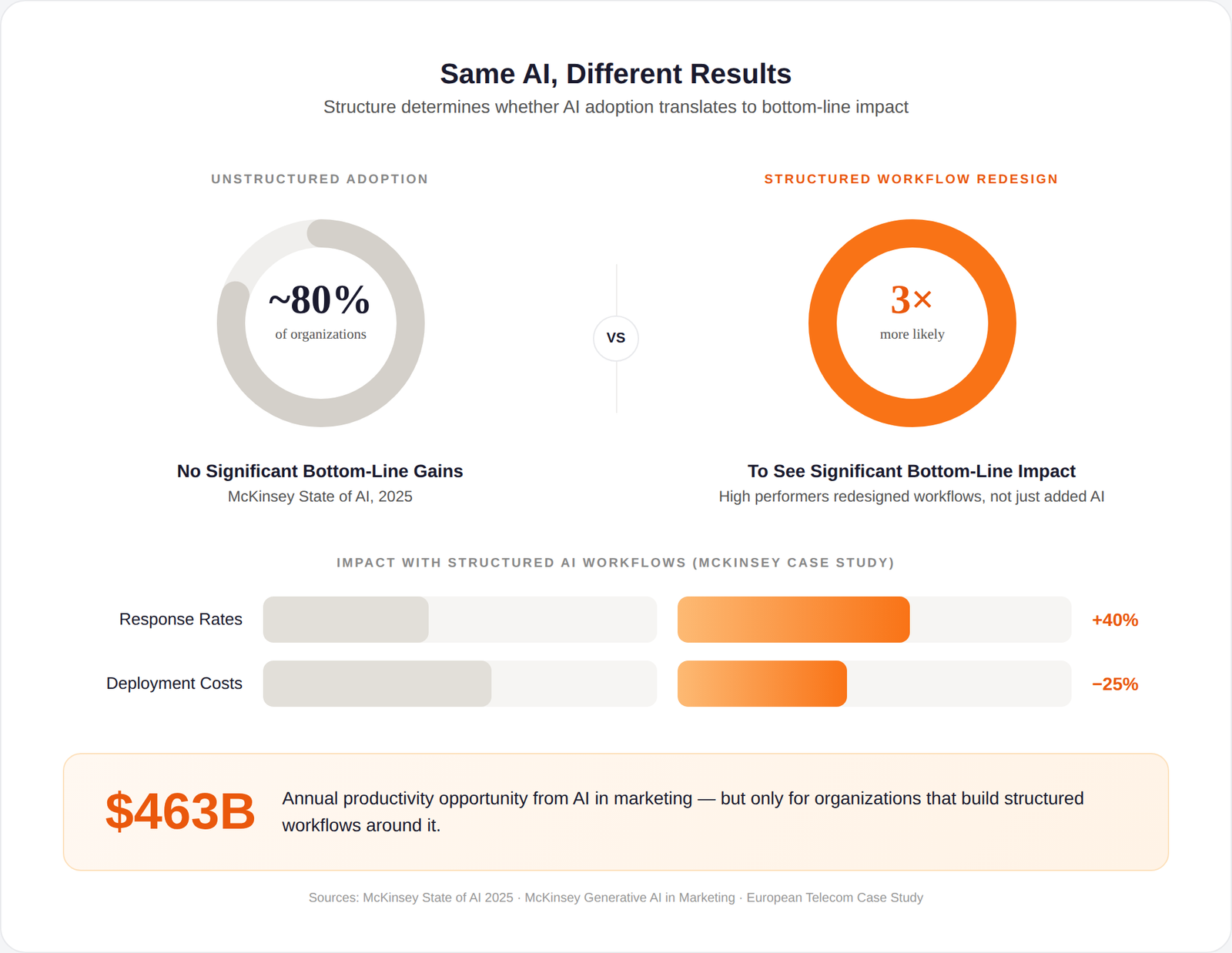
McKinsey's research on generative AI in marketing estimated that the productivity gains from AI in marketing alone could be worth 5 to 15 percent of total marketing spend, roughly $463 billion annually across the global economy. But the gains depend entirely on structure. One case study from a European telecom company achieved a 40% lift in email response rates and a 25% reduction in deployment costs, but only after building structured workflows that connected AI-generated content to segmentation models, personalization engines, and governance protocols.
McKinsey's 2025 State of AI report reinforced the point from a different angle: nearly eight in ten organizations reported no significant bottom-line gains from AI. The differentiator wasn't adoption. It was workflow redesign. High performers were almost three times more likely to have fundamentally redesigned their workflows, not just layered AI onto existing processes.
Teams applying structured content engineering approaches have reported 50% reduction in production costs, doubled publishing speed, and 40% higher impact on refreshed content. In specific implementations, content velocity has increased 300% while maintaining 75% AI citation rates. Refresh cycles that previously took 45 minutes per page have been compressed to under five.
Slate's sentiment data illustrates one dimension of this gap. Across AI tool conversations tracked over 90 days, "core functionality and features" dominated mentions at 72% of the total. But "price competitiveness" was the only sentiment theme where negative sentiment outweighed positive. Teams are spending on tools. They're not getting proportionate value because the connective system doesn't exist.
The deeper ROI argument is about compounding. Engineered content compounds over time: modular pieces get reassembled for new channels, refreshed content retains and builds authority, structured data improves retrieval with every cycle. Unengineered content just accumulates.
This is the core of the ROI case. The returns aren't in the tools. They're in the system connecting the tools.
Measurement in the Content Engineering Era
The metrics changed, and most teams haven't caught up.
Pageviews, time on page, and keyword rankings still matter. But they capture only one side of the discovery landscape. They tell you nothing about whether AI engines cite your brand when prospects ask about your category, or how your share of voice compares in AI-generated answers, or whether the sentiment in those answers is working for you or against you.
Slate's AI analytics surface what this new measurement layer looks like in practice.
AI Visibility and Share of Voice. The top entity in the AI SEO category held 7.08% share of voice over 90 days. The next four clustered between 2-6%. No single brand dominates. Visibility is distributed across dozens of entities, which means the gap between being present and being absent is both narrow and consequential.
Sentiment in AI responses. Across 4,143 brand mentions tracked in Slate's analytics, sentiment broke down to 51.9% positive, 43.1% neutral, and 5% negative. That 43% neutral zone is where engineering moves the needle. Neutral means the AI knows your brand exists but hasn't formed a strong characterization. That's an opportunity, not a default.
Attribution in a zero-click world. Traditional attribution models break when a significant share of brand influence happens in environments that don't produce clicks. Being cited in an AI Overview, being mentioned in a synthesized answer on Perplexity, appearing as a recommended solution in ChatGPT: these all influence buyer decisions without generating a trackable session.
Only 29% of marketers measure content ROI effectively. Only 19% track AI-specific KPIs. The inability to measure is itself an engineering problem. You can't demonstrate ROI from a system you haven't instrumented.
The Tools Landscape: 15,000 Products and a Missing Layer
There's no shortage of tools. That's actually the problem.
The content marketing platforms segment alone was valued at $13.1 billion in 2025, growing at a 19.4% CAGR, with cloud-based solutions accounting for roughly 60% of deployments. But more tools hasn't meant better outcomes.
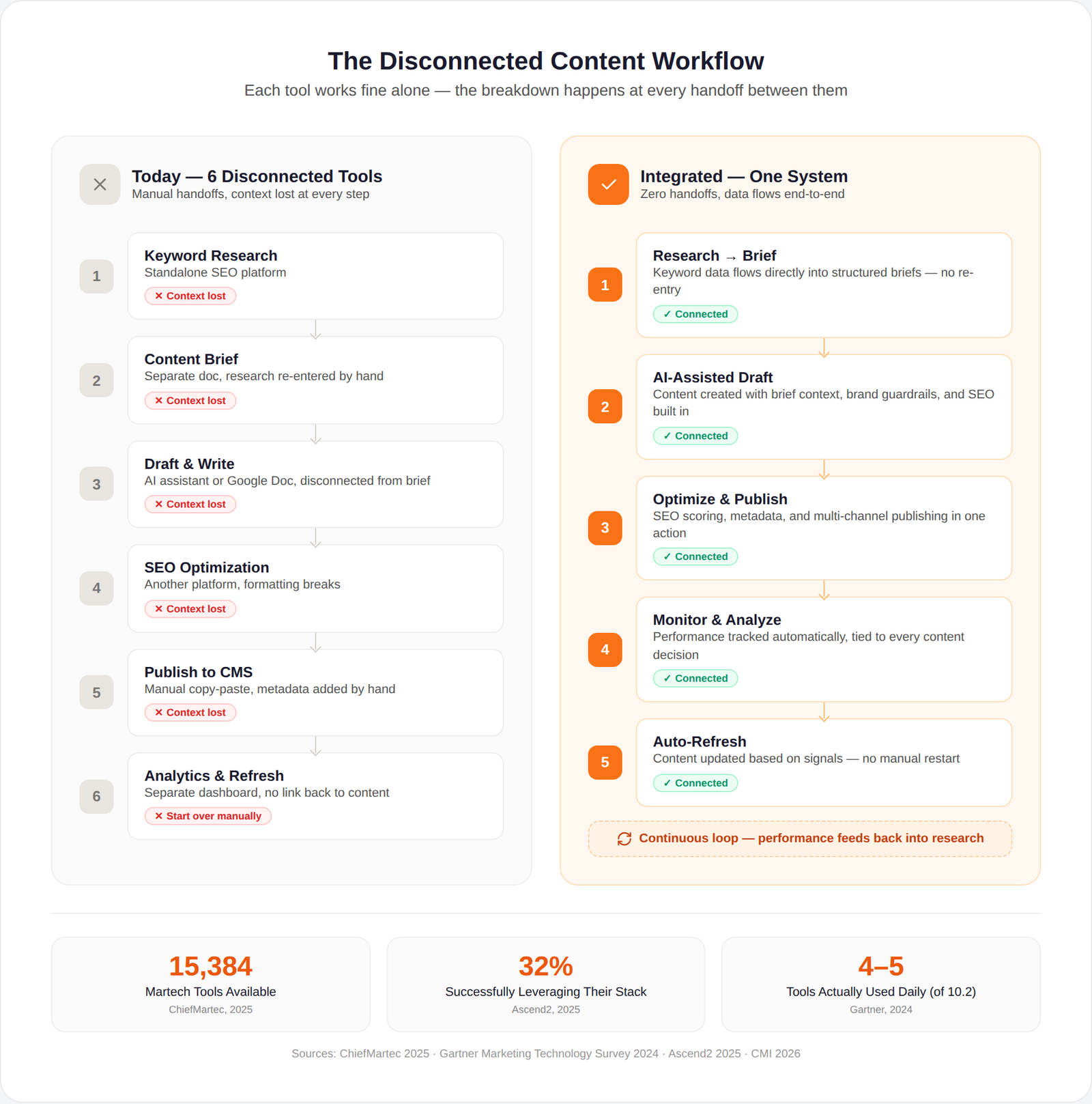
The pattern across the content workflow is familiar to anyone who's lived it. Research happens in one tool. Briefs get built in a doc. Writing happens in an AI assistant or a Google Doc. SEO optimization is a separate platform. Publishing requires logging into the CMS. Performance tracking lives in an analytics dashboard. Refreshing old content means starting the whole cycle again manually.
Each of these tools may work fine on its own. The breakdown happens in the handoffs between them, where context is lost, formatting breaks, and no one has a single view of what's working and what isn't.
When teams ask AI how to operationalize content, the answers don't point to content-specific platforms. They point to generic workflow automation tools: the kind built for connecting any two systems, not for orchestrating a content lifecycle.
The market is fragmented. No single tool has established itself as the connective layer. The category is crowded with capable point solutions, but none of them solve the end-to-end problem.
What's missing isn't another point solution. It's an infrastructure layer, something that connects research, creation, optimization, publishing, and monitoring into a single system that runs without requiring a human to manually move work between seven different tabs.
The Hiring Signal: A Role Taking Shape
Job postings are a leading indicator. When companies start hiring for roles that didn't previously exist, it tells you something about where the market is heading.
As of early 2026, there are over 133,000 "Content Engineer" job listings in the United States, with salary ranges between $123K and $190K. That's not a rounding error.
The infrastructure around this role is materializing quickly. Platforms are building education and credentialing around it. When that happens, a role is no longer experimental.
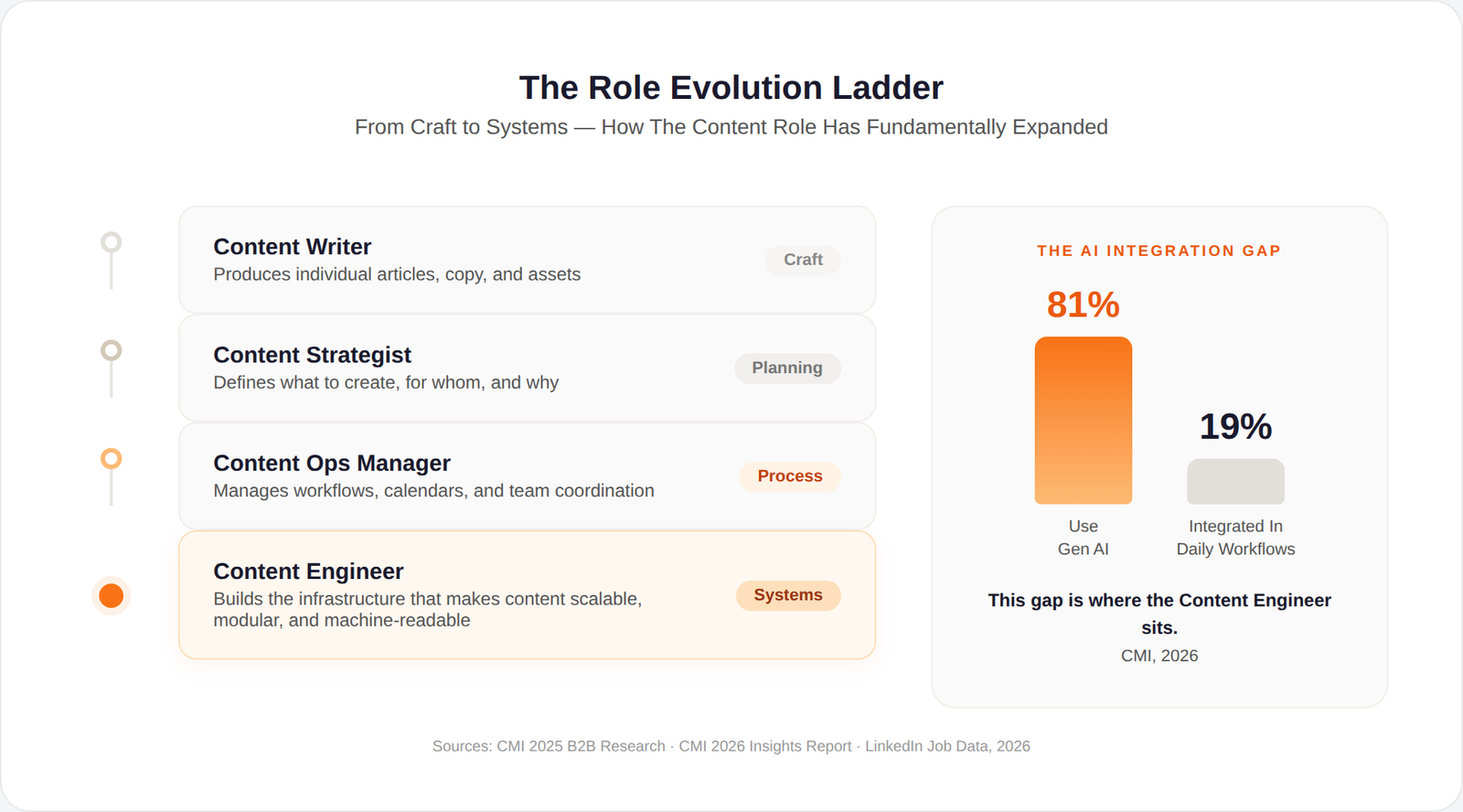
What a content engineer does sits at the intersection of content and systems design. They build structured content models, design automation pipelines, implement metadata frameworks, manage refresh systems, and bridge the gap between strategy and technical execution. The role is roughly 50% engineering and 50% content.
The underlying talent gap makes this more urgent. CMI's 2025 B2B research found that a lack of resources was the most frequently cited challenge among content marketers, at 58%. Their 2026 insights report showed that while 81% of B2B marketers now use generative AI, only 19% have integrated it into their daily workflows. That gap, between having the tools and knowing how to systematize them, is precisely where the content engineer sits.
This isn't a rebranding of the content strategist. It's the addition of a role that most content teams don't have and increasingly can't function without.
How to Start Building
Content engineering doesn't require rebuilding everything at once. It requires starting with the highest-leverage pieces and expanding from there.
Phase 1: Audit and Foundations (Weeks 1-4)
Start with what exists. Audit the current content library: what performs, what's decaying, what's structurally sound, what isn't. Map the current workflow and identify where manual bottlenecks and context loss occur. Define the entity architecture: what entities does the brand own, and how do topics connect to each other? Establish the content model with templates, metadata schema, and taxonomy.
The goal of this phase isn't to produce content. It's to define the structure that all future content will live inside.
Phase 2: Pipeline Build (Weeks 5-10)
Implement structured authoring with metadata standards. Build automation for repeatable tasks: meta description generation, internal linking, schema injection, multi-channel formatting. Set up content refresh triggers tied to performance signals rather than calendar dates. Integrate quality gates into the workflow so brand voice, factual accuracy, and optimization are checked during creation, not after.
Phase 3: Measurement and Optimization (Weeks 11-16)
Deploy AI visibility tracking across platforms. Set up citation monitoring: owned, competitor, and third-party. Build the feedback loops that connect measurement data back to content prioritization and pipeline execution. Establish the governance review cadence.
Phase 4: Scale (Ongoing)
Extend content engineering to additional content types, markets, and languages. Build personalization infrastructure. Expand cross-team (product, support, sales enablement). Continuously optimize the pipeline based on performance data.
Common mistakes to avoid:
- Starting with tools instead of structure
- Skipping governance (which scales mistakes alongside output)
- Measuring outputs (articles published) instead of outcomes (visibility, citations, pipeline influence)
- Treating AI as a standalone drafting shortcut rather than a governed pipeline component
Slate: Closing the Loop
What sets Slate apart from typical AI content tools is that it doesn't solve for one step. It connects the full chain.
Teams build multi-step workflows visually (research → draft → optimize → interlink → publish) and run them across hundreds of pages in a single click through Power Sheets. These workflows can run on a schedule, detecting decay, executing refreshes, and pushing updates to WordPress or Webflow without waiting for a prompt.
Brand governance scales with it. Style guides, tone rules, and brand knowledge sit in a central layer that governs output across all 24 AI models Slate connects to. Live keyword data flows in from existing SEO tools. AI search visibility, how your content gets cited in ChatGPT, Perplexity, and Gemini, is tracked natively. And through MCP integration with Claude, teams can work with their marketing data conversationally without leaving the platform.
The result: what used to be a six-tool, manual-handoff process becomes one system that runs continuously.
What's Next: Three Shifts to Watch
The trends behind content engineering aren't slowing down. If anything, the forces driving it, AI adoption, channel fragmentation, and pressure to do more with less, are accelerating.
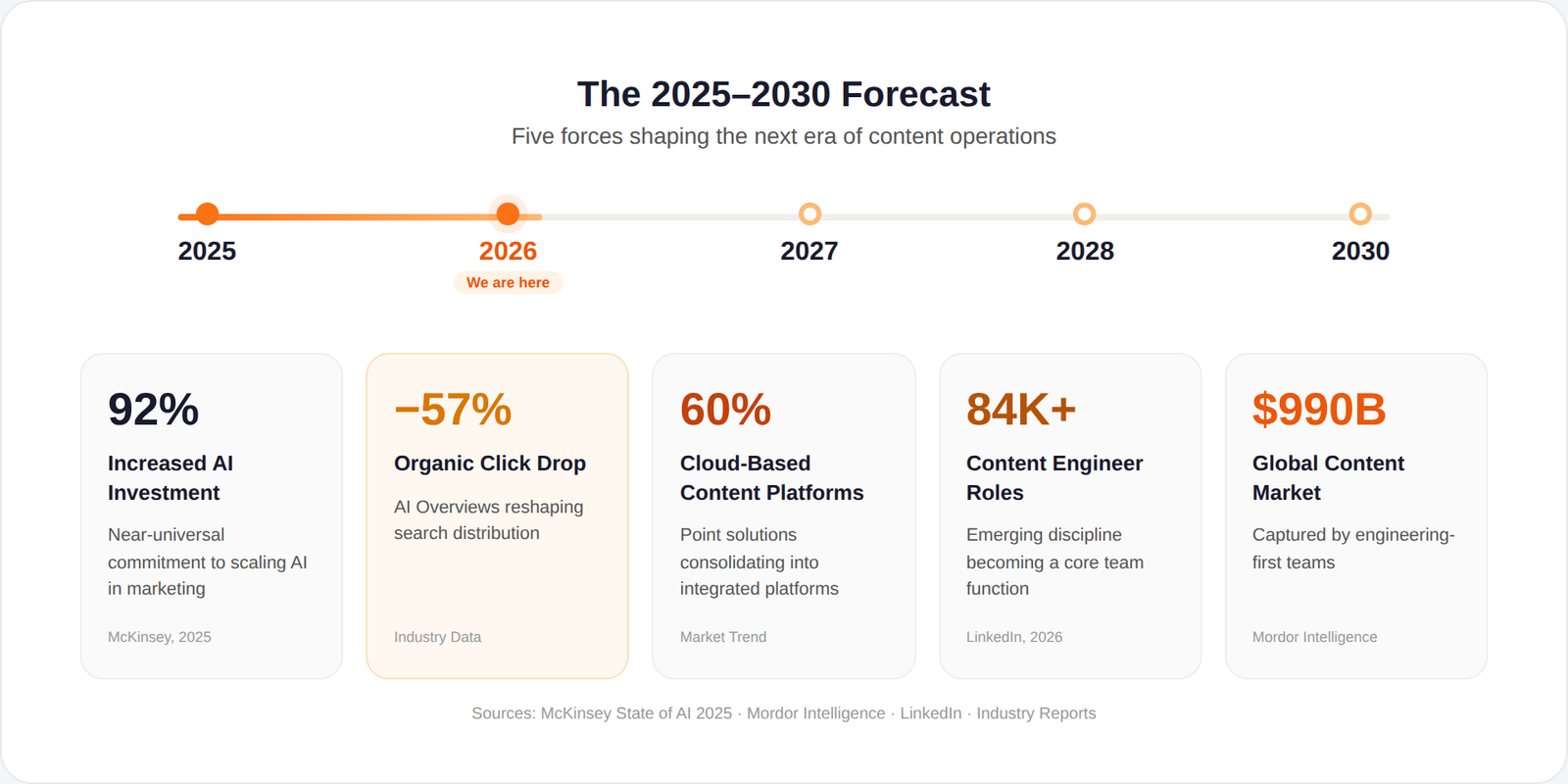
McKinsey's 2025 State of AI report found that 92% of companies plan to increase their AI investments over the next three years, but only 1% describe their current deployments as mature. That gap between investment and integration is where most of the next wave of change will happen.
AI search changes everything about distribution. Content that isn't structured for citation by LLMs will lose visibility as more discovery shifts to AI-powered search. Slate's own data across 75,000 monthly LLM sessions from 100 companies found that organic clicks dropped 57% after AI Overviews appeared on tracked keywords, even as impressions rose 19%. Google AI Mode already generates 2.2x more citations than AI Overviews in Slate's tracking data. The traffic didn't disappear. It moved. Brands that don't follow it will fall behind.
Slate's GEO topic data reveals an interesting signal here: Reddit holds 4.7% visibility in generative engine optimization conversations, outranking every dedicated SEO tool in the dataset. Earned, community-validated authority is becoming more valuable in AI discovery than tool-driven optimization.
Point solutions will keep collapsing into platforms. The martech landscape may list 15,000+ tools, but the direction is consolidation. Functions that used to require five separate products, research, briefs, writing, publishing, analytics, are merging into unified systems. McKinsey's research on agentic AI projects that scaled agent deployments could deliver 3-5% annual productivity improvements and lift growth by 10% or more, but only when agents are embedded in redesigned end-to-end workflows, not bolted onto legacy processes.
Content engineering becomes a department function, not an experiment. The role is already being formalized through certifications, job boards, and dedicated platform features. As the content marketing market approaches $990 billion by 2030, the organizations that treat content as infrastructure, with its own architecture, governance, and automation, will outperform those still running manual assembly lines.
The shift isn't dramatic. But it's structural. And structural shifts don't reverse.
FAQs
What is content engineering?
Content engineering is the practice of building systems that enable teams to create, structure, optimize, distribute, and measure content at scale. It focuses on the infrastructure connecting research, creation, optimization, publishing, measurement, and refresh into a continuous loop, rather than treating each as a disconnected step.
How is content engineering different from content strategy?
Content strategy defines what to create and why. Content engineering defines how to build the system that executes that strategy repeatably and at scale. Strategy is the blueprint. Engineering is the foundation, plumbing, and wiring.
How is content engineering different from content operations?
Content operations manages the people, process, and workflow coordination needed to produce content. Content engineering goes deeper into the technical infrastructure: structured content models, automation pipelines, metadata frameworks, governance systems, and measurement instrumentation. Operations runs the process. Engineering designs and builds it.
What does a content engineer do?
A content engineer builds structured content models, designs automation pipelines, implements metadata and taxonomy frameworks, manages content refresh systems, and bridges the gap between content strategy and technical execution. The role is roughly half engineering and half content.
Do I need content engineering if my team is small?
Small teams benefit most because they have the least capacity for manual handoffs and rework. A systemized approach automates the operational overhead that would otherwise consume a disproportionate share of a small team's time.
How does content engineering relate to AI and GEO?
AI answer engines evaluate citation-worthiness based on systemic qualities: topical authority, content freshness, structural clarity. These are exactly the qualities that content engineering produces. You can't achieve them by optimizing individual pages. You achieve them by engineering the system those pages live inside.
What tools are needed for content engineering?
Most teams already have the point tools (SEO platforms, a CMS, analytics). What's typically missing is the connective layer that passes intelligence between stages. Content engineering platforms like Slate unify the lifecycle from research through refresh in a single system.
How do I measure the impact of content engineering?
Track both traditional SEO metrics and AI visibility metrics: citation frequency, share of voice across AI platforms, sentiment in AI responses, owned vs. third-party citation ratios, content velocity, and decay rate. The ROI comes from three sources: time savings on manual handoffs, improved performance from embedded optimization, and visibility gains from systematic AI coverage.