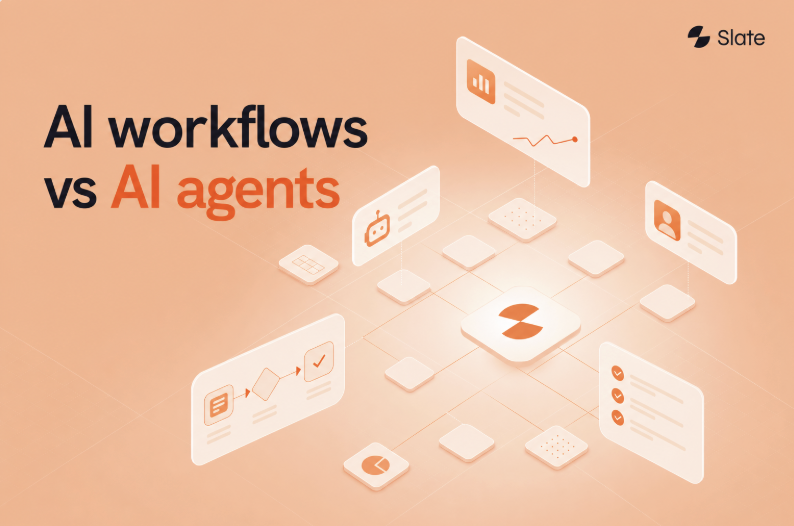
“AI agent” and “agentic AI” are used interchangeably across the internet. Vendor pages blur them together. LinkedIn makes it worse. Even your product deck probably uses both without distinction.
Here’s what they mean: an AI agent handles a bounded task. Agentic AI coordinates steps, tools, and agents toward a larger goal.
The build decision comes down to autonomy, orchestration, and control: how much of each does the workflow need?
Key Takeaways
- AI agents are task-focused systems that execute instructions inside a bounded scope.
- Agentic AI coordinates agents, tools, and steps toward a larger outcome.
- The useful build decision comes down to autonomy, orchestration, and control.
- Generative AI creates content. Agentic AI takes action toward a goal through planning, tools, and feedback loops.
- An AI agent is a component. Agentic AI is the coordination layer around components.
- A task agent executes a step. An agentic system can own discovery, execution, measurement, and refresh.
AI Agents vs. Agentic AI In One Sentence
An AI agent perceives an input, reasons, and acts to complete a specific task inside a bounded scope.
Agentic AI decomposes a goal, plans across steps, invokes tools or agents, and adjusts based on feedback until the objective is met.
Short version: an AI agent completes a task; agentic AI owns a workflow.
The industry uses both labels loosely. Some vendors call any tool-using model an “agent.” Others use “agentic” for anything with a planning loop.
What Is An AI Agent?
An AI agent is a single system that executes a specific task under defined rules.
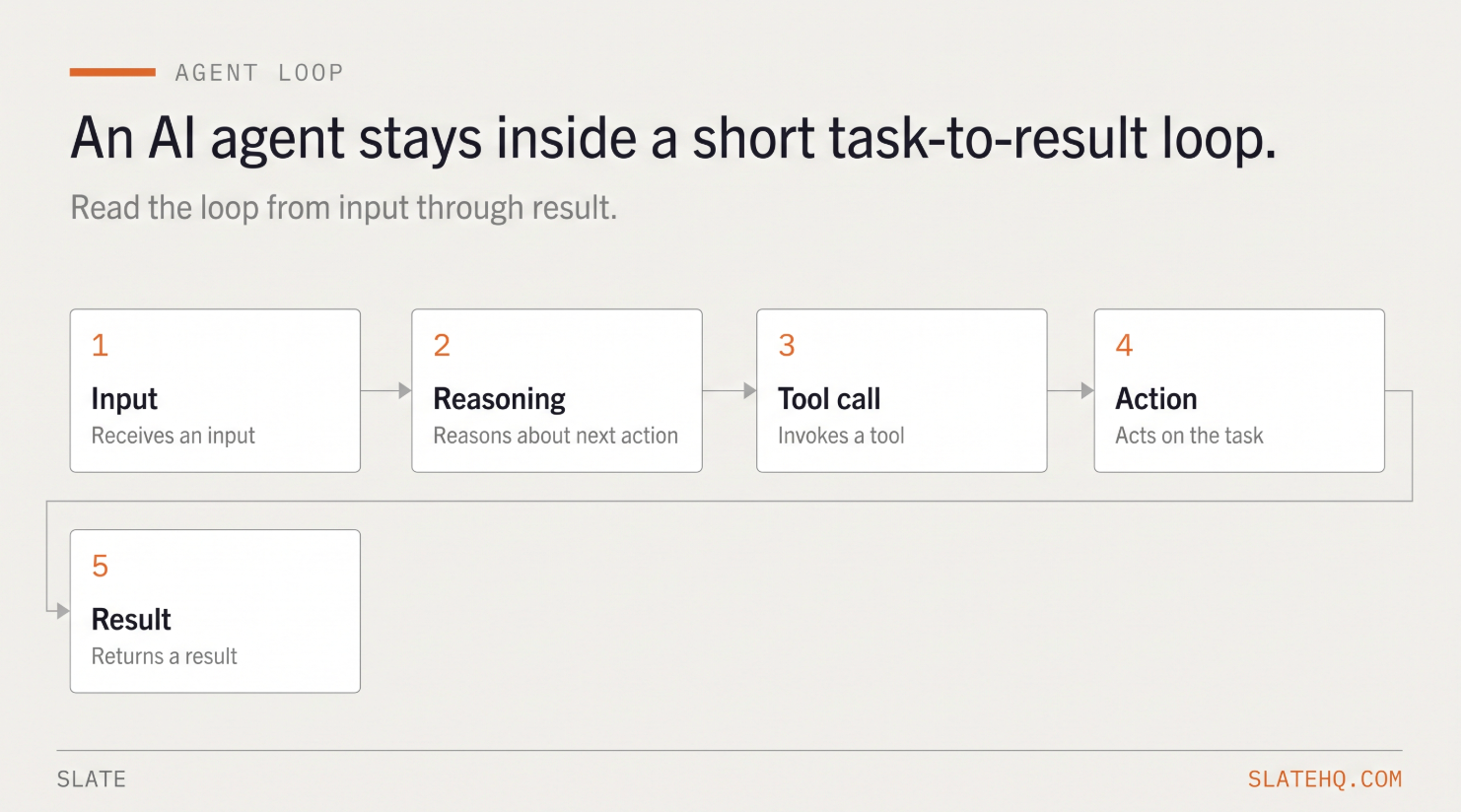
It takes an input, reasons about the next action, invokes a tool if needed, and returns a result. Its scope stays narrow by design.Think ticket routing, code snippet generation, flight lookup, document summary, or database retrieval. Each has a clear start and finish.
Operationally, an AI agent has:
- Scope: One task or a tight task category
- Goal structure: Task-driven
- Decision rights: Bound by rules and permissions
- Tool access: One tool or a small fixed set
- Feedback loops: Minimal. It acts, returns a result, and stops
An agent perceives, decides, and acts inside a fence. The fence is the design.
How An AI Agent Works
The loop is simple: input → reasoning → tool call → action → result.
A ticket-classification agent receives a support message, reasons about the category, applies a label, and routes the ticket. It doesn’t plan a full resolution, negotiate with billing, or decide whether a refund should happen.
Its autonomy is bounded. Its job is the task in front of it.
When the task ends, the agent stops.
What Is Agentic AI?
Agentic AI is a system architecture that coordinates agents, tools, and steps toward a higher-level objective. It decomposes the goal, plans the sequence, assigns subtasks, checks results, and keeps going until the work is complete or a human needs to step in.
The agent hears “do this.” The agentic system hears “achieve this,” then lays out the work.
Agentic AI usually includes:
- Goal decomposition: Breaks an objective into subtasks
- Planning: Sequences work across tools and systems
- Orchestration: Routes tasks between agents, APIs, databases, and apps
- Memory: Carries state across the workflow
- Adjustment: Re-plans when a step fails or conditions change
- Escalation: Hands work to a human when confidence, risk, or permission limits kick in
The coordination layer is the key difference. It decides what runs, when it runs, and how outputs get folded back into the plan.
How Agentic AI Works
The loop is plan → execute → review → revise.
Take incident response. The goal is to “resolve the outage.” The system pulls logs, correlates alerts, identifies the failing service, proposes a repair, asks for human approval before irreversible action, applies the approved change, and confirms recovery.
If one step breaks, the system re-plans.
That closed loop separates agentic work from disconnected task calls. The system keeps context, evaluates progress, and measures itself against the original objective.
AI Agents vs. Agentic AI: Quick Comparison
Five Key Differences Between AI Agents And Agentic AI
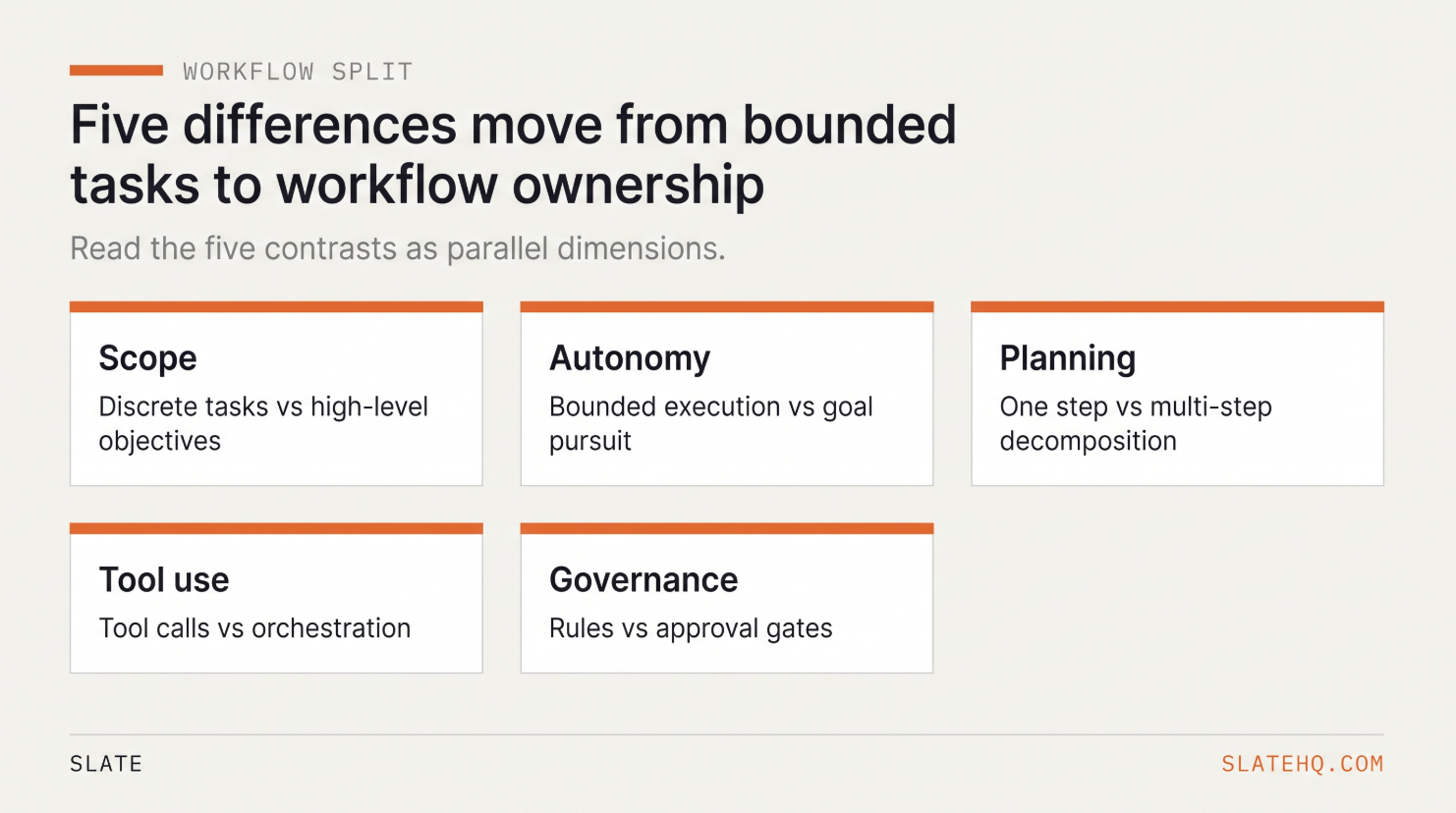
The split comes down to scope, autonomy, planning, tool use, and governance.
Each dimension moves from bounded task execution toward coordinated workflow ownership.
1. Scope: Discrete Tasks vs. High-level Objectives
An AI agent works inside a discrete task. Give it a message, and it classifies the message. Give it a query, and it returns an answer. Agentic AI starts with a higher-level objective and breaks that objective into work.
“Draft one reply to this ticket” fits agent scope. “Manage the support case from classification through follow-up” fits agentic scope.
2. Autonomy: Bounded Execution vs. Goal Pursuit
An agent’s autonomy lives inside its rules. It can decide how to complete the assigned task. It doesn’t decide what the task should be. Agentic AI makes decisions about sequence, retries, escalation, and tool choice. That power raises the oversight bar.
The more a system can decide, the more permissions, guardrails, and monitoring you need around it.
3. Planning: One Step vs. Multi-step Decomposition
An agent reasons about the next action. Agentic AI reasons across a sequence. It breaks an objective into subtasks, orders them, checks progress, and revises the plan when results miss the target. A summary agent summarizes. A research system plans queries, gathers sources, synthesizes findings, checks quality, and revises weak sections.
Memory is what lets the system connect step 4 back to the goal from step 1.
4. Tool Use: Tool Calls vs. Orchestration
A typical agent calls one tool or a small fixed set. Agentic AI adds an orchestration layer. That layer decides which agent or tool runs, passes context, and reconciles outputs.
This is where multi-agent system research shows up. One agent researches, another drafts, another checks facts, and the orchestrator stitches the work together.
5. Governance: Rules vs. Approval Gates
An agent runs inside fixed permissions. Agentic AI needs approval logic baked into the workflow. It needs to know which steps require sign-off, which actions are hard to undo, and when to pause.Audit trails matter here. So do scoped permissions and human checkpoints. You can dig deeper into AI content governance tools to keep those checkpoints tight.
Governance becomes architecture, which is less glamorous than the demo and far more useful after week two.
How AI Agents And Agentic AI Work Together
Agentic AI commonly acts as the coordination layer for agents, tools, and steps. Think of it as components and a system. An AI agent is a building block. Agentic AI organizes those blocks toward an objective. You can run useful agents by themselves. A routing agent, a summarizing agent, or a lookup agent can save time with a narrow job. Agentic AI needs something to coordinate: agents, tools, APIs, databases, or a mix of those pieces.
So is agentic AI made of agents? Sometimes. The agentic behavior comes from planning, orchestration, memory, and feedback loops. Orchestration begins when the workflow needs planning across steps, context carried between steps, and evaluation against a goal.
There’s no magic threshold where “three tools” becomes agentic. Depth of coordination is the tell.
Single-agent Workflow vs. Multi-agent Workflow
A single-agent workflow is linear and bounded. A content agent receives a brief and drafts a section. A multi-agent workflow adds coordination.
One agent researches, another drafts, another fact-checks, and an orchestrator sequences the work, passes context, inserts approval checkpoints, and measures the result against the goal. More agents add volume. Orchestration adds control.
What Makes A Workflow Agentic?
A workflow leans agentic when it has planning, coordination, memory, and feedback. Agent count is a weak signal. Two disconnected agents can still be two disconnected tasks.
A workflow is agentic when it includes:
- Goal decomposition: Breaks a high-level objective into subtasks
- Multi-step planning: Sequences and re-sequences work toward the goal
- Cross-system tool calls: Coordinates actions across more than one system
- Memory: Carries state between steps
- Iterative evaluation: Checks results and revises the plan
- Escalation logic: Hands work to a human when risk or uncertainty gets high
The important tell is orchestration plus planning plus feedback. A closed-loop system can recover from a broken step. A hard-coded chain usually stalls and waits for someone to clean up the mess.
When To Use AI Agents vs. Agentic AI
Use AI agents for narrow, repeatable, low-risk tasks where the steps are known.
Use agentic AI for multi-step, multi-system goals that need planning, orchestration, and governance.
Plain automation also deserves a seat at the table. If the workflow is fully predictable, a script will probably be faster, cheaper, and easier to trust. The right SEO automation tools can cover many of those predictable cases.
Start simple. Add an agent when the task needs reasoning over messy inputs. Add agentic orchestration when the workflow spans several systems and decisions.
Decision Framework: One Agent Or A System?
Enterprise Workflow Examples For 2026
AI Agent Examples
Single-agent tasks with bounded scope:
- Ticket classification: Reads a support message and routes it to the right queue
- Reply drafting: Creates a first-draft response for review
- Code snippet generation: Produces a function from a natural-language request
- Data lookup: Pulls a record or metric from a connected system
- Content summarization: Condenses a document into a shorter version
Each one acts inside a fixed perimeter, then stops.
Agentic AI Examples
Orchestrated workflows that pursue an objective:
- End-to-end incident response: Correlates alerts, diagnoses the issue, proposes repairs, applies approved changes, and confirms recovery
- Onboarding orchestration: Provisions accounts, assigns training, schedules check-ins, and tracks completion
- Campaign tuning: Monitors performance, changes budget allocation, revises creative, and reports lift
- Multi-step research: Plans a query set, gathers sources, synthesizes findings, and checks the result against the question
What Agentic AI Looks Like In An Organic Growth Workflow
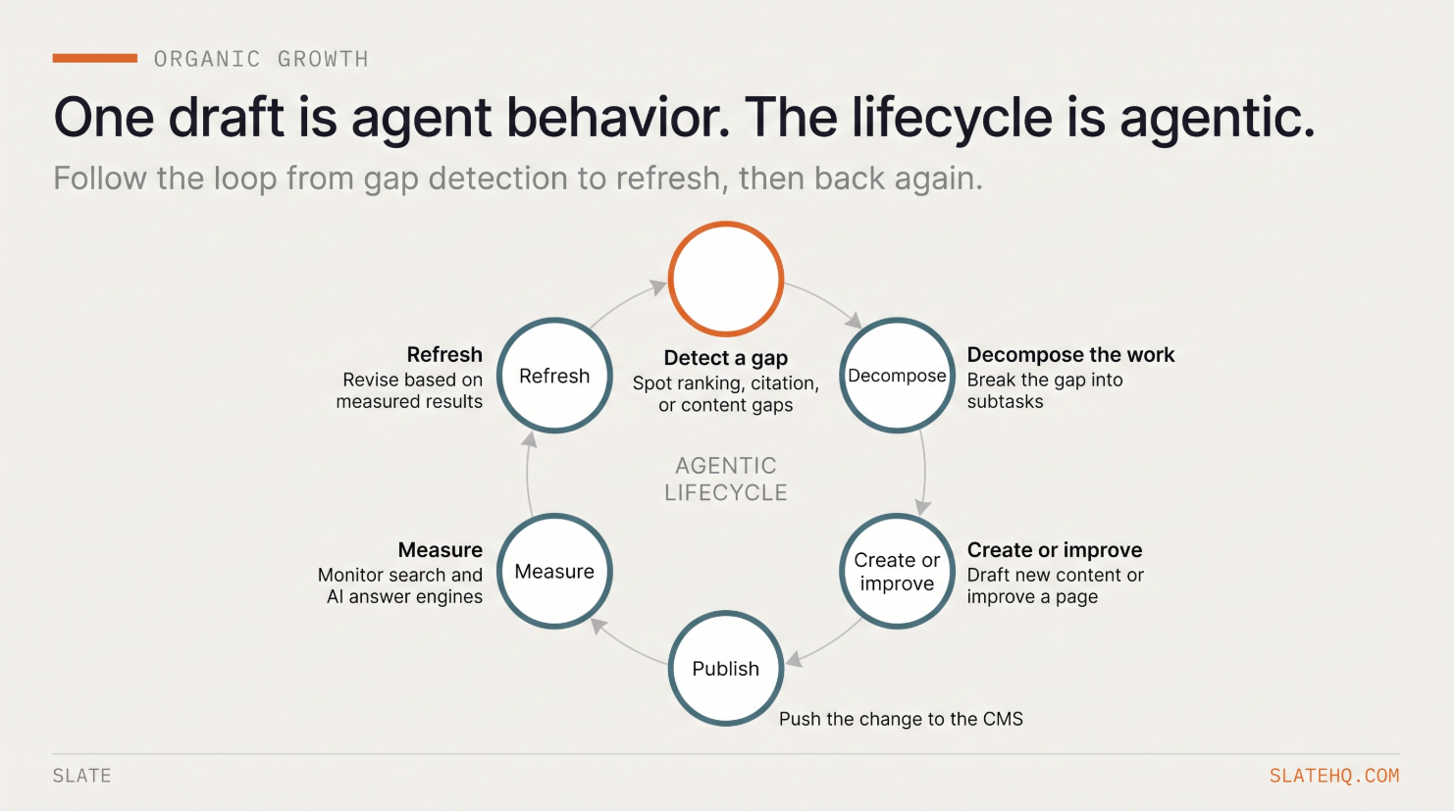
Content and SEO work naturally runs in loops. Writing one draft is agent behavior. Owning the content lifecycle is agentic behavior.
A closed loop can look like this:
- Detect a gap: Spot a ranking, citation, or content gap across search and AI answer engines
- Decompose the work: Break the gap into subtasks, such as new content, an update, an internal link repair, or outreach
- Create or improve: Draft new content or improve an existing page against the target
- Publish: Push the change to the CMS
- Measure: Monitor performance across search and AI answer engines
- Refresh: Revise based on measured results, then feed the next cycle
That’s agentic AI applied to organic growth operations.
Slate is one example of agentic AI. It detects opportunities, executes changes, publishes, and measures instead of stopping at a draft. A single agent writes; an agentic system owns the lifecycle around that writing.
AI Agents vs. Generative AI vs. Agentic AI
Generative AI creates content from a prompt: text, images, code, or summaries.
A generative model can sit inside an agent or an agentic system. The surrounding structure decides the role.
Use this model:
- Generative AI: Creation.
- AI agent: Task execution.
- Agentic AI: Orchestration.
This agentic AI vs generative AI distinction trips up buyers because the same model can appear in all three setups.
Comparison Table: Generative AI vs. AI Agents vs. Agentic AI
For teams working through the agentic AI vs generative AI distinction, the takeaway is plain: generation produces output, orchestration produces outcomes.
AI Agent vs. Chatbot: Where Interfaces Fit In
A chatbot mainly communicates.
An AI agent takes action through tools.
The spectrum looks like this:
- Chatbot: Conversational interface. It responds
- Copilot or assistant: Helps a human complete work and stays mostly advisory
- AI agent: Uses tools and takes action to complete a task
- Agentic system: Orchestrates goal pursuit across tools, steps, and agents
A chatbot can answer a question. An agent can answer, then do something about it.
That AI agent vs chatbot line keeps teams from assigning too much capability to a chat box with nice manners.
Governance, Risk, And Human Oversight
Higher autonomy raises the control burden. Good oversight patterns usually include minimum necessary permissions, audit trails, approval gates for high-risk actions, human handoff triggers, and access that expires when the task ends.
Agent sprawl is a serious operating risk. When every team spins up agents with separate permissions and no shared observability, the error surface grows faster than anyone can monitor. The answer is shared governance through the coordination layer.
Common failure modes include:
- Goal drift: The system chases a proxy metric instead of the objective
- Brittle tool calls: A changed API or malformed call breaks a step
- Permission errors: The system tries an action beyond its access
- Hallucinated subtasks: It invents work that doesn’t belong in the plan
- Infinite loops: It cycles and never converges
- Stale context: Long sessions collect bad state
- Escalation failures: It misses the handoff point
Human checkpoints belong before irreversible actions, before customer-facing outputs, and whenever confidence drops below a set threshold.
Operators need a system they can inspect and stop.
When To Skip Agentic AI
Agentic orchestration is overkill for many workflows.
Skip it when:
- The task is low-risk and single-step: A single agent or plain automation is faster and cheaper
- The workflow is fully deterministic: A script wins on reliability
- The decision is high-risk and customer-facing: Autonomy without strong guardrails becomes liability
- Latency or cost matters more than revision: Orchestration adds compute and delay per run
Choosing the simpler tool is good scoping.
How To Measure Whether An Agentic System Works
Execution alone doesn’t prove success. A system can complete every step and still produce a poor outcome. Measurement has to ask whether the workflow finished its task correctly, how often a human stepped in, how long it took, what it cost, and whether the business metric improved.
Useful metrics include:
- Completion rate: How often the workflow finishes
- Human intervention rate: How often a person steps in
- Cycle time: How long the workflow takes end to end
- Error rate: How often it produces incorrect output
- Cost per successful outcome: What each completed workflow costs
- Outcome quality: Whether the result meets the standard
For discovery workflows, teams may also track citation visibility, presence in AI-generated answers, and multi-platform discovery. The right AI search visibility tools make that tracking a lot less manual.
A system that measures and refreshes its own work shows agentic behavior. The refresh loop is where many single agents stop, and it’s the useful split in gen AI vs agentic AI work.
What This Means For Marketing And Content Teams In 2026
Content and organic growth teams feel this distinction because their work runs as a loop. Discovery now spans search engines and AI answer engines. Citations, summaries, click-through pressure, and ROI scrutiny all sit in the same operating plan.
Generating a draft is agent behavior. Owning opportunity discovery, content execution, publishing, AI visibility tracking, outreach, and refresh is agentic behavior.
Teams that win treat organic growth as a system. Pairing the right content automation tools with a clear loop makes that system easier to run.
Slate is a clear example of agentic AI applied to organic growth operations. It runs the loop in one platform:
- Cowork and custom agents: Teams delegate in natural language or package repeatable SEO, content, or growth tasks into reusable agents, no engineer required.
- Workflows and bulk automation: A visual workflow builder with prebuilt templates, plus Sheets for creating, improving, refreshing, and auditing thousands of URLs at once.
- Integrations and publishing: Native Ahrefs and Semrush access without a separate purchase, plus direct publishing to Webflow, WordPress and Sanity.
- AI visibility analytics: Brand presence tracked across six major AI platforms, including sentiment, brand mentions, prompt answers, and keyword tracking.
- Pages: Google Search Console and GA4 data unified for clicks, traffic, CTR, citations, and performance monitoring, so teams catch ranking and traffic drops early.
- Opportunities and outreach: Gap discovery across content, citations, rankings, and social, plus link and brand-mention outreach inside the platform.
Slate focuses on content, SEO, and AI search operations. It isn’t a generic creative proofing tool for video or visual brand campaigns. It has a G2 rating of 4.9.
The AI agents vs agentic AI framing maps directly onto Slate: it generates when needed, and it owns the lifecycle around content.
Plans start at $499/month. The base plan, Growth, includes 15,000 credits, 10,000 AI answers/month and 1000 web pages tracked. Other tiers are Scale ($999/month) Agency ($2000/month) and Enterprise (custom). Slate also has a 14-day free trial.
FAQs
1. What is the difference between AI agents and agentic AI?
AI agents complete bounded tasks, such as routing a ticket, drafting a reply, or pulling data. Agentic AI plans and coordinates agents or tools across multiple steps toward a larger goal. An agent completes a task. Agentic AI owns the workflow around it.
2. Is agentic AI the same as generative AI?
Generative AI creates content from a prompt. Agentic AI takes action toward a goal using planning, tool access, and feedback loops. A generative model can be one component inside an agentic system.
3. Can agentic AI coordinate multiple AI agents?
Yes. Agentic AI often acts as the coordination layer for multiple agents, tools, and steps. It decomposes a goal, assigns subtasks, sequences work, passes context, and evaluates the result against the original objective.
4. Is agentic AI more autonomous than AI agents?
Generally, yes. Agentic AI makes decisions about sequencing, re-planning, and escalation. An agent’s autonomy stays bounded by its assigned task and rules.
Higher autonomy requires tighter permissions, guardrails, and monitoring.
5. Can agentic AI exist with one agent?
Yes. Agentic behavior depends on planning, orchestration, memory, and feedback loops. A single agent can behave agentically if it decomposes a goal, coordinates tools, carries context, and revises based on results.
6. What is the difference between an AI assistant, an AI agent, and agentic AI?
An assistant responds to requests and stays mostly advisory. An AI agent uses tools to take action on tasks. Agentic AI orchestrates agents and tools across steps toward an outcome.
7. How do agentic workflows fit into SEO and content operations?
Agentic systems can discover a ranking or citation gap, decompose the work, create or improve content, publish it, measure performance across search and AI answer engines, and refresh based on results. That’s the full loop: discovery, execution, measurement, and refresh. Slate runs this pattern end to end.