Your content pipeline is broken. The AI writer isn't the problem.
That's the uncomfortable truth most "Jasper alternatives" articles won't tell you. B2B content teams adopted Jasper expecting to scale output - and many did get faster drafts. But faster drafts don't fix the real bottleneck: the operational chaos between ideation and published, optimized content.
Briefs still live in Google Docs. Reviews still happen over Slack threads. SEO is still bolted on after writing. Publishing still requires manual copy-pasting into your CMS.
And according to HubSpot's 2026 State of Marketing Report, 94% of marketers plan to use AI in their content creation processes — yet speed gains alone haven't translated into smoother workflows for most teams.
This article evaluates Jasper alternatives across the full content lifecycle - not just writing quality. That means team collaboration, SEO integration, CMS publishing, governance, and pricing at team scale. The list includes pure AI writers, SEO-content platforms, and full content operations tools, because the best alternative depends entirely on where your team's real bottleneck sits.
The 12 tools below were evaluated on writing quality, team workflow support, SEO capabilities, CMS publishing, governance features, integration depth, team pricing, and fit for B2B content types like case studies, whitepapers, and thought leadership.
Why B2B Content Teams Are Looking Beyond Jasper in 2026
Jasper isn't a bad tool. It has a solid template library, decent brand voice features, and it genuinely accelerates marketing copy. But a growing number of B2B content teams are hitting its ceiling - and the reasons go deeper than writing quality.
Forrester's 2026 predictions highlight that enterprises are expected to defer roughly 25% of planned AI spend into 2027, with only 15% of AI decision-makers reporting measurable EBITDA lift from AI — a sign that speed alone isn't justifying investment.That gap tells you something important: speed alone doesn't justify the investment.
The AI writing quality plateau
Jasper's output has become increasingly recognizable. B2B content demands subject-matter depth, specific claims, and genuine perspective - not just fluent prose that says nothing new. When every competitor's blog post is drafted by the same underlying models with similar prompts, the result is a sea of content that reads fine but ranks poorly and converts worse.
The missing operations layer
Jasper generates drafts. It doesn't manage the content lifecycle. There's no native editorial calendar, no approval workflow, no role-based permissions, and no way to track a piece of content from brief to published without juggling four other tools alongside it.
Limited SEO and publishing integration
Jasper doesn't provide SERP analysis, keyword clustering, or NLP-term optimization. It doesn't publish directly to your CMS. B2B teams need a brief-to-publish pipeline - not a text editor that stops at export.
Pricing pressure at team scale
Per-seat pricing compounds quickly for content teams of 10 or more. When heavy editing is still required after AI drafting, the ROI math gets hard to justify - especially when that budget could fund tools that solve more of the pipeline.
How We Evaluated These Jasper Alternatives
Every tool on this list was assessed against eight criteria that matter specifically to B2B content teams:
Quick Comparison Table - All 12 Jasper Alternatives at a Glance
1. Slate - Best for B2B Content Teams That Need a Full Operations Platform
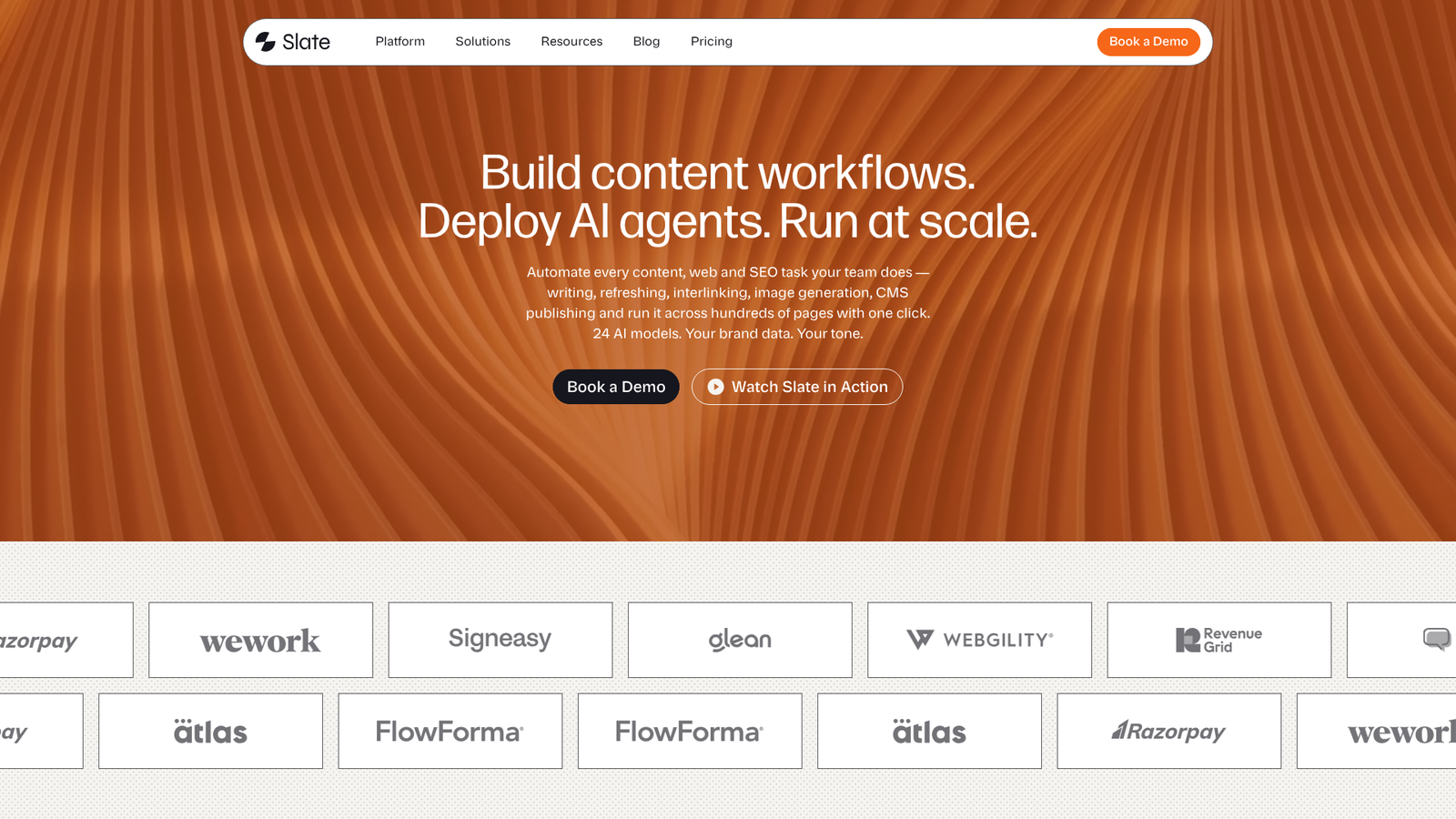
Slate is a content operations platform that manages the entire content lifecycle - from ideation and brief to SEO optimization, multi-stakeholder review, and CMS publishing.
Where every other tool on this list handles one or two stages of content production, Slate orchestrates the full pipeline. It's built for teams, not solo users, which makes it the most structurally different option from Jasper on this list.
Best for: B2B content teams of 5+ people who need workflow structure, governance, and publishing - not just faster drafts.
Key strengths
- End-to-end pipeline: brief → draft → optimize → review → publish
- Role-based permissions and multi-stakeholder approval workflows
- Built-in SEO optimization so content is search-ready before it leaves the platform
- Direct CMS publishing to WordPress, HubSpot, Webflow, and headless CMS
- Centralized brand voice and style guide enforcement across all contributors
Pricing: Plans start at $199/mo; custom pricing available for larger teams. See pricing at slatehq.com/pricing
Most teams searching for a Jasper alternative think they need a better AI writer. Slate's argument is different: a better writer still produces content that sits in Google Docs waiting for approval. The bottleneck is operational, and that's what Slate addresses.
For teams drowning in Slack threads, spreadsheet editorial calendars, and manual CMS uploads, Slate consolidates the point solutions - AI writing tool, SEO tool, project management, and CMS connector - into a single workflow. That consolidation argument is worth pressure-testing against your actual tool spend before dismissing it.
The honest caveat: if your team is two people and your content process is simple, Slate's depth is overkill. It's designed for teams where content involves multiple contributors, reviewers, and approval stages before anything goes live.
2. Copy.ai - Best for Marketing Copy and GTM Workflow Automation
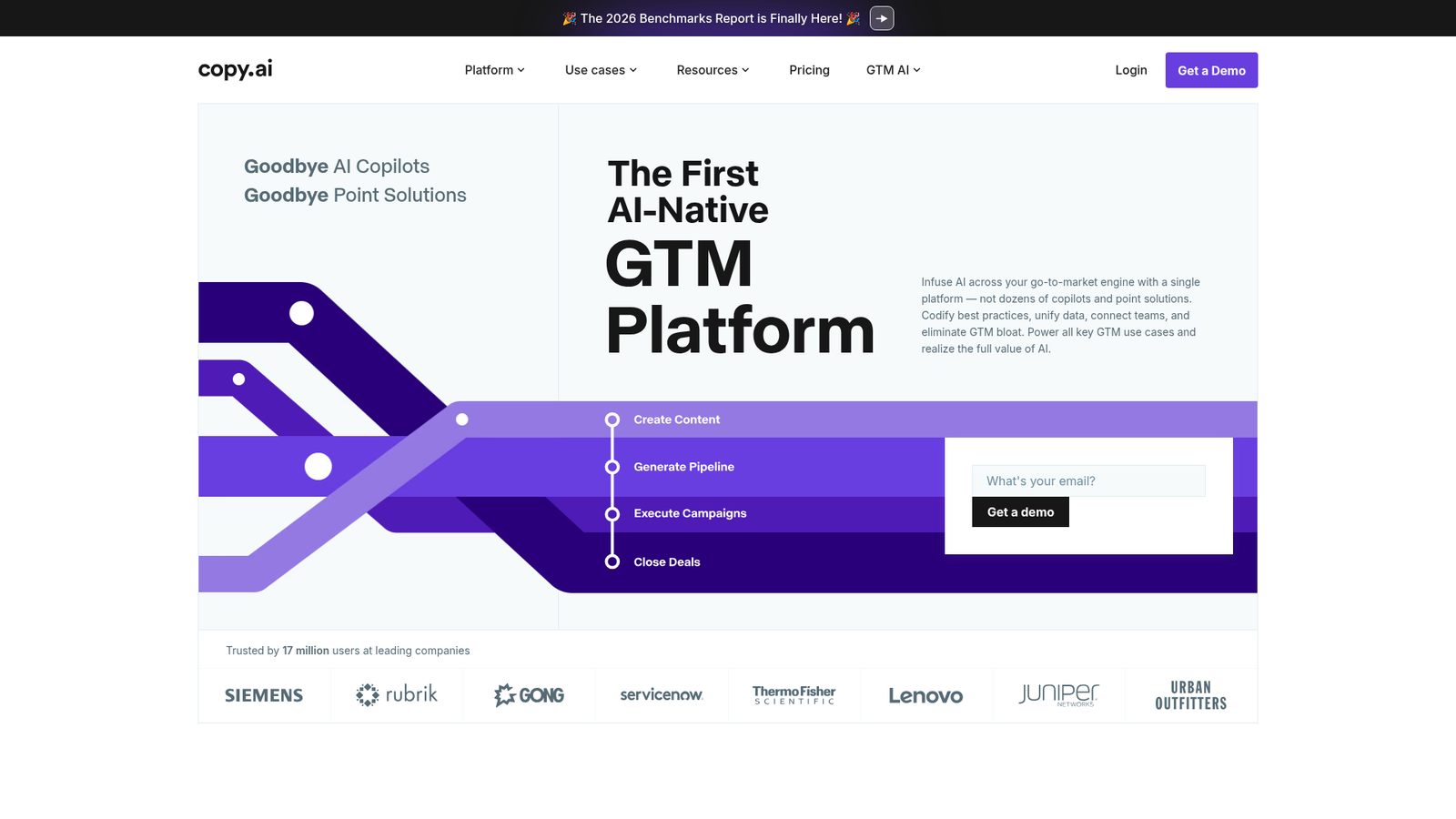
Copy.ai started as a short-form copy tool and has since expanded into a GTM workflow automation platform with a serious enterprise push.
Its workflow builder lets teams automate repetitive marketing copy tasks - think email sequences, ad variations, and product descriptions - without pinging someone on Slack every time a new campaign needs copy. Brand voice customization and team collaboration features have improved significantly in 2026.
Best for: B2B marketing teams focused on demand gen copy - ads, emails, landing pages - rather than long-form editorial content.
Key strengths
- Workflow builder for automating high-volume, repetitive copy tasks
- Strong template library covering ads, emails, social, and product descriptions
- Brand voice customization with team-wide consistency settings
- Improving enterprise features including admin controls and usage analytics
- Solid free tier for initial evaluation before committing to a paid plan
Pricing: Chat $29/mo monthly (or $24/mo billed annually, 5 seats, unlimited chat words); Growth $1,000/mo ($12,000/yr, 75 seats, 20K workflow credits); Expansion $2,000/mo ($24,000/yr, 150 seats); Scale $3,000/mo ($36,000/yr, 200 seats); Enterprise custom.
The limitation worth naming: Copy.ai's long-form content quality is still inconsistent. It works well for short-form, structured copy where the format is predictable. For B2B thought leadership, case studies, or whitepapers, you'll spend more time editing than you'd expect. SEO integration is surface-level, and there's no CMS publishing pipeline.
If your primary pain point with Jasper is demand gen copy volume and workflow automation, Copy.ai is a strong fit. If you need long-form editorial depth, look elsewhere on this list.
3. Writer - Best for Enterprise Brand Governance and Compliance
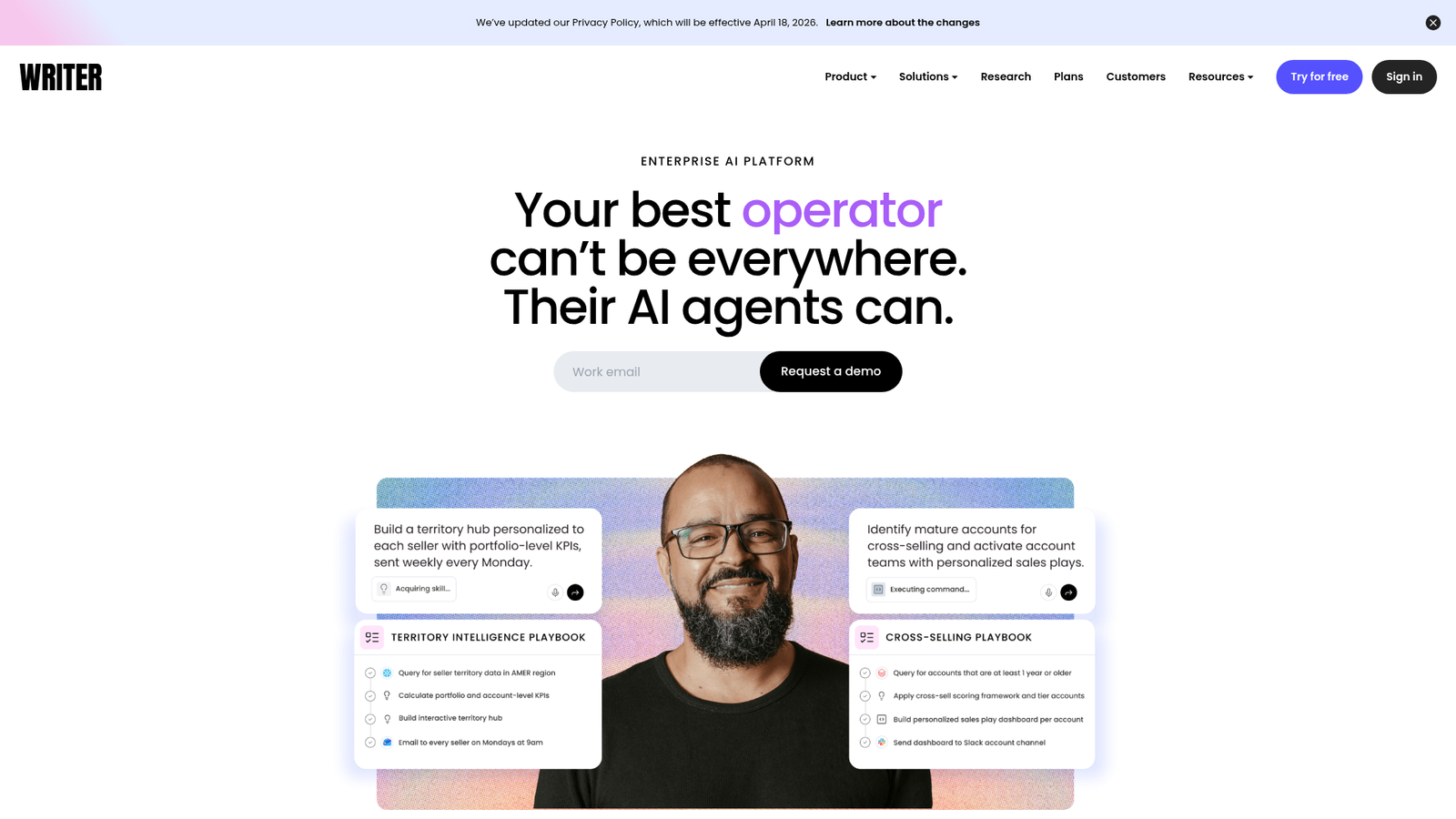
Writer is an enterprise-grade AI writing platform built around brand consistency and compliance - a genuinely different value proposition from most AI writing tools.
Style guide enforcement, terminology management, and compliance checking are first-class features, not afterthoughts. Every piece of content produced through Writer can be checked against your brand standards automatically, which matters enormously for B2B companies in regulated industries.
Best for: Enterprise B2B teams in fintech, healthtech, legal, or any regulated industry where compliance and brand governance are non-negotiable.
Key strengths
- Style guide enforcement and terminology management at the platform level
- Compliance checking built into the writing workflow, not bolted on after
- Team-wide brand voice configuration with granular controls
- Integrations with Figma, Chrome, Google Docs, and enterprise tools
- AI writing capabilities with governance guardrails throughout
Pricing: Starter plan with per-seat monthly or annual pricing (up to 5 users, 14-day free trial, no credit card required); Enterprise custom pricing.
Writer's AI writing quality is solid - not the most creative output on this list, but consistent and on-brand, which is exactly what enterprise teams need. The trade-off is cost and complexity. Writer is priced for enterprise budgets, and it's overkill for teams that don't have genuine compliance requirements.
The SEO features are limited, and there's no CMS publishing pipeline. Writer solves the governance problem exceptionally well. It doesn't solve the SEO or publishing problem, so plan to pair it with dedicated tools for those workflows.
4. Frase - Best for SEO Content Research and Optimization
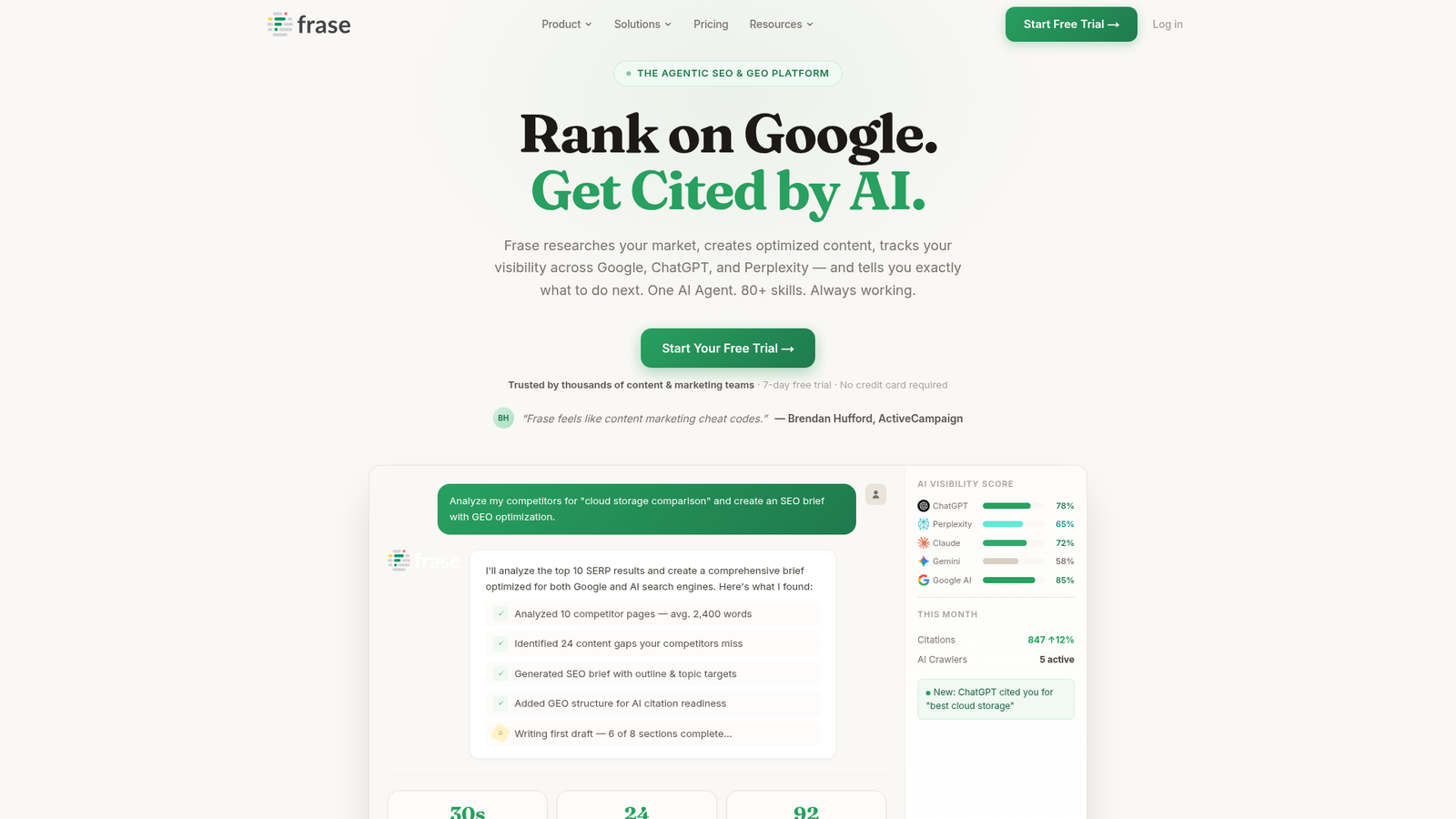
Frase is an SEO-first content tool that combines SERP analysis, content brief generation, and NLP-optimized outlines with an integrated AI writing layer.
The core workflow: enter a keyword, get a brief built from the top-ranking pages, write against a real-time content score, and publish knowing your piece covers the topics that matter for that query. For B2B teams where SEO is a primary channel, this workflow saves hours per piece.
Best for: SEO-focused B2B content teams that need better research and optimization, and are comfortable using a separate tool for primary drafting.
Key strengths
- SERP analysis that surfaces what top-ranking pages actually cover
- Content brief generation from People Also Ask and forum research
- Real-time NLP optimization scoring as you write
- Affordable entry point with meaningful team features at higher tiers
- Question research that's particularly useful for B2B FAQ and pillar content
Pricing: Starter $49/mo ($39/mo annual, 1 seat, 10 AI-optimized articles/mo); Professional $129/mo (3 seats, 40 articles/mo); Scale $299/mo (5 seats, 100 articles/mo); Enterprise custom. All plans include full AI Agent, GEO tracking, site audits, and API/MCP access.
The honest limitation: Frase's AI writing quality is average. It's best used as a research and optimization layer, with a stronger writing tool handling the actual drafting. Teams that try to use Frase as their primary AI writer tend to be disappointed. Teams that use it as their SEO research layer - paired with Claude or ChatGPT for drafting - get significantly better results.
Collaboration features scale up on higher-tier plans, and Frase now includes direct publishing via its API and MCP server. Starting at $49/mo (or $39/mo annual), it remains one of the most cost-effective SEO and GEO content tools available.
5. Surfer - Best for Data-Driven SEO Content Scoring

Surfer leads the market on SEO content scoring, with NLP-powered optimization that tells you exactly what your content needs to rank - and by how much.Surfer holds a 4.8/5 rating across 500+ verified G2 reviews, placing it among the top-rated content optimization platforms.
The Content Editor provides real-time scoring against competing pages, the SERP Analyzer surfaces competitive content intelligence, and Surfer AI generates drafts that are optimized from the first sentence. The WordPress integration is one of the most reliable CMS connections in this category.
Best for: B2B teams with a strong SEO strategy that need to ensure every piece of content is optimized for search - pairs well with other writing tools.
Key strengths
- NLP-powered content scoring with real-time optimization feedback
- SERP Analyzer for competitive content intelligence and gap analysis
- Surfer AI for drafts that are SEO-optimized from the start
- Content audit capabilities for improving existing content performance
- Native WordPress integration for streamlined publishing
Pricing: (all billed yearly): Discovery $49/mo; Standard $99/mo; Pro $182/mo; Peace of Mind $299/mo; Enterprise $999/mo. The old 'Essential' and 'Scale' plan names have been discontinued.
Surfer's AI writing is secondary to its optimization capabilities. If you're choosing between Surfer and Frase, Surfer wins on SEO depth and WordPress integration; Frase wins on price and content brief quality. Many B2B teams use both - Frase for research and briefs, Surfer for optimization and scoring.
The workflow and collaboration features are limited. Surfer is a specialist tool, and it's priced like one. For teams where SEO performance is the primary metric, that specialization is worth it.
6. Writesonic - Best for Multi-Format AI Content at Scale
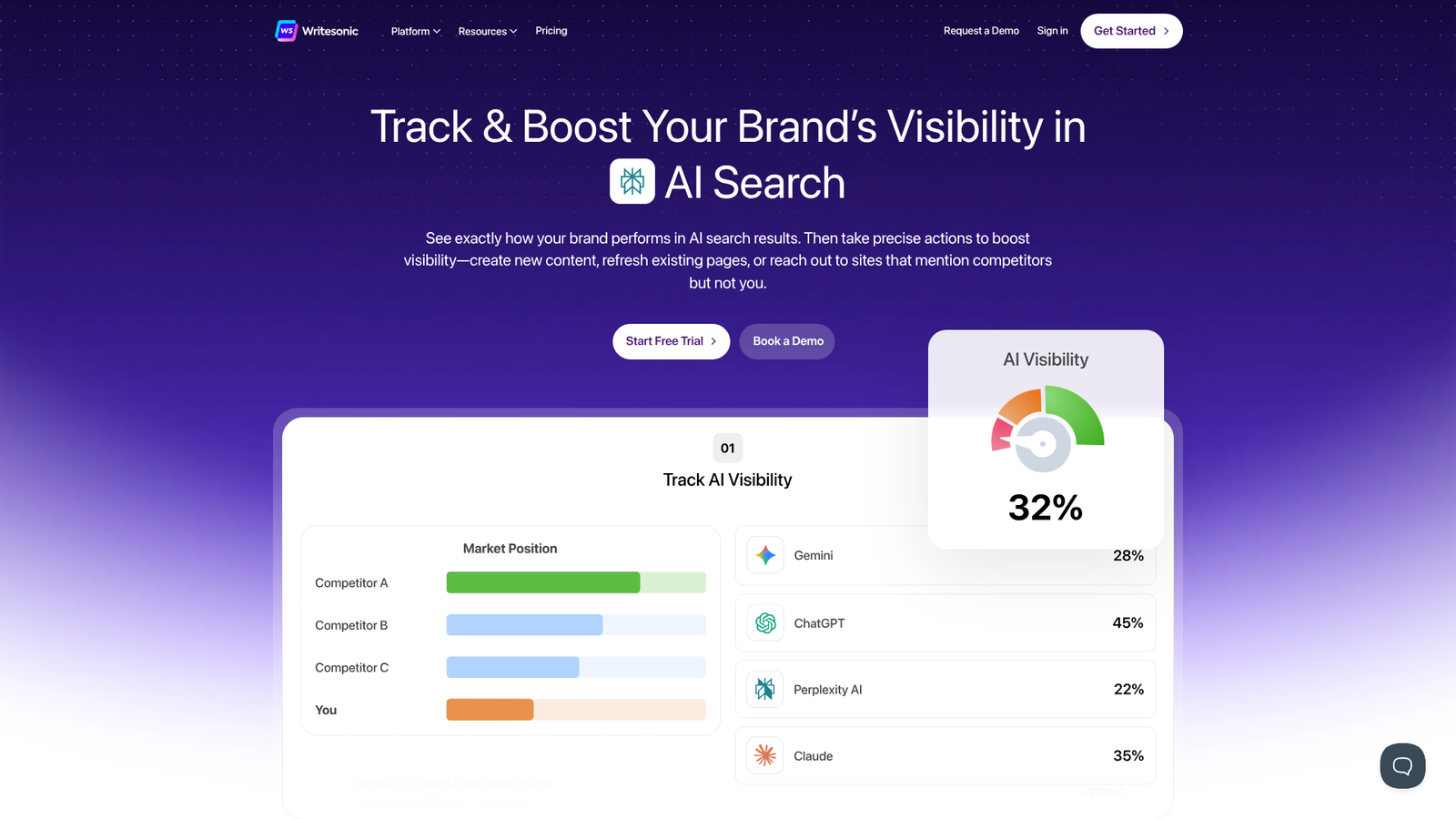
Writesonic covers more content formats than almost any other tool on this list - blog posts, ads, product descriptions, landing pages, social posts, and more - with competitive team pricing that makes it accessible for mid-market B2B teams.
Chatsonic adds a conversational AI layer for research and ideation. Multi-language support across 25+ languages makes it a practical option for B2B teams with international audiences.
Best for: B2B teams needing high-volume, multi-format content - especially with global audiences - on a budget.
Key strengths
- Broad content format coverage from blog posts to ad copy to product descriptions
- Plans now include AI Search Tracking (GEO) across ChatGPT, Perplexity, Google AI Overviews, Gemini, Claude, and Copilot — starting at $79/mo (annual).
- Chatsonic for conversational research and ideation workflows
- Multi-language support across 25+ languages for global B2B teams
- Improving SEO features including keyword integration and meta generation
Pricing: Starter $99/mo ($79/mo annual, 1 user, 15 articles/mo); Basic $249/mo ($199/mo annual, 2 users, 25 articles); Growth $499/mo ($399/mo annual, 3 users, 50 articles); Enterprise custom.
Output quality varies significantly by content type. Writesonic performs well on structured, shorter formats - ad copy, email subject lines, product descriptions. Long-form B2B content tends to require more editing than you'd want. There's no governance layer, no workflow automation, and no CMS publishing.
For teams that need volume across multiple formats and can't justify Surfer or Frase's price point, Writesonic is a reasonable middle ground. Don't expect it to replace a dedicated SEO tool or a content operations platform.
7. Scalenut - Best for SEO Content Clusters and Topic Authority

Scalenut combines AI writing with SEO topic clustering - a combination that works particularly well for B2B teams building topical authority through pillar content strategies.
Cruise Mode handles end-to-end blog post generation from keyword to draft, incorporating SERP analysis and NLP term optimization throughout. The content planner helps teams map out topic clusters systematically rather than producing one-off posts.
Best for: B2B content teams building topical authority through content clusters and pillar pages.
Key strengths
- Topic clustering tools for systematic pillar content strategy
- Cruise Mode for end-to-end blog post generation with SEO built in
- SERP analysis and NLP term optimization integrated into the writing workflow
- Content planner for managing topical authority at scale
- Mid-range pricing with solid feature depth relative to cost
Pricing: Scalenut has restructured into three GEO-focused plans — Starter, Plus, and Professional — combining content creation with AI visibility tracking across ChatGPT, Google AI, and Perplexity. Visit scalenut.com/pricing for current rates (plans available in monthly and discounted annual billing).
The writing quality needs editing - Scalenut's strength is the SEO structure it provides, not the prose it generates. Team collaboration features are limited, there's no CMS publishing, and the UI can feel clunky compared to more polished tools. But for the price, the topic clustering and Cruise Mode combination is genuinely useful for B2B teams executing a content cluster strategy.
If your primary goal is building topical authority efficiently, Scalenut deserves a trial. If you need governance, workflow automation, or publishing, you'll need to supplement it.
8. AirOps - Best for Programmatic Content and Content Ops Automation
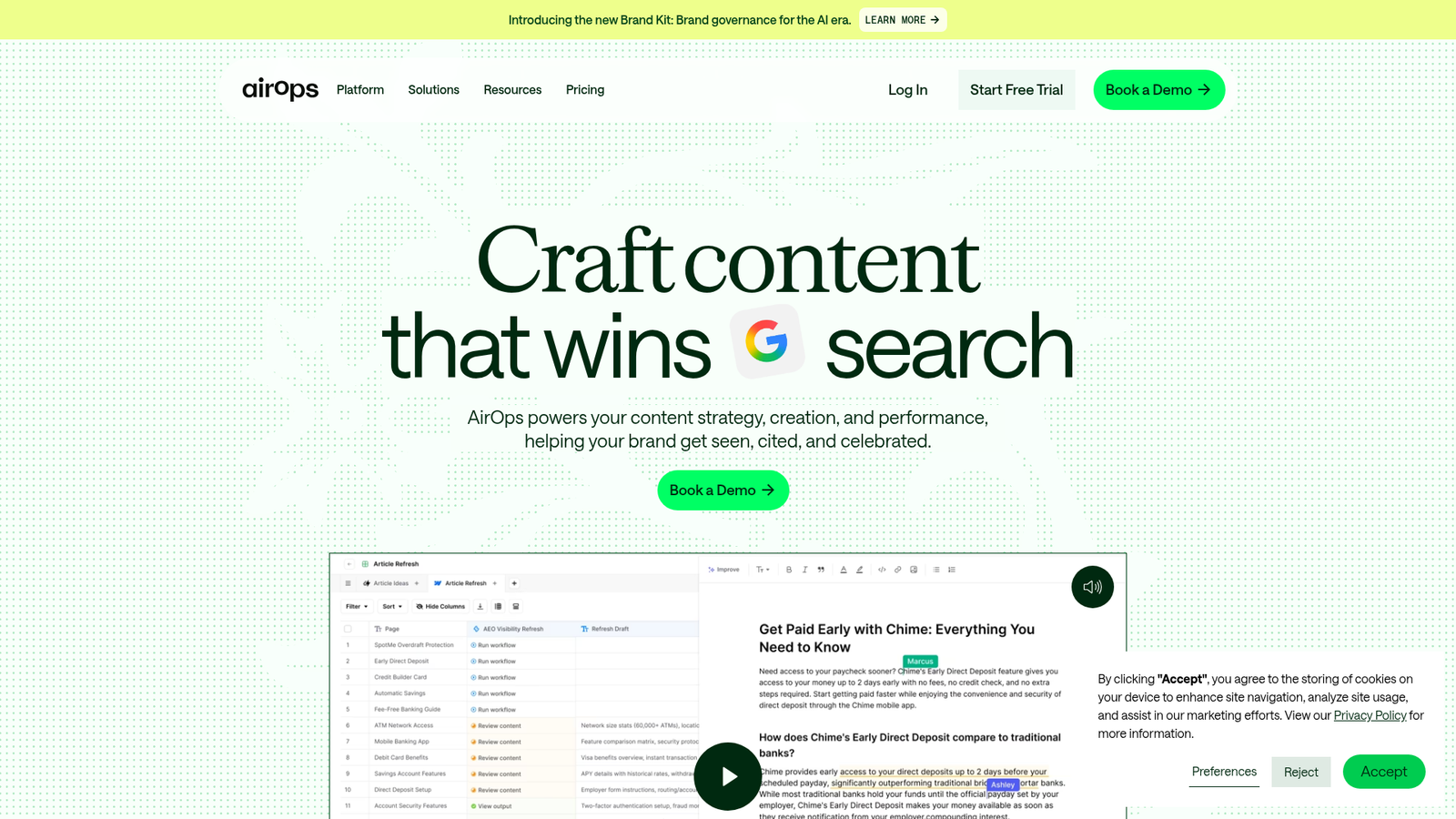
AirOps sits at the intersection of AI content generation and workflow automation - making it one of the few tools on this list that genuinely competes with Slate on the operations side of content production.
Its workflow builder automates content pipelines end-to-end, with integrations across CMS platforms and data sources. Template-based content generation at scale makes it particularly powerful for B2B companies with large product catalogs or location-based pages.
Best for: B2B companies with large product catalogs or location-based pages that need programmatic content generation at scale.
Key strengths
- Workflow builder for automating multi-step content pipelines
- Programmatic content generation from structured data sources
- CMS integrations for direct publishing at scale
- Template-based generation for consistent output across hundreds of pages
- Mid-market and enterprise positioning with genuine workflow depth
Pricing: Custom pricing based on usage and team size
AirOps has a steep learning curve. It's not a tool you open and start writing in - it requires setup, workflow configuration, and some technical comfort. For editorial and thought leadership content, it's not the right fit. For programmatic SEO at scale, it's one of the most capable options available.
The custom pricing model lacks transparency, which makes initial evaluation harder. Request a demo early and be specific about your use case - AirOps' value varies significantly depending on what you're trying to automate.
9. Outranking - Best for SEO-First AI Writing with Auto-Publishing
Outranking is built specifically around SEO performance, combining automated SERP research, content brief generation, and AI writing with native CMS publishing.
Content monitoring and performance tracking add a measurement layer that most AI writing tools skip entirely. For lean B2B content teams that want an SEO-to-publish pipeline without enterprise complexity, Outrank's feature-to-price ratio is hard to beat.
Best for: Lean B2B content teams that want an SEO-to-publish pipeline without enterprise complexity.
Key strengths
- Native CMS publishing to WordPress and other platforms at all pricing tiers
- Automated SERP research and content brief generation
- Content performance monitoring post-publish
- SEO-first writing approach with optimization built into the draft process
- Accessible entry pricing with publishing features included from the start
Pricing (monthly billing): Starter $25/mo (5 SEO documents); SEO Writer $69/mo (15 SEO documents, 2 users); SEO Wizard $139/mo (30 SEO documents, 3 users); Custom plan for agencies. Yearly billing: Starter $19/mo, SEO Writer $79/mo, SEO Wizard $159/mo.
Outrank is a newer platform with a smaller user base than Frase or Surfer, which means fewer community resources and a less mature feature set. Writing quality is functional but not premium - you'll still want a human editor on anything that represents your brand's thought leadership. Team collaboration features are minimal, and governance is essentially nonexistent.
For small B2B teams that need SEO and publishing without the overhead of a full content operations platform, Outrank fills a real gap in the market.
10. ChatGPT (Business/Enterprise) - Best for Flexible, General-Purpose AI Assistance
ChatGPT Business (formerly Team, renamed August 29, 2025) is OpenAI's collaborative plan for teams starting at 2 users.
Custom GPTs let teams encode brand voice, content frameworks, and editorial guidelines into reusable workflows. The Enterprise plan adds SOC 2 compliance, admin controls, and data privacy guarantees that matter for B2B companies handling sensitive information.
Best for: B2B teams that want a powerful AI co-pilot for ideation and drafting, paired with dedicated SEO and workflow tools.
Key strengths
- Most versatile AI on this list - handles research, ideation, drafting, and analysis
- Custom GPTs for encoding brand voice and content frameworks into reusable workflows
- Access to GPT-5.4 and GPT-5.4 Thinking for complex B2B topics and technical content, plus generous access to advanced capabilities like Deep Research, Image Gen, and Codex.
- Enterprise plan with SOC 2 compliance and data privacy controls
- Shared workspace, SAML SSO, and admin controls in the Business plan.
Pricing: Plus $20/mo; Business $20/seat/mo (annual) or $25/seat/mo (monthly), minimum 2 seats; Enterprise custom (annual only). Codex seats are usage-based with no fixed monthly seat fee.
The limitations are structural, not quality-related. ChatGPT has no SEO features, no content workflow or publishing capabilities, and no governance beyond custom instructions. It requires significant prompt engineering to produce consistently on-brand B2B content. Output needs editing for depth and specificity - it's an excellent starting point, not a finished product.
Think of ChatGPT Teams as the drafting engine in a larger stack. Pair it with Frase or Surfer for SEO, and Slate or a project management tool for workflow, and you have a capable content operations setup.
11. Claude (Team Plan) - Best for Long-Form Depth and Analytical Content
Claude from Anthropic has earned a reputation among B2B content teams for producing the most nuanced, analytically rigorous long-form writing of any AI assistant - with noticeably less "AI slop" than most alternatives.
Claude's 200K-token context window (expanded to 500K on Enterprise plans, and 1M tokens in Claude Code for Max, Team, and Enterprise users on Opus 4.6 since March 2026) lets Claude process entire research documents, previous articles, and brand guidelines in a single session.
Best for: B2B teams producing thought leadership, whitepapers, and in-depth reports that require analytical depth and nuance.
Key strengths
- Superior long-form writing quality with noticeably less generic output
- 200K+ token context window for processing research documents and brand guidelines
- Projects feature for organizing team knowledge and maintaining context
- Strong analytical reasoning for synthesizing complex B2B topics
- Consistent voice maintenance across long-form pieces
Pricing: Pro $20/mo; Max starts at $100/mo (5x Pro usage) or $200/mo (20x Pro usage); Team Standard $25/seat/mo annual ($30/seat/mo monthly, min 5 seats); Team Premium $100/seat/mo annual ($125/seat/mo monthly, includes Claude Code); Enterprise custom.
Claude shares the same structural limitations as ChatGPT: no SEO features, no workflow or publishing tools, no governance, no template library. It requires manual prompt engineering and works best when given detailed context about your audience, brand voice, and content goals.
The distinction between Claude and ChatGPT for B2B content teams comes down to use case. For analytical depth, long-form synthesis, and thought leadership, Claude tends to produce better first drafts. For versatility, research breadth, and custom workflow automation, ChatGPT has the edge.
12. Rytr - Best Budget Option for Short-Form B2B Copy
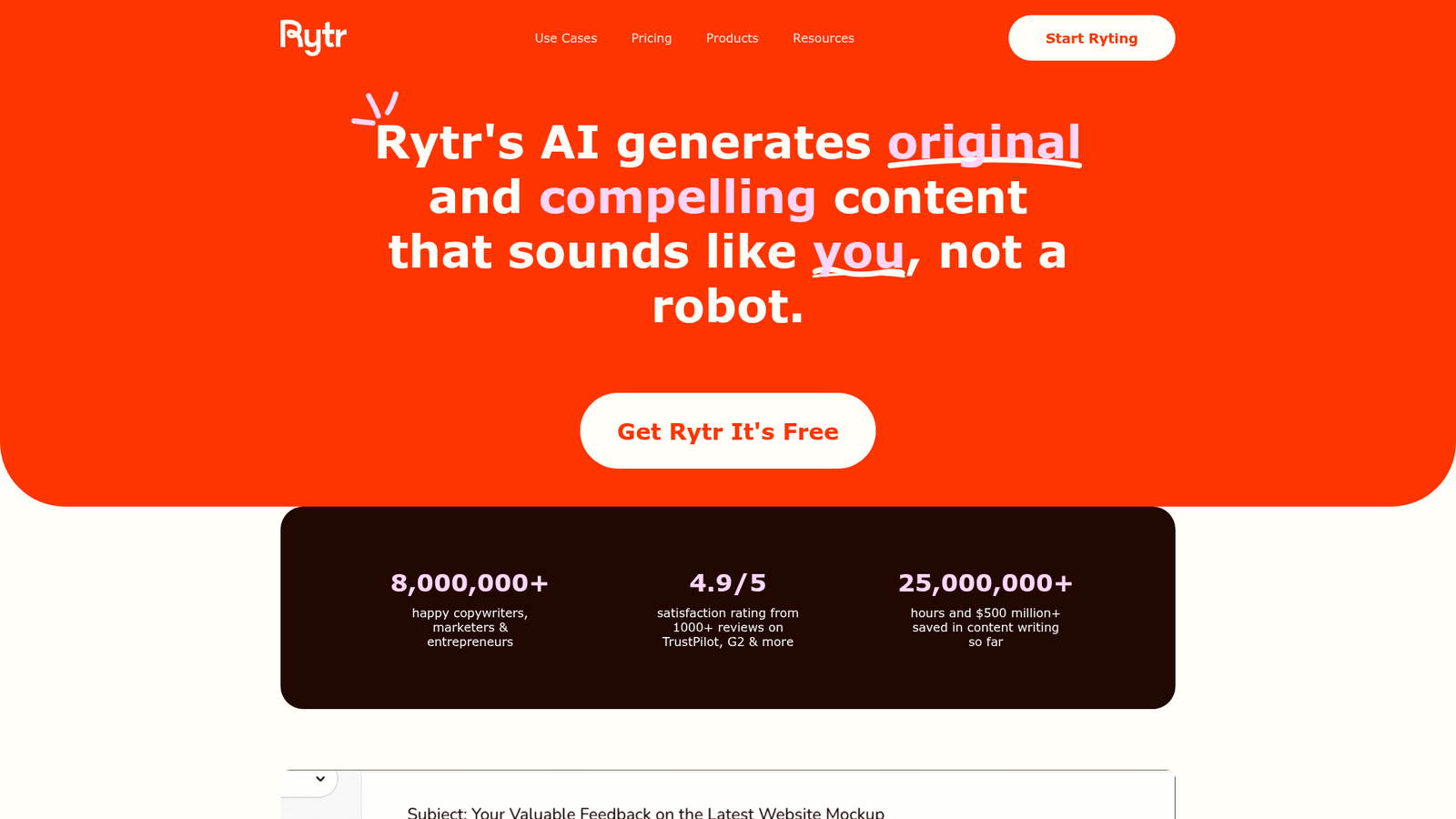
Rytr is the most affordable AI writing assistant on this list - a lightweight tool with 40+ use cases, tone customization, and a built-in plagiarism checker that covers the basics without the overhead of a full content platform.
The Chrome extension lets writers use Rytr anywhere in their browser, which makes it useful for quick copy tasks without switching contexts. For solo B2B marketers or small teams with tight budgets, it handles short-form copy assistance competently.
Best for: Solo B2B marketers or small teams on a tight budget needing quick copy assistance - a supplement, not a replacement, for your content stack.
Key strengths
- Most affordable option on this list with a functional free tier
- 40+ use cases covering ads, emails, social posts, and short-form copy
- Built-in plagiarism checker included at all pricing tiers
- Chrome extension for writing assistance without switching tools
- Tone and voice customization for basic brand consistency
Pricing: Pro $20/mo; Max starts at $100/mo (5x Pro usage) or $200/mo (20x Pro usage); Team Standard $25/seat/mo annual ($30/seat/mo monthly, min 5 seats); Team Premium $100/seat/mo annual ($125/seat/mo monthly, includes Claude Code); Enterprise custom.
Writing quality for long-form content is noticeably lower than every other paid tool on this list. SEO features are minimal. There's no team collaboration, no workflow automation, and no CMS publishing. Rytr is not a primary content tool for B2B teams - it's a quick-copy assistant that earns its place in a stack through price, not capability.
If budget is the primary constraint and you need something for email subject lines, social captions, and ad copy, Rytr is a reasonable starting point. Just don't expect it to carry your content strategy.
Honorable Mentions - Other Tools Worth Knowing
A few tools didn't make the top 12 but deserve a mention for specific situations.
Grammarly isn't an AI writer, but it's an essential editing and brand voice consistency layer that complements every tool on this list. If your team isn't using it already, it's worth adding regardless of which AI writing tool you choose.
SEOwriting.ai specializes in budget-friendly bulk SEO content generation - useful for programmatic SEO at scale, though quality concerns make it better suited for high-volume, lower-stakes content than B2B thought leadership.
Gemini is Google's multimodal AI, strong for research tasks like data analysis and sourcing. It integrates well with Google Workspace, but it's not yet mature for team content workflows or editorial production.
Microsoft 365 Copilot is worth evaluating if your team already lives in the Microsoft ecosystem. Its content marketing features are limited compared to dedicated tools, but the integration depth with Word, Teams, and SharePoint has real value for enterprise teams.
ContentMonk is a newer AI content platform with an SEO focus. It's worth watching, but the track record is limited enough that it didn't earn a full review here.
How to Choose the Right Jasper Alternative for Your B2B Team
The right tool depends on where your content pipeline actually breaks down. Start by identifying your primary pain point - then use this framework to shortlist.
If your problem is writing quality
Look at Claude, ChatGPT Teams, and Writesonic. Claude produces the best long-form analytical content. ChatGPT offers the most versatility. Writesonic covers the widest format range at the lowest team price point. All three require pairing with dedicated SEO and workflow tools.
If your problem is SEO performance
Frase, Surfer, Scalenut, and Outrank are your options. Frase wins on research and brief quality. Surfer wins on optimization depth and scoring. Scalenut wins on topic clustering for pillar content strategies. Outrank wins on the SEO-to-publish pipeline for lean teams. Many B2B teams run Frase and Surfer together - Frase for briefs, Surfer for optimization.
If your problem is team workflow and operations
Slate, Copy.ai, and AirOps address this directly. Slate covers the full content lifecycle. Copy.ai focuses on demand gen copy workflows. AirOps handles programmatic content automation at scale. If your team is still managing content through Google Docs and Slack threads, this is the category to prioritize.
If your problem is brand governance and compliance
Writer and Slate are the strongest options. Writer leads on compliance checking and terminology management - critical for regulated B2B industries. Slate integrates governance into the broader content operations workflow.
If your problem is the entire content pipeline
Slate is the only tool on this list designed to address the full brief-to-published workflow. That's not a sales pitch - it's a structural observation. Every other tool on this list solves one or two stages of the pipeline. Slate is built to orchestrate all of them.
Many B2B content teams end up running a combination: Claude or ChatGPT for drafting, Surfer or Frase for SEO, and Slate for operations. The key is minimizing friction between tools - look for integrations and avoid manual handoffs between stages.
The Real Question - Do You Need a Better Writer, or Better Content Operations?
Most teams searching for Jasper alternatives think they need a better AI writer. The search intent is understandable - Jasper's output feels generic, so the instinct is to find a tool that writes better.
Gartner publishes the Magic Quadrant for Content Marketing Platforms — no Magic Quadrant for 'Content Generation Platforms' exists. The 74% figure comes from a TopRank Marketing blog post, not Gartner. Recommend either removing the stat or rewriting to cite the correct Gartner CMP report. That's not a writing quality problem. That's an operations problem.
A better AI writer still produces content that sits in Google Docs waiting for approval. It still requires manual SEO optimization. It still needs someone to copy-paste it into your CMS. The highest-impact investment for B2B content teams in 2026 is a content operations layer that orchestrates people, processes, and AI tools together - not just a different text generator.
Before you choose a tool, audit your actual bottleneck. Time how long a piece of content spends in each stage from brief to published. If the majority of time is in drafting, a better AI writer helps. If the majority of time is in review, approval, SEO, or publishing - which it usually is - a better AI writer doesn't move the needle.
FAQs
What is the best free alternative to Jasper AI?
Rytr's free tier (10K characters/month), ChatGPT's free plan, and Copy.ai's free tier are the most functional free options. Free tiers are rarely sufficient for B2B team use at any meaningful volume - they're better suited for evaluation than production. Most teams find more value in free trials of paid tools like Frase, Surfer, or Slate, where the full feature set is accessible during the trial period.
Which Jasper alternative is best for SEO-focused B2B content?
Frase is the strongest option for research and content brief generation, Surfer leads on optimization scoring and competitive analysis, and Scalenut works well for teams building topic clusters and pillar content strategies. Outrank is worth considering if you need SEO and CMS publishing in a single, affordable tool. The key principle: SEO should be embedded in your content process from brief to publish, not bolted on after writing is complete.
Which Jasper alternative is best for enterprise B2B teams?
Writer is the strongest choice for governance-first enterprises - particularly in regulated industries like fintech, healthtech, and legal. Slate is the better fit for operations-first enterprises that need workflow automation, multi-stakeholder review, and CMS publishing at scale. ChatGPT Enterprise and Claude Enterprise serve AI-first enterprises that want maximum flexibility with data privacy controls. Enterprise needs vary significantly - governance requirements, team size, compliance obligations, and workflow complexity should drive the decision more than writing quality alone.
Can AI writing tools produce authentic B2B thought leadership?
Honestly, not on their own. AI tools accelerate drafting but can't replace subject-matter expertise, original research, or genuine perspective - the three things that make B2B thought leadership worth reading. The most effective approach is AI-assisted: human experts provide the insight and direction, AI handles the drafting structure, and human editors refine the output. Claude tends to produce the highest-quality long-form drafts for this workflow. Governance tools like Writer and Slate help maintain authenticity and brand consistency when multiple contributors are involved.
How much do Jasper alternatives cost for a team of 10?
At 10 seats, approximate monthly costs look like this: Rytr Unlimited (~$290/mo at $29/user); ChatGPT Business (~$200/mo annual or ~$250/mo monthly); Claude Team Standard (~$250/mo annual, min 5 seats) or Team Premium (~$1,000/mo annual if Claude Code needed); Copy.ai Chat plan capped at 5 seats, so 10 seats requires Growth at $1,000/mo; Writesonic is plan-based (not per-seat) starting ~$79/mo annual; Writer Enterprise (custom); and Slate (from $199/mo).
What's the difference between an AI writing tool and a content operations platform?
AI writing tools generate text - Jasper, ChatGPT, Claude, and Rytr all fall into this category. Content operations platforms manage the entire content lifecycle: planning, creation, optimization, review, approval, publishing, and measurement. Slate is a content operations platform. Copy.ai and AirOps have meaningful workflow capabilities that push them toward the operations end of the spectrum. Most B2B teams need both capabilities - either in one platform or as integrated tools that minimize manual handoffs between stages.
Do any Jasper alternatives publish directly to a CMS?
Yes - Surfer integrates with WordPress, Outrank publishes to WordPress and other CMS platforms, AirOps connects to multiple CMS platforms for programmatic publishing, and Slate supports WordPress, HubSpot, Webflow, and headless CMS. Most AI-only tools - ChatGPT, Claude, Rytr, and Writesonic - don't offer CMS publishing. If direct publishing is a requirement, it significantly narrows your options and makes Slate, Surfer, Outrank, or AirOps the practical shortlist.
Is it better to use one all-in-one tool or build a content tool stack?
It depends on team size and workflow complexity. Small teams of two to five people often benefit from an all-in-one approach - Slate or Scalenut can cover enough of the pipeline to avoid tool sprawl. Larger teams with specialized roles often build a stack: Claude or ChatGPT for drafting, Surfer or Frase for SEO, and Slate for operations and publishing. The deciding factor is friction - if your tools don't integrate well and require manual handoffs between stages, the stack creates more overhead than it saves. Prioritize integrations and look for tools that share data without manual export.