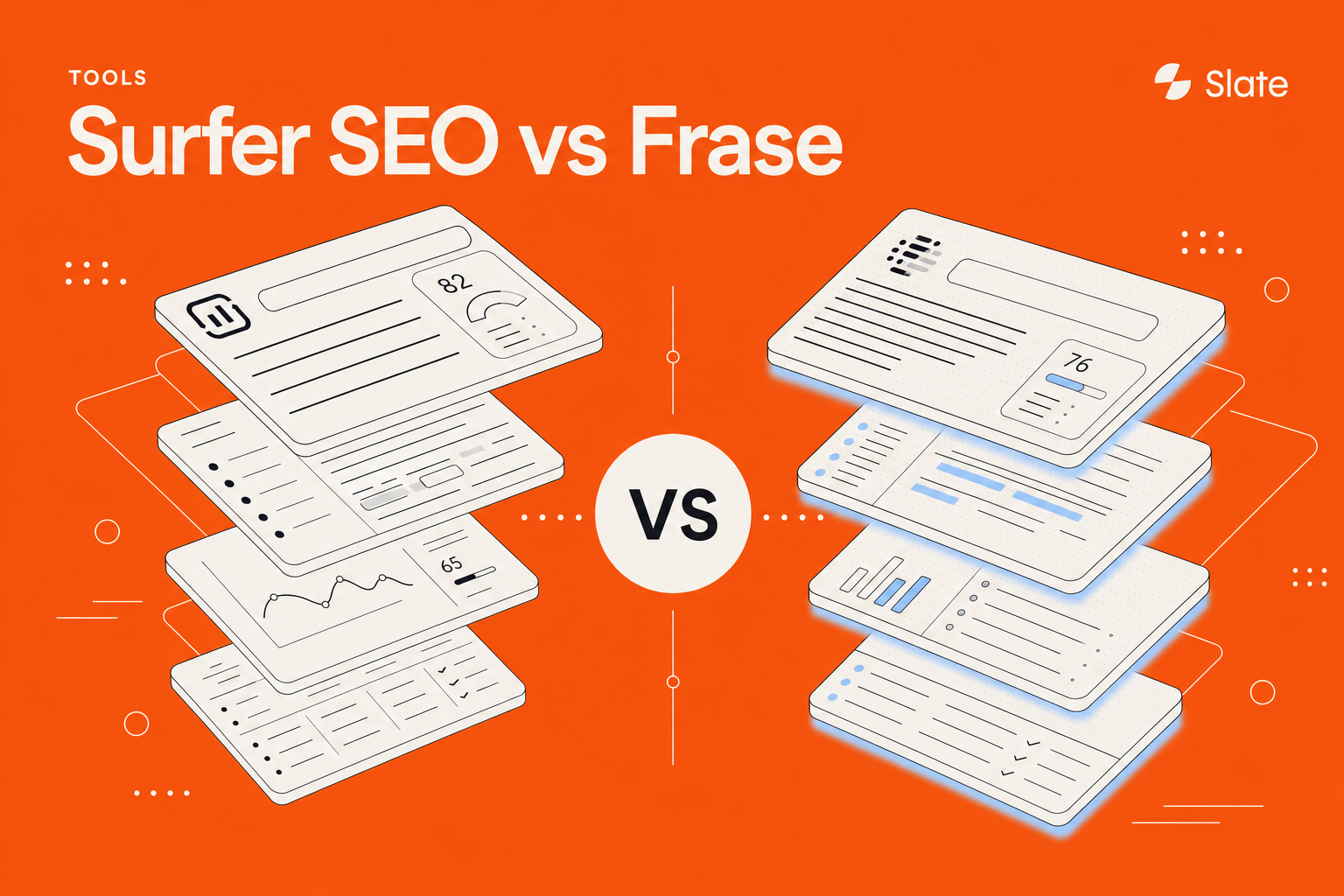
Choosing between Surfer SEO and Frase usually comes down to one question: are you buying optimization depth or research-to-brief speed? Both tools overlap, but they solve different parts of the content workflow, and the wrong pick means another underused subscription draining your budget.
The core difference: Surfer SEO is a data-dense on-page optimization platform built around SERP analysis, content scoring, and audits. Frase specializes in automating research, content briefs, and AI-assisted drafting, and now layers in AI-search and GEO visibility tracking. Surfer leans toward optimization depth; Frase leans toward workflow breadth and AI search.
Key Takeaways
If you skim nothing else, this is the decision in brief. Surfer SEO is the stronger pick when deep optimization, SERP correlation, and on-page audits are your primary job. Frase is the better fit when research throughput, brief automation, AI drafting speed, and AI search visibility matter more than raw scoring depth.
- Best for optimization-heavy workflows: Surfer SEO, thanks to its 500+ web-signal content score and dedicated SEO Audit.
- Best for research and brief-building speed: Frase, which compresses SERP research into automated briefs.
- Pricing snapshot: Surfer starts at $49/mo (Discovery), Frase starts at $49/mo (Starter); the difference shows up in usage caps and add-ons, not entry price.
- AI search positioning: Frase now actively markets itself as an AI search and GEO platform; Surfer remains SEO-first with AI visibility tracking added on.
- The bigger 2026 question: Does your stack produce citation-ready content that surfaces in AI answers, not just blue-link rankings? Frase now treats AI search as a core pillar, while Surfer still approaches it from an SEO-first base.
- No universal winner: Fit depends on team size, budget, refresh needs, and how much weight you place on AI visibility.
Surfer SEO vs Frase at a Glance
Both platforms have grown beyond their origins, but their centers of gravity remain distinct. Surfer pulls toward the optimization end of the workflow; Frase pulls toward research, briefs, and drafting. The table below maps where each tool earns its keep. For teams weighing the broader landscape, our roundup of the best AI SEO tools is a useful starting point.
For a wider field of options, see our roundup of Surfer SEO alternatives.
How We Evaluated Surfer SEO and Frase
Most comparisons skip the part where they tell you how they reached a verdict. This one uses an explicit rubric so you can weight the criteria that matter to your team rather than inheriting someone else's priorities.
The evaluation weights seven categories: optimization depth and scoring quality, research and brief quality, workflow speed across research-to-draft, content refresh and audit support, collaboration and governance, pricing and total cost of ownership, and AI-search readiness. Each was assessed using a same-task principle: run one seed keyword through both tools across every stage, then measure time to output, manual intervention required, and score uplift.
Before you buy, check these four things:
- How many articles or documents your team produces monthly, and whether each tool's caps fit.
- Whether your bottleneck is optimization precision or research throughput.
- How much you weight AI search visibility versus traditional rankings.
- Whether you need governance and approval controls for multiple writers.
What's the Difference Between Surfer SEO and Frase?
Surfer SEO and Frase solve overlapping but different problems. Surfer is a data-dense on-page SEO platform built around SERP analysis, content scoring, and audits. Frase specializes in automating research, content briefs, and AI-assisted drafting, and now layers in AI-search and GEO visibility tracking and guidance.
Where the two diverge is the point at which optimization ends and workflow value begins. Surfer assumes you already have a draft and want to tune it against the SERP with surgical precision. Frase assumes you're starting earlier - at research and brief creation - and want a single environment to carry an idea through to a publishable, optimized draft.
Both are evolving toward AI visibility, but only Frase markets generative engine optimization as a core product pillar. Surfer can support AI-ready content; it simply doesn't foreground it the same way. If GEO is central to your strategy, our list of the best generative engine optimization tools compares the dedicated options.
Workflow Comparison: Research, Briefs, Drafting, Optimization, and Refresh
The clearest way to choose is to compare operating models stage by stage, not feature checklists. Here's how each tool performs across the five phases of a content workflow.
Research and SERP Analysis
Surfer's SERP Analyzer breaks down the first page of Google with on-page factors and content scores for each competing URL, and its Content Editor draws recommendations directly from that analysis. Frase analyzes the top 20 results, returning averages for word count, headers, and images, plus extracted headings, topics, and user questions from sources like People Also Ask and Reddit.
Mini-verdict: Surfer is stronger for diagnostic SEO analysis; Frase is faster for brief-oriented research at scale.
Content Briefs and Outline Generation
Frase produces more complete, ready-to-assign briefs with less manual curation, especially when you care about questions, competitor headings, and topical coverage. It's widely credited with compressing 30–60 minutes of manual research into roughly two minutes.
Surfer can generate outlines through the Content Editor, but its interface is built to optimize a working draft rather than hand a writer a fully structured editorial brief. If briefs are your bottleneck, this gap matters. For deeper gap analysis, our guide to content gap analysis tools is a useful companion.
Mini-verdict: Frase is the dedicated brief engine; Surfer is the optimization editor.
Drafting and AI Writing
Both tools require human editing - AI assists, but strategy and judgment stay human. The practical difference is friction. Frase is generally regarded as the more writer-friendly, AI-drafting-first environment, with many reviewers describing a smoother path from AI draft to publishable copy.
Surfer offers AI writing integrated with its Content Editor, but its strength remains optimization data rather than the drafting experience itself. Expect a more optimization-led writing surface if you lean on Surfer as your primary drafting tool. If drafting velocity is your focus, our overview of the best AI content marketing tools covers adjacent options.
Mini-verdict: Frase for drafting velocity; Surfer for tuning what you've drafted.
Content Optimization and Scoring
For pure SEO optimization depth, Surfer is the more mature option. Its Content Score draws on 500+ web signals and is treated by many practitioners as an industry reference point for ranking correlation. Frase provides a solid optimization score plus competitor benchmarks, and now adds real-time GEO scoring in the same editor.
A word of caution on scores: treat them as guides, not goals. Chasing a high number can erode readability and dilute search intent. A score of 85 on a thin, keyword-stuffed page beats nothing - and loses to a 72 that actually answers the question well.
Mini-verdict: Surfer for score-driven SEO tuning; Frase if you want dual SEO + GEO scoring in one place.
Content Refresh and Post-Publish Optimization
Refresh is underdeveloped across the entire field, so this is where careful evaluation pays off. Surfer's dedicated Content Audit reviews existing URLs against competitors and suggests updates - missing terms, structural fixes, word-count changes - making it strong for classic SEO refresh programs.
Frase approaches refresh differently. Its AI Visibility tracking monitors how content performs across Google and AI search engines, helping you spot pieces losing visibility, with the AI Agent proposing fixes. For a structured approach, see our guides to refreshing content workflows and the best content refresh tools.
Mini-verdict: Surfer for keyword-led refresh; Frase for continuous AI + SEO visibility tuning.
Feature-by-Feature Breakdown
Beyond the core workflow, three operational areas separate these tools for scaling teams: linking and audits, collaboration, and integrations.
Internal Linking, Audits, and Topical Maps
Surfer offers a mature SEO Audit module that supports refreshes and can surface internal linking opportunities and keyword usage corrections. It also aids topical cluster planning through keyword research, though there's no standalone topical map product. Frase focuses on research, briefs, and AI visibility scoring; internal linking and topical mapping are less foregrounded. For cluster-building specifically, our list of AI tools for topic clusters goes deeper.
Team Collaboration, Governance, and Brand Control
This is where most comparisons go shallow. For multi-writer teams, consistency across writers is the real challenge - not the optimization score of any single page. Frase markets brand governance and centralized workflows more overtly, with its AI Agent operating inside defined rules while humans review and approve outputs.
Surfer supports teams through its agency and content-manager solutions, but it's not framed as a governance platform. If you're running ten writers across client accounts, you'll likely need to build approval and brand-voice controls into adjacent processes. Our guide to content operations best practices covers how to structure that.
Integrations and Workflow Fit
Surfer has a clear integration story: Google Docs for in-draft optimization, WordPress for publishing, and ChatGPT for prompt-driven writing with its NLP recommendations. This makes it easy to slot into a standard SEO writing stack. Frase centers its messaging on the agentic workflow rather than specific integration logos, so B2B SaaS teams with strict CMS or API requirements should confirm fit hands-on.
Surfer SEO vs Frase Pricing and Value by Team Type
Entry price tells you almost nothing here - both start at $49/mo. The real cost differences show up in usage caps, add-ons, and how each model scales with your output. Below, value is framed by team type rather than tier list.
Surfer SEO
Surfer is an AI search optimization and SEO content platform that helps teams create, optimize, and monitor content across Google and AI search.
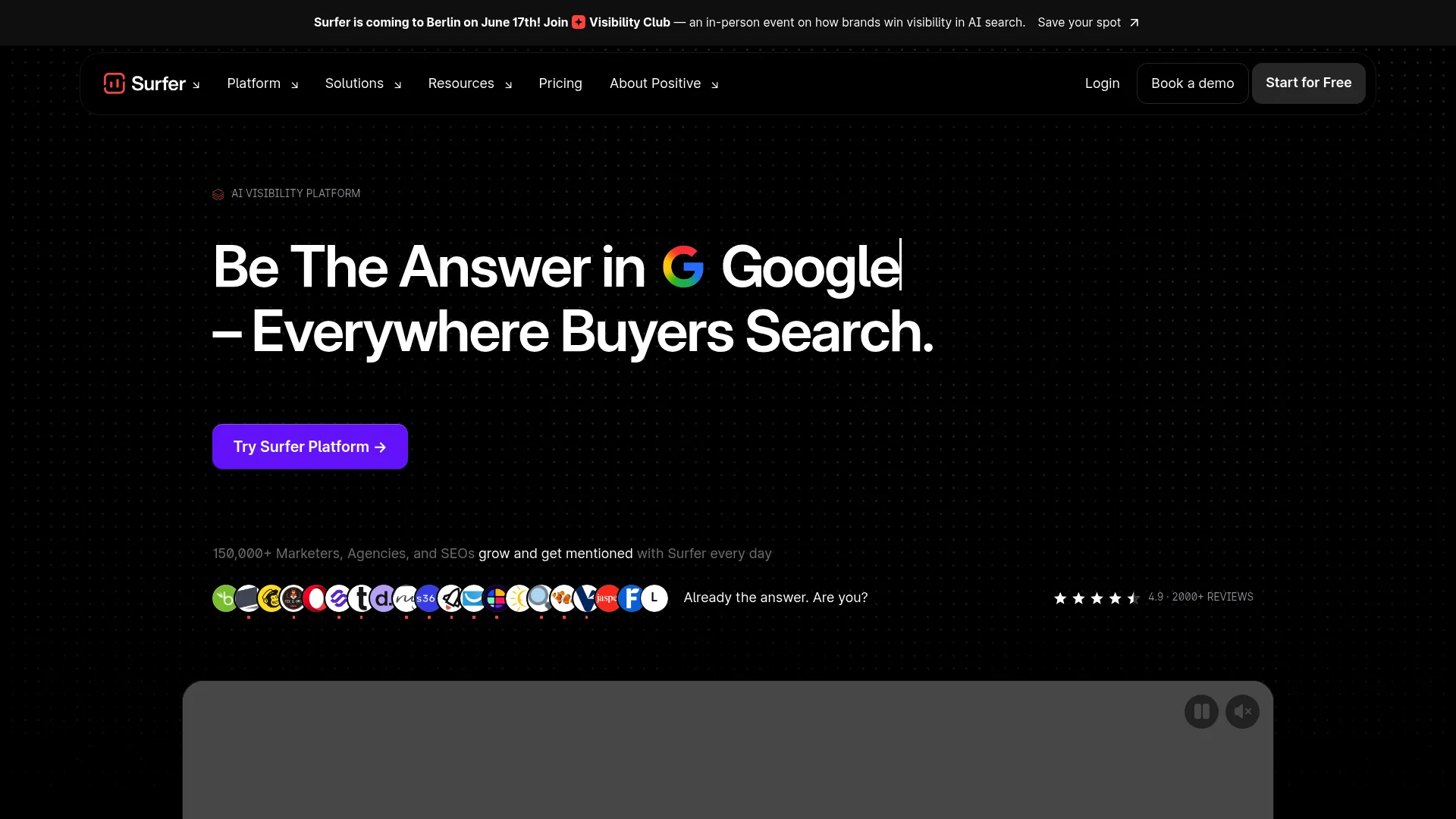
Best for: Marketing teams, SEOs, and agencies that want AI-search visibility tracking plus deep content optimization in one platform.
Key features: Create and optimize content with real-time AI SEO guidelines; track AI search visibility and brand mentions across tools like ChatGPT and Google AI Overviews; audit pages to uncover content gaps, cannibalization, and optimization opportunities.
Pricing: Discovery $49/mo, Standard $99/mo, Pro $182/mo, Peace of Mind $299/mo, Enterprise $999/mo. Prices shown billed yearly; a 7-day free Pro trial is available.
G2 rating: 4.8/5
Frase
Frase is an AI SEO and GEO platform that researches, writes, optimizes, publishes, and tracks content so it ranks on Google and gets cited by AI.
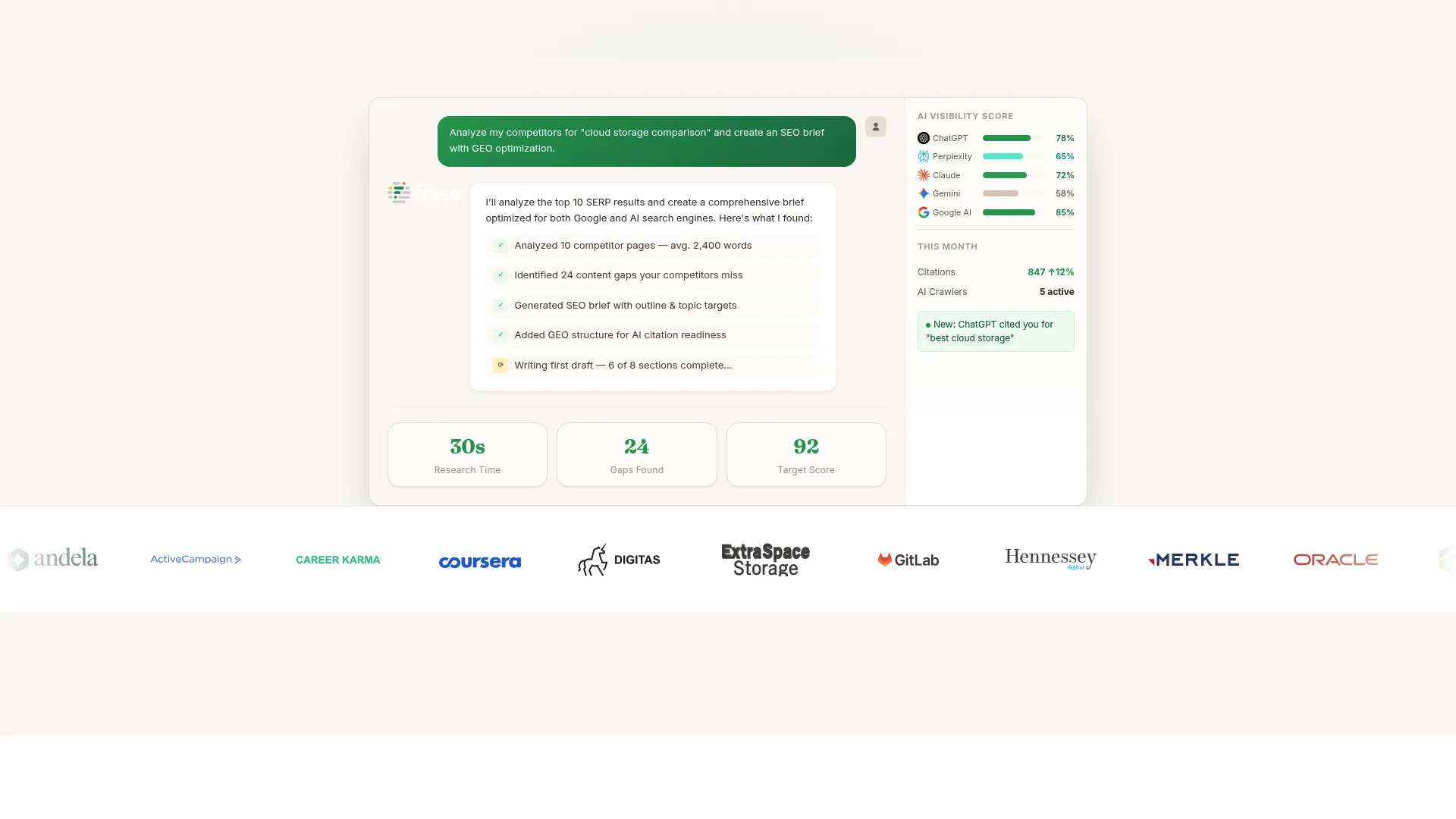
Best for: Content marketers, SEO teams, and agencies that want one platform for research, optimization, and AI search visibility tracking.
Key features: AI agent for content research, writing, optimization, and publishing; SEO + GEO content optimization with real-time scoring; AI visibility tracking across Google and major AI engines.
Pricing: Starter $49/mo, Professional $129/mo, Scale $299/mo, Enterprise custom. Annual billing saves 20%; a 7-day free trial is available.
G2 rating: 4.8/5
Value by team type:
- Solo creators and budget bloggers: Frase's strong briefs and AI drafting make it the more practical entry point, provided you watch document limits and AI add-ons. Surfer's higher tiers make sense only if you value per-piece optimization precision.
- Agencies: Surfer wins for SEO-specialist agencies selling optimization and audits. Frase wins for content-production agencies running high volume, where its scaling plans and AI Agent offer more leverage.
- In-house B2B SaaS teams: Choose Surfer if your challenge is proving SEO performance and fine-tuning key pages. Choose Frase if your bottleneck is research throughput and AI search visibility across many topics.
If you only care about optimization depth, choose Surfer. If you only care about research-to-brief speed and AI visibility, choose Frase.
Surfer SEO Pros and Cons
Surfer earns its reputation on optimization rigor, but that same focus introduces a trade-off worth naming.
Pros: Best-in-class SERP analysis and content scoring built on 500+ web signals; strong Content Editor UX for optimizing drafts against competitors; dedicated SEO Audit for existing pages; clean integrations with Google Docs, WordPress, and ChatGPT; widely trusted by professional SEOs and agencies.
Cons: Higher effective cost as you scale into deeper optimization needs; score-first design can encourage over-optimization if users chase numbers at the expense of readability and intent; less emphasis on AI-search/GEO features and brand governance compared with Frase.
Frase Pros and Cons
Frase's breadth across research, drafting, and AI visibility is its biggest strength - and the source of its main limitation.
Pros: Exceptional research and brief automation; writer-friendly AI drafting that many operators prefer over alternatives; explicit AI-search/GEO orientation with visibility tracking across Google, ChatGPT, and Perplexity; accessible entry pricing with scaling plans for high-volume production.
Cons: Pure SEO optimization depth and SERP correlation scoring are generally viewed as secondary to Surfer's; lower tiers carry document limits and paid add-ons that can complicate budgeting; governance controls are marketed clearly but warrant hands-on validation before relying on them at scale.
Which Tool Is Best for You?
There's no universal winner - only the better fit for your team, budget, and visibility goals. Use these persona-based recommendations to shortcut the decision.
Best for Solo Creators and Budget-Conscious Bloggers
Frase. Its lower friction on briefs and AI drafting helps a solo operator move from idea to published article quickly, and the entry plan is workable as long as you monitor document caps and AI add-ons.
Best for Agencies and Multi-Writer Teams
It splits. Surfer suits SEO-specialist agencies that sell optimization and audits as a service. Frase suits content-production agencies running high article volume across many writers, where its centralized workflows and AI Agent reduce coordination overhead. Compare the broader field in our best AI SEO tools roundup.
Best for In-House B2B SaaS Content Teams
Surfer if your priority is precise on-page optimization and proving SEO performance on key pages. Frase if your bottleneck is research throughput and AI-assisted drafting across a large topic surface, especially with AI visibility on the roadmap.
Best for Refreshing Existing Content
Surfer for classic SEO refresh anchored in audits and SERP correlation. Frase if you define refresh as continuous tuning across both Google and AI search visibility, with an agent suggesting changes.
Best for Teams Prioritizing AI Search Visibility
Frase is better aligned here, given its explicit GEO scoring and visibility tracking across ChatGPT and Perplexity. Surfer can support the same goal through AI visibility tracking, but its core frame remains SEO-first. Teams that treat AI discovery as a system, not a per-article task, often outgrow single-tool optimization. The best AI visibility tools show how this is shifting. Slate is built specifically for that AI-search-first reality.
What Changed for Surfer vs Frase in 2026
The biggest shift this year isn't a feature - it's the distribution layer. AI Overviews, answer engines, and zero-click discovery now sit between your content and your audience, which changes what "visibility" even means.
Frase responded by repositioning itself as an agentic SEO and GEO platform. It now tracks visibility across Google, ChatGPT, and Perplexity, scores content for both SEO and GEO in a single editor, and pushes an AI Agent designed to research, write, optimize, and monitor. The framing is explicitly AI-search-centric.
Surfer's positioning held steady: SERP correlation, content scoring, and audits, with AI visibility tracking added on rather than made the headline. That consistency is a strength for SEO-led teams, but it means citation readiness and extractable formatting are not the product's organizing principle.
The honest read: Frase moved much more explicitly into AI visibility and GEO, while Surfer layered AI visibility tracking onto a traditional SEO model. Measuring success beyond rankings is now the baseline, and structuring content so AI systems can extract and cite it is the new table-stakes skill. Our primer on AI SEO explains why.
Beyond Optimization - Engineering Content for AI Search Visibility
Here's the reframe worth sitting with. Rankings are part of the story, but the bigger question is whether your stack builds a repeatable visibility system across both search and AI discovery - not whether you can optimize one article to a higher score.
AI search does not reward individual blog posts. It rewards systems that consistently produce clear, referenceable answers across a topic surface. That's a different discipline from per-page optimization. It's content engineering: citation-ready structure, brand-safe AI workflows, refresh velocity, and visibility measured where buyers actually find you. Understanding how AI citations work is foundational to that discipline.
This is the gap neither Surfer nor Frase was built to close end to end. Slate operates as the system of action for AI-driven organic growth - connecting AI visibility tracking across ChatGPT, Google AI Mode, AI Overviews, and Perplexity to scalable, brand-safe content execution through workflows and bulk operations. The point isn't to replace optimization; it's to engineer visibility as a repeatable system rather than a one-off tweak.
Pricing: Starting at $199/mo.
G2 rating: 4.9/5
If your goal is being found across both search and AI answers, it's worth evaluating beyond single-tool optimization. Learn more about content engineering or book a demo.
Final Verdict: Surfer SEO vs Frase
Neither tool is universally better. Surfer SEO wins for deep on-page optimization, SERP correlation, and content audits - the right pick for SEO-led teams willing to invest in precision. Frase wins for research-to-brief speed, AI-assisted drafting, and AI-search/GEO visibility - the better fit for content-ops-led teams.
Applying the rubric: Surfer takes optimization depth, scoring quality, and classic refresh. Frase takes brief completeness, workflow speed, drafting friction, and AI-search readiness. They tie on entry price; the divergence is in caps, add-ons, and where your bottleneck lives.
The deciding factor isn't a leaderboard. It's whether you value optimization depth or workflow breadth, and how much weight you place on AI visibility. If visibility across both search and AI answers is the real goal, evaluate systems built for that - not single-tool optimization alone.
Frequently Asked Questions
Is Frase better than Surfer SEO?
Neither is universally better. Surfer is stronger for deep on-page optimization, SERP analysis, and content scoring. Frase is stronger for automating research, content briefs, AI-assisted drafting, and AI-search/GEO visibility. The right choice depends on whether you prioritize optimization depth or workflow breadth and AI search readiness.
What is the difference between Surfer SEO and Frase?
Surfer is a data-dense on-page SEO platform built around SERP analysis, content scoring, and audits. Frase specializes in automating research, content briefs, and AI-assisted drafting, and adds AI-search and GEO visibility tracking. Surfer leans toward optimization depth; Frase leans toward research-to-brief speed and broader workflow coverage.
Which tool is better for content optimization?
Surfer SEO is the more mature option for pure optimization, with a Content Score built on 500+ web signals and a dedicated SEO Audit. Frase offers solid scoring plus GEO metrics in one editor. Treat any score as a guide, not a goal - score quality and intent matter more than the number.
Is Surfer SEO worth it compared with Frase?
It depends on your bottleneck. Surfer is worth it for teams that value precise on-page optimization, SERP correlation, and audits. If your constraint is research throughput, brief speed, or AI search visibility, Frase delivers more value per workflow. Both start at $49/mo, so compare usage caps and add-ons, not entry price.
Which tool is better for content briefs?
Frase. It automates SERP research into writer-ready briefs, capturing competitor headings, topics, and user questions, and compresses what would take 30–60 minutes into roughly two minutes. Surfer generates outlines through its Content Editor but is built to optimize working drafts rather than produce standalone editorial briefs.
Which tool is easier for beginners?
Frase generally has the lower learning curve for getting from idea to draft, thanks to automated briefs and AI drafting. Surfer requires slightly more SEO judgment to interpret scores and SERP data well. Both reward users who understand search intent; neither replaces strategic thinking entirely.
Which tool is better for agencies?
It depends on the agency model. Surfer fits SEO-specialist agencies selling optimization and audits, with strong SERP correlation and repeatable workflows. Frase fits content-production agencies running high article volume, offering centralized workflows, governance messaging, and an AI Agent that reduces coordination overhead across multiple writers and clients.
How do Surfer SEO and Frase compare for multi-tool stacks (e.g., vs Clearscope or Page Optimizer Pro)?
In multi-tool stacks, Surfer and Frase cover research, briefs, and optimization, while Clearscope and Page Optimizer Pro act as additional scoring or content-quality layers. Surfer overlaps more with those score-first tools; Frase complements them by handling research, briefs, AI writing, and AI visibility tracking in one platform.