The best SEO rank tracking software depends on what your team does after visibility changes. Slate is the strongest fit for content teams that need AI search visibility, content operations, publishing, and measurement in one platform.
Semrush fits broad SEO-suite evaluation. Google Search Console remains the free first-party baseline.
Keyword positions still matter, but they don’t describe the whole discovery picture. AI-generated answers can surface brands, cite sources, or omit pages even when conventional Google rankings look stable.
This guide compares nine tools by tracking use cases, pricing context, AI visibility definitions, and the workflow after a ranking or AI-visibility gap appears.
Key Takeaways
- Slate is the strongest fit for content teams that need AI visibility signals, content workflows, publishing, outreach, and measurement in one platform.
- Semrush fits teams that want a broad SEO suite with rank tracking inside it.
- AccuRanker suits teams that want frequent, on-demand refreshes at high keyword volumes.
- Nightwatch and Keyword.com fit teams that need city- and ZIP-level tracking.
- Google Search Console is a free first-party Google performance baseline, but average position differs from a live rank check.
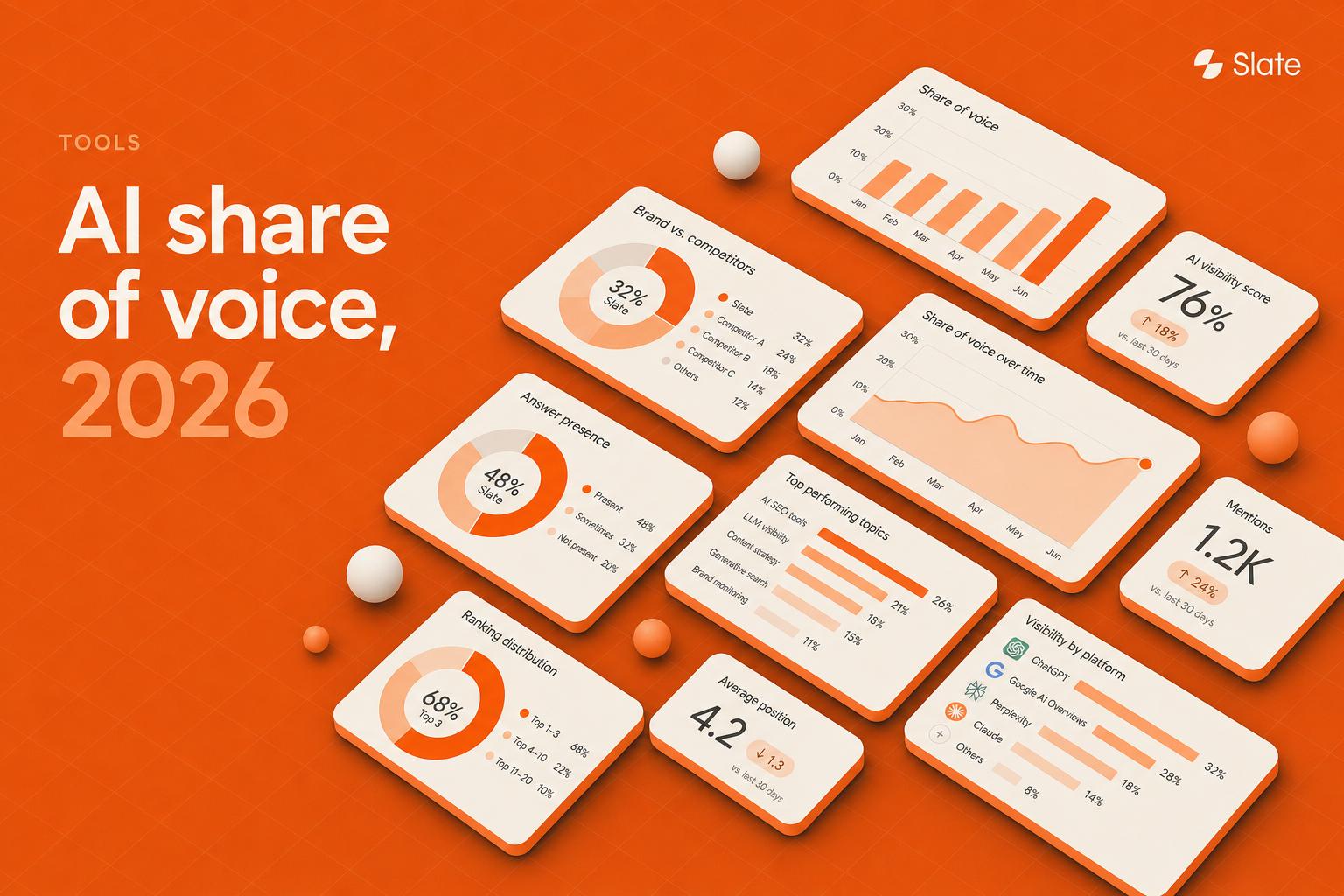
- AI visibility should be defined by metric: Mention, citation, answer inclusion, sentiment, prompt coverage, or share of voice.
- Rank tracking is a signal. The outcome depends on whether the team can diagnose, prioritize, publish, and measure the change.
The Nine Best SEO Rank Tracking Software Tools At A Glance
A good SEO rank tracker should help teams monitor search engine rankings, spot material changes, and decide what to do next. For content teams, the bigger question is whether the software stops at reporting or connects the signal to execution.
AI visibility has several possible meanings. A vendor may measure brand mentions, source citations (see Slate’s guide to AI citation tracking tools), answer inclusion, sentiment, prompt coverage, or a share-of-voice model.
Pricing can also hide operational differences. Keyword limits aren’t comparable unless cadence, locations, devices, competitors, seats, prompts, and API access are considered together.
How We Evaluated SEO Rank Tracking Software
The practical value of SEO rank tracking software depends on the decisions it supports. A daily ranking change helps only if the team can interpret it, assign an owner, and connect it to a content or technical action.
Slate is listed first for one specific criterion: Content teams that need the loop from visibility signal to published update in one operating system.
Ranking Freshness And Accuracy
Daily rank updates, scheduled refreshes, and on-demand checks serve different jobs. Active launches may need frequent validation, while lower-priority keywords can often be monitored less often. Tools may disagree because location, device, language, timing, personalization, and SERP interpretation vary.
Ask the vendor: Does cadence apply to every keyword, location, and device?
Local, Mobile, And Multi-Search-Engine Coverage
Local rank tracking is more than a country selector. Teams may need city-level rank tracking, ZIP-code rank tracking, local pack tracking, map pack rankings, mobile rank tracking, desktop rankings, Google rankings, Bing rankings, or broader multi-search-engine tracking.
Ask the vendor: Can location and device be separated in reporting?
AI Search Visibility And Brand Monitoring
“Tracks AI search” is too broad to be useful. Buyers should ask whether the tool measures AI Overview tracking, AI Mode tracking, ChatGPT visibility tracking, Perplexity visibility tracking, citation inclusion, brand mention monitoring, sentiment, prompt coverage, or AI share of voice.
Ask the vendor: How does the tool score an AI visibility win?
Reporting, Integrations, And Agency Workflows
Rank tracking becomes operational when reports reach the right audience. Agencies often need scheduled reports, white-label reports, client reporting, role-based seats, API access, and exports. In-house teams usually need Google Search Console and Google Analytics data reconciled with ranking movement.
Ask the vendor: Which reporting features are included in the plan?
From Insight To Execution
Some platforms stop at dashboards. Others support briefs, content updates, bulk edits, publishing, outreach, and post-publish measurement. That counts when a ranking alert needs to become a prioritized task instead of another chart.
Ask the vendor: What happens after a ranking, citation, or traffic gap is detected?
Don’t compare keyword limits in isolation. A 10,000-keyword plan refreshed weekly across one location is not comparable to a 2,000-keyword plan refreshed daily across five locations and two devices.
1. Slate: Best For Content Teams That Need Rank Tracking, AI Visibility, And Execution In One Platform
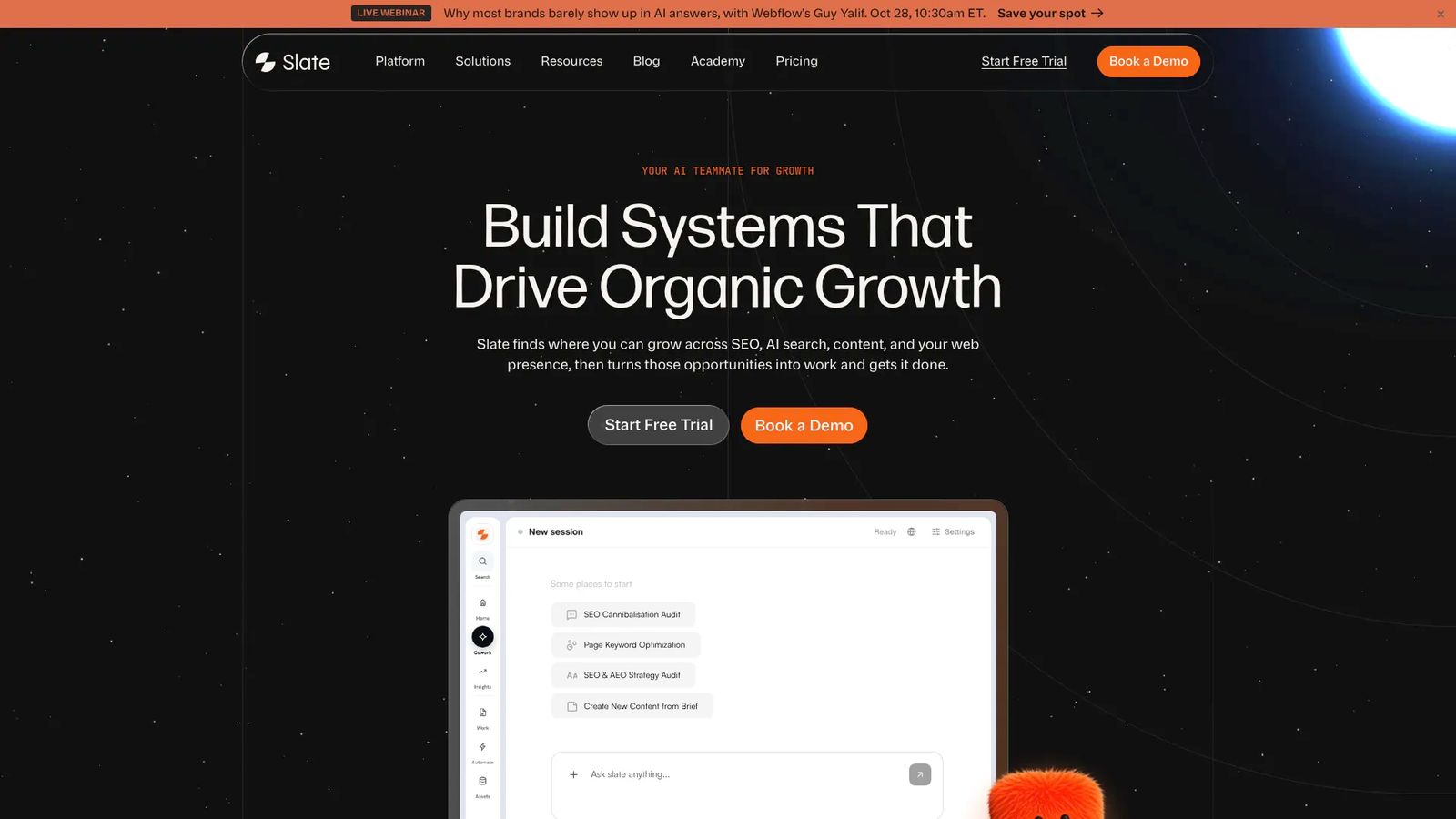
Best for: SEO leaders, content operations teams, organic-growth marketers, and agencies that need to turn search and AI-visibility signals into content updates, publishing workflows, outreach, and measurement.
Slate’s fit is narrow and operational: Teams that need visibility data to become work. If a page loses ground, a topic becomes underrepresented in AI answers, or a content cluster starts decaying, Slate helps teams move from detection to execution.
The platform combines Keywords for Google rank tracking, AI Search Analytics, Opportunities, Cowork, Workflows, Sheets, SuperBlocks, Pages, and Outreach. AI Search Analytics tracks ChatGPT, Google AI Mode, Google AI Overviews, and Perplexity on every plan.
Claude and Gemini are add-on answer packs.
Key features:
- AI Search Analytics for AI search visibility across supported answer engines. Keywords for Google rank tracking by page, with rank movement tied to Search Console clicks and impressions.
- Opportunities for keyword gaps, AI visibility topic changes, suggested prompts, third-party outreach targets, and content decay.
- Cowork for delegating content and SEO work in natural language.
- Workflows for repeatable content automation.
- Sheets for bulk content refreshes, audits, and portfolio-scale work.
- SuperBlocks for reusable workflow components.
- Pages for performance monitoring.
- Outreach for third-party outreach workflows.
- CMS publishing to Webflow, Sanity, and WordPress.
- Built-in Semrush data.
Pricing: Growth $499/month; Scale $999/month; Agency $2,000/month; Enterprise custom. Growth includes 1 user. Scale and above offer custom user and workspace counts Annual billing saves 20%. A 14-day free trial is available.
Considerations: Slate is broader than a lightweight keyword position checker. Teams that only need a low-cost tracker for a small keyword list may prefer a narrower tool.
Slate is also not a generic creative proofing platform for non-content assets such as video, visual brand campaigns, or creative review workflows.
Choose Slate if: Your team needs AI visibility tracking, content refresh workflows, CMS publishing, outreach, and measurement in one system.
Skip Slate if: You only need a simple rank tracker and don’t need execution workflows.
2. Semrush: Best For Larger Teams Evaluating A Broad SEO Suite
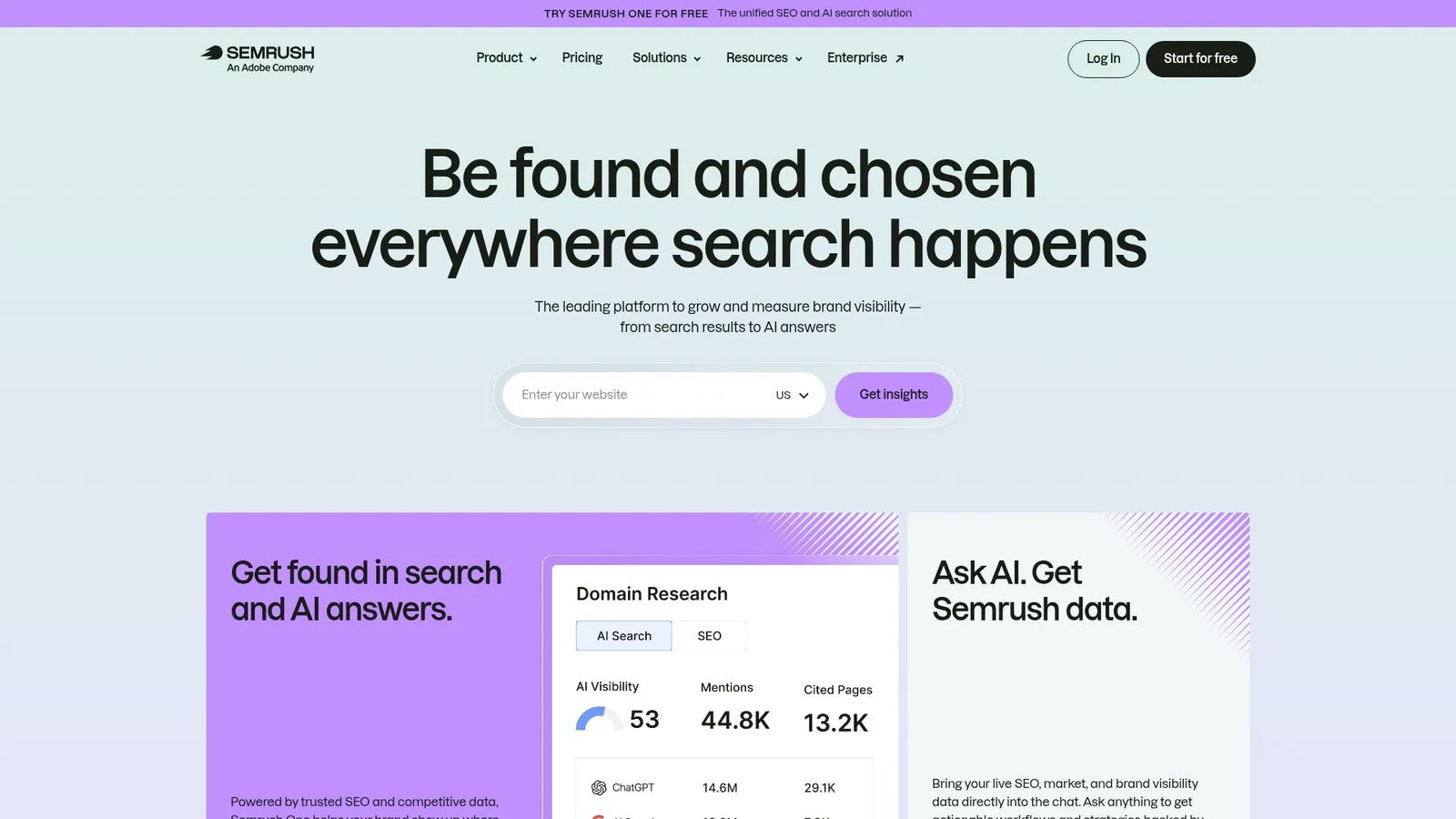
Best for: Teams that want to evaluate rank tracking as part of a broader SEO software purchase.
Semrush fits teams that don’t want a standalone keyword rank tracker. The buying case is usually broader: Position tracking alongside other SEO workflows, reporting needs, competitive research requirements, and AI visibility features.
Key features to evaluate:
- Position tracking scope.
- Location and device options.
- Reporting workflows.
- Competitor tracking.
- API and export requirements.
- AI visibility metric definitions.
Pricing: Semrush’s SEO plan starts at $139/month and includes Position Tracking with 500 keywords tracked daily. Higher SEO + AI Search plans increase limits and AI visibility capacity. Multi-location and device tracking and keyword cannibalization analysis start on Pro+ ($299/month).
Considerations: Semrush should be evaluated at the exact plan and workflow level a team intends to use. Buyers comparing it against dedicated rank trackers should look closely at cadence, tracked locations, devices, reporting, and any AI visibility definitions.
Choose Semrush if: Your team wants rank tracking inside a broader SEO suite.
Skip Semrush if: You want a narrow rank tracker and don’t need suite-level SEO tooling.
3. SE Ranking: Best For Balancing Budget Evaluation With Rank Tracking Needs
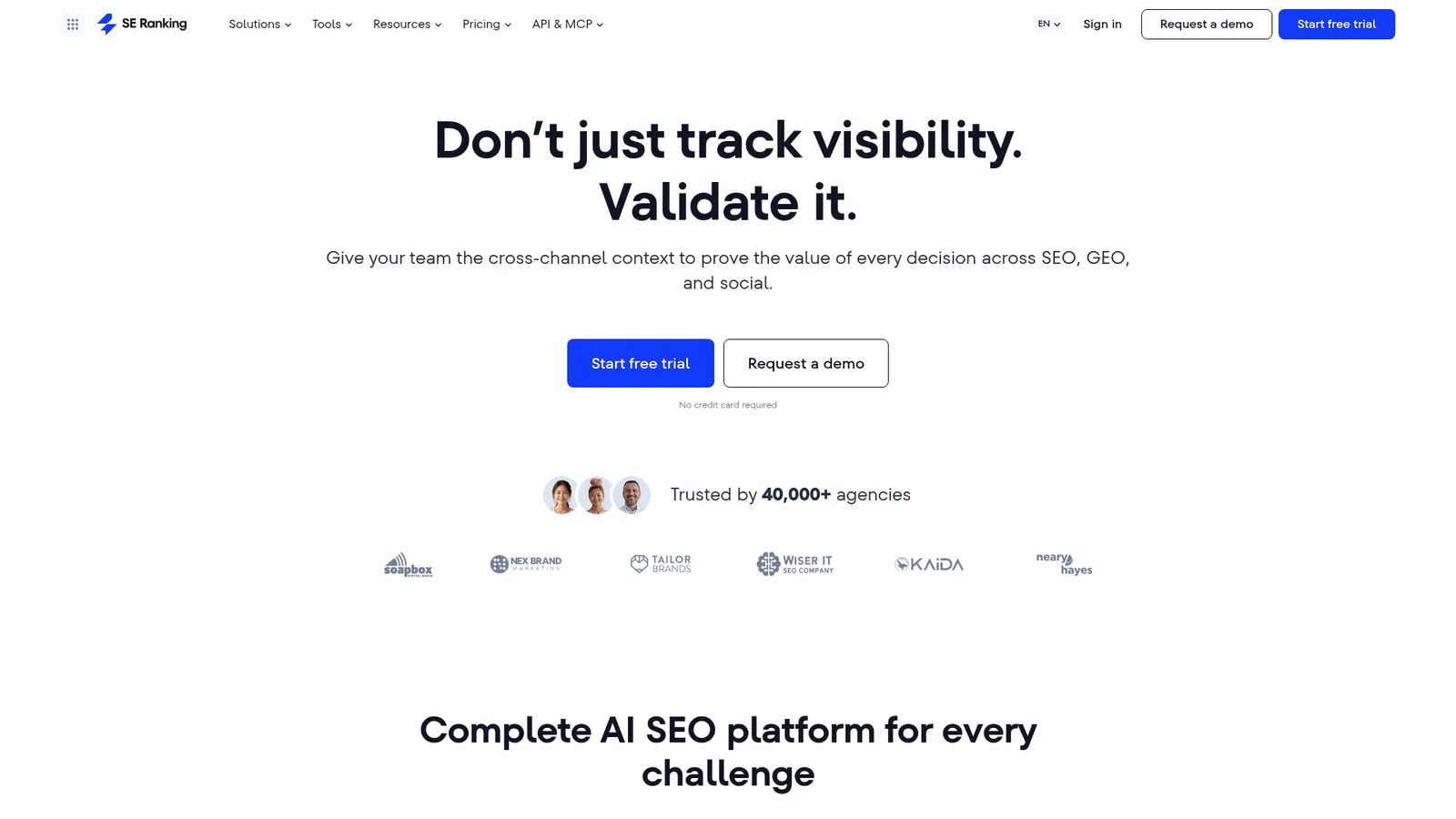
Best for: Teams comparing rank tracking options with budget sensitivity and practical reporting needs.
SE Ranking makes most rank-tracker shortlists for its balance of capability and price. SE Ranking lists rank tracking across major search engines, daily keyword tracking, local and map rank tracking, reporting, exports, and integrations.
Key features to evaluate:
- Supported search engines.
- Location and device segmentation.
- Keyword position tracking.
- Reporting options.
- AI visibility scope.
- Plan-level limits.
Pricing: SE Ranking’s Core plan starts at $129/month and includes 2,000 daily keywords. SE Ranking also offers Growth and Enterprise options, with AI Search available as an add-on.
Considerations: Buyers should define whether they need simple rank monitoring, client reporting, local rank tracking, or AI visibility before comparing plans. Those use cases can create very different capacity requirements.
Choose SE Ranking if: Your team wants to evaluate a budget-conscious SEO rank tracker.
Skip SE Ranking if: Your main need is an execution layer for content refresh, publishing, outreach, and AI search workflows.
4. AccuRanker: Best For Teams Comparing Refresh-Heavy Rank Tracking
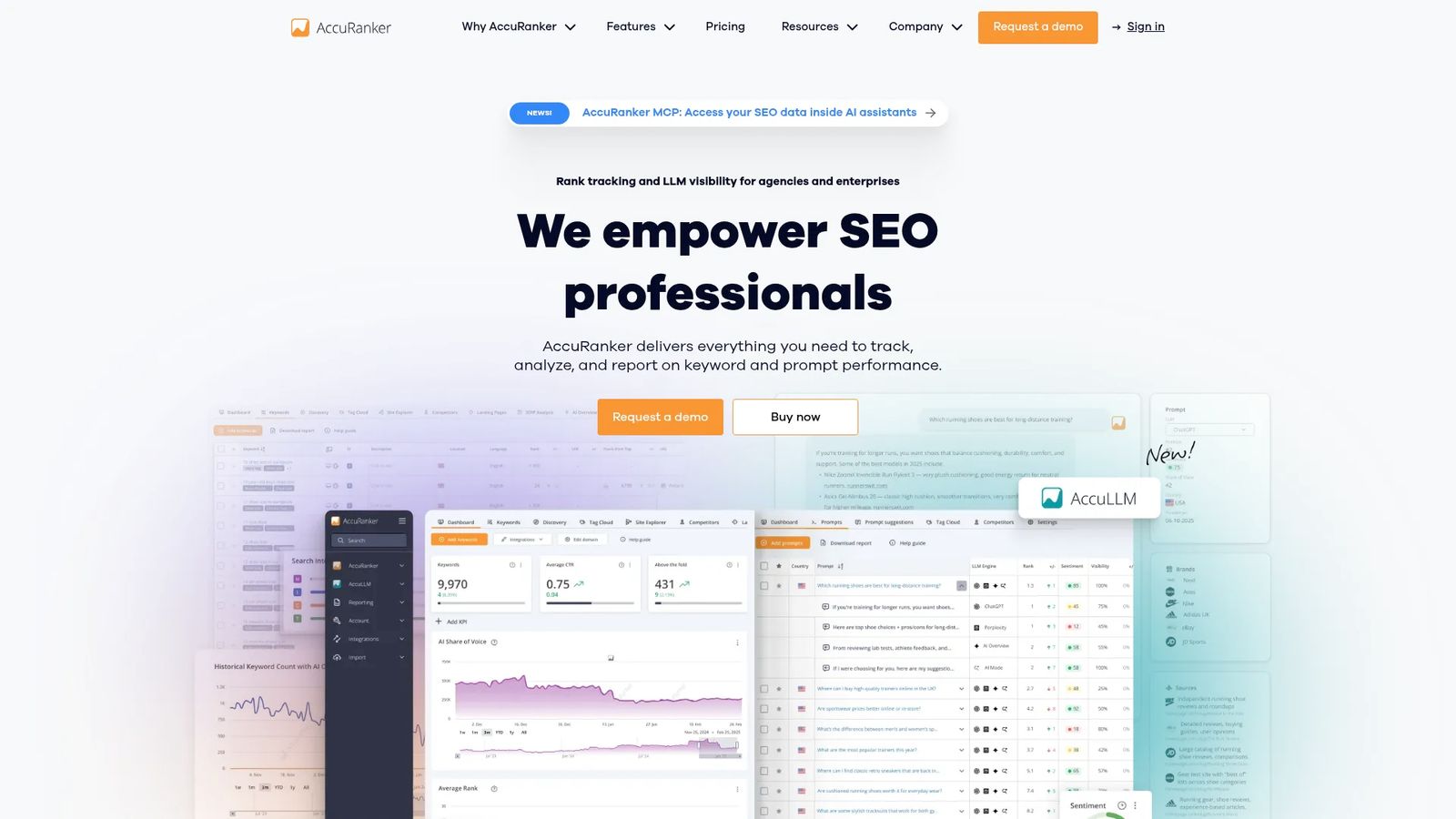
Best for: Teams that care about rank tracking refresh models and high-volume monitoring.
AccuRanker is built for teams that want rank tracking to move faster than a weekly report. That use case appears when a team has just deployed content changes, needs to prepare for a stakeholder update, or wants to understand whether a ranking movement is still unfolding.
Key features to evaluate:
- Refresh model.
- Keyword capacity.
- Location and device tracking.
- Reporting and exports.
- API access.
- AI visibility definitions.
Pricing: AccuRanker starts at $224/month for the Professional plan. Expert and Enterprise options are available for larger teams and higher-volume tracking needs. AI visibility is a separate product, AccuLLM.
Considerations: Refresh-heavy tracking can look attractive, but the operational question is whether the team will act on the extra checks. If the workflow after a ranking alert is unclear, faster data may not improve execution.
Choose AccuRanker if: Your rank tracking evaluation prioritizes refresh flexibility and keyword monitoring depth.
Skip AccuRanker if: Your team needs content workflow, CMS publishing, and AI-search execution in the same platform.
5. Nightwatch: Best For Local Rank Tracking Evaluation
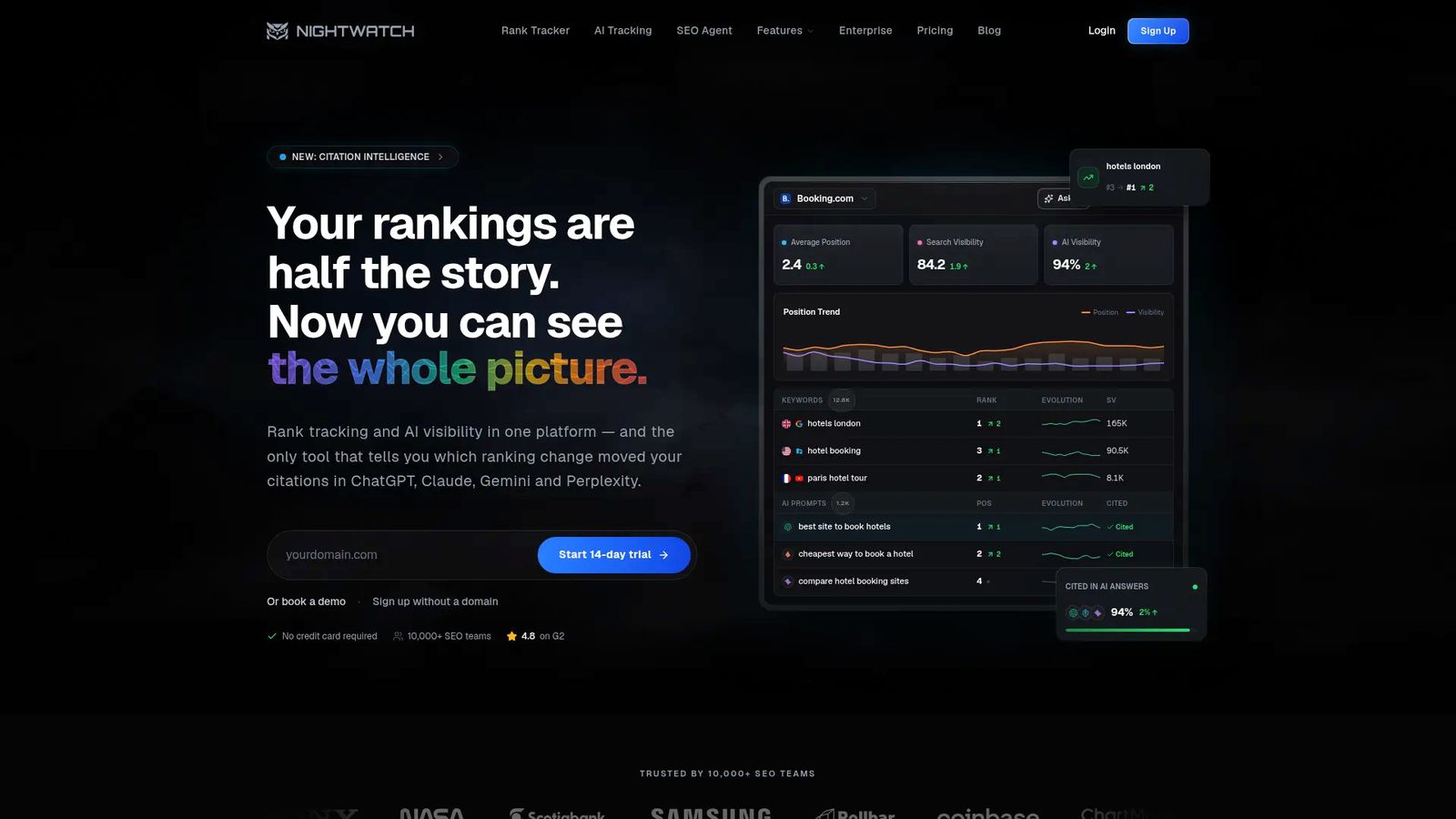
Best for: Teams evaluating local rank tracking for multi-location visibility monitoring.
Nightwatch is a common pick for local SEO rank tracking.
Its plans include rank tracking, AI visibility, reporting, and local tracking capabilities, with plan differences mainly tied to volume and advanced account needs.
Key features to evaluate:
- City and ZIP-code options.
- Mobile and desktop separation.
- Local pack and map pack reporting.
- Supported search engines.
- Scheduled reporting.
- AI visibility scope.
Pricing: Nightwatch starts at €79/month for 500 daily tracked keywords and 50 AI prompts. A 14-day free trial is available.
Considerations: Local rank tracking is sensitive to geography, device, language, and timing. Teams should test the locations they care about instead of relying on national averages.
Choose Nightwatch if: Your team is evaluating local rank tracking depth as a primary buying criterion.
Skip Nightwatch if: The main need is a content-operations platform that carries insights through publishing and measurement.
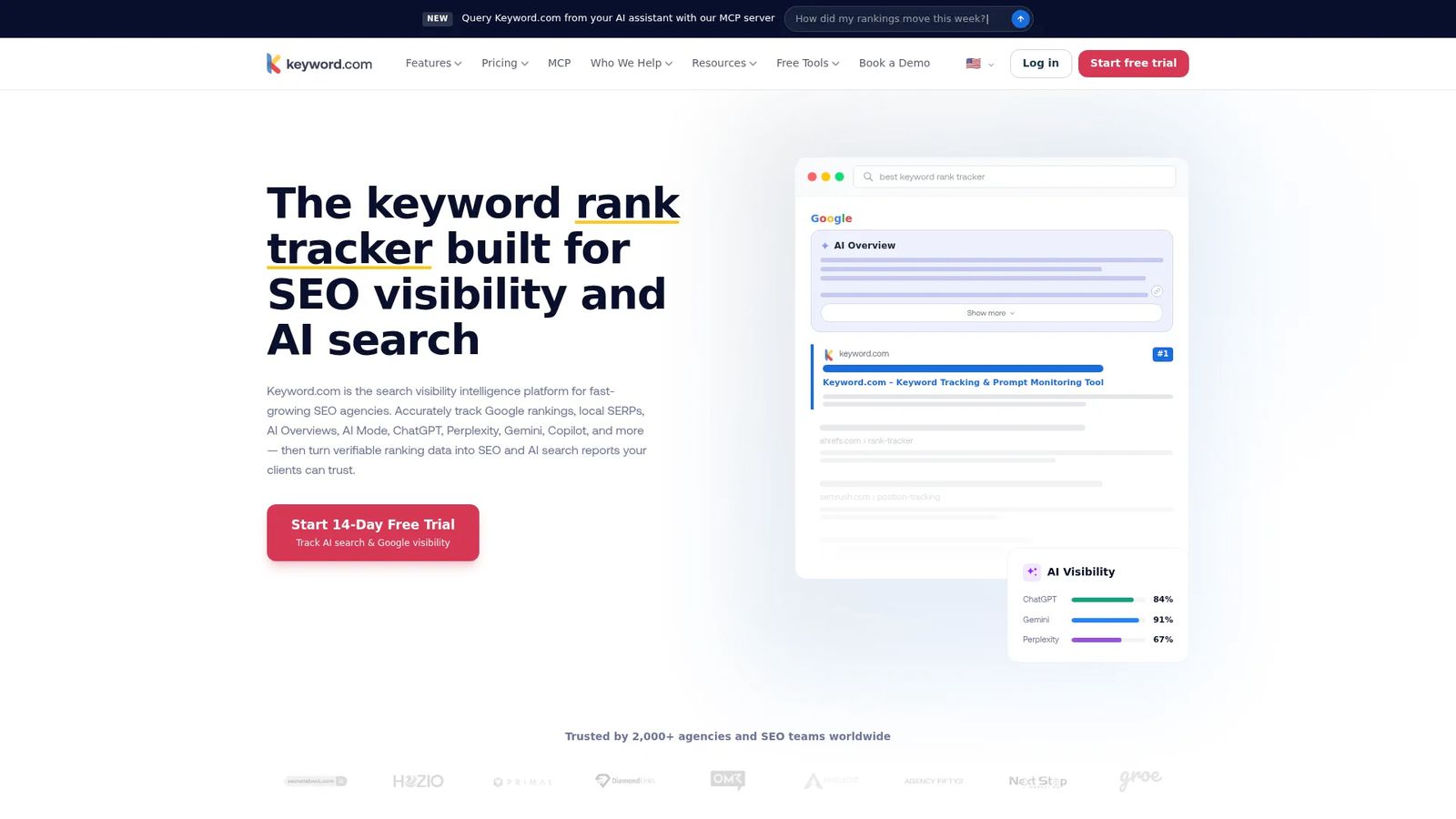
6. Keyword.com: Best For City And ZIP Tracking Evaluation With AI Visibility Pricing Context
Best for: Teams comparing local rank tracking and AI visibility pricing models.
Keyword.com fits buyers who need rank tracking plus local and AI visibility.
Key features to evaluate:
- City-level tracking.
- ZIP-code tracking.
- API pricing.
- Agency workflows.
- AI Visibility credit model.
- Reporting and exports.
Pricing: Keyword.com’s Search Visibility plan starts at $4/month, or $3/month billed annually. AI Visibility starts at $9.80/month, or $7.83/month billed annually. 360° Visibility starts at $33/month, or $26/month billed annually. AI Visibility covers ChatGPT, Perplexity, AI Mode, AI Overviews, Gemini, Claude, Copilot, DeepSeek, and Mistral.
Considerations: Keyword.com pricing separates Google search visibility, AI visibility, 360° visibility, and API-only access. Buyers should compare the combined operating cost if they need both conventional SERP tracking and AI visibility monitoring.
Choose Keyword.com if: Your team is evaluating city or ZIP-level rank tracking with separate AI visibility pricing.
Skip Keyword.com if: You need content briefs, bulk refreshes, CMS publishing, and outreach in the same workflow.
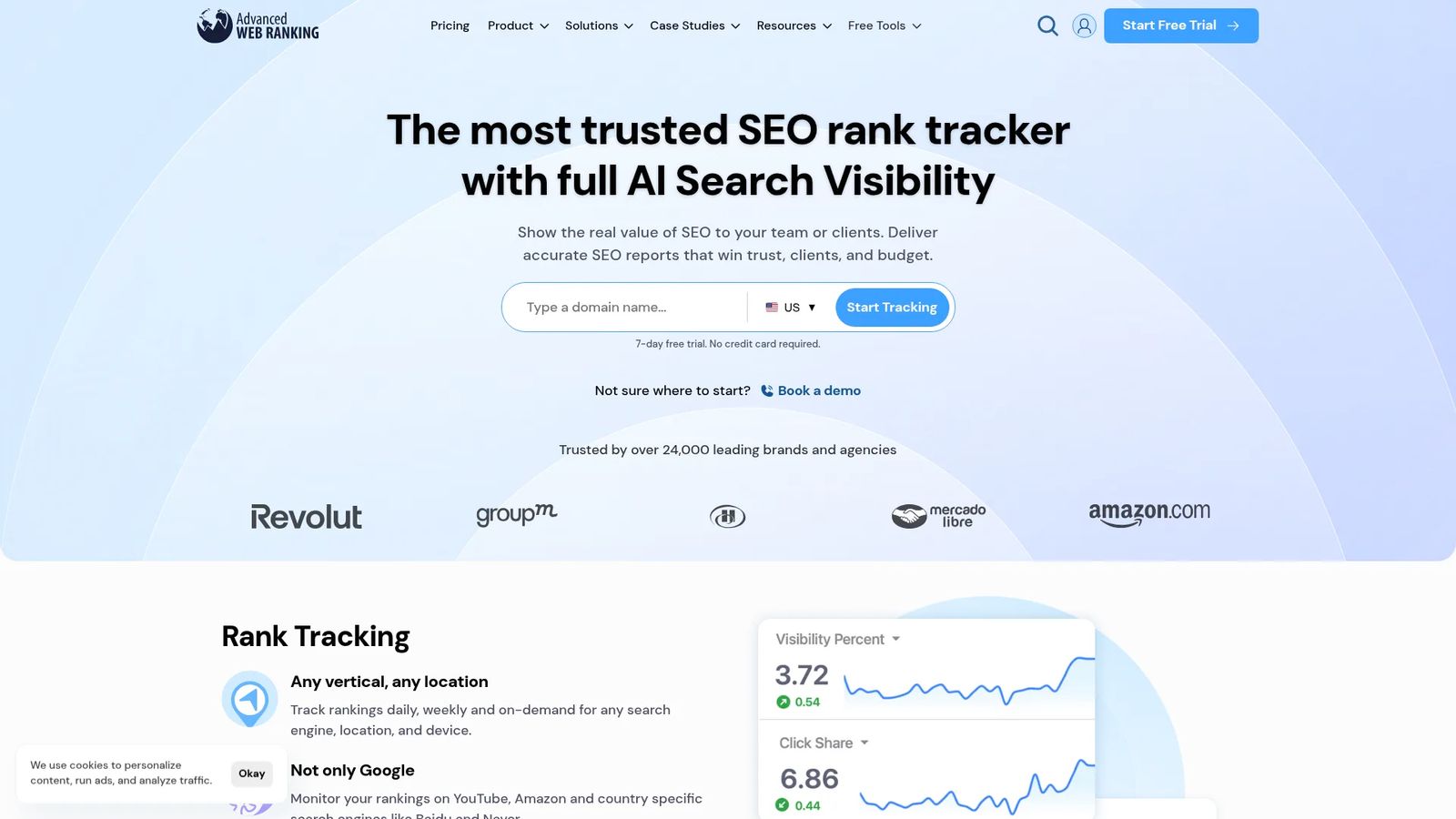
7. Advanced Web Ranking: Best For Reporting-Focused Rank Tracking Evaluation
Best for: Teams comparing rank tracking tools with reporting as a major buying factor.
Advanced Web Ranking suits buyers who care about reporting as much as raw ranking positions. Its pricing model is based on keyword units, which makes update frequency, search engines, locations, and device settings important parts of the evaluation.
Key features to evaluate:
- Report customization.
- Client-ready reporting.
- White-label options (Agency plan and up, which is also where API access starts).
- Local and mobile coverage.
- API access.
- AI visibility definitions.
Pricing: Advanced Web Ranking starts at $139/month for the Pro plan. That plan supports 7,000 keywords updated once a week on one search engine, single location, and device; changing cadence or tracking configuration changes unit consumption. Pro also includes AI visibility tracking and AI citations and mentions.
Considerations: Reporting depth doesn’t automatically solve prioritization. Teams should confirm whether reports help stakeholders make decisions or simply distribute more rank movement data.
Choose Advanced Web Ranking if: Your team is evaluating rank tracking with reporting depth as a central requirement.
Skip Advanced Web Ranking if: Your main need is an integrated workflow from AI visibility and keyword gaps to published content updates.
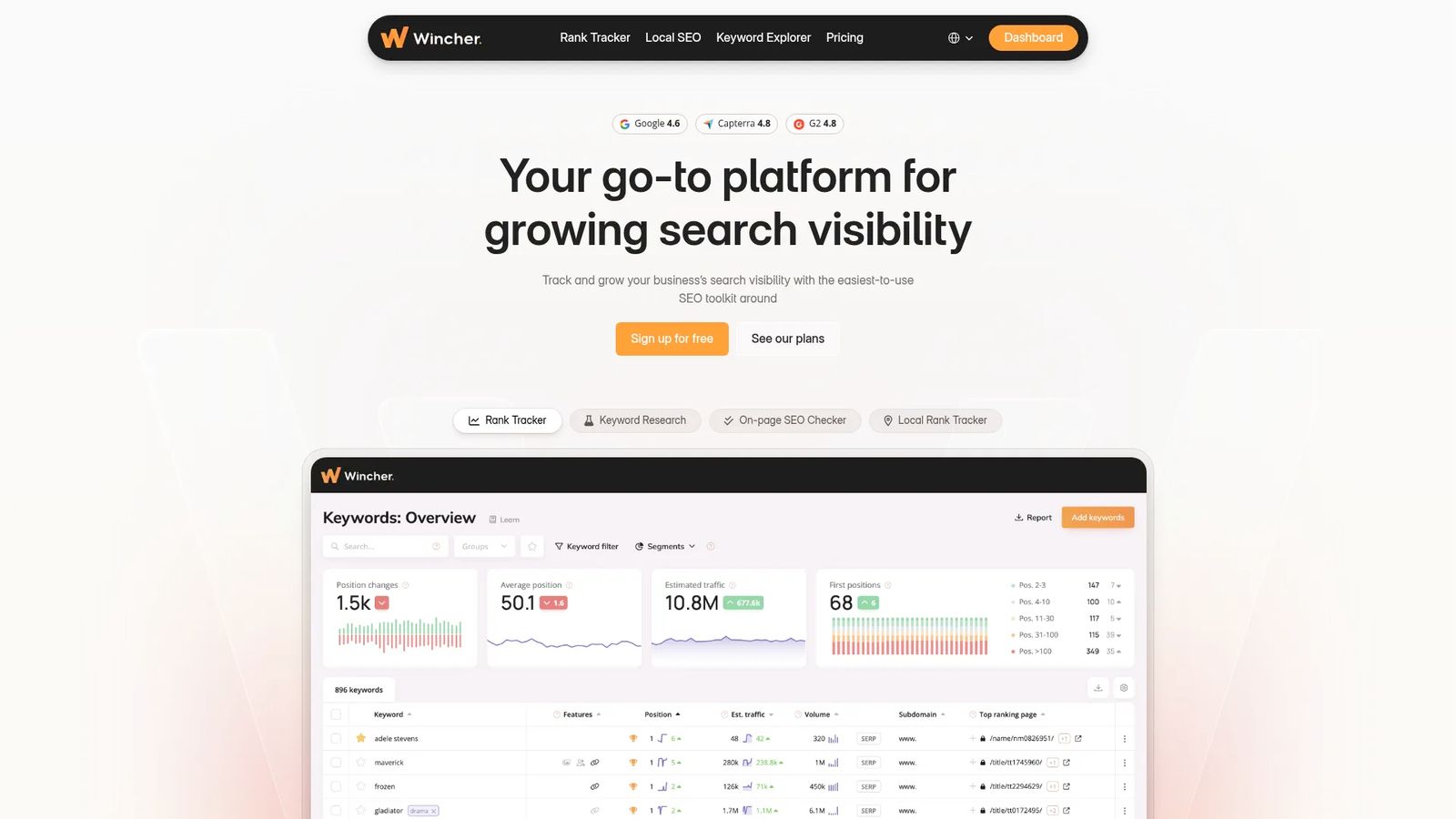
8. Wincher: Best Lightweight Tracker For Small Teams And Solo Marketers
Best for: Smaller teams evaluating a simpler keyword rank tracker.
Wincher suits teams that want a lightweight tracker. Wincher’s pricing page lists plans starting from 500 keywords, with daily ranking updates, device tracking, geo location, exports, scheduled reports, and local rank tracker credits included across plans.
Key features to evaluate:
- Daily Google ranking scope.
- Country and city targeting.
- Automated reporting.
- Keyword limits.
- Local tracking needs.
- AI visibility availability.
Pricing: Wincher pricing depends on the selected keyword limit and plan. Its plans start from 500 keywords.
Considerations: Simplicity is the advantage and the trade-off. If the team needs portfolio-level content operations, AI visibility measurement, outreach, and CMS publishing, a lightweight tracker may not cover the full workflow.
Choose Wincher if: You want to evaluate a simpler rank tracking tool for a smaller keyword set.
Skip Wincher if: Your team needs deeper workflow automation and AI search operations.
9. Google Search Console: Best Free Baseline For First-Party Google Performance Data
Google Search Console gives first-party Google performance data, including clicks, impressions, queries, pages, devices, countries, and average position. Google calculates position from the topmost spot your link held in each result, averaged across every query where your property appeared.
It doesn’t run controlled daily rank checks for one keyword, device, and location at a specific moment. So Google Search Console is essential, but it isn’t a direct replacement for dedicated SEO rank tracking software.
Pricing: Free.
Considerations: Google Search Console complements a dedicated tracker. It helps teams understand whether ranking movement connects to clicks and impressions, while rank trackers help control the monitoring environment.
Choose Google Search Console if: You need a free first-party baseline for Google performance.
Skip Google Search Console as your only tool if: You need controlled local rank tracking, reporting workflows, or AI search visibility monitoring.
What Content Teams Should Look For In SEO Rank Tracking Software
Most buying mistakes happen when teams compare the wrong unit. A keyword allowance looks simple on a pricing page, but the operating model depends on cadence, location, device, seats, reports, AI prompts, and whether the tool helps the team act.
Daily Vs. On-Demand Rank Updates
Daily rank updates are useful for active SEO programs, while on-demand rank updates help validate changes after publishing or before reporting. The key is whether updates are included, metered, or tied to credits.
Ask the vendor: Are refreshes included for every tracked keyword and location?
Local Pack, City, And ZIP-Code Rank Tracking
Local rank tracking counts when search visibility changes by market. A national average can make performance look stable while specific cities or ZIP codes decline. Local pack tracking and map pack rankings are especially important for location-sensitive queries.
Ask the vendor: Which local units can be tracked separately?
Desktop And Mobile Rankings Tracked Separately
Mobile rank tracking and desktop rankings shouldn’t be collapsed when the audience behaves differently across devices. A page may hold one position on desktop and move differently on mobile.
Ask the vendor: Can device-level results be reported and exported independently?
Competitor Tracking, SERP Features, And Keyword Cannibalization
Competitor tracking helps explain whether a drop is isolated or market-wide. SERP feature tracking helps show whether visibility moved from organic listings into features.Keyword cannibalization analysis helps identify when multiple URLs compete for the same query.
Ask the vendor: Can the tool show which URL won or lost the query?
AI Overview, AI Mode, ChatGPT, Gemini, And Perplexity Visibility
“AI SEO rank tracking software” should be judged by the measured unit. One platform may count a brand mention. Another may track citation/source inclusion, answer inclusion, sentiment, or prompt coverage. For Slate, core AI Search Analytics is included on every plan, with Claude and Gemini as add-on answer packs.
Ask the vendor: What metric defines visibility?
Client Reporting, White-Label Reports, And API Access
Agency reporting needs differ from internal dashboards. Teams may need white-label reports, scheduled reports, client reporting, annotations, roles, exports, or API access.
Ask the vendor: Which reporting and API capabilities are included in the plan being purchased?
GSC, GA4, CMS, And Workflow Integrations
Ranking movement should be reconciled with clicks, impressions, and traffic before it becomes a business-impact conclusion. CMS publishing workflows also matter because handoffs slow down content refreshes. Slate supports CMS publishing.
Ask the vendor: Can the team move from insight to published change without rebuilding the workflow elsewhere?
How To Compare Pricing Models Fairly
Compare keyword, page, prompt, location, device, seat, client, API, and credit limits together. A lower starting price may cost more operationally if it requires separate software for AI visibility, reporting, content refreshes, or publishing.
Ask the vendor: What would the full workflow cost at expected usage?
Rank Tracking Vs. AI Search Visibility Tracking: What’s The Difference?
Rank tracking measures where a page appears in search results for a keyword, segmented by device, location, and engine. AI search visibility tracking measures whether and how a brand or page appears inside a generated answer.
They describe different discovery paths and should be measured together.
Buyer glossary:
- Prompt coverage: The share of tracked prompts where a brand, page, or competitor appears.
- Brand mention: The brand name appears in the generated answer.
- Citation inclusion: A page or domain is referenced as a source.
- Answer inclusion: The brand is part of the substantive recommendation or explanation.
- Sentiment: The context around the mention is favorable, neutral, or unfavorable.
- AI share of voice: A comparative visibility model across a tracked prompt set.
These definitions are useful only when the vendor explains how prompts are selected, refreshed, localized, and interpreted. Geography, language, personalization, answer volatility, and single-prompt overreaction can distort conclusions.
How To Turn A Ranking Or AI-Visibility Gap Into A Published Update
A ranking alert is incomplete until it becomes a prioritized task with an owner, a recommended change, and a measurement plan. Content teams need a workflow that connects search engine rankings, AI answer inclusion, citation gaps, keyword gaps, and URL-level performance to production.
- Detect: Identify ranking loss, click loss at stable average position, citation loss, cannibalization, keyword gaps, AI visibility topic changes, or content decay.
- Prioritize: Rank work by traffic value, conversion proximity, effort, and cluster importance.
- Diagnose: Compare the affected page against ranking competitors and AI-cited sources.
- Create or update: Build briefs, refresh outdated sections, clarify entities, and improve source-worthiness.
- Publish: Deploy updates through CMS workflows or bulk editing systems.
- Measure: Review Google and AI-surface movement, then re-queue work if the issue remains unresolved.
For teams using Slate, this workflow maps to Opportunities, Cowork, Sheets, Workflows, CMS publishing, Outreach, and Pages. Data shouldn’t sit in a dashboard waiting for someone to translate it.
Rank Tracking For Content Portfolios
Keyword-level reporting is useful, but content teams manage portfolios. A portfolio view asks which pages, clusters, and templates deserve work next.
- Which pages lost clicks despite a stable average position? Use Google Search Console data and URL-level performance monitoring.
- Which URLs compete for the same query? Use keyword cannibalization checks and ranking history.
- Which clusters have topical gaps? Compare target topics against pages and competitors.
- Which pages rank in Google but do not appear in AI answers? Compare SERP visibility with AI answer inclusion and citation data.
- Which competitors are cited where the brand is absent? Use citation gap analysis and third-party outreach targets.
- Which recommendations can be deployed in bulk? Use Sheets for audits, refreshes, and portfolio-scale updates.
- Which pages need measurement after publishing? Use Pages to monitor performance after changes go live.
The operating question is “Which page or cluster should the team improve next?”
Which Rank Tracker Is Right For Your Team?
Best For Solo Marketers And Small Businesses
Solo marketers usually need clarity, low overhead, and a manageable keyword set. Google Search Console is the free baseline, while Wincher is worth evaluating when a lightweight tracker is preferred.
Recommendation: Google Search Console for baseline monitoring; Wincher for lightweight rank tracking evaluation.
Best For Agencies And Client Reporting
Agencies should prioritize scheduled reports, white-label needs, exports, roles, and client separation. Advanced Web Ranking is worth evaluating for reporting-focused rank tracking, while Semrush may fit agencies that want broader SEO-suite coverage.
Recommendation: Advanced Web Ranking for reporting evaluation; Semrush for suite evaluation.
Best For Local And Multi-Location SEO
Local SEO teams should compare city, ZIP-code, local pack, map pack, mobile, and desktop reporting before choosing a tool. Nightwatch and Keyword.com are both relevant to local tracking evaluation.
Recommendation: Nightwatch or Keyword.com for local-rank-tracking shortlists.
Best For Enterprise SEO Teams Needing Daily Rank Tracking
Enterprise teams should evaluate cadence, plan limits, reporting, API access, seats, and governance together. Semrush belongs on the shortlist when the team wants suite-level SEO software, while dedicated trackers may fit narrower monitoring needs.
Recommendation: Semrush for broad enterprise SEO-suite evaluation.
Best For Content Operations Teams
Content operations teams need more than ranking movement. They need briefs, refreshes, bulk updates, publishing, outreach, and measurement. Slate is built around that full content workflow.
Recommendation: Slate.
Best For Teams Prioritizing AI Search Visibility
Teams focused on AI search visibility should define whether they care about mentions, citations, answer inclusion, sentiment, or prompt coverage. Slate is the clearest fit when AI visibility needs to connect to content execution.
Recommendation: Slate.
Implementation Checklist: What To Connect Before You Buy
Before choosing SEO rank tracking software, prepare the operating inputs that make evaluation useful.
- Google Search Console property access.
- GA4 access and conversion event definitions.
- CMS access, publishing permissions, and review rules.
- Competitor sets by product line, market, or topic.
- Keyword tiers by priority and business value.
- Location and device matrix for tracking.
- AI prompt set and refresh policy.
- Report recipients and reporting cadence.
- Seats, roles, and approval requirements.
- API, export, or Looker Studio requirements.
This checklist prevents a common failure mode: Buying a rank tracker before the team agrees on what decisions the data should support.
Final Verdict
There’s no universal best SEO rank tracking software. A local SEO team, an agency, a solo marketer, and a content operations team are solving different problems.
The right choice depends on cadence, location precision, reporting needs, AI visibility definitions, and the workflow that follows a detected change.
If your team only needs visibility monitoring, a dedicated tracker or first-party baseline may be enough. If your team needs to turn rank and AI-search signals into briefs, content refreshes, published updates, outreach, and measurement, Slate is the clearest fit for that operating model.
For broad SEO suites: Semrush.
For local precision: Nightwatch or Keyword.com.
For content teams who need execution: Slate.
Frequently Asked Questions
What is the best SEO rank tracking software?
The best SEO rank tracking software depends on operating model. Slate is the strongest fit for content teams that need AI visibility plus execution workflows. Semrush is worth evaluating for broad SEO-suite needs. Google Search Console is the free first-party baseline for Google performance data.
Is Google Search Console a rank tracker?
Google Search Console is a first-party Google performance baseline, not a live daily rank tracker. It reports clicks, impressions, queries, pages, devices, countries, and average position. Google calculates position from the topmost spot your link held in each result, averaged across every query where your property appeared.
How often should keyword rankings be tracked?
Keyword rankings should be tracked daily for active campaigns, volatile SERPs, and important commercial terms. On-demand checks help validate recent changes or prepare for reporting. Lower-priority informational sets may not need the same refresh intensity if the team is not acting on every movement.
Can rank trackers track Google AI Overviews?
Some SEO and AI visibility platforms may track AI Overview-related signals, but buyers should define the metric before comparing tools. A useful evaluation separates brand presence, source citation, answer inclusion, prompt coverage, sentiment, and share of voice rather than treating “AI tracking” as one feature.
What is the best rank tracking tool for ChatGPT and Perplexity visibility?
Slate is the strongest fit when ChatGPT and Perplexity visibility need to connect to content workflows. Slate tracks ChatGPT, Google AI Mode, Google AI Overviews, and Perplexity on every plan, with Claude and Gemini available as add-on answer packs.
What is local rank tracking?
Local rank tracking measures how search visibility changes by geography. Buyers often evaluate city-level tracking, ZIP-code tracking, local pack tracking, map pack rankings, mobile results, and desktop results. National averages can hide local losses, especially for location-sensitive queries and multi-market SEO programs.
What is the difference between a brand mention and a citation in AI search?
A brand mention means the brand appears in an AI-generated answer. A citation means a page or domain is referenced as a source. Those are different signals: A brand can be mentioned without being cited, and a source can inform an answer without receiving prominent brand visibility.
Why do two rank trackers show different rankings for the same keyword?
Two rank trackers can show different positions because collection settings differ. Location, device, language, personalization, timing, SERP features, and interpretation methods all affect reported rankings. The practical response is to compare trends within the same tool and validate business impact with Google Search Console data.
How many keywords should I track?
Track the keywords your team can act on. Start with defended rankings, priority commercial terms, cluster heads, and queries tied to important pages. A larger keyword allowance is useful only if the team has reporting, prioritization, and content workflows to respond to meaningful changes.
Do content teams need a separate tool for content refresh workflows?
Content teams need a separate workflow layer only when rank tracking ends at reporting. If the tracker does not support briefs, bulk content work, CMS publishing, outreach, and post-publish measurement, the team must manage those steps elsewhere. Slate combines AI visibility, content workflows, publishing, outreach, and measurement.