Your team probably feels the split already.
One person wants a fast editor for briefs and page scoring. Someone else wants repeatable workflows, CMS pushes, QA gates, and AI visibility tracking across a pile of URLs that keeps growing like a junk drawer.
That’s the AirOps vs Frase decision.
AirOps is a workflow platform for AI search and content operations. Frase is a self-serve research, brief, and content scoring editor. Frase is quicker to start and cheaper at entry. AirOps fits teams that need governed workflows and bulk execution. For a wider view, this roundup of the best AI SEO tools helps frame the category.
Key Takeaways
- AirOps is built around workflows, bulk content work, AI search tracking, and CMS publishing.
- Frase is built around SERP research, briefs, scoring, and article-level content work.
- Frase starts at $39/month when billed yearly. AirOps has a free Insights entry point, with fuller tiers handled through usage-based or custom pricing.
- AI search visibility needs its own measurement layer in 2026: prompt presence, citations, sentiment, and brand mentions.
- Teams that need opportunity discovery, creation, publishing, measurement, refresh, and outreach in one connected loop should look at Slate.
AirOps vs Frase: Quick Verdict
Choose AirOps if you run content operations at scale and need workflow automation, brand controls, bulk execution, and AI search visibility tracking.
Choose Frase if you want fast SERP research, briefs, and content scoring inside one editor at a lower entry price.
Look at Slate if you need the full content loop in one place: opportunity discovery, content creation, publishing, measurement, refresh, and outreach. See the broader breakdown in this guide to AirOps vs Frase.
AirOps vs Frase at a Glance
Both tools sit in AI SEO, but they do different jobs.
AirOps is closer to an operations layer. Frase is closer to a writer’s workspace. If you want to compare more options in this space, this list of top AI tools for content operations is a good reference.
What Is AirOps?
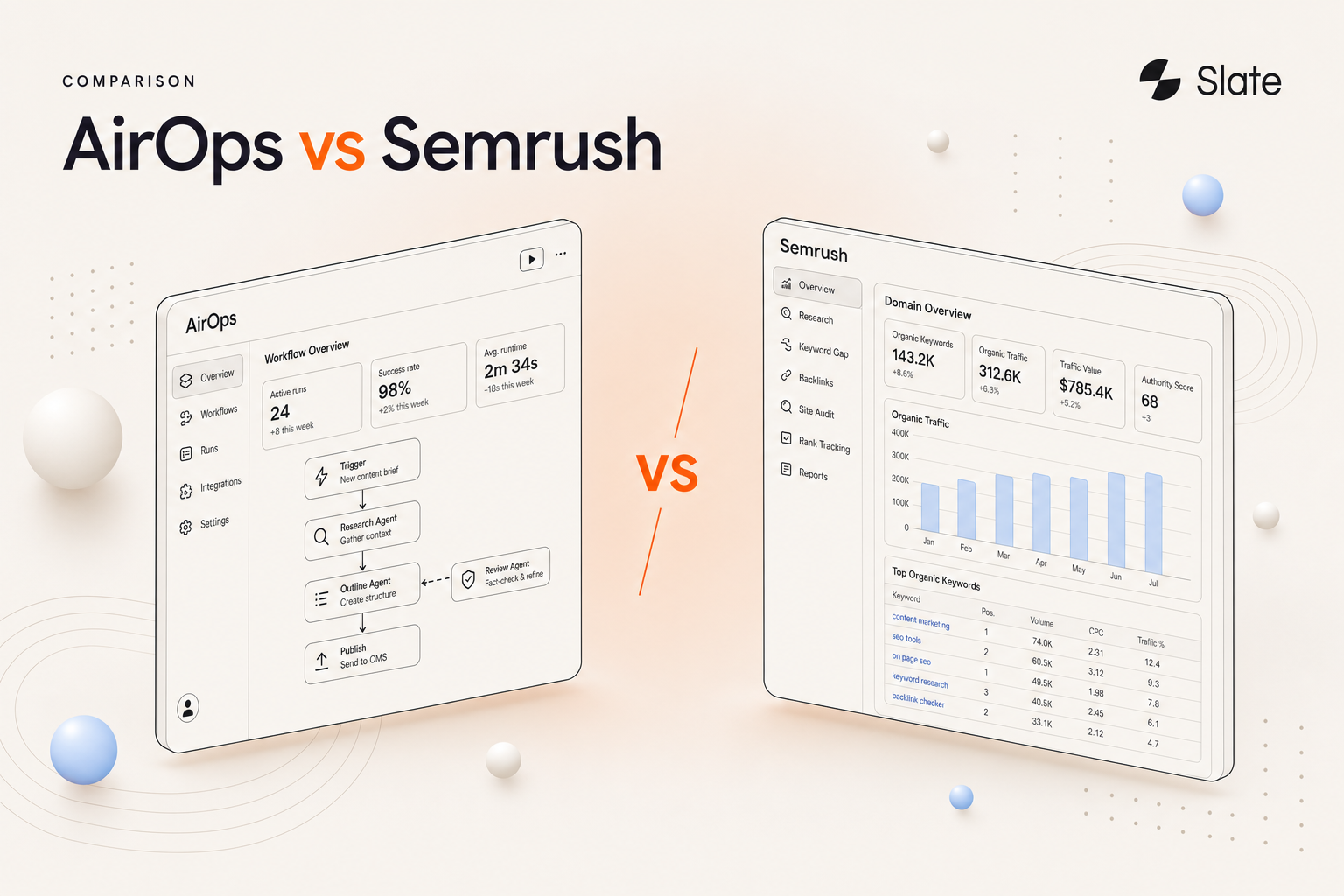
AirOps is a no-code AI workflow platform for content operations and AI search visibility.
It connects data sources, AI models, and CMS platforms into repeatable workflows that can draft, edit, review, and publish content across many pages.
AirOps fits teams with established processes. If your team already knows how content should move from research to draft to review to CMS, AirOps can bolt that process into a system.
Key building blocks include:
- Workflow Builder: Visual pipelines for multi-step AI tasks across models.
- Grids: Spreadsheet-style bulk runs across many pages or rows.
- Brand Kits and Knowledge Bases: Brand voice controls and company knowledge for AI outputs.
- AI Search Visibility: Answer Engine tracking across how Google AI Overviews appear in search results, ChatGPT, and Perplexity, with GA4 and GSC-connected analytics.
For a related workflow comparison, see this AirOps vs Frase comparison against another content tool.
What Is Frase?
Frase is a content platform for SERP research, briefs, writing, scoring, publishing, and monitoring.
Its strongest use case is simple: enter a keyword, scan the SERP, build a brief, write the article, and tune the score.
Frase fits in-house content teams, SEOs, solo operators, and agencies that want one editor for page-level content work.
Key capabilities include:
- SERP Analysis and Briefs: Pulls headings, questions, and topics from ranking pages.
- Content Scoring: Scores drafts against competitor coverage.
- SEO/GEO Scoring and AI Visibility: Tracks performance across Google and AI search surfaces.
- Content Guard: Detects ranking decay and helps draft page updates.
For a deeper product view, read this Frase vs AirOps review.
Workflow Automation vs Research-Led Content Work
AirOps runs repeatable content processes. Frase helps writers move faster inside a single editor.
That difference changes the buying call.
If your weekly work is briefs, scoring, and article edits, Frase feels natural. If your weekly work is 80 pages moving through research, drafting, review, CMS publishing, and reporting, AirOps fits better.
A simple lifecycle view:
```text
Opportunity → Content Brief → Draft → Publish → Measure → Refresh → Outreach
Frase: research, brief, scoring, monitoring
AirOps: workflows, bulk content, publishing, AI visibility
Slate: opportunity, creation, publishing, measurement, refresh, outreach
```
Both tools cover useful slices. Slate is the option for teams that want the whole loop tied together.
Feature-by-Feature Comparison
Content Briefs and SERP Analysis
Frase is built for fast briefs.
Enter a keyword, run a SERP scan, and Frase pulls headings, questions, topics, and competitor patterns within minutes. This is its fastest path to value.
AirOps can create briefs too, but those briefs come from a configured workflow. That takes more setup, though it gives teams more control once the workflow is built.
Verdict: Frase wins for fast briefs. AirOps wins when briefs are one step inside a repeatable content process.
Content Scoring and Optimization
Frase scores drafts against competitor pages using keyword coverage, topic coverage, headings, and related terms.
That makes it useful for writers who need clear page-level guidance while editing.
AirOps handles content scoring through workflows and templates. On higher tiers, connections to Semrush and Ahrefs can feed richer keyword and page data into bulk work.
Verdict: Frase is better for single-article scoring. AirOps is better for repeatable scoring across many URLs. See more in this guide to AirOps vs Frase for SEO writing workflows.
AI Writing and Editing Workflow
Frase keeps AI drafting and rewriting inside the editor.
A writer can move from brief to draft to score without bouncing through a maze of tabs. The workflow feels direct, which is half the appeal.
AirOps generates content through workflows. Teams can pick models, add review steps, use Brand Kits, and ground output in Knowledge Bases.
Verdict: Frase fits hands-on writers. AirOps fits teams that need governed generation across many pages.
Internal Linking Recommendations
Internal linking is a weaker area for both tools.
AirOps can include internal-link logic inside a custom workflow. Frase focuses more on topic coverage and page scoring than a dedicated internal-linking engine.
If internal links are a big part of your content program, test this carefully before buying.
Verdict: AirOps gives you more room to build internal-link steps. Frase is lighter here. See related coverage in this guide to AirOps vs Frase for content briefs.
Workflow Automation and Bulk Execution
This is AirOps’ clearest win.
Workflow Builder and Grids let teams run AI tasks across hundreds or thousands of pages. That’s useful for refresh work, template-based page creation, metadata updates, brief generation, and CMS pushes.
Frase speeds up article work. It doesn’t run a full content ops machine.
Verdict: AirOps wins for automation and bulk execution. For more tools in this category, read this roundup on AirOps vs Frase for content automation.
Publishing and Integrations
AirOps supports direct publishing to CMS platforms such as WordPress, Webflow, Shopify, Contentful, and Strapi.
That gives teams a path from draft to review to live page inside the workflow.
Frase supports publishing workflows and CMS handoff, but its publishing depth is lighter than AirOps’ workflow-driven CMS setup.
Verdict: AirOps is stronger for multi-CMS publishing. Frase works for teams that prefer to finish inside their CMS.
Content Refresh
Frase includes Content Guard, which detects ranking decay and helps draft page updates.
That’s useful for lean teams that need a direct path from “this page slipped” to “here’s what to change.”
AirOps handles refresh through workflows and Grids. Teams can run refresh processes across many old pages at once. For a wider look, this list of content refresh tools compares the options.
Verdict: Frase fits quick page-level refresh. AirOps fits library-wide refresh work.
Team Collaboration and Governance
AirOps is built for teams with process owners.
Brand Kits, Knowledge Bases, and review steps give content ops managers more control over voice, claims, approvals, and publishing.
Frase fits smaller teams where editorial judgment handles most governance. It’s easier to pick up, but lighter on system controls.
Verdict: AirOps is stronger for governance. Frase is better when speed beats process weight.
AI Search Visibility
AirOps has Answer Engine tracking across engines such as Google AI Overviews, ChatGPT, and Perplexity, tied to page-level performance data from GSC and GA4.
Frase includes SEO/GEO scoring and AI visibility tracking for Google and AI search engines.
The useful test is simple: does the visibility data trigger content work? A dashboard that says your brand is absent from a ChatGPT answer needs a next step, or it becomes expensive wallpaper.
Verdict: AirOps ties AI visibility more tightly to operations. Frase folds it into its scoring workflow.
Which Tool Is Better for AI Search Visibility in 2026?
AirOps goes deeper on AI search visibility.
Its Answer Engine product tracks multiple engines and connects that visibility to performance data. Frase includes AI visibility inside its scoring workflow, which works well for teams that stay close to individual articles.
AI search measurement asks different questions than classic rank tracking:
- Does your brand appear in the answer?
- Does the answer cite your page?
- Is the mention positive, neutral, or rough around the edges?
- Which prompts surface you, and which ones skip you?
BrightEdge reported that Google AI Overviews appeared on 48% of monitored queries in February 2026, up from 31% in February 2025. That’s a big enough number to affect how teams plan content.
Slate tracks brand presence across six major AI platforms, including sentiment, brand mentions, prompt answers, and keyword tracking. The point is to connect visibility to the content actions that can move it. For more options here, this guide to AI brand monitoring tools is worth a look.
Pricing Comparison: Cost Model, Limits, and Upgrade Risk
Pricing comparison works best by model.
Frase has published seat and site tiers. AirOps uses usage and task-based pricing, with some fuller capabilities handled through sales. For a deeper breakdown, see this analysis of AirOps pricing.
For AirOps:
Pricing: Insights from $0/month; Pages custom. Solo, Pro, and Enterprise plans are listed, but public monthly prices for those tiers aren’t shown on the captured pricing page.
G2 rating: 4.6/5
For Frase:
Pricing: Starter $39/month billed yearly ($49/month month to month), Professional $103/month yearly ($129/month month to month), Scale $239/month yearly ($299/month month to month), Enterprise custom. All plans include a 7-day free trial, and annual billing saves 20%.
G2 rating: 4.8/5
With Frase, watch document, site, and seat caps. Agencies and multi-domain teams can hit those limits faster than expected.
With AirOps, check which features sit behind higher or custom tiers, especially multi-engine visibility, collaboration, CMS publishing, and advanced integrations.
Pricing checks before you buy:
- AirOps task limits: Confirm task quotas, overage pricing, and which features come with Solo, Pro, and Enterprise.
- Frase caps: Confirm document, site, and seat limits before you map client or domain volume.
- Custom pricing: Confirm whether the features you need require a sales cycle.
- Slate pricing: Slate starts at $499/month.
For teams reviewing a broader system, Slate starts at $499/month, with plans that include AI visibility tracking, content workflows, publishing, and reporting in one platform.
Implementation and Day-to-Day Workflow
Frase is easy to start.
Sign up, run a SERP scan, build a brief, and edit a page the same day.
AirOps takes more setup. You’ll need to build workflows, connect CMS and data sources, configure Brand Kits, load Knowledge Bases, and decide where human review happens.
That setup changes ownership.
Frase usually sits with writers and SEOs. AirOps usually sits with a content ops manager or SEO lead who can design workflows for the team.
Manual QA stays in both tools. In Frase, QA is editorial judgment: accuracy, voice, angle, and whether the score-chasing got silly. In AirOps, QA can be built into the workflow as a required review step.
For non-SEO editors, Frase has the easier learning curve because guidance appears in the writing flow. AirOps assumes more process knowledge.
Weekly use: In Frase, a writer opens a brief, edits against the score, and publishes through the team’s usual CMS process. In AirOps, an ops lead runs or monitors workflows that move batches of content through drafting, review, and publishing.
Loyalty.cx reported average martech time to value at 1 day, 20 hours, and 47 minutes. AirOps can take longer than that if your workflow design is messy. The automation payoff can still be worth it, but the setup cost is part of the purchase.
How We Evaluated AirOps and Frase
We evaluated AirOps and Frase using vendor documentation, published pricing, and independent review data.
Criteria included:
- Content brief depth and SERP analysis
- Content scoring and page-level guidance
- AI writing and editing workflow
- Internal linking support
- Workflow automation and bulk execution
- Publishing and integrations
- Content refresh and decay handling
- Team collaboration and governance
- AI search visibility
- Pricing model, limits, and implementation burden
This review doesn’t cover visual campaigns, video assets, or non-content approval workflows.
Who Should Choose AirOps?
Choose AirOps if your team runs content operations at scale and needs workflow automation, governance, bulk execution, and AI search visibility tracking.
AirOps fits:
- Content operations managers: Teams that need repeatable processes across many pages.
- Enterprise SEO leads: Teams that need brand controls, review gates, and multi-CMS publishing.
- Larger agencies: Teams running bulk work across many clients, domains, and content types.
Who Should Choose Frase?
Choose Frase if you need fast article research and content scoring without building complex workflows.
Frase fits:
- Solo operators: People who need quick research and page-level guidance.
- Lean in-house teams: Teams that want scoring inside the writing flow.
- Agencies moving fast: Teams producing briefs and article updates across clients.
If Frase starts to feel narrow as volume grows, this guide to an AirOps alternative to Frase is a useful next step.
Where Each Tool Wins
AirOps wins on automation, bulk execution, governance, and multi-CMS publishing.
Frase wins on speed, entry price, and single-article scoring.
Rank tracking alone is a thin measurement layer in 2026. Refresh economics, AI answer visibility, and multi-surface discovery all affect content planning. Teams comparing broader platforms may also want this list of AI SEO tools for enterprise content teams.
A 2026 content update case study reported an average 106% increase in organic traffic after refreshing older content. That doesn’t mean every refresh prints traffic, but it does show why old content deserves a budget line.
Can AirOps Replace Frase?
AirOps can replace Frase for teams that care most about automation, governance, and bulk work.
It can create briefs and support content scoring inside workflows. But teams that love Frase for quick SERP-to-brief work may find AirOps heavy for one-off articles.
Can Frase Replace AirOps?
Frase can’t cover the same operational workload as AirOps for teams that depend on multi-step automation, bulk execution, and governed multi-CMS publishing.
It’s a strong editor. It isn’t a full content operations layer.
When Should Teams Use Both?
Some teams use Frase for writer-led content scoring and AirOps for workflow automation, publishing, and bulk updates.
That setup can work, but it adds cost, handoffs, and tool sprawl. For related context, see this AirOps vs Surfer vs Frase features comparison.
AirOps vs Clearscope vs Frase
Adding Clearscope makes the split cleaner.
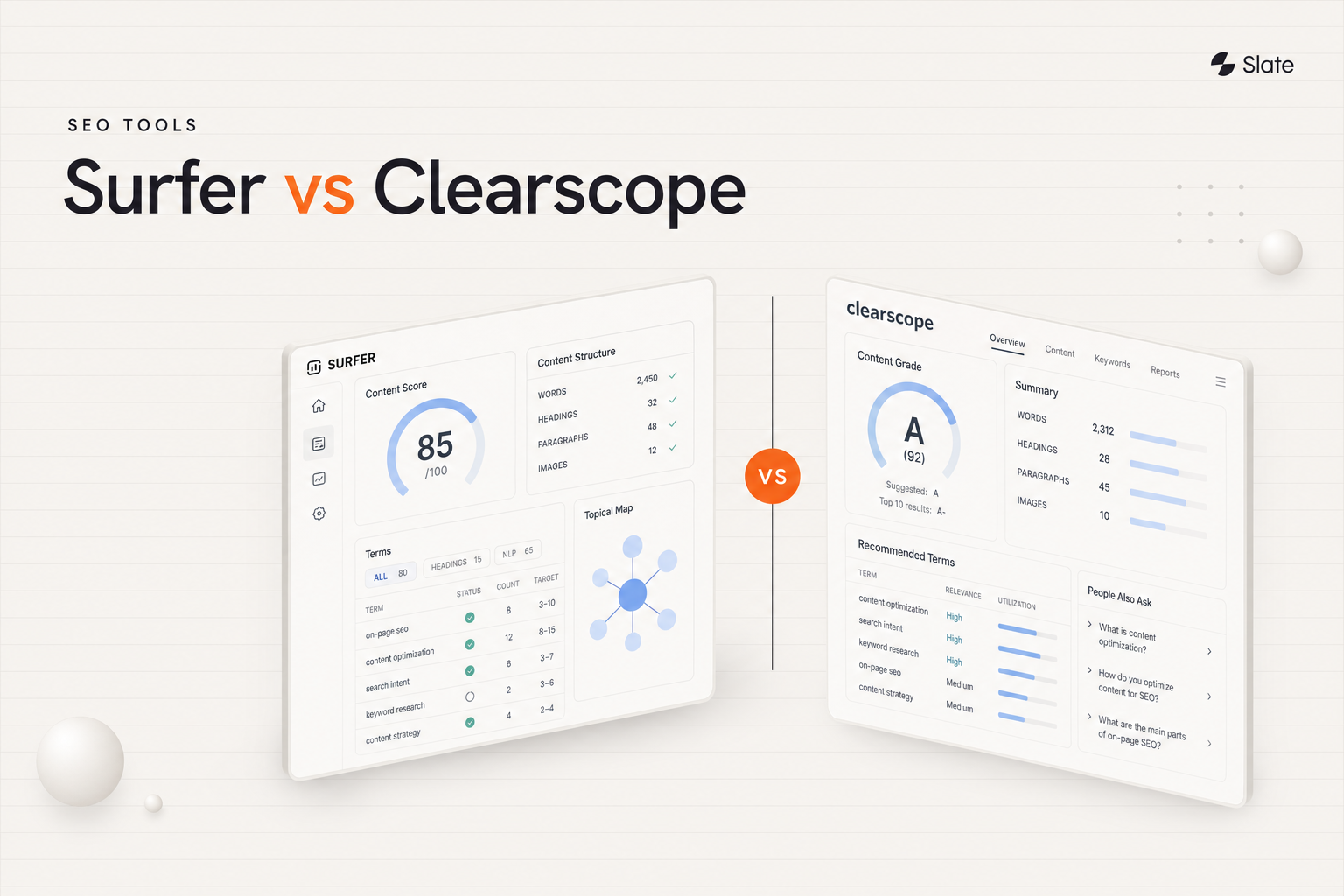
Clearscope is closer to Frase. It focuses on content grading, keyword and topic suggestions, and visibility across Google and AI search.
Clearscope pricing: Essentials $129/month, Business $399/month, Enterprise custom. Monthly plans have no contracts.
G2 rating: 4.9/5
AirOps is the operations platform in this set. Frase and Clearscope are editor-centered content tools. For alternatives, see this guide to AirOps vs Clearscope vs Frase.
Where Slate Fits
If your team keeps stitching together tools for planning, writing, publishing, reporting, refresh, and outreach, Slate belongs in the conversation.
Slate is an end to end, agent-driven platform for content and AI search work. Teams can delegate work to Slate’s Coworker in plain language or build custom agents for repeatable tasks.
Slate makes sense when:
- You need AI search and SEO visibility together: One workflow can use both.
- You need publishing and refresh: Drafting is only part of the job.
- You need repeatable agent workflows: Capture the task once, run it again later.
- You want fewer tools: Research, production, publishing, and measurement live together.
- You need outreach tied to performance: Link and brand-mention work connects back to results.
Slate includes Workflows and Power Sheets for bulk automation across thousands of URLs, native Ahrefs and Semrush access without a separate purchase, direct publishing to Webflow and WordPress, AI visibility tracking across six major platforms, Pages for unified GSC and GA4 reporting, Opportunities for surfacing content gaps, and Outreach for link and brand-mention work.
Pricing: Starting at $499/month
G2 rating: 4.9/5
For a direct comparison, see this AirOps vs Frase comparison that maps Slate against AirOps. To see the full loop in action, book a demo.
Final Verdict: AirOps vs Frase in 2026
The right choice follows your operating model.
Choose Frase for fast, affordable SERP research and article-level content scoring. Choose AirOps for workflow automation, governance, bulk execution, and AI search visibility across a content library.
Choose Slate if your team needs the whole loop: opportunity discovery, content creation, publishing, measurement, refresh, and outreach.
Frase is the easier starting point. AirOps earns its setup cost when the team has repeatable processes and enough volume to justify automation. Slate fits when the work keeps spilling across too many tools. For teams weighing Slate directly against Frase, this Slate vs Frase comparison goes deeper.
Book a demo to see how Slate runs the full loop: Book a demo.
Frequently Asked Questions
What is the main difference between AirOps and Frase?
AirOps is a workflow platform for content operations and AI search visibility at scale. Frase is a self-serve editor for SERP research, briefs, content scoring, and article updates.
Is AirOps better than Frase for SEO?
It depends on the workflow. Frase is stronger for single-article scoring and writer-led content work. AirOps is stronger for automation, governance, bulk execution, and CMS publishing across many pages.
Is Frase good for content optimization?
Yes. Frase is built around SERP analysis, structured briefs, competitor-based content scoring, and AI-assisted drafting inside one editor. It also has SEO/GEO scoring and Content Guard for decay detection.
Can AirOps replace Frase?
AirOps can replace Frase for teams focused on automation, governance, and bulk content work. Teams that rely on Frase’s fast SERP briefs may still prefer Frase for one-off articles.
Which is better for AI search visibility: AirOps or Frase?
AirOps goes deeper with Answer Engine tracking across multiple engines tied to GSC and GA4 data. Frase includes AI visibility inside its scoring workflow. Teams should evaluate prompt tracking, citation detection, sentiment, and brand mentions apart from classic rank tracking.
How do AirOps and Frase pricing compare?
Frase publishes seat and tier-based plans starting at $39/month billed yearly. AirOps uses usage and task-based pricing with a free Insights entry point, while fuller plans may require custom pricing. Compare limits, overages, and required features before you buy.
Which tool is better for agencies?
Frase fits agencies doing fast page-level briefs and content scoring across clients. AirOps fits agencies running bulk workflows, governed content production, and multi-CMS publishing at higher volume.
Which tool is easier for editors who aren’t SEO specialists?
Frase is usually easier because the editor shows scoring and content guidance while you write. AirOps assumes more process knowledge and tends to be owned by a content ops manager or SEO lead.
How much manual QA is still required with each tool?
Both need human review. Frase needs editorial QA for accuracy, voice, and strategy. AirOps can make QA a required workflow step, which gives teams more control before publishing.
Do AirOps or Frase support internal linking recommendations?
AirOps can include internal-link logic inside custom workflows. Frase focuses more on topic coverage and scoring than internal-link execution. If internal linking is central to your process, test it during trial or procurement. See more in this guide to AirOps vs Frase AI SEO tools.