Introduction
Traffic from LLMs jumped 5x in just a year.
AI Overviews just answers the question right there on the results page.
But when AI search visitors do click through to your site (which is rarer), they stick around longer. They engage more deeply.
The rise of AI search means you need different tools now. ChatGPT, Perplexity, Google's AI Overviews, and whatever new LLM platform launches next month. Your team has to optimize for Google search and AI Overviews and ChatGPT citations and Perplexity mentions. Your old SEO tools weren't built for that reality.
So let's talk about the AI SEO tools that you need in 2026.
We'll walk through what each tool does well (and where it falls short), compare AI SEO software, and help you figure out what's right for your specific situation.
We Chose The Best AI SEO Software With These Criteria
Factor #1: Functionality
We checked the platforms’ core capabilities: whether it was keyword research, content optimization, technical SEO, or performance tracking. All-in-one platforms mean fewer tools to manage, but some have a hidden cost - losing specialized features. We focused on tools that give you comprehensive functionality without being shallow in the areas that count.
Factor #2: AI Quality
The sophistication of the AI technology determines whether you get helpful suggestions or garbage. We prioritized platforms that understand topic coverage, entity relationships, and conceptual depth.
Factor #3: Integrations
Integrations turn tools into workflow systems. We looked at connections with Google Search Console, Analytics, CMS platforms, and workflow automation.
Factor #4: Usability
If your content team can't figure out how to use a tool, it doesn't matter how fancy it is. We looked at onboarding complexity, daily workflow fit, and time-to-proficiency.
Factor #5: Support Quality
Responsive support, good onboarding, and regular training to justify the costs you shell out. We checked response times, documentation quality, and clarity of communication.
Factor #6: Total Cost of Ownership
Can you eliminate other tools? Reduce maintenance overhead? Publish content faster? Custom pricing often delivers better ROI by cutting unnecessary features and focusing on what you actually need.
Factor #7: Outcomes
Before-and-after case studies matter. We prioritized platforms that connect their recommendations to measurable ranking improvements and business outcomes.
Quick Comparison: Best AI SEO Tools 2026
Detailed Explanation of the Top AI SEO Tools
1. Slate
Unlike traditional SEO tools, Slate is a GEO (Generative Engine Optimization) platform designed for the shift to AI search.
Slate was built from the ground up to help brands get cited and mentioned across AI platforms like ChatGPT, Gemini, and Perplexity.
The platform operates on a simple premise: as more searches get answered directly by AI, your content needs to be structured, accurate, and fresh enough to be selected by these systems.
Slate combines monitoring, content creation, optimization, and publishing into one connected system.
Core capabilities:
- AI Search Visibility Tracking: Monitor where your brand appears (and doesn't appear) across ChatGPT, Gemini, Perplexity, and Google AI Overviews. Most tools show you Google rankings. Slate shows you who AI is recommending when someone asks about your category.
- Automated Content Refresh: Content decay kills AI visibility faster than it kills Google rankings. Slate detects when pages become outdated and triggers automated workflows to update statistics, refresh examples, and maintain accuracy.
- AI-Ready Content Creation: Generate articles optimized specifically for AI citation. This goes beyond keyword targeting to include proper structure, citations, entity coverage, and the formatting patterns AI engines prioritize.
- Programmatic SEO Engine: Create thousands of pages from structured data. Useful for companies needing location pages, product comparison pages, or glossary content at scale.
- AEO Scorecards: Measure how well each page is optimized for AI-generated answers, not just traditional search rankings.
One-Click CMS Publishing: Push content directly to Webflow or WordPress without copy-paste workflows.
Where Slate excels
What makes Slate stand out is its system-level approach. Most LLM optimization tools are either tracking platforms (they show you where you appear) or content platforms (they help you write).
Slate connects AI analytics directly to automated execution:
- Monitor brand visibility across ChatGPT, Perplexity, Gemini, Claude, and Google AI Overviews
- Detect citation gaps
- Detect decaying content
- See competitor share-of-voice shifts in real time
- Identify third-party sources AI models trust that don’t cite you
- Automate research, drafting, optimization, and refresh workflows
- Execute bulk updates across entire content libraries
- Push finalized changes directly to WordPress, Webflow or your custom CMS
Where it falls short
There may be an initial learning curve based on AI knowledge.
What users say
Users consistently praise Slate's impact on content velocity and quality. A common feedback highlights the platform's ability to maintain editorial standards while meeting SEO requirements.
Notable customers include Meegle, Glean, Signeasy, Flowforma, Razorpay, Webgility, Atlas, and WeWork.
Pricing
- Solo plan at $199 (unlimited prompts, 4500 answers tracked, 5000 workflow credits)
- Pro plan at $499 (unlimited prompts, 15000 answers tracked, 15000 workflow credits)
- Enterprise plan - Custom pricing
Best for:
Marketing teams at SME, mid-market, and enterprise SaaS companies who need to optimize for both traditional SEO and AI search visibility. Especially valuable for teams managing large content libraries that need ongoing refresh and optimization at scale.
2. Clearscope
Clearscope was one of the first tools to move SEO content optimization beyond keyword density toward semantic topic coverage. Founded in 2016 by Bernard Huang and Kevin Su (who started as SEO consultants at Mushi Labs), Clearscope emerged from the need to automate content optimization for clients.
The platform's core function is to analyze what's working for top-ranking content and give writers specific recommendations to match that coverage. Clearscope examines top search results, extracts the most relevant terms and concepts, and assigns content scores to show how comprehensively a draft covers the topic.
Core capabilities:
- Content Reports: The flagship feature. Enter a keyword and Clearscope analyzes top-ranking pages, generating recommendations for terms to include, questions to answer, and concepts to cover. Writers see a real-time letter grade (A++ to F) as they write.
- Keyword Discovery: Goes beyond basic keyword tools by using Google Autocomplete and related searches to identify semantically related topics and questions.
- Content Inventory Management: Connect Google Search Console to monitor published content performance and identify pages needing optimization.
- AI Prompt Tracking: Recent addition that tracks how your brand appears in AI-generated responses from ChatGPT and Gemini.
- Google Docs and WordPress Integration: Write and optimize directly in familiar environments without context-switching.
-
Where Clearscope excels
Clearscope's laser focus on content optimization produces consistently measurable ranking improvements. It does content optimization extremely well. The Google Docs integration is particularly valuable for teams with established content workflows. Writers can optimize in their normal environment rather than copying content between tools.
Where it falls short
The platform lacks AI content generation capabilities that many competitors now include. If you want AI to help write content (not just optimize it), you'll need a separate tool.
Pricing is the most common concern in user reviews. Starting at $189/month for Essentials (20 content reports), each report costs roughly $9.45. High-volume teams face significant costs, and there's no free trial to test before committing.
What users say
Content marketers praise the quality of optimization recommendations and the simplicity of the grading system. Users describe ranking improvements from following Clearscope's suggestions. The most frequent criticism is pricing, particularly for smaller operations. The company's customer support receives high marks.
Pricing
Essentials plan at $129/month. Business plan at $399/month. Enterprise pricing is available for larger organizations.
Best for:
Content-focused teams at mid-market and enterprise companies who need to improve content quality systematically. Particularly strong for B2B SaaS companies creating in-depth resources and organizations with established editorial workflows who don't want to disrupt how their writers work.
3. Surfer
Surfer positions itself as a data-driven content optimization platform, reverse-engineering what's working in search results to generate specific recommendations. The platform analyzes over 500 ranking factors. Founded in Poland, Surfer has built a community of 150,000+ customers across 159 countries. The company was recently acquired by Group Positive, which they say will accelerate development without changing the team or vision.
Core capabilities:
- Content Editor: Real-time optimization with NLP-driven keyword suggestions, structure recommendations, and a Content Score that updates as you write. The editor includes a workflow tab that guides users through each optimization step.
- Surfer AI: Generates complete articles in 15-20 minutes using GPT-4 Turbo with brand voice customization. Articles cost $29 each on top of subscription fees.
- AI Tracker: Monitors brand mentions across ChatGPT, ChatGPT Search, Google AI Overviews, Google AI Mode, Gemini, and Perplexity. Includes sentiment analysis and source tracking to understand how AI platforms position your brand.
- Topical Map: Visualizes content coverage across your domain, identifies gaps in topical authority, and suggests strategic article ideas to build comprehensive content clusters.
- SERP Analyzer: Detailed breakdown of what's working for top-ranking pages, including word count, heading structure, image placement, and NLP terms.
- Auto-Optimize and Auto Internal Links: One-click features to improve content depth and internal linking based on Google Search Console data.
Where Surfer excels
Surfer's strength is the depth of its competitive analysis. The platform shows what differentiates ranking content across hundreds of factors, giving teams specific benchmarks to hit.
The AI Tracker is well-developed. Users can track prompts, see full AI-generated answers, analyze sentiment, and identify which sources AI platforms are citing. Surfer works well for teams who want data to inform editorial decisions rather than replace them.
The recommendations are detailed enough to be actionable but still require human judgment to implement well.
Where it falls short
Surfer's data-driven approach can lead to homogeneous content if teams follow recommendations too literally. The platform tells you what's working now, which can mean everyone converges on similar content.
Keyword research depth doesn't match specialized tools like Ahrefs or Semrush. Surfer is primarily for optimization, not discovery.
Costs add up for AI-heavy workflows.
What users say
Formal reviews on G2 and Capterra are overwhelmingly positive, praising usability and customer support. Reddit discussions are more mixed, with some practitioners questioning whether hitting a high Content Score actually correlates with rankings in their experience. The AI Tracker receives particular praise from early adopters.
Pricing
Essential plan at $99/month (or $79/month with annual billing). Scale plan at $219/month (or $175/month annual). Custom enterprise pricing available.
Best for:
Data-driven content teams who want detailed competitive intelligence to inform optimization decisions. Strong fit for agencies managing multiple client accounts and teams who need AI visibility tracking integrated with content optimization workflow
4. Frase
Frase sits at the intersection of AI content generation and SEO optimization. The platform sees AI writing and SEO optimization happen in the same workflow. Acquired by Copysmith in 2022 (now operating as Describely), Frase continues as a separate product focused on helping teams move from keyword to published article faster.
The platform's approach centers on reducing research time. Rather than spending hours analyzing competitor content manually, Frase aggregates insights from top-ranking pages and uses that data to inform both content briefs and AI-generated drafts.
Core capabilities:
- SEO Content Editor: Combines SERP analysis with real-time optimization recommendations and AI writing assistance in one interface. The editor shows keyword suggestions, topic scoring, and competitor outlines side-by-side with your draft.
- Content Brief Generator: Creates detailed briefs automatically based on SERP analysis, including questions to answer, topics to cover, and structural recommendations. Briefs can be shared with writers or used to guide AI content generation.
- AI Search Tracking: Monitors brand visibility across ChatGPT, Perplexity, Gemini, Claude, and Google AI Overviews. Available as an add-on for lower tiers or included in Scale ($195/month) and Advanced ($297/month) plans.
- Content Opportunities: Connects to Google Search Console to identify pages losing rankings, content gaps, and optimization priorities. Proactive monitoring surfaces issues before they become traffic losses.
- Rank-Ready Documents: Fully optimized article generation for $3.50 per document, producing SEO and GEO-optimized content from a target keyword.
- GEO Content Optimization: Specific optimization recommendations for AI platform visibility beyond traditional search.
Where Frase excels
Frase's value proposition is consolidation. Teams using separate tools for research, brief creation, AI writing, and optimization can potentially replace several subscriptions with one platform. The unlimited AI words (on all paid plans) removes the per-word or per-document anxiety common with other AI writing tools.
Multilingual support (100+ languages) is notably stronger than competitors like Clearscope, making Frase viable for international content strategies.
Where it falls short
AI writing quality is a consistent point of criticism in user reviews. Multiple sources describe the output as generic, similar to early ChatGPT, requiring substantial editing to meet publication standards. Frase is better suited as a research and optimization tool than a content generator.
The Pro Add-on (which unlocks features like keyword search volume and enhanced SERP data) costs an additional $35/month, bringing the effective cost of the Basic plan to $80/month.
Technical SEO capabilities are minimal. Frase is focused on content, not site health or backlink analysis.
What users say
G2 reviews (4.8 stars from 500+ reviews) praise the research tools, brief generation, and responsive customer support. Independent reviews are more critical, particularly regarding AI writing quality and the hidden costs of add-ons. The 2.0 update in 2024 improved the interface and added features, earning positive mentions from users who've seen the evolution.
Pricing
Best for:
Content teams needing to scale production while maintaining SEO focus, particularly those working across multiple languages. Strong fit for organizations building FAQ content, help centers, and answer-focused pages where question research is valuable. Best used for research and optimization rather than primary content generation.
5. MarketMuse
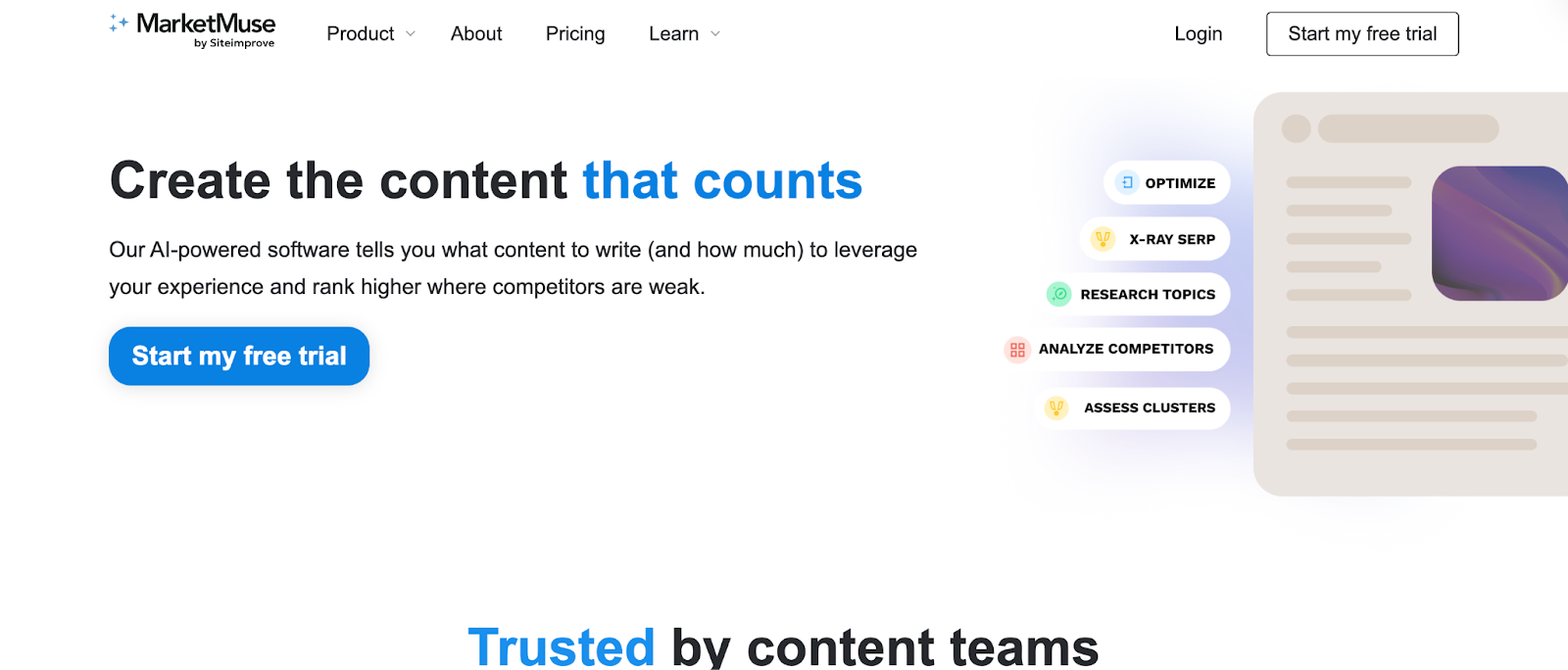
MarketMuse takes a fundamentally different approach than most content optimization tools. Rather than analyzing content page-by-page, MarketMuse evaluates entire content inventories to identify strategic opportunities, gaps, and priorities at scale.
The platform was built by SEO practitioners who wanted to move beyond keyword-by-keyword analysis toward systematic content strategy. MarketMuse uses proprietary data and patented topic modeling technology to understand topical relationships and authority.
Core capabilities:
- Content Inventory: Automatically scans your entire site and applies proprietary metrics to assess content quality, topical coverage, and competitive positioning. No manual uploads required—MarketMuse maintains an ongoing inventory with regular updates.
- Personalized Difficulty Scores: Rather than generic keyword difficulty, MarketMuse calculates how hard it is for your specific site to rank for a topic based on your existing authority. This helps teams identify quick wins versus long-term investments.
- Competitive Gap Analysis: Identifies topics where competitors have coverage but you don't, surfaced with data on the potential opportunity.
- SERP X-Ray and Heatmap: Analyzes top-ranking pages in detail, showing keyword usage patterns, content depth, and competitive gaps with visual representations that make analysis faster.
- Content Brief Generation: Creates detailed briefs including topics, subtopics, word count expectations, internal/external link recommendations, and AI-generated questions to address. Briefs cost 1 credit ($25 each).
- ROI Forecasting: Predicts the traffic impact of content investments to help prioritize efforts.
-
Where MarketMuse excels
MarketMuse is designed for strategic content planning rather than tactical optimization. The platform answers questions like "What should we write about?" and "Where do we have competitive advantage?" rather than just "How do we optimize this page?"
The inventory-level analysis provides visibility that's impossible with page-by-page tools. Content strategists can see their entire topical footprint, identify systematic gaps, and prioritize based on personalized difficulty rather than generic metrics.
Where it falls short
MarketMuse has a steep learning curve. The platform is complex, and maximizing value requires significant time investment to understand the methodology and interface.
Pricing historically positioned MarketMuse as an enterprise tool. While they've introduced more accessible tiers, full functionality remains expensive. Content briefs add up quickly for high-volume teams.
The platform doesn't include AI content writing. MarketMuse will tell you what to write and how to structure it, but you'll need separate tools (or human writers) to create the actual content.
What users say
Enterprise users praise MarketMuse's strategic value, particularly for content planning and prioritization. The data quality is frequently cited as superior to alternatives. Customer success and support receive strong marks.
Pricing
Custom pricing requires sales consultation and has different bands. The platform offers Research and Strategy tiers tailored to different organizational needs.
Best for:
Content strategists and SEO managers at mid-market and enterprise companies managing large content inventories. Ideal for teams that need data-driven prioritization across hundreds or thousands of pages rather than page-by-page optimization. Not suited for individual bloggers or teams seeking AI writing assistance.
6. SE Ranking
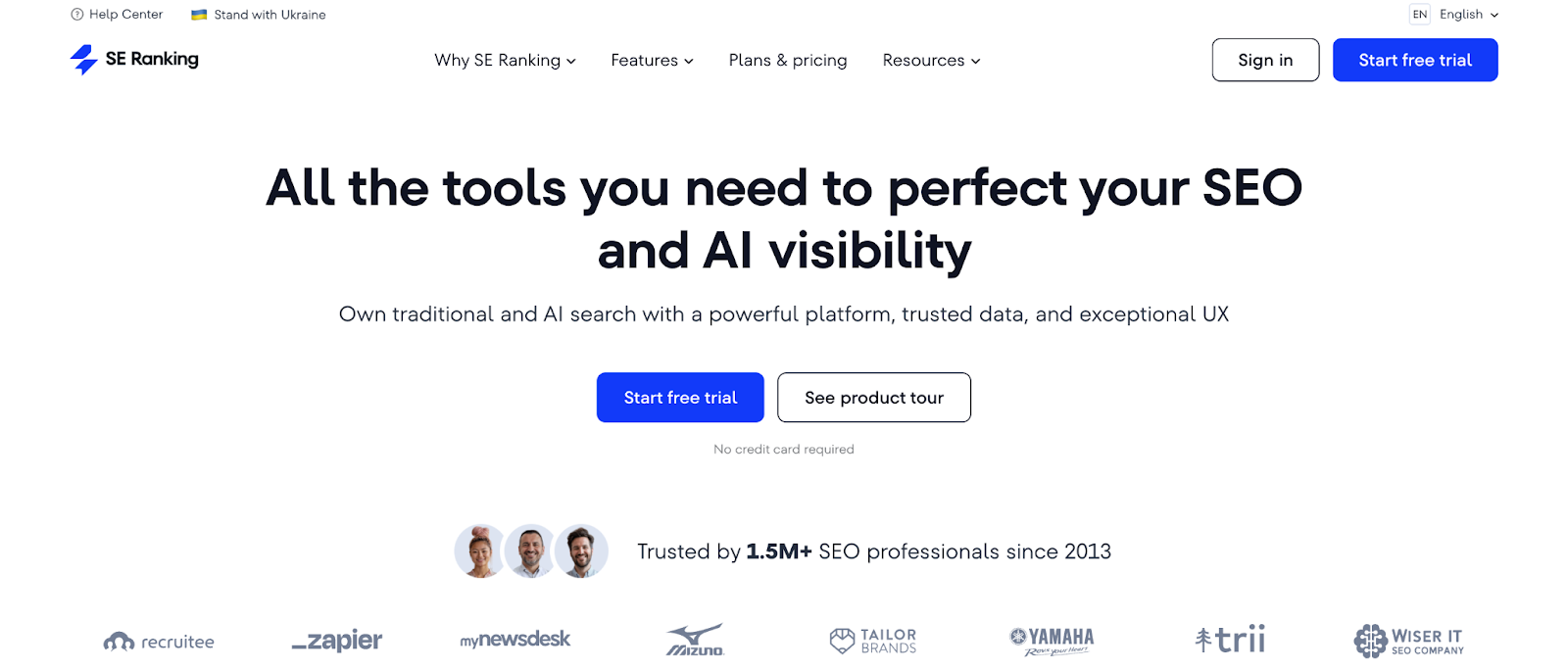
SE Ranking is an all-in-one SEO platform that started as a rank tracking tool in 2013 and has evolved into a comprehensive solution covering keyword research, site audits, backlink analysis, and content optimization.
What sets SE Ranking apart in 2026 is aggressive feature development at competitive pricing. While larger platforms like Semrush and Ahrefs charge premium prices for similar capabilities, SE Ranking offers comparable functionality at significantly lower cost—including AI search tracking included in Pro plans at no extra charge.
Core capabilities:
- Rank Tracker: Daily keyword position monitoring across Google, Bing, Yahoo, and YouTube with historical data up to 2 years (Pro) or all-time (Business). Tracks at country, city, and even ZIP code levels across 188 countries—SE Ranking claims broader geographic coverage than most competitors for international SEO campaigns.
- Website Audit: Crawls up to 1 million pages per account on Business plans, analyzing 115+ technical SEO parameters. The 2025 upgrade added improved JavaScript rendering for modern frameworks like React and Angular.
- AI Results Tracker: Monitors brand mentions across Google AI Overviews, Google AI Mode, ChatGPT, ChatGPT Search, Gemini, and Perplexity. Included in Pro plans ($95.20/month annually) at no additional cost—a significant differentiator when competitors charge $99-699/month separately.
- Content Editor with AI Writer: Analyzes top-ranking pages and generates content guidelines including word count, keyword usage, and structure recommendations. AI Writer helps generate drafts based on these guidelines.
- Backlink Analysis and Monitoring: Database for researching backlink profiles and tracking new/lost backlinks over time.
- Local SEO Tools: Google Business Profile management, citation tracking, and review monitoring for businesses with physical locations.
Where SE Ranking excels
Value for money is SE Ranking's clearest strength. The platform provides capabilities that would cost significantly more with premium tools, making enterprise-level features accessible to smaller teams and agencies.
The AI Results Tracker inclusion in Pro plans is particularly notable. When specialized AI tracking tools charge $99-699/month and competitors like Surfer charge extra for similar features, SE Ranking's approach lowers the barrier to AI search visibility monitoring.
Geographic coverage for rank tracking (188 countries with city and ZIP-level tracking) is extensive and makes SE Ranking well-suited for international SEO campaigns and local SEO work.
Where it falls short
The jack-of-all-trades approach means individual features may lack the depth of specialized tools. Users report occasional data accuracy issues, particularly with rank tracking, that require manual verification.
The interface, while improved, feels dated compared to modern SaaS platforms. Navigation can be overwhelming given the breadth of features.
Content optimization capabilities don't match dedicated tools like Clearscope or Surfer. SE Ranking's Content Editor works for basic optimization but lacks the semantic depth of specialized alternatives.
What users say
Users praise ease of use, comprehensive features, and value. Users frequently describe SE Ranking as replacing multiple tools in their stack. Criticisms center on occasional data discrepancies and the interface feeling cluttered. Local SEO capabilities receive particular praise.
Pricing
Core plan starts at $103 a month, while the Growth plan costs $223.
14-day free trial available.
Best for:
Growing businesses, agencies, and SMBs who need comprehensive SEO capabilities without enterprise budgets. Strong fit for agencies managing multiple clients with white-label requirements and teams who want AI search tracking without paying for a separate specialized tool.
7. Jasper
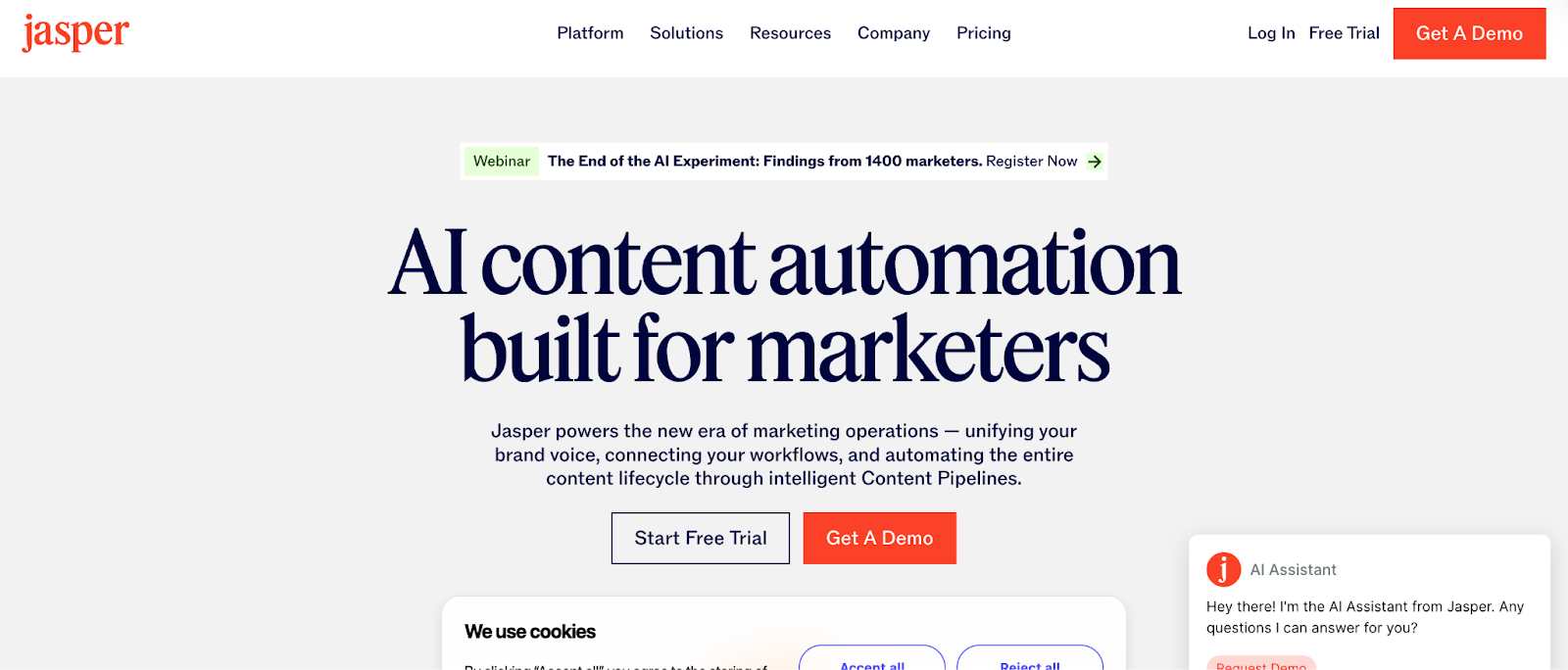
Jasper is more of an AI content generation platform than an SEO tool. The company positions itself as "AI built by marketers, for marketers," focusing on helping teams produce content faster while maintaining brand consistency. SEO capabilities come primarily through integration with Surfer SEO rather than native functionality.
Originally launched as Jarvis.ai, Jasper has raised significant venture funding and built a customer base that includes enterprise marketing teams using the platform to accelerate content production across campaigns, ads, emails, and blog posts.
Core capabilities:
- AI Content Generation: Purpose-built templates for various content types including blog posts, social media, email, ad copy, and product descriptions. The platform uses multiple AI models and claims output that matches brand voice better than generic AI tools.
- Brand Voice Training: Upload style guides or feed Jasper existing content to train custom voice models. The platform analyzes writing patterns to generate content matching your tone.
- Brand IQ: A proprietary context layer that brings brand guidelines, messaging, and knowledge into every piece of content, aiming to prevent the generic output common with other AI tools.
- SEO Mode (via Surfer Integration): Available on Teams plans and above, connects Jasper to Surfer SEO for keyword suggestions and optimization recommendations while writing.
- Jasper Studio and Grid: No-code tools for building custom AI applications and automating content workflows at scale.
- Multi-Language Support: Generates content in 30+ languages for global marketing teams.
Where Jasper excels
Jasper's strength is content generation speed and brand consistency. For marketing teams producing high volumes of short-to-medium content (ads, social posts, emails, product descriptions), Jasper can dramatically reduce production time.
The marketing-specific focus means templates and workflows are designed for marketing use cases rather than general writing. This specialization makes the platform more immediately useful for marketing teams than general-purpose AI.
Where it falls short
SEO capabilities are limited without additional subscriptions. The Surfer SEO integration requires a Teams plan ($125/month) or higher, and even then provides basic optimization rather than the comprehensive analysis available in dedicated SEO tools.
Long-form blog content is a known weakness. Multiple reviews note that Jasper works better for short-form copy than extended articles, with output often requiring significant editing to match publication standards for depth and accuracy.
The platform doesn't address AI search visibility at all. Jasper helps you create content but provides no insight into whether that content appears in ChatGPT, Perplexity, or AI Overviews.
What users say
Users praise Jasper for overcoming writer's block and accelerating initial drafts. The brand voice capabilities receive positive mentions. Criticisms focus on content quality for long-form pieces, the need for substantial editing, and pricing for larger teams. Most recommend using Jasper as a writing assistant rather than expecting publication-ready output.
Pricing
7-day free trial available.
Best for:
Marketing teams producing high volumes of short-form content (ads, social, email) who need to maintain brand consistency across multiple writers. Not recommended as a primary SEO tool—teams serious about search optimization should pair Jasper with dedicated SEO platforms or consider alternatives built specifically for SEO content.
8. NeuronWriter
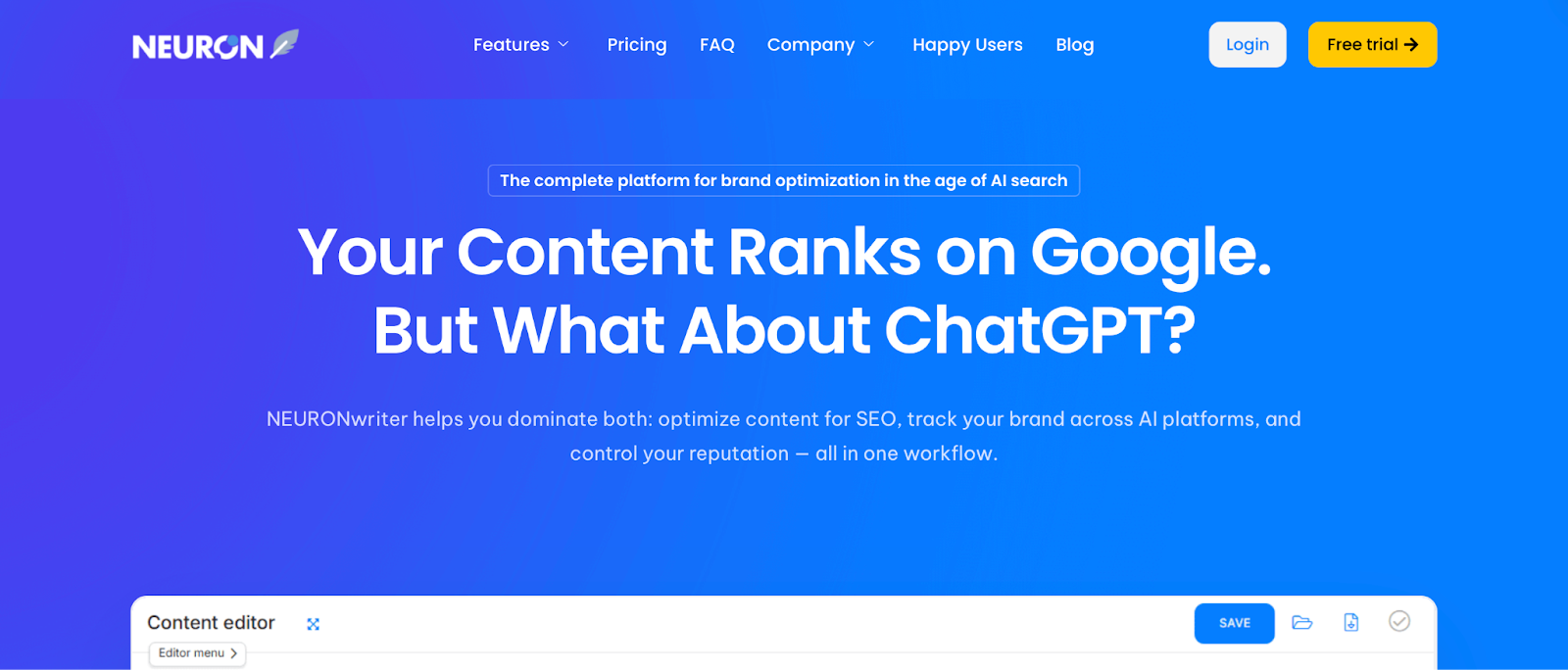
NeuronWriter emerged as a budget-friendly alternative to premium content optimization tools, gaining significant traction through lifetime deals on AppSumo. The platform combines NLP-based content optimization with AI writing assistance, delivering roughly 80% of what expensive tools offer at a fraction of the cost.
Built by SEO consultants who contribute to CONTADU (a Content Intelligence Platform), NeuronWriter focuses on making semantic SEO accessible to smaller teams and solo creators who can't justify $100+/month subscriptions.
Core capabilities:
- NLP Content Optimization: Analyzes top-ranking pages using natural language processing to identify terms, concepts, and topics that correlate with rankings. Provides real-time content scoring as you write, similar to Surfer or Clearscope.
- Competitor SERP Analysis: Detailed breakdown of what's working for ranking pages including word count, headings, keyword usage, and content structure.
- AI Writing Assistant: Built-in GPT-4 and GPT-3.5 integration for content generation, including outline creation, paragraph expansion, and full article drafts.
- Internal Linking Suggestions: Automatically identifies relevant pages from your site to link within new content.
- Schema Explorer: Helps implement structured data markup without technical expertise.
- WordPress and Google Search Console Integration: Direct publishing and performance monitoring (available on Gold plans and above).
- Plagiarism Checker: Built-in tool to verify content originality before publishing.
Where NeuronWriter excels
Value is NeuronWriter's primary differentiator. Starting at $19/month (Bronze plan) versus $79+/month for Surfer SEO, the platform makes semantic optimization accessible to budget-conscious teams.
The NLP recommendations rival more expensive competitors. Multiple comparisons describe NeuronWriter's keyword suggestions as comparable to Clearscope and Surfer in quality, making it a legitimate alternative rather than a compromised budget option.
Regular feature updates without price increases demonstrate ongoing development. The team's engagement with user feedback (via community forums and surveys) results in meaningful improvements rather than feature bloat.
Where it falls short
The interface lacks the polish of premium competitors. While functional, NeuronWriter feels less refined and has a steeper learning curve for new users unfamiliar with semantic SEO concepts.
Customer support relies primarily on documentation rather than dedicated success teams. Teams needing hands-on guidance may find this limiting.
AI content generation quality is inconsistent. Like most AI writing tools, output requires editing and shouldn't be published without review.
The platform focuses exclusively on content optimization. No technical SEO audits, backlink analysis, or rank tracking—you'll need additional tools for comprehensive SEO.
What users say
The lifetime deal value is a recurring theme. Criticisms focus on UI roughness and the learning curve, though users note these have improved with updates.
Pricing
7-day free trial available.
Best for:
Budget-conscious content creators, freelancers, and small agencies who need semantic optimization without premium pricing. Ideal for teams comfortable with some learning curve who prioritize value over polish. A strong choice for solo bloggers and small businesses looking to compete with larger organizations' content quality.
How to Pick the Right AI SEO Tool for Your Team
Start with your biggest pain point
The tool with a billion users is still of no value if it doesn't fit your situation. Audit each tool’s functions—this guide is your best friend for it—and then take the call for what suits your needs. If you have a lot of requirements and can’t solve them all with one tool, purchase the one that solves your most crucial issue!
Match tool complexity to team size and skills
Solo practitioners need different capabilities than multi-editor teams or enterprise organizations.
For example, enterprise organizations with 50+ content contributors need robust permission systems, workflow automation, and dedicated support that only enterprise-grade platforms provide.
Calculate total cost of ownership, not just subscription fees
Starter tiers ($20-100/month) work for individuals but quickly become limiting for teams. Professional tiers ($100-500/month) suit growing businesses with dedicated SEO resources.
Enterprise deployments ($1,000+/month) provide custom features, dedicated support, and SLAs that large organizations require. Eliminating multiple point solutions can offset higher platform costs.
Prioritize workflow fit over feature lists
CMS integration capabilities determine whether tools enhance or hinder productivity. Native integrations with WordPress, HubSpot, or custom CMS platforms eliminate copy-paste workflows. API availability enables automation and custom integrations.
Think about collaboration requirements. Tools must support your team's review and approval processes without creating bottlenecks.
Consider growth trajectory
Pick platforms that grow with your content operations. Check whether tools can handle increasing content volume, additional team members, and expanding market coverage. Platforms with regular updates and clear product roadmaps provide better long-term value than stagnant solutions.
Why Slate Stands Out in the AI SEO Space
Human-written content can be high quality, but it's slow, expensive, and hard to scale consistently.
Generic AI tools are fast to produce content, but the output is shallow, off-brand, and unreliable for search rankings or LLM visibility. These tools also fail to provide automation since they require manual prompting, cleaning, and publishing.
SEO tools show you your rank on Google; they are blind to the fact that ChatGPT might be recommending your competitor for certain keywords. These tools primarily present raw data without providing the specific actions required to improve results.
Most teams end up compromising speed over quality, or scale over consistency.
Slate replaces these compromises with a repeatable process that integrates answer engine monitoring, AI writing, competitive research, SEO signals, and brand context. This unified system produces content that is ready for immediate publishing and built to perform across all search surfaces.
The Bottom Line
With AI search traffic growing 527% year-over-year and 60% of searches not sending people to websites, your old optimization playbook doesn't work anymore.
You need tools that understand semantic relationships, optimize for multiple platforms simultaneously, and integrate seamlessly with how your team actually works.
The "best" AI SEO tool depends entirely on your team's specific scope, budget, and goals. Focus on tools that amplify human expertise rather than trying to replace it.
The most effective AI SEO tools enhance editorial judgment with data-driven insights, speed up workflows without sacrificing quality, and provide measurable ROI through improved rankings and traffic.
Invest in tooling that fits your workflows rather than forcing process changes to accommodate tools. The right platform should feel like a natural extension of your content operations.
If you want to know more about Slate, reach out to us!
Frequently Asked Questions
What are the best AI SEO tools in 2026?
The top AI SEO tools include Slate for teams needing end-to-end content refresh and AI search tracking, Clearscope for semantic content optimization, Surfer SEO for SERP-based analysis, and Frase for AI content creation with answer optimization. Your best choice depends on team size, budget, and whether you need comprehensive capabilities or specialized features.
How do AI SEO tools differ from traditional SEO tools?
AI SEO tools focus on semantic relationships, entity optimization, and topic modeling rather than just keyword density and technical factors. They optimize for multiple search platforms, including ChatGPT, Perplexity, and AI Overviews, while traditional tools primarily target Google's traditional search results.
Do I need multiple AI SEO tools or one all-in-one platform?
All-in-one platforms like Slate reduce tool sprawl and simplify workflows, making them ideal for growing teams and enterprises. Specialized tools like Clearscope or MarketMuse might provide deeper functionality in specific areas.
How should I evaluate ROI for an AI SEO tool?
Look beyond subscription costs to total impact: time saved on optimization, ability to eliminate other tools, improved content velocity, and measurable ranking improvements. Tools that integrate with existing workflows and provide AI search visibility often deliver higher ROI than standalone solutions requiring workflow changes.
Are AI SEO tools worth the investment for small teams?
Yes, especially budget-friendly options that provide advanced AI capabilities at accessible pricing. Small teams benefit most from tools that automate time-consuming tasks like semantic analysis and content optimization, allowing them to compete with larger organizations.