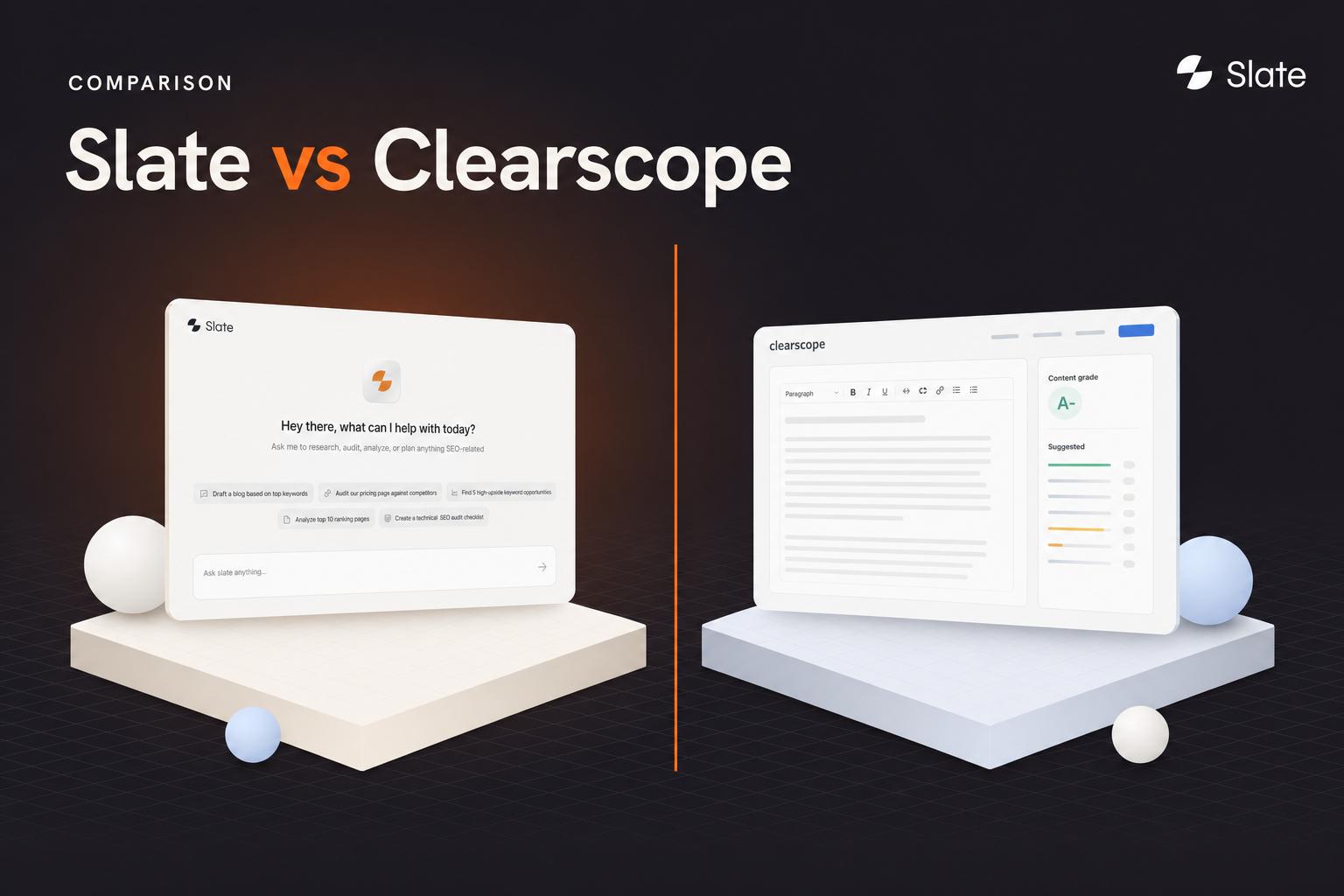
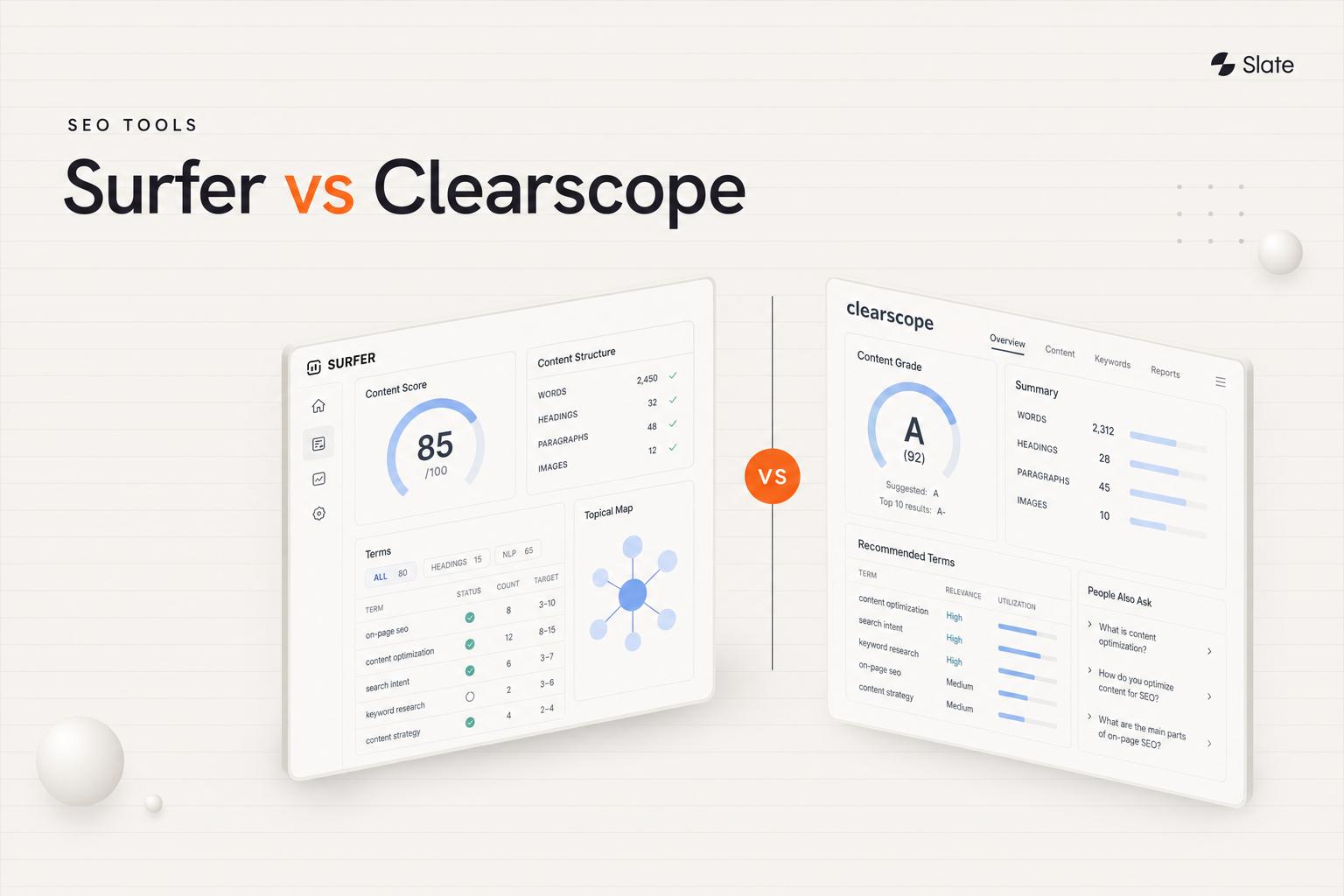
Choosing between Surfer SEO and Clearscope in 2026 comes down to operating model more than feature checklists. Surfer SEO is the broader SEO workspace built for prescriptive optimization, planning, and agency-scale workflows, while Clearscope is the cleaner editorial layer built for writer adoption and enterprise content operations. The right pick depends on whether your bottleneck is SEO control or editorial throughput - and increasingly, whether your content is engineered to be surfaced across AI-driven discovery experiences, not just ranked by Google.
Key Takeaways
- Best for SEO-led teams: Surfer SEO suits buyers who want planning, SERP analysis, audits, and AI assistance in one workspace.
- Best for editorial teams: Clearscope suits buyers where writer adoption, clean UX, and enterprise editorial governance matter most.
- Scoring model difference: Surfer uses a numeric content score driven by NLP terms, structure, and length; Clearscope uses a letter grade from A++ to F based on semantic coverage versus top pages.
- Workflow difference: Surfer is more prescriptive and SEO-control-heavy; Clearscope is more streamlined and writer-friendly.
- Pricing posture: Surfer is the lower-entry option starting at $49/mo; Clearscope starts higher at $129/mo and scales into higher-cost business and enterprise tiers.
- 2026 buying lens: Content score alone is not enough. Buyers should evaluate AI search visibility, citation readiness, refresh workflows, and governance alongside core optimization features.
Surfer SEO vs Clearscope at a Glance
Before going deep, here's the side-by-side view buyers usually want first. The table below collapses the most common decision criteria into a single read.
The pattern is consistent. If the buyer's job is to consolidate SEO work in one place, Surfer pulls ahead. If the buyer's job is to get more writers producing publishable content faster, Clearscope is the safer pick.
What Is Surfer SEO?
Surfer SEO is an AI search and SEO content optimization platform that helps teams research, plan, write, and audit content with a real-time numeric content score grounded in SERP analysis.
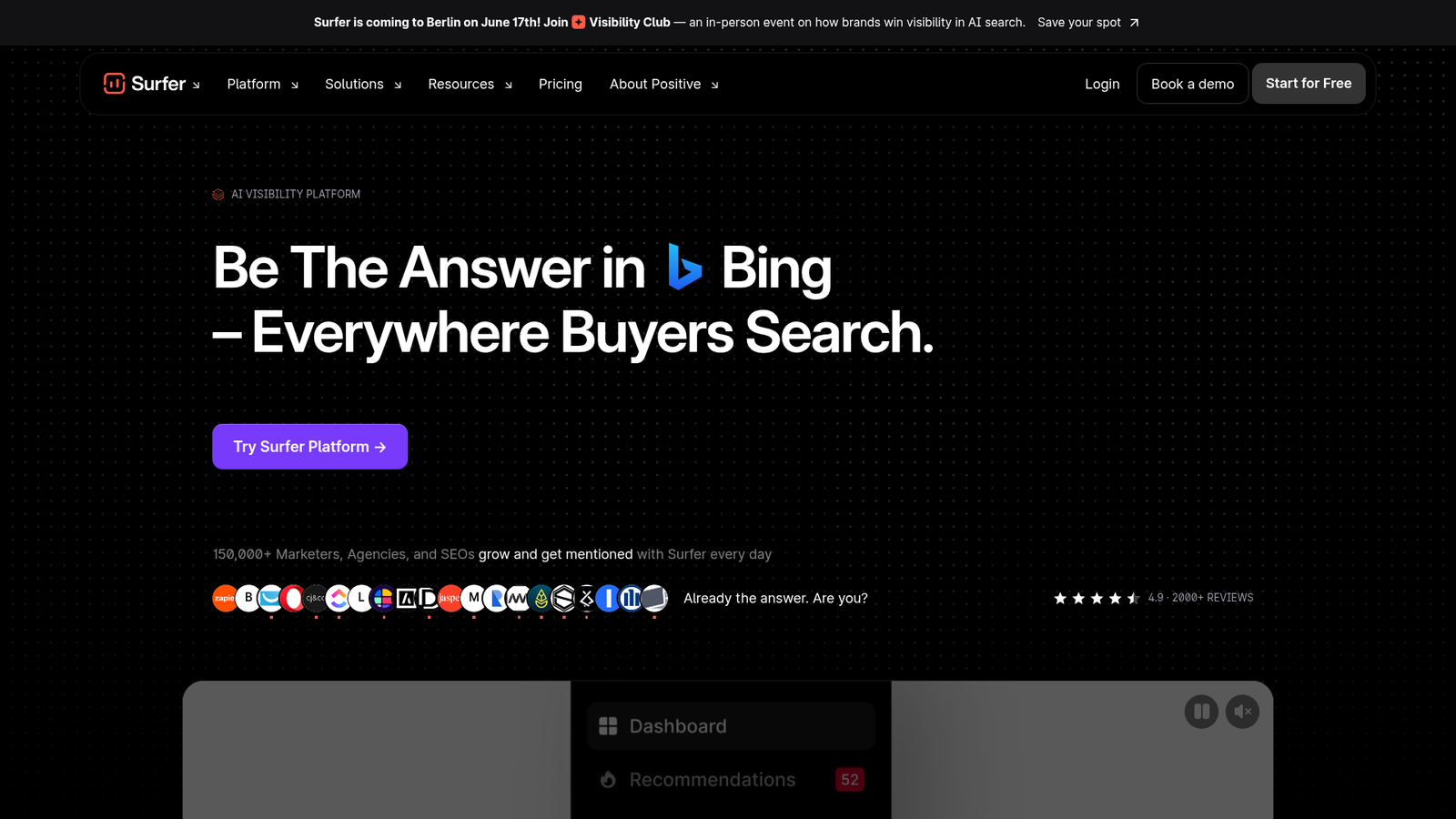
Best for: Content marketers, SEO teams, and agencies that want to optimize and track content performance across traditional search and AI search.
Key features:
- Content Editor with a real-time numeric content score based on NLP terms, headings, length, and structure
- SERP Analyzer, Keyword Research, and Topical Maps for planning and competitive analysis
- Content Audit for monitoring and refresh prioritization
- Surfer AI plus in-editor assistants (Auto Optimize, Coverage Booster, Surfy) for AI-assisted drafting and optimization
- Automated internal linking suggestions based on semantic similarity
- Optional AI Tracker add-on for AI search visibility monitoring
Pricing: Pricing: Discovery $49/mo, Standard $99/mo, Pro $182/mo, Peace of Mind $299/mo, Enterprise $999/mo (all billed yearly; Surfer no longer offers monthly billing). Yearly billing saves \~20%
G2 rating: 4.8/5
Surfer is the more prescriptive of the two tools. It tells you what to add, where, and how often, which suits SEO specialists who want maximum control over output.
What Is Clearscope?
Clearscope is an SEO and AI search visibility platform built around clean editorial reports, letter-grade scoring, and semantic term coverage analysis grounded in top-ranking pages.
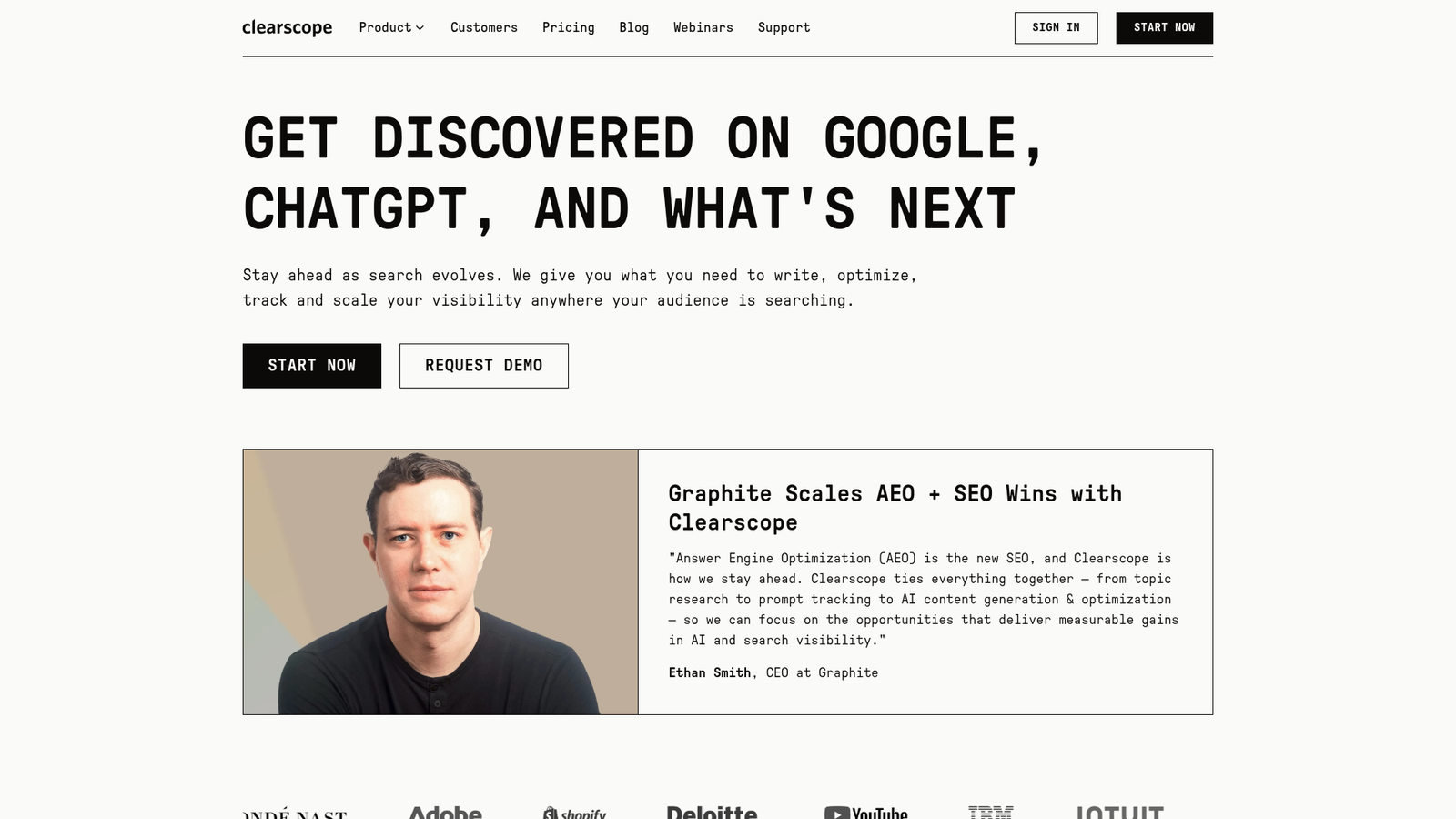
Best for: Content marketing and SEO teams that want to grow and monitor organic and AI-search visibility with writer-friendly editorial workflows.
Key features:
- Content Reports with a letter grade from A++ to F based on semantic coverage
- Search intent summaries that group SERP results by intent type
- Content Inventory for team-wide visibility and ongoing optimization
- Internal Linking View powered by Google Search Console performance data
- Native integrations for Google Docs, WordPress, and Microsoft Word
- Local SEO targeting for region-specific recommendations
Pricing: Essentials $129/mo, Business $399/mo, Enterprise custom. Monthly plans with no minimum contract; add-ons available for extra pages and drafts.
G2 rating: 4.9/5
Clearscope's emphasis is restraint. It surfaces what matters editorially - terms, intent, readability - without burying writers in dials. That's why it tends to win adoption inside editorial-led teams.
Surfer SEO vs Clearscope: What's the Real Difference?
Most feature comparisons miss the actual decision. The split between Surfer and Clearscope isn't a feature gap - it's an operating model gap.
The core split:
- Surfer SEO: An SEO operating workspace. Prescriptive, data-heavy, and designed so an SEO specialist can run planning, optimization, audits, and AI drafting from one screen.
- Clearscope: An editorial optimization layer. Cleaner UI, fewer dials, designed so non-SEO writers hit a defensible content grade without learning a new discipline.
- The decision: Choose Surfer when SEO leads the workflow; choose Clearscope when editorial leads it.
Bottom line: If your writers ignore the tool, feature depth doesn't matter. If your SEO team needs more than a grade, editorial simplicity isn't enough. For broader category context, see these Surfer SEO alternatives.
Content Scoring Model: Numeric Score vs Letter Grade
This is where the philosophical difference between the tools is most visible - and where writer adoption either succeeds or quietly collapses.
How Surfer SEO's Content Score Works
Surfer's Content Editor analyzes top-ranking pages for your target keyword and generates a real-time numeric score reflecting how closely your draft matches that competitive set.
Score inputs include:
- Keyword and NLP term usage
- Headings and overall structure
- Word count and content length
- Use of images and media
The result is precise feedback, but feedback that rewards completeness against a SERP benchmark - which is exactly what SEO specialists want and exactly what non-SEO writers often find overwhelming.
How Clearscope's Content Grade Works
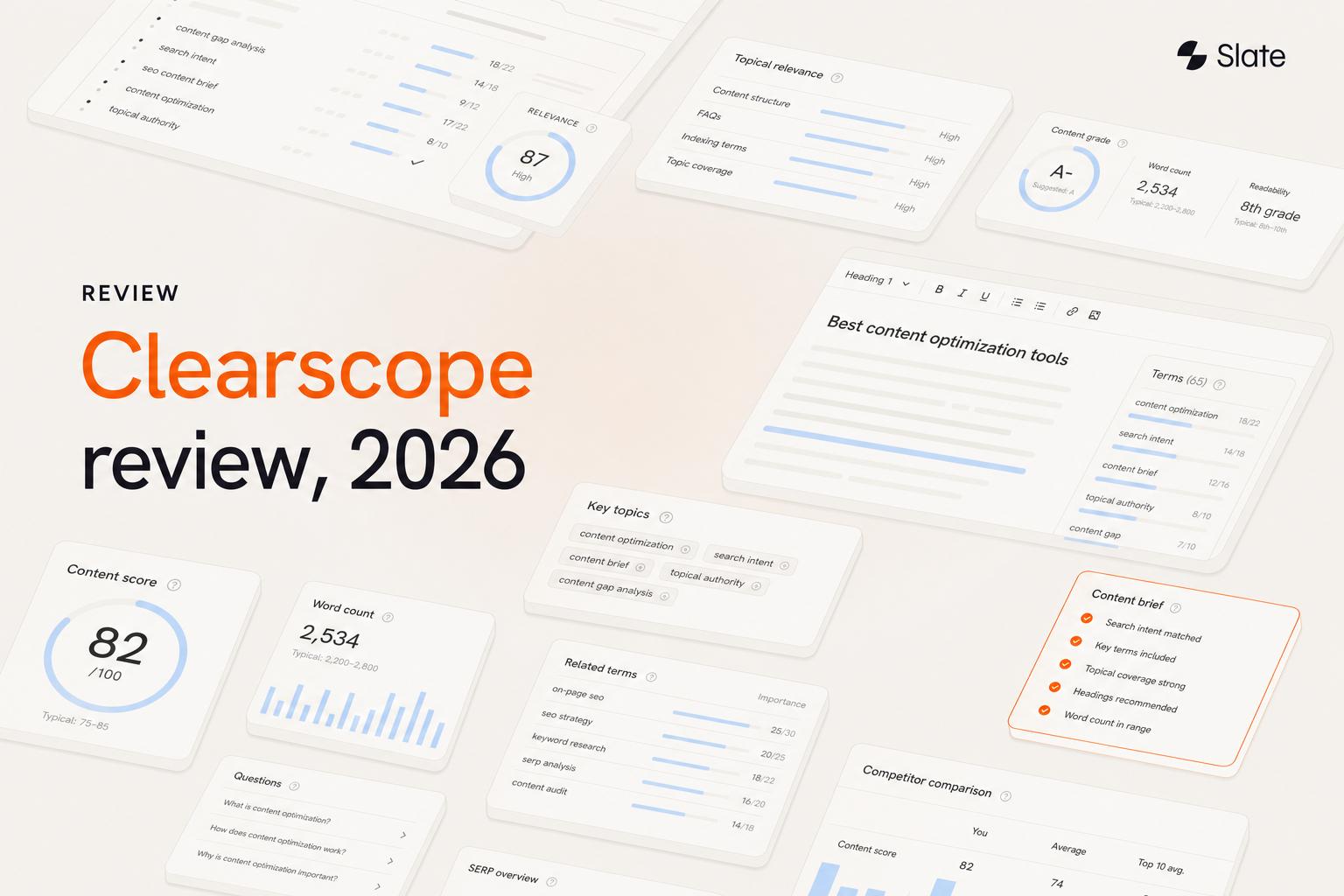
Clearscope grades content from A++ down to F based on how well a draft covers the topic compared to top-ranking competitors.
Grade inputs include:
- Semantic term coverage and prioritization
- Readability balance
- Search intent alignment
The letter grade is intentionally less granular than a number out of 100. Writers know "I'm a B+ and need to reach A" without needing to interpret what 78 means versus 84.
Which Scoring Model Should You Trust?
Scoring is one input, not the strategy. A numeric score encourages precise SERP matching, which is useful for ranking but can produce content that reads like every other page on the SERP. A letter grade encourages editorial judgment within guardrails. Neither score directly tells you how content is performing across AI answer engines - which is increasingly part of the discovery layer buyers use.
Editor Experience and Writer Workflow
Editor UX is the single biggest predictor of whether your investment pays back. The best optimization tool in the world is worthless if writers route around it.
Writing Inside Surfer SEO
Surfer's editor is dense by design. The right rail surfaces terms, structure checks, and AI actions in parallel - Auto Optimize, Coverage Booster, and Surfy as an in-editor assistant. SEO specialists love this density because it means more control without leaving the editor.
The tradeoff is cognitive load. A generalist writer dropped into Surfer for the first time often spends more time interpreting the interface than producing prose. Surfer is a workspace, not a writing surface.
Writing Inside Clearscope
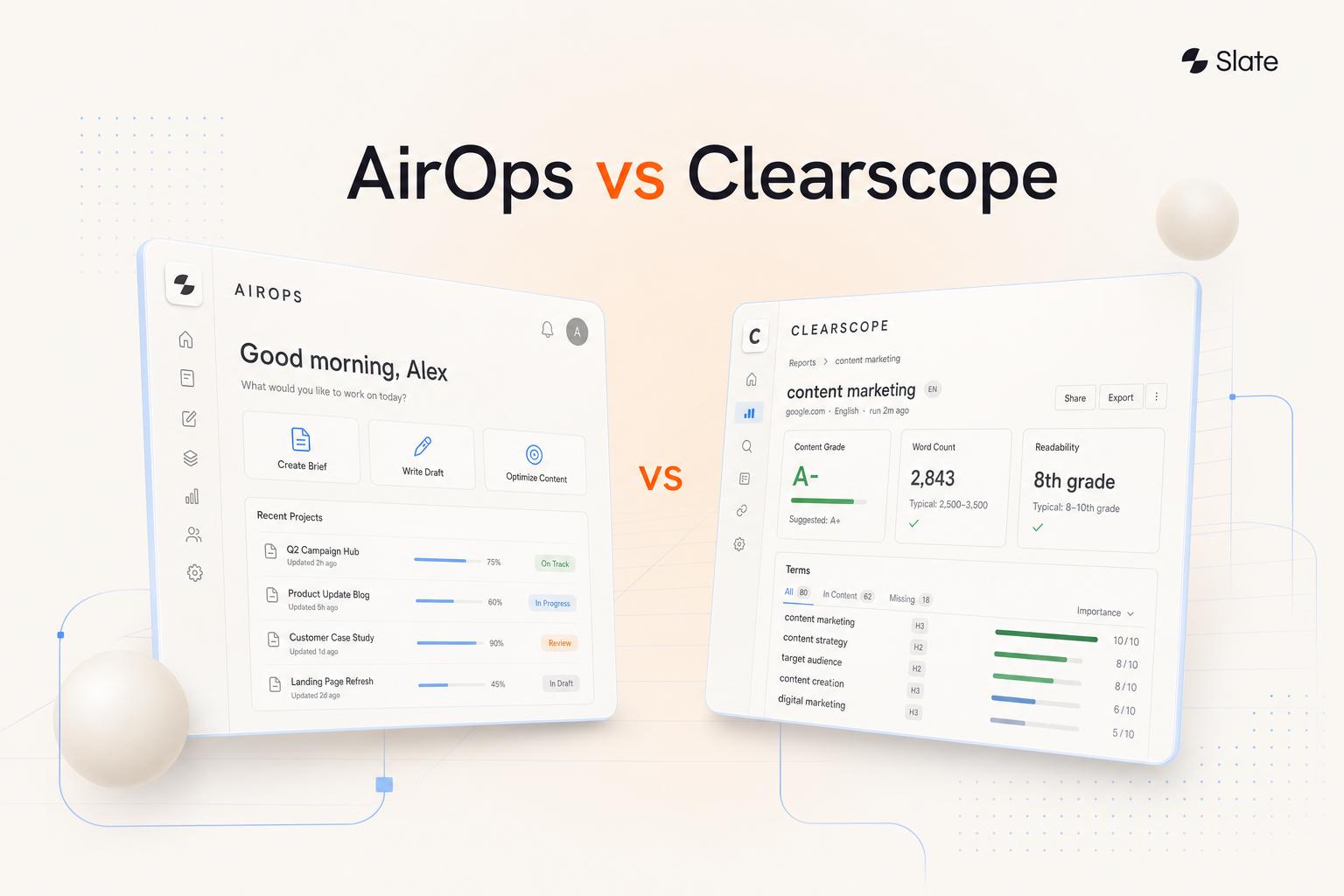
Clearscope strips the editor back to a target grade, a term list, and a readability indicator. Writers see what to add and roughly how often, then write. Native integrations with Google Docs, WordPress, and Microsoft Word mean writers stay inside the tools they already use.
The tradeoff is fewer SEO-specialist controls. If your team wants in-editor SERP comparisons, audit-level depth, or aggressive AI optimization, Clearscope can feel sparse.
Writer Adoption Reality Check
The tool your writers ignore is the wrong tool, regardless of how well it benchmarks on features. For comparison context with AI-first editors, see this take on Surfer vs Clearscope vs Jasper. Run a small adoption pilot before committing to either platform - three writers, three articles, count how many revisions they make voluntarily inside the editor versus working around it.
AI Writing and AI-Assisted Optimization
This category is where the two tools have diverged most clearly in 2026.
AI Features in Surfer SEO
Surfer has leaned into AI as a first-class capability. The current AI stack includes:
- Surfer AI for first-draft generation
- Auto Optimize for automatic optimization of existing drafts
- Coverage Booster for filling semantic gaps
- Surfy, an in-editor AI assistant for inline suggestions
For solo operators and small teams, this can compress first-draft time meaningfully. For editorial teams, the AI output still requires substantive human editing for tone, originality, and factual accuracy.
AI Features in Clearscope
Clearscope's posture is editorial-first. Public messaging from Clearscope is explicit: AI is used "where it actually helps - extracting meaningful terms, clustering topics, analyzing search intent, and highlighting editorial opportunities. Not just spraying content with GPT."
Clearscope is less centered on full first-draft generation. Writers are still expected to do the primary writing, while AI supports analysis, optimization, and editorial guidance underneath.
How Much Editing Each AI Draft Actually Needs
Bottom line: Surfer AI drafts still need editorial review for voice, accuracy, and brand fit. Clearscope puts less emphasis on first-draft generation, so the editing burden tends to center on human-written content and optimization support. If your editorial standard is high and your headcount is thin, restraint may serve you better than speed. For broader options here, compare the best AI content marketing tools.
Strategic Planning, Topical Maps, and SERP Analysis
Planning depth is where Surfer's "SEO workspace" framing pays off most clearly.
Surfer's stack includes a dedicated SERP Analyzer, keyword research with clustering, and Topical Maps for full-cluster planning. The output is designed for SEO teams that want to map dozens of interlinked articles before any drafting begins. Audits then feed back into the planning loop, so refreshes share infrastructure with net-new ideation.
Clearscope plans at the report level. Search intent summaries and content inventory give editorial teams a sense of topic landscape, but the planning surface is narrower than Surfer's. Teams using Clearscope often plan inside a separate research tool and bring topics into Clearscope for execution.
The Slate point of view: Planning should connect to content engineering workflows - the system that turns plans into citation-ready pages, not just rank-targeted drafts. The question isn't "did we cover the keyword?" It's "can an AI system extract a clean answer from our page?" For deeper alternatives, see Clearscope vs Surfer SEO for content optimization.
Internal Linking and Post-Publication Monitoring
Most comparisons treat internal linking and monitoring as side notes. They shouldn't be. Post-publication work is where compounding organic growth actually happens.
Internal Linking in Surfer vs Clearscope
Surfer offers automated, semantically-related internal linking suggestions - and in some workflows, automatic insertion. The pitch is speed: surface relevant links across your site without manual curation.
Clearscope takes a different stance. Its Internal Linking View uses Google Search Console performance data to surface linking opportunities rooted in real traffic and ranking context, not just semantic similarity. The argument is that performance-grounded links are more valuable than semantically-matched ones at scale.
Both philosophies are defensible. Surfer optimizes for throughput; Clearscope optimizes for signal quality.
Content Monitoring and Refresh Workflows
Surfer's Content Audit module identifies underperforming pages and routes them back into the editor for refresh. Full-site tracking provides ongoing visibility into ranking changes.
Clearscope's Content Inventory gives team-wide visibility across content performance and lets teams regrade and prioritize updates over time. Teams scaling this work often pair these features with dedicated content refresh tools.
Both tools still center their monitoring around optimization and refresh workflows, even as AI-visibility features have become part of the category. For SaaS-specific guidance, see Surfer SEO vs Clearscope for SaaS websites.
Collaboration, Seats, and Team Workflow
Collaboration is where the two tools diverge on team scale.
Surfer uses seat-based pricing on lower tiers, with higher plans supporting more team members and Enterprise covering broader team access. Built-in collaboration, shared workspaces, and external sharing fit agency workflows where multiple specialists touch the same brief.
Clearscope leans into team scale on its Business tier and above, with unlimited users and Content Inventory designed to give editorial leads visibility across the entire content pipeline. Premium support and account management appear on higher tiers, which matters for enterprise procurement.
The shorthand:
- Agencies juggling client work: Surfer's workspace model and seat structure fit better
- Enterprise editorial orgs: Clearscope's unlimited-user model and inventory view fit better
- Small in-house teams: Either works; let writer adoption decide
Surfer SEO vs Clearscope Pricing Comparison
Pricing is the most-asked question and often the fastest-changing variable.
Two things matter more than headline numbers:
- Per-seat math at scale. Clearscope's unlimited-user posture on Business can become more attractive than Surfer's seat-based tiers as active user counts grow.
- Add-ons and AI features. Surfer's AI Tracker add-on is incremental. Clearscope page and draft add-ons can stack quickly on Essentials.
Don't budget on plan names. Budget on team scenario.
Which Tool Is Better for Your Team? Use-Case Verdicts
The honest answer to "which is better" is always conditional. Here's the breakdown by buyer profile.
Best for Freelancers and Solo Operators
Surfer SEO is the default. At $59/mo for Discovery, the entry cost is materially lower than Clearscope's $129/mo Essentials, and the breadth of features - editor, SERP analysis, audits, AI assistance - supports the broad responsibility surface of a solo operator. Clearscope only makes sense at this stage if you primarily serve enterprise clients who expect Clearscope-graded deliverables.
Choose Surfer SEO if cost-to-capability ratio is your priority.
Best for In-House SEO Teams at SaaS Startups
This is the most contested segment. Surfer wins if you want a single SEO workspace and the team has enough SEO maturity to use it well. Clearscope wins if writer adoption is your bottleneck - if your content team is mostly editors and PMMs who don't want to learn a new discipline.
Choose Surfer SEO if SEO leads execution. Choose Clearscope if writers do. See more in Surfer SEO vs Clearscope for SEO teams.
Best for Content-Led B2B SaaS Companies
Clearscope is usually the better primary optimization layer for content-led B2B SaaS. Editorial-first UX, semantic focus, and Microsoft Word integration matter when content is treated as a craft, not a checklist. The tradeoff is shallower planning depth; many teams pair Clearscope with a separate research tool.
Choose Clearscope if editorial quality is the differentiator.
Best for Agencies
Surfer typically wins for agencies managing multiple client sites. Multi-member workspaces, audits across client domains, automated internal linking, and AI assistance compress production economics. Clearscope is the better pick when an agency sells premium editorial services to a handful of high-value clients who pay for deliverable quality. Compare further at Surfer SEO vs Clearscope for agencies.
Choose Surfer SEO for multi-client throughput. Choose Clearscope for premium editorial deliverables.
Best for Enterprise Editorial Teams
Clearscope is the default. Unlimited users on Business, Content Inventory for team-wide governance, and a clean writer experience reduce onboarding friction at scale. Surfer earns the slot only when an enterprise SEO function leads content strategy and editorial is downstream. See Surfer SEO vs Clearscope for enterprise teams.
Choose Clearscope for writer-led enterprise editorial. Choose Surfer SEO for SEO-led enterprise content.
Surfer SEO vs Clearscope vs Frase, Jasper, MarketMuse, and NeuronWriter
Buyers rarely compare just two tools. Here's the broader landscape.
Frase: Combines SEO research with AI writing and answer-engine framing. Strong on detailed briefs and an entry point for budget-conscious teams. Fits early-stage marketers who need briefs plus drafting in one tool.
Jasper: AI writing-first, not optimization-first. In multi-tool stacks, Jasper handles drafting while Surfer or Clearscope handle optimization. Pick Jasper when copy production volume is the bottleneck and SEO depth is secondary.
MarketMuse: Enterprise topic modeling and topical authority planning. Best for large sites planning hundreds of interlinked pages where authority and coverage models drive prioritization. Heavier procurement; deeper planning.
NeuronWriter: Positioned as the budget alternative for AI-assisted SEO content optimization. Lower entry pricing than Surfer or Clearscope, with smaller-team workflows. Fits independent operators and small agencies trading polish for cost.
For a broader category map, see Clearscope vs Surfer SEO.
When Neither Surfer SEO nor Clearscope Is the Right Fit
The 2026 reality: scoring-first content tools were built around traditional search optimization. Teams optimizing only for keyword coverage may miss newer visibility questions around AI Overviews, ChatGPT, Perplexity, and Gemini citations. If your team's bottleneck is AI search visibility, citation readiness, or scaled content engineering - not just hitting a content grade - neither Surfer nor Clearscope is the natural pick. Here are three alternatives worth evaluating.
1. Slate - Best for AI Search Visibility and Content Engineering Workflows
Slate is an end-to-end AI search optimization and content engineering platform built for the discovery layer that traditional SEO tools weren't designed for.
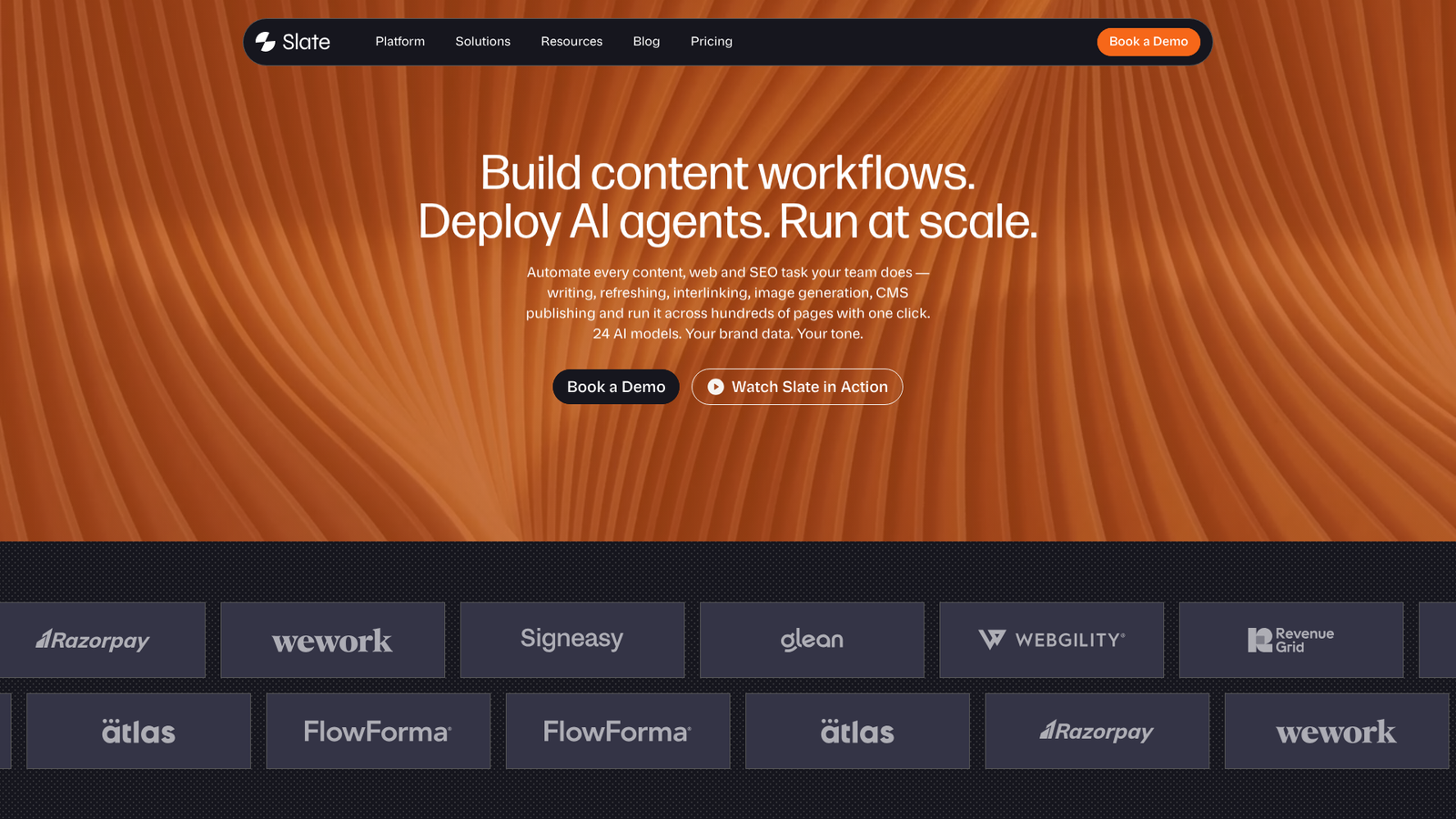
Best for: Marketing, SEO, and content teams that need to monitor AI search visibility and automate content operations at scale.
Key features:
- AI Search Analytics across ChatGPT, Google AI Mode, Google AI Overviews, Perplexity, Claude, and Gemini to track brand visibility and citation gaps
- Workflows: A visual builder for multi-step content automation with 24+ AI models, conditional logic, web scraping, and CMS publishing
- Power Sheets for bulk content refreshes, programmatic creation, and optimization audits across thousands of URLs
- SuperBlocks: Pre-built workflow components and templates for AI Search Optimization
- Brand Kit & Knowledge Base for style guides, tone rules, and brand-safe content generation
- Direct CMS publishing to Webflow and WordPress, plus MCP integration with Claude
What Slate does that Surfer and Clearscope don't: track where your brand appears across AI answer engines, identify citation gaps where competitors are mentioned instead, and run repeatable workflows for net-new and refresh content - engineered for citation readiness and extractability, not just keyword scoring.
Pricing: Starting at $199/mo.
G2 rating: 4.9/5
For teams thinking through the next layer of organic growth, see this best fit: Surfer SEO or Clearscope decision framework.
2. MarketMuse
MarketMuse focuses on enterprise topic modeling and topical authority planning, surfacing content gaps and authority scores across large content libraries.
Best for: Enterprise teams planning hundreds of interlinked pages where authority modeling drives prioritization.
Key features:
- Topic modeling and content cluster analysis
- Authority scoring and gap identification
- Enterprise-scale planning workflows
3. Frase
Frase combines SERP research, content briefs, and AI writing into a single workflow with an answer-engine optimization angle.
Best for: Marketers who need briefs plus drafting in one tool on a moderate budget.
Key features:
- SERP-driven content briefs
- AI writing for first drafts
- Answer-engine optimization framing
Surfer SEO vs Clearscope in 2026: The AI Search Lens
The discovery layer changed faster than most tools could adapt. In 2026, users get answers from Google AI Overviews, ChatGPT, Perplexity, and Gemini before they ever see a blue link. That shift forces a new buying lens on top of the traditional scoring debate.
Four 2026 evaluation criteria buyers should assess alongside traditional scoring:
- AI visibility tracking across answer engines. Both vendors now position parts of their product around AI visibility, but buyers should still verify which engines, reports, and workflows are actually included.
- Citation readiness in content structure. Is your content structured so an AI system can extract a clean, attributable answer? Scoring models measure SERP fit, not extractability.
- Refresh workflows tied to changing discovery surfaces. Traditional audits are strongest on ranking drops and on-page opportunities; they may not fully capture when visibility shifts inside AI-generated answers.
- Governance over AI-generated drafts. Brand voice, factual accuracy, and review gates matter more as AI assistance scales. Both tools support this differently.
The 2026 buying lens isn't just "which tool scores my content better." It's "where does my content actually surface, and can I engineer for that?" Explore the broader framing in this AI SEO comparison.
Final Verdict: Surfer SEO vs Clearscope
The decision matrix:
The right answer depends on operating model, not feature lists. Surfer SEO wins when SEO leads the workflow and you want one workspace for planning, optimization, and audits. Clearscope wins when editorial leads and writer adoption is the lever that compounds. And if your real bottleneck is visibility inside AI answer engines, the better question isn't "Surfer or Clearscope" - it's whether your content is engineered for the discovery layer your buyers actually use. See Surfer vs MarketMuse vs Frase vs Clearscope enterprise for deeper enterprise framing.
Ready to engineer content for AI search? Book a demo.
Frequently Asked Questions
Is Surfer SEO better than Clearscope?
Neither is universally better. Surfer SEO wins for SEO-led teams and agencies that want broader planning, SERP analysis, audits, and AI writing in one workspace. Clearscope wins for editorial teams and enterprises where writer adoption, clean UX, and unlimited-user collaboration matter more than feature breadth. The decision is operating model, not feature checklist.
Is Clearscope worth the higher price?
For large editorial teams where writer adoption, unlimited users, and Content Inventory drive measurable throughput, Clearscope's $129/mo Essentials and $399/mo Business tiers are usually justified. For solo operators and small SEO-led teams, Surfer SEO typically delivers better value at lower entry cost. Pay Clearscope's premium when editorial quality is your differentiator.
Which tool is better for SaaS websites?
For Clearscope vs Surfer SEO optimization for SaaS websites, the split is usually SEO-led vs content-led. In-house SEO-led SaaS teams typically prefer Surfer SEO for planning depth and audits. Content-led B2B SaaS companies typically prefer Clearscope for editorial UX, Word integration, and writer adoption. Both can support SaaS workflows; the right pick depends on who leads execution.
Which tool is better for agencies?
Agencies usually pick Surfer SEO for multi-client workflow depth, audits across client domains, and AI-assisted production economics. In a broader Surfer SEO vs Frase vs Jasper vs Clearscope for agencies comparison, Frase fits brief-heavy workflows, Jasper fits copy-volume needs, and Clearscope fits agencies selling premium editorial deliverables to a small number of high-value clients.
Does Clearscope or Surfer SEO have better AI writing?
Surfer SEO has the broader AI writing stack - Surfer AI for first drafts, Auto Optimize, Coverage Booster, and the Surfy assistant. Clearscope takes a more restrained posture, using AI more for term extraction, topic clustering, search intent analysis, and optimization support than for full first-draft writing. Surfer wins on draft speed; Clearscope wins on editorial control.
Can either tool track AI search visibility in ChatGPT or Perplexity?
Both tools now position parts of their offering around AI-search visibility. Surfer SEO offers an AI Tracker add-on, while Clearscope markets visibility and tracking across Google and AI chatbot surfaces. Teams whose primary buying lens is AI search visibility across ChatGPT, Perplexity, Gemini, and AI Overviews should verify which engines, reports, and limits are included.
Should I switch from Surfer SEO to Clearscope (or the reverse)?
Switching costs include retraining writers on a new scoring model, rebuilding brief and workflow templates, and migrating topical plans. Before switching, diagnose whether the real problem is feature gaps or adoption friction. If writers aren't using the current tool, switching may help; if SEO depth is missing, switching to a simpler tool will make the gap worse, not better.
What's the best alternative to Surfer SEO and Clearscope?
For teams whose primary lens is AI search visibility and content engineering - tracking brand presence across ChatGPT, Perplexity, Gemini, Claude, AI Overviews, and AI Mode, and running repeatable workflows for net-new and refresh content - Slate is the strongest alternative. MarketMuse fits enterprise topical authority needs, and Frase fits brief-plus-AI-writing workflows on a moderate budget.