Your enterprise content team is drowning in tools that don't talk to each other.
Dozens of writers. Multiple CMS platforms. Regional teams optimizing in silos. AI-generated content with no governance layer. The result: inconsistent quality, missed SEO opportunities, and zero visibility into what's actually driving organic growth.
Generic SEO tools weren't built for this. They were built for solo practitioners and small agencies - not distributed content operations with 50+ contributors, multi-brand governance requirements, and procurement teams asking hard questions about SOC 2 compliance and SSO requirements.
This guide covers the 15 best AI SEO tools specifically evaluated for enterprise content teams. Every tool is assessed against criteria that actually matter at scale: multi-team workflows, content governance, CMS integration depth, security, and total cost of ownership. If you're a VP of Content, Head of SEO, or Content Operations Manager shortlisting tools for a team of 10 or more, this is the resource you've been looking for.
For additional insights on content operations best practices and how to structure your enterprise content strategy, we've covered the operational frameworks that make tool adoption successful at scale.
How we evaluated these AI SEO tools for enterprise use
Most tool roundups evaluate features in a vacuum. We evaluated each tool through a single lens: can an enterprise content team actually operate at scale with this?
Enterprise-specific evaluation criteria
AI content optimization capabilities - Does the tool use NLP scoring and SERP analysis, and content brief generation to meaningfully improve content quality, or is it just a keyword density checker with a new coat of paint?
Multi-team workflow support - Can you assign roles, set permissions, build approval chains, and track content pipeline status across a distributed team?
Content governance and brand voice controls - Does the tool enforce editorial standards, brand voice guidelines, and compliance guardrails at the point of creation - not just after the fact?
CMS and tech stack integrations - Native plugins, API connections, and headless CMS compatibility with platforms like WordPress, HubSpot, Contentful, and Drupal. Shallow integrations that require copy-paste workflows don't count.
Scalability - Multi-site, multi-region, and multi-language support. Can the tool grow with a 200-person content org without breaking?
Security and compliance - SOC 2 certification, SSO, GDPR compliance and data residency options. Non-negotiable for enterprise procurement.
Reporting and executive dashboards - Can leadership see content SEO performance without digging through raw data exports?
Pricing model and total cost of ownership - Subscription price is only part of the story. Implementation, training, per-seat costs at scale, and integration development all factor in.
Onboarding, training, and customer success - Enterprise rollouts across 50+ content producers require more than a help center article.
Quick comparison table - 15 best AI SEO tools at a glance
1. Slate - best for enterprise content governance and multi-team workflows
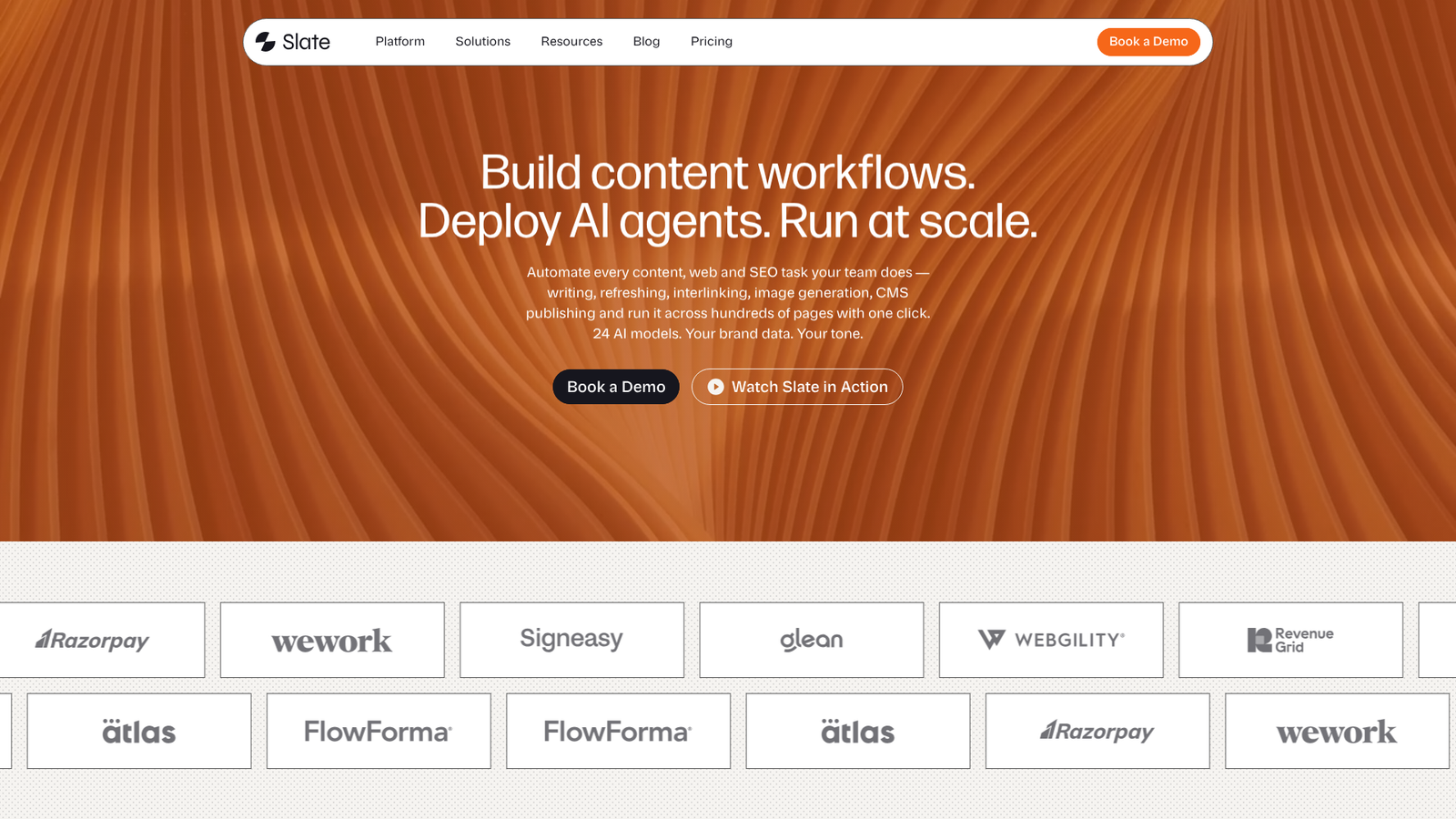
Slate is a purpose-built enterprise content operations platform that combines AI-powered SEO optimization with the governance and workflow infrastructure that large content teams actually need.
Where most AI SEO tools focus on optimizing individual pieces of content, Slate is designed around the operational reality of enterprise content: multiple contributors, editorial oversight requirements, CMS handoffs, and the need for consistent quality at scale. It's the tool built specifically for the audience reading this article.
Best for: Enterprise content teams with 10+ writers and editors, multi-brand organizations, regulated industries, and companies managing content across multiple CMS environments.
Key strengths
- Content governance framework with brand voice enforcement and editorial guardrails
- Role-based access and multi-step approval chains for distributed teams
- Deep CMS integrations including WordPress, HubSpot, Contentful, and headless environments
- AI-powered content optimization with enterprise-grade controls and compliance awareness
- Executive reporting dashboards with content performance attribution
Pricing: Starting at $199/month; custom enterprise pricing available for team and agency tiers - request a demo for a tailored quote.
Slate's honest limitation: because it's purpose-built for enterprise governance, it's not the right fit for solo practitioners or small teams that just need a content editor. The platform's depth is its strength, but it does require proper onboarding to get full value from the workflow orchestration features.
2. Surfer SEO - best for AI-driven content optimization at scale
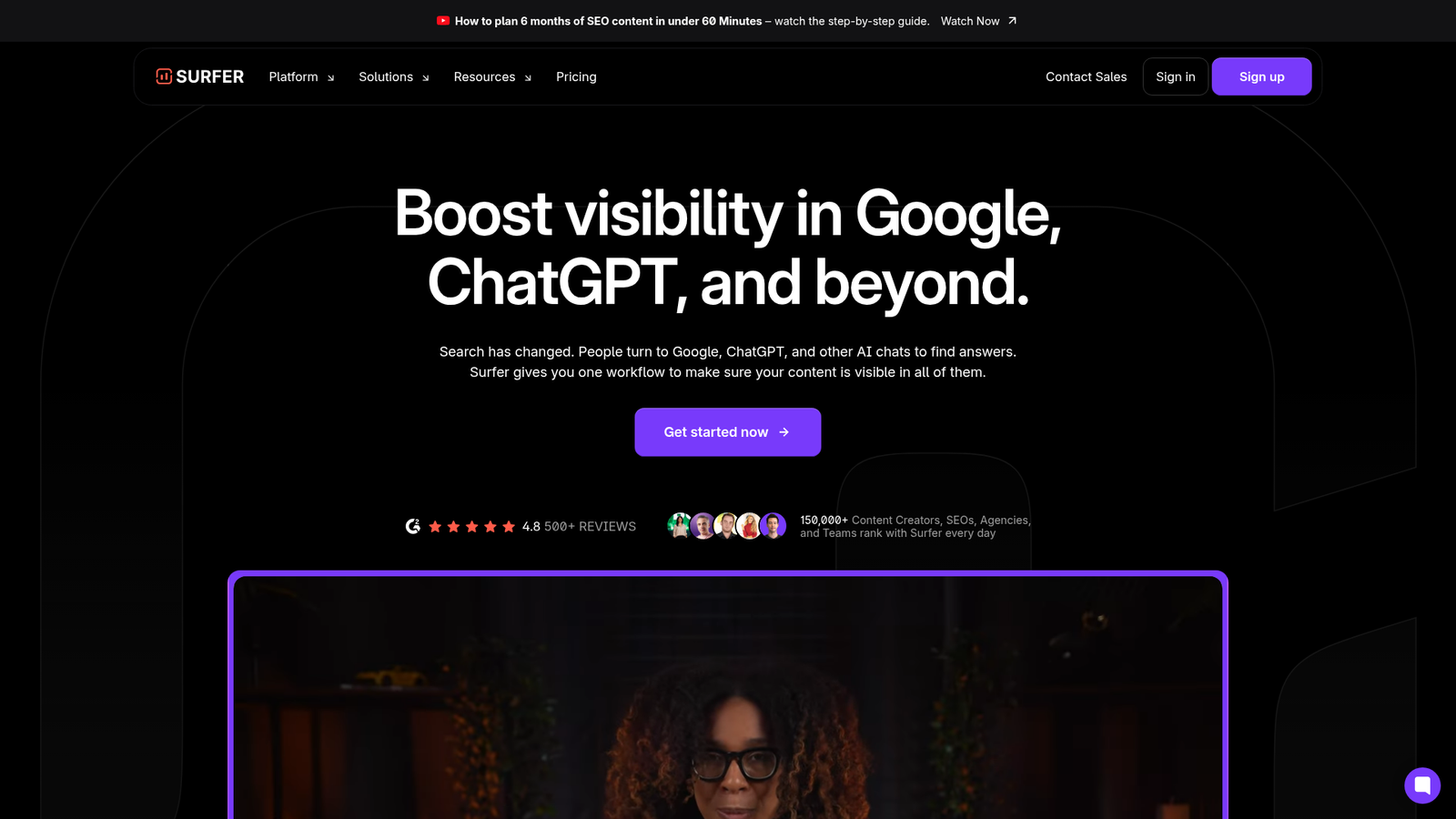
Surfer SEO is a SERP-based content optimization platform that scores content in real time against top-ranking pages using NLP analysis.
It's the most widely adopted content optimization tool among enterprise content teams, and for good reason: the Content Editor is intuitive enough that writers adopt it quickly, and the NLP scoring is genuinely useful for closing optimization gaps. Surfer's Grow Flow module scans domains weekly to automatically surface missing internal links, keyword gaps, and improvement tasks - reducing the manual audit burden on SEO leads.
Best for: Content teams focused on on-page optimization who need a strong, writer-friendly content editor; less suited to teams that need governance and workflow orchestration.
Key strengths
- Real-time NLP content scoring against SERP competitors
- Grow Flow for automated weekly domain-level optimization tasks
- AI content generation via Surfy AI integrated into the editor
- Keyword clustering and SERP Analyzer for content planning
- API access and integrations with Google Docs and WordPress
Pricing:
Starts at $49/mo (Discovery plan). Standard $99/mo; Pro $182/mo; Peace of Mind $299/mo; Enterprise custom. Surfer restructured its pricing in 2025 — there is no current $89/mo plan.
The main limitation for enterprise teams: Surfer doesn't offer native multi-team workflow features, role-based permissions, or content governance controls. It works best as the optimization layer within a broader enterprise content stack - paired with a governance platform like Slate for operational oversight.
3. Semrush - best all-in-one SEO platform with AI features
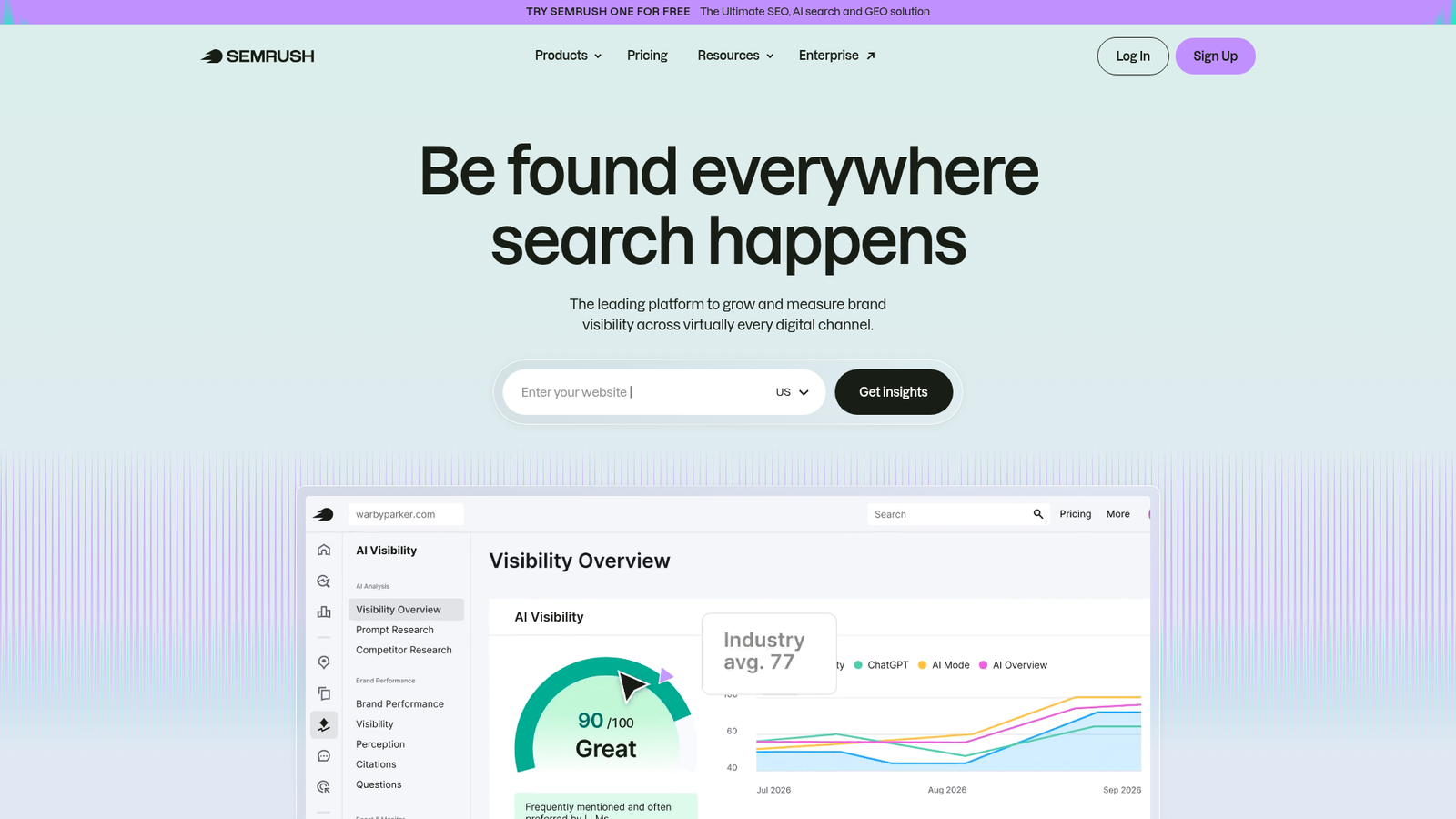
Semrush is the most comprehensive all-in-one SEO platform on the market, covering keyword research, competitive intelligence, technical audits, and AI-assisted content optimization under one roof.
For enterprise teams that want a single platform for SEO research and content optimization, Semrush is the default choice. Its AI Visibility Toolkit tracks brand mentions across Google AI Overviews, ChatGPT, Gemini, and Perplexity (current platform list per semrush.com/kb/1493-ai-visibility-toolkit).' Pull the exact platform list from Semrush's own KB and phrase as 'tracks brand mentions' rather than 'integrates with.- reflecting the industry's shift toward multi-LLM support. The SEO Writing Assistant and ContentShake AI add content creation capabilities, though these work best as supplements to a dedicated content workflow rather than replacements for one.
Best for: Enterprise teams that need a single platform for SEO research and content optimization; particularly strong when paired with a dedicated content workflow and governance tool.
Key strengths
- SEO Writing Assistant with real-time content optimization recommendations
- ContentShake AI for AI-assisted content generation and ideation
- Keyword Magic Tool with advanced filtering and topic clustering
- Comprehensive site audit and technical SEO capabilities
- Tiered pricing with expanded AI features and custom enterprise options
Pricing: Pro $139.95/mo (monthly) or $117.33/mo (annual); Guru $249.95/mo; Business $499.95/mo. (Rewrite '~$139/mo' as the exact '$139.95/mo' Pro-plan figure.)
The honest trade-off: Semrush can feel overwhelming for teams that only need content optimization. The platform's breadth is a strength for SEO-mature organizations, but it requires dedicated management to extract full value. AI writing features are add-ons rather than core functionality, and content workflow capabilities remain limited compared to purpose-built tools.
4. MarketMuse - best for AI content strategy and topic authority planning
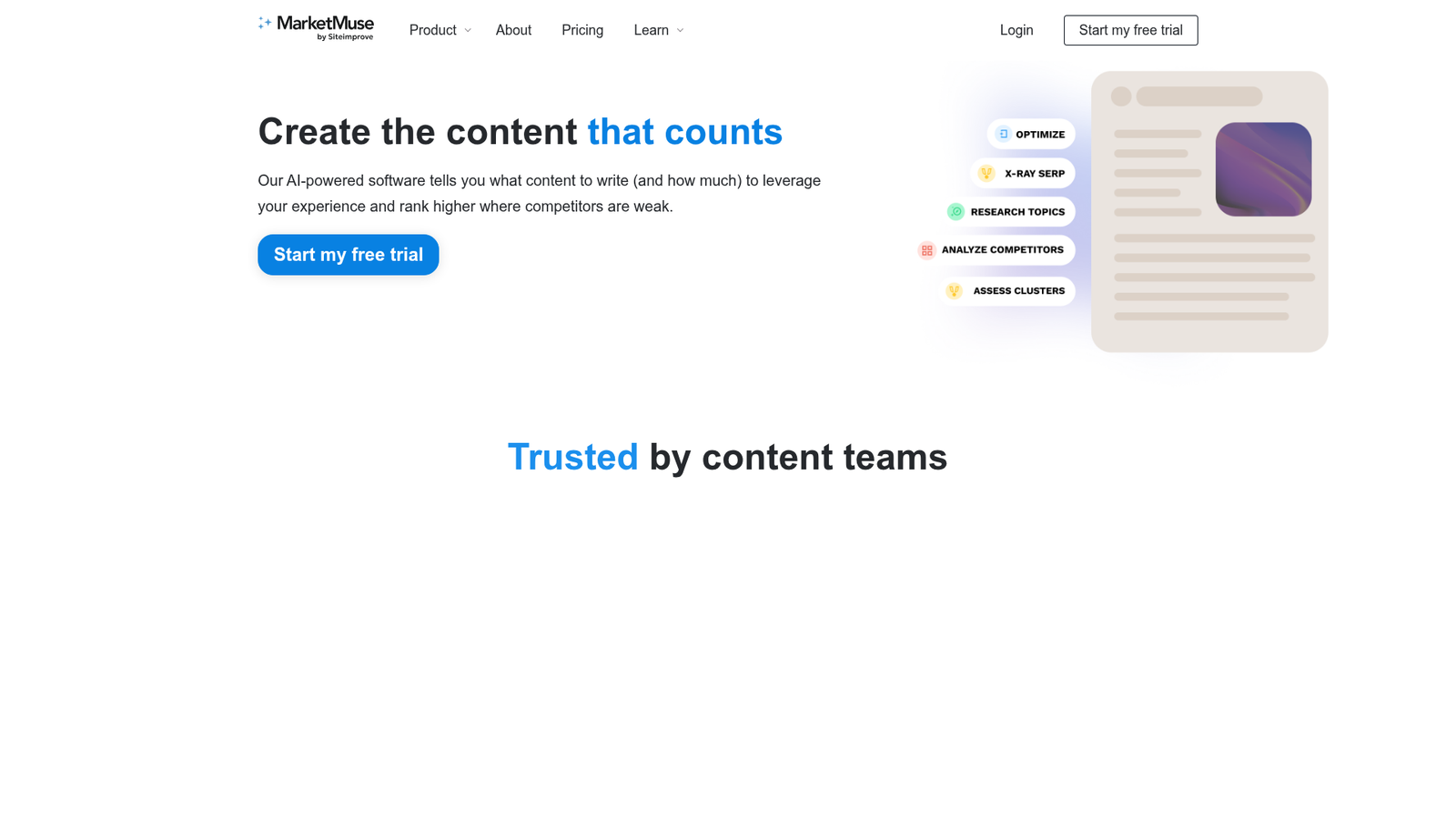
MarketMuse is a content intelligence platform built around topic modeling and authority planning - it helps enterprise teams understand not just what to write, but how to build comprehensive topical coverage that outranks competitors.
The platform's AI analyzes your existing content library against competitor coverage to identify gaps, prioritize topics by difficulty and opportunity, and generate detailed content briefs. For enterprise teams managing large content libraries across multiple topic clusters, MarketMuse provides a strategic layer that most optimization tools don't offer.
Best for: Content strategists and SEO leads who need data-driven topic planning; enterprise teams building topical authority across large, established content libraries.
Key strengths
- AI-powered topic modeling and content authority scoring
- Content inventory and audit automation for large libraries
- Competitive content gap analysis with prioritized recommendations
- Detailed content briefs with AI-generated outlines and questions
- Personalized difficulty scores calibrated to your domain's authority
Pricing: Published tiers: Optimize $99/mo; Research $249/mo; Strategy $499/mo. Free tier available (10 queries/month). The 'custom quoted' framing misstates MarketMuse pricing — the three main tiers have public monthly prices.
The limitation to flag: MarketMuse is expensive at scale, and the learning curve is steeper than tools like Clearscope or Surfer. CMS integrations are limited, and there are no native workflow features - so it functions as a strategy and planning layer rather than an end-to-end content operations tool.
5. Clearscope - best for content optimization simplicity and team adoption
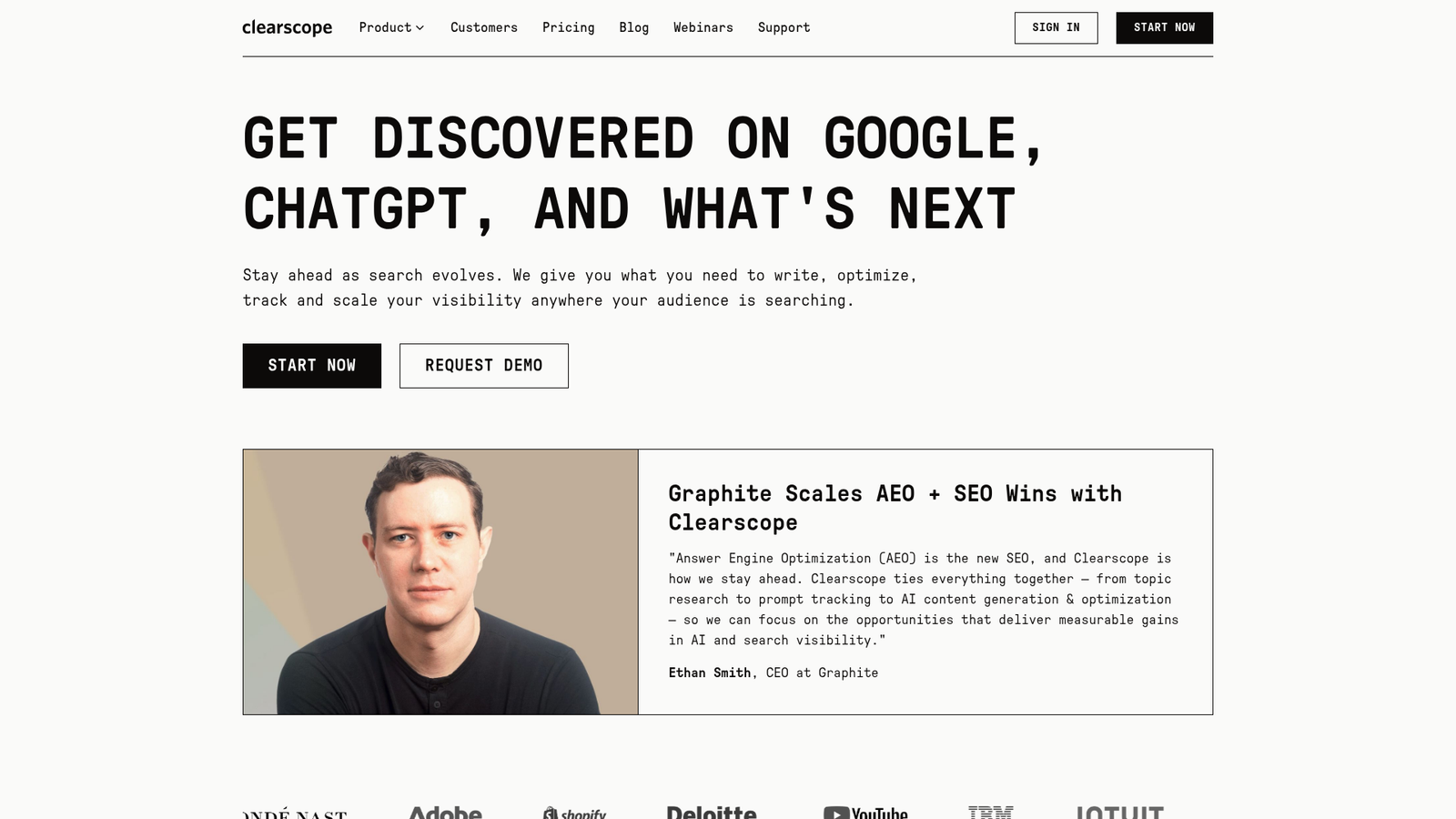
Clearscope is a premium AI-powered content optimization platform known for its clean interface and high adoption rates among enterprise content teams - particularly effective for mid-market and large organizations where writer buy-in is the primary challenge.
The platform's content grading system is deliberately simple: writers see a score, they see which terms to include, and they optimize. There's no steep learning curve. Google Docs and WordPress integrations mean writers can optimize without leaving their existing tools. For enterprise teams rolling out SEO optimization to a large pool of writers with varying SEO experience, Clearscope's simplicity is a genuine competitive advantage.
Best for: Enterprise teams prioritizing ease of adoption across large writer pools; organizations where simplicity and consistent usage matter more than feature depth.
Key strengths
- Intuitive content grading system with clear optimization recommendations
- Real-time term analysis based on SERP competitor research
- Native Google Docs and WordPress integrations for in-workflow optimization
- Content inventory tracking for monitoring existing content performance
- Team collaboration features with shared report access
Pricing: Starts at $129/mo (Essentials, unlimited users). Business $399/mo; Enterprise custom. The $189/mo figure is not a current Clearscope plan.
The honest limitation: Clearscope's per-report pricing model gets expensive quickly at enterprise scale. AI content generation capabilities are limited compared to Surfer or Jasper. If your team needs deep workflow features, governance controls, or technical SEO capabilities, you'll need to pair Clearscope with additional tools.
6. Conductor - best enterprise SEO platform for organic marketing intelligence
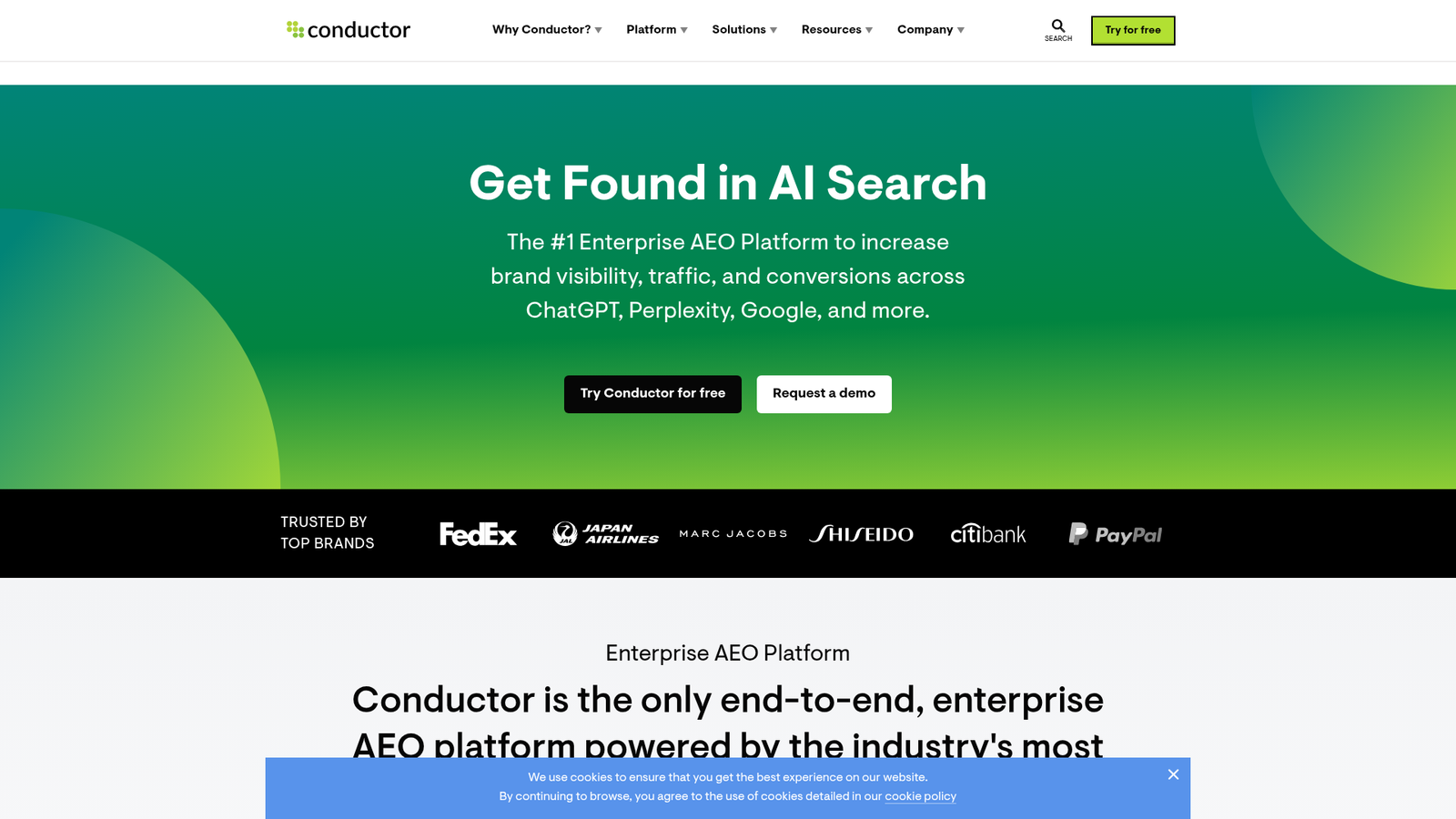
Conductor is a true enterprise SEO platform built for large organizations that need organic marketing intelligence beyond content optimization - it connects SEO data to business outcomes in a way that most tools don't.
Conductor's strength is its integration ecosystem. It connects with Adobe, Salesforce, and major CMS platforms, making it a viable hub for enterprise teams that need SEO data flowing into their broader marketing stack. The platform includes enterprise security features including SOC 2 certification and SSO, which matters for procurement teams at large organizations. Customer success support is a genuine differentiator - Conductor's onboarding and ongoing support model is designed for enterprise rollouts, not self-serve adoption.
Best for: Large enterprises with dedicated SEO teams who need organic marketing intelligence connected to their broader marketing technology stack.
Key strengths
- Content intelligence with audience intent data and optimization recommendations
- Organic marketing insights tied to business performance metrics
- Site health monitoring and technical SEO capabilities
- Competitive visibility tracking across markets and regions
- Enterprise security with SOC 2 certification and SSO support
Pricing: Custom enterprise pricing (Conductor does not publish rates publicly). Industry data: annual contracts typically start at $26,800+/year (≈$2,233+/mo) at the low end; mid-market deployments $40K–$70K/year; enterprise often $100K–$500K+/year. First-year TCO usually runs 1.5–2x subscription when implementation and professional services are included.
The trade-off worth noting: Conductor doesn't offer AI content generation, and the platform requires a dedicated team to manage effectively. Onboarding timelines tend to be longer than lighter-weight tools. It's a serious investment best suited to organizations with mature SEO operations and the internal resources to support it.
7. BrightEdge - best for enterprise SEO automation and AI recommendations
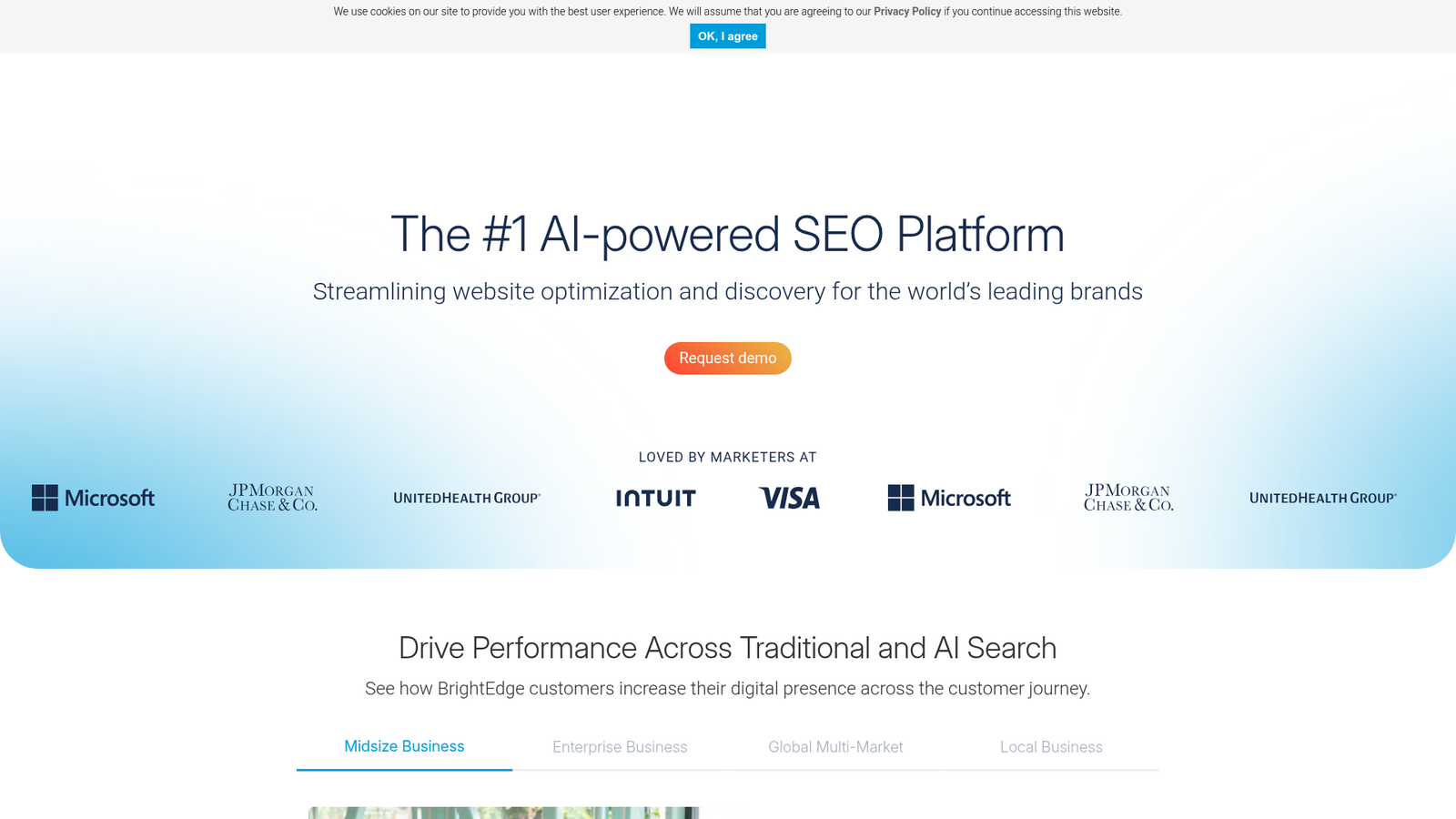
BrightEdge is an enterprise-grade SEO platform with deep automation capabilities and AI-powered recommendations - built for Fortune 500 organizations that need SEO operating at massive scale.
The platform's AI-powered recommendations engine analyzes content performance, competitive positioning, and technical health to surface prioritized actions for SEO teams. BrightEdge's competitive benchmarking capabilities are particularly strong, giving enterprise teams visibility into how their content performs relative to competitors across thousands of keywords. Content performance tracking connects organic visibility to revenue impact, which is the reporting language that executive stakeholders actually care about.
Best for: Fortune 500 and large enterprise teams with dedicated SEO operations; organizations that need automated SEO recommendations across massive content libraries.
Key strengths
- AI-powered recommendations engine for prioritized SEO actions
- Keyword and content intelligence for large-scale content planning
- Technical SEO automation for site health management
- Competitive benchmarking across thousands of keywords and markets
- Enterprise integrations and API for connecting to broader tech stacks
Pricing: Custom enterprise pricing - contact BrightEdge for a quote based on your organization's scale and requirements.
The honest assessment: BrightEdge's interface feels dated compared to newer tools, and the implementation complexity is real. The learning curve is steep, and you'll need dedicated internal resources to manage the platform effectively. It's not a tool you deploy and immediately get value from - but for organizations with the resources to invest, the depth of automation and data is hard to match.
8. seoClarity - best for enterprise content analytics and AI search optimization
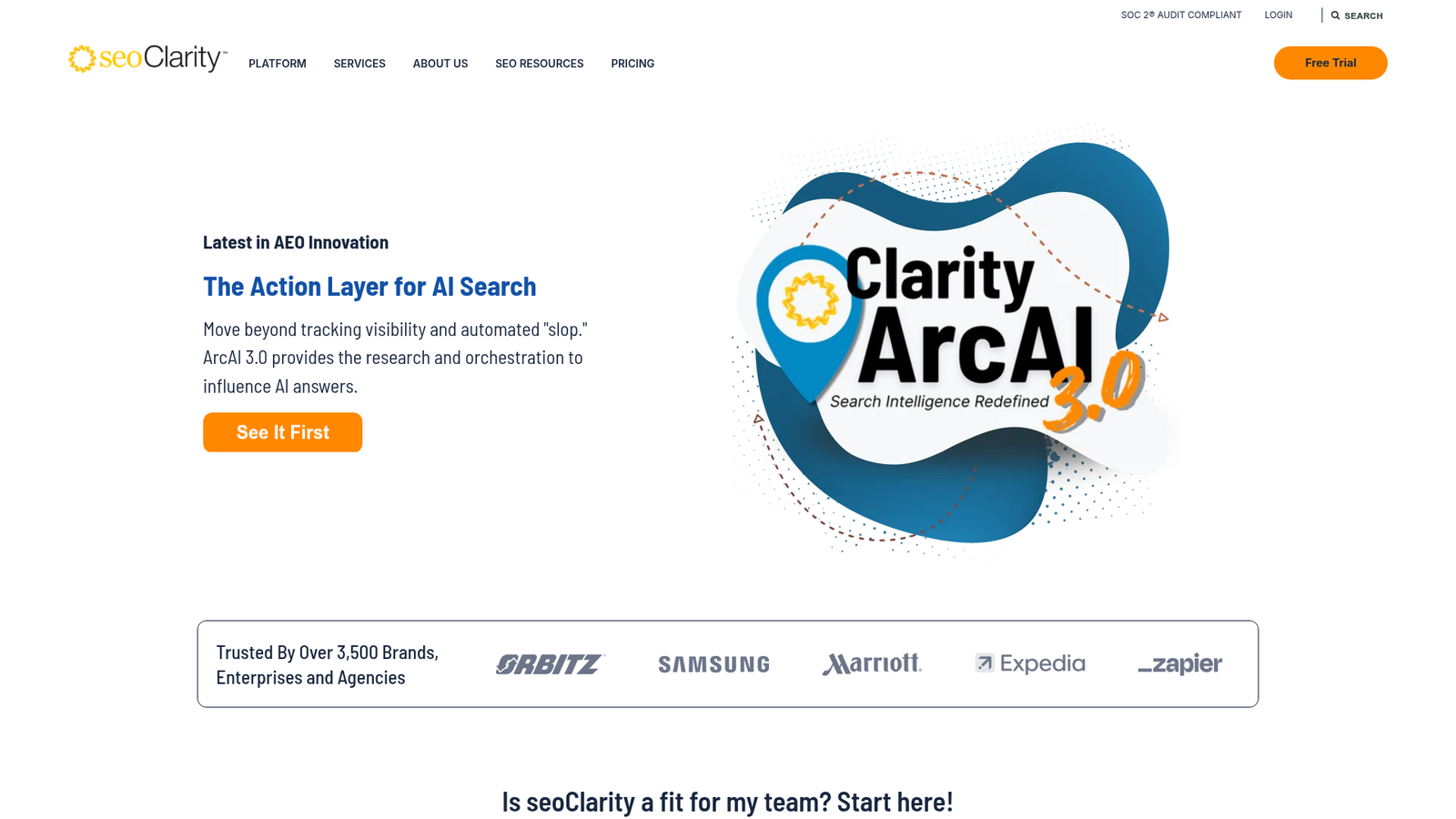
seoClarity is an enterprise-grade SEO platform that combines comprehensive data with AI-driven insights - particularly strong for organizations that need large-scale keyword tracking and emerging AI search visibility management.
The platform's enterprise-grade keyword tracking handles the volume that large organizations actually deal with - millions of keywords across multiple sites and regions. Content Fusion, seoClarity's AI content optimization module, connects content recommendations directly to ranking data, so optimization decisions are grounded in actual performance evidence rather than generic NLP scoring. The platform's AI search visibility tracking is increasingly relevant as AI Overviews and AI Mode reshape how enterprise content gets discovered.
Best for: Data-driven enterprise SEO teams that prioritize analytics and AI search visibility tracking alongside content optimization.
Key strengths
- Enterprise-grade keyword tracking and AI-driven SEO insights at scale
- Content Fusion for AI-powered content optimization tied to ranking data
- Rank intelligence and SERP analytics for competitive visibility
- Technical SEO auditing for large, complex site architectures
- AI search visibility tracking for AI Overviews and emerging search formats
Pricing: Custom enterprise pricing - contact seoClarity for a quote based on your keyword volume and team size.
The limitation: seoClarity's interface requires training to navigate effectively, and the platform's complexity can slow adoption across large content teams. Content creation features are limited - it's primarily an analytics and optimization intelligence platform, not an end-to-end content workflow tool.
9. Frase - best for AI content briefs and research automation
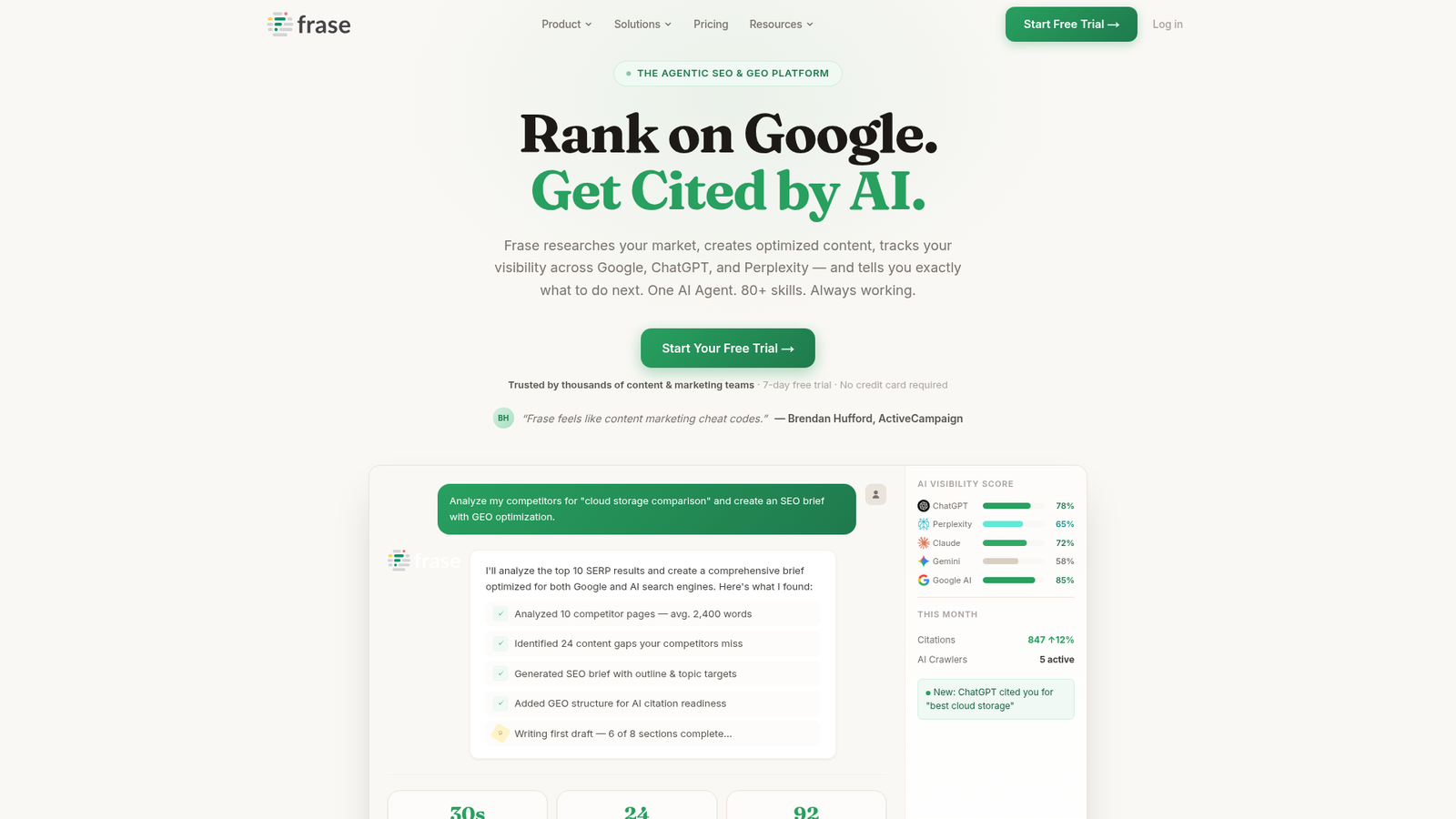
Frase is an AI-powered content research and brief generation platform that accelerates the research phase of content production - it's fast, affordable, and genuinely useful for teams that spend too much time on manual SERP research.
Frase's core workflow is straightforward: enter a keyword, and the platform pulls together SERP data, competitor content analysis, and related questions to generate a structured content brief in minutes. Google Search Console integration connects brief generation to actual performance data, so you're optimizing based on what's already working. For enterprise teams that need to scale content brief production without scaling headcount, Frase delivers real efficiency gains.
Best for: Small-to-mid enterprise content teams that need to accelerate content research and brief creation; best used as a complement to a broader enterprise platform rather than a standalone solution.
Key strengths
- AI-powered content brief generation from SERP analysis
- Question mining and related topic research for comprehensive coverage
- AI content writing and optimization within a single interface
- Google Search Console integration for performance-informed optimization
- Team collaboration features for shared brief management
Pricing: Starts at $49/mo (Starter, monthly billing) or $39.20/mo (Starter, billed annually). Professional $129/mo; Scale $299/mo; Enterprise custom. The $45/mo figure is not a current Frase plan.
The honest limitation: Frase isn't built for enterprise scale. There's no SSO, permissions are basic, and the platform lacks the governance and workflow features that large content teams need. Content quality from the AI writer requires editorial review. It's a strong tool for accelerating research, but it's not a company-wide enterprise solution.
10. Ahrefs - best for enterprise keyword research and competitive SEO intelligence
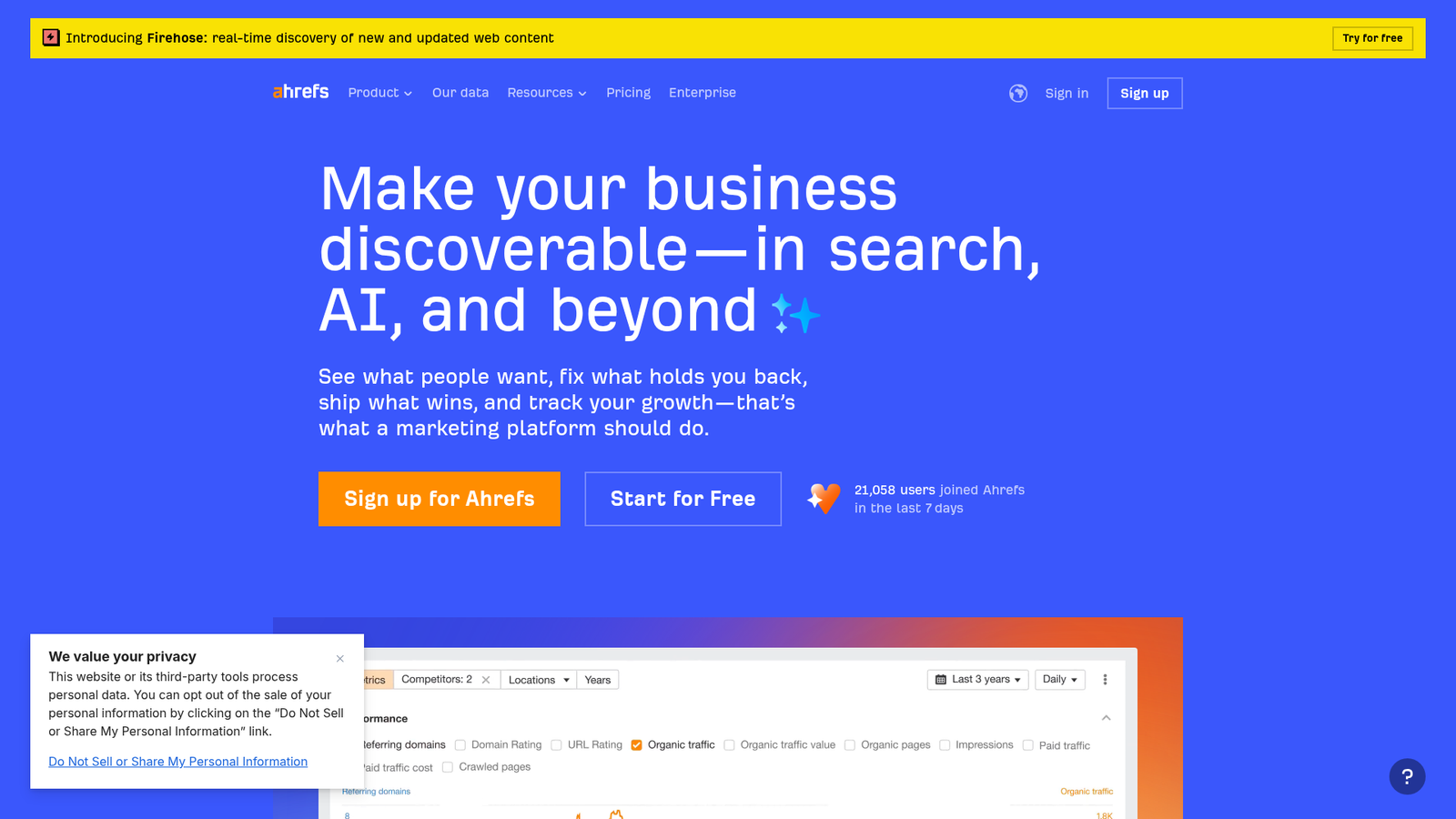
Ahrefs is the industry standard for backlink analysis, keyword research, and competitive intelligence - its AI models process billions of backlinks and keywords daily to surface insights that inform content strategy at enterprise scale.
The platform's AI-enhanced backlink analysis and anomaly detection help enterprise SEO teams identify link building opportunities and flag potential issues before they impact rankings. Predictive ranking analysis gives content teams forward-looking intelligence rather than just historical reporting. Keywords Explorer's advanced filtering capabilities make it the go-to tool for enterprise keyword research, and Content Explorer surfaces content opportunities based on actual search performance data.
Best for: Enterprise SEO teams that need robust keyword research and competitive intelligence; best paired with a dedicated content optimization tool for end-to-end workflow coverage.
Key strengths
- AI-enhanced backlink analysis with anomaly detection and predictive ranking insights
- Keywords Explorer with advanced filtering for large-scale keyword research
- Content Explorer for identifying high-performing content opportunities
- Site Explorer for comprehensive competitive analysis
- Site Audit for technical SEO health monitoring across large sites
Pricing: Starter $29/mo for basic research; Lite $129/mo; Standard $249/mo; Advanced $449/mo; Enterprise $1,499/mo (annual commitment required). The ~$129/mo figure matches Lite but misses the Starter tier that exists today.
The trade-off: Ahrefs' AI features are focused on research and analysis rather than content creation or optimization. Workflow features are limited, and per-seat pricing gets expensive at enterprise scale. It's an essential research tool, but you'll need additional tools to cover content optimization and workflow management.
11. Jasper - best for AI content generation with brand alignment
Jasper is an AI content generation platform that integrates keyword research and SEO parameters into its copywriting workflow, allowing enterprise teams to maintain brand alignment while producing content at scale.
Jasper's approach to brand consistency is one of its strongest enterprise features - the platform allows teams to encode brand voice, tone guidelines, and knowledge base content so that AI-generated output stays on-brand across contributors. Enterprise security features including SSO and SOC 2 compliance make it viable for enterprise procurement. The integration with Surfer SEO means content can be generated and optimized within a connected workflow, reducing the friction of moving between tools.
Best for: Enterprise content teams that prioritize AI content generation with brand consistency; works best when integrated with a dedicated SEO optimization tool like Surfer SEO or Clearscope.
Key strengths
- AI content generation across formats with integrated keyword and SEO parameters
- Brand voice and knowledge base features for consistent AI output
- Campaign and content workflow tools for team coordination
- Team collaboration and approval features for editorial oversight
- Enterprise security with SSO and SOC 2 compliance
Pricing: Pro $59/mo (billed annually) or $69/mo (monthly); Business custom. Jasper retired the Creator $49/mo plan — Pro is now the entry tier. The ~$49/mo figure referenced is no longer available.
The important caveat: Jasper is not an SEO tool natively. It relies on integrations with dedicated SEO platforms for optimization scoring. Content still needs SEO review and editorial oversight - without careful prompting and brand configuration, AI output can trend generic. It's a strong generation layer, not a complete SEO solution.
12. Scalenut - best for end-to-end AI content workflow on a budget
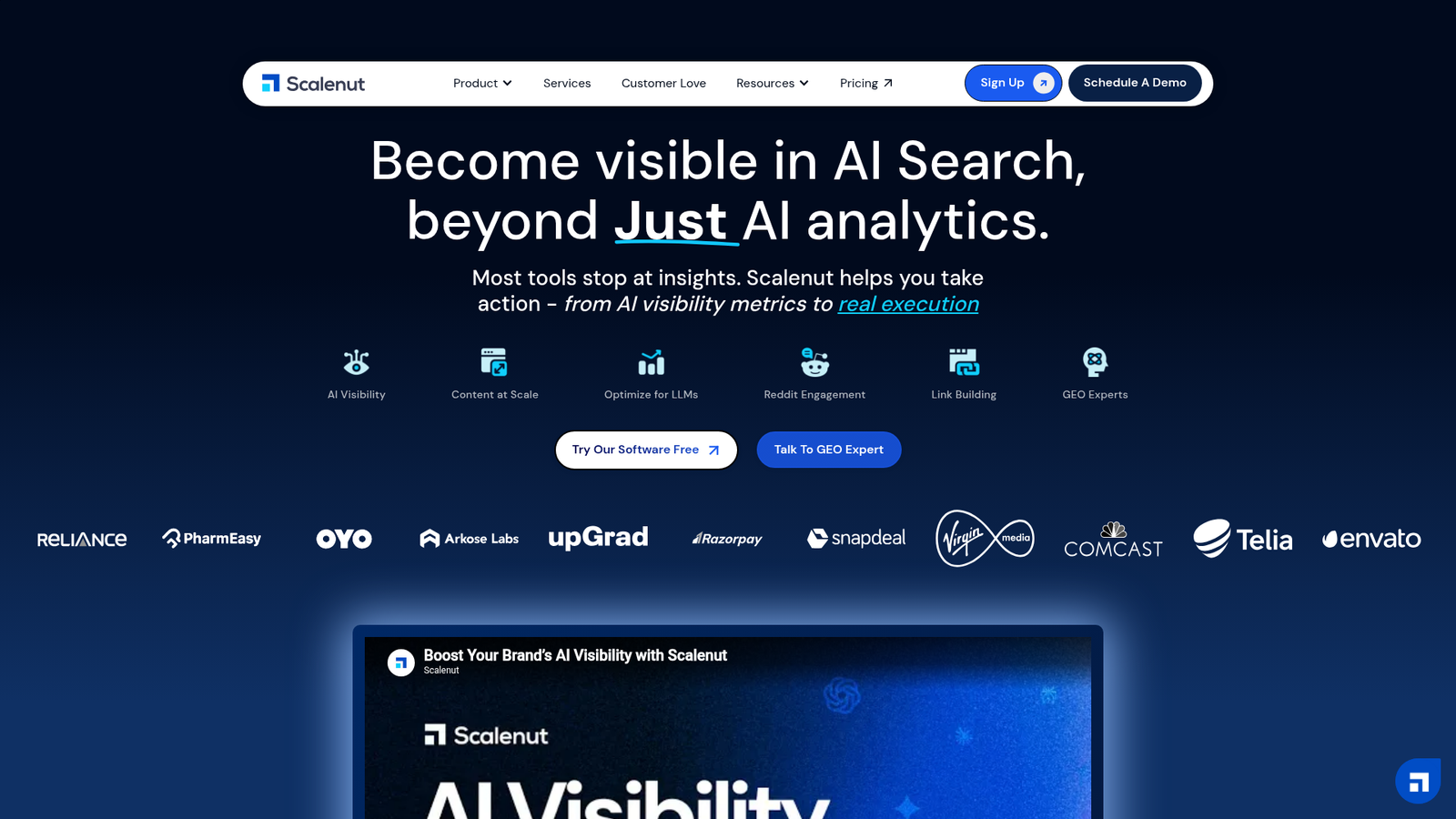
Scalenut is an affordable all-in-one AI content platform that covers research, writing, and optimization in a single workflow - a strong entry point for growing enterprise content teams before they scale to dedicated enterprise platforms.
Scalenut's Cruise Mode generates article drafts section by section using NLP and factual SERP data, which meaningfully reduces the time from brief to first draft. The platform's keyword planner and topic clustering help content teams build structured content plans without needing a separate strategy tool. For enterprise sub-teams or departments with budget constraints, Scalenut delivers a functional end-to-end workflow at a price point that's hard to argue with.
Best for: Growing enterprise content teams that need an affordable end-to-end AI content workflow; good entry point before scaling to enterprise-grade platforms with deeper governance capabilities.
Key strengths
- Cruise Mode for section-by-section AI article generation using NLP and SERP data
- SEO content optimization with NLP scoring and term recommendations
- Keyword planner and topic clustering for content planning
- Content brief generation from SERP analysis
- Chrome extension for in-browser optimization
Pricing: Starter $59/mo; Plus $89/mo; Professional $199/mo; VIP Service custom. Scalenut restructured its plans — the old 'Essential $39/mo' plan has been retired. Starter is now the entry tier at $59/mo.
The honest limitation: Scalenut's enterprise governance features are limited. Team permissions are basic, there's no SSO, and the platform's data sets are smaller than Semrush or Ahrefs. It's a capable tool for content production, but it's not designed for the governance and compliance requirements of large enterprise organizations.
13. SE Ranking - best for multi-location enterprise SEO with AI tools
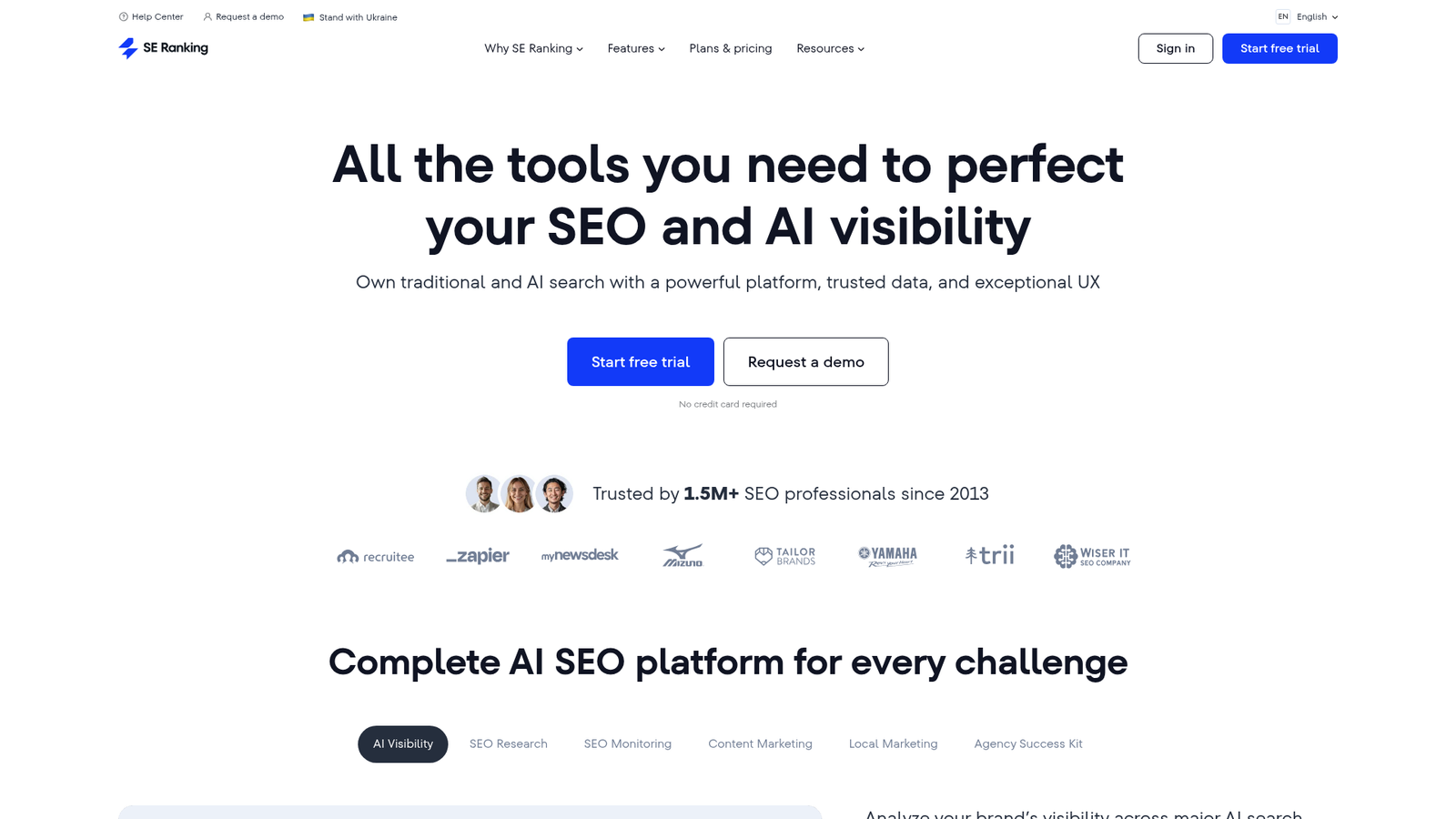
SE Ranking is a growing SEO platform with strong multi-location management capabilities and AI-powered features including keyword clustering, predictive audits, and ranking forecasts - particularly well-suited to enterprise organizations managing SEO across many locations.
For retail, hospitality, healthcare, and franchise organizations managing SEO across dozens or hundreds of locations, SE Ranking's local SEO and multi-location management features address a specific operational need that broader platforms handle less elegantly. White-label reporting makes it useful for enterprise teams that need to present SEO performance to regional stakeholders or franchise partners. The platform's value-to-price ratio is strong compared to enterprise-tier alternatives.
Best for: Multi-location enterprise organizations - retail, hospitality, healthcare - that need SEO management across many locations with AI-powered content optimization capabilities.
Key strengths
- AI-powered keyword clustering, predictive audits, and ranking forecasts
- Multi-location SEO management for distributed enterprise organizations
- Competitive analysis and keyword rank tracking at scale
- White-label reporting for stakeholder and partner communication
- API access and integrations for connecting to broader tech stacks
Pricing: Core $103.20/mo (annual billing) or $129/mo (monthly); Growth $279/mo (monthly) / $223.20/mo (annual); Enterprise custom. SE Ranking retired the 'Essential' $65/mo plan — Core is now the entry tier.
The trade-off: SE Ranking's AI features are still maturing compared to Semrush or Ahrefs, and the platform has less brand recognition in enterprise procurement conversations. Content governance features are limited. It's an excellent value for multi-location use cases, but less compelling as a primary enterprise content optimization platform.
14. Alli AI - best for automated on-page SEO optimization at enterprise scale
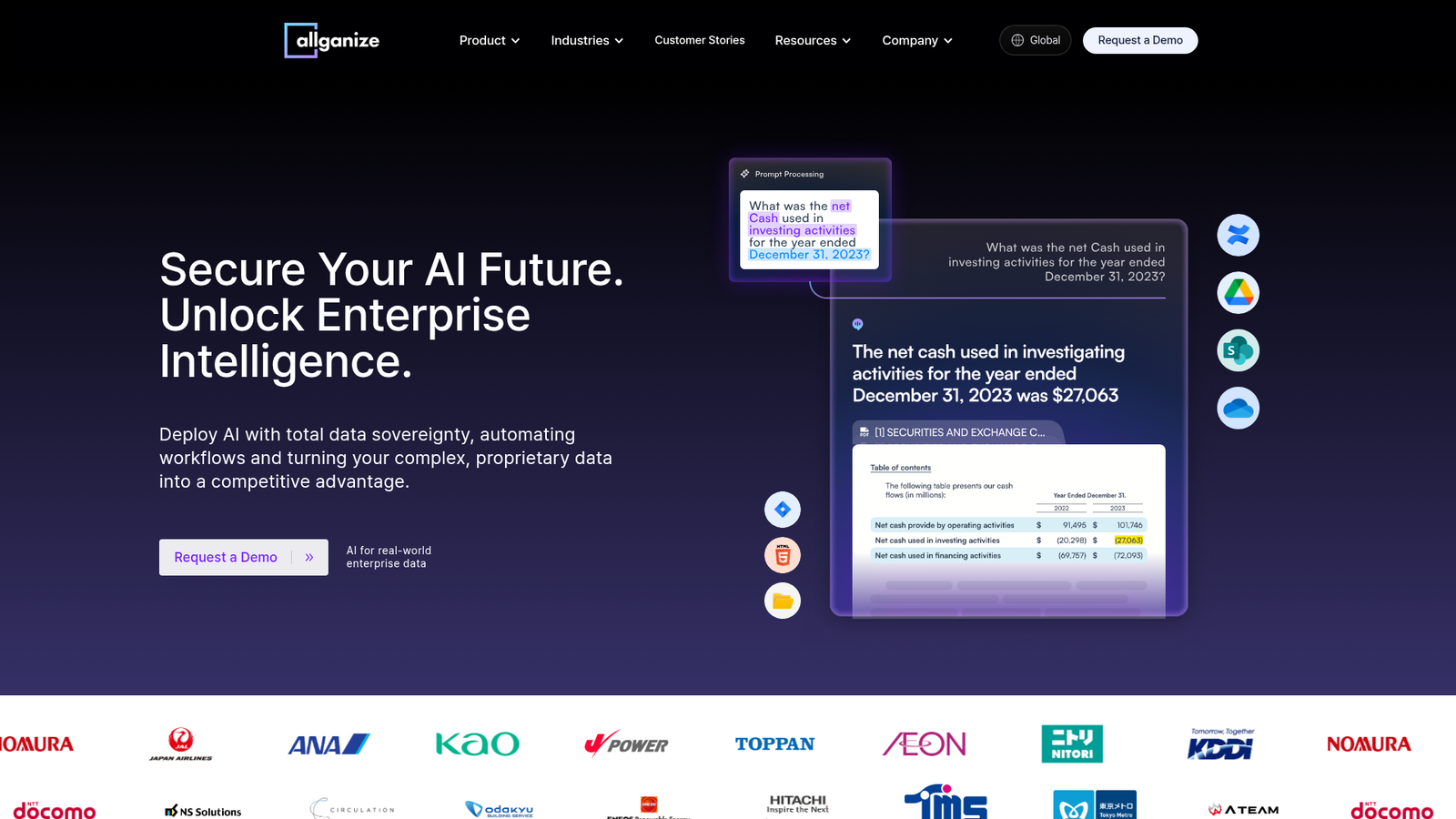
Alli AI takes a fundamentally different approach to enterprise SEO: instead of helping teams create and optimize content, it automates on-page SEO changes across existing content libraries with real-time edits and performance validation.
The platform deploys via a code snippet, making it CMS-agnostic - it works across WordPress, custom CMS environments, and headless architectures without requiring developer resources for each change. For enterprise teams sitting on large existing content libraries with inconsistent title tags, meta descriptions, schema markup, and internal linking, Alli AI can systematically address those gaps at a scale that manual optimization can't match. A/B testing for SEO changes adds a layer of validation that reduces the risk of bulk changes going wrong.
Best for: Enterprise teams with large existing content libraries that need automated on-page optimization without developer resources; best used as a complement to content-focused AI tools rather than a replacement.
Key strengths
- Automated on-page SEO optimization with real-time deployment and performance validation
- Bulk optimization across thousands of pages simultaneously
- A/B testing for SEO changes to validate impact before full rollout
- CMS-agnostic deployment via code snippet - no developer dependency
- Multi-site management for enterprise organizations with multiple domains
Pricing: Business $299/mo (5 sites, 5 team members, 500 keywords, 1,250 pages); Agency $599/mo (15 sites, 15 members, 2,000 keywords, 5,000 pages); Enterprise custom (50 sites, 50 members, 5,000 keywords, 20,000 pages). Smaller tiers also exist: Small Biz ~$169/mo (1 site, 100 keywords); Consultant ~$399/mo. Annual billing saves ~17%. 10-day free trial.
The important caveat: Alli AI is not a content creation or content intelligence tool. It doesn't help teams write better content or develop content strategy. At enterprise scale, bulk automated changes require careful oversight - a misconfigured rule can create SEO problems across thousands of pages simultaneously. It's a powerful tool in the right hands, but it needs to sit within a broader content governance framework.
15. Dashword - best lightweight AI content optimization for enterprise sub-teams
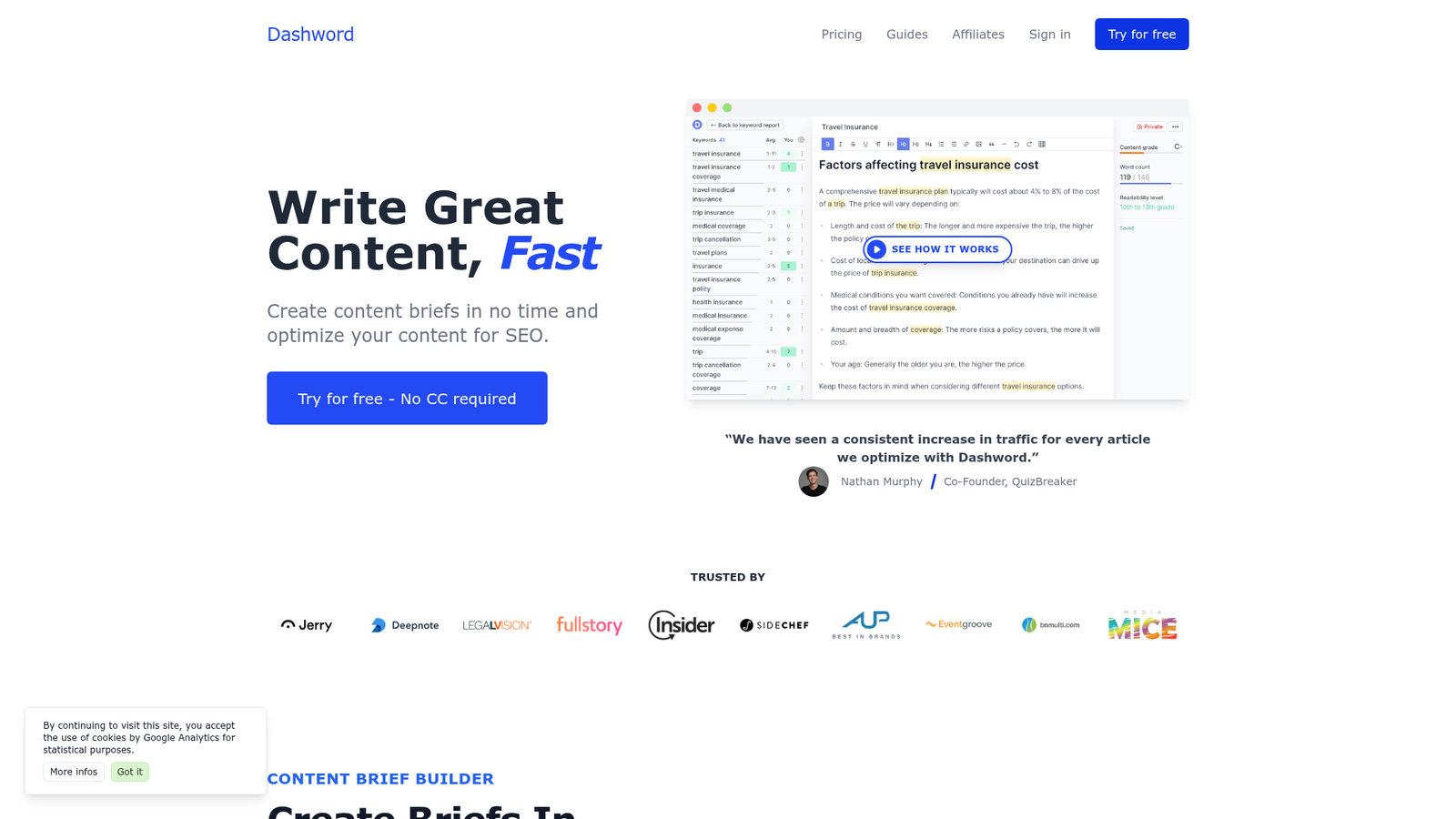
Dashword is a lightweight content optimization tool with a clean interface and fast onboarding - designed for teams that need straightforward content scoring without the complexity of enterprise platforms.
For individual enterprise departments or sub-teams that need a simple, affordable content optimization tool without going through a full enterprise procurement process, Dashword fills a practical gap. The interface is clean, the learning curve is minimal, and content monitoring features help teams track how existing content performs over time. It's a reasonable choice for a marketing sub-team or regional content team that needs basic optimization capabilities without waiting for a company-wide platform rollout.
Best for: Individual enterprise departments or sub-teams that need simple, affordable content optimization; not suitable as a company-wide enterprise solution.
Key strengths
- AI content brief generation from SERP analysis
- Real-time content optimization scoring with term recommendations
- Content monitoring and tracking for existing content performance
- Simple, clean interface with minimal onboarding requirements
- Team collaboration features for shared content management
Pricing: Plans start around $99/mo; Business tier available for teams needing expanded report volume.
The honest limitation: Dashword lacks the enterprise features that procurement teams require - no SSO, no advanced permissions, no SOC 2 certification. The feature set is smaller than Clearscope, Surfer, or MarketMuse. It's a capable tool for a specific use case, but it's not a company-wide enterprise solution.
Enterprise AI SEO tool comparison: feature-by-feature matrix
How to choose the right AI SEO tool for your enterprise content team
Most tool comparisons stop at feature lists. This section helps you make an actual decision based on your team's specific situation.
Map your content operations maturity
Where your team sits on the content operations maturity curve determines which tool category you need - not which tool has the most features.
Teams just beginning to scale content production need tools that are easy to adopt and deliver immediate optimization value: Clearscope, Surfer SEO, or Scalenut. Teams with established content operations that are optimizing for efficiency and quality need workflow and governance capabilities: Slate, Conductor, or BrightEdge. Teams transforming mature content organizations need enterprise platforms that connect content performance to business outcomes and integrate with the broader marketing stack.
Identify your primary use case
The tool category matters more than individual features. Content creation teams need AI generation capabilities (Jasper, Scalenut). Content optimization teams need NLP scoring and SERP analysis (Surfer SEO, Clearscope, MarketMuse). Technical SEO teams need audit and automation capabilities (Ahrefs, BrightEdge, Alli AI). Enterprise content operations teams need governance, workflow, and integration depth (Slate, Conductor, seoClarity).
Most enterprise teams need tools from multiple categories - the question is whether you want a single platform that covers multiple use cases or a best-of-breed stack. For more on building an enterprise content stack, see our content operations best practices guide.
Evaluate integration requirements
Your CMS environment is the most important integration to validate before committing to any tool. A content optimization tool that requires copy-paste workflows with your CMS creates friction that kills adoption. Map your tech stack - CMS, marketing automation, analytics, DAM - and verify integration depth with each tool's sales team before signing a contract.
For teams on WordPress or HubSpot, most tools offer native integrations. For headless CMS environments (Contentful, Sanity, custom builds), integration depth varies significantly. Our AI SEO checklist covers the technical integration requirements for major platforms.
Assess governance and security needs
Enterprise procurement teams will ask about SOC 2, SSO, GDPR compliance, and data residency. Get answers before you're three months into an evaluation. Tools like Conductor, BrightEdge, seoClarity, Jasper, and Slate have enterprise security credentials. Tools like Frase, Scalenut, and Dashword don't - which may or may not matter depending on your industry and data handling requirements.
Role-based access and permissions are equally important for large content teams. If your platform can't distinguish between a writer's editing access and an editor's approval authority, you'll have governance problems at scale.
Calculate total cost of ownership
The subscription price is the smallest part of the cost equation for enterprise tools. Factor in implementation time and cost, training across your content team, ongoing management overhead, per-seat costs as your team grows, integration development for non-native connections, and the opportunity cost of slow adoption.
A $2,000/mo platform that your team actually uses is cheaper than a $500/mo tool that sits underused. For a deeper look at how to evaluate enterprise SEO investments, see our benefits of content operations platform analysis.
Which AI SEO tool is right for your enterprise content team?
The right answer depends on what's actually breaking in your content operation right now.
If your primary pain is inconsistent content quality, brand voice drift, and lack of editorial oversight across a distributed team, governance and workflow infrastructure is your gap - and Slate is built specifically for that problem. If you need a single platform for SEO research and content optimization, Semrush covers the most ground. If content optimization adoption is the challenge, Clearscope's simplicity wins. If you're building topical authority across a large content library, MarketMuse's content intelligence is hard to beat. For full enterprise SEO operations with deep analytics and automation, Conductor, BrightEdge, and seoClarity are the serious contenders.
The trend in 2026 is clear: the best enterprise AI SEO tools are converging toward platforms that unify content generation, optimization, and governance in a single workflow. Teams that are still managing these as separate tool categories are creating the exact fragmentation and inconsistency that holds enterprise content operations back.
Explore Slate for enterprise content governance to see how purpose-built workflow and governance infrastructure changes what's possible for your content team.
For related insights on building enterprise content operations, see our guides on best generative engine optimization tools and best LLM optimization tools to understand how AI search is reshaping enterprise content strategy.
Frequently asked questions
What is an AI SEO tool, and how is it different from a traditional SEO platform?
An AI SEO tool uses machine learning, natural language processing, and generative AI to automate or enhance SEO tasks - content optimization, keyword research, content generation, and technical audits. Traditional SEO platforms rely on manual analysis and static data, reporting on what has happened. AI tools learn from patterns across large data sets to provide predictive recommendations and automate optimization decisions, reducing the manual work required from SEO teams.
What features should enterprise content teams look for in an AI SEO tool?
Enterprise content teams need more than content optimization - they need multi-team workflow support, role-based permissions, deep CMS integrations, brand voice governance, SOC 2 and SSO security, scalable pricing that doesn't penalize growth, executive reporting dashboards, API access, and multi-site and multi-language support. Most tools cover some of these; few cover all of them. Prioritize the features that address your team's specific operational gaps rather than the longest feature list.
How much do enterprise AI SEO tools typically cost?
Typical cost ranges have shifted since this article was written. Today: Entry-level point tools $19–$49/mo (NeuronWriter $19–$23, Dashword $30, Rytr $9, Frase Starter $49, Surfer Discovery $49); mid-market SaaS $59–$199/mo (Jasper Pro $59, Scalenut Starter $59, Slate $199, Semrush Pro $139.95, Ahrefs Lite $129); enterprise custom $2,000–$10,000+/mo (Conductor, BrightEdge, seoClarity, Alli AI Enterprise).
Can AI SEO tools replace human content writers and SEO strategists?
No - enterprise teams that get the most value from AI SEO tools use them to enable their team to produce more and better content - not to reduce headcount. They accelerate research, automate optimization recommendations, and reduce the time from brief to first draft, but human judgment remains essential for strategy, brand voice, nuance, and quality assurance.
How do AI SEO tools integrate with enterprise CMS platforms like WordPress, HubSpot, or Contentful?
Integration methods vary: native plugins and extensions, API connections, browser extensions, and headless CMS compatibility. Integration depth matters more than the existence of an integration - some tools offer real-time in-CMS optimization while others require copy-paste workflows that kill adoption. For WordPress and HubSpot, most major tools offer native integrations. For headless CMS environments, verify integration depth directly with the vendor before committing. Our AI SEO guide covers the specifics for major platforms.
What is content governance in the context of enterprise SEO, and why does it matter?
Content governance is the framework of policies, workflows, and controls that ensure content meets brand standards, SEO best practices, and compliance requirements at scale. For enterprise teams, it matters because brand consistency breaks down across distributed contributors, AI-generated content needs quality assurance before publishing, regulated industries face legal and compliance exposure from ungoverned content, and accountability requires clear ownership at every stage of the content pipeline. Governance isn't a nice-to-have at enterprise scale - it's the operational infrastructure that makes consistent quality possible. For more on building governance frameworks, see our content operations vs content strategy comparison.
How should enterprise teams measure ROI from AI SEO tools?
Establish baselines before implementation, then measure at 90-day intervals across these metrics: organic traffic growth, keyword ranking improvements, content production velocity (pieces published per month), time-to-publish reduction, content optimization scores, conversion rates from organic content, and cost-per-content-piece. The most compelling ROI case for enterprise teams tends to combine efficiency gains (faster production, less manual optimization) with quality improvements (higher optimization scores, better rankings). Tools that can't connect to your analytics stack make this measurement harder - factor that into your evaluation.
Can enterprise teams use multiple AI SEO tools together, or should they consolidate?
Both approaches work, and the right answer depends on your team's size, budget, and integration capabilities. A best-of-breed stack - for example, Ahrefs for research, Clearscope for optimization, Jasper for generation, and Slate for governance - gives you the strongest capability in each category but adds integration complexity. Consolidated platforms reduce tool sprawl but may involve trade-offs in specific capability areas. The trend in 2026 is toward platforms that unify multiple capabilities, which reduces the coordination overhead that fragmented stacks create for large content teams.