Your buyers ask Google, ChatGPT, Perplexity, Gemini, and Slack threads before they talk to sales. Some never click a search result at all.
So the old content playbook has a leak in it.
AI systems now choose what gets cited, summarized, and trusted. That puts pressure on teams to use AI without flooding the site with generic drafts that buyers skim once and forget.
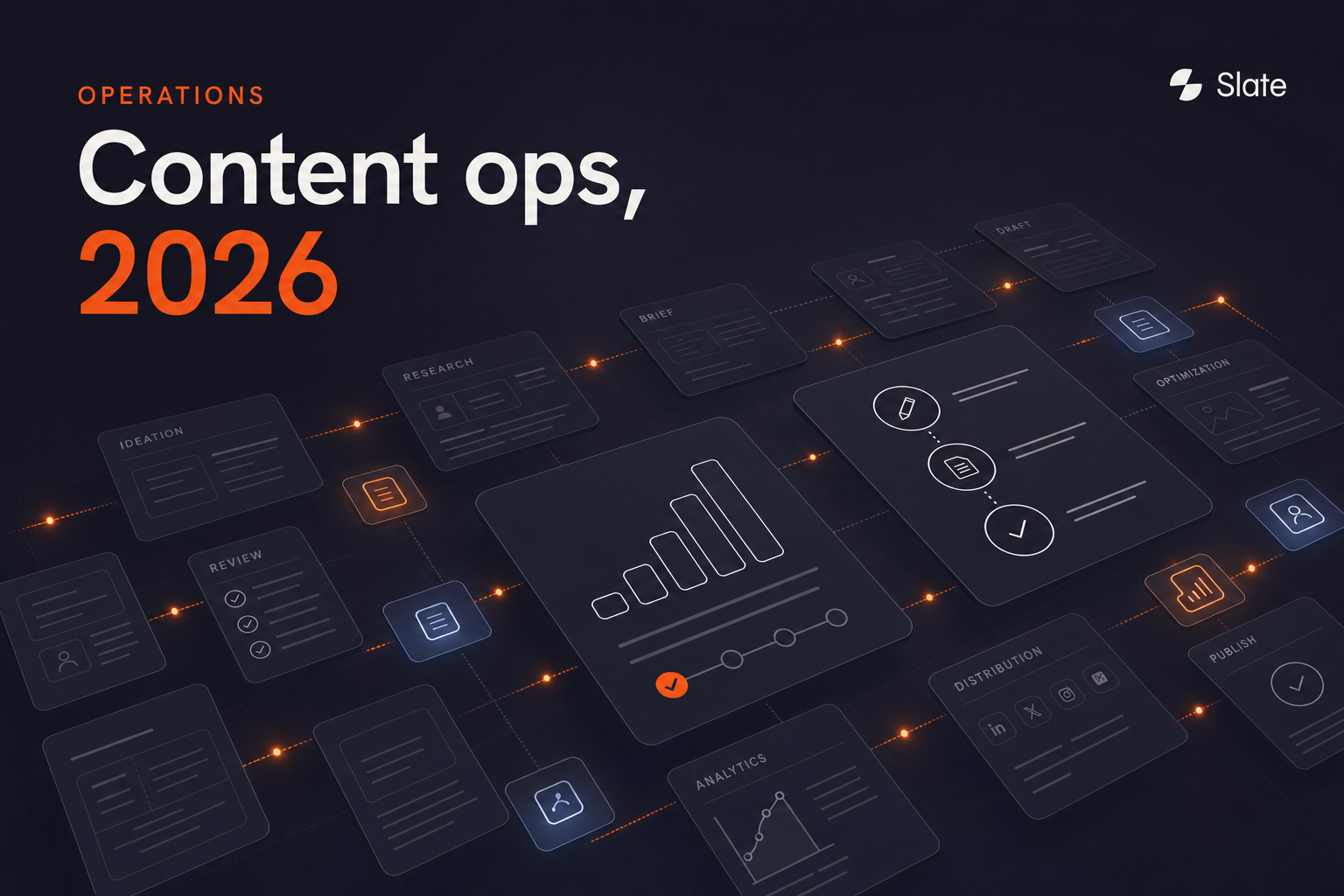
An AI content strategy is the operating system for that work. It uses AI across research, planning, drafting, SEO, publishing, measurement, and refresh cycles, with humans owning judgment, accuracy, positioning, and conversion paths.
The win comes from the loop, not the draft.
Key Takeaways
- An AI content strategy uses AI across research, planning, creation, SEO, publishing, measurement, and refresh work, with human review built in.
- In 2026, content has to earn visibility in Google results and AI-generated answers.
- The bottleneck is execution across the loop.
- Repeatable work belongs in workflows or agents.
- Strong plans start from ranking gaps, citation gaps, traffic decay, and buyer intent.
- Refresh work deserves the same attention as net-new content.
- Humans still own positioning, source checks, brand voice, and conversion strategy.
What Is an AI Content Strategy?
An AI content strategy is a system for using AI to research, plan, create, improve, distribute, and measure content, with human oversight at the points where judgment carries business risk.
That definition is useful because teams often shrink “AI content strategy” down to “AI writing.” That’s where quality starts to sag.
AI-assisted strategy:
- Uses AI to synthesize research, detect gaps, group topics, and draft briefs.
- Keeps humans accountable for positioning, accuracy, and conversion paths.
- Turns repeatable tasks into reusable workflows.
AI-generated content with weak oversight:
- Lets models produce drafts from thin inputs.
- Chases volume before differentiation.
- Drifts away from brand voice and conversion intent.
A content strategy needs a connective layer across SEO tools, AI models, CMS workflows, analytics, and editorial review. If you want the operating model behind that, this guide on content strategy in the age of AI goes deeper.
Why AI Content Strategy Has More Weight in 2026
Leadership usually asks one question first: why change a content motion that already brings traffic?
Because discovery changed.
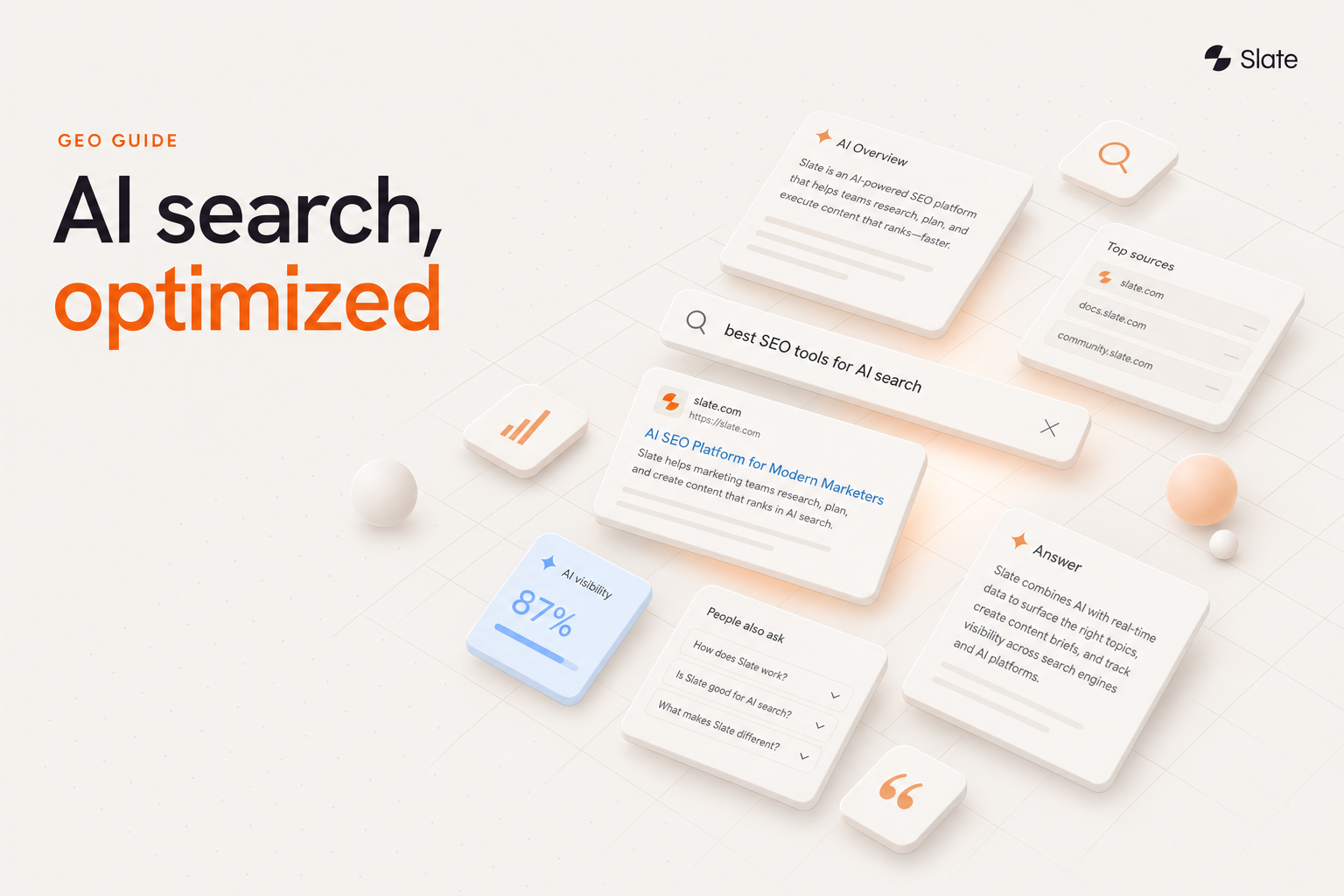
Pew Research Center found that 18% of the 68,879 Google searches it analyzed from March 2025 produced an AI-generated summary. In the same study, 58% of the 900 U.S. adults in its panel ran at least one search that produced an AI summary that month.
When those summaries appeared, users clicked a standard organic result about 8% of the time. Without a summary, the click rate was about 15%.
So visibility can influence a buyer before a click ever happens.
What changed in 2026:
- Search results now include AI Overviews and answer engines.
- Citation visibility has value on its own.
- Content has to support retrieval, summarization, and attribution.
- Refresh work carries more weight because AI answers often pull from established pages.
- Agent-based execution is turning one-off tasks into repeatable systems.
- Measurement now spans search engines and AI platforms.
- Tool sprawl slows every learning cycle.
When someone asks ChatGPT a buying question and gets a clean answer with sources, scanning 10 links feels like homework. If your page can’t be parsed, cited, and trusted, it gets left out. For a deeper look at the shift, this breakdown of the future of AI SEO is worth reading.
That’s why strategies for improving content for Google AI Overviews now belong in the core content plan.
What AI Should Handle, and What Humans Should Own
Humans should own positioning, source validation, editorial judgment, compliance review, final messaging, and conversion strategy. AI should handle repetitive research and production tasks where speed helps and judgment risk is lower.
Human review checkpoints should cover fact-checking, tone, source validation, CTAs, compliance, and final approval. Use AI for bulk audits, gap detection, first-pass briefs, and draft variants. Keep final claims, regulated content, brand messaging, and consolidation decisions with humans.
If two articles are fighting each other in search, a person should decide whether to merge them. A prompt shouldn’t make that call.
For governance detail, see this guide on content strategy in the age of AI.
How to Build an AI Content Strategy That Converts: 7 Steps
Start with conversion goals, audience segments, and intent. Then use AI to find gaps, build clusters, create briefs, draft assets, improve pages, publish, and measure. Each step needs four pieces: input, output, human check, and KPI.
1. Define Your Business Goals and Conversion Paths
Before AI touches the work, map how content turns into pipeline. Many strategies chase traffic that never becomes revenue because the offer doesn’t match intent.
Use a simple map:
- TOFU: Educational guides and definitions to newsletter signup or resource download.
- MOFU: Comparison content and frameworks to templates, webinars, or demo prompts.
- BOFU: Product-led pages and decision content to trial signup or booked demo.
- Retention: How-to content and workflow guides to expansion, activation, or renewal.
The output is an intent-to-offer map.
The human check: every planned asset needs a specific next step. “Learn more” is usually a shrug in button form.
The KPI: conversion rate by intent stage.
2. Use AI for Audience Analysis and Persona Validation
AI is good at turning messy inputs into patterns. It can sort customer interview notes, support tickets, sales-call themes, Reddit threads, review sites, and search queries fast. Then a human has to check whether those patterns show up in the market.
Feed AI these inputs:
- Customer interview transcripts.
- Support tickets.
- Sales call notes.
- Search query data.
- Product reviews.
- Community discussions.
Ask for draft personas, jobs-to-be-done statements, objections, and language pulled from customers.
Then trace each claim back to evidence. If a pain point only exists in the model’s output, treat it as a hypothesis.
The KPI: engagement and conversion by validated segment.
3. Run Competitor Gap Analysis
Strong content plans start from gaps. Look at where competitors rank, where AI answers cite them, where their pages cover subtopics you’ve skipped, and where their content earns engagement.
Track these gap types:
- Ranking gaps: Competitors rank for queries you don’t cover.
- Citation gaps: AI answers cite competitors and skip your brand.
- Content gaps: Their pages answer questions yours miss.
- Distribution gaps: Their content earns engagement on channels you’re ignoring.
- Traffic opportunity gaps: High-intent terms have attainable upside.
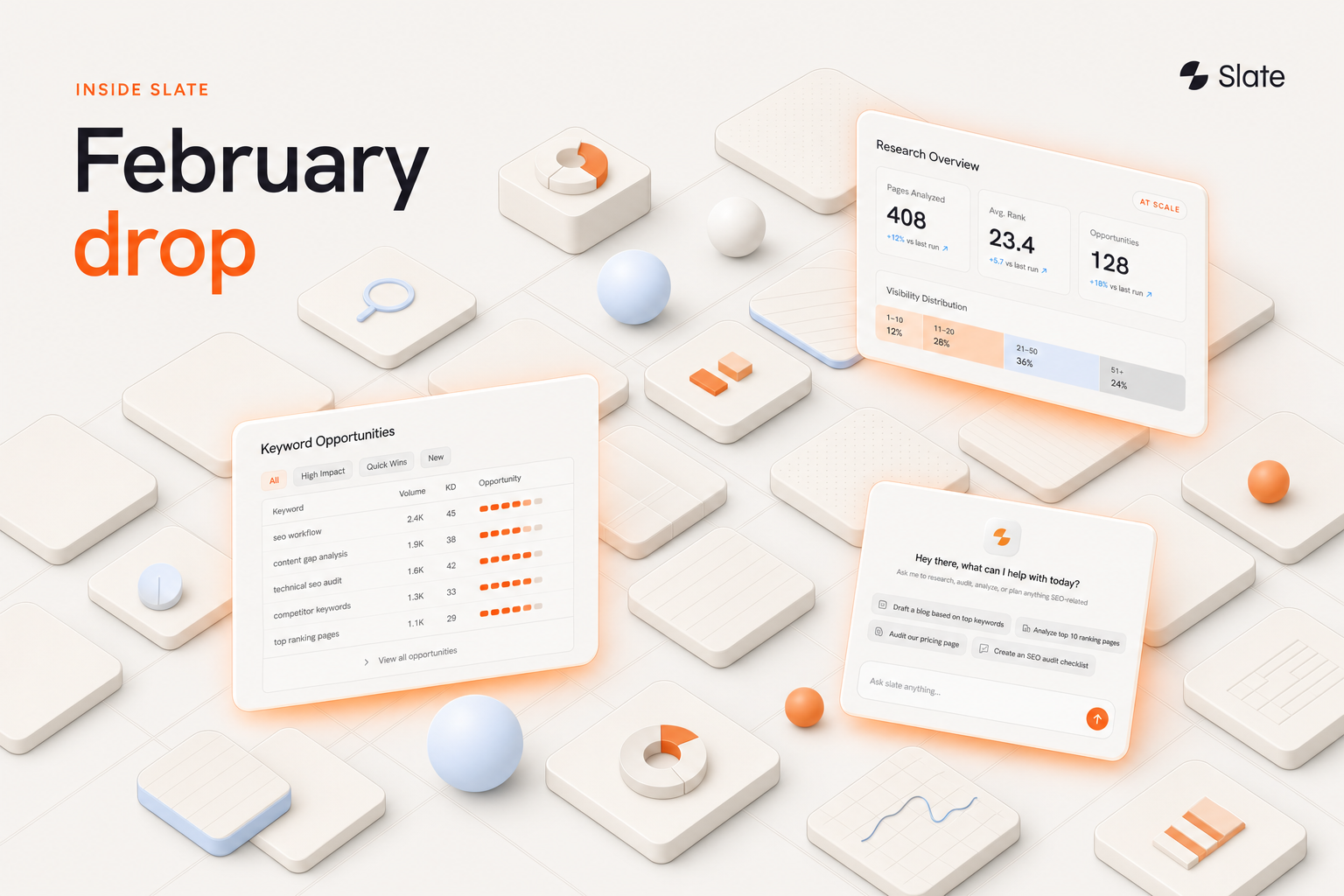
This is where connected research beats export gymnastics. The right content gap analysis tools keep discovery and action in one place. Slate includes native Ahrefs and Semrush access, so gap discovery, clustering, and briefing can happen in one place.
The output is a prioritized opportunity list. The human check is strategic fit. The KPI is new rankings, AI citations, and qualified conversions captured.
For a broader tool view, see this guide to AI content marketing strategy.
4. Turn Keyword Research Into Topic Clusters and Content Pillars
Keyword research becomes useful when it turns into a publishable plan.
The chain looks like this:
Seed terms to clusters to pillars to briefs to calendar.
Take the seed term “AI content strategy.”
The pillar could be a guide on building one. Supporting clusters could cover audience analysis with AI, competitor gap analysis, AI content briefs, measuring AI search visibility, and refresh workflows. Each cluster page links back to the pillar. The pillar links out to each cluster.
That structure helps search engines and AI systems understand coverage depth. It also gives buyers a path through the topic instead of leaving them inside one isolated blog post. AI can group terms and questions fast. Humans decide which clusters support revenue. The right AI tools for topic clusters can speed up that grouping work.
5. Generate Content Briefs Before Drafts
The brief decides whether the draft has a spine. A thin brief gives the model permission to guess. A strong brief gives it boundaries, sources, angles, and conversion intent.
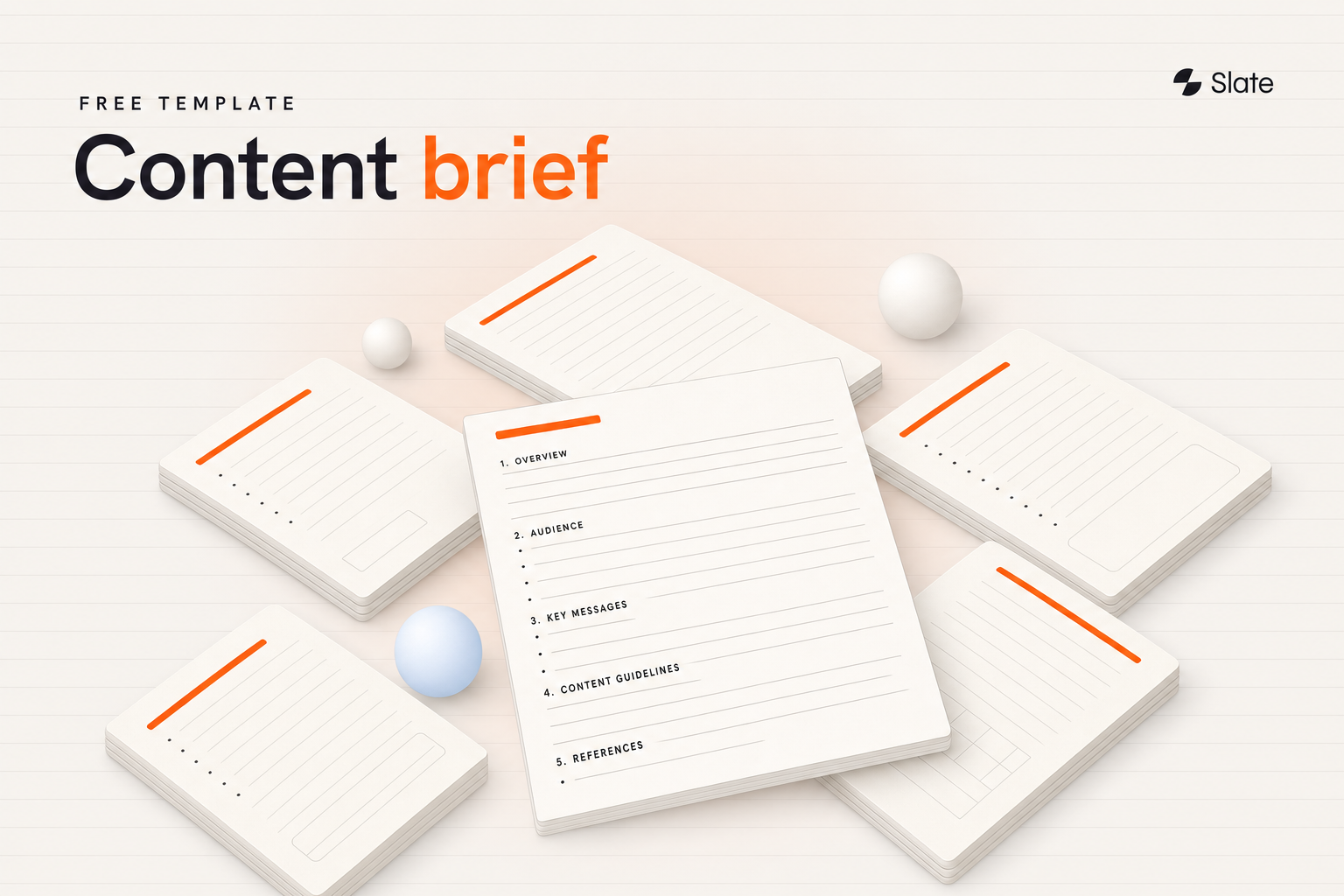
A useful AI content brief includes:
- Search intent and funnel stage.
- Target keyword and cluster.
- Entities and subtopics.
- Questions to answer directly.
- Internal links.
- CTA and conversion goal.
- Tone and brand voice notes.
- Approved sources.
- Citation rules.
- Differentiated angle.
AI-assisted briefing can cut manual work on repeat formats, especially when the input set is clean. The output is a ready-to-draft brief. The human check is whether the angle and conversion path are explicit. The KPI is fewer revision cycles and stronger first drafts.
A SEO content brief generator lets teams capture the brief pattern once and reuse it.
6. Build the Creation, Publishing, and Distribution Workflow
Once the brief is solid, the workflow needs owners and timing. Who drafts? Who reviews? Who checks claims? Who publishes? Who repurposes the asset?
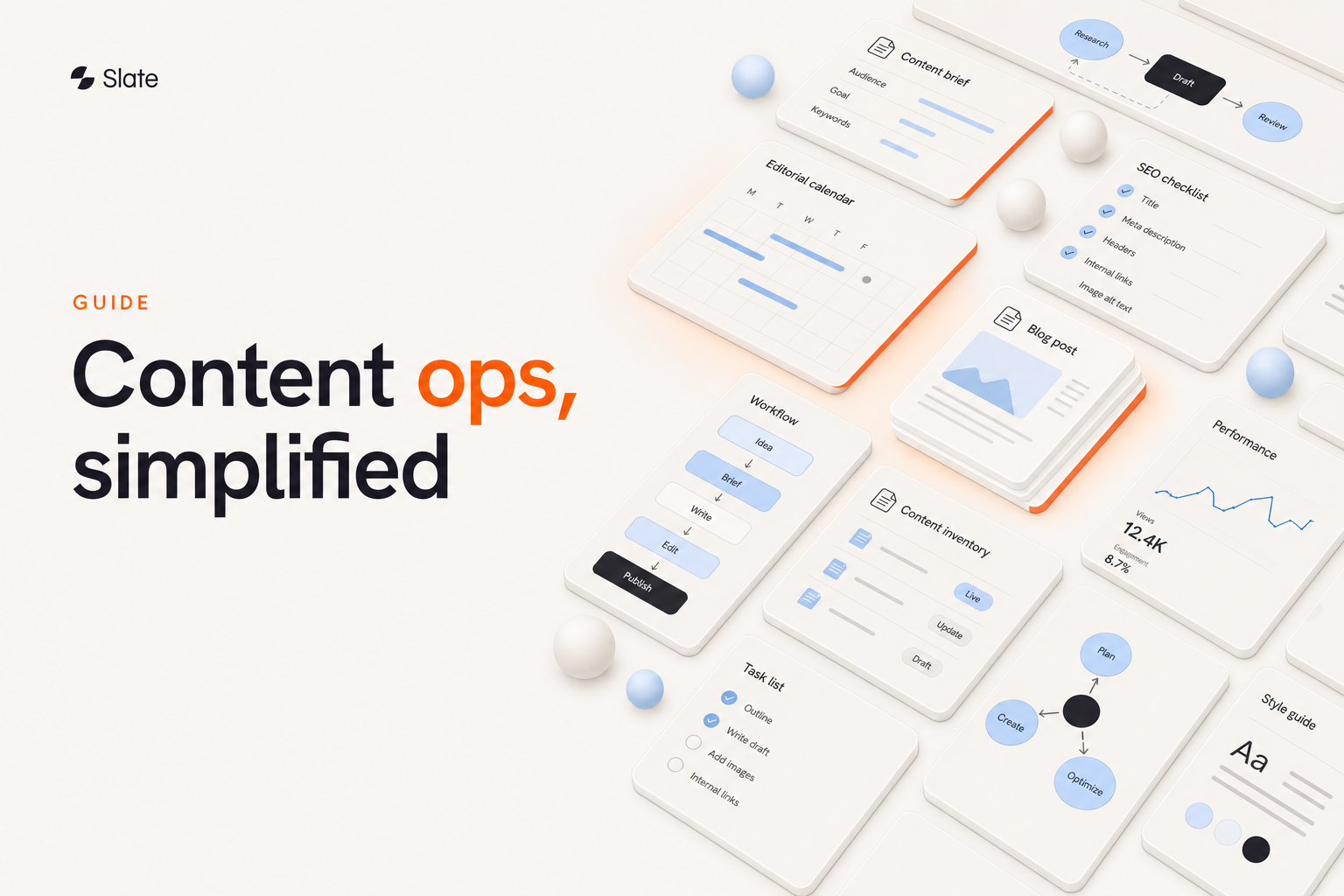
Repeatable work should become a workflow or agent. Copying prompts from a doc for the 47th time is how teams slowly become spreadsheet janitors. A set of content workflow tools can absorb that repeat work.
A simple repurposing matrix helps one asset work across channels:
Slate supports direct publishing to Webflow and WordPress from workflows and sheets, so teams can keep improvement and deployment in the same loop.
The output is a published and distributed asset. The human check is channel fit and brand consistency. The KPI is engagement and conversions per surface.
For the system view, see how to use AI in your content strategy.
7. Measure Performance, Refresh Winners, and Repair Weak Pages
Refresh work is part of the strategy. AI answers often pull from established, structured pages, so high-potential URLs deserve routine updates.
Use a decision rule:
- Refresh: High-intent pages with traffic decay or citation loss.
- Improve: Thin pages that miss intent or lack depth.
- Merge: Overlapping articles that split rankings.
- Create: Validated gaps with no existing coverage.
Watch for ranking drops, declining clicks, lower CTR, lost citations, and weaker conversions. A review of content refresh tools can help prioritize the queue.
The output is a prioritized refresh queue. The human check is whether the update changes usefulness, depth, or positioning. The KPI is lift per refreshed page compared with net-new output.
How to Improve Your AI Content Strategy for SEO and AI Search Visibility
Use AI to refine structure, improve readability, find missing subtopics, match search intent, strengthen internal links, and spot refresh candidates. Human review still protects accuracy, differentiation, and brand voice.
You now write for two discovery systems: search rankings and AI answers.
Traditional SEO
Keep the basics sharp. Use clear headings. Match the query’s intent. Cover the topic deeply enough to satisfy the searcher. Add internal links that reinforce the cluster. Ranking still affects whether a page can be pulled into an AI answer. Weak pages rarely become trusted sources.
AI Search and Citation Strategy
Pages that get cited tend to have extractable sections. Use concise definition blocks, direct FAQ answers, structured lists, tables, and clear attribution. AI systems need clean chunks they can quote, summarize, and connect to a source.
A practical framework:
- Lead sections with a direct answer, then explain.
- Use tables, numbered steps, and FAQ blocks where they help.
- Attribute claims and name sources clearly.
- Refresh evergreen pages before they decay.
- Keep definitions concise enough to be quoted.
Useful follow-up guides:
How to Measure Results: Traffic, Conversions, and Citation Visibility
Measure an AI content strategy across production efficiency, rankings, traffic, engagement, conversions, refresh lift, and AI answer visibility. Reporting on Google alone leaves blind spots.
Split leading and lagging indicators. Leading indicators include production efficiency, refresh cadence, workflow reuse, and citation pickup. Lagging indicators include rankings, traffic, pipeline, and revenue.
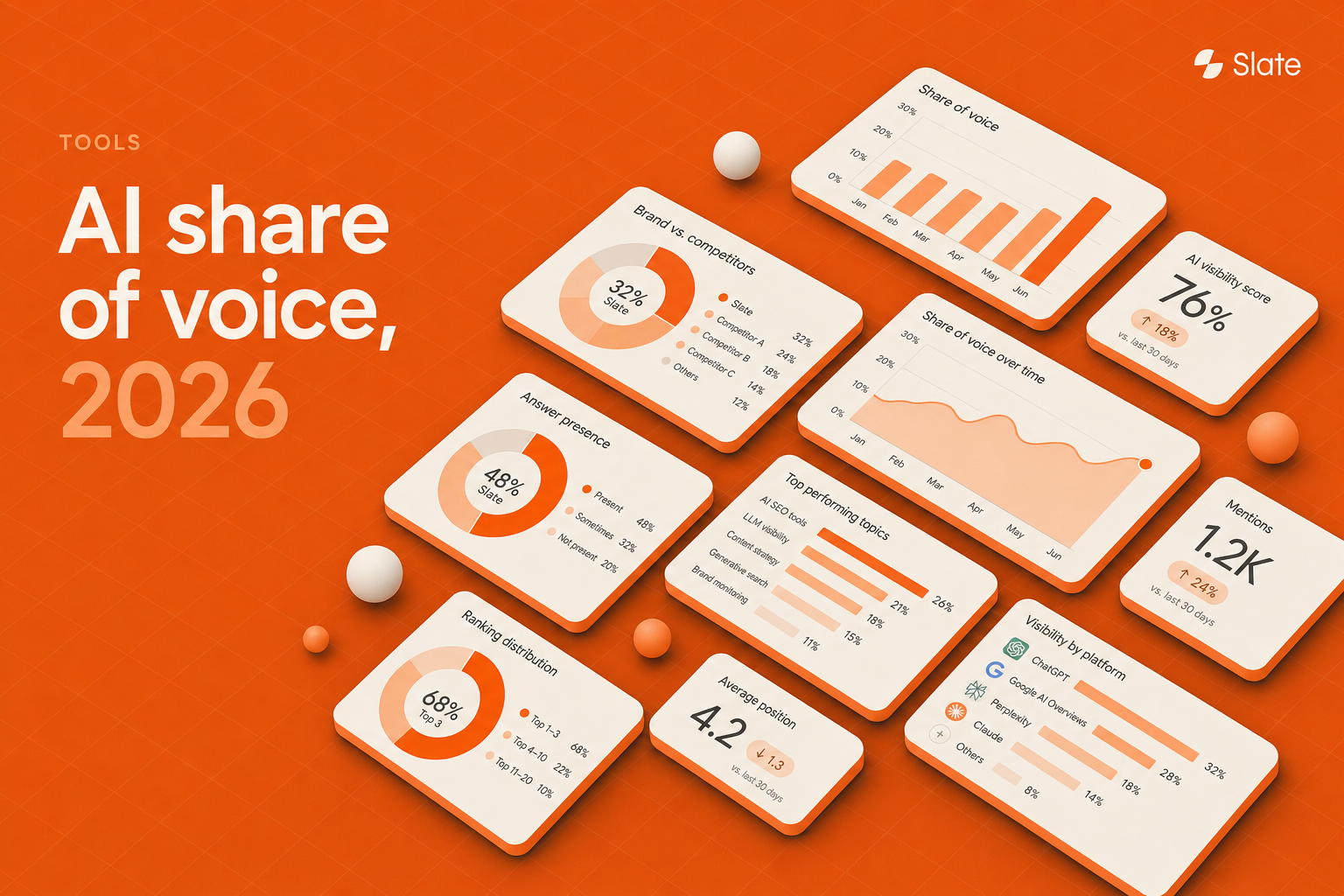
Slate unifies Google Search Console and GA4 data for clicks, traffic, CTR, and performance monitoring. It also tracks brand presence across six major AI platforms, so teams can catch drops and measure lift across surfaces. For a closer look at the metrics that matter, see this guide to AI search metrics.
Pair that with data on best strategies for Google AI Overviews featured content to benchmark visibility.
Best AI Tools for Each Stage of Your Content Workflow
The best AI tools depend on the job: research, SEO analysis, briefs, drafting, publishing, measurement, or refresh work.
If your team only needs drafting, plenty of tools can help. If your team needs opportunity discovery, workflow automation, publishing, AI visibility tracking, and refresh management in one loop, the list gets shorter. A broader roundup of the best AI SEO tools covers the wider landscape.
1. Slate
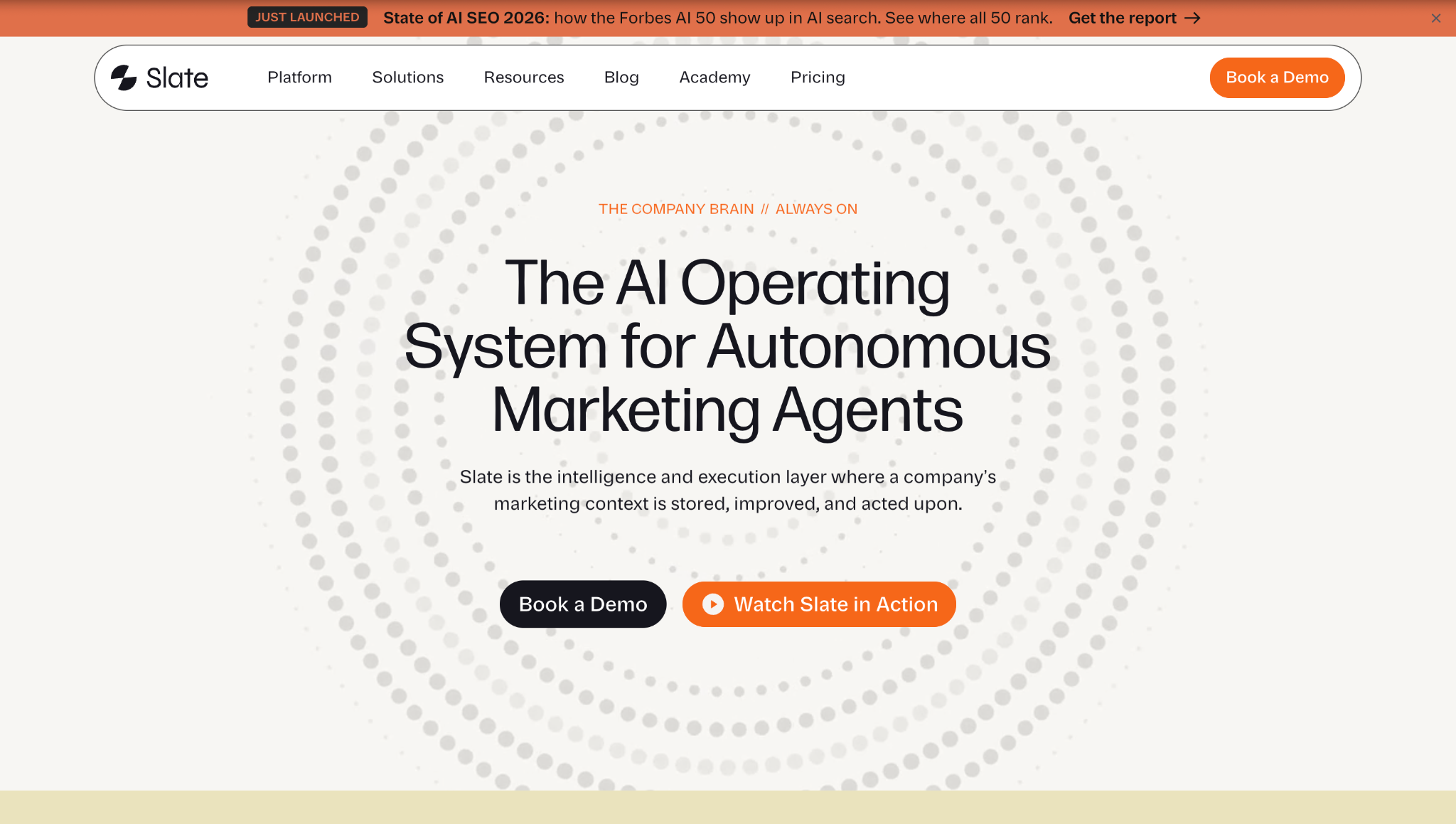
Slate is an end-to-end, agent-driven content, SEO, and AI search platform. It covers opportunity discovery, content creation, publishing, measurement, and refresh work.
Teams can delegate to Coworker in plain language or build custom agents for repeat tasks.
Core capabilities include a visual workflow builder, Power Sheets for bulk URL work, native Ahrefs and Semrush access, direct Webflow and WordPress publishing, AI visibility analytics across six major AI platforms, unified GSC and GA4 data in Pages, Opportunities for gap detection, and Outreach for link and brand-mention work.
Best for: SEO leaders, content operations teams, and organic-growth marketers adapting to AI-driven discovery.
Pricing: Starting at $499/month. For current pricing and packaging, defer to the provided BrandKit.
G2 rating: 4.9/5
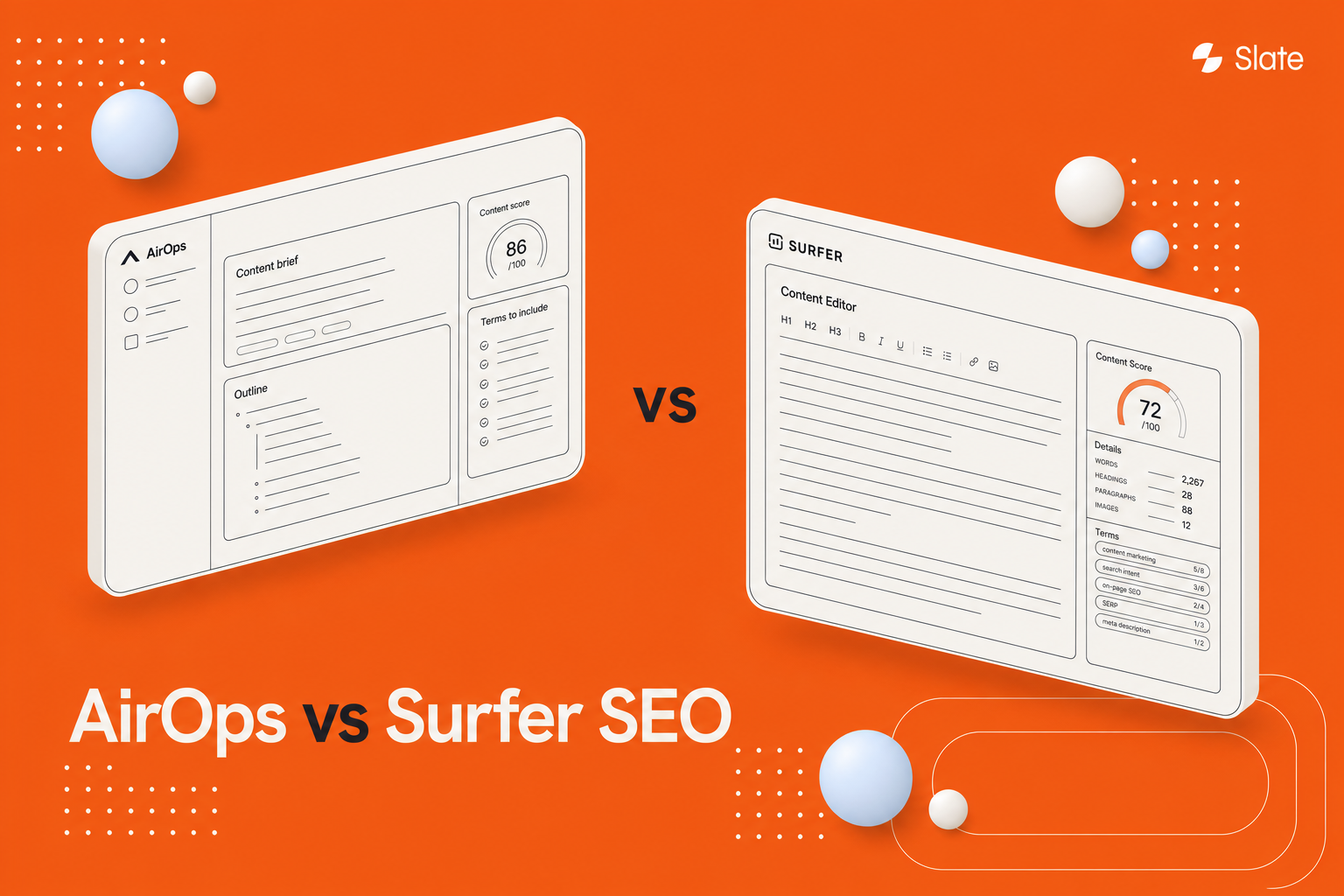
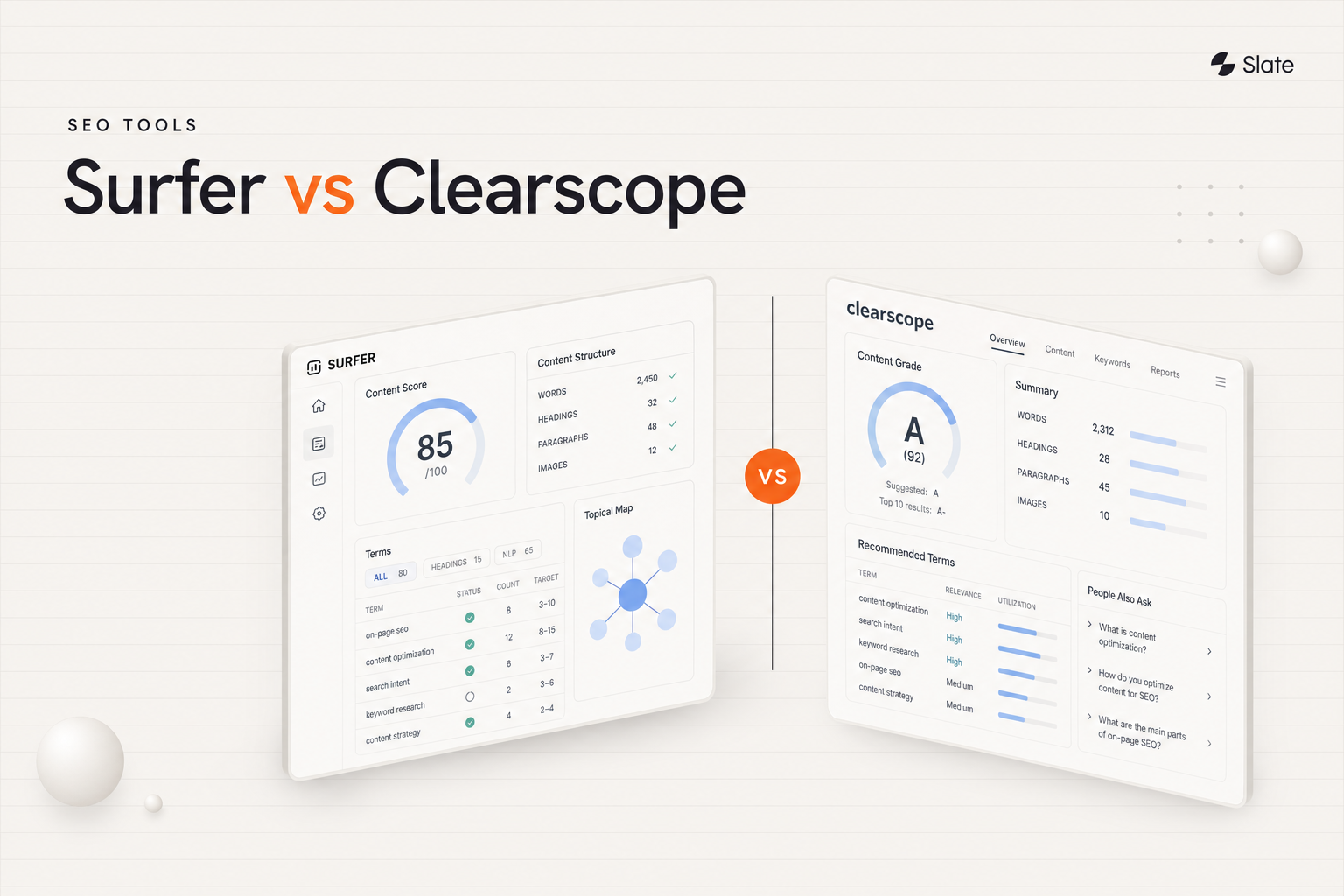
2. Surfer

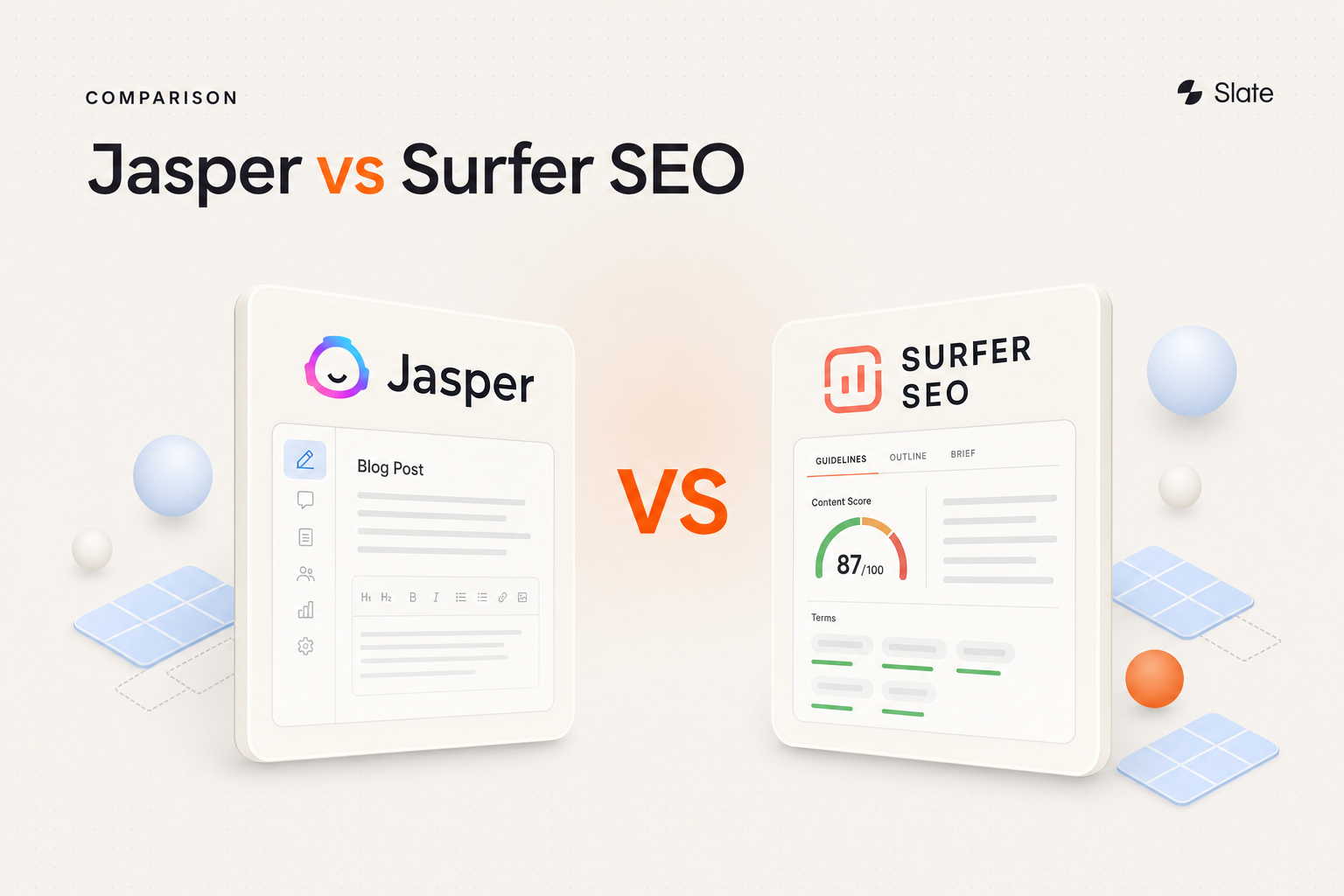
Surfer focuses on on-page SEO tuning. It gives writers guidance on structure, terms, and readability while they work on a draft.
Best for: Writers and editors improving individual pages for search.
3. Jasper AI
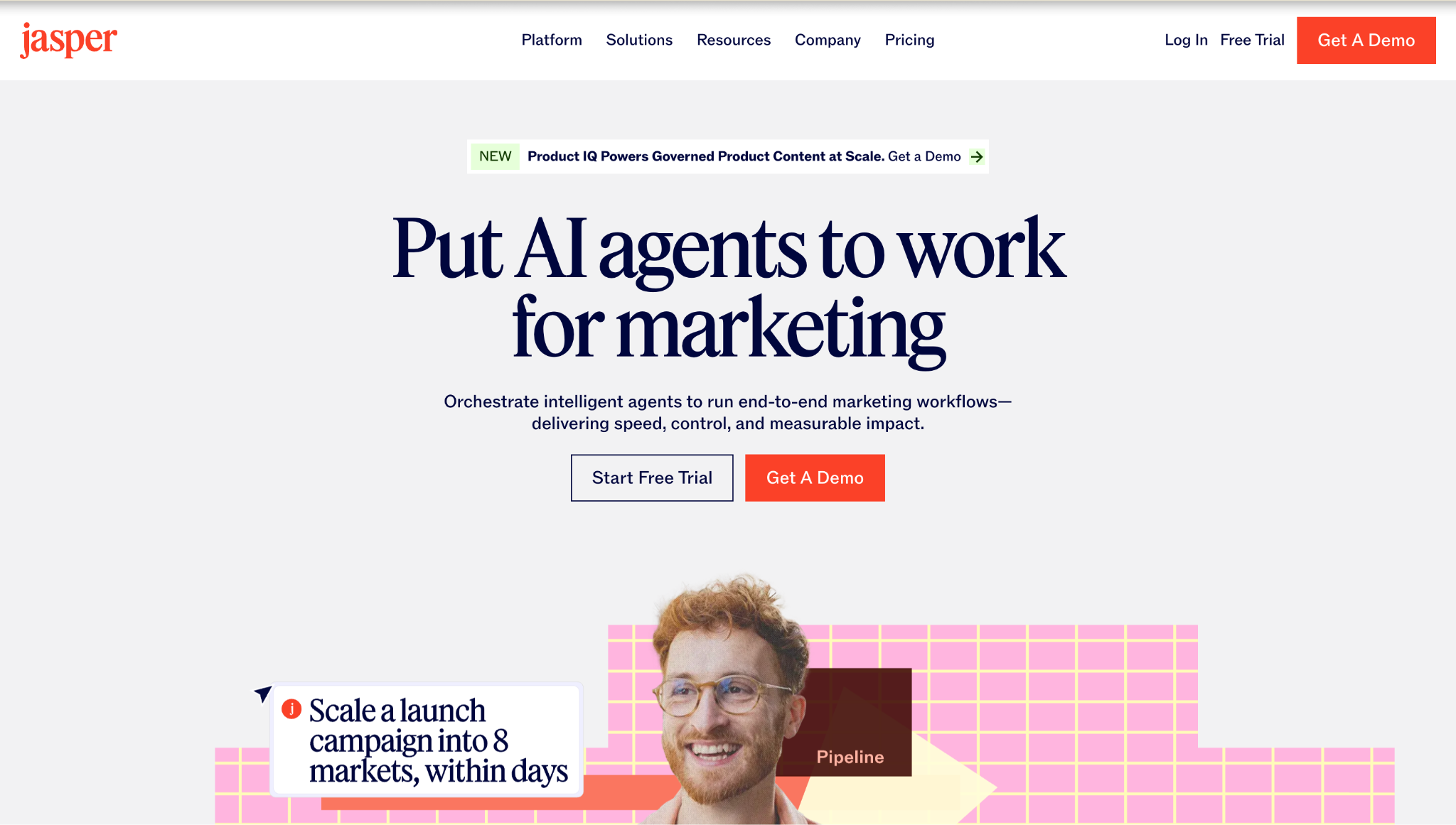
Jasper AI is a marketing AI writing platform for campaign copy, blog drafts, and brand-aligned variations.
Best for: Marketing teams producing drafts and campaign copy at volume.
4. Writesonic
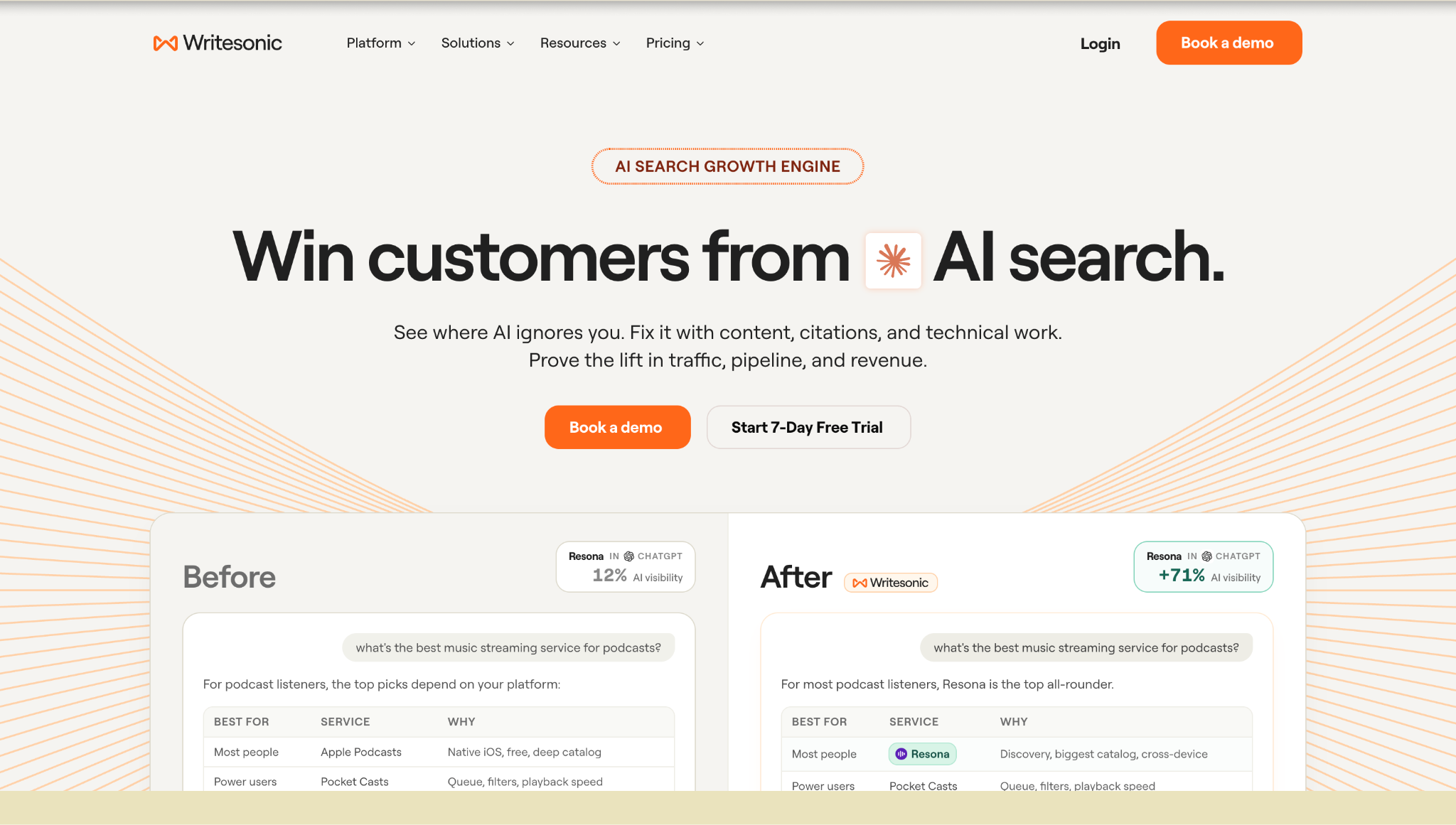
Writesonic creates AI-generated content across formats, including articles, landing pages, and ads.
Best for: Small teams that need fast drafting across content types.
5. Profound

Profound focuses on AI search visibility and answer-engine monitoring. It helps brands see how they appear inside AI-generated answers.
Best for: Teams tracking brand visibility across AI answer engines.
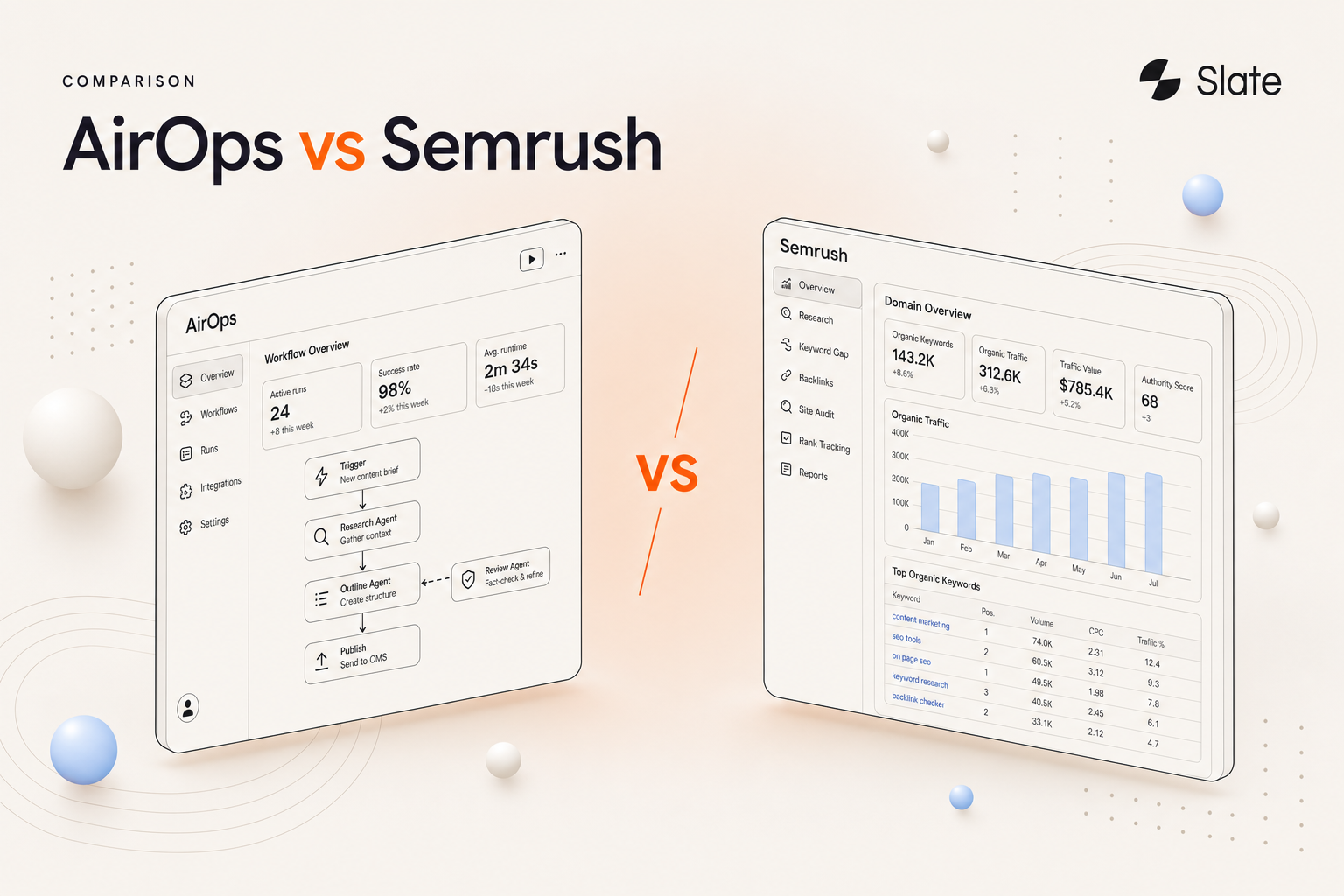
6. Airops
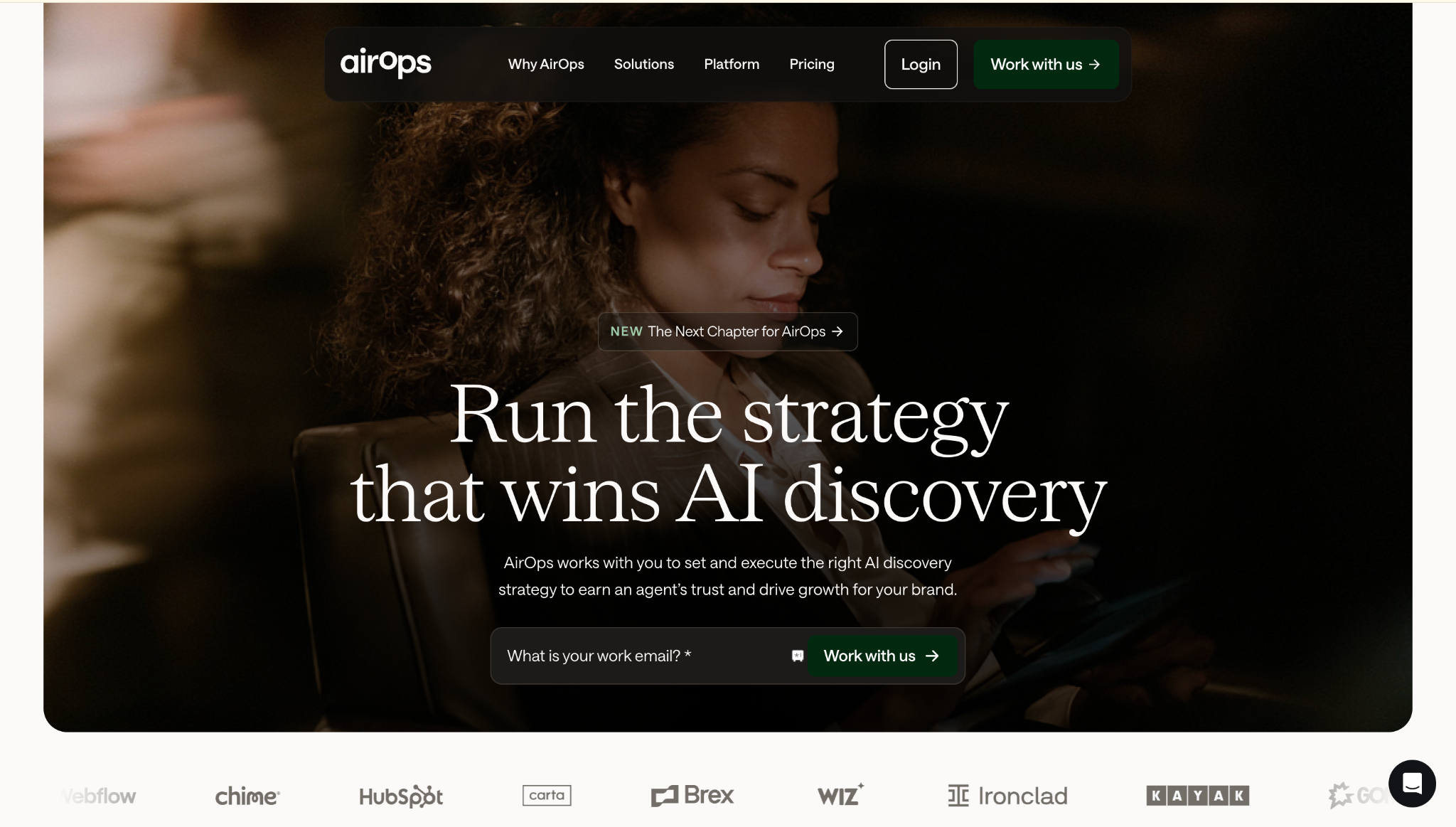
Airops helps teams build AI-powered content workflows and automations for production at scale.
Best for: Teams building custom AI content workflows.
For deeper page tuning, explore the SEO and AEO content optimization agent and this guide to AI content optimization strategies.
Common Mistakes That Make AI Content Strategies Fail
The same failures show up again and again.
- Generic drafts. Thin briefs produce bland output. Put positioning, examples, and angle into the brief.
- Hallucinated or stale facts. Use approved sources and require human fact-checking before publication.
- Weak conversion paths. Assign a CTA and funnel stage to every asset.
- Brand voice drift. Use style rules, knowledge inputs, and human tone review.
- Tool sprawl. Connect research, creation, publishing, measurement, and refresh work.
- Publishing without QA. Keep review checkpoints mandatory.
- Overproducing net-new content. Run refresh decisions every cycle so decaying winners don’t sit untouched.
Governance ties the system together: approval workflows, source policies, QA standards, brand controls, and traceability for AI-assisted assets. For more on that layer, see this roundup of AI content governance tools.
Ready to run the loop in one place? Book a demo: https://slatehq.com/book-a-demo
Frequently Asked Questions
What Is an AI Content Strategy?
An AI content strategy is a system for using AI across research, planning, creation, SEO, distribution, measurement, and refresh work, with human oversight built in.
It combines automation with editorial judgment so teams can scale output, improve search and AI visibility, and stay conversion-focused.
How Can AI Help With Content Planning?
AI can analyze search demand, audience questions, competitor coverage, and performance data. Then it can turn that research into topic clusters, briefs, and editorial calendars. Humans approve priorities, positioning, and business fit.
Can AI Create a Full Content Marketing Strategy?
AI can assist with research, ideation, clustering, briefs, SEO, and reporting. Humans set goals, define positioning, approve messaging, validate facts, and choose which opportunities support revenue.
What Are the Best AI Tools for Content Strategy?
It depends on the job. Some tools focus on drafting. Others handle SEO analysis, brief creation, publishing, AI visibility tracking, refresh work, or workflow automation. The strongest setup connects strategy decisions to execution and reporting.
How Do You Use AI for SEO Content Improvement?
Use AI to refine structure and readability, find missing subtopics, match search intent, strengthen internal links, and spot refresh opportunities. Human review keeps the page accurate, differentiated, and on-brand.
How Do You Measure Whether Your AI Content Strategy Is Working?
Track production efficiency, rankings, organic traffic, engagement, conversions, refresh lift, and visibility in AI-generated answers. A strong scorecard covers Google, AI answers, and revenue outcomes.
How Is AI Content Strategy Different for SEO Teams, Content Ops, and Growth Marketers?
SEO leads usually care most about rankings, citations, and technical signals. Content ops teams care about workflow, governance, ownership, and throughput. Growth marketers care about conversion paths, pipeline, and revenue. A shared system connects all of that work in one loop.
How Do You Maintain Brand Voice Across AI-Assisted Content?
Put brand-voice rules into the brief. Use approved examples, style rules, source policies, and human tone review before publishing. QA catches drift before it becomes a pattern.