Your content team probably isn’t comparing AirOps and MarketMuse for fun. Something is stuck.
Maybe strategy takes too long. Maybe briefs come out thin. Maybe drafts pile up in spreadsheets. Maybe nobody can tell whether ChatGPT, Perplexity, or Google AI Overviews cite your brand.
That’s the split.
MarketMuse is stronger for topic modeling, authority planning, and briefs. AirOps is stronger for AI-search visibility, workflow automation, refresh, bulk work, and publishing. You can also compare the broader field of best AI SEO tools before you commit.
They overlap, but they rarely replace each other one for one.
Key Takeaways
- AirOps fits teams that need AI-search visibility, workflow automation, refresh workflows, and publishing support.
- MarketMuse fits teams that need topic modeling, content briefs, authority planning, and content scoring.
- AirOps pricing starts with a free Insights plan, then moves into Solo, Pro, and Enterprise tiers with task-based usage.
- MarketMuse has a free single-user plan, plus Optimize, Research, and Strategy tiers without public dollar pricing.
- Your bottleneck decides the tool: planning depth points to MarketMuse, while execution volume points to AirOps.
- AI-search visibility now belongs in the buying process, especially for teams tracking citations and share of voice across answer engines.
- Slate is the pick when you want opportunity discovery, creation, publishing, reporting, and refresh in one agent-led platform.
AirOps vs MarketMuse At A Glance
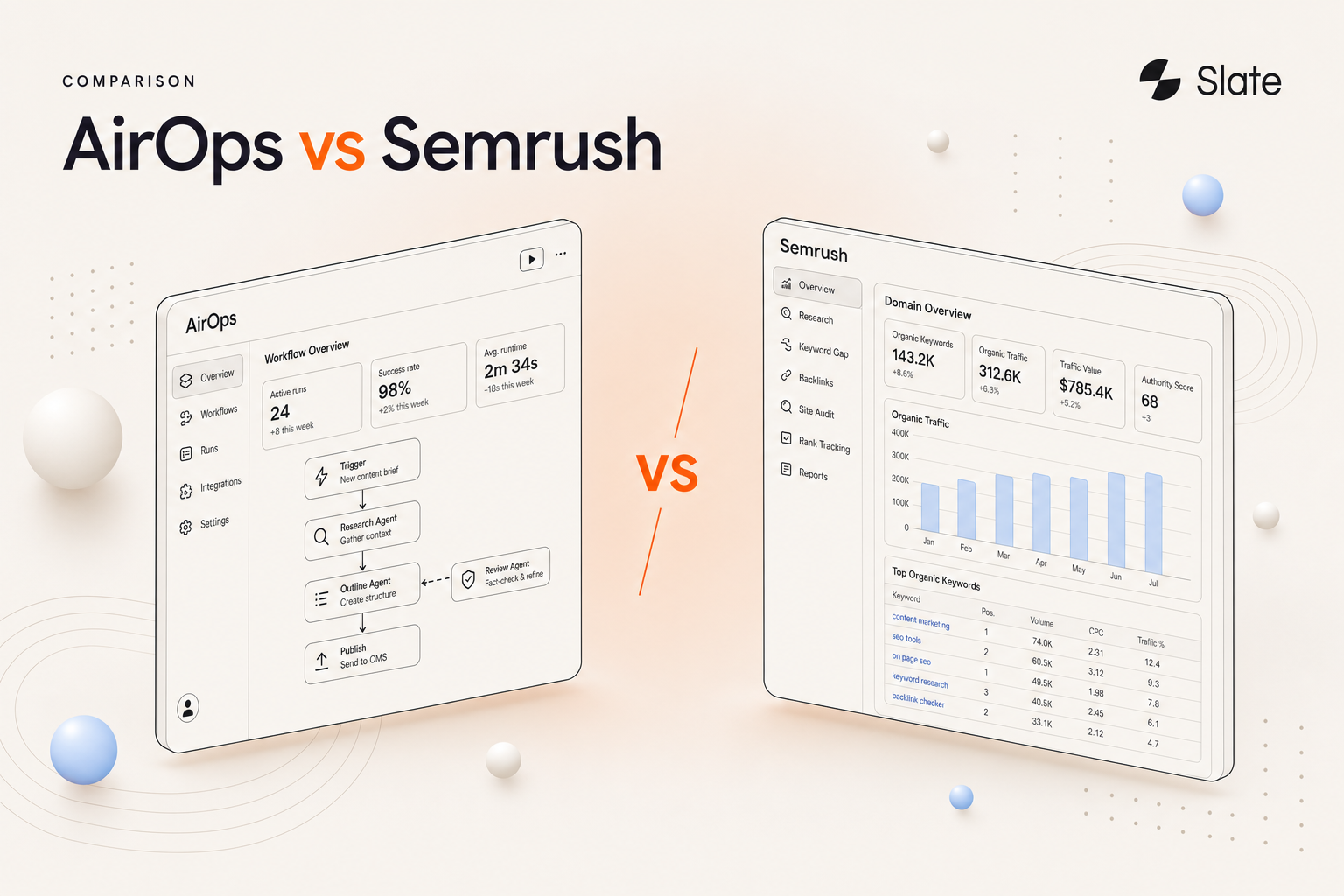
AirOps is an AI-search growth platform built for visibility tracking, content workflows, and publishing at volume.
MarketMuse is a content strategy platform built for topic modeling, content plans, and brief generation.
That difference matters when you’re buying. One tool helps you decide what to create. The other helps you get the work through production and back into measurement.
What Is AirOps?
AirOps is a growth platform for AI search and answer-engine optimization. It helps teams measure visibility, prioritize content work, and move pages through production.
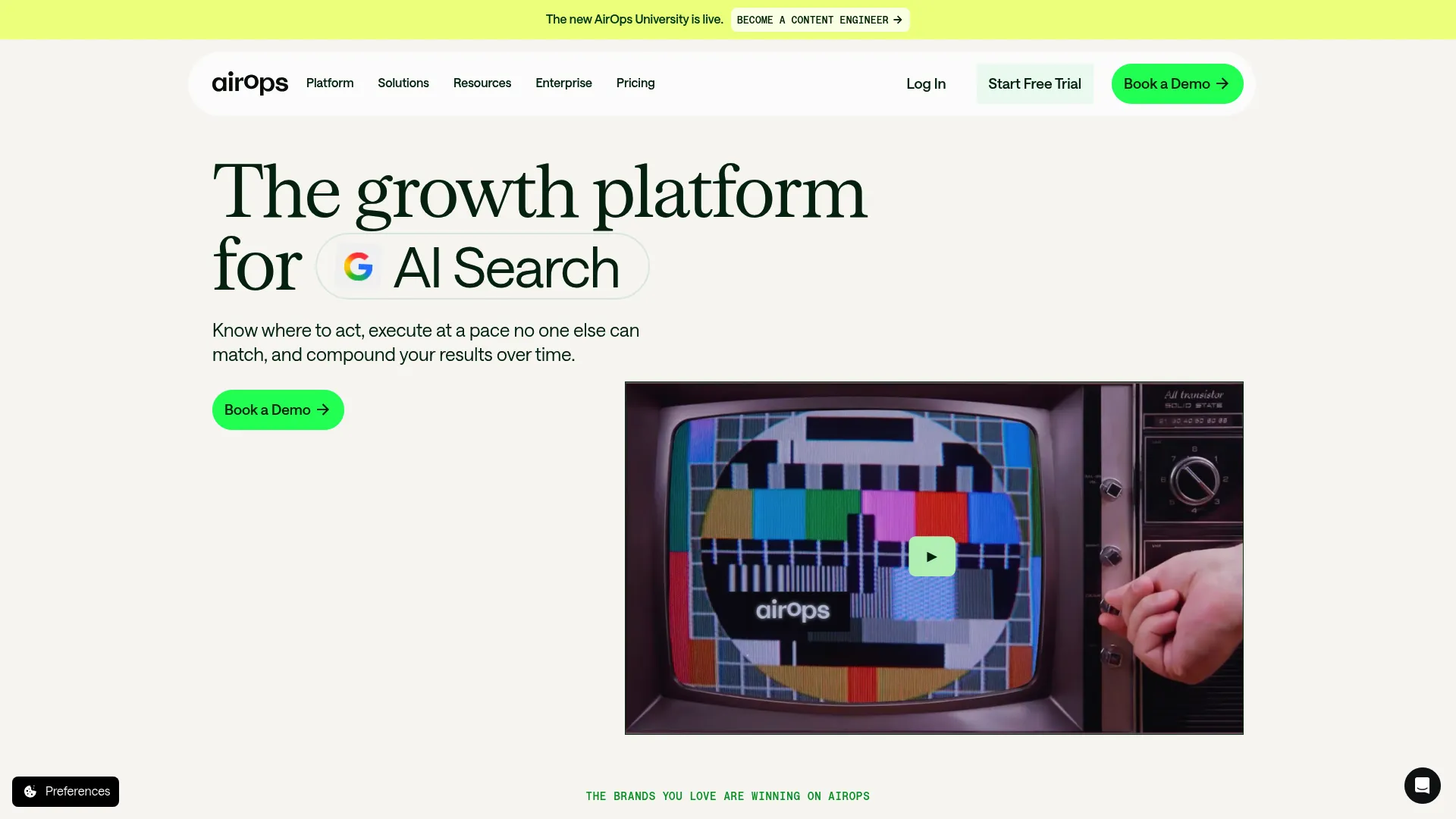
AirOps sits closer to the doing layer. It’s built for teams that already have a content engine and want fewer handoffs, faster refresh cycles, and better AI-search tracking.
- AI-search visibility with citation tracking, competitor intelligence, and share of voice.
- Content refresh and creation workflows.
- Brand governance through Quill, brand kits, and knowledge bases.
- Multi-engine AI visibility on higher tiers, with ChatGPT-only coverage on entry plans.
- Integrations for publishing and workflow handoff.
Best for: Teams focused on execution, refresh, and AI-search content operations.
AirOps Pros And Cons
Pros: AirOps is strong on workflow automation, bulk work, AI-search visibility tracking, and publishing handoffs. It works best when your strategy is already set and your team needs to run faster.
Cons: Task-based pricing can climb as volume grows. Lower tiers also limit AI-engine coverage. Teams that need deep topic modeling may want a dedicated planning tool beside it.
See best AirOps alternatives for nearby options.
G2 rating: 4.6/5
What Is MarketMuse?
MarketMuse is AI content planning and scoring software. It helps teams research topics, build plans, create briefs, and improve existing pages. If you want the full write-up, read our MarketMuse review.
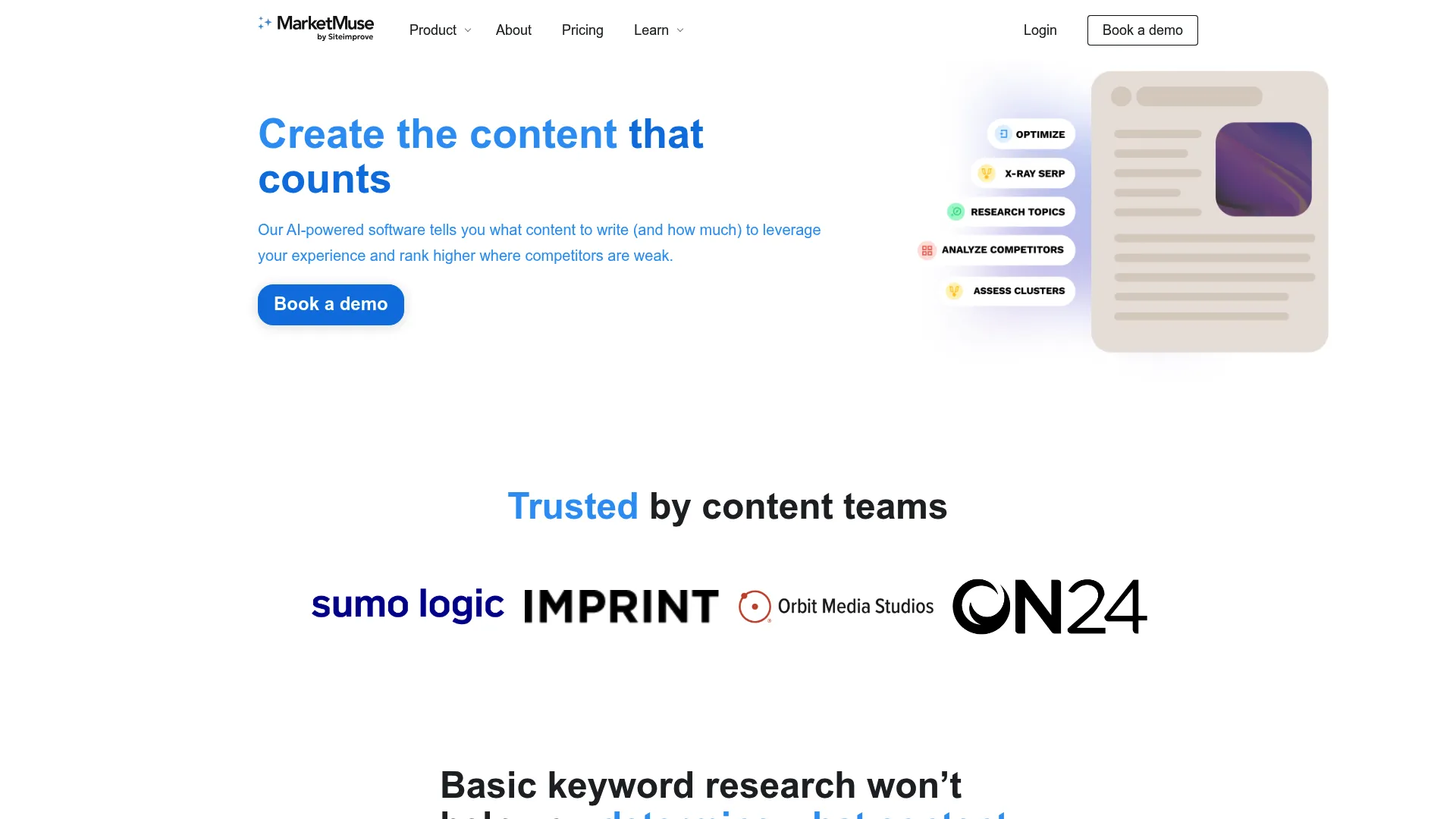
MarketMuse earns its keep before production starts. Strategists use it to map a topic surface, find gaps, and give writers a tighter brief than “please cover this keyword” (a haunted sentence).
- Content planning with topic, SERP, and competitive gap analysis.
- Brief generation with multiple brief types and writer guidance.
- Content scoring based on topic models.
- Research workflows for topical authority planning.
- Writing support tied to briefs and scoring.
Best for: Strategists who care about topic authority and brief quality.
See content brief generators for related tools.
MarketMuse Pros And Cons
Pros: MarketMuse has deep topic modeling, structured briefs, and scoring that gives strategists a defensible plan. It’s strongest before the first draft.
Cons: Paid-tier dollar pricing isn’t public, which makes budgeting annoying. Execution, bulk publishing, and AI-search visibility tracking are lighter than AirOps.
G2 rating: 4.6/5
AirOps vs MarketMuse: Feature-By-Feature Comparison
The buying decision usually gets made here, because the tools split fast once you look past the homepage copy.
Content Briefs
MarketMuse is the better brief tool.
Its briefs come from topic models and competitive gap analysis, so writers get structured guidance on what to cover and where the gaps are. AirOps can generate briefs through workflows, which helps when you need consistency across a lot of pages.
Use MarketMuse when the brief itself needs depth. Use AirOps when the brief needs to feed a larger production line.
Verdict: MarketMuse for brief depth. AirOps for brief throughput.
On-Page Scoring And Content Improvement
MarketMuse scores pages against topic models. That gives writers and editors a clear target for coverage.
AirOps handles content improvement through workflows, which works better when you’re processing many URLs at once. Think refresh queues, content updates, and page-level changes across a large site. For deeper coverage, browse the best content optimization tools.
Verdict: MarketMuse for single-page depth. AirOps for bulk improvement.
Topic Modeling And Topical Authority
MarketMuse owns this category.
Topic modeling and gap analysis are the main reasons strategists buy it. AirOps has visibility and opportunity signals, but topic modeling isn’t its center of gravity.
If your growth plan depends on building authority across a topic cluster, MarketMuse gives you the cleaner planning layer.
Verdict: MarketMuse for topical authority planning.
AI Writing And Content Production
AirOps pulls ahead in production.
Its workflows help teams generate, refine, and prepare content with brand controls through Quill and knowledge bases. MarketMuse supports writing through briefs and scoring, but it’s built closer to the planning desk than the production floor.
The useful test is editing time. If AirOps reduces repetitive production work across 50 pages, that’s the value.
Verdict: AirOps for production volume. MarketMuse for brief-led writing quality.
Workflow Automation And Bulk Operations
AirOps treats content like a pipeline. Research, drafting, scoring, publishing handoff, and refresh can all sit inside repeatable workflows. Teams often pair it with other content automation tools to close the gaps.
MarketMuse is planning-heavy. It gives you the map, then your team usually carries the work into other systems.
For content ops teams juggling dozens of pages, AirOps saves more coordinator hours.
Verdict: AirOps for automation and bulk work.
Integrations And Publishing
AirOps sits closer to publishing. Its integrations support workflow execution and downstream handoff.
MarketMuse fits teams that hand off briefs and plans into a separate production process. That setup works fine if your writers, editors, and CMS already have a clean process.
For teams comparing AirOps integrations vs MarketMuse, the difference is where the tool stops.
Verdict: AirOps for publishing-oriented workflows. MarketMuse for planning handoff.
AI Search Visibility Tracking
AirOps has the stronger AI-search visibility layer.
It tracks citations, share of voice, and competitor presence in AI answers. Pro adds multi-engine coverage, while entry tiers focus on ChatGPT.
MarketMuse is built around content strategy and topic depth. If you need citation tracking across AI engines, AirOps is the better fit. It also helps to review dedicated AI citation tracking tools when this is your priority.
Verdict: AirOps for AI-search visibility.
Reporting, Measurement, And Refresh
AirOps supports post-publish tracking and refresh workflows. That helps when you need to know which pages are fading and which pages deserve another pass. Compare the leading content refresh tools to see what fits.
MarketMuse measurement lives closer to research and scoring. It helps you plan and improve content, then your analytics stack carries more of the post-publish load.
Verdict: AirOps for refresh and post-publish measurement.
AirOps vs MarketMuse Pricing Compared
AirOps starts free with its Insights tier, then moves into Solo at around $200/month, Pro, and custom Enterprise plans. Usage is task-based, so volume can change the bill.
MarketMuse has a free single-user plan, plus Optimize, Research, and Strategy tiers. Paid-tier dollar prices aren’t public.
Pricing In Practice: Which Model Fits Your Team
Headline pricing gets fuzzy once the content program grows.
- MarketMuse value ties to user access, research usage, and brief quality.
- AirOps value ties to task volume, workflow execution, visibility tracking, and refresh work.
- AirOps can get pricier as task volume grows.
- MarketMuse requires direct contact for paid-tier budgeting.
Compare the full breakdown at AirOps pricing vs MarketMuse.
Does AirOps Replace MarketMuse?
AirOps can replace MarketMuse for teams that already know what they want to create and need faster execution, refresh, and AI-search visibility.
MarketMuse still wins when brief quality and topical authority modeling drive the program.
A common setup is simple: strategists build topic plans in MarketMuse, then content ops runs execution in AirOps. Larger teams may outgrow that split and look for one system that covers the whole loop.
For more detail, see does AirOps replace MarketMuse? and AirOps alternative to MarketMuse.
Which Tool Should You Choose?
Pick based on the bottleneck your team feels every week.
Best For Solo Strategists And Small Teams
Solo strategists who live in research and briefs will probably get more from MarketMuse. Its free single-user plan and topic modeling fit slower, more deliberate planning work.
Small teams already producing content at volume should look harder at AirOps. The Solo tier gives them a cleaner way to run repeatable work.
Best For Content Operations Teams
Content ops teams should favor AirOps.
The reason is simple: workflow automation and bulk work cut coordinator drag. If your team runs refresh queues, content updates, and publishing handoffs every week, AirOps fits the job. It pairs well with the best AI tools for content operations already in your stack.
Best For Agencies
Agencies often need both layers.
MarketMuse helps with strategy decks and briefs. AirOps helps with delivery across client accounts, especially when the same workflow repeats across many sites.
The lead tool depends on what the agency sells: strategy or execution.
Best For Enterprise Editorial Ops
Enterprise editorial teams need governance, volume, and measurement in the same operating rhythm.
AirOps handles execution and visibility at scale. MarketMuse supports authority planning. Larger programs often need a bigger system around both.
See AirOps vs MarketMuse for enterprise.
Best For Large-Scale Refresh Programs
Refresh-heavy programs should lean toward AirOps.
Finding decaying pages, updating them in batches, and tracking visibility after publish fits AirOps better than MarketMuse.
The 2026 Lens: Evaluating SEO Tools In The AI-Search Era
Search has moved beyond blue links. When someone asks ChatGPT or Perplexity a question and gets a synthesized answer with citations, your team needs to know whether your brand appears there.
Old SEO tooling focused on scoring a page before publish. Newer buying criteria include citation tracking, repeatable workflows, AI-answer visibility, publishing handoffs, and proof after the page goes live. This is where generative engine optimization tools are starting to matter.
That’s why the planning-versus-execution split only gets you partway. Many teams want the loop closed.
Why Slate Covers The Full Loop AirOps And MarketMuse Split Between Them
Slate covers the whole content loop: opportunity discovery, content creation, publishing, measurement, outreach, and refresh.
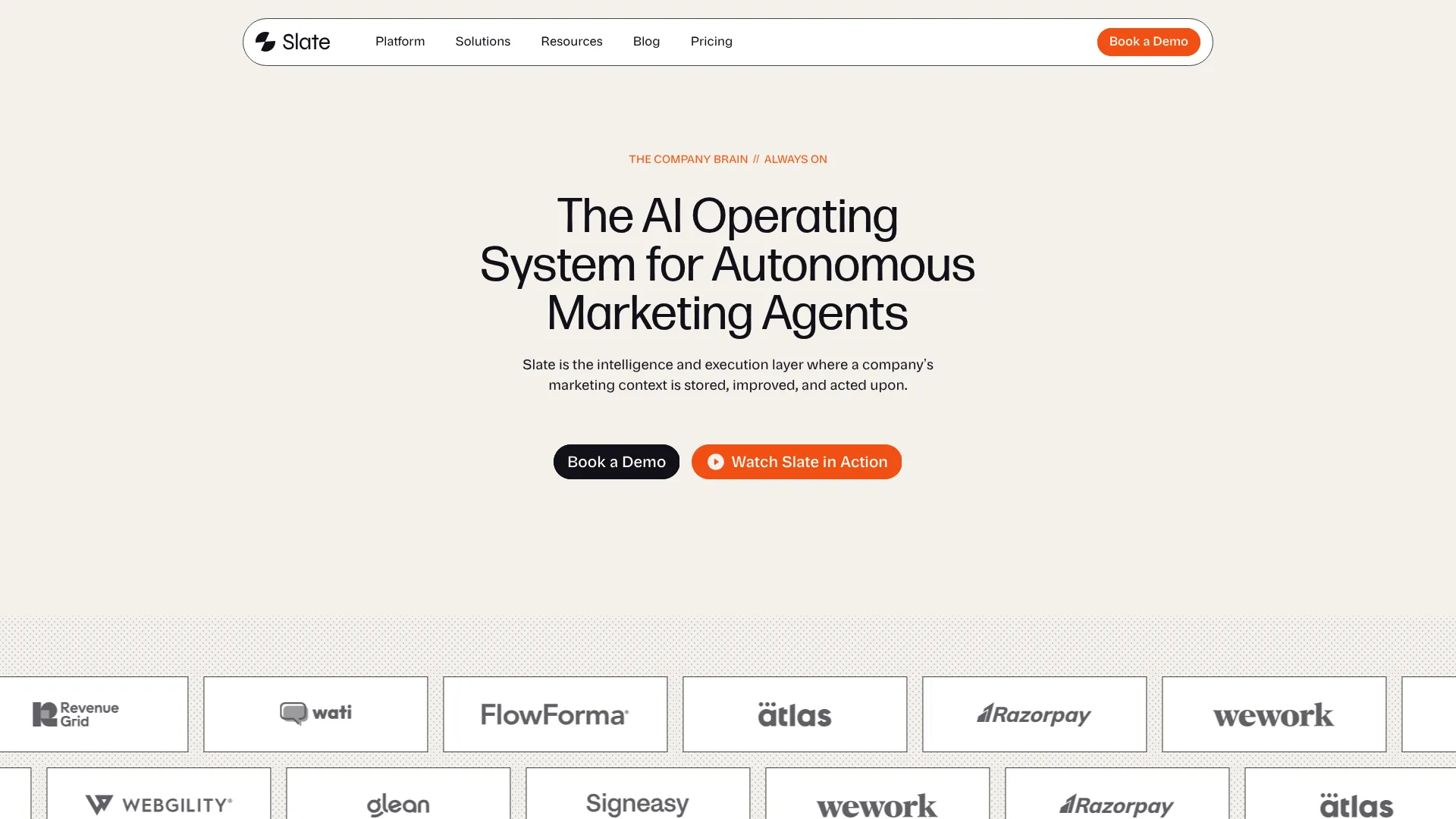
Marketers can hand work to Slate’s Coworker in plain language, or build custom autonomous agents for repeatable SEO and content tasks. No engineer required.
- AI visibility analytics across six major AI platforms, including sentiment, brand mentions, prompt answers, and keyword tracking.
- Native Ahrefs and Semrush access, plus direct publishing to Webflow and WordPress.
- Pages unifies Google Search Console and GA4 for clicks, traffic, CTR, and citation monitoring.
- Opportunities surfaces gaps across content, citations, rankings, and social.
- Outreach handles link and mention discovery.
Pricing: Starting at $499/month.
Free trial, Enterprise, and Agency plans are available.
G2 rating: 4.9/5
Book a demo: https://slatehq.com/book-a-demo
Compare directly at Slate vs MarketMuse.
Final Verdict: AirOps vs MarketMuse
Pick MarketMuse if your team is stuck on topic strategy, briefs, and authority planning.
Pick AirOps if your team is stuck on execution, refresh, publishing handoffs, and AI-search visibility.
MarketMuse’s paid pricing being unlisted makes budgeting harder. AirOps’ task-based pricing can climb with volume, and entry tiers limit AI-engine coverage.
For teams that want AI-search visibility, content production, publishing, reporting, and refresh handled by agents in one place, Slate is the clearest pick.
Book a demo: https://slatehq.com/book-a-demo
Frequently Asked Questions
What Is The Difference Between AirOps And MarketMuse?
AirOps is execution-oriented. It helps with AI-search visibility, workflow automation, bulk operations, publishing, and refresh.
MarketMuse is strategy-oriented. It helps with topic modeling, content planning, briefs, and scoring.
Is AirOps Better Than MarketMuse For SEO Content?
It depends on your bottleneck.
AirOps is better for execution speed, bulk work, refresh, and AI-search visibility. MarketMuse is better for topic modeling, authority planning, and brief quality.
Which Tool Is Better For Content Briefs: AirOps Or MarketMuse?
MarketMuse is stronger for briefs.
Its briefs come from topic models and competitive gap analysis, so they give writers better coverage guidance. AirOps briefs work better when you need speed and consistency across many pages.
Does AirOps Replace MarketMuse?
AirOps can replace MarketMuse when your team mostly needs execution, refresh, and visibility tracking.
MarketMuse remains the better choice when brief quality and topical authority planning drive the program. Some teams use MarketMuse for planning and AirOps for production.
How Do AirOps And MarketMuse Compare On Pricing?
AirOps starts free with Insights, then moves into Solo at around $200/month, Pro, and custom Enterprise tiers with task-based usage.
MarketMuse has a free single-user plan, plus Optimize, Research, and Strategy tiers without public dollar pricing.
Compare by usage pattern, because the billing models are different.
MarketMuse vs SurferSEO vs AirOps: Which Is Best?
MarketMuse is best for topic strategy and briefs. Surfer is best for page scoring. AirOps is best for workflow automation and AI-search visibility.
See MarketMuse vs SurferSEO vs AirOps.
Which Is Better For Smaller Teams?
Strategy-focused solo users should start with MarketMuse.
Small teams already producing at volume should look at AirOps, especially if refresh and repeatable workflows are the bottleneck.
Does AI-Search Visibility Tracking Matter In 2026?
Yes.
AI engines now synthesize answers and cite sources directly. Citation rate, mention rate, and share of voice belong beside classic SEO metrics.